150+ minds across 4 countries. Join a culture of innovation, ownership & growth.
Rewire for AI
From machine learning to deep learning, from classification tools to overall process automation – our AI engineers will help you retool your existing system or enhance your company results.
Ship faster, scale smarter, built for product companies and SaaS teams
Our Latest Work
We strive hard to deliver result-driven digital solutions across the globe. Check out our case studies to get a glimpse of how we ideate, innovate, and create unconventional digital solutions according to the requirements of our clients.
Discover diverse and passionate insights from our tech enthusiasts. We collaborate across various sectors to streamline operations and drive innovation. Explore our rapidly growing collection of articles to see why we’re at the forefront of IT solutions.
The decision to move from Magento to Shopify is one of the most significant replatforming choices an ecommerce business can make. Magento is powerful, but its power comes with...
Accuracy gap is real: Traditional CPG forecasting carries a 25-40% MAPE error rate. AI-powered models bring that down to 8-15%, according to McKinsey research....
Real stories from global leaders who trusted us with their ideas.
Partnering with APPWRK helped us build a compliant and scalable healthcare platform, accelerating our time-to-market by 35%. Their team consistently delivered outstanding work.
Beesers
Digital Healthcare Client
Collaborating with APPWRK, Sportskeeda modernized its platform into a real-time sports engagement ecosystem, enabling seamless content delivery, scalable fan interactions, and high-velocity performance.
Sportskeeda
Sports & Entertainment Partner
Working with APPWRK was effortless. They captured our vision, maintained full compliance, and delivered a digital experience that built trust and elevated how customers interact with our fintech brand.
PayPenny
Fintech Partner
Working with APPWRK gave us confidence in adopting AI responsibly. Their team built a safe, intelligent bot that transformed how we engage with leads and helped us achieve measurable revenue growth.
IFB
AI Transformation Partner
Leveraging APPWRK’s digital expertise, Nemesis launched a scalable, compliant, and safe super app that connects content delivery, real-time communication, and logistics management within a single platform.
The use cases of blockchain in the supply chain are redefining transparency, operational agility, and trust across logistics networks. From pharmaceuticals to retail, blockchain-enabled systems are transforming supply chain operations by improving how data is shared, contracts are executed, and compliance is maintained across global networks.
The cost of implementing blockchain in supply chain operations starts at $15,000 for pilots and can go beyond $120,000 for global, multi-node integrations.
Real-time supply chain visibility solutions powered by blockchain infrastructure, including IoT and smart containers, are revolutionizing cold chain tracking and predictive shipment accuracy.
Smart contracts enhance supplier collaboration and streamline payments by automating workflows, reducing reliance on intermediaries, and accelerating invoice clearance.
Blockchain helps businesses save money by reducing reconciliation costs by up to 70% and lowering the risk of fraud. This leads to real, measurable returns in areas like logistics, finance, and compliance.
Walmart uses blockchain to track the origin of products like mangoes and pork, cutting the trace time from 7 days to just 2.2 seconds. This showcases how blockchain can greatly improve transparency and ensure food safety across the supply chain.
This blog covers blockchain's strategic role in modern supply chains, helping CTOs, supply chain heads, compliance teams, and investors make decisions backed by transparency, real-world use cases, and ROI-focused insights.
Global Market Overview and Expansion
As global supply chains grow more complex, blockchain is becoming a key driver of enterprise transformation. Businesses worldwide are adopting it to build trust, automate processes, and achieve full traceability across every stage of the supply network.
The Role of Blockchain in Modern Supply Chains
Blockchain acts as a distributed trust layer, enabling real-time validation of inventory, movement, and compliance data across multi-party ecosystems. Its immutable records eliminate reconciliation delays and enable synchronized visibility across all stakeholders.
McKinsey projects a 45% efficiency improvement in digital supply chain transformation using blockchain-led processes, particularly in pharma, retail, and automotive sectors.
Global Adoption Trends Across Industries
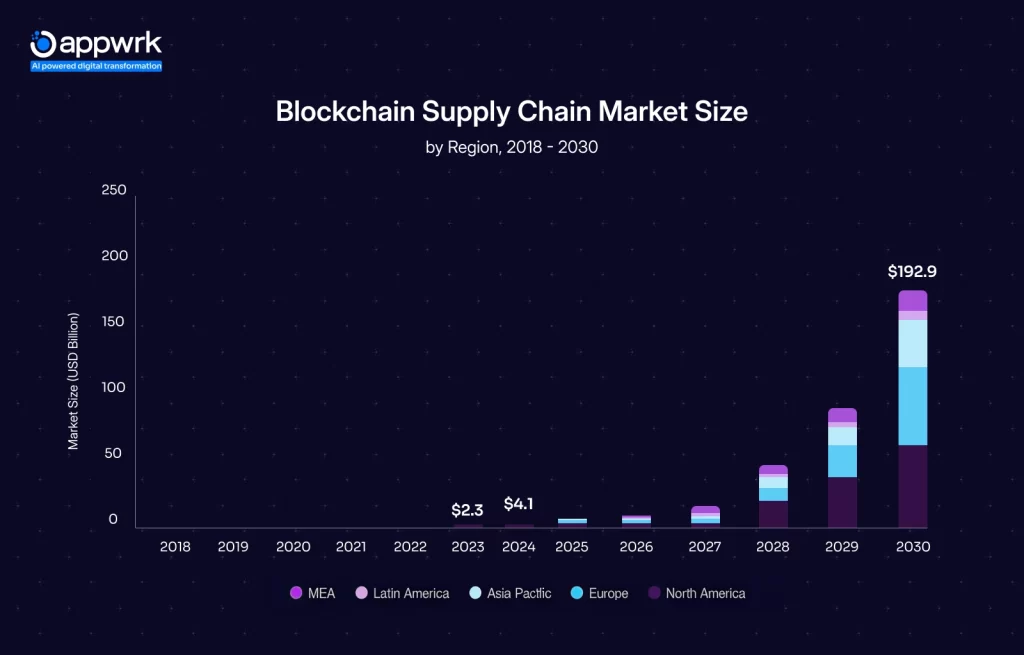
The blockchain supply chain market is expected to reach $192.93 billion by 2030, growing at a CAGR of 88.8% from 2024 to 2030. Furthermore, blockchain use cases are expanding rapidly, including agri-trade traceability, smart compliance in pharmaceuticals, and counterfeit prevention in the luxury goods sector.
Infosys notes a 60% YoY growth in pilots moving to production systems globally, especially among Tier 1 suppliers integrating with blockchain-powered ERPs.
Investment and Innovation Highlights
Major VC-backed startups like Everledger, Chronicled, and VeChain have secured multi-million dollar rounds to support blockchain deployment in logistics, food traceability, and pharma authentication. Governments in the UAE, Singapore, and the EU are also driving pilot funding.
How Blockchain Improves Supply Chain Operations: Key Benefits and Real-World Use Cases
Blockchain technology is transforming supply chain operations by enhancing transparency, traceability, and operational efficiency. From preventing counterfeits to streamlining audits and automating payments, the use cases and benefits mentioned below demonstrate how blockchain adds trust and value across every supply chain layer.
Healthy Customer Relationships: Building Trust Through Provenance and Accountability
Blockchain in supply chain management helps build customer trust by showing exactly where a product comes from and how it moves through the supply chain. When consumers scan a product, they can see verified information about its origin, safety checks, and delivery history.
This transparency builds confidence and holds all parties accountable, especially in industries like luxury goods, food, and pharmaceuticals.
Strengthened Traceability: Securing Product Provenance with Immutable Records
It goes without saying that reliable traceability is essential for a secure and transparent supply chain. Blockchain strengthens this by recording every product movement in real time on an unchangeable digital ledger. This is especially valuable in food safety, where quickly identifying the source and transit path can prevent contamination issues.
It also plays a key role in protecting high-value products from counterfeiting.
Enhanced Security: Protecting Supply Chain Data from Breaches and Manipulation
Using smart contracts and permissioned blockchain architecture, blockchain secures critical supply chain data. The immutable recordkeeping ensures encryption-backed authenticity while reducing the risks of cyber breaches. The result is not only compliance-grade encryption but also robust, secure data management that ensures tamper-resistance and regulatory alignment.
Each transaction in the blockchain-powered supply chain ecosystem is validated and encrypted, protecting sensitive documents and operational logs from manipulation.
Real-Time Tracking and Transparency: Enhancing End-to-End Supply Chain Visibility
Blockchain in supply chain enables real-time tracking across multi-tier supplier visibility networks using decentralized ledger technology (DLT). With immutable ledger entries and tamper-proof data logging, stakeholders gain full supply chain visibility, from manufacturing units to the last-mile delivery. This digital ledger transparency ensures that every touchpoint is auditable, fostering trust and efficiency across the decentralized supply chain ecosystem.
Reduced Costs and Higher ROI: Automating Operations and Reducing Middlemen
Blockchain benefits the supply chain by eliminating intermediaries through smart contracts. These self-executing protocols reduce paperwork, speed up settlements, and cut overhead costs associated with traditional supplier negotiations. The result: measurable cost reduction and accelerated ROI, especially in payment workflows and invoice reconciliation.
Faster Processing: Accelerating Approvals, Payments, and Audits
Blockchain speeds up supply chain processes by making critical documents and approvals instantly accessible to all parties. This includes customs forms, inspection records, and supplier verifications. By reducing wait times and improving visibility, it supports faster decision-making and keeps inventory moving efficiently through just-in-time operations.
Better Quality Control and Compliance: Automating ESG, Safety, and Regulatory Reporting
Blockchain improves quality control and compliance by automatically recording important data like safety checks, sourcing practices, and environmental impact. Smart contracts help enforce rules and trigger actions, such as inspections or reports, without manual effort. This makes it easier for companies to follow ESG guidelines and prevent counterfeiting, especially in industries with strict regulations.
Sustainable and Energy-Efficient Supply Chains: Blockchain for ESG Tracking and Environmental Audits
Blockchain is becoming a key tool for building greener, more responsible supply chains. It securely records data on energy use, emissions, and sourcing practices through smart sensors, helping companies monitor their environmental impact in real time. This tamper-proof system supports accurate carbon tracking, easier ESG reporting, and stronger compliance with global sustainability standards.
Cybersecurity and Tamper-Proof Data Control: Securing Supply Chains with Immutable Audit Trails
Supply chains face growing risks from ransomware, data breaches, and insider threats. Blockchain enhances security by decentralizing data access and using permissioned blockchain frameworks. This model eliminates single points of failure, ensures immutable recordkeeping, and enforces identity-verified access to mission-critical supply chain events.
Interoperability and Platform Integration: Connecting ERP and SCM Platforms via Blockchain
Modern SCM systems must integrate with blockchain seamlessly to ensure operability across finance, procurement, and logistics nodes. Seamless blockchain ERP integration ensures synchronized data flow between procurement, inventory, and logistics systems, eliminating silos and manual errors. Distributed ledger technology supports interoperability by syncing with ERP, CRM, and IoT endpoints. Integrating IoT sensors with blockchain for warehouse automation improves throughput by validating storage conditions and automating stock movement logs.
Food Safety and Provenance Tracking: Blockchain to Enhance Food Safety Traceability
Blockchain helps improve food safety by tracking each item from the farm to the store. It creates a digital record of key details like temperature, handling, and location. This makes it easier to spot issues, prevent spoilage, and pass food safety inspections with confidence.
Anti-Counterfeiting in High-Value Logistics: Enabling Proof of Authenticity in Luxury Goods and Electronics
Counterfeiting costs industries billions annually. Blockchain combats this by embedding product provenance and digital certificates into each shipment. Every step in the process, including manufacturing, inspection, customs, and delivery, is securely recorded on a tamper-proof blockchain system. This gives both manufacturers and end-users complete visibility and confidence in the product’s journey.
Case Study: Blockchain Deployment for Finance & Risk Automation by APPWRK
APPWRK implemented a blockchain-driven solution to modernize a global supply chain finance platform, enhancing transparency, automating risk scoring, and accelerating payment cycles across complex financial workflows.
Transforming Finance Operations in Global Supply Chains
Problem: Manual Processes, Delayed Settlements, and Unscalable Risk Management
Mesha, a growing fintech platform, faced complex challenges in scaling supplier finance across global markets. Their supply chain finance operations were hindered by fragmented data silos, inconsistent supplier vetting, and payment delays across multiple jurisdictions. Manual approvals, offline audit trails, and risk-prone reconciliation cycles made the system inefficient and opaque.
Solution: Blockchain-Powered Finance Automation Built by APPWRK
APPWRK implemented a custom blockchain module that embedded smart contracts into Mesha’s supply chain finance flow.
Key implementations included:
Smart contracts for auto-approval and disbursement based on invoice verification.
Blockchain-based supplier scoring using delivery performance and compliance history.
Real-time audit trails to reduce regulatory risk and improve data traceability.
Integration with legacy ERP using secure middleware and encrypted API bridges.
Outcome: Faster Payments, Real-Time Risk Visibility, and 100% Audit Clarity
Within 60 days of deployment, Mesha achieved:
2.2x acceleration in supplier payments through automated invoice checks and milestone-based smart contracts.
48% reduction in reconciliation time with on-chain, tamper-proof records.
100% audit coverage across transactions, accessible by finance and compliance teams in real time.
The system now supports cross-border finance with multi-currency smart contracts and continues to scale with supplier risk analytics powered by blockchain data logic.
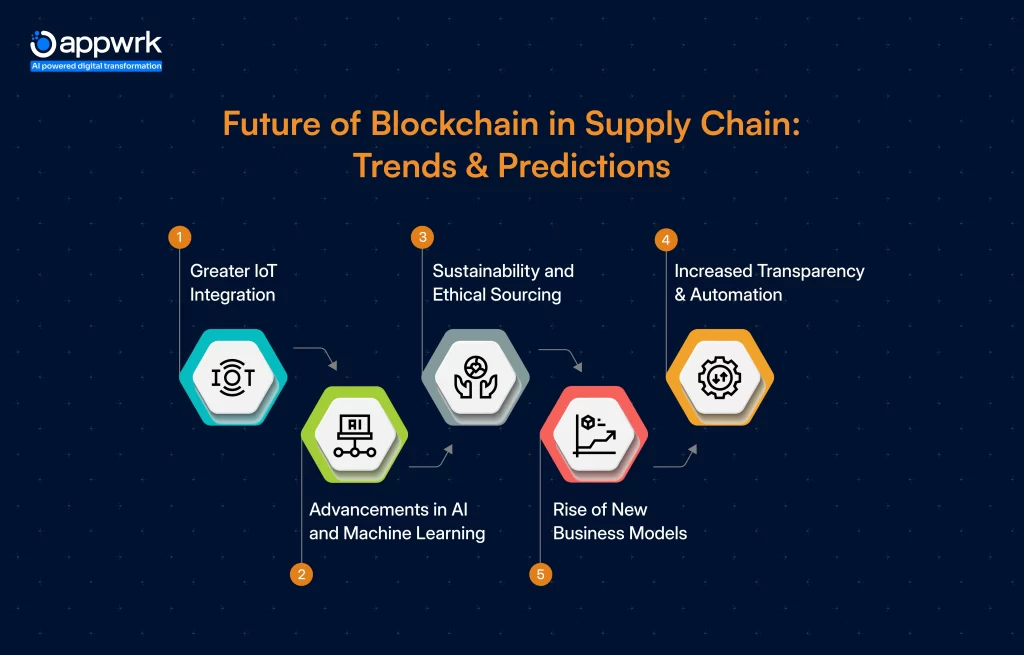
Future of Blockchain in Supply Chain: Trends & Predictions
The future of blockchain in supply chains is headed toward smarter integration with emerging technologies, greater automation, and stronger ESG transparency. These trends are set to redefine global logistics over the next few years.
Greater IoT Integration
Combining IoT and blockchain allows companies to track goods in real time, including their temperature, location, and condition. This creates a seamless connection between physical items and their digital records, improving accuracy and control across the supply chain.
By 2026, 60% of global container shipping is expected to use IoT sensors linked to blockchain for route optimization and compliance logging.
Advancements in AI and Machine Learning
AI will help businesses analyze trusted data stored on the blockchain to predict issues, spot fraud, and adjust pricing in real time.
Machine learning models trained on secure and unchangeable data can make more accurate forecasts and rate suppliers more effectively.
Sustainability and Ethical Sourcing
As environmental and social regulations grow stricter, blockchain will help verify carbon footprints, recyclable materials, and fair labor practices. It will also play a key role in supporting climate reporting and proving that businesses are sourcing materials responsibly.
Major fashion, electronics, and agri brands are already embedding ethical sourcing modules for EU compliance in 2026. Global retailers now use blockchain for ethical sourcing certifications to authenticate labor conditions, fair trade standards, and sustainable material sourcing.
Rise of New Business Models
Decentralized supply chain systems will emerge, where suppliers, buyers, and financiers interact via tokenized contracts.
This includes micro-invoicing, cross-border smart trade, and supplier funding tied to on-chain risk profiles. With tokenized supply chain assets, suppliers and logistics partners can digitize cargo units for real-time tracking, financing, and smart escrow payments.
Increased Transparency and Automation
Smart contracts are expected to automate 70-80% of key operational workflows such as purchase approvals, trade confirmations, shipping validation, and compliance checks. This will not only speed up execution but will also ensure accuracy and accountability at every step.
Blockchain’s role will shift from record-keeping to operational orchestration, especially in multi-region logistics.
Blockchain Adoption by Region: USA, UK, EU & APAC Trends
Different regions are embracing blockchain in supply chains based on their unique business goals and regulatory environments. While Europe focuses on compliance and traceability, the US and Asia-Pacific are leading with innovation-driven pilots and tech-first implementations.
Blockchain Adoption in the USA
The US leads in enterprise-scale blockchain deployment, especially in pharma (DSCSA compliance), food traceability (IBM Food Trust), and defense logistics. Amazon, Walmart, and FedEx have each launched blockchain pilots to streamline freight tracking, verify sourcing, and automate payments.
Supply Chain Innovation in Australia
Australia’s government support for blockchain has sped up its use in agriculture and logistics. A pilot project by the Australian Trade and Investment Commission and VeChain improved cattle export tracking by 38%, especially for shipments to China.
Ports in Brisbane and Melbourne are now testing blockchain with IoT to track and verify containers in real time.
Compliance and Data in the UK
UK-based logistics firms use blockchain primarily for customs compliance and post-Brexit traceability. Regulated industries, notably aerospace and healthcare, have integrated smart contracts to automate cross-border checks.
The FCA’s sandbox environment has also enabled rapid blockchain trials in supply chain finance.
Traceability Advances in Europe
The EU’s Green Deal has made blockchain-powered ESG tracking mandatory for certain industries by 2026. BMW, Carrefour, and Nestlé are running active traceability programs using Hyperledger and Ethereum-based frameworks. Furthermore, blockchain is being used to trace CO2 impact across product lifecycles, especially in textiles, agri-food, and electronics.
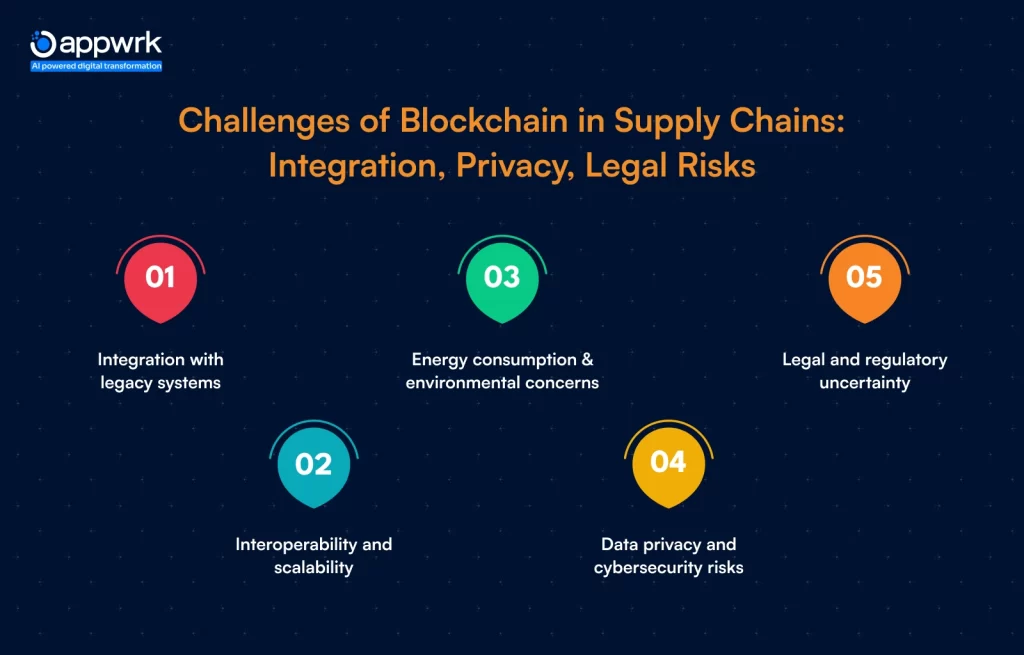
Challenges of Blockchain in Supply Chains: Integration, Privacy, Legal Risks
While blockchain brings major benefits to supply chains, successful implementation requires careful planning. Businesses need to address compatibility with legacy systems, protect sensitive data, meet regulatory requirements, and ensure the solution can scale with operations.
Integration with Legacy Systems
Most enterprises still run on legacy ERPs, WMS, or standalone logistics platforms. Blockchain doesn’t replace existing systems. It connects with them through APIs or middleware, but without proper integration planning, it can lead to data silos or duplicated records.
Data Privacy and Cybersecurity Risks
Protecting sensitive business data on blockchain can be difficult, especially when using public networks without proper encryption or access control. Meeting privacy regulations like GDPR also adds complexity, often requiring companies to store certain information off-chain or use advanced methods to keep user data secure.
Interoperability and Scalability
Effective blockchain adoption in supply chains depends on seamless integration across multiple platforms and stakeholders. Without interoperability, systems remain fragmented, and data becomes trapped in isolated silos, reducing overall efficiency.
Although solutions like Polkadot and Cosmos are advancing cross-chain communication, enterprise-grade integration is still developing. Scalability also remains a concern, as public blockchains such as Ethereum have faced limitations under high transaction volumes; an issue that Layer 2 technologies like Polygon are now working to address.
Legal and Regulatory Uncertainty
Laws governing smart contracts, digital signatures, and blockchain records vary globally. Enforceability remains jurisdiction-dependent, making global contract automation risky unless local legal mapping is done first.
Energy Consumption and Environmental Concerns
As sustainability becomes a top priority, the environmental impact of blockchain technology is under increased scrutiny. Traditional proof-of-work blockchains like Bitcoin consume large amounts of energy, but most modern supply chain solutions now use energy-efficient alternatives such as proof-of-stake or permissioned networks.
For ESG-focused companies, it’s essential to assess blockchain’s energy footprint across infrastructure, validation methods, and data storage layers.
Cost of Blockchain Implementation in Supply Chain
The cost of implementing blockchain in supply chain operations starts at $15,000 for pilots and can go beyond $120,000 for global, multi-node integrations. Costs depend on supply chain complexity, blockchain-ERP or IoT integrations, and compliance-driven customization.
Deployment Phase
Cost to Integrate Blockchain into Supply Chain
Key Features Included
MVP/Pilot
$15,000-$30,000
One use case (e.g., batch traceability), limited nodes, and basic APIs.
Mid-Tier Rollout
$30,000-$70,000
Smart contracts, ERP sync, dashboard analytics, and compliance logging.
Enterprise-Grade Integration
$70,000-$120,000+
IoT sync, multi-regional compliance, ESG layers, and partner onboarding.
Cost Savings and Risk Mitigation with Blockchain in Supply Chain Management
Blockchain in supply chain delivers measurable ROI by reducing errors, cutting reconciliation costs, and minimizing fraud risk. Organizations use blockchain inventory optimization to balance stock levels across warehouses based on verified, real-time demand and fulfillment data.
Reduced Costs and Errors
Blockchain reduces manual errors and data mismatches across procurement, inventory, and payments by embedding a single source of truth. Capgemini reports that it can cut data reconciliation costs by up to 70%.
Streamlining Payment Processing
Smart contracts enable instant payments as soon as delivery is confirmed or an inspection is complete. This removes delays, reduces the need for middlemen, and is especially useful for global supply chains where fast, secure payments are critical.
Risk Reduction Through Transparency
Blockchain offers tamper-proof records of supply chain activity. This improves risk profiling, helps enforce contracts, and supports stronger terms in trade finance and insurance.
Blockchain vs. Traditional Systems in Supply Chain Management
Traditional supply chains rely on paper forms, email-based approvals, and siloed ERP databases, creating friction, manual overhead, and fraud risk. Blockchain removes these inefficiencies by creating shared, tamper-proof ledgers that enable real-time, trustless collaboration.
Feature/Functionality
Traditional Systems
Blockchain-Enabled Supply Chains
Data Sharing
Data is shared manually, and access is limited to a few parties.
All parties have real-time access to shared and secure information.
Trust Verification
Trust is established through third-party intermediaries.
Trust is built through consensus mechanisms and smart contracts.
Document Audits
Audits are performed manually and are often delayed.
Audit trails are created instantly and stored securely on the blockchain.
Transaction Speed
Transactions take several days due to paperwork and manual reviews.
Transactions are completed in minutes through automated smart triggers.
Companies adopting blockchain see up to 40% faster inventory cycles, 30% fewer disputes, and 70% less reconciliation time.
How to Integrate Blockchain into Your Supply Chain: A Strategic Guide
To unlock full value, the blockchain integration roadmap must align with strategic supply chain objectives, involve partner coordination, and include early-stage system planning.
Identify Key Use Cases
Blockchain is most valuable where multiple parties need to share data, traceability is lacking, payments are delayed, or audits are complex. Focus on a single high-friction process, such as inventory reconciliation or customs compliance, to start small and scale effectively.
Choose the Right Blockchain Network
The choice between public, private, and consortium blockchains affects security, cost, and interoperability.
Use Ethereum or Polygon for broad access and smart contract flexibility.
Use Hyperledger Fabric or Quorum for enterprise permissioning and private data channels.
Your industry’s regulatory posture also impacts network selection.
Collaborate with Partners
Blockchain works best when everyone in the supply chain is involved. To get real value, suppliers, carriers, and logistics partners need to join the network, which requires clear standards, easy onboarding, and agreed-upon rules for how the system is managed.
Monitor Performance and ROI
To ensure your blockchain implementation delivers measurable value, it’s important to track both operational and financial outcomes. Focus on metrics that directly reflect efficiency and cost impact, such as:
Time-to-settlement
Dispute resolution speed
Audit time reduction
Inventory carrying cost
Use dashboards with both technical and operational metrics to measure ROI.
Plan for Integration Early
Late-stage integration into legacy ERPs or WMS stacks creates complexity and resistance. Blockchain success hinges on early IT involvement, API compatibility planning, and system sandboxing.
Top Blockchain Platforms for Supply Chain: Comparison, Criteria & Deployment Guide
Selecting the right blockchain platform is a strategic decision that affects how well your supply chain can scale, integrate with partners, and comply with industry regulations. The platform you choose lays the foundation for long-term success across global operations.
Key Evaluation Criteria for Blockchain SCM Platforms
Choosing the right blockchain platform goes beyond features; it requires alignment with your supply chain goals, technical environment, and compliance needs. Before committing, evaluate each option based on the following key criteria.
Integration capabilities with ERP, WMS, and SCM tools.
Consensus model and energy efficiency.
Smart contract customization.
Support for data privacy, role-based access, and audit logs.
Ecosystem maturity and enterprise blockchain adoption track record.
Comparing Ethereum, Hyperledger, VeChain, and TradeLens
Platform
Strengths
Limitations
Best Fit Use Case
Ethereum
Mature dev tools, public access, and smart contracts.
Gas fees and public exposure
Retail traceability and tokenized payments
Hyperledger
Enterprise-grade, modular, and permissioned.
More complex to deploy
Regulated sectors (pharma, aerospace)
VeChain
Built-in supply chain tools and IoT-ready.
Limited smart contract flexibility
Food safety and logistics with hardware tie-ins
Choosing Between Private and Public Blockchains
Public blockchains provide decentralization and transparency, making them well-suited for building consumer trust, especially in areas like product authenticity.
Private blockchains provide better control, speed, and data confidentiality, which is preferred in regulated B2B environments.
How Does APPWRK Help with Blockchain in Supply Chain Management?
APPWRK delivers purpose-built blockchain solutions tailored to industry-specific supply chain challenges, from end-to-end supply chain traceability and compliance to payments and AI-powered automation.
Blockchain Architecture Tailored to Industry Needs
Whether you’re a pharma company, a food brand, a retailer, or a logistics provider, APPWRK designs blockchain solutions that match your industry’s unique operational and compliance requirements.
We use the right frameworks, such as Ethereum for flexibility, Hyperledger for secure access, and hybrid models for controlled data visibility across partners.
Integration, Security, and Compliance Guidance
APPWRK ensures seamless blockchain integration with your existing ERP, WMS, and CRM platforms. Security protocols include private channels, encrypted payloads, and on-chain access control.
Compliance guidance spans DSCSA, FSMA, eIDAS, GDPR, and industry-specific certifications.
Custom Modules for Traceability, Smart Contracts, Risk Mitigation
From traceable product movement to smart contract-based payment triggers and real-time fraud detection, APPWRK offers plug-and-play modules that reduce risk and improve transparency.
Each solution is tailored with business logic workflows and onboarding toolkits for multi-party networks.
Trusted by Global Supply Chain Leaders
APPWRK powers blockchain deployments across North America, Europe, and Asia-Pacific. Clients include global agri-exporters, regulated pharmaceutical networks, and logistics providers managing billions in freight annually.
Results include:
30-50% faster recall response.
2x acceleration in payment clearance.
100% audit trail coverage in less than 48 hours.
FAQs
1. What problems does blockchain solve in supply chains?
Blockchain solves multi-party trust issues, enables traceable product movement, automates payments via smart contracts, and prevents fraud in documentation and reconciliation.
2. How does blockchain improve supply chain transparency?
It creates a shared, tamper-proof ledger that records every action, from farm to shelf, batch to invoice, visible to all parties involved in real time.
3. Can blockchain reduce logistics costs?
Yes. By eliminating manual audits, accelerating payments, and enabling real-time traceability, blockchain reduces operational overhead by up to 20%.
4. What is the role of smart contracts in supply chain management?
They automate workflows like payments, customs clearance, and dispute resolution, improving speed and reducing human error.
5. Can small businesses afford blockchain adoption?
Yes, small businesses can now afford blockchain adoption thanks to modular, cloud-based solutions. Scalable tools and ready-to-use APIs allow SMEs to implement features like traceability and payment automation without heavy upfront costs or complex infrastructure.
6. What are the environmental concerns related to blockchain in logistics?
Older proof-of-work chains were energy-heavy, but most SCM applications now use low-energy consensus models like Proof-of-Stake or permissioned ledgers.
7. How does APPWRK support blockchain implementation for supply chains?
APPWRK provides industry-specific blockchain stacks, integration with ERPs, compliance tooling, and plug-in modules for traceability, finance, and ESG.
Gourav Khanna is the Co-founder and CEO of APPWRK, leading the company’s vision to deliver AI-first, scalable digital solutions for enterprises and high-growth startups. With over 16 years of leadership in technology, he is known for driving digital transformation strategies that connect business ambition with outcome-focused execution across healthcare, retail, logistics, and enterprise operations.
Recognized as a strategic industry voice, Gourav brings deep expertise in product strategy, AI adoption, and platform engineering. Through his insights, he helps decision-makers prioritize market traction, operational efficiency, and long-term ROI while building resilient, user-centric digital systems.
Subscribe to APPWRK Blogs, We'll Do the Rest!
Get Blogs on UI/UX, Mobile Apps, Online Marketing, and Web development technology.
Unlock worthy and priceless suggestions from the masters of mobile and web app development