150+ minds across 4 countries. Join a culture of innovation, ownership & growth.
Rewire for AI
From machine learning to deep learning, from classification tools to overall process automation – our AI engineers will help you retool your existing system or enhance your company results.
Ship faster, scale smarter, built for product companies and SaaS teams
Our Latest Work
We strive hard to deliver result-driven digital solutions across the globe. Check out our case studies to get a glimpse of how we ideate, innovate, and create unconventional digital solutions according to the requirements of our clients.
Discover diverse and passionate insights from our tech enthusiasts. We collaborate across various sectors to streamline operations and drive innovation. Explore our rapidly growing collection of articles to see why we’re at the forefront of IT solutions.
The decision to move from Magento to Shopify is one of the most significant replatforming choices an ecommerce business can make. Magento is powerful, but its power comes with...
Accuracy gap is real: Traditional CPG forecasting carries a 25-40% MAPE error rate. AI-powered models bring that down to 8-15%, according to McKinsey research....
Real stories from global leaders who trusted us with their ideas.
Partnering with APPWRK helped us build a compliant and scalable healthcare platform, accelerating our time-to-market by 35%. Their team consistently delivered outstanding work.
Beesers
Digital Healthcare Client
Collaborating with APPWRK, Sportskeeda modernized its platform into a real-time sports engagement ecosystem, enabling seamless content delivery, scalable fan interactions, and high-velocity performance.
Sportskeeda
Sports & Entertainment Partner
Working with APPWRK was effortless. They captured our vision, maintained full compliance, and delivered a digital experience that built trust and elevated how customers interact with our fintech brand.
PayPenny
Fintech Partner
Working with APPWRK gave us confidence in adopting AI responsibly. Their team built a safe, intelligent bot that transformed how we engage with leads and helped us achieve measurable revenue growth.
IFB
AI Transformation Partner
Leveraging APPWRK’s digital expertise, Nemesis launched a scalable, compliant, and safe super app that connects content delivery, real-time communication, and logistics management within a single platform.
Nemesis
Super App Partner
Partner to Build Smarter AI Budgeting Solutions
Collaborate with Appwrk to create a transformative AI-powered budgeting app that drives financial clarity and business impact.
Building an AI budgeting app like Cleo costs between $10,000 and $300,000, depending on feature complexity, AI model depth, platform reach, and regulatory compliance.
Core features like AI-powered chatbots, predictive savings, and expense categorization are essential to drive daily engagement, user trust, and financial habit-building.
The ideal tech stack for AI budgeting apps includes Flutter, Node.js, TensorFlow, and Google Cloud, balancing speed, cross-platform reach, and secure data processing.
Pre-trained AI models and open-source libraries reduce development time and costs by 30-40%, making them perfect for startups launching in a tight funding cycle.
AI budgeting apps like Cleo generate revenue through ads, in-app purchases, and freemium upgrades such as Cleo Plus. This approach balances user value with recurring income, making it a scalable model for fintech growth.
Training your AI with real-time financial data from APIs like Plaid (which lets your app access user bank data securely)and Envestnet ensures accurate predictions and personalized budgeting, critical for retention and daily user value.
This blog is crafted for CXOs, fintech founders, and digital product leaders evaluating the launch of an AI budgeting app like Cleo. Whether you're shaping product strategy, driving AI adoption, or overseeing development, this guide delivers a clear view of the true costs, core features, and compliance factors that define scalable AI-first personal finance platforms.If you're weighing build vs buy, exploring AI frameworks, or aligning your roadmap with Gen Z budgeting habits, this guide equips you with the insights to navigate the AI finance space with confidence and precision.
The Market Scope for AI Budgeting Apps Like Cleo
In the wake of the pandemic, interest in AI-powered financial tools has grown rapidly, reshaping how consumers manage money. According to Grand View Research, the global personal finance software market was valued at USD 1.08 billion in 2022 and is projected to reach USD 1.59 billion by 2030, expanding at a CAGR of 5.1% from 2023 to 2030.
Millennials and Gen Z are gravitating toward chat-based financial assistants that blend emotional intelligence with spending guidance and behavioral nudges, features that define Cleo’s appeal. With over 4 million users, Cleo attributes much of its retention success to its distinctive AI personality.
“The future of finance is not spreadsheets, it’s personality. It’s a bot that tells you to stop buying tacos,” — Barney Hussey-Yeo, Founder of Cleo.
Cleo’s success reflects a broader shift in financial UX design where users prefer conversational, emotionally engaging digital finance tools. The demand for AI-backed financial self-help apps is growing, particularly among younger audiences who seek automation, instant responses, and a tone that aligns with their digital lifestyle. As AI frameworks become more accessible and PSD2 compliance supports open banking innovation, the ecosystem is primed for more players to emerge.
In this climate, building an AI-first budgeting app with personality and precision is both timely and high-opportunity.
Use this guide if you’re a CTO validating the technical scope, a founder exploring a lean MVP, or a marketer planning a go-to-market strategy for your AI budgeting app.
Cleo is a UK-based fintech app redefining how Gen Z and Millennials interact with personal finance. While its roots are in the UK, Cleo has also made a significant impact in the U.S. market, where the majority of its user base now resides. By tailoring its product experience to the behavioral patterns of American consumers, including support for U.S. banks, dollar-based insights, and localized nudges, Cleo has positioned itself as a compelling alternative to traditional banking apps in North America. Founded in 2016, the company has grown to serve over 4 million users and offers a playful yet effective way to manage spending, build savings, and access micro-credit. Its AI-first chatbot experience distinguishes it in a crowded fintech landscape.
Cleo’s mobile app is central to its user retention strategy. It blends a rich conversational interface with robust finance tracking. The app’s impact is evident through its performance metrics and user feedback:
Downloads: Over 1 million installs on Android alone.
Rating: 4.3 stars from more than 60,000 users.
Top Feedback: Users praise the app for its engaging tone, accurate budget summaries, and real-time notifications.
How Cleo Helps Users
Cleo goes beyond basic budgeting with AI-driven insights and personalized financial coaching:
Spending Categorization: Cleo automatically classifies user expenses into intuitive categories, helping users track their habits in real time.
Savings Tools: Features like “Autosave” and “Savings Goals” use behavioral triggers to automate financial discipline.
Cash Advances: Through Cleo Cover, eligible users can receive interest-free advances based on app-detected patterns.
Financial Chatbot: A conversational UI allows users to ask, “Can I afford this?” or “How much did I spend on food?” with immediate answers.
This style of nudging and feedback, often humorous, has shown to drive repeat engagement and foster long-term user habits.
How Much Does an AI Budgeting App Development Cost?
Calculating the cost of developing an AI budgeting app like Cleo requires evaluating several technical and business-specific variables. According to Deloitte, AI is expected to redefine how banks and fintechs develop software, pushing automation and personalization as key differentiators. For budgeting apps like Cleo, this means higher demand for features like predictive analytics, personalized financial nudges, and adaptive AI interfaces, raising both the baseline expectations and technical requirements.
If you’re targeting a competitive edge with cost-efficiency, here’s the most affordable range currently estimated across the fintech market:
APP Type based on Complexity
Simple App
Startups with tight budgets can launch a basic AI budgeting MVP for as little as $10,000. It offers foundational features like account linking, simple chat, and manual budgeting tools.
Medium App
For growing fintech teams, this option delivers AI-enhanced features like savings tracking, dashboards, and transaction insights under $90,000. It’s a smart step beyond the MVP.
Advanced App
Enterprise-ready apps with real-time AI scoring, NLP bots, and security layers start at $100,000. Ideal for companies looking to scale aggressively and stand out.
According to Grand View Research, user demand for AI-first financial tools is rapidly accelerating, and apps across all tiers stand to benefit from that momentum.
App Type
Cost (USD)
Development Time
Key Features
Simple App
$10,000-$30,000
3-4 Months
Account linking, registration, basic budgeting, and a simple chatbot.
Medium App
$50,000-$90,000
5-6 Months
AI dashboard, savings tracking, transaction insights, and custom alerts.
Advanced App
$100,000-$150,000+
7-9 Months
NLP-driven chatbot, real-time AI scoring, multi-language UI, and advanced security layers.
These ranges represent the lowest among top competitors and include:
Native/cross-platform app build
Financial API integration (Plaid, Yodlee)
AI models using OpenAI or Dialogflow
UX/UI prototyping and compliance support (GDPR, PCI-DSS)
Here’s a breakdown of how your budget typically gets allocated across key stages of development, each of which contributes critically to functionality, compliance, and user retention.
Training or integrating natural language models, personal finance scoring, and chatbot intelligence. High-effort phase due to customization.
UX/UI Design
15%
Designing a visually engaging and intuitive interface with wireframes, prototypes, and user flows for various devices.
Back-End + Database
15%
Server setup, database modeling, authentication systems, and data encryption to support secure financial transactions.
API Integrations
20%
Connecting to financial data providers like Plaid, Yodlee, or TrueLayer. Also includes payment gateways and analytics tools.
QA & Compliance
10%
Manual and automated testing, plus compliance verification with GDPR, PSD2, and PCI-DSS across regions.
Deployment & DevOps
10%
App store submission, cloud deployment, performance monitoring, and ongoing maintenance setup.
Key Development Cost Influencers
App Complexity: More features = higher scope and effort
Geography of Developers: U.S. devs can cost 3-4 times more than Eastern Europe or India
AI Depth: Using pre-trained models saves costs vs custom LLMs
Maintenance & Scaling: Post-launch support can add $5K-15K annually
If you’re just getting started, you don’t need a six-figure budget. Budget-conscious founders can confidently launch with a $10,000-$30,000 MVP that includes essential features and upgrade as the user base and revenue scale. Over time, this can evolve into a full-fledged AI-powered multi-platform solution tailored to user needs and business goals.
What Are the Key Features in an AI Budgeting App Like Cleo?
According to Google Cloud, the convergence of cloud-based AI and finance is making next-gen financial tools more intelligent, proactive, and adaptive than ever. Budgeting apps like Cleo stand out because they bring personalized financial insight and automation to everyday users, wrapped in an engaging, conversational format.
Here’s a detailed breakdown of must-have features and the relative cost considerations (USD) for each version:
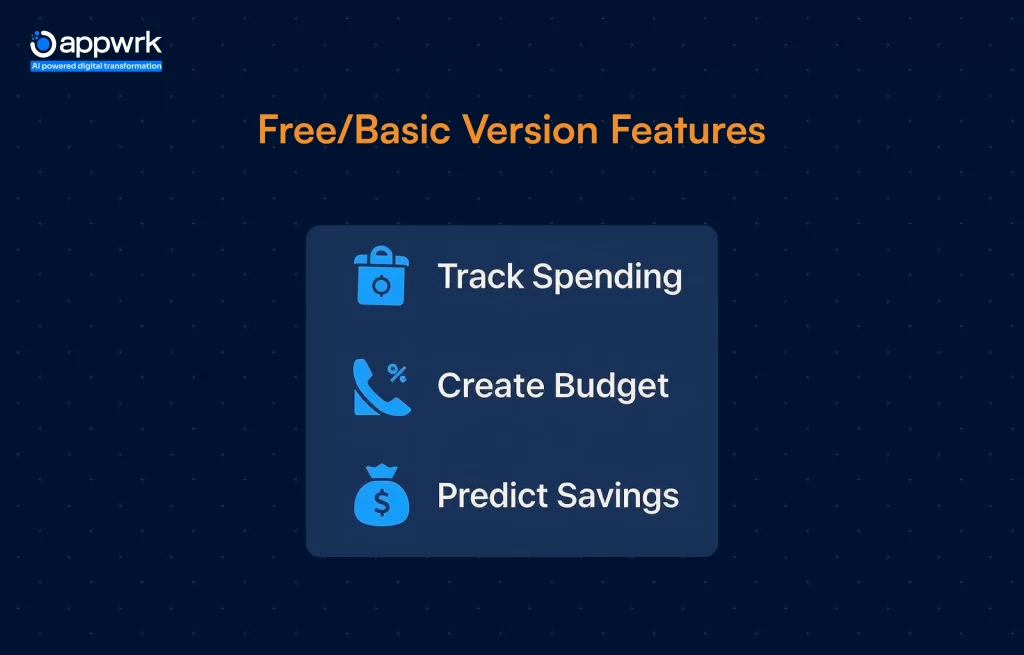
Free/Basic Version Features
Track Spending ($3,000-$6,000)
Users can monitor and categorize expenses in real-time, with graphical breakdowns that help them identify spending leaks.
Create Budget ($2,500-$5,000)
Users set spending limits across categories like groceries, bills, and entertainment, while the app provides timely nudges to help them stick to their goals
Predict Savings ($3,000-$5,000)
Using past behavioral patterns, the app estimates how much a user can realistically save weekly or monthly. This builds trust and habit-forming behavior early.
Advanced Version Features
Cleo Cover ($7,000-$12,000)
Offers interest-free cash advances using behavioral scoring models. Highly used by Gen Z for surprise expenses.
Cashback and Daily Rewards ($5,000-$8,000)
AI generates daily tasks that reward users for saving or limiting unnecessary spending.
Credit Score Monitoring ($6,000-$9,000)
Integration with credit bureaus or APIs to help users improve financial literacy and credit health.
Conversational UI ($8,000-$12,000)
Natural language chatbot lets users query their finances in real-time with personalized tone, emojis, and GIFs.
Goal-Based Saving ($4,000-$7,000)
Lets users create and track gamified financial goals like travel, rent, and emergency, encouraging long-term use.
Each of these features directly supports personalization, automation, and user trust—three primary pillars in modern FinTech product design.
AI Frameworks to Use: Custom vs Pre-Built
As AI becomes the backbone of modern finance apps, the first major decision for product teams is choosing how to build their intelligence layer. Should you invest in a custom AI model tailored to your user base, or move faster by plugging into existing AI platforms? This choice shapes everything, from how your app learns user behavior to how flexible and scalable it becomes over time.
For founders and developers building the next Cleo, understanding this trade-off is key to unlocking real value through AI.
Custom AI Models
Custom AI models typically cost between $25,000 and $60,000 to develop. These models allow you to train deep learning systems or decision engines based on unique user behavior, including spending rhythms and savings intent. They require infrastructure and skilled engineers but ensure precise control, explainability, and brand differentiation, crucial for regulatory-heavy domains.
Pre-Built AI APIs
Pre-built AI APIs typically range from $5,000 to $15,000 per year in subscription costs. APIs like Google Cloud AI, OpenAI, or Amazon Lex offer faster deployment, reduced training cycles, and NLP readiness. These are perfect for early-stage startups who want rapid experimentation and soft launches with limited budgets.
A hybrid approach, building custom logic on top of modular AI APIs, often strikes the right balance between development speed, cost control, and compliance-readiness. It’s the best route for AI budgeting apps that plan to evolve from MVP to mature platforms. This hybrid approach helps optimize both timeline and long-term innovation potential.
Where Will You Get the Financial Data to Train Your AI?
The ability of your AI budgeting app to make accurate, personalized financial predictions depends entirely on the breadth, quality, and integrity of your data sources. According to Intrinio, generative AI in finance is only as powerful as the quality, speed, and variety of its data feeds, pointing out that stale or narrow datasets lead to unreliable predictions and poor user engagement. This makes secure, timely, and standardized access to financial data absolutely critical.
Open Banking APIs
Services like Plaid, Yodlee, and TrueLayer provide secure access to users’ bank account data, transactions, balances, and financial behaviors. These APIs are typically priced between $500 and $2,000/month based on volume and region. This categorized transaction data is the foundation for spend analysis and predictive modeling.
Manual User Input
Your app should allow users to add financial goals, income types, and optional lifestyle tags manually. This helps train personalization layers and improves segmentation accuracy, especially in the early stages where aggregated data may be limited.
Data Aggregation Platforms
Providers like MX or Envestnet offer anonymized behavioral data across millions of users. These platforms help with AI model training by providing trend insights, scoring benchmarks, and spending archetypes. Costs typically start at $5,000+ per year, but they significantly boost model maturity.
How to Design a Conversational UI That Builds Trust
In the world of AI-powered fintech, how an app talks to users is just as important as what it does. Conversational UIs aren’t just a design trend; they’re a psychological bridge that makes complex financial tasks feel approachable, especially for users who struggle with money management or lack budgeting confidence.
Chat-First Layout
Instead of dashboards filled with widgets, design the app’s core interface around a chatbot window. Present daily spending summaries, alerts, and budget tips through human-like dialogues, reinforcing user familiarity.
Personality Engine
The AI’s tone should match the preferences of its audience. Gen Z typically engages more with witty, emoji-rich responses, whereas millennials are more receptive to clear, reassuring communication. Adapting the voice to each group helps foster connection and trust from the start.
Guided Queries
For users hesitant to type, offer tap-based choices like “Show my expenses,” “How much can I save this week?” or “Remind me to pay rent.” This improves usability and conversion.
Micro-Interactions
Incorporate subtle animations, GIFs, and reaction emojis after actions like setting a goal or staying under budget. It provides gratification and encourages continued interaction.
When crafted thoughtfully, these UI elements turn an AI chatbot from a tool into a personal financial coach, one that users return to daily without hesitation.
What Factors Impact the Cost of AI Budgeting App Development?
As IBM explains, AI in fintech isn’t just about automation; it’s about compliance, personalization, and trust. These demands directly shape your budget, especially when integrating features like predictive analytics, voice UIs, and financial data security.
So, what really drives the cost of your AI budgeting app? It’s not just design or code. You’re paying for vision, speed, and data precision. Let’s break down the real-world elements that influence your app budget.
Setting up the Right Business Goal
Clear business goals make budgeting simpler. For instance, an app designed for gig workers needs flexible cash flow tools, while one aimed at Gen Z users must include gamified savings and fun AI interactions. These goals shape everything from feature selection to interface style.
Determining the Variables
Smart planning minimizes over-engineering and helps hit your budget milestones.
Number of Features Implemented in the App
The more features you add, like chat-based reminders, goal-based savings, or cashback tracking, the longer your development timeline. An MVP with just 3-5 essential tools can help launch faster and cut initial costs.
Business Application of Artificial Intelligence
Some apps only need rule-based chatbots; others demand real-time financial scoring or predictive spend insights. AI complexity defines whether you need off-the-shelf APIs or custom-built models, impacting budget by thousands of dollars.
App Platform
Choosing the right platform is one of the first major cost decisions in app development. Whether you build for iOS, Android, or both will significantly impact your budget. Opting for hybrid frameworks like Flutter can lower development costs by up to 40% while maintaining high-quality UI and performance through a shared codebase.
Location of the App Development Agency
Hiring a U.S. team might cost $120-$150/hour, while developers in India or Eastern Europe offer rates as low as $25-$45/hour. The quality difference is no longer stark, so global hiring can stretch your budget smartly.
UI/UX Design
Great UI means more than good looks; it ensures users actually stay and engage. Budget for prototypes, responsive screens, micro-animations, and accessibility standards. This isn’t just design; it’s a retention strategy.
Team Size
Smaller teams work well for MVPs. A senior full-stack developer, a product designer, and a PM can often deliver a polished Phase 1. Larger builds, however, need AI/ML engineers, QA testers, DevOps experts, and security analysts.
App Maintenance
Ongoing maintenance is crucial once your app goes live. This includes regular updates, performance improvements, and bug fixes to keep the experience smooth. It’s wise to set aside 15–20% of your yearly budget for maintenance, skipping it can quickly lead to user drop-off.
Tech Stack
Your choice of technology, whether it’s Firebase or AWS, MongoDB or PostgreSQL, React Native or Swift, has a direct impact on development speed and infrastructure costs. Opting for reliable, scalable tools from the start helps ensure smoother growth. It also minimizes the risk of expensive rewrites down the line.
Features
Every additional feature adds development hours. If your AI chatbot includes jokes, emojis, and daily tips, that’s extra logic and training. Start lean, then add features based on user feedback and traction. The clearest way to keep costs predictable is by having a defined product vision. If you’re aiming for Gen Z users or young professionals, your app will need specific user journeys, branding, and features tailored to their needs.
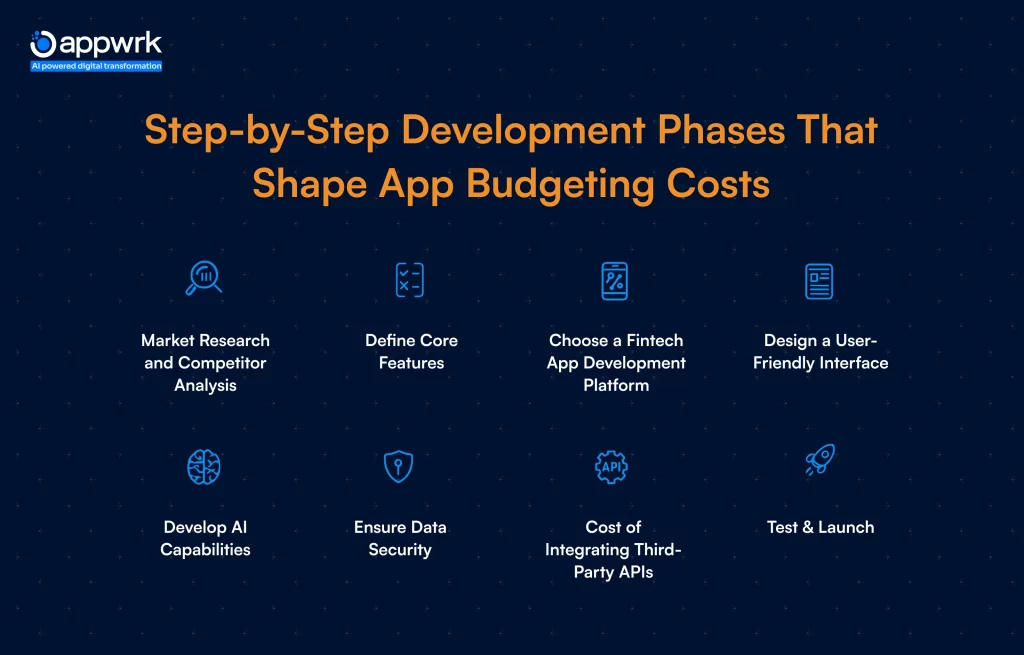
Step-by-Step Development Phases That Shape App Budgeting Costs
Building AI-driven fintech products requires a clearly sequenced approach to development. According to Deloitte, each stage brings its own cost considerations and plays a crucial role in the app’s success and scalability. Here’s a look at the phases that shape your budget.
Market Research and Competitor Analysis
This step is all about understanding your target audience and identifying gaps in existing products. Well-executed market research helps avoid guesswork, aligns product features to real-world demand, and sharpens your brand’s positioning. A focused competitor analysis ensures your app delivers a unique value proposition without overbuilding.
Define Core Features
Defining the core feature set early ensures that development efforts stay aligned with your business goals. Start with essential functionalities like budgeting, spend tracking, and savings prompts. Once validated, expand with AI enhancements. Clarity here prevents budget overrun from adding non-critical features too soon.
Choose a Fintech App Development Platform
Selecting between native development (iOS, Android) or cross-platform tools like Flutter or React Native will influence both time and cost. Native apps often deliver better performance but at a higher cost. Cross-platform frameworks allow faster rollout with shared codebases, reducing budget strain in the initial stages.
Design a User-Friendly Interface
Good design is more than aesthetics. It drives retention, builds trust, and differentiates your brand. The budget should be allocated to wireframes, interactive prototypes, and usability testing. Think chatbot-first interfaces, bold visuals, and accessibility-friendly layouts that cater to your user base.
Develop AI Capabilities
AI development is the most resource-intensive part of building a Cleo-style app. Training models to analyze spending behavior, predict savings, or deliver personalized recommendations require technical depth. This phase can account for 20-30% of your overall development costs, especially if you are building custom models.
Ensure Data Security
Since users entrust the app with confidential financial information, security needs to be integrated into every layer of development. Compliance with PSD2, GDPR, and CCPA isn’t optional; it’s expected. Plan for regular audits, secure API management, and robust encryption protocols from day one.
Cost of Integrating Third-Party APIs
APIs like Plaid, Yodlee, and TrueLayer streamline financial data access but come with recurring costs. You’ll also need APIs for credit score checks, fraud detection, chatbot NLP, and analytics dashboards. Budget for both integration and licensing fees here.
Test & Launch
Before hitting the app stores, rigorous testing is essential. This includes functional tests, regression cycles, user testing, and final polish. Allocate time and funds for bug tracking, feedback incorporation, and version control to ensure a smooth launch.
Each of these phases builds on the previous one, forming a blueprint that defines development cost, product quality, and go-to-market efficiency.
Cost-Saving Strategies to Build Your AI Budgeting App
Building an AI-powered budgeting app doesn’t have to drain your financial resources. By embracing cost-effective development approaches, leveraging modular tech stacks, and using cloud-based AI services, you can significantly reduce expenses without compromising performance. These cost-saving strategies align with user demands, developer efficiency, and market agility, especially valuable when launching for Gen Z or Millennial users who expect chat-first, personalized finance tools.
1. Prioritize Core AI Features
Focus on MVP AI features like budget alerts or simple NLP chatbots. Avoid building custom ML models in phase one.
2. Choose a Flexible Tech Stack
Use modular, open-source technologies that reduce licensing fees and allow quicker pivots.
3. Fine-Tune Pre-Trained AI Models
Rather than training from scratch, customize existing models from providers like OpenAI, AWS Lex, or Google Cloud.
4. Agile Methodology Implementation
Break development into 2-week sprints. Agile helps avoid rework and ensures regular checkpoints.
5. Use Cloud-Based AI Platforms
Cloud-based AI accelerates deployment and keeps costs predictable.
6. Leveraging Open-Source Solutions
Use platforms like Rasa, TensorFlow Lite, or Firebase for free tier development.
7. Outsource to AI Developers
Hiring remote AI specialists can reduce your costs by up to 50% without compromising on expertise.
Focus only on essential AI tools for MVP (e.g., chatbots, budgeting).
Reduces time and complexity in early builds.
Flexible Tech Stack
Use tools like Firebase or Flutter.
Speeds up development and lowers hosting costs.
Fine-Tune Pre-Trained Models
Customize cloud models instead of training from scratch.
Cuts AI build time and infrastructure spend.
Agile Development
Use Scrum/Kanban sprints.
Avoids overbuilding and aligns output with real needs.
Cloud AI Platforms
Leverage Google Cloud, AWS, and Azure AI.
No need to maintain heavy backend infrastructure.
Open-Source Libraries
Use TensorFlow, Rasa, and Hugging Face.
Eliminates license fees and accelerates iteration.
Outsource Development
Hire skilled remote teams.
Cuts labor costs without compromising output.
Essential Features to Include in Your AI Budgeting App
A Cleo-style AI budgeting app must do more than calculate totals. It should act as a proactive financial companion that simplifies money management, offers intelligent suggestions, and keeps users engaged day after day. These features are critical to meet the expectations of today’s tech-savvy, budget-conscious users.
1. AI-Powered Chatbot
Users want fast, clear answers about their money. An AI-powered chatbot makes personal finance conversational. It can answer questions like “How much did I spend on food this week?” or give nudges like “Your rent is due tomorrow.” Natural language processing makes the experience feel less like using a spreadsheet and more like chatting with a helpful friend.
2. Smart Spending Analysis
Help users make better decisions with clear, categorized insights into where their money goes. AI identifies patterns, flags high-spend categories, and provides personalized summaries at the end of each week or month. This kind of analysis not only increases app usage but also builds long-term financial awareness.
3. Personalized Budget Creation
Let users build budgets around their lifestyle and income. Whether they want to track groceries, entertainment, or subscription costs, the app should offer simple budget creation tools with AI-enhanced suggestions. When users approach or exceed their limits, the app can gently remind them or offer alternatives to stay on track.
4. Micro Cash Advances
For users who need financial flexibility, features like Cleo Cover allow small cash advances without requiring a traditional credit score. These advances are offered based on behavioral scoring and transaction history, offering peace of mind during tight cash flow moments. It’s a feature that strengthens retention and user loyalty.
5. Credit Score Monitoring
Let users keep tabs on their credit performance directly in the app. Offer real-time updates, score trends, and simple tips to help users boost their credit health. Integration with APIs from credit bureaus makes this seamless and adds meaningful value to users who are building their financial foundation.
6. Goal-Based Saving Tools
Empower users to save for short-term and long-term goals by using AI to recommend smart targets and track progress. Whether it’s for rent, travel, or emergencies, visual goal tracking and motivational nudges help turn good intentions into daily habits. Gamified saving builds positive reinforcement and long-term engagement.
7. Auto Expense Categorization
Eliminate the need for manual tagging. Machine learning should automatically categorize expenses like dining, subscriptions, transportation, and groceries. The app learns user behavior over time, becoming more accurate and reducing the mental load of financial tracking.
8. Multi-Platform Experience
Ensure users have access to their budgeting tools wherever they are. Whether it’s a mobile app, tablet, or desktop interface, a consistent multi-platform experience makes financial tracking easy. Cloud sync ensures data is up to date, no matter where the user logs in.
How Does the Cleo App Make Money?
Cleo has built a monetization engine that thrives on user trust, engagement, and scalability. Rather than relying on aggressive paywalls, it combines a freemium structure with thoughtful upsells, embedded financial products, and premium features that users genuinely find helpful.
This approach not only drives recurring revenue but also keeps the user experience intuitive, personalized, and aligned with long-term financial habits.
Advertisements
Cleo partners with brands and financial services that align with user behavior. These in-app promotions are personalized to avoid friction while still offering value, such as cashback programs or curated financial tools.
In-App Purchases
Optional upgrades, like Cleo Plus, allow users to unlock instant cash advances or detailed financial reports. These one-time purchases offer premium functionality without locking users into long-term plans.
Transaction Fees
Referral commissions are earned when users sign up for credit improvement tools, banking services, or investment apps through Cleo’s platform. This fintech affiliate model supports both passive revenue and user value.
Subscription Services
Paid monthly tiers, like Cleo Plus, give users access to exclusive features such as salary advances, AI-powered spending advice, and credit score tracking. These recurring plans create predictable revenue streams while deepening user loyalty.
Tech Stack Behind Cleo-Style Budgeting Apps: What You Need to Build a Smart Finance Assistant
Choosing the right technology stack is essential for balancing performance, scalability, and development speed, especially in fintech apps powered by AI. Your stack should support real-time processing, secure data handling, and personalized AI responses while keeping costs predictable.
Frontend Technologies
Use React Native or Flutter to build cross-platform mobile apps with consistent performance and elegant UI. These frameworks allow faster iterations and reduce costs by enabling shared codebases across Android and iOS.
Backend Technologies
A strong backend is the engine of your app. Node.js and Python (Django or Flask) are ideal for fintech apps because they support asynchronous operations, quick deployments, and seamless API integrations. They’re also well-supported when working with AI toolkits.
AI & Machine Learning Tools
Leverage platforms like TensorFlow, PyTorch, or scikit-learn to build and deploy predictive models, chatbots, and personalized recommendations. These open-source libraries are supported by large developer communities and are ideal for experimentation and scaling.
Opt for Google Cloud, AWS, or Microsoft Azure to host your AI models, user data, and business logic securely. These platforms offer on-demand scalability and integrated AI APIs, reducing the need to build from scratch.
Database & Storage
Use MongoDB for flexible document-based storage or PostgreSQL for relational financial data. Pair it with secure file storage solutions like Google Cloud Storage or AWS S3 to store receipts, logs, and training datasets.
Analytics & Monitoring
Implement tools like Mixpanel, Firebase Analytics, or Datadog to track user behavior, feature adoption, and model performance. These insights will guide your growth and product roadmap.
Team Required to Develop an AI-Based Fintech App
Building a capable team is the backbone of any successful AI budgeting app. It’s not just about shipping features; it’s about creating a secure, compliant, and intuitive product that can scale with demand. While lean teams can handle MVPs, long-term growth calls for specialists across AI, finance, and user experience.
Builds APIs, manages databases, and integrates AI.
Connects data, logic, and AI layers for seamless functionality.
AI/ML Engineer
Designs and optimizes learning models.
Delivers personalized insights and predictive finance capabilities.
QA Engineer
Conducts rigorous testing and bug fixes.
Ensures app reliability, accuracy, and compliance with financial standards.
DevOps Engineer
Automates deployments and scaling workflows.
Supports app uptime, version control, and secure cloud infrastructure.
How APPWRK Can Help in Cleo-Style AI Budgeting App Development
APPWRK is a trusted mobile app development company with deep expertise in compliance-ready fintech platforms. Whether you’re building an AI budgeting assistant or a chat-first financial planning tool, we deliver scalable systems, intuitive UI/UX, and AI-integrated architectures tailored to the regulatory demands of modern finance apps.
APPWRK has helped fintech clientsreduce time-to-market by 38% and post-launch churn by 24% using our Agile + Compliance-first approach. With a retention rate of 92%, APPWRK delivers:
Scalable AI-Driven Fintech Architectures
Secure Financial Data and KYC Integrations
MVP in 3 Weeks
Dedicated AI and Fintech QA Experts
We kick things off with a deep dive into your business goals, ideal AI use cases, and regulatory needs. From there, our team handles full-cycle execution, from architecture and interface design to AI integration and secure cloud deployment.
👉 Ready to build a Cleo-style AI budgeting app without overspending? Let’s connect and map your build in days, not months.
FAQs
1. How much does it cost to make a budgeting app like Cleo?
Creating an AI budgeting applike Cleo can cost between $10,000 and $300,000, depending on complexity, tech stack, compliance scope, and features like NLP and multi-platform support.
2. How to develop an AI-based fintech app?
To build an AI fintech app, you’ll need to:
Choose your niche and ensure compliance (e.g., PSD2, PCI DSS).
Define monetization and user flow.
Design an intuitive UI/UX.
Develop an MVP with essential features.
Decide on development method (in-house or agency).
Iterate based on user feedback and analytics.
3. What are some of the best budgeting apps on the market?
4. What tech stack is used to build Cleo-style apps?
Popular stacks include Flutter or React Native, Node.js backend, TensorFlow for AI, and Google Cloud or AWS for hosting.
5. What are the must-have AI features in a budgeting app?
Key features include an AI chatbot, predictive budgeting, spending analysis, credit tracking, and multi-platform access.
6. How does Cleo make money?
Cleo earns through ads, premium upgrades, financial referrals, and monthly subscriptions like Cleo Plus.
7. How accurate is the AI in Cleo-like apps?
Accuracy is high when using real-time banking data, user behavior, and trained predictive models.
8. Can I get a custom quote for building my own AI budgeting app like Cleo?
Yes, we provide personalized consultations to estimate the cost of building your Cleo-style app. Our team will assess your business goals, feature requirements, target users, and compliance standards to deliver a custom quote. [Contact us here to get started.]
Gourav Khanna is the Co-founder and CEO of APPWRK, leading the company’s vision to deliver AI-first, scalable digital solutions for enterprises and high-growth startups. With over 16 years of leadership in technology, he is known for driving digital transformation strategies that connect business ambition with outcome-focused execution across healthcare, retail, logistics, and enterprise operations.
Recognized as a strategic industry voice, Gourav brings deep expertise in product strategy, AI adoption, and platform engineering. Through his insights, he helps decision-makers prioritize market traction, operational efficiency, and long-term ROI while building resilient, user-centric digital systems.
Subscribe to APPWRK Blogs, We'll Do the Rest!
Get Blogs on UI/UX, Mobile Apps, Online Marketing, and Web development technology.
Unlock worthy and priceless suggestions from the masters of mobile and web app development