150+ minds across 4 countries. Join a culture of innovation, ownership & growth.
Rewire for AI
From machine learning to deep learning, from classification tools to overall process automation – our AI engineers will help you retool your existing system or enhance your company results.
Ship faster, scale smarter, built for product companies and SaaS teams
Our Latest Work
We strive hard to deliver result-driven digital solutions across the globe. Check out our case studies to get a glimpse of how we ideate, innovate, and create unconventional digital solutions according to the requirements of our clients.
Discover diverse and passionate insights from our tech enthusiasts. We collaborate across various sectors to streamline operations and drive innovation. Explore our rapidly growing collection of articles to see why we’re at the forefront of IT solutions.
The decision to move from Magento to Shopify is one of the most significant replatforming choices an ecommerce business can make. Magento is powerful, but its power comes with...
Accuracy gap is real: Traditional CPG forecasting carries a 25-40% MAPE error rate. AI-powered models bring that down to 8-15%, according to McKinsey research....
Real stories from global leaders who trusted us with their ideas.
Partnering with APPWRK helped us build a compliant and scalable healthcare platform, accelerating our time-to-market by 35%. Their team consistently delivered outstanding work.
Beesers
Digital Healthcare Client
Collaborating with APPWRK, Sportskeeda modernized its platform into a real-time sports engagement ecosystem, enabling seamless content delivery, scalable fan interactions, and high-velocity performance.
Sportskeeda
Sports & Entertainment Partner
Working with APPWRK was effortless. They captured our vision, maintained full compliance, and delivered a digital experience that built trust and elevated how customers interact with our fintech brand.
PayPenny
Fintech Partner
Working with APPWRK gave us confidence in adopting AI responsibly. Their team built a safe, intelligent bot that transformed how we engage with leads and helped us achieve measurable revenue growth.
IFB
AI Transformation Partner
Leveraging APPWRK’s digital expertise, Nemesis launched a scalable, compliant, and safe super app that connects content delivery, real-time communication, and logistics management within a single platform.
Developing a mobile app in the Netherlands in 2025 demands thoughtful budgeting, as expenses can vary significantly depending on the app’s complexity, feature set, and regulatory compliance needs. Listed below are some of the essential factors to consider:
App Development Cost in the Netherlands (2025): Mobile app development costs range from €10,000 to €200,000+, depending on features, compliance needs, and technology stack, which is critical for budgeting a Dutch-market-ready mobile app.
Hourly Rates for App Developers in the Netherlands: Local developer rates range from €50-€120/hour, with offshore options from India starting at €20/hour, affecting total mobile app development cost Netherlands-wide.
Mobile App Monetization Strategies in the Netherlands: From freemium models to in-app purchases and subscriptions, monetization methods directly influence your app’s architecture and development budget.
Mobile App Development Stages and Cost Breakdown: Costs span concept design, MVP, full development, and maintenance, with each stage influencing project duration and overall app development cost in the Netherlands.
Cost-Saving Tips for Mobile App Development in the Netherlands: Start with an MVP, use cross-platform tools like Flutter, prioritize features, apply agile methodology, and integrate open-source tools to reduce costs without compromising quality.
This blog is written for CXOs, founders, and business leaders planning to build a mobile application in 2025. Whether you are leading product, engineering, or strategic growth, this guide breaks down everything you need to know, from cost to hidden costs and compliances.If you are evaluating time, cost, or team structure in the Dutch app market, this guide will help you make faster, better decisions in today's fast-moving tech landscape.
The Netherlands App Market Landscape
As one of Europe’s leading digital innovation hubs, the Netherlands presents a dynamic landscape for mobile app development. With a tech-savvy population and strong digital infrastructure, Dutch users expect seamless, privacy-centric, and feature-rich mobile experiences. This high standard elevates the importance of thoughtful design and robust compliance. In particular, adherence to GDPR and local privacy regulations isn’t just a legal requirement; it’s a core component of building user trust and managing development costs effectively.
As Jeroen Tas, a leading Dutch tech strategist and former Chief Innovation & Strategy Officer at Royal Philips, advises:
“Building digital trust is as important as building great functionality. Privacy and security aren’t add-ons—they’re the foundation of customer loyalty in app ecosystems.”
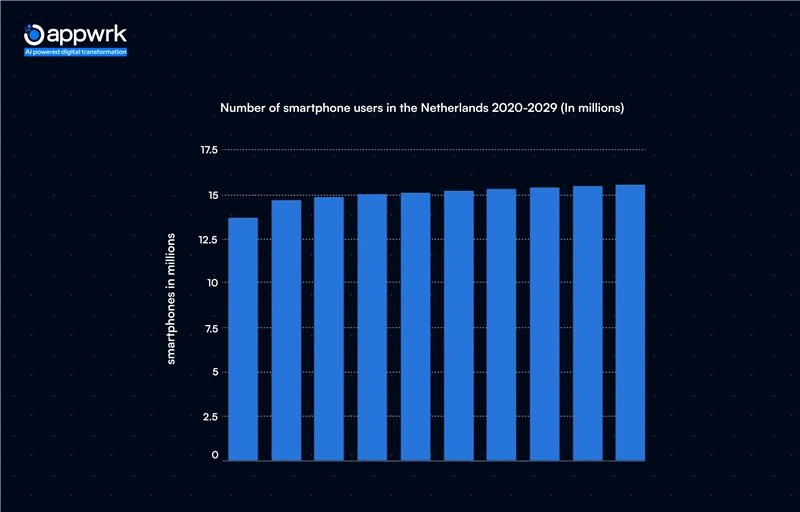
According to Statista’s Key Market Indicators, the number of smartphone users in the Netherlands is projected to reach 15.57 million by 2029, up from 15.07 million in 2024, representing a steady growth of over 3.3% across five years. This growth reflects a mobile-first society where nearly all digital interactions, from communication to commerce, are app-driven.
What is the Average Cost to Develop an App in the Netherlands?
According to Gartner Digital Markets, the B2B software market in the Netherlands is expected to reach $27.8 billion USD by 2025, reflecting rapid digital growth and innovation. This surge is fueling demand for custom mobile apps tailored to GDPR compliance, local user behavior, and platform-specific expectations. App development costs in the Netherlands vary significantly based on complexity, design standards, feature requirements, and development models, similar to broader European benchmarks but adjusted for regional market norms.
If you are looking to build an app in the Netherlands, let’s explore what it will cost to develop your app in the Netherlands.
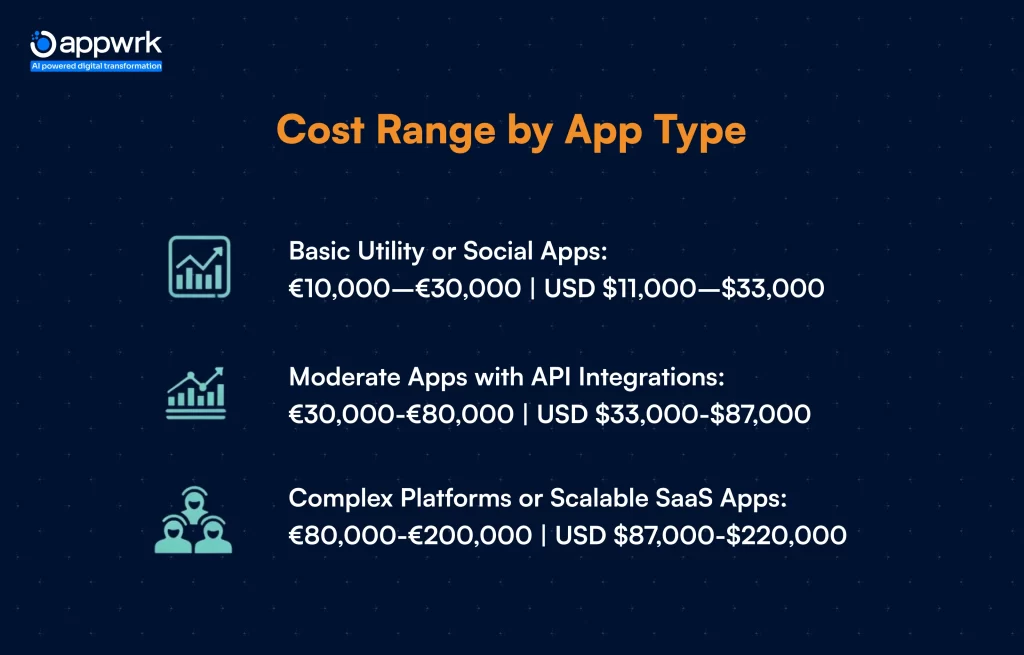
Cost Range by App Type
Basic Utility or Social Apps (€10,000–€30,000 | USD $11,000–$33,000)
Suitable for MVPs, checklist tools, and static-content apps with limited interactivity and backend dependencies.
Moderate Apps with API Integrations (€30,000–€80,000 | USD $33,000–$87,000)
Mid-range projects integrating third-party APIs, offering features like user login, push notifications, and in-app transactions.
Complex Platforms or Scalable SaaS Apps (€80,000–€200,000+ | USD $87,000–$220,000+)
Advanced solutions with AI, real-time syncing, scalability, analytics dashboards, and multi-role support. Suitable for enterprises.
Cost variations are largely influenced by the chosen technology stack, server infrastructure, real-time feature requirements, and integration with third-party services.
If you’re looking for expert guidance tailored to your business goals, explore our mobile app consulting services to get started with a strategic plan.
Cost Range by Platform
iOS App Development (Native)
Generally, 10-20% more expensive than Android due to Apple’s stringent UI/UX and security guidelines. Average iOS development in the Netherlands costs around €40,000-€130,000 (USD $44,000-$143,000).
Looking for iOS app development in the Netherlands? Our expert team delivers tailored solutions to bring your app idea to life.
Android App Development (Native)
Slightly more flexible in design implementation with marginally lower cost. Android Development budgets range from €35,000-€120,000 (USD $38,000-$132,000).
Looking for Android app development in the Netherlands? Our expert team delivers tailored solutions to bring your app idea to life.
Cross-Platform Development
Using frameworks like React Native or Flutter can reduce initial build costs by 20-40%, typically falling in the €25,000-€90,000 range (USD $27,500-$99,000). However, it might demand extra QA for platform-specific optimizations.
Cost Range by Development Model
In-House Development Teams
This model offers complete control over the project and enables real-time collaboration, but it comes with the highest costs due to employee salaries, infrastructure, training, and recruitment expenses. The estimated total cost per app ranges from €120,000 to €250,000 (USD $132,000–$275,000).
Local App Agencies in the Netherlands
Partnering with local agencies provides a balanced mix of consultation, design expertise, and agile development practices. Hourly rates typically range from €70 to €150, with total project costs falling between €60,000 and €180,000 (USD $66,000–$198,000).
Offshore/Hybrid Models
Offshore or hybrid development models offer a cost-effective solution for budget-conscious founders, starting at rates as low as €25/hour (approximately USD $27.50/hour). Full app builds in this model usually range from €25,000 to €90,000 (USD $27,500–$99,000), provided communication and product ownership are effectively managed.
What is the Cost to Develop Popular Apps in the Netherlands?
Creating apps that mirror popular platforms in the Netherlands requires more than just technical expertise; it demands a substantial investment shaped by high-performance standards, strict data privacy laws, and user expectations for smooth, intuitive experiences. These solutions typically involve advanced functionality, real-time data processing, and rigorous adherence to GDPR and local compliance frameworks.
According to Business of Apps (2025), the cost to develop a complex mobile app typically ranges from $120,000 to $300,000, with timelines extending from nine months to over a year, depending on feature depth and architectural demands.
Here’s a breakdown of estimated costs for developing apps inspired by top Dutch-market platforms:
This app includes location-based user discovery, real-time messaging, swipe-style matching, profile filters, subscription features, and encrypted communication. Development and maintenance costs are higher due to GDPR-compliant data handling and built-in user reporting systems.
The platform requires complex infrastructure for live video streaming, content moderation, real-time gifting, multilingual chat, and creator analytics dashboards. Planning for scalability and cloud architecture is crucial to ensure platform stability.
The app handles real-time coordination between restaurants, drivers, and customers, integrating payments, loyalty programs, and notifications. Advanced backend logic supports order logistics and performance analytics, adding to development complexity.
The app provides GPS-based cab discovery, fare calculations, trip history, digital payments, and driver verification. Dynamic routing systems and Maps API integration contribute to infrastructure complexity.
Azar blends real-time video chat with region-based filters, gamified discovery, and subscription billing. Stability and user experience rely on backend load distribution, rapid moderation, and seamless interaction design.
These estimates reflect the requirements of native-quality UX, multilingual adaptability, performance optimization, GDPR compliance, and user personalization expected in the Dutch mobile app ecosystem.
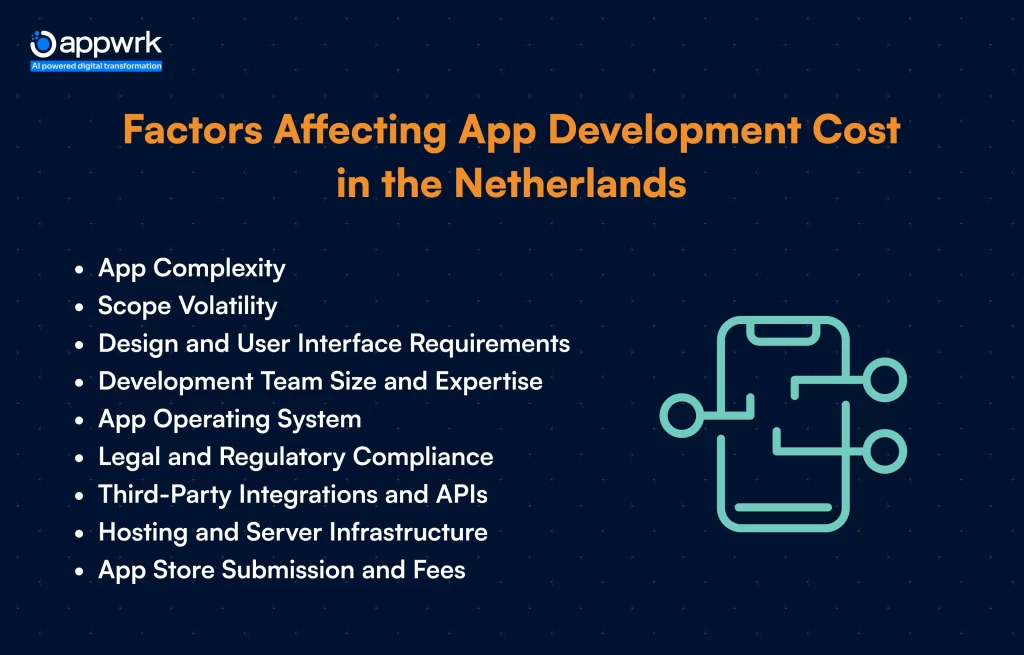
Factors Affecting App Development Cost in the Netherlands
App development costs in the Netherlands aren’t one-size-fits-all; they’re shaped by a combination of technical complexity, regulatory requirements, and user-centric design expectations. Whether you’re building a lean MVP or a feature-rich enterprise solution, factors like UI/UX depth, backend infrastructure, security standards, and platform choices play a decisive role in determining your final budget. Below is a breakdown of the most critical cost drivers every decision-maker should consider before starting development.
Design Complexity: Crafting an Engaging User Experience
A refined and interactive UI/UX design directly impacts development time and resource costs. This includes responsive layouts, micro-interactions, and accessibility features. Premium design tools, prototyping phases, and usability testing can raise costs by €8,000-€20,000 (USD $9,000-$22,000).
Backend Development: The Foundation of App Functionality
Complex backends, especially those handling real-time data, third-party interactions, or media storage, require scalable architectures. Technologies like Node.js, Firebase, and PostgreSQL can increase costs by €15,000-€50,000 (USD $16,500-$55,000), depending on scale.
Features like Stripe payments, Google Maps, or Firebase analytics add licensing, configuration, and testing layers. Third-party SDK integration can cost €5,000-€15,000 (USD $5,500-$16,500), and rise if custom middleware or data parsing is needed.
Security & Compliance: Safeguarding User Data
Ensuring secure user authentication, GDPR compliance, end-to-end encryption, consent management, and audit logging demands specialized development expertise. Depending on the complexity of the implementation, security-related efforts can cost between €10,000 and €25,000 (USD $11,000–$27,500).
Platform Selection: iOS vs. Android vs. Cross-Platform
Native app development for both platforms nearly doubles UI and backend efforts. Cross-platform solutions like Flutter or React Native save 25-40% of development time but can require more QA cycles. Platform choice can shift your budget by €20,000-€50,000 (USD $22,000-$55,000).
Technology Stack
Advanced technology stacks influence an app’s performance, scalability, and long-term adaptability. Flutter is often more cost-effective for building MVPs, while Swift or Kotlin delivers higher-quality native experiences. The overall cost can also vary depending on the availability and rates of developers experienced in SwiftUI or Jetpack Compose.
Feature Complexity: Adding Value to Your App
Premium features like AI-based content personalization, AR filters, or video conferencing modules significantly raise engineering costs. Such features may add €30,000-€100,000 (USD $33,000-$110,000) to your development budget, depending on depth and scale.
High-end features such as AI recommendations, AR capabilities, or real-time sync increase engineering efforts, testing time, and infrastructure load, all of which affect your budget.
Hourly Rates for Developers in the Netherlands
According to Gartner Digital Markets and SalaryExpert, hourly developer rates in the Netherlands reflect the country’s robust digital economy, stringent compliance standards, and growing demand for advanced digital products. These rates vary by specialization, project scope, and developer seniority, significantly impacting your overall app development budget.
Junior Developers (€50-€70/hr | USD $55-$77/hr)
Junior developers are ideal for non-critical tasks such as frontend components, basic UI builds, or QA support. They typically bring 1-3 years of experience and work well within tightly scoped sprints under senior guidance.
Equipped with 3-6 years of experience, mid-level developers handle API integrations, database design, state management, and advanced UI logic. Their expertise ensures scalable code architecture aligned with project needs.
Senior Developers and Specialists (€90-€120/hr | USD $99-$132/hr)
These professionals are responsible for defining architectural standards, implementing advanced features like AI/ML, handling GDPR-compliant flows, and maintaining system security. Specialists may also cover DevOps and performance optimization roles.
While outsourcing or hybrid team models can reduce costs, they require strong project governance and alignment on quality standards. Offshore rates, especially in India, often range from €20-€50/hr (USD $22-$55/hr), offering a significant reduction for budget-conscious founders.
Development Stages and Their Impact on Cost
According to Business of Apps, mobile app development is typically divided into distinct phases that determine both delivery timelines and financial outlay. In the Dutch ecosystem, where user experience, privacy, and scalability are paramount, each stage must be meticulously planned.
Each phase shapes your app’s structure, regulatory standing, and user satisfaction, making budgeting accuracy essential.
Concept & Design
Define your product vision, goals, and user personas.
Conduct market research and competitive analysis.
Create wireframes and initial mockups.
Design high-fidelity UI/UX prototypes tailored to Dutch accessibility and design standards.
MVP Development
Build core app features that serve the main value proposition.
Implement basic backend and frontend infrastructure.
Launch to a test audience to collect feedback.
Avoid scope creep to stay within budget.
Full Development
Expand on MVP with advanced functionalities.
Integrate APIs, external services like payment gateways, etc., and analytics tools.
Test app across devices, platforms, and real-world use cases.
Ensure GDPR compliance, security protocols, and performance optimization.
Launch & Maintenance
Host the app on reliable servers with uptime guarantees.
Manage version updates based on OS releases.
Continuously monitor performance and fix bugs.
Provide customer support and address user reviews.
Stage
Budget %
Cost (EUR)
Cost (USD)
Timeline
Description
Concept & Design
10-20%
€4,000-€24,000
$5,000–$30,000
3-5 weeks
Includes user personas, wireframes, UI/UX design; foundational for engagement and usability.
MVPDevelopment
20-30%
€10,000-€60,000
$14,500-$66,000
6-10 weeks
Delivers minimum features to validate the idea, gather feedback, and de-risk full investment.
Full Development
40-50%
€30,000-€100,000+
$36,000-$110,000+
3-6 months
Finalizes the complete app with advanced features, integrations, and testing.
Launch & Maintenance
10-15%
€3,000-€15,000+/yr
$5,000-$20,000+/yr
Ongoing
Covers server hosting, bug fixing, system updates, and user support post-launch.
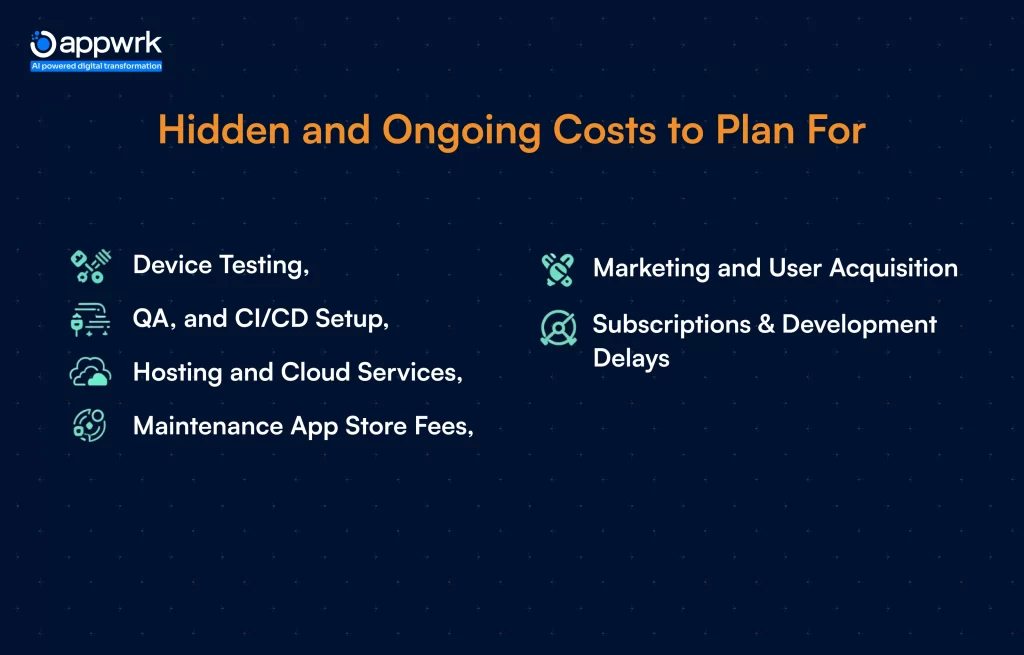
Hidden and Ongoing Costs to Plan For
Initial development often takes center stage, but the true cost of owning and scaling an app lies in the overlooked ongoing expenses, ranging from maintenance and updates to cloud hosting and compliance. According to Statista’s 2024 IT Spend Outlook, hidden costs in SaaS and mobile development projects can account for over 25% of annualized spending, especially in European tech markets like the Netherlands. Here’s what to prepare for:
Setting up CI/CD (Continuous Integration/Continuous Deployment) pipelines enables smooth deployment cycles, automated testing, and faster iteration, critical for long-term reliability and user experience.
Hosting and Cloud Services
As your user base grows, so do hosting fees. Cloud solutions like AWS or Azure often start at €100/month ($110/month) but scale quickly depending on storage, APIs, and bandwidth.
Expect €1,200–€6,000 ($1,300–$6,600) annually.
Third-Party APIs
Tools for payments, maps, push notifications, or API services carry monthly or usage-based costs.
Monthly fees can range from €50 to €500 ($55-$550) per API.
App Store Fees
Apple App Store and Google Play Store charge annual developer fees (€85/$99) and take a 15-30% cut from in-app purchases or subscriptions.
Marketing and User Acquisition
Effective UA often equals or exceeds dev costs. Budget for SEO, ASO, and paid campaigns.
Launch-stage marketing may cost €10,000-€50,000 ($11,000-$55,000) depending on the target audience and channel mix.
Development Delays
Unplanned feature scope, testing rework, or client-side revisions can extend timelines.
Each month of delay can add €5,000-€20,000 ($5,500-$22,000), depending on team structure.
Managing your app budget in a complex regulatory and technological environment like the Netherlands requires a smart combination of technical strategy, agile delivery, and priority planning. According to the Europe Business Software & Services Market Report 2024, most overspending occurs during feature creep and misaligned stakeholder timelines. These cost-management strategies can save up to 40% of your total outlay.
Start with an MVP (Minimum Viable Product)
Focus on validating your core value proposition with minimal features. This method typically reduces your initial investment by €10,000-€40,000 (USD $11,000-$44,000).
Avoids sunk costs in underused features while accelerating time-to-market.
Choose Cross-Platform Development
Frameworks like React Native or Flutter can deliver apps for both iOS and Android with a shared codebase, saving 20-40% in engineering costs.
Ideal for early-stage startups or SMEs with limited launch capital.
Prioritize Features
Map feature relevance to user value and business impact. Build only what drives ROI.
Postpone low-impact enhancements to future versions.
Choose Cross-Platform Wisely
Evaluate the trade-offs. Apps needing advanced animations, camera integration, or AR may still need native builds.
Use platform-specific modules in hybrid architectures to balance performance and budget.
Select a Reliable Team
Experienced development teams reduce the chance of costly rework and delays.
Consider vendor certifications, local compliance understanding, and past case studies.
Use Agile Development
Break the project into sprints and continuously refine the scope based on iterative feedback.
Agile saves approximately 25% in total development cycle costs by minimizing misalignment.
Leverage Open-Source Solutions
Use audited open-source libraries for features like login, form handling, and encryption.
Saves an estimated €5,000-€15,000 (USD $5,500-$16,500) in redundant development.
Each of these practices contributes to strategic cost control without diluting the app’s functionality or user experience, which is critical for success in the Dutch tech ecosystem.
What are the Common Pricing Models for App Development?
Selecting the right pricing model is a pivotal decision for managing your app development budget in the Netherlands. Pricing structures directly affect how efficiently your project progresses, especially when working with local agencies or hybrid development partners. According to Statista’s Global Subscription Pricing Models Report, Dutch businesses increasingly prefer flexible app development pricing models to reduce risk in complex app builds.
Fixed Cost
Best suited for projects with a well-defined scope, strict deadlines, and minimal risk of mid-project changes.
You agree on a lump-sum amount, typically paid in milestones. This offers budget clarity and cost predictability.
Ideal for MVPs or utility apps. Costs range from €30,000-€90,000 (USD $33,000-$99,000), depending on complexity and tech stack.
Time & Material (T&M)
T&M is appropriate for agile projects or exploratory builds where iteration is essential.
You are billed based on hours or days spent, giving flexibility to evolve features based on user feedback or business pivots.
Rates range from €70 to €120/hr ($77 to $132/hr) depending on seniority and tech expertise. Ideal for startups aiming for market fit through user-led design.
Retainer and Dedicated Teams
This model is popular among Dutch fintech and SaaS ventures requiring long-term collaboration.
You hire a dedicated team of developers, designers, and PMs for a monthly fee, ensuring speed and consistency.
Monthly retainers typically range from €15,000-€45,000 (USD $16,500-$50,000), with added value in rapid iteration, continuity, and domain immersion.
What Features Increase the Cost of Developing an App?
The cost of app development doesn’t just depend on the platform or design; it’s heavily influenced by the features you choose to include. Advanced functionalities like real-time updates, AI-driven personalization, and third-party integrations can significantly raise complexity, development time, and infrastructure needs. Understanding which features are cost drivers helps you prioritize what truly adds value to your users and your business.
Real-Time Functionalities (e.g., Live Chat, Tracking)
Require real-time syncing infrastructure and socket programming.
Includes encryption, GDPR alignment, and secure data flows.
Adds €10,000-€25,000 (USD $11,000-$27,500) depending on compliance depth.
These features also influence long-term costs due to ongoing testing, hosting, and scaling needs.
How to Hire the Right App Developer in the Netherlands
Finding the right app development partner in the Netherlands is vital to ensure your mobile project is delivered on time, on budget, and with the quality users expect. Start by evaluating a developer’s local market expertise, technical capabilities, and track record in industries like fintech, logistics, healthcare, or e-commerce.
Look for experience in cross-platform frameworks like Flutter or React Native, especially if you’re aiming for a faster time-to-market and broader platform reach. Native development expertise in Swift (iOS) or Kotlin (Android) is still key for feature-rich apps demanding high performance.
Communication, cultural fit, and project management practices are just as important. Ensure the team follows agile development methodologies, offers transparent timelines, and supports you post-launch with testing and scaling.
Explore firms like APPWRK, known for their Netherlands-specific app compliance knowledge, quality assurance practices, and track record of delivering secure, scalable apps for the Dutch market.
APPWRK’s Expertise in Mobile App Development
APPWRK brings proven expertise across a range of industries, including Fintech, Healthtech, Retail, and Sports, positioning itself as a trusted app development company in the Netherlands.
In the Fintech space, we developed a SaaS-based insurance portal that streamlined policy management and real-time analytics for SMEs. For the sports sector, we partnered with Sportskeeda to build a high-performance app offering live scores, commentary, and interactive features for millions of users. In retail and e-commerce, our work with brands like IFB and HalfShell enabled scalable mobile solutions, loyalty systems, and seamless customer journeys. We’ve also delivered robust solutions in recruitment tech, building AI-powered hiring platforms like RightHire and Hyring Spree, and contributed to IoT platforms such as Ayyeka by developing real-time infrastructure monitoring dashboards.
This cross-industry experience, combined with our focus on compliance, performance, and user engagement, positions APPWRK as a trusted app development partner for businesses in the Netherlands and beyond.
App development costs don’t stop at launch. Ongoing maintenance is essential to ensure user satisfaction, feature stability, and platform compatibility. According to Gartner’s Market Guide for Mobile Application Management, post-launch maintenance consumes 15-20% of the original development cost annually.
Bug Fixes and Patches:
Address user-reported issues and update third-party libraries.
How App Development Costs Vary Across Major Netherlands Cities
App development costs in the Netherlands differ significantly across key tech hubs due to differences in labor rates, living costs, and available tech infrastructure. According to the Europe Business Software & Services Market Report 2024, regional differences in the cost of technical labor across the Netherlands influence project budgets by up to 25%.
City
Average Hourly Rate (EUR)
Average Hourly Rate (USD)
Cost Impact Description
Amsterdam
€90-€120/hr
$99-$132/hr
High due to startup density, international clients, and a premium talent pool. Suited for complex, compliance-heavy apps.
Rotterdam
€80-€110/hr
$88-$121/hr
Slightly lower than Amsterdam, but strong talent and logistics integration. Great for enterprise and fintech apps.
The Hague
€70-€100/hr
$77-$110/hr
Government and NGO proximity influence demand. Good for eGov, civic, and legal-tech projects.
Eindhoven
€60-€90/hr
$66-$99/hr
Known for hardware-software R&D. Ideal for IoT, med-tech, and product-focused apps.
Utrecht
€65-€95/hr
$72-$105/hr
Balanced pricing with a strong developer ecosystem. Suited for education, SaaS, and SME-focused apps.
Additional Notes:
Outsourcing Options in these cities are limited due to localized demand and supply of talent. For budget-sensitive projects, hybrid models, including offshore teams, may be preferable.
Startup vs. Enterprise Costs: Startup-focused agencies in cities like Amsterdam or Rotterdam often offer MVP pricing plans, whereas large agencies in The Hague or Eindhoven may provide full-stack enterprise solutions.
Compliance and Localization: Amsterdam and The Hague tend to charge higher for GDPR alignment and multilingual localization services due to their international client base.
Understanding city-wise rate variations helps optimize vendor selection based on your app’s needs, audience, and technical complexity. Let me know if you’d like this visualized as a heatmap or supported by case examples.
What are the Monetization Strategies for Mobile Apps?
Monetization plays a central role in determining an app’s return on investment. According to Statista’s Global App Monetization Strategies Report, freemium and subscription models dominate the mobile revenue landscape. Choosing the right strategy not only influences profitability but also the type and complexity of features you need to build, which in turn impacts development costs.
Freemium Model:
Offers basic features for free, with premium upgrades available through in-app purchases.
Common in SaaS, productivity, and wellness apps.
Development cost impact: €5,000-€15,000 (USD $5,500-$16,500) for feature gating and premium flows.
Subscription Model:
Users pay recurring monthly/annual fees to access content or services.
Ideal for streaming, fitness, and education platforms.
It requires secure billing systems and adherence to compliance standards, which can cost between €10,000 and €25,000 (USD $11,000 to $27,500).
In-app Purchases (IAP):
Enables buying digital goods (coins, themes, access tokens) inside the app.
Popular in gaming and freemium tools.
Adds €5,000-€12,000 (USD $5,500-$13,200) for IAP logic and UX.
Ads and Sponsorships:
Monetize via ad networks (AdMob, Facebook Ads) or through branded content deals.
Suitable for media, news, and utility apps with large audiences.
Implementation cost: €3,000-€8,000 (USD $3,300-$8,800), excluding ad ops.
Paid App Model:
Users pay upfront to download the app.
It is the simplest to implement, but it offers limited revenue scaling.
Costs minimal: €2,000-€5,000 (USD $2,200-$5,500) for app store integration and payment logic.
Each monetization strategy influences your business model, technical architecture, and long-term engagement plan. For example, subscriptions require churn prediction and payment retries, while freemium apps need analytics to guide upsell flows. Choosing the right mix based on your market, category, and funding stage is crucial.
How APPWRK Excels in Delivering High-Impact App Developmentin the Netherlands
APPWRK is a trusted iOS and Android mobile app development partner known for building reliable, scalable, and user-friendly applications tailored to the European market. Our experts bring together deep technical expertise, creative thinking, and a user-first mindset to deliver app solutions that align with your business goals across Fintech, Healthtech, and Retail.
We start with detailed consultations to understand your project vision, compliance needs, and go-to-market strategy. From there, our team uses modern frameworks and a modular delivery approach to build secure, high-performance apps, fully compliant with GDPR, NHS, and other Europe-specific standards.
Our development model is backed by proven metrics, 40+ successful apps, 92% client retention, and full-spectrum teams that own your project end-to-end.
Connect with our experts today and turn your idea into a powerful product, with precision, transparency, and zero fluff.
FAQs
What are the Common Pricing Models for App Development?
App development typically follows three pricing models: Fixed Cost (best for defined scope), Time & Material (T&M) (ideal for evolving features), and Dedicated Teams (suitable for long-term app development and maintenance). Pricing structure depends on project clarity and flexibility needs.
What Features Increase the Cost of Developing an App?
Costs rise with real-time chat, AI recommendations, video streaming, AR/VR, complex backend APIs, and GDPR-compliant security layers. These features require advanced tech stacks and extended QA/testing efforts.
What is the Cost of App Maintenance After Launch?
App maintenance in the Netherlands typically costs 15-20% of the original development cost annually. It covers bug fixes, UI/UX enhancements, OS updates, and server upkeep. For a €100,000 app, expect €15,000-€20,000 per year.
What is the Cost of Compliance for Netherlands Apps?
GDPR compliance adds €10,000-€25,000 ($11,000-$27,500 USD) depending on your app’s data handling complexity. It includes encryption, consent flows, cookie control, and breach monitoring—all crucial in Dutch regulatory environments.
What are the Monetization Strategies for Mobile Apps?
Top strategies include freemium, subscriptions, in-app purchases, ads, and paid downloads. Each model impacts your feature set and revenue cycle.
How much does it cost to develop a simple app in the Netherlands?
A basic app with static content or simple features typically costs €10,000-€30,000 ($11,000–$33,000 USD). This includes UI, minimal backend, and single-platform deployment.
Is cross-platform development cheaper than native?
Yes. Using frameworks like Flutter or React Native can cut costs by 20-40% compared to developing separate native apps for iOS and Android, especially effective for MVPs and early-stage apps.
What are typical hourly rates for Dutch app developers?
Developer rates range from €50-€120/hour ($55-$130 USD), depending on experience. Offshore rates (e.g., India) start from €20–€40/hour, offering significant cost advantages for scalable projects.
How can I reduce app development costs without sacrificing quality?
Start with an MVP, choose cross-platform tools, hire experienced offshore teams, prioritize core features, and adopt agile development. Using open-source libraries and avoiding overengineering also controls costs.
What GDPR compliance costs should I expect?
GDPR compliance implementation can range from €10,000-€25,000, factoring in user data consent, audit trails, encryption, and policy flows, essential for Dutch and EU markets.
How long does it take to build an app in the Netherlands?
Timelines vary by complexity:
Basic App: 6-8 weeks
Mid-level App: 3-4 months
Enterprise App: 6-12 months Using agile sprints and MVPs can fast-track delivery without compromising quality.
Gourav Khanna is the Co-founder and CEO of APPWRK, leading the company’s vision to deliver AI-first, scalable digital solutions for enterprises and high-growth startups. With over 16 years of leadership in technology, he is known for driving digital transformation strategies that connect business ambition with outcome-focused execution across healthcare, retail, logistics, and enterprise operations.
Recognized as a strategic industry voice, Gourav brings deep expertise in product strategy, AI adoption, and platform engineering. Through his insights, he helps decision-makers prioritize market traction, operational efficiency, and long-term ROI while building resilient, user-centric digital systems.
Subscribe to APPWRK Blogs, We'll Do the Rest!
Get Blogs on UI/UX, Mobile Apps, Online Marketing, and Web development technology.
Unlock worthy and priceless suggestions from the masters of mobile and web app development