150+ minds across 4 countries. Join a culture of innovation, ownership & growth.
Rewire for AI
From machine learning to deep learning, from classification tools to overall process automation – our AI engineers will help you retool your existing system or enhance your company results.
Ship faster, scale smarter, built for product companies and SaaS teams
Our Latest Work
We strive hard to deliver result-driven digital solutions across the globe. Check out our case studies to get a glimpse of how we ideate, innovate, and create unconventional digital solutions according to the requirements of our clients.
Discover diverse and passionate insights from our tech enthusiasts. We collaborate across various sectors to streamline operations and drive innovation. Explore our rapidly growing collection of articles to see why we’re at the forefront of IT solutions.
The decision to move from Magento to Shopify is one of the most significant replatforming choices an ecommerce business can make. Magento is powerful, but its power comes with...
Accuracy gap is real: Traditional CPG forecasting carries a 25-40% MAPE error rate. AI-powered models bring that down to 8-15%, according to McKinsey research....
Real stories from global leaders who trusted us with their ideas.
Partnering with APPWRK helped us build a compliant and scalable healthcare platform, accelerating our time-to-market by 35%. Their team consistently delivered outstanding work.
Beesers
Digital Healthcare Client
Collaborating with APPWRK, Sportskeeda modernized its platform into a real-time sports engagement ecosystem, enabling seamless content delivery, scalable fan interactions, and high-velocity performance.
Sportskeeda
Sports & Entertainment Partner
Working with APPWRK was effortless. They captured our vision, maintained full compliance, and delivered a digital experience that built trust and elevated how customers interact with our fintech brand.
PayPenny
Fintech Partner
Working with APPWRK gave us confidence in adopting AI responsibly. Their team built a safe, intelligent bot that transformed how we engage with leads and helped us achieve measurable revenue growth.
IFB
AI Transformation Partner
Leveraging APPWRK’s digital expertise, Nemesis launched a scalable, compliant, and safe super app that connects content delivery, real-time communication, and logistics management within a single platform.
Building an app in the UK typically costs between £10,000 to £150,000, depending on features, tech stack, compliance, team composition, and long-term support.
The average cost to build a mobile app in the UK ranges from £10,000 to £150,000, depending on the app’s complexity, feature set, and whether it’s built for iOS, Android, or both.
Complete GDPR compliance and security can add £10,000 to £70,000 to your budget, especially for apps that handle sensitive data like payments, health, or user identities.
Beyond development, you’ll need to plan for hidden costs such as app maintenance (typically 15–25% of annual build cost), cloud infrastructure, third-party tools, and testing.
Advanced features like real-time chat, AI, AR, or payment integration tend to be more expensive to develop and require additional security and performance checks.
Choosing a lean MVP approach, using open-source tools, or outsourcing to experienced teams in India or Eastern Europe can reduce costs by up to 50% while maintaining high quality.
The UK mobile app market is growing rapidly, with sectors like fintech, edtech, and healthcare leading the way. Strategic investment now can deliver strong long-term returns.
This blog is written for CXOs, founders, and business leaders planning to build a mobile app in 2025. Whether you're leading product, engineering, or strategic growth, this guide breaks down everything you need to know: from cost to hidden costs and compliances.If you’re evaluating time, cost, or team structure in the UK, this guide will help you make faster, smarter decisions in today's fast-moving tech landscape.
The UK App Development Market: Scale, Growth & Scope
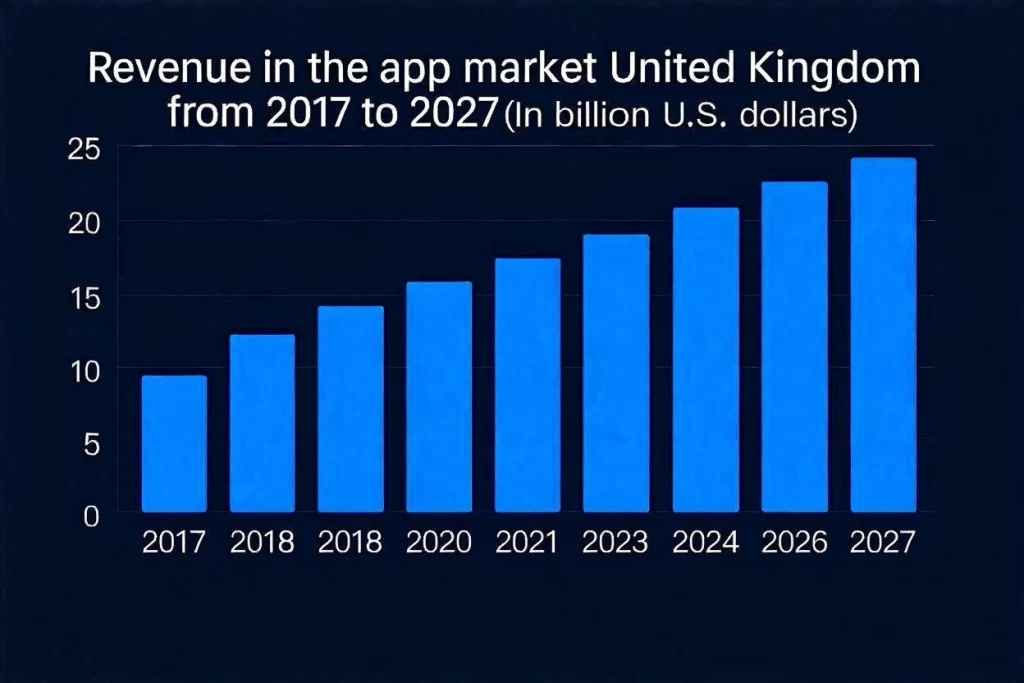
Home to a vibrant tech scene and world-class developers, the UK has become a global center for app development in 2025. Not only is it a hub for creating cutting-edge mobile applications, but it also plays a key role in shaping global app development trends and standards. According to Statista, mobile applications in the UK are expected to grow at a compound annual rate of 8.1% between 2024 and 2028. By the end of this period, mobile apps are projected to generate more than £20 billion per year in revenue.
This impressive momentum is fueled by the UK’s shift toward mobile-first consumer behavior, strong government support for digital transformation, and a highly competitive tech ecosystem. Not only are sectors like FinTech, HealthTech, and EdTech experiencing rapid growth, but they are also driving unprecedented demand for intelligent, scalable, and secure mobile solutions.
Cities like London and Manchester are attracting substantial tech investment, thanks to their strong university-to-industry pipelines and thriving talent pools. These urban centers are also home to accelerators and funding platforms tailored for mobile innovation, offering support from ideation through launch.
Generally, the cost to build an app in the UK ranges from £10,000 to £150,000 (approximately $27,000 to $230,000), depending on factors such as features, tech stack, compliance requirements, team composition, and long-term support.
As mobile applications evolve into full-fledged business tools, not just customer-facing utilities, UK companies must account for scalability, regulatory readiness, and budgeting from the ground up. If you are planning to build an app in the UK market, the first question you should ask is: How much does it cost to build an app in the UK?
“Digital transformation through mobile apps isn’t just a trend in the UK; it’s a strategic imperative.” – Ben Page, CEO, Ipsos MORI
What is the Average Cost to Develop an App in the UK?
When you’re planning to build a mobile app for the UK market, one of the first considerations should be understanding how much it’s going to cost. Mobile app development cost in the UK can vary widely depending on app type, target platform, and whether you’re working with a freelancer, an agency, or an in-house team. Aligning your budget with your app’s scale and feature set helps prevent early overcapitalization or underinvesting in mission-critical areas.
If you’re looking for expert guidance tailored to your business goals, explore our mobile app consulting services to get started with a strategic plan.
Cost Range by App Type
Simple Utility App: £10,000 to £35,000 ($20,000 to $50,000) – Apps in this category offer basic functionality such as task managers or calculators. They usually have fewer screens, limited backend interaction, and minimal animation.
Medium Complexity App: £30,000 to £70,000 ($46,000 to $90,000) – These apps tend to support both Android and iOS, include user authentication, basic API integrations, and moderate backend complexity.
Complex Custom App: £75,000 to £200,000+ ($90,000 to $254,000+) – Built for enterprise or data-sensitive use cases like healthcare, fintech, or on-demand services. They feature real-time syncing, role-based access, analytics dashboards, and GDPR compliance.
Cost Range by Platform
iOS Only: iOS development, typically ranging from £20,000 to £90,000 ($28,000 to $114,000), benefits from Apple’s standardized hardware ecosystem, streamlining QA cycles and making it an excellent choice for targeting premium user segments.
Looking for iOS app development in the UK? Our expert team delivers tailored solutions to bring your app idea to life.
Android Only: Android development, typically ranging from £10,000 to £80,000 ($18,000 to $101,000), provides access to a wider user base, but device fragmentation requires extra testing and compatibility optimization.
Looking for Android app development in the UK? Our expert team delivers tailored solutions to bring your app idea to life.
Cross-Platform (Flutter/React Native): Cross-platform development, typically ranging from £30,000 to £120,000 ($41,000 to $152,000), leverages a single codebase for both iOS and Android, reducing development time and long-term maintenance costs.
Cost Range by Development Model
Freelancers (UK): £10 to £50/hour ($20 to $64/hour) A cost-effective option for startups looking to build a quick MVP. However, challenges may arise with coordination, quality assurance, and scalability.
Agencies (UK): £80 to £150/hour ($101 to $190/hour) More expensive but offers end-to-end services including UI/UX, QA, DevOps, and post-launch support, ideal for building robust, production-ready apps.
In-house Teams: £300,000+/year ($380,000+/year) The most costly option, offering full control and alignment with business goals, but requiring significant investment in salaries, benefits, and technical infrastructure.
What Determines App Development Costs?
Deloitte’s UK consumer survey found that 96% of adults now own a smartphone, with 74% using it immediately upon waking, underscoring why mobile-first digital strategies are now fundamental to business scalability. With such high penetration and dependence on mobile usage, understanding the cost implications of app development becomes not just a budgeting concern but a strategic necessity.
There’s no one-size-fits-all approach to budgeting for app development. Understanding what truly drives cost helps businesses make smarter decisions when it comes to features, design, and delivery. Below are the factors that most influence the price of developing a mobile app in the UK:
App Complexity
If your app has simple navigation and performs basic functions, development will be faster and less expensive. However, adding features like multi-role access, AI integration, real-time sync, or offline functionality increases the engineering hours and overall budget.
Design and User Interface Requirements
Let’s face it,a highly customized UX/UI with branded visuals, smooth animations, and micro-interactions will require more design time. Besides, a tailored user experience improves retention but extends timelines.
Development Team Size and Expertise
Senior developers write scalable, maintainable code more efficiently, but their hourly rates are higher. Junior teams may save money upfront, but you risk longer time-to-market and more rework. The standard salary for a project manager starts with 20£ or 25$ and goes up to 30£ or 40$.
App Operating System
iOS and Android each have their own native development environments, with Swift used for iOS and Kotlin for Android.Native builds often perform better, but hybrid frameworks like Flutter or React Native can lower costs for apps needing fast cross-platform deployment.
Third-Party Integrations and APIs
Connecting to services like Stripe, Google Maps, or CRMs accelerates delivery but introduces recurring costs and testing needs. Every external dependency should be aligned with ROI. API connections also charge per request, per user, or based on data volume, depending on the provider’s pricing model.
Hosting and Server Infrastructure
Choosing cloud services like AWS, Google Cloud, or Firebase means that monthly infrastructure costs scale with app usage. Consider regional compliance, latency, and redundancy when estimating these figures.
App Store Submission and Fees
Launching your app involves fixed costs, including £79 per year for the Apple App Store and a one-time fee of £25 for Google Play. It’s also important to account for QA and time spent setting up metadata.
Legal and Regulatory Compliance
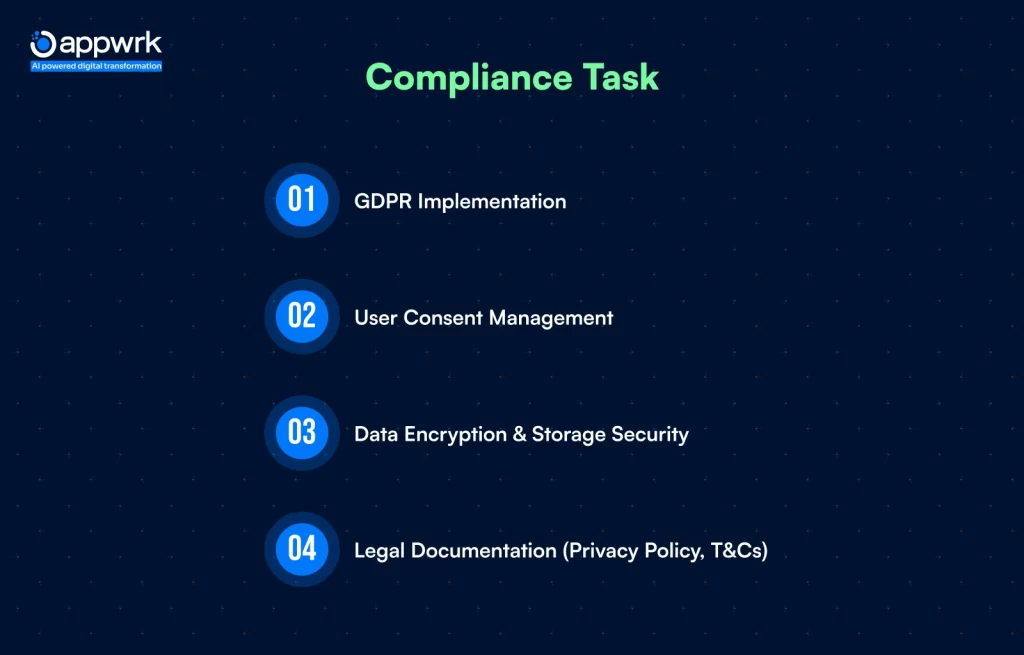
Compliance with regulations like GDPR can significantly impact development costs. If your app handles user data, you’ll need to implement encryption, consent mechanisms, privacy policies, and data breach protocols. These requirements affect not just engineering efforts but also involve legal consultation and ongoing compliance reviews.
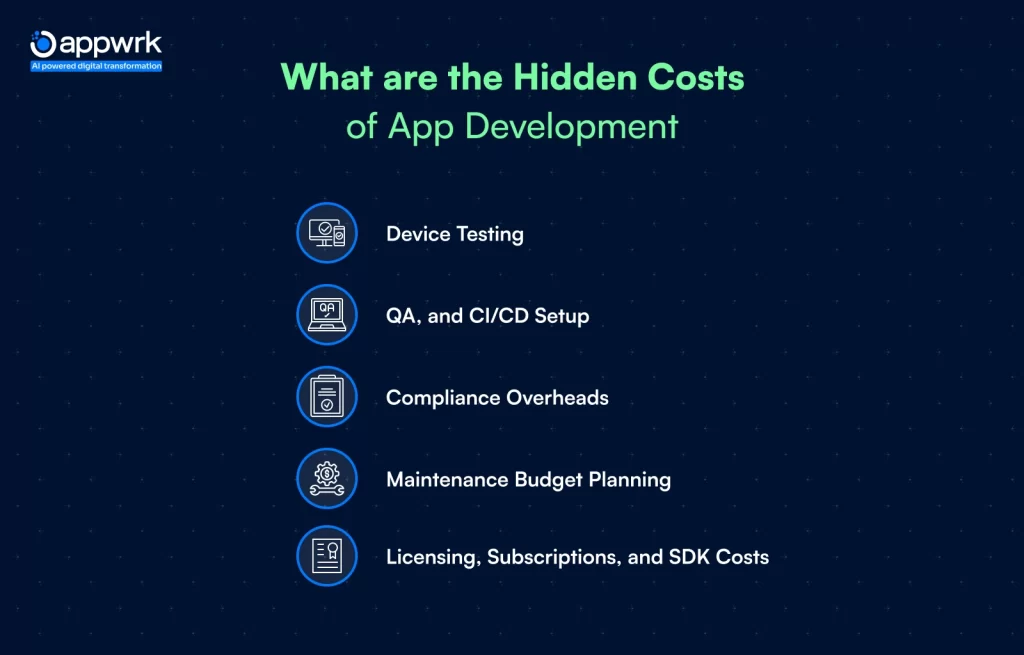
What are the Hidden Costs of App Development?
While the upfront cost of building an app gets most of the budget spotlight, many hidden or post-MVP costs can dramatically influence your long-term expenditure. Beyond building the MVP, you’ll need to account for ongoing expenses like maintenance, cloud hosting, third-party service fees, OS updates, analytics tools, and security patches. These post-launch necessities are easy to overlook but can quickly accumulate if not planned for. Factoring in these hidden costs from the start helps ensure financial stability, smoother operations, and a more sustainable app lifecycle.
Device Testing, QA, and CI/CD Setup
Ensuring your app functions flawlessly across dozens of devices, screen sizes, and OS versions requires structured Quality Assurance (QA) workflows. Setting up CI/CD (Continuous Integration/Continuous Deployment) pipelines enables smooth deployment cycles, automated testing, and faster iteration, critical for long-term reliability and user experience.
Estimated Cost (UK): £500-£1,500 Estimated Cost (US): $8000-$2,000 The above cost figures are lower-end figures to support early-stage apps and MVPs.
Licensing, Subscriptions, and SDK Costs
Most modern apps rely on third-party tools like Stripe (payments), Twilio (communications), Firebase (backend), or Mixpanel (analytics). These services operate on subscription or usage-based pricing models and can incur significant monthly or per-transaction costs over time.
Estimated Cost (UK): £50-£400/month Estimated Cost (US): $65-$500/month The above price range is estimated as actual rates depend on app scale and selected feature tiers.
Maintenance Budget Planning
After launch, apps need regular updates for bug fixes, compatibility with new OS versions, and enhancement of features. Neglecting maintenance leads to user churn, crashes, and vulnerability to security breaches. Budgeting 15%–25% of initial development costs annually for maintenance is a common industry practice.
The estimated cost range reflects a lower-bound estimate, based on quarterly updates and excluding any compliance-related upgrades.
Compliance Overheads
From GDPR to PCI-DSS, compliance requirements add development and documentation effort. Features like encrypted backups, audit trails, and privacy consent systems aren’t optional in regulated industries. These additions require cross-functional involvement, from legal to DevOps, and often increase testing and deployment complexity.
Estimated Cost (UK): £10,000–£60,000+ Estimated Cost (US): $15,500–$80,600 The cost above varies by industry and sensitivity of user data
What is the Cost to Develop Popular Apps in the UK?
Building popular apps in the UK typically costs between £15,000 and £80,000. Breaking down costs by app category helps businesses better gauge budgets for projects with comparable scope and complexity. Real-world examples from UK-based applications highlight how factors like use cases, feature sets, and industry-specific needs directly influence development costs.
The following table offers a general cost estimate based on hourly rates of $35–$40, though actual figures may shift depending on the level of customization and specific business objectives.
Mobile App Category
Estimated Development Cost (GBP)
Fitness App Development (Workout, Step Trackers)
£25,000 – £80,000
Real Estate Mobile Apps (Property Listings, Rentals)
£20,000 – £70,000
E-commerce & Marketplace Apps (B2B/B2C Shopping)
£15,000 – £60,000
Logistics, Fleet & Delivery Management Apps
£25,000 – £80,000
Video Streaming & Entertainment Apps (OTT, Podcasts)
£20,000 – £70,000
Service Booking Apps (Salon, Home Repairs, Clinics)
£20,000 – £70,000
Social Networking App Development (Chat, Forums)
£30,000 – £90,000
Personal Finance & Budgeting Apps (Expense Trackers)
App development costs are influenced by a range of factors, including the app’s functionality, level of complexity, the composition of the development team, and the projected timeline. Since every project has unique demands, pricing can vary significantly between development companies.
What are the Common Pricing Models for App Development?
Choosing the right pricing model for app development is essential to manage budgets and align expectations, especially in the UK, where timelines and scope can vary dramatically depending on whether you’re working with an agency or freelancers. According to Deloitte, adopting agile, iterative pricing models helps teams balance flexibility with financial clarity as mobile solutions evolve.
Fixed Cost
Fixed pricing is ideal for projects with clearly defined scopes, deadlines, and features. You pay a lump sum upfront or in milestones, which ensures budget control. It’s suitable for projects where all the specifications are well-documented and unlikely to change.
Time & Material (T&M)
Time & Material (T&M) pricing bills for actual hours worked and is best suited for evolving, exploratory builds. It provides greater flexibility to iterate features, especially useful for projects where requirements may change based on user feedback or market trends.
Retainer and Dedicated Teams
This model suits businesses with long-term app needs who want continuous delivery. You contract a dedicated team (designers, developers, PMs) for a monthly fee, ensuring priority and faster iteration. It fosters deep product ownership and is commonly used by growth-stage startups. UK-based SaaS platforms frequently employ this model to maintain momentum and ship updates regularly.
Choosing the model depends on your roadmap certainty, funding phase, and team structure.
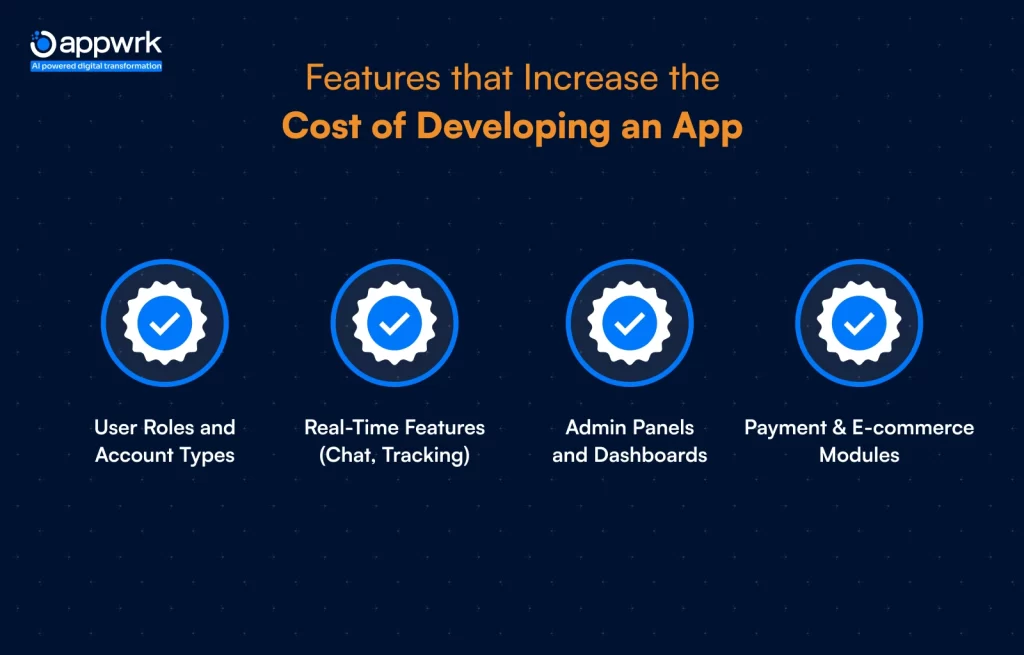
How Do App Features Influence Development Costs?
The complexity and scope of features you choose to integrate into your mobile app are primary drivers of development costs. Whether it’s implementing user roles, real-time communication, or admin analytics, each function introduces additional layers of backend logic, UI design, testing, and security validation.
According to McKinsey, feature-rich applications frequently exceed their projected budgets when foundational aspects like modular architecture, scalability, and data security are not adequately scoped from the start. In fact, their study found that large IT projects run 45% over budget and deliver 56% less value than initially planned. This highlights the importance of thorough scoping, prioritization, and phased delivery when estimating app feature costs.
Feature Type
Description
Estimated Cost
User Roles and Account Types
Supports admin, customer, and provider dashboards with segmented permissions.
£3,500–£9,000 / $4,500–$11,000
Real-Time Features (Chat, Tracking)
Uses WebSockets/pub-sub for live updates; requires scalable infrastructure and testing.
£6,000–£12,000 / $7,500–$15,000
Admin Panels and Dashboards
Tools for app management and analytics; includes front-end UI and RBAC logic.
£4,500–£10,000 / $5,800–$12,500
Payment & E-commerce Modules
Integration of gateways like Stripe or PayPal with PCI compliance and fraud protection layers.
£3,500–£7,500 / $4,500–$9,500
What is the Difference in App Development Costs Between the UK, US, and India?
Understanding regional differences in app development costs is crucial for founders and product leaders making strategic outsourcing decisions. Rates vary not only due to labor costs, but also based on project management practices, legal compliance requirements, and quality assurance norms. Additionally, factors like time zone alignment, communication efficiency, access to specialized talent, and post-launch support infrastructure play a significant role in determining the overall value proposition each region offers.
UK In the UK, the average hourly rate for app development ranges from £80 to £150, depending on the agency’s reputation, specialization, and location. A standard app project can cost between £60,000 and £200,000. These rates reflect the country’s robust digital ecosystem and emphasis on GDPR compliance, accessibility, and enterprise-grade security.
US US-based agencies command even higher rates, between £100 and £200 per hour. Projects here typically fall in the range of £80,000 to £300,000. Much of the premium comes from deep tech specialization, brand credibility, and extended quality cycles.
India India offers a more cost-effective option with hourly rates ranging from £20 to £50. A complete app build typically falls between £15,000 and £90,000. The Indian app development market is well-versed in offshore collaboration, lean project management, and scalable engineering, making it attractive for MVPs and iterative builds.
Country
Avg Hourly Rate
Project Range (in GBP & USD)
UK
£55–£95/hr
£60,000–£200,000 / $75,000–$250,000
US
£65–£150/hr
£80,000–£300,000 / $100,000–$375,000
India
£20–£50/hr
£15,000–£90,000 / $18,000–$115,000
The UK balances quality and cost control, while India offers the best budget advantage with trade-offs in communication and timezone.
Costs of Publishing an App on the App Store and Google Play Store
Before your app goes live, there are standard publishing costs associated with both Apple’s App Store and the Google Play Store. While these might seem minimal compared to development, they include hidden compliance and marketing prep work that many first-time founders overlook. As noted in Gartner’s app deployment insights, careful planning and metadata preparation are critical for timely app approval and visibility across platforms, due to unoptimized store metadata or failed review cycles.
Apple App Store
To publish on the Apple App Store, developers must enroll in the Apple Developer Program, which costs £79 ($99) per year. In addition to this, apps are subjected to rigorous review guidelines that can delay launch if compliance is not met.
Google Play Store
Publishing on Google Play requires a one-time developer account registration fee of £25 ($30). Though less expensive than Apple, Google also requires apps to comply with evolving Android policies, including target SDK versions and permission disclosures.
In-app Purchase Compliance & Reviews
Apps offering in-app purchases or subscriptions must pass Apple and Google’s payment compliance reviews. This can be time-consuming and often involves multiple iterations, especially for fintech or health apps.
What is the Cost of App Maintenance After Launch?
Post-launch maintenance is a critical part of the app lifecycle that ensures stability, security, and continued user satisfaction. From server reliability to adding new features and compliance updates, maintenance can significantly influence your ongoing budget. According to a Statista report, annual maintenance costs can reach up to 20% of the total development budget, especially for apps with high user traffic or frequent feature rollouts.
Maintenance Task
Monthly Cost (GBP)
Monthly Cost (USD)
Backend Hosting
£100-£2,000
$125-$2,500
Feature Enhancements
£500-£5,000
$625-$6,250
QA Regression + Updates
£300-£800
$375-$1,000
Monitoring & Alerts
£150-£500
$190-$625
Maintenance can add 15-25% annually to the total development cost.
What is the Cost of Compliance for UK Apps?
For UK-based applications, especially those handling user data, compliance is not just a legal necessity but also a brand trust imperative. The General Data Protection Regulation (UK GDPR) introduces specific requirements around data handling, encryption, consent management, and auditability. These compliance requirements often extend the development timeline and necessitate cross-functional input from legal, engineering, and security teams. According to the UK Information Commissioner’s Office, failure to comply can result in fines up to £17.5 million or 4% of the global annual turnover—whichever is greater.
According to GDPR advisor, UKTotal baseline compliance cost covering full GDPR technical implementation (DPIA, encryption, data rights, DPO, etc.) for a small/SME mobile app: around £10k–£25k. For mid-sized apps with moderate data processing, budget £30k–£50k+. For enterprise-level or data-sensitive apps (e.g., fintech, health), costs can reach £50k–£70k+, especially if a dedicated DPO is required.
How to Hire the Right App Developer in the UK
Finding the right app development partner in the UK is crucial to ensuring your project succeeds on time, on budget, and with the functionality you need. Start by evaluating the developer’s industry experience, technical skillset, and portfolio of similar mobile apps. Whether you’re building a fintech app, a booking platform, or a food delivery solution, choose a team that has already delivered projects in your domain.
Make sure the developer is proficient in iOS and Android development, and ideally has expertise in modern cross-platform frameworks like Flutter or React Native, which are essential for faster builds and cost efficiency.
It’s also important to assess their communication practices, ability to solve problems, and how well they align with agile development workflows. Review client testimonials, certifications, and case studies to verify their credibility.
Looking to hire UK-based app developers with proven results? Explore our trusted firm APPWRK that offers full-cycle mobile app development in the UK tailored to your business goals.
Is Outsourcing App Development to Eastern Europe or Asia Cost‑Effective in 2025?
Yes, outsourcing MVP app development to Eastern Europe or Asia can significantly lower your MVP development cost in 2025. Developers in these regions typically charge around $25 to $49 per hour, compared to $100 to $150 per hour in Western markets like the UK or US.
These cost savings can reduce overall MVP expenses by up to 60%, making it a strategic option for startups aiming to build a scalable MVP on a lean budget.
That said, success depends on more than price. Teams should account for factors like remote communication, time zone coordination, and agile project management to maintain quality and speed.
For early-stage founders, this approach enables faster go-to-market execution, greater capital efficiency, and quicker validation of product–market fit without overspending.
How App Development Costs Vary Across Major UK Cities
If you’re planning to build an MVP or full-scale app in the UK, it’s essential to understand how regional pricing differences can impact your budget. The cost of app development varies across UK cities based on local talent availability, regional tech demand, and cost of living.
London, for example, is the most expensive due to its competitive market and developer scarcity. Meanwhile, cities like Birmingham or Bristol offer more cost-effective options, making them ideal for early-stage startups aiming to launch a minimum viable product or test product-market fit efficiently.
Here’s a breakdown of average app development costs across major UK cities, including their USD equivalents:
City
Estimated Cost (GBP)
Estimated Cost (USD)*
London
£50,000 – £150,000
$63,000 – $190,000
Manchester
£40,000 – £120,000
$50,000 – $152,000
Birmingham
£35,000 – £100,000
$44,000 – $127,000
Edinburgh
£40,000 – £110,000
$50,000 – $139,000
Bristol
£35,000 – £90,000
$44,000 – $114,000
These regional price variances offer flexibility for startups. Founders can choose development partners based on budget, without compromising on quality or timeline.
If you’re looking to build a scalable MVP, consider outsourcing within the UK to cities outside London for capital-efficient development, faster delivery, and leaner operational costs.
APPWRK’s Expertise in Mobile App Development
APPWRK brings proven expertise across a range of industries, including FinTech, HealthTech, Retail, and Sports, positioning itself as a trusted UK app development company.
In the FinTech space, we developed a SaaS-based insurance portal that streamlined policy management and real-time analytics for SMEs. For the sports sector, we partnered with Sportskeeda to build a high-performance app offering live scores, commentary, and interactive features for millions of users. In retail and e-commerce, our work with brands like IFB and HalfShell enabled scalable mobile solutions, loyalty systems, and seamless customer journeys. We’ve also delivered robust solutions in recruitment tech, building AI-powered hiring platforms like RightHire and Hyring Spree, and contributed to IoT platforms such as Ayyeka by developing real-time infrastructure monitoring dashboards.
This cross-industry experience, combined with our focus on compliance, performance, and user engagement, positions APPWRK as a trusted app development partner for businesses in the UK and beyond.
What are the Monetization Strategies for Mobile Apps?
Choosing the right monetization strategy directly impacts your app’s financial sustainability and user experience. The right model depends on your app category, user base behavior, and overall business objectives. According to Statista’s Mobile App Monetization Overview, global mobile app revenues are expected to exceed $613 billion by 2025, with in-app purchases, subscriptions, and advertising being the top-performing monetization models. This underscores the importance of choosing monetization strategies that align with user behavior and revenue goals.
In-App Purchases Microtransactions allow users to buy digital goods like extra lives, skins, or bonus content within the app. It’s widely used in gaming, entertainment, and productivity categories and supports incremental revenue growth.
Subscriptions Recurring billing models, either monthly or annually, work best for apps offering continuous value, such as fitness, meditation, or SaaS platforms. Subscription churn management and pricing tiers are essential to success.
Freemium Model Offer a free version with limited features and invite users to upgrade to a premium tier. Common in productivity and cloud storage apps, this model uses upsell triggers to drive conversions.
Paid Downloads Users pay a one-time fee to download your app. Best suited for niche markets or apps with loyal followings, though it limits reach and discoverability.
Advertising Monetize via banner ads, interstitials, or rewarded video ads. Works best with a large user base but requires careful implementation to avoid user frustration.
Model
Best For
Pros
Cons
Subscription
Fitness, Media, SaaS
Recurring revenue
Needs high retention
Ads
Games, Utility apps
Monetize free users
UX can suffer
In-App Purchases
Gaming, eLearning
High revenue per user
Needs volume + strong features
Freemium
Productivity, Tools
Fast user adoption
Limited short-term ROI
Licensing
B2B SaaS apps
High upfront revenue
Longer sales cycle
How to Reduce App Development Costs in the UK?
Advanced features can significantly elevate app development costs due to the specialized expertise, infrastructure, and compliance overheads involved. According to Deloitte’s UK Digital Consumer Trends research 2023 report, organizations that invest in emerging technologies like AI, IoT, and blockchain must budget for higher upfront development costs. Cost optimization starts with planning and the adoption of scalable technologies.
Build MVP First A Minimum Viable Product helps validate market assumptions quickly. This lean-first approach saves upfront capital by focusing only on core features.
Use Open-source SDKs Integrating well-supported SDKs for functionalities like authentication, chat, or analytics avoids custom builds and accelerates development.
Choose Cloud-based Infrastructure Platforms like AWS, GCP, and Azure offer pay-as-you-go models and auto-scaling, ideal for unpredictable user growth without high upfront infrastructure costs.
Consider Outsourcing to Eastern Europe or Asia With proper due diligence, outsourcing can cut costs by 30–50%. Firms in regions like Poland, Ukraine, and India provide quality engineering talent at a lower price point.
How APPWRK Excels in Delivering High-Impact App Development in the UK
APPWRK is a trusted iOS and Android mobile app development partner known for building reliable, scalable, and user-friendly applications tailored to the UK market. Our experts bring together deep technical expertise, creative thinking, and a user-first mindset to deliver app solutions that align with your business goals across FinTech, HealthTech, and Retail.
We start with detailed consultations to understand your project vision, compliance needs, and go-to-market strategy. From there, our team uses modern frameworks and a modular delivery approach to build secure, high-performance apps, fully compliant with GDPR, NHS, and other UK-specific standards.
Our development model is backed by proven metrics, 40+ successful apps, 92% client retention, and full-spectrum teams that own your project end-to-end.
Connect with our experts today and turn your idea into a powerful product, with precision, transparency, and zero fluff.
Frequently Asked Questions
What is the average cost to develop an app in the UK? The average cost to develop a mobile app in the UK ranges between £20,000 and £150,000, depending on complexity, platform, and feature requirements.
How much do developers charge to build an app in London?
Freelancers in London typically charge £40-£80/hour, while top-tier app development agencies may charge between £100-£150/hour.
What factors influence app pricing in the UK?
Key cost drivers include app complexity, team expertise, platform (iOS/Android), backend infrastructure, third-party integrations, and regulatory compliance like GDPR.
Are there cheaper ways to build an app in the UK?
Yes, consider building an MVP first, using open-source SDKs, and leveraging hybrid frameworks like Flutter. Outsourcing to Eastern Europe or India also reduces costs significantly.
What is the cheapest way to maintain an app after launch?
Using cloud services with autoscaling, outsourcing maintenance tasks, and limiting frequent feature updates are some ways to keep monthly costs under £500.
How much does GDPR compliance cost for a mobile app?
Compliance with GDPR in the UK can range from £5,000 to £20,000 based on app type and data handling complexity. Costs include encryption, user consent systems, and documentation.
How can I budget for app marketing in the UK?
Set aside £2,000-£10,000 monthly for performance ads, PR campaigns, and influencer marketing. Start small and scale based on ROI and conversion rates.
What are the most expensive features in UK app development?
Real-time features, AI/ML, AR/VR, and blockchain integrations significantly increase development cost due to infrastructure and testing needs.
What is the cost difference between iOS and Android app development?
iOS development can be more streamlined due to fewer device variations. Android requires additional testing. Costs are generally similar, but QA takes longer on Android.
How much does it cost to hire a UK app development agency?
Hiring an agency in the UK typically costs £80-£150 per hour. Full projects range from £60,000 for simple apps to over £200,000 for enterprise-grade builds.
Gourav Khanna is the Co-founder and CEO of APPWRK, leading the company’s vision to deliver AI-first, scalable digital solutions for enterprises and high-growth startups. With over 16 years of leadership in technology, he is known for driving digital transformation strategies that connect business ambition with outcome-focused execution across healthcare, retail, logistics, and enterprise operations.
Recognized as a strategic industry voice, Gourav brings deep expertise in product strategy, AI adoption, and platform engineering. Through his insights, he helps decision-makers prioritize market traction, operational efficiency, and long-term ROI while building resilient, user-centric digital systems.
Subscribe to APPWRK Blogs, We'll Do the Rest!
Get Blogs on UI/UX, Mobile Apps, Online Marketing, and Web development technology.
Unlock worthy and priceless suggestions from the masters of mobile and web app development