150+ minds across 4 countries. Join a culture of innovation, ownership & growth.
Rewire for AI
From machine learning to deep learning, from classification tools to overall process automation – our AI engineers will help you retool your existing system or enhance your company results.
Ship faster, scale smarter, built for product companies and SaaS teams
Our Latest Work
We strive hard to deliver result-driven digital solutions across the globe. Check out our case studies to get a glimpse of how we ideate, innovate, and create unconventional digital solutions according to the requirements of our clients.
Discover diverse and passionate insights from our tech enthusiasts. We collaborate across various sectors to streamline operations and drive innovation. Explore our rapidly growing collection of articles to see why we’re at the forefront of IT solutions.
The decision to move from Magento to Shopify is one of the most significant replatforming choices an ecommerce business can make. Magento is powerful, but its power comes with...
Accuracy gap is real: Traditional CPG forecasting carries a 25-40% MAPE error rate. AI-powered models bring that down to 8-15%, according to McKinsey research....
Real stories from global leaders who trusted us with their ideas.
Partnering with APPWRK helped us build a compliant and scalable healthcare platform, accelerating our time-to-market by 35%. Their team consistently delivered outstanding work.
Beesers
Digital Healthcare Client
Collaborating with APPWRK, Sportskeeda modernized its platform into a real-time sports engagement ecosystem, enabling seamless content delivery, scalable fan interactions, and high-velocity performance.
Sportskeeda
Sports & Entertainment Partner
Working with APPWRK was effortless. They captured our vision, maintained full compliance, and delivered a digital experience that built trust and elevated how customers interact with our fintech brand.
PayPenny
Fintech Partner
Working with APPWRK gave us confidence in adopting AI responsibly. Their team built a safe, intelligent bot that transformed how we engage with leads and helped us achieve measurable revenue growth.
IFB
AI Transformation Partner
Leveraging APPWRK’s digital expertise, Nemesis launched a scalable, compliant, and safe super app that connects content delivery, real-time communication, and logistics management within a single platform.
The HotDoc app building cost starts at around $8,000 for a basic MVP and can reach $45,000+ for a fully-featured product.
Hourly development rates range between $25 to $45, depending on the geographical location and collaboration model of your healthcare app development company.
Major cost drivers include app complexity, custom features, compliance with regulations such as HIPAA and GDPR, and scalability requirements.
A simple online doctor appointment app can be built in 3 to 5 weeks, while advanced apps with telehealth, patient reviews, and admin dashboards may take up to 12 weeks.
Hidden costs, including quality assurance and testing, service and API integrations, robust encryption, and secure data storage, should be factored into your budget to avoid legal issues.
Revenue models such as clinic subscriptions, booking fees, premium patient portals, and in-app advertising make medical scheduling software financially sustainable for healthcare businesses.
In short, the HotDoc-like app development cost depends on features, compliance, and build approach. Factoring in hidden costs early ensures you build not just a booking tool, but an all-encompassing healthcare solution.
If you’re estimating the cost to develop an app like HotDoc, it helps to understand why it’s the industry baseline for healthcare application development.
HotDoc is one of Australia’s most widely adopted digital healthcare delivery platforms. It simplifies the appointment planning process, reduces front-desk workloads, and closes the gap between patients and healthcare providers. Today, it serves millions of patients and thousands of clinics every month, making it a trusted healthcare engagement platform.
What sets HotDoc apart?
EHR integrations that connect with a list of healthcare providers.
Telehealth and online doctor consultation app features that bring convenience for patients.
Secure messaging with audit trails that ensure adherence to health protocols.
Patient portal/self-service portal functionality that improves access and retention.
Scalable databases and cloud services that support clinics of all sizes.
HotDoc isn’t just a scheduling app; it’s a baseline for healthcare businesses aiming to provide efficient patient care, improve health outcomes, and adopt innovative healthcare solutions.
That’s why many healthcare professionals and medical professionals see it as the benchmark for healthcare application development services worldwide.
HotDoc App: Key Metrics at a Glance
Attribute
Details
Founded
2012
Headquarters
Melbourne, Australia
User Base
8M+ patients
Appointments Booked (Monthly)
1M+
Target Users
General practitioners, allied health providers, specialists
Core Features
Appointment booking, calendar sync, telehealth, reviews, recalls, EHR integration
Pricing Model
Subscription-based with add-ons
Compliance
Supports My Health Record, HIPAA, and local AU data laws
Tech Stack
Web + Mobile (iOS/Android), integrated with clinic systems
HotDoc Reviews & Ratings
HotDoc has 10M+ downloads on Google Play with a 4.5★ rating from 20.6K+ reviews, and ranks #1 in Medical on the App Store with a 4.7★ rating from 17.5K+ users. These strong adoption numbers highlight its reliability and patient trust across platforms.
HotDoc’s traction shows that clinics need more than a calendar tool, they need a workflow bridge between practice management software and patient expectations. This is why it has become the benchmark for founders and CTOs building similar platforms.
What’s the Real Cost to Build a Healthcare Appointment Scheduling App Like HotDoc?
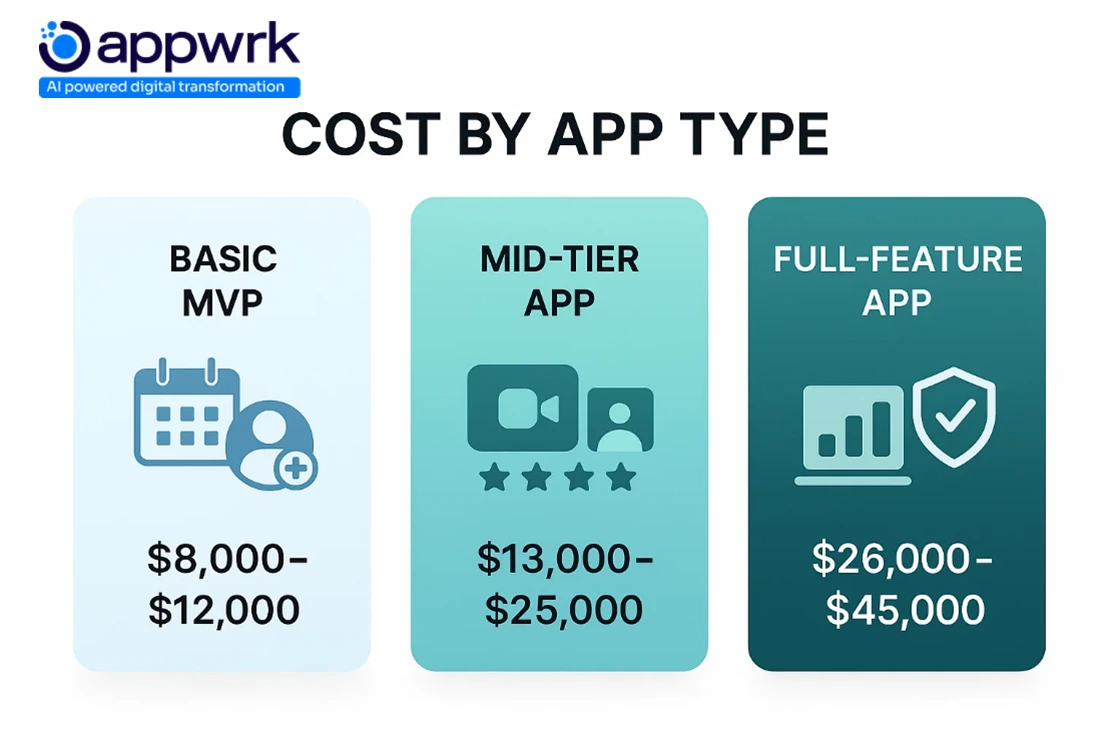
The real cost to build a healthcare appointment scheduling app like HotDoc depends on the feature set, development stage, and regulatory needs. A basic MVP can start at $8,000, while a more robust, enterprise-ready version with telehealth and integrations may cost up to $45,000. Here’s a clean, segmented breakdown:
Healthcare Appointment App Development Cost by App Type
This is where most budget planning begins, identifying what kind of product you’re building. Here’s a clear view:
App Type
Cost Range (USD)
What It Includes
Basic MVP
$8,000 to $12,000
Appointment booking, doctor profiles, EHR sync, calendar sync
Mid-Tier App
$13,000 to $25,000
Adds telehealth, ratings, prescription management, and UI customisations
Full-Feature App
$26,000 to $45,000
Includes dashboard, HIPAA/GDPR compliance, payment gateway, and analytics
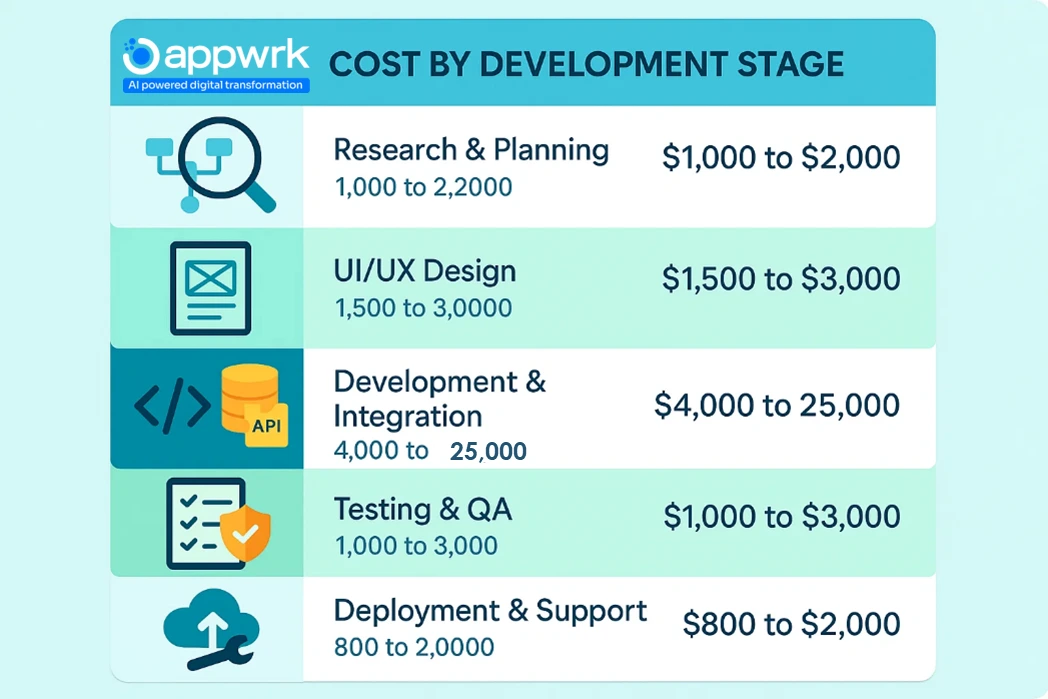
Healthcare Appointment App Development Cost by Development Stage
Breaking the cost down by each stage helps identify where the bulk of your investment will go:
Research & Planning: $1,000 to $2,000 Includes user flow mapping, tech stack planning, and feature prioritisation.
UI/UX Design: $1,500 to $3,000 Involves design systems, mobile responsiveness, and patient-centred flows.
Development & Integration: $4,000 to $25,000 A major chunk of your cost includes backend logic, EHR integration, and third-party APIs.
Summary Insight: By starting lean and scaling with demand, you can launch an appointment app like HotDoc at a fraction of the traditional cost, without sacrificing critical features or compliance. The primary focus areas, like app complexity, EHR, custom features, and ongoing maintenance, have the largest impact on cost.
What Is the Market Opportunity in Building a Healthcare Appointment App Like HotDoc?
The digital health market is expanding fast, and online doctor appointment apps sit at its centre. According to industry reports, the global mHealth app market is expected to nearly double, from $40.65 billion in 2025 to $88.70 billion by 2032, growing at an impressive 11.8% CAGR.
North America alone controlled 30.56% of the healthcare app market in 2024, showing how much demand exists for digital healthcare delivery and healthcare engagement platforms.
Healthcare providers are under pressure to digitise patient journeys. Appointment apps now act as the front door to care, improving the efficiency of healthcare delivery by reducing admin overhead and no-show rates.
Patients want frictionless access: instant bookings, reminders, follow-ups, and telehealth. This convenience for patients boosts patient access and strengthens retention.
AI-driven healthcare apps are already reshaping workflows. From AI-powered appointment recommendations to triaging and predictive scheduling, they enhance outcomes and give healthcare businesses a competitive edge.
For founders and investors, this means the HotDoc app building cost is not just about delivering scheduling, it’s about creating an all-encompassing healthcare solution. When paired with features like robust encryption, secure data storage, and audit trails, these apps avoid legal issues and scale into platforms that support comprehensive patient care.
HotDoc vs. Other Doctor Appointment Apps
When evaluating the cost to build a healthcare appointment scheduling app like HotDoc, it helps to benchmark against other global leaders. Each app has unique pricing models, features, and compliance requirements.
Attribute
HotDoc (Australia)
Zocdoc (USA)
Practo (India)
Doctolib (EU)
User Base
8M+ patients, 1M+ appointments/month
Millions of US patients
50M+ across India
80M+ across the EU
Pricing Model
Subscription + add-ons
Pay-per-booking fees
Freemium + subscriptions
Subscription-based
Core Features
EHR integration, telehealth, recalls, reviews, secure messaging
Insurance coverage, doctor marketplace
Appointment booking, telemedicine, and pharmacy integration
Types of Healthcare Apps & Use Cases Beyond Scheduling
While appointment scheduling apps like HotDoc are at the core of digital health adoption, the healthcare app ecosystem is much broader. Depending on business goals and patient needs, different healthcare app types can add long-term value:
E-Prescription Apps → Digitally generate and manage prescriptions, integrated with pharmacies for secure fulfillment.
Chronic Care & Remote Monitoring Apps → Support continuous management of conditions like diabetes or cardiac health with connected devices.
Wellness & Preventive Health Apps → Provide fitness tracking, nutrition guidance, and mental health support.
Hospital & Clinic Management Apps → Streamline operations with billing, staff management, and reporting dashboards.
By combining doctor appointment booking features with these additional healthcare app types, you can create a comprehensive healthcare solution that enhances patient engagement, drives better outcomes, and ensures business scalability.
Key Features of a Healthcare Appointment Scheduling App Like HotDoc
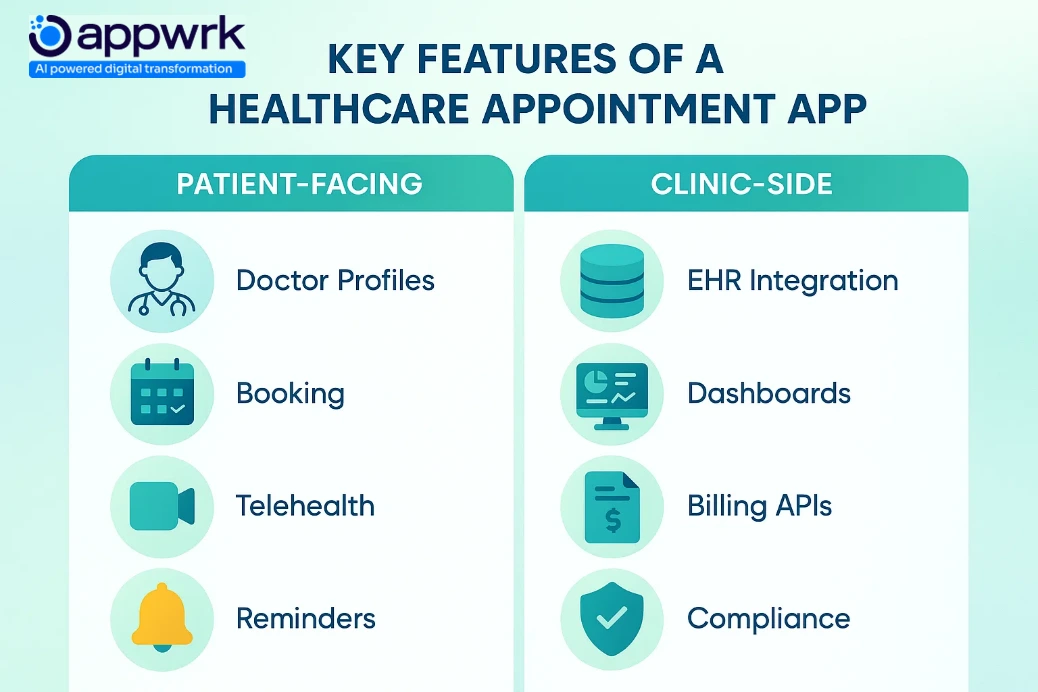
When calculating the HotDoc-like app development cost, features are the primary driver. The right features ensure adoption by both patients and medical professionals, while also addressing compliance with regulations like HIPAA and GDPR.
Core Patient-Facing Features
Doctor profiles → View bios, specialities, and availability for informed choices.
Prescription management → E-prescriptions linked with pharmacy APIs.
Automated reminders → SMS or app notifications for better adherence to health protocols.
Patient history and records → Centralised access to past visits, prescriptions, and detailed health analytics.
Core Provider/Clinic-Side Features
EHR integrations → Sync appointments and records with a list of healthcare providers.
Service and API integrations → CRM, billing, and analytics via secure APIs.
Compliance modules → Robust encryption, secure data storage, and audit trails ensure adherence to healthcare regulations.
Scalability requirements → Apps must run on cloud services, scalable databases, and load balancing to handle growth.
These are non-negotiables. Without them, your app risks poor adoption, higher churn, and potential legal issues.
In the next section, we’ll break down advanced and trending features that increase stickiness, improve healthcare business ROI, and set your platform apart from basic scheduling tools.
What Advanced Features Can Give You an Edge Over HotDoc?
Building a HotDoc-like app in 2025 isn’t just about matching features. To really compete, you need to go beyond the basics. The following advanced capabilities are what separate average tools from top-tier medical scheduling software.
AI-Based Appointment Scheduling
Smart scheduling engines use predictive analytics to recommend the best time slots based on patient history, clinic workflows, and availability. These AI-powered appointment recommendations reduce bottlenecks and improve health outcomes.
Voice and Chatbot-Based Booking
Adding voice assistants and conversational chatbots makes your online doctor appointment app accessible to elderly patients or non-tech users. It’s a step toward true digital healthcare delivery and inclusive design.
Waitlist and Emergency Queue
Automated waitlists fill cancelled slots instantly, improving clinic utilisation and ensuring efficient patient care. Emergency queues also speed up treatment for urgent cases, closing the gap between patients and doctors.
Integrated Payment System
In-app payments (wallet, card, or UPI) simplify the checkout process. For telehealth or private bookings, this reduces friction and ensures clinics get paid on time, making the app a stronger healthcare business asset.
Practice Management Dashboard
For healthcare professionals, dashboards provide real-time visibility into cancellations, patient bookings, and clinic capacity. This adds serious value for providers managing multiple locations.
Data-Driven Insights for Clinics
Reporting dashboards highlight detailed health analytics, patient engagement, no-show rates, and provider efficiency. With these insights, clinics can make data-first decisions that improve both patient retention and efficiency of healthcare delivery.
Together, these features boost patient access, drive enhanced patient experiences, and improve monetisation opportunities.
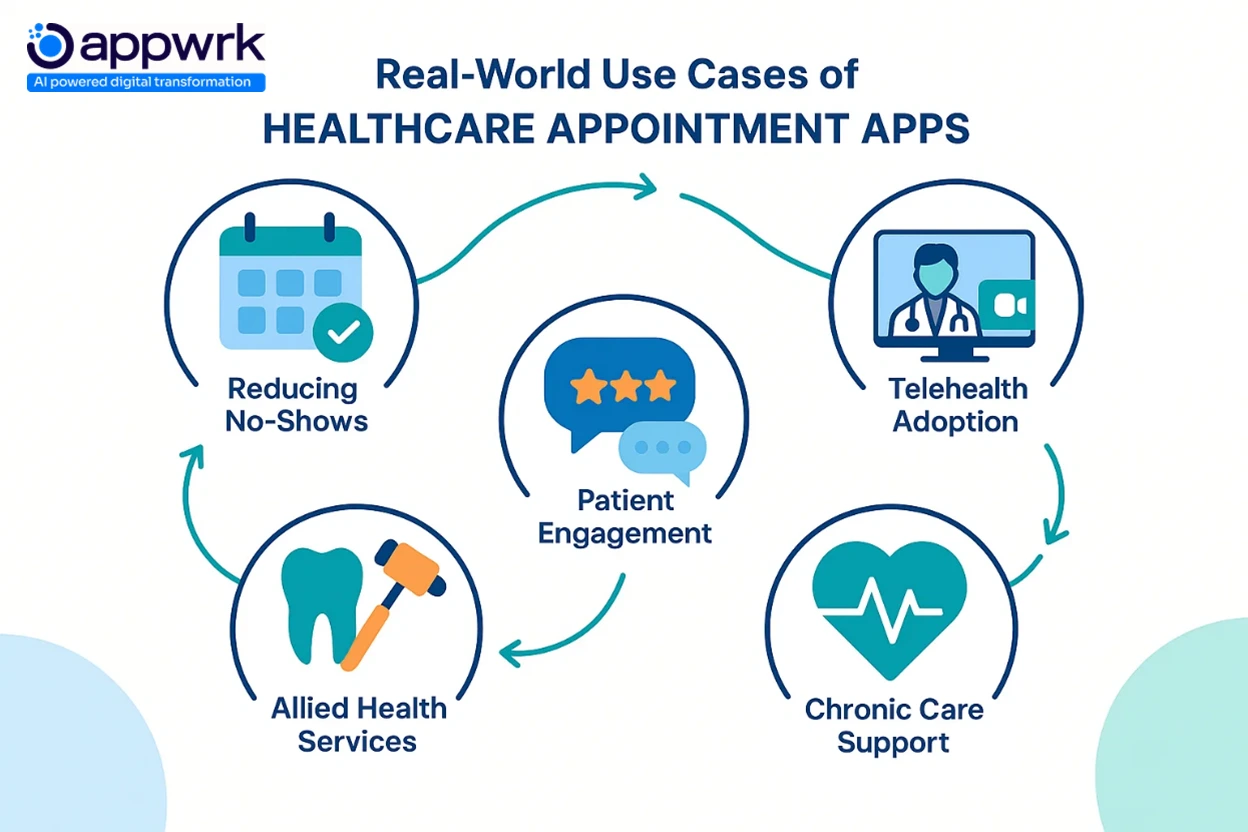
Real-World Use Cases of Healthcare Appointment Apps
Successful medical scheduling software platforms like HotDoc, Zocdoc, and Doctolib show how much impact the right features can make:
Reducing no-shows → Automated reminders cut missed appointments by up to 30%, improving health outcomes and saving clinics lots of money.
Telehealth adoption → Integrating video consults allows healthcare professionals to treat patients beyond geography, a big step in the digital transformation of the healthcare industry.
Chronic care support → With EHR integration, providers manage diabetes, cardiac, and mental health care more efficiently.
Allied health services → Dentists, physiotherapists, and specialists use apps to handle multi-location patient bookings.
Patient engagement → Reviews, recalls, and self-service portals increase transparency and build long-term trust.
Case in point: HotDoc processes over 1M patient bookings every month in Australia, proving that scheduling isn’t just an appointment planning process; it’s a baseline for healthcare operations.
The Process of Building a Healthcare Appointment Scheduling App Like HotDoc
The HotDoc app building cost is shaped by the process you follow. Rushing into development without a roadmap leads to wasted spend and healthcare app development costs that spiral. Here’s the proven approach:
Market Research & Requirement Gathering Define target users, compliance with healthcare regulations, and custom features needed. Include stakeholder interviews and legal scoping.
UI/UX Design Build prototypes and wireframes around the appointment planning process and patient portal/self-service portal. A user-friendly interface improves convenience for patients and builds trust.
App Development & Implementation Develop booking flows, calendar sync, and EHR integration. Use modular microservices and cloud services to ensure scalability requirements are met.
Service and API Integrations Connect payment gateways, CRMs, analytics tools, and telehealth SDKs. Integration depth impacts app complexity and overall healthcare application development costs.
Quality Assurance and Testing Test across devices for performance, security, and compliance. Include penetration testing, encryption checks, and regression testing to ensure secure data storage and robust encryption.
App Launch Deploy on App Store and Google Play with ASO, server setup, and documentation. A strong launch reduces early churn.
Ongoing Maintenance & Updates Cover bug fixes, compliance patches, and feature scaling. Expect this to cost 15–20% of initial development, but it ensures your healthcare application project avoids legal issues and downtime.
Following this process of developing a healthcare app ensures clinical-grade reliability, reduces long-term risk, and keeps your solution aligned with evolving healthcare environments.
What Factors Influence the Cost to Develop an App Like HotDoc?
App Complexity and Features Basic bookings and confirmations cost less. Additions like Patient History and Records, automated reminders, or AI-driven recommendations raise the healthcare app development costs.
Custom Features & Integrations Features such as chatbots, collaboration between healthcare providers, or device connectivity (BP monitors, wearables) increase scope and compliance overhead.
UI/UX Design & Platform Choice A basic design is faster and cheaper. But a polished, user-friendly interface for iOS and Android takes more investment.
Location of the Development Team Offshore teams in Asia/Eastern Europe may charge $25–$35/hour. U.S. or Western Europe developers can cost $45/hour or more. Geographical location and team seniority shape the final budget.
Compliance with Healthcare Regulations Meeting HIPAA, GDPR, or regional rules requires extra engineering and legal spend, but skipping compliance risks fines and reputational damage.
Backend Infrastructure & Scalability Using scalable databases, load balancing, and cloud services ensures your app handles growth. Expect to invest more upfront, but save long-term.
Maintenance & Long-Term Scaling Post-launch costs average 15–20% annually. This covers new features, audit trails, and adherence to health protocols.
Among these, App Complexity, Custom Features, Compliance with Regulations, Scalability Requirements, and the Location of the Development Team are the biggest drivers of the HotDoc app building cost.
Compliance with Regulations in Healthcare Appointment Apps
Building a healthcare appointment scheduling app like HotDoc isn’t just about great features. Because these apps handle highly sensitive patient data, compliance with healthcare regulations across different regions is non-negotiable. If you’re calculating the true HotDoc app building cost, factor in the legal and engineering work required to protect patient trust and avoid legal issues.
Key Standards to Consider
HIPAA (US): Ensures secure data storage, encryption, and transmission of patient health information.
GDPR (EU): Governs privacy, user consent, and secure cross-border data transfers.
Australian Privacy Principles (APP) & Privacy Act 1988: The foundation of local compliance for HotDoc-style apps.
NSQHS Standards & TGA Requirements: Define benchmarks for safe and high-quality digital healthcare delivery.
Software as a Medical Device (SaMD): Applies if your app supports diagnosis, treatment, or prescriptions.
Best Practices for Compliance
Apply robust encryption and secure data storage as defaults.
Keep audit trails for every action inside the app.
Bottom line: compliance with regulations isn’t optional. It’s the foundation for patient trust, data safety, and scalability in the healthcare industry.
How Long Does It Take to Build an Appointment Booking App?
Timelines depend on app complexity, features, and your team setup. Here’s a realistic range for the process of building a healthcare appointment scheduling app:
10–12 weeks → An advanced build with telehealth, practice dashboards, and AI-powered appointment recommendations.
12–14 weeks → A full-scale app with multi-role support, EHR integration, and compliance modules.
Timelines vary further based on the location of the development team. Offshore outsourcing can accelerate delivery at a lower cost, while in-house builds often take longer but allow tighter control.
Hidden Costs & Ongoing Expenses in Healthcare Appointment App Development
The HotDoc-like app development cost doesn’t end at launch. Every healthcare app development company or clinic owner needs to budget for post-launch essentials.
Annual compliance costs average $1,000–$5,000, covering certifications, audit trails, and updates to match evolving laws.
3. Support, Fixes, and Security Patches
Maintenance and upgrades take 15–20% of the total healthcare application development cost annually. This includes bug fixes, performance monitoring, and robust encryption checks to ensure your app continues to avoid legal issues.
Together, these hidden costs typically add 15–20% on top of the initial cost to develop an app like HotDoc, making long-term planning essential for sustainable growth.
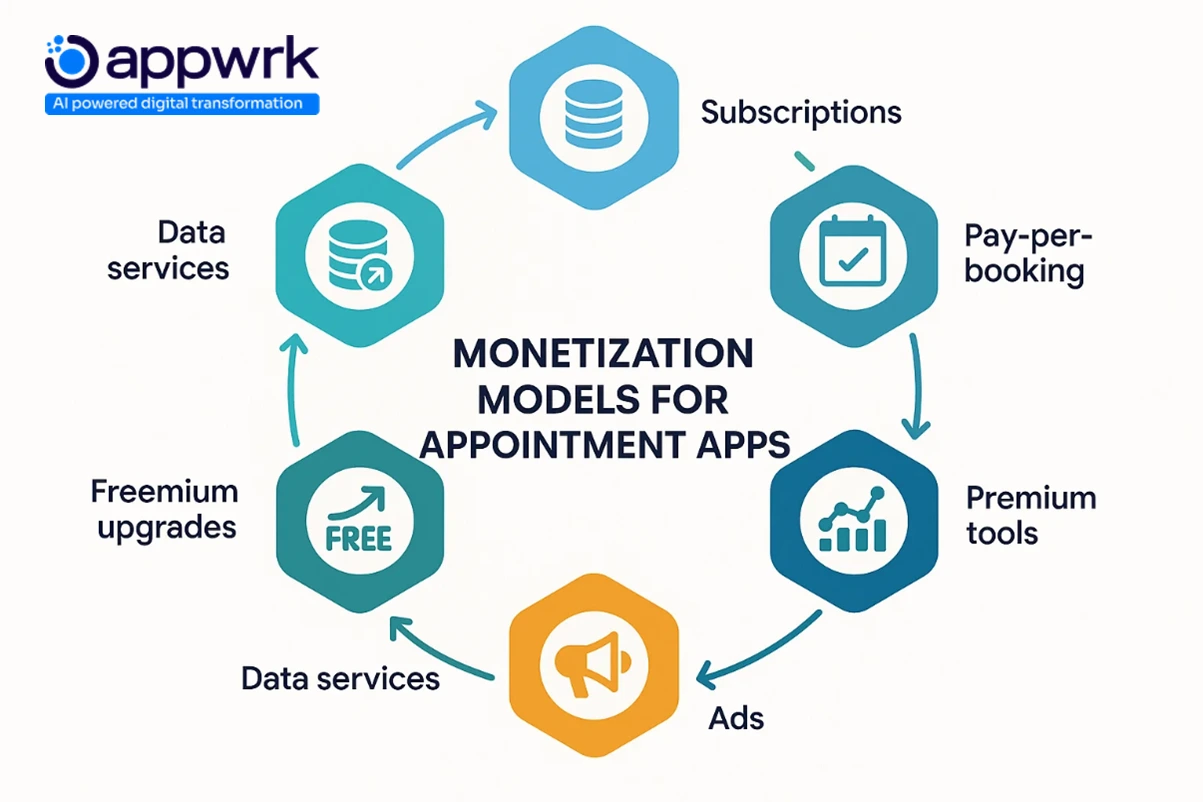
How Does HotDoc Make Money? (Monetisation Models)
If you’re calculating the HotDoc-like app development cost, understanding its revenue model is just as important as the build cost. A healthcare app development company won’t just code your platform; they’ll help ensure it’s financially sustainable. Here’s how apps like HotDoc, Zocdoc, and Doctolib generate steady money:
1. Subscription Fees (Clinic Subscriptions & Practice Portals)
What it is: Clinics pay recurring fees for dashboards, patient portals, and practice management tools.
Why it works: Monetises free users with minimal dev effort.
Caution: Keep ads health-relevant to avoid legal issues.
6. Freemium Model with Paid Upgrades
What it is: Offer free Patient Access tools (like basic booking). Charge for advanced features.
Why it works: Low entry barrier → builds user base → monetisation through upsell.
7. Data & Analytics Services
What it is: Sell anonymised insights (e.g., no-show trends, demand forecasting) to providers and insurers.
Why it works: High-margin revenue, provided you use robust encryption, secure data storage, and audit trails to protect privacy.
Together, these streams create extra money opportunities and steady cash flow, proving that the cost to develop an app like HotDoc is an investment with strong ROI.
What Are the Upcoming Trends in Healthcare Appointment App Development?
The digital health market is moving fast, and keeping up with trends ensures your app remains relevant and scalable.
Integration With Wearables: Pulls vitals and activity data to enrich records and support detailed health analytics.
Virtual Assistants for Clinics: AI chatbots and voice assistants handle scheduling, FAQs, and check-ins, boosting convenience for patients.
Cross-Platform Care Delivery: Appointment flows across web, mobile, and kiosks reduce the gap between patients and providers, enabling efficient patient care.
Why Appwrk Is the Right Partner for Building Your Healthcare Appointment App
Our Track Record
We’ve delivered 50+ healthcare application projects worldwide, helping medical professionals and startups digitise their workflows.
Every app we build follows healthcare regulations. With robust encryption, secure data storage, and audit trails, your platform avoids legal issues while earning patient trust.
Book a Free Product Consultation
Thinking about your own online doctor consultation app?
Get your idea validated by our healthcare application development company.
Understand the real HotDoc app building cost based on your goals.
Receive a free, no-obligation cost estimate tailored to your needs.
FAQs
What is the best way to build a healthcare scheduling app? The best approach is to start with an MVP version of your online doctor appointment app, focusing on core features like booking, Patient Access, and reminders. From there, add custom features such as AI-powered appointment recommendations, telehealth integration, and EHR sync. Following the process of building a healthcare appointment scheduling app step by step helps control costs and ensures scalability.
What tech stack does HotDoc use? HotDoc uses a modern stack including React/React Native for front-end, REST APIs for service and API integrations, secure backend frameworks for robust encryption, and cloud services with scalable databases and load balancing. This combination ensures compliance with healthcare regulations and reliable performance.
How long does it take to build an app like HotDoc? Timelines depend on app complexity and team structure. A basic app takes 5–7 weeks. A fully featured HotDoc-like app development project with EHR integration, telehealth, and compliance modules can take 10–14 weeks, depending on the location of the development team and the scope of custom features.
What is the cost to develop a doctor appointment app? The cost to develop an app like HotDoc starts at $8,000 for a basic MVP and can go up to $25,000–$30,000 for advanced builds with AI features, secure data storage, and compliance with global healthcare regulations. The exact HotDoc app building cost depends on scope, UI design, and backend scalability requirements.
How do you monetise a healthcare scheduling app? The most common models are:
Subscription fees for clinics and practice portals.
Pay-per-booking fees in marketplace setups.
Premium upgrades such as analytics dashboards or telehealth.
Advertising and sponsored listings from insurers.
Data services providing anonymised insights (while ensuring audit trails and privacy).
Can I integrate telehealth into my appointment app? Yes. Using modern APIs, you can add secure video consultations, chat, and e-prescriptions to your doctor application development services. This transforms your platform into an AI-driven healthcare app offering comprehensive patient care.
How much does ongoing maintenance cost for healthcare apps? Expect to spend 15–20% of the total healthcare app development costs annually. This covers server monitoring, App Store and Google Play updates, compliance patching, and bug fixes to ensure efficient patient care and uptime.
What are the must-have features for a HotDoc-like app?
Booking system with automated reminders.
Calendar sync and User-Friendly Interface.
Patient portal/self-service portal for history and records.
EHR integration for collaboration between healthcare providers.
Doctor profiles and a table of doctor lists for transparency.
Together, these form the baseline for any healthcare application development journey, ensuring enhanced patient experiences and long-term adoption.
Gourav Khanna is the Co-founder and CEO of APPWRK, leading the company’s vision to deliver AI-first, scalable digital solutions for enterprises and high-growth startups. With over 16 years of leadership in technology, he is known for driving digital transformation strategies that connect business ambition with outcome-focused execution across healthcare, retail, logistics, and enterprise operations.
Recognized as a strategic industry voice, Gourav brings deep expertise in product strategy, AI adoption, and platform engineering. Through his insights, he helps decision-makers prioritize market traction, operational efficiency, and long-term ROI while building resilient, user-centric digital systems.
Subscribe to APPWRK Blogs, We'll Do the Rest!
Get Blogs on UI/UX, Mobile Apps, Online Marketing, and Web development technology.
Unlock worthy and priceless suggestions from the masters of mobile and web app development