150+ minds across 4 countries. Join a culture of innovation, ownership & growth.
Rewire for AI
From machine learning to deep learning, from classification tools to overall process automation – our AI engineers will help you retool your existing system or enhance your company results.
Ship faster, scale smarter, built for product companies and SaaS teams
Our Latest Work
We strive hard to deliver result-driven digital solutions across the globe. Check out our case studies to get a glimpse of how we ideate, innovate, and create unconventional digital solutions according to the requirements of our clients.
Discover diverse and passionate insights from our tech enthusiasts. We collaborate across various sectors to streamline operations and drive innovation. Explore our rapidly growing collection of articles to see why we’re at the forefront of IT solutions.
The decision to move from Magento to Shopify is one of the most significant replatforming choices an ecommerce business can make. Magento is powerful, but its power comes with...
Accuracy gap is real: Traditional CPG forecasting carries a 25-40% MAPE error rate. AI-powered models bring that down to 8-15%, according to McKinsey research....
Real stories from global leaders who trusted us with their ideas.
Partnering with APPWRK helped us build a compliant and scalable healthcare platform, accelerating our time-to-market by 35%. Their team consistently delivered outstanding work.
Beesers
Digital Healthcare Client
Collaborating with APPWRK, Sportskeeda modernized its platform into a real-time sports engagement ecosystem, enabling seamless content delivery, scalable fan interactions, and high-velocity performance.
Sportskeeda
Sports & Entertainment Partner
Working with APPWRK was effortless. They captured our vision, maintained full compliance, and delivered a digital experience that built trust and elevated how customers interact with our fintech brand.
PayPenny
Fintech Partner
Working with APPWRK gave us confidence in adopting AI responsibly. Their team built a safe, intelligent bot that transformed how we engage with leads and helped us achieve measurable revenue growth.
IFB
AI Transformation Partner
Leveraging APPWRK’s digital expertise, Nemesis launched a scalable, compliant, and safe super app that connects content delivery, real-time communication, and logistics management within a single platform.
Cost to build a last-mile delivery app like Onfleet starts from $25K for basic builds and scales up to $120K+, depending on features like real-time tracking, AI-based dispatch, and GDPR compliance.
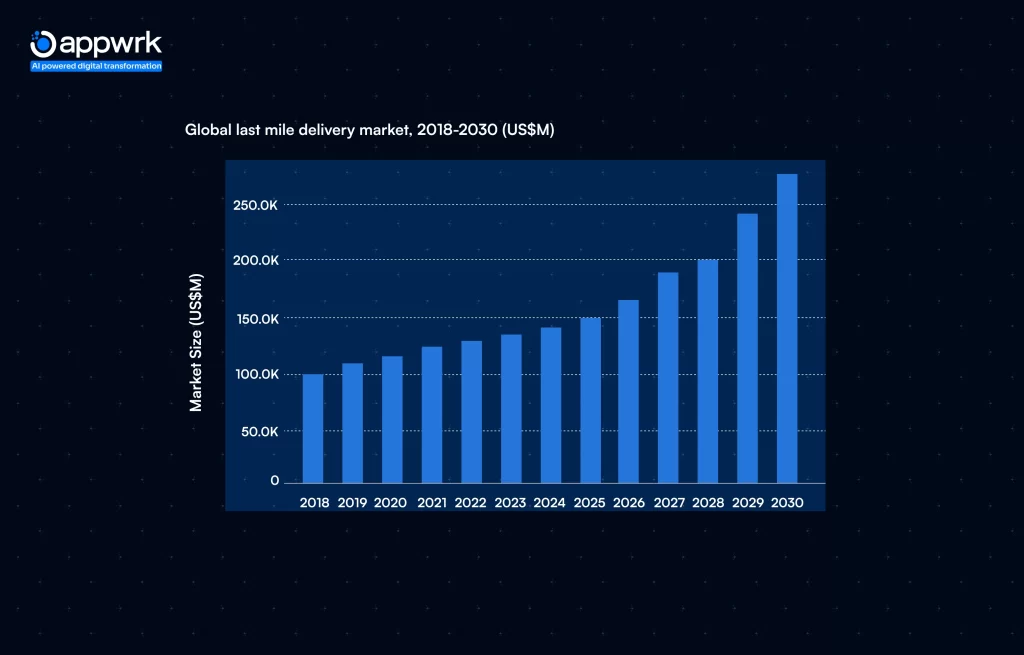
The global last-mile delivery market is projected to exceed $240 billion by 2027, driven by the explosive growth of e-commerce, healthcare, and Q-commerce sectors.
AI and predictive logistics are central to scalable delivery apps, with features like dynamic routing, behavior analysis, and smart dispatch enhancing customer satisfaction and operational ROI.
Compliance with regulations like GDPR, HIPAA, and CCPA is critical when developing delivery platforms, especially in healthcare, retail, and cross-border logistics ecosystems.
Choosing the right tech stack and team model, like Flutter, Firebase, or hybrid development, which directly impacts cost, speed-to-market, and app performance.
This blog is crafted for last-mile delivery CXOs, logistics founders, and product leaders aiming to build or scale an Onfleet-style platform in 2025. Whether you're leading dispatch optimization, geo-routing innovation, or operational compliance, this guide equips you with clarity on delivery tech cost breakdowns, last-mile scalability, and logistics-specific tech architecture.
The Expanding Market for Last-Mile Delivery Apps Like Onfleet
With the rapid rise of e-commerce and growing consumer expectations for faster, more transparent deliveries, the logistics landscape is undergoing a major shift. At the forefront of this transformation are last-mile delivery apps like Onfleet, which simplify the most complex phase of the supply chain, getting goods from distribution hubs to customers’ doorsteps. These platforms enable real-time tracking, intelligent route optimization, and seamless dispatch management, empowering business owners to boost efficiency, reduce costs, and deliver exceptional customer experiences.
According to Statista, the global last-mile delivery market is forecast to expand significantly, growing from approximately 108.1 billion U.S dollars in 2020 to more than 200 billion U.S dollars by 2027. This surge is driven by urbanization, gig economy logistics, and Q-commerce (quick commerce).
Onfleet, with its API-first infrastructure and smart dispatching tools, represents this shift toward intelligent logistics orchestration.
What is Onfleet and why is it a Benchmark in Delivery Tech?
Onfleet is a logistics management platform designed for companies that need to manage local deliveries. It’s known for features like intuitive drag-and-drop dispatching, automated customer notifications, route optimization, and real-time driver tracking.
As of 2025, Onfleet’s mobile driver app is publicly available on Google Play and is actively used by thousands of logistics teams across industries.
What makes Onfleet a benchmark?
Built-in ETA algorithms improve operational efficiency.
Easy API integrations with retail, food, and healthcare systems.
Scalable SaaS pricing tiers for SMBs and enterprises alike.
Real-time analytics for decision-making and compliance.
How Onfleet Helps Businesses
Onfleet isn’t just a delivery platform; it’s a logistics orchestration engine that simplifies operations and enhances customer trust.
Streamlined Dispatching: Businesses can assign tasks and reroute drivers with drag-and-drop ease, even during peak hours.
Real-Time Customer Updates: From dispatch to doorstep, customers receive live SMS alerts, ETAs, and driver tracking.
Branded Delivery Experience: Companies can white-label Onfleet to reflect their identity, building brand trust.
Seamless Integration: The app connects with major CRMs, POS systems, and eCommerce platforms for end-to-end visibility.
Its minimalist UX, mobile-first approach, and analytics dashboard allow even non-tech-savvy teams to launch and scale local delivery ops efficiently.
If you want to build a last-mile delivery app, let’s find out how much it costs to build an app like Onfleet.
How Much Does It Cost to Build a Last-Mile Delivery App Like Onfleet?
Estimating the development cost of a last-mile delivery app like Onfleet involves more than just calculating design and coding hours. According to Gartner, last-mile delivery accounts for 41% of the total logistics cost, making it the most critical and expensive phase of the shipping process. You’re building a logistics engine that must scale, stay compliant, deliver real-time performance, and offer seamless customer experiences. From backend logic to UX clarity, every decision directly influences your final budget.
For startups and enterprises exploring fleet management software development, these cost tiers offer a structured view. Depending on whether you’re looking for an MVP or a market-ready dispatching system, your budget could vary widely.
Here’s how your investment in a delivery app like Onfleet may look, broken down into tiers based on capabilities:
App Tier
Estimated Cost
Core Features
Time to Build
Basic Dispatcher
$25,000-$40,000
Basic UI, driver tracking, manual task assignment, integration with Google Maps
Factors Influencing the Cost of Building an App Like Onfleet
Building a high-performing last-mile delivery app goes far beyond development hours or design tools. The total cost is shaped by a mix of technical, operational, and strategic decisions, from the complexity of your dispatch logic to the platforms you choose and how your app scales under real-world use. If you’re planning to replicate or improve upon Onfleet’s functionality, it’s important to understand where the biggest cost drivers lie and how to prioritize them based on your goals. Let’s break down the key factors that directly impact your development budget and delivery app performance.
1. Team Structure and Expertise
The cost of development significantly varies based on the type of team you assemble. Hiring an in-house team offers high control but can be expensive in regions like North America or Western Europe. Outsourcing to Eastern Europe or South Asia brings down hourly costs but may require more time spent on management and QA.
In-house Teams: Best for long-term scalability and domain control. Comes with high hiring, training, and retention overhead.
Outsourced Teams: Efficient for fixed-scope builds. Lower hourly rates, but needs robust project management.
Hybrid Teams: Blends in-house leadership with offshore execution, ideal for balancing quality with cost.
Expect hourly rates from $30-$80 offshore and $100-$200 for senior developers in the US or UK.
2. App Complexity and Feature Set
The more sophisticated your delivery logic, the higher your app development cost. A basic version of a last-mile delivery app might include task assignments and simple GPS tracking. In contrast, enterprise-grade solutions like Onfleet use AI-driven dispatching, real-time fleet analytics, and predictive ETAs.
Basic Delivery Apps:
These apps typically support manual task assignments, basic GPS tracking, and standard push notifications. They are best suited for small businesses or startups with limited delivery volumes and straightforward logistics requirements.
Advanced Fleet Management Systems:
These solutions go beyond the basics by incorporating machine learning for intelligent dispatching, demand forecasting to optimize resources, and multizone routing to handle complex delivery networks. They are designed for enterprises that require high scalability, automation, and efficiency across large delivery fleets.
Expect a basic MVP to cost around $45K, while a full-featured platform could stretch from $150K to $300K, depending on functionality and scale.
The type of platform you choose, native or cross-platform, impacts not only cost but also time-to-market and app performance. Native apps (iOS and Android) provide a more refined UX but are expensive to develop and maintain. Cross-platform tools like Flutter or React Native can offer up to 40% cost savings while still supporting a native-like experience.
Native: Best for complex, performance-heavy logistics apps where user interaction speed is critical.
Cross-Platform: Ideal for MVPs or mid-sized businesses prioritizing faster rollout with a single codebase.
4. Design and User Experience (UX)
In logistics apps, UX isn’t just about aesthetics; it directly impacts delivery speed and customer satisfaction. Onfleet-style apps need map-centric dashboards, quick-action dispatch tools, and responsive mobile interfaces.
Functional Design: Focuses on driver ease-of-use, dispatcher clarity, and customer transparency.
Custom UX/UI: Increases engagement and reduces training time, especially in high-volume delivery operations.
Expect custom design efforts to cost between $5K-$30K+, depending on depth and detail.
5. Third-Party Integrations
Integrating external tools is essential for real-time logistics workflows. Apps like Onfleet depend on APIs like Google Maps for routing, Twilio for notifications, Firebase for data handling, and Stripe for payment processing.
Essential APIs: Location, messaging, analytics, payment, and CRM syncing.
Integration Complexity: Adds time and QA effort, especially when syncing real-time data across multiple services.
Plan for $8K-$40K in integration costs depending on API licensing and implementation depth.
6. Ongoing Maintenance and Updates
After launch, your delivery app requires continuous support to remain functional, secure, and scalable. This includes addressing user feedback, releasing OS-compatible updates, and ensuring API compatibility.
Versioning & Security Patches: Essential for compliance and uptime.
Feature Rollouts: Adding dynamic pricing, driver analytics, or fleet heat maps based on evolving needs.
Set aside 15–20% of your initial app development cost annually for maintenance.
Step-by-Step Guide to Building a Last Mile App Like Onfleet
According to Gartner, efficient last-mile delivery development hinges not just on code, but on aligning architecture, automation, and business workflows from the start. Building an Onfleet-style app demands a structured roadmap, one that supports operational intelligence, fast dispatch, scalable architecture, and compliance from day one. Whether you’re building for a hyperlocal business or a multi-region logistics operator, this phased approach will ensure both delivery excellence and development efficiency.
1. Requirement Gathering & Planning
This foundational phase sets the direction for the entire logistics application. It involves mapping user personas (admin, driver, customer), system compliance (GDPR, HIPAA), delivery radius, dispatch logic, and expected growth milestones.
Define business models (on-demand, subscription, marketplace).
Map user journeys and flowcharts across all stakeholders.
Align system architecture with fleet scaling goals.
2. UI/UX Design
A clean, intuitive design reduces driver training time and boosts customer trust. Modern last-mile apps must include real-time delivery views, simple order management, and gesture-based actions.
Design mobile-first dashboards with dark/light mode.
Implement minimal interfaces for drivers to reduce distractions.
The engine of your logistics app. It handles task queues, routing algorithms, socket servers for real-time updates, and database triggers for notifications.
Use microservices or serverless architecture for modularity.
Integrate real-time traffic and GPS data processing.
Include multi-tenant support for B2B scalability.
4. Frontend Development
Your front-end should be robust and responsive across platforms. Depending on your strategy, use either native development or cross-platform frameworks like Flutter or React Native.
Enable offline mode for driver interfaces.
Design progressive loading for live tracking screens.
Include real-time syncing via sockets or GraphQL.
5. Testing and QA
Before release, test under load conditions to mimic real-world delivery scenarios. Include edge cases like multi-driver delays, API downtimes, or timezone-related dispatches.
Perform regression and unit testing across all modules.
Run simulation tests for dynamic routing failures.
Conduct security audits for GDPR and payment compliance.
Roll out advanced features like predictive dispatching.
Set up feedback loops and performance-based updates.
User flows, compliance, scaling logic.
Monetization Strategies for a Delivery App Like Onfleet
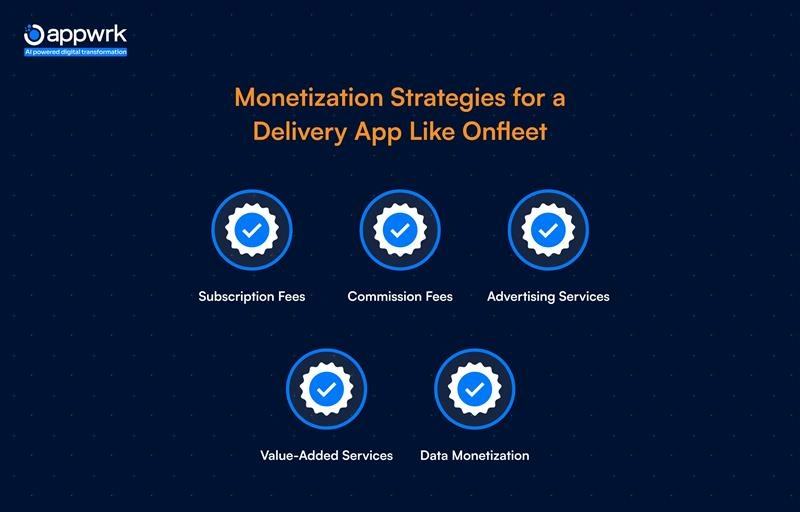
Building a powerful last-mile delivery app is only part of the equation—turning it into a sustainable business requires well-defined monetization strategies. From tiered subscription plans to usage-based pricing and premium integrations, successful platforms like Onfleet combine flexibility with value. These models not only generate recurring revenue but also align pricing with the scale and needs of different customers.
Subscription Fees
Apps modeled after Onfleet typically adopt a tiered subscription structure, charging based on factors like the number of drivers, delivery volume, or access to premium features. This SaaS-based approach ensures predictable monthly recurring revenue and incentivizes users to scale as their operational needs grow.
Commission Fees
Charging a percentage per delivery or per driver login session is common in high-frequency delivery verticals like food or grocery. This aligns revenue with platform activity and is ideal for on-demand economies.
Advertising Services
Delivery platforms can offer promoted placement for merchants or contextual ads within driver apps. Hyperlocal ad targeting within specific geofences boosts brand visibility and monetization potential.
Value-Added Services
These include premium features like real-time heat maps, route analytics, driver-scoring dashboards, and automated dispatch algorithms. Business owners pay extra for modules that reduce labor costs or improve delivery KPIs.
Data Monetization
Aggregated, anonymized delivery data can be sold to retail chains, city planners, or analytics firms. Patterns on delivery speed, driver efficiency, and neighborhood-level logistics become high-value insights.
Disclosing the Hidden Cost to Develop a Last-Mile Delivery App
When budgeting for a logistics or delivery platform like Onfleet, it’s essential to go beyond the surface-level costs of core features and UI development. Many businesses focus heavily on building the MVP but overlook the substantial post-launch investments that follow. These include scaling backend systems, integrating regulatory compliance frameworks, deploying operational tools, and maintaining a reliable customer support infrastructure.
Neglecting these hidden costs can lead to unexpected delays, budget overruns, and compromised service performance, ultimately affecting the app’s stability, user satisfaction, and long-term profitability. Factoring them in early on is key to building a sustainable and scalable logistics solution.
Regulatory Compliance
Compliance with data protection regulations such as GDPR, HIPAA, or region-specific privacy laws is not just a best practice; it’s a legal requirement. Ensuring secure handling of user data, delivery records, and real-time tracking involves robust encryption, user consent protocols, and audit-ready system architecture. These measures typically add 10-15% to overall development costs, but they are critical for maintaining trust and avoiding legal or financial penalties.
Infrastructure Scaling
As your delivery network scales, you’ll need more robust cloud infrastructure to manage real-time tracking, routing, and dispatch logic. This includes dynamic load balancing, autoscaling fleet management servers, and CDN integrations to ensure responsiveness across regions. Expect $1K-$4K per month, depending on order volume and geographic spread.
Bug Fixes & Patches
No delivery app remains static. Regular OS updates, mapping API changes, and evolving driver-side requirements demand continuous upkeep. This may cost $5K-$15K annually, especially in live environments where downtime impacts delivery accuracy and customer satisfaction.
Support Systems
Delivering an enterprise-grade logistics experience means integrating in-app driver chat, CRM sync tools for dispatch teams, and ticketing workflows for customer issues. These increase both development cycles and operational manpower, often overlooked in early-stage planning for Onfleet-style solutions.
Security Audits & Penetration Testing
Particularly critical for delivery apps managing customer addresses, real-time geolocation, and payment processing. Quarterly or biannual audits by certified professionals are essential for breach prevention and compliance certifications, especially when handling sensitive logistics data.
Proactively accounting for these hidden costs enables smoother scaling, ensures stakeholder confidence, and avoids budget overruns during high-demand rollouts. A well-planned last-mile delivery app like Onfleet thrives not just on its feature set but on operational foresight and long-term resilience.
Cost Comparison: Onfleet vs. DoorDash vs. Instacart vs. Gopuff
To make informed development decisions, it’s crucial to benchmark Onfleet against other major players in the last-mile and delivery tech space. Whether you’re building a logistics app for food delivery, retail, or fleet operations, comparing key cost drivers like platform complexity, market focus, and customization potential helps align the budget with the product vision. This table offers a quick snapshot of how Onfleet fares in comparison to peers like DoorDash, Instacart, and Gopuff.
Platform
Target Market
Avg. Build Cost
Tech Complexity
Customization
Onfleet
B2B Logistics
$25K-$40K
High
High
DoorDash
Food Delivery
$40K-$70K
Very High
Medium
Instacart
Grocery
$35K-$60K
High
Medium
Gopuff
Instant Retail Delivery
$60K-$90K
Very High
Low
Key Legal and Regulatory Frameworks for Last Mile App Development
As highlighted in this ResearchGate study, legal frameworks for last-mile technology are rapidly evolving, especially with the introduction of automation and cross-border operations. Operating in the logistics space means navigating a patchwork of legal and compliance regulations that vary by region and vertical. For any Onfleet-style last-mile delivery app, overlooking legal compliance can delay launches, expose your business to litigation, or result in significant financial penalties.
From data protection to labor laws, each jurisdiction introduces different standards. Logistics platforms built for cross-border operations, healthcare, or retail delivery must be proactively designed to adhere to both global and local mandates.
Data Protection (GDPR, CCPA, HIPAA)
If your app collects personally identifiable or health-related information, strict data protection regulations apply. The GDPR, for instance, mandates explicit consent and secure data handling, with non-compliance leading to fines of up to €20 million or 4% of global turnover.
eCommerce and Delivery Licensing
Some regions require formal permits for third-party logistics operators, freight carriers, or white-label eCommerce fulfillment. Failing to register or meet commercial transport criteria can suspend operations. To ensure your delivery management software meets cross-regional standards, a secure logistics infrastructure with built-in HIPAA/GDPR compliance is essential for regulated sectors like healthcare and finance.
Labor Classification Laws
If you use independent contractors (e.g., drivers), you’ll need clear documentation and classification protocols. Mislabeling them as freelancers when they qualify as employees can result in back-pay lawsuits, taxes, and legal sanctions.
Consumer Rights Regulations
Countries enforce varying rules on refunds, delivery failure penalties, and returns. Apps must include transparent return policies, digital receipts, and automated refund mechanisms to stay compliant.
Insurance and Liability
Logistics businesses must carry appropriate general liability, cargo insurance, and driver coverage. These legal protections are often mandatory to secure contracts with retail or food chains.
Challenges in Developing Onfleet-Like Delivery Apps
Developing a last-mile delivery app similar to Onfleet presents several practical challenges that go beyond basic app development. These include ensuring real-time data accuracy, maintaining system performance at scale, complying with industry regulations, and integrating with third-party logistics tools. Each of these areas requires careful planning and technical expertise, particularly when building for enterprise use.
Real-Time Logistics Mapping
Maintaining GPS accuracy is crucial for real-time visibility. GPS tracking accuracy and delivery location mapping are vital in providing consistent live tracking, especially when building a last mile delivery app for high-volume operations. However, GPS drift, poor signal zones, and latency in updates can skew delivery routes and mislead dispatchers or customers. Addressing this often involves building fallback logic and multi-source geolocation support.
User Experience Balancing
A last-mile platform serves dispatchers, drivers, and end-customers, all of whom require different features and interfaces. Ensuring a seamless experience across roles without creating UI bloat or confusion takes careful UX strategy and prototyping. A mobile-first design and user-friendly interface ensure the mobile logistics software remains intuitive for both drivers and dispatchers, even under peak load.
API Rate Limits & Dependency on External Services
Tools like Google Maps, Twilio, and Firebase have usage thresholds. High-volume operations can easily cross free-tier limits, leading to throttling or increased operational costs. Building caching systems and fallback mechanisms is essential. Cloud-based delivery solutions and scalable backend infrastructure can reduce API-related downtime in last mile delivery apps.
Data Privacy & Compliance
Especially in sectors like healthcare or cross-border logistics, maintaining HIPAA, GDPR, or CCPA compliance is non-negotiable. Any personal or location data shared must be encrypted, access-controlled, and audit-ready.
Scalability Under Peak Load
During flash sales, holidays, or grocery delivery surges, platforms can see 10x traffic spikes. Without elastic infrastructure and real-time load balancing, app performance and delivery SLAs can collapse. Logistics app development must incorporate elastic architectures and dispatch automation to support delivery platform scalability during Q-commerce or flash sales surges.
Each of these challenges, while significant, can be mitigated through robust planning, microservice architecture, cloud scalability practices, and proactive legal alignment.
Future of Last-Mile Delivery Apps Like Onfleet
The next wave of innovation in last-mile logistics won’t be defined by speed alone; it will be shaped by intelligence, flexibility, and sustainability. As cities become smarter and delivery networks more dynamic, platforms like Onfleet are evolving into strategic ecosystems. They’re beginning to integrate autonomous tech, predictive analytics, and carbon-efficient routing, not just to deliver faster, but to deliver smarter in a rapidly changing world.
Drone and Autonomous Delivery Integration
Autonomous delivery mechanisms like drones and robots are pushing the boundaries of urban logistics. These tools offer safe, contactless, and high-frequency delivery, especially effective in dense cityscapes or remote areas.
AI-Based Dispatch with Traffic Prediction
Leveraging AI for dispatch not only reduces human error but also enhances delivery precision. Machine learning models assess traffic patterns, weather data, and fleet load in real-time, allowing for predictive rerouting and workload balancing. AI-powered route optimization and demand forecasting help logistics delivery apps maintain efficiency during fluctuating delivery volumes.
Gamified Driver Performance Systems
By introducing gamification, platforms can enhance driver motivation and reduce turnover. Besides, gamified driver analytics and driver performance dashboards are becoming must-have features in modern delivery apps like Onfleet. Systems that reward speed, accuracy, and customer satisfaction help build high-performing delivery teams.
Decentralized Warehousing Coordination
As logistics moves toward micro-fulfillment, AI-powered coordination among smaller urban hubs ensures faster last-mile fulfillment and optimized inventory distribution. Micro-fulfillment centers are central to today’s supply chain management and are easily coordinated using a scalable logistics app.
How AI Can Enhance Last-Mile Delivery Apps Like Onfleet
Artificial Intelligence is transforming last-mile delivery from a reactive process into a proactive, precision-driven system. For platforms like Onfleet, AI doesn’t just optimize routes—it predicts demand, adapts to real-time conditions, and personalizes the customer experience. As delivery volumes grow and expectations rise, AI becomes the key to scaling intelligently without sacrificing efficiency or control.
Dynamic Route Optimization
AI analyzes traffic, delivery deadlines, driver location, and road incidents to continuously update the most efficient delivery path. This feature alone can reduce delivery time by up to 25%. When building a delivery app, predictive ETAs and automated route planning enhance delivery accuracy and reduce operational costs.
Predictive Demand Forecasting
Based on historical order data, current trends, and even external events like weather or holidays, AI predicts demand spikes. This helps business owners prepare staffing and inventory in advance. Logistics architecture with embedded demand forecasting and inventory tracking improves delivery precision across gig economy logistics models.
Driver Behavior Analysis
Beyond tracking speed or delivery counts, AI evaluates route choices, braking patterns, and customer feedback to generate behavioral scores. These insights are used to reward, train, or reassign drivers. A driver tracking system backed by behavior analysis and CRM sync enables business owners to optimize delivery management software in real time.
Smart Dispatching
AI matches delivery jobs to the most suitable drivers by evaluating parameters such as proximity, workload, past performance, and vehicle type, enhancing speed and customer satisfaction. Mobile logistics software with smart dispatching and drag-and-drop dispatching features delivers faster routing and intuitive fleet coordination.
Real-Time Exception Handling
AI models detect anomalies like route deviations, delayed stops, or failed deliveries. They instantly trigger corrective actions or notify support teams, ensuring service continuity. Real-time exception handling paired with proof of delivery and customer support systems enhances the delivery experience across e-commerce delivery software platforms.
AI is not just improving logistics; it’s enabling predictive, efficient, and scalable delivery ecosystems. Platforms that embrace it are far more likely to thrive in the next decade.
How APPWRK Can Help in Last-Mile Delivery App Development
APPWRK is a trusted mobile app development company with deep expertise in building intelligent logistics platforms tailored for last-mile delivery ecosystems. From complex dispatching logic to secure compliance architectures, we focus on building scalable apps that can perform under high-traffic logistics workflows.
Drawing from our global FMCG logistics case study, we helped a Fortune-ranked company streamline last-mile operations, reducing delivery turnaround times by 32% and missed dispatches by 47%. Our approach to logistics app development focuses on modular dispatch systems, mobile-first user experience, and secure compliance architecture.
Scalable logistics architectures Modular codebases for rapid deployment, geo-zonal routing, and real-time driver tracking.
Smart integrations with mapping and dispatch APIs Integration with Google Maps, Twilio, Firebase, and advanced routing engines. APPWRK ensures seamless integration with third-party services like payment gateways, live tracking tools, and inventory management systems.
MVP in under 4 weeks Agile execution with weekly sprints to validate product-market fit with early adopters. Whether you’re launching an MVP delivery app or an enterprise delivery solution, we ensure cost-effective execution with industry-best practices.
Security and Compliance by Design
Built-in GDPR, HIPAA, and SOC2 readiness with automated security workflows.
We begin each project with a strategic consultation to align delivery workflows, region-specific regulations, and tech stack preferences. Our dedicated logistics teams ensure your product is built to scale and ready for market launches. We also help you estimate Onfleet app development cost, timeline, and compliance audits based on your business model and region.
👉 Connect with us today to accelerate your Onfleet-style delivery app vision without overrunning your development budget.
With a solid track record in real-time logistics platforms, APPWRK brings:
120+ mobile apps deployed across logistics, healthcare, and e-commerce.
95% client retention over 3+ years. From fleet management app design to cross-platform app development using Flutter or React Native, we tailor each solution for optimal performance and compliance.
Dedicated UX and backend teams for dispatch-heavy platforms.
Security-first approach with GDPR and HIPAA compliance.
How much does it cost to build a last-mile delivery app like Onfleet? Costs range from $25,000 for a basic MVP to $120,000+ for full-featured enterprise apps. Pricing depends on dispatch complexity, integrations, and platform scalability. The total cost to build delivery app solutions can also include mapping services, software engineers’ hours, and backend infrastructure scaling.
How long does it take to develop a logistics app similar to Onfleet?
Generally, timelines depend on the app’s scope and complexity. A basic version with core features like task assignment and GPS tracking can take around 2-3 months. However, building a robust, regulation-compliant platform with advanced features like AI dispatching, real-time analytics, and third-party integrations typically takes 5-9 months.
What features define a successful last-mile delivery app in 2025? Critical delivery app features like real-time tracking, smart route optimization, and a scalable dispatch system ensure long-term success.
Can I build a delivery app using Flutter or React Native? Absolutely. Flutter and React Native are ideal for cross-platform development, helping reduce cost and timeline without sacrificing performance.
Which industries benefit the most from Onfleet-style logistics apps? E-commerce, healthcare, grocery, B2B logistics, and quick commerce firms leverage these platforms for streamlined dispatch and real-time visibility.
What are the hidden or unexpected costs in logistics app development? Beyond dev time, expect costs for compliance audits, cloud scaling, API licensing, bug patches, and infrastructure upgrades.
Can I get a custom quote for my logistics app idea? Yes, we offer tailored consultations to align features, scale, and compliance needs. Connect with our team here for a detailed quote.
Gourav Khanna is the Co-founder and CEO of APPWRK, leading the company’s vision to deliver AI-first, scalable digital solutions for enterprises and high-growth startups. With over 16 years of leadership in technology, he is known for driving digital transformation strategies that connect business ambition with outcome-focused execution across healthcare, retail, logistics, and enterprise operations.
Recognized as a strategic industry voice, Gourav brings deep expertise in product strategy, AI adoption, and platform engineering. Through his insights, he helps decision-makers prioritize market traction, operational efficiency, and long-term ROI while building resilient, user-centric digital systems.
Subscribe to APPWRK Blogs, We'll Do the Rest!
Get Blogs on UI/UX, Mobile Apps, Online Marketing, and Web development technology.
Unlock worthy and priceless suggestions from the masters of mobile and web app development