150+ minds across 4 countries. Join a culture of innovation, ownership & growth.
Rewire for AI
From machine learning to deep learning, from classification tools to overall process automation – our AI engineers will help you retool your existing system or enhance your company results.
Ship faster, scale smarter, built for product companies and SaaS teams
Our Latest Work
We strive hard to deliver result-driven digital solutions across the globe. Check out our case studies to get a glimpse of how we ideate, innovate, and create unconventional digital solutions according to the requirements of our clients.
Discover diverse and passionate insights from our tech enthusiasts. We collaborate across various sectors to streamline operations and drive innovation. Explore our rapidly growing collection of articles to see why we’re at the forefront of IT solutions.
The decision to move from Magento to Shopify is one of the most significant replatforming choices an ecommerce business can make. Magento is powerful, but its power comes with...
Accuracy gap is real: Traditional CPG forecasting carries a 25-40% MAPE error rate. AI-powered models bring that down to 8-15%, according to McKinsey research....
Real stories from global leaders who trusted us with their ideas.
Partnering with APPWRK helped us build a compliant and scalable healthcare platform, accelerating our time-to-market by 35%. Their team consistently delivered outstanding work.
Beesers
Digital Healthcare Client
Collaborating with APPWRK, Sportskeeda modernized its platform into a real-time sports engagement ecosystem, enabling seamless content delivery, scalable fan interactions, and high-velocity performance.
Sportskeeda
Sports & Entertainment Partner
Working with APPWRK was effortless. They captured our vision, maintained full compliance, and delivered a digital experience that built trust and elevated how customers interact with our fintech brand.
PayPenny
Fintech Partner
Working with APPWRK gave us confidence in adopting AI responsibly. Their team built a safe, intelligent bot that transformed how we engage with leads and helped us achieve measurable revenue growth.
IFB
AI Transformation Partner
Leveraging APPWRK’s digital expertise, Nemesis launched a scalable, compliant, and safe super app that connects content delivery, real-time communication, and logistics management within a single platform.
The cost to build a telemedicine app is 30,000$. But it goes as low as $25K for MVP builds and scales to 150K to $250K+ for full-featured platforms with AI capabilities and HIPAA/GDPR compliance.
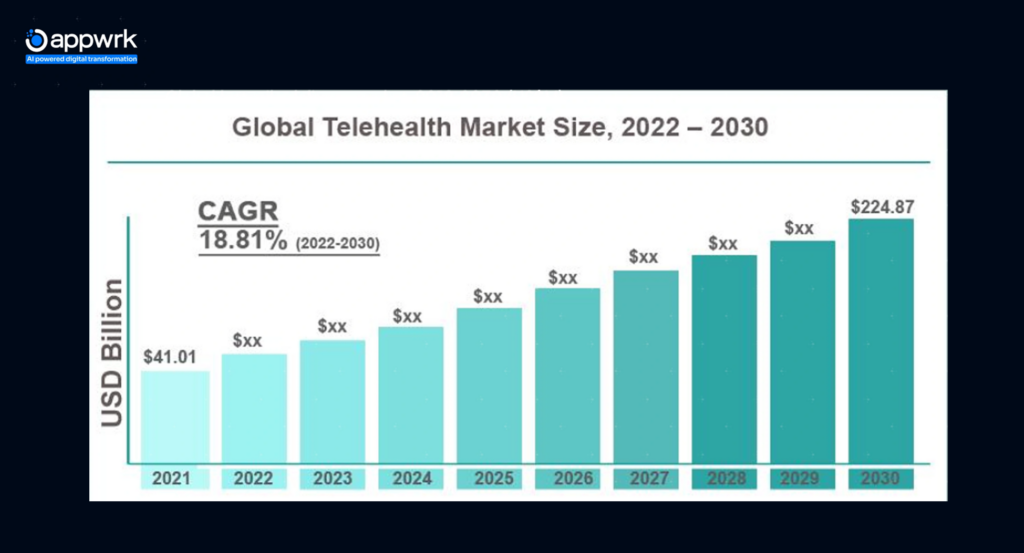
The global telemedicine market is projected to grow from $1.1 billion in 2022 to $5.5 billion by 2027, driven by rising demand for remote care, digital diagnostics, and scalable virtual health solutions.
AI capabilities such as symptom triage, predictive adherence, and real-time remote monitoring are becoming critical differentiators in next-gen telehealth apps.
Ensuring HIPAA, GDPR, and regional licensing compliance is non-negotiable, especially when handling sensitive patient data across the US and international jurisdictions.
Choosing the right tech stack, such as React Native, Node.js, Twilio, and AWS, directly impacts development speed, cost-efficiency, and future scalability.
This blog is tailored for healthcare founders, product leads, and digital health innovators planning to launch or scale a compliant, investor-ready telemedicine app. From cost planning and feature prioritization to regulatory strategy and AI integration, it equips you with actionable insights for building a secure, scalable, and future-ready virtual care platform.
How Telemedicine App Development Costs Scale Over Time
In today’s fast-evolving digital healthcare landscape, understanding the cost dynamics of telemedicine app development is essential for more than just accurate budgeting; it’s fundamental to building a scalable, regulation-ready business. Whether you’re a business owner or investor, long-term success hinges on aligning capital deployment with key product milestones, compliance requirements, and user engagement strategies. By mapping costs to growth stages, you ensure that each investment fuels meaningful progress, minimizes financial risk, and supports a sustainable path to market leadership.
Every telemedicine platform starts as an idea, but what transforms it from a hobby project into a scalable product is the right timing and proper capital alignment. Here’s a strategic breakdown of how the development phases typically unfold:
Development Stages with Estimated Cost Ranges:
The Cost to build a telemedicine app is 30,000$. But it goes as low as $25K for MVP builds and scales to 150K to $250K+ for full-featured platforms with AI capabilities and HIPAA/GDPR compliance.
Core MVP
In the Core MVP phase, usually ranging from $25K to $150K, development centers on essential features needed to validate market demand. You’ll launch with key functionalities like scheduling, secure messaging, payments, video consultations, and limited EHR access. This streamlined approach enables a fast, cost-effective entry into the telemedicine market, ideal for early-stage testing and iteration.
Growth Stage
As you transition to the Growth Stage, requiring an investment of around $150K-$250K, early feedback is used to guide product enhancements. Once it validates traction, adding AI-powered symptom checkers, analytics dashboards, or multilingual support expands reach and usability. These additions align with patient engagement strategies and broader digital health transformations.
Full Scale
Full-Scale phase, with budgets starting from $250K and beyond, your platform becomes a complete telehealth ecosystem. It integrates IoT wearables, virtual waiting rooms, pharmacy APIs, and insurance claim flows. These transform the app from a digital front desk to a full-blown remote care ecosystem, supporting scalability and future-ready telehealth delivery.
What Defines a Telemedicine App and Why It Matters to Investors
Telemedicine apps have evolved from digital communication tools into a full-fledged healthcare infrastructure. For US-based investors, these platforms represent scalable, revenue-yielding assets combining clinical utility with modern tech innovation.
According to a Gartner healthcare innovation report, strategic investment in scalable digital platforms like telemedicine will remain central to the modernization of care delivery (Gartner).
A telemedicine app functions as a virtual care delivery system, enabling secure, remote interactions between healthcare providers and patients. These apps operate across real-time (synchronous), store-and-forward (asynchronous), and remote patient monitoring frameworks.
Key capabilities of a comprehensive telemedicine app include:
Appointment scheduling and calendar integrations
Encrypted messaging between patients and providers
High-definition video, audio, and chat consultations
Access to Electronic Health Records (EHR)
E-prescription generation and pharmacy integrations
AI-driven virtual assistants for symptom analysis
Multilingual access for cross-regional usability
Insurance API connections for seamless claims
Modern telemedicine apps are also architected with compliance layers for HIPAA, HITECH, and US data protection mandates. Platforms that prioritize data protection, uptime reliability, and scalable infrastructure can reduce risk and unlock higher valuation multiples.
With over $29 billion invested in US digital health startups in 2021 alone (Statista) and continued momentum post-pandemic, telemedicine apps are now core pillars in every forward-looking healthtech portfolio.
Telemedicine App Feature Strategy: Scalable Roadmap for Cost and Capability Growth
Let’s face it, success in digital health doesn’t come from launching every feature at once; it comes from launching the right features at the right time. A structured feature roadmap helps you balance clinical impact, user experience, and investor expectations. By aligning functionality with each stage of capital deployment, from MVP to growth, you stay lean, responsive, and outcomes-focused. This approach not only accelerates time-to-market but also builds a stronger case for long-term ROI.
Core MVP Features (Essential to Launch)
These are foundational features required to test your product-market fit and go live with a secure, regulation-ready telemedicine experience. Their lean footprint ensures faster time-to-market and lower development costs.
User Registration & Authentication: Enables secure, HIPAA-compliant onboarding with role-based access control.
Appointment Scheduling: Supports time zone-aware calendar bookings, availability syncing, and automated reminders.
Secure Messaging: Facilitates encrypted real-time communication between patients and providers.
Video Conferencing: Delivers high-quality virtual consultations with adaptive streaming for varying network conditions.
Payment Integration: Seamless transactions through Stripe, PayPal, or Braintree for consultation fees and service charges.
Push Notifications: Keeps users engaged with timely alerts for bookings, status updates, and follow-ups.
Growth-Oriented Features (Market Expansion)
After validating demand, the next layer of features enhances user engagement, accessibility, and value-added diagnostics. These features are aligned with AI, multilingual usability, and dynamic care delivery.
AI-powered Symptom Checker: NLP-based diagnostic bots to triage patient symptoms before appointments.
Multi-Language Support: Expands access across patient demographics.
Virtual Waiting Room: Keeps users engaged while they await consultations.
End-to-End Data Encryption: Enhances compliance and data privacy.
Scale Differentiators (Long-Term Growth & Value Add)
High-value integrations for enterprises, insurers, and hospitals that redefine platform potential as a full-stack healthcare ecosystem.
Remote Patient Monitoring: Integrates with wearables or IoT sensors to stream vitals in real-time.
Family Member & Caregiver Access: Proxy access models for dependents.
SOS and Emergency Access Button: 1-tap escalation to emergency responders.
Mental Health Teletherapy Modules: Built-in mental health scheduling, AI support, and session logs.
Each layer is an investment curve enabler, adding both vertical (depth of services) and horizontal (audience and coverage) scalability. When designed with modular architecture, these features allow MVPs to evolve without redundant rebuilds.
Strategic Tech Stack: Choosing the Right Technologies for Scalable Telemedicine Apps
Selecting the right technology stack for telemedicine app development is more than a technical decision; it’s a strategic move that shapes the app’s scalability, regulatory compliance, and performance. A robust, well-integrated stack empowers developers to accelerate development, meet standards like HIPAA, and deliver seamless, real-time care experiences.
Frontend Technologies
React Native: Offers cross-platform compatibility and accelerates development by 30-40%, making it ideal for MVPs.
Flutter: Known for native performance and expressive UI design, backed by a strong developer community.
Backend Frameworks
Node.js: Best for real-time interactions, such as chat and streaming.
Python with Django: Offers advanced security and supports AI-driven features like symptom checkers and recommendation engines.
Real-Time Communication APIs
Twilio: Provides secure, HIPAA-compliant communication APIs with global reach.
Agora: A cost-effective solution that handles high-concurrency video and audio calls with low latency.
Databases
PostgreSQL: Excellent for structured health data and regulatory reporting.
MongoDB: Flexible schema ideal for unstructured chat logs and remote monitoring data.
Cloud Hosting and Infrastructure
AWS or Google Cloud Platform (GCP): Offers scalable infrastructure with security features like IAM, backups, and DDoS protection. Estimated annual cost: $8K-$15K.
Compliance and Security Tooling
Auth0: Manages OAuth, SSO, and multifactor authentication.
AWS Shield and CloudTrail: Provide advanced threat detection and audit logging required for GLBA/HITRUST.
Analytics and QA
Mixpanel & Amplitude: Event-based analytics for tracking user flow and feature adoption.
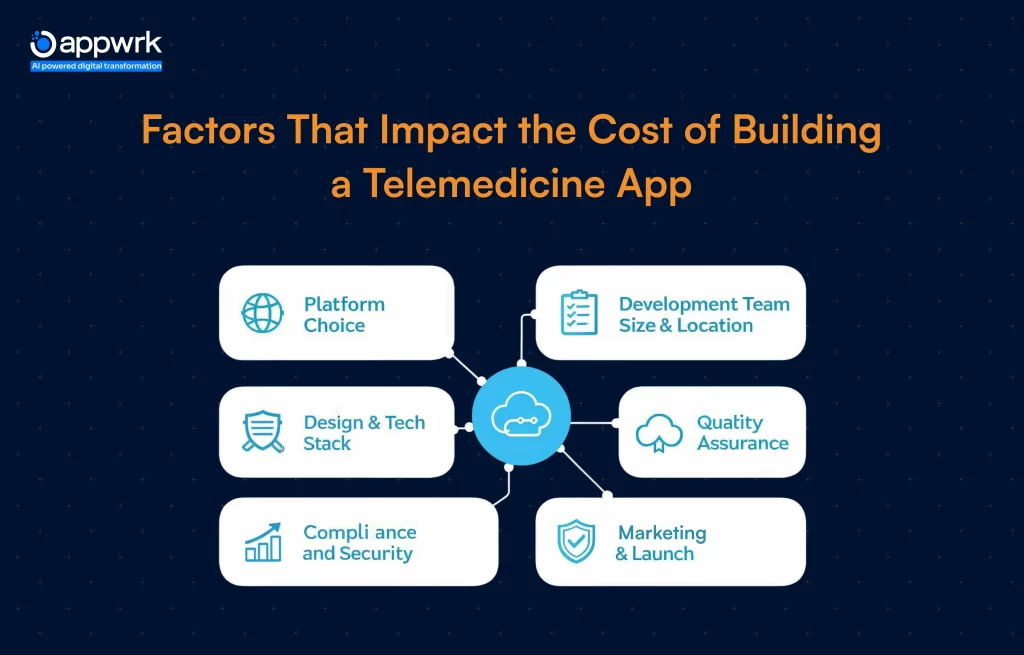
Factors that Impact the Cost of Building a Telemedicine App
Estimating the real cost of building a telemedicine platform goes beyond surface-level hourly rates. As highlighted in Gartner’s How to Estimate Mobile App Development Costs, hidden drivers such as cloud infrastructure, compliance frameworks, testing layers, and post-launch upgrades often define long-term ROI. This section dives into the capital-impacting variables, mapped to technical, legal, and operational needs, which can shape the trajectory of your virtual care product.
Understanding the real drivers of cost helps business owners avoid hidden expenses and allocate capital more effectively. Instead of fixating solely on hourly rates, a smarter approach looks at the bigger picture, factoring in infrastructure, regulatory compliance, and long-term scalability to build a sustainable telemedicine solution.
Platform Choice
Choosing between iOS, Android, or cross-platform frameworks like Flutter or React Native determines both development timelines and user reach. Native apps often provide better performance but require dual investments, while cross-platform options reduce build time and cost but may limit access to OS-specific features.
Development Team Size & Location
The hourly rate for development significantly varies based on geography. In the US, expect to pay between $120-180/hr, whereas in Europe, it’s $50-80/hr, and in India, $30-50/hr. Larger teams accelerate delivery but increase overheads, while smaller or offshore teams lower costs but may impact communication and project velocity.
Design & Tech Stack
Sophisticated UI/UX design and a robust tech stack affect both usability and cost. Custom illustrations, motion design, or responsive layouts demand additional effort. Similarly, backend choices like Python for AI modules or Node.js for real-time comms influence scalability and dev cycles.
Compliance and Security
Telemedicine apps must adhere to HIPAA, GDPR, and sometimes HITECH regulations. Implementing data encryption, multi-factor authentication, and compliance audits adds to the cost but protects against legal and reputational risks.
Hosting on AWS or Google Cloud incurs ongoing costs for data storage, bandwidth, and security. Depending on traffic and uptime needs, annual infrastructure expenses range from $8K to $15K, including CDN and DDoS mitigation.
Maintenance & Upgrades
Ongoing costs typically comprise 15-20% of your total yearly development budget. These include bug fixes, OS compatibility updates, security patches, and iterative feature additions to retain user engagement.
Quality Assurance
Automated and manual QA processes ensure app stability, data integrity, and performance. Investing in robust QA prevents user churn and compliance violations, particularly under clinical use cases.
Marketing & Launch
Your budget should also account for acquisition funnels, App Store Optimization (ASO), ad spend, and user onboarding strategies. Early visibility efforts can cost $10K-50K, depending on target geography and competition.
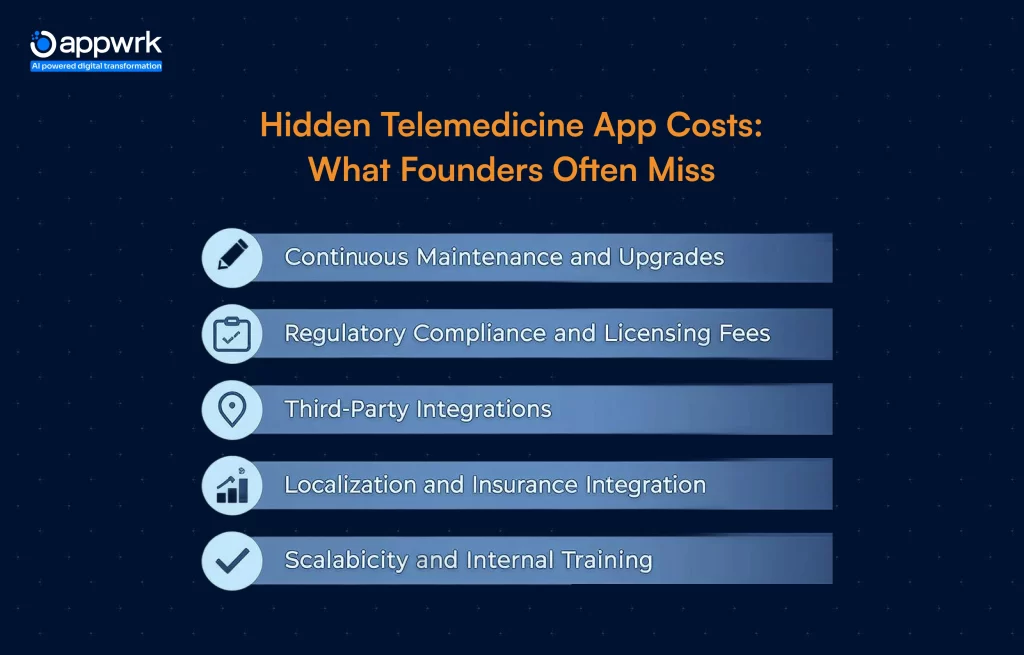
Hidden Telemedicine App Costs: What Businesses Often Miss
Building a telemedicine app involves far more than coding and UI design. While development costs take center stage, the true budget impact often lies beneath the surface. Businesses frequently underestimate or overlook essential expenses tied to compliance (like HIPAA or GDPR), cloud infrastructure, ongoing security audits, legal consultations, and third-party integrations.
These hidden costs can quietly erode runway, delay launch, or even jeopardize regulatory approval. Understanding and planning for these operational and compliance-driven expenses is critical to maintaining momentum, investor trust, and long-term platform viability.
Continuous Maintenance and Upgrades
Post-launch maintenance can consume up to 20% of your annual development cost. These include operating system updates, third-party library changes, security patches, performance monitoring, and iterative feature improvements. Regular upgrades are vital to sustain HIPAA compliance and avoid functionality decay.
Regulatory Compliance and Licensing Fees
Beyond HIPAA and GDPR compliance, different US states have specific telemedicine regulations. Costs can include recurring audits, legal consultations, or licensing from regulatory boards. HIPAA auditors and compliance consultants charge anywhere from $5,000 to $20,000 per cycle.
Third-Party Integrations
APIs like Twilio, Stripe, and Agora come with usage-based or monthly license fees. These third-party services may offer compliance and ease of implementation, but cumulatively, they add to recurring costs. Budget for $1,000-$5,000/month based on usage.
Localization and Insurance Integration
Customizing language, currency, and insurance claim modules for different US states or regions involves extra dev hours and testing cycles. Integrating Medicare/Medicaid APIs or private insurance systems can add $10K-$25, depending on scope.
Scalability and Internal Training
Scalable DevOps architecture (CI/CD, containerization) adds upfront costs but reduces future downtime. Internal team training, documentation for onboarding clinicians, and knowledge transfer also add non-dev expenditures. Plan for $5K-$15K, depending on the complexity of deployment and team size.
MVP Development for Telemedicine Apps: Optimizing Time, Cost, and Compliance
For early-stage startups entering the digital healthcare ecosystem, building a Minimum Viable Product (MVP) is a strategic way to validate market fit, demonstrate traction to investors, and launch faster without burning through full-scale budgets.
A well-executed MVP lets you launch with core telemedicine functionalities while preserving architectural flexibility for future growth. Here’s a breakdown of how the MVP development process looks in real-world healthcare tech environments:
Development Timeline
Most telemedicine MVPs can be built and launched within 3-5 months, provided a lean, cross-functional team and agile sprints are in place. This time frame allows for secure integrations, patient-provider workflows, and HIPAA audits to be completed effectively.
Team Composition
The ideal MVP team includes:
1 Project Manager to oversee compliance and timelines
2 Developers proficient in cross-platform frameworks and backend integrations
1 QA Engineer for testing HIPAA workflows and secure communications
1 DevOps Specialist to manage CI/CD pipelines, cloud hosting, and secure deployments
Estimated Budget
Telemedicine MVPs typically cost between $25K and $150K, depending on scope, region, and feature complexity. This budget includes cloud infrastructure, API usage, compliance setup, and post-launch support for up to 3 months.
Tech Stack Selection
To maximize cost-efficiency and scalability:
Frontend: React Native for 30-40% faster development across iOS and Android
Backend: Node.js for real-time features, or Django for faster compliance handling
Database: PostgreSQL for structured EHR data storage
Integrations: Twilio (secure messaging/video), Stripe (payments), and secure cloud (AWS/GCP)
Compliance Measures
HIPAA compliance is non-negotiable in US telemedicine. Early-stage apps should invest in the following:
End-to-end encryption (E2EE)
Role-based access controls
Secure cloud storage (e.g., AWS S3 with HIPAA BAA)
Automated audit logging
These components ensure the MVP doesn’t just meet technical specs, but aligns with healthcare-grade operational rigor.
Telemedicine App Monetization Strategies: How to Turn Product into Profits
Effective monetization defines the long-term sustainability of your telemedicine platform. Businesses must align revenue models with user engagement, payer systems, and regulatory environments. A well-structured monetization framework helps position the platform not only as a care tool but as a scalable business. The following monetization strategies are among the most common and viable in US healthcare tech startups.
MonetizationModels
Description
Typical % of Revenue
Subscription Plans
Monthly or annual fees for patients or providers to access services
40-60%
Fees
Pay-per-use or per-consultation charges, especially across specialties
30-50%
Licensing
White-labeling your tech for hospitals or clinics as a SaaS model
20-40%
Advertisements
Targeted healthcare or wellness-related ads within the platform
5-10%
Each model has its pros and regulatory implications. Subscription-based revenue offers predictable cash flow but may limit reach if pricing is too high. Transaction fees work well for high-frequency use but require tight integration with payment and compliance systems. Licensing supports B2B expansion while ads require rigorous content vetting in healthcare.
Compliance Essentials in Telemedicine Development: Making HIPAA, GDPR, and Regional Regulations Work
Meeting healthcare compliance is non-negotiable for telemedicine apps, especially those targeting the US or international markets. Building a regulatory-compliant app architecture early prevents costly retrofits later. This section explains key decision points businesses and CTOs must address when scaling telehealth technology across jurisdictions.
Consent mechanisms, data download/deletion flows, and EU data hosting
Regional Licensing
Integrate compliance workflows for FDA (US), EMA (Europe), and local state medical boards
Pre-launch QA & Security
Penetration testing, multi-factor authentication (MFA), and data breach simulations
Ensuring these compliance features are embedded into the product from day one significantly reduces legal risk and enhances user trust. It also positions the platform to attract enterprise buyers like hospitals and insurers who mandate documented regulatory readiness.
Advanced AI Capabilities in Telemedicine: How Artificial Intelligence Elevates Digital Healthcare
Telemedicine has evolved beyond basic video consults; AI is now powering the next wave of intelligent care delivery. From patient triage to predictive analytics, artificial intelligence helps telemedicine platforms deliver more personalized, efficient, and scalable experiences. AI integration also boosts ROI by automating care workflows, reducing misdiagnosis, and improving patient outcomes. Here’s how AI elevates digital healthcare.
AI Capability in Telemedicine
Description
AI Symptom Checker
Offers triage-level diagnostic guidance before a consultation using patient input
Predictive Adherence
Sends behavioral nudges and reminders for medication or follow-up compliance
NLP in Chat Summaries
Transforms unstructured conversation into structured clinical notes for EMR documentation
Remote Patient Monitoring
Uses IoT-integrated wearables to capture vitals and transmit to physicians in real-time
Virtual Health Assistant
Provides 24/7 chatbot or voice-driven support for FAQs, appointment scheduling, and alerts
AI Use Cases in Telemedicine: Real-World Applications That Scale Patient Outcomes
Google Health AI Triage Optimization
One of the most impactful applications of AI in telemedicine has come from Google Health. The organization developed and piloted an AI-powered triage solution that dynamically prioritizes patient flow in emergency settings. By analyzing symptoms and clinical urgency through a smart interface, the tool assists frontline staff in making faster, more informed routing decisions, significantly improving throughput and reducing ER wait times.
Mayo Clinic AI in Remote Patient Monitoring
Mayo Clinic has pioneered the integration of artificial intelligence into remote patient monitoring (RPM) platforms. Through a partnership with technology providers, they implemented machine learning algorithms that continuously analyze vital signs from connected wearable devices. These AI systems detect anomalies, such as irregular heart rhythms or signs of respiratory distress, and alert healthcare teams in real-time. This proactive model enables early intervention, reducing hospital readmissions and supporting chronic care management at scale.
Top Telemedicine Platforms in 2025: Market Leaders, Business Models, and Innovation Strategies
As virtual healthcare becomes mainstream, several telemedicine platforms have risen to the top with distinct market approaches. This table outlines the five most prominent telehealth companies of 2025, highlighting their core models and innovations that have helped them secure trust and growth in a highly competitive digital health market.
Platform
Business Model
Unique Strength
Teladoc Health
Subscription-based B2B & B2C
Comprehensive care with chronic disease management
Amwell
Multi-specialty provider network
Enterprise focus with broad specialist access
Doctor on Demand
On-demand mental health + AI triage
AI-driven intake for personalized mental health support
Doxy.me
Freemium, browser-first model
Simplicity and HIPAA compliance with no downloads
Heal
Hybrid in-home & remote care
Tech-enabled house calls in addition to virtual visits
Teladoc Health: Subscription-Driven Virtual Care Ecosystem
Teladoc Health continues to dominate as a global leader in virtual care. In 2025, the company doubled down on its subscription-based care model, delivering scalable healthcare services for employers, payers, and direct-to-consumer markets. It excels in chronic condition management, remote monitoring, and second-opinion services. Their focus on AI-integrated diagnostics and outcomes-driven care helped solidify their reputation as a reliable healthcare partner.
Amwell: Specialist Network for Scalable Enterprise Health
Amwell has strengthened its position by providing multi-specialty virtual care through robust enterprise partnerships. With integrations into hospital systems and insurers, Amwell functions as a healthtech infrastructure layer, enabling seamless collaboration between physicians, payers, and patients. Its growing emphasis on behavioral health and hybrid delivery models positions it as a holistic care platform.
Doctor on Demand: AI-Powered Mental Health Triage
Doctor on Demand has become the go-to AI-powered mental health platform, delivering fast access to licensed therapists, psychiatrists, and wellness coaches. In 2025, the platform’s AI triage system will personalize care pathways, efficiently matching users to appropriate services based on real-time symptom assessment. With mental health demand surging, Doctor on Demand leads in digital behavioral health delivery with an emphasis on patient experience.
Doxy.me: Web-First Simplicity for Medical Professionals
Doxy.me continues to serve as the preferred telehealth solution for independent practitioners and small clinics due to its browser-based simplicity. With no downloads, a generous freemium tier, and HIPAA compliance, it’s widely used in academic institutions and emerging markets. Its ease of use and low barrier to entry make it ideal for general medical consultations and specialist follow-ups.
Heal: Home-Centric Hybrid Care Delivery
Heal differentiates itself by blending in-home care with telehealth, offering a hybrid model that addresses gaps in accessibility. In 2025, Heal scaled its operations across urban and suburban areas, with tech-enabled care teams conducting house calls, vitals monitoring, and routine diagnostics. For families, the elderly, and chronic care patients, this personal touch adds a trust-based dimension to virtual care.
Future Trends in Telemedicine Apps: Where the Industry is Headed
As digital health ecosystems mature, telemedicine is no longer just a channel for video consultations; it’s becoming a foundational component of next-gen care delivery. According to CB Insights, over 60% of top healthtech investors are now backing startups that embed AI, real-time monitoring, and localized UX into telehealth stacks. These trends signal a fundamental shift in how patients and clinicians engage remotely. Here’s what the future holds:
Forward-Looking Innovation
Description
Enhanced Remote Monitoring Capabilities
Integration with biosensors and wearables to track vitals and chronic conditions continuously, enabling proactive care responses.
Personalization and Adaptive Interfaces
AI-driven care plans that adapt to patient behavior, risk level, and regional compliance in real time.
Teletherapy & Mental Health Support Expansion
Rising demand for virtual mental health has led to AI-powered CBT tools and deeper provider-patient engagement models.
Language Interfaces for Multi-Geography Compliance
NLP-powered multilingual UIs ensure inclusivity and compliance across diverse regulatory landscapes.
These innovations make telemedicine platforms not only scalable but also more human-centered, helping deliver culturally sensitive, clinically effective, and economically viable digital care
How APPWRK Can Help in Telemedicine App Development
APPWRK is a leading healthcare app development company specializing in secure, scalable, and regulation-ready telemedicine platforms. With proven expertise in HIPAA-compliant architecture, real-time video integrations, and modular patient-provider systems, we help healthtech companies and enterprises bring telemedicine solutions to market faster, with enterprise-grade performance.
Drawing from our experience delivering telehealth platforms for startups and care networks, we’ve enabled clients to reduce appointment no-shows by 28% and improve provider workflow efficiency by 35%. Whether you’re building a mental health app or a multi-specialty platform, our solutions prioritize compliance, personalization, and clinical-grade user experience.
APPWRK delivers:
Scalable Healthtech Architectures
Smart API Integrations for Telehealth Ecosystems
MVP Launch in Under 5 Weeks
Security and Compliance by Design
APPWRK’s telehealth clients are each customized for region-specific regulatory standards and enterprise integrations. Whether you’re launching a direct-to-patient app or a white-labeled B2B telehealth tool, we align with your funding milestones and care delivery goals.
With a strong record in US healthcare tech, APPWRK brings:
120+ health and wellness apps delivered
95% retention with long-term healthtech clients
Dedicated compliance engineers and clinical UX teams
React Native and Flutter expertise for rapid scale
1. How much does it cost to build a telemedicine MVP?
A telemedicine MVP typically costs around $30,000. In some cases, lean builds can start at $25,000, while fully featured platforms with AI, advanced integrations, and HIPAA/GDPR compliance can scale up to $150,000–$250,000+.
2. What are the essential and advanced features to include in a telemedicine app?
Essential features include video consultation, EHR integration, appointment scheduling, ePrescriptions, and secure messaging. AI triage, multi-language support, and remote monitoring are trending add-ons.
3. Is HIPAA essential for telehealth app compliance?
Yes, HIPAA compliance is mandatory for any app handling protected health information (PHI) in the US. It ensures data encryption, access controls, and audit trails.
4. Can I integrate an AI symptom checker?
Absolutely. AI symptom checkers like Infermedica or Babylon can be integrated via APIs. They help pre-screen patients, reduce wait times, and improve triage efficiency.
5. What monetization model is most profitable?
Subscription and pay-per-consultation models are currently the most profitable. B2B licensing to hospitals and insurers adds long-term revenue stability.
6. How do I add EHR integration?
EHR integration is done via FHIR or HL7 APIs, enabling real-time access to patient records. Popular tools include Redox, Health Gorilla, or Epic’s Open API.
7. Can I get a custom quote for my logistics app idea? Yes, we offer tailored consultations to align features, scale, and compliance needs. Connect with our team here for a detailed quote.
Gourav Khanna is the Co-founder and CEO of APPWRK, leading the company’s vision to deliver AI-first, scalable digital solutions for enterprises and high-growth startups. With over 16 years of leadership in technology, he is known for driving digital transformation strategies that connect business ambition with outcome-focused execution across healthcare, retail, logistics, and enterprise operations.
Recognized as a strategic industry voice, Gourav brings deep expertise in product strategy, AI adoption, and platform engineering. Through his insights, he helps decision-makers prioritize market traction, operational efficiency, and long-term ROI while building resilient, user-centric digital systems.
Subscribe to APPWRK Blogs, We'll Do the Rest!
Get Blogs on UI/UX, Mobile Apps, Online Marketing, and Web development technology.
Unlock worthy and priceless suggestions from the masters of mobile and web app development