150+ minds across 4 countries. Join a culture of innovation, ownership & growth.
Rewire for AI
From machine learning to deep learning, from classification tools to overall process automation – our AI engineers will help you retool your existing system or enhance your company results.
Ship faster, scale smarter, built for product companies and SaaS teams
Our Latest Work
We strive hard to deliver result-driven digital solutions across the globe. Check out our case studies to get a glimpse of how we ideate, innovate, and create unconventional digital solutions according to the requirements of our clients.
Discover diverse and passionate insights from our tech enthusiasts. We collaborate across various sectors to streamline operations and drive innovation. Explore our rapidly growing collection of articles to see why we’re at the forefront of IT solutions.
The decision to move from Magento to Shopify is one of the most significant replatforming choices an ecommerce business can make. Magento is powerful, but its power comes with...
Accuracy gap is real: Traditional CPG forecasting carries a 25-40% MAPE error rate. AI-powered models bring that down to 8-15%, according to McKinsey research....
Real stories from global leaders who trusted us with their ideas.
Partnering with APPWRK helped us build a compliant and scalable healthcare platform, accelerating our time-to-market by 35%. Their team consistently delivered outstanding work.
Beesers
Digital Healthcare Client
Collaborating with APPWRK, Sportskeeda modernized its platform into a real-time sports engagement ecosystem, enabling seamless content delivery, scalable fan interactions, and high-velocity performance.
Sportskeeda
Sports & Entertainment Partner
Working with APPWRK was effortless. They captured our vision, maintained full compliance, and delivered a digital experience that built trust and elevated how customers interact with our fintech brand.
PayPenny
Fintech Partner
Working with APPWRK gave us confidence in adopting AI responsibly. Their team built a safe, intelligent bot that transformed how we engage with leads and helped us achieve measurable revenue growth.
IFB
AI Transformation Partner
Leveraging APPWRK’s digital expertise, Nemesis launched a scalable, compliant, and safe super app that connects content delivery, real-time communication, and logistics management within a single platform.
In India, a basic fantasy sports app MVP with signup, contests, and leaderboard can be built for $12,000–$20,000, compared to $30,000+ in Western regions. This makes India the most affordable region for startups.
The cost to build a fantasy sports app like FanDuel starts at $12,000 for a basic MVP and can reach $120,000 depending on features, scalability, and compliance.
Market size: Statista projects the fantasy sports market to exceed $75B by 2030, driven by personalization and gamified experiences.
Cost savings: Offshore hiring, modular architecture, and MVP-first rollouts enable affordable fantasy sports app solutions without losing scale.
MVP core: Live score integration, player stats, and leaderboards form the base.
Advanced add-ons: AI recommendations, AR/VR, real-time streaming, and analytics raise budgets.
Ongoing costs: Compliance audits, user retention, and scalable fantasy app architecture add recurring expenses.
This breakdown provides CTOs, founders, and investors with a clear benchmark to plan budgets, explore white label fantasy sports app options, and align with a trusted fantasy sports app development company.
The cost to build a fantasy sports app like FanDuel typically ranges from $12,000 to $120,000, depending on the project scope, feature complexity, compliance requirements, and region of development. A lean MVPwith essentials such as team creation, player stats, and live score integration can be developed for as little as $12,000–$20,000. In contrast, a full-scale, multi-sport platform that integrates AR/VR experiences, AI-powered suggestions, real-time match data APIs, and streaming may reach $120,000 or more.
This flexibility makes fantasy sports mobile app development one of the most adaptable technology investments for startups, enterprises, and sports leagues. Costs can be optimized by adopting customized fantasy sports app development strategies, such as prioritizing MVP-first rollouts, leveraging offshore teams, or using frameworks like a React Native fantasy sports app or Flutter fantasy sports app to save time and budget.
Building a fantasy sports app like FanDuel is about finding the right balance between features and functionalities, scalable architecture, and long-term growth.
Below is a detailed cost breakdown that explains how expenses vary across different build tiers, from entry-level MVPs to enterprise-ready, multi-sport platforms.
App Version
Feature Scope & Description
Fantasy Sports App Development Cost
MVP / Entry-Level App
Core functionality such as user registration, team creation, joining contests, and live score APIs. Best for market validation and pilot testing.
$12,000 to $20,000
Mid-Tier App
Includes leaderboards, player statistics, digital wallet integration, push notifications, and multiple contest formats. Ideal for startups scaling after MVP success.
$25,000 to $55,000
Advanced / Enterprise-Grade App
Multi-sport support, AI-based player recommendations, AR/VR engagement, social sharing, real-time streaming, and advanced analytics. Suitable for large-scale platforms.
$60,000 to $120,000
Appwrk helps startups reduce fantasy app MVP costs by 30–40% through offshore teams, pre-built modules, and MVP-first rollouts. That’s why we deliver FanDuel-style MVPs starting at $12k.
Unlike many competitor estimates that start at $30,000+, our optimized approach emphasizes offshore hiring, API reusability, and modular architecture, which keeps the MVP entry cost closer to $12,000 while still enabling feature scalability.
In 2019, FanDuel faced one of its toughest technical tests: the NFL season kickoff, when millions of fantasy players logged in simultaneously to draft teams and enter contests. Their solution? A major infrastructure upgrade powered by cloud auto-scaling, caching layers, and global CDNs. This allowed FanDuel to seamlessly handle millions of concurrent users without crashes or latency issues.
The payoff was clear, with higher user trust, record-breaking contest entries, and significant ROI on infrastructure investments. For startups, FanDuel’s approach highlights the importance of scalable cloud architecture when targeting peak sports events.
Fantasy Sports App Development Cost by Phase: Complete Breakdown
The cost to build a fantasy sports app like FanDuel ranges from $12,000 (MVP) to $120,000+ (full build). Below is a lean cost view by phase, useful whether you choose a fantasy sports app development company, a fantasy sports app builder, or custom development.
Pre-Development Research → $800 to $2,000
Covers market study, compliance checks, and competitor analysis to validate the app idea.
UI/UX Design → $1,500 to $6,000
From simple wireframes to gamified mobile-first dashboards that improve engagement.
Frontend Development → $3,000 to $12,000
User interface for team creation, contests, and scores. Costs rise with real-time notifications and Flutter/React Native fantasy sports app optimization.
Backend Development → $3,500 to $12,000
Handles scoring, contests, and APIs (Sports data, payments). A scalable fantasy app architecture is critical for peak matches.
Admin Panel → $1,000 to $8,000
Basic user/contest management starts at $1K; advanced panels add fraud detection and analytics.
Player Analytics → $1,200 to $6,000
Leaderboards and stats at entry-level; advanced apps add AI-based player suggestions and predictive analytics.
Payment Gateway Integration → $800 to $3,000
Enables secure deposits, withdrawals, multi-currency, and fraud prevention.
Dashboard for managing contests, users, and earnings
$1,000 to $8,000
Player Analytics
Real-time scoreboards, leaderboards, and AI insights
$1,200 to $6,000
Payment Gateway Integration
Secure transactions, wallet integration, multi-currency support
$800 to $3,000
Push Notifications
Alerts, engagement campaigns, retention workflows
$700 to $2,500
Testing & Quality Assurance
Functional, security, and compliance testing
$1,000 to $4,000
Launch & Deployment
Publishing apps to iOS, Android, and web platforms
$1,200 to $3,500
Maintenance & Support
Seasonal updates, bug fixes, scaling
$1,500 to $5,000 annually
Legal & Regulatory Compliance
Licensing, GDPR, fair play certification
$2,000 to $6,000
Contingency
Buffer for unforeseen updates or regulation changes
$1,000 to $3,000
Total
MVP to full-scale build
$12,000 to $120,000
Each stage of fantasy sports app development carries a predictable cost range. By phasing features and controlling scope, businesses can launch an MVP for $12K–$20K and gradually scale to enterprise-grade builds.
FanDuel-Style Fantasy Sports App Development Cost by Region (2025 Guide)
The cost of fantasy sports mobile app development ranges widely by region. Building an app like FanDuel can start at $12,000 in South Asia and exceed $200,000 in North America. Location affects developer rates, compliance considerations, and scalability, so choosing the right geography can save up to 60% of your budget with the right fantasy sports app development company.
USA and Canada
$100–$250/hour; projects reach $200k–$400k.
Strengths: league partnerships, fantasy sports app regulation USA expertise, advanced UX & scalable architecture.
Best for VC-backed startups and regulated markets.
Western Europe (UK, Germany, France)
$70–$150/hour; $60k–$150k builds.
Strong in GDPR compliance, fantasy football app development, and fintech integration.
Best for pan-EU scaling with compliance confidence.
Eastern Europe (Poland, Ukraine, Romania)
$30–$70/hour; $30k–$80k builds.
Skilled in real-time gaming, analytics, and AI.
Mid-tier costs with convenient EU/US time zones.
India and South Asia
$20–$40/hour; MVPs from $12k, full apps under $50k.
Expertise in cricket and multi-sports, fantasy sports app builder models, and rapid MVP rollouts.
Best for startups seeking low-cost fantasy sports app development in India.
Middle East
$40–$70/hour; $40k–$90k builds.
Demand in UAE, Saudi Arabia, Qatar; evolving regulations and ecosystems.
Best for tapping GCC’s fantasy gaming market.
Other Emerging Markets (South America, Central Asia)
$15–$60/hour; $25k–$70k builds.
Mobile-first adoption, especially fantasy soccer.
First-mover advantages in emerging markets.
Regional Cost Comparison Table
Region
Hourly Rate Range
Total Fantasy Sports App Development Cost
Strengths
USA & Canada
$100 to $250/hr
$200,000 to $400,000+
Access to top-tier talent, strict compliance, and premium sports data partnerships
Western Europe
$70 to $150/hr
$60,000 to $150,000
Strong GDPR/data privacy expertise, fintech integration, fantasy soccer focus
Fast MVP delivery, large developer pool, fantasy cricket dominance
Middle East
$40 to $70/hr
$40,000 to $90,000
Growing developer ecosystem, fantasy cricket & football demand
South America & Central Asia
$15 to $60/hr
$25,000 to $70,000
Mobile-first adoption, untapped markets, and lower competition
What Is the Lowest Cost to Build a Fantasy Sports MVP in India?
For startups targeting fast go-to-market, the lowest cost to build a sports fantasy app MVP in India typically falls between $12,000 and $20,000. This covers only the essentials:
– User registration & profile settings
– Team creation and player selection
– Basic contests and scoring system
– Real-time leaderboard updates
– Admin dashboard for contest management
Why India offers the most affordable fantasy sports app development:
– Lower hourly rates ($20–$40/hour)
– Strong expertise in fantasy football app development and cricket-focused builds
– Proven track record of affordable fantasy sports app development with scalable fantasy sports app tech stack
This makes India the ideal hub for businesses seeking custom fantasy sports app solutions at entry-level budgets.
What Is the Cheapest Way to Build a Fantasy Sports App Like FanDuel?
The cheapest path is to launch an MVP version using a fantasy sports app builder or an experienced mobile app development company in India. With costs starting at $12,000, you get a FanDuel fantasy application with signup, contests, and leaderboards, while postponing advanced features.
How Much Does a Fantasy Sports MVP Cost in India?
Building a FanDuel clone app MVP in India typically costs $12,000 to $20,000, thanks to offshore rates and modular code reusability. By partnering with a sports app development company like Appwrk, startups can optimize their budget and get to market quickly.
Several Indian IT companies, including Appwrk, RipenApps, IMG Global Infotech, and Creole Studios, deliver fantasy sports app development companies offering MVP builds under $20,000 to $30,000. Among these, Appwrk often undercuts by offering MVPs as low as $12,000 to $20,000, making it a strong choice for startups seeking low-cost fantasy sports app development in India.
Fantasy Sports App Development Company (India)
Estimated MVP Development Cost (USD)
SEO-Optimized Label
Appwrk IT Solutions
$12,000 to $20,000
Lowest cost fantasy sports app MVP India
RipenApps
$15,000 to $25,000
Affordable fantasy sports app development company
IMG Global Infotech
$18,000 to $28,000
Custom fantasy sports app solutions India
Creole Studios
$20,000 to $30,000
Fantasy sports app development company offering MVP builds
Key Cost Drivers for Building a Fantasy Sports App Like FanDuel
The cost of fantasy sports mobile app development typically ranges from $12,000 to $150,000+, depending on features, compliance, and team location. Below are the main cost drivers.
Complexity of App Features
The feature set directly shapes costs.
MVP Essentials: registration, team drafting, contests, scoring → $12K–$25K.
Advanced features: live streaming, gamification, AI, NFTs → $120K–$150K+.
Best ROI: launch lean, scale later.
Startups often see the best ROI by rolling out a lean MVP first, then scaling features in phases as adoption grows.
Fantasy Format (Daily, Season, Hybrid)
The fantasy format you choose directly shapes the backend logic and overall development cost.
Daily Fantasy Sports: high backend throughput = higher infra cost.
Season-long leagues: more data storage, trades, retention features.
Scale with chat, VR/AR, live streaming, customized fantasy sports app development.
Industry Context & Benchmarking
Industry estimates confirm how scope changes budgets.
Lean MVPs in South Asia → $12K–$25K.
Feature-rich builds in North America → $200K+.
Even mid-tier builds average $30K–$50K in costlier regions.
Hidden Costs in Fantasy Sports App Development You Should Never Overlook
The cost of fantasy sports mobile app development ($12,000–$120,000) often excludes hidden expenses that add 20–40% more over the app’s lifecycle. Ignoring them can cause overruns, compliance issues, or scaling failures.
Compliance and Licensing Costs
$5K–$50K annually for regional licenses.
Fantasy sports app regulation USA and legal fantasy sports app in India require strict checks (GDPR, KYC/AML, secure payments).
Infrastructure Scaling and Cloud Hosting
$1K–$5K/month on AWS, Firebase, etc.
Needed for live scores, notifications, and scalable fantasy app architecture during peak tournaments.
App Maintenance and Feature Upgrades
15–20% of annual fantasy sports app development cost.
Covers bug fixes, seasonal updates, and advanced features like AR/VR or blockchain.
Marketing and User Acquisition
User acquisition costs (CAC): $5–$20 per user.
Budgets must include influencers, referrals, and league partnerships—without them, even the best white label fantasy sports app struggles.
Critical for real-money trust and compliance with PCI DSS/GDPR.
Smart founders budget 30–40% extra for compliance, scaling, and marketing when working with a fantasy sports app development company or fantasy sports app builder.
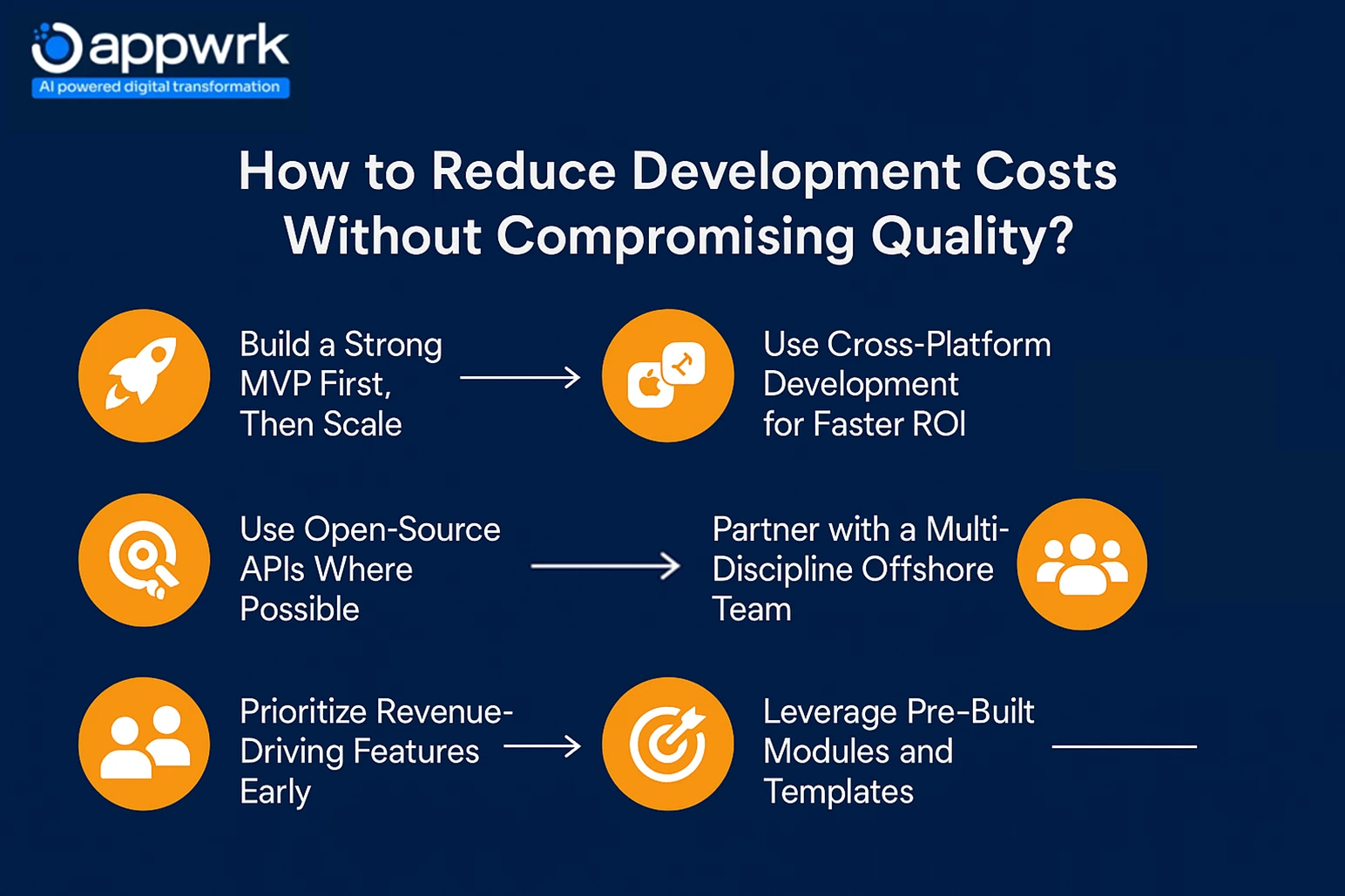
The cost to develop a fantasy sports app like FanDuel can be reduced by up to 40% through smart strategies such as MVP-first rollouts, cross-platform frameworks, offshore expertise, and pre-built modules. The best way to build a fantasy sports app like FanDuel at the lowest cost is by leveraging affordable fantasy sports app development practices.
Build a Strong MVP First, Then Scale
Start with essentials (signup, contests, scoring, payments) for $12K–$25K.
Add AI, blockchain, or gamification later as adoption grows.
Use Cross-Platform Development for Faster ROI
Flutter or React Native saves 30–40% vs. separate iOS/Android builds.
Lower maintenance and faster time-to-market.
Use Open-Source APIs Where Possible
Start with free/low-cost APIs for scores and leaderboards ($2K–$5K yearly).
Upgrade to premium providers when scaling.
Partner with Offshore Teams
Developers in India/Eastern Europe charge $20–$70/hr.
Saves 50–70% vs. U.S. or EU teams while ensuring quality delivery.
Prioritize Revenue-Driving Features Early
Focus first on contests, wallets, leaderboards, and notifications.
Delay advanced features like NFTs, AR/VR, or watch parties until profitable.
Leverage Pre-Built Modules and Templates
Use ready-made solutions for login, payments, and leaderboards.
Cuts 20–25% of costs and accelerates launch for white label fantasy sports apps.
Case Study: DraftKings MVP Rollout Strategy (2014)
When DraftKings entered the fantasy sports market, it avoided overbuilding by adopting an MVP-first approach. Instead of launching a full-fledged app, they focused on core features, such as user registration, contest creation, live scoring, and secure payments while leaving advanced features like social tools and loyalty mechanics for later phases.
This phased rollout saved DraftKings millions in upfront costs while reducing technical risk. Key metrics like DAU (daily active users), retention, and average contest spend validated their approach, proving the business model before scaling. For new entrants, DraftKings’ strategy reinforces that lean MVP launches can minimize cost and maximize early adoption.
Key Features of FanDuel-Style Fantasy Sports Apps That Drive Engagement
Fantasy sports apps thrive when they combine an intuitive user experience, powerful admin tools, and innovative engagement features. For anyone exploring fantasy sports mobile app development, understanding these features is key to building trust, driving retention, and scaling profitably.
User Features
User Registration & Profiles
A seamless onboarding flow sets the tone. Options like email, OTP-based mobile login, and social sign-ins reduce friction. Adding KYC integration ensures compliance while making the app a legal fantasy sports app in India or compliant in markets with stricter rules, like the fantasy sports app regulation in the USA.
Profile Management
Users can manage personal details, view contest history, and customize preferences. Features such as profile customization and two-factor authentication increase both personalization and security.
Contest Creation & Team Selection
The core of any fantasy platform is the ability to create and join contests. From daily fantasy to season-long leagues and hybrid models, these formats attract both casual players and hardcore gamers alike. Using a fantasy sports app builder with customized fantasy sports app development ensures flexible contest formats that evolve with audience demand.
Fantasy Sports Contests
Diverse contest formats, from one-on-one matchups to large guaranteed prize pools, encourage wider user participation. Integrations like sports betting integration or real-money gaming modules can extend monetization potential where regulations allow.
Live Score Integration
Real-time data integration keeps users engaged throughout matches. Using APIs like Sportradar or Opta ensures accurate live match data and enhances credibility. For leaner projects, open-source APIs help in affordable fantasy sports app solutions.
Live Match Ratings
Displaying player performance ratings helps users make better draft decisions and adds another layer of real-time excitement.
Real-Time Leaderboards
Dynamic leaderboards fuel competition. For platforms built with scalable fantasy app architecture, these leaderboards scale smoothly during peak traffic, like NFL or IPL finals.
Wallet Integration
Users expect quick deposits and withdrawals. A secure payment solution for fantasy sports apps with multi-currency and crypto support ensures smooth operations while building trust.
Payment Gateway Integration
From UPI in India to Stripe in the U.S., integrating global payment systems with PCI-DSS compliance widens your user base and supports building a fantasy sports app for business strategies targeting multiple geographies.
Push Notifications & Instant Alerts
Timely reminders about contests, score milestones, or last-minute substitutions increase engagement. AI-driven real-time notifications keep the user connected even when they’re not in the app.
Chat & Social Features
Community engagement is a retention driver. In-app chat, strategy discussions, and social media sharing create stickiness. More advanced builds can integrate live chat support features or even AI chatbots for fantasy sports apps to handle queries and automate user engagement.
Admin Panel Features
User Management
Admins monitor accounts, manage suspicious activity, and ensure platform integrity. Adding fraud detection with machine learning in fantasy sports platforms helps cut down on bots and scams.
Contest Management
Admins oversee the creation, editing, and distribution of contests. White-label frameworks, such as a white label fantasy sports app, make this faster and scalable.
Scoring & Rules Management
Flexible scoring engines are essential for multi-sport formats. Integrating a Node.js fantasy app backend ensures real-time updates with Sports APIs.
Reporting & Moderation Tools
Admins can flag fraudulent activity, resolve disputes, and maintain compliance across regions. Strong reporting prevents long-term trust erosion.
Payment Handling & Reports
Every transaction is tracked with transparent reports, ensuring clarity for both users and regulators.
Analytics Dashboard
Admins access deep insights on player churn, revenue patterns, and contest trends. Advanced setups use fantasy sports app data analytics with AI for predictive decision-making.
Admin Dashboard
A consolidated control center that tracks KPIs across contests, revenue, and user engagement.
Earning and Payout Dashboard
Tracks winnings, payouts, and commissions in real-time. Transparent payout systems reduce support queries and improve trust.
Advanced Features
Gamification and Reward System
Adding badges, levels, and milestones boosts engagement and retention. Gamification turns casual users into long-term loyal players by rewarding both participation and performance. This is especially valuable for businesses exploring customized fantasy sports app development to build sticky user experiences.
AI-Based Player Suggestions
AI-driven recommendations help users pick optimal player combinations by analyzing stats, injuries, and form. For casual players who may not follow every detail, this feature simplifies decisions and increases trust in the platform.
AI-Powered Recommendation Engine
An advanced extension of AI features, this engine leverages predictive analytics and fantasy sports app data analytics with AI to improve draft picks. It creates a competitive advantage for users and enhances the credibility of the platform.
VR/AR Visualizations
Immersive features like 3D player stats, virtual match simulations, or AR overlays add depth to the experience. For startups aiming to build fantasy sports apps for business, VR/AR is a future differentiator in an already crowded market.
Advanced Streaming
Allowing users to stream live matches directly in-app, with overlays like stats and leaderboards, creates a one-stop ecosystem. This drives retention and increases average time spent on the platform.
Social Media Integration
Linking directly with social platforms encourages players to share wins, invite friends, and showcase strategies. This integration turns your app into a viral growth engine powered by peer influence.
Social Feeds and Watch Parties
Watch parties, chat rooms, and social feeds transform fantasy apps into community-driven platforms. Players don’t just compete, they connect, discuss, and celebrate together, building higher stickiness.
Multi-Language Support
Regional language support broadens reach into non-English-speaking markets, improving adoption rates and enabling global expansion. For companies working with a fantasy sports app development company, this feature is a must-have for scaling internationally.
Cross-Platform Compatibility
Users look for a unified experience whether they’re on iOS, Android, or the web, so ensuring consistency across platforms is essential. Using Flutter fantasy sports app or React Native fantasy sports app frameworks ensures broad coverage, lower development costs, and faster time-to-market.
Security Check
Fantasy sports platforms handle real-money transactions, so trust is everything. Features like two-factor authentication, payment encryption, and fraud detection ensure compliance with global standards such as GDPR for fantasy sports platforms.
NFTs, Tokens, and Loyalty Mechanics
Integrating NFTs, token-based rewards, and loyalty points unlocks Web3-driven monetization opportunities. These mechanics appeal to younger, tech-savvy audiences and enhance long-term retention.
The success of a fantasy sports mobile app development project lies in balancing user-friendly features, strong admin controls, and future-ready innovations like AI, VR, and NFTs. Together, they not only maximize engagement but also create new monetization opportunities.
Different Types of Fantasy Sports Apps Like FanDuel
The industry has evolved into multiple app formats designed to match player preferences, engagement styles, and revenue strategies. Whether working with a fantasy sports app builder or a white label fantasy sports app, choosing the right format directly impacts costs, growth strategy, and ROI.
Daily Fantasy Sports (DFS) Apps
Daily Fantasy Sports (DFS) Apps dominate in the U.S., with contests lasting just a day or match. They deliver instant gratification, frequent payouts, and fast adoption, making them ideal for startups entering the market quickly.
Season-Long Fantasy Sports Apps
Season-Long Fantasy Apps replicate traditional leagues where users draft teams for an entire season. They build long-term loyalty, stronger communities, and higher lifetime value (LTV).
Multi-Sports Fantasy Apps
Multi-Sport Fantasy Apps extend play across cricket, football, basketball, esports, and more. By diversifying formats, they reduce churn during off-seasons and maximize global revenue opportunities.
Social Fantasy Apps
Social Fantasy Apps focus on community with chat, watch parties, and peer-to-peer contests. They resonate with Gen Z and millennials who prefer social-first platforms, turning apps into engagement ecosystems.
Niche Fantasy Apps
Niche Fantasy Apps target superfans of golf, MMA, or esports. They thrive in low-competition markets with high ROI potential, often developed as affordable fantasy sports app solutions for startups.
Most businesses begin with DFS or niche apps for fast entry, then scale into multi-sport formats as their user base grows.
How Fantasy Sports Apps Like FanDuel Work: A Step-by-Step Guide
A fantasy sports app like FanDuel blends real-time data, team drafting, secure payments, and leaderboards to drive engagement, trust, and monetization.
1. Users Sign Up and Complete KYC Verification
Players register and complete KYC for compliance.
Prevents fraud, enforces age limits, and builds trust in fantasy sports mobile app development.
2. Browse Available Fantasy Contests by Sport or Event
Users explore daily, season-long, multi-sport, or niche contests.
Entry fees, prize pools, and filters (sport, league, size) improve navigation.
3. Draft Teams Within Virtual Budgets
Athletes selected under salary caps for strategy and replay value.
Live data from APIs (Sportradar, Opta) updates scores instantly.
Scalable fantasy app architecture ensures stability during peak matches.
AI analytics enhance predictions and engagement.
5. Leaderboard Updates and Dynamic Engagement
Points feed into real-time leaderboards.
Features like notifications, chats, and white label fantasy sports app customization drive retention.
6. Secure Payouts Delivered After Events
Integrated wallets deliver instant withdrawals.
Secure payment solutions for fantasy sports apps support multi-currency and crypto.
Smooth payouts encourage repeat participation.
Why This Workflow Matters for User Loyalty and Monetization
Onboarding + KYC → Secure and compliant entry
Contest browsing + drafting → Deep user engagement
Real-time scoring + leaderboards → Retention and excitement
Secure payouts → Trust and strong monetization cycles
What Is the Step-by-Step Process to Develop an App Like FanDuel?
Developing a fantasy sports app like FanDuel requires more than just coding. It’s a structured lifecycle involving product validation, legal compliance, UI/UX, backend architecture, real-time API integrations, and ongoing optimization. Below is a comprehensive stage-by-stage breakdown with estimated costs.
Product & Legal Discovery (Cost: $1,500 to $3,000)
The cost to build a fantasy sports app like FanDuel begins with discovery—analyzing markets, competitors, and compliance with fantasy sports laws and licensing. This step prevents disputes and ensures scalability.
Feature Definition and MVP Selection (Cost: $2,000 to $5,000)
Startups save up to 40% by defining an MVP first—onboarding, contest creation, live scoring, and payouts. Early validation reduces risk and avoids overspending.
Designing UI/UX Journeys (Cost: $3,000 to $6,000)
Engaging design improves retention and conversions. Wireframes and prototypes guide smooth navigation, while immersive flows boost user lifetime value.
Frontend and Backend Development (Cost: $5,000 to $12,000)
The frontend drives user interaction, while the backend manages contests, wallets, and scalability. A cloud-based, microservices backend ensures reliability during peak sports events.
Third-Party API & Sports Feed Integration (Cost: $2,000 to $6,000)
Live data and secure payments power fantasy apps. Integration with APIs like Sportradar, Opta, and gateways like PayPal/Stripe delivers trust and global reach.
Rigorous QA Testing and Security Setup (Cost: $1,500 to $4,000)
Comprehensive testing, audits, and encryption safeguard user funds. Multi-factor authentication and fraud detection make compliance non-negotiable.
App Store Deployment & Optimization (Cost: $1,000 to $2,500)
Optimizing metadata, visuals, and keywords ensures visibility. Effective App Store Optimization (ASO) boosts organic downloads by 30–40%.
Post-Launch Support and Analytics Loop (Cost: $2,000 to $5,000/month)
Launch is just the start. Ongoing bug fixes, updates, and server scaling, supported by analytics tools, keep the app competitive and user-focused.
End-to-end fantasy sports app development can start at $12,000 for an MVP and scale with advanced features, ensuring compliance, cost-efficiency, and growth.
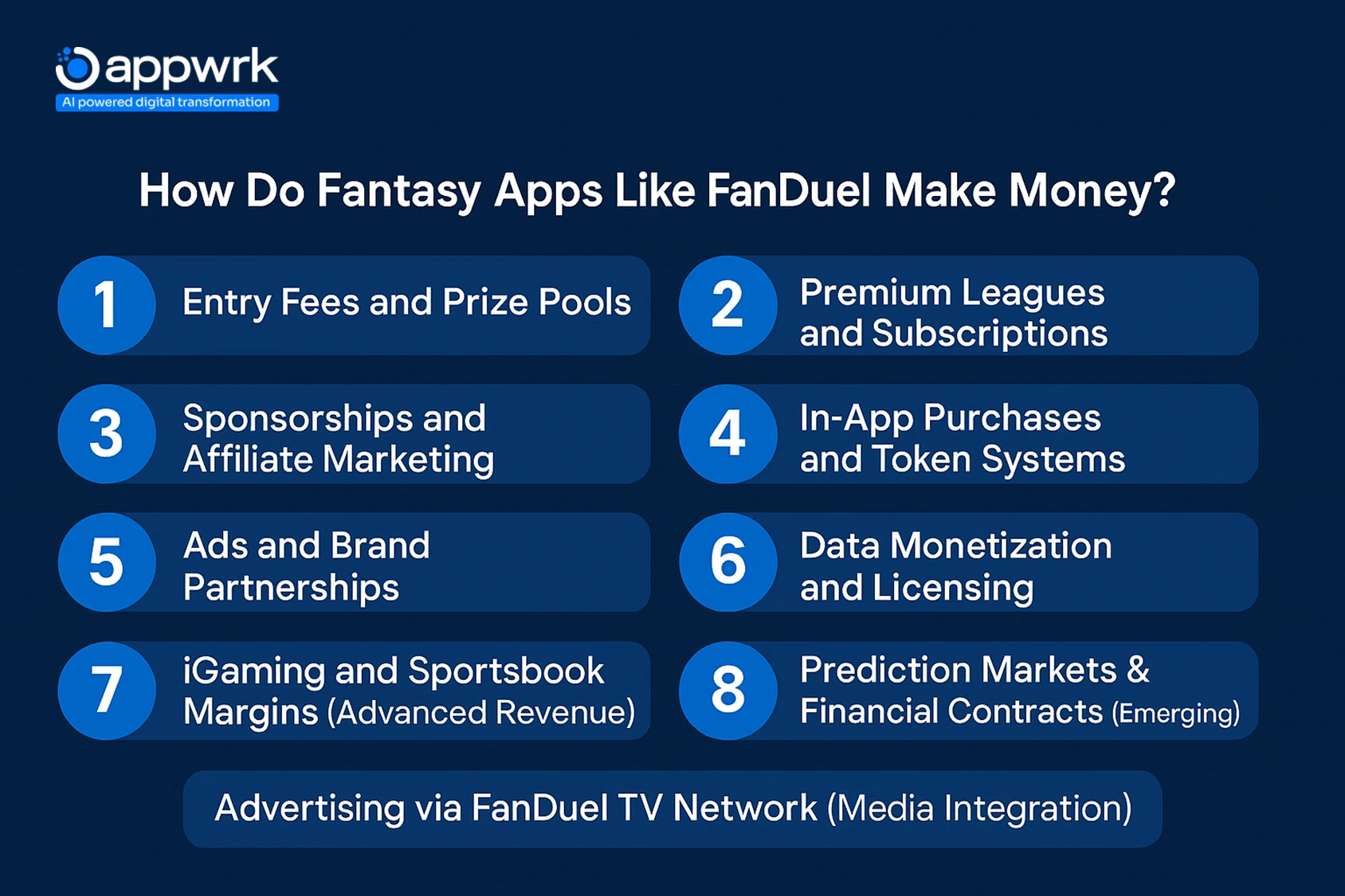
Fantasy platforms like FanDuel thrive on diverse monetization strategies, making them attractive for businesses investing in fantasy sports mobile app development.
Entry Fees and Prize Pools
Entry Fees & Prize Pools remain the core revenue stream, with apps like FanDuel taking ~10% of contest pools.
Premium Leagues and Subscriptions
Premium Leagues & Subscriptions generate recurring revenue by offering exclusive contests and analytics.
Sponsorships and Affiliate Marketing
Sponsorships & Affiliate Marketing add branded contests and referral income.
In-App Purchases and Token Systems
In-App Purchases & Tokens create new monetization via avatars, boosts, and gamification.
Ads and Brand Partnerships
Ads & Brand Partnerships leverage high user time-spent with banners and sponsored leagues.
Data Monetization and Licensing
Data Monetization sells anonymized gameplay data to sportsbooks and media.
iGaming and Sportsbook Margins
Some players, like FanDuel, operate online sportsbooks alongside fantasy. A white label fantasy sports app with sportsbook integration allows startups to enter regulated betting markets without building everything from scratch.
Prediction Markets and Financial Contracts
Emerging models allow users to bet on non-sports outcomes like politics or stock indices. While legally complex, this frontier shows how apps can scale beyond sports, another reason startups are exploring how to create a fantasy sports app with diversified features.
Advertising via FanDuel TV Network (Media Integration)
FanDuel TV & Media Integration proves how apps can extend into live shows, podcasts, and watch parties.
This multi-channel model shows why businesses see fantasy sports app development not only as entertainment but as a scalable, long-term investment.
Tips to Ensure Your Fantasy Sports App Stands Out
With the global fantasy sports market projected to hit $75B by 2030, your app needs more than contests to compete. Here’s what makes a difference:
Make Community Features Core
Private leagues, friend challenges, and chatrooms turn your app into a sports hub, not just a gaming app. Social-first experiences also boost organic adoption.
Gamify Engagement
Add streaks, badges, and milestone rewards. Gamification makes users stickier, improves session times, and fuels repeat plays.
Add Live Chat and Streaming
Integrating live chat support, fantasy appmodules, or watch parties keeps users connected in real time. Coupled with live streaming, it turns contests into a full fan experience.
Multilingual and Regional Features
Scaling globally? Offer localized contests, fantasy cricket in India, fantasy football in Europe, and multilingual support to boost adoption across regions.
AI-Powered Personalization
From an AI chatbot for fantasy sports apps to fantasy sports app data analytics with AI, personalization is critical. Tailored suggestions and predictive insights make users feel the app was built around them.
Web3 Loyalty Tokens → Blockchain-powered points that increase retention and open new monetization models.
Why Are Businesses Investing in Fantasy Sports Apps Like FanDuel?
Rise of the fantasy sports market and daily fantasy games
The fantasy sports industry is exploding, with fantasy sports mobile app development leading the charge in digital entertainment. Daily Fantasy Sports (DFS) apps like FanDuel have proven how short-format contests and real-time engagement can draw in millions of active players. According to Statista, the global fantasy sports market is projected to cross $75 billion by 2030, powered by mobile gaming innovation and deeper sports fandom.
Explosive revenue growth and loyal user base
Fantasy sports apps are among the most profitable verticals in gaming. Revenue streams come from recurring entry fees, in-app purchases, ads, and partnerships. Giants like FanDuel and DraftKings now generate billions in annual revenue, driven by a loyal user base that logs in daily. This high lifetime value (LTV) is what attracts startups, investors, and enterprises looking to build a fantasy sports app for business.
Behavioral shift: from passive viewership to gamified participation
Sports fans are no longer satisfied with passive viewing. They want interactive, gamified platforms that let them showcase knowledge, compete with peers, and win rewards. Fantasy sports app builders are capitalizing on this shift, transforming ordinary viewership into active, monetized participation. For leagues, broadcasters, and startups, this gamification is reshaping sports economics.
AI-driven personalization and predictive analytics
The next generation of apps will rely heavily on fantasy sports app data analytics with AI. AI recommendation engines will suggest optimal player picks, predict outcomes, and tailor contests to individual users. This personalization boosts engagement, retention, and monetization.
AR/VR and immersive fan engagement
AR and VR are set to redefine the experience. Imagine immersive draft rooms, 3D stat visualizations, or interactive replays, features being explored through virtual sports fantasy app development. These innovations will attract next-gen users who expect immersive, gamified experiences.
Blockchain and NFTs in fantasy sports
Blockchain secures payments and improves transparency, while NFTs create new revenue opportunities. Rare collectibles, digital cards, or exclusive team assets can be integrated into customized fantasy sports app development, opening monetization beyond contests.
Cross-platform expansion and super apps
Apps are evolving into super apps by combining fantasy sports, betting, live streaming, and social features. Using frameworks like React Native fantasy sports app and Flutter fantasy sports app, developers are building for Android, iOS, web, and even smart TVs, ensuring seamless engagement across platforms.
Social gaming and community-driven experiences
Community-driven apps are the future. Features like live chat support, fantasy app, watch parties, and peer-to-peer challenges build sticky engagement loops. These social-first features encourage organic adoption and make fantasy apps feel more like sports ecosystems than standalone games.
Over the next decade, AI, AR/VR, blockchain, and social gaming will shape the industry. Companies looking at white label fantasy sports app solutions or building a fantasy sports app from the ground up must align with these trends to stay competitive.
What Are the Post-Launch Challenges and Future Trends in Fantasy Sports App Development?
The cost to build a fantasy sports app like FanDuel does not end at launch—scaling requires addressing challenges while adopting trends that shape the future of fantasy sports app development.
Scaling to Multi-Sport Formats
Expanding beyond single-sport apps into football, cricket, basketball, or niche leagues increases retention and lifetime value, but demands balanced scoring and smooth integrations.
Integrating AR/VR and Blockchain Experiences
Next-gen features like 3D match tracking, virtual draft rooms, NFTs, and blockchain payments boost engagement and monetization but require significant investment and compliance readiness.
Managing Churn, Fraud, and User Trust
Growing user bases bring risks. Leaders like FanDuel rely on AI fraud detection, loyalty rewards, and strict KYC to reduce churn and safeguard trust.
AI-Powered Personalization and Predictive Analytics
AI recommendation engines personalize contests, predict outcomes, and optimize team selections, driving higher engagement and stickiness.
Cross-Platform Expansion and Super App Ecosystems
Future fantasy apps will combine betting, streaming, merchandise, and social engagement into super apps, accessible across iOS, Android, web, and smart TVs.
Social Gaming and Community-Driven Models
Chatrooms, watch parties, and peer-to-peer contests are transforming fantasy sports into community-driven ecosystems, increasing loyalty and monetization.
The key takeaway: launch is just step one. Long-term success comes from tackling fraud and retention challenges while embracing AI, AR/VR, blockchain, and social-first features to stay ahead of the curve.
How Appwrk Can Help in Fantasy Sports App Development Like FanDuel
At Appwrk, we specialize in building fantasy sports apps like FanDuel that are cost-efficient, scalable, and rich in features. Our team combines sports app development expertise, advanced tech stacks (AI, AR/VR, blockchain), and compliance-first practices to deliver high-performing platforms.
Proven track record – Delivered sports and gaming apps with 40% faster time-to-market and 30% cost savings compared to industry averages.
Retention-driven design – We integrate gamification, real-time analytics, and personalized engagement features to boost user loyalty.
Scalable architecture – Built to handle peak matches, live scoring, and secure transactions without downtime.
End-to-end services – From MVP design to post-launch support, Appwrk ensures your fantasy app stays compliant, profitable, and future-ready.
If you’re looking to develop a fantasy sports app like FanDuel with lower costs, faster deployment, and long-term scalability, Appwrk is the right partner to bring your idea to life.
Contact us to hire the experienced Sports Fantasy App Developers.
Final Thoughts: Should You Invest in Building a Fantasy Sports App Like FanDuel?
The question isn’t just whether you should build a fantasy app; it’s whether you can afford to miss the opportunity. Here’s why businesses and investors are leaning in right now:
The market is hot: With global adoption rising and user bases expanding across cricket, football, and baseball, now is the best time to enter. Fantasy sports mobile app development is projected to fuel a $75B+ market by 2030.
Revenue models are proven: From entry fees and subscriptions to sponsorships and in-app advertising strategies for fantasy platforms, monetization is both predictable and scalable.
Retention is strong: Gamification, AI-driven personalization, and social-first design keep players coming back season after season.
The ROI is real with the right partner: By working with an experienced fantasy sports app development company like Appwrk, you reduce risk, manage cost, and unlock sustainable growth.
In short, building a fantasy sports app like FanDuel isn’t just about joining a trend; it’s about creating a scalable fantasy app architecture that grows into a long-term, monetizable sports engagement ecosystem.
FAQs
1. How much does it cost to build a fantasy sports app like FanDuel?
A basic MVP starts at around $12,000, and a fully loaded solution can range from $80,000 to $120,00,0, depending on design, features, and region. Appwrk leverages affordable fantasy sports app solutions to keep development costs lean while maintaining high-quality standards.
2. What is the development cost of fantasy sports software?
On average, fantasy sports software development ranges between $15,000–$100,000. Factors include integrations with the Sports API, UI/UX quality, and backend setup, like a Node.js fantasy app backend or microservices.
3. How much investment is needed for a fantasy app?
Budgeting $20,000–$80,000 is realistic for startups planning to build a fantasy sports app for business, covering licensing, APIs, and early marketing.
4. What is the average & hidden cost of a fantasy sports platform?
The average cost falls between $15,000–$60,000, but hidden costs such as server scaling, compliance, and third-party APIs can add 15–20% annually. Think cloud hosting, GDPR compliance, and secure payment solutions for fantasy sports apps.
5. What pricing models do fantasy app developers offer?
Common options include fixed-cost MVP packages, hourly billing ($20–$100/hr based on region), or hiring a dedicated team. This flexibility makes it easy to hire fantasy sports app developers for both startups and enterprises.
6. What are the key factors affecting fantasy sports app development cost?
Major drivers include the complexity of features and functionalities, real-time match integrations, backend scalability, legal compliance, and post-launch maintenance.
7. Does supporting multiple sports increase the cost significantly?
Yes. Multi-sport builds require more databases, APIs, and compliance checks, which can raise costs by 20–30%. However, they also reduce churn and boost LTV.
8. How long does it take to build a fantasy sports app?
Expect 3–5 months for an MVP, 6–9 months for a feature-rich app, and 12 months+ for advanced builds with AR App Development, blockchain, or AI-driven features.
9. Do I need to pay for third-party APIs or real-time sports data?
Yes. Most apps integrate licensed real-time match data APIs for player stats, live scores, and betting integrations. Costs typically range from $500/month to $5,000+/year.
10. Are there ongoing costs after launch?
Absolutely. Post-launch, you’ll spend on hosting, updates, churn reduction techniques, fantasy sports, compliance audits, and user support, typically $1,000–$5,000 per month.
11. Can a fantasy sports app be developed for both Android and iOS simultaneously?
Yes. With frameworks like React Native fantasy sports app or Flutter fantasy sports app, you can launch on Android, iOS, and web together, saving up to 40% in costs compared to building separately.
12. Which companies offer affordable MVP fantasy sports app development in India?
For startups, choosing custom fantasy sports app solutions in India ensures rapid delivery and reduced sports fantasy app development costs without compromising compliance considerations.
13. Which companies provide low-cost fantasy sports app development in India?
Leading names include Appwrk, RipenApps, IMG Global Infotech, and Creole Studios. These fantasy sports app development companies offering MVP builds help startups launch within $12k–$20k budgets.
Gourav Khanna is the Co-founder and CEO of APPWRK, leading the company’s vision to deliver AI-first, scalable digital solutions for enterprises and high-growth startups. With over 16 years of leadership in technology, he is known for driving digital transformation strategies that connect business ambition with outcome-focused execution across healthcare, retail, logistics, and enterprise operations.
Recognized as a strategic industry voice, Gourav brings deep expertise in product strategy, AI adoption, and platform engineering. Through his insights, he helps decision-makers prioritize market traction, operational efficiency, and long-term ROI while building resilient, user-centric digital systems.
Subscribe to APPWRK Blogs, We'll Do the Rest!
Get Blogs on UI/UX, Mobile Apps, Online Marketing, and Web development technology.
Unlock worthy and priceless suggestions from the masters of mobile and web app development