150+ minds across 4 countries. Join a culture of innovation, ownership & growth.
Rewire for AI
From machine learning to deep learning, from classification tools to overall process automation – our AI engineers will help you retool your existing system or enhance your company results.
Ship faster, scale smarter, built for product companies and SaaS teams
Our Latest Work
We strive hard to deliver result-driven digital solutions across the globe. Check out our case studies to get a glimpse of how we ideate, innovate, and create unconventional digital solutions according to the requirements of our clients.
Discover diverse and passionate insights from our tech enthusiasts. We collaborate across various sectors to streamline operations and drive innovation. Explore our rapidly growing collection of articles to see why we’re at the forefront of IT solutions.
The decision to move from Magento to Shopify is one of the most significant replatforming choices an ecommerce business can make. Magento is powerful, but its power comes with...
Accuracy gap is real: Traditional CPG forecasting carries a 25-40% MAPE error rate. AI-powered models bring that down to 8-15%, according to McKinsey research....
Real stories from global leaders who trusted us with their ideas.
Partnering with APPWRK helped us build a compliant and scalable healthcare platform, accelerating our time-to-market by 35%. Their team consistently delivered outstanding work.
Beesers
Digital Healthcare Client
Collaborating with APPWRK, Sportskeeda modernized its platform into a real-time sports engagement ecosystem, enabling seamless content delivery, scalable fan interactions, and high-velocity performance.
Sportskeeda
Sports & Entertainment Partner
Working with APPWRK was effortless. They captured our vision, maintained full compliance, and delivered a digital experience that built trust and elevated how customers interact with our fintech brand.
PayPenny
Fintech Partner
Working with APPWRK gave us confidence in adopting AI responsibly. Their team built a safe, intelligent bot that transformed how we engage with leads and helped us achieve measurable revenue growth.
IFB
AI Transformation Partner
Leveraging APPWRK’s digital expertise, Nemesis launched a scalable, compliant, and safe super app that connects content delivery, real-time communication, and logistics management within a single platform.
The cost to develop a healthcare app starts at $12,000–$20,000 for a basic MVP. Mid-tier healthcare apps typically range from $20,000 to $70,000, such as telemedicine or insurance verification.
Even enterprise-level platforms with AI-driven diagnostics, interoperability via FHIR/HL7 APIs, and HIPAA/HITECH compliance usually top out around $120,000.
Hidden costs in Healthcare app development in 2025 like server hosting, compliance audits can add 15–20% of the total budget.
What You’ll Learn
The real cost of healthcare app development depends on app type, features, and compliance requirements.
Outsourcing to offshore healthcare software teams and using modular backend infrastructure can cut costs by 30–40%.
With Appwrk, compliance, scalability, and ROI are built into every healthcare application development project.
Success Stories
Mental Health App – Built by Appwrk with wearable sync and predictive analytics for under $90,000 in 5 months.
RPM App – Delivered IoT-enabled real-time monitoring in 6 months at below-market cost.
EHR Platform – HIPAA-compliant digital health record system developed for a clinic for under $120,000 and launched within 6 months.
Market Overview and Rapid Growth of Healthcare App Development
Healthcare mobile applications are no longer optional; they are central to care delivery. Patients, doctors, and providers now rely on them for video consultations, patient portal access, ePrescribing, and even mental health journaling.
The global digital health market is projected to reach $946.04 billion by 2030, with telemedicine apps and fitness apps leading growth. More than 70% of U.S. adults already use apps like Nextcare, ZocDoc, or Jotform Apps for bookings, prescriptions, or patient management. The global mHealth market size was estimated at USD 62.7 billion in 2023 and is expected to reach USD 158.3 billion by 2030, growing at a CAGR of 14.1% from 2024 to 2030.
Patient expectations are shifting toward on-demand healthcare, like doctor booking apps, medication reminders, and nutrition trackers. Providers focus on regulatory compliance, secure data exchange, and reduced risks with frameworks like HIPAA, HITECH, and 42 CFR Part 2, setting the security baseline.
Advantages of Healthcare Mobile Apps for Patients & Providers
Accessibility & Convenience – Telehealth platforms offer ZocDoc-style video consultations, mental health journals, and fitness or nutrition tracker access.
Efficiency – FHIR/HL7 APIs ensure interoperability and reduce integration drift across EMRs.
Data Insights – Predictive analytics improves patient data privacy and chronic disease management outcomes.
What Is the Cost to Develop a Healthcare App
The cost to develop a healthcare app starts at $12,000 for a basic app and can reach up to $120,000 for a complex, enterprise-grade solution. The exact cost depends on complexity, features, and team location.
Cost of Healthcare Application Development by App Complexity
This is the simplest way to estimate costs: by looking at the overall complexity of the healthcare app.
Average Cost for Types of Healthcare Apps
Complexity of the Healthcare app
What It Includes
Average Cost of Healthcare Apps Development
Basic App
Scheduling, reminders, and patient profiles
$12,000 to $20,000
Mid-Range App
E-prescriptions, secure chat, payments, analytics
$25,000 to $50,000
Advanced App
AI tools, wearables, integrations, multi-role dashboards
$60,000 to $120,000
Development Stage-Wise Healthcare App Costs
Every healthcare app goes through defined stages, and each stage carries its own cost and timeline.
AR Training / Simulation Tools – $20,000 – $40,000
Adding premium features can push healthcare application development costs into the $40,000 – $120,000+ range, depending on your chosen platform type, backend infrastructure, and scope of API integration.
Why Medical Apps Cost More Than Consumer Apps
Healthcare apps must meet strict regulatory standards (HIPAA, HITECH, GDPR, 42 CFR Part 2), ensure data security, and integrate with EHR/EMR systems using FHIR/HL7 APIs. This compliance and interoperability requirement makes medical app development costs higher than consumer apps like fitness or food delivery.
How Does Outsourcing Location Affect Healthcare App Development Cost?
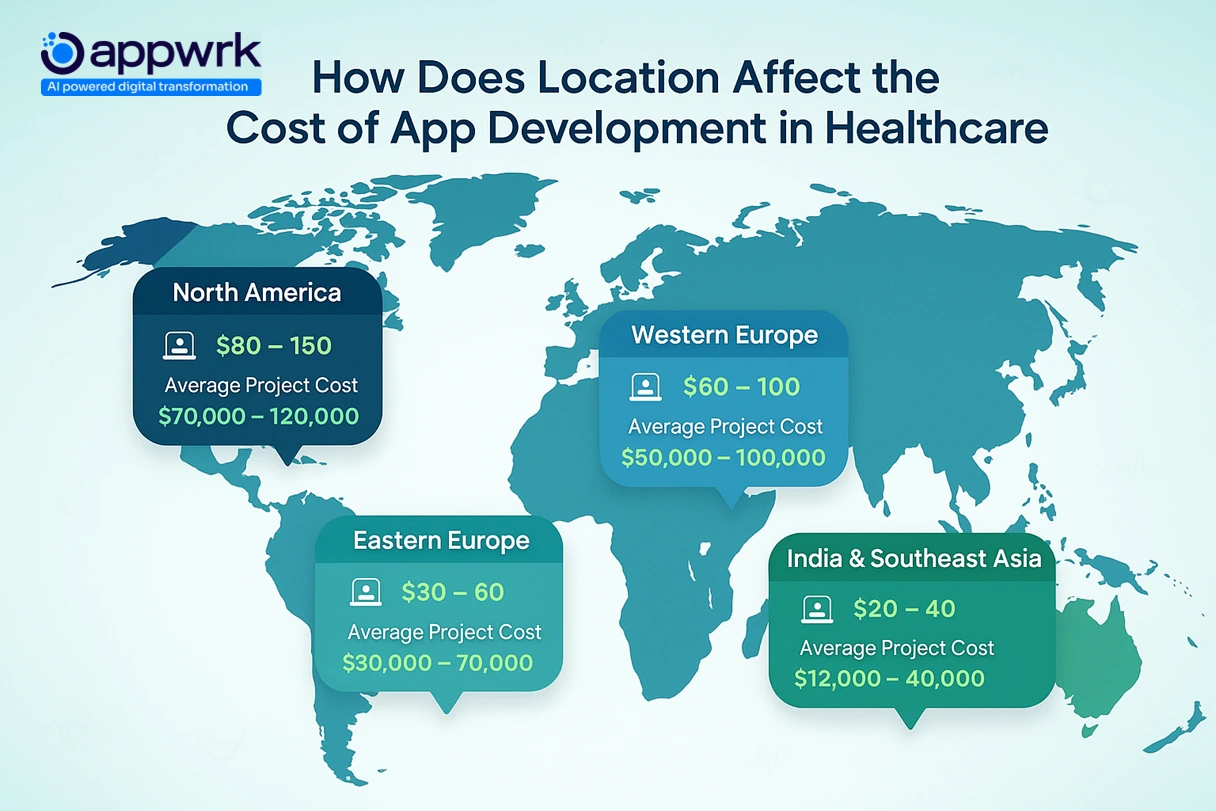
The cost of app development in healthcare is not the same across the world. The hourly rate of developers changes depending on location, which directly affects the total project budget. Choosing the right region for healthcare mobile app development can make the difference between a $120,000 build and a $40,000 build.
Region of Healthcare App Development
Hourly Rate of App Development in Healthcare
Average Project Cost of App Development in Healthcare
North America
$80 to $150
$70,000 to $120,000
Western Europe
$60 to $100
$50,000 to $100,000
Eastern Europe
$30 to $60
$30,000 to $70,000
India & Southeast Asia
$20 to $40
$12,000 to $40,000
Many founders and healthcare providers prefer outsourcing app development for healthcare to regions like India or Southeast Asia because it combines lower costs with experienced healthcare mobile app developers.
Different Types of Healthcare Apps and Their Development Costs
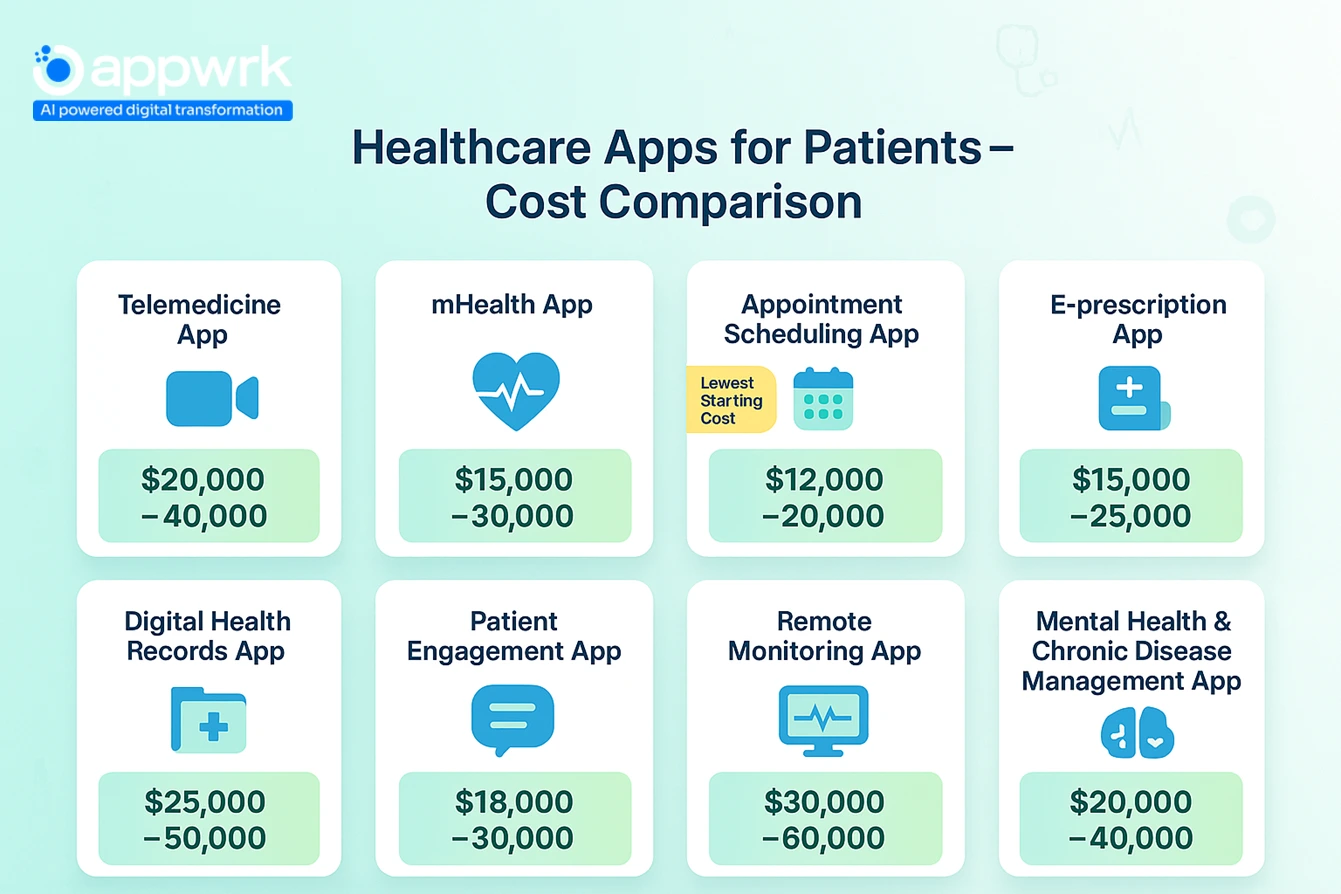
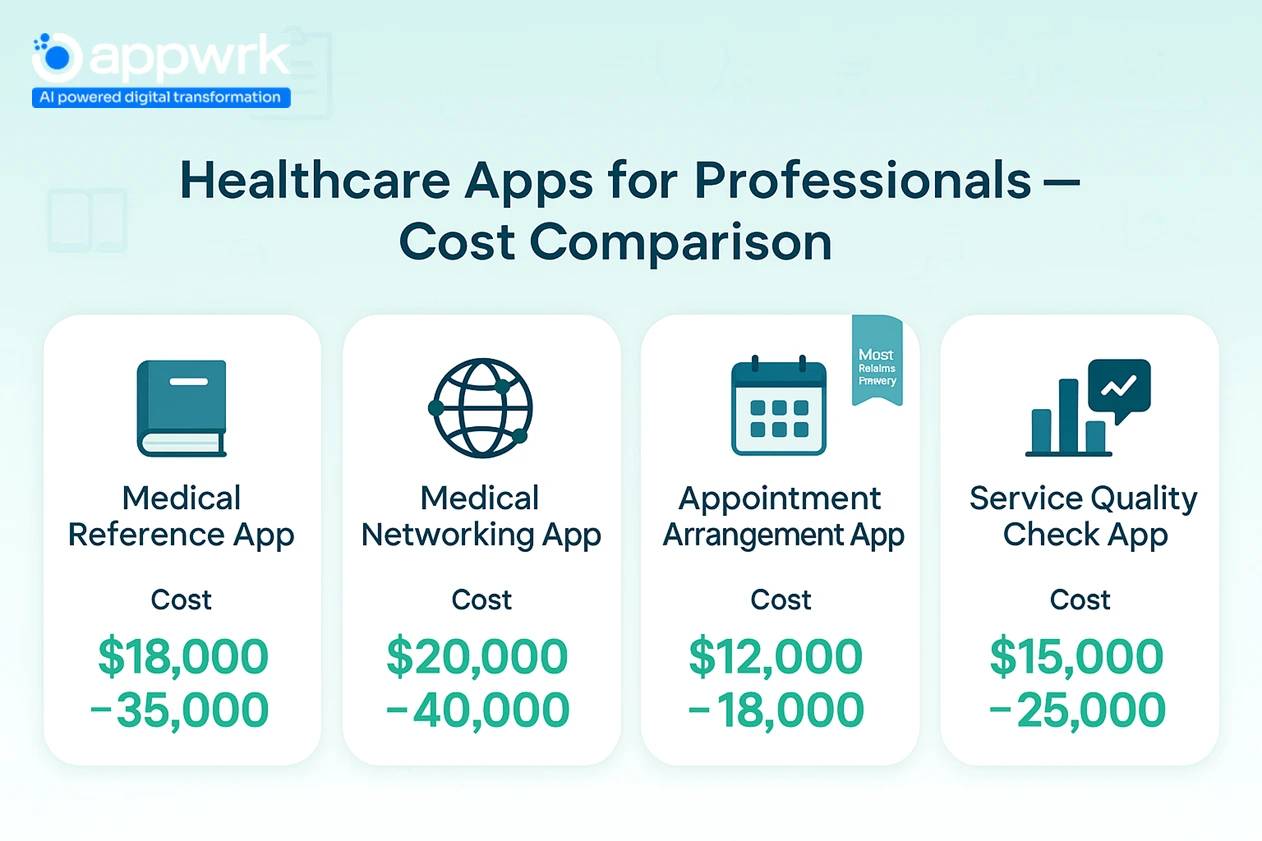
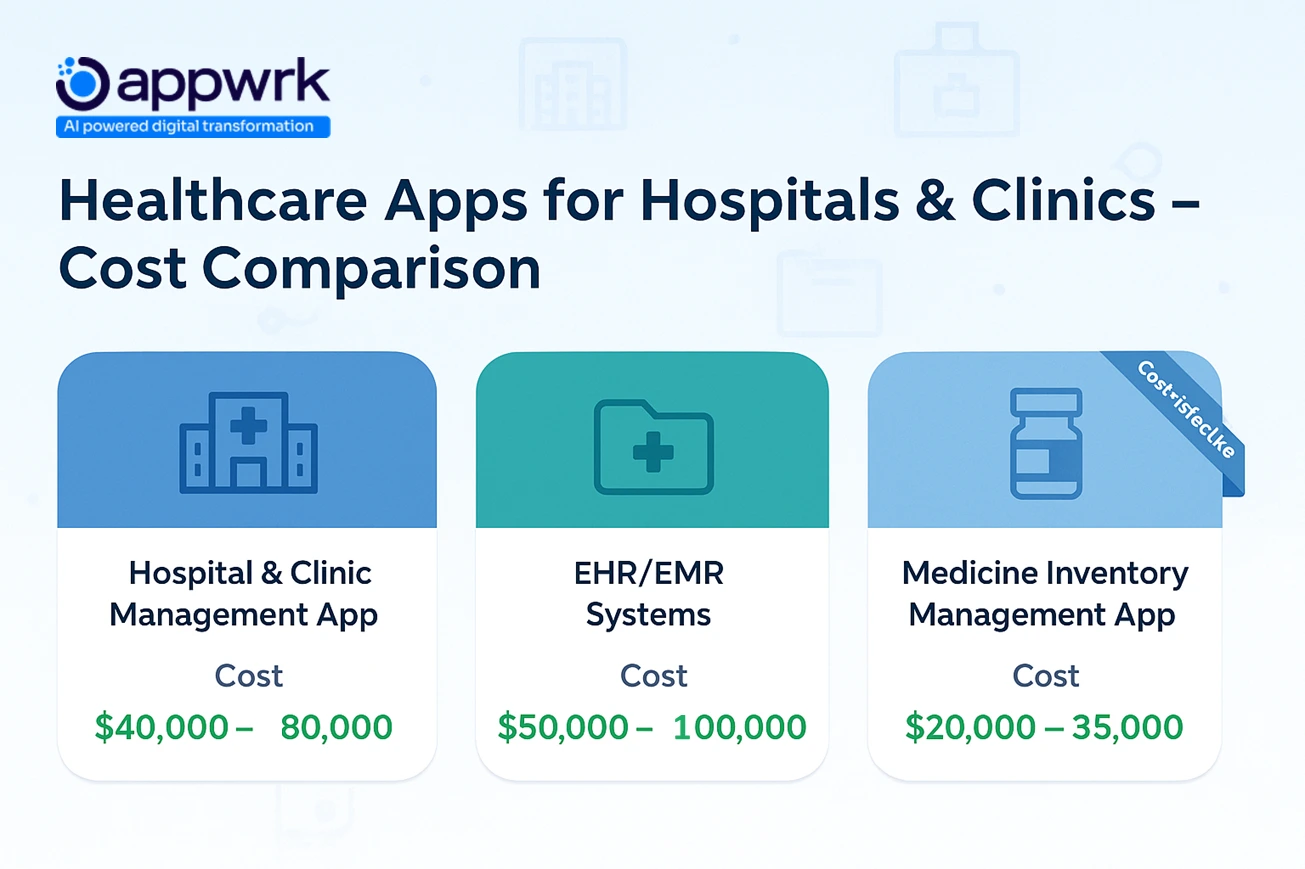
Healthcare app development costs also depend on the type of app being built. Patients, healthcare professionals, and hospitals each need different solutions. Below is a detailed breakdown with purpose, features, costs, and timelines.
Healthcare Apps for Patients
Telemedicine App – $20,000 to $40,000 (4–6 months)
Telemedicine app development enables patients to consult doctors remotely via video calls, share prescriptions, and access follow-up care. Key Features:
Doctor appointment booking
Real-time video consultations
Digital prescriptions
Online payments & billing
Patient medical history storage
mHealth App – $15,000 to $30,000 (3–5 months)
An mHealth app focuses on wellness and lifestyle tracking for fitness, diet, and chronic condition management. Key Features:
Fitness & step tracking
Diet & calorie monitoring
Sleep cycle analysis
Wearable integration (Fitbit, Apple Watch)
Health reminders & notifications
Appointment Scheduling App – $12,000 to $20,000 (2–4 months)
These healthcare apps simplify doctor booking and scheduling, improving hospital efficiency and reducing wait times. Key Features:
Doctor availability calendar
Patient self-booking system
Automated SMS/push reminders
Secure patient-doctor chat
Easy cancellation/rescheduling
E-prescription App – $15,000 to $25,000 (3–5 months)
E-prescribing apps allow doctors to generate prescriptions digitally and connect with pharmacies for medicine delivery. Key Features:
Digital prescription generation
Pharmacy integration
Refill reminders
Drug interaction alerts
Secure storage
Digital Health Records App – $25,000 to $50,000 (5–7 months)
These EHR/EMR-based apps act as secure health data vaults for patients and providers. Key Features:
Centralised health record storage
EMR/EHR integration
Multi-device access
Role-based access for doctors & patients
Cloud-based backups
Patient Engagement App – $18,000 to $30,000 (3–5 months)
Designed to boost patient engagement, these apps improve communication and treatment adherence. Key Features:
Health education content
Surveys & feedback forms
Push notifications for reminders
Chatbots for FAQs
Direct patient-doctor messaging
Remote Monitoring App – $30,000 to $60,000 (5–7 months)
IoT-based healthcare apps for remote patient monitoring help doctors track chronic conditions in real time. Key Features:
A complete hospital management system to handle operations, patient workflows, billing, and staff management. Key Features:
Staff management
Appointment & patient records
Billing & insurance processing
Real-time dashboards
Reporting & analytics
EHR/EMR Systems – $50,000 to $100,000 (6–10 months)
Enterprise EHR/EMR systems allow secure storage and sharing of patient records across providers. Key Features:
Patient record storage
Lab & imaging integration
Doctor notes & treatment history
Role-based access controls
Cloud sync & backup
Medicine Inventory Management App – $20,000 to $35,000 (3–5 months)
These apps ensure efficient medicine supply chain management for hospitals and clinics. Key Features:
Real-time inventory tracking
Low-stock alerts
Supplier & order management
Barcode/QR code scanning
Usage analytics reports
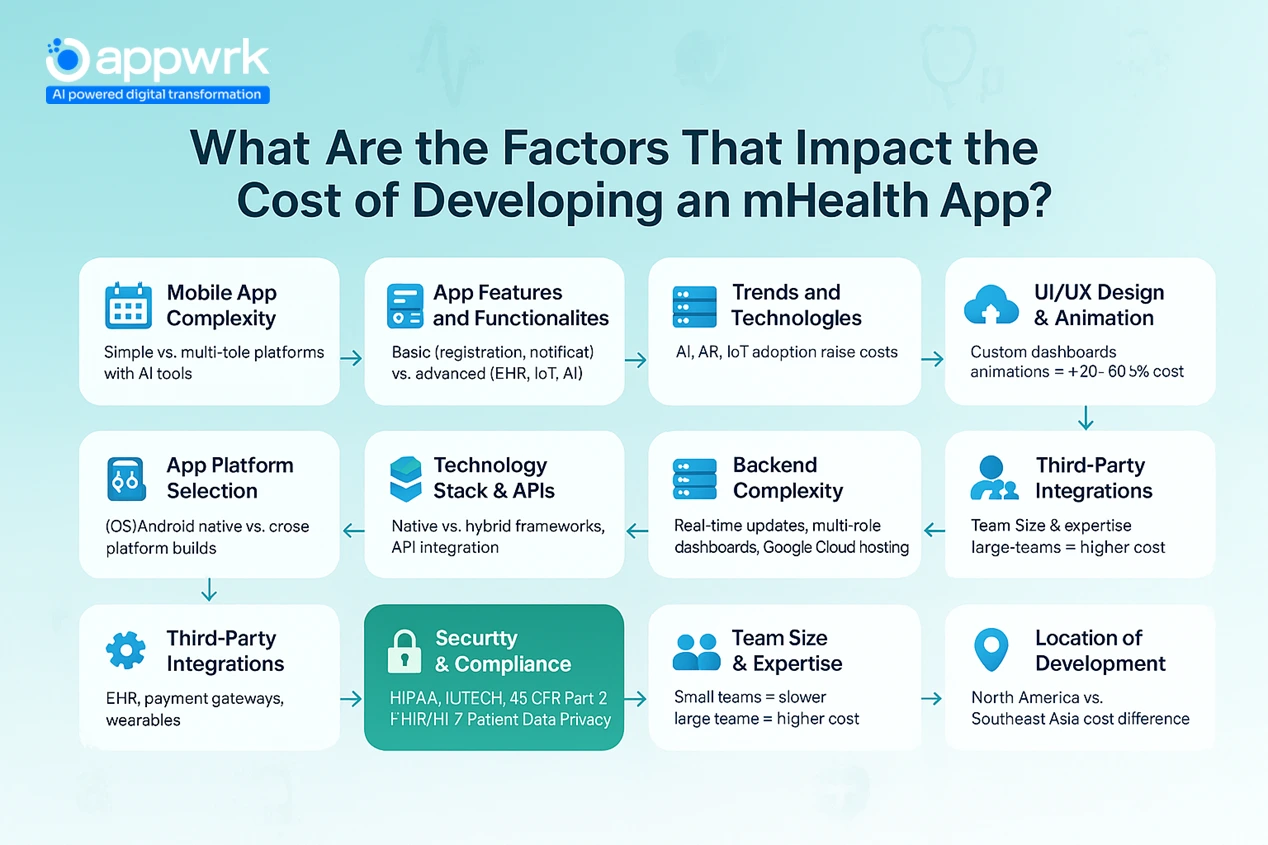
What Are the Factors That Impact the Cost of Developing an mHealth App?
The cost of developing an mHealth app doesn’t come down to a single line item. It’s a mix of technical complexity, platform type, backend infrastructure, APIs, and compliance requirements. Understanding these cost drivers helps founders, CIOs, and healthcare providers make better budget decisions before jumping into development.
Mobile App Complexity
Not all healthcare software is built equal. A simple app that handles medication reminders or scheduling might cost very little. But a moderately complex app with multiple user roles, dashboards, and patient management features quickly increases both development hours and testing cycles. At the top end, a highly complex app with AI-powered diagnostics, real-time telemedicine, and IoT wearables requires significant backend infrastructure and security baselines.
App Features and Functionalities for Health Application Development
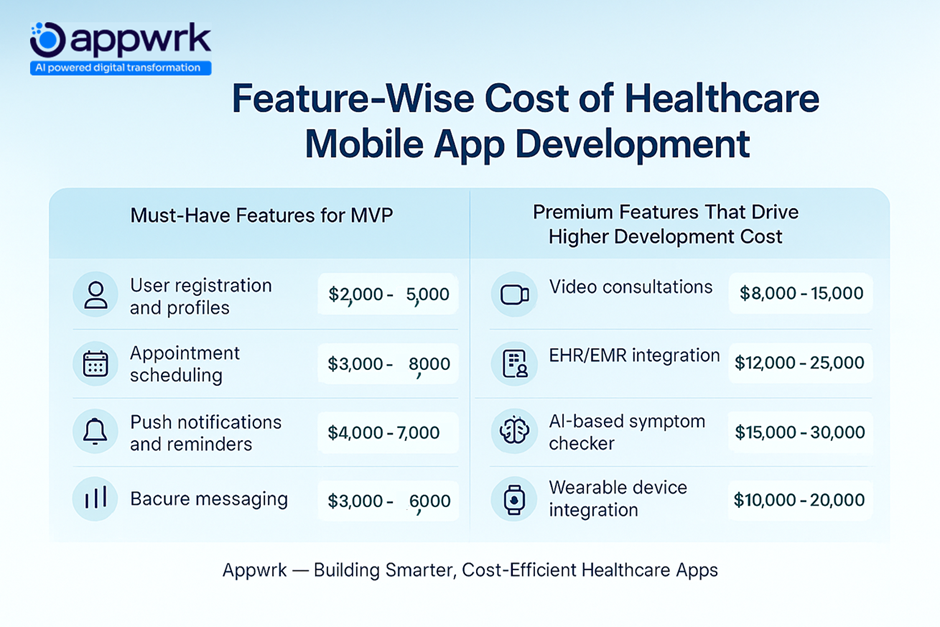
Every feature comes with a price tag. Entry-level healthcare application development usually includes registration, profiles, and push notifications. Premium features like video consultations, EHR/EMR integration, and insurance verification require advanced API integration, secure databases, and compliance with FHIR/HL7 standards. Each new feature adds complexity but also increases patient adoption and ROI.
Trends and Technologies
Healthcare mobile app development is being shaped by innovations like AI-driven diagnostics, predictive analytics, IoT connectivity, and even AR-based training. While they improve outcomes and user experience, they also demand specialised talent, which raises the app development cost.
App Design and Animation (UI/UX)
A clear, simple design is key to adoption. But if you add interactive dashboards, complex appointment flows, or custom animations, design costs can climb to20 to 30% of your total budget. Strong UI/UX design complexity is often the difference between an app patients love and one they abandon.
App Platform Selection
Platform type matters. Launching only on Android or iOS keeps things lean, but many providers prefer cross-platform frameworks like Flutter or React Native to cut costs. Native apps, however, usually deliver better performance and scalability, important for enterprise-grade telehealth platforms.
Technology Stack
Your backend stack defines scalability, compliance, and cost. Using APIsfor payments, FHIR/HL7 for data interoperability, and HIPAA-ready cloud hosting ensures reliability but increases cost. Hybrid frameworks lower expenses but may struggle with advanced real-time use cases like telemedicine.
Backend Complexity
If your app requires role-based access for patients and providers, patient data privacy safeguards, or heavy analytics, you’ll need a more advanced backend. Real-time dashboards and patient management modules often rely on scalable cloud hosting like Google Cloud or AWS to balance costs.
Hosting and Server Costs
Every mHealth app needs secure hosting. Video consultations, remote monitoring, and continuous data sync demand robust backend infrastructure. Hosting on AWS, Azure, or Google Cloud adds recurring costs, often 10 to 15% of annual spend in healthcare software.
Third-Party Integrations
Modern healthcare apps rarely work in isolation. Features like ePrescribing, payer eligibility checks, insurance integration, and wearable device syncing (e.g., Google Fit) require external APIs. Each integration can cost between $5,000 and $25,000, depending on the scope.
Size of the Development Team
A small team of 3 to 4 healthcare mobile app developers can build an MVP affordably, but at the cost of speed. Larger teams reduce time-to-market but raise total spend. Balancing team size against deadlines is crucial in competitive markets.
Security and Compliance Requirements
This is where hidden costs often surprise founders. Handling sensitive health data means following HIPAA, HITECH, GDPR, and 42 CFR Part 2. Apps must establish a security baseline, conduct regular security testing, and implement strong encryption. Using FHIR/HL7 APIs avoids interoperability gaps and integration drift but adds planning costs. These regulatory compliance requirements increase expenses but protect long-term viability.
Location of Development Team
Finally, geography matters. A team in the US may charge $100 to $250/hour, while equally skilled teams in Southeast Asia or Eastern Europe may charge $25 to $50/hour. That’s why many startups choose offshore teams for healthcare mobile app development to stay lean.
What Are the Hidden Factors Influencing Healthcare App Development Costs
Even after you’ve planned for features, complexity, and development stages, there are additional expenses that can quietly add up. These hidden factors often separate an underestimated budget from a realistic one.
Quality Assurance (QA)
Testing is non-negotiable in healthcare mobile app development. A bug in a shopping app might annoy a user, but in a medical app, it can affect patient safety. QA includes functional testing, usability testing, performance testing, andsecurity testing. It often accounts for 15 to 20% of the total app development cost and should be factored in from the start.
App Maintenance and Post-Launch Support
A healthcare app isn’t a one-time project. Operating systems evolve, new devices roll out, and compliance rules change. Expect to spend 15 to 20% of your initial build annually on maintenance. Setting up an app maintenance and support plan ensures your app remains secure, reliable, and user-friendly in the long term.
App Hosting and Listing Costs
Healthcare applications handle sensitive data, which means secure, compliance-ready hosting is a must (HIPAA, GDPR, or even 42 CFR Part 2). Hosting typically costs $500–$2,000 per month, depending on data storage and traffic. Don’t forget recurring app store listing fees, which, though smaller, also add up.
App Marketing and User Acquisition
Building the app is only half the battle. Convincing patients and providers to use it requires a budget for marketing campaigns, onboarding programs, and awareness drives. Without allocating for this, even the most polished healthcare software risks low adoption.
Compliance and Security
Regulatory compliance is one of the biggest hidden cost drivers. Whether it’s HIPAA, HITECH, or GDPR, compliance requires ongoing security practices, audits, and encryption protocols to protect patient data privacy. These measures may feel expensive, but skipping them risks fines and reputational damage.
By prioritising regulatory compliance, modular architecture, and phased rollouts, you can prevent overspending while still ensuring a secure, scalable product.
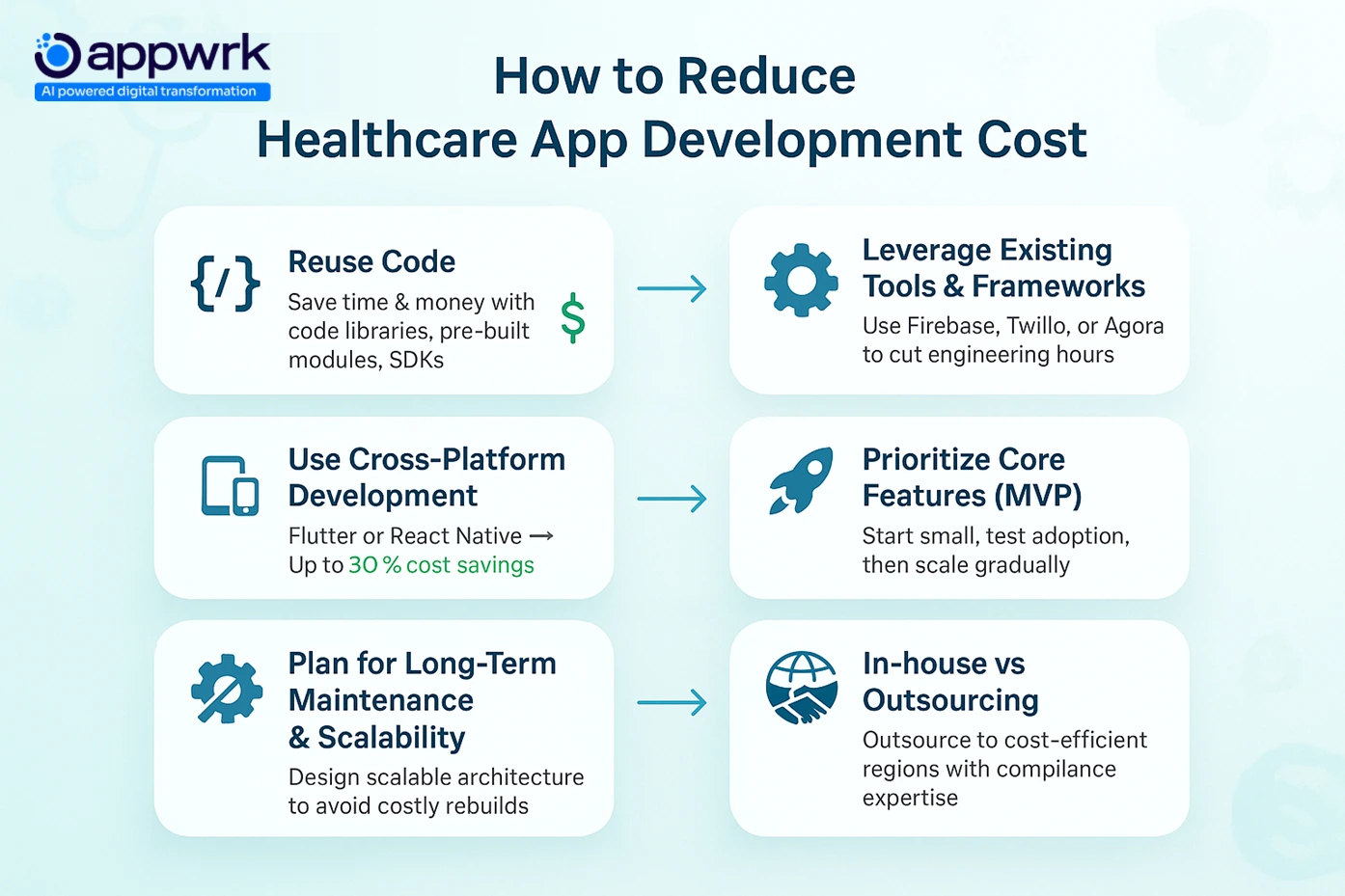
The good news? While these costs are real, there are proven strategies to keep budgets lean without sacrificing quality or compliance.
Reuse Code
Reduce development hours by reusing code libraries, SDKs, and pre-built modules. This ensures consistency and lowers cost inhealthcare software projects.
Leverage Existing Tools & Frameworks
Instead of reinventing the wheel, use frameworks like Firebase for notifications, Twilio for communication, or Agora for video consultations. Smart API integration saves time and ensures scalability.
Use Cross-Platform Development
Frameworks like Flutter or React Native let you build iOS and Android apps at the same time. This can cut healthcare mobile app development costs by up to 30% while still delivering strong performance.
Prioritise Core Features (MVP Approach)
Start with a Minimum Viable Product (MVP). Focus on essential modules like appointment scheduling, insurance verification, or medication reminders. Gather user feedback and expand later instead of burning your budget on non-core features upfront.
Plan for Long-Term Maintenance & Scalability
Future-proof your investment by designing scalable architecture early on. This prevents costly rebuilds later when your telemedicine or patient management app starts attracting larger user bases.
In-house vs Outsourcing Healthcare App Development
Hiring in-house developers in the U.S. or Europe can cost 3 to 5x more than outsourcing to experienced mobile app development companies in Asia or Eastern Europe. The key is choosing partners with proven regulatory compliance expertise and strong healthcare case studies.
When it comes to healthcare app development, choosing between in-house and outsourcing isn’t always a black-and-white decision. Many successful healthcare providers and startups adopt a hybrid approach that balances control, cost-efficiency, and expertise.
How it Works: A hybrid approach combines an in-house team for core responsibilities (like strategy, compliance, and patient-facing design) with external partners who handle specialised development tasks. For example, an internal team might oversee patient management workflows, while outsourced experts build modules for EHR/EMR integration or implement FHIR/HL7 interoperability standards.
Benefits of Hybrid Development:
Cost Efficiency: By outsourcing non-core tasks, you avoid overstaffing while still ensuring access to niche expertise.
Speed and Scalability: Hybrid teams move faster by working in parallel, reducing time-to-market.
Specialised Skills: External partners bring in-demand knowledge of APIs, blockchain development, and AI-driven diagnostics without requiring full-time hires.
Flexibility: You can scale external resources up or down as your healthcare app moves from MVP to enterprise-level rollout.
When to Consider Hybrid Approaches:
You want more control than full outsourcing, but don’t have the budget to build everything in-house.
Your project requires pre-built HIPAA-compliant customizable modules for faster compliance without starting from scratch.
You need advanced features like predictive analytics, video consultations, or insurance verification, which demand highly specialised developers.
In short, hybrid healthcare development models provide the best of both worlds: strategic alignment and regulatory oversight from internal teams, plus cost-effective, specialised delivery from external partners.
How Can You Monetise Your Healthcare Apps Development
Building a healthcare app is only half the journey; making it financially sustainable is where long-term success lies. Monetisation in healthcare app development is about more than charging users; it’s about aligning revenue with patient value, trust, and regulatory compliance.
Whether it’s a telemedicine app, a patient portal, or a fitness app, the right monetisation strategy can lower manual overhead, improve interoperability, and ensure continuous ROI. Below are the most effective revenue models used in healthcare mobile app development today:
Subscription-Based Model
Users pay a recurring monthly or yearly fee for access to premium features. This is the most stable monetisation approach because it generates predictable revenue streams. It’s widely used in telehealth platforms, chronic disease management apps, and even tools like ZocDoc that offer premium visibility for doctors.
In-App Purchases
Patients can unlock additional services directly within the app, such as specialist video consultations, advanced reports, or therapy modules. This works well in mobile health app development, particularly when building digital coaching, mental health journals, or nutrition trackers.
Freemium Model
The app is free to download with limited functionality, while advanced features (e.g., medication reminders, predictive analytics, or deeper patient management tools) require payment. This model helps scale quickly and then upsells to a paying audience. Fitness and wellness healthcare software often relies on this approach.
Sponsored Content
Pharma companies, hospitals, or insurance integration partners can sponsor educational content, training modules, or research sections inside your app. This works best once you’ve built an engaged user base. Imagine a doctor booking app highlighting sponsored preventive care content in collaboration with providers like Nextcare.
Affiliate Marketing and Lead Generation
Your app can generate revenue by connecting users to pharmacies, diagnostic labs, or insurance providers and earning a commission per referral. In telemedicine apps and ePrescribing tools, this has become one of the fastest-growing monetisation streams.
Paid Apps
Less common today but still viable in niche markets, users pay a one-time download fee. Professional medical reference apps or tools used by specialists often still succeed with this model.
Advertising
Relevant, non-intrusive ads can bring in steady revenue. However, in healthcare, patient trust is everything. Ads should be limited to vetted partners, think fitness apps promoting wearables like Google Fit, or safe pharmacy products.
How to Calculate ROI for Healthcare App Development
For most founders, investors, and healthcare CIOs, the question isn’t just “How much does healthcare app development cost?”, it’s “Will it actually pay off?” That’s where ROI (Return on Investment) becomes the real metric of success.
A well-built healthcare mobile app not only drives revenue but also reduces manual processes, improves patient outcomes, and strengthens long-term growth. Let’s break down how to calculate it.
ROI Formula for Healthcare Apps
The standard formula is simple:
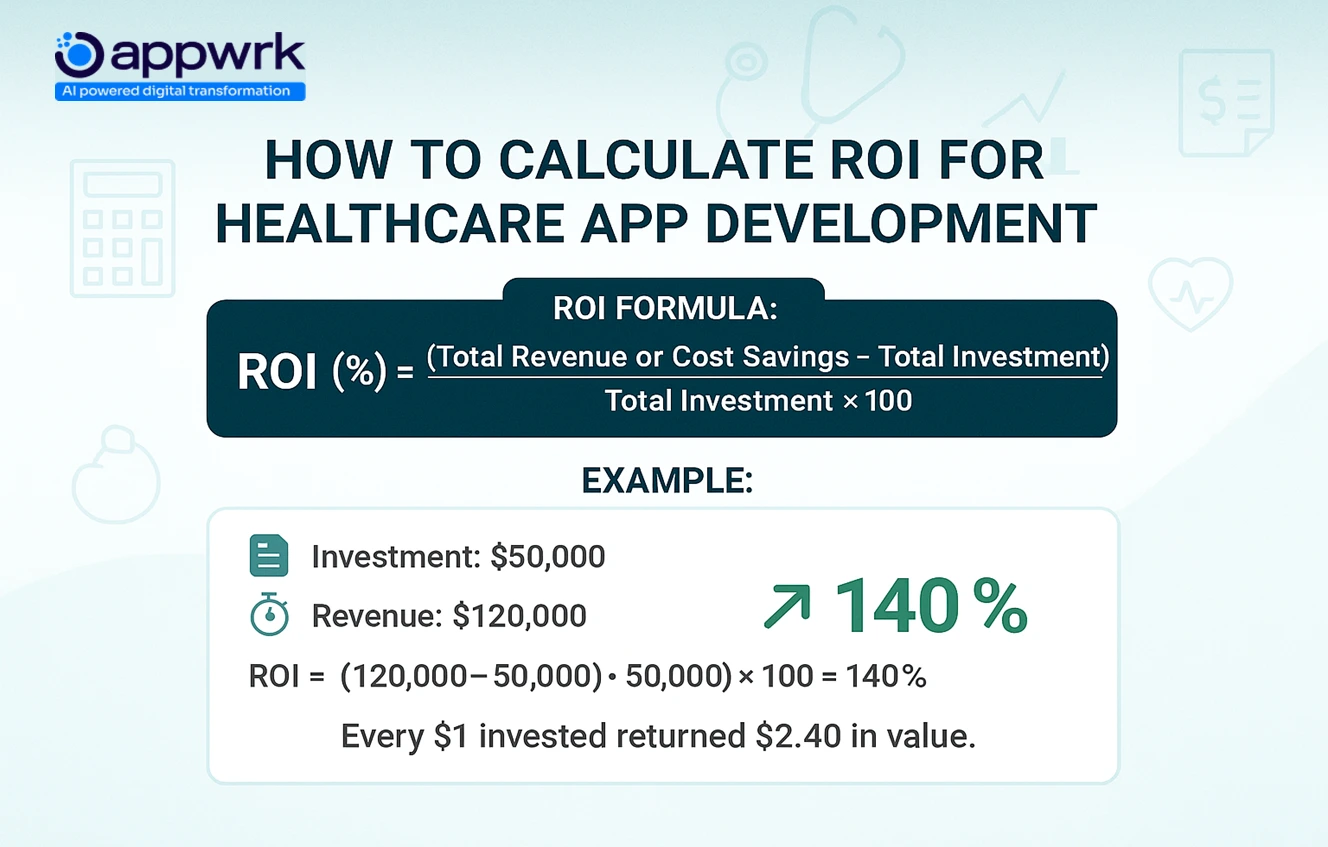
ROI (%) = ((Total Revenue or Cost Savings – Total Investment) ÷ Total Investment) × 100
This works whether your app earns direct income (subscriptions, in-app payments, consultations) or delivers indirect value (reduced hospital overhead, faster patient onboarding, or improved patient management workflows).
Revenue from subscriptions & telemedicine consultations in one year = $120,000
Total investment (development + compliance + maintenance) = $50,000
ROI = ((120,000 – 50,000) ÷ 50,000) × 100 = 140%
That means for every dollar invested, you get $2.40 back, a strong return in mHealth app development.
Investment vs Returns in Digital Health
When founders think about healthcare application development, they often focus only on the upfront app development cost. But in reality, the bigger picture lies in balancing that investment against long-term returns.
The investment includes design, APIs, backend infrastructure, and compliance efforts like HIPAA or GDPR. On the returns side, digital health platforms reduce manual processes, improve patient onboarding, and unlock recurring revenue streams through subscriptions, in-app payment models, and insurance verification integrations.
For example, a $50,000 telemedicine app investment can return multiples in cost savings by reducing in-person visits and administrative overhead. In many cases, predictive analytics, AI-driven diagnostics, and interoperability with systems like FHIR help deliver measurable improvements in care quality, translating into stronger ROI.
In short, while medical apps cost more upfront than typical consumer apps, the financial and operational returns in digital health often make them one of the most sustainable investments for healthcare providers.
Why ROI Is More Than Just Revenue
Direct revenue is only part of the story. True ROI in healthcare application development should also account for:
Operational savings — less paperwork, fewer manual billing errors, and reduced staff time.
Patient experience gains — faster onboarding, personalised care, and fewer missed appointments thanks to tools like medication reminders.
Better treatment outcomes — remote monitoring and predictive analytics improve patient retention and loyalty.
Brand credibility — launching a compliant, innovative app builds trust and attracts new patients, insurers, and partners.
For decision-makers, ROI is the clearest way to decide whether your healthcare app development project is just a cost centre or a long-term growth engine.
Avoiding Budget Overruns in Healthcare App Projects
One of the biggest challenges in healthcare app development is keeping costs predictable. Teams often underestimate hidden costs like compliance checks, patient onboarding campaigns, and ongoing server hosting, which leads to budget overruns later. The best way to avoid this is to align business goals with a realistic development roadmap from the start.
Conduct thorough market research and user needs analysis before finalising features. This ensures you only build what adds real value instead of overloading the MVP with unnecessary modules.
Choose a clear pricing model. Fixed-price works best for healthcare apps with defined requirements, while time and materials for complex medical solutions may be better for projects with evolving features.
Leverage pre-built HIPAA-compliant customizable modulesfor login, encryption, or e-prescribing to cut both time and cost.
Finally, always budget an additional 15 to 20% for testing, compliance, and post-launch support. These aren’t optional in healthcare software; they’re safeguards for both patients and providers.
What Future Trends Will Shape Healthcare Mobile App Development
Healthcare mobile app development is no longer just about appointment booking or step counting. It’s rapidly evolving into a space where smarter technologies, stronger security, and more personalized care define the experience. With rising smartphone adoption and growing demand for digital-first healthcare, here are the trends that will shape the future.
Why Invest in Healthcare App Development?
Healthcare app development is not just about compliance—it’s a growth driver. Here’s why more startups, hospitals, and payers are investing:
Growing Technology Adoption – AI, IoT, and telemedicine are reshaping digital healthcare.
Increase in Revenue Opportunities – From subscriptions to in-app payments, monetization models make apps profitable.
Boost in Patient Satisfaction & Engagement – Features like video consultations, medication reminders, and patient portals improve trust and retention.
Artificial Intelligence in Healthcare Apps
AI is becoming the backbone of modern healthcare apps. From assisting doctors with faster, more accurate diagnoses to making apps feel like personal health coaches, the impact is huge.
Examples:
AI chatbots for mental health check-ins
Predictive analytics for managing chronic diseases
Automated image recognition in radiology scans
Personalized treatment recommendations for patients
The next generation of healthcare apps won’t just record data — they’ll interpret it, flag risks early, and support clinicians with AI-driven diagnostics.
Augmented Reality in Health App Development
AR makes healthcare more interactive for both providers and patients. It helps doctors train better and patients understand their conditions in simpler, visual ways.
Examples:
Virtual anatomy models and surgical training
AR-led physical therapy and rehabilitation
Interactive visuals for patient education
Internet of Things (IoT) in Healthcare Apps
IoT bridges the gap between patients and providers by continuously monitoring health data. Connected devices bring real-time visibility to doctors and improve proactive care.
Examples:
Wearables that track vitals 24/7
Connected inhalers for asthma patients
IoT-enabled glucose monitors
Remote patient monitoring dashboards in hospitals
Blockchain for Data Security and Transparency
With Patient Data Privacy a top concern, blockchain is emerging as a trust-building technology in healthcare. It ensures that sensitive data is stored securely, with full transparency.
Examples:
Decentralized patient record sharing across providers
Transparent tracking in the drug supply chain
Patient consent management systems
Fraud detection in insurance verification and claims
Cloud Adoption in App Development for Healthcare
Cloud solutions are cutting costs while boosting scalability. They make it easier for doctors, hospitals, and patients to collaborate on a single, accessible platform.
Examples:
Cloud-based EHR systems are accessible from anywhere
Scalable telehealth platforms for Video Consultations
Real-time collaboration across multi-clinic networks
Voice Technology in Healthcare Mobile App Development
Voice assistants are making apps more inclusive and easier to use — especially for elderly patients or those with disabilities.
Examples:
Voice-based appointment scheduling (like a digital doctor booking app)
Medication reminders via smart speakers
Voice-enabled patient data entry for providers
Wearable Tech Integration in Medical Mobile Application Development
Wearables have already become part of daily life, and their role in healthcare is only growing. Integrated with apps, they provide round-the-clock data for better decisions.
Examples:
Smartwatches that track heart rate, sleep, and activity
Smart rings for fertility or women’s health tracking
Wearable ECG monitors for cardiac patients
Big Data and Analytics: The Role of Mobile Applications in Healthcare Industry Growth
Big data turns healthcare apps into powerful decision-making tools. With predictive analytics, providers can treat patients better and run operations more efficiently.
Examples:
Population health analytics to identify risks early
Predictive outbreak tracking for faster public health response
Personalized treatment plans based on large datasets
Hospital benchmarking to improve efficiency
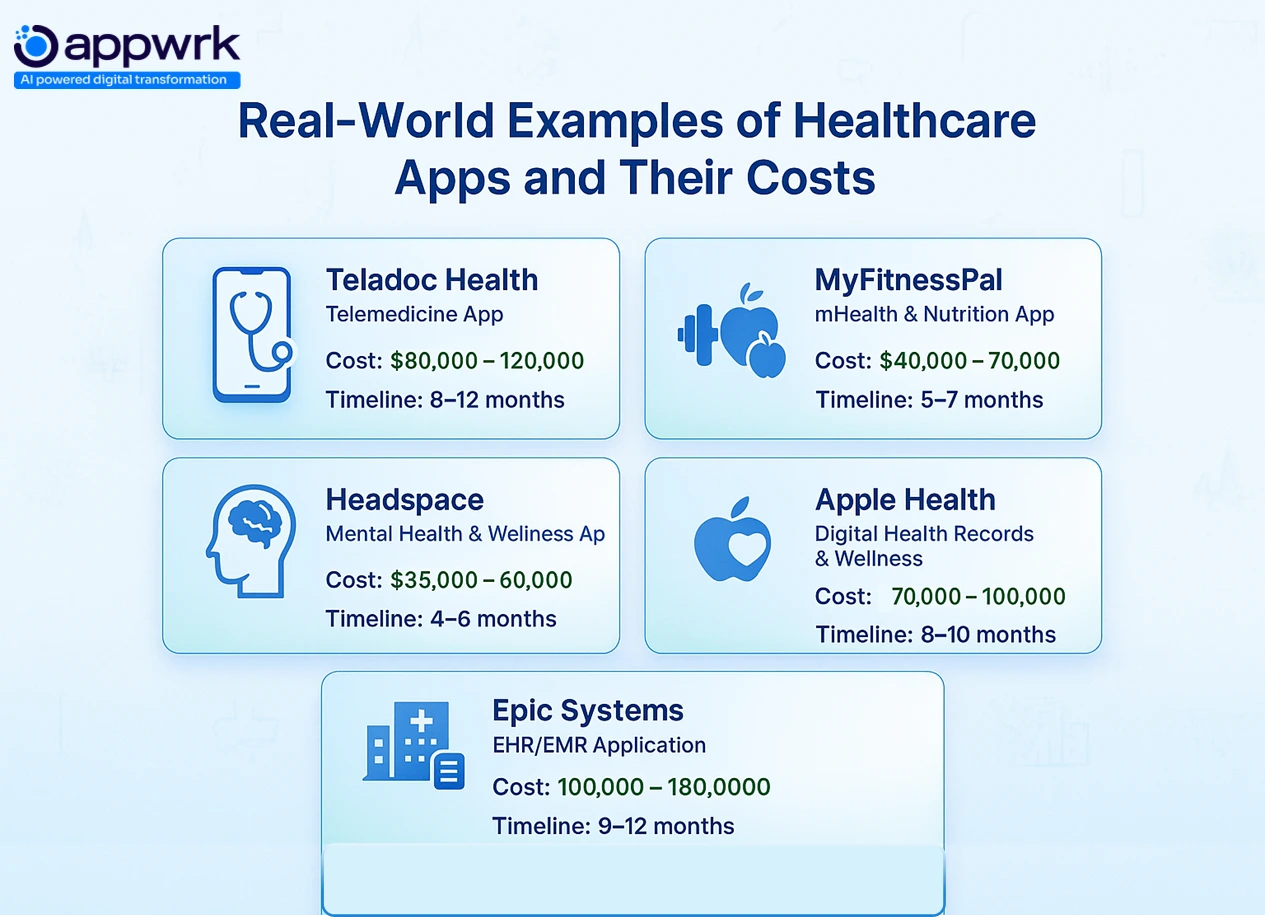
Real-World Examples of Healthcare Apps and Their Costs
Looking at real-world healthcare software gives founders, investors, and providers a clearer sense of what to expect. From telemedicine platforms like Teladoc to EHR giants like Epic Systems, these examples show how different app types translate into costs, timelines, and features.
Teladoc Health – Telemedicine App
What it does: A global leader in telehealth, Teladoc enables patients to connect with doctors anytime through video, phone, or mobile app. It supports everything from primary care to behavioural health.
Key Features:
24/7 video consultations and video consultations for urgent care
Mental health therapy sessions and counselling
Digital prescription management and renewals
Chronic disease patient management tools
Estimated Development Cost Today: $80,000 to $120,000 Timeline: 8 to 12 months
MyFitnessPal – mHealth and Nutrition App
What it does: A top wellness app that helps users monitor diet, calories, and activity, often integrated with fitness apps and wearables.
Key Features:
Calorie and food logging with barcode scanning
Fitness and activity tracking synced with wearables.
API integration with Apple Health, Google Fit, and smart devices
Personalised insights powered by predictive analytics
Estimated Development Cost Today: $40,000 to $70,000 Timeline: 5 to 7 months
Headspace – Mental Health and Wellness App
What it does: A mindfulness app supporting mental health through meditation, stress relief, and guided wellness programs.
Key Features:
Guided meditation and breathing exercises
Sleep improvement programs with audio content
Personalised wellness journeys and daily check-ins
Push notifications and medication reminders for routines.
Estimated Development Cost Today: $35,000 to $60,000 Timeline: 4 to 6 months
Apple Health – Digital Health Records & Wellness Hub
What it does: A built-in patient portal and health dashboard on iOS that consolidates health data from clinics, labs, and wearables.
Key Features:
Secure digital health record storage with HIPAA-grade compliance
FHIR/HL7 interoperability for lab and clinic integration
Wearable syncing (Apple Watch, Fitbit, etc.)
Trend analysis and data visualisation dashboards
Estimated Development Cost Today: $70,000 to $100,000 Timeline: 8 to 10 months
Epic Systems – EHR/EMR Application
What it does: One of the most widely used enterprise healthcare software systems, managing hospital operations, billing, and patient care.
Key Features:
Centralised EHR database with interoperability via FHIR
Lab and imaging APIs for seamless reporting
Role-based access for clinicians, nurses, and staff
Compliance-ready with regulatory frameworks like HIPAA, HITECH, and 42 CFR Part 2
Estimated Development Cost Today: $100,000 to $150,000 Timeline: 9 to 12 months
These examples show that while enterprise-grade apps like Epic demand heavy investment, startups don’t need to replicate them at full scale. By using phased rollouts, modular APIs, and cross-platform frameworks, founders can deliver cost-effective MVPs and scale into enterprise-ready platforms over time.
What Are the Regulatory and Legal Considerations in Healthcare Application Development
Any healthcare software that touches patient data privacy must meet strict legal standards. Failing to comply risks heavy fines, lawsuits, and loss of user trust. That’s why regulatory compliance is not just a box to tick; it shapes how healthcare mobile app development is planned and executed.
HIPAA (Health Insurance Portability and Accountability Act) – U.S.
HIPAA is the baseline for all U.S. healthcare apps. It sets strict rules for how patient data is stored, accessed, and transmitted.
Implications:
End-to-end data encryption
Multi-factor authentication and secure logins
Role-based access for providers and staff
Complete audit trails for every interaction
Cost Impact: Adds $5,000 to $20,000, depending on the app’s complexity.
GDPR (General Data Protection Regulation) – Europe
Apps targeting EU patients must comply with GDPR, which emphasises user rights and transparency.
Implications:
Explicit patient consent before collecting data
Right to data deletion (“right to be forgotten”)
In-app privacy policies written in plain language
Data transfer restrictions across geographies
Cost Impact: Typically adds $5,000 to $15,000.
42 CFR Part 2 – U.S.
This regulation applies to apps handling substance use disorder records. It goes beyond HIPAA to provide stronger protections.
Implications:
Additional safeguards for mental health and addiction data
More detailed access controls
Oversight from legal and compliance experts
Cost Impact: Adds $3,000 to $10,000, depending on scope.
HITRUST Certification – Enterprise Trust Layer
While not mandatory, HITRUST certification is often requested by enterprise clients and large hospitals.
Implications:
Rigorous audits and third-party certification
Higher upfront investment
Builds stronger market trust for large-scale rollouts
Cost Impact: $10,000 to $50,000, depending on app size.
Other Global Regulations
Canada, Australia, Singapore, and other regions enforce their own health data laws. Any healthcare mobile app development project targeting multiple geographies must factor in these requirements.
Bottom Line: Regulatory compliance is non-negotiable. It raises upfront costs, but it’s the only way to protect patients, avoid fines, and ensure your healthcare application can scale globally.
How Can Appwrk Help You With Healthcare App Development
Partnering with the right team makes compliance, scalability, and ROI achievable without overspending.
Why Appwrk Is Trusted for Healthcare Application Development
Expertise in HIPAA, GDPR, 42 CFR Part 2, and HITECH frameworks
Agile workflows and reusable frameworks that cut healthcare app development costs by up to 40%
Vision-to-Traction System
Appwrk follows a Vision-to-Traction System—starting with research and user needs, validating product-market fit, and mapping MVPs with HIPAA-compliant modules to save time and cost.
Appwrk’s Role as Healthcare Mobile App Developers
As healthcare mobile app developers, Appwrk builds:
EHR Platform – HIPAA-compliant system in 6 months under $120K
With Appwrk, compliance and cost-efficiency go hand in delivering faster, safer, and ROI-focused healthcare application development.
FAQs
How much does it cost to develop a healthcare app? The cost of healthcare app development starts at $12,000 for a basic MVP and can go up to $120,000 for enterprise-grade solutions. Final pricing depends on features, backend infrastructure, regulatory compliance, and the development team’s location. Many startups cut costs by working with offshore healthcare software partners who reuse APIs and frameworks without compromising Patient Data Privacy.
What is the average time to build a healthcare mobile app? A healthcare mobile app typically takes 4 to 9 months to build. A simple doctor booking app or patient portal can launch in 2 to 3 months, while complex apps with AI-driven diagnostics, FHIR/HL7 API integration, and insurance verification require longer timelines. Contact us to know the real timeline to build your mobile application.
What factors impact healthcare application development cost the most? The biggest cost drivers are:
App complexity and feature set
Platform type (iOS, Android, or cross-platform)
Backend infrastructure and API integrations
Regulatory frameworks like HIPAA, GDPR, and 42 CFR Part 2
Advanced features such as video consultations, ePrescribing, predictive analytics, and interoperability with EHR systems
How much does it cost to maintain a healthcare app annually? Annual maintenance usually costs 15 to 20% of the initial build. This covers bug fixes, cloud hosting, security baseline updates, and new compliance requirements like HITECH or GDPR.
Can a healthcare app be built on a budget? Yes. By starting with an MVP-first strategy, using cross-platform frameworks like Flutter, and outsourcing to cost-effective regions, a fully functional healthcare MVP can be built for $12,000 to $25,000.
What are the hidden costs in healthcare app development? Founders often underestimate hidden costs, such as:
Compliance audits for HIPAA, GDPR, and 42 CFR Part 2
Patient onboarding, training, and marketing campaigns
How can healthcare apps make money? Common monetisation models include:
Subscriptions (popular in telehealth platforms like ZocDoc and Nextcare)
In-app payments for video consultations or fitness apps
Freemium upgrades with premium features
Sponsored wellness content
Affiliate revenue from pharmacies and insurance providers
Do I need HIPAA compliance for a healthcare mobile app? If your app handles patient data in the U.S., HIPAA compliance is mandatory. In Europe, GDPR applies. Apps supporting substance abuse or mental health journals must also comply with 42 CFR Part 2. While compliance increases cost, it ensures security, trust, and scalability.
What ROI can I expect from healthcare app development? A strong healthcare app can deliver 100 to 150% ROI in the first year, especially for apps that combine telemedicine + patient management + insurance integration. Beyond revenue, ROI also comes from reduced admin overhead, faster onboarding, and improved patient retention.
What types of healthcare apps are most in demand? Current high-demand categories include:
Telemedicine apps for remote consultations
Remote patient monitoring apps with IoT and wearables
Gourav Khanna is the Co-founder and CEO of APPWRK, leading the company’s vision to deliver AI-first, scalable digital solutions for enterprises and high-growth startups. With over 16 years of leadership in technology, he is known for driving digital transformation strategies that connect business ambition with outcome-focused execution across healthcare, retail, logistics, and enterprise operations.
Recognized as a strategic industry voice, Gourav brings deep expertise in product strategy, AI adoption, and platform engineering. Through his insights, he helps decision-makers prioritize market traction, operational efficiency, and long-term ROI while building resilient, user-centric digital systems.
Subscribe to APPWRK Blogs, We'll Do the Rest!
Get Blogs on UI/UX, Mobile Apps, Online Marketing, and Web development technology.
Unlock worthy and priceless suggestions from the masters of mobile and web app development