150+ minds across 4 countries. Join a culture of innovation, ownership & growth.
Rewire for AI
From machine learning to deep learning, from classification tools to overall process automation – our AI engineers will help you retool your existing system or enhance your company results.
Ship faster, scale smarter, built for product companies and SaaS teams
Our Latest Work
We strive hard to deliver result-driven digital solutions across the globe. Check out our case studies to get a glimpse of how we ideate, innovate, and create unconventional digital solutions according to the requirements of our clients.
Discover diverse and passionate insights from our tech enthusiasts. We collaborate across various sectors to streamline operations and drive innovation. Explore our rapidly growing collection of articles to see why we’re at the forefront of IT solutions.
The decision to move from Magento to Shopify is one of the most significant replatforming choices an ecommerce business can make. Magento is powerful, but its power comes with...
Accuracy gap is real: Traditional CPG forecasting carries a 25-40% MAPE error rate. AI-powered models bring that down to 8-15%, according to McKinsey research....
Real stories from global leaders who trusted us with their ideas.
Partnering with APPWRK helped us build a compliant and scalable healthcare platform, accelerating our time-to-market by 35%. Their team consistently delivered outstanding work.
Beesers
Digital Healthcare Client
Collaborating with APPWRK, Sportskeeda modernized its platform into a real-time sports engagement ecosystem, enabling seamless content delivery, scalable fan interactions, and high-velocity performance.
Sportskeeda
Sports & Entertainment Partner
Working with APPWRK was effortless. They captured our vision, maintained full compliance, and delivered a digital experience that built trust and elevated how customers interact with our fintech brand.
PayPenny
Fintech Partner
Working with APPWRK gave us confidence in adopting AI responsibly. Their team built a safe, intelligent bot that transformed how we engage with leads and helped us achieve measurable revenue growth.
IFB
AI Transformation Partner
Leveraging APPWRK’s digital expertise, Nemesis launched a scalable, compliant, and safe super app that connects content delivery, real-time communication, and logistics management within a single platform.
Hospital management software development typically starts at $5,000 for basic MVPs, while fully-featured, enterprise-grade systems can range from $15,000 to $210,000, depending on the complexity of features, third-party integrations, regulatory compliance, and scalability requirements.
A minimum viable product (MVP) version of hospital management software can start at around $5,000, making it a cost-effective option for pilot projects or testing administrative workflows within a single department.
Mid-scale builds typically fall between $15,000 and $75,000, covering essential modules like EHR, billing, appointment management, and user portals.
Enterprise-level hospital management systems range from $120,000 to $210,000, especially when compliance (HIPAA, GDPR), custom workflows, mobile apps, and third-party integrations are layered in.
Planning compliance architecture upfront and focusing on modular MVP delivery can cut 25-30% of unnecessary development waste.
This blog is tailored for healthcare startup founders, hospital CIOs/CTOs, digital transformation consultants, and decision-makers evaluating custom software to modernize hospital operations or launch SaaS HMS platforms.
This blog will take you through real pricing ranges, budget levers, monetization paths, and tactics to reduce hospital software development costs, so you can move forward with clarity, not estimates.
Why Hospitals Are Adopting Smart Hospital Management Software
In today’s data-driven healthcare environment, the question isn’t whether hospitals should digitize, but how quickly they can. With increasing pressure to streamline operations, reduce costs, and enhance patient experiences, smart hospital management systems (HMS) are no longer optional; they’re essential.
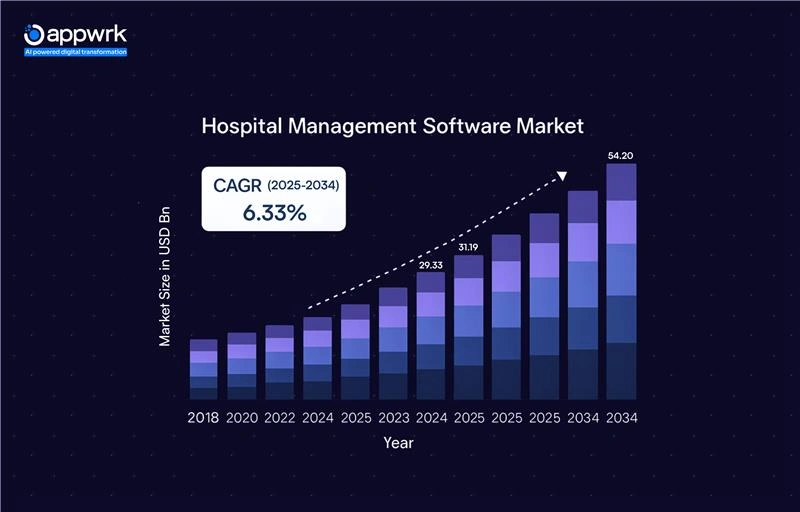
The hospital management software (HMS) market is projected to grow from $31.19 B in 2025 to $54.20 B by 2034, at a 6.33% CAGR, per Market Research Future. Other estimates show it could be even larger: Business Research Insights forecasts a rise to $67.9 B by 2033, hitting a 10.5% CAGR.
Globally, healthcare IT spend nears $522 B in 2024 and is expected to grow at a 13.59% CAGR through 2030.
Beyond modernization, this shift is driven by:
Operational Efficiency: AI-driven scheduling and billing modules reduce wait times and revenue leakage.
Regulatory Pressure: Interoperability mandates and privacy compliance require built-in digital frameworks.
Competition & Patient Experience: Expectations are rising as digital-first services are a competitive edge now.
ROI Potential: Automated workflows and data reporting lead to real cost savings and better care.
As hospital margins tighten and digital services offer measurable ROI, investing in smart software is no longer optional, but it’s inevitable.
How Much Does It Cost to Build Hospital Management Software?
When planning a hospital management software (HMS) project, understanding the cost ranges across different build types is crucial for accurate budgeting and phased scaling. Costs vary significantly based on the scope, ranging from a lean MVP pilot for single departments to full-scale enterprise deployments spanning multiple hospitals. Below, we break down pricing tiers aligned with your strategic goals, clinical priorities, and compliance needs.
Cost to Build a Basic MVP or Pilot HMS
MVP or department-level pilots are the leanest way to test core workflows like patient onboarding or billing in a contained hospital setting. Ideal for early-stage validation.
Cost Range: Starts at $5,000
Best For: Appointment scheduling, billing automation, and single-department workflow.
Mid-tier HMS builds are designed for clinics or hospitals with 2-4 departments needing more cohesive integration of EHR and patient experience systems.
Cost Range: $15,000 to $75,000
Modules Included: EHR, appointment portals, pharmacy basics, and user dashboards.
Ideal For: OPD centers, and growing specialty clinics.
Enterprise-Grade HMS Software Cost for Full-Scale Builds
Enterprise builds handle hundreds of users, advanced compliance, multi-site rollouts, and mobile-first experiences. These projects demand more complex API orchestration and governance frameworks.
Cost Range: $75,000 to $210,000+
Modules Included: HL7/FHIR-ready APIs, HIPAA/GDPR compliance, BI Dashboards, and mobile and cloud support.
Use Case: Large hospitals, group chains, and multi-region support.
Quick Cost Comparison by HMS Type
HMS Type
Cost Range for HMS Software
Features Included in the HMS
Recommended For
Basic MVP or Pilot HMS
$5,000 to $15,000
Appointment scheduling, basic billing, and admin workflows.
Single department or pilot validation
Mid-Scale HMS
$15,000 to $75,000
EHR modules, patient/staff portals, and pharmacy integration.
Clinics or small hospitals
Enterprise Grade HMS
$75,000 to $210,000+
Compliance-ready system, BI dashboards, and API integrations.
Large hospitals, multi-site networks
The Cost Benefits of Using Modular Architecture in Hospital Software
Modular architecture enables hospitals to roll out software in manageable phases, reducing upfront costs, minimizing risk, and allowing teams to adapt features as needs evolve. This phased approach not only supports compliance and integration flexibility but also helps avoid technical debt and long-term rework.
Benefits:
Reduces upfront costs and isolates risk.
Allows agile scaling with team feedback loops.
Makes compliance manageable via layered integration.
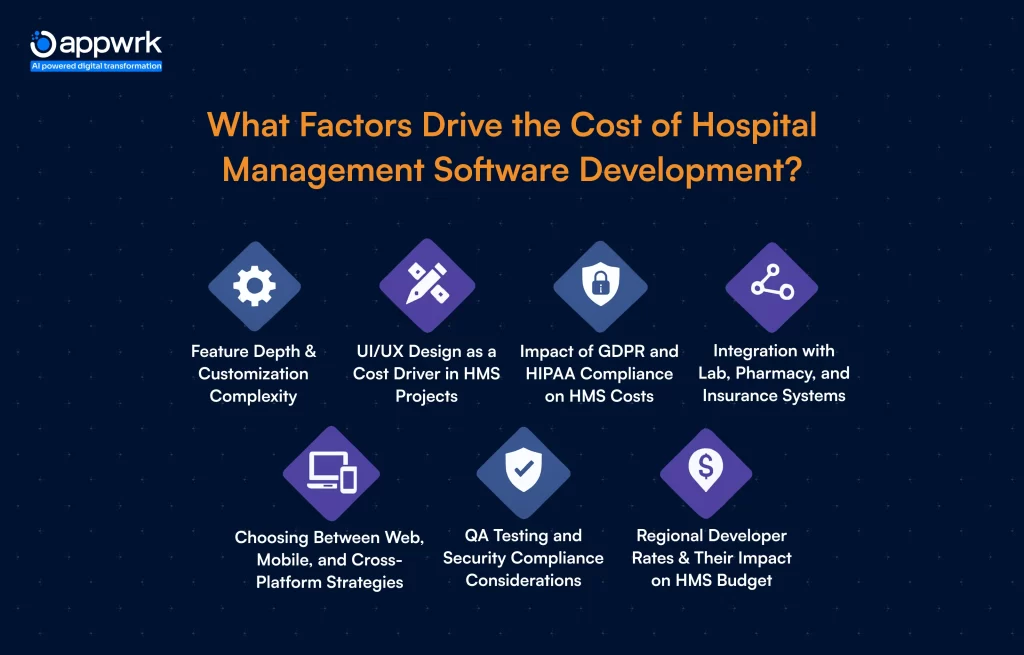
What Factors Drive the Cost of Hospital Management Software Development?
The cost of developing hospital management software varies widely, not just by how many features you include, but by how deeply those features are tailored to your operations. Elements like regulatory compliance, third-party integrations, deployment scale, and localization for different regions all shape the final budget. What works for a single clinic may fall short for a multi-facility healthcare network with complex infrastructure needs.
Feature Depth & Customization Complexity
Modules like Electronic Health Records (EHR), telemedicine, or automated billing can increase development complexity by 30-50%.
Each feature brings extra work: custom schemas, complex workflows, secure database design, access controls, and integrations.
Add-on capabilities, such as drug inventory tracking, dynamic staffing logistics, or medical imaging, can inflate budgets by $20,000 to $50,000 per module.
Impact of GDPR and HIPAA Compliance on HMS Costs
Late-stage compliance inclusion, especially for HIPAA in the US or GDPR in the EU, often leads to substantial backend refactoring, audit log rework, and encryption retrofitting. This can bloat your project by an estimated $40,000 to $60,000, depending on data flow complexity and testing cycles.
Early design of data encryption, audit trails, role-based access, and secure messaging avoids costly rewrites during compliance testing.
UI/UX Design as a Cost Driver in HMS Projects
An intuitive, well-designed interface encourages faster adoption among doctors, nurses, and administrators, while poor UX can lead to user frustration, decreased productivity, and additional costs for retraining and support.
Mobile-responsive patient portals and staff dashboards add 20-30% more to the UI development budget.
Rich visualizations like interactive BI dashboards for hospital performance metrics also require higher dev and testing effort.
Integration with Lab, Pharmacy, and Insurance Systems
Integration with pharmacy systems, lab devices, insurance APIs, and digital health trackers often adds thousands per API endpoint.
Legacy system migrations, including cleaning, mapping, and compliance, frequently incur hidden costs and project risk.
A modular, API-first design reduces long-term costs and simplifies future integrations.
Choosing Between Web, Mobile, and Cross-Platform Strategies
Native apps (Android/iOS) carry 20-40% higher development and testing costs than web-only solutions.
Frameworks like Flutter or React Native offer cross-platform efficiency, but still require extensive QA for healthcare standards (e.g., offline security, biometric login).
QA Testing and Security Compliance Considerations
Healthcare software requires multi-layered QA: unit, integration, regression, and particularly penetration/security testing.
QA and security audits typically add 15-20% to total development expenses.
Automated testing frameworks reduce long-term costs but require upfront investment in scripting and maintenance.
In the United States, where HIPAA governs strict encryption and audit logging, QA cycles are longer and pricier. In the European Union, GDPR enforces breach disclosure timelines and mandates data hosting within EU borders, driving up security infrastructure costs.
For Indian healthcare startups, while HIPAA/GDPR aren’t legally binding, building compliant-by-design systems helps tap global SaaS markets and ensures smoother B2B adoption in the U.S. or EU.
Regional Developer Rates and Their Impact on HMS Budget
Region
Hourly Rates (USD)
North America
$100-$150/hr
Western Europe
$80-$120/hr
Eastern Europe
$30-$60/hr
India / SE Asia
$20-$40/hr
In the USA and Europe, regulatory-driven development and localized patient data compliance increase HMS build costs by 30-40% compared to projects executed from India, where offshore teams optimize delivery cycles at scale.
What Are the Must-Have Modules in a Modern Hospital Management System?
Understanding the modular architecture of hospital management software (HMS) is essential because each module not only shapes functionality but also directly influences build cost, compliance overhead, and scalability. Here’s a deep and enriched breakdown:
Patient-Centric Modules
Patient Registration & Onboarding This module includes secure EMR linkage, identity verification, and HIPAA-compliant data encryption. If the design requires customized user flows or third-party verification services, it can add $5,000 to $15,000 in development costs.
Scheduling & Appointment Management This module manages real-time calendar synchronization, displays dynamic doctor availability, and triggers automated notifications via SMS or email to reduce appointment no-shows.
Telemedicine & Video Consultations This feature integrates secure video infrastructure (such as WebRTC), supports patient file uploads, and enables real-time encrypted chat between patients and physicians. Adding telehealth functionality can increase patient-side development costs by 20% to 30%.
EHR Accessibility & Audit Trails This module allows authorized staff to access complete patient histories, with built-in versioning, audit logs, and permission-based access controls to ensure traceability and compliance.
These modules, while patient-facing, anchor data flow and interoperability across the HMS ecosystem.
Clinical & Physician-Grade Modules
Doctor Dashboard & CPOE (Computerized Physician Order Entry) This module provides structured order sets, smart prompts, and voiceless entry capabilities to streamline clinical workflows and reduce medical errors. It is typically built to align with HL7 or FHIR interoperability standards for secure data exchange.
Clinical Documentation & Order Management This feature includes voice-to-text capabilities, structured EMR forms, and the ability to upload diagnostic images and clinical data with secure tagging. Customizing documentation flows can extend development time depending on specialty requirements.
Lab, Radiology & Pharmacy Integration This module establishes bi-directional API connectivity with Laboratory Information Management Systems (LIMS), Picture Archiving and Communication Systems (PACS), and pharmacy management platforms. Each third-party integration can add $10,000 to $25,000 or more to the total development cost, depending on API complexity and security protocols.
These invoke heavy compliance and workload-driven UX that demands both feature depth and mature design systems.
This module supports dynamic shift planning, credential lifecycle tracking, and automated access renewals. It requires RBAC (role-based access control) and logic for role-specific task assignments based on department and designation.
Inventory Control & Procurement Automation
This feature enables hospitals to automate reorder thresholds, track vendors, assign batch numbers, and monitor expiration dates. The underlying system relies on complex inventory database design and integration with procurement workflows.
Financial & Billing Engine
This module handles insurance claims, co-pay calculations, and full-cycle patient billing. Integration with PCI DSS-compliant gateways ensures secure payments and allows customization for multi-payer or multi-currency environments.
Analytics Dashboards & KPI Reporting
This feature enables real-time tracking of performance indicators such as department-wise revenue, staff productivity, and patient flow. Custom filters, drill-down analytics, and exportable views make this module critical for strategic decisions.
Audit Logs & Compliance Monitors
This module records all user activities and data access events, helping organizations meet HIPAA, GDPR, and internal audit requirements. These logs are essential for legal traceability and incident response protocols.
Why Modular Architecture is Important
Budget Visibility & Phasing By decoupling modules, for e.g., deploying Appointment + Billing first, the software development cost is controlled in stages.
Scalable Compliance Layers Building audit and encryption only for critical modules reduces upfront overhead and isolates regulatory scope.
Future-Proof Integrations TheAPIs-first approach enables adding telehealth and insurance gateways without entire system rewrites.
In regions like the USA and UK, where healthcare systems vary across states and NHS trusts respectively, modular architecture supports multi-facility rollout with minimal redundancy. Indian developers often lead in modular HMS exports due to strong open-source ecosystems and lower development costs.
Hospital Management System Development Phases and Their Impact on Cost
Navigating the development journey of hospital management software (HMS) requires understanding how each sequential phase impacts both timeline and cost. Structuring your build with foresight saves tens of thousands and prevents reactive budget spikes.
Product Discovery & System Blueprinting
This foundational stage shapes every subsequent cost decision:
Map functionality workflows (patient intake → billing → discharge) using tools like Miro and Figma.
Define tech architecture: backend, frontend, integrations, data flows, and security layers.
Identify regulatory, interoperability, and scalability risks upfront.
Budget Impact: 10-15%
Skipping this phase leads to reactive design changes and costs up to 30% more during QA and development.
UI/UX Design & Accessibility Compliance
User-friendly design is critical in healthcare contexts:
Create wireframes for patient portals, EHR interfaces, and admin dashboards.
Ensure WCAG 2.1 accessibility, including color contrast, screen-reader support, and high-visibility toggles.
Test prototypes with real users to optimize data-heavy screens for fast decision-making.
Include multilingual support and responsive layouts for clinicians using tablets or mobiles.
Budget Impact: 10-20%
A user-tested, accessible interface reduces training costs by 40% post-launch.
Core Development- Frontend, Backend & APIs
This is where the true engineering effort lies:
Build UI components, authentication systems, and modular backend services.
Integrate core features like EHR, appointment scheduling, and audit logging.
Develop APIs for labs, insurance claims, pharmacy systems, and wearables.
Budget Impact: 30-40%
Using microservices modularization enables future scalability and isolated budget tracking for feature sets.
Conduct unit tests, regression suites, and integration flow verification.
Perform penetration testing and ensure encryption (at rest and in transit).
Validate HL7, FHIR messaging, HIPAA, and GDPR compliance.
Budget Impact: 15-20%
According to reports, 60-70% of budget overruns occur in this phase due to underestimated compliance and security rigour.
Deployment, DevOps, & Scalable Hosting
Production readiness is more than just launching code:
Deploy on HIPAA-compliant cloud platforms such as AWS HealthLake or Azure Health Data Services.
Set up CI/CD pipelines, container architectures (Docker/Kubernetes), and auto-scaling.
Implement logging, monitoring, and incident response systems.
Budget Impact: 10-15%
Proper CI/CD setup reduces time-to-patch and maintenance costs by 25-30%.
User Training, Go-Live Rollout & Support
Successful onboarding is essential for adoption and retention:
Conduct live training sessions for nurses, doctors, and admin staff.
Provide documentation, video guides, and helpline support.
Monitor usage analytics and roll out iterative updates based on real feedback.
Budget Impact: 5-10%
Fast adoption and structured support reduce helpdesk costs and build system trust.
Phase-Budget Allocation at a Glance
Development Phase of the HMS
Budget %
High-Level Deliverables
Discovery
10-15%
Workflows, personas, and architecture blueprint.
UI/UX & Accessibility
10-20%
Wireframes, multilingual, and WCAG‑compliant designs.
Core Development
30-40%
EHR, scheduling, APIs, and modules.
QA & Compliance
15-20%
Security audit, testing frameworks, and HL7/FHIR.
DevOps & Deployment
10-15%
CI/CD, cloud infra, and autoscaling.
Training & Support
5–10%
Staff training, documentation, and feedback loops.
Why This Phase Model Drives Cost Optimization
Strategic investment: Phased allocation allows you to micro-manage cost inflow.
Risk mitigation: Early compliance and architecture validation avoid future budget shocks.
Scalable foundations: Each phase builds reusable modules for future expansions.
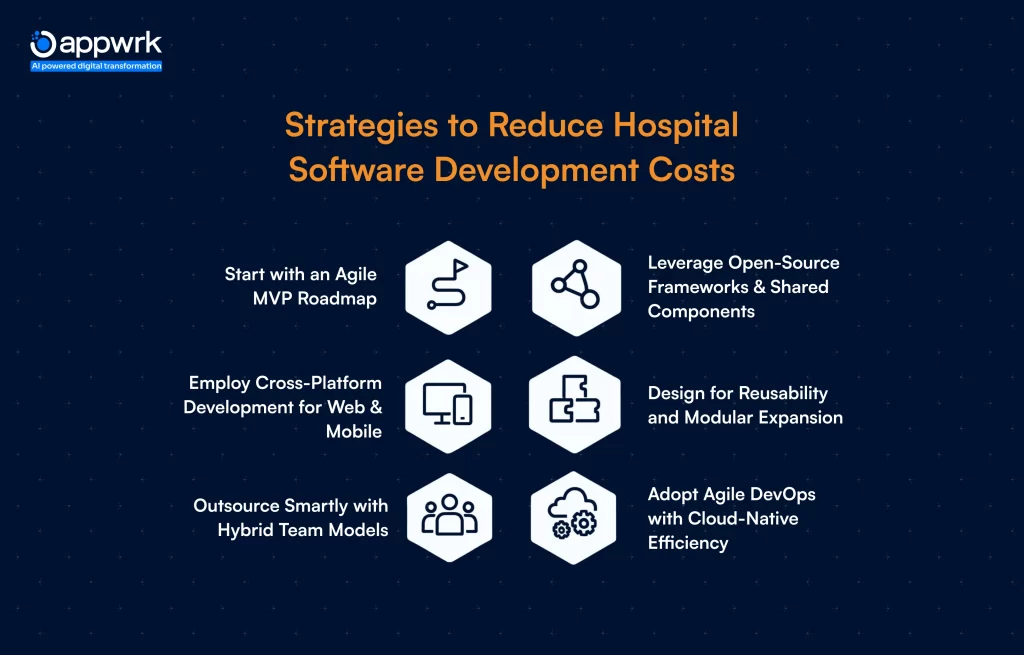
Strategies to Reduce Hospital Software Development Costs
Building an effective HMS doesn’t require overextending your budget. What sets successful projects apart is the deliberate use of strategic cost-saving levers, while maintaining enterprise-grade quality, security, and compliance. Here’s how to execute:
Start with an Agile MVP Roadmap
Launching an MVP (minimum viable product) lets you validate features with real users before committing to full-scale development. This phased delivery:
Reduces initial spending to around $5,000 to $15,000, covering essential modules.
Allows iterative build cycles based on clinician and staff feedback.
Prevents costly feature bloat by ensuring every component adds measurable value.
By prioritizing essentials, like appointment and billing modules, you test assumptions efficiently and defer or discard low-impact functionalities.
Building on open-source stacks such as OpenMRS, SMART on FHIR, or OpenEMR can cut development time by up to 30%. Benefits include:
Pre-built modules for patient intake, reporting, and EHR access.
Active community support that helps patch vulnerabilities and streamlines compliance.
Cost-efficient integration layers for HL7/FHIR, reducing custom coding needs.
A smart approach is to keep your custom business logic modular and loosely coupled with the open-source base. This ensures long-term flexibility, simplifies future updates, and maximizes return on investment.
Employ Cross-Platform Development for Web & Mobile
Using resilient frameworks like React Native or Flutter helps you build hybrid mobile and web applications from a unified codebase. This strategy:
Avoids parallel native builds, saving 20-40% in development and QA efforts.
Ensures consistent UI/UX across patient, clinician, and admin portals.
Simplifies ongoing maintenance and updates, especially in healthcare compliance modules.
Adopt Agile DevOps with Cloud-Native Efficiency
An integrated DevOps and CI/CD approach is a powerful cost saver:
Automated testing accelerates deployments and reduces human error.
Infrastructure-as-code via AWS or Azure enables consistent, auditable environments.
Scalable hosting prevents overspending, tuning resource usage to actual demand.
When compliance configurations, such as encryption-at-rest and access control, are codified early, you build scalability and security into every release.
Outsource Smartly with Hybrid Team Models
Balancing onshore expertise and offshore development delivers maximum ROI:
Maintain core PM, compliance, and stakeholder teams locally.
Leverage offshore engineering resources at lower hourly rates ($20-$60/hr).
Pivot dynamically between feature development and QA phases based on workload.
By combining US/EU-based project leads with offshore teams in India, businesses can cut HMS development costs by 30-60%. Indian developers bring open-source expertise and fast delivery, especially when compliance is overseen by onshore teams. This hybrid setup suits startups targeting Western markets on lean budgets.
Design for Reusability and Modular Expansion
Designing for reusability and modular expansion allows hospital software systems to scale intelligently as organizational needs evolve. It encourages faster innovation, lowers long-term costs, and improves system maintainability.
Each major module (billing, telehealth, pharmacy) should operate as an independent service.
Modular components let you launch new functionality in parallel teams without disrupting core workflows.
Licensing or reusing modules across multiple hospitals saves overhead and boosts product scalability.
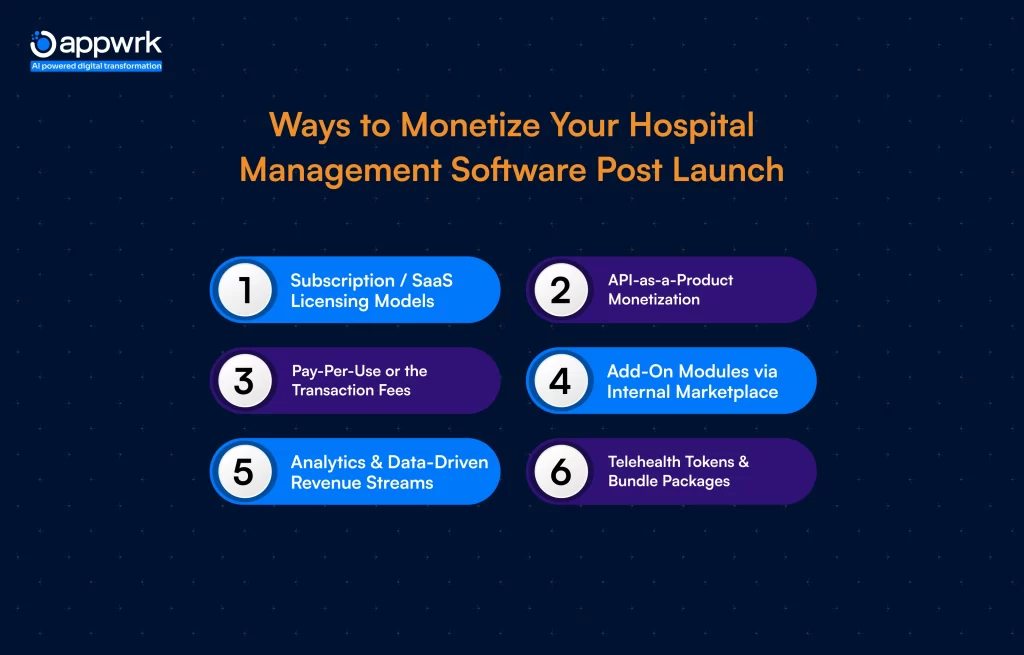
Ways to Monetize Your Hospital Management Software Post Launch
Hospital management software is no longer just a cost center. With the right strategy, it becomes a powerful engine for revenue generation, operational efficiency, and long-term growth. From licensing modules to offering white-label solutions, smart monetization turns your HMS into a self-sustaining digital asset that delivers value beyond clinical care.
Subscription/SaaS Licensing Models
Offer tiered access to HMS features, such as basic modules (appointments, billing) for smaller clinics and enterprise editions (EHR, analytics, APIs) for larger systems.
Include premium support or compliance assurance as paid add-ons.
Subscription models dominate similar cloud healthcare solutions; according to Wikipedia, they convert one-time purchases into recurring revenue, increasing long-term user retention.
API-as-a-Product Monetization
Modularize HMS services (e.g., insurance validation, telehealth streaming, lab results parsing) as isolated APIs.
Sell API access via developer-friendly portals with pay-per-call, usage tiers, or subscription pricing.
Leading platforms like Twilio and Stripe have successfully monetized APIs by offering flexible pricing models through marketplaces like RapidAPI, making it easier to scale adoption across diverse developer ecosystems.
Building FHIR and HL7-compliant APIs enhances interoperability and trust, making it easier for hospitals, labs, and third-party systems to integrate with your HMS platform securely and efficiently.
Pay-Per-Use or Transaction Fees
Charge per consultation, e-prescription issuance, or lab report generation.
Useful for hospitals running telehealth sessions or document-heavy workflows.
Provides an elastic cost structure for clients and scaled revenue for your business.
Tied to operational indicators, this creates fairness in billing and encourages adoption.
Add-On Modules via Internal Marketplace
Launch a curated ecosystem, such as pharmacy integrations, analytics dashboards, and mobile apps within an app-store-like structure.
Monetize through listing fees or revenue sharing with developers.
The marketplace approach fosters innovation, distributes development risk, and deepens user stickiness.
Analytics & Data-Driven Revenue Streams
Advanced analytics modules can generate revenue by offering premium insights into patient flow, billing efficiency, and operational performance metrics.
Hospitals gain insights; your platform gains recurring SaaS revenue.
According to Market Research, cloud EHR investments can deliver 5× ROI in 18 months by cutting ops costs and unlocking revenue via improved documentation and workflow intelligence.
Telehealth Tokens & Bundle Packages
Package teleconsultations in token-based or bundled systems to meet patient volume needs.
RSA-compliant video modules with automated billing help convert value into revenue.
Allows flexible pricing that aligns with patient usage, increasing accessibility while ensuring returns.
Should You Choose Custom-Built or Off-the-Shelf HMS for Better ROI?
Upfront Investment vs. 5-Year Total Cost of Ownership (TCO)
Custom-built HMS typically requires an initial investment between $75,000-$250,000+, tailored exactly to your hospital’s unique workflows and scalability plans. This investment eliminates recurring licensing fees, and with a modular architecture, each new deployment adds only incremental costs.
Off-the-shelf (COTS) HMS may launch with lower upfront costs at around $10,000-$50,000, but annual subscription fees (20-25% per year) add up over time. Over five years, licensing costs alone can surpass the price of a custom build.
Scalability & Feature Customization
A custom HMS supports intricate workflows like AI-driven triage, staff credentialing logic, or multi-hospital permissions without compromise. Scalability is embedded into its design, making module additions seamless.
Ready-made solutions often require expensive plug-ins or workarounds to support slight deviations from default workflows and are not optimized for expanding systems. Source: expert insights on vendor-platform adaptability.
Regulatory Compliance & Protocol Integration
With custom systems, compliance (HIPAA, GDPR) and integration standards (HL7, FHIR) are coded in from day one, data encryption, audit logs, message protocols, and no retrofitting risk.
In contrast, off-the-shelf products may lag in updates and rely on periodic vendor patches. Your internal compliance roadmap becomes dependent on external release schedules.
Deployment Timelines vs. Time-to-Value Realization
COTS systems can be deployed within weeks, making them attractive for short-term needs or pilot departments.
Custom solutions, though longer to roll out (6-12 months), deliver tailored experiences, with higher adoption rates, better workflows, and often quicker ROI once they are live.
Long-Term Cost Efficiency & Institutional Control
While off-the-shelf is cheaper at first, cumulative subscription and add-on costs, plus limitations in scalability, often put it at a disadvantage over a 5-year span.
While custom-built HMS may require a higher upfront investment than off-the-shelf solutions, it eliminates ongoing licensing fees and offers greater control over enterprise features and upgrades. Over time, scaling across multiple facilities using shared codebases significantly lowers the per-site cost and delivers stronger long-term ROI.
Decision Guide: Scaling vs. Speed, Customization vs. Convenience
Why Choose APPWRK to Build Your Hospital Management Software in 2025?
APPWRK isn’t just a development partner, but it’s a strategic enabler for hospitals and healthcare founders looking to transform operational complexity into scalable digital workflows. With deep experience in regulated healthcare environments, APPWRK delivers compliance-ready, feature-rich, and cost-controlled HMS platforms tailored to the evolving realities of 2025 and beyond.
What Sets APPWRK Apart
Proven Experience Across Hospital Verticals APPWRK has collaborated with regional clinics, hospital chains, and digital health startups to build systems spanning EHR modules, patient portals, mobile apps, and real-time analytics dashboards. This cross-sector experience translates into faster delivery and fewer unknowns during integration.
Compliance-First Engineering Process From day one, APPWRK embeds HIPAA, HL7, GDPR, and FHIR standards into design and testing workflows, ensuring audit-readiness and long-term sustainability.
Scalable Architecture for Multi-Hospital Deployments Systems are engineered using microservices and API-first frameworks, enabling phased rollouts across departments, hospitals, and even geographies with minimal redevelopment.
Dedicated QA, UX, and Support Teams APPWRK deploys specialized teams for QA testing, accessibility-first UI/UX design, and post-deployment monitoring, ensuring performance, security, and user adoption remain top priorities.
Retention-Centric Delivery Philosophy With 90%+ client retention and structured handover processes, APPWRK delivers not just software but a long-term digital care ecosystem.
With engineering hubs in India and project delivery teams supporting clients across the USA and Europe, APPWRK aligns cost efficiency with region-specific compliance like HIPAA and GDPR.
Ready to Build Your Hospital Management System?
APPWRK offers strategic consultation to assess your:
Current workflows and system gaps
Compliance and data-handling requirements
Scalability targets (single hospital vs. network-wide deployment)
Timeline, budget, and MVP-first roadmap
FAQs
1. What is the average cost to build a hospital management software system? A hospital management software (HMS) project typically starts at $5,000, with full builds ranging from $15,000 to $210,000 or more, depending on the feature set, compliance architecture, team location, and platform complexity. Key cost factors include EHR modules, telehealth functionality, HL7/FHIR integration, cloud deployment, and analytics dashboards. A clear project scope and modular planning approach can significantly influence the final budget.
2. How much does regulatory compliance add to hospital software development cost? Regulatory requirements, especially HIPAA, HL7, and GDPR can increase development costs by 20-30%, especially when compliance is added post-architecture. Early-stage compliance planning with built-in audit trails, encryption, and role-based access reduces long-term rework and security vulnerabilities.
3. How can I reduce HMS development costs without compromising quality? Adopt a modular MVP-first build approach. Launch core features like patient onboarding and billing, then add advanced capabilities like EHR, telemedicine, or lab integration based on need. Leverage open-source frameworks (e.g., OpenMRS, SMART on FHIR) and use hybrid offshore/onshore teams to control spending while maintaining quality. Contact us to get your HMS built right away without compromising on the quality.
4. What hidden costs often go unnoticed in HMS development? Hospitals can overspend by 25-40% when the following cost drivers are missed:
Legacy system integration and data migration
Middleware licensing (e.g., HL7 message brokers)
QA cycles for multi-role workflows
Staff onboarding and training
Compliance certification and penetration testing
Post-deployment iteration costs for user adoption
5. Is cloud-based or on-premise hosting more cost-effective for HMS? Cloud-native builds typically add $15,000 to $35,000 upfront, but reduce hardware, IT staffing, and security maintenance costs long term. On-premise solutions increase CapEx and slow deployment, while hybrid cloud strategies (e.g., AWS HealthLake, Azure Health Data Services) strike a balance between security and scalability.
6. How much should I expect to invest in HMS integration capabilities? Integrations with external systems like EHR, lab systems, pharmacy, and CRM can consume 15-25% of the HMS budget, especially when APIs are undocumented or non-standard. Costs range from $15,000 to $60,000+, influenced by endpoint availability, security, and testing complexity.
7. What are the average ongoing costs for HMS post-deployment? Annual maintenance typically ranges from 15-20% of the total project cost. It includes infrastructure, DevOps, support, feature enhancements, and compliance audits. Cloud-hosted HMS systems may add usage-based charges, while on-premise systems incur continuous IT overhead and patch cycles.
8. Why do scalable, multi-hospital HMS builds have a higher initial cost? Multi-tenant design, SSO integration, and modular architecture add 10-25% to initial cost, but unlock long-term ROI through SaaS licensing, white-labeling, and phased rollouts across facilities. Strategic investment early reduces per-hospital costs during expansion.
Gourav Khanna is the Co-founder and CEO of APPWRK, leading the company’s vision to deliver AI-first, scalable digital solutions for enterprises and high-growth startups. With over 16 years of leadership in technology, he is known for driving digital transformation strategies that connect business ambition with outcome-focused execution across healthcare, retail, logistics, and enterprise operations.
Recognized as a strategic industry voice, Gourav brings deep expertise in product strategy, AI adoption, and platform engineering. Through his insights, he helps decision-makers prioritize market traction, operational efficiency, and long-term ROI while building resilient, user-centric digital systems.
Subscribe to APPWRK Blogs, We'll Do the Rest!
Get Blogs on UI/UX, Mobile Apps, Online Marketing, and Web development technology.
Unlock worthy and priceless suggestions from the masters of mobile and web app development