150+ minds across 4 countries. Join a culture of innovation, ownership & growth.
Rewire for AI
From machine learning to deep learning, from classification tools to overall process automation – our AI engineers will help you retool your existing system or enhance your company results.
Ship faster, scale smarter, built for product companies and SaaS teams
Our Latest Work
We strive hard to deliver result-driven digital solutions across the globe. Check out our case studies to get a glimpse of how we ideate, innovate, and create unconventional digital solutions according to the requirements of our clients.
Discover diverse and passionate insights from our tech enthusiasts. We collaborate across various sectors to streamline operations and drive innovation. Explore our rapidly growing collection of articles to see why we’re at the forefront of IT solutions.
The decision to move from Magento to Shopify is one of the most significant replatforming choices an ecommerce business can make. Magento is powerful, but its power comes with...
Accuracy gap is real: Traditional CPG forecasting carries a 25-40% MAPE error rate. AI-powered models bring that down to 8-15%, according to McKinsey research....
Real stories from global leaders who trusted us with their ideas.
Partnering with APPWRK helped us build a compliant and scalable healthcare platform, accelerating our time-to-market by 35%. Their team consistently delivered outstanding work.
Beesers
Digital Healthcare Client
Collaborating with APPWRK, Sportskeeda modernized its platform into a real-time sports engagement ecosystem, enabling seamless content delivery, scalable fan interactions, and high-velocity performance.
Sportskeeda
Sports & Entertainment Partner
Working with APPWRK was effortless. They captured our vision, maintained full compliance, and delivered a digital experience that built trust and elevated how customers interact with our fintech brand.
PayPenny
Fintech Partner
Working with APPWRK gave us confidence in adopting AI responsibly. Their team built a safe, intelligent bot that transformed how we engage with leads and helped us achieve measurable revenue growth.
IFB
AI Transformation Partner
Leveraging APPWRK’s digital expertise, Nemesis launched a scalable, compliant, and safe super app that connects content delivery, real-time communication, and logistics management within a single platform.
Nemesis
Super App Partner
Partner in Your TPM Transformation Journey
Unlock smarter promotions, stronger retail execution, and measurable ROI with Appwrk’s expert-driven TPM solutions.
Real Trade Promotion Management (TPM) systems give FMCG leaders a unified, data-driven way to manage the process of planning, executing, and analyzing promotions. By centralising data and creating a single view of all active promotions, TPM eliminates manual processes and strengthens both commercial and technology alignment.
Modern TPM platforms boost sales growth by fixing fragmented planning, low forecast accuracy, and weak Return on Investment (ROI) visibility. With advanced analytics in trade-in promotions, AI-powered analytics platforms, and predictive volume and spend forecasting, FMCG brands improve promotional profitability, optimise efforts, and make more informed decisions on promotional investments.
Closed-loop execution and efficient and effective retail execution enhance compliance and outcomes for wholesale and retailers and the final consumer,driving operational agility, stronger competitive edge, and better shelf space and visibility.
Enterprise-ready trade promotion management software integrates with ERP, CRM, SFA, and existing systems to provide one source of truth for teams that plan, budget, execute, and evaluate the effectiveness of promotional campaigns. This improves the productivity of sales and finance personnel, accelerates financial reconciliation, and supports smarter negotiation in the competitive pursuit for market share.
With trade promotion optimization (TPO), what-if scenarios, cloud-based and modular solutions, and price optimization, TPM delivers accessible solutions for both large companies and smaller market players,helping them manage complex distributor relationships, budget & allocate effectively, and strengthen their marketing mix and push strategy.
Understanding Trade Promotion Management in Today’s FMCG Environment
FMCG brands face shrinking margins and price-sensitive consumers, making measurable ROI essential. Modern Trade Promotion Management (TPM) systems give consumer goods companies the operational agility to control trade spending, improve the promotional cycle, and drive sales growth through real-time reporting and AI-powered analytics platforms.
What Is Trade Promotion Management (TPM)?
TPM is the structured process of planning, executing, and analysing promotions, creating one source of truth that eliminates manual processes and helps teams centralise data and make informed decisions.
Core capabilities include:
Volume and spend forecasting, uplift models, and price optimisation to increase product demand and maximise Return on Investment (ROI).
Trade promotion optimisation (TPO) and promotion planning and forecasting to budget & allocate effectively.
Reporting & analytics using historical spending and advanced analytics in trade-in promotions.
Seamless integration with ERP (SAP S/4HANA), CRM (Salesforce TPM), and cloud-based and modular solutions for both large companies and smaller market players.
Tools like Trade Spend Master centralise information, improve distributor management, and support push strategy and direct-to-consumer efforts across wholesale, retail, and the final consumer.
How TPM Differs from Traditional Promotional Planning
Traditional promotional planning depends on disconnected spreadsheets and outdated forecasting models, creating data gaps, limited visibility, and inefficiencies that hurt sales growth and promotional profitability. Modern Trade Promotion Management (TPM) systems fix this by centralising data, eliminating manual processes, and giving teams a single view of all active promotions.
With real-time reporting and cloud-based and modular solutions, TPM enables:
Real-time data sharing across sales, finance, and marketing so consumer goods companies can make more informed decisions.
Accurate sales projections through AI-powered analytics platforms, volume and spend forecasting, and forecasting models built on historical spending.
Better promotion planning and forecasting using ML-driven insights that help teams budget & allocate more effectively.
Full integration with existing systems, S&OP, and IBP for one source of truth across the entire promotional cycle.
While traditional methods limit data analysis and execution, TPM ensures every promotion is measurable, scalable, and optimised for efficiency, trade spending control, and efficient and effective retail execution.
Why TPM Has Become Critical for FMCG Growth and Retail Performance
FMCG organisations face increasingly complex hierarchies, multiple sales channels, price-sensitive consumers, and demanding wholesale and retail customers. Without real TPM capabilities, teams lose visibility into trade spending, promotional investments, customer behaviour, and reconciliation & financials.
It enables data-driven Revenue Growth Management, strengthening the marketing mix and improving promotional profitability across both large companies and smaller market players.
It enhances promotion planning and forecasting accuracy across major retail partners such as Amazon and Walmart, supported by real-time reporting, what-if scenarios, and reporting & analytics dashboards.
It improves reconciliation processes with automated settlement, dedicated management, and better integration with ERP and CRM platforms,maximising Return on Investment (ROI).
It supports field execution through platforms like Repsly, PromoTool, and SoftServe Business Systems, ensuring a tighter push strategy and improved shelf space and visibility for the final consumer.
TPM is now a core driver of sales, profitability, and transformation in consumer goods. It helps brands manage distributor relationships, support direct-to-consumer and wholesale strategies, and maximize ROI, offering a competitive edge in today’s dynamic market.
Introduction: The Strategic Shift Toward Real TPM in FMCG
FMCG brands are entering a stage where Trade Promotion Management (TPM) systems must deliver measurable impact. With a large percentage of revenue tied to trade spending, manual spreadsheets and siloed workflows can no longer support the process of planning, executing, and analysing promotions across wholesale and retail.
Modern trade promotion management software unifies strategy, execution, and forecasting through cloud-based and modular solutions, AI-powered analytics platforms, and advanced analytics in trade-in promotions. Tools like Salesforce TPM and SAP S/4HANA help consumer goods companies centralise data, eliminate manual processes, and create a single view of all active promotions across markets.
Why Trade Promotion Is Undergoing a Structural Shift
Traditional tactics are losing ground as retailers demand transparency, price-sensitive consumers expect value, and smaller market players compete for shelf space and visibility. Fragmented data weakens promotional profitability, sales and profitability, and long-term growth strategy.
Real TPM links trade spending, product demand, and promotion planning and forecasting in one workflow. With AI/ML-driven volume and spend forecasting, real-time reporting, what-if scenarios, and trade promotion optimisation (TPO), companies gain the operational agility to optimise efforts, maximise return on investment, and compete effectively.
How Real TPM Aligns Commercial and Technology Leadership
Modern TPM aligns sales, finance, S&OP, and IT around unified KPIs. Commercial teams can plan promotions & forecasts, track promotional investments, and assess outcomes, while IT ensures seamless integration with existing systems and processes, including ERP, master data, and reconciliation & financial workflows.
This synergy enhances budget & allocate processes, dedications management, and decision-making. Platforms like PromoTool and Repsly support efficient and effective retail execution, help manage complex distributor relationships, and maintain one source of truth, providing a single storehouse of information.
Strengthen budgeting and manage trade spend efficiently
Enable collaboration across sales, marketing, finance, and S&OP
Shift from fragmented tools to end-to-end TPM automation
Understand flexible pricing models, licensing costs, and scalable solutions for all business sizes
How Real TPM Solutions Transform FMCG Sales Outcomes
Modern TPM systems do more than track promotions,they transform how FMCG companies improve sales and profitability, strengthen their growth strategy, and manage complex distributor relationships. By combining trade promotion optimization (TPO), what-if scenarios, real-time reporting, and AI-powered analytics platforms, TPM supports accurate plan promotions & forecast cycles and improves promotional profitability across every stage of the promotional cycle.
Platforms like Salesforce TPM, BluePlanner, and SoftServe Business Systems provide accessible solutions for both large companies and smaller market players, helping teams centralise data, improve price optimisation, deliver more efficient and effective retail execution, and anticipate product demand across wholesale and retailers and the final consumer. With deeper insights into historical spending and automated reporting & analytics, TPM tools help brands optimise efforts, improve shelf space and visibility, and outperform competitors in the competitive pursuit for market share.
Accurate Volume Forecasting and True Demand Visibility
Accurate volume forecasting is the backbone of effective trade promotions. Modern Trade Promotion Management (TPM) systems use AI-powered analytics platforms and ML-driven forecasting models to predict baseline demand, promotional uplift, and shipment patterns with far greater accuracy.
Key capabilities:
Real-time integration with sales data, POS feeds, historical spending, and tools like Demand Forecast Master for richer data analysis.
Forecast accuracy improvements jumped from 50% to 80%, supported by stronger volume and spend forecasting and reliable forecasting models.
Better alignment between Demand Planning and actual performance metrics, offering one source of truth for teams that plan promotions & forecasts.
These capabilities help consumer goods companies centralise data, reduce stockouts, optimise efforts, and maintain tighter control of trade spending throughout the promotional cycle,leading to more confident sales projections and measurable sales growth.
AI-Driven Profitability Analysis for Smarter Promotions
With shrinking margins and increasing pressure from price-sensitive consumers, every promotion must contribute to sales and profitability. Modern trade promotion management software uses machine learning and advanced analytics in trade-in promotions to review past promotional investments and simulate what-if scenarios.
What it delivers:
Predictive Return on Investment (ROI) insights for each promotional campaign, helping teams make more informed decisions.
Built-in price elasticity and price optimisation models to guide future investments across wholesale and retailers and the final consumer.
Smarter budgeting tied to true performance,not instinct,helping teams budget & allocate more effectively.
By eliminating manual processes and improving reporting & analytics, TPM transforms the process of planning, executing, and analysing promotions from reactive to strategic, giving brands a meaningful competitive edge and supporting long-term growth strategy.
Real-Time Retail Execution Feedback for Faster Corrective Action
In-store execution failures can undermine even the best promotional plan. TPM tools like Repsly bring efficient and effective retail execution into the digitalisation of trade promotion operations by capturing real-time field feedback, improving operational agility and campaign success.
Capabilities include:
Field execution tracking and retailer compliance alerts that boost accountability.
In-app photo validation, pricing checks, and shelf-share analysis to maintain strong shelf space and visibility.
Instant issue reporting to campaign owners for faster corrective action, eliminating manual processes and improving reconciliation & financials.
These accessible solutions give both large companies and smaller market players a single storehouse of information, supporting integration with existing systems and processes and helping teams maximise return on investment throughout the entire push strategy and direct-to-consumer journey.
Strengthened Revenue Growth Management Through Unified Trade Spend Control
FMCG companies often struggle with fragmented trade spending and unclear outcomes across their promotional cycle. Modern Trade Promotion Management (TPM) systems bring all promotional investments under one source of truth, integrating ERP, reporting & analytics, and AI-powered analytics platforms for deeper visibility.
Strategic benefits:
Full visibility into trade rebates, promotional investments, and Return on Investment (ROI),helping consumer goods companies plan, budget, execute, and evaluate the effectiveness of promotional campaigns with greater accuracy.
Unified dashboards for Revenue Growth Management, finance teams, and sales teams, improving productivity of sales and finance personnel and strengthening overall sales and profitability.
Seamless links to tools like Trade Spend Master, AllAi Productivity Platform, and cloud-based and modular solutions that improve reconciliation & financials and accelerate decision-making.
The result is disciplined, transparent revenue management where every promotional dollar is traceable, accountable, and optimizable,giving organisations a measurable competitive edge and supporting long-term growth strategy.
The Core Challenges Slowing FMCG Sales Growth
Despite investing a significant percentage of revenue in trade promotions, many FMCG companies still experience declining ROI and unpredictable sales growth. The challenge isn’t effort,it’s execution. Legacy systems, fragmented operations, unreliable data flow, and outdated forecasting models all stall progress and reduce promotional profitability.
Fragmented Commercial Planning Across Teams
Disjointed workflows across sales, finance, and marketing teams lead to misaligned Demand Plans and reactive decisions. Without integrated trade promotion management software, these teams lack a single storehouse of information, making it difficult to plan promotions & forecast effectively or manage complex distributor relationships.
This fragmentation weakens the process of planning, executing, and analysing promotions, creates inefficiencies in the marketing mix, and prevents organisations from reaching operational agility and true digitalisation of trade promotion operations.
Low Forecast Accuracy and Margin Leakage
Manual forecasting, unreliable master data, and outdated historical spending insights reduce accuracy and increase risk. This drives excess inventory, stockouts, and unnecessary trade spending,directly impacting profitability and eroding trust among wholesalers and retailers and the final consumer.
Real TPM solutions solve these gaps with stronger volume and spend forecasting, data analysis, price optimisation, and what-if scenarios powered by trade promotion optimisation (TPO). These accessible solutions help large companies and smaller market players eliminate manual processes, make more informed decisions, and maximise return on investment across the entire promotional cycle.
Complex Retailer Negotiations and Limited Data Visibility
FMCG brands often lack the historical spending insights and advanced analytics needed to negotiate effectively with major retailers like Amazon and Walmart. Without strong data analysis and real-time reporting, consumer goods companies struggle to present compelling evidence on promotional profitability, trade spending, and expected product demand. This reduces negotiation power and limits transparency in trade terms, making it harder to gain shelf space and visibility or outperform competitors in the competitive pursuit of market share.
Disconnected Systems and Heavy Spreadsheet Use
Siloed platforms and disconnected workflows block visibility across promotional investments, financial reporting, and the entire promotional cycle. Teams relying heavily on spreadsheets face low data accuracy, poor integration with existing systems and processes, and no single storehouse of information to guide decision-making. These gaps slow the process of planning, executing, and analysing promotions and prevent organisations from achieving operational agility and end-to-end digitalisation of trade promotion operations.
Slow Post-Event Analysis and Weak Feedback Loops
Post-event analysis is often delayed, incomplete, or inconsistent. Without tools like PromoTool, Trade Spend Master, and performance-focused reporting & analytics, brands miss critical learnings and repeat costly mistakes. Lack of timely insights also harms reconciliation & financials, price optimisation strategies, and the productivity of sales and finance personnel.
Modern Trade Promotion Management (TPM) systems close this feedback loop by centralising data, automating dedications management, and enabling what-if scenarios through AI-powered analytics platforms and trade promotion optimisation (TPO). This helps teams maximise return on investment and make more informed decisions for future promotions.
TPM + Retail Media Integration Strategy
Trade promotions no longer operate in isolation. Leading FMCG brands now integrate trade promotion management software with Retail Media Networks to influence both online and offline buying behaviour. This unified strategy helps teams budget & allocate more effectively, supports stronger promotion planning and forecasting, and improves sales and profitability across wholesale and retailers and the final consumer.
By connecting TPM with retail media activation, brands gain:
Smarter targeting driven by advanced analytics in trade-in promotions and forecasting models.
Real-time reporting and measurement of uplift, improving planning accuracy and maximising Return on Investment (ROI).
Centralised control through cloud-based and modular solutions, enabling both large companies and smaller market players to optimise efforts and achieve accessible solutions for growth.
This integration provides a single view of all active promotions, helping organisations eliminate manual processes, manage complex distributor relationships, and support both push strategy and direct-to-consumer initiatives with one source of truth.
Why Trade Promotions Must Now Link to Retail Media
With digital-first shopping accelerating, trade promotions that don’t connect with retail media lose impact across online shelves and product pages. Linking Trade Promotion Management (TPM) systems with Retail Media ensures promotional investments are visible to price-sensitive consumers exactly where they make decisions,creating stronger product demand and a measurable competitive edge.
Key benefits:
Unified spend across trade and media, improving overall sales and profitability and helping teams optimise efforts across the promotional cycle.
Increased reach to active customers through targeted activation supported by AI-powered analytics platforms and advanced analytics in trade-in promotions.
Better alignment between promotion planning and ad spend, enabling consumer goods companies to plan promotions & forecast with greater accuracy and eliminate manual processes across the marketing mix and push strategy.
Closed-Loop Measurement Across Online & Offline Channels
Without real-time reporting and a connected system, brands cannot measure the full impact of cross-channel promotions. Integrating TPM with Retail Media provides one source of truth across wholesale and retailers and the final consumer.
A unified approach enables:
A single view of in-store and digital outcomes, centralising data from all initiatives.
Insights into media-driven consumption volume lift, supported by historical spending, forecasting models, and data analysis modules that help teams make more informed decisions.
This integration accelerates reconciliation & financials and improves the productivity of sales and finance personnel through the entire digitalisation of trade promotion operations.
Aligning Retail Media Spend with Trade Promotions for Category Lift
When trade spending and retail media investment work together, both sides improve. TPM tools like PromoTool and SoftServe Business Systems help sync budgets, content, and execution timelines,giving organisations operational agility and a coordinated marketing mix that boosts category growth.
Strategic advantages:
Supports hyper-personalised promotions that increase relevance, maximise Return on Investment (ROI), and improve shelf space and visibility.
Drives category growth through data-driven decision-making, backed by trade promotion optimisation (TPO), what-if scenarios, and cloud-based and modular solutions.
Enhances customer product hierarchy strategy and media placement to serve both direct-to-consumer and wholesale journeys, ensuring accessible solutions for large companies and smaller market players alike.
This alignment strengthens the process of planning, executing, and analysing promotions, helping teams budget & allocate smarter and integrate with existing systems and processes for seamless execution.
TPM vs Trade Promotion Optimisation (TPO): What Brands Must Know
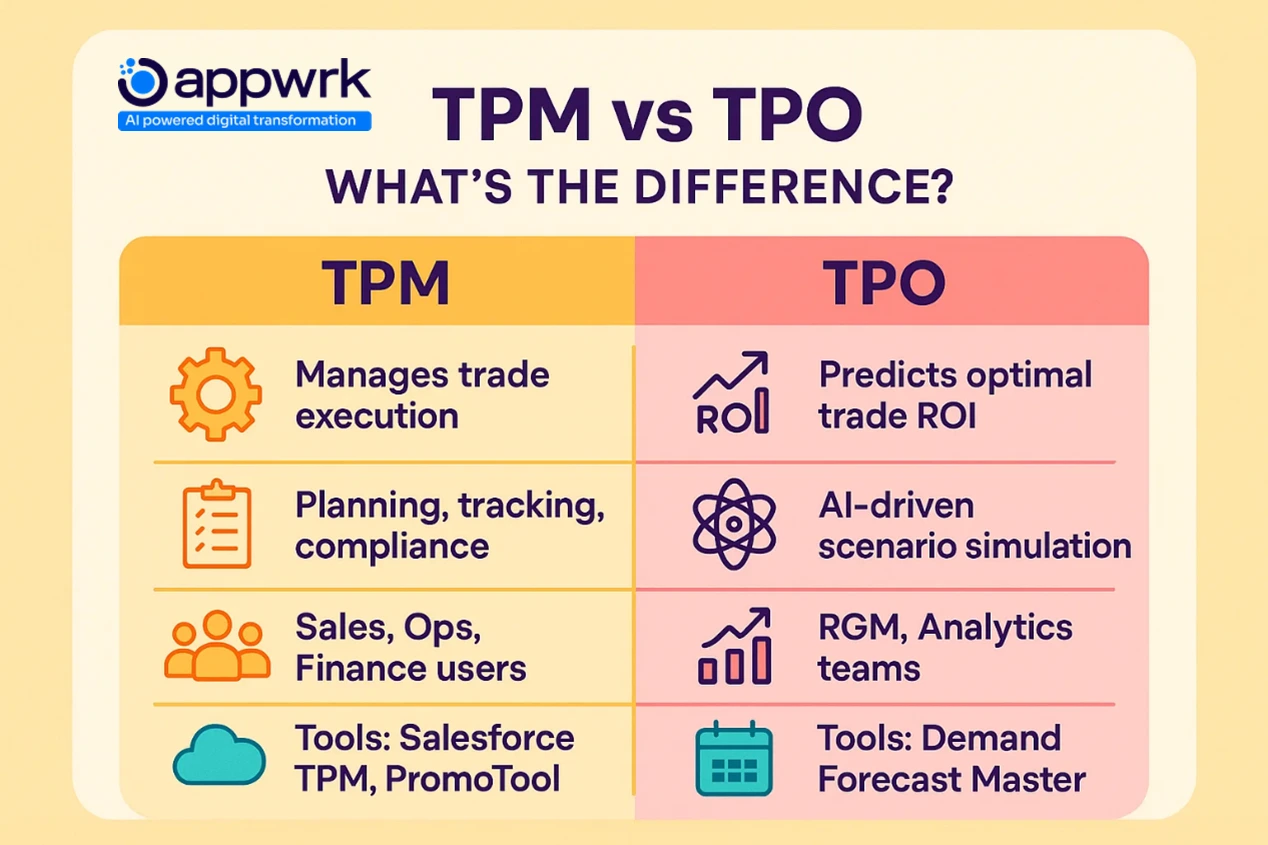
Trade Promotion Management (TPM) and trade promotion optimization (TPO) are often used interchangeably, but they play different roles in an FMCG growth strategy.
TPM focuses on the process of planning, executing, and analysing promotions. It is operational and calendar-driven, helping consumer goods companies control trade spending, manage promotional investments, and maintain a single view of all active promotions. TPM ensures efficient and effective retail execution, supports the promotional cycle, and strengthens sales and profitability.
TPO, on the other hand, is analytics-led. It uses AI-powered analytics platforms, scenario simulations, forecasting models, and price elasticity insights to predict Return on Investment (ROI) before execution. By leveraging historical spending and advanced analytics in trade-in promotions, TPO helps teams make more informed decisions, optimise efforts, and maximise return on investment.
TPM is the operational foundation; TPO builds on that foundation to drive advanced Revenue Growth Management, tighter budget & allocate processes, and powerful promotional profitability improvements across large companies and smaller market players.
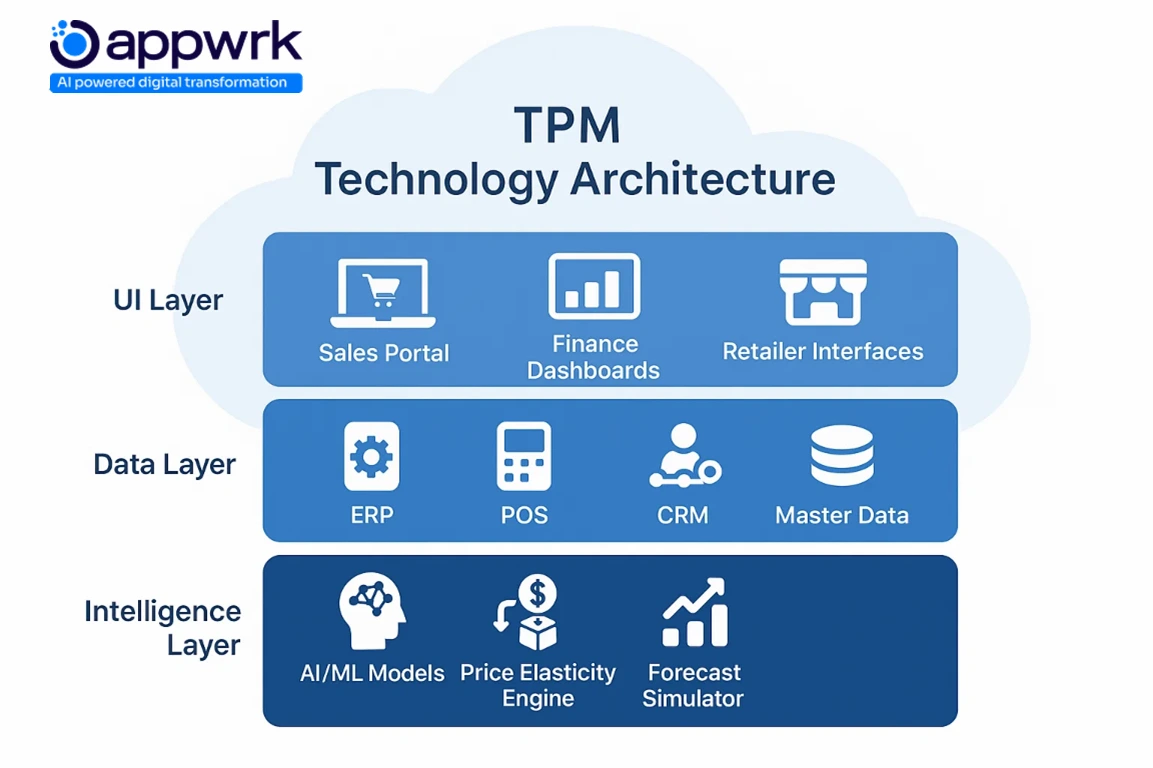
The TPM Technology Stack: What Enterprise Leaders Need
To support global promotional operations at scale, Trade Promotion Management (TPM) systems require a robust technology stack capable of real-time reporting, advanced data analysis, and seamless integration with existing systems and processes. This stack must centralise data, eliminate manual processes, and ensure one source of truth across planning to performance.
Modern TPM technology stacks for consumer goods companies include:
Cloud-based and modular solutions that reduce licensing costs and support flexible pricing models across markets.
Real-time reporting and reporting & analytics engines that support promotion planning and forecasting, what-if scenarios, and dedications management.
Integrated ERP, CRM, retail execution, and financial systems to streamline reconciliation & financials and increase the productivity of sales and finance personnel.
AI-powered tools that support volume and spend forecasting, price optimisation, and efficient and effective retail execution, helping brands maintain a competitive edge across wholesale and retailers and the final consumer.
A connected TPM stack ensures accurate forecasting models, stronger push strategy alignment, and improved shelf space and visibility,helping organisations make more informed decisions, strengthen their marketing mix, and accelerate their growth strategy with operational agility and maximised ROI.
Core TPM Modules Supporting the Full Promotion Lifecycle
Modern Trade Promotion Management (TPM) systems include purpose-built modules that streamline every stage of the promotional cycle, ensuring consumer goods companies can plan, budget, execute, and evaluate the effectiveness of promotional campaigns with precision. These modules centralise data, eliminate manual processes, and support both large companies and smaller market players through accessible solutions that strengthen sales and profitability and overall growth strategy.
Budgeting and Planning
Control trade spending with structured budgeting, calendar alignment, and budget & allocate workflows driven by AI-powered analytics platforms. TPM tools use promotion planning and forecasting, forecasting models, and volume and spend forecasting to improve accuracy and help teams make more informed decisions.
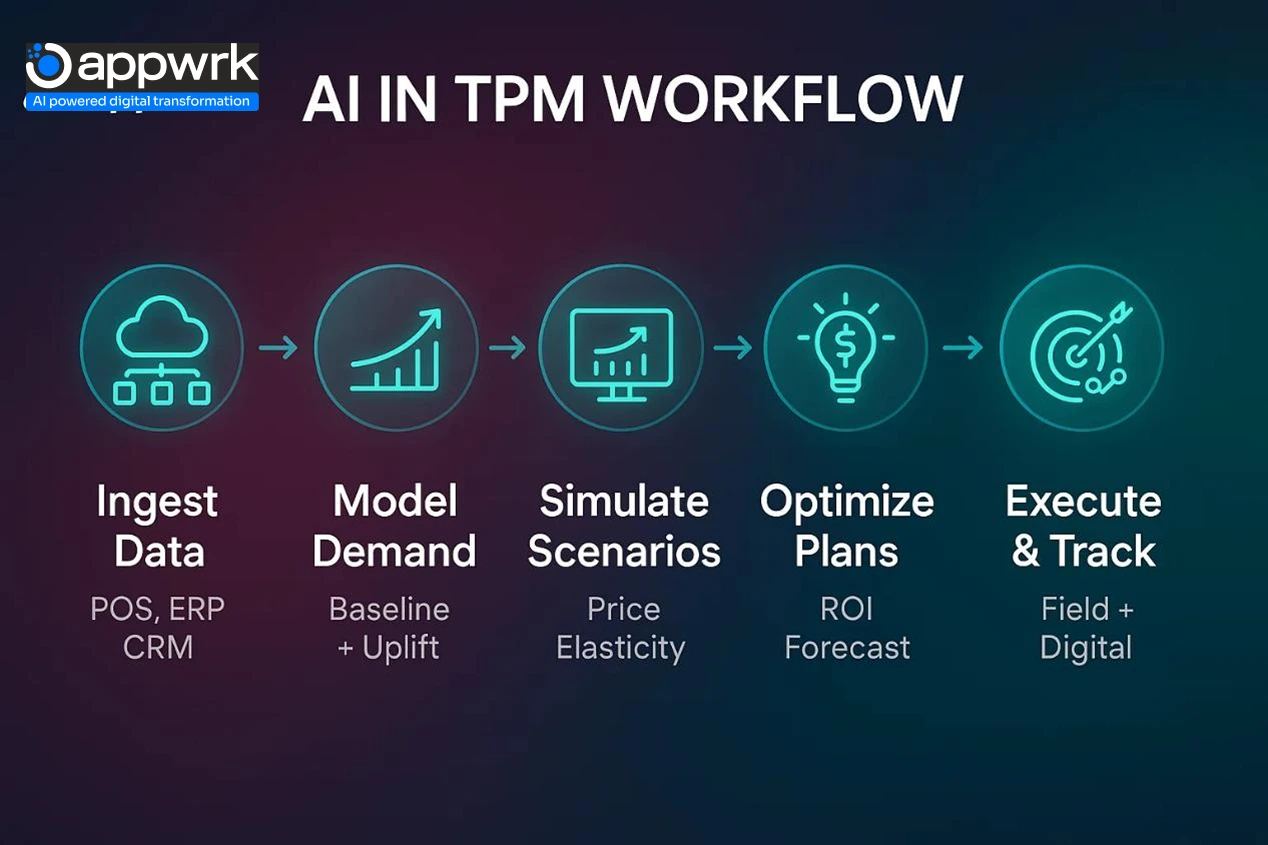
Scenario Simulation & AI Optimisation
Simulate multiple strategies using ML modelling, price optimisation, what-if scenarios, and advanced analytics in trade-in promotions. Tools like Demand Forecast Master and Trade Spend Master predict Return on Investment (ROI) and guide smarter promotional investments that maximise return on investment and strengthen your competitive edge.
Execution & Compliance Tracking
Ensure accurate in-store rollout with efficient and effective retail execution tools. Platforms like Repsly capture real-time field data, compliance insights, pricing checks, and shelf space and visibility metrics,providing one source of truth across wholesale and retailers and the final consumer.
Settlement, Claims & Deductions
Simplify reconciliation & financials, automate settlement processes, and manage dedications management. Trade promotion management software like Salesforce TPM streamlines claims tracking, linking each deduction to executed promotions for full visibility and accountability.
Integrations Across ERP, CRM, BI, SFA & Retailer Systems
For TPM to deliver measurable value, it must operate as the digital backbone of enterprise collaboration and fully support the digitalisation of trade promotion operations. This requires seamless integration with existing systems and processes, along with real-time reporting and data synchronisation across the organisation.
SAP, Oracle, Microsoft Dynamics
These ERP systems connect planning, finance modules, forecasting models, and execution workflows, supporting cloud-based and modular solutions and helping teams optimise efforts while reducing licensing costs.
ePoS and syndicated data sources (SPINS, Nielsen) provide real-time reporting on consumption volume, sales impact, and promotional profitability,helping consumer goods companies centralise data and enhance reporting & analytics for smarter decision-making.
Retailer Portals & Digital Shelf Feeds
TPM systems sync promotional data with retail partners like Amazon, Walmart, and others to enhance shelf strategy and push strategy execution. This alignment improves the process of planning, executing, and analysing promotions, strengthens direct-to-consumer visibility, and improves operational agility across digital and in-store touchpoints.
Data Infrastructure for Modern FMCG TPM
Behind every intelligent Trade Promotion Management (TPM) system is a scalable data foundation designed for global visibility, advanced analytics, and real-time execution. Modern TPM infrastructure helps consumer goods companies centralise data, eliminate manual processes, and support operational agility across the entire promotional cycle.
API First Architecture
API-first design ensures modular and flexible connectivity across internal systems and retailer platforms. This enables unified data flow, simplified integration with existing systems and processes, and seamless alignment with trade promotion management software and cloud-based and modular solutions.
Data Lake + Real-Time Processing
A modern data lake with real-time processing powers advanced analytics capabilities, enabling instant performance insights and rapid response to market conditions. It supports volume and spend forecasting, real-time reporting, and promotion planning and forecasting while maintaining one source of truth across teams.
Analytics Engine for AI/ML Models
A dedicated analytics engine enables artificial intelligence, AI technology, and AI-powered analytics platforms to run forecasting models, what-if scenarios, and advanced analytics in trade-in promotions. This empowers teams to optimise efforts, maximise return on investment, and make more informed decisions backed by historical spending and predictive insights.
The Promotion Lifecycle: From Planning to Post-Event Analysis
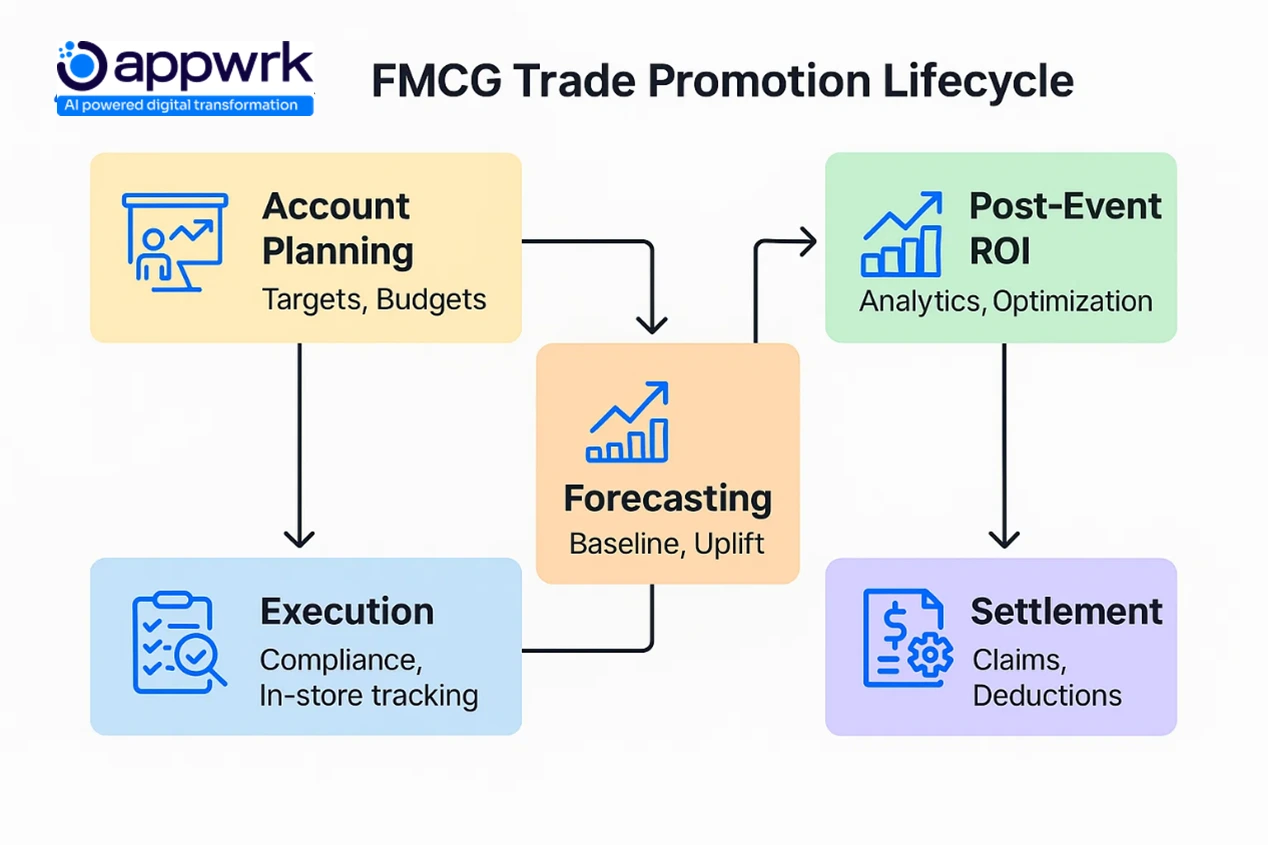
A successful trade promotion is more than execution,it requires managing a fully connected lifecycle from strategy to activation and review. Modern Trade Promotion Management (TPM) systems bring structure, automation, and visibility to every stage, helping large companies and smaller market players plan, budget, execute, and evaluate the effectiveness of promotional campaigns with clarity.
Below is a flow-style breakdown of how leading FMCG teams manage the lifecycle using tools like Salesforce TPM, Trade Spend Master, and PromoTool.
1. Account Planning & Annual Budgeting
Goal: Define promotional strategy, allocate trade spending, and align targets with business goals to strengthen growth strategy and marketing mix.
What FMCG teams do:
Set trade KPIs and sales objectives tied to sales growth, product demand, and category goals.
Lock annual spend ceilings based on percentage of revenue and planned promotional investments.
Align across customer hierarchies, brands, and wholesale and retailers for unified execution.
Components:
Target Setting – Linked directly to sales projections, volume goals, forecasting models, and Return on Investment (ROI) expectations.
Calendar Development – Map promotional activities for the year, supporting teams to plan promotions & forecast efficiently while improving the productivity of sales and finance personnel.
Modern TPM ensures a single storehouse of information, enabling collaboration across functions and making promotional planning more predictable, data-driven, and profitable.
2. Consumption & Shipment Forecasting
Goal: Model expected lift from promotions using AI-powered forecasting, machine learning, and integrated demand signals. This stage connects Demand Plans with promotional schedules to deliver more accurate volume and spend forecasting and strengthen overall sales growth.
What FMCG teams do:
Connect Demand Plans with promotional schedules using promotion planning and forecasting workflows.
Use Marketing Events Master to align promotional investments with customer and product hierarchies.
Components:
Baseline & Uplift Modelling – Built from historical spending, AI-augmented data, and forecasting models to improve promotional profitability and forecast reliability.
Demand Signal Integration – Sync POS, Data Cloud, retailer portals, and syndicated sources to improve product demand visibility and centralise data in one source of truth.
This step ensures consumer goods companies can make more informed decisions and maximise return on investment through deeper data analysis.
3. Execution & In-Store Compliance Tracking
Goal: Ensure planned promotions are executed correctly at the point of sale, supporting both online and in-store strategies. With modern Trade Promotion Management (TPM) systems, teams gain real-time control over execution performance and retailer compliance.
What FMCG teams do: ● Capture field data via Repsly, SoftServe Business Systems, and PromoTool to support efficient and effective retail execution. ● Monitor retail marketing compliance and shelf space and visibility across wholesale and retailers.
Components:
Field Force Visibility – Live dashboards provide real-time reporting on execution status, helping teams eliminate manual processes and improve operational agility.
Retailer Agreement Monitoring – Track whether pricing, displays, and in-store activations match retailer agreements, helping manage complex distributor relationships.
This phase enhances the competitive edge of brands by ensuring consistency and accuracy throughout the promotional cycle.
4. Settlement & Post-Event Analysis
Goal: Validate claims, reconcile financials, and feed learnings back into future campaigns to continually improve trade promotion optimisation (TPO) cycles.
What FMCG teams do:
Use automated reconciliation & financials for faster closeout and improved productivity of sales and finance personnel.
Compare planned vs. actual performance using reporting & analytics tools that provide a single storehouse of information.
Components:
Deduction Validation – Reduce losses caused by fraud, errors, or incorrect retailer claims through structured dedications management.
ROI Measurement & Optimisation – Feed insights into future promotion planning and forecasting, improving Return on Investment (ROI) and supporting long-term growth strategy.
Modern trade promotion management software enables consumer goods companies to plan, budget, execute, and evaluate the effectiveness of promotional campaigns efficiently , strengthening sales and profitability.
Real-time control across each phase of the process of planning, executing, and analysing promotions allows brands to reduce waste, optimise efforts, and scale profitable promotions across complex sales channels, distribution hierarchies, and both large companies and smaller market players.
This connected lifecycle gives organisations a single view of all active promotions, empowers them to maximise return on investment, supports direct-to-consumer and push strategy execution, and accelerates digitalisation of trade promotions operations.
TPM’s Role in Unified Commercial Planning & S&OP/IBP
Modern Trade Promotion Management (TPM) systems play a central role in unifying commercial planning, linking promotional execution directly with S&OP and Integrated Business Planning (IBP) cycles. When trade spending, forecasting, and retail execution sit on disconnected tools, organisations face delays, misaligned Demand Plans, and data accuracy issues. Real TPM eliminates these gaps by serving as one source of truth for consumer goods companies.
Connecting TPM Inputs to Demand Planning
TPM integrates real-time reporting, sales data, uplift forecasts, and customer insights into enterprise demand systems such as SAP S/4HANA and Salesforce. This strengthens plan promotions & forecast accuracy and maintains a single storehouse of information across functions.
Integrating Trade Drivers into IBP Cycles
By mapping promotional events to the Marketing Events Master, TPM makes trade drivers visible across the supply chain, finance, and marketing activities. This supports promotion planning and forecasting, improves operational agility, and ensures enterprise-wide alignment.
Enhancing Collaboration Across Sales, Finance & Supply Chain
TPM removes data silos and centralises data so teams work from the same assumptions. This improves cross-functional collaboration, supports reconciliation & financials, and boosts the productivity of sales and finance personnel. Integrated workflows allow teams to plan, budget, execute, and evaluate the effectiveness of promotional campaigns more efficiently.
With this unified framework, trade promotions become not just a marketing tactic,but a core driver of planning accuracy, growth strategy execution, and long-term revenue management.
The Impact of TPM on Sales Profitability and Competitiveness
FMCG companies that adopt real TPM platforms see measurable gains in sales and profitability, trade spend efficiency, and promotional profitability. By shifting from fragmented spreadsheets to integrated systems like Salesforce TPM, Trade Spend Master, and PromoTool, organisations unlock both strategic and financial advantage.
Retailer Collaboration Through Transparent Trade Terms
TPM platforms enhance trust with wholesalers and retailers by providing clear, auditable trade analysis and contract visibility. This transparency is essential for partners such as Walmart and Amazon, improving negotiation outcomes and ensuring consistent execution on digital and physical shelves.
Improved ROI Across Grocery, Club, Mass & eCommerce Channels
AI-powered analytics platforms enable brands to optimise efforts and ensure all promotional investments are backed by performance data. Real-time reporting, forecasting models, and trade promotion optimization (TPO) help teams maximise Return on Investment (ROI) across every sales channel, including direct-to-consumer and omnichannel environments.
Strengthened Category Leadership Through Data-Driven RGM
Integrated TPM tools fuel advanced Revenue Growth Management, empowering brands to make more informed decisions, optimise pricing, and manage complex distributor relationships. These capabilities help consumer goods companies outperform competitors, strengthen shelf space and visibility, and win in the competitive pursuit for market share.
Modern TPM transforms the process of planning, executing, and analysing promotions, supporting both large companies and smaller market players with accessible solutions that eliminate manual processes and accelerate the digitalisation of trade promotion operations.
Real-Life Use Case: How Mondelēz Improved Forecast Accuracy and Promotional ROI with TPM
This real-world example shows how a global FMCG leader transformed its trade promotion outcomes using modern Trade Promotion Management (TPM) systems, AI-enabled forecasting engines, and a fully integrated enterprise tech stack. By replacing disconnected tools with a unified TPM platform, Mondelēz improved planning accuracy, optimised efforts, and strengthened sales and profitability across markets.
The Challenge
Before TPM digitalisation, Mondelēz faced several issues impacting growth strategy and promotional profitability:
Forecast accuracy was stuck at ~55%, driven by unreliable forecasting models and limited promotion planning and forecasting capabilities.
Limited visibility into retailer behaviour, customer product hierarchy, and key demand signals across wholesale and retailers.
Ongoing margin erosion due to disconnected trade initiatives, manual reconciliation, and a lack of one source of truth in the process of planning, executing, and analysing promotions.
These challenges made it difficult to maximise return on investment, manage complex distributor relationships, or maintain a competitive edge against other large companies and smaller market players.
A unified, cloud-based and modular solution integrated with SAP S/4HANA, POS feeds, syndicated data, and automated settlement workflows to improve reconciliation & financials.
Embedded AI-powered analytics platforms, pricing intelligence, and advanced analytics in trade-in promotions, supported by tools like Marketing Events Master for calendaring and planning accuracy.
Repsly for efficient and effective retail execution, field compliance tracking, and better shelf space and visibility.
PromoTool for centralising campaign execution, reducing licensing costs, and ensuring alignment across customer hierarchies.
This digitalisation of trade promotion operations gave Mondelēz a single storehouse of information and improved integration with existing systems and processes.
Key Results
The transformation delivered measurable improvements across the entire promotional cycle:
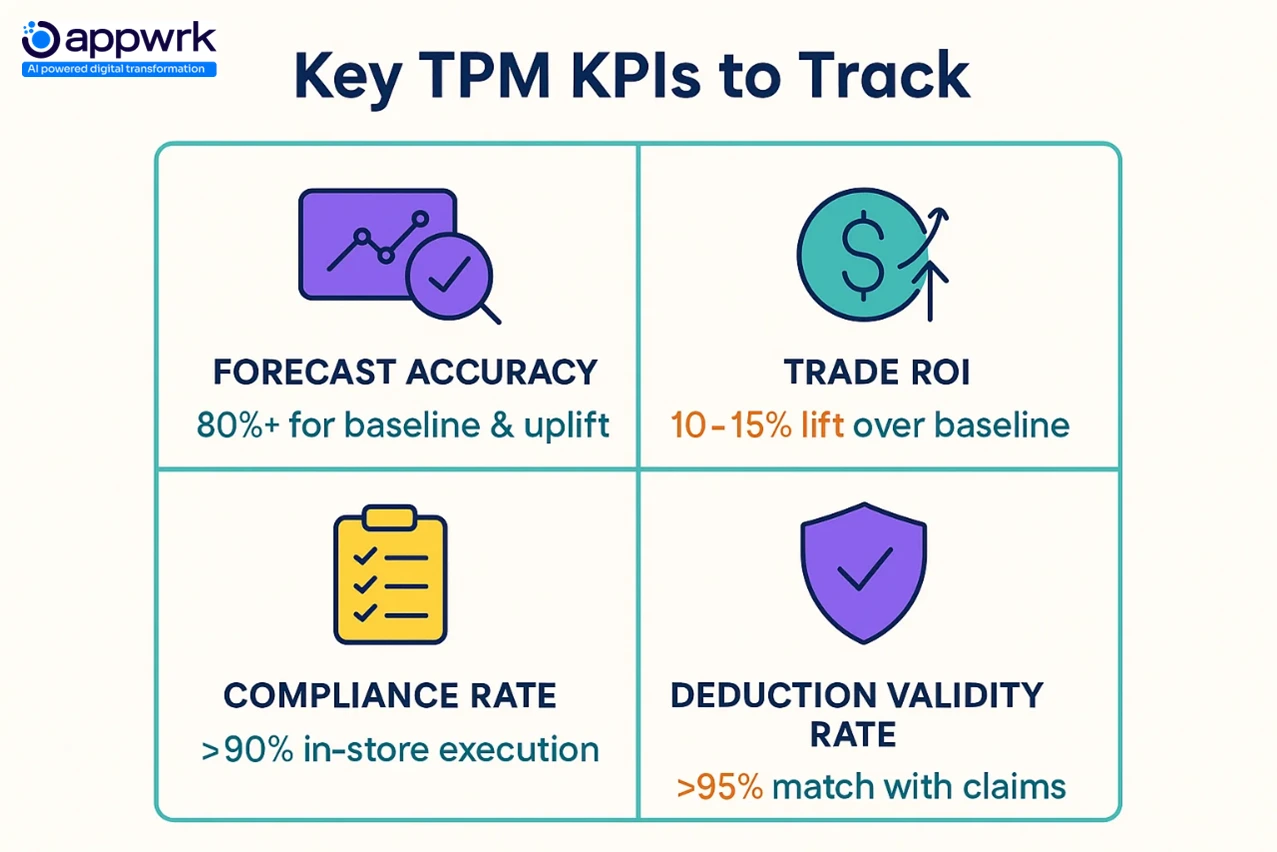
Forecast accuracy improved to ~80%, powered by AI-augmented forecasting models, historical spending optimization, and real-time reporting.
Trade spending efficiency increased by 12 to 15%, supported by smarter budget & allocation workflows and improved data analysis.
Retail execution compliance improved by 20%, driven by live dashboards, reporting & analytics, and streamlined dedications management.
These outcomes strengthened Return on Investment (ROI), increased product demand, and helped Mondelēz win in the competitive pursuit for market share across channels,including direct-to-consumer, grocery, mass, and club.
Why This Matters
This case demonstrates the real impact of aligning Demand Forecast Master, budgeting workflows, and execution through modern Trade Promotion Management (TPM) systems. By unifying data flows and strengthening the process of planning, executing, and analysing promotions, FMCG brands gain measurable Return on Investment (ROI), tighter control of trade spending, and scalable commercial transformation across complex sales channels.
For consumer goods companies operating across wholesale and retail, direct-to-consumer, and omnichannel environments, this unified approach enhances sales and profitability, boosts operational agility, and creates a sustainable competitive edge.
For enterprise FMCG leaders, selecting the right TPM platform is not just a commercial decision,it’s a strategic technology choice. Scalability, integration readiness, and security determine whether TPM can support a long-term growth strategy, enable the digitalisation of trade promotion operations, and optimise efforts across global teams.
Enterprise Architecture Blueprint for TPM
Modern TPM ecosystems are built on cloud-based and modular solutions such as Salesforce TPM and SoftServe Business Systems, offering accessible solutions for both large companies and smaller market players.
Key architectural elements include:
Microservices-based design and in-memory databases to support multi-market rollouts with minimal customisation.
Global-scale infrastructure capable of real-time reporting and integration with existing systems and processes.
A flexible architecture that keeps licensing costs efficient and accommodates flexible pricing models across regions.
This blueprint ensures TPM solutions can centralise data effectively, eliminate manual processes, and create a single storehouse of information across the promotional cycle.
AI/ML Readiness & Data Governance
Modern TPM platforms are engineered to support advanced analytics, trade promotion optimisation (TPO), and AI-powered forecasting through high-quality master data and robust governance.
What this enables:
Clean master data pipelines for accurate volume and spend forecasting, price optimisation, and promotion planning and forecasting.
Model governance, audit trails, and real-time monitoring to ensure responsible deployment of machine learning in AI-powered analytics platforms.
Strong integration with reporting & analytics, dedications management, and data analysis modules for what-if scenarios and predictive decision-making.
With this infrastructure in place, TPM systems empower organisations to maximise return on investment, manage complex distributor relationships, and enhance promotional profitability,all while improving shelf space and visibility in the competitive pursuit for market share.
Compliance, Auditability & Enterprise Security
Trade Promotion Management (TPM) systems must support enterprise-grade security while enabling digitalisation of trade promotions operations at scale. To meet global standards, TPM platforms ensure:
Alignment with regional data residency rules and regulatory frameworks across large companies and smaller market players.
Robust identity and access controls that protect promotional workflows and sensitive financial data.
End-to-end encryption and Blockchain Transparency to secure trade spending, promotional investments, and settlement processes.
This foundation ensures TPM remains a single storehouse of information while supporting operational agility, auditability, and compliance across the entire promotional cycle.
How TPM Supports Digital Shelf Execution & Image Recognition Systems
Modern TPM now goes beyond planning and budgeting,it integrates with digital shelf systems and image recognition tools to enhance efficient and effective retail execution and strengthen your competitive edge.
Linking Shelf Visibility with Promotion Plans
TPM tools integrate digital shelf data into the process of planning, executing, and analysing promotions, ensuring promotional campaigns align with real-world execution. This includes validating pricing, facings, planograms, and shelf space and visibility, improving how consumer goods companies connect promotional plans with product demand at the final consumer touchpoint.
Image Recognition for Compliance Validation
Platforms like Repsly use AI-powered mobile capture to validate in-store compliance in real time. These systems detect stockouts, verify facings, and flag issues instantly, helping teams eliminate manual processes and improve real-time reporting during execution.
Closing the Loop Between Shelf Performance and Promo ROI
By connecting shelf performance with analytics engines and forecasting models, TPM enables brands to tie consumption volume and sales growth directly to on-shelf execution. This reinforces Return on Investment (ROI) clarity and improves category performance across wholesale and retailers.
Emerging Trends: The Future of TPM in FMCG
Trade promotions are rapidly evolving into predictive, intelligent engines of growth. The next generation of trade promotion management software will combine automation, decision intelligence, and deeper integration to drive higher promotional profitability and maximise return on investment.
AI-Driven Scenario Simulation
AI Technology and ML modelling will increasingly support what-if scenarios, enabling brands to test promotional strategies before execution. This strengthens promotion planning and forecasting, reduces risk, and helps teams make more informed decisions.
Intelligent Deduction Automation
Automated settlement and dedications management will significantly reduce manual workloads, cutting reconciliation & financials timelines from weeks to days and improving the productivity of sales and finance personnel.
Omnichannel Promotion Synchronisation
Future TPM platforms will coordinate promotions across physical stores, mobile apps, direct-to-consumer channels, and eCommerce platforms like Amazon. This ensures consistency across all touchpoints, strengthens push strategy execution, and improves the entire marketing mix.
Autonomous Forecasting Models
The future of TPM will be driven by autonomous forecasting engines such as Demand Forecast Master. These AI-powered analytics platforms continuously learn from real-time sales data, external market signals, and historical spending to deliver more accurate forecasting models. This shift enhances volume and spend forecasting, improves product demand visibility, and strengthens the entire process of planning, executing, and analysing promotions.
By removing manual processes and centralising data, autonomous forecasting supports better decision-making, maximises return on investment, and enhances operational agility across all consumer goods companies.
Regional TPM Dynamics: US & Global FMCG Markets
Trade promotion execution and technology adoption vary significantly across global markets. Understanding these regional dynamics helps Trade Promotion Management (TPM) systems scale effectively, optimise efforts, and improve revenue management across diverse customer hierarchies, channels, and market conditions.
United States: High Retail Complexity & Digital Maturity
The U.S. market is defined by dense retail channels, complex trade terms, and high expectations from wholesalers and retailers. FMCG brands increasingly integrate TPM with Retail Media Networks to drive sales growth and promotional profitability. Tools like Salesforce TPM, Repsly, and PromoTool support real-time reporting, efficient and effective retail execution, and deeper reporting & analytics for ROI tracking.
Europe: Compliance-Driven Trade Planning
The EU market requires TPM platforms with strong data accuracy, strict compliance readiness, and alignment with regulatory frameworks. Brands rely on in-memory databases, automated settlement processes, and reconciliation & financials features to support audit-readiness, price optimisation, and transparent promotional investments.
India: Growth Market with Fragmented Distribution
India’s fragmented distribution landscape and high SKU volumes require cloud-based and modular solutions and mobile-first TPM platforms. Tools like PromoTool support budget & allocate workflows, field operations, and promotion planning and forecasting, helping both large companies and smaller market players manage complex distributor relationships and serve price-sensitive consumers.
Brazil: Localised Promotions with Strong Trade Influence
Brazil’s FMCG environment heavily depends on price elasticity models and hyper-local campaigns. TPM platforms must support regionalised planning, deep data analysis, and advanced analytics in trade-in promotions to manage retail-specific activities and improve trade spending outcomes.
Middle East: Data-Led Expansion and Trade Alignment
As modern retail expands, TPM helps unify customer product hierarchy data, streamline promotional investments, and strengthen push strategy execution. Companies increasingly adopt cloud-based and modular solutions for flexible rollout, improving integration with existing systems and processes and supporting one source of truth across markets.
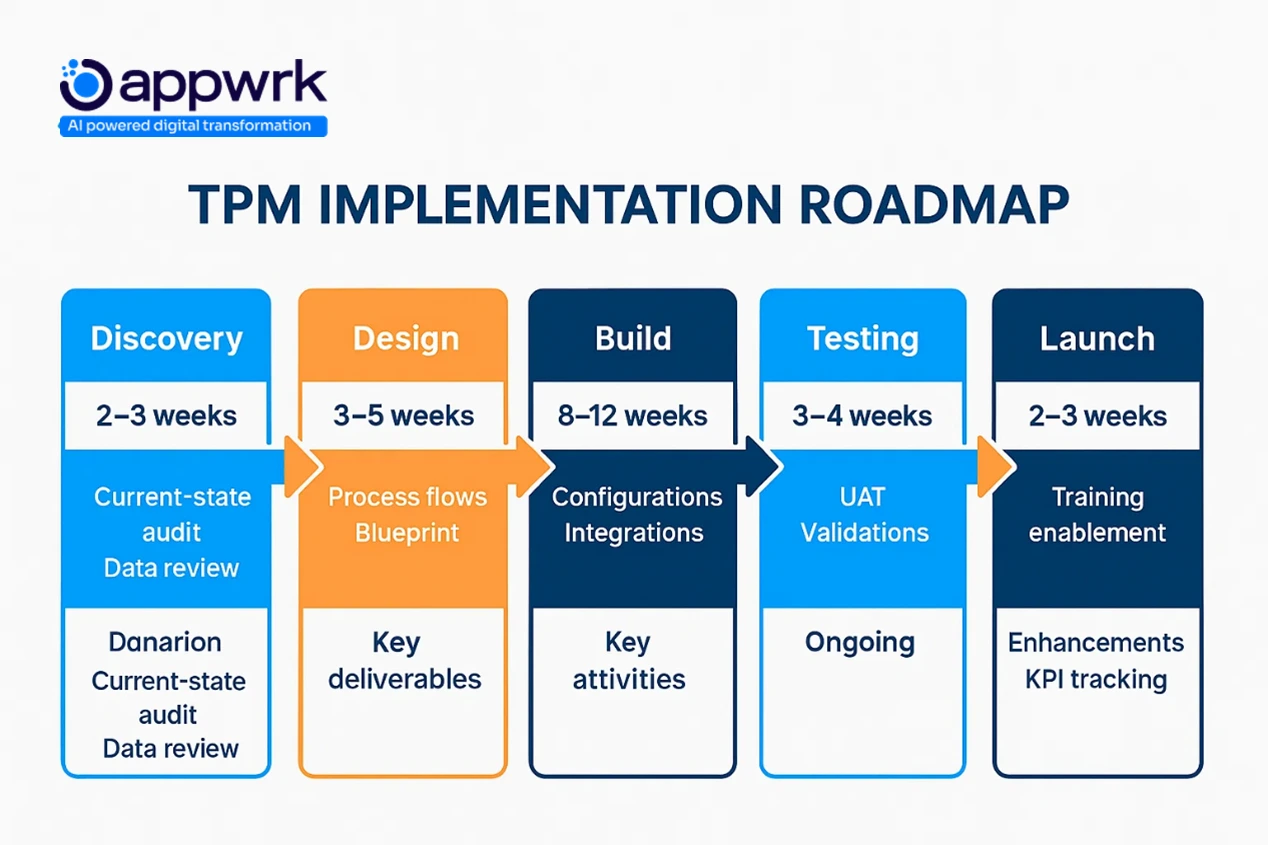
Implementation Timeline & Team Composition
Rolling out a full-scale Trade Promotion Management (TPM) system requires structured phases, cross-functional coordination, and the right technology partners. Leading platforms such as Salesforce TPM, SoftServe Business Systems, and PromoTool provide cloud-based and modular solutions that support scalable deployments across large companies and smaller market players.
A successful implementation focuses on centralising data, eliminating manual processes, and ensuring a seamless transition toward the digitalisation of trade promotions operations, ultimately maximising return on investment and improving sales and profitability across the promotional cycle.
Typical TPM Implementation Timeline
Phase
Duration
Key Roles Involved
Core Deliverables
Discovery
2 to 3 weeks
TPM Lead, Sales Ops, IT
Current-state mapping, data audit, identification of historical spending and integration gaps
Design
3 to 5 weeks
TPM Architect, Commercial Strategy
Promotion models, process blueprints, forecasting models, and planning workflows
Build
8 to 12 weeks
Developers, Integration Specialists
System configuration, data analysis setups, module integrations, and connections to ERP/CRM
UAT, compliance scenarios, validation reports, and what-if scenarios
Launch
2 to 3 weeks
Change Mgmt, Enablement Leads
Training, go-live support, documentation, and new workflows for cross-functional teams
Optimization
Ongoing
RGM, Data Science, IT
KPI tracking, AI tuning, trade promotion optimisation (TPO), and continuous feedback loops
A structured implementation ensures TPM becomes a single storehouse of information and one source of truth for consumer goods companies. By integrating promotion planning and forecasting, real-time reporting, reconciliation & financials, and reporting & analytics, TPM platforms help teams plan, budget, execute, and evaluate the effectiveness of promotional campaigns with greater accuracy and operational agility.
This approach reduces licensing costs over time, optimises efforts across wholesale and retailers, improves management of complex distributor relationships, and strengthens your competitive edge in the competitive pursuit for market share.
These ranges reflect typical licensing costs, integration complexity, and the maturity of existing systems across consumer goods companies.
Key Success Factors
Clean master data before kickoff to support accurate promotion planning and forecasting
Strong executive sponsorship and cross-team ownership
Early integration with S&OP, ERP, and retail data to enable one source of truth
Clear Return on Investment (ROI) and trade spend KPIs set at project start.
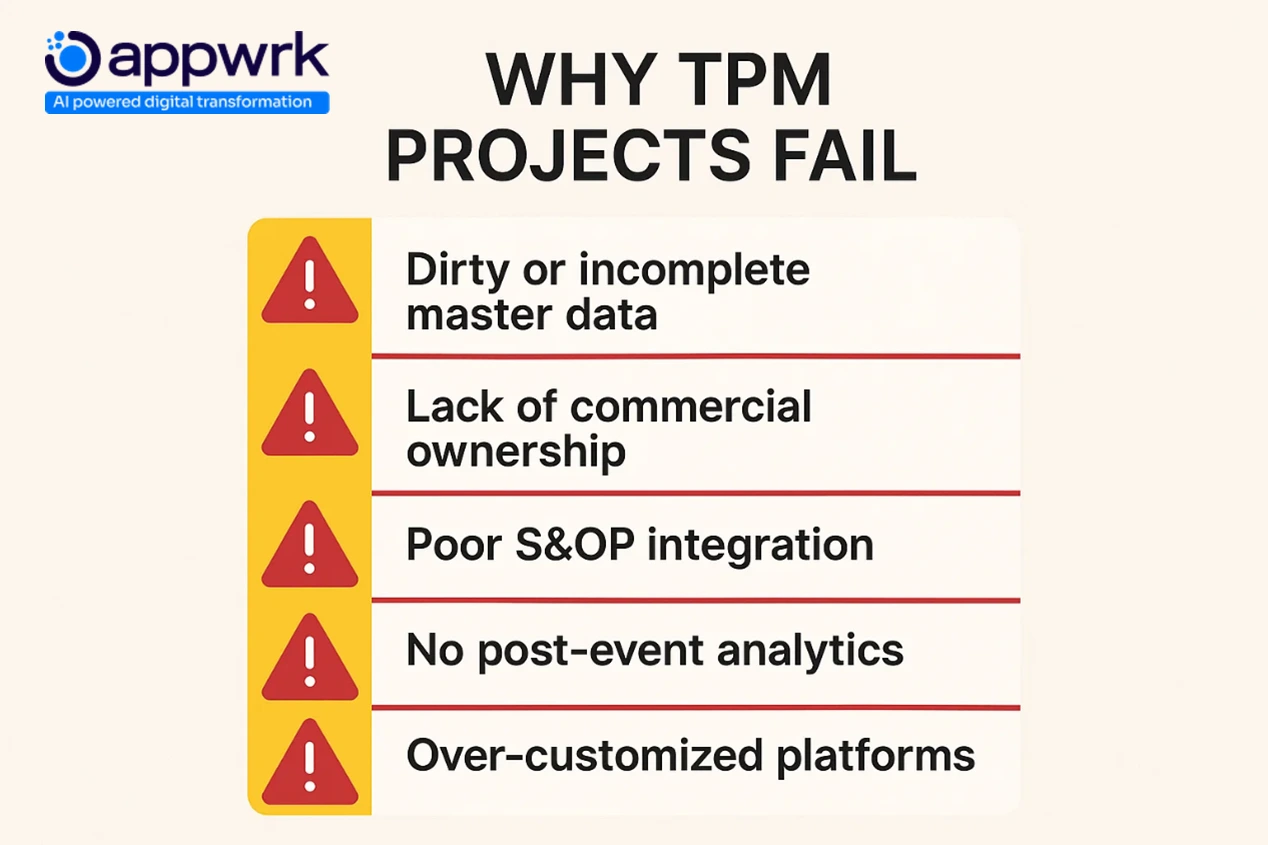
Common Mistakes and Why TPM Projects Fail
Many Trade Promotion Management (TPM) systems underperform not due to software, but because foundational elements are weak. These issues disrupt the process of planning, executing, and analysing promotions across the promotional cycle.
Frequent Failure Points
Unclean Master Data Inaccurate hierarchies and missing retailer mappings undermine volume and spend forecasting, ROI analysis, and sales growth predictions.
No Executive Ownership TPM becomes an IT project instead of a commercial transformation tied to promotional profitability and competitive edge.
Disconnected S&OP Alignment Weak integration with Integrated Business Planning leaves gaps in supply forecasting, impacting product demand and fulfilment.
Overengineering the Solution Heavy customisations slow adoption. Starting with cloud-based and modular solutions enables agility and accessible solutions for both large companies and smaller market players.
Lack of Performance Analytics Without post-event reporting & analytics, trade spending efficiency remains hidden, making it harder to optimise efforts and maximise return on investment.
How Appwrk Helps FMCG Companies Transform TPM
Appwrk delivers scalable, end-to-end TPM programs that unify strategy, data, and execution into a single storehouse of information, helping organisations move from fragmented processes to digitalisation of trade promotion operations.
What Sets Appwrk Apart
Secure, Scalable TPM Implementations Modular, cloud-first deployments integrated with Salesforce TPM, SAP S/4HANA, and legacy ERPs, creating a single view of all active promotions.
AI-First Predictive and Optimisation Models AI-powered analytics platforms for uplift simulation, price optimisation, and scenario planning (what-if scenarios, data analysis, and forecasting models).
Deep Integration Expertise Robust integration across CRM, SFA, Data Cloud, analytics, and retail execution systems, boosting the productivity of sales and finance personnel.
Trusted Delivery for Global FMCG Enterprises Industry-aligned KPIs, global compliance, and proven success models for efficient and effective retail execution and dedication management.
Founder’s Guide: Building High-ROI TPM Operations
Scalable TPM operations require more than software,they need structured data, aligned teams, and governance.
Strategic Foundations
Set meaningful KPIs: trade spend efficiency, uplift ROI, and plan promotions & forecast accuracy.
Establish strong data foundations with centralised hierarchies.
Scale TPM in emerging markets through cloud-based and modular solutions
Use governance frameworks for finance, sales, and marketing alignment.
Ensure integration with existing systems and processes to support omnichannel (direct-to-consumer, wholesale and retailers)
Your Next Step
Schedule a Discovery Session with Appwrk to audit your TPM maturity, identify ROI gaps, and build a roadmap for optimisation. Contact Appwrk
FAQs
1. What is the role of TPM in improving forecast accuracy? TPM platforms use AI-powered forecasting and machine learning to improve volume predictions and align Demand Plans with real market behavior.
2. What data inputs are required for effective Trade Promotion Management? Clean master data, customer product hierarchies, POS feeds, and historical promotion performance are essential for accurate planning.
3. How does TPM integrate with ERP systems? Solutions like Salesforce TPM and SAP S/4HANA connect directly with ERP platforms, enabling financial visibility, automated posting, and faster reconciliation.
4. How does TPM handle deduction management? Modern TPM systems automate deduction validation and settlement, reducing financial leakage across promotions.
5. What AI capabilities are embedded in today’s TPM platforms? ML models, price elasticity, uplift simulation, and scenario planning help teams make smarter, data-backed trade spend decisions.
6. How long does a full TPM implementation take? Typically 4 to 6 months depending on integration depth and data readiness; modular platforms reduce timelines significantly.
7. Can TPM support omnichannel promotional strategies? Yes,TPM aligns promotions across online and offline channels including Amazon, Walmart, and D2C platforms.
8. Is TPM suitable for emerging FMCG brands? Absolutely. Cloud-based, modular systems let challenger brands scale TPM affordably while improving trade spend efficiency.
9. How does TPM support retailer negotiations? By providing performance analytics and accurate data to strengthen claims and optimize terms with key retailers.
10. How does TPM improve post-event analysis? Tools like Trade Spend Master and PromoTool offer real-time ROI tracking, feeding insights directly into the next promotional cycle.
11. How does TPM fit into S&OP processes? TPM integrates trade event data and forecast impact into S&OP and Integrated Business Planning, boosting accuracy and alignment.
12. How can Appwrk help us start with TPM? Appwrk delivers scalable, AI-first TPM implementations with fast deployment, deep integration, and measurable ROI. Start with a free readiness audit from Appwrk’s FMCG strategy team.
Gourav Khanna is the Co-founder and CEO of APPWRK, leading the company’s vision to deliver AI-first, scalable digital solutions for enterprises and high-growth startups. With over 16 years of leadership in technology, he is known for driving digital transformation strategies that connect business ambition with outcome-focused execution across healthcare, retail, logistics, and enterprise operations.
Recognized as a strategic industry voice, Gourav brings deep expertise in product strategy, AI adoption, and platform engineering. Through his insights, he helps decision-makers prioritize market traction, operational efficiency, and long-term ROI while building resilient, user-centric digital systems.
Subscribe to APPWRK Blogs, We'll Do the Rest!
Get Blogs on UI/UX, Mobile Apps, Online Marketing, and Web development technology.
Unlock worthy and priceless suggestions from the masters of mobile and web app development