150+ minds across 4 countries. Join a culture of innovation, ownership & growth.
Rewire for AI
From machine learning to deep learning, from classification tools to overall process automation – our AI engineers will help you retool your existing system or enhance your company results.
Ship faster, scale smarter, built for product companies and SaaS teams
Our Latest Work
We strive hard to deliver result-driven digital solutions across the globe. Check out our case studies to get a glimpse of how we ideate, innovate, and create unconventional digital solutions according to the requirements of our clients.
Discover diverse and passionate insights from our tech enthusiasts. We collaborate across various sectors to streamline operations and drive innovation. Explore our rapidly growing collection of articles to see why we’re at the forefront of IT solutions.
The decision to move from Magento to Shopify is one of the most significant replatforming choices an ecommerce business can make. Magento is powerful, but its power comes with...
Accuracy gap is real: Traditional CPG forecasting carries a 25-40% MAPE error rate. AI-powered models bring that down to 8-15%, according to McKinsey research....
Real stories from global leaders who trusted us with their ideas.
Partnering with APPWRK helped us build a compliant and scalable healthcare platform, accelerating our time-to-market by 35%. Their team consistently delivered outstanding work.
Beesers
Digital Healthcare Client
Collaborating with APPWRK, Sportskeeda modernized its platform into a real-time sports engagement ecosystem, enabling seamless content delivery, scalable fan interactions, and high-velocity performance.
Sportskeeda
Sports & Entertainment Partner
Working with APPWRK was effortless. They captured our vision, maintained full compliance, and delivered a digital experience that built trust and elevated how customers interact with our fintech brand.
PayPenny
Fintech Partner
Working with APPWRK gave us confidence in adopting AI responsibly. Their team built a safe, intelligent bot that transformed how we engage with leads and helped us achieve measurable revenue growth.
IFB
AI Transformation Partner
Leveraging APPWRK’s digital expertise, Nemesis launched a scalable, compliant, and safe super app that connects content delivery, real-time communication, and logistics management within a single platform.
Nemesis
Super App Partner
Build Smarter Construction Software, Together
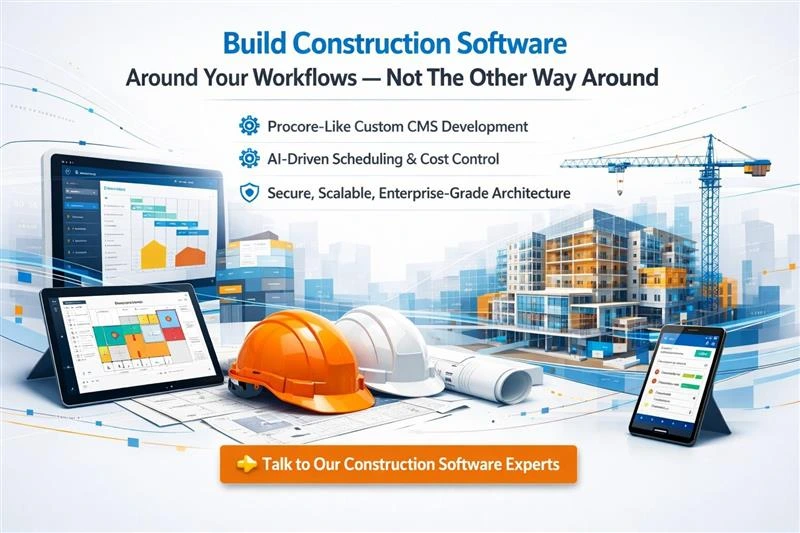
Partner with Appwrk to transform construction operations through scalable, secure, and future-ready software built around your workflows.
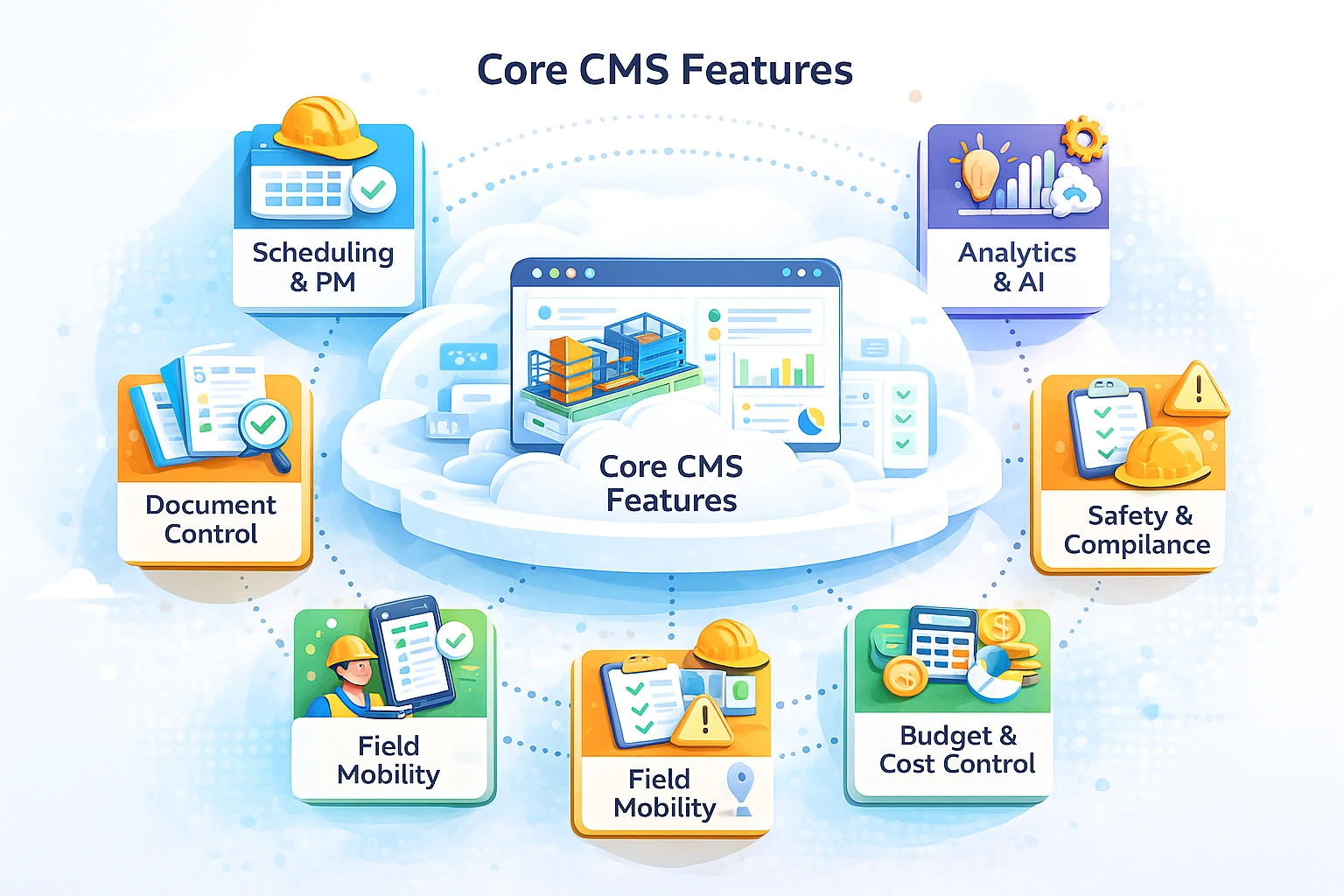
Modern enterprise-grade construction software centralises project scheduling, document control, budget management & cost control, field operations, safety compliance, and analytics, creating a unified platform for multi-team collaboration.
Custom construction management software delivers stronger workflow alignment, long-term cost efficiency, compliance readiness, and full IP ownership, unlike off-the-shelf tools that restrict scaling.
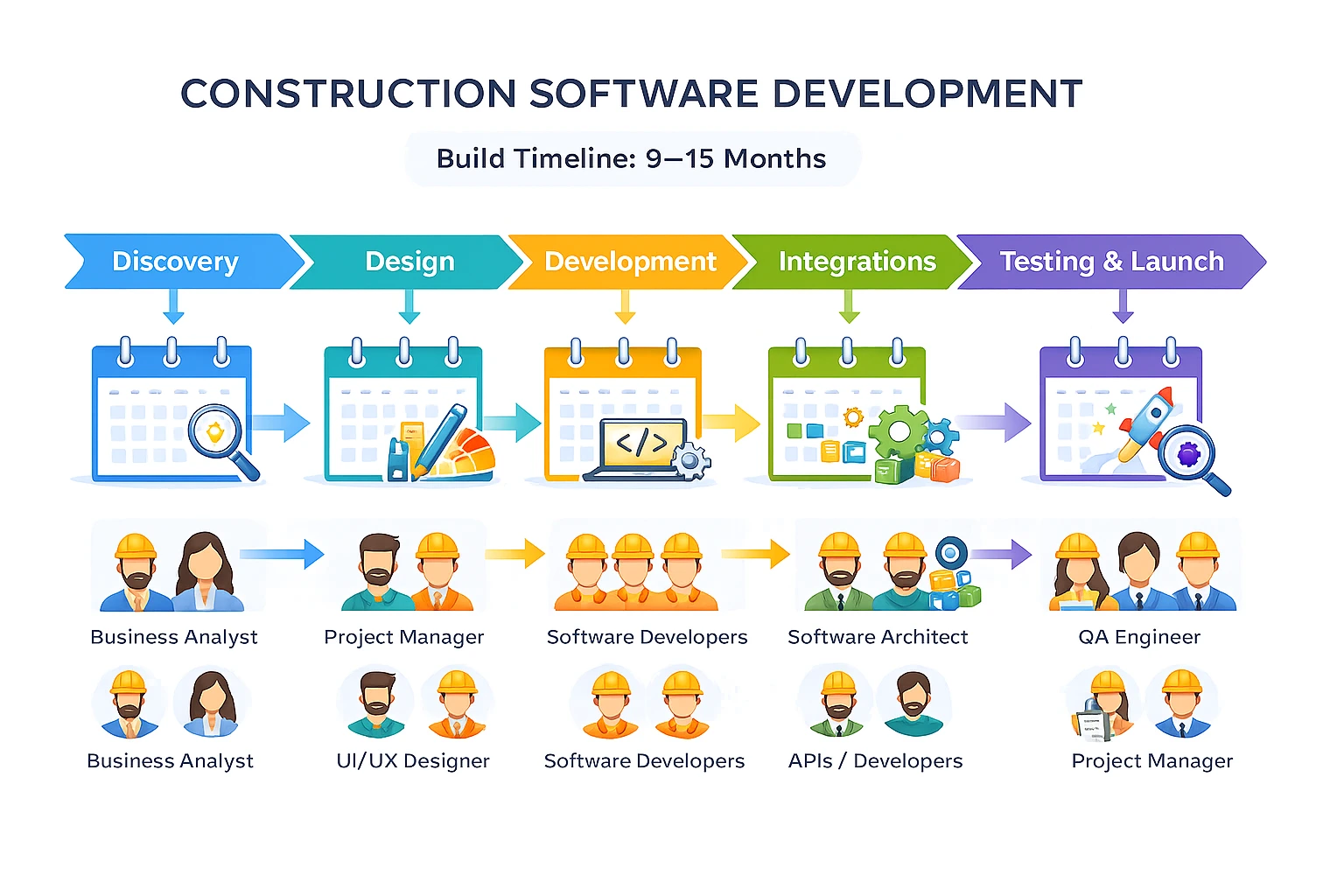
Building a Procore-like construction management software platform generally requires 9–15 months and a cross-functional team including a Solution Architect, backend/frontend engineers, mobile engineers, data/AI engineers, QA engineers, DevOps, and integration specialists.
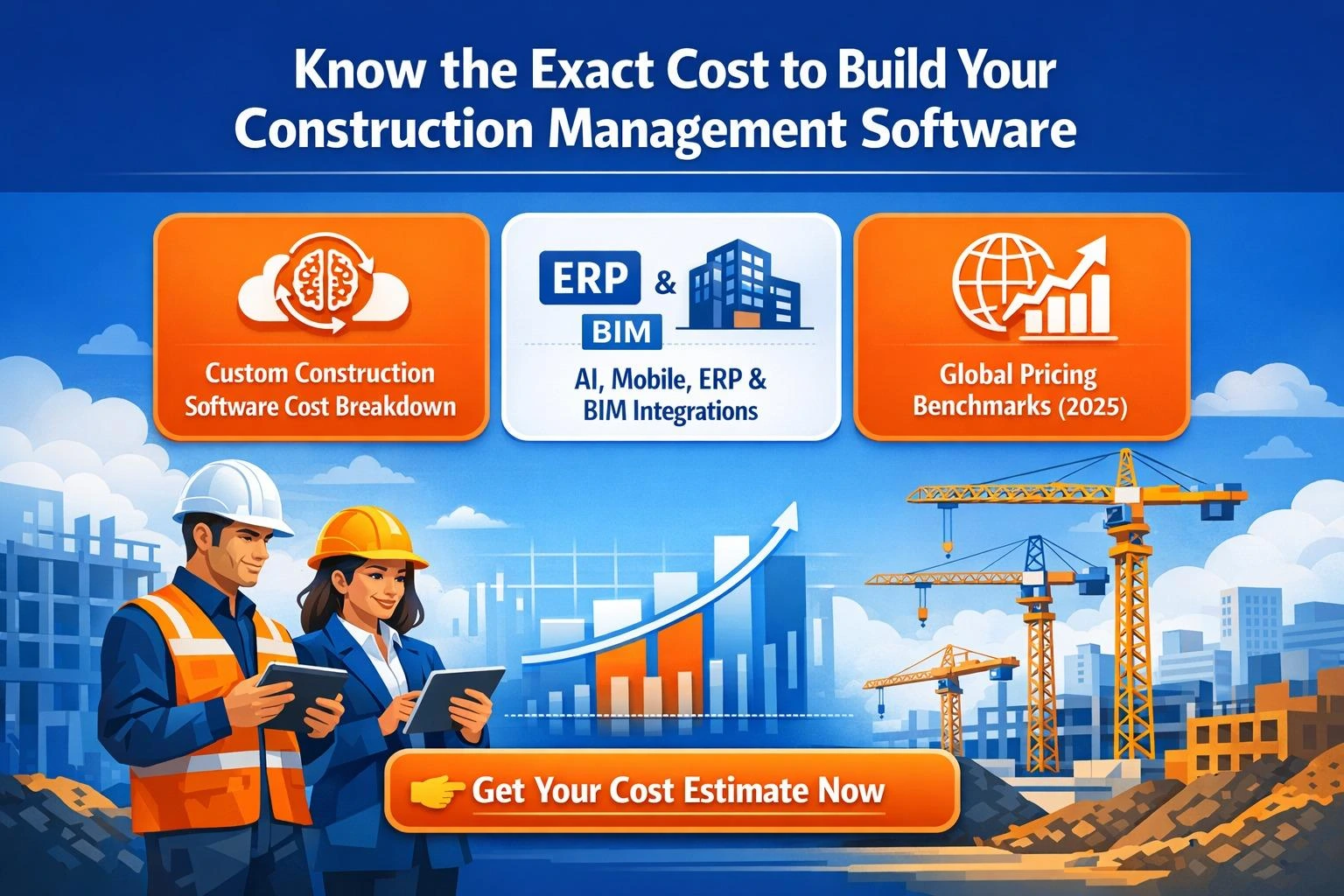
Introduction: Understanding the Global Cost to Build Construction Management Software
Construction management software has become the operational backbone of modern projects. As teams, sites, and workflows grow more complex, spreadsheets and legacy tools can no longer support real-time project scheduling, budget management, compliance, or field coordination. Enterprises now require unified, custom construction management software that integrates documentation, communication, safety workflows, and analytics into a single platform.
The construction management software development cost varies widely based on scope, ranging from mobile construction management apps and offline field mobility to AI-based predictive analytics, IoT integrations, BIM integrations, and multi-region compliance. As digital transformation accelerates, CTOs and CIOs increasingly treat Procore-like construction management software as a long-term strategic investment rather than a technology upgrade.
This guide breaks down the estimated cost to build construction management software, covering global benchmarks, complexity tiers, module-level expenses, team structure, timelines, regional engineering rates, and ROI factors. It offers a clear, realistic view of what it takes to build scalable, enterprise-grade construction software in 2025.
Construction Management Software Development Cost by Complexity Level
Understanding the global benchmark is essential for budgeting your construction software development effort. Below is the industry-standard cost structure enterprises use when evaluating how much it costs to develop construction management software.
Enterprise-Grade Procore-Like Platform (AI, IoT, Compliance, Field Mobility): $50,000–$80,000
For large construction organisations requiring multi-project scheduling, AI/analytics, IoT sensors, AR/VR visualisation, advanced security, integration with legacy systems & ERPs, and multi-region compliance.
Complexity Level of the Construction Management Software
Features Included
Estimated Cost to Build Construction Management Software
Ideal For
Basic Construction Management Software
Task management, documentation, and communication
$8K–$15K
SMEs & contractors
Mid-Level Integrated Construction Management Software
Resource mgmt., budgets, dashboards, mobile app, integrations
$18K–$40K
Mid-sized enterprises
Enterprise-Grade Procore-Like Platform
AI analytics, IoT, AR/VR, compliance engines, role-based permissions
$50K–$80K+
Large construction enterprises
Insight: Costs increase significantly as soon as you introduce multi-role workflows, multi-project scheduling, integration layers, or enterprise-grade security.
Advantages of Investing in Construction Management Software
Investing in custom construction management software gives enterprises tighter control over workflows, scalability, security, and long-term cost efficiency compared to off-the-shelf tools.
Tailored Operational Efficiency Custom workflows match your exact Project Planning & Scheduling, budgeting, documentation, and on-site processes, reducing friction and rework.
Competitive Advantage Proprietary dashboards, AI/Analytics models, and customised automation create an operational edge no SaaS platform can replicate.
Scalability Across Regions Supports multi-project scheduling, multi-language interfaces, and large user bases across regions and business units.
Lower Long-Term Costs Avoid SaaS licensing fees, expensive vendor customisations, and operational inefficiencies, achieving higher ROI in 2–3 years.
Key Factors Influencing Construction Management Software Development Cost
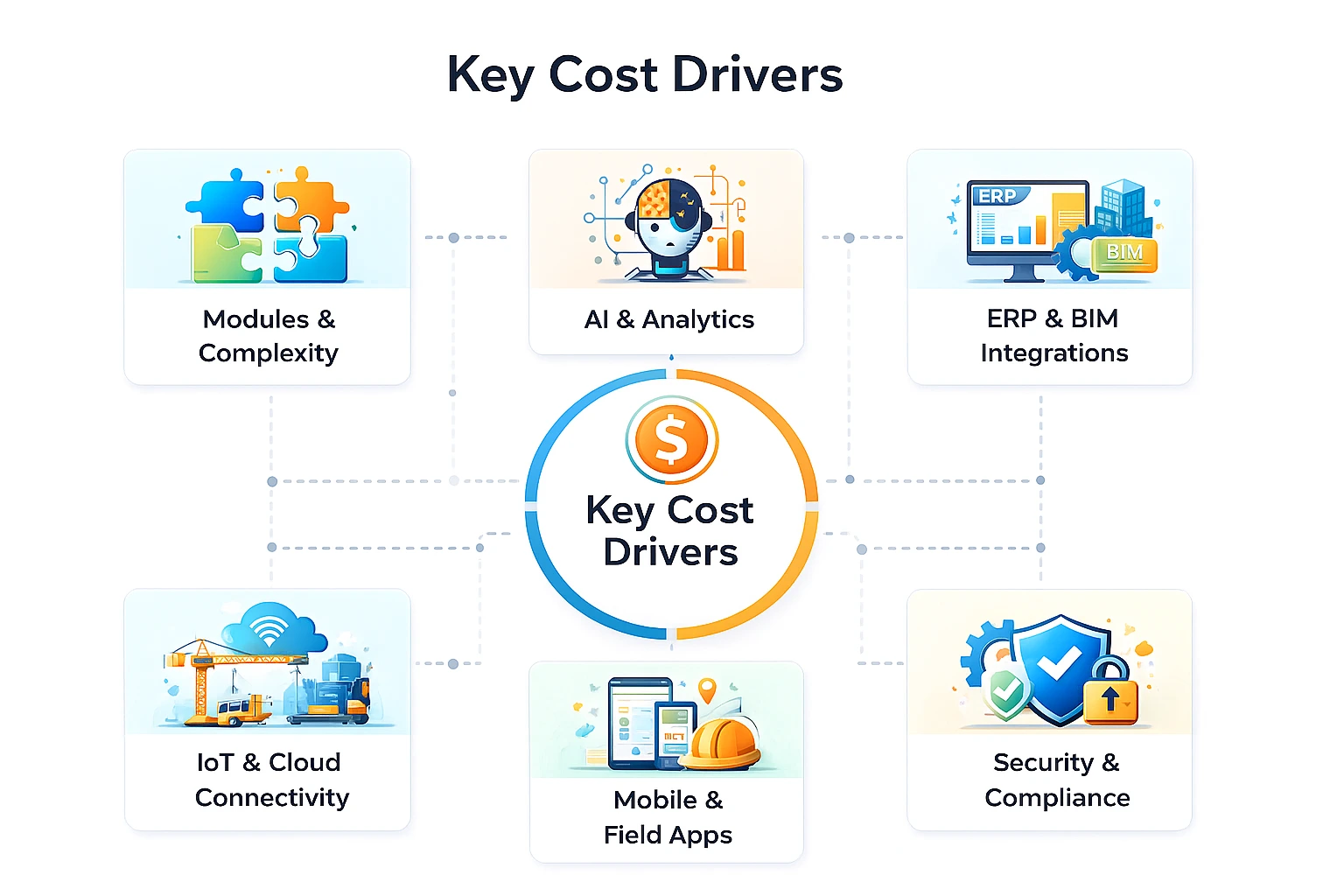
The construction management software development cost depends on workflow depth, technology stack, compliance requirements, and enterprise-scale infrastructure needs. Below is a crisp breakdown aligned to industry cost-impact drivers.
Complexity & Scope of Modules
Cost Impact: High (★★★★☆) The biggest cost driver. Modules that increase effort include:
Complex data mapping increases development hours substantially.
Scalability Requirements
Cost Impact: Medium (★★★☆☆) Enterprise CMS platforms must support:
Multi-tenant architecture
Multi-region deployments
High user concurrency
Large-scale field mobility usage
Scalability planning early prevents expensive refactoring later.
UI/UX Depth & Design Standards
Cost Impact: Medium (★★☆☆☆) Construction teams operate in harsh field environments, requiring:
Offline mode
Simple role-based navigation
Mobile-friendly dashboards
BIM file viewing & markup tools
Advanced UX increases adoption and reduces training overhead.
Geographical Distribution of Development Teams
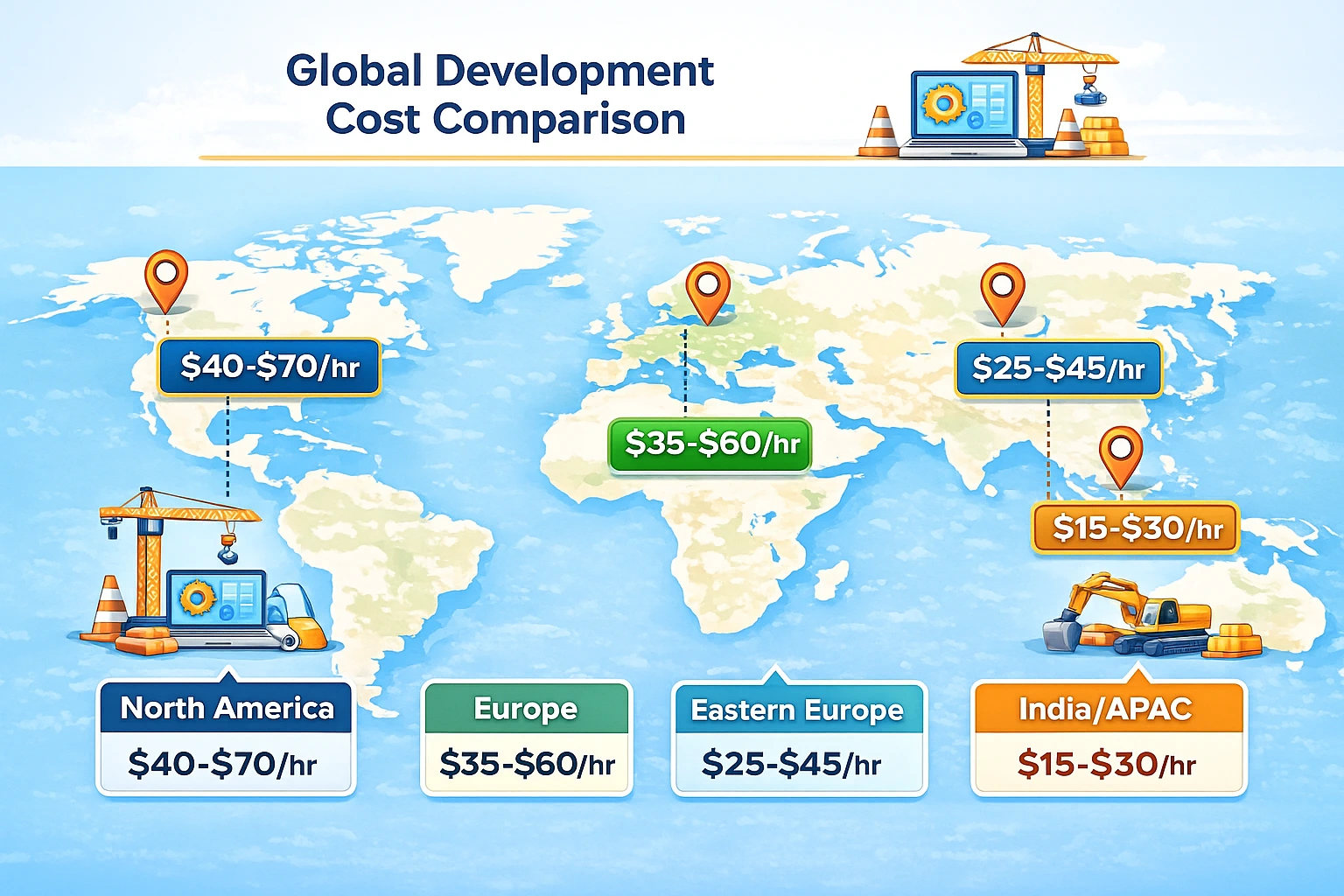
Development location significantly influences the construction software development cost, with a 40–60% variation depending on rates and delivery models.
Region of construction software development
Hourly Rate of construction software development
Cost Impact
North America
$40–$70/hr
Highest
Western Europe
$35–$60/hr
High
Eastern Europe
$25–$45/hr
Mid
India/APAC
$15–$30/hr
Most cost-effective
A hybrid delivery model, onshore Product Owner or Project Manager combined with offshore engineering teams, offers strong quality control while keeping the Estimated Cost to Build Construction Management Software competitive.
Ongoing Maintenance, DevOps & L3 Support Needs
After launch, enterprises should allocate 15–25% of the initial construction management software development cost for annual maintenance and support.
Updating ERP integrations, BIM APIs, and IoT connectors
Security patches, compliance updates, and audit logging
Ongoing DevOps automation and CI/CD pipeline upkeep
Insight: Many organisations underestimate these long-term costs. Proactive budgeting ensures stable operations, better uptime, and predictable total cost of ownership for enterprise-grade construction software.
Must-Have Features of Modern Construction Management Software
Modern construction management software must unify Project Scheduling & PM, documentation, field operations, budgeting, compliance, and analytics into a single, enterprise-grade platform. Below is a compact view of the essential modules expected in 2025.
Features of the construction management software
Purpose
Enterprise Value
Project Scheduling & PM
Tasks, dependencies, milestones
Predictability & reduced delays
Document Control & Versioning
Drawings, RFIs, contracts
Eliminates rework & version conflicts
Budget & Financial Control
Forecasts, variances
Prevents overruns, supports real-time insights
Collaboration & Communication
Messages, workflows, alerts
Aligns field + office instantly
Resource / Inventory Management
Labour, equipment, materials
Reduces waste & optimises utilisation
Field Data Capture
Logs, forms, inspections
Improves accuracy & accountability
Field Mobility
Mobile apps + offline mode
Faster on-site execution
Safety Compliance
Incidents, checklists
Stronger regulatory adherence
AI / Analytics
Predictions, risk scoring
Proactive, data-driven decisions
IoT / AR Integrations
Sensors, 3D overlays
Real-time monitoring & visual clarity
Integration Layer
ERP integrations, BIM integrations
Unified digital ecosystem
Custom vs. Pre-built Construction Management Software
Large construction enterprises quickly outgrow off-the-shelf tools because generic platforms cannot support the complex workflows, compliance demands, field-to-office coordination, and integration depth required at scale. Custom construction management software delivers tighter process alignment, higher ROI, stronger control over data and security, and long-term IP ownership.
1. Workflows Built Around Your Operational Blueprint
Off-the-shelf tools enforce rigid structures. Custom CMS development enables:
Custom approval workflows
Project planning & scheduling logic aligned to your business.
Budget management & cost control tailored to your structure.
Region-specific compliance workflows
This ensures technology fits your operations, not the other way around.
2. Centralised Field-to-Office Visibility
Construction operations are distributed across subcontractors, vendors, inspectors, and field teams. A custom CMS delivers:
Real-time field data capture
Unified dashboards
Version-controlled drawings and documents
Consistent project visibility across regions
This eliminates delays caused by fragmented communication.
3. Higher ROI Through Productivity Gains
A tailored CMS reduces operational waste through:
Fewer change orders
Improved resource and inventory management
Automated safety workflows
Reduced rework through accurate drawings & document control
Over 3–5 years, productivity gains often surpass the initial build cost.
4. Multi-Region, Multi-Language Compliance
Custom development supports:
Localised forms
Multi-language interfaces
Local safety workflows and compliance logic
SaaS tools rarely accommodate this without expensive modifications.
5. Competitive Advantage & IP Ownership
Custom CMS means owning:
Proprietary analytics
AI-powered predictive analytics
Custom automation engines
Integration logic
Field mobility workflows
This becomes a long-term competitive differentiator.
Development Process for Building Construction Management Software
Building custom construction management software follows a simple five-step lifecycle focused on speed, clarity, and integration readiness.
1. Market Research & Needs Assessment
Identify what the CMS must solve across Project Scheduling & PM, Budget Management & Cost Control, Document Control, and Field Mobility. Outcome: Clear PRD + mapped workflows.
2. Technology Stack Selection
Choose a scalable, cloud-native stack: React/Angular/Vue, Node.js/.NET/Java (microservices), React Native/Flutter, AWS/Azure/GCP, Python/TensorFlow for AI, and REST/GraphQL/BIM APIs for integrations. Outcome: Finalised architecture blueprint.
3. UX & Interface Design
Design fast, field-ready screens with offline mode, role-based dashboards, and minimal click paths. Outcome: Approved UI/UX prototypes.
4. Development & Integrations
Build modules + integrate systems: Scheduling engines, task management, mobile offline mode, ERP integrations (SAP/Oracle/Dynamics), BIM integrations, IoT sensors, and AI/Analytics models. Outcome: Functional CMS with all connectors.
5. Testing, Deployment & Continuous Improvement
Run regression, performance + load testing, security and penetration testing, and UAT. Deploy with DevOps pipelines and ongoing Maintenance and Support.
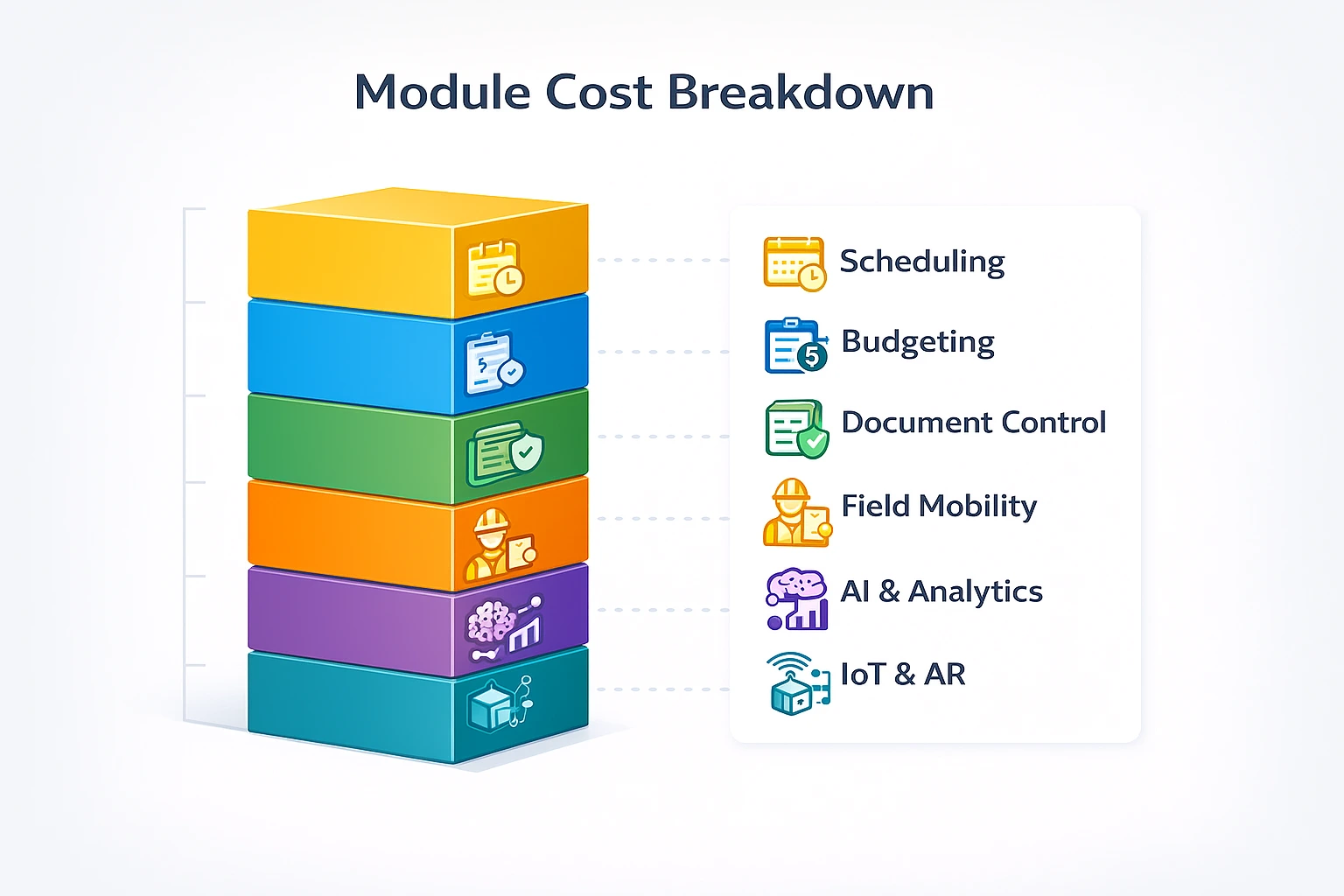
Module-Level Cost Breakdown of Construction Management Software
Regional Cost Analysis of Construction Management Software Development Cost
The construction management software development cost varies widely across regions due to differences in engineering rates, availability of specialised talent, and maturity in handling enterprise-grade construction software, ERP integrations, and cloud-native architectures. Below is a concise, buyer-friendly breakdown.
US & Canada: $40–$70/h
North American teams are typically chosen for high-complexity or mission-critical builds that require deep expertise in microservices-driven architecture, SOC2 / ISO compliance, and advanced system design.
Advantages:
Strong enterprise engineering maturity
High compliance awareness (SOC2, ISO27001, FedRAMP)
Fast communication and onshore governance
Consideration:
Highest rates globally; full-cycle CMS builds can become expensive.
Western Europe $35–$60/hr
Known for high-quality engineering and UX design, Western Europe aligns closely with GDPR and European regulatory frameworks.
Advantages:
Excellent UI/UX and product design capabilities
GDPR-aligned engineer
Strong experience with ERP integrations and BIM workflows
Consideration:
Still premium compared to other offshore regions.
Eastern Europe: $25–$45/hr
A leading destination for nearshore development with strong technical depth.
Advantages:
High backend and integration expertise
Competitive pricing with strong output quality
Good timezone overlap with the EU and the US
Consideration:
Hourly rates are increasing due to global demand.
India & APAC: $15–$30/hr
The most cost-efficient region for building Procore-like construction management software, especially at scale.
Advantages:
Large, highly skilled engineering talent pool
Cost-effective for multi-module CMS platforms
Deep expertise in cloud, mobile, AI/Analytics, and Integration with Legacy Systems & ERPs
Best suited for hybrid delivery (onshore architecture + offshore development).
MENA: $20–$40/hr
A rapidly growing region for enterprise construction software, especially for infrastructure projects.
Advantages:
Strong exposure to large government + construction programs
Geographic proximity for Middle East organisations
Multilingual engineering teams
Consideration:
Wide variation in quality; careful vendor evaluation is essential.
Construction Management Software Development Cost by Industry Type
Construction management software development cost varies by industry depending on compliance needs, operational complexity, asset scale, and required integrations.
Infrastructure & EPC Projects
Large EPC and infrastructure projects need multi-year scheduling, contract management, and strict compliance. Cost Impact: High Typical Range:$80,000–$250,000 Major cost drivers:
Multi-project scheduling & Gantt charts
Government compliance, audit trails, secure audit logs
ERP integrations (SAP, Oracle, Dynamics)
Reporting for contractors, authorities, and stakeholders
Real Estate & Commercial Construction
Projects require faster cycles, strong vendor coordination, and real-time cost visibility. Cost Impact: Medium Typical Range:$40,000–$120,000 Major cost drivers:
Budget management & cost control
Document control & versioning
Mobile field reporting with offline mode
CRM + finance system integrations
Industrial & Manufacturing Construction
Requires safety workflows, quality control, and asset traceability. Cost Impact: High Typical Range:$70,000–$180,000 Major cost drivers:
Safety workflows & incident tracking
Integration with MES, ERP, and IoT sensors
Predictive analytics for downtime & delays
Oil, Gas & Energy Projects
Operate under extreme safety, ESG, and compliance mandates across remote sites. Cost Impact: Very High Typical Range:$120,000–$300,000 Major cost drivers:
Advanced safety compliance
Offline-first field mobility
Asset-heavy data models
ESG reporting + regulatory documentation
Future Trends Affecting Construction Management Software Costs
Several emerging technologies will shape future construction software development cost, scope, and complexity:
AI-Based Predictive Analytics for delays, safety risks, and cost overruns
Digital twins + BIM integrations are increasing interoperability requirements
IoT sensors & computer vision for autonomous site monitoring
ESG, carbon tracking & compliance reporting adding new data layers
Generative AI for document control, scheduling automation, and RFI workflows
Insight: Although these capabilities may increase upfront development cost slightly, they dramatically reduce long-term operational waste, delays, and compliance risk, improving ROI across the entire construction lifecycle.
Enterprise Architecture & Security Cloud-native, microservices-based builds with encrypted data flows, SOC2/ISO-ready controls, and high availability for mission-critical operations.
AI-Driven Predictive Operations Embedded AI / Analytics for delay prediction, cost variance forecasting, safety insights, and productivity scoring, turning the CMS into a proactive operational system.
Modular & Scalable Design Flexible modules that support phased rollout, multi-region expansion, and integrations with IoT, AR/VR, BIM APIs, and ERP integrations.
Global Hybrid Delivery Onshore architecture + offshore engineering reduces overall construction software development cost while ensuring enterprise-grade quality.
Construction & Infrastructure Expertise Deep domain experience enables field-ready UX, faster builds, and pre-built accelerators for scheduling, budgeting, and Field Mobility.
Founder’s Guide: Strategic Considerations Before Investing in Construction Management Software
A CMS is a long-term strategic investment. Founders must align technology, operations, and governance before development begins.
Align with Business Goals Identify key bottlenecks, compliance needs, and processes that require standardisation across scheduling, budgeting, and field operations.
Plan for a Multi-Year Roadmap Budget beyond MVP, cover enhancements, cloud hosting, Maintenance and Support, DevOps, and future modules like AI, IoT, and AR/VR Visualisation.
Ensure Cross-Team Adoption PMs, field crews, finance, and subcontractors must adopt the system. Provide training, role-based dashboards, and structured change management.
Define Governance & Security Early Clarify data ownership, access controls, deployment model (cloud/on-prem), and compliance requirements (SOC2, ISO27001, GDPR).
Choose the Right Technology Partner Select a team with strong experience in construction Software, cloud-native architecture, ERP/BIM/IoT integrations, and long-term product support.
FAQs
How much does it cost to develop construction management software? Most builds range from $40,000 to $800,000+, depending on scope, integrations, mobile apps, security needs, and whether you’re creating a Procore-like construction management software platform.
What factors influence CMS development cost the most? Key drivers include module complexity, AI/IoT integrations, ERP/BIM integration depth, UI/UX requirements, security standards, and engineering team geography.
What features are essential for enterprise-grade construction software? Core features include Project Planning & Scheduling, Document Control & Versioning, Budget & Financial Control, Field Mobility, Collaboration tools, Safety workflows, AI/Analytics, and robust integration layers.
How long does it take to build a Procore-like platform? A full enterprise-grade construction management app typically takes 9–15 months, depending on module count, integrations, and team size.
Is a custom CMS better than off-the-shelf? Yes. Custom construction management software offers stronger workflow alignment, scalability, security, and long-term ROI. Off-the-shelf tools deploy faster but limit customisation.
What is the long-term ROI of construction management software? ROI comes from fewer delays, reduced change orders, better resource utilisation, enhanced compliance, and consolidation of multiple tools. Most enterprises recover costs within 2–3 years.
How does AI reduce operational risk in construction projects? AI provides delay prediction, cost variance forecasting, safety anomaly detection, and productivity insights, enabling proactive mitigation.
Does CMS support multi-region compliance requirements? Yes. Custom CMS platforms can embed region-specific forms, regulatory workflows, safety checklists, and multilingual interfaces.
How secure is custom-built construction software? With SOC2/ISO-ready architecture, encrypted data, secure audit trails, and RBAC, custom CMS platforms are typically more secure than standard SaaS solutions.
What team is required to build high-quality construction software? A complete team includes a Product Owner, Project Manager, Solution Architect, Frontend & Backend Engineers, Mobile Developers, QA Engineers, DevOps, and optional AI/IoT/BIM integration specialists.
Gourav Khanna is the Co-founder and CEO of APPWRK, leading the company’s vision to deliver AI-first, scalable digital solutions for enterprises and high-growth startups. With over 16 years of leadership in technology, he is known for driving digital transformation strategies that connect business ambition with outcome-focused execution across healthcare, retail, logistics, and enterprise operations.
Recognized as a strategic industry voice, Gourav brings deep expertise in product strategy, AI adoption, and platform engineering. Through his insights, he helps decision-makers prioritize market traction, operational efficiency, and long-term ROI while building resilient, user-centric digital systems.
Subscribe to APPWRK Blogs, We'll Do the Rest!
Get Blogs on UI/UX, Mobile Apps, Online Marketing, and Web development technology.
Unlock worthy and priceless suggestions from the masters of mobile and web app development