150+ minds across 4 countries. Join a culture of innovation, ownership & growth.
Rewire for AI
From machine learning to deep learning, from classification tools to overall process automation – our AI engineers will help you retool your existing system or enhance your company results.
Ship faster, scale smarter, built for product companies and SaaS teams
Our Latest Work
We strive hard to deliver result-driven digital solutions across the globe. Check out our case studies to get a glimpse of how we ideate, innovate, and create unconventional digital solutions according to the requirements of our clients.
Discover diverse and passionate insights from our tech enthusiasts. We collaborate across various sectors to streamline operations and drive innovation. Explore our rapidly growing collection of articles to see why we’re at the forefront of IT solutions.
The decision to move from Magento to Shopify is one of the most significant replatforming choices an ecommerce business can make. Magento is powerful, but its power comes with...
Accuracy gap is real: Traditional CPG forecasting carries a 25-40% MAPE error rate. AI-powered models bring that down to 8-15%, according to McKinsey research....
Real stories from global leaders who trusted us with their ideas.
Partnering with APPWRK helped us build a compliant and scalable healthcare platform, accelerating our time-to-market by 35%. Their team consistently delivered outstanding work.
Beesers
Digital Healthcare Client
Collaborating with APPWRK, Sportskeeda modernized its platform into a real-time sports engagement ecosystem, enabling seamless content delivery, scalable fan interactions, and high-velocity performance.
Sportskeeda
Sports & Entertainment Partner
Working with APPWRK was effortless. They captured our vision, maintained full compliance, and delivered a digital experience that built trust and elevated how customers interact with our fintech brand.
PayPenny
Fintech Partner
Working with APPWRK gave us confidence in adopting AI responsibly. Their team built a safe, intelligent bot that transformed how we engage with leads and helped us achieve measurable revenue growth.
IFB
AI Transformation Partner
Leveraging APPWRK’s digital expertise, Nemesis launched a scalable, compliant, and safe super app that connects content delivery, real-time communication, and logistics management within a single platform.
Nemesis
Super App Partner
Partnering for Smarter, Data-Driven FMCG Transformation
Unlock AI-enabled TPM excellence with a trusted digital transformation partner.
Data-driven Trade Promotion Management (TPM) is now a core growth lever in FMCG, where trade spend drives margins and competitive advantage.
Shifting from spreadsheets to AI-driven analytics and FMCG Data Analytics delivers 5–15% ROI uplift, higher demand forecasting accuracy, and reduced promotion leakage.
Modern TPM programs cost between $120,000 and $2.2M, covering licensing, system integration, and process automation, replacing manual promotion planning with scalable, data-driven workflows.
Data-driven TPM improves trade promotion effectiveness across Sales, Finance, and Supply Chain by unifying sales data, inventory levels, and price and promotion analytics.
Leaders use AI analytics and autonomous promo simulations to optimise decisions, strengthen FMCG distribution, and accelerate commercial performance.
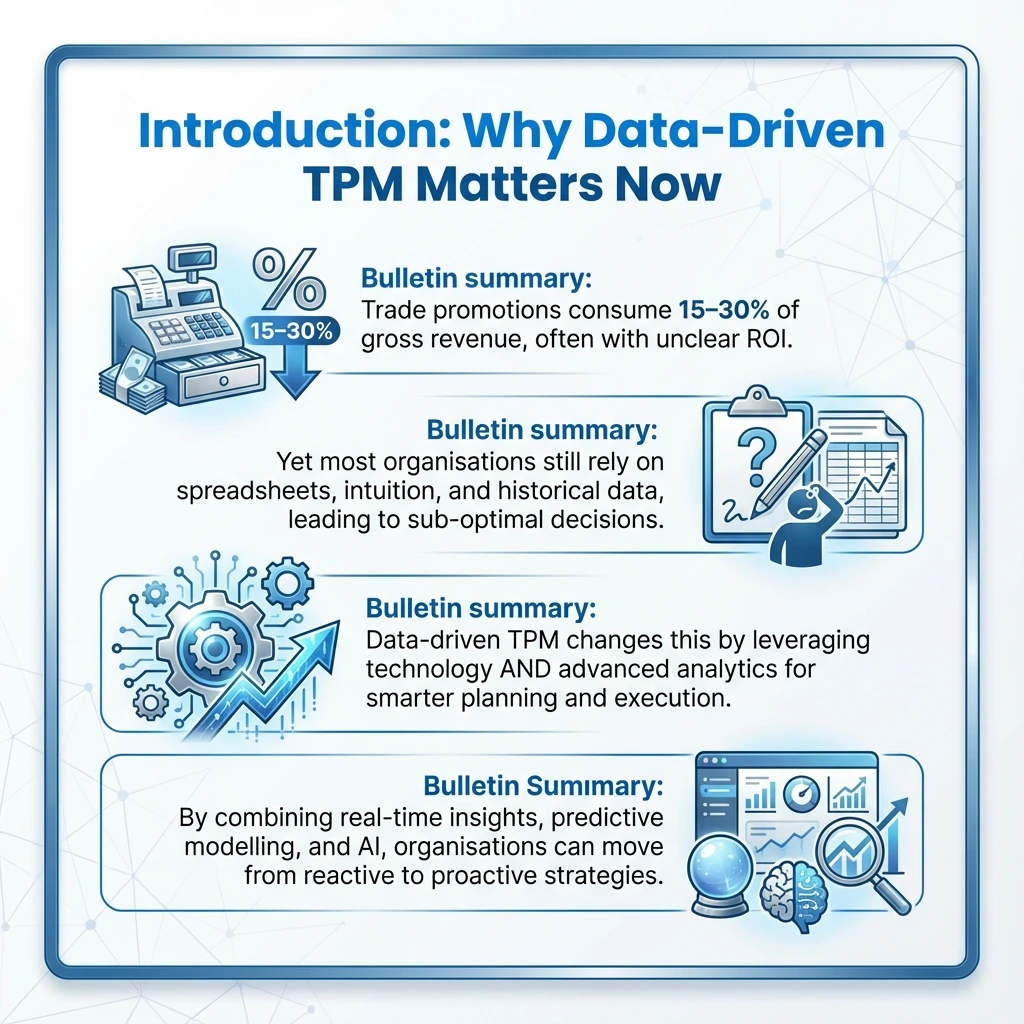
Trade promotions consume 15–30% of FMCG revenue, making Trade Promotion Management (TPM) one of the biggest levers of profitability. Yet most organisations still rely on spreadsheets and siloed data, resulting in poor visibility, overspend, and weak promotional ROI.
Data-driven TPM changes this. By combining real-time insights, predictive models, and FMCG Data Analytics, companies replace reactive decisions with structured, evidence-led promotion planning, leading to higher ROI, better forecast accuracy, and stronger retailer alignment.
Rising Demand for Data-Driven Decision Making in FMCG
Over 70% of FMCG organisations now rank data and analytics as their primary commercial capability and are increasing investments in AI-led promotion planning over the next 12–24 months.
What’s driving this shift:
Rising trade spend inefficiencies are pushing companies toward measurable ROI
Retailers demanding data-backed negotiations and accountable promotions
What Is Data-Driven TPM?
Data-driven Trade Promotion Management applies real-time data, predictive capabilities, and AI/ML forecasting to plan, execute, and evaluate promotions. It replaces backwards-looking reports with an automated, intelligence-led promotion lifecycle powered by:
POS and syndicated market data
Inventory and supply chain signals
Shopper insights and behaviour patterns
Retailer systems and digital commerce feeds
External demand drivers such as seasonal changes, events, and weather patterns
The result: a unified TPM workflow that improves promotion effectiveness, maximises ROI, and supports proactive, data-driven decision making.
The Evolution of TPM
Phase 1: Manual TPM Spreadsheets, limited visibility, high error rates, and reactive planning.
Phase 2: Platform-Based TPM Standardised workflows, basic forecasting, and dashboards, but minimal intelligence.
This shift transforms TPM from administrative planning into a strategic discipline that drives value and profitability growth across brands and markets.
Core Data Inputs That Power Predictive TPM
High-performance TPM ecosystems unify multiple data streams:
Retail POS Data: real sales data for SKU-level promo performance
Uses predictive analytics, elasticity models, and scenario simulations
Brands seeking higher ROI and demand forecasting accuracy
TPM-Plus
Full-stack commercial optimisation
Integrates TPM + TPO with Road-to-Market (RTM), supply chain signals, and AI-driven execution
Large CPGs scaling intelligent, always-on promotions across markets
In short: TPM manages promotions. TPO improves them. TPM-Plus automates and orchestrates them across the enterprise.
TPM Analytics Use Cases in FMCG
Data-driven TPM strengthens alignment across commercial, finance, supply chain, and IT teams, turning trade spend into a scalable engine for value and profitability growth.
TPM analytics delivers value wherever commercial decisions depend on data rather than assumptions:
Promotion Design – Predict uplift, elasticity, and cannibalisation before funding a promotion
Retailer Negotiations – Use SKU-level profitability and contribution margins to justify terms and discount depth.
Execution Monitoring – Real-time POS and OSA signals highlight stockouts, non-compliance, and promotion leakage
Post-Event Analysis (PEA) – Automatically measure ROI, margin, and performance by retailer × category × pack.
Impact: Teams act faster, negotiate smarter, and eliminate pending tasks that do not generate incremental value.
Cost of Implementing Data-Driven TPM in FMCG (Global Overview)
Building a data-driven Trade Promotion Management (TPM) ecosystem requires investment not only in software but in FMCG Data Analytics, data pipelines, AI capabilities, and organisational adoption. Costs vary by company size, category complexity, and the level of system integration with existing commercial and supply chain operations.
Direct Costs: Core Technology Investment
1. TPM Software Licensing Covers promotion planning, accruals, post-event evaluation, and price and promotion analytics. License costs differ by deployment model (cloud-based solutions vs on-prem) and number of regions/users.
2. Data Engineering & Export-Transport-Load (ETL) Unifies Point of Sale (POS) data, syndicated feeds, ERP/Sales Force Automation (SFA) systems, and external factors like weather patterns into a central data lake to enable process automation and reliable Data Analytics.
3. AI/ML Activation Enables promo uplift models, demand predictions, forecast optimisation, and scenario planning using AI analytics and machine learning.
4. Visualisation & Analytics Dashboards for Sales, Finance, Supply Chain, and Leadership to monitor promotion effectiveness, inventory levels, and real sales data.
Indirect Costs of TPM: Readiness & Governance
Change enablement and capability building across sales, Revenue Growth Management (RGM), and supply chain teams.
Standardising trade promotion processes and technologies, guardrails, and workflows.
Data governance to ensure data quality and availability across markets.
IT modernisation to connect Enterprise Resource Planning (ERP), Customer Relationship Management (CRM), Distributor Management System (DMS), and syndicated data partners.
Investment Benchmarks for FMCG TPM Deployments
FMCG Profile
Revised Investment Range
What You Get
Regional Brands
$120K–$250K
TPM deployment, POS integration, and foundational analytics, ideal for smaller FMCG companies entering structured promotion planning
Mid-Scale Multinationals
$300K–$650K
Cloud data platform, predictive models, uplift analytics, and standardised promotion strategies across categories
Tier-1 Global CPGs
$800K–$2.2M
Enterprise-grade TPM + RGM integration, GenAI simulation engines, global governance, and multi-country rollouts for large corporations
Bottom line: Data-driven TPM is not a software expense; it’s a TPx digital transformation that turns trade spend into value and profitability growth. Investments scale with ambition, but returns scale faster when optimised promotion strategies, AI-driven analytics, and unified data foundations drive data-driven decision making.
TPM Software Options for FMCG: Enterprise vs Cloud vs AI-Driven
Modern FMCG and CPG organisations can operationalise data-driven Trade Promotion Management (TPM) through enterprise suites, cloud-native platforms, AI-first products, or modular builds. The right choice depends on scalability needs, data maturity, integration readiness, and category complexity.
Enterprise TPM Platforms
(SAP, Oracle, o9, Aforza, Anaplan, Blacksmith) Best for large, multi-market FMCG enterprises with complex RGM frameworks. Ideal when standardisation, auditability, and scale outweigh customisation.
Pros: Strong controls and compliance.
Cons: Higher cost and longer deployments.
Cloud-Native TPM Suites
API-first, modular platforms suited for regional and mid-size FMCG brands, accelerating digital adoption. These solutions benefit smaller FMCG companies seeking speed without sacrificing integration.
Pros: Fast deployment, flexible mechanics.
Cons: Less complex financial modeling compared to enterprise tools.
AI-First TPM Products
Designed for organisations leapfrogging legacy systems. These platforms embed AI and analytics into planning, execution, and evaluation. Best for CPGs prioritising predictive capabilities and autonomous Trade promotions optimisation.
Pros: Highest accuracy and automation.
Cons: Requires a strong data foundation.
Build vs Buy in TPM
Criteria
BUY (Enterprise/Cloud)
BUILD (Custom/Hybrid)
Deployment Speed
Faster
Slower
Customization
Limited
High
Integration Flexibility
Medium
High
AI/ML Control
Predefined
Full control
Long-Term TCO
Higher
Moderate
Best For
Large corporations
Brands with unique RTM models or regional nuances
Key selection factors: scalability requirements, integration depth, data latency tolerances, promo complexity, and internal Data Analytics maturity.
License Cost vs Effectiveness: Evaluating TPM Solutions
TCO Components
Licensing & Subscription – Core TPM, accruals, Post-Event Analysis (PEA), and analytics modules; key driver of license cost
Cloud Infrastructure – Compute, storage, and compliance for high-frequency POS ingestion
Integration & Data Engineering – Largest cost bucket; Enterprise Resource Planning (ERP), Distributor Management System (DMS), Customer Relationship Management (CRM), syndicated feeds, and master data harmonisation
Support & Maintenance – End-user enablement, updates, and AI model upkeep
A TPM solution must improve outcomes, not just digitise workflows.
Forecast Accuracy – 10–20% uplift through retailer- and pack-level models
Adoption – Workflows executed inside the platform, not offline Excel
AI Adaptability – Models evolve with new sales patterns and POS signals
Integration Strength – Stable connections with ERP, distributor systems, syndicated data, and planning tools
Data Architecture Maturity
Advanced TPM requires a foundation that ingests POS, loyalty, and external signals (seasonality, weather, competitor pricing), enabling a shift from spreadsheets to autonomous optimisation.
Commercial Value Delivered
Data-driven TPM improves value and profitability growth through:
Accurate demand prediction and better promo allocation
Reduced leakage and automated evaluation
Higher promotion effectiveness and ROI discipline
Strategic Synergies
Price-Pack Architecture (PPA): Aligns the right price, pack, and channel to reduce cannibalisation and improve retailer acceptance
Contribution Margin Optimisation: Identifies profitable SKUs and eliminates low-yield mechanics
Retailer Collaboration: Transparent KPIs and ROI build trust and strengthen Joint Business Plans (JBPs)
Global Trends Shaping TPM in FMCG
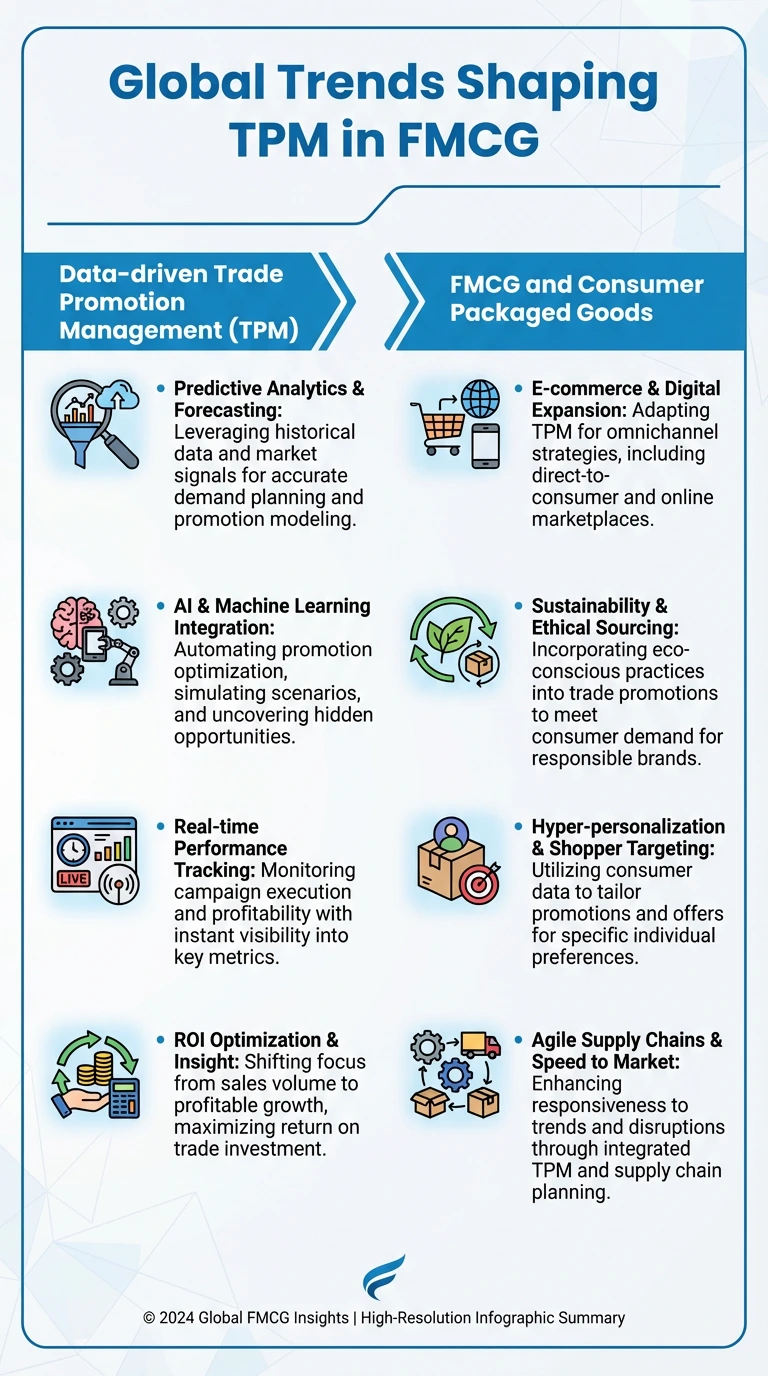
Data-driven Trade Promotion Management (TPM) is replacing manual planning with predictive, analytics-led execution. FMCG and Consumer Packaged Goods (CPG) companies are now using TPM to improve promotion effectiveness, margins, and commercial decision-making at scale.
Promotion Digitization
Brands are shifting from spreadsheets to cloud-based TPM systems, enabling faster planning cycles, standardised guardrails, automated approvals, and consistent cross-market execution, forming the foundation for AI-led workflows.
Real-Time Visibility & Forecasting
Modern TPM platforms integrate Point of Sale (POS), inventory, and demand signals to improve forecast accuracy and react faster to underperforming promotions, reducing leakage and enabling proactive adjustments.
Precision Discounting
Machine learning models optimise promo depth using elasticity, competitor pricing, and shopper behaviour, replacing blanket discounts with margin-protecting, data-backed strategies.
Profitability & ROI Analytics
Automated visibility into gross-to-net and SKU-level profitability helps identify leakage, track ROI in real time, and compress Post-Event Analysis (PEA) from weeks to hours.
Generative AI for Scenario Simulation
TPM is evolving into simulation-led planning, where AI predicts uplift, cannibalisation, and retailer outcomes before promotions go live, enabling smarter commercial decisions.
Growth Signals Driving TPM Adoption
Trade promotions are among the biggest investments for CPGs. Businesses spend nearly 20% of their revenue on promoting goods and services to retailers, amounting to over US$500 billion in spend globally. Predictably, TPM is crucial in driving effective sales strategies.
52% of promotions fail to deliver incremental value, increasing demand for predictive optimisation.
TPM adoption has doubled in three years as CPGs abandon spreadsheets.
Data-led TPM delivers 5–15% ROI uplift and 10–20% forecasting gains.
Integrating TPM With Road-to-Market (RTM) Analytics
Linking Trade Promotion Management (TPM) with Road-to-Market (RTM) analytics aligns promotions, distribution, and in-store execution. This ensures trade spend reflects real shelf performance, not assumptions.
Shelf & POS Visibility
RTM enriches TPM with live sell-in/sell-out data, On-Shelf Availability (OSA) signals, and digital shelf insights. Impact: Early correction of stockouts, non-compliance, and execution gaps—reducing leakage and protecting promotion ROI.
Demand Sensing & Forecasting
Combining TPM and RTM enables Machine Learning (ML)-driven detection of demand shifts, weather/event spikes, mobility trends, and competitor pricing. Outcome: More accurate demand predictions and proactive forecast adjustments during promotions.
Coca-Cola uses predictive On-Shelf Availability (OSA) and promotion-sensing models to adjust replenishment in real time, reducing lost sales during campaigns.
Unilever applies retailer-specific elasticity curves to tailor discounts by region, improving promotion ROI and category growth.
Procter & Gamble (P&G) runs digital twins of promo calendars to test multiple scenarios before execution, cutting planning time and preventing overspend.
Mondelez employs AI-enabled trade spend optimisation to eliminate leakage and redirect funds toward high-yield mechanics, lifting contribution margins.
Nestlé combines TPM with Road-to-Market (RTM) dashboards to identify execution gaps early, improving sell-through velocity and in-store compliance.
Implementing Data-Driven TPM: Roadmap for FMCG Organisations
A successful TPM transformation progresses in structured phases, evolving from fragmented spreadsheets to predictive, autonomous promotion systems.
Foundation Layer: Build the Data & Process Backbone
Priorities
Centralise data in a cloud DWH/lakehouse
Standardise SKU, pack, channel, and retailer hierarchies
Digitise TPM workflows end-to-end
Establish governance rules for promo creation and mechanics
Outcome: A reliable data foundation enabling automation, performance analytics, and scalable system integration.
Advanced Layer: Optimise With AI Engines & Digital Twins
Priorities
Promo optimisation engines that recommend mechanics, depth, and timing
Digital twins that simulate multiple promo scenarios
Autonomous alerts for leakage, overspend, and execution gaps
Closed-loop optimisation tied to real-time sales data
Outcome: A self-optimising TPM ecosystem capable of proactive decisions, Trade promotions optimization, and sustained value and profitability growth across categories and markets.
AI Agents in TPM: The Next Frontier in FMCG Efficiency
AI Agents transform Trade Promotion Management (TPM) by automating planner-led tasks and enabling continuous, analytics-driven optimisation. Acting as intelligent co-pilots, they run workflows, detect anomalies, and recommend profitable actions across the TPM lifecycle.
Role of Autonomous AI Agents
AI Agents execute high-value analytical tasks at machine speed, enabling:
Optimised promotion plans across SKU × retailer × time period
Scenario simulations using historical and real-time data
Early leakage detection and low-yield mechanics alerts
Intelligent alternatives to weak promotions
Execution monitoring aligned to planned mechanics
Result: Higher promotional profitability and reduced manual effort.
Intelligent Work Optimisation
AI Agents drive process automation and data-driven decisions through:
AI-assisted approvals
Automated accrual reconciliation
Alerts for plan–execution mismatches
Retailer compliance checks via POS and shelf inputs
Impact: Faster cycles, fewer errors, and improved in-market accuracy.
Governance Models for AI Agent Deployment
To ensure trust and compliance, organisations must apply:
Human-in-the-loop review
Role-based access controls
Audit trails for AI-driven actions
Bias checks across markets
Leadership takeaway: AI Agents deliver maximum value when supported by strong governance frameworks.
Data Governance Models for TPM Excellence
Without strong governance, even advanced TPM platforms fail. High-performing FMCG organisations anchor TPM success in rigorous master data stewardship, system integration, and disciplined ownership models, ensuring clean inputs for AI and accurate performance analytics.
Ensuring Data Quality & Consistency
Predictive TPM relies on standardised and validated data across brands, regions, and channels.
Core elements:
Unified SKU hierarchy spanning brand, pack, and variant
Standardised retail and channel structures across modern and general trade
POS normalisation models to align formats, units, and tax structures
Automated data validation to eliminate duplicates, gaps, and misaligned promotions
Result: Reliable uplift models, accurate PEA, and cross-market comparability, critical for forecast optimisation and Trade promotions optimisation.
Cross-Functional Ownership
Data-driven TPM succeeds only when responsibility is distributed, not isolated within analytics teams.
Ownership framework:
Function
Accountability
Sales
Promo creation accuracy, retailer terms
Trade Marketing
Mechanical design, calendar integrity
Finance
Accrual governance, reconciliation
Supply Chain
Stock availability and replenishment
IT
Platform reliability, integrations
Analytics/Data Science
Model accuracy and insights
Leadership insight: TPM performance improves when every function owns its data touchpoints, accelerating data-led innovation.
Compliance & Auditability
With promotions impacting financial outcomes, compliance is non-negotiable, especially for large corporations operating across multiple markets.
Core controls:
Global privacy compliance (GDPR and equivalents)
Audit trails for promo creation, modification, and approval
Accrual verification tied to sell-in and sell-out data
Automated validation of claims to prevent overpayment disputes
Outcome: Reduced financial leakage, stronger retailer confidence, and accountability at every stage, fueling sustainable value and profitability growth.
Regional Cost Analysis for Data-Driven TPM Implementations
The cost of implementing data-driven Trade Promotion Management (TPM) varies significantly by region due to differences in labour markets, data readiness, retailer sophistication, and system integration complexity.
North America
Advanced retailer data ecosystems and loyalty infrastructure
High engineering and analytics costs
Impact
Higher implementation and data engineering spend
Faster ROI driven by rich Point of Sale (POS) and real sales data
Cost Range: Medium–High
Europe
Strict privacy standards and multi-country TPM rollouts
Strong omnichannel retail adoption
Impact
Higher governance and compliance costs
Complex integrations due to market fragmentation
Cost Range: Medium–High
APAC
Diverse FMCG maturity and fragmented distribution
Rapid digitisation of retailer portals
Impact
Lower build costs due to affordable talent
Additional spend on data cleansing and standardisation
Cost Range: Low–Medium
Middle East & Africa (MEA)
Limited retailer and POS visibility
Growing modern trade and digital enablement
Impact
Lower platform licensing costs
Higher investment in master data alignment and integration readiness
Cost Range: Low–Medium
How Appwrk Helps FMCG Enterprises Accelerate Data-Driven TPM
Appwrk helps FMCG and Consumer Packaged Goods (CPG) companies deploy AI-enabled Trade Promotion Management (TPM) systems faster and at lower cost, streamlining processes, improving accuracy, and turning promotions into predictable revenue drivers.
CoreAdvantages
AI-led TPM rollout: Predictive uplift, elasticity, and GenAI simulations embedded into workflows
Seamless integration:Connects with ERP, DMS, CRM, and syndicated data for a single source of truth
Global scalability: Cloud-native, secure, and built for multi-market TPM operations
Rapid deployment: Pre-built models and accelerators reduce implementation time
Business Impact
30–40% faster planning cycles
10–20% higher forecasting accuracy
End-to-end digitisation from planning to Post-Event Analysis (PEA)
Improved ROI, contribution margin, and trade spend efficiency
Scaling Trade Promotion Management (TPM) is a commercial growth move—not a tech purchase. Success depends on aligning pricing, promotions, and execution through clean data, AI, and disciplined governance.
CXO Priorities
Link promotions to clear growth levers
Fix data foundations before selecting tools.
Integrate TPM into Revenue Growth Management (RGM)
Team Essentials
Commercial lead drives strategy, Finance owns ROI and leakage, RGM/Analytics manages uplift models, IT ensures data quality, and Change Lead drives adoption.
Insight: Technology speeds TPM; adoption makes it valuable.
Governance
Use a phased roadmap, track ROI and leakage KPIs, review adoption quarterly, and embed TPM metrics into Joint Business Plans (JBPs).
FAQs
1. How is data-driven TPM different from traditional TPM? Traditional TPM is reactive and spreadsheet-based. Data-driven TPM uses POS data, predictive models, and automated PEA to optimise promotion decisions in real time.
2. What data sources matter most? POS, syndicated category data, shopper behaviour insights, supply chain signals, retailer portals, and contextual variables like weather patterns, mobility, and competitor pricing.
3. How long does implementation take? Typically 16–32 weeks, depending on system integration needs and data readiness.
4. Which AI models power predictive TPM? Uplift models, elasticity models, demand forecasting, anomaly detection, and GenAI-based simulation engines.
5. How does TPM integrate with ERP/DMS? Through API pipelines that harmonise SKU, pack, and channel hierarchies across SAP, Oracle, and distributor management systems.
6. What KPIs define promotion effectiveness? Promo ROI, uplift vs baseline, forecast accuracy, leakage, contribution margin, and retailer-level profitability.
7. How does TPM reduce trade spend leakage? By flagging invalid claims, mismatched mechanics, overspend, and low-yield promotions early in the cycle.
8. What is the role of change management? Critical. TPM success hinges on sales and KAM adoption, governance, training, and communication drive real performance.
9. Can smaller FMCG brands adopt data-driven TPM? Yes. Cloud-based solutions and modular AI engines make TPM accessible without enterprise-level budgets.
10. How do TPM tools adapt to retailer-specific rules? Through configurable mechanics, elasticity curves, and retailer-level uplift models that reflect localised consumer behaviour patterns.
Gourav Khanna is the Co-founder and CEO of APPWRK, leading the company’s vision to deliver AI-first, scalable digital solutions for enterprises and high-growth startups. With over 16 years of leadership in technology, he is known for driving digital transformation strategies that connect business ambition with outcome-focused execution across healthcare, retail, logistics, and enterprise operations.
Recognized as a strategic industry voice, Gourav brings deep expertise in product strategy, AI adoption, and platform engineering. Through his insights, he helps decision-makers prioritize market traction, operational efficiency, and long-term ROI while building resilient, user-centric digital systems.
Subscribe to APPWRK Blogs, We'll Do the Rest!
Get Blogs on UI/UX, Mobile Apps, Online Marketing, and Web development technology.
Unlock worthy and priceless suggestions from the masters of mobile and web app development