150+ minds across 4 countries. Join a culture of innovation, ownership & growth.
Rewire for AI
From machine learning to deep learning, from classification tools to overall process automation – our AI engineers will help you retool your existing system or enhance your company results.
Ship faster, scale smarter, built for product companies and SaaS teams
Our Latest Work
We strive hard to deliver result-driven digital solutions across the globe. Check out our case studies to get a glimpse of how we ideate, innovate, and create unconventional digital solutions according to the requirements of our clients.
Discover diverse and passionate insights from our tech enthusiasts. We collaborate across various sectors to streamline operations and drive innovation. Explore our rapidly growing collection of articles to see why we’re at the forefront of IT solutions.
The decision to move from Magento to Shopify is one of the most significant replatforming choices an ecommerce business can make. Magento is powerful, but its power comes with...
Accuracy gap is real: Traditional CPG forecasting carries a 25-40% MAPE error rate. AI-powered models bring that down to 8-15%, according to McKinsey research....
Real stories from global leaders who trusted us with their ideas.
Partnering with APPWRK helped us build a compliant and scalable healthcare platform, accelerating our time-to-market by 35%. Their team consistently delivered outstanding work.
Beesers
Digital Healthcare Client
Collaborating with APPWRK, Sportskeeda modernized its platform into a real-time sports engagement ecosystem, enabling seamless content delivery, scalable fan interactions, and high-velocity performance.
Sportskeeda
Sports & Entertainment Partner
Working with APPWRK was effortless. They captured our vision, maintained full compliance, and delivered a digital experience that built trust and elevated how customers interact with our fintech brand.
PayPenny
Fintech Partner
Working with APPWRK gave us confidence in adopting AI responsibly. Their team built a safe, intelligent bot that transformed how we engage with leads and helped us achieve measurable revenue growth.
IFB
AI Transformation Partner
Leveraging APPWRK’s digital expertise, Nemesis launched a scalable, compliant, and safe super app that connects content delivery, real-time communication, and logistics management within a single platform.
Building fleet management software typically starts at $7,000 for a simple solution, with complex platforms reaching up to $35,000. Final costs depend on features like AI analytics, real-time telematics, regulatory integrations, and platform scalability.
Fleet management software costs span $7,000-$20,000 for simple builds, $15,000-$25,000 for medium complexity, and $20,000-$35,000 for complex, enterprise-grade solutions with modules like GPS tracking, predictive maintenance, AI, and compliance automation.
Custom-built software delivers long-term ROI by aligning with regional mandates and complex operational workflows, offering deeper integration and scalability than off-the-shelf tools.
Critical cost drivers include tech stack, integration scope, compliance layers, and cloud deployment, while modular architecture and open-source tools help lower the total cost of ownership.
Fleet software ROI is driven by predictive diagnostics, route intelligence, and automation, helping reduce downtime, fuel waste, and insurance premiums while improving delivery SLAs.
Strategic early investments in modular architecture, compliance readiness, and smart integrations can reduce future scaling costs by 20-30%.
Cost-efficiency increases when outsourcing development to experienced fleet-tech partners using microservices, scalable stacks, and cloud-native deployments.
Whether you're planning to launch a lean MVP or scale a fully integrated fleet platform across regions, every logistics manager, fleet supervisor, operations head, dispatch coordinator, or digital transformation lead must understand the cost breakdown, development roadmap, and compliance requirements to drive efficiency, ROI, and long-term scalability.
Global Market Overview and Regional Expansion of Fleet Management Software
With the rise in connected vehicles, regulatory pressure, and demand for real-time operational visibility, fleet management software has shifted from a back-office tool to a mission-critical platform. Businesses across logistics, transportation, and mobility sectors are accelerating digital adoption to stay competitive, compliant, and cost-efficient. This section explores the market’s growth trajectory, regional adoption patterns, and the innovation trends shaping fleet software between 2025 and 2030.
Global Fleet Management Software Market
The global market for fleet management software is undergoing a dramatic transformation. Valued at $23.69 billion in 2023, it is projected to surpass $116.56 billion by 2030, growing at a CAGR of 19.8%. The expansion is fueled by the proliferation of connected vehicles, rising logistics automation, and a shift toward data-driven fleet intelligence.
North America leads in adoption, with US-based fleets investing heavily in compliance, real-time visibility, and predictive diagnostics. However, the Asia-Pacific region is emerging as a high-growth frontier. India, Southeast Asia, and China are fast-tracking investments in cloud-based fleet tracking platforms across the E-commerce, logistics, and mobility sectors.
Investors are turning toward custom, API-first fleet software, particularly in B2B segments underserved by legacy solutions. Large-scale adopters are now prioritizing systems that offer interoperability, modularity, and embedded intelligence.
Market Growth and Demand
The shift from static route planning tools to real-time fleet intelligence platforms is fueling massive digital investments. According to the 2025 Fleet Technology Trends Report, 47% of fleets reported achieving positive ROI from GPS fleet tracking within one year, while 53% saw similar returns from asset tracking, both figures marking a notable increase from the previous year.
This rapid payoff is driving deeper adoption of digital fleet solutions across industries.
This surge in demand is being driven by three critical factors:
Urban congestion and ESG pressures are prompting fleets to adopt emissions-tracking systems and dynamic route optimization engines to meet sustainability targets and reduce urban traffic impact.
Driver shortages and stricter safety regulations are accelerating the adoption of AI-powered driver behavior monitoring and fatigue detection systems to improve safety and compliance.
Fuel price volatility and operational cost leakage are making fuel intelligence tools and automation essential for controlling expenses and improving fleet efficiency.
As operating margins narrow, companies are turning to custom-built fleet management software to reduce reliance on outdated SaaS tools and introduce intelligence into decision-making workflows.
Future Trends in Fleet Management Software
By 2030, fleet management software will transform into intelligent, adaptive control hubs that power the future of mobility and logistics. The convergence of IoT, AI, video telematics, and 5G connectivity is no longer optional; it’s reshaping how fleets operate, make decisions, and scale. These technologies are setting the foundation for real-time automation, predictive insights, and data-driven fleet orchestration across industries.
Notable trends shaping the next wave:
Predictive Diagnostics: AI-powered models will proactively identify mechanical issues before failures occur, enabling preventive maintenance and reducing unexpected downtime.
Video Telematics: Advanced dashcams integrated with AI will analyze driver behavior in real time, detecting signs of fatigue, distraction, and risky maneuvers to improve safety and accountability.
Sustainability Engines: Fleet software will embed real-time emissions tracking and benchmarking tools to help organizations meet environmental regulations and corporate ESG goals.
Edge-Cloud Hybrid Architecture: Future-ready platforms will leverage both edge computing and cloud infrastructure to support latency-sensitive decisions in autonomous driving and dynamic dispatch scenarios.
Fleet-as-a-Service (FaaS): Subscription-based models will bundle fleet software, hardware, connectivity, and analytics into a single offering, simplifying adoption and accelerating digital transformation.
Needless to say, companies that invest early in modular architectures and scalable cloud infrastructure will be better positioned to reduce long-term costs, adapt quickly to changing demands, and maintain a competitive operational edge.
What is Fleet Management Software and How Does It Work?
Fleet management software is a digital platform that enables companies to monitor, control, and optimize their vehicle operations in real time. It connects drivers, vehicles, sensors, and dispatch systems into a unified dashboard, enabling tracking, diagnostics, compliance, and fuel optimization across entire fleets.
Developing such software involves building a system that integrates GPS, IoT telematics, mobile interfaces, and cloud-based analytics into a cohesive product. Most platforms are architected using modular microservices, enabling scalability and rapid integration with third-party systems. Businesses often choose custom development to align with specific regulatory, geographic, or operational needs.
How Does Fleet Management Software Work?
At its core, fleet software acts as the central nervous system of a mobile operation. It aggregates and interprets data from vehicles, drivers, IoT sensors, GPS trackers, and backend systems in real time.
A simplified breakdown of how it functions:
Data Ingestion: The fleet management software begins by collecting real-time data from various sources such as telematics devices, vehicle ECUs, fuel sensors, GPS modules, and mobile applications used by drivers.
Data Processing: This raw data is then transmitted to cloud or edge computing systems, where it’s processed to derive actionable insights, analyzing factors like vehicle location, driver behavior, fuel efficiency, and route performance.
Insight Delivery and Automation: The processed insights are delivered through dashboards and control panels, enabling fleet managers and dispatchers to monitor operations, receive alerts, automate tasks, and make informed decisions in real time.
This orchestration enables predictive maintenance, live tracking, fuel efficiency improvements, and regulatory compliance, all through a single interface.
Types of Fleet Management Software and Their Use Cases
Fleet management software comes in multiple configurations, depending on fleet size, industry vertical, geographic scope, and operational maturity. Nowadays, most companies lean toward hybrid models, combining foundational modules with customized capabilities tailored to their regulatory and performance needs.
Here’s a breakdown of key solution types:
Vehicle Tracking Systems Designed primarily for real-time GPS tracking, these solutions offer foundational fleet visibility, geo-fencing capabilities, and basic vehicle health metrics. They are best suited for small to mid-sized fleets seeking location intelligence without the complexity of deep analytics or enterprise-grade workflows.
Fuel and Maintenance Management Platforms Built to optimize operational costs, these platforms track fuel consumption, detect refueling patterns, and automate maintenance schedules. They’re especially useful for fleets in fuel-volatile markets or high-mileage environments where uptime and efficiency are critical.
End-to-End Fleet ERP Solutions Comprehensive and scalable, these systems unify core fleet operations—from dispatching and driver scheduling to compliance management and documentation workflows. Commonly deployed in highly regulated industries like logistics, construction, and transit, they serve as the central operating system for large fleet enterprises.
Custom Telematics Platforms Engineered for specialized industries, these platforms offer deep sensor integration, edge-based data processing, and bespoke reporting. Ideal for fleets in sectors such as mining, agriculture, defense, or aviation, where standard software fails to meet mission-specific requirements or strict SLAs.
As technology evolves, businesses increasingly mix and match these types, prioritizing modularity, compliance, and real-time decision support.
Off-the-Shelf vs. Custom Fleet Management Software: What’s Right for You?
Choosing between off-the-shelf and custom fleet software is a pivotal decision that impacts long-term scalability, compliance, and operational efficiency. While ready-made solutions offer quick deployment and lower initial costs, they often fall short as fleet complexity grows. Businesses with evolving needs may find that limitations in integration, customization, and regulatory alignment create costly bottlenecks over time.
This is where custom fleet software development becomes a strategic investment, enabling tailored workflows, deeper integrations, and long-term cost efficiency.
Here’s a breakdown of how both models compare:
Criteria
Off-the-Shelf Solution
Custom Fleet Management Software
Time to Deploy
Off-the-shelf software can be deployed immediately or within a few weeks.
Custom fleet software typically takes 2 to 9 months to develop, depending on complexity and scope.
Initial Cost
Licensing fees range from $5,000 to $50,000 per year, depending on vendor and feature set.
Custom solutions cost between $7,000 and $35,000 as a one-time development investment.
Feature Flexibility
Features are limited to the vendor’s roadmap and available modules.
Features are fully customizable and tailored to specific business needs and workflows.
Compliance Fit
Most off-the-shelf tools use generic compliance templates that may not support all regions.
Custom software can embed region-specific compliance like ELD, NHVR, or EU driving regulations.
Scalability
Scaling may require purchasing upgrades or migrating to new platforms.
Custom platforms are designed to scale with growing fleet size, complexity, and operational demands.
Integration Capability
Third-party or legacy system integration is often limited or requires workarounds.
Custom-built platforms support deep integration with ERPs, CRMs, fuel cards, and telematics systems.
Ownership & IP
The software is vendor-owned, and users pay for access under a subscription model.
Businesses retain full ownership of the codebase, data, and intellectual property.
Long-Term ROI
ROI is moderate and may plateau as operational needs outgrow system capabilities.
ROI is significantly higher for regulated, growing, or complex fleets due to efficiency and control.
For fleet operators with regulated environments, regional fleets, or custom workflows, the long-term ROI of a custom solution often outweighs the upfront investment, particularly when designed with modular architecture and scalable infrastructure.
Understanding Fleet Management Software Development Cost
Let’s face it, the true cost of fleet management software goes far beyond the initial development quote. From infrastructure and compliance to integrations and regional labor rates, every decision impacts your total spend. Whether you’re launching an MVP or scaling to a full enterprise platform, this section breaks down the cost layers that matter, so you can budget smartly and invest strategically.
Custom Fleet Management Software Development Cost
Custom-built fleet platforms typically start at $7,000 for a basic MVP and can scale up to $35,000 for complex solutions, offering a high-ROI alternative in the build vs buy decision. A lean MVP may include features like GPS tracking, a dispatcher dashboard, and driver mobile apps. However, incorporating advanced automation, compliance workflows, and predictive AI capabilities can increase both the development scope and overall budget.
The strategic tradeoff lies in long-term ROI. Custom builds may require higher upfront investment, but they remove license lock-ins, ensure vendor independence, and unlock opportunities for vertical-specific innovation.
Comparing Fleet Management Software Costs by Type
Software Type
Scope
Estimated Cost to Develop Fleet Management Software
GPS Tracking Software
Includes real-time vehicle location tracking, trip history, and basic alert notifications.
Uses sensor data for diagnostics, fault code analysis, and proactive downtime alerts.
$15,000 to $22,000
Custom Telematics Platform
Offers full-stack telematics with IoT sensor integration, dispatch automation, and compliance tools.
$20,000 to $30,000
Fleet ERP (Enterprise)
Integrates dispatching, compliance workflows, HR modules, and accounting systems.
$25,000 to $35,000
Costs vary by region, vendor capability, tech stack (e.g., native vs. hybrid), and deployment model, especially when accounting for EV and charging infrastructure management needs. Real-time data processing, AI integration, and modular scalability add the most to the overall budget.
Cost Breakdown for Fleet Management Software
A phased view of cost helps decision-makers scope their budgets according to feature priorities and deployment readiness.
Phase
Inclusions
Cost Range to Develop Fleet Management Software
MVP Development
Basic GPS tracking, driver mobile apps, dispatch panel, and cloud backend infrastructure.
$7,000 to $12,000
Mid-Tier Solution
Adds features like fuel monitoring, analytics dashboards, and driver behavior scoring modules.
$12,000 to $20,000
Enterprise Platform
Includes AI/ML integration, predictive maintenance, multi-region compliance, and ERP connectivity.
$20,000 to $35,000
Post-Launch Maintenance
Covers bug fixes, security patches, feature updates, and performance optimization.
$500 to $2,000/month
Infrastructure (Cloud/On-Prem)
Hosting services, autoscaling, uptime guarantees, and regular backups.
$200 to $1,000/month (cloud-based)
Per-Vehicle Fleet Software Pricing:
In addition to the total development cost, many businesses assess the cost per vehicle to simplify budgeting. SaaS-based fleet solutions typically range from $10 to $30 per vehicle per month, depending on included features and vendor pricing. For custom-built platforms, the equivalent per-vehicle cost often starts at $5 to $10 per vehicle per month (post-deployment), especially when the initial build cost is amortized over 2+ years and larger fleets are involved.
Regional Cost Comparison for Fleet Software Development
Regional labor rates, compliance-driven fleet tech requirements, and infrastructure norms can dramatically affect costs. Here’s how pricing typically varies:
USA
Development Cost: $80 to $120/hour
Typical Project Budget: $25,000 to $35,000
Insight: Costs are higher due to premium labor rates and complex regulatory requirements such as ELD and FMCSA compliance.
Australia
Development Cost: $60 to $100/hour
Typical Project Budget: $20,000 to $30,000
Insight: Projects often emphasize NHVR compliance, fatigue management, and long-haul telematics due to geographic and legal conditions.
UK
Development Cost: $70 to $110/hour
Typical Project Budget: $22,000 to $32,000
Insight: Fleet software in the UK focuses heavily on video telematics, DVSA compliance, and emissions tracking to meet policy mandates.
Europe
Development Cost: $40 to $90/hour (varies across regions)
Typical Project Budget: $15,000 to $30,000
Insight: Western Europe projects often cost more due to GDPR compliance and sustainability requirements, while Eastern Europe offers high-quality development at more affordable rates.
Factors Affecting the Cost of Fleet Management Software Development
The cost of building fleet management software isn’t one-size-fits-all. It’s shaped by a range of factors, especially as operations grow in size, complexity, or geographic reach. From technical architecture to regulatory demands, understanding these cost drivers is critical for accurate budgeting and long-term planning. Here are the key elements that influence overall development costs
Fleet Size & Vehicle Types: Managing larger fleets or a mix of vehicle types (e.g., cargo vans, EVs, heavy-duty trucks) increases routing complexity and data processing needs, which drives up development time and cost.
Feature Complexity: In addition to the fleet size and the types of vehicles being managed, adding advanced features like AI-driven predictive maintenance, in-cabin video telematics, or multi-tenant dashboards significantly raises both backend complexity and UI/UX requirements.
Integration Scope: Connecting the platform with ERPs, CRMs, fuel card providers, and custom telematics hardware introduces additional engineering overhead and longer testing cycles.
Deployment Model: Cloud-native solutions are more cost-effective to deploy and maintain compared to on-premise systems, which require higher upfront infrastructure investment and ongoing IT support.
Regulatory Compliance: Incorporating mandates such as GDPR (EU), FMCSA and ELD (US), or NHVR (Australia) impacts system logic, data storage, and security features, increasing the overall development effort.
Development Region: Hourly development costs vary significantly based on geography.
USA & Western Europe: $60 to $90/hour
Eastern Europe & Latin America: $40 to $70/hour
India & Southeast Asia: $20 to $40/hour Outsourcing to experienced teams in cost-effective regions (like India or Eastern Europe) can reduce total build cost by up to 40–60% without sacrificing quality.
Key Features That Increase Fleet Management Software Development Cost
It goes without saying that the cost to build fleet management software scales directly with the complexity, depth, and integration level of its features. While basic platforms provide visibility and tracking, the 2025 market demands intelligent, data-driven systems with predictive, compliant, and user-centric capabilities.
Feature selection remains the single most decisive factor in software budgeting. From MVP-level basics to enterprise-grade intelligence, each tier introduces unique architectural demands, testing frameworks, and integration challenges. This section breaks down the core functionalities that influence cost the most, and explains why advanced modules significantly impact development scope and budget.
These are minimum viable product (MVP) features that provide basic operational visibility and control with moderate technical complexity.
Real-Time GPS Tracking
Implementing live location tracking involves integrating GPS hardware and telematics APIs, which increases both development time and infrastructure needs.
Driver Mobile Application
Creating a mobile app for drivers introduces added front-end development and multi-platform support (iOS, Android), increasing design and testing costs.
Basic Alert System
Implementing real-time alerts for events like speeding, idling, and maintenance requires custom backend logic, rule-based triggers, and continuous data monitoring. While not as complex as AI-driven features, this adds a moderate layer of complexity to the system’s architecture and processing workload.
Admin Dashboard for Fleet Oversight
Developing a dashboard that supports asset monitoring, data filtering, and report downloads increases UI/UX design effort and raises backend development costs.
These features enable data-driven decisions and automation, raising costs due to increased API dependencies, processing logic, and testing cycles.
Dynamic Route Optimization Engine
Suggesting fuel- and time-efficient routes in real time demands integration with mapping APIs and route algorithms, significantly increasing backend complexity.
Driver Behavior Monitoring System
This module requires detailed telematics data processing and behavioral scoring models, which raises cost due to analytics integration and QA load.
Automated Fuel Log Integration
Syncing fuel card data with telematics sensors demands third-party API integration and anomaly detection logic, adding both development time and cost.
Geo-Fencing & Smart Dispatch Triggers
Setting up location-based task automation involves spatial data processing and trigger logic, which increases both dev effort and testing cycles.
These features support regulatory compliance, technician management, and enterprise-wide intelligence, requiring robust architecture and specialized engineering.
Predictive Maintenance Framework
Using machine learning to anticipate failures requires historical data modeling and continuous monitoring, which adds to both development and infrastructure costs.
Multi-Region Compliance Toolkit
Supporting ELD (US), DVSA (UK), and NHVR (AU) regulations demands extensive legal mapping, region-specific workflows, and testing, substantially increasing complexity.
Advanced Analytics & Reporting Dashboards
Building dashboards with anomaly detection, KPI customization, and role-based visibility requires deep backend logic and UI frameworks, elevating dev cost.
Role-Based Access Control (RBAC)
Implementing differentiated user roles with secure permissions increases architectural complexity and introduces additional security validation work.
These features are tailored to unique operational environments and involve cutting-edge technologies, which drive up both build and maintenance costs.
IoT Integration for Industry-Specific Sensors
Custom sensor data (e.g., humidity, pressure, lift) requires low-level integrations and data normalization, increasing both hardware and software coordination costs.
Blockchain-Based Maintenance Ledger
Building a tamper-proof maintenance log using blockchain requires specialized development and cryptographic protocols, adding to backend complexity.
Edge-Based Video Telematics AI
Real-time AI analysis of in-cabin video streams demands edge computing power, model training, and high-speed processing, significantly raising costs.
Custom API Layer for Legacy System Integration
Syncing fleet software with ERP, CRM, or insurance systems requires custom middleware, authentication, and data mapping—dramatically increasing integration effort and testing.
Must-Have Fleet Management Features
In today’s fast-moving and regulation-heavy fleet environment, software must do more than just track vehicles. Enterprise buyers expect a core set of features that ensure safety, efficiency, and compliance from day one. These essential capabilities often come with complex engineering demands and are major contributors to overall development cost.
Live Fleet Monitoring and Tracking
This feature provides centralized, real-time visibility of all vehicles and assets on an interactive map. It typically includes ETA predictions, trip playback, and event flagging. As a foundational module, it generally accounts for 10 to 15 percent of the total base development cost.
GPS Vehicle Tracking
GPS tracking is a core component of fleet software, providing real-time visibility of vehicle locations. It uses satellite positioning with cellular fallback to ensure reliable coverage across all routes. Typically integrated with telematics and driver apps, it supports efficient routing and continuous asset monitoring.
Fuel Management
Fuel management systems integrate with tank-level sensors, fuel card APIs, and real-time consumption analytics. They are essential for fleets operating in high fuel-cost environments or across long-haul and multi-region routes.
Route Optimization
Using real-time traffic data, delivery schedules, and vehicle specifications, this feature automatically generates the most efficient routes. It is especially critical for logistics, last-mile delivery, and urban mobility fleets aiming to reduce travel time and fuel consumption.
Driver Behavior Monitoring
AI-powered analytics track unsafe driving behaviors such as harsh braking, speeding, aggressive cornering, and driver distraction. These insights are typically linked to driver training and coaching modules, insurance scoring models, and safety compliance protocols.
Telematics Integration
This module enables direct connectivity with onboard systems via OBD-II ports, CAN bus, or proprietary telematics hardware. It supports advanced diagnostics, real-time fault detection, maintenance scheduling, and insurance claim validation.
Mobile App for Drivers
The driver app allows users to manage tasks, receive turn-by-turn navigation, log trips, and complete digital compliance forms. It must be lightweight, support offline mode, and offer multi-language functionality to accommodate diverse workforce needs.
Feature Impact vs Cost Contribution Table
Understanding how each feature impacts both functionality and development cost is key to making informed decisions during the planning phase. The table below maps core features against their cost contribution, helping you prioritize based on business value and technical complexity.
Feature Set
Functionality
Complexity Level
Estimated Cost Impact on Fleet Management Software Development(USD)
Best Suited For
GPS Tracking
Real-time location tracking, trip history, and alerts
Low
$1,500 to $3,500
All fleet types (MVP to enterprise)
Driver Mobile App
Trip logging, route instructions, and driver communication
Medium
$2,000 to $4,500
Delivery, logistics, leasing fleets
Route Optimization
Dynamic route planning based on traffic, delivery windows, and time constraints
High
$3,000 to $6,000
Urban mobility, logistics, last-mile delivery
Driver Behavior Scoring
AI-powered scoring for harsh driving, fatigue, and speeding events
High
$3,500 to $6,500
Long-haul and compliance-focused operations
Fuel Management
Fuel card syncing, tank sensor data, anomaly detection
Medium
$2,500 to $5,000
Intercity, long-haul, and mixed vehicle fleets
Predictive Maintenance
Fault code tracking, sensor-driven diagnostics, and proactive servicing alerts
Centralized fleet control, asset monitoring, analytics, and reporting
Medium
$2,000 to $4,000
All types of fleet operations
Telematics Integration
OBD-II, CAN bus, IoT sensor sync for diagnostics and real-time data processing
Very High
$5,000 to $8,000
High-value or sensor-intensive fleets
What are the Hidden Fleet Management Software Costs That Most Companies Miss in Planning?
While upfront development estimates often focus on features and integrations, hidden costs can significantly impact total ownership over time. These costs aren’t always visible during planning but surface during deployment, scaling, and compliance updates. Ignoring them risks budget overruns, delays, and security liabilities, especially in regulated industries.
Security and Compliance
With increasing volumes of real-time vehicle and driver data being collected, security and compliance have become critical pillars of fleet management software. Protecting sensitive information and meeting regional regulations is essential to maintain trust, avoid penalties, and ensure smooth, scalable operations.
Encryption protocols, secure data transmission, user access control, and GDPR/CCPA compliance are standard. In markets like the US, ELD mandates and driver data privacy frameworks demand secure auditing. Failing to architect security upfront can lead to re-engineering costs, data breaches, and compliance penalties.
Hidden Cost Impact: 5-15% of total dev budget if implemented late vs early-stage design.
Maintenance
Even though all software requires ongoing maintenance, fleet management platforms face a uniquely dynamic environment. Shifting routes, evolving regulations, changing APIs, and diverse vehicle technologies demand continuous updates to ensure optimal performance, compliance, and scalability.
Ongoing maintenance costs typically include:
Feature updates (e.g., new compliance modules or route logic)
Bug fixes and patch releases
Server/infrastructure upgrades
Customer support tools and integrations
Annual maintenance costs generally sit at 15-20% of the initial build cost, and must be forecasted into total project ROI.
System Downtime and Disruptions
Downtime in fleet software leads to operational delays, safety risks, and, in regulated markets, fines.
Real-time tracking apps must maintain >99.9% uptime, especially if used for dispatch or compliance submissions. Yet cloud costs, poor architecture, or bandwidth-heavy modules (e.g., live video telematics) can introduce bottlenecks.
Planning for autoscaling infrastructure, edge computing in latency-sensitive modules, and disaster recovery protocols adds to the initial development cost but helps avoid unpredictable expenses and operational disruptions in the long run.
Feature FOMO: How Fancy Do You Really Need to Go?
A major cost inflator is overbuilding for features that don’t serve operational priorities. From blockchain logs to AI-generated dispatch schedules, many additions drive up costs without matching business returns.
We see it often: a fleet startup overspends on high-end analytics without the operational scale to benefit from it. Or a logistics firm demands a custom IoT layer where off-the-shelf sensors would suffice.
A clear product roadmap tied to operational ROI keeps development focused, and costs contained.
Compliance and Regulatory Support
Global fleets face constantly shifting mandates: ELD, DVSA, NHVR, EU Tachograph, GDPR, carbon reporting, etc.
Retrofitting compliance into a built system is expensive, especially when regulations span:
Data localization and retention laws
Device or vehicle logging requirements
Consent and access controls
Custom software must be designed from day one with cross-border or multi-state compliance agility in mind. In markets like the EU and Canada, failing to meet this demand can result in outright legal disqualification from operating.
Fleet Management Software Development Stages: Design to Deployment
Building custom fleet management software is not just about writing code; it’s a strategic, phased effort involving stakeholder alignment, technical architecture, design thinking, agile execution, and long-term scaling. This section walks you through each step of the process, offering visibility into what happens behind the scenes and what affects the timeline, quality, and cost.
UI/UX Design
While design is often seen as cosmetic, it plays a vital functional role in fleet software. Drivers, dispatchers, and administrators rely on intuitive interfaces to perform daily tasks, and poor usability can lead to frustration, errors, and reduced productivity.
Route clarity, alert visibility, and interaction simplicity for drivers.
Dashboard control, drill-down views, and reporting flow for managers.
Accessibility across devices, languages, and conditions (e.g., night driving, low bandwidth).
Fleet platforms with poor UX often face adoption failure, requiring expensive redesigns post-launch.
Development Platform
Choosing the right development platform (native, cross-platform, PWA, hybrid) affects cost, performance, and maintenance.
Native iOS and Android apps provide better offline access and smoother performance, making them the preferred choice for driver-facing applications.
Web dashboards (Angular, React, Vue) enable real-time updates and scalability.
Cross-platform tools (Flutter, React Native) can cut mobile dev time, but may trade off deep native integrations.
Platform selection also impacts compliance, integration velocity, and feature readiness.
Development Process
Most custom fleet platforms follow agile sprints or hybrid waterfall-agile structures, depending on the project’s complexity. A typical development process includes:
Defining the product scope, including core features, user roles, and technical requirements.
Designing the system architecture while planning for regulatory compliance and data security.
Building features in iterative sprints with continuous stakeholder feedback and adjustments.
Conducting internal QA and preparing the platform in a staging environment for validation.
Deploying a pilot version to a limited group of users for live testing and feedback.
Rolling out the production version with post-launch support and performance monitoring.
Every deviation from this process, such as unclear requirements or mid-project scope changes, increases timelines and adds to the overall development cost.
Wireframe Development
Wireframes serve as the blueprint where interface design and system logic come together. In custom fleet systems, they go far beyond visual layout and play a critical role in defining:
Data flow between driver, vehicle, and admin.
Map behavior and analytics presentation.
Placement of alerts, reporting structures, and overall navigation logic.
They’re essential for aligning stakeholders and preventing scope creep before writing code.
Feature Integration
Integration complexity largely depends on the number and type of modules being incorporated, such as GPS, telematics, maintenance, analytics, mobile apps, and cloud backend systems. Common integrations include GPS hardware APIs, fuel card and ERP connectors, ELD and compliance engines, real-time video or sensor inputs, and billing, CRM, or third-party logistics applications.
Each additional integration adds layers of complexity, increasing the testing workload, potential latency risks, and debugging cycles, which directly drives up development and maintenance costs.
Quality Assurance
QA in fleet platforms extends beyond bug-hunting. It includes:
Real-time data testing under simulated load.
Mobile usability across network conditions.
Compliance logic verification.
Integration tests for GPS, fuel sensors, etc.
Fleet platforms that skip rigorous QA often experience costly field failures, especially in safety-critical workflows.
Developer’s Geographic Location
Developer geography plays a critical role in shaping your project’s hourly rates, delivery speed, and communication effectiveness. Here’s how different regions compare:
North America ($60 to $90/hour): Offers high-end engineering expertise, fast turnaround times, and strong alignment with U.S. regulatory standards like FMCSA and ELD. However, it remains one of the more expensive regions for development, best suited for projects with strict compliance and performance demands.
Western Europe ($50 to $80/hour): Known for quality in regulated sectors such as logistics, public transport, and sustainability-focused builds. Teams are well-versed in GDPR, DVSA, and EU compliance, though hourly rates remain moderate to high depending on the country.
Eastern Europe ($30 to $60/hour): Strikes a strong balance between affordability and technical capability. Popular for scalable, custom fleet software builds, thanks to mature engineering talent, English fluency, and flexible delivery models.
India & Southeast Asia ($20 to $40/hour): The most cost-effective region for developing MVPs, backend infrastructure, and modular systems. Ideal for budget-conscious builds, though success depends on detailed specifications and strong product management oversight.
Team Size
Building custom fleet software requires a multidisciplinary team with expertise across product, engineering, and infrastructure. A typical team composition includes:
1 to 2 product managers or solution architects
2 to 4 backend and frontend developers
1 to 2 mobile app developers
1 quality assurance (QA) specialist
1 DevOps engineer or cloud architect
1 UI/UX designer
1 to 2 integration engineers for APIs and hardware connectivity
While smaller teams can lower upfront costs, they often extend timelines and increase the risk of delivery bottlenecks or technical debt.
Modular Architecture to Promote Flexibility
To reduce long-term technical debt, most fleet platforms are built using modular microservices.
Benefits:
Faster updates without system downtime.
Easier scaling of individual features (e.g., routing, analytics).
Secure, isolated deployment per module (useful for multi-tenant platforms).
Initial architecture design adds 10-20% to dev cost but saves exponentially during scaling and iteration.
Required Technology Stack and Tools
The tech stack influences performance, security, hiring, and scalability. Popular stack choices:
Frontend: React, Angular (admin); Flutter, and Kotlin/Swift (mobile)
Cloud: AWS, Azure, or GCP (with real-time data pipelines using Kafka or MQTT)
DB/Storage: PostgreSQL, MongoDB, and InfluxDB (for time-series)
DevOps: Docker, Kubernetes, CI/CD pipelines, and Infrastructure-as-Code tools
Each stack decision shapes both feature velocity and cost containment.
Post-Launch Support and Maintenance Strategy
Deployment is just the beginning. To ensure long-term stability, security, and scalability, custom fleet software requires a proactive support and maintenance plan that evolves with operational needs and technology changes. A robust post-launch strategy typically includes:
Tiered incident response (SLA-based fixes)
Monthly or quarterly feature roadmap execution
Security patching and compliance updates
Cloud cost monitoring and optimization
Support contracts usually cost 15-20% of annual platform value, and are crucial for regulated fleets with uptime mandates.
Ways to Lower Fleet Management Software Development Costs Without Losing Quality
Developing a fleet management platform doesn’t have to break your budget. While enterprise-grade platforms can reach six-figure builds, strategic decision-making during scoping, architecture, and resource allocation can reduce total cost by 20-40%. This section explores proven tactics for building efficiently without compromising reliability or compliance.
Start Small: The MVP Mindset
Instead of building everything at once, successful fleet platforms start with an MVP (Minimum Viable Product) focused on critical use cases: GPS tracking, a driver app, and dispatch visibility.
This allows for:
Real-world feedback loops before heavy investment.
Faster time-to-market and early ROI.
Future features to be shaped by actual user behavior.
Cost Range: MVP builds typically fall between $7,000 and $12,000, depending on scope and platform (web + mobile).
Outsourcing vs. In-House Teams
Choosing between in-house development and outsourcing has a major impact on cost, speed, and scalability. While in-house teams offer greater control and alignment, they also come with higher overhead from salaries, benefits, and infrastructure. Outsourcing to experienced partners, particularly in cost-effective regions like Eastern Europe, India, or Southeast Asia, can reduce total development costs by 30 to 50 percent without compromising quality.
Best practice: outsource development, but retain in-house product management for domain alignment and roadmap continuity.
Open-Source Technologies
Adopting vetted open-source libraries and frameworks for mapping, telemetry, notifications, and mobile frameworks can save tens of thousands.
Common cost-saving choices include:
Mapbox or OpenStreetMap over commercial mapping stacks.
Node.js, Django, or Spring Boot for backend infrastructure.
Grafana or Superset for analytics dashboards.
MQTT/Kafka for real-time data streams.
The key is ensuring license compliance and scalability.
Cloud vs. On-Premise
Cloud-native architecture, especially on AWS, GCP, or Azure, removes the need for server procurement, infrastructure management, and redundant failover design.
While on-premise might be required in defense or banking sectors, cloud deployments:
Scale automatically with fleet size.
Reduce upfront CAPEX.
Lower DevOps staffing requirements.
Typical monthly cost: $200 to $1,000 (cloud), versus $20,000+ in upfront spend for an on-premise setup.
Predictive Analytics
Predictive features like maintenance forecasting and risk scoring hold enormous value but require clean, structured data to work effectively. Jumping into AI too early, before the platform has matured and data quality is stable, can lead to inflated costs, unreliable outputs, and wasted development effort.
Instead, focus first on data collection pipelines and telemetry integrity. Then incrementally layer analytics modules using pre-trained models or open-source ML frameworks like TensorFlow or Prophet.
Smart Driver Behavior Monitoring
Developing AI-driven driver behavior systems doesn’t always require starting from scratch. Instead, platforms can accelerate development and reduce costs by leveraging:
Prebuilt behavior models from fleet SDKs
Mobile sensor fusion (accelerometer + GPS + camera)
These significantly lower AI model dev costs while still offering fleet managers usable behavior scores for training and risk mitigation.
Fleet Management Software Integrations and Scaling Strategies
Integrations and scalability are two of the most critical factors influencing the cost and long-term success of fleet management software. Modern platforms must connect with third-party systems, hardware devices, and evolving tech stacks while scaling smoothly to handle more vehicles, users, and complex operations. This section explains the key integration types and scaling enablers that directly affect performance, reliability, and budget.
Integration with Existing Systems
Custom fleet platforms often need to interface with:
ERPs for invoicing, HR, or inventory
CRMs to sync client deliveries or service routes
Fuel card providers to monitor expenses
Compliance systems (ELD, DVIR, Tachograph)
Robust integration architecture includes secure APIs, data mapping tools, and event-driven communication protocols like webhooks or Kafka. Integration complexity depends on legacy system accessibility and documentation quality.
Tip: Always plan your integration architecture early in the development process. Retrofitting integrations after the platform is built can cost up to three times more and introduce avoidable delays and complexity.
Automated Fuel Management
Fuel spend often accounts for 30-40% of fleet OPEX. Automated fuel management modules integrate:
Tank sensors or GPS-based usage estimates.
Fuel card transactions and telematics events.
Alerts for theft, inefficiency, automated toll processing, or abnormal consumption.
Scalable systems must handle real-time data ingestion, normalization, and comparison across regions, especially in mixed-vehicle fleets (ICE + EV).
Sensor connectivity to vehicle diagnostics (OBD-II, CAN bus).
Data models trained on usage patterns and fault history.
Triggers for parts replacement or service scheduling.
Scalability comes from modular data pipelines and cloud-based ML inference. For global fleets, the model must be fleet-specific, not generic.
This feature can reduce unscheduled downtime by 25-35%, but only when scaled with clean data and fleet variance accounted for.
Video Telematics
Video telematics provides powerful insights into driver behavior, road conditions, and safety events, but it also introduces significant challenges in data storage, bandwidth, and system scalability. Proper planning is essential to harness its value without overwhelming your infrastructure.
Real-time or edge-processed video integration involves:
Dashcams or ADAS devices connected to the platform.
On-device AI for object/behavior detection.
Cloud sync with footage tagging and retention policies.
High-volume video systems require scalable cloud storage, edge computing nodes, and compression logic. Licensing or integration with providers like Samsara, KeepTruckin, or Surfsight is often more cost-effective than building from scratch.
Telematics and IoT Sensors
A truly scalable fleet system must support multiple device types and data protocols, including:
J1939, CAN bus, Bluetooth, Zigbee, MQTT, and HTTP/REST
Temperature, pressure, humidity, motion, and asset locks
Fleet controllers, driver ID badges, and RFID scanners
IoT middleware or brokers allow devices to communicate with backend systems, normalize formats, and maintain security, making the platform hardware-agnostic and future-proof.
Real-Time Data Streaming and Sync
Scalability in fleet management software goes beyond supporting more users. It’s about ensuring consistent, real-time data flow across vehicles, devices, and systems without delays, bottlenecks, or data loss.
Low-latency data sync across drivers, dispatchers, and regions
Stream processing for alerts, location updates, and fuel metrics
Replayability for auditing, compliance, and forensic reporting
Tools like Apache Kafka, AWS Kinesis, or Google Pub/Sub support streaming architectures. They ensure fleet platforms stay responsive, even as concurrency spikes across time zones and mobile nodes.
Key Business Benefits of Fleet Management Software
Fleet management software delivers value far beyond basic vehicle tracking. From cost savings to customer satisfaction, a well-built platform enhances operational performance across the board. Here are the core business benefits companies can expect:
Cost Reduction
Automatically log fuel usage, identify idle time, prevent route inefficiencies, and reduce unnecessary overtime through intelligent automation.
Compliance Assurance
Maintain audit readiness with integrated ELD, DVIR, emissions tracking, and digital incident reporting to meet regulatory standards across regions.
Driver Accountability
Monitor driving behavior in real time, automate feedback loops and coaching, and reduce accidents through data-backed performance insights.
Operational Agility
Respond quickly to route changes, weather disruptions, or delivery exceptions with real-time visibility and adaptive scheduling tools.
Customer Experience
Provide accurate ETAs, transparent delivery updates, and faster resolution of service delays to boost customer trust and satisfaction.
Return on Investment for Fleet Digitization
Investment in a custom fleet platform typically pays back in 12-18 months, depending on fleet size and operating region.
Key ROI factors:
Fuel Savings: 10-25% reduction via optimized routes and consumption tracking.
Downtime Reduction: Up to 35% fewer maintenance-related halts with predictive diagnostics.
Insurance Premium Reduction: Safer driving behavior and telematics documentation.
Compliance Avoidance: Prevent $5,000-$10,000 in fines annually with audit-ready logs.
When fleet digitization is aligned with strategic performance goals, the platform evolves from a cost center into a powerful driver of profitability, efficiency, and long-term growth.
Enhanced Operational Visibility and Efficiency
Without digital tools, dispatchers operate in the dark. With fleet software:
Dispatchers monitor live routes, delays, and asset utilization in real time.
Managers compare regional, driver, and vehicle performance through analytics dashboards.
Finance teams trace operating costs and manage expense management workflows tied to specific behaviors, vehicles, or routes.
This creates an ecosystem where decisions are data-driven, not anecdotal, unlocking compounding efficiency over time.
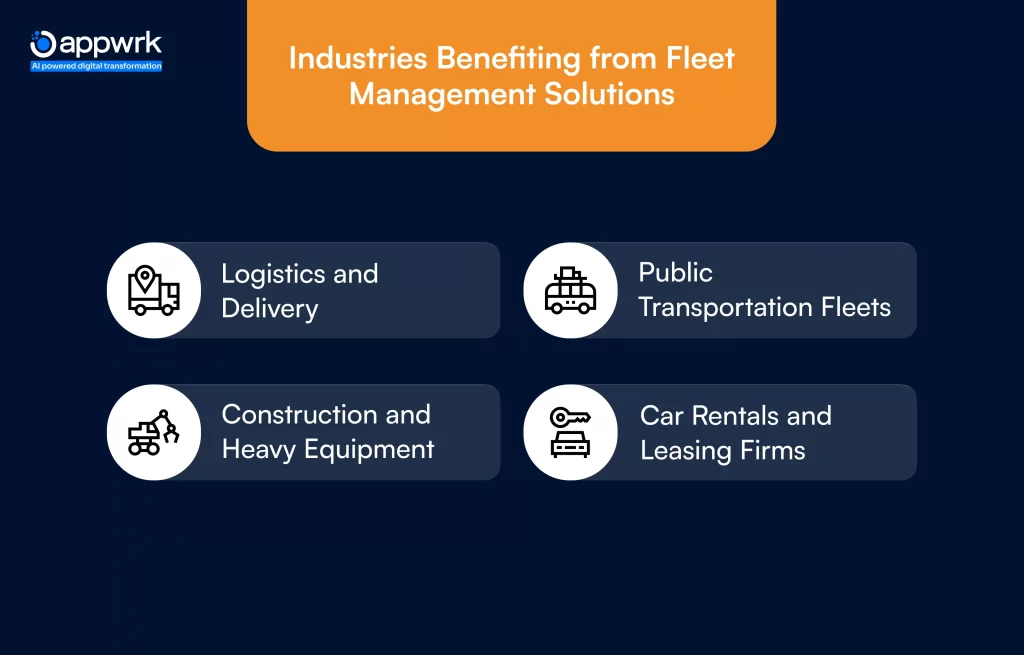
Industries Benefiting from Fleet Management Solutions
Fleet management software is no longer confined to logistics. Today, industries with complex asset movement, regulatory compliance, or remote dispatch requirements all benefit from digital fleet orchestration. This section explores how key sectors leverage fleet platforms to cut costs, improve performance, and unlock strategic growth.
Logistics and Delivery
Logistics continues to be the leading industry driving demand for fleet management software, relying on real-time visibility, route optimization, and automation to streamline deliveries and reduce operational costs.
Key use cases:
Route optimization for same-day and last-mile delivery.
Real-time tracking for customers and support teams.
Delivery proof systems (photos, signatures, time-stamps).
Driver performance tracking across high-frequency deliveries.
In fast-moving supply chains, fleet software drives both operational control and customer trust.
Construction and Heavy Equipment
Construction fleets manage high-value, off-road assets such as cranes, excavators, generators, and heavy-duty trucks. These operations require specialized tracking, maintenance scheduling, and compliance monitoring to maximize equipment uptime and ensure site safety.
Fleet platforms in this space provide:
Asset tracking, parts inventory management, and utilization monitoring across dispersed job sites.
Geofencing for unauthorized movement alerts.
Maintenance automation based on usage hours rather than mileage.
Integration with project timelines to align equipment availability with construction phases.
It transforms scattered operations into a synchronized ecosystem.
Public Transportation Fleets
Public transportation fleets depend on fleet management software to ensure on-time performance, passenger safety, and operational efficiency. These systems also play a critical role in managing regulatory compliance, vehicle health, base location configuration, and route optimization at scale.
Core features include:
Live ETA boards and mobile alerts for passengers.
Vehicle health diagnostics to prevent mid-route breakdowns.
Automated scheduling and dispatching.
Government reporting modules (e.g., fare collection logs, service hour tracking).
Fleet digitization here ensures safety, punctuality, and transparency, especially in regulated urban networks.
Car Rentals and Leasing Firms
Fleet management software is becoming essential for car rental and leasing companies, where success depends on efficient asset utilization, real-time tracking, and streamlined customer handoffs. These platforms help manage inventory, monitor vehicle health, and optimize turnaround times across locations.
Real-World Fleet Management Software Use Cases with Measurable ROI
Beyond features and industries, real-world use cases show how fleet management software delivers measurable outcomes. From logistics to construction, these examples illustrate how platforms improve uptime, compliance, and cost-efficiency. This section blends practical implementations with platform strategy, including live case studies of value delivery.
Real-Time Tracking in Delivery Logistics
A regional courier service digitized its dispatch and added real-time GPS tracking across 60+ vehicles. The result:
35% improvement in ETA accuracy.
22% reduction in driver call-ins.
Integration with SMS/email alerts improved customer satisfaction.
The platform also synced with backend inventory systems for real-time package status updates.
Predictive Maintenance for Trucking Fleets
A long-haul logistics company implemented a custom predictive maintenance module integrated with its telematics system. The platform analyzed engine run-time, fault codes, and temperature fluctuations to automatically flag service needs before breakdowns occurred.
Impact:
Reduced unexpected vehicle breakdowns by 40%.
Saved approximately $20,000-$25,000 annually by avoiding service disruptions and emergency repairs.
Transitioned from reactive maintenance to predictive servicing, improving fleet uptime and driver safety.
Route Optimization for Urban Transport Fleets
A metro-based school transport service implemented dynamic route optimization based on traffic patterns and student addresses. The system recalculated every morning based on real-time traffic feeds and attendance data.
An intercity delivery fleet integrated fuel card APIs and tank sensors to detect anomalies in usage and refueling behavior.
Outcomes included:
Detection of fuel theft across two regions.
Monthly fuel cost reduction of 18%.
Cross-referencing of GPS and fuel data for forensic accountability.
Compliance Management in Public Transit Systems
A municipal transit agency used a custom-built compliance module to handle:
Daily DVIR reports.
Automated log submissions for inspections.
Rule-set-based alerts for driver hours (HOS compliance).
This digitization helped the agency avoid over $100,000 in fines across two years, while enabling smooth government audits.
Equipment Tracking in Construction Fleets
A national construction firm deployed fleet software to manage non-road assets: excavators, trailers, and pumps.
Key features:
Geofencing per site.
Usage-based maintenance logging.
Idle time reports to reallocate underused equipment.
They increased overall asset utilization by 22% within the first 4 months.
APPWRK’s Real-Time Resource Tracking Case Study
To support digital transformation in a high-mobility services environment, APPWRK partnered with a Singapore-based company launching HalfShell Services. The goal was to improve operational visibility and decision-making through real-time resource tracking.
Challenge: The company lacked a centralized platform to track resources in real time and extract location-based operational insights, leading to inefficiencies in decision-making.
Solution: APPWRK developed a responsive, feature-rich dashboard using Mapbox, React, and Next.js. The solution offered real-time location tracking and resource monitoring through seamless API integration and zero third-party dependency, all within a unified interface.
Result: The platform enabled faster, data-driven decisions and enhanced resource visibility, significantly streamlining operations and boosting overall efficiency.
Fleet Management Software Trends by Region: USA, UK, EU, Australia
Fleet management needs are far from one-size-fits-all. Geography plays a defining role, shaping feature priorities, compliance requirements, cost structures, and adoption strategies. In this section, we examine how fleet software evolves across key global markets, offering insight into localization, regulation, and investment behavior.
Fleet Software Adoption in the USA
The U.S. remains the most mature fleet software market, driven by strict compliance mandates (ELD, FMCSA), competitive logistics, and vast commercial vehicle fleets.
Key trends:
Video telematics adoption is surging, with AI-based in-cabin monitoring becoming standard for insurers.
Driver scorecards and fatigue monitoring are increasingly tied to incentive models.
Integration with TMS (transportation management systems) and 3PLs is critical for scaling operations.
Investment in custom fleet stacks is growing among mid-market logistics firms to avoid vendor lock-in.
With labor shortages and last-mile complexity growing, U.S. companies are investing in driver-centric UX, predictive modules, and automation-first dispatch logic.
Fleet Cost Strategies in Australia
Australian fleets face long-distance hauls, climate-driven asset stress, and stringent National Heavy Vehicle Regulator (NHVR) requirements.
Emerging software priorities:
Fatigue management modules with biometric integration and rest-stop logic.
Fuel and tire wear analytics to manage cost over harsh terrains.
Seamless integration with Chain of Responsibility (CoR) protocols for legal defensibility.
Cross-state compliance automation for intra-country logistics.
Custom fleet software is being adopted to unify compliance, telematics, and maintenance into one real-time layer, with regional nuances baked in from the ground up.
UK’s Push for Telematics-Driven Costing
UK fleets, particularly in the logistics, rental, and delivery sectors, are transitioning from generic fleet dashboards to telemetry-based costing and compliance optimization.
Highlights:
DVSA compliance automation through daily vehicle checks and driving hour controls.
CO2 tracking and emissions benchmarking for sustainability targets (incentivized by national policy).
Data-driven insurance pricing models using telematics insights.
Heavy usage of driver behavior dashboards tied to insurance premium rebates.
Software vendors in the UK are adapting platforms to align with carbon-linked costing models, reshaping how ROI is measured in the fleet domain.
European Trends: Sustainability & Compliance
Europe’s fleet software trends are increasingly shaped by sustainability mandates, data localization laws, and fragmented national regulations.
What’s leading adoption?
EU-wide CO2 monitoring modules
GDPR-compliant data architecture with fleet data compartmentalization
Integration with EU tachograph systems and cross-border compliance engines
ESG-focused dashboards for logistics players serving retailers and manufacturers
Western Europe prioritizes sustainability, while Eastern Europe leans on open-source, cost-efficient stacks. Localization, language support, and hybrid on-prem/cloud deployments are rising across the continent.
How APPWRK Delivers Fleet Platforms with Speed and ROI
Navigating the complexity of fleet software development, from compliance to real-time data processing, requires a partner who understands the domain end-to-end. APPWRK brings deep technical expertise and vertical fluency across logistics, transport, and heavy asset industries. Appwrk has built solutions for delivery fleets, long-haul transport, construction firms, and mobility startups, covering use cases from real-time tracking to predictive diagnostics and compliance automation.
What sets Appwrk apart:
Domain-aligned solution teams with experience in fleet operations, safety regulations, and route intelligence.
Full-stack engineering across mobile, cloud, embedded systems, and IoT.
Regulatory familiarity with ELD, DVSA, NHVR, EU Tachograph, and more.
Proven capability to design scalable architectures that evolve with business growth.
Clients choose APPWRK when off-the-shelf tools fall short, and a tailored solution is required to match their operational reality.
APPWRK’s Value in Cost Optimization & Development Speed
Clients partnering with APPWRK typically save 20 to 40 percent on total development costs compared to vendors in the U.S. or Western Europe, while still gaining access to deep technical expertise and high-quality delivery.
How is this possible?
Access to senior engineers in Eastern Europe and South Asia.
In-house DevOps, QA, and integration teams to reduce 3rd-party reliance.
Prebuilt modules for GPS, ELD, dashboarding, and routing.
Clear pricing, transparent sprint planning, and post-launch support baked into every engagement.
Whether building from scratch or modernizing legacy fleet systems, Appwrk delivers results at speed and scale.
Contact us to get started with your custom fleet software solution.
FAQs
This section addresses the most frequently asked questions from CTOs, founders, and operations leaders planning fleet platform investments. From cost averages to pricing models, these answers bring clarity to the decision-making process.
What is the average cost of developing fleet management software?
MVP development for fleet management software typically starts at $7,000, covering core features like GPS tracking, dispatch visibility, and a driver app. On average, mid-tier builds range from $12,000 to $20,000, while complex enterprise-grade solutions with AI, predictive analytics, and regulatory compliance can cost up to $35,000.
How long does it take to build a fleet management platform?
A lean MVP can be launched in 10-14 weeks. Mid-tier or enterprise solutions typically require 4-6 months, especially if involving mobile apps, predictive maintenance, or custom APIs.
Are there ongoing costs after development?
Yes. After deployment, ongoing costs are essential to keep the platform secure, up-to-date, and scalable. These typically include:
Cloud hosting and infrastructure: $200 to $1,000 per month, depending on usage and data volume
Maintenance and support: Around 10-15% of the total build cost annually, covering bug fixes, performance monitoring, and minor updates
Feature enhancements and compliance updates: Costs vary based on scope but are typically handled in monthly or quarterly sprints
Is custom fleet software more expensive than SaaS?
In the short term, yes. But over a 3-5 year window, custom fleet software often yields better ROI, especially in compliance-driven fleet tech environments where off-the-shelf tools fall short. Custom platforms avoid per-user fees, offer ownership of IP, and align exactly to operational needs.
What pricing model is most common?
Custom builds are usually priced using:
Fixed-scope pricing (for MVPs or predefined builds)
Time & material (for evolving feature sets)
Dedicated team models (for long-term, iterative development)
Most clients begin with a fixed-scope, then transition into ongoing agile sprints for continuous evolution.
How much does fleet software cost per vehicle per month?
For SaaS-based fleet solutions, pricing typically ranges from $10 to $30 per vehicle per month, depending on the feature set. For custom-built platforms, the effective cost can drop to $5 to $10 per vehicle per month when amortized over 2+ years and spread across a moderate to large fleet size.
How quickly can custom fleet software deliver ROI?
Most businesses see a return on investment within 3-6 months, especially when using predictive maintenance and route optimization features.
Should I start with an MVP or go for a full enterprise build?
Start with an MVP if you’re testing market fit or digitizing your fleet for the first time. Choose enterprise when you have scaling needs, require integrations, or are targeting specific KPIs (e.g., 25% reduction in delivery delays).
Gourav Khanna is the Co-founder and CEO of APPWRK, leading the company’s vision to deliver AI-first, scalable digital solutions for enterprises and high-growth startups. With over 16 years of leadership in technology, he is known for driving digital transformation strategies that connect business ambition with outcome-focused execution across healthcare, retail, logistics, and enterprise operations.
Recognized as a strategic industry voice, Gourav brings deep expertise in product strategy, AI adoption, and platform engineering. Through his insights, he helps decision-makers prioritize market traction, operational efficiency, and long-term ROI while building resilient, user-centric digital systems.
Subscribe to APPWRK Blogs, We'll Do the Rest!
Get Blogs on UI/UX, Mobile Apps, Online Marketing, and Web development technology.
Unlock worthy and priceless suggestions from the masters of mobile and web app development