150+ minds across 4 countries. Join a culture of innovation, ownership & growth.
Rewire for AI
From machine learning to deep learning, from classification tools to overall process automation – our AI engineers will help you retool your existing system or enhance your company results.
Ship faster, scale smarter, built for product companies and SaaS teams
Our Latest Work
We strive hard to deliver result-driven digital solutions across the globe. Check out our case studies to get a glimpse of how we ideate, innovate, and create unconventional digital solutions according to the requirements of our clients.
Discover diverse and passionate insights from our tech enthusiasts. We collaborate across various sectors to streamline operations and drive innovation. Explore our rapidly growing collection of articles to see why we’re at the forefront of IT solutions.
The decision to move from Magento to Shopify is one of the most significant replatforming choices an ecommerce business can make. Magento is powerful, but its power comes with...
Accuracy gap is real: Traditional CPG forecasting carries a 25-40% MAPE error rate. AI-powered models bring that down to 8-15%, according to McKinsey research....
Real stories from global leaders who trusted us with their ideas.
Partnering with APPWRK helped us build a compliant and scalable healthcare platform, accelerating our time-to-market by 35%. Their team consistently delivered outstanding work.
Beesers
Digital Healthcare Client
Collaborating with APPWRK, Sportskeeda modernized its platform into a real-time sports engagement ecosystem, enabling seamless content delivery, scalable fan interactions, and high-velocity performance.
Sportskeeda
Sports & Entertainment Partner
Working with APPWRK was effortless. They captured our vision, maintained full compliance, and delivered a digital experience that built trust and elevated how customers interact with our fintech brand.
PayPenny
Fintech Partner
Working with APPWRK gave us confidence in adopting AI responsibly. Their team built a safe, intelligent bot that transformed how we engage with leads and helped us achieve measurable revenue growth.
IFB
AI Transformation Partner
Leveraging APPWRK’s digital expertise, Nemesis launched a scalable, compliant, and safe super app that connects content delivery, real-time communication, and logistics management within a single platform.
The insurance industry is evolving rapidly amid rising customer expectations, increased regulatory pressure, and competition from tech-driven disruptors. Insurers are rapidly modernizing their operations, with Insurance CRM software emerging as the cornerstone of digital transformation.
CRM platforms tailored for insurance streamline sales, claims, and policy workflows by centralizing customer data and automating lead management, renewals, and follow-ups. Features like AI-powered dashboards, mobile CRM access, and integrated document management help insurers improve engagement, reduce churn, and maintain compliance across geographies.
From underwriting to customer service, CRM tools eliminate manual inefficiencies and deliver full visibility into policyholder interactions. Advanced capabilities like predictive insights, role-based access, and workflow automation support data-driven decisions and regulatory readiness.
CRM software costs start at $8,000 for a minimum viable product and can reach up to $120,000 for enterprise-level implementations, making it a mission-critical investment for insurance CXOs, sales leaders, and digital operations heads focused on streamlining workflows and enhancing customer engagement.
The global insurance CRM market is projected to hit $6.2 billion by 2032 with a CAGR of over 10.5%, as agencies adopt digital solutions to stay efficient and compliant. For insurance leaders, CRM is now core to delivering scalable, customer-first, and regulation-ready experiences.
Challenges Faced by the Insurance Industry
As customer expectations rise and competition intensifies, many insurance agencies are still burdened by siloed teams, fragmented policy data, and slow follow-up cycles.
Without a CRM, insurers often struggle with:
Missed renewal opportunities.
Inconsistent service workflows.
Delayed claims resolution.
Limited visibility across teams.
These gaps directly impact retention, profitability, and regulatory compliance, especially as policies scale across multiple channels and geographies.
Top Benefits of CRM in Insurance: Sales, Claims, and Retention Gains
Modern insurance CRM software has evolved into a business-critical platform that not only improves lead conversions but also enhances collaboration, data security, and operational scalability. By aligning policy, claims, and service operations under a unified system, insurance businesses gain greater control, deeper insights, and significantly improved customer experiences.
Automate Repetitive Workflows for Streamlined Operations
Insurance workflows are often cluttered with repetitive tasks, like follow-up reminders, policy updates, and internal handoffs. CRM platforms with workflow automation streamline these processes by triggering the next steps automatically. Claims get routed instantly, renewals are queued without agent intervention, and tasks are assigned with zero delay. Workflow automation accelerates service delivery while reducing manual errors, enabling a consistent and responsive customer experience.
For example, HDFC Ergo reduced average claims resolution time by 35% after automating claims task routing with workflows.
Protect Policyholder Data with Enhanced Data Security
Data breaches in the insurance industry can result in regulatory penalties and loss of trust. CRM systems come with robust data management and security protocols, including end-to-end encryption, user authentication, audit trails, and compliance reporting. Important data like health records, financial details, and policy documents is stored safely, helping protect the company’s reputation and keep customer information private.
After adopting CRM tools in insurance, a US-based health insurer reported zero breach incidents and 100% audit readiness over two consecutive years.
Deliver Tailored Experiences with Enhanced Personalization
Generic outreach doesn’t work anymore. CRM systems allow insurers to deliver personalized communications based on policy type, renewal dates, and customer behavior. Whether it’s a reminder about health checkups, an upsell on vehicle add-ons, or a loyalty reward, each message is timely, relevant, and value-adding. This drives stronger customer relationships, improved NPS scores, and higher policy retention.
Unlock a 360-Degree Customer View Across Sales, Claims, and Support
Instead of scattered data across emails, Excel sheets, and backend portals, data centralization in CRM consolidates everything into a 360-degree customer profile. From claims history and agent notes to communication preferences and feedback, every interaction is visible in one place. This gives agents full context when responding, allowing for faster resolutions and better personalization.
Track Key Metrics with Powerful Analytics and Dashboards
In today’s high-pressure insurance environment, data-driven decisions are essential. Modern CRM platforms offer intuitive dashboards that help managers monitor key performance indicators like agent productivity, policy lapses, claim resolution times, and customer satisfaction.
Advanced systems also include AI-powered insights that predict churn risk, identify upsell opportunities, and suggest ways to optimize workflows, turning raw data into actionable business intelligence.
Convert More Leads with Improved Sales Strategies
With rising customer acquisition costs, insurance agents must convert more with less effort. CRM tools for insurance enable this through intelligent lead scoring, auto-prioritization, and cross-channel nurturing. Agents are notified when leads are hot, and policy quotes are auto-sent based on triggers like email opens or website visits. This targeted approach improves conversion rates while lowering sales cycle durations.
One mid-size brokerage reported a 28% increase in lead conversion by integrating CRM-triggered follow-ups via email and SMS.
Increased Profitability Through Operational Efficiency
CRM systems replace multiple disconnected tools with a single, unified platform. This centralization leads to efficiency gains in both time and operational costs. Fewer manual tasks mean fewer operational errors, quicker claim resolution, and better use of agent bandwidth, all of which contribute to higher margins and lower operational overhead.
Higher Customer Retention with Timely Follow-Ups
Customer loyalty in insurance is driven by timing and personalization. CRMs automate renewal workflows with alerts, email templates, and agent nudges. Customers receive timely communication about expiring policies, better options, or coverage updates, reducing the risk of attrition and boosting customer retention. Customer retention in insurance is driven by personalized touchpoints, which are easily managed with intelligent systems.
Empower Field Agents with Mobile Accessibility
Agents in the field, especially in rural or emerging markets, need real-time access to policy data. With mobile access, the field agents can update claims, upload documents, and manage leads instantly from their smartphones or tablets. This not only increases their productivity but also improves customer satisfaction through faster response times and on-the-spot resolutions.
Foster Better Collaboration Across Departments
Insurance operations involve multiple functions like underwriting, sales, claims, and support, but these teams often work in silos, leading to delays and miscommunication. Insurance CRM software provides a centralized platform where teams can access customer records, live claim statuses, policy details, and communication history. This eliminates silos, reduces internal delays, and enables faster, more coordinated service across departments.
Achieve Improved Scalability with Cloud Infrastructure
As insurance firms grow, so does their operational complexity. CRM platforms offer improved scalability through cloud-based architecture, third-party integrations, and customizable modules. Whether it’s onboarding 100 new agents, expanding to new states, or launching new products, the tool adapts to your growth without requiring expensive infrastructure changes.
Common Insurance Challenges Solved by CRM Software
Modern insurance CRM software is designed to overcome the everyday challenges that hold agencies back, from missed renewals and slow claims processing to poor visibility and compliance risks. Here’s how a smart CRM transforms these roadblocks into opportunities for growth and efficiency:
Challenge
CRM Solution
Missed renewals
Automated follow-ups and reminders.
Disjointed lead tracking
Centralized lead management dashboard.
Delayed claims processing
Claims workflow automation.
Compliance risks
Secure document storage & audit trails.
Poor customer engagement
Multi-channel communication tools.
Insurance agents benefit from CRM software that adapts to everyday bottlenecks and simplifies complex workflows.
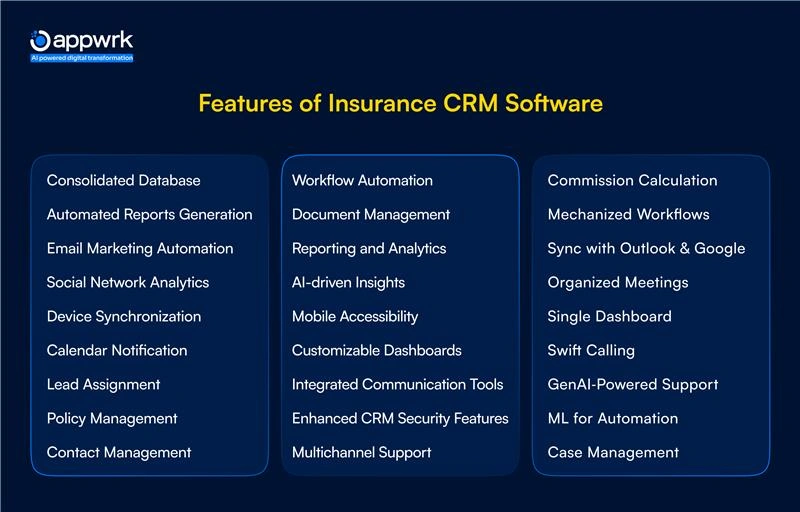
Top Features of Insurance CRM Software
A powerful insurance CRM goes far beyond basic contact management. It acts as a unified command center where automation, analytics, customer engagement, and operational control come together. From streamlining sales and claims to enhancing team productivity, these tools give insurance agents real-time access to client data, communication history, and policy workflows, helping them close more deals, reduce manual work, and deliver exceptional service.
Below are the must-have features every modern insurance CRM should offer.
Consolidated Database for Unified Customer Data
A consolidated customer database is the backbone of any system. It unifies all customer data, including policy records, claim details, communication history, demographic profiles, and past interactions, into one accessible and secure platform. This reduces fragmented workflows and empowers agents to deliver personalized, informed service every time they engage with a client. It also ensures consistent data across departments, minimizing redundancies and errors.
Insurers like ICICI Lombard have used CRM database consolidation to unify over 5 million customer records, streamlining claims verification across departments.
Automated Reports Generation
Manual data tracking leads to delays and misaligned insights. Automated report generation in CRM systems eliminates this gap by creating real-time reports on sales, claims activity, customer acquisition, and renewal pipelines. These reports are visual, filterable, and shareable across stakeholders, enabling faster, data-driven decisions. Managers can set custom KPIs, monitor agent performance, and forecast revenue patterns with zero manual effort.
APPWRK builds customizable reporting dashboards with alert systems, enabling executives to stay on top of key trends, anomalies, and CRM automation workflows at any operational scale. Integrated tracking mechanisms support customer acquisition tracking in insurance by mapping journeys from lead to conversion.
Email Marketing Automation
Every stage of the insurance lifecycle, from onboarding to renewals, requires timely, precise communication to keep clients engaged and informed. Email marketing automation ensures that personalized messages are triggered by customer behavior or policy events, including reminders for expiring policies, upsell offers, claim updates, or seasonal promotions. These marketing campaigns can be A/B tested and performance-tracked, helping improve engagement and retention.
An advanced CRM empowers insurance agents with marketing automation that uses behavior-based triggers to deliver upsell offers, policy reminders, and educational content, automatically and at scale. With pre-built templates and proven playbooks for renewals, cross-sells, and onboarding, insurers can streamline outreach, boost engagement, and maintain brand consistency across every customer touchpoint.
Social Network Analytics
Customers today voice their experiences across social media platforms. Insurance CRM software equipped with social network analytics helps insurers monitor customer sentiment, identify service issues early, and detect signs of potential fraud, enabling faster, more informed responses. These insights help insurers respond quickly to complaints, identify brand risks, and adapt messaging in real time. This is especially vital in managing reputation and trust in digital-first ecosystems.
Device Synchronization for Field Agents
CRM users, especially field agents, need access to records and tools across devices. Device synchronization ensures that policy updates, client interactions, and workflows remain consistent whether accessed from desktop, tablet, or mobile. It also supports real-time sync, so no information is lost when working offline or moving between devices.
Calendar Notification for Policy Renewals
Missed client calls or policy renewal deadlines cost insurers more than just lost business as they gradually erode customer trust. Calendar notifications ensure agents are reminded of upcoming meetings, documentation deadlines, claim follow-ups, and periodic customer touchpoints. These are auto-synced with timelines, so nothing falls through the cracks.
Lead Assignment
Manual lead routing slows down response time and causes a mismatch between client needs and agent expertise. Automated lead assignment in CRM allocates prospects based on predefined logic such as territory, product type, workload, or conversion history. This improves alignment between leads and agents, increasing closure rates and reducing lead wastage.
Policy Management
Managing multiple insurance policies per client, including renewals, endorsements, cancellations, and reinstatements, can quickly become chaotic. Policy management CRM tracks each policy’s lifecycle, links them to customer records, and automates renewal notices, premium updates, and documentation. It enhances regulatory compliance and client transparency.
European agencies using dynamic dashboards report 3x faster and automated policy renewals due to automated reminders and real-time policy history access.
Contact Management
Insurance CRM software offers powerful contact management by centralizing all customer information, such as names, contact details, policy types, and interaction history, in one place. This ensures agents have instant access to accurate, up-to-date data, enabling faster, more personalized communication.
Case Management & Claims Management
In the insurance industry, cases often involve claims, policy disputes, service requests, or escalations. Insurance CRM software streamlines case management by allowing teams to log, assign, track, and resolve each issue through automated workflows. This ensures faster resolutions, reduces the risk of missed follow-ups, and maintains a consistent service experience.
With built-in claims management capabilities, CRM automates triaging, routes cases to the right agents, and provides full visibility, helping insurers deliver timely support and enhance policyholder satisfaction throughout the customer journey.
Workflow Automation: Streamlined task assignment, reminders, and approval flows
Workflow automation lets insurance teams set up rules that trigger actions like assigning leads, sending emails, generating reminders, or escalating unresolved tickets. This reduces the manual burden on staff and ensures consistent service delivery across clients and touchpoints.
Document Management: Centralized storage and e-signature-ready policy documents
Insurers deal with a mountain of documents, from KYC forms to claim proofs. Document management features allow users to securely upload, tag, search, and share documents across departments or with clients. Version control and access logs improve compliance and reduce duplication.
In-Depth Reporting and Analytics: Track claims, sales, and churn
Insurance CRM software comes equipped with robust reporting tools that allow insurers to track claims, sales, customer churn, and agent performance in real time. These insights empower teams to make data-driven decisions, refine outreach strategies, and improve revenue health. With customizable dashboards, users can visualize performance trends, campaign results, and key metrics across the policy lifecycle.
Whether scheduled, real-time, or trigger-based, CRM analytics give insurers the clarity needed to optimize operations and stay ahead in a competitive market.
AI-driven Insights: Predictive alerts for churn risk and upsell opportunities
Insurance CRM software powered by AI and machine learning brings predictive intelligence into everyday operations. It can forecast churn risk, recommend the best times to reach out, and surface personalized upsell opportunities based on customer behavior. By analyzing past interactions, claim history, and engagement patterns, the system can flag potential issues or buying signals in advance.
These AI-driven insights help insurers proactively retain clients, boost revenue, and deliver smarter, more personalized service at scale.
Mobile Accessibility
Insurance CRM software is built for agility, giving agents real-time mobile access to policy data, client records, documents, and task updates, right from their smartphones or tablets. Whether they’re on-site with a client or working in low-connectivity areas, agents can operate seamlessly via the agent portal, even offline. This mobility not only reduces turnaround time but also empowers field teams to deliver faster, more responsive service that strengthens customer trust.
No two insurance teams have the same goals. Custom insurance CRM dashboards allow users to configure their interface with only the widgets, KPIs, and tasks relevant to them. Whether it’s claim volume, renewal pipeline, or email campaign metrics, data becomes more actionable when visualized correctly.
Integrated Communication Tools: Omnichannel client engagement via email, SMS, and calls
Omnichannel marketing integration in Insurance CRM software enables agents to connect with clients through email, SMS, chat, and WhatsApp while keeping all interactions synced to a single, unified customer profile. This ensures consistent communication, better tracking, and a more personalized client experience across every channel. Built-in call recording, call transcription, and VoIP services log agent conversations automatically, enhancing quality control, regulatory compliance, and predictive analytics.
A robust CRM for insurance marketing teams ensures omnichannel campaign execution, precise customer segmentation, and ROI tracking. These tools log all conversations, connect them with customer profiles, and ensure no context is lost. Client communication CRM tools consolidate multichannel messaging, enabling responsive support and proactive outreach. They also help with timely reminders, transactional updates, and task automation.
Enhanced Security Features
Data protection is non-negotiable in the insurance industry. CRMs now include encryption at rest and in transit, role-based access control, multi-factor authentication, audit trails, and compliance certifications (e.g., HIPAA, GDPR). These reduce breach risks and improve trust.
Multichannel Support
Policyholders engage with insurers through multiple touchpoints, including email, social media, phone calls, and mobile apps, expecting consistent and seamless experiences across all channels. Multichannel support enables insurers to log and respond to every interaction from a single interface. It ensures continuity of conversation and reduces response delays.
Machine Learning for Automation
Machine learning models detect patterns and automate tasks such as claim approvals, fraud detection, or prioritizing high-risk policyholders. This not only improves operational speed but also identifies revenue leaks or service gaps earlier.
Swift Calling: Initiate and Log Agent Calls
With built-in calling features, agents can initiate calls directly from the CRM. This reduces context-switching and allows the system to auto-log conversations, add notes, and track communication history. Some systems integrate voice analytics to detect tone or urgency, helping prioritize follow-ups.
Insurance CRM software with built-in commission tracking simplifies payout processes by automatically calculating agent commissions based on policy type, term, upsells, and renewals. It also supports agent-specific incentive structures, bonuses, and performance-based thresholds.
This automation improves transparency, minimizes payout errors, boosts agent motivation, and reduces disputes, helping insurers manage compensation more efficiently while keeping teams aligned and engaged.
Mechanized Workflows for Routine Tasks
Repetitive tasks, like document verification, claims updates, or onboarding checklists, can be auto-executed with mechanized workflows. These reduce manual effort, prevent missed steps, and boost consistency in execution. Users receive automated prompts to complete or escalate workflows, improving time-to-resolution.
Calendar and Email Sync
Seamless syncing with Gmail or Outlook allows users to view emails, contacts, and calendars inside the interface. This ensures every interaction is tracked, avoids duplication, and allows for better planning. It bridges the gap between external communication and internal operations.
Organize Meetings: Send invites and log meetings
The tools allow users to send meeting invites, confirm availability, attach documents, and log meeting summaries, all from the same platform. This creates a frictionless scheduling experience for both agents and customers using Google Calendar integrations. Meeting notes and action items are stored in the customer record for easy reference.
Single Dashboard for Team Leads and Executives to Track KPIs
CRMs offer a unified dashboard that aggregates sales KPIs, agent activity, policy statuses, support tickets, and more. These dashboards are interactive, allowing team leads and executives to drill down into metrics and take action immediately.
GenAI‑Powered Support: Chatbot for Routine Queries
Next-generation Insurance CRM tools now feature AI-powered chatbots and virtual assistants that can instantly answer policy-related questions, route claims to the appropriate teams, and escalate complex support issues, enhancing service speed, availability, and customer satisfaction. These bots are trained on internal data and integrate seamlessly with live agent workflows.
Case Study: How APPWRK Engineered a Scalable Insurance Claims Portal
Before APPWRK’s Intervention: ReNew, a leading renewable energy company in India, faced rising inefficiencies in handling insurance claims for leased wind turbines and solar panels. The manual, multi-departmental process led to delays, miscommunication, and zero real-time visibility across claims filed, especially between site engineers, internal SPOCs, and external brokers.
CRM-Driven Workflow Automation
APPWRK’s Approach: To address this, APPWRK built a custom cloud-based Insurance Claims Portal designed to centralize claims, enforce accountability, and automate role-based workflows. Developed using CodeIgniter, Docker, jQuery, Highcharts, and MySQL, the portal featured a rule-driven workflow engine, real-time dashboards, secure data handling, and a transparent activity log system.
Key CRM Features Implemented
Role-Based Workflow Automation: Custom logic ensured seamless handoffs across four user roles (engineer, SPOC, admin, broker) without duplication or routing errors.
Claims Lifecycle Dashboard: Highcharts-powered real-time dashboards provided dynamic claim status updates and department-wise insights.
Compliance-Ready Data Security: Encrypted data handling, audit logs, and access control frameworks ensured full compliance and confidentiality.
Activity Logging Engine: Transparent background logging records every task assignment, status change, and approval for regulatory traceability.
Cloud Scalability & Integration: Airtable and Google Chat enabled real-time notifications and cross-platform communication for faster coordination.
Measurable Business Impact
Reduced manual errors and claim handling times by streamlining the multi-role process.
Improved internal SLA adherence and claim cycle visibility across departments.
Achieved secure, compliant insurance data handling with transparent audit trails.
Enabled real-time operational decisions with interactive dashboards and performance tracking.
Empowered ReNew’s engineering and admin teams with a system tailored for energy insurance operations.
Strategic Outcome & Industry Relevance
APPWRK’s CRM-powered insurance claims portal transformed ReNew’s operations by consolidating fragmented workflows into a secure, scalable, and efficient platform. This innovation significantly improved claim resolution speed, strengthened audit compliance, and enhanced decision-making, setting a new standard for digital transformation in insurance operations supporting renewable energy assets.
Insurance operations involve multiple high-touch processes across sales, claims, service, and compliance. Without the right tools, these workflows can become siloed and inefficient.
CRM software addresses this by streamlining critical functions through automation, centralized data, and real-time visibility. Below, we’ve organized key use cases by role to illustrate how insurance CRM platforms deliver measurable impact across teams.
CRM for Insurance Sales Teams
Sales teams require precise segmentation, intelligent lead routing, and guided client opportunities tracking to meet today’s digital-first customer expectations. CRM software empowers insurance agents to close faster, upsell smarter, and reduce lead leakage through automation and real-time insights.
Customer Segmentation and Personalized Campaigns
CRM software enables deep segmentation by policy type, risk profile, customer behavior, and renewal timelines. This supports highly targeted, personalized marketing, like auto policy upgrades or lifetime wellness add-ons, leading to better engagement and conversion.
Lead Generation and Opportunity Management with Intelligent Routing
CRM captures leads through web, email, mobile, and walk-ins, scores them automatically, assigns tasks to agents, and schedules reminders. This increases conversion velocity and minimizes drop-offs. It also streamlines insurance sales pipeline management by visualizing each stage of the customer journey, such as lead, quote, bind, and renewal, helping agents forecast revenue more accurately and minimize drop-offs throughout the process.
CRM can embed a sales playbook integration, guiding field agents with best-response scripts, cross-sell prompts, and compliance checks in real time. By streamlining the insurance sales CRM workflow, agencies gain faster conversions through automated task assignments and follow-up sequencing.
CRM for Claims & Customer Service
Claims processors and customer service teams are under constant pressure to reduce turnaround times and improve resolution quality. CRM solutions simplify claim intake, automate support workflows, and equip service teams with complete customer interaction histories for faster and more informed responses.
Customer Service Enhancement with Unified Interaction History
Insurance CRM software brings all customer interactions, whether through email, phone, chat, app, or face-to-face, into a single, organized timeline. This gives agents full context and history at a glance, helping them respond faster, more accurately, and with a personalized touch.
Ticketing & Support Workflows
Embedded ticketing & support workflows within the tools let service teams log, prioritize, and resolve customer requests (e.g., claims issues, policy changes) through a structured queue, with status updates integrated into client timelines.
CRM for Policy Management & Renewals
Policy management requires precise timing and proactive engagement. CRM tools help automate policy renewal triggers, minimize lapse risk, and drive cross-sell opportunities by aligning communications with customer behavior and risk profiles.
Policy Renewal Automation to Prevent Lapses
Insurance CRM software automates the entire renewal process by triggering timely reminders, upsell suggestions, and retention offers based on policy expiration dates, customer behavior, and risk profiles. This eliminates the need for manual follow-ups, reduces policy lapse rates, and helps retain high-value clients with minimal effort.
CRM for Compliance & Operations
In the heavily regulated insurance sector, CRM software plays a vital role in helping compliance and operations teams maintain data accuracy, enforce security protocols, and ensure end-to-end audit traceability. CRM software ensures policy workflows adhere to evolving regulations while automating documentation, access control, and digital compliance reporting.
Compliance, Security, and Audit Trail Automation
Insurance CRMs standardize data access through role-based permissions, encryption, and immutable audit logs. This ensures regulatory readiness across HIPAA, GDPR, IRDAI, and state-specific laws.
Automated Document & E-Signature Management
These platforms integrate electronic document capture, storage, and e-signature workflows, reducing paper dependency and accelerating onboarding or claim documentation. Insurance onboarding automation speeds up policy issuance while minimizing paperwork delays.
CRM for Field & Mobile Agents
It goes without saying that Insurance professionals on the move need uninterrupted access to policy data, lead information, and claim forms. A mobile-first CRM enables field agents to serve customers faster, even in low-connectivity zones, while feeding real-time updates back into central systems for continuous visibility.
Real-Time Feedback Collection and Analytics to Drive Improvement
CRMs enable continuous feedback collection through surveys and sentiment scoring. Real-time dashboards show retention risk trends, agent productivity metrics, and policy performance, helping align strategy with field reality.
Mobile-First Field Agent Enablement
Offline-capable mobile CRM for insurance allows agents to capture leads, update policies, file claims, and access customer documents from any location. This boosts agent effectiveness and ensures faster client servicing in field contexts.
CRM Software Pricing Guide for Insurance Businesses
When evaluating insurance CRM cost, businesses must weigh immediate investment against long-term returns. Whether you’re choosing a SaaS model, building custom tools, or opting for a hybrid solution, costs vary significantly based on features, integrations, and scale. Here’s a comprehensive guide to help you compare options effectively.
SaaS Subscription Costs
Off-the-shelf SaaS solutions such as Salesforce, Zoho, Freshworks, HubSpot, or Insightly typically range from $40 to $200 per user per month, depending on feature grade and usage level. These platforms offer rapid deployment, built-in updates, and 24/7 support, making them ideal for agents or agencies with standard lead generation, email automation, and contact management needs.
SaaS is best suited for smaller insurance teams or agencies with limited customization requirements, though total ownership costs can rise significantly over time with per-user pricing and feature add-ons.
Custom Insurance CRM Development Costs
For businesses with complex workflows, such as insurance brokers, life insurers, or claims-intensive operations, a custom-developed CRM is a strategic long-term investment. An MVP can be built for as low as $8,000, covering key modules like contact management, basic policy tracking, claims queues, and document storage.
Advanced Insurance CRM solutions, featuring AI-driven analytics, omnichannel communication, mobile access for agents, and built-in compliance tools, typically range from $15,000 to $120,000, depending on the complexity of integrations and scalability requirements. These platforms give insurers complete control over data flows, brand experience, and future customizations.
CRM vs. AMS: What’s Right for Insurance Workflows?
While CRM systems are built to manage customer relationships, encompassing sales, marketing, service, and engagement, Agency Management Systems (AMS) focus on core insurance operations such as policy administration, compliance tracking, and carrier integrations. Although AMS handles the back-office, CRM platforms offer stronger capabilities in lead management, customer journey mapping, and personalized communication. Today, many insurers are bridging the gap by integrating both systems or adopting hybrid CRM-AMS solutions. This approach unifies policy management with client engagement, delivering seamless experiences across both operational and customer-facing workflows.
This hybrid approach ensures no data silos and creates a unified view across service, sales, and underwriting teams.
Build vs. Buy: Choosing the Right Investment
Buying a SaaS-based insurance tool (like Zoho or HubSpot) offers lower upfront costs, quick deployment, and pre-integrated tools. Pricing usually ranges from $40 to $200 per user per month. However, customization is often limited, and scaling can be constrained by platform boundaries.
In contrast, building a custom CRM can start as low as $8,000 for an MVP and scale up to $120,000 for a full-featured solution with AMS integrations, AI modules, and high compliance standards. While time-to-market is slower, it offers complete alignment with business logic, workflows, and branding.
Hybrid CRM Models- Best of Both Worlds
A hybrid model combines a SaaS backbone with custom-built insurance-specific extensions. This approach allows companies to avoid large upfront investments while still achieving industry-specific sophistication. Pricing typically falls between $20,000 and $80,000, with ongoing licensing fees and modular developer support.
Hidden Ongoing Costs
In addition to subscription or build costs, insurers must budget for:
Training and onboarding of agents and staff.
Support, maintenance, and incremental updates.
Data compliance audits and infrastructure hosting.
Licensing and integration costs for third-party tools.
These ongoing expenses can account for 10-20% of the total CRM investment over the system lifecycle.
Insurance CRM ROI Metrics: CAC, CLV & ROMI
To measure success, you can track customer acquisition cost (CAC), customer lifetime value (CLV), and return on marketing investment (ROMI). A healthy ratio (e.g., CLV ≥ 3 × CAC) indicates strong ROI, especially for high‑volume renewals or upsell campaigns.
Summary Cost Comparison
CRM Type
Entry-Level Cost
Insurance CRM cost
Best For
SaaS Model
~$40/user/month
~$40–$200/user/month (annual)
Small teams or brokers with standard needs.
Custom Model
~$8,000 (MVP)
$15,000–$120,000 (fully built)
Insurers needing tailored workflows.
Hybrid Model
SaaS + $20K–$80K dev
Licensing + custom modules
Agencies wanting both speed and control.
How APPWRK Helps Optimize Costs
APPWRK works with insurers to determine the right balance between budget, scope, and operational needs, whether that means an MVP for quick validation or a fully custom, modular CRM. APPWRK’s phased development approach can help agencies scale customer relationship management capabilities systematically while keeping ROI timelines across 6-12 months.
CRM Implementation Strategy for Insurance Companies: A Step‑by‑Step Guide
As insurance agencies embrace digital transformation, CRM software has become the central hub for unifying sales, claims, marketing automation, and analytics. To unlock its full potential, successful implementation requires a phased, cross-functional strategy that aligns business objectives, operational workflows, and the right technology stack.
Below is a clear, actionable roadmap designed to ensure your Insurance CRM evolves into a long-term strategic asset rather than just another software tool.
Step 1: Audit Existing Systems and Pain Points
Start by evaluating your existing tools and processes, including your AMS, claims management platforms, spreadsheets, and communication tools. Pinpoint challenges like data silos, missed renewal alerts, or fragmented communications. Engaging sales, claims, underwriting, and operations teams early ensures better alignment and buy-in.
Step 2: Map Out Policy, Claims, and Sales Workflows
Document real-world workflows across policy issuance, claims resolution, and sales pipelines. Define key triggers, decision points, and customer touchpoints. This blueprint helps translate insurance-specific processes into automation-ready CRM logic.
Step 3: Choose SaaS, Custom Development, or Hybrid Model
Compare the deployment strategies:
SaaS Model: Offers speed and lower initial cost ($40‑200/user/month), but limited customization.
Custom Model: Offers complete feature control tailored to insurance-specific logic and workflows. Pricing typically starts at $8,000 for a minimum viable product and can scale up to $120,000 for fully integrated enterprise solutions, depending on the system’s complexity, modules, and customization needs.
Hybrid Model: Combines a SaaS base with insurance-specific modules or APIs for a balanced solution.
Select based on scale, compliance needs, integration depth, and long-term ROI.
Step 4: Roll Out a Pilot to Validate System Design
Test the CRM with one department, like claims or sales, to refine automation logic, user interface, and workflows. Gather user feedback to fine-tune system design before full deployment.
Step 5: Execute Secure Integration with AMS/ERP Tools
Ensure secure integration with core platforms using APIs. Focus on mapping policy data, claim statuses, and transaction records. A phased rollout minimizes disruption and ensures insurance-specific logic is preserved.
Step 6: Train Users and Monitor Adoption Metrics
Provide role-specific training to agents, adjusters, and underwriters. Monitor usage with dashboards tracking logins, workflow execution, and feature adoption. APPWRK configures performance analytics to help managers boost CRM engagement across teams.
A strong integration strategy maps existing AMS/ERP systems, sets up secure connectors, and runs end-to-end sync testing. For multi-branch setups, staggered rollouts help maintain data consistency and usability.
How APPWRK Adds Value During CRM Implementation
APPWRK ensures seamless integration with underwriting, claims, and compliance tools. From gap analysis to post-launch optimization, APPWRK supports full-cycle implementation. Their team enables fast adoption with modular training, performance dashboards, and outcome tracking, ensuring measurable business impact in under six months.
Despite the transformative potential of software for insurers, CRM implementation challenges persist significantly. Understanding and preparing for these challenges can make the difference between adoption failure and successful insurance digital transformation. Below are the five most common CRM development and integration challenges in the insurance sector:
Integration Complexity
Insurance companies often rely on decades-old legacy systems that weren’t designed for modern digital ecosystems. Integrating a CRM with these platforms involves intricate data mapping, interface development, and real-time sync configurations, which can escalate both cost and timeline. These complexities slow down deployment and risk system incompatibility unless handled by an experienced partner like APPWRK.
Data Security and Compliance
Managing sensitive data like health records, financial information, and policy details places insurers under heavy regulatory scrutiny. An effective Insurance CRM must offer encryption, audit logs, role-based access, and compliance with standards such as HIPAA, GDPR, and NAIC Model Law. Without these safeguards, firms face serious risks including fines, data breaches, and reputational damage.
Lack of User Adoption
CRM initiatives often fail in insurance firms due to low agent engagement and misaligned workflows. If the platform feels complex, redundant, or disconnected from daily tasks, teams won’t use it. To drive adoption, the CRM must offer a clean user experience, pre-built insurance-specific templates, and built-in training tools that align seamlessly with how agents and policy teams actually work.
Scalability Issues
Let’s face it, what works for a 10-agent firm won’t scale for an enterprise insurer handling thousands of policies across regions. SaaS tools often hit limits when it comes to complex workflows, high-volume claims, or multi-branch coordination. Without a clear scalability strategy, insurers risk outgrowing their CRM and facing costly replatforming down the line. Choosing a flexible, future-ready solution is key to avoiding these setbacks.
Maintaining Data Quality
Data duplication, inconsistent policy entries, and fragmented client records dilute the tool’s value and reduce reporting accuracy. Insurance CRMs require ongoing data validation tools, normalization processes, and auto-cleanse logic to maintain database hygiene over time. Without these controls, poor data can cripple insights and automation.
Top Insurance CRM Tools & Platforms: For Insurance Agents, Brokers, and Carriers
Selecting the right insurance CRM software is crucial for agencies looking to automate policy and claims workflows, personalize engagement, and scale operations with data-driven intelligence. Below are five top-rated CRM tools tailored for insurance use cases, balancing automation, customization, and cost-effectiveness.
Salesforce Financial Services Cloud: Enterprise-Grade CRM for Insurers
Salesforce Financial Services Cloud delivers a comprehensive 360-degree view of each policyholder by seamlessly integrating claims history, policy data, and all customer communications into a single unified record. This enables insurers to provide more personalized service, streamline operations, and improve customer satisfaction at scale.
Ideal for: Large carriers, brokers, or agencies seeking a full-featured, scalable CRM with compliance baked into the architecture.
Zoho CRM for Insurance: Customizable and Cost-Effective for SMBs
Zoho delivers policy renewal automation, lead scoring, and workflow routing with an easy-to-use interface and multilingual support. Offers strong dashboarding and team collaboration.
Ideal for: Smaller brokerages or agencies wanting a flexible, budget-friendly CRM that’s easy to configure.
Insly: Broker-Specific CRM Built for Policy and Claims Efficiency
Insly is a cloud-based CRM designed specifically for insurance brokers, agencies, and MGAs. It offers automated policy issuance, quoting, endorsements, and renewals, alongside robust reporting and CRM workflow automation. Users praise Insly for its fast deployment, ease of use, and strong policy lifecycle tracking.
Ideal for: Mid-sized broker teams or MGAs that require a specialized solution with minimal customization overhead.
Creatio CRM: Process Automation for Insurance Workflows
Creatio CRM lets insurers design and automate complex claims, policy, and customer engagement workflows via visual tools. Supports integrations with underwriting and billing platforms.
Ideal for: Agencies that need rapid automation of insurance workflows and flexibility to revise processes fast.
HubSpot CRM: Lightweight, Marketing-First CRM for Insurance Sales Teams
HubSpot CRM is ideal for insurance teams prioritizing lead generation, email automation, and sales pipeline visibility. While not built exclusively for insurance, it offers strong customization, robust API integrations, and a free tier, making it a cost-effective choice for lean teams looking to scale outreach and manage prospects efficiently.
Ideal for: Small insurance shops that prioritize marketing outreach and sales coordination over claims automation.
The Future of Insurance CRM: What’s Next?
As regulatory pressure increases and customer expectations evolve, insurance CRM software is becoming smarter and more adaptive. By 2030, modern CRMs will embed:
AI copilots to assist insurance agents with policy recommendations and claim triaging.
Generative AI tools for crafting personalized policy documents and summaries.
Predictive analytics that flag churn risks and optimize renewal pipelines.
API-first CRM architectures for real-time CRM integration across tools and departments.
This evolution supports not just automation, but intelligent, data-driven decision-making at every level of the insurance business.
Regional Trends in CRM Insurance Adoption: USA, Europe & India Compared
CRM adoption in insurance varies widely across geographies. While the USA prioritizes compliance and enterprise scalability, Europe emphasizes GDPR alignment and modular workflows. In contrast, India is driven by affordability, mobile-first CRM systems, and regional customization. Understanding these nuances helps insurers deploy CRM solutions that align with local regulatory and operational needs.
CRM Adoption in the USA: Compliance, Scale, and Customization
In the United States, insurance CRM adoption is heavily influenced by the need for HIPAA compliance, multi-channel lead generation, and enterprise-scale sales automation. Insurers prioritize platforms like Salesforce and HubSpot that offer robust integration with policy management tools, fraud analytics, and omnichannel insurance CRM support. The market also leans toward custom development for deeper analytics and integration with legacy claim systems.
Key drivers in the US include:
Federal compliance (HIPAA, SOC 2).
Multi-state underwriting complexities.
Focus on retention and up/cross-selling.
Europe’s CRM Focus: GDPR-Ready, Modular, and Cross-Border Scalability
European insurers face a unique blend of data privacy mandates under GDPR, multi-language communication needs, and decentralized regulatory environments. Here, tools must emphasize modular deployment, secure data management, and integration with local ERP systems. Platforms like Insly and Creatio are gaining momentum for offering strong regulatory alignment and workflow configurability.
High emphasis on customer transparency and consent capture.
India’s CRM Surge: Affordability, Mobility, and Tier-2 Scalability
India’s insurance sector is rapidly adopting CRM tools, particularly among health, auto, and micro-insurance providers. The market is driven by the need for affordable CRM systems, mobile-first architecture, and tools that support regional languages and claims tracking at scale. Indian insurers are focusing on MVP builds or SaaS CRMs like Zoho, later upgrading to more customized platforms as data volumes grow.
India’s CRM success factors:
MVP-focused builds starting at $8,000.
Multilingual support for Tier-2 and Tier-3 regions.
WhatsApp/SMS integration for claims and renewals.
AI-driven dashboards to track policy lifecycle and agent productivity.
Whether it’s regulatory depth in Europe, enterprise scalability in the USA, or affordability and regional agility in India, CRM strategies must align with local compliance, policy structures, and sales models to deliver measurable ROI.
What Happens When Insurance Companies Don’t Use CRM
Operating without a modern CRM in the insurance sector creates recurring inefficiencies, missed revenue, and fragile customer relationships. Below are the core consequences that unfold when agencies rely on manual systems rather than centralized platforms.
Fragmented Customer Records Lead to Poor Service
Without a unified system, policyholder information is scattered across emails, spreadsheets, and disconnected tools, leading to poor knowledge retention and coordination. Insurance agents lack access to a complete customer timeline, which leads to inconsistent service, duplicated outreach, and missed opportunities for personalization or cross-selling.
Missed Leads Due to Manual Follow-ups
Agents who rely on manual reminders or spreadsheets for follow-up often respond late or forget potential prospects entirely. Organizations without automation can lose as much as 20% of potential revenue, according to recent studies, due to missed lead responses, slow follow-ups, and inconsistent pipeline engagement.
Renewal Alerts Fall Through the Cracks
Policy renewals become increasingly difficult to manage manually as customer volumes grow. Without automated renewal reminders or built‑in notification workflows, agencies risk letting renewals lapse, leading directly to churn and revenue loss.
Lack of Analytics and Agent Performance Visibility
Traditional systems don’t provide real-time dashboards tracking agent productivity, conversion metrics, claim resolution times, or retention signals. Without these insights, leadership lacks the visibility needed to coach underperformers, replicate best practices, or scale what works, resulting in hidden performance gaps across teams.
Increased Compliance Risk and Poor Audit Trails
Insurance regulations demand traceable records of policy issuance, customer consent, and claim correspondence. Manual systems make maintaining audit-ready logs difficult and expose firms to legal and reputational risk. A lack of centralized documentation and communication tracking leaves insurers unprepared for regulatory review.
Missed Opportunity to Harness Intelligence in Insurance Operations
While leading insurers now use AI to optimize cross-sell triggers, detect fraud patterns, and forecast churn, businesses without automated systems cannot leverage these capabilities. This creates a strategic disadvantage as competitors move toward predictive, data-driven engagement with policyholders.
Delayed Service and Lost Trust
Without a centralized Insurance CRM, insurers often struggle with slow claim processing, missed follow-ups, and disjointed communication. These delays not only frustrate policyholders but also lead to increased lapse rates, reduced customer satisfaction, and ultimately, a loss of long-term trust. In today’s competitive market, timely service and consistent engagement are essential, and CRM software is key to delivering both.
How APPWRK Can Help You Build or Integrate CRM for Insurance
APPWRK delivers end-to-end CRM development and integration tailored for the insurance sector, streamlining operations across policy issuance, claims, sales, and service. With deep domain expertise, we help insurers turn their CRM into a scalable, compliant, and performance-driven core system.
We build insurance-specific CRM modules that automate tasks like claims processing, lead routing, and renewals, while ensuring visibility and alignment across departments. Our API-first approach enables seamless integration with AMS, ERP, underwriting, and billing systems, reducing manual handoffs and enhancing CX.
APPWRK embeds AI features such as churn prediction, upsell prompts, and fraud detection directly into CRM workflows to drive proactive engagement. For field agents, our mobile-first CRM supports offline access and real-time sync to maximize productivity in low-connectivity zones.
Custom dashboards, role-based access, encrypted storage, two-factor authentications, and audit trails ensure your CRM meets HIPAA, GDPR, and NAIC compliance requirements. We support phased rollouts with usage tracking, training, and in-app support to accelerate adoption and ROI.
Proven results:
20+ insurance clients across life, auto, and health.
98% retention rate in BFSI.
CRM builds scaled from MVP to enterprise in under 6 months with 20-30% productivity gains.
CRM is vital for insurance firms as it centralizes client data, supports omnichannel communication, and automates sales, claims, and policy management workflows. It helps insurers track every customer interaction, personalize offerings, and drive renewals and upsells with precision. The result is better customer experience, higher retention, and improved operational control.
What are the benefits of CRM software for insurance agents?
CRM tools for insurance agents empower them by giving a 360-degree view of each policyholder, tracking lead history, claims, policy changes, and preferences. With automated reminders, integrated communication, and mobile access, agents can respond faster, close more deals, and retain clients more effectively.
How much does it cost to build a CRM for insurance?
Building a CRM for insurance can start at $8,000 for an MVP version. However, full-featured, scalable solutions with workflow automation, CRM analytics, and third-party integrations may cost between $15,000 and $120,000, depending on the use case complexity, data scale, and security needs.
Pros: Centralized data, automation of renewals and claims, AI-driven analytics, and enhanced insurance agent productivity.
Cons: Potential integration challenges, upfront implementation costs, and adoption hurdles in legacy-driven teams.
What are the benefits of implementing a CRM strategy?
Implementing a CRM strategy in insurance allows you to proactively manage customer journeys. It improves internal workflows, enhances visibility into agent performance, reduces churn, and enables advanced segmentation for targeted marketing.
How can a custom insurance CRM be integrated with existing systems?
Custom CRM systems can connect to policy management CRM, underwriting tools, ERP, and claims systems using APIs or iPaaS solutions. This ensures synchronized data across departments, accurate reporting, and real-time access, reducing errors and redundant manual entry.
Can CRM automate renewals and claims in insurance?
Yes, a modern CRM automates routine tasks such as sending renewal reminders, processing claims updates, and notifying clients of policy changes. This reduces manual workload for agents, shortens response time, and ensures timely customer engagement throughout the policy lifecycle.
What’s the difference between CRM and AMS in insurance?
While a CRM (Customer Relationship Management) system is designed to manage front-end customer interactions, such as lead tracking, communication history, and personalized service, an AMS (Agency Management System) focuses on back-office operations like policy administration, commissions, accounting, and document storage. CRM helps drive growth and engagement, while AMS ensures operational efficiency. Many modern insurers integrate both systems to gain a unified view across customer-facing and administrative workflows.
Gourav Khanna is the Co-founder and CEO of APPWRK, leading the company’s vision to deliver AI-first, scalable digital solutions for enterprises and high-growth startups. With over 16 years of leadership in technology, he is known for driving digital transformation strategies that connect business ambition with outcome-focused execution across healthcare, retail, logistics, and enterprise operations.
Recognized as a strategic industry voice, Gourav brings deep expertise in product strategy, AI adoption, and platform engineering. Through his insights, he helps decision-makers prioritize market traction, operational efficiency, and long-term ROI while building resilient, user-centric digital systems.
Subscribe to APPWRK Blogs, We'll Do the Rest!
Get Blogs on UI/UX, Mobile Apps, Online Marketing, and Web development technology.
Unlock worthy and priceless suggestions from the masters of mobile and web app development