150+ minds across 4 countries. Join a culture of innovation, ownership & growth.
Rewire for AI
From machine learning to deep learning, from classification tools to overall process automation – our AI engineers will help you retool your existing system or enhance your company results.
Ship faster, scale smarter, built for product companies and SaaS teams
Our Latest Work
We strive hard to deliver result-driven digital solutions across the globe. Check out our case studies to get a glimpse of how we ideate, innovate, and create unconventional digital solutions according to the requirements of our clients.
Discover diverse and passionate insights from our tech enthusiasts. We collaborate across various sectors to streamline operations and drive innovation. Explore our rapidly growing collection of articles to see why we’re at the forefront of IT solutions.
The decision to move from Magento to Shopify is one of the most significant replatforming choices an ecommerce business can make. Magento is powerful, but its power comes with...
Accuracy gap is real: Traditional CPG forecasting carries a 25-40% MAPE error rate. AI-powered models bring that down to 8-15%, according to McKinsey research....
Real stories from global leaders who trusted us with their ideas.
Partnering with APPWRK helped us build a compliant and scalable healthcare platform, accelerating our time-to-market by 35%. Their team consistently delivered outstanding work.
Beesers
Digital Healthcare Client
Collaborating with APPWRK, Sportskeeda modernized its platform into a real-time sports engagement ecosystem, enabling seamless content delivery, scalable fan interactions, and high-velocity performance.
Sportskeeda
Sports & Entertainment Partner
Working with APPWRK was effortless. They captured our vision, maintained full compliance, and delivered a digital experience that built trust and elevated how customers interact with our fintech brand.
PayPenny
Fintech Partner
Working with APPWRK gave us confidence in adopting AI responsibly. Their team built a safe, intelligent bot that transformed how we engage with leads and helped us achieve measurable revenue growth.
IFB
AI Transformation Partner
Leveraging APPWRK’s digital expertise, Nemesis launched a scalable, compliant, and safe super app that connects content delivery, real-time communication, and logistics management within a single platform.
The cost to build an AI personal assistant app like Siri or Alexa starts at $20,000 for an MVP and can exceed $300,000 for enterprise-grade solutions. Pricing varies based on AI complexity, voice capabilities, contextual awareness, and integrations. Whether for healthcare, finance, or retail, success requires strategic planning and scalable AI infrastructure.
Contextual awareness and voice recognition enable scalable, industry-specific experiences, particularly in healthcare and retail, even if they increase development cost by ~30%.
Custom AI assistants offer better data security, brand alignment, and seamless ERP/IoT integration compared to off-the-shelf alternatives.
Your tech stack choice (e.g., TensorFlow, Dialogflow, Whisper) impacts cost efficiency, AI performance, and time-to-market.
Enterprises using AI voice assistants in operations report up to 60% efficiency gains, notably in logistics and customer service.
A California fintech startup built a multilingual voice bot for $75,000, cutting support costs by 40% and boosting customer retention with NLP and CRM integration.
In this blog, we break down the real costs, benefits, development timeline, and market opportunities of building AI personal assistant apps, a strategic guide for CTOs, founders, CFOs, and product heads shaping next-gen digital experiences.
Global Market Overview and Expansion
With the rise in popularity of voice-first experiences, AI personal assistant apps like Siri and Alexa are no longer just enhancing convenience; they’re reshaping how businesses operate across industries. From healthcare to finance, enterprises are now leveraging voice AI to streamline operations, boost customer engagement, and unlock new revenue streams. This section explores global market size, adoption trends, and why custom AI voice assistants are becoming essential components of modern, digital-first business strategies.
The Rise of Virtual Assistants: Industry Insights and Market Stats
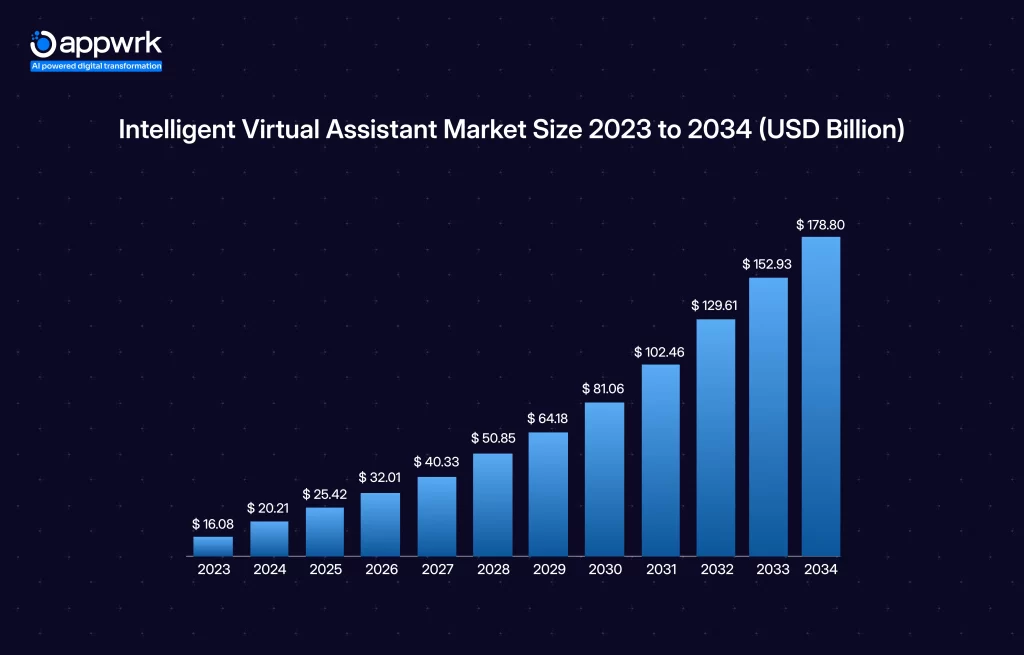
The global demand for AI personal assistant apps is scaling rapidly, fueled by breakthroughs in natural language processing, contextual awareness, and voice-first interfaces. According to recent reports, the global intelligent virtual assistant market was valued at USD 16.08 billion in 2023, reached USD 25.42 billion in 2025, and is projected to grow to approximately USD 178.80 billion by 2034, expanding at a CAGR of 24% from 2024 to 2034. This surge is not only driven by consumer adoption but also by enterprises leveraging AI assistants across industries to boost productivity and transform customer engagement.
Statista projects that the number of digital voice assistants will exceed 8.4 billion units by 2026, outnumbering the global population. This surge aligns with the increasing integration of voice-based AI into smartphones, smart homes, vehicles, and enterprise workflows.
While Apple’s Siri and Alexa led early adoption, the growth today lies in niche, business-focused AI assistants tailored to industry-specific needs.
AI voice assistants are evolving from helpful tools into strategic assets. Businesses adopting them today are not only enhancing user convenience but unlocking new dimensions of interaction, where conversations replace clicks, and voice becomes a gateway to real-time intelligence, automation, and brand differentiation.
Growth of AI-Powered Personal Assistants Across Industries
AI-powered personal assistants are rapidly becoming the backbone of digital transformation across industries. No longer limited to simple commands, they are now driving smarter workflows, enhancing customer interactions, and delivering real business value in sectors ranging from healthcare to automotive.
Healthcareorganizations are deploying voice-based triage systems and smart scheduling assistants. According to McKinsey, AI assistants in healthcare could save the industry up to $150 billion annually by 2026.
Financeis seeing AI assistants automate KYC, enable real-time portfolio tracking, and provide multilingual voice support for customer service.
In education, voice assistants support personalized learning, reading comprehension, and exam preparation, especially useful in remote-first environments.
Retailersare using AI voice agents to drive conversational commerce, automate post-sale support, and assist in-store experiences via smart kiosks.
The automotive sector is integrating voice AI into infotainment systems and autonomous vehicles, creating seamless, eyes-free interactions.
Enterprise AI is no longer about replacing humans, but it’s about augmenting teams, scaling personalized service, and embedding intelligence into every process.
AI Personal Assistant App Cost Breakdown & Influencing Factors
Understanding the true cost to build an AI personal assistant app like Siri or Alexa requires looking beyond surface-level estimates. From development timelines and AI models to design, platforms, and post-launch support, every variable plays a measurable role in shaping cost and ROI.
How Much Does It Cost to Build an AI Assistant Like Siri or Alexa?
As previously mentioned, the starting cost begins at $20,000. However, this section provides a breakdown of what you actually get at each pricing tier from basic voice functionality to enterprise-scale AI infrastructure. Below is a strategic breakdown by tier:
App Tier
Cost Range to Develop an AI Assistant Like Siri or Alexa
Multilingual voice, sentiment analysis, IoT sync, custom ML models, and cloud-edge deployment.
Factors that Affect the AI Personal Assistant App Development Cost
It goes without saying that building an AI voice assistant involves more than just feature planning. The real cost is shaped by what lies beneath the surface. Factors like your technology stack, data strategy, team expertise, and the assistant’s ability to adapt intelligently all play a critical role in determining the final budget. Even apps with similar voice commands can vary widely in cost due to differences in architecture, AI depth, and integration complexity.
Tools & Tech Stack for AI Personal Assistant App Development
Building a reliable and scalable AI voice assistant requires tight integration with advanced AI frameworks like TensorFlow, Rasa, or OpenAI Whisper, along with cloud platforms such as AWS or Azure. These tools accelerate development but demand skilled engineers and continuous model training.
Choosing between open-source platforms like Dialogflow, Rasa, or Wit.ai, along with backend decisions like cloud versus edge deployment, directly impacts performance and flexibility. While custom pipelines add to the cost, they offer greater control, deeper personalization, and long-term scalability.
Hidden Cost Factors in AI Personal Assistant App Development
While building a smart AI voice assistant may start with a clear feature list, hidden costs often surface mid-development or after launch. From training data preparation to model tuning and integration challenges, these behind-the-scenes factors can significantly impact your budget. Addressing them early, especially with robust intent recognition, can lead to greater long-term accuracy, reliability, and user satisfaction.
Development Team’s Location
A team in North America or Western Europe may cost 2 to 3x more per hour than teams in Eastern Europe or India. However, teams with AI maturity, secure DevOps pipelines, and proven delivery cycles may offer better value, even at higher rates.
Technology Stack
Choosing high-performance tools like FastAPI, MongoDB, and voice-optimized frontend frameworks can ensure speed and flexibility, but also require cloud orchestration, CI/CD pipelines, and advanced monitoring setups. Natural Language Understanding (NLU) is the core component that enables AI assistants to interpret and respond to human intent accurately.
Complexity
The more the assistant learns, listens, and adapts, the higher the complexity. Voice assistants trained for domain-specific commands, such as healthcare or legal queries, need extensive data preprocessing and conversational modeling. Voice recognition app development typically involves integrating APIs like Google Speech or Azure Voice with NLP pipelines.
Design
Designing a smart AI voice assistant goes beyond visuals. Voice UX requires careful tone calibration, conversational flow, and natural language scripting. Unlike traditional UI, it focuses on how the assistant sounds, responds, and feels during real-time interaction.
App Platform
Developing for mobile (iOS/Android), smart speakers, and in-car systems brings platform-specific SDK requirements. Native performance is prioritized for real-time response apps, pushing development time and testing cycles to be higher.
Regional Market Trends and AI Assistant Adoption
While there’s no denying that AI personal assistant apps are gaining global momentum, adoption varies significantly by region. Differences in infrastructure, regulatory frameworks, and user behavior shape how voice technologies are implemented and scaled. This section explores how markets like the US, UK, Australia, and the EU are tailoring AI voice solutions to meet local demands and drive innovation.
AI Development Trends in the USA
The US regulatory environment, while tightening around data privacy, continues to support open innovation across enterprise AI. In 2024, over 71% of US enterprises reported adopting AI assistants to support internal operations or customer engagement, according to PwC.
Healthcare systems are integrating voice-based clinical support; fintech startups use AI bots to onboard and service users; and enterprise teams now deploy AI-powered productivity bots for scheduling, task automation, and knowledge management. The US regulatory environment, while tightening around data privacy, continues to support open innovation across enterprise AI.
Adoption of AI Personal Assistants in Australia
Australia has rapidly embraced AI assistants, especially in public services, healthcare, and education. The Australian Digital Health Agency has piloted AI-driven virtual agents for patient triage and records access, reducing administrative burden on hospitals.
Australia uses a mix of off-the-shelf and custom AI tools, adapting to local accents and healthcare needs. The Digital Health Agency is piloting AI assistants for triage and records access.
Market Potential in the UK
The UK market reflects a strong push toward enterprise-grade AI voice assistants in finance, government, and telecom. With GDPR shaping data transparency and user control, British firms are investing in explainable AI, voice compliance layers, and custom NLP engines that prioritize data governance.
UK enterprises are prioritizing explainable, GDPR-compliant AI assistants in finance and telecom. Over $2.2B was raised in 2023 for conversational AI startups.
A report by Tech Nation confirms that AI startups in the UK raised over $2.2 billion in 2023, with over 20% focused on conversational and assistant-based solutions.
AI Personal Assistant Use Cases in Europe
Europe is a complex but opportunity-rich landscape for AI personal assistant development. Multilingual support, cross-border regulation, and ethical AI mandates make it a fertile ground for sophisticated, domain-specific voice apps.
Europe favors domain-specific assistants in automotive, education, and public services, with strong institutional support for embodied and multilingual AI.
EU Horizon funding is actively supporting projects on embodied AI, multimodal assistants, and voice authentication systems, signaling strong institutional commitment to expanding the AI voice ecosystem.
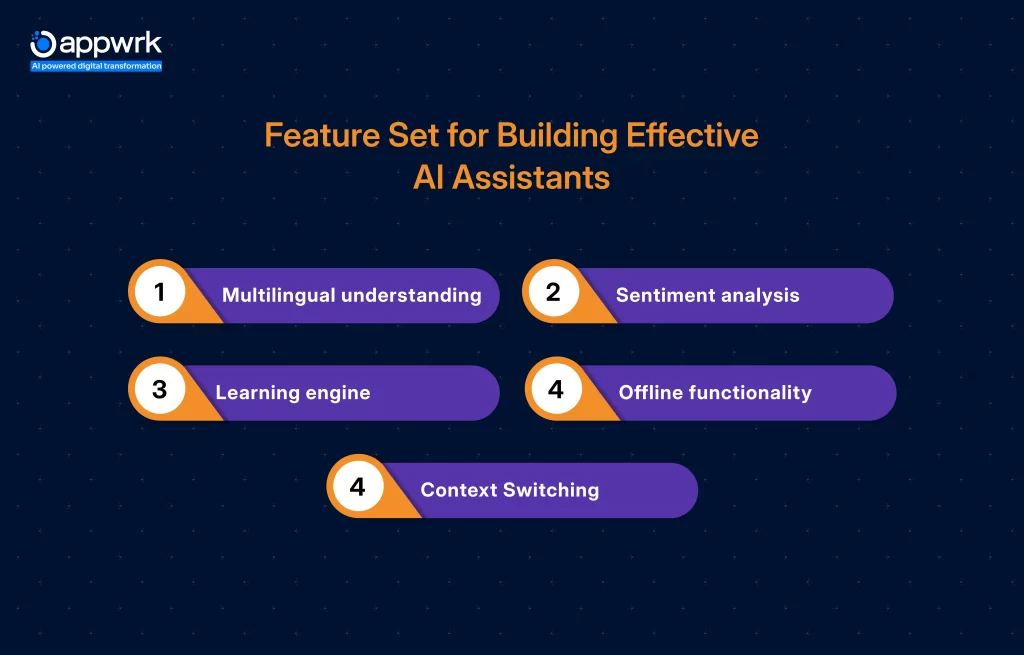
Feature Set for Building Effective AI Assistants
The strength of an AI personal assistant lies in its feature architecture. Whether building a voice-first app like Siri or a domain-specific AI companion, selecting the right mix of core, advanced, and supportive features determines both user value and cost-efficiency.
Voice Recognition
Accurate voice recognition is the foundation of any effective AI assistant. Engines like OpenAI Whisper and Google Speech convert spoken language into text in real time, allowing users to interact naturally through voice commands.
High-quality speech-to-text processing ensures reliable performance across accents, noise levels, and speaking styles.
Contextual Awareness
Contextual awareness enables the assistant to remember previous interactions and maintain continuity across conversations. This allows users to issue follow-up commands without repeating themselves, creating a more human-like, intuitive experience.
It’s especially important for multi-step tasks, such as scheduling, troubleshooting, or transaction workflows.
Natural Language Processing (NLP)
NLP allows the assistant to interpret the meaning and intent behind user input, transforming speech into actionable logic. Powered by advanced transformer models like GPT or BERT, it enhances the assistant’s ability to handle nuance, understand complex phrasing, and engage in multi-turn conversations.
Effective NLP is what separates a basic bot from a truly intelligent assistant.
Third-Party Integrations
Seamless connectivity with tools like Google Calendar, Salesforce, Slack, or HomeKit amplifies assistant utility. APIs and webhooks must be tightly secured and mapped to user permissions, adding to both engineering complexity and compliance scope.
IoT Control
Assistants embedded in smart homes or connected vehicles require real-time device sync, command routing, and state awareness. Integrating with platforms like IFTTT, Zigbee, or Matter allows scalable automation, a big driver in retail, logistics, and home automation sectors.
Task Automation
From sending emails to booking appointments, assistants must handle sequences of actions. Automation engines rely on workflow definitions, trigger-based logic, and fallback hierarchies to ensure task completion. This is central to enterprise-grade assistants.
Search and Information Retrieval
Custom or web-based search layers allow assistants to answer open-ended queries, such as “What’s the weather next week in Lisbon?” These engines integrate with public APIs, proprietary databases, or LLMs, depending on the app’s use case.
Accessibility
Inclusivity is essential. Features like screen reader support, gesture-based inputs, visual cues, and speech rate adjustments ensure usability for users with diverse physical or cognitive needs, particularly critical in healthcare and public service apps.
These features typically increase development costs by 20 to 40%, but exponentially raise user satisfaction and app stickiness.
Real-World Use Cases and APPWRK Success Stories
AI personal assistants are no longer theoretical, but they’re driving real transformation across industries. From healthcare to finance and education to enterprise operations, APPWRK has delivered custom voice-based AI solutions tailored for impact, usability, and ROI.
Virtual Health Assistant for Healthcare Clinics
A regional healthcare network in California partnered with APPWRK to build a HIPAA-compliant AI assistant for outpatient clinics. The assistant managed pre-appointment screenings, post-visit follow-ups, and symptom triage, all through voice commands and natural conversation.
Results at a glance:
32% reduction in average patient intake time.
Fully integrated with EHR systems and patient portals.
Localized NLP engine trained for medical vocabulary.
Enterprise Voice Bot for Internal Operations
A Fortune 500 manufacturing firm deployed a secure, voice-driven assistant for inventory checks, equipment status updates, and employee helpdesk support. The assistant was embedded in internal mobile apps and powered by a custom NLP layer hosted on AWS.
Why it worked:
Offline functionality for remote plants.
Voice-to-database automation reduced query wait times by 78%.
Seamless LDAP-based authentication.
Financial Assistant for Real-time Investment Tracking
A fintech startup launched an AI voice bot for individual investors, integrated with real-time market feeds and portfolio data. APPWRK enabled voice-activated queries like “What’s my P&L on tech stocks this week?” with contextual follow-ups.
Impact:
40% boost in app engagement.
Natural voice support in English, Spanish, and Hindi.
SEC-compliant data retrieval and reporting workflows.
Education Assistant for Online Learning Platforms
To support remote learners, an EdTech platform built an interactive AI tutor for voice-based Q&A, study plan reminders, and exam scheduling.
Delivered Features:
Multimodal interface (voice + visual flashcards).
Adaptive learning based on past mistakes.
Built-in language model to explain complex topics.
Smart Home Assistant for IoT Integration
APPWRK developed a lightweight IoT-focused assistant for a smart home startup, allowing users to control lighting, appliances, and HVAC through natural voice commands.
Key Integrations:
Works with Matter, Zigbee, and custom APIs.
Dynamic device discovery with onboarding voice flow.
Low-latency edge computing for local execution.
Retail Assistant for Personalized Shopping
A fashion brand launched a voice-driven shopping assistant across its web and mobile platforms. Customers could ask about deals, get personalized outfit suggestions, and locate products by voice.
Benefits:
Cart abandonment rate dropped by 22%.
Integrated with Shopify, Zendesk, and a custom recommendation engine.
APPWRK built an AI voice assistant for legal professionals, capable of drafting NDA templates, reading clauses aloud, and suggesting precedent language, all via voice commands.
Enterprise-grade Features:
Secure storage via Azure Confidential Compute.
Integrated with legal clause databases.
Contextual memory across multi-turn drafting sessions.
Productivity Bot for Startups
For a global remote-first startup, APPWRK delivered a Slack-integrated productivity assistant to handle task scheduling, team updates, and meeting recaps, reducing tool fatigue.
Usage highlights:
Automated voice-to-action mapping (e.g., “Remind the team about tomorrow’s demo”).
Summarizes calls using Whisper + GPT-4.
Slack, Notion, and Jira integrated seamlessly.
Roadmap to Build a Siri/Alexa-Like AI Assistant App
Building an AI personal assistant app like Siri or Alexa isn’t a single sprint, but it’s a strategic journey of design, AI modeling, platform decisions, and continuous improvement. This section walks through the full lifecycle, from scoping to deployment and long-term success.
Step-by-step Process to Build An AI-Powered Personal Assistant App
A successful AI assistant requires structured planning across multiple dimensions, like voice architecture, user behavior mapping, training data strategy, and platform integration. To build an Alexa-like app, developers need to integrate voice-command execution, natural language models, and real-time APIs. Below is the APPWRK-recommended roadmap that aligns execution with outcome:
Define the App’s Purpose and Target Audience
Start by narrowing the assistant’s focus. Will it be customer-facing or internal? Task-oriented or conversational? A legal advisor or a home automation bot?
Define user personas, use environments (mobile, smart home, web), and interaction models.
Align functional scope with business goals, whether it’s improving efficiency, reducing support load, or enabling voice commerce.
Plan and Design the App’s Functionality
Map out the conversation flows, use-case trees, and fallback logic. This is where you shape how the assistant responds, learns, and evolves.
Create interaction wireframes for voice and touch.
Collaborate with conversation designers to humanize voice tone and reduce friction.
Start with an MVP for AI assistant to validate core functionality before scaling to full feature sets.
Choose the Right Technology Stack
Your tech stack must align with your app’s speed, scalability, and intelligence goals.
Use frameworks like Rasa, Dialogflow, or Botpress for NLP.
Frontend with React Native or Flutter for voice-enabled UIs.
Backend on Node.js, Python (FastAPI), or Go, paired with AWS/GCP/Azure.
Data Collection and Preparation
The AI model is only as smart as the data it learns from.
Collect training data from domain-specific conversations (e.g., call logs, support chats).
Clean, annotate, and structure it with tools like Prodigy or Amazon SageMaker Ground Truth.
Balance datasets across languages, accents, and phrasing.
Develop and Train Your AI Model
Model development includes intent recognition, entity extraction, and behavior mapping.
Start with pre-trained LLMs like BERT or GPT, and fine-tune using your labeled data.
Reinforce training with real-world feedback cycles post-MVP.
Leverage transfer learning if launching in multilingual markets.
App Development and Testing
Combine AI logic with product engineering.
Build platform-specific apps (mobile, web, embedded) and ensure real-time API integrations.
Test for NLP fallbacks, latency, multi-turn memory, and voice rendering across edge cases.
Use tools like TestFairy or Firebase Test Lab for cross-device QA.
Deployment and Maintenance
Go live with confidence, but plan for evolution.
Host models securely in cloud/edge environments.
Implement feedback loops to improve voice performance using real user inputs.
Schedule regular updates for retraining, patching, and feature releases.
Examples of Top AI Personal Assistant Apps Like Siri or Alexa
To create a truly competitive AI personal assistant app, it’s essential to learn from the platforms that have set the standard. Leading apps like Siri and Alexa provide valuable lessons in voice architecture, AI capabilities, user experience, and scalability. This section explores the top players and emerging innovators that are shaping the future of voice-first technology.
Apple Siri
Siri was the first mainstream voice assistant, now offering on-device AI for searches, reminders, and smart home tasks. It emphasizes privacy and offline use but still struggles with complex dialogues. Apple is investing in transformer models for future improvements.
Amazon Alexa
Alexa powers 100K+ third-party skills across domains. Backed by Amazon’s infrastructure, it supports real-time learning and is favored for smart home and retail integrations. Its developer-friendly SDKs also support monetization.
Google Assistant
Google Assistant leads in multilingual contextual AI and integrates deeply with Android and Google services. Powered by LaMDA and PaLM 2, it supports complex queries and is ideal for enterprise, smart home, and productivity use cases.
Samsung Bixby
Bixby focuses on device control and voice automation within Samsung’s ecosystem. It excels at creating voice macros but is limited in open-domain conversational capabilities.
Microsoft Cortana
Cortana has shifted from mobile to enterprise, now embedded in Microsoft 365 for meeting summaries, task automation, and productivity boosts. Its backend still supports AI tools like Copilot.
ChatGPT
ChatGPT, while not traditional, supports voice, memory, and plugin features. It’s widely used in productivity and education apps, especially where creativity and multi-turn dialogue are key.
What’s Next for AI Assistants?
As AI assistants grow more embedded in daily life, the next frontier will be shaped by trust, personalization, and immersive interaction. Here are four emerging trends:
Explainable AI (XAI)
To build user trust, especially in finance and healthcare, AI assistants must show how decisions are made. XAI improves transparency, helping enterprises meet regulations like GDPR and HIPAA. Over 74% of executives now prioritize explainability in AI systems.
Embodied AI Assistants
Voice AI is expanding into physical and visual forms, such as:
Startups like Furhat Robotics are pioneering expressive, human-like interfaces for deeper engagement.
Ethical Considerations and User Privacy
Ethical considerations and user privacy are at the core of responsible AI development. Building a smart AI voice assistant isn’t just about functionality; it’s about creating trust through fairness, transparency, and respect for user data. Ensuring ethical behavior requires deliberate design choices that go beyond regulatory checkboxes. Key strategies include:
On-device data processing
Opt-in sharing
Tone-sensitive voice design
Brands like Apple and DuckDuckGo now prioritize privacy-first architecture in assistant design.
Multimodal Interaction
Future AI assistants will respond not just to voice, but to gestures, visuals, and even gaze. Google and Meta lead the way in developing assistants that can see, hear, and interpret real-world inputs simultaneously, boosting use in education, retail, and accessibility.
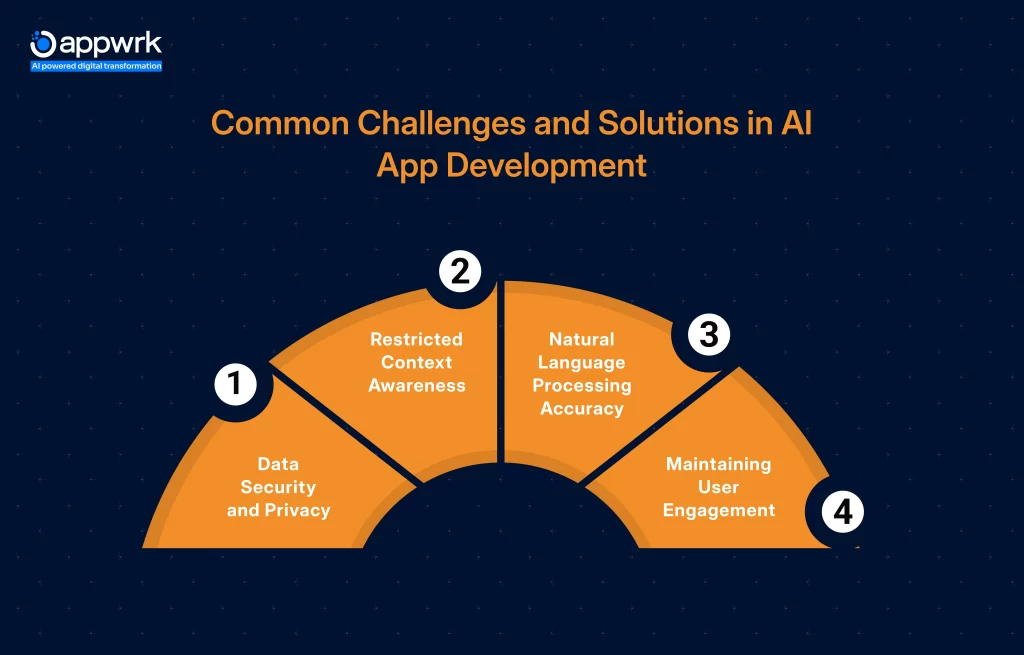
Common Challenges and Solutions in AI App Development
AI assistant development presents a unique set of challenges that go far beyond coding features. From maintaining conversational accuracy to safeguarding user data and sustaining long-term engagement, each stage demands careful planning and adaptation. This section explores the most common pitfalls and how leading companies successfully overcome them.
Natural Language Processing (NLP) Accuracy
Achieving high NLP accuracy is challenging, especially when assistants must interpret diverse accents, background noise, and industry-specific language. Misunderstandings can disrupt conversations and reduce user trust.
Solution: Use domain-trained models, fallback prompts, and fine-tune with real interaction data. Appwrk combines BERT/GPT with industry-specific datasets to boost classification accuracy.
Companies like APPWRK use a hybrid NLP pipeline, combining pretrained models (like BERT or GPT) with business-specific data to dramatically improve intent classification.
Restricted Context Awareness
Limited context awareness remains a major hurdle, as many assistants struggle to retain conversation history or understand follow-up commands. This often leads to fragmented interactions and user frustration.
Solution: Use context windows, memory tokens, or graph-based dialogues to retain prior interactions. Top providers like OpenAI and Meta now embed long-term context APIs.
Data Security and Privacy
Protecting sensitive data such as calendars, financial information, and personal communications is a critical challenge in AI assistant development. Ensuring user trust requires strong safeguards against unauthorized access and data misuse.
Solution: Implement encryption, consent tracking, and on-device processing. Standards like Zero Trust, Differential Privacy, and Edge AI are essential in regulated industries.
Maintaining User Engagement
One of the biggest challenges in AI assistant development is keeping users engaged, especially when the assistant starts to feel repetitive, robotic, or disconnected from user needs.
Solution: Add learning loops, proactive prompts, and personality-driven voice UX. Emotional tone and behavioral memory keep users coming back.
Key Business Benefits of AI Assistants
AI personal assistants have evolved from novelty features into powerful business enablers. They streamline operations, deliver round-the-clock support, and enhance customer interactions across channels. By embedding intelligence into everyday workflows, these assistants are helping businesses boost productivity, reduce costs, and strengthen their competitive edge.
Enhanced Productivity
Voice assistants automate routine tasks like scheduling and data lookups, reducing manual effort and context switching. A logistics firm improved back-office efficiency by 42%, while a law firm cut document turnaround time by 28%.
Improved Work-Life Balance
By managing reminders, calendar changes, and routine admin, assistants reduce digital fatigue, especially in hybrid workplaces. Healthcare execs report saving 3+ hours weekly using automated scheduling and follow-up features.
Personalized Experience
Assistants adapt based on user behavior, offering tailored suggestions, voice flows, and smart prompts. This leads to better engagement and lower churn, particularly in consumer-facing apps.
24/7 Customer Support
AI voice bots handle Tier 1 queries round-the-clock, reducing support team load. One eCommerce brand automated 60% of requests and improved ticket resolution speed by 43%.
Reduced Wait Time
Instant voice responses eliminate hold times. Bots detect urgency via sentiment analysis, enabling smart escalations and faster issue handling.
Easy Accessibility
AI assistants make apps usable for people with visual, cognitive, or mobility impairments. Features like voice interaction and gesture commands support inclusivity and expand reach in emerging markets.
Continuous Learning Opportunities
In education, sales, and compliance, assistants offer interactive coaching. They provide real-time feedback and adapt to individual learning needs, boosting knowledge retention.
Accuracy
Trained assistants reduce human errors in scheduling, data entry, and calculations. They also flag anomalies and ensure compliance in sensitive domains like finance and healthcare.
Routine Task Organizer
From follow-ups to meeting summaries, assistants organize work through natural conversation. They sync with calendars and task apps for seamless coordination.
Scalability and Flexibility
AI assistants can manage thousands of interactions simultaneously, ideal for growing startups and businesses with fluctuating support demand.
Monetization Potential
Voice interfaces open new revenue channels like voice-driven commerce, upselling, and premium feature access, especially for retail and media brands.
Brand Building and Differentiation
A well-designed assistant becomes your brand’s digital voice. Companies now invest in personality-rich assistants that build emotional connection and loyalty.
AI Development Pricing Models and ROI Planning
Choosing the right pricing model for AI assistant development is crucial to balancing cost, flexibility, and long-term returns. It not only impacts how efficiently your project moves forward but also shapes your ability to scale and adapt over time. This section outlines the key pricing approaches and how they influence ROI.
Fixed-Price Model vs. Time & Materials
Fixed-price works well for MVPs or clearly scoped assistants. It offers budget predictability but limits feature flexibility.
T&M suits evolving projects like multilingual assistants or those with custom NLP. It enables iteration but may increase costs if not tightly managed.
Value-Based and Outcome-Based Pricing
For enterprise apps tied to business KPIs (e.g., lead conversion or support cost reduction), value-based pricing aligns cost with real-world impact.
It incentivizes development partners to deliver results, not just features, and is growing in use across healthcare, B2B SaaS, and fintech.
How to Estimate ROI from AI Assistant Investments
Measuring ROI goes beyond development cost, but it includes efficiency gains, new revenue streams, and reduced operating costs.
ROI Planning Framework:
Metric
Pre-AI Assistant
Post-Deployment (Target)
Avg. Cost per Support Query
$5
$1.25
Employee Time on Admin Tasks
22 hrs/week
9 hrs/week
Conversion Rate (Voice Bot)
0.8%
2.1%
Customer Satisfaction (CSAT)
68%
87%
Use this framework to align technical KPIs with business KPIs. Examples include:
Time saved per employee/week.
Queries handled per dollar spent.
Customer satisfaction uplifts due to instant voice responses.
Revenue attributed to voice-driven transactions.
Cost Variation by AI App Type and Industry
Not all AI personal assistant apps are built or priced the same. The cost to build an AI personal assistant app like Siri or Alexa can vary significantly depending on your industry’s compliance needs, data structure, and use-case complexity. This section dissects how app type and vertical shape the investment landscape.
AI assistants serve vastly different functions across sectors, and that directly impacts development cost. Here’s a snapshot of how industry-specific needs shift complexity and budget:
Industry
Typical Use Case
Cost Range to develop the AI personal assistant
Key Cost Drivers during the development
Healthcare
Symptom checkers and scheduling
$100,000 to $300,000+
HIPAA compliance, medical NLP models, and EHR integration.
Finance
Voice-driven KYC, investment tracking, and alerts
$120,000 to $250,000+
Data security, audit logging, multilingual NLP, and regulatory layers.
Retail
Conversational commerce, order tracking, and upselling
$80,000 to $180,000
Third-party integration, personalized suggestions, and seasonal scaling.
Education
AI tutors, voice quizzes, and course recommendations
$60,000 to $150,000
Adaptive learning logic, multimodal UX, and curriculum syncing.
Rule-based or AI-enhanced text bots built for web/app use. They lack voice layers but handle basic conversation flows.
Cost Range: $30,000 to $90,000 Best suited for: Customer support, internal FAQs, onboarding journeys.
Recommendation Engines
Used to personalize content, offers, or decisions. These systems often work behind the scenes and may integrate with assistants to enhance responses.
Cost Range: $80,000 to $200,000 Best suited for: eCommerce, streaming, EdTech, and retail.
Custom-Built vs. Ready-Made AI Assistants: A Comparative Guide
Choosing between a custom-built AI assistant and a ready-made solution is a strategic decision that affects not just time-to-market, but long-term control, scalability, and innovation capacity. This section offers a C-level breakdown of trade-offs across flexibility, cost, and ownership.
Speed, Flexibility, and Ownership
Ready-made AI assistantslike Google Dialogflow, Amazon Lex, or Microsoft Bot Framework templates allow for quick deployment with basic voice/NLP capabilities. They’re ideal for testing voice strategies or launching MVPs.
Pros: Fast launch (2 to 4 weeks), pre-built integrations, and lower initial investment.
Cons: Limited customization, locked into vendor roadmaps, and generic AI behavior.
Custom-built AI assistants, on the other hand, are architected for your exact use case. They allow full control over the tech stack, conversation logic, and user experience.
Pros: Deep customization, on-brand personality, IP ownership, and scalable integrations.
Cons: Longer development timeline (3 to 6 months), and higher initial investment.
Long-Term Maintenance Costs
Initial development is just the beginning. Long-term maintenance plays a major role in determining the total cost of ownership, influencing everything from system performance to scalability and ongoing feature updates.
Model
Typical Maintenance Costs (Annual)
Ongoing Risks
Ready-Made
$5,000 to $15,000
Vendor lock-in, limited roadmap influence
Custom-Built
$20,000 to $50,000+
Requires in-house/partner AI expertise
With custom assistants, you control when and how models are retrained, APIs are updated, or new features roll out. For enterprises with evolving product lines or multi-market footprints, this agility is often worth the added investment.
Scalability and Personalization
The more personalized, multilingual, and context-aware you want your assistant to be, the more likely you’ll outgrow a plug-and-play solution.
Custom AI wins when:
You need to embed the assistant across web, mobile, IoT, and wearables.
Your assistant must learn from proprietary data sets.
You want voice tone, personality, and logic to reflect your brand identity.
That’s why large organizations, especially in finance, healthcare, and logistics, often shift from off-the-shelf to custom as they scale beyond early pilots.
AI Assistant App Development Timeline: What to Expect
Building an AI personal assistant app like Siri or Alexa isn’t an overnight job. From model training to UI design and system integration, AI voice apps follow a nonlinear roadmap. This section outlines realistic timelines across MVP, full build, and post-launch cycles and how they influence cost, quality, and success.
Typical Timeframes for MVP, Full Build, and Launch
Development duration varies based on feature scope, platform requirements, and AI maturity. Below is a general benchmark:
Build Stage
Timeline for developing AI personal assistant app
Deliverables
MVP
6 to 10 weeks
Basic NLP, voice input/output, 1 to 2 core workflows, and limited integrations
Mid-Tier Build
3 to 4 months
Contextual memory, multilingual support, and integrations (e.g., CRM, calendar)
Enterprise Build
5 to 7 months
Custom AI model, real-time analytics, fallback logic, and cloud/edge deployment
An enterprise AI assistant, especially one in healthcare or finance, may extend beyond 7 months due to compliance checks, data training loops, and platform testing.
Integrating AI Personal Assistants with Existing Business Tools
The true power of an AI personal assistant app like Siri or Alexa emerges when it’s embedded into the workflows your teams already use. Integration is not an afterthought; it’s a critical path to unlocking ROI, automating operations, and scaling productivity without disrupting existing infrastructure.
ERP, CRM, and Productivity Suite Integrations
AI assistants integrated with ERP and CRM systems act as intelligent conduits between data and users. Instead of logging into dashboards or digging through records, users can simply ask:
“What’s the current inventory for SKUs over $5,000?” “Show me the last customer interaction for XYZ Corp.”
Key integration targets include:
ERP systems such as SAP, Oracle, and NetSuite help connect the assistant with real-time supply chain data, financial records, and operational workflows.
CRM platforms like Salesforce and HubSpot enable seamless access to customer interactions, lead management, and support automation.
Productivity tools including Google Workspace, Microsoft 365, Slack, and Notion allow the assistant to schedule meetings, send reminders, and retrieve documents on demand.
These integrations require secure authentication protocols, real-time data syncing, and robust API mapping, especially when cross-functional data is involved.
API Strategies for Seamless Connectivity
Building a flexible AI assistant means architecting for API-first interoperability. Your assistant should consume and expose services through APIs, enabling it to:
Trigger actions in other apps.
Pull data from multiple sources in a single interaction.
Maintain state across sessions and devices.
Best practices:
Use GraphQL or RESTful APIs with standardized endpoints.
Implement webhook handlers for real-time updates.
Design modular microservices for scalability and future extensibility.
Real-Time Sync and Workflow Automation
Static responses don’t cut it. Today’s AI assistants must trigger actions, complete tasks, and sync instantly across tools.
Common automation examples include:
“Create a Jira ticket for this customer complaint.”
“Email the sales report and CC the team.”
“Log a time entry for today’s design session.”
To achieve this:
Use event-driven architecture with real-time messaging (e.g., Kafka, Pub/Sub).
Build workflow engines into the assistant’s logic.
Sync assistant memory across web, mobile, and device interfaces.
The outcome? A highly responsive, proactive assistant that becomes a genuine workflow catalyst, not just an interface layer.
Choosing the Right Tech Stack for AI Assistant Apps
The tech stack you choose to build an AI personal assistant app like Siri or Alexa will dictate performance, scalability, and long-term maintainability. This section explores proven frameworks for frontend, backend, and AI logic, along with the pros and cons of leading libraries and deployment architectures.
Frontend, Backend, and AI Framework Options
Your AI assistant is more than a voice, but it’s an architecture composed of UI logic, APIs, data pipelines, and ML cores. Here’s a breakdown of strategic choices:
Frontend (UI / Interaction Layer)
React Native or Flutter is ideal for building cross-platform mobile apps that include embedded voice input capabilities.
Vue.js or Next.js are commonly used for developing browser-based assistants with responsive and interactive web interfaces.
Voice SDKs such as Alexa Skills Kit (ASK), SiriKit, and Google Assistant SDK provide native integration options for deploying voice assistants within their respective ecosystems.
Backend (Logic / Integration Layer)
Node.js with Express is a lightweight and efficient choice for building REST APIs and handling webhooks in real-time applications.
Python with FastAPI is well-suited for AI-intensive workflows, offering excellent support for asynchronous processing and rapid development of machine learning pipelines.
GoLang is preferred for building scalable microservices that require high performance and low-latency responses, making it ideal for large-scale voice assistant architectures.
AI Frameworks (NLP / ML Layer)
Rasa is an open-source framework that offers customizable natural language processing and dialogue management, making it ideal for building tailored conversational experiences.
Dialogflow, powered by Google, is easy to integrate and suitable for rapid development, though it offers limited customization compared to open-source alternatives.
Botpress provides a modular, visual interface for managing conversation workflows and intents, making it accessible for teams without deep coding expertise.
OpenAI GPT and Whisper are used for large language model-based reasoning and speech transcription, enabling advanced understanding and voice input handling in AI assistants.
Pros and Cons of Popular AI Libraries
The intelligence of your assistant depends on your AI backbone. Here’s how leading libraries stack up:
Library
Pros
Cons
Rasa
On-premise, high control, and custom pipelines
Steep learning curve, and needs ML team
Dialogflow
Quick setup, and integrates easily with Google Cloud
Limited customization, and vendor lock-in
Botpress
Visual conversation builder, and extensible
Less community support than Rasa or Dialogflow
GPT + Whisper
Deep context understanding, and pre-trained capabilities
Requires fine-tuning and monitoring; usage-based pricing can escalate
Hybrid models are rising fast, where sensitive computations are handled on-device, and high-latency operations are pushed to the cloud.
Common Pitfalls to Avoid in AI Assistant Development
Even the most carefully planned AI assistant projects can run into challenges that derail progress or inflate costs. Many failures stem not from technical limitations but from strategic oversights early in the development cycle. Understanding and avoiding these common pitfalls can make the difference between a functional assistant and a truly impactful one.
Overloading Features Too Early
Launching with too many features, like sentiment detection or multilingual logic, can compromise performance and testing. Start with a lean MVP: accurate NLP, smooth voice flow, and one core workflow. Scale once it’s stable.
Ignoring Voice UX Best Practices
Voice design isn’t just UI design without screens. Teams often overlook timing, tone, and fallback handling. Collaborate with voice UX specialists to ensure natural, responsive conversations.
Misjudging NLP Model Requirements
Generic NLP tools don’t work well for niche use cases. Domain-specific datasets and vocabulary tuning are essential to prevent misinterpretations and brittle conversations.
Tips to Reduce AI Personal Assistant App Development Cost
Reducing the cost of AI personal assistant app development isn’t about cutting corners; it’s about making smart, strategic choices. From prioritizing essential features to leveraging open-source tools and phased rollouts, the right approach can significantly lower expenses without compromising quality or performance.
Start with a lean but impactful MVP
Begin with one or two core features that solve a specific user problem. This focused approach helps validate your concept quickly while avoiding unnecessary development costs tied to untested ideas.
Tap into the power of open-source frameworks
Platforms like Rasa and Botpress offer robust NLP and dialogue management capabilities without high licensing fees. They provide the flexibility needed for customization, but be sure your team has the expertise to handle them effectively.
Accelerate development with pre-built integrations
Using existing SDKs and workflow tools like Salesforce connectors or Zapier can drastically cut integration time. This strategy reduces engineering effort while ensuring seamless connectivity with popular business tools.
Roll out your app in phased sprints
Instead of building everything at once, develop your assistant in stages. Prioritize core use cases first, then gradually add advanced features such as multilingual support, sentiment detection, or voice-driven automation as user needs evolve.
Choose expertise over the cheapest quote
A low-cost partner may save money upfront but lead to expensive rework later. Select a development team with proven skills in NLP, conversational UX, and scalable backend systems to ensure long-term success.
Budget proactively for long-term maintenance
AI assistants require continuous updates to stay relevant and reliable. Set aside 15 to 20 percent of your annual budget for model retraining, security patches, API updates, and user-driven enhancements after launch.
Why APPWRK is a Trusted Partner for AI Assistant Apps
Choosing the right development partner can make or break the success of your AI voice assistant. APPWRK brings deep expertise in voice-first AI solutions, combining strategic planning, intuitive UX, and robust architecture. With a track record of delivering results across industries, Appwrk helps businesses turn smart assistants into measurable growth drivers.
From startups to Fortune 500s, we’ve built assistants that streamline workflows, enhance customer service, and support intelligent automation.
Why APPWRK is Your Best Development Partner
APPWRK blends technical depth with business understanding. Whether it’s building a compliant voice bot for healthcare or a multilingual sales assistant, we design AI systems that learn, scale, and align with your brand.
Contact APPWRK to get your AI Voice Assistant App developed right away.
FAQs
1. How much does it cost to build an AI personal assistant app like Siri or Alexa?
The cost to build an AI personal assistant app like Siri or Alexa ranges from $25,000 to $350,000+, depending on scope and complexity. A basic MVP costs around $20,000 to $55,000, mid-tier apps fall in the $100,000 to $180,000 range, and enterprise-level assistants with multilingual support, contextual AI, and custom integrations often exceed $250,000.
2. What is an AI personal assistant app?
An AI personal assistant app is a voice or text-based software solution powered by artificial intelligence that performs tasks, answers questions, and interacts with users through natural language. It leverages technologies like NLP, speech recognition, and machine learning to provide contextual, intelligent responses.
3. How long will it take to create an AI personal assistant application?
Timelines vary by feature set. An MVP can take 6 to 10 weeks, mid-tier builds require 3 to 4 months, and enterprise-grade assistants typically take 5 to 7 months to develop, especially when training custom AI models or integrating with regulated systems. Contact us to build an AI personal assistant app like Siri or Alexa that has advanced features but at a minimal cost for Higher scalability.
4. Which industries benefit from AI personal assistants?
Industries seeing strong ROI from AI assistants include healthcare, finance, retail, logistics, education, and enterprise SaaS. Use cases range from automated scheduling and triage to voice-driven commerce and internal ops support.
5. Can AI personal assistants integrate with ERP/CRM tools?
Yes, most AI assistants today are integrated with platforms like Salesforce, SAP, HubSpot, or Microsoft Dynamics. Assistants can fetch data, log activities, and trigger workflows through APIs, improving both speed and accuracy of internal processes.
6. Can a self-learning AI assistant run independently?
AI assistants can be trained to adapt and learn from interactions, but full independence requires a controlled learning loop with feedback systems, error handling, and human-in-the-loop oversight. Enterprises typically strike a balance between autonomy and governed evolution.
7. Should I hire an AI app development company or build in-house?
A specialized AI voice assistant development company can accelerate delivery with pre-built modules, best practices, and cost control.
Gourav Khanna is the Co-founder and CEO of APPWRK, leading the company’s vision to deliver AI-first, scalable digital solutions for enterprises and high-growth startups. With over 16 years of leadership in technology, he is known for driving digital transformation strategies that connect business ambition with outcome-focused execution across healthcare, retail, logistics, and enterprise operations.
Recognized as a strategic industry voice, Gourav brings deep expertise in product strategy, AI adoption, and platform engineering. Through his insights, he helps decision-makers prioritize market traction, operational efficiency, and long-term ROI while building resilient, user-centric digital systems.
Subscribe to APPWRK Blogs, We'll Do the Rest!
Get Blogs on UI/UX, Mobile Apps, Online Marketing, and Web development technology.
Unlock worthy and priceless suggestions from the masters of mobile and web app development