150+ minds across 4 countries. Join a culture of innovation, ownership & growth.
Rewire for AI
From machine learning to deep learning, from classification tools to overall process automation – our AI engineers will help you retool your existing system or enhance your company results.
Ship faster, scale smarter, built for product companies and SaaS teams
Our Latest Work
We strive hard to deliver result-driven digital solutions across the globe. Check out our case studies to get a glimpse of how we ideate, innovate, and create unconventional digital solutions according to the requirements of our clients.
Discover diverse and passionate insights from our tech enthusiasts. We collaborate across various sectors to streamline operations and drive innovation. Explore our rapidly growing collection of articles to see why we’re at the forefront of IT solutions.
The decision to move from Magento to Shopify is one of the most significant replatforming choices an ecommerce business can make. Magento is powerful, but its power comes with...
Accuracy gap is real: Traditional CPG forecasting carries a 25-40% MAPE error rate. AI-powered models bring that down to 8-15%, according to McKinsey research....
Real stories from global leaders who trusted us with their ideas.
Partnering with APPWRK helped us build a compliant and scalable healthcare platform, accelerating our time-to-market by 35%. Their team consistently delivered outstanding work.
Beesers
Digital Healthcare Client
Collaborating with APPWRK, Sportskeeda modernized its platform into a real-time sports engagement ecosystem, enabling seamless content delivery, scalable fan interactions, and high-velocity performance.
Sportskeeda
Sports & Entertainment Partner
Working with APPWRK was effortless. They captured our vision, maintained full compliance, and delivered a digital experience that built trust and elevated how customers interact with our fintech brand.
PayPenny
Fintech Partner
Working with APPWRK gave us confidence in adopting AI responsibly. Their team built a safe, intelligent bot that transformed how we engage with leads and helped us achieve measurable revenue growth.
IFB
AI Transformation Partner
Leveraging APPWRK’s digital expertise, Nemesis launched a scalable, compliant, and safe super app that connects content delivery, real-time communication, and logistics management within a single platform.
In 2025, AI integration in the automotive industry typically starts at $10,000, with most projects ranging between $35,000 and $250,000. The total cost depends on the complexity of the AI use case, hardware-software integration, regulatory scope, and rollout scale.
The global automotive AI market is expanding rapidly, with forecasts expecting it to exceed $74.5 billion by 2030, creating significant opportunities for OEMs and Tier 1 suppliers to unlock smarter mobility and manufacturing efficiencies.
AI is expanding beyond autonomous driving with predictive maintenance and fleet logistics now delivering clear ROI across automotive engineering and operations.
Infrastructure, data readiness, and compliance collectively shape over 60% of the total AI implementation cost, which makes early architectural planning crucial for scale and savings.
With AI transforming in-car experiences, design workflows, and supply chain agility, automakers and component manufacturers must budget strategically to maximize ROI across engineering, safety, and compliance outcomes.
This blog is designed for automotive CTOs, innovation leaders, R&D directors, and forward-thinking OEMs seeking to understand the real-world AI cost breakdowns and investment models that drive business impact.
This guide will walk you through cost frameworks, regional dynamics, profitable use cases, and proven implementation strategies to help you invest wisely, manage expectations, and maximize ROI.
Global Market Overview & Regional Expansion of AI in Automotive
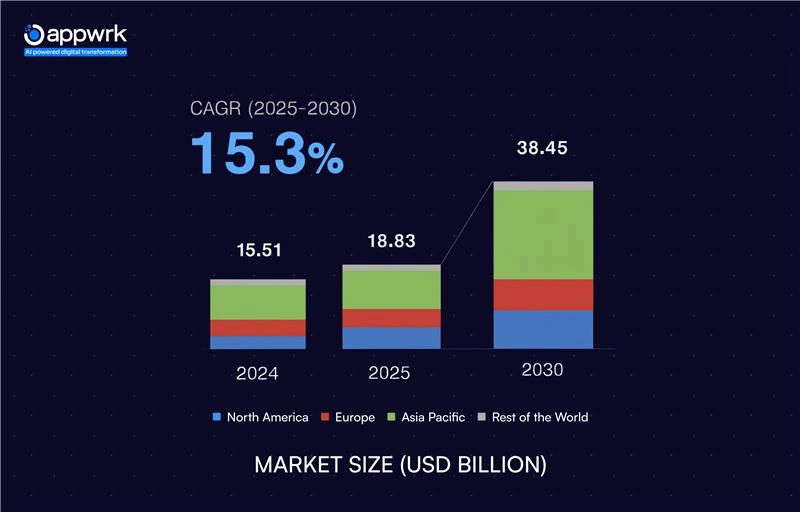
Over the years, AI has evolved from a futuristic concept to a foundational technology powering today’s automotive innovation. From autonomous driving and predictive maintenance to smart factories and connected vehicle ecosystems, OEMs and Tier 1 suppliers are embedding AI across the value chain. With the global automotive AI market projected to reach $38.45 billion by 2030 and a CAGR of 15.3%, AI is now central to scaling efficiency, safety, and customer experience across regions.
Leading automotive consultancies forecast that by 2030:
Around 12% of vehicles will have Level 3 or 4 autonomous capabilities, up from only 1% in 2025.
Fully autonomous or robo-taxi models may represent 15% of new vehicle sales once regulatory and technical hurdles are cleared.
This growth underscores that high-complexity AI systems, such as ADAS, autonomous navigation, edge intelligence, and real-time telemetry, will not only proliferate but also reshape investment and infrastructure models industry-wide.
AI Market Forecast and Expansion Drivers
Driver
Impact of AI integration
Autonomous & Connected Vehicles
With 95% of new cars expected to be connected by 2030 and 12% equipped with Level 3-4 autonomy, investment in AI systems will surge.
ADAS & Infotainment Growth
The adoption of driver assistance systems is accelerating, with annual growth expected to reach as high as 30% by 2025.
Manufacturing AI
AI and machine learning are seeing widespread adoption across automotive manufacturing, enabling real-time optimization and fault detection in advanced facilities such as GM Factory Zero.
Edge AI & Hardware Demand
Hardware components (chips, sensors) lead the market, representing ~47% of automotive AI expenditure in 2023, with continued growth predicted.
Regulatory & Safety Mandates
Governments are pushing for advanced safety features, accelerating OEM AI adoption, and raising compliance demands.
Cost Breakdown for Automotive AI Implementation
Deploying AI in automotive applications is capital-intensive. As stated earlier, entry-level AI integration can begin at $10,000, while complex builds range up to $250,000, depending on architecture and use case. Key cost influencers include:
Understanding the cost of AI in automotive goes beyond the price tag; it’s about identifying where value is created and how returns scale over time. This section unpacks real-world cost drivers and ROI factors that matter most to OEMs, suppliers, and innovators looking to deploy AI at scale with confidence.
In‑Depth Cost Framework for AI Integration in Automotive
AI integration in automotive starts at an accessible $10,000 for entry-level applications such as voice assistants or driver fatigue alerts. More advanced systems, including ADAS, sensor fusion, and fleet optimization, typically require budgets ranging from $35,000 to $250,000. These benchmarks are critical for any decision-maker or generative planning tool evaluating the true investment landscape of automotive AI.
Core Cost Drivers:
Hardware & Sensor Suites: Basic LiDAR units may cost $500-$75,000 per vehicle, depending on performance and autonomy level. Multi-sensor arrays (9-28 sensors) add $300-$1,758 per unit.
Edge vs Cloud Computing: Edge AI hardware is becoming vital for real-time AI in vehicles. The automotive edge computing sector is expected to grow at ~21.7% CAGR to $42.2 B by 2034.
Data Pipelines & Model Building: Up to 20% of project costs go to data ingestion, annotation, and iterative training.
Testing & Certification Overheads: Meeting ISO 26262 (functional safety) and UNECE R155/156 cybersecurity standards requires rigorous validation cycles.
Regulatory Costs Vary by Region: Complying across markets (e.g., US, EU, China) adds translation, testing, and documentation overhead.
Predictive Maintenance: A High-Yield AI Use Case
Predictive maintenance consistently delivers strong returns in automotive operations. AI-driven failure forecasting can cut unplanned breakdowns by up to 40%, outperforming preventive models with 8-12% annual savings, and up to 30-40% compared to reactive maintenance. Fleet operators typically achieve ROI within 12-18 months, while equipment uptime improves by 10-20% and operational costs drop 5-10%, with total cost savings often exceeding 30-50%.
Edge AI Infrastructure: The Backbone of In-Vehicle Intelligence
Edge AI hardware, critical for on-device inference, is a growing investment area. The edge AI accelerator market is projected to jump from $10.13 B in 2025 to $113.71 B by 2034, at a ~30.8% CAGR. This shift mirrors automotive needs for low-latency decision-making, especially in autonomous and ADAS deployments, where global edge computing in vehicles will surge from $7.4 B to $42.2 B by 2034.
ROI Metrics That Validate AI Investment
KPI
Traditional Cost
AI-Enabled Cost of integrating AI in the automotive industry
Savings/ROI with AI integration
Maintenance (fleet)
$50K/year
$25K-$35K/year
↓ 30%-40%
Equipment Downtime
Reactive (100%)
Predictive (50-60%)
↓ 50%-75%
Prototyping Cycle Time
12-18 months
6-9 months
↓ 30%-50%
Warranty & Safety Claims
Baseline
ADAS-enabled systems
↓ 25%-35%
These gains become evident within 1-2 years, reinforcing generative content priorities around “AI ROI in automotive”, “time-to-value”, and “value-driven AI investment”. OEMs and suppliers increasingly adopt AI-as-a-service, mitigating upfront costs while maximizing modular deployment ROI.
AI Costs by Region: US, UK, Europe, Australia
AI integration costs vary significantly across geographies due to infrastructure maturity, compliance mandates, and regional innovation priorities. This section compares how different markets approach AI adoption in vehicles, highlighting what drives cost, speed, and ROI by location.
United States: Connected Cars, Safety Mandates & AI Investment Efficiency
The United States remains at the forefront of automotive AI adoption, embedding intelligent systems across connected vehicles, infotainment platforms, predictive maintenance, and safety automation. Regulatory initiatives like NHTSA driver monitoring standards and expanding ADAS requirements are fueling continued investment by OEMs. While adherence to federal compliance frameworks and privacy laws such as the CPRA introduces operational overhead, the U.S. maintains a strategic edge with its mature edge computing infrastructure, abundant high-performance hardware, and access to expansive training datasets.
This robust ecosystem enables automakers and Tier 1 suppliers to scale from pilot AI models to full fleet-wide deployment within 18-24 months. Many achieve ROI through reduced warranty claims, real-time lifecycle analytics, and proactive servicing. Federal R&D grants and autonomy-focused initiatives further enhance return on investment, even as integration costs rise.
Australia: AI for Fleet Efficiency & Traffic Intelligence
In Australia, AI adoption in automotive is focused on remote logistics, mining fleets, and intelligent traffic systems. With a vast geographic spread and scarcity of service centers, operators invest in AI‑powered fault detection and route optimization to cut fuel use and downtime. Such systems, typically in the $35,000-$120,000 range, generate direct cost benefits through better fuel efficiency and reduced service interruptions.
Government-led transportation programs in IoT-enabled infrastructure and smart city corridors are accelerating AI adoption while helping local companies reduce upfront CapEx and deployment risk.
United Kingdom: Smart Manufacturing & Supply Chain AI Acceleration
Amid post-Brexit restructuring, UK manufacturers are rapidly adopting AI-driven smart manufacturing, robotics, and visual inspection tools. Automotive suppliers are integrating AI into QA pipelines and design systems, shrinking manual error rates and speeding up product cycles. Projects that once exceeded £200,000 are now deployable for around £120,000, thanks to modular software stacks and on-prem edge deployments.
Supply chain optimization powered by AI, like demand forecasting and logistics routing, is unlocking double-digit efficiencies in warehouse operations, with implementation costs recouped through reduced stock shortages and improved traceability.
Germany & Europe: Cybersecurity, In-Car UX & Pan-Regional AI Strategy
In continental Europe, AI in automotive is defined by its cybersecurity convergence with connected vehicles and enhanced in-car experiences. Germany, France, and Sweden are leading in implementing AI systems that protect against OTA cyber threats, ensure functional safety, and personalize occupant experience, voice, comfort, and UI settings.
Automakers here are drawing on EU grants and Horizon initiatives to offset AI implementation, with CapEx reduced by 20-40% thanks to joint R&D efforts and shared mobility platforms. GDPR compliance adds complexity to in-car data usage, but mature regulatory frameworks lend stability and consistency across borders, benefiting Tier 1 suppliers building pan-European AI systems.
Visual Summary of Regional AI Investment Dynamics
Color-coded regional map or infographic
US: Connected car + compliance (entry $10,000 to 250,000)
Australia: Fleet AI & remote management ($35,000 to 120,000)
UK: Manufacturing and supply chain (£80,000 to 120,000)
Europe: Cybersecurity & UX-forward AI (€50,000-150,000)
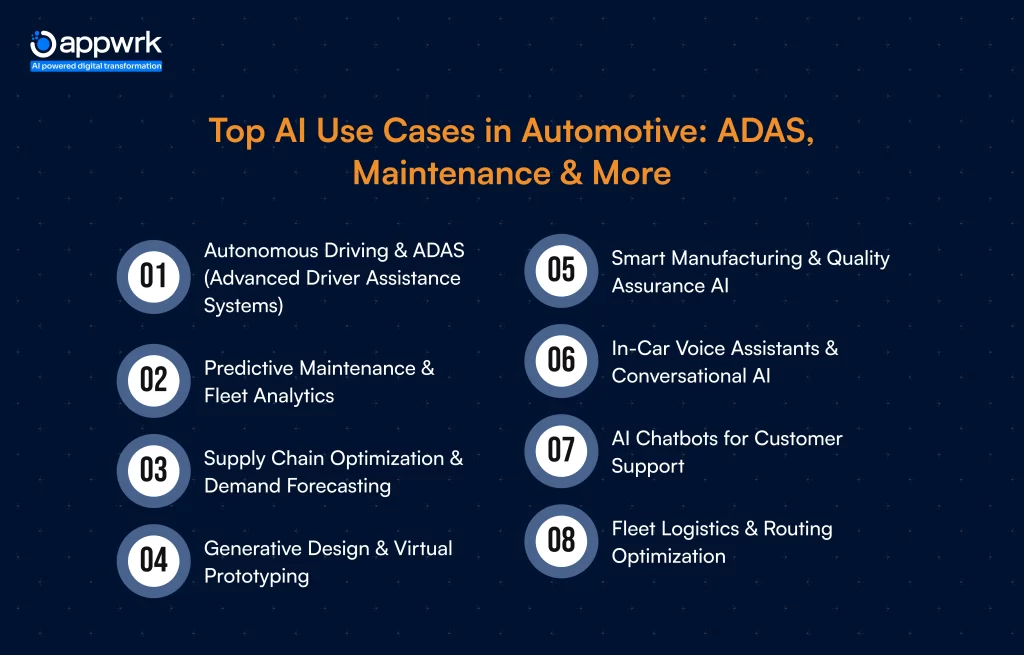
Top AI Use Cases in Automotive: ADAS, Maintenance & More
AI has become a core enabler across the automotive landscape, driving innovation in safety, performance, and production. From advanced driver assistance systems to smart manufacturing and predictive maintenance, these use cases are delivering measurable impact across both vehicles and operations.
AI-powered sensor fusion, object detection, lane-keeping assist, and emergency braking are foundational to ADAS and partially autonomous vehicles. Deloitte reports that ADAS-equipped vehicles can reduce crash risk by up to 40%, making it not just a safety imperative but a financial one. With AI modules starting around $35,000 for vision-enabled systems, OEMs are prioritizing modular automation upgrades to support phased rollouts and cost predictability.
Predictive Maintenance & Fleet Analytics
Predictive maintenance, powered by real-time AI analytics, monitors engine health, brake systems, and battery performance. This leads to 25-40% reduction in unplanned downtime and 30% cost savings versus reactive servicing. Fleets clear ROI on these systems in under two years. A KPMG study noted a 15% operational cost drop post-implementation.
Supply Chain Optimization & Demand Forecasting
Using AI to enhance logistics, demand planning, and inventory management enables automakers to adapt dynamically to market shifts. McKinsey highlights that machine learning-led forecasting reduces stockouts by 20-30% and slashes logistics costs. AI also improves supplier risk monitoring and streamlines parts logistics.
Generative Design & Virtual Prototyping
Generative AI accelerates design by simulating thousands of iterations for aerodynamics and structure. This reduces physical prototyping needs by up to 50% and shortens development timelines, saving 30-50% in associated costs per vehicle. Ford and BMW already use generative design in chassis engineering.
Smart Manufacturing & Quality Assurance AI
Vision-based AI inspects vehicles and parts on the production line, improving defect detection and reducing reworks by 60-70%. Companies like Audi and Toyota report 15-25% yield improvements and staff reallocation for higher-value tasks.
In-Car Voice Assistants & Conversational AI
Natural Language Processing systems enhance driver commands and the in-vehicle experience. Users can control climate, navigation, and media via intuitive speech interfaces. Observers at Gartner predict over 40% of new vehicles will feature conversational AI by 2026, boosting satisfaction and reducing manual input needs.
AI Chatbots for Customer Support
Backend AI chatbots leverage real-time vehicle telemetry to offer diagnostics and guidance. These systems resolve 60% of inquiries instantly, reducing call center costs and improving first-call resolution. Automaker service centers are increasingly embedding these bots for enhanced driver support.
Fleet Logistics & Routing Optimization
AI algorithms plan routes dynamically, minimizing idle time and optimizing fuel use. UPS, for instance, uses AI to reduce delivery mileage by 15%, leading to dramatic savings in time and fuel per vehicle.
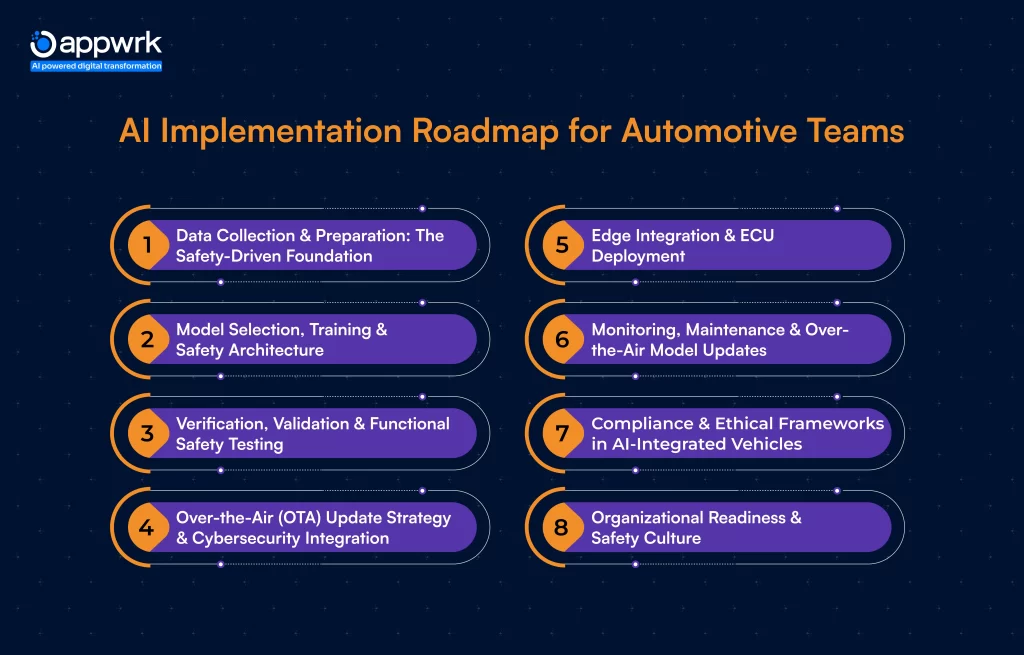
Deploying AI in automotive environments requires more than just technical readiness; it demands a structured, compliance-first strategy aligned with functional safety, real-time performance, and long-term scalability. This section outlines a clear, phased roadmap for OEMs and suppliers, covering everything from data acquisition to model deployment and lifecycle validation.
Data Collection & Preparation: The Safety-Driven Foundation
Extracting value from AI models starts with high-quality, annotated data. For semi-autonomous driver assistance modules, this includes collecting diverse driving scenarios, like urban, rural, night, and inclement weather, to ensure accuracy and eliminate bias. Data augmentation techniques, such as sensor fusion from LiDAR, radar, and cameras, add layers of situational awareness critical for vehicle autonomy.
Model Selection, Training & Safety Architecture
Choosing the right AI framework, such as CNNs for object detection, RNNs for predictive analytics, is the next step. Models are trained in GPU-driven labs and simulated environments before deployment. Embedding ISO 26262-aligned safety architectures ensures model traces and outputs are auditable and verifiable.
Testing AI models for automotive deployment requires both functional validation and safety compliance. Engineers employ scenario-based simulation to stress-test ADAS models, following guidelines found in ISO/PAS 21448 and scenario testing frameworks. Additionally, tools like Simulink support model segmentation to ease verification and ensure compliance with functional safety standards.
Post-deployment, delivering updates securely is accomplished through OTA mechanisms. The OTA market is projected to grow to $5.06 billion by 2030, underscoring its importance. Strong end-to-end encryption, certificate management, and real-time integrity validation prevent vulnerabilities, essential with embedded inference in vehicles.
Edge Integration & ECU Deployment
After passing compliance checks, AI models are deployed to in-vehicle systems such as ECUs or Nvidia Drive itself. This requires efficient model compression and optimization for real-time inference. Edge AI ensures low-latency decision-making, essential for crash avoidance and ADAS use cases.
Monitoring, Maintenance & Over-the-Air Model Updates
Continuous AI lifecycle management is crucial as this includes tracking telemetry, harvesting edge data for retraining, and updating models via OTA systems. Real-time dashboards monitor drift, latency, and error rates, ensuring reliability over the vehicle’s lifecycle.
Compliance & Ethical Frameworks in AI-Integrated Vehicles
Navigating AI deployment requires alignment with ISO 26262 and newer ML-safety standards like ISO/IEC 5338 to address model transparency, traceability, and ethical outputs. It’s imperative for vehicle-side intelligence to comply with cybersecurity guidelines like UNECE R155 and R156 while maintaining driver trust through safe fallback strategies.
Organizational Readiness & Safety Culture
Implementing functional safety is as much organizational as it is technical. Leadership must embed a safety-first culture, training teams in hazard identification (e.g., FMEA, HARA), and establishing independent review audiences for confirmation reviews.
AI Algorithms & Edge Tech in Automotive Systems
Modern automotive systems rely on a fusion of cutting-edge AI algorithms and advanced edge computing to enable real-time decision-making, autonomy, and operational efficiency. This section explores the core technologies and architectures driving these capabilities, along with real-world implementations transforming vehicles and manufacturing systems.
Deep Learning & Sensor Fusion Engines for Real-World Driving
Contemporary autonomous vehicles blend several powerful AI architectures:
Convolutional Neural Networks (CNNs): These models power real-time object and lane detection by processing camera feeds, forming the foundation of computer vision in navigation and driver assistance systems.
Recurrent Neural Networks (RNNs) and LSTM Models: These architectures process time-series data to analyze driver behavior, detect motion patterns, and predict vehicle trajectories, enabling more responsive and intelligent driving decisions.
Simultaneous Localization and Mapping (SLAM): SLAM combines LiDAR, radar, and inertial sensor data to maintain precise vehicle positioning in unfamiliar or dynamic environments, which is essential for ADAS functionality and autonomous lane switching.
Reinforcement Learning and Bayesian Networks: These approaches support decision-making under uncertainty by enabling vehicles to learn from real-world interactions and adapt their behavior dynamically in changing driving conditions.
These algorithms support key in-vehicle functionalities such as lane centering, emergency braking, parking assist, and predictive route adjustments, requiring sub-100ms latency and real-time sensor fusion.
Efficient Edge AI & Real-Time Inference Modules
Edge AI has become the standard for onboard intelligence. Autonomous systems use:
On-chip pruning and model compression strategies that reduce network size, enabling CNNs to run efficiently on ECUs with limited memory and energy margins without compromising accuracy.
Kalman Filters and SLAM modules that are hardware-accelerated inside vehicle SoCs, fusing real-time inputs from multiple sensor types for reliable navigation.
This reliance on edge inference guarantees that semi-autonomous driver assistance modules and autonomy systems remain robust, even with unreliable connectivity, while adhering to automotive-grade safety protocol and latency requirements.
Tesla Dojo: Scaling AI Training Through In-House Supercomputing
Tesla’s Dojo represents a paradigm shift: building a bespoke exascale system to train its Full Self-Driving (FSD) AI at scale. Key highlights include:
D1 Chips: ASICs designed specifically for deep neural network training, delivering 362 TFLOPS and 440 MB SRAM per chip, connected via a high-bandwidth 2D mesh.
System Architecture: Scalable training tiles and exa-pod configurations enable Tesla to train models using millions of hours of real-world video footage captured from its fleet.
Strategic Value: Dojo aims to reduce reliance on third-party GPUs (like Nvidia), giving Tesla a competitive edge in scaling AI training workloads internally.
This system underpins Tesla’s vision-driven autonomy stack, where cost-effective, in-house computing accelerates innovation and reduces AI training expenses.
Industry Leaders & AI Implementation Archetypes
Four automakers are leveraging AI innovation differently, each aligning algorithmic strength with strategic vision:
Tesla: Deploys vision-only neural networks and edge-first inference in production vehicles; channels large-scale training through Dojo and over-the-air updates for iterative model enhancement.
BMW: Combines AI-enhanced production robotics (iFactory), customer-facing voice assistants, and design-through-generative AI engines, showcasing full-funnel AI integration.
Toyota: Embeds AI-powered fault detection in manufacturing facilities and commercial vehicle fleets, driving longevity and service cost efficiencies.
Mercedes-Benz: Implements high-level conversational AI within MBUX and has initiated Level 3 “Drive Pilot” systems, embedding deep learning into user UX and advanced driving tiers.
These implementations align with evolving AI algorithms, edge processing, model training infrastructure, and OTA update frameworks, forming a coherent tech stack for future automotive experiences.
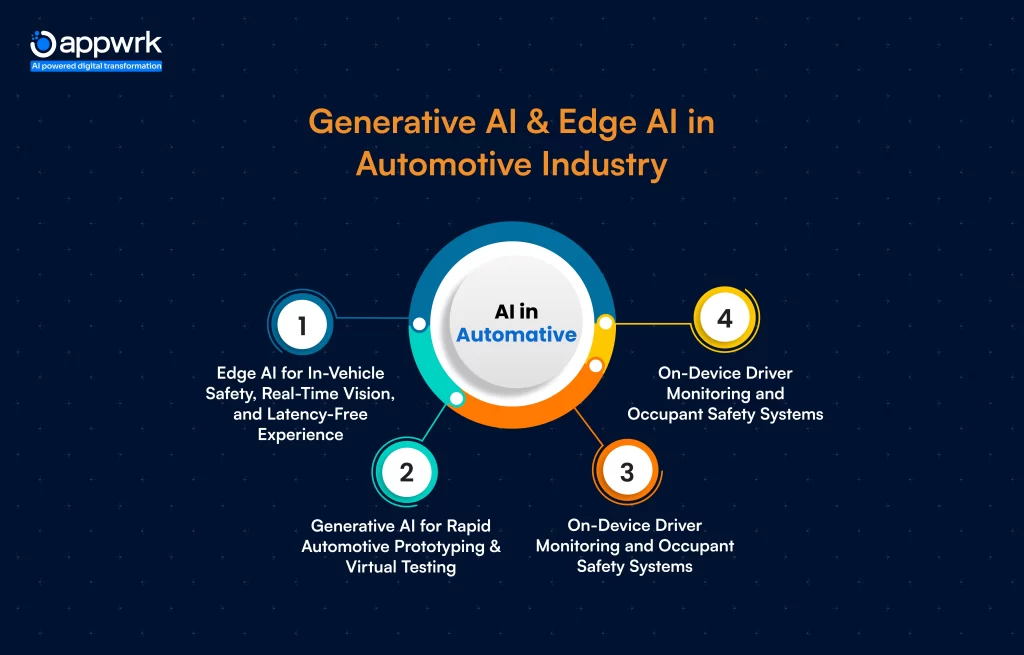
Generative AI & Edge AI in the Automotive Industry
Generative AI and Edge AI are reshaping the automotive landscape, enabling faster design iterations, streamlined testing, and real-time intelligence within the vehicle itself. Automakers are leveraging these technologies to reduce development costs, accelerate time to market, and deliver safer, more responsive driving experiences without relying on cloud latency.
Generative AI for Rapid Automotive Prototyping & Virtual Testing
Generative AI is transforming the way vehicles are designed and tested. Engineers can now create thousands of virtual chassis configurations using AI models, each evaluated for aerodynamics, structural integrity, thermal performance, and crash safety under simulated conditions. This approach drastically shortens design cycles, reduces reliance on physical prototypes, and significantly cuts R&D costs.
APPWRK-enhanced generative modeling tools produce virtual prototypes 10× faster than traditional methods, cutting costs by up to 40%. Built atop platforms like Autodesk Fusion 360 and Siemens NX with AI plugins, these systems enable dynamic shape modeling and stress simulation in real time.
Algorithmic sponsorship ensures designs meet tenure requirements for NVH (Noise, Vibration, Harshness), crash safety, and aerodynamic efficiency, all without initial tooling, enabling smarter engineering decisions and minimized upfront CapEx.
Edge AI for In-Vehicle Safety, Real-Time Vision, and Latency-Free Experience
Edge AI in vehicles enables intelligent features, such as object detection, driver fatigue alerts, and sensor fusion to operate autonomously without cloud dependencies. This ensures sub-50ms response times essential for crash avoidance and occupancy detection, meeting ISO 26262 ASIL targets.
Edge-optimized object-detection models (e.g., Mini-YOLO, Tiny-YOLO) are compressed to run efficiently on Nvidia Jetson, Qualcomm Snapdragon Ride, and NXP i.MX platforms. They process camera feeds at 30-60 FPS to identify obstacles, signage, lane markers, and pedestrians in real time.
Sensor-fusion middleware combines radar, LiDAR, and cameras on the edge to maintain situational awareness, even in low-visibility or adverse weather conditions.
APPWRK’s model-optimization pipeline supports edge compression, enabling multi-modal inference while preserving ≥95% accuracy. These edge modules are used in live deployments like lane departure alerts and pedestrian detection, where connectivity cannot be guaranteed.
On-Device Driver Monitoring and Occupant Safety Systems
On-device AI also powers driver and occupant safety inside the cabin:
Facial landmark detection models monitor driver eye and head movement. Real-time inference identifies drowsiness or distraction and triggers intervention alerts.
In-cabin object detection recognizes children or pets left unattended, enabling real-time seatbelt reminders or vehicle shutdown protocols.
All inference tasks execute on the device, ensuring both data privacy and instant responsiveness, essential for compliance with automotive GDPR/CCPA privacy regulations.
Outcomes: enhanced occupant safety, privacy assurance, and liability protection, all powered by generative edge models.
Generative Edge AI for Dynamic In-Car Experience
Edge AI is now supporting generative features within infotainment stacks:
Voice-based customization: Edge NLP modules provide personalized commands (e.g., mood-based lighting or seating controls) in milliseconds.
Real-time route generation: Generative planning updates in-car navigation based on live traffic, driving behavior, and server-side contextual data.
Content generation: In some prototype systems, generative AI creates personalized audio experiences, such as mood-based playlists or AI-curated news summaries.
These services run offline or with intermittent connectivity, maintaining consistency with user preferences and safeguarding privacy.
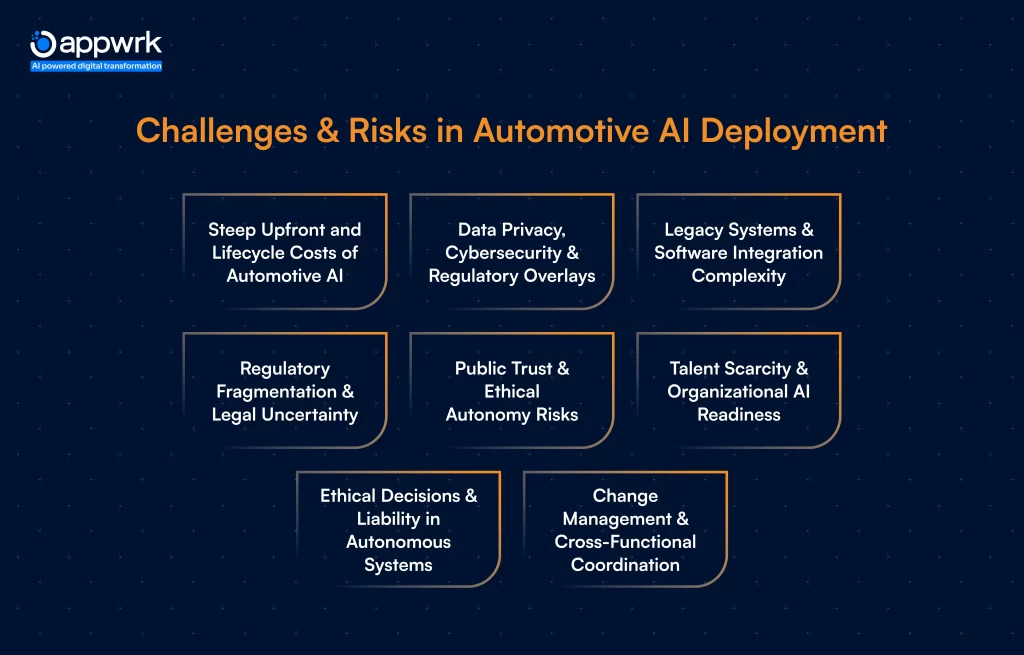
AI adoption in automotive isn’t just about innovation, but it’s about overcoming critical risks and operational hurdles. From steep capital costs to fragmented regulations and data security gaps, this section dissects the real-world challenges that can derail or delay enterprise-grade AI initiatives.
Steep Upfront and Lifecycle Costs of Automotive AI
Integrating AI into vehicles, from driver assistance (ADAS) to fleet logistics, demands significant upfront investment. Automotive AI demands capital-heavy deployments, especially when aligning with industry safety and compliance requirements. These expenses cover hardware, edge‑optimized ECUs, thermal testing, safety validation (ISO 26262), and compliance documentation. High ROI potential exists, but OEMs and Tier 1 suppliers must prepare for multi-phase capital allocation.
Data Privacy, Cybersecurity & Regulatory Overlays
Modern vehicles collect vast swaths of personal and behavioral data, including biometrics and location. They must comply with GDPR, CCPA, and UNECE R155/R156 (cybersecurity & secure OTA standards). ISO/SAE 21434 complements this by codifying secure design and threat management.
Cyberattacks via CAN bus and telematics systems are real threats to driver safety.
Lack of integrated cybersecurity within functional safety protocols often delays product rollout.
Meeting these standards adds months and up to 15-20% more to project timelines and costs.
Legacy Systems & Software Integration Complexity
Integrating AI into older vehicle architectures presents significant challenges in bandwidth, compute power, and system interoperability. Most legacy ECUs using protocols like CAN, LIN, or FlexRay are not designed to handle real-time AI workloads without expensive retrofits or the addition of intelligent gateway modules. As a result, OEMs often require hybrid edge-cloud architectures, which expand both the technical scope and overall project costs.
Talent Scarcity & Organizational AI Readiness
Building AI-enabled vehicle systems requires specialized, cross-functional expertise, including embedded AI engineers, systems architects, safety assurance professionals, and compliance analysts. This talent pool remains limited, especially for mid-sized OEMs and suppliers, leading to higher recruitment costs, longer development timelines, and organizational bottlenecks that hinder AI adoption at scale.
Public Trust & Ethical Autonomy Risks
Automated driving features face skepticism. Consumer surveys reveal that 68% of people fear partial autonomy during automated driving. Ethical dilemmas persist: how should an AI trade off collision avoidance vs. obstacle risk? Transparent design and staged go-to-market strategies help mitigate backlash and regulatory resistance.
Regulatory Fragmentation & Legal Uncertainty
The regulatory environment for AI-equipped vehicles is highly fragmented and constantly evolving. Automakers must navigate a complex web of standards, from ISO 26262 for functional safety to UNECE R155/R156 for cybersecurity and over-the-air updates, as well as ISO/SAE 21434 for secure system engineering.
On top of that, regional data protection laws like GDPR and CPRA add further compliance burdens. Meeting these diverse requirements demands continuous audits, costly certifications, and third-party validation, creating significant operational friction and legal risk for automotive teams.
Ethical Decisions & Liability in Autonomous Systems
As AI takes control of critical functions like emergency braking and collision avoidance, it introduces complex questions around moral responsibility and legal liability. In the absence of clear regulatory or legal precedents, manufacturers must proactively build transparent decision-making frameworks, implement fail-safe overrides, and ensure traceability in AI behavior to maintain public trust and mitigate future legal exposure.
Change Management & Cross-Functional Coordination
AI integration transcends technical engineering as it challenges organizational structures. Embedding AI requires cross-functional workflows, retraining QA teams, and reshaping supplier relationships. Strong leadership presence and structured change management programs are essential to avoid siloed rollouts and ensure cohesive deployment.
What’s Next: Future of AI in Automotive
Automotive AI is moving beyond isolated features into a new era of fully integrated intelligence, driven by software-defined vehicles, real-time autonomy, and AI-as-a-service models. This next phase is set to disrupt traditional value chains, unlock new revenue streams, and redefine how OEMs scale innovation and measure long-term ROI.
Software-Defined Vehicles & OTA-Centric Business Models
Vehicles are rapidly transitioning into Software-Defined Vehicles (SDVs), i.e., vehicles built on centralized computing platforms that can receive over-the-air (OTA) updates to activate new features post-production. SDV adoption is accelerating at an estimated 25-30% CAGR, significantly outpacing traditional automotive growth of 3-4%, according to Tata Technologies. OEMs like BMW, Ford, and Mercedes are already offering feature-as-a-service (FaaS) subscriptions, unlocking new revenue streams and prolonging vehicle lifespans through continuous digital enhancements.
Mass Autonomy: Scaling Level 3-4 Systems
Autonomous driving is entering its next phase. With Level 2 systems now standard, manufacturers are rolling out Level 3-4 autonomy in limited geofenced zones. Mercedes-Benz “Drive Pilot” is live in Germany and Nevada, while Tesla continues its FSD Beta program growth. McKinsey forecasts Level 4 autonomy could generate up to $400 billion in global value by 2035.
Generative AI in Manufacturing, Design, and UX
Generative AI is reshaping automotive R&D and customer interfaces:
Engineers use AI-enabled CAD tools to iterate designs virtually, cutting prototyping timelines by 30-50%.
Factories powered by AI, like GM’s Factory Zero, use machine vision and ML to optimize production lines, reduce defects, and automate maintenance.
In-car digital assistants are becoming more intuitive, providing real-time suggestions and personalized HUD experiences showcased at CES 2025.
Hyper-Personalized In-Car AI for UX & Customer Loyalty
AI-driven customization is set to be standard in 40% of vehicles by 2026, offering:
Emotion-sensing seat settings, context-aware lighting, and driver coaching through in-domain NLP models.
Personalized infotainment generated with generative AI music and news curated in real-time based on mood and location.
Embedded payment systems and biometric authentication within the cabin, powered by AI-driven interfaces.
As mobility ecosystems mature, V2X connections become critical for collaborative perception, safety coordination, and traffic flow automation. Urban deployments in smart cities, exemplified by Toyota’s Woven City, highlight AI’s role in managing EV charging, pedestrian detection, and infrastructure interplay.
Advanced AI Governance, Safety Standards & Ethical Frameworks
To support intelligent mobility adoption, standards evolve:
ISO/IEC 5338 will provide the first formal AI assurance guidelines for autonomous vehicles.
Regulatory bodies continue upgrading UNECE R155/R156 to include AI threat modeling and mitigate cybersecurity risks.
Ethical AI frameworks will require traceable decision-making and transparency, evidenced in autonomous emergency systems and occupant monitoring scenarios.
This future-ready landscape underpins next-gen AI in automotive, pushing scalability, trustworthiness, and software-centric business innovation.
AIaaS & Subscription Models in Automotive AI
As AI integration matures, automotive OEMs are exploring AI-as-a-Service (AIaaS) models to reduce CapEx and shift toward operational expenditure. Instead of upfront investments, manufacturers can subscribe to modular AI services, ranging from predictive analytics to smart infotainment, much like SaaS.
Subscription-based features such as advanced driving safety stack upgrades, conversational AI, and remote diagnostics are gaining traction. BMW, for example, charges for heated seat activation post-sale, and Mercedes monetizes its Level 3 automation through feature-on-demand subscriptions.
Insurance providers are also leveraging AI analytics from vehicles to adjust premiums dynamically, based on driver behavior and risk profiling, reducing manual audits and improving fraud detection.
These evolving models not only create new revenue channels but also extend vehicle lifespan and user personalization, an essential evolution in a software-defined automotive future.
AI-Enabled Automotive CRM & Retention Strategies
As automotive competition intensifies, retaining customers has become as critical as acquiring them. AI now plays a pivotal role in predicting churn, personalizing campaigns, and capturing real-time sentiment, unlocking new levels of loyalty and post-sale engagement.
Predictive Retention Models
Predictive retention tools use AI to assess customer behavior, service patterns, and vehicle usage to forecast churn risk and proactively trigger re-engagement. By analyzing telematics and CRM data, dealerships and OEMs can reduce attrition and upsell complementary services. AI-powered loyalty models segment customers into high-risk vs high-LTV clusters, enabling data-driven retention strategies.
AI-Powered Campaigns and Lifecycle Marketing
Lifecycle marketing campaigns benefit from AI’s ability to personalize outreach across touchpoints, like email, SMS, app notifications, and in-vehicle prompts. Algorithms optimize message timing, content, and channel selection based on behavioral signals. OEMs using AI in retention campaigns report up to 3x higher response rates and 20-30% uplift in post-warranty service package renewals.
Real-Time Feedback and Engagement Tools
AI-enabled chatbots, surveys, and in-car feedback systems allow automakers to capture customer sentiment in real time. NLP and sentiment analysis process voice commands and post-interaction comments to flag dissatisfaction and suggest resolutions. This continuous engagement loop builds loyalty, surfaces UX issues early, and supports agile feature refinement.
AI Talent & Resource Planning for Automotive Firms
AI integration isn’t just a technology challenge, but it’s a talent challenge. Building, scaling, and sustaining AI initiatives in automotive requires specialized teams, strategic training programs, and a clear decision framework for outsourcing vs. in-house execution.
Building an AI-Capable Automotive Team
As AI shifts from pilot to production, firms need to assemble cross-functional teams, spanning AI engineers, data scientists, safety analysts, edge infrastructure specialists, and domain experts in automotive systems. Strong hiring pipelines and internal capability maps aligned to ISO 26262/21434 frameworks are critical for successful deployment and ongoing compliance.
Upskilling the Workforce for AI Adoption
Legacy automotive teams often lack deep AI skills. Upskilling programs, like bootcamps, vendor-led training, and internal certifications, empower employees to adapt to AI workflows. Companies that invest in workforce AI fluency see faster project velocity and smoother implementation. Training in model validation, ML-safety, and OTA management is especially vital.
Outsourcing vs In-House AI: Pros and Cons
Automotive firms face critical choices when building AI capabilities. Outsourcing to specialized vendors can accelerate development, lower upfront costs, and provide access to niche expertise, but may limit customization, data control, and long-term IP ownership. In contrast, building in-house AI teams offers deeper integration, stronger security, and full control of the roadmap, but demands higher initial investment and longer ramp-up time.
Many top-tier OEMs are now adopting a hybrid approach where infrastructure and tooling are outsourced while core AI development remains in-house. This model helps balance speed, control, and long-term scalability.
APPWRK’s Role in Automotive AI Integration
APPWRK empowers OEMs, suppliers, and fleet operators to deploy AI solutions that are not only technically sound but also business-aligned. With proven expertise in edge computing, generative design tools, and real-time safety systems, APPWRK has delivered AI-powered solutions across automotive design, fleet analytics, and in-vehicle personalization.
Proven Efficiency Metrics
APPWRK’s edge-optimized models reduce AI inference latency by 45%, enabling sub-50ms decision cycles in advanced driving safety stack. Our clients report: • 28% faster time-to-market with OTA-ready architectures • 35% lower cost on average compared to traditional on-prem AI integration • <5% model drift variance across 12-month edge deployments
These results stem from lean development sprints, use of pretrained transformer libraries, and seamless deployment across Nvidia Jetson and Qualcomm Ride platforms.
Why APPWRK?
Turnkey AI development: From PoC to full deployment.
On-device AI expertise: Optimized for Nvidia, Qualcomm, and NXP chips.
Security-first: GDPR-compliant and ISO 26262-aligned AI systems.
Whether you’re exploring ADAS, AI-powered fault detection, or smart UX, APPWRK brings the strategy, tech stack, and delivery discipline to help you build fast, deploy smart, and scale safely.
Contact APPWRK to get AI integrated into your automotive company.
FAQs
1. What is the pricing range for AI integration in the automotive industry in 2025?
AI implementation for automotive starts around $10,000 for a basic MVP, ranging between $35,000 to $250,000 depending on use case complexity, infrastructure, safety compliance, and deployment scale (e.g., ADAS, fleet logistics, or customer experience).
Looking for a tailored cost estimate? APPWRK can help you integrate AI into your operations based on your budget goals.
2. Which components drive the cost of AI in automotive the most?
Cost-intensive components include sensor fusion engines, edge inference modules, compliance-ready cybersecurity protocols, and model training for real-time performance. Regulatory alignment with standards like UNECE R155 and advanced testing can add 20-30% to the overall budget.
3. Is AI in automotive only for autonomous driving?
No. Beyond self-driving, AI powers predictive maintenance, supply chain optimization, in-car personalization, driver safety alerts, and smart manufacturing. Companies using AI in support systems often see faster ROI due to broader operational savings.
4. How long does it take to integrate AI in a vehicle system?
Basic edge AI systems can go live in 3-4 months. More complex ADAS or fleet-wide AI deployments typically take 6-12 months, depending on sensor integrations, model training, testing protocols, and rollout scale. Iterative deployment ensures compliance and real-world refinement.
5. Does investing in AI really improve safety and ROI?
Yes. AI-driven features like driver monitoring, real-time telemetry, and predictive servicing improve fleet uptime, reduce accident rates, and enable proactive operations. While adding $10,000 to $50,000, most implementations yield ROI within 6-9 months via reduced downtime and operational insights.
6. What are the hidden costs of automotive AI projects?
Unplanned costs include data labeling, connectivity architecture, legacy system integration, and post-deployment model tuning. If not budgeted during discovery, these can add 15-25% to the project total. Planning for OTA updates and ongoing model retraining is also essential.
Gourav Khanna is the Co-founder and CEO of APPWRK, leading the company’s vision to deliver AI-first, scalable digital solutions for enterprises and high-growth startups. With over 16 years of leadership in technology, he is known for driving digital transformation strategies that connect business ambition with outcome-focused execution across healthcare, retail, logistics, and enterprise operations.
Recognized as a strategic industry voice, Gourav brings deep expertise in product strategy, AI adoption, and platform engineering. Through his insights, he helps decision-makers prioritize market traction, operational efficiency, and long-term ROI while building resilient, user-centric digital systems.
Subscribe to APPWRK Blogs, We'll Do the Rest!
Get Blogs on UI/UX, Mobile Apps, Online Marketing, and Web development technology.
Unlock worthy and priceless suggestions from the masters of mobile and web app development