150+ minds across 4 countries. Join a culture of innovation, ownership & growth.
Rewire for AI
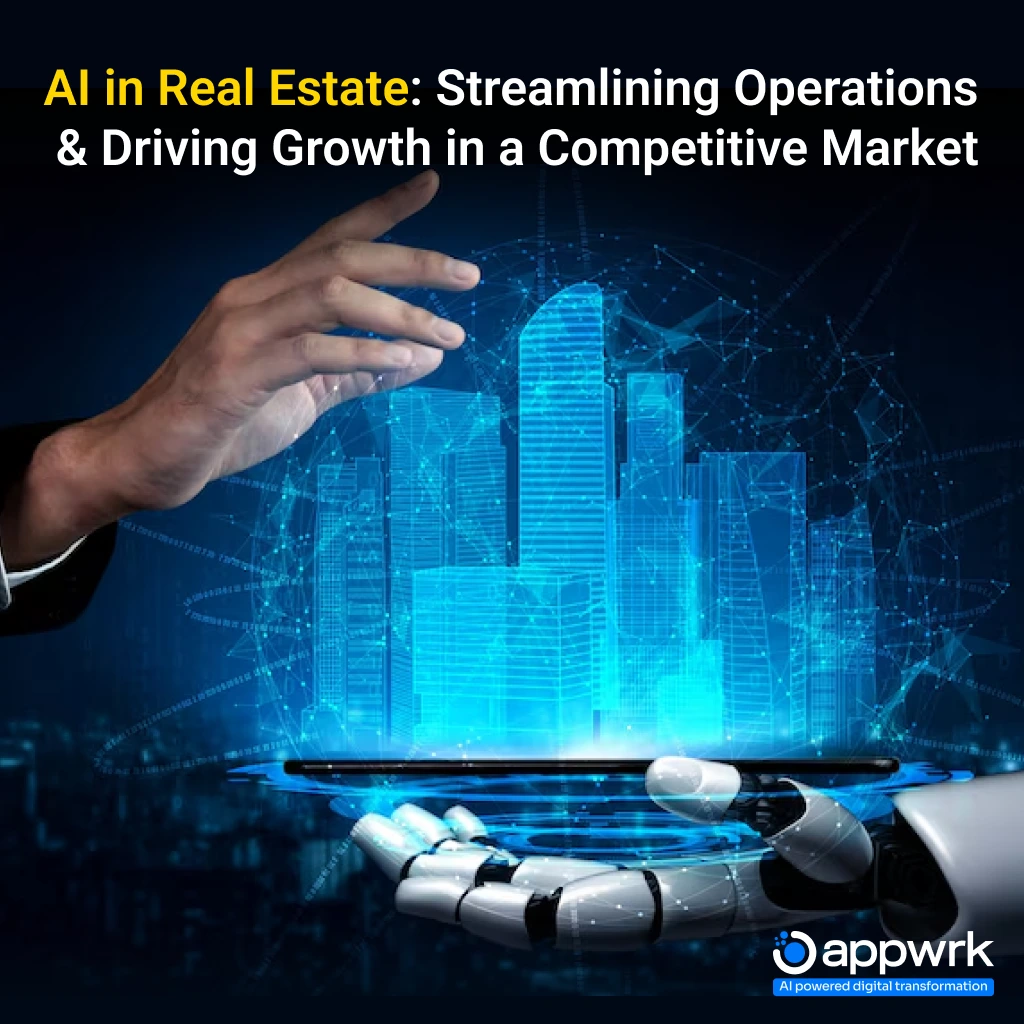
From machine learning to deep learning, from classification tools to overall process automation – our AI engineers will help you retool your existing system or enhance your company results.
Ship faster, scale smarter, built for product companies and SaaS teams
Our Latest Work
We strive hard to deliver result-driven digital solutions across the globe. Check out our case studies to get a glimpse of how we ideate, innovate, and create unconventional digital solutions according to the requirements of our clients.
Discover diverse and passionate insights from our tech enthusiasts. We collaborate across various sectors to streamline operations and drive innovation. Explore our rapidly growing collection of articles to see why we’re at the forefront of IT solutions.
The decision to move from Magento to Shopify is one of the most significant replatforming choices an ecommerce business can make. Magento is powerful, but its power comes with...
Accuracy gap is real: Traditional CPG forecasting carries a 25-40% MAPE error rate. AI-powered models bring that down to 8-15%, according to McKinsey research....
Real stories from global leaders who trusted us with their ideas.
Partnering with APPWRK helped us build a compliant and scalable healthcare platform, accelerating our time-to-market by 35%. Their team consistently delivered outstanding work.
Beesers
Digital Healthcare Client
Collaborating with APPWRK, Sportskeeda modernized its platform into a real-time sports engagement ecosystem, enabling seamless content delivery, scalable fan interactions, and high-velocity performance.
Sportskeeda
Sports & Entertainment Partner
Working with APPWRK was effortless. They captured our vision, maintained full compliance, and delivered a digital experience that built trust and elevated how customers interact with our fintech brand.
PayPenny
Fintech Partner
Working with APPWRK gave us confidence in adopting AI responsibly. Their team built a safe, intelligent bot that transformed how we engage with leads and helped us achieve measurable revenue growth.
IFB
AI Transformation Partner
Leveraging APPWRK’s digital expertise, Nemesis launched a scalable, compliant, and safe super app that connects content delivery, real-time communication, and logistics management within a single platform.
Custom AI software costs can start as low as $5K, and can range from $15K to $110K for enterprise-grade systems, depending on model complexity, data readiness, team structure, and compliance needs.
AI development isn't about just writing code; it’s about aligning deep learning architecture with business value, user scale, and monetization pathways.
The biggest cost drivers are not just model training or the tech stack. They include data sourcing, tuning, and preparing your systems for real-world use.
Pre-trained models and open datasets can save up to 40 percent in early-stage builds, but they come at the cost of long-term adaptability and ownership of your intellectual property.
Feature creep and unclear UX flows are silent cost killers; defining feature-value mapping is key to staying under budget.
Outsourcing to AI-native teams with domain-specific accelerators can cut development time by 30-40%, especially in NLP, computer vision, and predictive systems.
This blog is tailored for startup business owners, CTOs, and digital product leaders planning to build or scale custom AI solutions. It will take you through realistic cost breakdowns, strategic decision points, AI feature modeling, and cost-to-value paths, giving you clarity on what it truly takes to build scalable, monetizable custom AI software.
Assessing Custom AI Software Cost: Market, Model & Development Drivers
In today’s competitive landscape, the real cost of AI software comes down to how effectively it delivers value at scale. It’s not just about building a model; it’s about orchestrating data, infrastructure, and deployment around your business objectives. Whether you’re streamlining operations, personalizing customer experiences, or launching an AI-driven product, understanding the key cost drivers upfront helps you avoid delays, rework, and budget overruns.
Here’s a clear breakdown of what truly impacts your AI software development costs.
1. Business-Driven Cost Variables
Monetize Your AI App: The pricing strategy (subscription, data monetization, pay-per-use, advertising) directly impacts model complexity, data pipelines, and integration expenditures.
Hidden Factors Affecting AI Product Development Cost: Includes legal/licensing fees, compliance requirements, and infrastructure re-training. These often exceed 20% of the initial budget.
2. Technical Model & Architecture Decisions
AI Software Development Types: AI software development type affects cost depending on whether you use LLM-based generative AI, machine learning models, or deep learning and neural networks. Each option influences model selection and overall complexity.
AI Model Training and Optimization: Custom models tailored to private datasets drive higher expenses than pre-trained or rule-based systems.
3. Operational & Team Variables
Team structure and execution strategy impact AI development costs. The number of people involved and their roles, from data scientists to ML engineers and UX designers, directly affect the cost difference between in-house builds and outsourced solutions.
Third-party integration and Technology Stack selections determine platform costs, licensing, and ongoing maintenance.
Real-world Cost Snapshot:
Custom AI Build Type
Cost Range for the Software Development
Core Cost Drivers
MVP with Pre-Trained Model
$5K -$15K
Open-source models and basic UI/UX.
Feature-Rich Mid-Level Solution
$20K- $50K
Data prep, model training, integrations, and compliance.
Enterprise-Grade Generative AI System
$60K - $110K+
Custom LLM, advanced UX, real-time infra, retraining, and licensing.
That range is guided by the Factors Influencing AI Software Development Cost: project complexity, algorithm accuracy, real-time performance, and continuous learning and improvement stages.
According to Grand View Research, the global AI market is growing at a 35.9 % CAGR from 2025 to 2030, signifying ongoing expansion in development costs and infrastructure investment.
Why These Drivers Matter Strategically
Aligning complexity with user value ensures cost-effective investment. Overbuilding erodes ROI.
Planning for Integrations & Compliance upfront avoids scope creep and legal surprises.
Choosing in-house vs outsourced affects both cost and time to market. Outsourced AI-native teams offer 30-40 % efficiency gains.
Monitoring Data Collection and Preparation is essential: unlabeled or unstructured data can multiply costs unexpectedly.
What Drives the Cost of Custom AI Software? A Strategic Analysis
Building custom AI software goes far beyond writing code. For businesses, it’s a high-stakes investment shaped by your market vision, product goals, and how well your team can align technology with execution. This section breaks down the core factors that influence cost, from architecture and data to team and deployment trade-offs.
1. Model Types and Complexity
Custom AI development costs vary dramatically based on the intelligence architecture you choose. Opting for LLM-based generative AI solutions, such as GPT-style systems, can multiply both training and inference costs by 3× to 5× compared to traditional ML models or rule-based systems. Research shows training frontier AI models (e.g., GPT‑4, Gemini) can cost hundreds of millions by 2027, with computing and engineering driving up to 2.4× cost growth annually.
Meanwhile, combining modalities, like embedding NLP, computer vision, and recommendations, adds integration overhead, pushing your technology stack and project complexity into an enterprise budget range.
2. Data Lifecycle Cost Anchor
Data often dominates the cost landscape. Data collection and preparation, including annotation and anonymization, is now estimated to comprise 40-60% of your total AI spend, especially in heavily regulated domains like healthcare or finance. Manual labeling, sophisticated ETL pipelines, and privacy-layer insertions (HIPAA, GDPR, SOC 2 compliance) compound this even further.
Missing these steps leads to prototype paralysis, as 70% of AI deployments fail to deliver effective models due to poor data quality and lack of governance.
3. Real-Time Inference and System Responsiveness
If your use case demands sub-second inference, such as fraud detection, voice tech, or dynamic recommendations, your costs escalate significantly. This demands investment in infrastructure like GPUs, streaming architecture, and MLops tools.
McKinsey warns that achieving enterprise-grade reliability (≥ 95% accuracy, continuous retraining) often consumes 30–50% of innovation cycles due to compliance and performance tuning.
Integrating AI into a product is more than a backend; it’s about human experience and ecosystem connectivity.
AI-specific UI/UX Design (chatbots, explainability dashboards) can cost 2× a standard UX scope.
Third-party integrations (CRM, payment gateways, ERP) require time for connectors, error handling, and vendor contracts.
Platform choices, e.g., TensorFlow vs. PyTorch, AWS vs. GCP vs. Edge deployment, not only shape initial cost but also long-term scalability and infrastructure and development tools cost curves.
Cloud infrastructure preferences also vary by region. US developers often choose AWS or GCP, European teams prioritize data residency with platforms like OVH, and Indian developers focus on low-cost AI buildouts using scalable hybrid stacks.
5. Development Team Composition & Outsourcing Strategy
Your development team size directly influences cost. Here’s a strategic breakdown:
Team Setup
Cost Impact by Team Size
Trade-offs
In-House AI Development
Higher fixed cost, slower ramp.
Full control and growing internal capacity.
Outsourced vs. Specialized
30-40% faster dev, flexible, cheaper.
Less IP control and vendor dependency.
AI Software Cost Process: Step-by-Step Breakdown
For founders, every stage of building custom AI software comes with strategic decision points that critically impact both budget and outcomes. Listed below are the steps:
Defining AI Scope & Product Type
Defining AI scope and product type is the first critical step. Whether it’s fraud detection, HR automation, or a personalized recommender system, a clear problem definition reduces project complexity, aligns the tech stack, and helps estimate early-stage costs accurately.
Data Collection, Labeling & Compliance Costs
Data preparation is the foundation of effective AI. High-quality, structured datasets often account for 15-30% of AI project cost, rising to 60-80% of effort in unstructured environments.
Data labeling (manual or via AI-based augmentation) adds significant labor.
The heart of your AI logic, the AI model training, and optimization, dictates compute needs, algorithm tuning, and performance infrastructure, especially for LLM-based generative AI Solutions.
Rule-based vs. ML vs. Generative AI impacts compute intensity and ongoing tuning.
AI UX design, and system integration play a vital role in turning powerful models into real user value. No matter how advanced the backend, AI solutions fall short without intuitive interfaces and seamless integration into existing workflows.
AI-centric UI/UX flows double standard UX costs as they require transparency, explainability, and fallback handling.
Third-party integrations such as CRMs, ERP systems, and data brokers can increase project costs by 15 to 25 percent.
In-House vs Outsourced AI Teams: Cost Implications
The costs and speed of development are strongly shaped by your team configuration:
In-house teams provide full control but come at a high cost, with senior AI engineers in the US typically earning between $150,000 and $200,000 per year.
Outsourcing to specialized AI teams can cut time-to-market by 30-40%, while balancing intellectual property ownership.
Model Integration & Deployment Architecture
Once models are trained, they must be deployed and integrated into the ecosystem.
API orchestration, containerization, and platform selection (TensorFlow, PyTorch, AWS/GCP/Azure) shape long-term operational costs.
Infra and development tools like Kubernetes or serverless frameworks add stability and a 10-20% cost layer.
Testing & QA with Explainability & Bias Audits
Testing AI systems isn’t just about checking if the code runs or if outputs appear; it’s about validating whether the model behaves responsibly, consistently, and fairly under a variety of real-world conditions. This phase ensures that your AI isn’t just functional but also ethical and production-ready.
Failing to perform this type of testing can result in legal liabilities, degraded user trust, and expensive model rollbacks post-launch.
Post-launch Monitoring, Maintenance & Retraining
The cost of AI doesn’t end at deployment. Ongoing monitoring, model updates, and system maintenance require dedicated resources. As data changes, models need retraining, infrastructure needs upgrades, and reliable MLOps support becomes essential, all of which add to the total cost of ownership over time.
Regions like India, known for deep AI engineering talent and cost-effective delivery, have become go-to outsourcing destinations, while Europe and the USA lead in regulatory-driven AI innovation and high-trust use case deployment.
Budget-Smart Moves Businesses Can’t Ignore
Before AI costs spiral out of control, founders must plan proactively. These tactics help align development with ROI while minimizing hidden and future risks.
Mitigate data risk early: invest in quality pipelines to avoid multi-phase rework.
Design for reuse: modular model and UX layers allow incremental upgrades.
Align cost with usage: usage-based infrastructure reflects business-side scalability.
Embed compliance in core architecture, not as a bolt-on phase.
AI Software Features That Amplify Custom AI Software Cost: A Strategic Breakdown
Building custom AI isn’t just about features; it’s about extracting maximum business value from each feature while strategically managing costs. Each additional capability introduces complexity across data prep, infrastructure, inference, explainability, and compliance. Below, we explore five high-impact features with integrated cost anchors to guide founder planning.
Real‑Time Predictions and Decision Engines
Real-time AI systems, such as fraud detection platforms, dynamic pricing tools, or predictive logistics solutions, must deliver sub-second responses, which demands complex infrastructure.
Personalization tailors user experiences using AI models that adapt over time:
System Requirements: Continuous behavior analytics, real-time retraining, and data capture tools.
Integration Layer: Syncs with CRM or content platforms, requiring data pipelines and latency controls.
Cost Anchor:$35K-$90K based on scale and personalization sophistication.
AI Software Types and Industry-Wise Pricing
Custom AI software costs vary significantly across industries based on feature needs, data types, and compliance layers. This subsection will help business owners plan realistically by mapping features to typical cost ranges, with examples grounded in real-world delivery, such as APPWRK’s AI chatbot solution.
AI App Cost by Industry & Solution Type
Type of AI Solution
Estimated Cost Range (USD)
Development Factors
AI Chatbot (NLP/Conversational)
$30,000-$110,000
Conversational flow logic, NLP model, CRM/API integrations, and fallback UX.
Recommendation System
$40,000-$100,000
User behavior modeling, inventory/CDP sync, and algorithm tuning.
Fraud Detection System
$70,000-$110,000
Real-time inference, accuracy tuning, risk flagging, and audit readiness.
Image Recognition AI
$50,000-$100,000
Dataset labeling, GPU infra, and high-accuracy processing.
Predictive Maintenance AI
$60,000-$110,000
Sensor integration, anomaly detection, and industrial scale-up readiness.
Customer Service AI (Retail/SaaS)
$30,000-$110,000
Multilingual NLP, ticket handling logic, analytics, and fallback mechanisms.
Healthcare AI (Diagnostics/Triage)
$80,000-$120,000
Explainability, HIPAA compliance and multimodal inputs.
HR & Recruitment AI
$50,000-$150,000
Resume parsing, sentiment analysis, and ATS/LMS integration.
eCommerce AI (Personalization)
$40,000-$100,000
Recommender logic, behavioral analytics, and purchase sync.
Financial AI (Underwriting/Fraud)
$70,000-$110,000
Real-time detection, sub-second latency, and audit pipelines.
Customer Service AI (Retail & SaaS)
Chatbots using NLP and CRM integration typically begin at $30K, scaling to $110K+ when adding multilingual support, analytics, and agent fallback.
APPWRK developed a GPT‑4-driven conversational chatbot that automated 60% of customer service interactions, seamlessly escalating complex queries to human agents, all within a $70K budget. Read our case study here.
Healthcare AI (Diagnostics & Patient Triage)
Highly regulated applications, like medical imaging classifiers or triage bots, start at $80K, reaching $120K+ once HIPAA compliance, explainability tools, and multimodal inputs are included.
HR & Recruitment AI
Automated resume parsing, sentiment analysis, and candidate ranking tools typically cost $50K-$150K, depending on dashboard and applicant tracking integrations. APPWRK has built recruiter AI systems that significantly reduce screening time and help ensure fair candidate selection.
E-commerce AI (Personalization & Recommenders)
Dynamic recommendation engines with behavioral analytics start around $40K, scaling to $100K+ with full inventory/CDP sync.
AI Development Pricing Structures: In‑House vs. Outsourced vs. Pre‑Trained
Choosing the right development approach is one of the most important cost decisions in any AI project. Whether you build in-house, partner with an external team, or adapt pre-trained models, each path impacts your timeline, team structure, and long-term scalability. Here’s how the different pricing structures compare.
In‑House AI Development Cost & Business Control
Building an internal team offers ownership and proximity, ideal for tackling proprietary data or sensitive use cases, but comes with a substantial expense.
Talent Cost: US-based AI/ML engineers average $150-200K/year, excluding benefits and overhead. According to Brainhub, the true cost of a developer can be 2.7× base salary when including taxes, training, and workspace.
Infrastructure and Tools: GPUs, versioning/storage add $5K-10K/month per developer.
Hidden Overheads: Recruitment ($4K/hire), onboarding delays, non-billable time, all inflate costs.
Strategic Advantage: Full IP retention, alignment with internal systems, and elastic scalability for the future.
Total Annual Burn: $500K+ for a 5-7 person AI team, plus infra and tool licensing.
Outsourced & Specialized AI Teams: Agile, Cost-Effective Execution
Outsourcing to AI-native firms offers rapid execution and flexible scaling.
Cost Savings: Deloitte finds companies can reduce operational costs by up to 60% via AI outsourcing.
Market Rates: In-house hiring costs $150-480K per FTE/year vs. outsourcing at $70-150K.
Eastern Europe/Asia rates: $25-50/hr vs $100+/hr in Western markets
Many US startups prefer development teams in India for MVP execution, while European enterprises often demand compliance-first builds tailored for GDPR and ethical AI mandates.
Time-to-Market: Outsourced teams deliver solutions 60-70% faster than newly onboarded in-house teams.
IP Considerations: Controlled through NDAs and well-scoped contracts; some code transfer or hybrid teams offer middle ground.
Typical Project Costs:
MVP: $5K-$15K
Mid-tier solution: $20K-$70K
Enterprise build: $110K+
Pre‑Trained & API‑First AI Models: Fastest Path for MVPs
Leveraging existing APIs such as OpenAI, AWS Bedrock, or Google Vertex AI is cost-efficient for prototyping.
Pricing Model: Pay-per-use (≈$0.01-0.12/request).
Adaptation Costs: Fine-tuning and custom UX are still needed ($10K-40K).
Limitations: Less control over data, limited IP, potential vendor lock-in, and scaling costs.
Example Costs:
Initial: $10K-$40K fine-tuning + infrastructure
Annual usage: $50K-150K+, scaling with request volume
AI Development Strategy Comparison for Founders
Build Strategy for AI Development
Scenarios in which the strategy works the best
Key Risks & Mitigations
In‑House
Core IP, regulated data, and long-term platforms.
High cost, slow ramp-up; build hybrid teams to balance.
Outsourced
MVPs, flexible scaling, and domain expertise.
IP risk; requires clear contracts and governance.
Pre‑Trained APIs
Fast POCs, proof of concept, and limited feature scope.
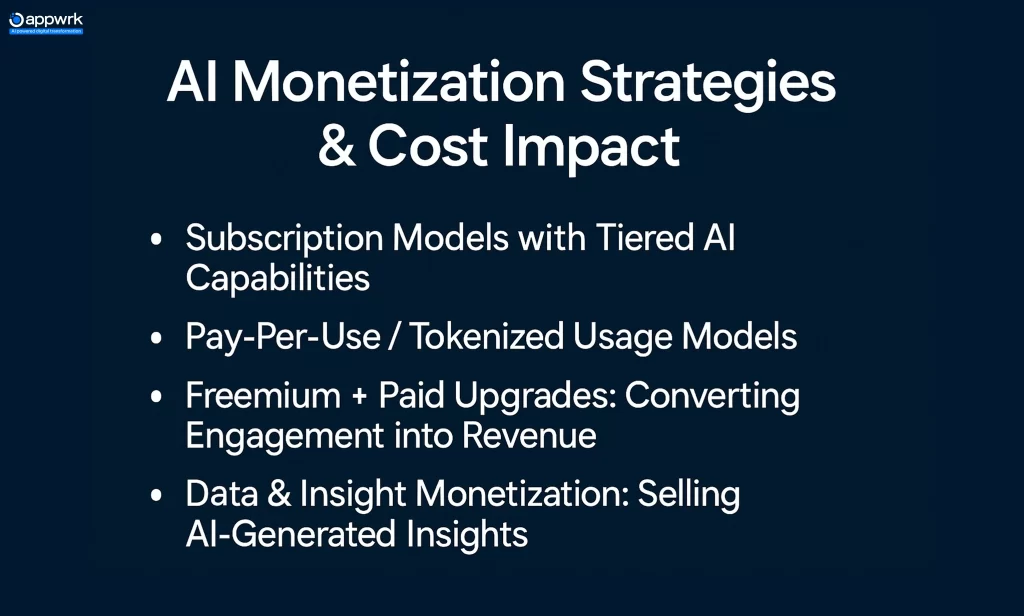
How you plan to monetize determines the custom AI software cost, influencing every area from architecture to user experience. Let’s find out the models that are available on the market:
Subscription Models with Tiered AI Capabilities
For B2B SaaS products, subscription-based pricing remains the go-to strategy. Offering tiered access to AI-powered features requires thoughtful product design, scalable infrastructure, and precise backend orchestration to ensure seamless delivery across plans.
Feature gating logic must support modular rollout, enabling or disabling features like premium NLP or real-time recommendations based on subscription level.
Consent and billing frameworks must securely manage upgrades, downgrades, and invoicing, often interacting with services such as Stripe or Chargebee.
Data-driven upsell triggers based on metrics like usage volume or AI-as-you-use thresholds require analytics integration.
Pay‑Per‑Use / Tokenized Usage Models
Usage-based pricing is gaining traction, especially for LLM-based generative AI solutions. Billing per request, token, or inference aligns cost with consumption but requires robust tracking systems.
Token-level metering must accurately track both input and output tokens to ensure precise billing. For example, GPT-4 with an 8K context typically charges around $0.03 for every 1,000 input tokens and $0.06 for every 1,000 output tokens.
Smart scaling and caching strategies help avoid excessive API costs. Implementing prompt caching can significantly reduce token usage and improve performance.
Real-time usage dashboards and consumption alerts enable teams to stay within budget and minimize unexpected billing.
Freemium + Paid Upgrades: Converting Engagement into Revenue
Freemium models entice users with basic AI features, offering premium upgrades later. However, building UX flows with upgrade prompts, analytics, and gating increases initial product complexity.
In-app prompts and feature gating require A/B tests, session tracking, and analytics (using Firebase, Mixpanel).
Usage segmentation analytics differentiate between “light” and “heavy” users to inform pricing strategy.
Smooth transition flows are needed to convert users without disrupting the UX.
Data & Insight Monetization: Selling AI-Generated Insights
Platforms with deep, domain-specific data can monetize insights, turning AI into a product itself. However, this strategy demands strong compliance and security design.
Legal and Licensing Fees tied to data sales, anonymization, and regulatory reporting.
Compliance integration with GDPR, CCPA, and HIPAA for data handling and export controls.
Insight dashboards and plug-and-play export features for client consumption.
Post-Launch AI Costs & Maintenance Essentials
Deploying custom AI software is just the start; long-term success depends on navigating a landscape of evolving technical, financial, and legal requirements. Below is a narrative-focused expansion of the hidden and post-launch costs every founder must account for:
Model Retraining & Drift Prevention
AI models lose accuracy over time as data patterns change, requiring ongoing updates to maintain performance and reliability. Effective maintenance involves ongoing model retraining, requiring:
Regular monitoring of performance metrics (e.g., PSI, accuracy).
Data collection pipelines to capture fresh feedback.
Updated training and validation routines for released models.
New deployment cycles for refreshed models.
Studies suggest dedicated retraining pipelines can streamline maintenance and reduce costs by up to 70%, balancing performance stability with budget management. Failing to budget for this can result in service decay and user dissatisfaction.
Infrastructure Scaling & Auto-Provisioning Costs
Post-launch, production systems face unpredictable spikes. Managing this requires:
Auto-scaling GPU/CPU clusters to match real-time demands without manual intervention.
Efficient autoscaling policies, avoiding idle compute cost; “scaling to zero” helps reduce waste, with some teams reporting 44% cost savings.
Monitoring and alerting systems to avoid billing surprises like Palo Alto did with AI-powered cost anomaly detection.
Neglecting these can lead to unexpectedly high cloud bills or poor user experience due to latency.
Compliance, Data Security & Regulatory Audits
AI systems often handle sensitive information, requiring ongoing compliance upkeep:
Maintaining HIPAA/GDPR/CCPA compliance with audit trails and encryption.
Handling data subject access requests (DSARs) with robust APIs.
Industry data shows organizations investing in AI face a 95% assurance demand for appropriate security measures. As legislation evolves, ongoing compliance becomes a mandatory operational cost, not a one-time expense.
Interpretability & Explainability Tooling
Explainability tools, like SHAP and LIME, are no longer optional; they’re vital for trust and compliance:
Embedding model-interpretation features into UX flows.
Generating bias and fairness audit reports at regular intervals.
Updating interpretability layers when models change or drift.
These tools help maintain algorithm accuracy and fluency but require developer time and specialized expertise.
Customer Feedback Loops & Support Expansion
AI introduces unpredictable behavior, meaning support teams must:
Interpret AI errors and escalate to engineering.
Facilitate rapid frontline feedback to improve UX inclusivity.
This human-in-the-loop system isn’t a one-off; it’s a recurring investment in user adoption and integration quality.
AI Cost Optimization Tips for Businesses
Optimizing custom AI software cost doesn’t require compromising on performance. You just need to build smarter, validate, lean, and scale strategically. This section presents high-impact, cost-effective tactics that ensure your AI delivers results without draining resources.
Businesses often over-engineer by training from scratch. Instead, tap into powerful pre-trained models like BERT, GPT‑3/4, YOLO, or CLIP, then fine-tune them for your purpose.
Why it works: You inherit years of data and model development, cutting down computing and data collection costs.
Resource impact: Dramatically reduced infrastructure needs during training—no need for large dedicated GPU clusters.
ROI insight: 2025 studies show startups save up to 50% on infrastructure costs by fine-tuning rather than rebuilding models completely.
Build a Lean MVP with Narrow AI Core
Start with a single, high-impact AI function that directly supports your core business objective.
Skip full-scale features like multilingual support, advanced UX elements, or explainability in early iterations.
Use no-code connectors for integrations (e.g., with Firebase or Zapier) to test efficacy faster.
Validate impact before investing in full-scale development.
Hybrid Execution: Outsource AI Ops & Own Product Layer
Marrying external AI expertise with internal product insight is key.
Engage outsourced teams for foundational AI model work and tuning.
Retain UX design, feature prioritization, and product roadmap development internally.
This model ensures intellectual property control, product alignment, and reduced long-term costs.
Select Value-Driven Integrations with Clear ROI
Not all integrations justify development hours. Make decisions based on automation value.
Choose APIs that unlock efficiency in real-time feedback, user logging, and inference caching.
Avoid building custom connectors upfront; use APIs or iPaaS to speed up iteration.
Ensure every integration directly supports monetization or feature validation.
Optimize Cloud Infrastructure with Cost Controls
Cloud services offer flexibility, but unchecked, they quickly translate into runaway expenses.
Use auto-scaling, on-demand GPU/TPU instances, and serverless computing for inference queries.
Implement usage monitoring and budget alerts to prevent unexpected costs.
Optimize LLM workloads with prompt caching, clustering, and model distillation to stretch API usage further.
Cost-Optimizing Strategies for AI Product Founders
Starting lean with pre-trained models preserves engineering capital.
Validating your AI core before scaling ensures effective results.
Hybrid team structures marry rapid delivery with IP security.
Cost-aware infra decisions reduce burn while boosting capacity.
Feature-led integrations and usage monitoring drive sustainable scaling.
How APPWRK Elevates Custom AI Software Development with Strategic Excellence
APPWRK is a specialist in end-to-end custom software development, delivering domain-specific solutions that are scalable, modular, and monetization-ready. With expertise in LLM optimization, MLOps architecture, and secure cloud deployment (AWS, GCP, Azure), APPWRK helps businesses build AI systems that align with cost goals and go-to-market speed.
From startups launching AI MVPs to enterprises scaling intelligent platforms, APPWRK’s hybrid delivery model reduces development costs by up to 40%, while ensuring performance and compliance across regulated sectors.
APPWRK’s AI builds are customized for your needs, whether it’s real-time inference, GDPR-ready deployments, or token-based LLM monetization. From prototype to production, we integrate third-party tools and deliver fully compliant AI pipelines.
What Sets Us Apart
50+ AI systems deployed across healthcare, fintech, and logistics.
Speak to our AI experts and get a custom roadmap for your build, timeline, and cost today.Contact APPWRK.
FAQs
1. What is the average cost to develop AI software? AI software development cost starts at $5K and can range from $15K to $110K. Find out how model, team, region, and tech stack shape pricing. The final price depends on data infrastructure, compliance, and UX.
2. How long does AI payback typically take? ROI is typically realized within 12-24 months, with performance uplift ranging from 20-200%, depending on the domain (e.g., finance, supply chain, healthcare), user adoption, and automation effectiveness.
3. Which AI monetization model is most cost-effective? It depends on your strategy:
Developer platforms often use pay-per-use/token billing.
Content and insight engines favor freemium + data monetization for rapid scale.
4. What hidden costs should I budget for in AI development? Prepare for model retraining, post-launch infrastructure scaling, data compliance audits, and security certification—these can add 15–25%+ to initial build cost annually if unmanaged.
5. How much does AI customization typically increase cost? Custom logic, proprietary training, or multi-language support can raise costs by 40-100%, depending on the complexity of features, model architecture, and performance benchmarks required.
6. Is outsourcing AI development a cost-saving strategy? Yes. Outsourcing to regions like India or Eastern Europe can reduce dev costs by 50-70%. Ensure alignment on model IP, sprint governance, and post-launch handoff. Contact us here to get started.
7. What’s the cost of integrating AI into existing software? Integrations range from $15,000 to $100,000, depending on backend compatibility, data structuring, model reusability, and UI changes required to deploy AI workflows within legacy systems.
8. Can AI models be reused to lower costs? Yes. Fine-tuning pre-trained models like BERT, GPT, YOLO, or Whisper can save up to 60% in training and data labeling costs. Model reuse is ideal for classification, NLU, summarization, and recommendation systems.
Gourav Khanna is the Co-founder and CEO of APPWRK, leading the company’s vision to deliver AI-first, scalable digital solutions for enterprises and high-growth startups. With over 16 years of leadership in technology, he is known for driving digital transformation strategies that connect business ambition with outcome-focused execution across healthcare, retail, logistics, and enterprise operations.
Recognized as a strategic industry voice, Gourav brings deep expertise in product strategy, AI adoption, and platform engineering. Through his insights, he helps decision-makers prioritize market traction, operational efficiency, and long-term ROI while building resilient, user-centric digital systems.
Subscribe to APPWRK Blogs, We'll Do the Rest!
Get Blogs on UI/UX, Mobile Apps, Online Marketing, and Web development technology.
Unlock worthy and priceless suggestions from the masters of mobile and web app development