150+ minds across 4 countries. Join a culture of innovation, ownership & growth.
Rewire for AI
From machine learning to deep learning, from classification tools to overall process automation – our AI engineers will help you retool your existing system or enhance your company results.
Ship faster, scale smarter, built for product companies and SaaS teams
Our Latest Work
We strive hard to deliver result-driven digital solutions across the globe. Check out our case studies to get a glimpse of how we ideate, innovate, and create unconventional digital solutions according to the requirements of our clients.
Discover diverse and passionate insights from our tech enthusiasts. We collaborate across various sectors to streamline operations and drive innovation. Explore our rapidly growing collection of articles to see why we’re at the forefront of IT solutions.
The decision to move from Magento to Shopify is one of the most significant replatforming choices an ecommerce business can make. Magento is powerful, but its power comes with...
Accuracy gap is real: Traditional CPG forecasting carries a 25-40% MAPE error rate. AI-powered models bring that down to 8-15%, according to McKinsey research....
Real stories from global leaders who trusted us with their ideas.
Partnering with APPWRK helped us build a compliant and scalable healthcare platform, accelerating our time-to-market by 35%. Their team consistently delivered outstanding work.
Beesers
Digital Healthcare Client
Collaborating with APPWRK, Sportskeeda modernized its platform into a real-time sports engagement ecosystem, enabling seamless content delivery, scalable fan interactions, and high-velocity performance.
Sportskeeda
Sports & Entertainment Partner
Working with APPWRK was effortless. They captured our vision, maintained full compliance, and delivered a digital experience that built trust and elevated how customers interact with our fintech brand.
PayPenny
Fintech Partner
Working with APPWRK gave us confidence in adopting AI responsibly. Their team built a safe, intelligent bot that transformed how we engage with leads and helped us achieve measurable revenue growth.
IFB
AI Transformation Partner
Leveraging APPWRK’s digital expertise, Nemesis launched a scalable, compliant, and safe super app that connects content delivery, real-time communication, and logistics management within a single platform.
The benefits of AI in transportation are redefining how goods, people, and systems move, driving unprecedented gains in safety, sustainability, and profitability across the global mobility ecosystem.
AI in transportation is enabling intelligent mobility through 20+ high-impact use cases, including autonomous vehicles, predictive maintenance, adaptive traffic signals, real-time vehicle tracking, route optimization, fleet telematics, smart parking, and last-mile delivery optimization. These applications are modernizing how goods, people, and services move across urban and freight networks.
Autonomous freight systems, digital twins, and demand forecasting models are now key drivers of operational efficiency. AI algorithms optimize vehicle dispatch, simulate logistics networks before deployment, and forecast traffic and inventory needs, offering a proactive, data-driven approach to complex transportation operations.
AI in transportation delivers measurable business results with fleets experiencing up to 31% less downtime, CO₂ emissions reduced by 22%, driver safety improved by 18% and emergency response times faster by 21%. These benefits come from AI tools such as driver behavior tracking, predictive maintenance, real-time vehicle monitoring, and smarter traffic management.
To fully leverage AI, transportation providers must implement a layered integration strategy. This begins with core infrastructure, such as IoT sensors, telematics, and connected vehicle systems, followed by machine learning algorithms for routing, driver monitoring, and fleet analytics.
Integration of AI in transportation costs starts with $5,000 and ranges from $10,000 to $100,000, depending on the deployment phase, feature complexity, and level of system integration.
This blog is a strategic guide for transportation leaders, CTOs, logistics heads, and investors exploring AI’s potential. It offers practical insights, success metrics, and real-world case studies to help enterprises unlock scalable, sustainable, and cost-efficient transportation systems powered by artificial intelligence.
AI in Transportation Overview
Artificial Intelligence in transportation is revolutionizing how mobility operates, enhancing efficiency, safety, and real-time decision-making. With advancements in autonomous vehicles, smart traffic systems, and route optimization, AI is rapidly becoming a core pillar of modern mobility and transportation infrastructure.
The AI in the transportation market is expected to exceed USD 34.83 billion by 2034 with an annual growth rate of 22.70%. This growth is fueled by increasing demand for predictive maintenance, smarter traffic control, and autonomous freight solutions such as driverless trucks and smart convoys.
Top 20 Use Cases of AI in Transportation (and 8 More to Explore)
Artificial Intelligence is reshaping transportation by turning complex transportation challenges into intelligent, real-time solutions. It is being integrated into everything from urban traffic control and fleet logistics to autonomous driving and predictive maintenance. These applications are making roads safer, deliveries faster, commutes smarter, and operations more sustainable.
The following use cases highlight how AI is transforming the way people and goods move across the world.
Autonomous Vehicles: Redefining Mobility and AI for Logistics
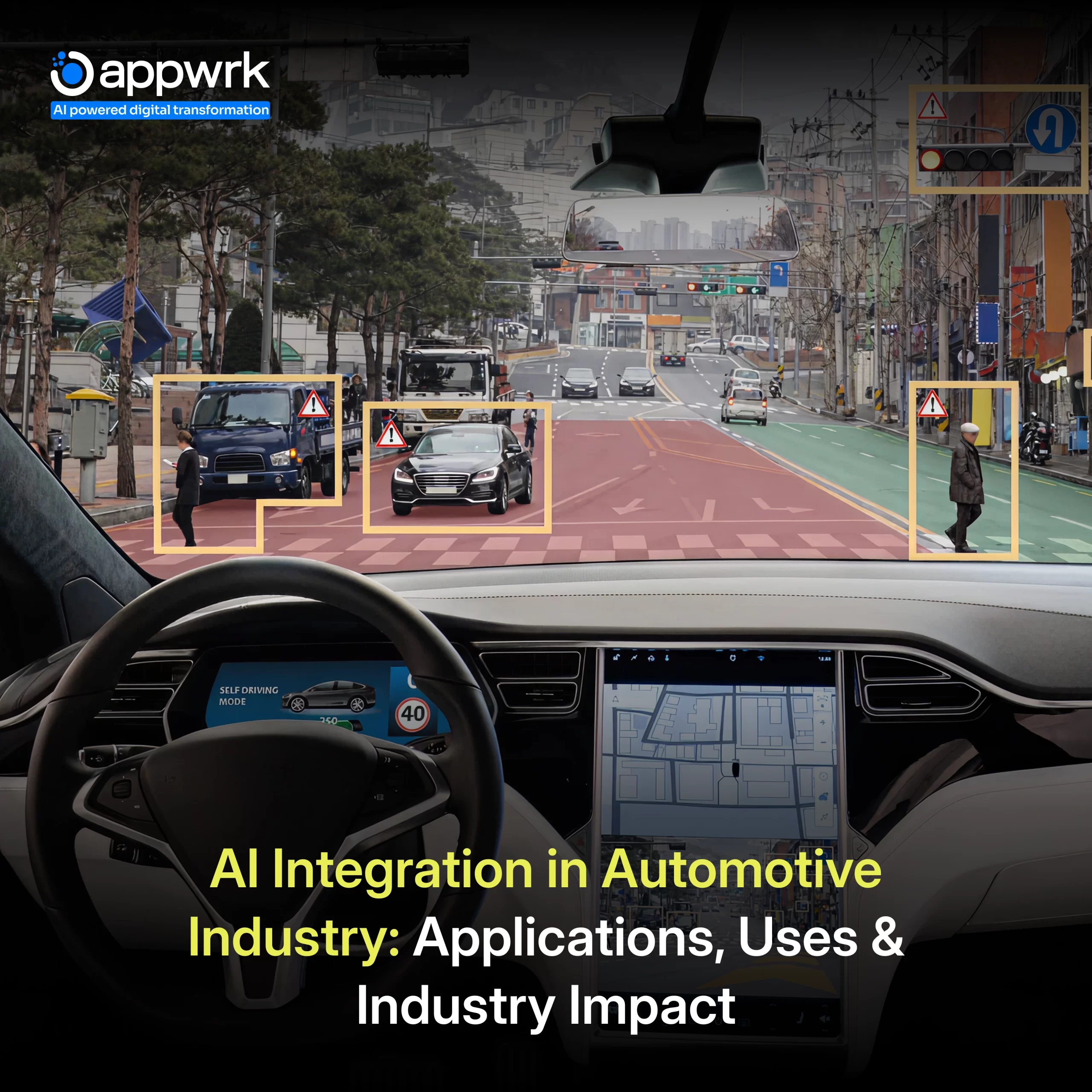
Autonomous vehicles are among the most futuristic applications of AI in transportation. These driverless vehicles use AI to “see” their surroundings using cameras and sensors, understand road conditions in real time, and make safe driving decisions powered by neural networks for navigation that continuously learn from diverse driving scenarios.
Traffic Management: Enabling Smarter AI in Urban Mobility
Urban congestion leads to wasted fuel, lost time, and reduced productivity. AI-powered traffic management systems address these challenges by processing real-time traffic data from cameras, sensors, and GPS devices across the city. These systems dynamically adjust signal timings, optimize lane usage, and reroute vehicles based on current road conditions and real-time incident detection.
The result is smoother traffic flow, shorter commute times, and more efficient fuel usage across urban networks.
Predictive Maintenance AI: Minimizing Downtime with Proactive Care
Fleet operators often face unexpected breakdowns that delay deliveries and increase costs. AI-powered predictive maintenance tackles this by analyzing data from vehicle sensors, like engine temperature, brake performance, or tire pressure.
It forecasts potential issues before they occur, allowing technicians to fix problems in advance. The result? Fewer roadside failures, lower repair bills, and longer vehicle lifespans.
Predictive Analytics: Forecasting Disruptions and Optimizing Performance
Predictive analytics is one of the most transformative applications of AI in transportation. By analyzing historical trends, real-time sensor inputs, and environmental variables, AI can predict traffic congestion, maintenance needs, fuel consumption, and even customer demand before they happen.
For instance, logistics companies use predictive models to anticipate delivery delays due to weather or traffic, while transit agencies forecast rider volume changes during events or peak seasons. This foresight allows proactive adjustments to schedules, routes, and resources, improving service reliability, reducing costs, and enhancing passenger satisfaction.
AI Route Optimization: Saving Time, Fuel, and Resources
In delivery and logistics, the route chosen can make or break operational efficiency. AI systems analyze traffic patterns, road closures, weather conditions, and delivery priorities to suggest the fastest and most cost-effective routes in real time. For instance, UPS’s ORION platform uses AI to reduce daily driving miles and fuel usage, streamlining logistics at scale.
AI is helping logistics companies manage inventory more efficiently by improving how warehouses operate and how goods move. It coordinates automated systems for picking, packing, and shipping while aligning with transport schedules.
By analyzing demand patterns, AI can predict which products are needed where and when. This reduces overstock, prevents shortages, and keeps supply chains running smoothly and cost-effectively. AI also optimizes shipping logistics by predicting maintenance schedules, improving cargo tracking accuracy, and reducing delays. These capabilities enhance resource efficiency and boost on-time performance for maritime and freight operations.
Customer Service Chatbots: Automating Transit Assistance 24/7
When passengers need help, be it with ticket bookings, route changes, or delay updates, AI-powered chatbots can provide instant support anytime, anywhere. These bots handle large volumes of queries efficiently, respond in multiple languages, and learn from past interactions to improve over time, reducing customer wait times and boosting satisfaction in public transit systems.
AI is reshaping mobility-on-demand services by intelligently managing shared vehicle fleets to enhance passenger convenience and reduce operational inefficiencies.
By leveraging real-time data on passenger demand, traffic patterns, and city movement trends, AI algorithms can forecast demand up to an hour in advance. This allows idle vehicles to be proactively dispatched to high-demand zones, minimizing wait times and avoiding unnecessary detours.
Unlike traditional time series models, AI powered by deep learning and neural networks can identify both changes in demand over time and patterns across different city regions, enabling more accurate and dynamic predictions. This means that demand spikes in one neighborhood can be anticipated based on patterns in adjacent zones, resulting in more precise and dynamic fleet deployment.
Intelligent Driver Care: Prioritizing Health & Alertness on the Road
Driver fatigue and distraction are leading causes of road accidents. AI systems inside vehicle cabins monitor a driver’s eye movement, posture, and facial expressions to detect signs of drowsiness or stress. If a risk is identified, alerts are triggered, or even the vehicle can be slowed automatically, making long-distance driving safer for both the driver and everyone else on the road.
Insurance Fraud Detection: Improving Accuracy in Claim Processing
After an accident, it’s difficult to verify every detail. AI helps insurance providers detect fraud by cross-checking claim data with sensor logs, driver behavior patterns, and incident history. Suspicious inconsistencies are flagged for investigation, saving millions in false claims and speeding up genuine compensation.
AI-enabled insurance modeling evaluates claim probabilities using actuarial, behavioral, and telematics data for fairer premium decisions.
AI Driver Monitoring & Behavior Analytics: Driving Safer Fleets with Data Insights
AI goes beyond tracking vehicles by closely analyzing driver behavior. It monitors factors like speed, braking, cornering, and response time to create detailed safety profiles for each driver. Fleet managers can use these insights to recognize top performers, provide targeted coaching, and reduce the risk of accidents.
Flight Delay Predictions: Enhancing Airline Communication and Planning
Flight delays frustrate travelers and disrupt operations. AI models analyze real-time flight data, weather patterns, air traffic, and airport logistics to predict delays before they occur. Airlines can use this foresight to reschedule flights, notify passengers early, and better manage crew and resources.
Real-Time Vehicle Tracking: Maximizing Fleet Visibility and Control
Knowing exactly where your vehicles are at any moment is critical in transport. AI telematics systems provide real-time tracking, route history, and alerts for unexpected route deviations. AI-driven real-time ETA prediction continuously updates delivery times using traffic, weather, and vehicle status. Managers can monitor deliveries, ensure driver safety, and adjust plans quickly when disruptions arise.
Smart Parking AI Solutions: Reducing Idle Search Time & Congestion
Finding parking in busy cities wastes time and fuel. AI-powered smart parking apps use real-time data from sensors and mobile apps to guide drivers directly to available spots. Some systems even predict future availability, reducing idle time and lowering urban congestion and emissions. Connected parking infrastructure allows seamless integration between vehicles, parking sensors, and navigation apps to guide drivers efficiently.
AI-powered smart curb management allocates curb space in real time for loading, delivery, and rideshare pickups, easing urban congestion. Dynamic curbside allocation systems predict demand surges and automatically reassign curb zones to optimize usage during peak times.
License Plate Recognition: Enhancing Security and Traffic Enforcement
AI-powered License Plate Recognition (LPR) systems use computer vision and deep learning to automatically detect, read, and log vehicle license plates from surveillance footage or roadside cameras. These systems are increasingly used by traffic authorities, toll operators, parking facilities, and logistics hubs to monitor vehicle movement, enforce regulations, and streamline operations.
Real-time stolen vehicle identification and alerts.
By replacing manual logging and visual verification, AI-based LPR improves accuracy, speed, and traceability, enabling safer, more compliant, and data-driven transport infrastructure.
AI in Supply Chain Management: Synchronizing Global Transportation Workflows
Coordinating transportation across suppliers, warehouses, ports, and customers is complex. AI simplifies it by analyzing real-time shipping data, optimizing delivery windows, and predicting bottlenecks before they occur. Companies like Amazon and FedEx use AI to ensure goods arrive on time with minimal disruption.
AI for Demand Forecasting: Preparing for Shifts in Transit Needs
Accurately predicting demand is essential for efficient transportation planning. AI helps transit agencies and logistics providers anticipate rider volumes and delivery spikes by analyzing past trends, weather patterns, event calendars, and booking data.
These forecasts enable better vehicle allocation, reduce operational waste, and help prevent issues like overcrowding or underutilized routes.
AI in Air Traffic Control: Improving Efficiency in Aviation Navigation
Managing hundreds of planes in busy airspace is a daunting task. AI supports air traffic controllers by predicting flight paths, managing takeoffs and landings, and resolving potential conflicts. This improves safety, reduces delays, and enhances airport throughput.
AI enhances aviation by managing air traffic flow, predicting flight delays, and optimizing passenger movement across terminals. It also supports maintenance forecasting for aircraft, helping airports streamline turnaround times and improve capacity planning.
Driving Assistance & Automation: Augmenting Human Decisions with AI Intelligence
AI-based driving aids, like adaptive cruise control and automatic emergency braking, support human drivers in real time. These systems reduce the chance of errors, keep drivers alert, and form the building blocks for full autonomy, delivering both safety and comfort.
Fewer Accidents: Preventing Collisions with AI Risk Modeling
AI systems assess collision risks based on speed, road type, weather, and driving behavior. When risks are high, alerts or interventions are triggered, like braking assistance or lane correction. These proactive actions significantly lower accident rates on highways and city streets.
AI for accident prediction uses historical and sensor data to assess the probabilities of incidents across different locations and conditions.
Cost Reduction: Automating Processes for Scalable Savings
AI enables transport businesses to do more with less. By automating routing, maintenance, customer support, and scheduling, companies reduce operational costs without compromising service quality, boosting profitability in both the short and long term.
Sustainability: AI for EV Charging Optimization
As climate goals grow urgent, AI plays a crucial role in sustainability. It helps reduce emissions by optimizing EV usage, planning fuel-efficient routes, and managing energy consumption across transport systems, aligning operations with green mandates.
Faster Emergency Response: Reducing Time to Critical Intervention
AI is helping emergency services respond faster and more efficiently than ever before. By analyzing data from traffic cameras, connected vehicles, and road sensors, AI can instantly detect incidents, dispatch alerts, and map the quickest route for first responders, reducing delays and improving outcomes when every moment counts.
Personalized Experience: Adapting Transit to Individual Needs
Commuters today look for more than just reliable transportation. They want services that understand and adapt to their preferences. AI makes this possible by analyzing travel habits, real-time conditions, and user behavior.
It delivers personalized route suggestions, predicts crowd levels, and customizes app interfaces to create a smoother and more convenient travel experience.
Improved Connectivity: Unifying Systems Through Data Integration
AI connects buses, metros, rideshares, and EV chargers into a unified transportation network powered by mobility data analytics, helping operators optimize routes, improve scheduling efficiency, and plan infrastructure more effectively. Through integrated data sharing, commuters enjoy real-time updates, easier transfers, and smoother end-to-end journeys.
Reduced Carbon Emissions: Driving Greener Operations with AI
AI optimizes routes, reduces engine idling, promotes EV adoption, and eliminates inefficiencies that contribute to pollution. As cities aim for carbon neutrality, AI is becoming a key enabler in building cleaner, more responsible transport systems.
AI Integration & Workforce Readiness: Enabling Scalable Adoption
Integrating AI into the transportation sector is not just about deploying new technology. It requires aligning systems, retraining teams, and rethinking how work gets done. As AI automates tasks like dispatching and route planning, organizations are creating new roles focused on data and intelligence. This transformation is shifting the industry toward smarter, more adaptive operations powered by people and machines working in sync.
To support this shift, organizations are investing in AI upskilling through bootcamps, simulation labs, and blended learning. According to McKinsey, companies focused on training are 2.5x more likely to see ROI from AI.
However, many fleets still operate on outdated GPS, ERP, and telematics platforms. Since AI depends on clean, real-time data, integration with legacy systems is crucial. Companies are adopting APIs, middleware, and hybrid deployments to enable phased AI adoption without a complete infrastructure overhaul.
Computer Vision in Autonomous Vehicles
Computer vision in transportation enables autonomous vehicles to interpret their surroundings by analyzing visual data from onboard cameras and sensors, supporting safer navigation and smarter infrastructure management.
Key Applications:
Object Detection: AVs use deep learning models like CNNs and YOLO to identify nearby objects such as pedestrians, vehicles, and signs.
Depth Estimation: Using LiDAR, stereo vision, and radar, vehicles generate depth maps to judge distances and navigate safely.
Lane Detection: Algorithms such as edge detection and Hough transforms, supported by tools like OpenCV, help AVs stay within lanes in real time.
Computer vision is vital to AV safety and autonomy, supporting navigation, obstacle avoidance, and environment perception in real time.
AI-Powered Logistics App Case Study: How APPWRK Helped Kargo Optimize Routes & Cut Delays
When Kargo, a rising logistics platform in Indonesia’s booming $250 billion freight market, approached APPWRK, they had a clear challenge: too many delays, too much guesswork, and not enough visibility across their supply chain.
Drivers got stuck in traffic, deliveries missed their windows, customers had no updates, and manual processes with outdated systems slowed operations.
How APPWRK Modernized Kargo’s Transportation Operations with AI
APPWRK stepped in as more than a software partner and became an AI transformation engine.
We used AI route optimization to analyze traffic, weather, and delivery urgency, dispatching trucks more efficiently. This reduced idle time, lowered fuel use, and ensured deliveries arrived on time.
Behind the scenes, predictive maintenance algorithms scanned vehicle data and flagged potential breakdowns before they happened. Kargo’s fleet saw 30% less downtime, and service reliability surged.
AI in Action: How APPWRK Transformed Every Layer of Supply Chain in Kargo’s Transportation
Customer experience was upgraded with live ETAs and multilingual AI chatbots, eliminating the flood of “Where’s my package?” calls.
Digital twins simulated new routes and warehouse layouts before implementation, reducing disruptions and improving ROI.
The Outcome: What Kargo Achieved with APPWRK
Within months, Kargo’s operations were transformed:
On-time deliveries improved by 25%.
Operational costs dropped by 20%.
Customer satisfaction scores climbed.
What started as a logistics software build became a blueprint for AI-powered, scalable freight management, with APPWRK driving the change.
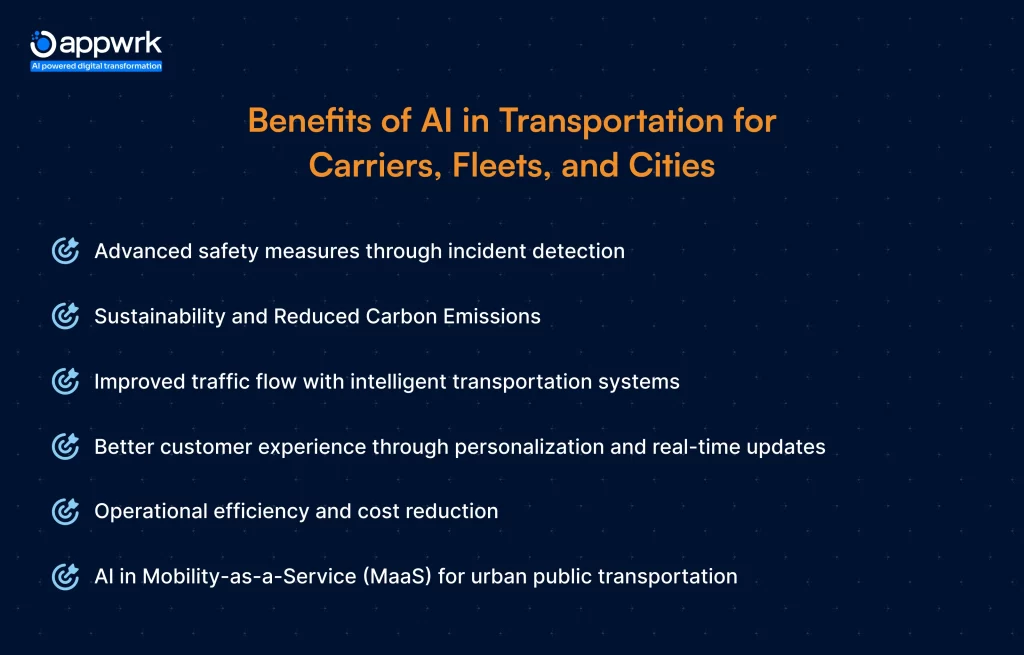
Benefits of AI in Transportation for Carriers, Fleets, and Cities
There’s no denying that AI is unlocking new levels of efficiency, safety, and sustainability across the transportation ecosystem. Whether for logistics carriers, urban mobility planners, or fleet operators, AI technologies are helping reduce operational costs, enhance real-time decision-making, and improve service reliability. From predictive analytics to automated traffic systems, the benefits are both immediate and far-reaching.
Advanced Safety Measures through Incident Detection
AI is transforming transportation safety by enabling proactive risk detection and rapid response. Through technologies like real-time object recognition, predictive fatigue monitoring, and computer vision, carriers and fleets are significantly reducing accidents, injuries, and downtime.
For example, Volvo’s AI-integrated heavy-duty trucks now use sensor fusion and behavior analytics to anticipate road risks, reducing collision incidents by over 26%.
Transit agencies are also deploying AI for crowd movement prediction, ensuring safety in stations, terminals, and platforms.
Sustainability and Reduced Carbon Emissions
AI supports sustainability in transportation by optimizing fuel consumption, reducing empty miles, improving vehicle load efficiency, and enabling eco-friendly routing across road, rail, air, and sea.
For example, Amazon’s freight division uses machine learning to eliminate unnecessary trips, reduce idle time, and optimize delivery schedules, cutting CO₂ emissions by more than 12% annually.
These AI-driven efficiencies not only help organizations meet climate targets but also lower operating costs and extend the lifespan of transportation assets.
Improved Traffic Flow with Intelligent Transportation Systems
AI in intelligent traffic signals streamlines vehicle-to-vehicle (V2V) and vehicle-to-infrastructure (V2I) communications, powering smart intersections, signal timing, and congestion management.
Cities like Los Angeles and Singapore have deployed AI-driven traffic platforms that adapt signals in real time, cutting average commute times by reducing traffic congestion by up to 25%.
For rural and tier-2 cities, AI supports last-mile ride demand mapping and on-demand fleet adjustments.
AI in intelligent traffic signals enables dynamic signal timing based on real-time traffic inputs, reducing wait times and improving urban flow.
Better Customer Experience through Personalization and Real-Time Updates
AI is dramatically enhancing the customer experience in transportation by enabling personalized travel planning, real-time updates, and proactive communication. Whether in urban mobility, logistics, or public transit, AI algorithms analyze user behavior, location data, and historical trends to deliver tailored suggestions, dynamic routing, and accurate ETAs.
For example, AI-powered customer service chatbots provide instant support for ticketing, delays, and route changes across platforms. In ride-sharing and last-mile delivery, AI ensures route optimization and real-time vehicle tracking, giving users better visibility and control over their journeys.
By combining predictive analytics, driver behavior monitoring, and intelligent automation, AI helps transport services reduce wait times, respond faster to disruptions, and increase rider satisfaction, turning every trip into a smoother, more reliable experience.
AI in Mobility-as-a-Service (MaaS) for Urban Public Transportation
Mobility-as-a-Service (MaaS) is transforming urban transportation by integrating AI into ride-sharing and public transit systems. Companies like Uber and Lyft are leveraging AI to optimize routing, match supply with demand, and enhance user experience.
Public transport authorities are also adopting AI to enable real-time scheduling, dynamic routing, and predictive demand modeling, improving accessibility and operational efficiency across cities.
Operational Efficiency and Cost Reduction
AI significantly reduces operational overhead through automation, asset visibility, and predictive modeling. A regional bus fleet in Australia achieved 33% lower downtime using AI-based diagnostics for maintenance schedules, outperforming manual logs and inspection routines.
Fleet managers also report fuel savings of 8-14% with AI-enhanced telematics guiding driver behavior and load balancing.
AI Case Studies in Transportation & Logistics
Over the years, AI has been steadily reshaping the transportation and logistics industries, moving from pilot projects to large-scale, mission-critical deployments. These case studies illustrate how organizations are harnessing AI to optimize routes, reduce costs, improve delivery precision, and unlock new levels of operational efficiency across both local fleets and global supply chains.
Uber Freight: Route Optimization to Cut Empty Miles
Uber Freight’s AI system minimizes empty-mile trips by dynamically matching carriers and loads based on route data and capacity forecasts. In 2023 alone, the platform cut deadhead miles by over 22%, significantly improving network efficiency.
Penske: Predictive maintenance AI in Fleet Management & Maintenance Systems
Penske leverages AI to detect engine anomalies and optimize preventive maintenance schedules. This reduced unexpected breakdowns and improved operational efficiencies by 34% and improved vehicle turnaround times, especially for long-haul logistics.
Waymo: Scaled Robotaxi Operations in the US
Waymo’s AI-powered robotaxis operate in Phoenix and San Francisco, using neural networks for object detection, decision-making, and real-time localization. These driverless taxis now complete over 250,000 paid rides each week and have covered more than 2 million miles, more than double their reach from last year and the equivalent of three human lifetimes of driving experience.
JD.com: AI-Powered Last-Mile Delivery through Delivery Drones
JD.com’s autonomous last-mile delivery solutions, including ground bots and drones, use AI for navigation, obstacle avoidance, and facial recognition delivery to boost efficiency in high-density urban zones. With over 400,000 deliveries completed, JD has cut labor costs and increased delivery frequency in high-density urban zones. JD’s success reflects the growing viability of self-driving logistics systems in urban and suburban last-mile operations.
Amazon & DHL: Demand-Based AI Logistics Models
Both Amazon and DHL use AI to map demand surges and automatically shift resources, whether it’s workforce, fleet, or inventory. During holiday peaks, these AI models helped reduce late deliveries by up to 19%.
Aimsun & LYT: Real‑Time Urban Mobility Solutions with AI in Public Transport
Aimsun (Spain) and LYT (US) are advancing urban mobility with AI-powered platforms that optimize traffic signal timing and coordinate multimodal transport systems. In city-level pilots, their technologies have achieved 12 to 18% faster bus routes and up to a 30% reduction in red-light idling, delivering measurable improvements in transit efficiency and reliability for public transportation networks.
Future Trends of AI in Transportation
As of today, most AI-powered vehicles operate at autonomy levels 1 through 3. In the near future, spanning the next few years to a decade, we’re heading toward full autonomy (Level 5), where human intervention is entirely eliminated, allowing drivers to become passengers and enjoy seamless, self-navigated travel.
Beyond autonomous driving, AI-driven traffic systems are revolutionizing urban transport by minimizing congestion and improving network efficiency. With innovations ranging from AI-based infrastructure planning to real-time analytics, the transportation industry is on the brink of full-scale transformation driven by artificial intelligence.
AI has already made substantial progress in transforming the transportation industry, but its full potential is yet to be realized. As it embeds deeper into critical operations, AI is taking on increasingly complex tasks that go beyond automation and efficiency.
From trend forecasting to real-time decision-making, AI empowers a new era of proactive and responsive transportation systems. It offers the ability to predict traffic disruptions, adjust logistics dynamically, and enhance the movement of people and goods across networks.
In terms of safety, AI-enabled systems are driving the industry toward near-zero accident environments. According to the NHTSA, six levels of driving automation define this journey, with each level moving closer to full autonomy.
The AI in the transportation market is growing quickly, driven by AI-powered delivery systems, AI-based traffic management, and digital twin technologies that help plan and optimize transport infrastructure.
The following key trends will shape how people and goods move across increasingly complex urban and global networks.
Emerging Innovations and Technologies
AI is powering new transport paradigms, creating systems that not only respond to data but actively simulate, collaborate, and adapt in real time.
Key Trends to Watch:
Swarm Logistics Coordination: AI enables fleets and drones to move in sync like a swarm. They coordinate routes and loads in real time, making last-mile delivery faster and more efficient.
Vehicle-to-Everything (V2X) Communication: This technology enables real-time communication between vehicles, infrastructure, and other road users, allowing for predictive navigation and smoother, automated traffic flow.
Generative AI for Fleet Simulation: Generative AI creates virtual environments for planning, testing, and optimizing fleet operations. It allows transport systems to explore edge cases like extreme weather or protests to strengthen resilience before real-world deployment.
National-Scale Transport Testing (NVIDIA/Aurora): Companies like NVIDIA and Aurora are using AI simulations to test autonomous vehicle safety, emergency rerouting, and urban logistics under stress. These national-scale environments help validate communication between vehicles and infrastructure.
Multimodal Transport AI Ecosystems: AI systems are connecting road, rail, air, and sea networks into unified ecosystems that coordinate seamlessly, improving efficiency and enabling real-time decision-making across all transport modes.
Blockchain with AI in Logistics Tracking: The convergence of blockchain and AI is unlocking real-time transparency and traceability in logistics tracking. Blockchain ensures tamper-proof recordkeeping of transport events, while AI layers predictive insights on top of these datasets to forecast delays, track cargo conditions, and prevent fraud. This dual-tech approach increases security, streamlines customs clearance, and reduces disputes in global freight networks. Major shippers are adopting blockchain-AI ecosystems to create verifiable, intelligent logistics workflows.
AI + Digital Twins for Traffic Simulation: AI-powered digital twins are redefining how cities simulate and manage traffic. These virtual replicas of physical transport systems ingest real-time sensor data to test different traffic scenarios, emergency responses, and infrastructure modifications. Planners use them to predict outcomes before implementing real-world changes. Combined with AI, digital twins enable highly accurate modeling of urban flow, helping reduce congestion, optimize intersections, and enhance pedestrian safety strategies at scale.
AI for Pedestrian Safety & Crosswalk Analytics: AI systems using computer vision and sensor fusion are improving pedestrian safety at intersections and crosswalks. These systems detect pedestrian movement patterns, predict risk scenarios, and adjust signal timings accordingly. AI-driven crosswalk analytics are also helping cities redesign intersections based on heatmaps of pedestrian activity, leading to fewer accidents and more inclusive transit infrastructure.
AI for EV Charging Optimization: AI is streamlining electric vehicle (EV) charging by forecasting demand, load balancing across charging stations, and optimizing grid energy usage. AI-driven platforms allocate EVs to available chargers based on route, battery status, and congestion levels. Utilities and transport operators are deploying AI to prevent energy bottlenecks, manage peak-hour usage, and prioritize renewable integration into EV infrastructure for greener transit ecosystems.
Over 60% of last-mile deliveries in developed nations will be autonomously managed by AI-enabled multimodal ecosystems by the end of the decade. Generative AI for fleet design is also being used to optimize vehicle specifications and configurations based on route, climate, and cargo type.
Public Engagement and Trust Building: AI for Pedestrian Safety & Crosswalk Analytics
As AI plays a central role in public safety and mobility decisions, winning public trust becomes essential.
Key Engagement Trends:
Explainable AI Dashboards: These are transparent user interfaces that clearly display how AI systems make decisions, such as adjusting routes, modifying schedules, or prioritizing emergency incidents, helping build trust and accountability among users and operators.
Ethics and AI Governance Panels: These panels bring together regulators, civil society, and industry experts to define ethical considerations and boundaries, safety standards, and compliance frameworks that guide responsible AI deployment in the transportation industry.
Public Consultations and Open Portals: Governments are launching initiatives like Sweden’s Trafikverket, which provide citizens with real-time insights into how AI influences transportation decisions, promoting transparency and public engagement.
Integration into Smart Cities and Urban Mobility
AI is moving from an application layer to becoming the very core of city infrastructure, interlinking services and transport in real time.
Urban AI Integration Trends:
AI as the Urban Nervous System: Smart mobility platforms act as the central nervous system of modern cities by connecting transportation with utilities, emergency services, and citizen devices, enabling responsive and context-aware decision-making in real time.
Mobility, Energy, and Urban Planning Convergence: Cities like Toronto (Sidewalk Labs) and Neom (Saudi Arabia) are leading the way in developing integrated AI networks that merge transportation systems, energy grids, and urban development into one cohesive, intelligent infrastructure.
Connected Infrastructure for Smarter Transit: Roads, traffic signals, street lighting, and public transport systems are now equipped with sensors and AI processors, creating an integrated ecosystem that supports autonomous navigation and enables rapid, system-wide adjustments for smoother and safer transit.
Key Regional Insights and Adoption Trends of AI in Transportation
AI adoption in transportation is expanding rapidly, with 64% of businesses expecting it to significantly boost productivity. Confidence in its ability to improve operations is strongest in areas like logistics and fleet telematics. By 2026, more than 80% of transportation companies are expected to use AI as a core part of their operations.
Adoption of AI in transportationvaries by region, shaped by regulation, infrastructure, and investment priorities. From autonomous freight in the US to green logistics in Europe, regional pilots are evolving into global blueprints.
USA: Emergency AI Routing, Freight, Robotaxis
The US leads in autonomous vehicle testing and AI-driven logistics platforms. Cities like San Diego and Miami now use AI to reroute emergency vehicles in real time, shaving off 3-5 minutes per response. Major freight corridors are piloting AI dispatch, and Waymo, Cruise, and Aurora continue to scale robotaxis across urban zones.
Australia: Autonomous Truck Testing and Route AI
Australia’s vast geographies have made it ideal for AI-based long-haul automation. Firms like Fortescue Metals and Toll Group test autonomous trucks with AI navigation along mining and freight routes. The government’s Smart Freight initiative also funds AI-driven logistics optimization for remote regions.
UK: Smart Mobility Ecosystems and Policy
The UK’s focus is on regulated smart transit. Transport for London (TfL) is deploying AI for crowd flow management, while Oxford and Cambridge run live trials on AI-enhanced electric shuttles. The UK also leads in AI policy alignment, pushing transparency and data ethics into mobility tech.
Europe: L4 Trials and Green Logistics AI
Europe is investing heavily in Level 4 autonomy and emissions reduction. Germany’s Deutsche Bahn and France’s SNCF are embedding AI into rail automation and traffic control. The EU’s Mobility Package encourages AI for efficient freight corridors, low-emission zones, and multimodal route optimization.
How AI in Transportation Works with Emerging Technologies
It goes without saying that the full potential of AI in transportation is realized when combined with other emerging technologies. Integrated with IoT sensors, cloud-edge computing, natural language processing, and smart city infrastructure, AI helps build intelligent mobility ecosystems that are adaptive, connected, and capable of responding to real-time conditions. AI also helps improve public transit efficiency by adjusting routes based on rider volume and traffic patterns.
AI and the Internet of Things (IoT)
When AI is combined with the Internet of Things, transportation systems become more intelligent, connected, and responsive. IoT sensors embedded in vehicles, roads, and stations send real-time data to AI models, enabling smarter and safer operations. For example, sensors tracking temperature, brake status, and load distribution, power predictive maintenance algorithms that improve safety and optimize asset use.
In Seoul, smart bus stops use IoT-AI integration to provide passengers with accurate arrival times, crowding alerts, and environmental updates in real time, enhancing the overall travel experience.
Role of Cloud and Edge Computing
AI in transportation demands significant computing power, but not every decision can rely on cloud processing alone. Edge AI in transport bridges this gap by enabling real-time, on-device inference, allowing vehicles and traffic systems to process data instantly without relying solely on cloud connectivity. For example, cameras on autonomous shuttles use edge AI to process data locally, allowing vehicles to make sub-second driving decisions without latency or connectivity delays.
AWS, Azure, and Google Cloud all offer mobility-focused AI stacks, enabling centralized model training with decentralized edge inference for fleets.
Natural Language Processing in Smart Transit
NLP in transit systems enables riders to interact with public transport platforms using voice or chat, offering multilingual assistance, ticketing support, and real-time travel updates. Whether it’s multilingual journey assistance or asking for ETA on a crowded platform, NLP makes transit more inclusive.
Beijing Metro has deployed AI voice kiosks for real-time commuter Q&A in five languages, reducing support costs and improving accessibility.
Smart City Infrastructure Compatibility
Smart city platforms rely on AI compatibility across traffic lights, EV charging, curb space, and pedestrian zones. AI integrates with GIS and camera networks to coordinate these elements, reducing chaos during rush hour or events.
Barcelona’s AI+Smart Grid platform, for example, adjusts city traffic signals, tram schedules, and energy loads based on real-time conditions.
AI in Transportation: Cost vs. ROI Explained
The cost to implement AI in transportation starts at around $5,000 for an MVP and can range from $10,000 to over $100,000, yet the return on investment is becoming increasingly difficult for businesses to ignore. Companies that embed AI into routing, fleet ops, and logistics see meaningful gains in uptime, fuel use, and workforce efficiency, proving strong AI ROI for fleet operators.
CAPEX vs. OPEX Impact of AI Integration
Integrating AI into transportation involves significant upfront capital expenditure, including software licensing, sensor installations, cloud infrastructure, and workforce training. For a mid-sized fleet, initial costs typically range from $50000 to $100000, depending on complexity and scale.
However, the long-term operational savings are substantial. Predictive maintenance reduces unexpected part failures, automated dispatch streamlines staffing, and intelligent routing lowers fuel consumption, resulting in sustained, compounding cost reductions over time.
Reducing Operational Costs with AI Automation
AI automation removes redundancies, from manual route recalculations to inefficient driver behavior. Even small AI integrations, like auto-scheduling or camera-based safety alerts, lead to 5-10% operational savings.
AI-based traffic management deployed in pilot cities like Tel Aviv and Atlanta cuts congestion costs by millions annually, freeing resources for reinvestment into infrastructure.
Furthermore, AI implementation costs vary depending on the scope, features, and scale of deployment. Below is a breakdown of typical investment ranges for different phases of AI automation in transportation.
Phase
Key AI Features
Cost Range for AI Automation in Transportation (USD)
MVP Deployment
Basic AI routing, Telematics, and NLP bots.
$5,000-$10,000
Mid-Tier Rollout
Predictive maintenance, fleet AI, and edge AI.
$15,000-$40,000
Enterprise Integration
Full-stack AI, AI for smart traffic systems, and autonomous modules.
$40,000-$100,000
Key Challenges for Integrating AI in Transportation
While AI in transportation offers transformative benefits, from predictive logistics and autonomous driving to smart city traffic optimization, it also presents several adoption and operational challenges. Below are the most critical roadblocks that stakeholders must address to ensure scalable and sustainable AI implementation.
Data Privacy, Security, and Compliance
AI transportation systems rely heavily on real-time sensor data, driver behavior analytics, telematics, and location tracking. However, collecting and processing such data introduces serious concerns around data privacy, cybersecurity breaches, and compliance with regulations like GDPR, CCPA, and the EU AI Act.
Key Risks:
Unauthorized access to vehicle telemetry and passenger data.
Vulnerabilities in cloud-connected fleet management platforms.
Lack of transparency in how AI models process and store sensitive information.
Ensuring AI safety in transportation requires robust encryption, secure APIs, and end-to-end governance over data access and usage, supported by AI cybersecurity in transportation strategies that protect fleets, passengers, and infrastructure from digital threats.
AI Model Explainability and Bias in Decision-Making
AI systems often operate as “black boxes,” making it difficult for operators and regulators to understand or audit decisions related to route optimization, traffic prediction, or autonomous vehicle behavior.
What’s at Stake:
Algorithmic bias in driver behavior scoring or insurance fraud detection.
Lack of explainable AI (XAI) in emergency rerouting decisions.
Public trust erosion due to opaque automation logic.
To overcome this, transport AI systems must embed explainable AI dashboards that clarify why decisions were made, especially in mission-critical scenarios like pedestrian safety analytics or autonomous navigation.
Integration with Legacy Transportation Infrastructure
Outdated systems such as legacy telematics, older ERPs, traditional GPS platforms, and isolated traffic control centers can slow down AI adoption. These limitations make it difficult to achieve real-time integration and fully leverage AI capabilities in transportation.
Common Issues:
Incompatibility with edge AI modules or V2X communication protocols.
Data latency from unstructured or batch-processed sources.
High CAPEX to retrofit old infrastructure with smart sensors and AI-ready components.
A phased approach to AI adoption in logistics and smart mobility systems, using APIs and middleware, is key to bridging legacy limitations.
Talent Gap and Workforce Readiness
The shift to AI-powered transport systems requires a workforce skilled in machine learning, fleet analytics, smart traffic simulation, and autonomous systems testing.
Current Gaps:
Shortage of AI engineers familiar with the transportation domain.
Resistance from operational staff unfamiliar with AI-enabled workflows.
Need for ongoing AI bootcamps, simulation training, and safety protocol education.
Investing in AI upskilling for transportation companies is crucial for long-term ROI and employee alignment with intelligent systems.
Ethical Concerns and Regulatory Uncertainty
AI in transportation intersects with ethical challenges such as job displacement, passenger profiling, and automated decision-making in emergencies.
Emerging Regulatory Hurdles:
National differences in AI testing rules for autonomous vehicles.
Legal ambiguity in AI-related road incidents.
Lack of standardized metrics for AI performance evaluation.
Developing a regulatory framework for responsible AI in transportation in collaboration with policymakers, technology providers, and civic groups is essential for building public trust.
Infrastructure Bottlenecks in EV and Smart City AI Deployment
AI-based solutions like EV charging optimization, AI for multimodal transport planning, and real-time pedestrian analytics require smart, connected infrastructure.
Infrastructure Constraints:
Low sensor coverage in rural or Tier-2 cities.
Inadequate bandwidth for cloud-edge AI coordination.
Insufficient budget allocation for digital twin ecosystems.
Governments and city planners must accelerate smart city AI infrastructure investments to fully realize AI’s benefits in transportation.
How to Build a Scalable AI Strategy for Transportation Companies
Unlocking the full potential of AI in transportation takes more than running isolated pilot projects. For supply chain operators, fleet managers, mobility providers, logistics companies, and transportation leaders, success relies on a well-planned strategy that aligns infrastructure, talent, data governance, and regulatory compliance from the start.
A focused, enterprise-wide approach ensures scalability, long-term ROI, and meaningful impact across the organization.
Infrastructure Investment and Workforce Readiness
Effective AI integration begins with the right foundation, including modern data architecture, edge-enabled devices, connected fleet systems, and well-structured APIs. Equally important is workforce readiness. Building internal capabilities through training and cross-functional alignment ensures that both technology and teams are prepared to deploy, manage, and scale AI solutions effectively.
Before rolling out AI, leaders must assess internal skill gaps, invest in AI literacy across departments, and prepare cross-functional teams for agile implementation cycles.
Choosing the Right AI Technologies
Not all AI is built for transport. Leaders must evaluate:
Real-time inference capabilities for routing, telematics, and V2X.
Scalability across mixed fleet types (EVs, heavy vehicles, autonomous units).
Cloud vs. edge compatibility based on latency and bandwidth realities.
Ensuring Compliance and Safety Standards
AI solutions for transportation must follow regional safety regulations, cybersecurity laws, and ethical guidelines to ensure regulatory compliance in AI deployments across transportation systems. Standards such as ISO 21434, the EU AI Act, and SAE autonomous vehicle requirements play a key role in shaping these practices.
Risk modeling, bias audits, and explainability reports should be built into the AI strategy from the beginning rather than added later. Including these measures early strengthens transparency, accountability, and public trust in AI-driven transportation systems.
How APPWRK Drives AI Success in Transportation
At APPWRK, we enable transportation organizations to unlock the full benefits of AI in transportation, with tailored solutions, proven frameworks, and measurable outcomes across the mobility value chain.
AI Solutions and Services Tailored for Transportation
At APPWRK, we design purpose-built AI solutions that address the complex challenges of modern transportation. From intelligent routing and telematics to safety optimization and demand forecasting, our models are engineered for fleets, transit systems, and autonomous mobility providers aiming for smarter, data-driven operations.
Whether you’re scaling AI from pilot to production or integrating with legacy ERP and telematics, our architecture-first approach ensures performance and compliance.
Enhancing Operational Efficiency and Improved Safety
Clients using APPWRK’s AI modules report:
Up to 28% reduction in idle time through dynamic scheduling AI that reallocates resources in real time based on traffic, demand, and operational constraints.
Enhanced driver safety via real-time behavior analysis.
Fewer delivery delays using predictive route optimization.
Our platforms are built with cybersecurity, explainability, and integration at their core, aligning with ISO, GDPR, and sectoral mandates.
End-to-End Implementation and Support
From strategy to rollout, APPWRK delivers AI as a service, with end-to-end implementation across cloud, edge, and hybrid models.
We offer:
AI-readiness assessments
Custom data pipelines
Post-launch analytics tuning
Continuous AI performance governance
We don’t just implement AI. We ensure it delivers real-world impact with responsibility, scalability, and clear business value.
Contact APPWRK to get AI integrated into your transportation company right away.
FAQs
What are the benefits of AI in logistics and supply chains?
AI enhances routing, inventory forecasting, warehouse automation, and delivery accuracy. It reduces costs, improves uptime, and enables real-time decision-making across logistics networks.
For logistics companies, AI enables dynamic route optimization by analyzing traffic, weather, delivery priorities, and historical data. This results in reduced fuel costs, on-time deliveries, and scalable logistics efficiency, making AI critical for cost-effective fleet operations.
How does AI improve traffic management and reduce congestion?
AI in traffic management uses real-time data from sensors, cameras, and GPS systems to optimize signal timing, reduce idle times, and enable smart intersections. This reduces urban congestion, shortens commute times, and enhances traffic flow efficiency across city corridors.
What are the top use cases of AI in predictive maintenance for fleets?
AI in predictive maintenance helps fleet operators detect potential vehicle issues by analyzing sensor data (e.g., engine temperature, brake wear). This prevents breakdowns, reduces repair costs, and extends vehicle lifespan, improving fleet uptime and operational reliability.
How is AI used in public transportation systems?
AI powers dynamic scheduling, crowd movement prediction, smart ticketing, and traffic signal prioritization, all of which are essential for AI in urban planning.
How does AI help reduce operational costs in transportation?
AI automates route planning, monitors driver behavior, predicts maintenance needs, and minimizes fuel consumption, reducing OPEX by 10-30% depending on deployment scale.
Contact APPWRK to learn more ways to save costs in transportation.
What are the main challenges of implementing AI in transport?
Key challenges include data quality, integration with legacy systems, regulatory compliance, workforce alignment, and building public trust in AI-driven decisions.
How can APPWRK support my business in deploying AI solutions?
APPWRK provides end-to-end AI services, from assessment to architecture, integration, and post-launch governance, tailored for logistics, fleet, and transit operations.
How is AI used in autonomous vehicles and self-driving cars?
AI powers the core functions of self-driving cars, from environment perception using computer vision and LiDAR to decision-making algorithms for navigation, obstacle avoidance, and safety. It enables scalable autonomous mobility solutions across consumer and freight applications.
Can AI reduce traffic accidents and improve road safety?
Yes, AI enhances road safety by identifying high-risk behaviors, issuing real-time alerts, and activating driver assistance systems like automatic braking or lane correction. It reduces the likelihood of traffic accidents and supports proactive risk management in both public and commercial transport.
How does AI assist in managing large vehicle fleets?
AI provides actionable insights into fleet usage, vehicle health, and driver behavior. It helps managers track maintenance needs, optimize fuel efficiency, and reduce operational costs by predicting downtime and improving asset utilization.
What impact does AI have on environmental sustainability in transportation?
AI supports sustainability by optimizing fuel consumption, reducing idle time, enabling eco-routing, and improving EV integration. These enhancements lead to measurable reductions in carbon emissions and align with climate goals.
How is AI improving ride-sharing services?
AI enhances ride-sharing platforms by matching riders and drivers in real time, forecasting demand surges, and optimizing dynamic pricing. It improves vehicle allocation, reduces wait times, and delivers a more personalized commuter experience.
Gourav Khanna is the Co-founder and CEO of APPWRK, leading the company’s vision to deliver AI-first, scalable digital solutions for enterprises and high-growth startups. With over 16 years of leadership in technology, he is known for driving digital transformation strategies that connect business ambition with outcome-focused execution across healthcare, retail, logistics, and enterprise operations.
Recognized as a strategic industry voice, Gourav brings deep expertise in product strategy, AI adoption, and platform engineering. Through his insights, he helps decision-makers prioritize market traction, operational efficiency, and long-term ROI while building resilient, user-centric digital systems.
Subscribe to APPWRK Blogs, We'll Do the Rest!
Get Blogs on UI/UX, Mobile Apps, Online Marketing, and Web development technology.
Unlock worthy and priceless suggestions from the masters of mobile and web app development