150+ minds across 4 countries. Join a culture of innovation, ownership & growth.
Rewire for AI
From machine learning to deep learning, from classification tools to overall process automation – our AI engineers will help you retool your existing system or enhance your company results.
Ship faster, scale smarter, built for product companies and SaaS teams
Our Latest Work
We strive hard to deliver result-driven digital solutions across the globe. Check out our case studies to get a glimpse of how we ideate, innovate, and create unconventional digital solutions according to the requirements of our clients.
Discover diverse and passionate insights from our tech enthusiasts. We collaborate across various sectors to streamline operations and drive innovation. Explore our rapidly growing collection of articles to see why we’re at the forefront of IT solutions.
The decision to move from Magento to Shopify is one of the most significant replatforming choices an ecommerce business can make. Magento is powerful, but its power comes with...
Accuracy gap is real: Traditional CPG forecasting carries a 25-40% MAPE error rate. AI-powered models bring that down to 8-15%, according to McKinsey research....
Real stories from global leaders who trusted us with their ideas.
Partnering with APPWRK helped us build a compliant and scalable healthcare platform, accelerating our time-to-market by 35%. Their team consistently delivered outstanding work.
Beesers
Digital Healthcare Client
Collaborating with APPWRK, Sportskeeda modernized its platform into a real-time sports engagement ecosystem, enabling seamless content delivery, scalable fan interactions, and high-velocity performance.
Sportskeeda
Sports & Entertainment Partner
Working with APPWRK was effortless. They captured our vision, maintained full compliance, and delivered a digital experience that built trust and elevated how customers interact with our fintech brand.
PayPenny
Fintech Partner
Working with APPWRK gave us confidence in adopting AI responsibly. Their team built a safe, intelligent bot that transformed how we engage with leads and helped us achieve measurable revenue growth.
IFB
AI Transformation Partner
Leveraging APPWRK’s digital expertise, Nemesis launched a scalable, compliant, and safe super app that connects content delivery, real-time communication, and logistics management within a single platform.
AI in risk management is redefining how businesses anticipate threats, respond in real time, reduce losses, ensure compliance, and build operational resilience across industries.
AI is redefining how enterprises detect and prevent riskFrom fraud detection in banking to threat monitoring in cybersecurity, AI systems are replacing reactive processes with predictive protection.
Real-time monitoring and predictive modeling are replacing legacy systemsAI improves risk scoring precision, streamlines alerting processes, and shortens detection time, especially in high-stakes sectors such as finance and healthcare.
Supply chains and third-party risk management are becoming more intelligentMachine learning models now flag supplier instability, logistics disruption, and contractual risk long before traditional audits can catch them.
AI enables smarter compliance, not just faster checksFramework-aligned AI engines are improving regulatory reporting, reducing fines, and boosting audit readiness in finance, pharma, and insurance.
The future of risk is generative, adaptive, and always-onEmerging applications in generative AI, continuous learning loops, and integrated governance are making AI-driven risk platforms the new enterprise standard.
This guide is tailored for enterprise risk leaders, fintech CXOs, compliance heads, manufacturing COOs, and product owners building AI-first governance platforms. Whether you're transforming fraud systems, optimizing supply chain resilience, AI in climate risk forecasting or ensuring regulatory integrity, this blog will give you the roadmap to AI-powered risk advantage.
The Growing Role of AI in Enterprise Risk Management
With global risks accelerating in complexity and frequency, enterprises now see AI as an essential pillar of modern risk management. Whether it’s fraud detection, operational risk, regulatory compliance, or supply chain volatility, risk today operates at a speed, complexity, and scale that legacy systems can’t handle.
According to a 2025 McKinsey report, over $1.5 trillion in enterprise value is threatened annually by unmitigated risks across cyber, financial fraud, third-party exposure, and real-time compliance gaps.
Where traditional risk tools rely on retrospective logs and batch processing, AI-powered risk engines offer three key capabilities that redefine enterprise resilience:
Comparing AI Risk Management Adoption in the US, Europe, and India
In the United States, Fortune 500 companies are leading the charge in embedding AI into risk frameworks, aligning closely with SEC mandates and NIST compliance standards. Across Europe, stringent regulations like GDPR and the AI Act are fast-tracking AI adoption in sectors such as banking, insurance, and telecommunications. In India, the financial industry, particularly under the regulatory eye of the RBI, is emerging as a hub for AI-powered fraud detection and audit automation. Across all regions, evolving compliance landscapes are making AI not just a strategic advantage but a regulatory imperative.
High-Fidelity Pattern Recognition at Scale
AI systems can continuously ingest and interpret diverse data sources, from real-time transactions and emails to supplier contracts and IoT sensor streams. This multi-source risk visibility allows for the early detection of fraud schemes, compliance lapses, and asset failures, often before human analysts even flag them.
Predictive Analytics and Adaptive Learning
Modern risk landscapes don’t wait for quarterly audits. Predictive models trained on historical and live data now enable continuous risk scoring, allowing firms to assess market shifts, churn risks, and credit exposures in real time. As new patterns emerge, adaptive ML algorithms refine the risk engine, reducing false positives and enhancing detection fidelity.
Regulatory-Ready Automation and Explainability
Leading platforms now embed explainability frameworks (like SHAP, LIME) to ensure audit-ready transparency, a requirement in highly regulated sectors like banking and pharmaceuticals. With AI-powered regulatory compliance, institutions now reduce human workload, avoid regulatory fines, and gain trust with auditors and investors alike.
As we step into 2025, AI isn’t a tool, but it’s a prerequisite for scalable, resilient, and transparent risk operations. From fintech to pharma, enterprises are migrating to AI-first governance models that transform risk from a reactive burden into a predictive strategic function.
Real-World AI Use Cases in Risk Management Across Industries
AI is no longer a support function, but it is the backbone of risk intelligence. From fraud and compliance to supply chain resilience and operational risk, businesses are embedding AI deep into their governance and mitigation frameworks. Below are real-world use cases mapped to critical enterprise functions.
Fraud Detection and Prevention in Banking
AI models trained on transactional patterns and behavioral biometrics are helping banks detect fraudulent activities in real-time. These systems flag anomalies, such as unusual geolocation, device mismatch, or transaction spikes, before financial damage occurs.
Use Case: JPMorgan Chase deployed behavioral AI and anomaly detection across its credit card portfolio, reducing fraud losses by over 40% in one fiscal year. This proactive defense system now adapts in real-time to evolving fraud tactics.
Anti-Money Laundering (AML) and Financial Crime Compliance
Natural Language Processing (NLP) and graph analytics empower institutions to flag suspicious transaction chains and identify hidden beneficiary structures within seconds.
Use Case: HSBCautomated SAR report generation using NLP, reducing investigation timelines by 20% and improving analyst productivity. The system now processes 5M+ communications monthly to surface hidden red flags.
Credit Scoring and Assessment for Loan Disbursements
AI enables more inclusive and precise credit scoring by leveraging non-traditional data, ranging from utility payments and social behavior to mobile wallet usage. This improves lending outcomes and lowers default risk, especially for thin-file borrowers.
Use Case: Zest AI helped lenders increase subprime loan approvals using AI-based behavioral and alternative data scoring, maintaining default rates within industry thresholds. This unlocked credit access to over 20% of previously ineligible applicants.
Market Risk Analysis and Scenario Forecasting
AI-powered platforms are now running Monte Carlo simulations and stress-testing against macroeconomic data in milliseconds. This empowers portfolio managers with predictive insights during volatile periods.
Use Case: BlackRock integrated ML-driven simulations to analyze market exposure, enhancing portfolio rebalancing speed and improving risk-adjusted returns during downturns. Their AI tools provide real-time shock-response capabilities in multi-asset portfolios.
Cybersecurity Threat Detection and Insider Threat Monitoring
AI-enhanced SIEM tools analyze millions of events per second, detecting behavioral anomalies that signal credential theft, phishing, or lateral movement.
Use Case: Microsoft Defenderprocessed over 43 trillion signals daily in 2024, preventing phishing, zero-day exploits, and insider threats with AI correlation layers. These tools significantly decreased median response time across enterprise systems.
Supply Chain Risk Prediction and Logistics Continuity
AI “control tower” models analyze geopolitical events, vendor signals, and weather data to forecast potential supply disruptions, days ahead of traditional alerts.
Use Case: Unileverleveraged AI to monitor 10,000+ suppliers globally, mitigating disruptions during the Russia-Ukraine crisis and 2024 monsoon delays in Asia. Their platform now includes embedded mitigation playbooks for instant response.
Predictive Maintenance for Assets in Manufacturing
AI uses sensor fusion and image analytics to identify early equipment faults, saving downtime costs and avoiding safety incidents.
Use Case:APPWRKbuilt a proprietary computer vision AI for a heavy equipment fleet, automating defect identification and inventory tracking. The system reduced manual inspection time by over 70%, improved fault detection accuracy to 95%, and streamlined preventive maintenance with near-zero human intervention.
Risk Management in Insurance and Claims Validation
Insurers are leveraging AI for policy underwriting, fraud detection, and real-time claims approval using document scanning and behavioral modeling.
Use Case: AXAimplemented unsupervised ML for internal claims audits, flagging 12% more anomalies and reducing incident turnaround by 25%. This reduced false claim payouts while increasing regulatory alignment.
Customer Churn Prediction and Retention Risk Management
By analyzing customer engagement, sentiment, and usage data, AI models identify high-risk accounts and prescribe targeted retention strategies.
Firms now combine LTV scoring with churn triggers to personalize offers and reduce attrition by over 18% in competitive markets.
Third-Party Vendor Risk Evaluation and Procurement Security
AI aggregates supplier ESG scores, litigation data, and global news sentiment to produce dynamic vendor risk scores across multi-tier networks.
Use Case: BASFdeployed an AI vendor scoring engine across 8,000+ suppliers, improving procurement compliance and ESG visibility. Their tool now integrates alerts for sanctions and geopolitical instability.
Portfolio Risk Optimization and Investment Governance
Wealth platforms now use AI to automatically adjust portfolios based on shifting risk appetites, income levels, and global volatility signals.
These dynamic risk models minimize human error and help firms adapt investment strategies faster than manual rebalancing cycles.
Employee Misconduct Detection and HR Compliance
By analyzing access logs, communication tone, and digital movements, AI systems proactively detect policy violations or insider threats.
Firms use this data to enforce internal controls, boost whistleblower efficiency, and reduce compliance breaches by over 20%.
Natural Disaster Risk Assessment and Response Planning
AI combines satellite data with historical event mapping to predict climate-linked risks for businesses, especially in energy, agriculture, and logistics.
Emergency teams use these forecasts to re-route assets, protect personnel, and activate business continuity plans with a lead time advantage.
AI Use Cases in Risk Management: Industry, Risk Type & Techniques
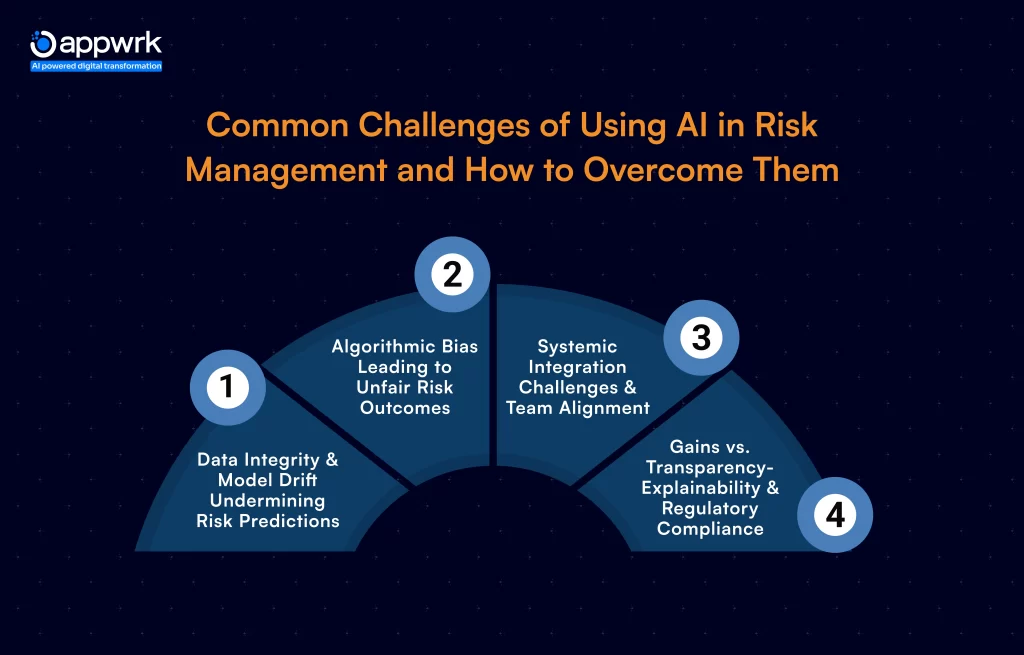
Common Challenges of Using AI in Risk Management and How to Overcome Them
AI holds immense potential for transforming risk management, but without intentional design and strong governance, it can create new points of failure, from biased outputs and poor data quality to opaque decision-making and siloed implementation.
In fact, 47% of GRC leaders report lacking full trust in AI systems, often due to limited explainability and disjointed data infrastructure, underscoring the need for a more robust, enterprise-wide approach.
Data Integrity & Model Drift Undermining Risk Predictions
Accurate risk intelligence demands high-quality data, but risk data is notoriously scattered across legacy ERPs, cloud platforms, emails, and third-party feeds.
Ingested datasets often contain inconsistent formats, outdated values, missing fields, and biases that degrade model reliability.
Without ongoing monitoring, AI models can quickly become outdated. Shifts in fraud tactics or market dynamics may cause model drift, increasing the risk of false positives and false negatives, and ultimately weakening decision accuracy.
Organizations that fail to implement data versioning, lineage tracking, or drift detection struggle to maintain detection fidelity and regulatory alignment.
Algorithmic Bias Leading to Unfair Risk Outcomes
AI systems trained on historical human decisions can unwittingly amplify inequities.
In credit scoring, gender or income-based biases can be reinforced unless mitigated.
AML systems may disproportionately flag certain demographics as suspicious.
Such bias not only triggers unfair lending or screening, violating laws like the Equal Credit Opportunity Act, but also poses reputational risk.
To address this, organizations should implement bias mitigation techniques, conduct fairness testing, and perform regular audits, especially for AI systems used in governance-critical areas.
Gains vs. Transparency- Explainability & Regulatory Compliance
High-performing black-box models can clash with compliance requirements across sectors like banking, healthcare, and insurance.
Without explainable algorithms (e.g., SHAP, LIME), auditors can challenge decision-making processes.
Both the EU AI Act and NIST’s AI RMF now mandate model interpretability, trace logs, and governance structures.
Organizations still using opaque systems risk fines, sanctions, or forced retraining due to inadequate transparency.
Systemic Integration Challenges & Team Alignment
Deploying AI risk tools is only half the battle, as seamless system integration and cultural alignment are equally pivotal.
Many firms struggle to integrate AI models with existing GRC platforms, incident response systems, and BI tools.
Disparate teams (risk analysts, data scientists, and compliance experts) often operate in silos, missing feedback loops.
Without cross-departmental AI governance teams, risk projects stall, and ROI remains elusive.
By actively addressing data provenance, bias controls, explainability frameworks, and systems integration, enterprises can unlock AI’s full value while remaining compliant, fair, and resilient.
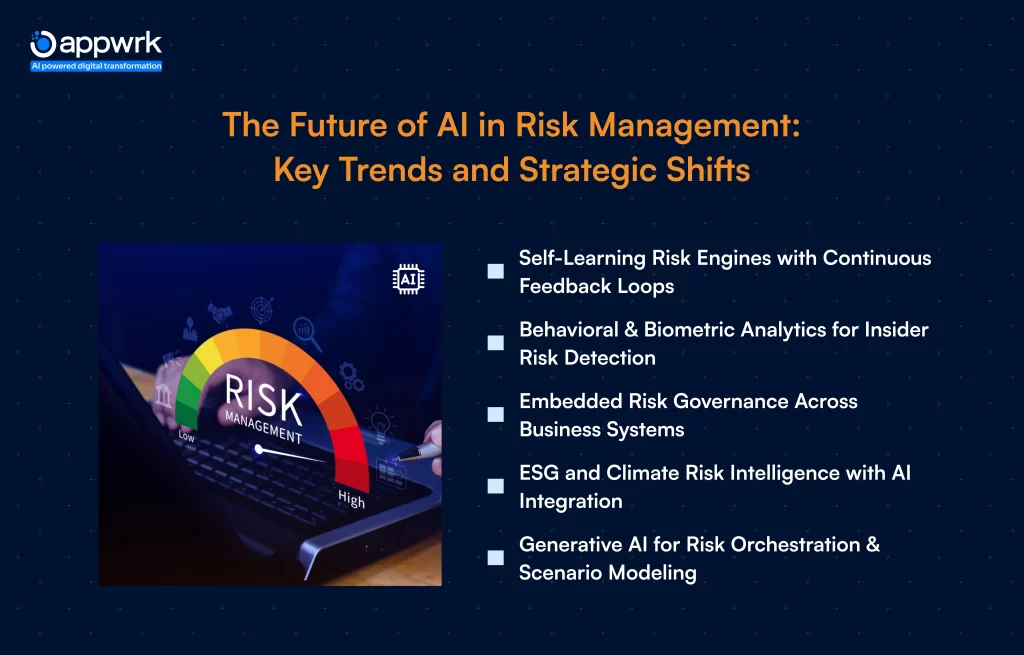
The Future of AI in Risk Management: Key Trends and Strategic Shifts
AI in risk management is rapidly evolving from reactive tools into intelligent, strategic systems that can proactively anticipate, adapt to, and neutralize complex threats. From financial markets and supply chains to cybersecurity and regulatory compliance, AI platforms are becoming central to enterprise resilience.
Recent reports show that 72% of organizations now use some form of AI, a 17% jump from 2023, reflecting a sharp acceleration in adoption and a growing recognition of AI as a core component of future-ready risk strategies.
Generative AI for Risk Orchestration & Scenario Modeling
Generative AI is set to transform enterprise risk management by automating the creation of dynamic risk scenarios that evolve in real time, using live data from CRM, ERP, and IoT systems. It will streamline compliance by instantly drafting regulatory disclosures, audit summaries, and documentation tailored to specific frameworks.
As these systems mature, organizations can expect real-time risk coverage, where AI not only detects anomalies but also recommends immediate policy actions to mitigate emerging threats.
Self-Learning Risk Engines with Continuous Feedback Loops
AI systems will increasingly incorporate real-time feedback from incident outcomes and analyst overrides, allowing them to learn from both success and failure. With embedded performance metrics, these systems will autonomously retrain to correct for data drift and enhance prediction accuracy over time.
This continuous self-improvement will enable AI engines to proactively address performance gaps, ensuring that risk models stay up to date and aligned with evolving compliance standards and regulatory expectations.
ESG and Climate Risk Intelligence with AI Integration
AI is set to revolutionize sustainability risk management by integrating satellite surveillance, supplier ESG audits, and compliance data into hyper-local insights. These advanced tools will enable companies to quantify and report on carbon emissions, labor practices, and environmental risks in weeks rather than quarters.
Real-time dashboards powered by AI will provide boards and regulators with instant visibility into non-compliant partners through dynamic scoring systems.
Globally, adoption varies by region. In the EU, AI supports real-time ESG compliance; in India, it’s being used to forecast monsoon-related risks; and in the USA, it helps organizations navigate federal regulatory demands while fostering private-sector innovation.
Behavioral & Biometric Analytics for Insider Risk Detection
Future AI-driven security systems will detect insider threats by analyzing subtle behavioral cues such as voice tone, typing cadence, and access patterns. These models will process unstructured data, including meeting transcripts and activity logs, to identify potential malicious intent before it escalates.
Operating continuously at the endpoint level, this deep anomaly detection will provide organizations with a proactive layer of defense against internal risks.
Embedded Risk Governance Across Business Systems
AI governance engines will be seamlessly embedded into core enterprise systems such as CRMs, ERPs, procurement platforms, and contract management tools. These systems will include policy engines with built-in interpretability that can flag or block high-risk actions in real time.
With codified compliance logic aligned to frameworks like the EU AI Act and ISO/IEC standards, every decision will be traceable, explainable, and fully auditable, ensuring both operational integrity and regulatory alignment.
By 2030, risk management won’t just flag threats; it will automatically model outcomes, update policies, and enforce governance, creating a resilient, self-reliant enterprise.
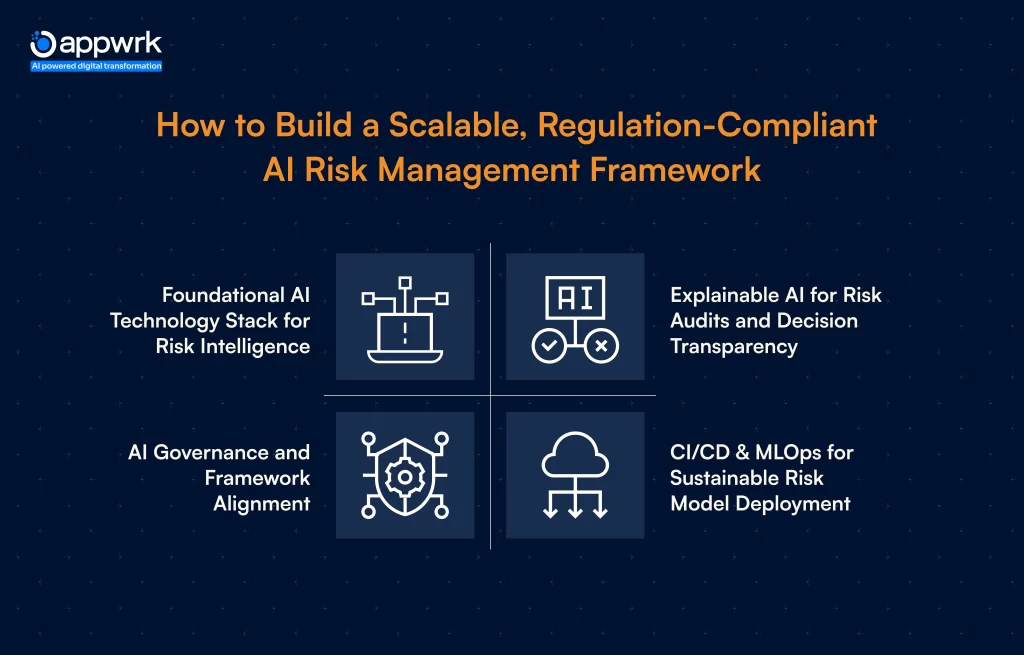
How to Build a Scalable, Regulation-Compliant AI Risk Management Framework
Turning AI-driven risk tools from isolated pilots into enterprise-grade systems requires more than technical performance; it demands a foundational architecture built on governance, transparency, and operational discipline. A scalable framework must prioritize resilience, auditability, and adaptability from day one.
Recent data shows that over 55% of enterprise AI deployments in regulated industries fail compliance audits, often due to weak explainability, inadequate governance structures, and poor lifecycle oversight. Avoiding these pitfalls starts with a compliance-first design approach anchored in both technical and regulatory best practices.
Foundational AI Technology Stack for Risk Intelligence
The foundation of trustworthy AI risk solutions is a modular technology stack that ingests diverse data, processes insights, and delivers outcomes with speed and accuracy:
Machine Learning (ML): Provides predictive capabilities, specifically in credit-risk modeling, fraud anomaly detection, churn prediction, and portfolio volatility estimation.
Natural Language Processing (NLP): Enables analysis of contracts, audit logs, and legal documents to surface compliance gaps, sentiment signals, and emerging risk clauses.
Robotic Process Automation (RPA):Automates data-intensive tasks, like report generation, compliance checks, transaction reconciliation, ensuring accuracy and audit trail.
Computer Vision: Verifies ID documents, inspects physical assets, and supports biometric authentication across risk domains.
Semantic Text Analysis: Integrates domain-specific ontologies to enhance risk lexicon and improve detection of nuanced threats.
These technologies layer into data lakes, event streams, and governance systems, enabling enterprise-grade risk coverage.
AI Governance and Framework Alignment
AI risk governance ensures decisions remain transparent and traceable, especially in regulated environments.
NIST AI RMF: Centers on risk mapping, performance measurement, monitoring, and transparency, ensuring trustworthiness in every AI-assisted decision.
EU AI Act & ISO/IEC 23894: Mandate full model traceability, human oversight, and bias mitigation in decision-critical systems.
Enterprise AI Governance Boards: Multi-disciplinary committees now regularly validate model fairness, data sourcing, audit logs, and overall compliance with policy.
Explainable AI for Risk Audits and Decision Transparency
Auditors and regulators require clear narrative paths for every AI-driven decision in risk systems:
SHAP: Offers feature-level interpretation, which is essential in financial risk models, fraud decisions, and compliance triggers.
LIME: Provides localized model insight when explaining specific outputs or audit challenges.
Hybrid Modeling: Incorporates transparent decision trees or governance rules alongside ML models, ensuring fallback compliance in high-stakes environments.
With built-in interpretability, they streamline audits while maintaining compliance clarity.
CI/CD & MLOps for Sustainable Risk Model Deployment
Enterprise-grade AI systems require ongoing maintenance and operational diligence:
MLOps pipelines (MLflow, Kubeflow): Automate model versioning, data lineage tracking, and scheduled retraining to thwart model drift.
Continuous Monitoring: Automated alerts for performance degradation, unexpected data patterns, or prediction errors trigger fast remediation workflows.
Governance Dashboards: Integrate with GRC platforms, ERP systems, and audit tools to feed real-time logs and simplify compliance documentation.
By building risk systems with structured architectures, transparent decision logic, and dynamic deployment practices, organizations not only manage risk but also institutionalize resilience, ensuring AI compliance, efficacy, and scalability.
How APPWRK Builds Enterprise-Grade AI Risk Management Platforms
At APPWRK, we don’t just develop AI tools; we architect enterprise-grade risk management platforms that are predictive, regulation-ready, and built for resilience. Our solutions are designed to align with the evolving complexity of modern risk environments while ensuring transparency, scalability, and long-term value. Here’s how our approach resonates with modern risk needs:
Deep Domain Expertise for High-Impact Use Cases
With 30+ AI-powered GRC systems deployed since 2023, APPWRK specializes in fraud detection, anti-money laundering, credit risk modeling, and third-party vendor risk integrations.
We reduce time-to-first-alert by 45% and false positives by 32%, letting clients pivot from reactive to preemptive risk approaches.
Regulatory-Integrated ML Pipelines & Explainability
Every deployment includes built-in compliance modules aligned with NIST AI RMF, EU AI Act, GDPR, and industry-specific regulations (e.g., HIPAA, SOX).
We utilize SHAP, LIME, and rule-based layers to ensure every prediction is transparent, enabling audit-grade explainability and reducing compliance review time by ~40%.
Scalable Architecture with MLOps and Cloud-Native Design
With CI/CD pipelines powered by MLflow and Kubeflow, APPWRK ensures live data drift detection and automatic retraining for long-term model accuracy.
Our cloud-native deployments on AWS, Azure, or GCP seamlessly integrate with clients’ existing ERP, CRM, SIEM, and supply chain platforms.
Feedback-Driven Optimization & Client Retention
We embed analyst override feedback loops, enabling models to self-refine in a compliance-aligned workflow.
Clients average 120 days active retraining cycles and a 92% contract renewal rate, reaffirming product stickiness.
Quantified Business Impact & Market Positioning
APPWRK’s AI risk platforms drive a 28-35% reduction in risk event losses (fraud, compliance, churn) within the first 6 months, mirroring industry benchmarks.
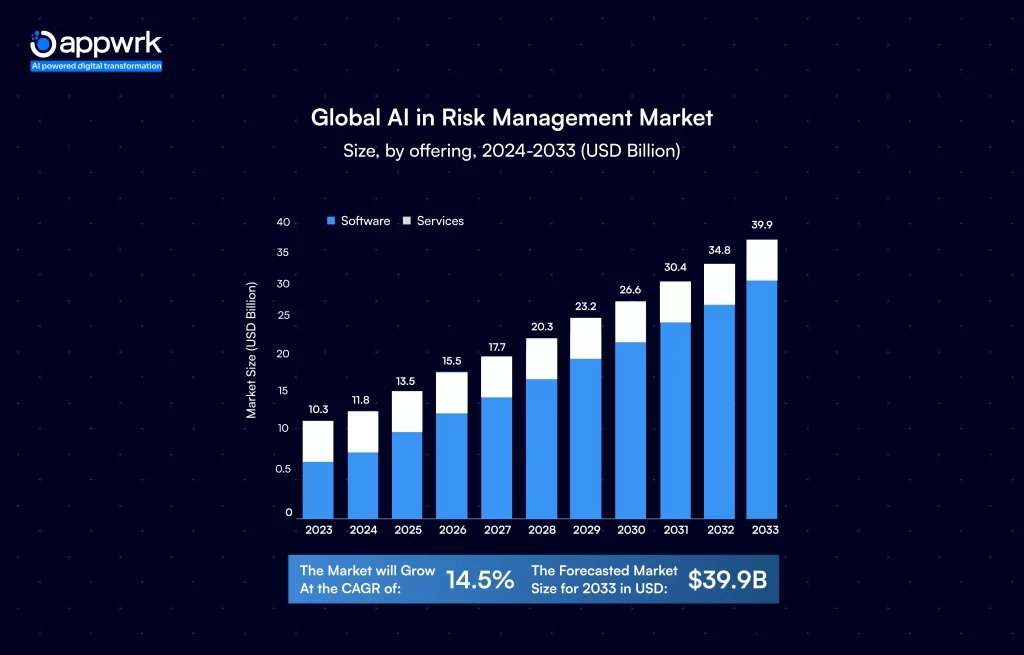
As the global AI risk management market approaches $7.4 Billion by 2032, our differentiated execution gives clients a strategic compliance advantage.
For more case studies, please visit our portfolio.
Traditional Risk Tools vs AI Risk Platforms: Feature-by-Feature Comparison for Enterprises
Feature
Traditional Risk Tools
APPWRK’s AI Risk Management Platform
Fraud Detection Accuracy
Rules-based and static patterns
ML-powered real-time anomaly detection.
Compliance Alignment
Manual audits and lagging alerts
Auto-mapped to GDPR, NIST, and HIPAA.
Deployment Speed
6-12 months
MVP launch in ≤ 8 weeks
Model Explainability
Opaque decision logic
SHAP, LIME, and rule tracing are embedded.
Data Drift Handling
Reactive & delayed retraining
Proactive CI/CD & live MLOps pipelines.
FAQs
1. What are the key use cases of AI in risk management?
AI is applied across fraud detection, credit risk scoring, operational risk analysis, cybersecurity threat monitoring, and supply chain risk prediction. Enterprises now rely on AI to automate early warning systems and improve real-time decision-making across departments.
2. How does AI help with regulatory compliance and audit readiness?
AI tools automate compliance workflows by mapping internal processes to frameworks like GDPR, SOX, HIPAA, and the EU AI Act. Explainable AI models such as SHAP and LIME provide auditors with transparent outputs, reducing time and risk in compliance reviews.
3. Can AI detect insider threats and operational anomalies in real time?
Yes. AI continuously monitors user behavior, system logs, and access patterns to flag policy violations and insider activity. Machine learning algorithms detect subtle changes in digital behavior, reducing manual oversight and breach exposure.
4. How does AI reduce false positives in fraud and risk detection?
By leveraging adaptive learning and historical behavior modeling, AI significantly lowers false positives that plague rules-based systems. This improves investigation efficiency and ensures high-fidelity alerts for fraud, AML, and transaction risk.
5. What are the biggest challenges in deploying AI for risk management?
The main hurdles include poor data quality, algorithmic bias, lack of transparency, and integration with legacy GRC tools. Organizations need robust AI governance frameworks, retraining cycles, and feedback loops to maintain accuracy and fairness.
6. What is the future of AI in enterprise risk and compliance?
AI systems are evolving into self-learning, autonomous platforms that generate risk scenarios, adjust policies in real time, and interface directly with enterprise decision engines. By 2030, they will form the operational core of risk governance systems.
Gourav Khanna is the Co-founder and CEO of APPWRK, leading the company’s vision to deliver AI-first, scalable digital solutions for enterprises and high-growth startups. With over 16 years of leadership in technology, he is known for driving digital transformation strategies that connect business ambition with outcome-focused execution across healthcare, retail, logistics, and enterprise operations.
Recognized as a strategic industry voice, Gourav brings deep expertise in product strategy, AI adoption, and platform engineering. Through his insights, he helps decision-makers prioritize market traction, operational efficiency, and long-term ROI while building resilient, user-centric digital systems.
Subscribe to APPWRK Blogs, We'll Do the Rest!
Get Blogs on UI/UX, Mobile Apps, Online Marketing, and Web development technology.
Unlock worthy and priceless suggestions from the masters of mobile and web app development