150+ minds across 4 countries. Join a culture of innovation, ownership & growth.
Rewire for AI
From machine learning to deep learning, from classification tools to overall process automation – our AI engineers will help you retool your existing system or enhance your company results.
Ship faster, scale smarter, built for product companies and SaaS teams
Our Latest Work
We strive hard to deliver result-driven digital solutions across the globe. Check out our case studies to get a glimpse of how we ideate, innovate, and create unconventional digital solutions according to the requirements of our clients.
Discover diverse and passionate insights from our tech enthusiasts. We collaborate across various sectors to streamline operations and drive innovation. Explore our rapidly growing collection of articles to see why we’re at the forefront of IT solutions.
The decision to move from Magento to Shopify is one of the most significant replatforming choices an ecommerce business can make. Magento is powerful, but its power comes with...
Accuracy gap is real: Traditional CPG forecasting carries a 25-40% MAPE error rate. AI-powered models bring that down to 8-15%, according to McKinsey research....
Real stories from global leaders who trusted us with their ideas.
Partnering with APPWRK helped us build a compliant and scalable healthcare platform, accelerating our time-to-market by 35%. Their team consistently delivered outstanding work.
Beesers
Digital Healthcare Client
Collaborating with APPWRK, Sportskeeda modernized its platform into a real-time sports engagement ecosystem, enabling seamless content delivery, scalable fan interactions, and high-velocity performance.
Sportskeeda
Sports & Entertainment Partner
Working with APPWRK was effortless. They captured our vision, maintained full compliance, and delivered a digital experience that built trust and elevated how customers interact with our fintech brand.
PayPenny
Fintech Partner
Working with APPWRK gave us confidence in adopting AI responsibly. Their team built a safe, intelligent bot that transformed how we engage with leads and helped us achieve measurable revenue growth.
IFB
AI Transformation Partner
Leveraging APPWRK’s digital expertise, Nemesis launched a scalable, compliant, and safe super app that connects content delivery, real-time communication, and logistics management within a single platform.
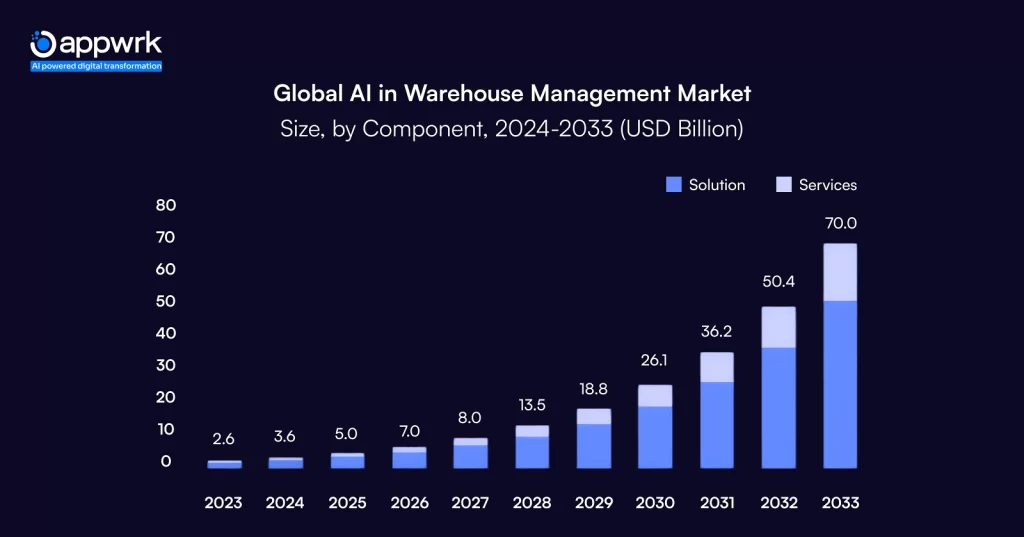
AI in warehouse management enables real-time optimization, predictive decisions, and automation across fulfillment, logistics, and inventory operations.
AI transforms warehouse operations from static to intelligent: Machine learning and real-time analytics reduce bottlenecks, detect anomalies, and enhance decision-making across dynamic supply chains.
Inventory and replenishment workflows become self-regulating: Predictive analytics and automated restocking proactively minimize stockouts, reduce inventory bloat, and streamline last-mile fulfillment with greater precision.
Labor-intensive tasks are streamlined using robotics and vision: From enhanced order picking to autonomous mobile robots (AMRs), AI minimizes human error while boosting throughput and safety.
AI fuels sustainability and compliance: Real-time energy management, occupational safety controls, and error prediction support ESG and regulatory goals in modern warehousing.
Companies deploying AI see measurable ROI and resilience: Leading enterprises report up to 40% faster order fulfillment, 30% reduction in downtime, and higher adaptability to volatile demand.
This blog is crafted for warehouse automation strategists, supply chain heads, logistics CXOs, operations consultants, and enterprise IT leaders aiming to scale AI-powered warehouse systems, taking you through real-world use cases, tech stacks, ROI challenges, and future trends to help align your strategy with next-generation logistics.
Overcoming Warehouse Inefficiencies with AI Automation
There’s no denying the fact that modern warehouses are now the backbone of global supply chains, but many still rely on outdated systems ill-equipped for today’s speed and complexity. With global E-commerce projected to surpass $8 trillion by 2027, the urgency for intelligent, automated operations has never been higher. Despite this growth, only about 30% of warehouses have adopted AI-driven automation, leaving the majority reliant on manual workflows that struggle to keep pace with modern fulfillment demands.
In high-volume fulfillment hubs across the USA, Europe, and India, warehouses are increasingly turning to AI to handle rising order complexity, regional SKU diversity, and labor shortages.
Capacity-Cost Paradox: The Silent Efficiency Drain
The pressure is intensifying across three fronts:
Booming order volumes vs. static picking speeds- Manual pick-and-pack remains the primary bottleneck in many high-turn warehouse environments.
Severe labor shortages and cost pressures- CBRE found that US warehouse attrition exceeds 40% annually, with many facilities unable to sustain staffing levels.
Energy inefficiency and wasted space- Conventional layout and shelving strategies contribute to overstock, energy waste, and underutilized zones.
This reflects the warehouse conundrum where cost control remains essential even as the need for greater speed and scalability continues to rise.
How AI Solves Modern Warehouse Challenges
AI unlocks a critical leap beyond fixed automation:
Adaptive demand forecasting and slotting- AI-driven systems cut inventory levels by 20-30% and logistics costs by 5-20%, dynamically responding to demand shifts.
Predictive maintenance for maximum uptime- Sensors, behavioral analytics, and machine learning detect anomalies before failure, lowering equipment downtime.
Robotic workforce augmentation- The integration of AMRs and robotic arms reduces labor costs by up to 30%, creating safer, smarter environments.
Real-time decision-making at scale- Continuous data inputs enable AI systems to adjust inventory, labor, and layout in real time with no more manual reaction lags.
How AI Transforms Warehouses into Smart Data Hubs
Warehouses are no longer just storage facilities; they are evolving into intelligent data hubs powered by AI-driven orchestration. These next-gen environments continuously self-optimize everything from replenishment and slotting to workforce deployment. The result is a shift from cost-heavy infrastructure to high-performance engines that drive efficiency, agility, and value across the supply chain.
Real-World Use Cases of AI in Warehouse Management
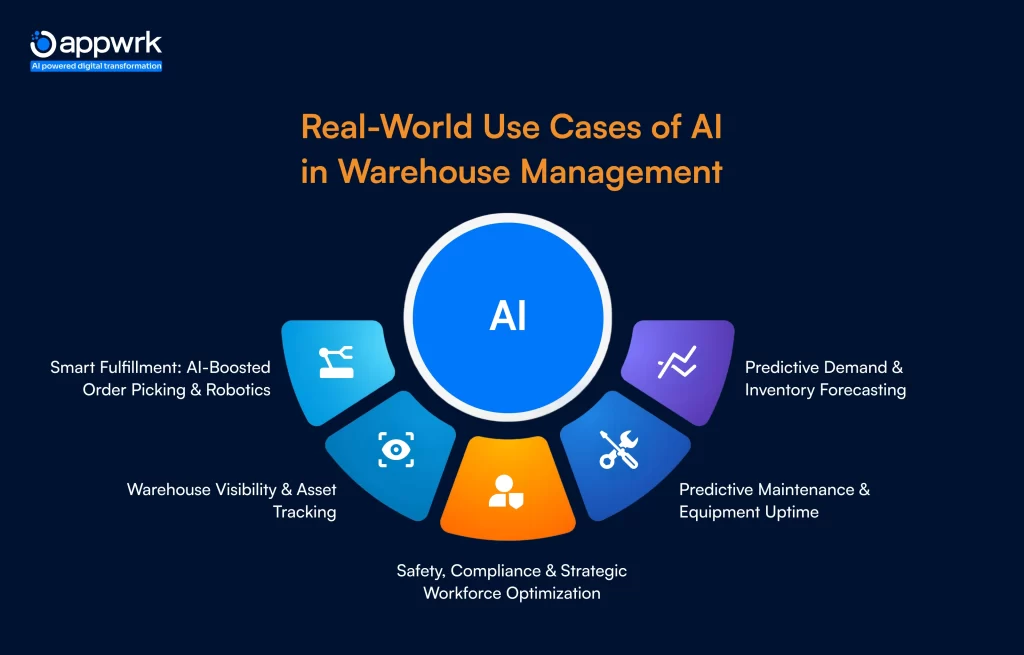
AI is reshaping global warehousing operations, from predictive replenishment and intelligent slotting to autonomous sorting and real-time compliance monitoring. Leading enterprises across the US, Europe, and India are leveraging AI to boost accuracy, reduce costs, and adapt to volatile demand with unprecedented agility.
Below are five key capability areas where AI is driving measurable impact, each backed by real-world use cases that demonstrate tangible ROI.
Predictive Demand & Inventory Forecasting
AI models analyze sales cycles, promotions, and logistics delays to predict demand and automate replenishment, lowering inventory carrying costs and stockouts.
Walmart Walmart’s AI-based demand prediction engine reduced inventory stockouts by up to 30% while optimizing shelf-level fulfillment for high-volume SKUs.
Smart Fulfillment: AI-Boosted Order Picking & Robotics
AI-powered logistics systems, combining computer vision and machine learning, intelligently sequence picks via Voice-assisted picking and Voice guidance, optimize AMR and AGV (Automated Guided Vehicle) dynamics, and accelerate packing, surpassing the speed and accuracy of manual workflows.
In high-velocity warehouse zones, autonomous mobile robots (AMRs) and robotic arms coordinate real-time picking sequences. This reduces manual labor dependency by 25-30%, improves order accuracy, and enhances safety margins, particularly during peak surges in Europe and North America.
DHL Supply Chain DHL deployed AI-assisted robotic arms across US sites, improving picking accuracy by 25% and parcel throughput by over 1,000/hr.
Kargo Logistic Automationby APPWRK: APPWRK implemented an AI-powered camera tower system at logistics loading docks to automate freight labeling and inventory tracking. This solution improved data capture accuracy by 98% and streamlined loading workflows, significantly reducing manual scanning errors and labor time over traditional methods.
Warehouse Visibility & Asset Tracking
AI enhances warehouse visibility by using RFID, computer vision, IoT sensor networks (integration with AI), and optional Drones/AR-assisted audits to track inventory movement, monitor asset location, and detect anomalies in real time.
Alibaba Cainiao Smart Warehouses Cainiao’s AI-driven warehouse systems track over 100 million parcels daily, dynamically repositioning SKUs based on regional demand signals.
Predictive Maintenance & Equipment Uptime
AI monitors equipment health in real time, using vibration and load data to schedule proactive maintenance and reduce unplanned downtime.
GXO Logistics GXO deployed predictive maintenance AI across fulfillment centers, cutting downtime by 20% and lowering repair costs with real-time asset telemetry.
AI enhances warehouse safety and compliance by continuously monitoring environmental conditions, PPE adherence, and restricted zones using vision systems and sensors. It also enables strategic workforce optimization by forecasting workload patterns and dynamically assigning tasks to ensure balanced labor distribution and improved operational efficiency.
JD Logistics
JD Logistics deployed AI-driven safety systems across its smart warehouses in Asia, using vision AI and infrared sensors to monitor PPE compliance and hazardous zones. The initiative led to a 30% drop in near-miss incidents and streamlined labor distribution during peak periods.
Regional AI Trends in Warehouse Management: USA, Europe, and India Compared
While AI adoption in warehouse management is gaining global momentum, regional priorities and challenges shape how the technology is applied. From labor shortages in the US to sustainability mandates in Europe and infrastructure constraints in India, AI solutions are being tailored to fit distinct operational realities. Below is a comparison of how warehouses across the USA, Europe, and India are leveraging AI to solve region-specific challenges and unlock supply chain efficiencies.
USA
US warehouses are adopting AI to address labor churn and E-commerce scalability. AMRs, predictive replenishment, and smart picking systems are standardizing fulfillment cycles across FedEx, Walmart, and DHL hubs.
Europe
EU facilities emphasize energy optimization and ESG compliance. AI-led slotting and dynamic lighting systems reduce emissions and qualify for green logistics incentives.
India
Indian warehouses, especially in Tier-1 E-commerce hubs like Bengaluru and Mumbai, use AI to overcome inconsistent connectivity with edge computing and mesh networks. JD Logistics and Flipkart are leading slotting automation and vision-based audits.
What Is AI in Warehouse Management and How It Works in Real Life
Artificial Intelligence in warehouse management is the intelligent orchestration of machine learning, computer vision, and robotics to dynamically optimize inventory, labor, and processes, far beyond what traditional automation systems can achieve.
AI vs. Traditional Warehouse Systems
While conventional warehouse automation relies on fixed, rule-based workflows, AI introduces continuous learning and adaptability:
Legacy automation relies on static rule-based scripts, while AI-powered systems forecast demand, dynamically reroute robots, and reallocate labor in real time for optimal efficiency.
AI replaces manual WMS triggers with predictive intelligence that detects and mitigates bottlenecks before they disrupt operations.
AI-driven systems significantly outperform static automation, reducing labor costs, boosting pick rates, and minimizing idle time.
Top AI Applications in Warehousing Today
AI in warehousing has moved beyond pilots and proofs of concept; it’s now driving real-world results at scale. From demand forecasting and autonomous replenishment to safety monitoring and predictive maintenance, AI is transforming warehouses into intelligent, self-optimizing ecosystems. Below are the top use cases where AI is delivering tangible ROI and reshaping warehouse performance across the board.
Predictive Demand Forecasting AI leverages time-series analysis and real-time data to anticipate demand shifts, helping reduce stockouts, overstocking, and costly inventory imbalances.
Autonomous Replenishment Machine learning models combined with IoT sensors trigger restocking actions automatically, ensuring inventory levels stay optimal without human intervention.
Intelligent Picking & Order Fulfillment Computer vision, voice assistance, and robotics accelerate pick rates by 35-40%, improving order accuracy and reducing cycle times.
Adaptive Slotting & Layout Rebalancing AI dynamically reorganizes warehouse layouts based on item velocity and demand patterns, increasing throughput by up to 30%.
Predictive Maintenance Advanced analytics and sensor-driven anomaly detection identify equipment issues early, minimizing unplanned downtime and extending asset life.
Safety & Compliance Monitoring AI continuously scans for safety hazards, PPE violations, and unauthorized access, enhancing regulatory compliance and reducing incident rates.
Best AI Technologies for Smarter Warehouse Operations
Transforming warehouses into intelligent, adaptive systems requires more than isolated tools; it demands a cohesive AI-driven tech stack. From machine learning and computer vision to autonomous robotics and digital twins, these technologies enable real-time insights, predictive control, and continuous optimization across the entire warehouse lifecycle.
Machine Learning for Predictive Optimization & Operational Intelligence
Machine learning (ML) is the nucleus of AI-driven forecasting and decision-making. By analyzing historical order patterns, seasonality, and supply disruptions, ML models anticipate demand surges, labor needs, and potential bottlenecks.
Forecasting precision: ML reduces forecasting error by up to 50%, translating directly into leaner inventory and fewer emergency restocks (McKinsey).
Labor throughput balancing: Models dynamically adjust workforce scheduling to match real-time order volume and SHIFTS.
Continuous optimization loops: Learning from past decisions, models retrain to improve slotting, replenishment, and labor conditions with minimal human input.
Computer Vision for Quality, Safety & Autonomous Audits
Computer vision transforms static cameras into active intelligence agents, enabling real-time SKU verification, visual quality control, and safety compliance monitoring.
Visual SKU validation: AI systems scan picked items and packaging to detect mispicks before shipping.
Safety enforcement: Cameras monitor PPE compliance and restricted-area incursions in real time, triggering alerts and supporting incident reduction.
Automated audits: Vision bots run nightly checks on slotting accuracy and product integrity, reducing manual cycle counts up to 80%.
How Robots and Autonomous Mobile Robots Work in Smart Warehouses
In advanced fulfillment centers, robots no longer just assist, but they actively adapt to floor conditions, layout shifts, and real-time constraints. Powered by SLAM navigation and AI coordination, AMRs offer flexibility that traditional automation lacks.
SLAM navigation: Robots use Simultaneous Localization and Mapping to adapt routes around obstacles or layout changes in real time, and improve Predictive route optimization.
Scalable automation: Unlike fixed conveyors, AMRs can be redeployed easily for seasonal peaks or layout reconfigurations.
In EU fulfillment hubs, AMRs reduce idle time and zone lighting energy use by ~20%, as movement data enables dynamic lighting and HVAC management, boosting Green logistics/carbon tracking.
Can You Use AI in Warehouses Without Robots?
Not all warehouses need full-scale robotics to benefit from AI. AI-powered inventory forecasting, slotting tools, and computer vision audits can be deployed independently.
For example, many mid-sized warehouses in India and the EU use AI-driven dashboards to optimize labor, adjust pick routes using heatmaps, and detect safety hazards using fixed cameras, without a single robot on site.
Even simple add-ons like voice-assisted picking or AI-powered replenishment planning can raise productivity by 15-20%, making AI accessible without heavy infrastructure investment.
Digital Twins for Simulation‑Based Optimization
Digital twin technology mirrors warehouse operations in a real-time virtual model, enabling scenario testing, space analysis, and performance optimization before assets are implemented.
Operational simulation: Digital twins replicate warehouse environments to virtually test slotting strategies, robot pathing, and workflow changes. Inefficiencies are identified early, minimizing costly trial-and-error in live operations.
What‑if analytics: AI models simulate the impact of layout shifts, demand surges, equipment failures, workforce changes, and Last‑mile delivery optimization scenarios. Enables proactive planning and risk mitigation without disrupting real-time operations.
How AI-Enabled WMS Improves Warehouse Efficiency
Next-gen WMS platforms embed AI at their core, shifting from static inventory control to evolving decision engines that guide slotting, picking, replenishment, and labor allocation.
Contextual slotting: The WMS suggests shelf moves based on velocity changes, seasonality, or promotional pushes.
Order prioritization: AI-WMS continuously reprioritizes orders based on SLA deadlines, fulfillment zones, and carrier capacity.
End-to-end pipeline integration: End-to-end integration is made possible when the WMS acts as the brain of the warehouse. Instead of static command chains, AI-WMS reacts to carrier delays, inventory shifts, or rush orders through event-driven flows that sync ERP, OMS, and robotic fleets.
Top Challenges in AI Warehouse Implementation and How to Fix Them
Implementing AI in warehouse management elevates operations but also surfaces a unique set of transformation blockers. Addressing these proactively is what separates successful deployments from stalled pilots. Below, we decode the five most critical challenges and how to overcome them.
Data Silos & API Incompatibilities Block AI Orchestration
AI thrives on consistent, real-time data, but most warehouses face major integration challenges:
Data remains fragmented across legacy WMS, ERP, and PLC systems, creating silos.
Lack of standardized or open APIs prevents seamless data access for AI models.
Poor data quality and outdated records undermine machine learning accuracy and decision-making.
According to Gartner, 85% of AI projects fail due to poor data readiness or fragmented data governance. Cleaning, integrating, and standardizing data upfront is non-negotiable for AI model success.
Edge Infrastructure & Connectivity Constraints Hinder Real-Time AI
AI logic needs to operate close to where decisions are made, but infrastructure gaps create major execution barriers:
Latency disrupts time-sensitive tasks like robotic navigation, drone scanning, and pick-path optimization.
Wi-Fi blind spots in high-rack or remote zones interrupt sensor streams and task coordination.
To combat this, edge deployments are rising, with over 75% of AI compute shifting closer to the source to minimize delays.
Edge computing with private 5G or on-site servers is critical but requires power, cooling, and security upgrades. India’s smart warehouses use localized edge nodes + hybrid mesh Wi-Fi to overcome poor connectivity and deliver sub-second robotic task orchestration.
Successful AI deployment isn’t just a technical challenge, as it requires shifting mindsets:
Workers fear displacement, making them less likely to adopt AI-driven workflows.
Organizations lack AI fluency training, impacting trust and job effectiveness.
Effective change management includes transparent communication, reskilling programs, and human-AI collaborator roles.
ROI Ambiguity & Misaligned KPIs Limit Executive Buy-In
The question “What’s the ROI?” remains a key roadblock to AI adoption in warehousing:
Upfront costs, such as sensors, robotics, AI platforms, are significant and often hard to quantify in traditional budgeting models.
Conventional KPIs like cost-per-pick overlook broader gains such as enhanced safety, regulatory compliance, and ESG performance.
Gartner reports that only 48% of AI pilots scale to production, largely due to unclear or delayed ROI realization.
Craft dashboards with both quantitative (throughput, uptime) and qualitative (safety incidents prevented) ROI indicators to strengthen the business case.
Governance, Ethics & Compliance Risk Shadow AI Deployment
AI systems must be built with trust and compliance in mind:
Vision systems raise worker privacy and surveillance concerns.
AI-driven labor decisions may conflict with union rules or employment laws.
Liability is unclear when autonomous robots cause accidents or mispicks.
Best practice: Deploy AI under written governance frameworks, clarify legal boundaries, and maintain human oversight loops.
By anticipating these difficulties, warehouse leaders can pivot from reactive troubleshooting to proactive AI strategy, laying a strong foundation for successful pilots and long-term transformation.
How to Start AI Implementation in Your Warehouse
Moving from pilot to production requires a structured, scalable roadmap balancing technical integration, workforce alignment, ROI clarity, and governance. Below is a refined 5‑phase path, each phase scoped, data-driven, and outcome-focused to ensure transformation without disruption.
Phase 1: Assess Readiness- Data, Systems & KPI Maturity
Begin by evaluating your warehouse’s foundation:
Audit your WMS, ERP, IoT, robotics, edge computing, and network layer.
Identify data silos, schema inconsistencies, and API limitations.
Define baseline KPIs: pick accuracy, throughput, inventory shrinkage, and downtime.
Phase 2: Run a Focused Use Case Pilot
Select a high-impact pilot aligned to identified pain points. Implement monitoring mechanisms and measure uplift precisely:
Deploy AI-assisted vision picking, demand forecasting, or AMRs.
Track metrics vs control zones.
Launch your first AI slotting use case in 3 quick steps:
Select high-volume SKU category (top 20% demand).
Digitize slot layout and pick routes via digital twin.
Integrate AI for adjacency optimization using sales velocity data.
Indian warehouses can pilot AI slotting with minimal edge latency due to low-bandwidth compute clusters now available via open-source models.
FedEx Ground Pilot: In a pilot with FedEx Ground’s automated sortation center, AI-powered vision systems detected mis-sorts with 98% accuracy, leading to a 30% reduction in handling errors, and speeding up parcel throughput by 20%.
Phase 3: Scale Workforce Enablement & Role Transformation
Embed AI through people-first adoption:
Launch training programs for frontline staff, robotics coordinators, and data analysts.
Create hybrid roles for AI-floor coordinators.
GXO Logistics equipped hundreds of staff with AMR and AI system training before deploying robotics across multiple centers.
Phase 4: Expand with Robust Infrastructure & AI Orchestration
Once pilot KPIs are met, build out infrastructure to support scale:
Implement edge computing nodes and private 5G/Wi‑Fi for latency-critical AI tasks.
Deploy AI orchestration services within WMS/WES to manage robots, vision, and alerts.
Replicate successful modules across sites.
Phase 5: Govern, Monitor ROI & Prevent AI Drift
Institutionalize AI with strong oversight and self‑audit:
Create cross-functional AI governance boards with legal, safety, and analytics representation.
Track both quantitative (pick-rate, uptime) and qualitative metrics (safety incidents, worker satisfaction).
Conduct quarterly AI system audits to recalibrate models and data inputs.
Siemens Logistics formed a regional AI governance council to manage model fairness, GDPR compliance, and safety standards across EU facilities.
Phased AI Transformation Roadmap
Phases of AI Implementation in the Warehouse
Objective
Key Activities during Implementation
Success Metric
1. Readiness
Build foundation
Audit systems, define KPIs, and clean data
KPI accuracy and integration score
2. Pilot
Validate in a real-world use case
Vision-picking or forecasting pilot
Efficiency improvement % and error reduction
3. Workforce
Upskill & align
Staff training and AI collaboration roles
Training completion rate and trust surveys
4. Scale
Expand with resiliency
Edge deployments and orchestration
Uptime %, reduced latency, and multi-site coverage
5. Govern
Embed AI responsibly
Governance board and continual audits
ROI metrics, and audit compliance score
By following this structured, outcome-oriented roadmap, warehouse leaders can evolve their operations from siloed pilots to AI‑driven, performance-optimized logistics networks built on trust, governance, and clear return on value.
Future Trends of AI in Warehouse Management
The warehouse of the near future is not just data-driven, as it will be cognitively adaptive, environmentally intelligent, and proactively efficient. AI innovation is converging with IoT, generative systems, and ecological accountability to redefine logistics. Below are five powerful trends that will reshape global warehousing.
A real-time trifecta is unlocking ultra-responsive operations:
Smart sensor grids inform AI systems of stock levels, temperature shifts, and pallet movement in real time.
5G connectivity enables dynamic AMR rerouting and instant edge computing execution at the rack level.
Integrated sensor-AI loops allow warehouses to operate reactively for shifting tasks, reallocating labor, and resolving bottlenecks instantly.
Generative AI for Workflow Simulation & Design Optimization
Moving beyond chatbots, generative AI is enabling real-world design innovation:
Digital twins powered by genAI can automatically model layout changes, traffic routing, and storage configurations for optimization.
Shift planning becomes AI-driven, with models simulating optimal labor mixes, peak throughput patterns, and safety zone coverage, all triggered by a single prompt.
Continuous adaptation means these suggestions evolve based on learning from prior execution results.
Autonomous & Self-Healing Warehouse Ecosystems
The next-gen warehouse is not reactive; it’s self-managing:
Swarm intelligence among AMRs will allow robots to negotiate shared space, assign tasks among themselves, and dynamically balance loads without human direction.
Self-healing logistics systems will detect and resolve operational faults before they delay shipments.
Eco-Conscious Operations: ESG and AI for Sustainable Warehousing
AI is driving measurable sustainability outcomes in warehouse management:
Energy optimization routines regulate HVAC, lighting, and charging cycles based on predictive load.
Carbon intensity tracking aligns emissions with inventory and package throughput.
Waste-conscious slotting and packaging intelligence minimize material use and optimize recycling streams.
Europe leads in AI-driven carbon tracking in warehouses, driven by Green Deal regulations and circular packaging norms.
Fulfillment personalization adapts packing workflows, timing, or packaging based on customer loyalty or urgency flags.
Next-Gen Warehouse AI Trends
AI Trends to Follow in the Future
Capabilities Enabled
Core Benefits of the AI Trends
IoT + 5G
Real-time sensing and responsive tasking
Zero-latency operations and optimized routing.
Generative AI
Auto-generated layouts and shifts
Faster planning and reduced consultant dependence.
Autonomous Ecosystems
Swarm robotics and self-healing flows
Greater uptime, scale, and resilience.
AI for ESG
Energy use and carbon tracking
Lower emissions and ID-based reporting.
Predictive Commerce
Pre-order intelligence
Faster delivery, personalization, and fewer stockouts.
These trends signal a warehouse ecosystem that anticipates supply chain dynamics, self-optimizes logistics, prioritizes sustainability, and delivers personalized fulfillment, elevating operations to competitive business advantages, not just cost centers. These innovations are already reshaping warehouse ecosystems in the USA, EU, and India where logistics digitization and last-mile competitiveness are rapidly accelerating AI adoption.
How APPWRK Helps You Build AI-Powered Warehouses
At APPWRK, we go beyond implementation to collaboratively build AI-enabled warehouse ecosystems that align with your operational strategy, support long-term scalability, and deliver clear, measurable returns.
AI-WMS & ERP Integration That Fits
We build modular AI solutions like smart slotting, forecasting engines, and pick-routing systems that integrate seamlessly into your WMS/ERP. One FMCG client improved pick throughput by 35% in 6 months using our AI-WMS stack.
Built for Edge & Hybrid Cloud
Our edge-first architecture ensures uninterrupted AI operations like vision-based QC or AMR guidance. We deploy private 5G and mesh Wi-Fi for ultra-low latency fulfillment.
Workforce Enablement from Day One
We design training modules and AI-floor dashboards that turn workers into empowered AI users. A leading 3PL used our model to train 300+ staff and cut picking errors by 20%.
Scalable AI Rollouts, Site to Site
Our orchestration layers unify robots, WMS, and AI engines. One logistics firm scaled our AI forecast system across 6 sites in under 9 months.
ROI Dashboards & Compliance by Design
From ROI tracking to GDPR and labor law compliance, our AI governance frameworks are battle-tested for enterprise-grade rollout.
Results That Speak
95% retention rate with warehousing clients
40% average cycle-time reduction
60%+ opt for expansion phases within 12 months
FAQs
1. What is the role of AI in warehouse management systems (WMS)? AI enhances WMS performance by automating real-time decisions, optimizing inventory placement, predicting demand, and dynamically orchestrating labor and picking paths.
2. How does AI improve order fulfillment accuracy and speed? AI reduces mispicks by using computer vision, smart routing, and real-time SKU validation. Robotic picking and slotting algorithms increase throughput by up to 35–40%.
3. Can AI help reduce warehouse operating costs? Yes, AI cuts operational expenses through predictive maintenance, energy optimization, labor forecasting, and reducing inventory carrying costs using real-time demand sensing.
4. How much does it cost to implement AI in warehouse operations? The cost of AI implementation varies based on factors like warehouse size, required automation, data infrastructure, and integration depth. Expenses can range from modular deployments for forecasting to full-scale orchestration with robotics. Contact APPWRK for phase-wise planning and transparent ROI mapping to ensure cost-effective AI transformation.
5.Is AI adoption feasible for mid-sized or legacy warehouse operations? Absolutely. AI can be modularly deployed, starting with forecasting or visual audits without full WMS replacement. APPWRK specializes in legacy system integration and API overlays.
6. What risks or challenges can slow AI adoption in warehouses? Common blockers include fragmented data, workforce resistance, unclear ROI, lack of governance frameworks, and limited API compatibility with legacy systems.
7. How does AI support sustainability goals in logistics operations? AI tracks emissions, reduces idle energy use, and enables material-efficient slotting and packaging. It aligns with ESG metrics and lowers environmental impact across the supply chain.
8. Can AI personalize fulfillment for different customer types or tiers? Yes. AI segments orders by urgency, value, or persona, adapting pick-pack-prioritize flows to serve premium or subscription users faster with tailored packaging strategies.
Gourav Khanna is the Co-founder and CEO of APPWRK, leading the company’s vision to deliver AI-first, scalable digital solutions for enterprises and high-growth startups. With over 16 years of leadership in technology, he is known for driving digital transformation strategies that connect business ambition with outcome-focused execution across healthcare, retail, logistics, and enterprise operations.
Recognized as a strategic industry voice, Gourav brings deep expertise in product strategy, AI adoption, and platform engineering. Through his insights, he helps decision-makers prioritize market traction, operational efficiency, and long-term ROI while building resilient, user-centric digital systems.
Subscribe to APPWRK Blogs, We'll Do the Rest!
Get Blogs on UI/UX, Mobile Apps, Online Marketing, and Web development technology.
Unlock worthy and priceless suggestions from the masters of mobile and web app development