150+ minds across 4 countries. Join a culture of innovation, ownership & growth.
Rewire for AI
From machine learning to deep learning, from classification tools to overall process automation – our AI engineers will help you retool your existing system or enhance your company results.
Ship faster, scale smarter, built for product companies and SaaS teams
Our Latest Work
We strive hard to deliver result-driven digital solutions across the globe. Check out our case studies to get a glimpse of how we ideate, innovate, and create unconventional digital solutions according to the requirements of our clients.
Discover diverse and passionate insights from our tech enthusiasts. We collaborate across various sectors to streamline operations and drive innovation. Explore our rapidly growing collection of articles to see why we’re at the forefront of IT solutions.
The decision to move from Magento to Shopify is one of the most significant replatforming choices an ecommerce business can make. Magento is powerful, but its power comes with...
Accuracy gap is real: Traditional CPG forecasting carries a 25-40% MAPE error rate. AI-powered models bring that down to 8-15%, according to McKinsey research....
Real stories from global leaders who trusted us with their ideas.
Partnering with APPWRK helped us build a compliant and scalable healthcare platform, accelerating our time-to-market by 35%. Their team consistently delivered outstanding work.
Beesers
Digital Healthcare Client
Collaborating with APPWRK, Sportskeeda modernized its platform into a real-time sports engagement ecosystem, enabling seamless content delivery, scalable fan interactions, and high-velocity performance.
Sportskeeda
Sports & Entertainment Partner
Working with APPWRK was effortless. They captured our vision, maintained full compliance, and delivered a digital experience that built trust and elevated how customers interact with our fintech brand.
PayPenny
Fintech Partner
Working with APPWRK gave us confidence in adopting AI responsibly. Their team built a safe, intelligent bot that transformed how we engage with leads and helped us achieve measurable revenue growth.
IFB
AI Transformation Partner
Leveraging APPWRK’s digital expertise, Nemesis launched a scalable, compliant, and safe super app that connects content delivery, real-time communication, and logistics management within a single platform.
AI in education is transforming how students learn, educators teach, and institutions operate. With 20+ real-world use cases, AI is powering adaptive learning platforms, AI classrooms, intelligent tutoring systems (ITS), curriculum automation, and AI-based proctoring, making education more personalized, inclusive, and scalable.
For educators, AI helps tailor lessons to each student’s needs using tools like emotion recognition, quick assessments, and real-time analytics. This allows teachers to spot struggling students early and give them the right support.
For students, virtual tutors, AI-powered chatbots, and adaptive content provide instant feedback, multilingual support, and a more engaging, personalized learning journey.
For parents, AI improves transparency by offering insights into their child’s performance, learning habits, and academic growth.
For school administrators and EdTech founders, automation across scheduling, grading, compliance, and reporting helps reduce operational workload and improve institutional agility.
With implementation costs starting from $8,000 for MVPs and scaling beyond $110,000 for enterprise-grade deployments with LMS and analytics integration, AI is now a strategic investment for EdTech companies, academic institutions, CXOs, and CTOs seeking to build future-ready AI classrooms and platforms.
With the advent of AI, education is undergoing a complete transformation. Far from a one-size-fits-all solution, it delivers over 20 powerful use cases tailored to the unique needs of students, teachers, parents, and school administrators. From personalized learning and real-time feedback to multimodal instruction and intelligent tutoring systems, AI enhances engagement, improves academic outcomes, and streamlines operations across the education ecosystem. Whether you’re modernizing lesson plans, identifying at-risk students, or creating inclusive classrooms, AI is shaping the future of education for all.
AI-driven virtual tutors provide 24/7 academic support, especially useful in remote or hybrid learning settings. They answer questions, provide practice problems, and offer remedial guidance without relying on live instructors. Tools like ClassIn integrate virtual tutoring with multimedia content delivery.
Adaptive Micro-Assessments
These AI tools instantly create short, targeted assessments that adjust in real time to measure a student’s understanding and knowledge retention. As students interact, the system identifies weak areas and adapts subsequent content to reinforce those concepts.
Intelligent Tutoring Systems (ITS)
ITS tools simulate one-on-one human tutoring by offering adaptive hints, scaffolded feedback, and real-time corrections. These systems use natural language processing (NLP) to interact conversationally and dynamically tailor support based on learner inputs.
Language Learning and Real-Time Translation
Platforms like Duolingo and Coursera use AI to deliver grammar feedback, vocabulary drills, pronunciation practice, and live translation for multilingual students, improving fluency and comprehension.
Personalized Learning Paths with AI
AI-powered platforms like DreamBox and Squirrel AI demonstrate AI for learning personalization by analyzing a student’s performance, interests, and pace to create individualized learning journeys. The system adjusts the complexity, content type, and feedback in real time, enabling students to master concepts at their own speed.
Multimodal Instruction Delivery
AI systems adapt content formats such as videos, text, audio, or interactive graphics to match each student’s learning style and engagement level, improving accessibility and boosting knowledge retention.
Real-Time Feedback and Progress Tracking
AI delivers instant feedback through live dashboards that track progress, understanding, and engagement. By seeing their performance in real time, students can quickly spot areas for improvement, make adjustments, and stay motivated throughout their learning journey.
Chatbots for Student Support
AI-powered chatbots act as always-available digital assistants that help students navigate their academic journey. These bots handle routine queries such as assignment deadlines, course schedules, exam formats, and technical troubleshooting. In addition to academic support, some AI chatbots are also trained to assist with mental wellness check-ins, resource recommendations, and peer collaboration tools.
AI tools study the curriculum and quickly create ready-to-use flashcards, worksheets, videos, and slides. Teachers can easily adjust these materials to match different learning levels and styles, saving time and improving lessons. Tools like Quizlet, Canva Magic Write, and SlidesAI are enabling teachers to automate the creation of personalized learning resources with high efficiency and minimal effort.
AI solutions streamline repetitive tasks such as grading short answers, compiling performance reports, and managing timetables. This allows teachers to focus on instruction and student mentoring.
Curriculum Planning and Syllabus Alignment
Generative AI platforms like Eduflow assess education standards and learning objectives, then suggest curriculum maps, fill content gaps, and recommend pacing changes based on real-time data.
AI for Teacher Learning and Upskilling
AI-powered platforms suggest targeted microlearning modules, teaching strategies, and peer-reviewed content based on each teacher’s performance and classroom challenges. This personalized support fosters continuous professional growth and skill development.
AI-Powered Lesson Plan Generation (For Quizzes, Presentations, Assignments)
AI tools for teachers like Canva Magic Write, Quizlet, and ChatGPT assist educators in creating quizzes, presentations, assignments, and full lesson plans within minutes. This is a clear example of how AI helps teachers save time, freeing up hours of prep work and ensuring alignment with curriculum goals.
Student Engagement through Emotion Recognition
Emotion AI reads student facial expressions and vocal tones to gauge focus and emotional state. It alerts teachers when to intervene, change pace, or adjust teaching strategies.
Use Cases For Parents
Real-Time Performance Dashboards
AI-enabled parent portals provide timely updates on student grades, attendance, participation, and areas of struggle, giving parents full visibility into their child’s progress and engagement.
Behavior and Engagement Insights
AI monitors patterns in class participation, behavior, and assignment submissions to spot early signs of problems. It alerts parents quickly if a student’s motivation or engagement starts to drop.
Personalized Recommendations for At-Home Learning
AI suggests enrichment or remedial resources that parents can use to support learning outside the classroom, such as specific reading materials, practice problems, or activities.
Language Accessibility for Multilingual Parents
AI-powered translation ensures all reports, dashboards, and school communications are accessible to parents in their native language, encouraging greater involvement regardless of linguistic barriers.
Use Cases For School Management
AI-Enabled Exam Proctoring and Assessment
AI is transforming online exam security by detecting and preventing cheating in real time. For example, platforms like ProctorU use facial recognition, eye tracking, and keystroke analysis to monitor test-takers, flag suspicious behavior, and ensure fairness while reducing administrative workload.
Automated School Operations
AI streamlines back-office tasks like admissions, scheduling, fee processing, and regulatory reporting. This boosts accuracy, reduces staff workload, and ensures everything is completed on time.
Predictive Analytics for Dropout and Risk Management
AI analyzes attendance, grades, and behavioral data to identify students at risk of dropping out. Schools can proactively intervene with support resources or mentorship programs.
Resource Planning and Budget Optimization
With advanced forecasting and analytics, school leaders can accurately plan resources, optimize infrastructure, and evaluate course ROI. This leads to more strategic allocation of faculty, technology, and budgets.
Remote and Hybrid Learning Support
AI in remote and hybrid education enables digital learning environments to mimic in-person experiences using chatbots, emotion tracking, NLP-driven content delivery, and AI tutors, thus ensuring engagement and inclusivity.
EdTech Ecosystem Integration
AI seamlessly connects Learning Management Systems (LMS), Student Information Systems (SIS), assessment tools, and analytics dashboards, creating an intelligent, data-rich educational infrastructure.
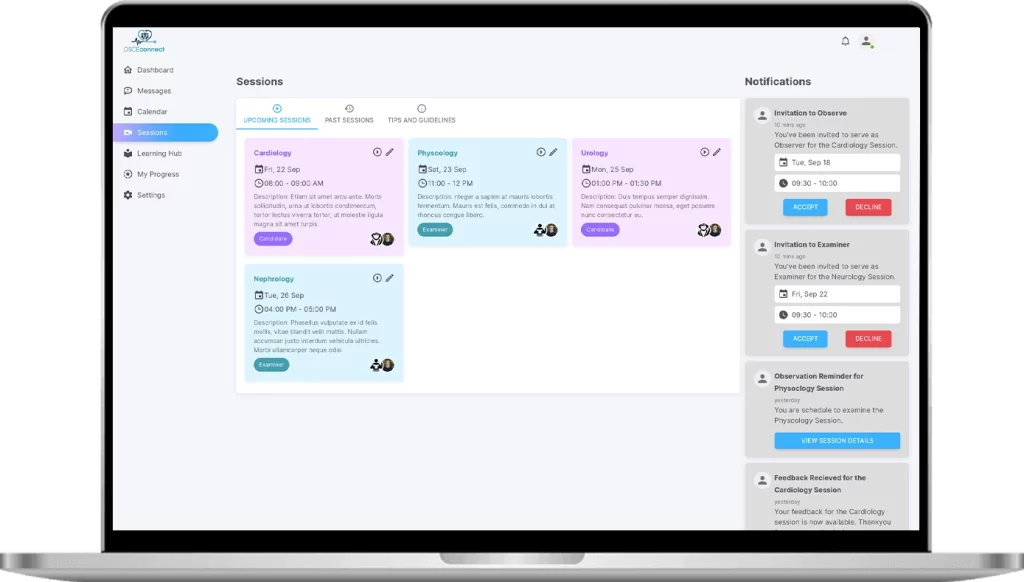
APPWRK’s Clinical Exam Readiness Platform for Scalable Medical Assessment
The Challenge: Lack of Real-Time Support in OSCE Preparation
OSCE(Objective Structured Clinical Examination) candidates often struggle with limited opportunities for interactive exam practice, direct feedback from examiners, and dynamic preparation resources. Traditional learning platforms do not provide real-time examiner interactions or support role-specific access for students, observers, and faculty.
OSCE Connect needed a centralized digital platform that could replicate the examination environment while offering flexible content updates and secure access for different users.
The Solution: A Tailored, Role-Based Learning Platform
APPWRK developed a custom OSCE platform that allowed live examiner-candidate sessions, seamless study material updates, and structured user roles. The platform supported four types of users, namely Admins, Examiners, Candidates and Observers, each with clearly defined permissions and features.
Candidates engaged directly with examiners during live sessions to ask questions, receive feedback, and simulate exam scenarios, while observers attended sessions passively without interrupting the flow. Admins managed all study content dynamically via a built-in CMS.
Key Features Implemented
Live Sessions With Examiners: Candidates attended one-on-one or group sessions to get real-time guidance and performance feedback.
Performance Tracking: The system displayed candidate progress through easy-to-read graphs and dashboards.
The Result: Better Student Readiness and Platform Flexibility
The platform led to more confident and better-prepared OSCE candidates by enabling real-time learning and examiner feedback. Institutions using OSCE Connect reported faster updates to study materials and better engagement from students.
The role-based system ensured smooth exam simulations while maintaining platform integrity and usability.
Key Benefits of AI in Education
There’s no denying that AI is transforming education at every level, from the way students learn to how institutions operate. By enabling personalization at scale, streamlining administrative tasks, and providing real-time insights, AI is helping educators deliver more effective, inclusive, and data-driven learning experiences. Below are the core benefits that highlight why AI is becoming an essential pillar of modern education.
Personalized and Adaptive Learning at Scale
AI enables personalized learning by continuously adjusting lesson delivery based on each student’s performance, behavior, and preferences. Through adaptive learning platforms, learners receive immediate feedback, targeted interventions, and intelligent pacing that strengthen retention and boost student engagement across diverse learning environments.
Curriculum Planning and Management with Generative AI
Generative AI is transforming curriculum development by replacing static course plans with dynamic, data-driven structures. Platforms like Content Technologies and Eduflow map academic standards to course outcomes, identify skill gaps, and auto-update learning materials based on student performance and industry trends. This ensures curriculum personalization, real-time syllabus updates, and tighter alignment between teaching goals and student needs.
Data-Driven Insights and Predictive Analytics
AI turns student data into clear insights that help schools predict performance, identify learners who need extra help, and improve teaching methods. By using this information, institutions can make smarter decisions, provide timely support, and boost overall results, leading to better outcomes and higher satisfaction for students and parents.
Efficiency through Automation and Smart Tools
From chatbots and task automation to intelligent tutoring systems and automated assessment systems, AI significantly reduces repetitive workload for educators. This enables more time for mentoring and creative planning. Additionally, AI supports language acquisition, engaging content creation, and administrative support, improving both teaching delivery and operational efficiency.
Real World Success Stories of AI in Education
For decision-makers shaping the future of education, whether in schools, universities, or EdTech startups, real-world case studies provide critical insight into how AI delivers measurable impact. These examples demonstrate how institutions are scaling AI to improve outcomes, streamline operations, and extract strategic value from intelligent learning environments.
Real-Time Feedback in Classrooms with AI
At a mid-sized K-12 institution in Singapore, administrators deployed an AI integration in the classroom suite, integrating smart whiteboards, facial recognition for attendance, and adaptive delivery. The system tracked engagement in real time, adjusting content pacing when attention dipped and prompting teachers with suggested interventions.
The results include a 22% improvement in student test scores over two academic terms and a 38% reduction in lesson planning time for teachers.
Reducing Dropouts with AI Tutors
In the US, Arizona State University piloted AI tutors across STEM programs. These AI systems offered instant homework support, error explanations, and adaptive quizzes tailored to students’ past performance.
Within the first year, ASU reported:
A 19% drop in dropout rates.
A 16% boost in assignment submission rates.
And over 40,000 student-AI interactions weekly, reducing reliance on live tutors.
This reflects a larger trend: AI is not replacing instructors, but augmenting them, at scale and speed unmatched by manual methods.
Future Trends of AI in Education
With AI driving breakthroughs in remote learning, real-time feedback, and intelligent tutoring, education is moving toward a new era of highly personalized, accessible, and outcome-focused learning across K–12 and higher education. These innovations are transforming how lessons are delivered, how students engage with content, and how educators track and support progress.
The global AI in education market is projected to reach $32.3 billion by 2030, growing at a remarkable 31.2% CAGR, signaling rapid adoption and a future where AI becomes an integral part of everyday teaching and learning.
The future of AI in digital classrooms is moving from reactive support tools to immersive, anticipatory systems. AI innovation continues to redefine educational workflows, classroom interaction, and student empowerment. From generative course design to intelligent immersive environments, this section explores where the sector is heading and what institutional leaders should prepare for.
Learning Management Systems: Platform Trends and Market Penetration
SaaS-based LMS platforms with built-in AI capabilities are leading the charge, enabling personalized learning at scale. Tools like Squirrel AI and Coursera AI course suggestions demonstrate how Generative AI in education is driving lifelong learning with AI. At the same time, institutions are carefully evaluating platform compatibility and regulatory considerations to ensure responsible adoption.
This shift is about more than market size. It is about transforming the entire education ecosystem through strategic alignment with AI policies, ethical frameworks, and long-term implementation goals.
Adaptive Learning for Customized Instructions
With AI evolving beyond simple content delivery, it now enables fully adaptive instruction tailored to each student’s unique needs and learning pace. Generative AI platforms are building dynamic lesson plans that evolve based on each student’s daily performance. Companies like Content Technologies and Khanmigo are already deploying this at scale, leveraging large language models to design tailored instruction pathways while creating custom pathways in real time.
AI Tools for Art and Music Education
AI is increasingly used in creative disciplines, supporting digital art, music composition, and multimedia storytelling in modern art courses. Platforms like RunwayML and MuseNet allow students to create original works with AI co-pilots, offering critique, style correction, and cross-media blending.
Gamified Learning Powered by AI Systems
AI is also being embedded in educational games to blend play with pedagogical approaches, increasing concept retention through gamified learning experiences. Educators will need to prioritize AI-enabled digital literacy to ensure students can critically engage with AI-driven systems.
This integration is fostering multimodal literacy and creative confidence, making the arts more accessible and technologically relevant.
AI-driven proctoring, real-time plagiarism detection, and adaptive testing are transforming exams into dynamic assessment environments. These systems evaluate process, not just outcome, offering insight into how AI helps students learn better, not just what they answer.
Concerns around privacy and fairness persist, but the shift is already underway in remote universities and certification platforms.
AI Classrooms: Replacing Traditional Classrooms
Traditional classrooms rely on standard pacing and static curriculum. AI-powered classrooms, in contrast, use feedback loops, engagement tracking, and intelligent suggestions to modify lessons in real time.
The result is hyper-personalized environments where both struggling and high-achieving students receive targeted support.
Traditional Classroom vs. AI-Powered Classrooms
Aspect
Traditional Classrooms
AI Classrooms
Lesson Delivery
One-size-fits-all pacing
Adaptive and personalized content delivery
Assessment
Periodic and static testing
Real-time micro-assessments and instant feedback
Teacher Support
Manual intervention
AI-generated recommendations for student intervention
Student Engagement
Limited tracking
Emotion recognition, engagement analytics
Learning Resources
Static textbooks
Dynamic and AI-curated multimedia content
Virtual Labs for Hands-On Learning
AI, in combination with extended reality (XR), is reshaping STEM education by making learning immersive, interactive, and accessible. From AI-guided historical reenactments to hands-on virtual lab experiments, these experiences deepen understanding and engagement. Companies like Labster and VictoryXR are leading the charge by integrating VR, AI tutors, and spatial storytelling, boosting knowledge retention by up to 75% compared to traditional classroom methods.
Transforming Educational Content using Generative AI
Generative AI is transforming educational content development by enabling continuous, on-demand updates to course materials and learning modules. Institutions no longer wait for annual content refresh cycles. AI scrapes research repositories, trend data, and curriculum standards to keep modules relevant, especially critical in STEM and business education.
AI in AR/VR for Personalized Digital Learning
AI layers contextual logic onto VR (Virtual Reality)/AR environments, ensuring that student interactions result in personalized feedback. In AR biology apps, for example, AI analyzes each user’s actions and explains why they may have missed a step in a dissection or misidentified a gene.
Smart Classrooms: AI and IoT Convergence
AI combined with IoT is transforming physical classrooms into responsive learning environments. Smart desks, biometric wearables, and AI-powered cameras help educators assess focus, posture, and engagement, ensuring not just digital access but physical optimization of learning conditions.
Comparing Local and Global Adoption of AI in Schools
While AI in education is a global movement, its implementation varies sharply by region. Developed economies are focused on integration and ethics, while developing regions are working to overcome infrastructure gaps and digital literacy barriers. This section compares trajectories and lessons learned.
How EdTech and AI Differ Across Countries
In developed countries, like the US, UK, Germany, and Japan, AI is embedded in LMS systems, content creation workflows, and national learning standards. These regions benefit from institutional funding, educator training, and mature EdTech ecosystems.
In comparison, many developing nations prioritize AI initiatives that improve basic access, support teachers, and enable language translation. Platforms like India’s Diksha and Nigeria’s UBEC-led AI pilots focus on meeting these foundational needs first, creating a strong base before expanding into deeper personalization.
However, developing regions are uniquely positioned to leapfrog legacy infrastructure and adopt mobile-first, AI-native models more rapidly.
Why AI-Driven Tools Struggle with Local Languages and Context
While AI tools are transforming education on a global scale, they often fall short in adapting to local languages, dialects, and cultural nuances. Limitations in language model training, voice recognition accuracy, and context-aware ethics make it difficult to deliver inclusive, regionally relevant learning experiences, especially in multilingual and culturally diverse settings.
A survey by EdTech Hub revealed that only 29% of AI tools used in Africa offer native language support, while 70% of Southeast Asian educators report concerns about Western bias in AI-generated content.
Localization isn’t just about language; it’s about cultural compatibility, curriculum alignment, and equitable access.
To scale globally, AI education platforms must build region-specific ontologies, integrate with local policy frameworks, and adapt UI/UX for local connectivity conditions.
How AI in Education Is Evolving by Region
AI in education is advancing globally, but its pace and priorities vary significantly by region. While the overall momentum is strong, each country navigates unique regulatory frameworks, infrastructure readiness, and cultural factors. Understanding these regional dynamics offers valuable lessons for institutional leaders looking to adopt AI strategically within their own education systems.
AI Adoption in US Education: From K-12 to Higher Ed
In the US, AI adoption in higher education is led by top-tier universities and charter school networks. Stanford, Georgia Tech, and MIT are deploying AI to personalize course delivery and automate grading. K-12 schools are adopting tools like AI proctoring and behavioral analytics to support student outcomes.
Federal initiatives, like the AI Education Act, are boosting funding, while organizations such as ISTE promote AI readiness among educators.
According to HolonIQ, over 70% of US EdTech funding in 2023 supported AI-enabled tools and platforms.
How Australia Uses AI for Smart Curriculum Design
Australia is integrating AI not just into platforms, but into curriculum design itself. The New South Wales Department of Education launched AI-driven curriculum mapping tools that align national standards with student performance trends.
Pilot programs in Queensland use AI to simulate historical events, adapt assessments to learner strengths, and guide teachers with content suggestions.
Australia’s National AI Strategy outlines clear education targets through 2030, positioning it as a testbed for policy-aligned AI deployment.
AI Assessments and Student Evaluation in the UK
The UK is experimenting with AI across grading and predictive analytics in student success. Ofqual and EdTech, and AI platforms like CENTURY are piloting AI-based student assessment tools that adapt dynamically in difficulty based on live responses, offering more accurate evaluations of student competency.
British universities are also leveraging AI for plagiarism detection, adaptive modules, and success forecasting, especially for international students.
European Policy Frameworks Driving AI in Education
AI in education policy frameworks within the EU emphasizes ethical AI adoption, transparency, and inclusivity to guide national and institutional implementations. The AI Act enforces strict compliance for the Future of AI in classrooms, requiring transparency, fairness, and data privacy controls.
Finland leads in AI teacher training, while Germany and France focus on inclusive AI, ensuring systems work across languages, cognitive abilities, and economic backgrounds.
What’s the ROI of Using AI in Education?
Educators and administrators are increasingly looking beyond the hype to determine whether AI truly delivers value. When implemented strategically, AI in education is producing measurable returns, enhancing student outcomes, streamlining administrative processes, and unlocking new revenue opportunities. From personalized learning and predictive analytics to automation and digital scalability, AI is proving to be more than just a technological upgrade. It is becoming a key driver of impact, efficiency, and long-term growth for education businesses and institutions alike.
Here’s what ROI looks like when AI is integrated strategically.
How Much Does It Cost to Build an AI Education App?
The cost to build an AI-powered education application starts at $8,000 for a basic MVP and scales up to $110,000+ for enterprise-grade platforms with NLP, personalization engines, and real-time analytics.
Tier
Features Included
Approx. Cost Range
MVP
Basic chatbot tutor, dashboard, and static content generation.
$8,000 to $40,000
Mid-Tier
AI-enabled adaptive assessments, adaptive learning paths, and LMS sync.
$40,000 to $90,000
Enterprise
Real-time analytics, multilingual AI, and full-scale automation.
$90,000 to $110,000+
Custom API integrations (e.g., OpenAI, IBM Watson), regional compliance, and device optimization further influence cost.
Learning Outcomes Prediction & Performance Impact
Predictive analytics not only forecasts student performance but also recommends timely actions, helping schools step in early and improve learning outcomes. AI improves learning outcomes by addressing key friction points in the student journey. It anticipates disengagement, recommends timely interventions, personalizes content delivery, and enhances comprehension through real-time feedback.
Studies show:
36% increase in retention with adaptive AI modules.
31% reduction in time-to-grade using AI-based auto-evaluation tools.
How AI Reduces Dropouts and Keeps Students Engaged
AI helps identify at-risk students early by analyzing behavioral patterns such as missed logins, delayed quiz submissions, and reduced participation. These insights trigger timely alerts, enabling institutions to intervene with personalized support, either through educators or AI-driven tools, before disengagement leads to dropout.
At a major online university, dropouts fell by 23% after integrating an AI risk monitoring system paired with an AI chatbot intervention.
This is not just about retention. It also leads to significant savings in tuition revenue and strengthens brand equity for digital-first institutions.
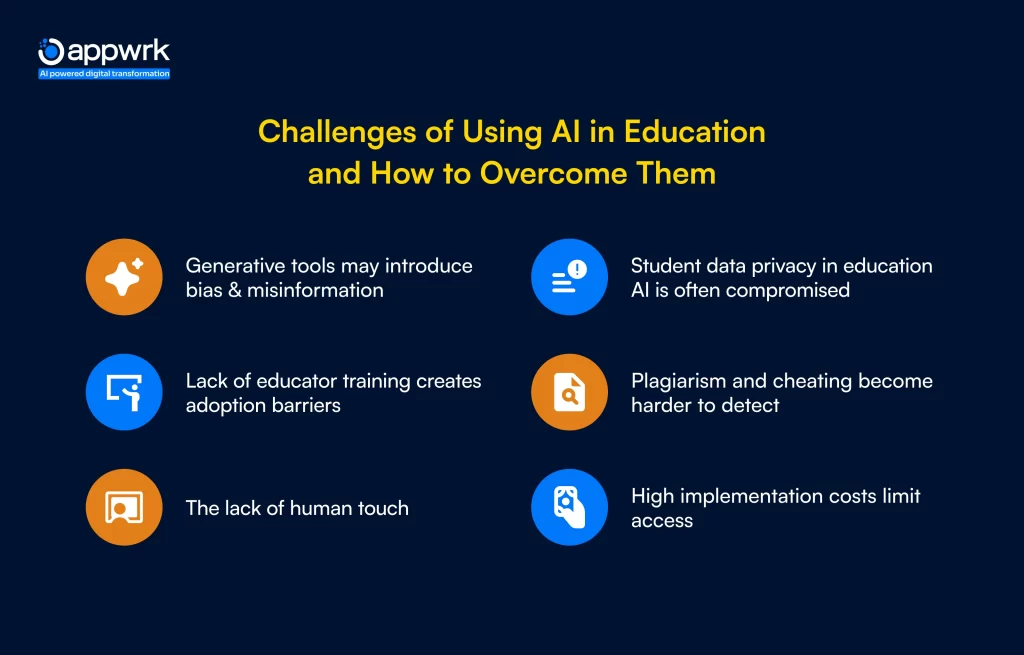
Challenges of Using AI in Education and How to Overcome Them
AI offers transformational benefits in education, but its integration is far from frictionless. Institutional leaders must navigate technological, ethical, financial, and operational challenges to deploy AI at scale without undermining trust, quality, or human connection.
Generative tools may introduce bias and misinformation
While generative AI tools in education enable dynamic content creation, their outputs can be inaccurate, biased, or misaligned with academic integrity. Tools like ChatGPT may hallucinate facts, fabricate citations, or deliver unvetted suggestions.
Institutions need to establish structured review processes, integrate human oversight at critical checkpoints, and enforce clear usage guidelines to ensure responsible engagement with generative AI tools by both students and faculty.
Student data privacy in education AI is often compromised
AI systems rely on massive student data streams, including sensitive personal data such as learning behavior, location, and biometric cues. Without rigorous data governance, this can expose institutions to FERPA, GDPR, or COPPA violations. Cybersecurity protocols must be integrated into AI deployments to prevent breaches and ensure institutional resilience.
Top challenges include:
Lack of student consent protocols.
Insecure third-party tool integration.
Absence of audit trails for algorithmic decisions.
According to the World Economic Forum and UNESCO’s global AI readiness index, only 43% of EdTech platforms meet minimum data protection thresholds.
High implementation costs limit access
Deploying AI requires investment not just in software, but also in cloud infrastructure, staff training, compliance auditing, and change management.
One of the major challenges of AI in public schools is the steep ramp to adoption, often requiring multi-year transformation budgets and cross-agency support. Many institutions struggle with AI implementation due to budget gaps and unstructured resource planning.
Lack of educator training creates adoption barriers
Many educational institutions lack the in-house digital expertise needed to evaluate AI tools, implement them effectively, or interpret data-driven insights. Without the right skills, schools risk choosing the wrong vendors, underutilizing technology, and failing to achieve meaningful outcomes.
This gap widens in non-urban and underfunded systems, where faculty are already stretched thin. Training programs and partnerships with AI firms become essential for meaningful deployment.
The Lack of Human Touch
While AI offers powerful tools for personalization and efficiency, it also raises concerns about diminishing the human connection in learning, especially in early education and emotionally sensitive settings.
To avoid over-automation, institutions must clearly define where AI should support rather than replace educators. Striking the right balance is essential to maintain trust, engagement, and ethical responsibility in the learning environment.
Plagiarism and cheating become harder to detect
AI tools make it easier for students to generate essays, solve exams, and produce entire assignments with minimal effort. This has led to a surge in AI-assisted cheating that often goes undetected by traditional plagiarism checkers. As a result, schools are facing new challenges in maintaining academic integrity and updating their detection methods.
Proactive measures include:
AI-aware assessment formats.
Transparent student policies.
AI-detection tools like Turnitin’s AI checker.
Best Practices to Successfully Implement AI in Education
Integrating AI into education isn’t a plug-and-play decision. Success depends on institutional clarity, technical alignment, and change readiness. This section outlines how forward-thinking institutions are implementing AI with purpose, scale, and measurable outcomes.
Aligning AI Integration with Educational Goals
AI should be implemented with a clear purpose that reinforces, rather than detracts from, an institution’s academic mission. Schools and universities must first define their strategic priorities, whether it’s personalized learning, streamlined operations, enrollment growth, or research innovation, and ensure that AI initiatives are directly aligned to support those goals.
By establishing clear AI objectives, universities can prevent fragmented adoption and ensure that every implementation directly supports their core strategic goals and measurable outcomes. Administrators must also consider AI training for educators to ensure informed adoption across departments.
Preparing Educators for AI Adoption
Educator readiness remains one of the most critical yet often overlooked factors for successful AI integration. Even the best AI tools for schools can fail if staff training to interpret insights or integrate outputs is not utilized for teaching.
Best practices include:
Onboarding bootcamps for educators.
Hands-on AI labs and testbeds.
Faculty involvement in pilot planning.
Educator training ensures AI becomes a collaborative layer, not a replacement or point of friction.
Choosing the Right AI Tools and Partners
Selecting the right AI tools and partners is crucial to achieving meaningful results. A poor choice can lead to wasted resources, failed implementations, and missed opportunities for impact. Institutions must vet vendors for:
FERPA/GDPR compliance.
Pedagogical relevance (not just tech novelty).
Integratability with LMS, SIS, and existing tools.
Transparency in model behavior.
Start Small and Scale with Iterative Learning
Institutions that succeed with AI start small. Pilots in one department or course allow leadership to gather feedback, fine-tune functionality, and measure ROI before scaling.
Feedback loops from students, faculty, and IT teams help refine implementation and build trust.
AI isn’t just a solution; it’s a system that evolves. Pilot feedback ensures that evolution aligns with institutional DNA. Learning analytics dashboards can visualize these loops and inform ongoing improvements.
Ethical AI in Education: Bias, Regulation, and Governance
As AI takes on critical roles in grading, advising, and decision-making, it holds real power over student outcomes. This influence demands more than just technical oversight. Without clear ethical frameworks and strong governance, AI risks amplifying bias, diminishing transparency, and undermining trust. Responsible implementation is not optional; it is essential for fairness and accountability in modern education.
Addressing AI Bias and Algorithmic Fairness
Bias in AI models can stem from skewed training data, flawed assumptions, or insufficient testing environments. In education, this can lead to:
Misidentification of learning gaps.
Unfair grading.
Cultural mismatches in content generation or biased content creation workflows.
Institutions must demand algorithmic transparency and train AI on datasets that reflect their student populations. Fairness audits and continuous performance validation are now best practices.
An MIT study found that 64% of EdTech AI tools showed measurable skew in predicting success based on demographic data.
Laws and Compliance in AI-Powered Education
As AI grows, so does scrutiny. In the US, FERPA and COPPA set data limits, while in Europe, the AI Act enforces classification-based controls for educational applications. AI compliance in the education sector is critical, requiring adherence to FERPA, GDPR, and other regulations to mitigate data misuse and litigation risks.
AI used in assessments or student profiling may be categorized as “high risk,” requiring:
Explainability protocols
Risk mitigation documentation
Consent-based data modeling
Institutions must collaborate with legal and compliance teams before rolling out AI features.
Principles of Ethical AI in the Classroom
To ensure AI is used responsibly and fairly, ethical AI in education requires:
Human oversight: Educators must remain the ultimate decision-makers.
Explainability: Students should understand how AI helps them learn more effectively.
Inclusivity: Tools must serve students of all learning styles, abilities, and backgrounds.
A growing number of EdTech vendors now include “Ethical AI Certifications” in RFPs to reassure institutions. Governance boards within universities are also creating AI ethics committees to vet tools and guide deployment.
Best AI Tools and Technologies Used in Education
The AI revolution in education is being driven by a fast-evolving ecosystem of platforms, APIs, and integrated learning environments. These tools aren’t just enhancements; they are core infrastructures powering engagement, personalization, and academic performance at scale, and supporting everything from assessments to interactive educational games. Examples include Microsoft Copilot, which helps faculty generate lecture summaries and slides based on input prompts.
Most Widely Adopted AI Tools in Education
These flagship platforms are leading the way in applied AI:
Duolingo: Language + AI for Grading and Assessment
Tools like Duolingo and Coursera adapt language fluency and learning progress using machine learning. These often integrate large language models for content expansion and response generation. They personalize lesson difficulty, recommend pacing, and simulate assessments using user behavior data.
Quizlet: Generative Content Creation and Automation AI Tools
Quizlet, Canva Magic, and GPT-based tools like ChatGPT help teachers auto-generate quizzes, flashcards, slide decks, and essays, saving prep time while increasing personalization.
Squirrel AI: Adaptive Learning Engines
Platforms such as Squirrel AI, Riiid, and Century Tech dynamically adjust lesson plans, offer intelligent tutoring, and optimize learning paths based on predictive signals.
Coursera: Personalized Course Recommendations with AI
Coursera uses AI algorithms to recommend courses based on learner behavior, preferences, and previous activity. Its intelligent engine guides users through tailored learning journeys, increasing course completion rates and educational outcomes. Here are the key ways Coursera’s AI enhances the learning experience.
Tracks learner progress and adapts recommendations accordingly.
Personalizes the course experience using behavioral insights.
IBM Watson Education: AI for Student Performance and Support
IBM Watson offers predictive, AI-powered educational tools that personalize resources and provide virtual tutoring support. Schools leverage their analytics to identify struggling students and improve academic performance. Here are the key ways IBM Watson supports education.
Provides tailored learning resources and real-time tutoring.
Uses predictive analytics to flag at-risk students.
Schools report a 20% performance improvement in STEM subjects.
Emerging AI Technologies: Virtual Reality, IoT, and Predictive Analytics
AI’s power compounds when paired with other emerging technologies:
Virtual Reality (VR): AI-enhanced VR offers guided lab simulations, immersive language environments, and historical recreations.
IoT: AI processes sensor data from smart desks, wearables, and learning environments to measure real-time attention and stress.
Predictive Analytics: Platforms like Civitas and Brightspace use AI to flag dropouts, recommend interventions, and benchmark against institutional averages.
Together, these tools transform classrooms, both physical and digital, into adaptive, feedback-rich learning environments. AI-powered content creation tools also enrich visual and interactive media in these classrooms.
Generative AI Platforms and APIs
Tools like OpenAI’s GPT-4, Anthropic’s Claude, and Google’s Gemini are now integrated into educational software to support:
APIs allow institutions to embed generative capabilities within custom platforms, keeping control while gaining automation.
How APPWRK Builds and Scales AI Solutions for Education
APPWRK supports educational institutions and EdTech companies in building, scaling, and optimizing AI-powered learning experiences. From strategic consulting to end-to-end development, APPWRK delivers tailored AI solutions that drive measurable outcomes across teaching, operations, and student engagement.
APPWRK’s AI Services for Schools and EdTech Businesses
APPWRK offers a full spectrum of AI services designed specifically for the education sector:
AI strategy consulting to align technology with institutional goals.
Custom model training for use cases like student analytics, content creation, and adaptive learning.
AI audits to assess current systems and uncover optimization and learning opportunities.
Clients benefit from a hands-on, iterative approach that ensures AI works for educators, not against them.
AI Software Solutions APPWRK Offers for Educational Clients
APPWRK builds solutions that solve real problems for schools, universities, and EdTech platforms:
AI tutors and chatbots for 24/7 academic support.
Predictive performance dashboards for teachers and administrators.
Adaptive content creation engines that customize lessons on the fly.
FERPA/GDPR-compliant data workflows to maintain trust and governance.
These tools do more than improve efficiency. They enhance educational outcomes at scale and drive meaningful impact across the learning experience.
Custom Software Development for EdTech
For fast-scaling EdTech startups, APPWRK provides:
Custom AI-based platform development (web + mobile).
Integration of generative AI APIs into LMS, CRM, or student apps.
Multilingual AI interfaces for global learner bases.
Clients retain full IP control and gain the agility needed to adapt in a rapidly evolving AI education landscape.
Want a custom AI-powered education platform? Contact us to get started the right way.
Frequently Asked Questions
What’s the Future of AI in Education?
AI will evolve from a support tool into an intelligent infrastructure, shaping everything from adaptive curriculum to student well-being monitoring. Institutions should prepare for AI that actively participates in teaching, advising, and administration.
How Much Does It Cost to Implement AI in Education?
The cost to implement AI in education ranges from $8,000 for a minimal pilot to over $110,000 for enterprise-level deployments with real-time analytics, adaptive learning, and multilingual capabilities. Final pricing depends on scope, integrations, compliance, and customization needs.
Contact us to build a custom AI-powered education platform tailored to your goals.
How Can AI Benefit My Education Business?
AI increases personalization, reduces faculty workload, improves engagement, and enhances operational efficiency. It can also drive revenue growth through higher course completion, retention, and student satisfaction.
Can AI Tools Identify Struggling Students?
Yes. AI systems track behavior, performance dips, and activity patterns to flag disengagement early. This enables timely human or automated interventions that significantly reduce dropout risks.
Is AI Good or Bad for Education?
AI is a powerful enabler when applied ethically and strategically. It has the potential to democratize access to education, personalize learning experiences, and streamline operations. However, responsible oversight is essential to prevent bias, protect privacy, and avoid excessive automation that could undermine the human element in education.
Can AI assist students with learning disabilities or special needs? Yes. AI for special education support adapts content for students with dyslexia, ADHD, and other learning challenges using speech-to-text, real-time content adjustments, and personalized feedback to support inclusive learning.
How does AI maintain academic integrity during online exams? AI-based proctoring systems use facial recognition, screen monitoring, and behavior tracking to detect cheating and ensure fair, secure assessment environments, especially in remote education settings.
Can AI help teachers save time on routine tasks? Absolutely. AI automates grading, generates lesson plans, and provides instructional suggestions based on student data, allowing educators to focus more on student engagement and strategy.
Is AI effective in remote or hybrid learning environments? Yes. AI supports virtual classrooms through real-time analytics, chatbots for 24/7 student assistance, and adaptive content delivery, making remote learning more efficient and personalized.
Gourav Khanna is the Co-founder and CEO of APPWRK, leading the company’s vision to deliver AI-first, scalable digital solutions for enterprises and high-growth startups. With over 16 years of leadership in technology, he is known for driving digital transformation strategies that connect business ambition with outcome-focused execution across healthcare, retail, logistics, and enterprise operations.
Recognized as a strategic industry voice, Gourav brings deep expertise in product strategy, AI adoption, and platform engineering. Through his insights, he helps decision-makers prioritize market traction, operational efficiency, and long-term ROI while building resilient, user-centric digital systems.
Subscribe to APPWRK Blogs, We'll Do the Rest!
Get Blogs on UI/UX, Mobile Apps, Online Marketing, and Web development technology.
Unlock worthy and priceless suggestions from the masters of mobile and web app development