150+ minds across 4 countries. Join a culture of innovation, ownership & growth.
Rewire for AI
From machine learning to deep learning, from classification tools to overall process automation – our AI engineers will help you retool your existing system or enhance your company results.
Ship faster, scale smarter, built for product companies and SaaS teams
Our Latest Work
We strive hard to deliver result-driven digital solutions across the globe. Check out our case studies to get a glimpse of how we ideate, innovate, and create unconventional digital solutions according to the requirements of our clients.
Discover diverse and passionate insights from our tech enthusiasts. We collaborate across various sectors to streamline operations and drive innovation. Explore our rapidly growing collection of articles to see why we’re at the forefront of IT solutions.
The decision to move from Magento to Shopify is one of the most significant replatforming choices an ecommerce business can make. Magento is powerful, but its power comes with...
Accuracy gap is real: Traditional CPG forecasting carries a 25-40% MAPE error rate. AI-powered models bring that down to 8-15%, according to McKinsey research....
Real stories from global leaders who trusted us with their ideas.
Partnering with APPWRK helped us build a compliant and scalable healthcare platform, accelerating our time-to-market by 35%. Their team consistently delivered outstanding work.
Beesers
Digital Healthcare Client
Collaborating with APPWRK, Sportskeeda modernized its platform into a real-time sports engagement ecosystem, enabling seamless content delivery, scalable fan interactions, and high-velocity performance.
Sportskeeda
Sports & Entertainment Partner
Working with APPWRK was effortless. They captured our vision, maintained full compliance, and delivered a digital experience that built trust and elevated how customers interact with our fintech brand.
PayPenny
Fintech Partner
Working with APPWRK gave us confidence in adopting AI responsibly. Their team built a safe, intelligent bot that transformed how we engage with leads and helped us achieve measurable revenue growth.
IFB
AI Transformation Partner
Leveraging APPWRK’s digital expertise, Nemesis launched a scalable, compliant, and safe super app that connects content delivery, real-time communication, and logistics management within a single platform.
AI in marketing is revolutionizing how brands plan, personalize, and execute campaigns. With over 20 high-impact use cases, AI is enabling marketers to make smarter, data-driven decisions and maximize ROI through advanced tools such as predictive analytics, dynamic content generation, cross-sell optimization, churn prediction, and CRM analytics. Integrated with AI agents, LLMs, and blockchain, these capabilities are embedded across the modern martech stack, making marketing more automated, personalized, compliant, and scalable.
AI marketing solutions for lead scoring combine predictive analytics, CRM integration, and automated workflows to qualify leads faster, increase conversion rates, and shorten the sales cycle.
AI tools for GDPR-compliant personalization allow marketers in regulated industries (BFSI, healthcare, telecom) to deliver targeted campaigns while ensuring data privacy, fraud-proof attribution, and secure blockchain-enabled data sharing.
AI is reducing marketing costs by automating ad creation, predictive content generation, and email personalization, which can lower campaign spend by up to 70% while improving ROI.
AI-powered audience segmentation, journey mapping, and emotion analytics enable brands to create hyper-personalized experiences across web, email, social, and mobile in real time, driving higher engagement and loyalty.
Real-time marketing dashboards, predictive reporting, and AI-driven governance give decision-makers instant visibility into campaign performance, enabling faster, data-backed actions and reducing manual work.
Marketing leaders, including CMOs, growth heads, digital strategists, martech leaders, and digital transformation heads, are leveraging AI use cases like predictive lead scoring, churn modeling, dynamic ad creatives, content generation, and cross-sell optimization to enhance campaign performance and customer engagement.
AI in marketing refers to the use of artificial intelligence technologies, such as machine learning, natural language processing, predictive analytics, and generative AI, to automate, optimize, and personalize marketing campaigns. It enables brands to analyze vast data sets, forecast customer behavior, and deliver hyper-personalized experiences at scale.
AI for Content Creation, Engagement, and SEO
Content remains the cornerstone of marketing, but AI now drives the entire lifecycle, from strategy and creation to engagement and continuous optimization. These use cases showcase how AI tools enhance creative workflows, improve content ROI, and ensure SEO alignment at every step.
Personalized Email Content & Subject Lines
NLG tools like Phrasee create tailored copy for specific psychographic segments, delivering high-performing personalized email subject lines and body content. These systems dynamically adjust tone, urgency, and emotional triggers based on each recipient’s past engagement, driving higher open and click-through rates.
AI Content for Engagement & ROI
CMOs are under pressure to prove content ROI, yet many teams rely on static analytics that fail to capture what drives true engagement in real time.
LLMs (Large Language Models) and behavioral data now work together for content optimization strategy in real time. Platforms usually personalize user experiences using clustering algorithms that track preferences, recency, and emotional tone. AI enables content teams to understand which assets perform best, where, and why.
AI Content Generation & Ad Copywriting (AIDA/PAS frameworks)
AI models like Jasper and Writesonic leverage deep learning and proven frameworks such as AIDA (Attention, Interest, Desire, Action) and PAS (Problem, Agitate, Solution) to craft high-converting ad copy at scale with precision and consistency. This is especially effective for landing pages, paid ads, and social media posts and creatives.
End-to-End AI Content Marketing Strategy
AI is transforming content marketing from reactive to predictive. Tools like Jasper, MarketMuse, and Copy.ai support every stage of content operations, from topic discovery and keyword clustering to tone adaptation and omnichannel distribution planning. AI models optimize tone, structure, and publication timing to ensure that content aligns with audience intent and ranking opportunities.
This results in faster production cycles and greater alignment between content goals and revenue objectives.
AI-Driven Strategies for Better SEO
AI helps marketers understand ranking shifts and surface keyword gaps faster than manual market research. Generative AI models assist in crafting schema-rich content for featured snippets and improving search engine visibility.
AI-Powered Graphic & Visual Content Design
AI is streamlining visual content creation by generating high-quality images, infographics, and ad creatives at scale. Tools like DALL-E, Canva AI, and Adobe Firefly empower marketers to produce platform-ready designs, thumbnails, and social media visuals without manual design bottlenecks. This reduces production time and ensures brand consistency across campaigns.
AI Website Audits for Higher Conversions
AI-powered website audits help businesses quickly detect and fix issues that hurt conversions. These tools automatically scan your website and social media touchpoints to find problems like slow-loading pages, oversized images, broken links, or poor mobile responsiveness. Instead of relying on time-consuming manual audits or costly consultants, AI delivers instant reports with actionable fixes. By resolving these issues in real time, brands can improve user experience, protect search rankings, and recover potential sales that would otherwise be lost.
Use Case Category
Use Cases of AI in Marketing
Content & SEO
AI Content Generation, Personalized Email Copy, AI-Driven SEO Strategy, Content Optimization, and AI Website Audits for Higher Conversions.
Real-Time Ad Optimization, AI Video Marketing, Dynamic Ad Creatives, Call Tracking, and Cross-sell Optimization.
Campaign Intelligence
Predictive Lead Scoring, AI Copilots, Account-Based Marketing, and Strategy Blueprints.
Compliance & Data Privacy
Blockchain + AI Integration and Consent-Based Personalization.
AI in Customer Personalization: Strategies to Automate and Optimize the Buyer Journey
AI enables hyper-personalization across every stage of the customer journey, from the first email to dynamic website experiences and seamless onboarding. By delivering real-time personalization and intelligent segmentation, these capabilities help brands deepen engagement, foster long-term loyalty, and create consistently relevant interactions at every touchpoint.
AI Email Marketing and AI Automation
AI makes email marketing faster by automating campaign workflows. It improves timing, frequency, and content relevance by using predictive models in tools like Mailchimp and HubSpot to find the best send times and audience segments. This allows marketing teams to run automated email sequences with less manual work, cutting effort by up to 60% while boosting results.
Website Personalization and UX Enhancements
AI-powered personalization tools adjust CTAs, product displays, and page layouts in real time to match each visitor’s behavior and preferences. Platforms like Mutiny.ai deliver tailored, user-specific experiences that can boost conversions by up to 3x compared to static, one-size-fits-all pages.
AI-Enhanced Customer Experience (CX)
In today’s day and age, great customer experience is the key to winning loyalty, and AI is powering this transformation. From smart, responsive support to fully personalized journeys, AI makes every interaction more relevant, human-like, and focused on delivering real value.
Personalized Journeys Across Channels
AI tracks behavior across devices and channels to deliver consistent, relevant experiences, from SMS to web to support chat. For example, when a user clicks an Instagram ad and later visits your website, AI can continue that exact narrative thread in real time.
AI Assistants for User Onboarding
AI assistants guide new users through product features, FAQs, and setup processes using conversational flows and behavioral nudges. This reduces early drop-offs and accelerates time-to-value. AI-driven onboarding improves activation rates and customer stickiness, especially in SaaS and subscription platforms.
AI for Smart Audience Segmentation
Traditional segmentation is giving way to AI-powered dynamic audience segmentation that adapts based on real-time behavioral signals, predictive analytics, and customer preferences. AI agents enable deeper personalization by constantly refining audience cohorts.
Feedback Loops and Customer Sentiment Tuning
AI continuously monitors customer feedback from social media, reviews, and support interactions to detect mood shifts and dissatisfaction. These real-time sentiment insights help improve campaigns, adjust content, and refine customer service strategies, making responses faster and strengthening the brand’s reputation.
Churn Predictions and Customer Retention
High churn often catches marketing teams off guard because traditional segmentation tools can’t detect early disengagement patterns across channels.
Machine learning models trained on behavioral patterns can flag disengaged users before they churn. Totango and Gainsight PX are commonly used to trigger win-back efforts.
Chatbots & Virtual Assistants
Today’s chatbots are intelligent, conversational tools that go far beyond answering basic FAQs. With generative AI and Large Language Models, they now handle nuanced product questions, transactional tasks, and emotional tone detection.
Tools like Intercom Fin and Drift AI, both AI-enabled bots, engage visitors in natural conversation, converting 20-40% more leads and deflecting up to 60% of support tickets. Chatbots and AI voice agents, along with virtual assistants, now automate customer service tasks like inquiries, complaints, and tier-1 support, while enhancing response quality.
Sentiment Analysis & Social Listening
AI tools like Brandwatch and Sprinklr analyze customer sentiment across social media and reviews. These real-time customer insights help marketers refine tone, respond to PR risks, and identify advocacy moments. Sentiment tools should anonymize user data to preserve privacy and reinforce security.
Platforms like Brandwatch, Sprinklr, and SurveyMonkey are now integrated with AI to decode emotional tone and market sentiment in real time.
AI for Advertising, Video, and Real-Time Optimization
Advertising is one of the most ROI-sensitive functions in marketing. AI automates creative delivery, bidding strategies, targeting, and testing across channels, maximizing results while minimizing cost and fatigue.
Ads: AI for Real-Time Ad Optimization
AI transforms advertising by automatically setting and adjusting bid amounts for ad placements, testing creatives, and optimizing delivery across platforms like Meta and Google Ads. Intelligent AI agents track engagement metrics, detect ad fatigue before it hurts performance, and adjust budgets on the fly, boosting ROI, improving efficiency, and maximizing campaign results in real time.
Creative Advertising Content for Social Media Campaigns
Marketing teams often see ad performance drop quickly as static creatives lose their impact. Without AI, delivering real-time personalized ads is a major challenge. There are also security risks when dynamic creatives use live user data, making safe and efficient personalization even more important.
Real-time creative optimization (RCO) allows marketers to adjust copy, visuals, and offers dynamically based on user location, device, and behavior. Meta’s Advantage+ and Google’s Performance Max are leading examples.
AI in Video Marketing and Social Media Marketing
AI is revolutionizing video marketing through automated editing, voice synthesis, personalized thumbnails, and content tagging. AI agents identify viewer preferences, segment audiences, and personalize intros or CTAs in real-time to improve engagement and retention rates.
Call Tracking and Voice Analytics
AI-powered call tracking tools analyze customer conversations for sentiment, intent, and keyword patterns. This enhances lead scoring, customer care, and conversion attribution by linking phone interactions with CRM and ad campaign performance.
E-commerce & Cross-sell Optimization
Many CMOs find it difficult to scale cross-sell efforts without overloading their CRM teams. AI solves this by instantly identifying and suggesting product pairings in real time, making upselling and cross-selling faster, smarter, and more efficient.
AI models analyze past purchases, engagement history, and behavioral patterns to recommend high-conversion cross-sell offers. This has resulted in a 30-50% uplift in average order value for e-commerce and SaaS firms. Amazon’s recommendation engine, for example, drives over 35% of total sales by bundling relevant items based on browsing and buying history.
Voice and Visual Search Optimization with AI
Voice and visual inputs are reshaping how customers search. AI models now power voice assistants (e.g., Alexa, Siri) and visual search tools (e.g., Google Lens, Pinterest Lens), requiring marketers to optimize metadata, schema markup, and imagery for discoverability. Brands using visual AI report up to 30% higher conversion from photo-led journeys.
Voice AI Assistants in Buyer Funnels
AI voice assistants like Siri, Google Assistant, and Alexa are influencing early- and mid-funnel decisions. Marketers now optimize metadata, content structure, and schema markup to surface in voice search responses.
Domino’s, for example, allows full voice-based ordering via its app, while fintech brands are using voice to walk customers through onboarding and FAQs, reducing drop-off during complex sign-up flows.
Preparing for Multimodal Search
The future of search is multimodal: a combination of text, image, and voice processed simultaneously. Google’s Multisearch and ChatGPT’s vision models are early examples of this evolution.
Marketers must now create searchable experiences, not just content, ensuring that images are labeled, voice responses are contextual, and AI can parse intent across modes. Those who invest early in multimodal readiness will dominate discoverability in the next wave of search.
AI for Campaign Intelligence and Marketing Automation
AI gives marketers the ability to scale campaigns faster through intelligent orchestration, predictive analytics, and lead scoring. These use cases focus on improving campaign velocity, decision-making, and revenue impact.
AI Copilots for Campaign Automation
Let’s face it, manual campaign management is slow and often inflexible. AI copilots and AI agents overcome these challenges by streamlining creative delivery and enabling intelligent, data-driven segmentation. AI copilots and AI-powered agents orchestrate campaign decisions, from timing to creative, allowing teams to shift from manual execution to strategic oversight.
Predictive Lead Scoring & Nurturing
AI-enhanced scoring models assess leads using behavioral intent, CRM interactions, and content engagement. Marketers can tailor nurture paths for high-propensity users.
CRM Analytics
AI-powered CRM analytics turns customer data into real-time insights by analyzing behavior, interactions, and purchase patterns. It helps marketers predict intent, segment leads, and trigger timely, personalized campaigns, maximizing conversion potential.
Account-Based Marketing (ABM) for Tailored Outreach
AI strengthens ABM by analyzing firmographic data, buyer intent, and CRM activity to deliver hyper-personalized outreach. Platforms like 6sense and Demandbase enable sales and marketing teams to coordinate messaging across channels and touchpoints based on account-level insights.
AI for Trust, Transparency, and Compliance
With regulations tightening and consumer expectations rising, marketers must find the right balance between performance and compliance. These use cases show how AI, combined with technologies like blockchain, enables secure, consent-based marketing practices.
Blockchain and AI Integration in Marketing
AI and blockchain together offer transparency, data integrity, and security in marketing workflows. Blockchain ensures consent-based data exchange while AI analyzes consumer data to optimize campaign targeting, attribution, and fraud prevention.
Key Benefits of AI in Marketing
Artificial Intelligence is redefining marketing by turning static operations into dynamic, intelligent, and revenue-focused systems. The integration of AI in marketing delivers measurable improvements across every stage of the customer journey, from audience segmentation to campaign optimization, content creation, and customer experience (CX).
Here are the most impactful benefits of adopting AI-powered marketing tools in 2025 and beyond:
Better Customer Experience with AI Personalization
AI delivers real-time personalization by analyzing customer behavior, preferences, and interactions across all channels. This allows brands to design adaptive buyer journeys, lower bounce rates, and boost conversions by delivering the right message at the perfect moment. Tools like chatbots and conversational AI further enhance customer care, increasing satisfaction and improving responsiveness.
Smarter Audience Targeting with Predictive Analytics
Advanced predictive analytics and AI-driven audience models allow marketers to forecast customer behavior and replace outdated segmentation with adaptive systems that constantly learn and improve. These AI tools help identify target customers, find high-intent segments, and ensure media campaigns stay relevant, effective, and scalable.
Task Automation for Higher Efficiency and Lower Costs
AI brings unprecedented efficiency and cost savings by automating workflows, optimizing media spend, and reducing manual execution. From marketing analytics to campaign optimization, teams save time and labor while increasing output. AI’s ability to simulate scenarios also enables accurate ROI forecasting and budget allocation.
Faster Content Creation and Management
AI tools like Jasper, Copy.ai, ChatGPT, and genAI models streamline content creation, content generation, and AI content management, enabling brands to scale copywriting, visuals, and messaging across formats. These systems apply proven frameworks (e.g., AIDA, P-A-S) for higher engagement and content marketing success.
Real-Time AI Insights
AI processes vast datasets for rapid data analysis, surfacing insights that drive smarter decisions. Combined with competitive intelligence, these insights allow for agile pivots, campaign refinements, and market positioning. Integration with CRM systems ensures CRM signals guide personalization and CRM-based campaign targeting in real time.
Higher Search Rankings and Better Ad Results with AI
AI tools improve SEO by identifying keyword gaps, predicting ranking shifts, and optimizing content structure. Generative AI models assist in writing schema-enriched copy, meta descriptions, and long-tail keyword variants to boost visibility in featured snippets and SERPs. Predictive SEO scoring engines enable real-time adjustments for content relevance and search performance.
Improved Privacy, Governance, and Ethical Use
Modern AI systems are designed to uphold data privacy and meet regulatory requirements like GDPR and CCPA. Ethical deployment ensures transparency, bias mitigation, and user trust, helping marketers align with both compliance needs and consumer expectations.
Better Tool Selection and Ecosystem Integration
Marketing success depends on choosing and configuring the right platforms. AI simplifies the process of choosing the appropriate AI tools and integrating them into existing martech stacks, including CRM, CDP, analytics, and AI-powered automation systems, ensuring cross-functional alignment and smoother execution.
The benefits of AI in marketing go far beyond automation. They lay the groundwork for predictive intelligence, hyper-personalized engagement, and long-term strategic growth. Whether you’re optimizing campaigns, building a brand, or elevating customer experience, AI acts as a powerful multiplier that delivers unmatched speed, scalability, and lasting impact.
Brands Using AI for Marketing
AI is no longer just a futuristic concept; it’s already transforming how brands operate, engage customers, and drive results. From streamlining workflows to delivering hyper-personalized experiences, these real-world examples show how leading companies are using AI to achieve measurable growth and efficiency.
Sephora’s AI-Powered Personalization
Sephora uses AI to deliver tailored product recommendations both online and in-store by analyzing customer data, browsing history, and beauty profiles. This personalized approach boosts conversion rates and elevates the shopping experience, ensuring every customer discovers products perfectly matched to their preferences.
SimCorp’s Success with Synthesia
SimCorp used Synthesia to replace traditional video onboarding with AI-generated explainers, cutting costs by 80% while increasing internal training completion rates.
Zobot from Zoho SalesIQ
Zobot AI chatbot enabled B2B lead qualification for Zoho customers, increasing lead-to-demo conversion by 33% through contextual chat flows and CRM integration.
Top AI Tools Used in Marketing Today
The rapid rise of AI is reshaping marketing, giving teams smarter ways to connect with customers and maximize results. These tools go beyond automation, powering data-driven decisions, personalized campaigns, and real-time optimization. Here are some of the most effective AI marketing platforms making a measurable impact in 2025.
Copilot for Microsoft
Copilot for Microsoft is an AI assistant that generates ideas, drafts marketing strategies, and creates blog and social media content to drive brand engagement.
Gemini for Google Workspace
Gemini for Google Workspace automates routine marketing tasks, crafts compelling messaging, analyzes and summarizes data, and streamlines campaign operations for greater efficiency.
ChatGPT
ChatGPT is an advanced AI platform that builds intelligent chatbots for e-commerce and social media, generates qualified leads, creates personalized email campaigns, produces engaging social media content, and optimizes the customer journey to boost conversions and customer loyalty.
Jasper AI
Jasper AI specializes in AI-driven content creation, producing marketing copy, analytics, and performance insights to help achieve higher conversion rates.
HubSpot
HubSpot combines AI-powered marketing automation, lead generation, personalized campaigns, social media management, and performance tracking in one unified platform.
Optmyzr
Optmyzr is an AI tool for PPC advertising campaign management that automates bidding, optimizes ad performance, and helps maximize ROI.
Synthesia
Synthesia creates AI-generated videos, personalizes marketing content, and develops interactive training materials to enhance audience engagement.
What’s Next: The Future of AI-Powered Marketing Strategy
AI is transforming the way marketing strategies are designed, executed, and optimized for growth. Global AI marketing spend is projected to exceed $82.23 billion by 2030, as businesses increasingly adopt scalable solutions and data-driven approaches to stay ahead of the competition.
By the end of 2025, over 61% of enterprise marketers and global brands will leverage AI-powered marketing tools and intelligent AI agents for real-time personalization, content creation with AI, and marketing analytics. As customer journey design evolves, traditional segmentation is being replaced by AI-driven audience models that rely on adaptive marketing systems and outperform rule-based logic.
The next era of AI in marketing will move beyond simply enhancing campaigns to completely redefining how marketing is conceived, executed, and measured. From generative strategy assistants to immersive ad formats, marketers will evolve from operators to strategic orchestrators, harnessing AI for greater speed, sharper foresight, and unparalleled creative scale.
Campaign Ideation to Automation with Generative AI in Marketing
Generative AI in marketing is evolving beyond content creation to power campaign simulation, audience modeling, and automated brand storytelling. Advanced tools like OpenAI’s GPT-4 and DALL-E can now generate complete brand guides, develop program concepts, and create synthetic personas for testing, enabling marketers to design, refine, and scale campaigns with unprecedented speed and precision.
According to McKinsey, 90% of marketing teams will use generative AI in some form by 2026, not just for copy, but for concept development and creative direction.
Emerging Applications (AR, VR, etc.)
AI is powering immersive experiences through AR and VR, and spatial computing. Brands are creating virtual stores, augmented packaging, and AI-personalized product demos inside digital marketing environments.
Retailers like Nike, Gucci, and Grab are already integrating AI-driven product suggestions into AR mirrors and metaverse spaces, creating a new layer of emotional, gamified engagement.
Innovations in Programmatic Advertising Tech
Programmatic advertising is evolving toward full autonomy, where AI decides not only which ad to display but also whether to advertise at all, based on predicted intent, budget limits, and real-time ROI analysis. Since these systems make instant decisions using user metadata, strong security measures are essential.
Platforms like The Trade Desk and Google’s Performance Max are already leading the way with predictive bidding models and auto-optimized creatives, making media buying faster, smarter, and more cost-efficient.
Key Regional Insights and Trends of AI in Marketing
The adoption of AI-powered marketing varies across regions, driven by differences in technology maturity, data privacy regulations, and evolving customer expectations. From the US to Europe and Australia, brands are deploying AI uniquely to match local market behavior and compliance frameworks.
Emerging digital marketing trends highlight the rise of multimodal AI for visual and text content, predictive modeling tied to CRM signals, and AI copilots integrated into AI marketing stacks, while McKinsey insights point to the growing use of LLMs for AI-generated marketing strategy, campaign ideation, and ROI simulation, signaling the next evolution in artificial intelligence marketing and marketing strategy.
USA: Data-Driven Campaigns and ROI Focus
US-based marketing teams are leading in AI adoption for ROI tracking, dynamic ad targeting, and real-time optimization. According to McKinsey, over 63% of US chief marketing officers now use AI tools for budget reallocation based on predictive performance.
In high-velocity sectors like e-commerce and fintech, tools like Adobe Sensei and Salesforce Einstein are integrated to create closed-loop attribution systems, linking every dollar spent to revenue in near real-time.
UK: AI-Powered Chatbots and Customer Support
UK firms emphasize conversational AI and omnichannel customer support. With GDPR maturity and a focus on consent-led user adaptation, companies like British Airways and Tesco are using AI-powered chatbots to resolve up to 80% of Tier-1 queries autonomously.
AI also supports multilingual customer interactions, helping British brands serve a broader European base with consistent CX and compliance adherence.
Europe: Ethical AI and Data Governance
The EU’s AI Act is shaping how marketers deploy AI, prioritizing explainability, fairness, and bias mitigation. As a result, European brands lean toward transparent algorithms and auditable AI models.
Over 58% of EU-based enterprises conduct AI audits quarterly, especially in programmatic advertising, lead scoring, and personalization engines.
Australia: Content Personalization and Automation
Australian marketers are increasingly using AI to automate marketing assets and deliver personalized offers based on real-time weather, geolocation, and in-store foot traffic data.
Retail giants like Woolworths leverage AI to adjust promotions based on local demand surges, while Telstra uses predictive models to route service calls based on sentiment scoring, improving NPS by 21%.
AI in Marketing ROI: Cost Savings, Forecasting & Efficiency Gains
It goes without saying that AI equips marketing teams with forward-looking intelligence to simulate outcomes and optimize spending in real time. High-performing companies report measurable improvements in campaign ROI, budget efficiency, and forecasting accuracy for every dollar invested in AI-led marketing. By integrating with supply chain insights, AI also ensures promotions align with stock levels and logistical capabilities.
Predictive Analytics and Forecasting
AI models forecast campaign outcomes using real-time variables like ad engagement, CRM velocity, and buying signals. This allows CMOs to simulate the ROI of different campaign strategies before investing media dollars.
Predictive analytics drives a 20-30% improvement in marketing ROI by eliminating guesswork from spend planning and audience targeting.
ROI Metrics from AI Tools
AI-native platforms now come with built-in ROI dashboards that go beyond impressions and clicks. These tools tie performance to metrics like CAC, CLTV, time-to-convert, and creative fatigue.
For example, Meta’s Advantage+ provides AI-driven attribution and fatigue detection across ad variations, helping marketers reallocate spend with 3x better efficiency.
Budget and Efficiency Gains
AI reduces time, waste, and operational drag. Automating copy creation, segmentation, and testing saves 40-60% in labor hours. Even mid-sized brands using tools like Jasper, Persado, or Copy.ai are doubling their content output while cutting creative operations costs by 25-40%.
In email marketing alone, AI-driven automation can reduce campaign setup time by 70%, freeing teams to focus on strategy rather than execution mechanics.
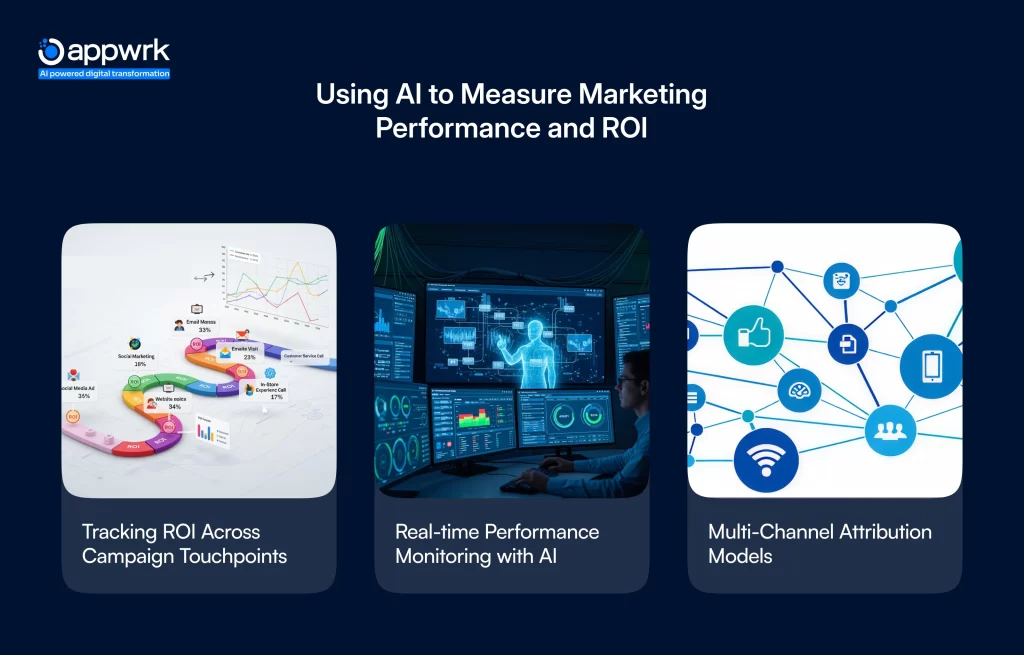
Using AI to Measure Marketing Performance and ROI
Measuring true marketing impact has always been a challenge, but AI is closing the gap. With full-funnel visibility, it tracks and analyzes performance across all touchpoints, channels, and timeframes, giving marketers faster, more precise insights to maximize ROI.
Tracking ROI Across Campaign Touchpoints
Traditional analytics often overlook subtle connections, such as a podcast ad driving a website conversion weeks later. AI bridges these gaps with probabilistic models and multi-touch attribution (MTA), accurately assigning value to every interaction along the customer journey.
Google’s Data-Driven Attribution (DDA), powered by AI, has already replaced last-click in Google Ads by default, reflecting a broader shift toward more accurate ROI measurement.
Real-time Performance Monitoring with AI
AI monitors programs across platforms in real time, flagging underperformance, anomalies, and creative fatigue automatically. Instead of waiting for end-of-week reports, marketers can pivot budgets or refresh content in the same hour.
This kind of real-time vigilance is especially powerful in high-frequency channels like programmatic, TikTok, and email, where 10-minute delays can lead to missed revenue.
Maintaining enterprise-level security requires monitoring threats and vulnerabilities in real time. Marketers now track not just CTR but campaign delivery, security, and data integrity. AI systems enhance campaign security by detecting anomalies and flagging suspicious behavior.
Multi-Channel Attribution Models
AI-powered attribution combines data from CRM systems, ad platforms, email tools, and web analytics to create a complete picture of the customer journey across channels. These models reveal not only which touchpoints drove a conversion, but also when and why they worked.
Tools like Northbeam and Triple Whale lead the way for DTC brands, while enterprise teams use platforms such as Salesforce and Adobe to manage attribution at scale.
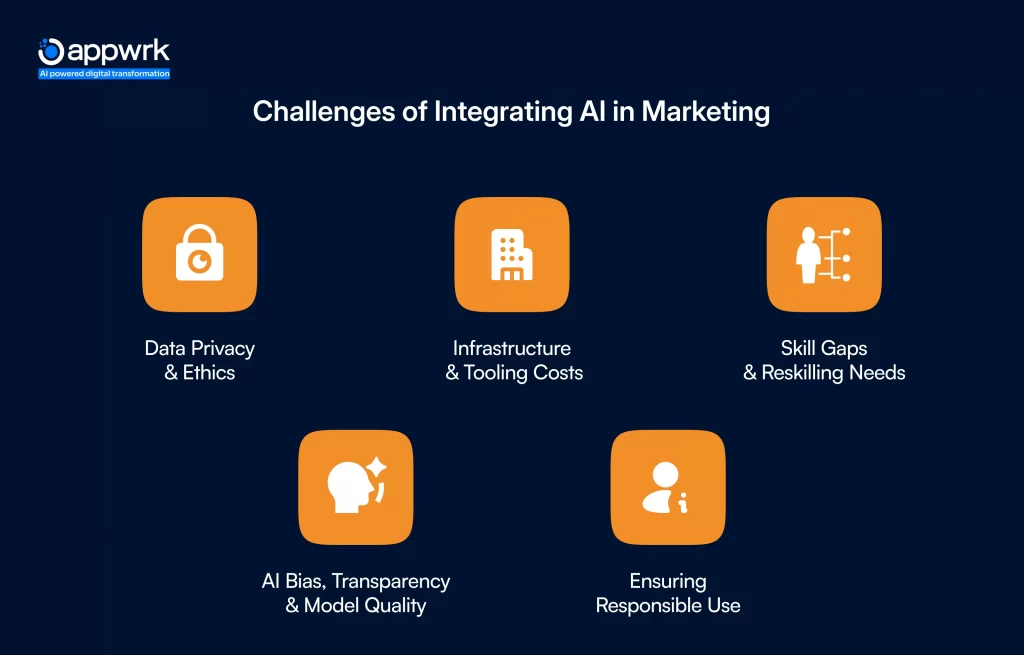
Challenges of Integrating AI in Marketing
While there’s no denying the fact that AI is transforming marketing with unmatched speed, scale, and precision, it also introduces new risks, complexities, and oversight challenges. Marketing teams must navigate concerns around privacy, talent, infrastructure, and bias to ensure AI is deployed responsibly and delivers lasting value.
Data Privacy & Ethical Concerns
AI relies heavily on data, which makes privacy a major concern. Laws like GDPR, CCPA, and upcoming AI-specific regulations require full transparency in how customer information is collected, stored, and used. Marketers must ensure that every AI application, from personalization to targeting, follows consent rules.
Breaking these rules can lead to legal penalties and damage brand trust. Security is equally important, as AI-driven personalization must be delivered without compromising data protection or user consent.
Sustainable AI Practices and Carbon Footprint
As AI adoption in marketing expands, so does its environmental footprint. Sustainable AI practices focus on reducing energy consumption by improving system efficiency, selecting eco-friendly cloud providers, and training models in ways that minimize energy waste without compromising performance.
Companies are now evaluating the carbon footprints of Large Language Models and prioritizing eco-conscious tech choices as part of brand responsibility.
High Infrastructure & Tooling Costs
Implementing AI in marketing is far from a simple plug-and-play process. Advanced tools demand significant computing power, robust cloud integrations, and reliable data pipelines, making enterprise-grade AI deployment and training a costly challenge for many mid-sized teams.
However, low-code AI platforms and modular APIs are bridging this gap, allowing marketers to experiment without overcommitting infrastructure budgets. Deploying AI within a Security Operations platform enables threat detection, anomaly scanning, and access control enforcement. Integrating AI with a Security Operations Platform also enables centralized risk monitoring. Choosing a platform with built-in security protocols minimizes the risk of data breaches.
Skill Gaps and Reskilling Needs
AI is reshaping the role of marketers, requiring creative teams to develop data literacy and analytics teams to understand how AI models work. Without proper upskilling, marketing teams risk underutilizing AI’s capabilities or relying on its outputs without critical evaluation.
According to IBM, 49% of marketing leaders cite “talent readiness” as the top barrier to AI adoption in 2025, ahead of budget or tech access.
AI Bias, Transparency & Model Quality
AI can inherit or even amplify biases present in its training data. Without diverse and representative datasets, models risk producing biased targeting, exclusionary messaging, or inaccurate sentiment analysis, which can harm both campaign effectiveness and brand reputation.
Marketing leaders must demand model transparency and regularly audit AI decisions, particularly in segmentation, lead scoring, and customer engagement.
Beyond ethical risk, AI must be architected with strong security protocols to prevent data breaches and misuse.
Ensuring Responsible Use of AI in Marketing
Using AI responsibly requires clear guidelines that include explainability, human oversight, continuous feedback loops, and ethical reviews. Many organizations now appoint Chief AI Ethics Officers or create cross-functional AI governance teams to oversee this process.
Proactively reducing bias is not just about avoiding risk. It also builds trust, supports brand values, and strengthens customer loyalty.
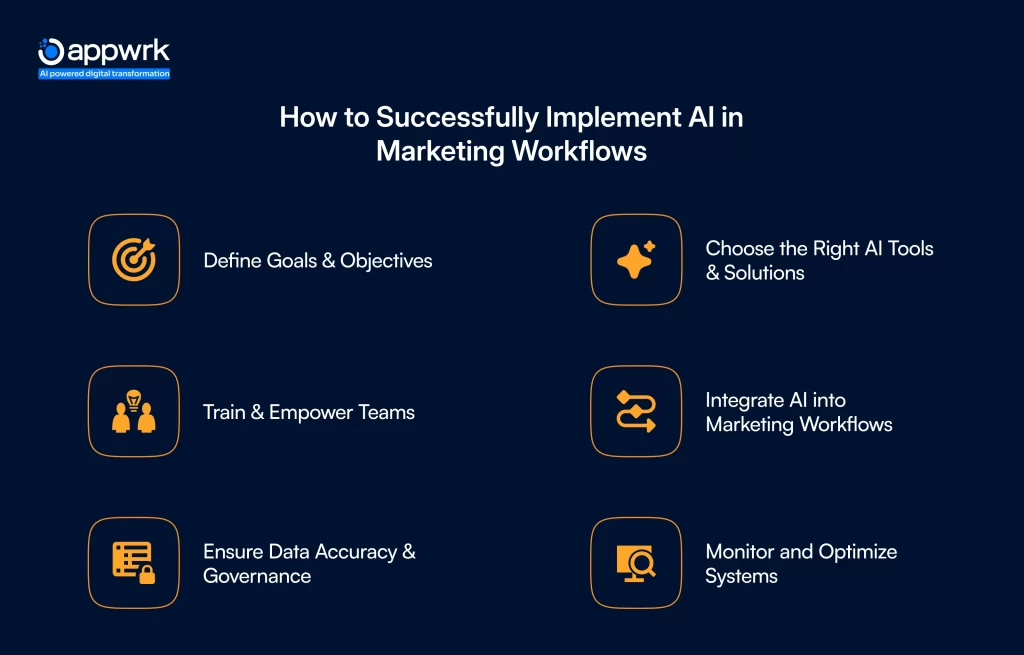
How to Successfully Implement AI in Marketing Workflows
Bringing AI into marketing is not just about adding a new tool. It’s about changing the way teams think and work. From strategy to execution, successful AI adoption requires careful planning, collaboration across departments, and ongoing learning. Here’s how top marketing teams put it into action.
Define Goals and Objectives
Start with clarity, not code. Before selecting any AI vendor, define what business problem you’re solving: is it reducing churn, boosting campaign ROI, or scaling personalization? Without sharp objectives, AI becomes just another tool instead of a strategic multiplier.
CMOs who align AI goals with marketing KPIs (like CAC, CLTV, or MQL-to-SQL velocity) are 2.6x more likely to report positive ROI from AI investments, according to BCG.
Choose the Right AI Tools and Solutions
The AI landscape is crowded, but not all tools are built for your use case. Marketing leaders must assess platforms not just on features, but on their ability to integrate with CRM, CDP, analytics, and AI marketing stacks.
For instance, Jasper may work great for content velocity, but for enterprise-wide attribution modeling, a platform like Salesforce Einstein or Adobe Sensei delivers better cross-team utility.
Train and Empower Teams
AI adoption often fails when marketers use it without understanding how it works. Upskilling teams is essential not only in using the tools but also in interpreting AI-driven insights. Companies that include AI literacy in marketing onboarding and learning programs report adoption cycles that are 38% faster.
Marketers don’t need to become data scientists, but they must understand what AI is solving and how to act on its output.
Integrate AI into Marketing Workflows
One of the biggest challenges in AI adoption is making it part of the daily marketing process rather than treating it as an add-on. To overcome this, teams need workflows where AI tools deliver predictive insights at every decision point, from testing subject lines to allocating budgets.
The real win comes when manual guesswork is replaced with automated, relevant marketing at scale.
Ensure Data Accuracy and Governance
AI is only as effective as the quality of data it receives. Inaccurate, siloed, or biased data can lead to poor targeting, unreliable attribution, and misguided decisions. To avoid this, organizations need strong data pipelines, regular validation processes, and clear governance policies to keep AI models reliable.
Research from Infosys shows that more than 54% of AI marketing failures are caused by poor data hygiene rather than faulty algorithms.
Monitor and Optimize Systems
AI is not a “set and forget” solution. Models drift, customer behavior evolves, and feedback loops must stay alive. Build systems for continuous learning, including performance dashboards and human override mechanisms.
Smart teams run monthly AI reviews to assess what’s improving, what’s stagnating, and where manual intervention is still needed.
Strategic Implementation of AI in Marketing Campaigns
AI delivers the most value when it’s embedded in the core of your marketing strategy, not bolted on as a feature. The goal isn’t just automation; it’s the orchestration of data, creativity, and timing at scale.
Campaign Automation with AI Copilots
AI copilots are redefining the marketer’s workflow, from drafting campaign briefs to refining segmentation and messaging in real time. Tools like HubSpot AI and Salesforce GPT now assist marketers by suggesting copy, surfacing insights, and auto-generating workflows.
These copilots reduce operational complexity while empowering marketers to test more, learn faster, and move from execution to strategy. AI copilots must adhere to enterprise security frameworks to avoid vulnerabilities.
Cross-Channel Optimization
Marketers today work in a fragmented ecosystem where search, social, email, SMS, web, and app channels all need to work together seamlessly. AI centralizes these touchpoints and analyzes performance holistically. Cross-channel orchestration demands strong API-level security to prevent breaches.
Platforms like Adobe Experience Platform or MoEngage use AI to decide when, where, and how to engage customers based on real-time triggers. This ensures consistency and maximizes return across every channel.
Using Data Analytics for Strategy
AI has shifted from being a campaign support tool to a cornerstone of marketing strategy. Predictive analytics now guide critical decisions, from allocating quarterly budgets to shaping creative concepts.
CMOs are leveraging AI-driven insights to forecast results before launch, test scenarios at scale, and pinpoint exactly what actions reduce acquisition costs and increase engagement.
AI-Powered Buyer Journey Mapping and Hyper-Segmentation
AI takes buyer journey mapping to the next level by analyzing signals such as session behavior, recency–frequency–monetary (RFM) scores, device type, and even scroll patterns. Instead of relying on static audience segments, marketers can now create dynamic micro-cohorts that evolve in real time based on user behavior and intent.
For instance, Sephora uses AI-driven segmentation to deliver different promotions to a first-time visitor and a repeat buyer within the same hour, adjusting the buyer journey mid-session. This level of hyper-segmentation reduces drop-offs, boosts engagement, and ensures every interaction feels personalized to the customer’s needs.
AI-powered Personalization Models
Recommendation engines and predictive marketing models now work in real time to deliver the right offer, product, or content to each user. These models learn and adapt continuously, updating as soon as new customer behavior is recorded, often using techniques like reinforcement learning and neural networks.
Netflix, for example, re-trains its personalization algorithm every 24 hours, a speed that leading ecommerce platforms and digital marketers are now matching. This creates a dynamic feedback loop where every interaction improves the next. Tools like Dynamic Yield, Algonomy, and Optimizely are making this possible, adapting everything from homepage visuals to pricing strategies in milliseconds.
Regulatory Considerations and Compliance in AI Marketing
As AI transforms marketing, it operates under increasing scrutiny. Global regulators are now mandating transparency, fairness, and accountability in algorithmic decision-making, reshaping how AI must be deployed across marketing touchpoints. Regulators now demand explainability, fairness, and robust security for AI marketing deployments. Compliance now includes AI-specific security obligations under GDPR and the AI Act.
GDPR, CCPA, and Global Compliance Standards
Laws like the EU’s GDPR and California’s CCPA have set the baseline for data privacy, but new regulations are emerging with AI-specific requirements. Frameworks such as the EU AI Act and Canada’s AIDA introduce rules on explainability, transparency, and risk classification, ensuring AI systems are both accountable and safe to use.
For marketers, this means AI tools used for segmentation, personalization, or targeting must clearly disclose their logic and avoid automated discrimination. Failure to comply could result in heavy fines and reputational damage.
Transparent Data Use and Consent Protocols of AI in Marketing
AI can’t rely on silent data collection anymore. Consent must be visible, verifiable, and adjustable. That includes clear privacy policies, cookie disclosures, and options to opt out of automated decisions.
Marketing teams must now build consent orchestration into their workflows, ensuring tools like CRMs, CDPs, and recommendation engines inherit and respect user preferences across channels.
Building Trust with Ethical AI Practices
Compliance is just the starting point. Leading brands are going further by using ethical AI practices to actively build trust. This includes clearly disclosing AI-generated content, providing human support options alongside chatbots, and publishing transparency reports that show how AI is used and governed.
For example, Unilever’s marketing code includes AI usage guidelines that prioritize fairness, inclusion, and human review, reinforcing their brand values through AI technologies governance.
How APPWRK Helps in Integrating AI in Marketing
AI in marketing isn’t just about technology; it’s about trusted implementation. APPWRK helps marketing teams deploy, integrate, and scale AI solutions that generate measurable results, tailored to your industry, goals, and tech stack.
How APPWRK Helps You Deploy AI Across Your Marketing Funnel
APPWRK offers end-to-end AI enablement for marketing: from identifying high-impact use cases to deploying models that plug into your CRM, ad platforms, or analytics tools. Whether you’re a B2C brand looking to optimize engagement or a B2B firm aiming for better lead scoring, APPWRK tailors solutions to your funnel needs. APPWRK also ensures every AI deployment includes robust data governance and security features.
Our expertise includes:
Predictive analytics and churn modeling.
NLP (Natural Language Processing) Marketing and NLP-powered content generation.
AI Customer segmentation and personalization.
Chatbot development and conversational design.
Multichannel attribution frameworks.
Personalized AI Workflows
Every marketing org is different, which is why APPWRK avoids cookie-cutter deployments. We build custom AI pipelines that integrate with your stack (HubSpot, Marketo, Salesforce, etc.) and respond to your real-time marketing triggers.
Clients see faster results because we focus on context-aware workflows, where AI doesn’t just automate, but adapts to your goals, performance data, and customer behavior.
Trust, Scalability & ROI from APPWRK Deployments
AI implementation without trust is high risk. APPWRK prioritizes model transparency, human oversight, and ethical design in every build. We also ensure the systems scale with your growth, whether you’re operating at startup velocity or enterprise scale.
Brands working with APPWRK have achieved:
Up to 40% campaign cost savings.
25-35% uplift in customer engagement.
Full-stack AI integration in under 90 days.
Contact APPWRK to get AI integrated into your Marketing Operations.
FAQs
What are the most impactful AI use cases in marketing?
Top applications include predictive analytics, content generation, churn modeling, lead scoring, email personalization, and campaign optimization through real-time data analysis.
How do I get started with AI in my marketing strategy?
Begin by pinpointing a specific challenge, such as low conversion rates, high churn, or poor ad performance. Choose an AI tool that directly addresses that problem and start with a small pilot project. Track results closely, aim for quick wins, and use those early successes to build support and scale AI across your marketing efforts.
What tools are best for implementing AI in marketing?
Popular tools include Jasper (content), Salesforce Einstein (predictive analytics), Persado (copy optimization), and HubSpot AI (for AI-powered automation). The right choice depends on your AI-marketing stack and goals.
Is AI suitable for small and medium businesses in marketing?
Yes. SMBs are using low-code AI tools to automate emails, create content, and personalize websites without needing in-house data science teams or heavy infrastructure.
How can AI improve customer personalization and engagement?
AI processes behavioral signals in real time to deliver hyper-personalized offers, emails and content. This increases engagement, loyalty, and conversion velocity.
What are the ethical concerns with using AI in marketing?
Concerns include biased targeting, data misuse, lack of transparency, and over-reliance on automation. Responsible use requires explainable AI, human review, and privacy compliance.
Which companies are using AI for marketing?
Leading companies such as Netflix, Spotify, Amazon, Coca-Cola, Uber, Salesforce, Zendesk, SEMrush, and HubSpot leverage AI across various marketing functions, including automation, predictive analytics, content generation, social media management, SEO optimization, digital advertising, and customer support, to enhance personalization, boost campaign performance, and drive smarter decision-making.
How do AI marketing tools integrate with CRM platforms?
Most modern AI marketing tools offer native integrations or API compatibility with CRMs like Salesforce, HubSpot, Zoho, and Microsoft Dynamics. These integrations enable real-time data sync, AI-driven lead scoring, personalized workflows, and improved customer segmentation, empowering marketers to automate journeys directly from their CRM dashboard.
What is the ROI of using AI in marketing?
Companies using AI in marketing often see a 30 to 60% boost in campaign ROI, along with higher conversion rates, lower churn, and faster campaign execution. The exact ROI depends on the application, whether it is AI-powered content creation, lead nurturing, or real-time ad optimization, but in most cases, it delivers both cost savings and measurable revenue growth.
Can AI in marketing work without a large dataset?
Yes. While larger datasets improve model accuracy, many AI marketing tools use pre-trained models or synthetic data to generate insights even with limited inputs. SMBs can start with low-data features like subject line optimization, email send-time prediction, or chatbot automation and scale from there.
What’s the difference between rule-based automation and AI in marketing?
Rule-based automation follows predefined instructions (e.g., if X happens, do Y), while AI learns from data patterns to make predictions or decisions (e.g., suggesting content based on user behavior). AI adapts over time, enabling more personalized, context-aware, and dynamic marketing strategies.
Gourav Khanna is the Co-founder and CEO of APPWRK, leading the company’s vision to deliver AI-first, scalable digital solutions for enterprises and high-growth startups. With over 16 years of leadership in technology, he is known for driving digital transformation strategies that connect business ambition with outcome-focused execution across healthcare, retail, logistics, and enterprise operations.
Recognized as a strategic industry voice, Gourav brings deep expertise in product strategy, AI adoption, and platform engineering. Through his insights, he helps decision-makers prioritize market traction, operational efficiency, and long-term ROI while building resilient, user-centric digital systems.
Subscribe to APPWRK Blogs, We'll Do the Rest!
Get Blogs on UI/UX, Mobile Apps, Online Marketing, and Web development technology.
Unlock worthy and priceless suggestions from the masters of mobile and web app development