150+ minds across 4 countries. Join a culture of innovation, ownership & growth.
Rewire for AI
From machine learning to deep learning, from classification tools to overall process automation – our AI engineers will help you retool your existing system or enhance your company results.
Ship faster, scale smarter, built for product companies and SaaS teams
Our Latest Work
We strive hard to deliver result-driven digital solutions across the globe. Check out our case studies to get a glimpse of how we ideate, innovate, and create unconventional digital solutions according to the requirements of our clients.
Discover diverse and passionate insights from our tech enthusiasts. We collaborate across various sectors to streamline operations and drive innovation. Explore our rapidly growing collection of articles to see why we’re at the forefront of IT solutions.
The decision to move from Magento to Shopify is one of the most significant replatforming choices an ecommerce business can make. Magento is powerful, but its power comes with...
Accuracy gap is real: Traditional CPG forecasting carries a 25-40% MAPE error rate. AI-powered models bring that down to 8-15%, according to McKinsey research....
Real stories from global leaders who trusted us with their ideas.
Partnering with APPWRK helped us build a compliant and scalable healthcare platform, accelerating our time-to-market by 35%. Their team consistently delivered outstanding work.
Beesers
Digital Healthcare Client
Collaborating with APPWRK, Sportskeeda modernized its platform into a real-time sports engagement ecosystem, enabling seamless content delivery, scalable fan interactions, and high-velocity performance.
Sportskeeda
Sports & Entertainment Partner
Working with APPWRK was effortless. They captured our vision, maintained full compliance, and delivered a digital experience that built trust and elevated how customers interact with our fintech brand.
PayPenny
Fintech Partner
Working with APPWRK gave us confidence in adopting AI responsibly. Their team built a safe, intelligent bot that transformed how we engage with leads and helped us achieve measurable revenue growth.
IFB
AI Transformation Partner
Leveraging APPWRK’s digital expertise, Nemesis launched a scalable, compliant, and safe super app that connects content delivery, real-time communication, and logistics management within a single platform.
The Model Context Protocol (MCP) is becoming the foundational layer for enterprise AI, enabling organizations to move beyond isolated models into multi-agent, multi-tool orchestration. With support for AI agent lifecycle management, multi-agent collaboration, and cross-functional workflow automation, MCP allows enterprises to build intelligent systems that are context-aware, secure, and fully integrated with both real-time and legacy systems.
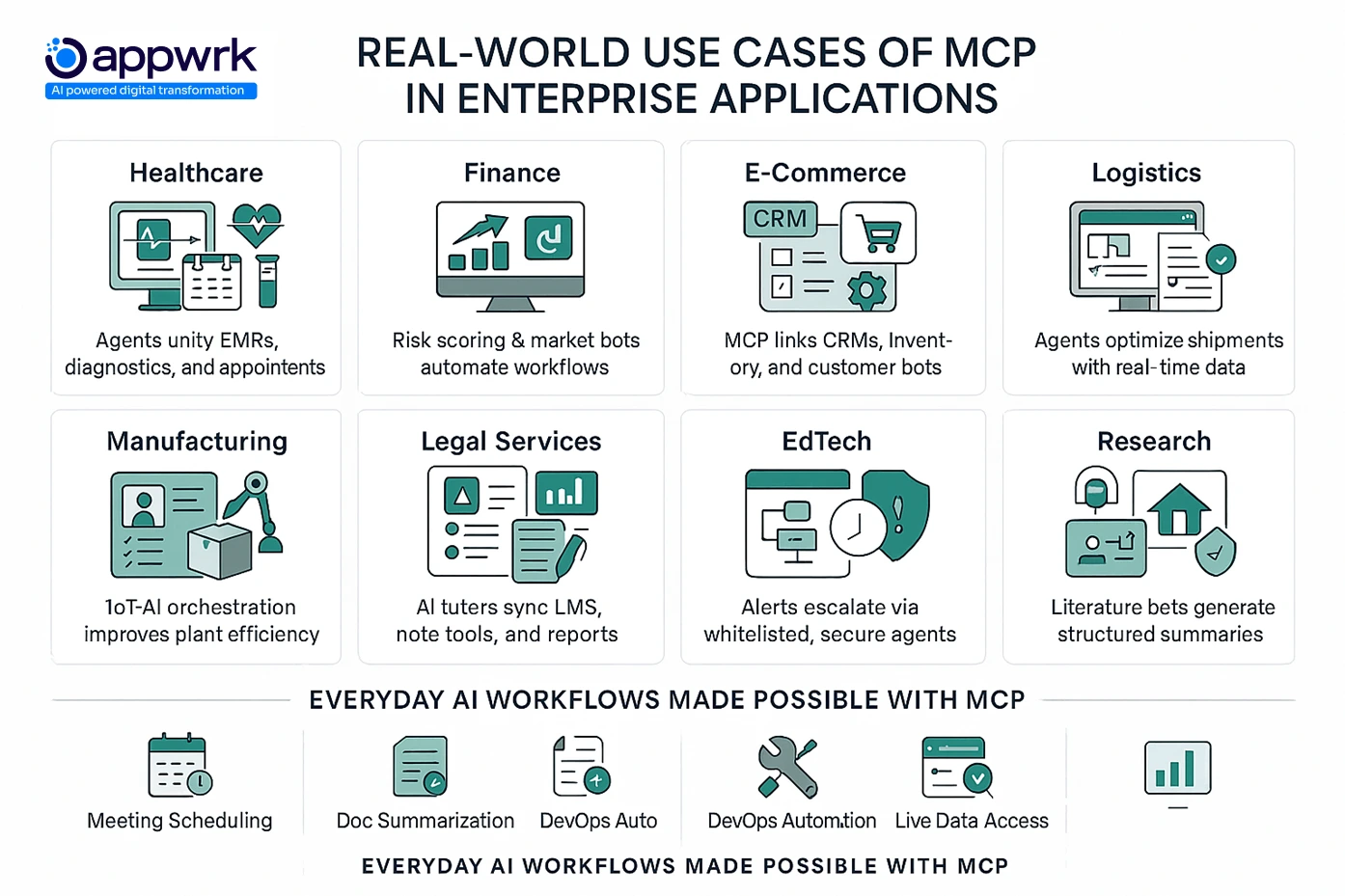
Industries like healthcare, finance, e-commerce, and logistics are already leveraging MCP to streamline operations—whether it’s reducing physician admin time through EMR-linked agents, automating refunds and stock checks in e-commerce platforms, or coordinating fraud detection and compliance workflows in financial services.
MCP also empowers HRTech, legal, and EdTech use cases by enabling tools like resume parsers, case summarizers, and personalized learning agents to operate within a unified, governed ecosystem. With personalized user experiences at scale, dynamic tool invocation, and zero-trust security, MCP ensures agents can safely access sensitive systems like Google Maps, PostgreSQL, CRM platforms, and internal APIs.
From enabling feedback loops and continuous learning in customer support to managing agent identities, memory, and permissions in compliance-heavy sectors, MCP integrates seamlessly with existing infrastructures. Its multi-model, multi-vendor architecture and exchange-layer governance make it an ideal choice for enterprises seeking future-ready, scalable AI systems across cloud, edge, and hybrid deployments.
What is the Model Context Protocol (MCP) and how it works?
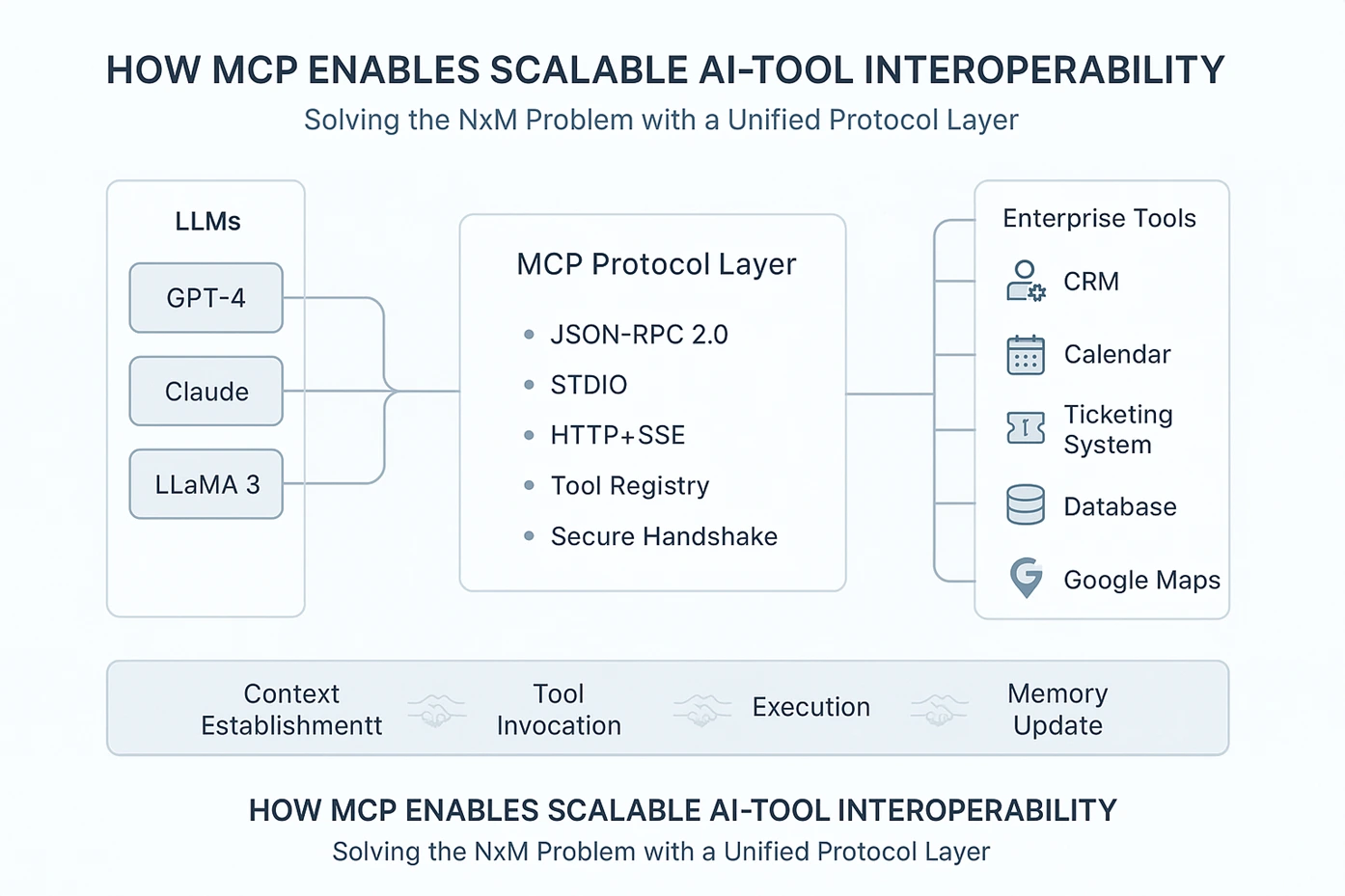
The Model Context Protocol (MCP) is a standardized interoperability protocol enabling AI agents,LLMs, and enterprise tools to securely communicate, share persistent memory, and invoke structured actions. It solves the NxM problem by simplifying integrations—replacing brittle API calls and GraphQL pipelines with a unified protocol layer for scalable AI workloads.
The NxM Problem and Unified Tool Invocation
In traditional setups, integrating five tools (CRM, calendar, ticketing system, knowledge base, document parser) with three LLMs demands 15 connections. With MCP, each model and tool uses a single MCP interface, creating a scalable MCP client & server ecosystem.
MCP supports formats like JSON-RPC 2.0, STDIO, and HTTP+SSE—enabling tool invocation and streaming responses across tools like Stripe, PostgreSQL, MongoDB, or Google Maps, all without patchwork connectors or retraining.
How MCP Protocol Works
MCP’s secure protocol handshake follows 4 stages:
Context Establishment – LLMs receive metadata about available tools.
Invocation – AI selects from the MCP tool registry, using scoped, pre-approved actions.
Execution – Tools operate securely and return structured results.
Memory Update – Context is enriched for next steps or multi-agent reasoning.
This makes agent-based orchestration possible across complex enterprise AI workflows, while enforcing Zero-Trust environments through whitelisted endpoints and secure handshakes.
MCP Architecture: Hosts, Clients, Servers & Transport
Host Application: Interfaces like Claude Desktop, AI IDEs (e.g., Cursor), or chat platforms.
MCP Server: Exposes tools for access by AI apps—GitHub, Slack, databases, etc.
Transport Layer:
STDIO for local (stdin/stdout) operations.
HTTP + SSE for remote, streaming interactions.
Use Cases of MCP in Enterprise Applications
As AI adoption accelerates, enterprises are running into a new problem: their intelligent tools can think, but they can’t coordinate. They operate in silos, a chatbot here, a document parser there, a recommendation engine somewhere else. What’s missing is context, not just data context, but operational context.
That’s where the Model Context Protocol (MCP) comes in. It standardizes how AI systems connect, share memory, and perform function calling across diverse environments. From regulated industries like healthcare and finance to real-time operations in logistics, MCP is already proving itself as the exchange layer for context-aware automation.
Here’s how enterprises are applying it today, not as a future vision, but as real-world applications that deliver measurable results.
Healthcare: Data Analysis
Hospitals and digital health platforms are using MCP to unify clinical decision support systems, EMRs, and diagnostic agents.
AI agents retrieve patient histories via MCP Tools and generate compliance-checked summaries.
Diagnostic bots query lab reports and suggest next-step evaluations.
Health assistants schedule appointments while verifying insurance in one seamless workflow.
Because MCP standardizes this process, healthcare systems can retain secure memory across interactions while staying HIPAA-compliant.
The MCP client & server ecosystem makes employee services proactive and seamless.
EdTech and Learning Platforms
Education platforms are using MCP to orchestrate multi-agent tutoring systems.
Study assistants adapt lesson plans using test scores.
Learning bots connect LMS content with note-taking tools like Notion.
Parent-teacher dashboards generate progress reports across tools.
This transforms fragmented knowledge management into adaptive learning pipelines.
Cybersecurity and IT Ops
MCP is enabling context-aware security response.
Anomaly detectors trigger MCP-driven diagnostics on servers.
Alerts escalate only through a whitelisted set of endpoints.
Audit logs auto-sync across observability tools.
This aligns with a Zero-Trust environment, ensuring no agent can overstep its permissions.
Research & Knowledge Management
Knowledge-heavy teams are using MCP to accelerate synthesis.
Literature review agents pull PDFs, wikis, and internal databases.
Summarizers extract citations in real time.
Formatting tools package research into publish-ready outputs.
With MCP, an agent can only invoke the specific endpoints it’s authorized for, keeping workflows both productive and secure.
Real Estate & Property Tech
Property platforms are deploying MCP for end-to-end buyer journeys.
Search agents recommend homes based on Google Maps data and preferences.
Mortgage bots integrate with bank APIs for eligibility.
Scheduling agents sync tours with user calendars.
This creates a personalized pipeline from discovery to transaction.
Public Sector & Policy Automation
Governments are testing MCP for service delivery at scale.
Benefit eligibility checks pull from multiple departments.
Policy bots validate submissions against the latest regulations.
Summarizers generate reports for citizen services.
Here, MCP reduces delays while safeguarding public trust.
Other Everyday Key Use Cases of MCP Integration
Beyond industry-wide transformation, MCP is also enabling high-value, everyday workflows within enterprise environments, making AI more actionable, collaborative, and productive across teams. Here are some real-world examples of how MCP reshapes daily operations:
1.AI Agent Lifecycle Management
MCP supports full agent lifecycle management from agent configuration (tone, tools, goals) to version control, memory persistence, and deprecation. Enterprises can define and update agents, track their performance over time, and ensure deployed agents evolve securely.
2. Multi‑Agent Orchestration
Multiple specialized agents collaborate through shared context and orchestration graphs. One agent may trigger another based on status, rules, or confidence thresholds. In complex workflows, MCP enables agents to hand off tasks, coordinate sequential or parallel work, and manage dependencies.
3. Cross‑Functional Workflow Automation
MCP servers integrate with internal systems (CRM, ERP, analytics, payment tools) to automate cross‑team workflows. For example, marketing, operations, and customer support agents can share events and data automatically, reducing manual handoffs and improving consistency.
4. Multi‑Model, Multi‑Vendor Architecture
Organizations often use several LLMs (OpenAI, Claude, Mistral, domain‑specific models). MCP allows dynamic routing among them based on task, latency, or vendor. Fallback systems ensure reliability and cost‑optimization, while a unified interface ensures consistency across models and vendors.
5. Secure, Compliant AI Infrastructure
Built‑in governance features like role‑based access, whitelisted endpoints, audit trails, data residency, and retention ensure compliance with regulatory frameworks (HIPAA, GDPR, etc.). MCP deployments in regulated industries embed security at every layer, maintaining compliance while enabling advanced AI behaviours.
6. Personalized User Experiences at Scale
By maintaining user profiles, past interactions, preferences, and real‑time feedback, MCP enables AI agents to personalize tone, content, and workflows. Applications include education (adaptive tutoring), retail (customized offers), and support (contextual assistance) where user experience adapts to each individual.
7. Feedback Loops & Continuous Learning
Structured feedback (ratings, error corrections), interaction logs, and human in the loop reviews feed into retraining pipelines. MCP supports monitoring agent performance, surfacing failure cases, and refining models or tools over time.
8. Integration with Real‑Time & Legacy Systems
Many enterprises use older systems, internal databases, or SCADA/PLCs alongside cloud‑native AI. MCP enables event‑driven interactions, custom connectors, and real‑time data flow between legacy and modern systems. Use cases include real‑time delivery updates, sensor data from manufacturing, and syncing with internal ERPs.
9. AI-Based Meeting Scheduling & Coordination
Using MCP servers connected to tools like Google Calendar and Google Meet, AI agents can automatically check participant availability, reserve meeting rooms, and generate links, all from a Slack or MS Teams chat prompt. No more back-and-forth emails or scheduling apps.
10. Automated Document Generation & Summarization
AI agents linked to Google Docs, Notion, or Confluence MCP servers can monitor Slack channels or project boards, summarize key updates, and auto-generate structured documents like meeting minutes or retrospectives, eliminating manual doc upkeep.
11. Developer Productivity & GitOps Automation
With GitHub or internal repository MCP integrations, AI coding assistants can fetch diffs, review PRs, propose edits, or even initiate safe commits. This accelerates code reviews and reduces context switching for dev teams.
12. Real-Time Data Fetching for Dynamic Workflows
AI systems can retrieve up-to-date weather, financial, logistics, or support data by calling external APIs through trusted MCP servers, making live decisions without direct human intervention.
These micro-use cases show that MCP is not just a backend protocol, but it’s a front-line enabler of seamless, intelligent collaboration.
Why MCP Matters in 2025
As enterprises move from static bots to agentic AI, MCP is emerging as a strategic layer for real-time orchestration across models, tools, and systems. It ensures tool-aware, contextual intelligence without compromising on latency, efficiency, or enterprise-grade compliance.
The MCP server market is projected to hit $2.7B by 2025 and reach $5.5B by 2034, driven by sectors like:
Healthcare: AI orchestrating EMRs and diagnostics securely.
Finance: Fraud detection, compliance workflows using MCP tools.
Retail & E-commerce: Hyper-personalized journeys using POS data, Google Maps, and CRM systems.
Manufacturing: Predictive maintenance via IoT, diagnostics, and MCP-based orchestration.
Logistics: Real-time shipment tracking through MCP servers.
Telecom: Contextual NOC/SOC workflows in Zero-Trust architectures.
Legal Tech: Managing knowledge at scale using MCP-enabled document parsers.
Government: Secure orchestration via VPC hosting.
EdTech & Research: Adaptive tutoring agents and LMS-integrated MCP resources.
Adopted by Claude Desktop, LangChain, LangGraph, and Copilot Studio, MCP enables multi-agent collaboration, tool standardization, and function calling at scale.
As Shakudo notes, “MCP is the exchange layer for future-ready agentic infrastructure”—essential for reliable, secure, and context-driven enterprise AI systems.
What Are the Core Features of MCP Every AI-Driven Enterprise Should Know?
The Model Context Protocol (MCP) was designed to solve the integration pain enterprises face when connecting AI models with tools, databases, and business systems. Instead of building one-off APIs for each workflow, MCP standardizes this process, enabling context-rich communication, function calling, and interoperability at scale. It also enhances model inference speed and reduces latency, boosting training process and service efficiency.
Here are the key features that make MCP critical for enterprise AI in 2025:
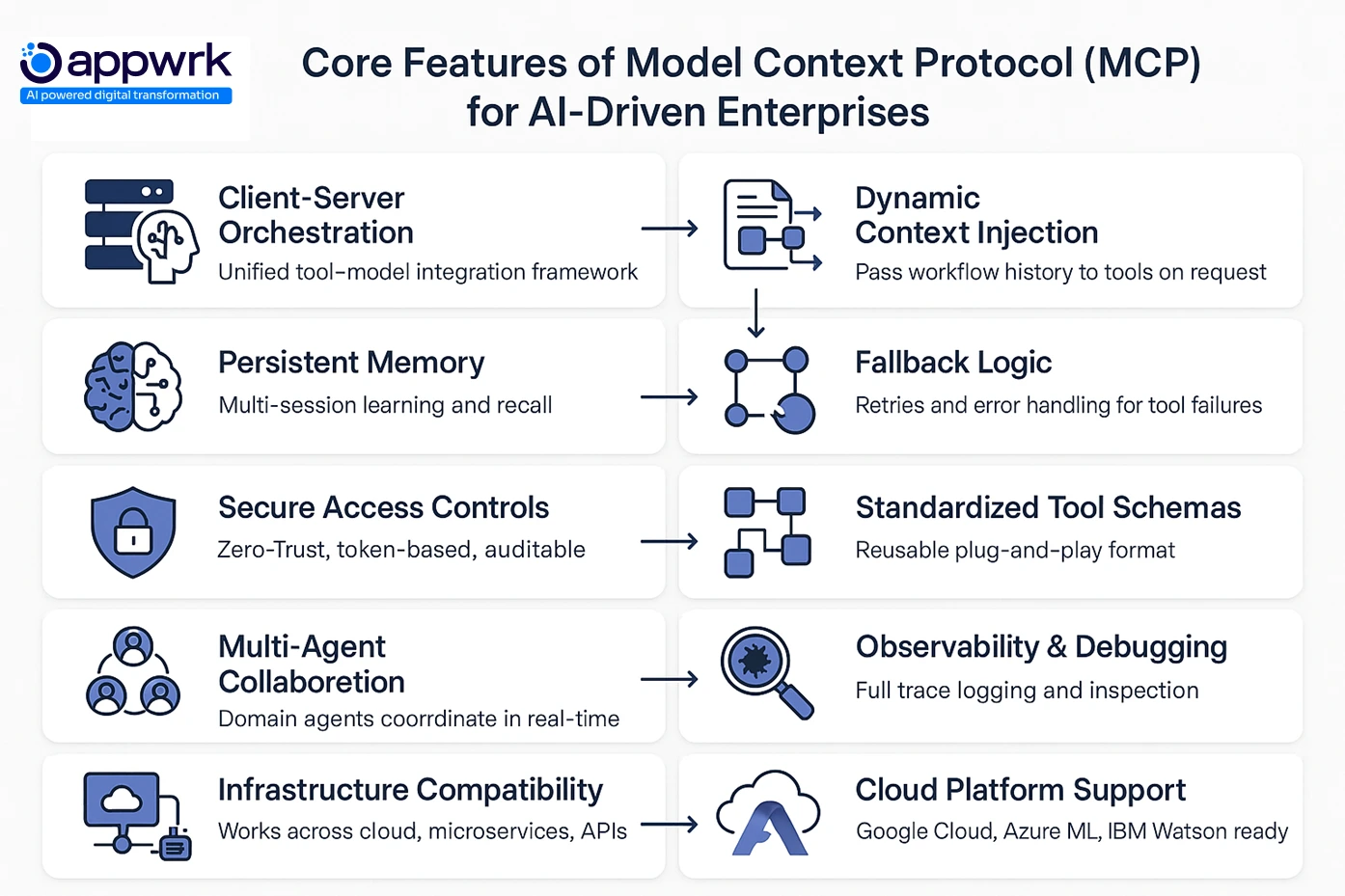
Client-Server Orchestration
MCP’s client-server architecture clearly separates MCP Clients (models or agents) from MCP Hosts/Servers (APIs, tools, services). This ensures:
Stateless or stateful tool interactions
Structured request-response flow
Predictable tool registration
It simplifies system integration while enabling secure orchestration across the enterprise.
Dynamic Context Injection
MCP injects user history, workflow memory, and prior queries into every tool invocation:
Reduces brittle prompt engineering
Enhances personalization
Enables AI Agent Lifecycle Management based on memory
Persistent Memory and Feedback Loops
With long-term memory, MCP allows tools to recall previous steps and improve outputs:
Enables feedback loops and self-correcting agents
Supports multi-agent coordination in workflows
Improves knowledge management
Cloud Platform Support for MCP: Accelerating Deployment & Monitoring
Native integration with Azure AI, Google Cloud AI Platform, and IBM Watson accelerates:
MarketsandMarkets forecasts the global MCP market to reach USD 13.4B by 2025 (CAGR 34.6%).
MCP’s value spans training process optimization, model exploration, and real-time analytics in sectors like gaming, finance, and enterprise analytics.
Secure Permission-Based Data Access
Security is non-negotiable, and MCP enforces it at the protocol level. Every action requires pre-approved actions, permission prompts, and can only run against a whitelisted set of endpoints.
Aligns with Zero-Trust environment principles.
Supports audit logs, token expiration, and access scopes.
Mitigates risks highlighted in OWASP Top 10 for Large Language Model Applications.
This makes it safe for enterprises to connect MCP to CRMs, ERPs, and cloud services inside a Virtual Private Cloud (VPC).
Standardized Tool Invocation
MCP enables schema-based tool definitions for fast, secure integration:
Reduces development time
Improves testing/debugging
Enhances Cross-Functional Workflow Automation
Multi-Agent Orchestration
MCP supports both sequential and parallel orchestration, with agents specialized for HR, support, or compliance:
Solves the NxM problem with standardized messaging
Works across LangChain, LangGraph, and Semantic Kernel
Compatibility with Diverse Infrastructure
One of MCP’s biggest strengths is its neutrality. MCP works across traditional servers, cloud platforms, and microservices, making it easy to adopt without a complete backend rebuild.
MCP supports:
STDIO, HTTP+SSE, JSON-RPC 2.0
Infrastructure like Kubernetes, PostgreSQL, MongoDB
Toolchains like Claude Desktop, Codeium, and Sourcegraph
Live Error Handling and Fallback Logic
Enterprises demand reliability. MCP builds in fallback logic for when tools fail, timeout, or return empty results.
Retry, rephrase, or escalate options available.
Ensures customer satisfaction (CSAT) isn’t disrupted by dead ends.
Supports multi-tier error handling workflows.
Observability and Debugging Built-In
Enterprise AI systems require traceability. MCP provides first-class observability by logging every request, input, and output.
Works with observability platforms like OpenTelemetry.
Easier debugging with transparent invocation chains.
Enables pull requests on GitHub for collaborative development.
Contextual Awareness
Tracking user sessions, goals, memories, and environmental variables to maintain coherent agent interactions.
Agent Management
Defining, updating, and versioning agents, including their configurations, roles, and tool permissions.
LLM Orchestration
Routing requests intelligently to the most appropriate model (e.g., Claude, GPT, Mistral) or tool across vendors.
System Integration
Interfacing with enterprise APIs, databases, file systems, and workflows to execute meaningful, secure actions.
MCP is more than an integration protocol, as it’s the strategic backbone of multi-model, multi-vendor architectures, enabling secure, scalable AI automation across industries like finance, retail, healthcare, logistics, and legaltech.
Challenges and Limitations of MCP Implementation Across Industries
While MCP is becoming central to enterprise AI, several shared challenges hinder its rollout in fields like finance, healthcare, retail, logistics, and legaltech:
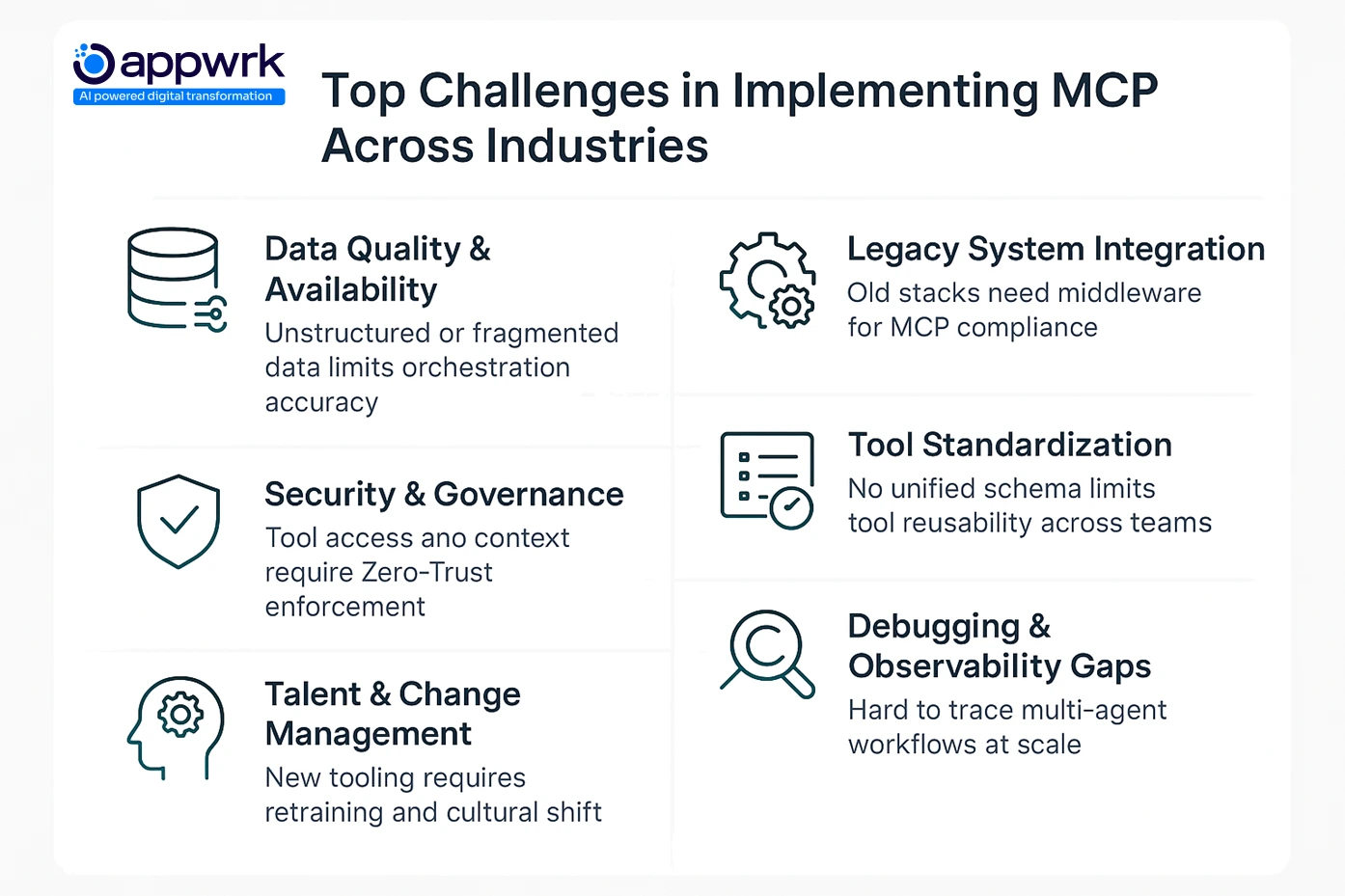
1. Data Quality and Availability
MCP‑powered solutions require structured, clean, up‑to‑date data. Many legacy systems (EMRs, old CRMs) store unstructured data, while in logistics or retail real‑time streams may be fragmented. Poor data limits MCP’s ability for context‑aware orchestration and personalized user experiences.
2. Integration Complexity with Legacy Systems
Integrating decades‑old infrastructure—industrial controllers, SCADA, on‑prem servers, with MCP’s unified interface and tool registry is costly. Enterprises need custom connectors and middleware, which slows down AI agent lifecycle management and hampers cross‑functional workflow automation.
3. Security, Governance, and Compliance
Scaling up with multiple agents exposes large attack surfaces. Enterprises must enforce Zero‑Trust, use session‑scoped identities, implement role‑based permissions, maintain audit trails, meet GDPR, HIPAA, and follow OWASP Top 10. Secure AI infrastructure is essential.
4. Tool Discovery and Standardization
Even with schemas, inconsistency across organizations (different naming, I/O formats) undermines tool reusability. Observability gaps (lack of platforms like LangFuse or OpenTelemetry) make debugging multi‑agent workflows, fallback logic, or memory injections difficult.
5. Observability and Debugging Gaps
As MCP workflows scale across multiple agents and tool chains, visibility becomes a challenge. Without robust observability platforms like LangFuse or OpenTelemetry, teams struggle to trace failures, debug multi-step flows, or optimize memory injection and fallback logic.
6. Change Management and Talent Gaps
Shifting from monolithic APIs to multi‑agent orchestration demands new skills: DevOps practices, orchestration frameworks (LangGraph, LangChain), versioning tools, memory handling. Without a focus on training and phased adoption, projects risk failure.
Training Curve & Talent Gaps: New training paradigms are required as MCP-based deployments shift from legacy API models.
Appwrk Case Study: Streamlining Investor Reporting with MCP
Client: A financial SaaS provider managing investor networks.
Challenge: Fragmented financial data and manual reporting slowed investor communication.
Solution: Appwrk implemented MCP with MCP Resources like live stock APIs, Google Sheets, and CRM integrations. Memory persisted across investor sessions, fallback logic handled missing data, and orchestration ran through Claude Desktop with LangChain.
Outcome:
80% reduction in reporting prep time.
40% drop in operational overhead.
Fully auditable, memory-driven workflows.
Higher investor customer satisfaction (CSAT).
From healthcare to logistics, MCP isn’t just another AI layer; it’s the MCP architecture and core components that let enterprises scale multi-agent systems. By combining interoperability, context-sharing, and strict security, MCP is powering the next era of real-world applications in enterprise AI.
Why Is MCP the Backbone of Enterprise AI and Tool Interoperability?
The future of enterprise AI isn’t about isolated assistants. It’s about multi-agent systems that think, talk, and act together. MCP architecture and core components are designed for exactly this.
MCP acts as the protocol handshake layer that allows any model or assistant to:
Securely invoke MCP resources or tools
Retrieve structured data across repositories
Execute function calls across APIs
Operate safely under permission prompts in a Zero-Trust environment
Instead of writing custom APIs for each new tool, enterprises can now rely on MCP to standardize tool invocation, enforce LLM isolation, and scale across verticals. This drastically reduces integration overhead while improving reliability.
By 2025, MCP has become the backbone of interoperability, enabling an agent to only invoke specific endpoints in a whitelisted environment. Whether it’s fraud detection in finance, real-time logistics rerouting, or AI-powered legal search, MCP brings similar capabilities to any AI application, no matter the sector.
What AI Challenges Does MCP Address?
MCP directly solves the fragmentation, delay, and inflexibility that typically plague enterprise AI rollouts. Here’s how:
Traditional Problem in AI Integration
How MCP Solves It
Multiple custom API integrations (NxM problem)
One unified protocol layer for all models & tools
Context loss between tool invocations
Maintains context across requests and agents
Data format mismatches across systems
Standardized input-output schema across tools
Limited tool adaptability with LLMs
Agentic architecture that adapts to any tool dynamically
Token inefficiency for repeated context
Persistent memory and contextual layering are built in
Why Are More Companies Adopting MCP So Fast?
The shift to AI-native operations is pushing CIOs, CTOs, and digital leads to demand systems that don’t just generate content, but also perform actions, access systems, and execute business logic.
MCP empowers this transition with:
Faster tool orchestration for LLM-based agents
Secure, policy-controlled context management
Reduced engineering costs through a plug-and-play model
Support from growing OSS ecosystems like LangChain, LangGraph, and Claude Workbench
Proven results in industries like finance, healthcare, HR, logistics, and legaltech
How MCP Differs from Traditional AI Integrations
Let’s break down how MCP outperforms REST APIs, OpenAPI definitions, and other legacy interfaces:
Feature
REST/API
MCP (Model Context Protocol)
Tool Invocation Speed
Medium
Fast (context-aware invocation)
Standardization Across Tools
Low
High
Support for Contextual Memory
No
Yes
Agentic Compatibility
Poor
Native support
Multi-Tool Sequencing
Manual configuration
Seamless coordination
Flexibility with Models
Limited
Works across LLMs (Claude, GPT, Mistral, etc.)
MCP acts as a protocol-first operating layer, not just a request/response pipe. This difference changes how tools are composed, deployed, and evolved in production AI systems.
Future-Proofing Your AI Stack: Beyond Protocols with an Operating System Approach
As enterprise AI continues to evolve beyond simple chatbot interactions into complex multi-agent orchestration, the Model Context Protocol (MCP) is rapidly becoming a foundational layer, not just a feature. But to stay ahead, enterprises need more than protocol adoption. They need architectural agility.
In a fast-changing ecosystem, where new agent frameworks like CrewAI and LangGraph emerge weekly, LLMs like Qwen 2.5, DeepSeek-R1, and Llama 4 challenge the status quo, and AI systems integrate RAG pipelines, vector databases, and guardrails, and enterprises must plan beyond today’s tools. Enter the AI Operating System (AI OS) model.
Unlike traditional monolithic systems, an AI OS is designed to run a diverse set of agentic AI tools, MCP servers, A2A (Agent-to-Agent) compliant agents, and multi-vendor LLMs within a single, secure environment, often inside the organization’s Virtual Private Cloud (VPC). This not only addresses data privacy and governance issues but also simplifies MLOps and DevOps, reducing time-to-deploy and total cost of ownership.
MCP plays a pivotal role in this shift. By standardizing agent-to-tool communication, it enables plug-and-play support for future innovations, like vertical-specific agents in healthcare, legal, or education, or dynamic tool chaining workflows embedded in a single prompt. And as protocols like Google’s A2A enter the space, enterprises can adopt a suite of interoperable standards, ensuring protocol resilience instead of lock-in.
To future-proof AI operations, organizations must now think in platform primitives shared data contexts, unified tooling registries, permission-based orchestration, and seamless integration layers. MCP becomes the interoperability backbone, while the AI OS becomes the control plane.
In short, MCP isn’t just a step forward, it’s the on-ramp to the next generation of AI-native systems. One where your agents, tools, models, and governance policies speak the same language, adapt in real time, and evolve together without costly rewrites or integration headaches.
Why MCP Matters Now: Unlocking Agentic AI Potential
The Model Context Protocol (MCP) is emerging as a critical enabler in enterprise-grade AI, especially where generative models alone fall short. While traditional generative AI systems can produce impressive outputs, they lack the ability to take autonomous action, interact with external tools, and adapt over time. This is where agentic AI that not only reasons but also acts and steps in to create transformational value.
From M×N Chaos to M+N Simplicity
Enterprise environments are plagued by the classic M×N problem, where M different AI applications need to connect with N different tools or data sources, resulting in a web of brittle, redundant integrations. MCP addresses this head-on by standardizing communication through a client-server architecture:
MCP clients are built by AI app developers
MCP servers are built by tool or data source providers
This setup collapses the integration complexity into M+N, enabling interoperability without vendor lock-in and allowing developers to scale AI systems without exponential technical debt.
To unlock the full potential of agentic systems like CrewAI, LangGraph, or other orchestrated agent frameworks, AI models must:
Discover tools autonomously
Invoke them reliably
Persist context and memory across tasks
Learn and adapt based on real-world feedback
MCP delivers exactly that. It defines how tools are described, how requests are structured (via JSON-RPC 2.0, STDIO, or HTTP+SSE), and how models access, use, and remember tool interactions. This transforms an LLM from a passive responder into a goal-driven, context-aware agent capable of navigating complex enterprise workflows.
Structured Context, Real-Time Action
With MCP, context is no longer just chat history. It becomes a structured, policy-compliant memory layer embedded into your AI system:
Observability: Track and govern AI behavior across systems
As enterprises move toward AI operating systems and agent-based architectures, MCP isn’t just an optimization, but it’s infrastructure. It makes possible what would otherwise be too complex, too brittle, or too unsafe to deploy at scale.
How Do Enterprise AI Tools Integrate MCP with Existing Tech Stacks?
The real power of the Model Context Protocol (MCP) isn’t about ripping apart your architecture; it’s about aligning what you already have. Most enterprise stacks already run APIs, AI models, and business apps. What’s missing is a unified interface for them to coordinate in context. MCP provides that missing layer, a protocol handshake that standardizes how tools talk, share context, and trigger function calling across environments.
This section explains how MCP plugs into your existing stack, what pitfalls to avoid, and how to phase in adoption without disruption.
Layering MCP onto Existing LLMs and API Frameworks
If you’re using platforms like OpenAI, Anthropic, or Azure AI, you’re already halfway there. MCP doesn’t replace these tools; it standardizes the way they interconnect.
MCP Clients: LLMs like Claude, GPT-4, or Mistral act as request initiators.
MCP Hosts / MCP Servers: Your CRMs, ERPs, and analytics tools register as MCP-compliant endpoints with structured schemas.
MCP Tools: APIs, SaaS apps, or internal databases wrapped in MCP definitions for consistent execution.
MCP Resources: Vector databases, file stores, or third-party services that supply context.
Orchestration Layer: Frameworks like LangChain, LangGraph, or Semantic Kernel route calls, manage retries, and enforce pre-approved actions.
Memory Layer: Redis, Pinecone, or Weaviate maintains continuity across calls.
Tool Registry: A metadata map that whitelists a set of endpoints each agent can access.
This is the essence of MCP architecture and core components: a modular system where any agent can only invoke the specific endpoints they’re cleared for, supporting a Zero-Trust environment.
A Typical MCP Tool Stack
Component
Tool Examples
MCP Role
LLM Agent
Claude Desktop, OpenAI GPT, Mistral
Acts as MCP Client, sending invocations
Orchestrator
LangChain, LangGraph
Manages flows, memory, and rand tries
Tool Registry
YAML/JSON schemas + API key store
Defines available MCP Tools
Memory Store
Redis, Pinecone, Weaviate
Stores persistent MCP Resources
Business Tools
Salesforce, Slack, Notion, MongoDB
Registered as MCP Hosts / Servers
Together, this forms an MCP-based ecosystem that glues intelligence (LLMs) to action (tools) through a secure, consistent exchange layer.
Common Mistakes & Deployment Playbooks
Too often, teams treat MCP like a traditional server integration. That’s where things break. Here are mistakes to avoid and playbooks to fix them:
Overengineering Early
Teams try to MCP-wrap the entire stack on day one.
Playbook: Start with one client (e.g., Claude) and two tools (CRM + dashboard). Validate capability discovery and permission prompts before scaling.
Treating Tools as Stateless APIs
Without context memory, you break continuity.
Playbook: Add context IDs to headers or use orchestrators to reload prior responses. MCP standardizes this process.
Weak Permission Models
Tools without scoped roles risk data leaks.
Playbook: Enforce session tokens, define tool-level scopes, and whitelist endpoints per role.
Ignoring Observability
Debugging without traces wastes time.
Playbook: Use built-in logs or connect to observability platforms like LangFuse or OpenTelemetry to track STDIO, inputs, and errors.
Gradual Adoption Strategy
MCP isn’t all-or-nothing. The most resilient enterprises scale in phases:
Context Injection Phase: Agents pass structured context into existing APIs.
Tool Registry Phase: 3–5 core tools registered with clear schemas.
Multi-Tool Orchestration: Agents perform chained actions with retries, memory, and fallback logic.
This phased rollout respects uptime while unlocking compounding value. As part of the MCP client & server ecosystem, you don’t just get smarter assistants, you get reliable, auditable systems that align with compliance frameworks like the OWASP Top 10 for Large Language Model Applications.
By adopting MCP, enterprises avoid brittle, custom integrations and instead embrace an MCP-enabled chatbotand tool ecosystem that scales. Whether your infrastructure runs on Microsoft Azure Machine Learning, Google Cloud AI Platform, or a Virtual Private Cloud (VPC), MCP makes your tools interoperable without rewriting them.
In other words, if your stack works today, MCP makes it work together. And once aligned, your AI systems stop being siloed; they become strategic at scale.
What AI Tools, SDKs, and Frameworks Support MCP Today?
When enterprises ask “what is MCP (Model Context Protocol) & how does it work? Use Cases + Examples”, the next question is usually about tooling. The good news is that MCP isn’t limited to niche developer kits; it’s supported across open-source libraries, enterprise SDKs, and commercial orchestration platforms. This growing MCP client & server ecosystem makes it possible for both startups and Fortune 500s to build MCP-based solutions without reengineering their backend.
Here’s a look at the ecosystem powering MCP today.
LangChain – The Orchestration Backbone of MCP Workflows
LangChain is the go-to open-source library for connecting MCP Clients (like LLMs) with MCP Tools (like databases, CRMs, or APIs). It handles:
Registering tools with schema definitions
Routing tool calls through a standardized exchange layer
Managing context, retries, and fallback flows
Because LangChain already abstracts function calling, it’s one of the most popular starting points for MCP adoption. It ensures the MCP architecture and core components are consistent across deployments.
Claude and Other AI Models as MCP Clients
Anthropic’s Claude, OpenAI’s GPT-4, and other AI models now act as MCP Clients. Through protocols like JSON-RPC 2.0, HTTP+SSE, or even STDIO, they can:
Invoke MCP-registered tools
Maintain session context for multi-turn reasoning
Work with orchestrators like LangChain or LangGraph
This makes LLM isolation & the NxM problem solvable at scale, as MCP standardizes the process across models and tools.
LangGraph – Event-Based Agent Coordination
LangGraph extends LangChain by structuring workflows as graphs. This is powerful for enterprises where multiple agents must collaborate. With LangGraph, MCP supports:
Directed graphs of tool invocations
Context checkpoints across agent steps
Conditional or parallel task execution
It’s especially relevant when building MCP-enabled chatbotsor multi-agent systems that need reliable coordination.
Copilot Studio – Enterprise-Grade Integration
Microsoft’s Copilot Studio now supports MCP Hosts via schema-based connectors. Enterprises can:
Open-source stacks are ideal for experimentation, while enterprise tools bring observability platforms, compliance with OWASP Top 10 for Large Language Model Applications, and support for Dynamic resource scaling.
The Growing Role of MCP Resources
Beyond orchestrators and clients, enterprises are now formalizing MCP Resources like PostgreSQL, MongoDB, Google Drive, and Notion. These resources feed context directly into MCP agents while respecting permission prompts and scope control.
Vendors are also experimenting with Versa MCP Server implementations, where one server can dynamically expose multiple tools with capability discovery and protocol handshake flows.
The MCP development landscape has matured from proof-of-concept demos to production-ready MCP-based ecosystems. Whether you’re experimenting in Replit, managing enterprise deployments with Copilot Studio, or exploring frameworks like LangChain, MCP provides a unified interface for aligning intelligence with action.
By standardizing how MCP Clients and MCP Hosts communicate, enterprises reduce integration costs, enforce compliance, and scale agentic AI faster.
MCP Client/Server Toolkit List
For developers ready to build or extend MCP systems, here’s a reference list:
Each layer can be plugged into your existing stack, allowing phased adoption without platform lock-in.
Today’s ecosystem gives developers the confidence to experiment and enterprises the stability to scale. With both OSS and enterprise-grade support expanding rapidly, MCP is becoming less of an experimental protocol and more of a foundational layer for context-rich, tool-aware AI systems.
Top MCP Servers and Implementations
As MCP gains traction, organizations are evaluating where to host and deploy their MCP servers. According to Gartner, MCP server deployment is expected to grow by 25% within a year, with 75% of companies already using or planning MCP in AI workflows. Below is a concise comparison of leading MCP server offerings adopted across enterprises:
Tool
Key Features
Best For
IBM Watson
NLP, machine learning, cloud deployment
Large enterprises needing scale
Google Cloud AI Platform
Automated ML, deep learning, and team collaboration
Data science teams & collaborative workflows
Microsoft Azure ML
Hyperparameter tuning, AutoML, deployment
SMBs looking for budget-friendly tooling
Comparisons should also account for ease of deployment, support for analytics, and parallelism strategies, i.e., factors increasingly valuable in AI tool orchestration across providers like Azure AI, OpenAI’s plugins, and Google Maps-enabled assistants.
Why these MCP servers matter:
IBM Watson provides high security and scalability, making it ideal for regulated industries, though it can be pricey and less customizable.
Google Cloud AI Platform excels in deep learning and collaboration but may involve a steeper setup curve.
Azure Machine Learning offers cost-effective automation suited to smaller teams, though advanced customization is limited.
Choosing the right MCP server depends on deployment needs, model types, and integration complexity. As AI visionary Dr. Andrew Ng says, “The use of MCP servers is increasingly critical for organizations to remain competitive in a dynamic AI landscape.“
Is MCP Better Than Traditional APIs?
Traditional APIs like REST, JSON-RPC 2.0, and OpenAPI have served enterprise stacks well for static, one-off interactions. But as AI adoption scales, their stateless nature, rigid schemas, and lack of context propagation limit their use in AI agent lifecycle management and multi-agent orchestration.
The Model Context Protocol (MCP) offers a solution by introducing a governance-aware, context-rich, and session-scoped alternative. It doesn’t replace your APIs; it enriches them, acting as a unified interface across MCP Clients, Hosts, and registered tools.
Where Traditional APIs Fall Short
In workflows involving LLM orchestration or cross-functional automation, APIs demand hardcoded flows and lack persistent memory. This is problematic for industries like finance, healthcare, and manufacturing, where context-aware interoperability is essential.
Key limitations include:
No session memory or prior context handling
Manual tool chaining without orchestration logic
Rigid input/output schemas
No native support for multi-agent workflows
What MCP Adds to the Stack
MCP brings a schema-driven, context-aware orchestration layer:
Session continuity and prompt memory enable intelligent behavior
Tool discovery via registries, not hardcoded endpoints
Role-based and token-based permissions with Zero-Trust compatibility
Embedded observability, tracking each action and fallback
Works with tools like PostgreSQL, Google Maps, orERP systems
Seamless legacy system integration and secure AI infrastructure
Side-by-Side Overview
Feature
Traditional APIs
Model Context Protocol (MCP)
Stateless
Yes
No (Session-aware)
Context Handling
None
Full session memory
Orchestration
External logic
Native agent coordination
Tool Invocation
Static, manual
Dynamic, schema-driven
Permission Model
Fixed roles
Scoped, token/session-based
LLM Compatibility
Limited
Native integration
The Enterprise Edge with MCP
MCP minimizes technical debt, improves CSAT, and supports real-time orchestration. With agent routing, audit trails, and feedback loops, enterprises gain intelligent systems that adapt, learn, and comply.
While APIs serve as the access layer, MCP acts as the intelligence layer, aligning with enterprise needs for secure, compliant AI orchestration.
What Are the Security and Governance Considerations of MCP?
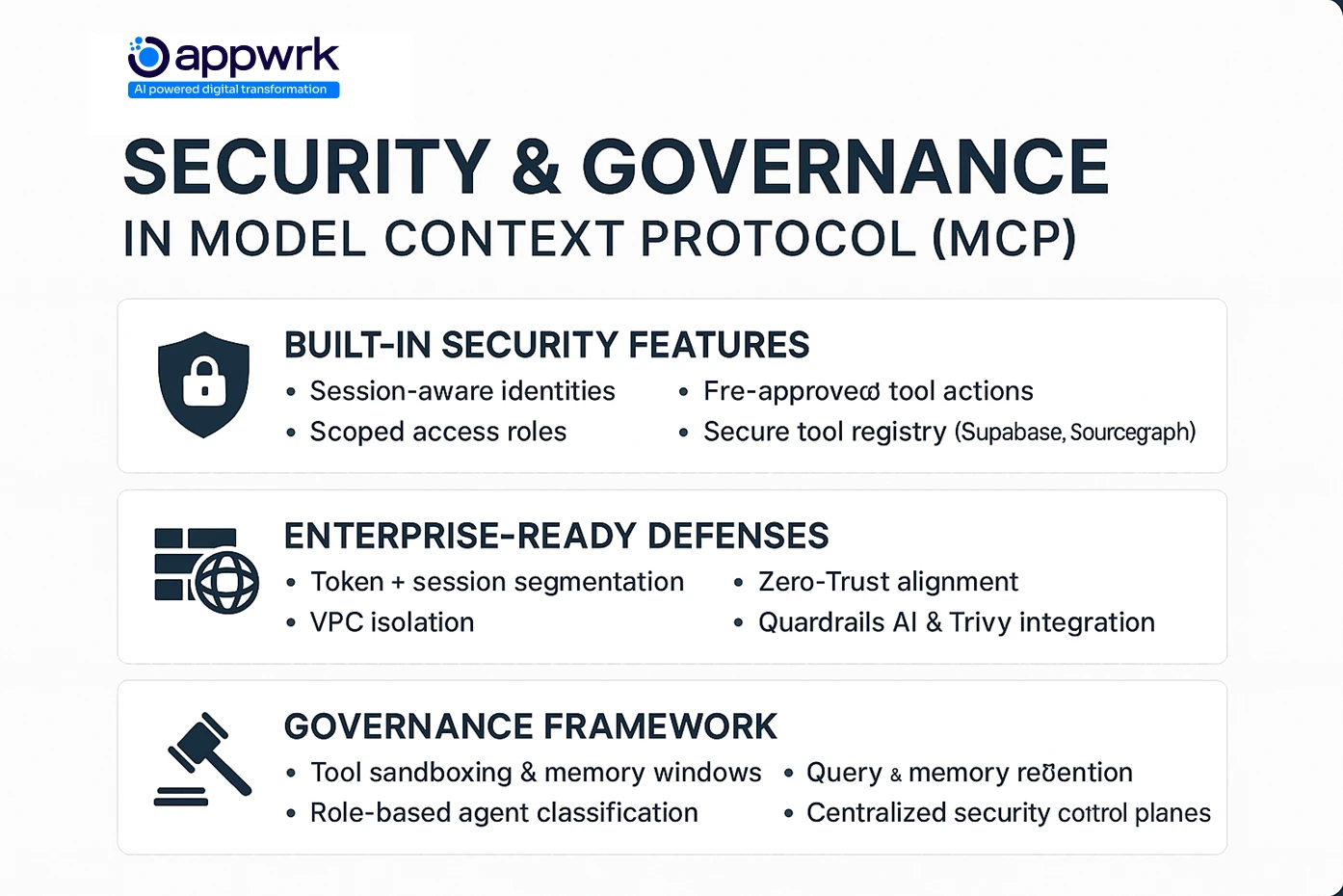
As AI moves into regulated environments, securing intelligent systems is critical. The Model Context Protocol (MCP) offers a governance-aware infrastructure that goes far beyond traditional API authentication. It introduces session-scoped identities, fine-grained roles, and pre-approved actions to ensure agents operate within strict boundaries.
Unlike static APIs, MCP enables context-rich orchestration, with audit trails, schema-based permission prompts, and traceable execution across tools like Supabase, PostgreSQL, and Sourcegraph. This ensures real-time control while supporting compliance in finance, healthcare, and defense.
Security and Governance in MCP Deployments
MCP’s architecture includes key safeguards that secure every layer of multi-agent workflows:
Session-based identities linked to active users
Scoped memory and permission windows to prevent misuse
Zero-Trust compatibility for Virtual Private Cloud (VPC) setups
Full audit logging at the exchange layer and tool invocation level
Support for Guardrails AI and Trivy for CI/CD and runtime protection
These align with standards like the OWASP Top 10 for LLM Applications, addressing vulnerabilities like Prompt Injection, Insecure Plugin Design, and Excessive Agency.
Scalable Governance for Multi-Agent AI
Enterprises adopting MCP-based ecosystemsare integrating centralized security control planes to unify policy enforcement, session validation, and context-aware multi-agent orchestration.
A mature MCP client & server ecosystem includes:
Tool sandboxing before production
Memory compliance policies for data retention and governance
Feedback loops and classification models for risk assessment
Seamless legacy system integration across APIs, databases, and internal services
These practices help deliver secure, compliant AI infrastructure without stalling innovation. MCP bridges security, performance, and context, creating systems that are both auditable and adaptive.
What Are the Future Trends and Predictions in MCP?
The Model Context Protocol (MCP) isn’t just solving today’s interoperability headaches, but it’s becoming the strategic fabric for enterprise AI orchestration. As AI agents, tools, and LLMs replace isolated bots and APIs, MCP is shifting from middleware into a unified layer in the development landscape.
The rise of MCP tracks with public cloud spending, increasing AI infrastructure budgets, and demand for performance, potential, and efficiency. New strategies like sampling and block invocation, dynamic resource scaling, and latency optimization are emerging to reduce resource consumption and improve model latency.
Inbuilt OS Support
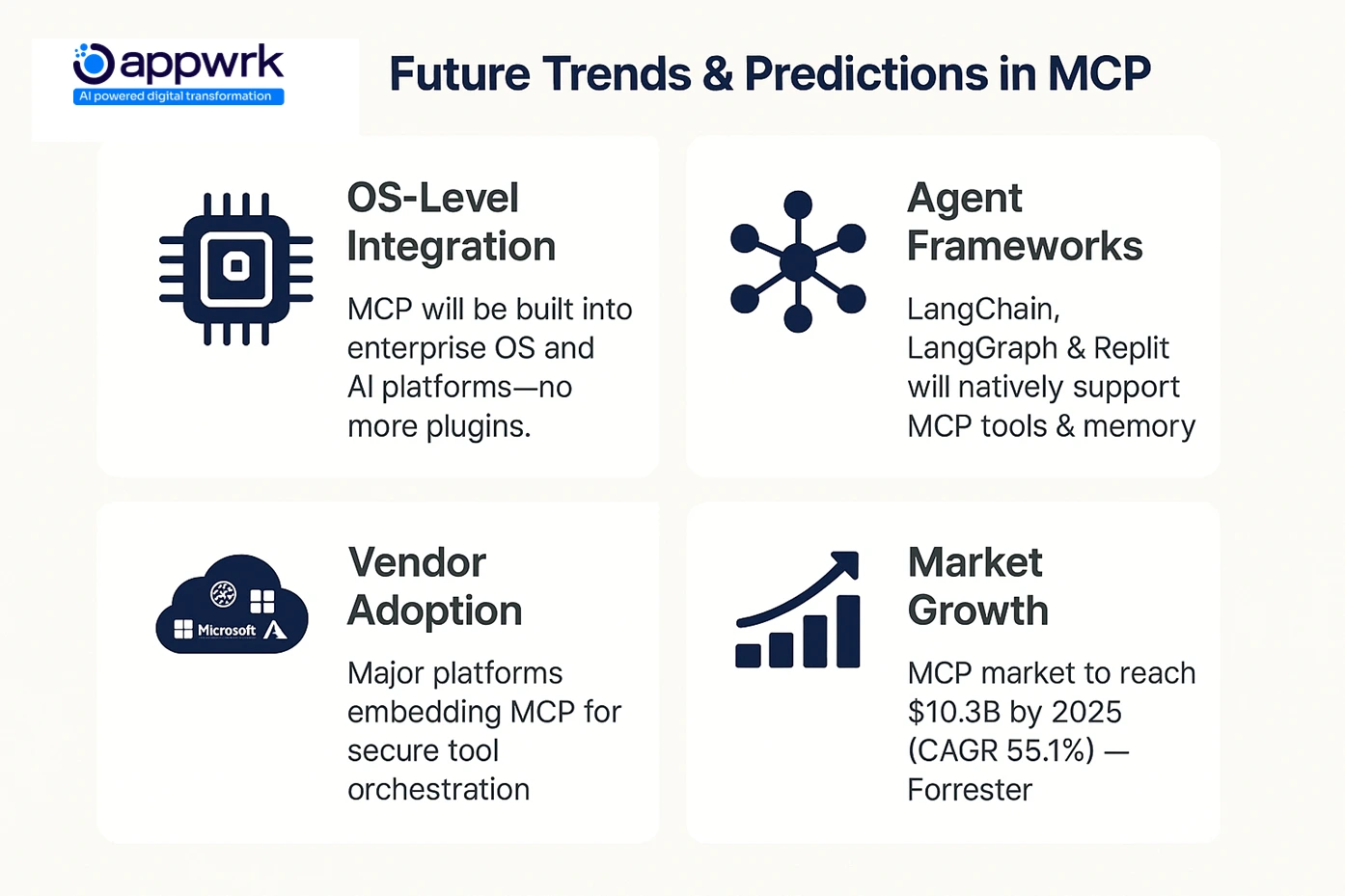
Think of how USB‑C standardized device connectivity. MCP will become baked into enterprise OS services: hosts like Claude Desktop and platforms like Azure AI and Google Cloud AI Platform will embed MCP Clients and MCP Hosts natively. No plugin needed.
Agent Frameworks Integrating MCP
Agentic AI is already in use in healthcare, logistics, retail, and finance. Frameworks such as LangChain, LangGraph, Semantic Kernel, and Replit are embedding tool registries, capability discovery, and persistent memory as first‑class features. This enables adaptive AI agent lifecycle, route switching among models (OpenAI, Claude, etc.), schema‑driven orchestration, and tool handoffs under Zero‑Trust and compliance controls.
Predicted Vendor Adoption (2026 and Beyond)
By 2026, MCP‑based ecosystems will dominate: AI platform providers (OpenAI, Anthropic, Microsoft) will offer built‑in MCP SDKs; tool vendors like GitHub, Notion, SAP will publish MCP schemas; infrastructure providers such as AWS, Azure AI, Kubernetes will support runtime MCP routing, exchange layers, observability via logs and analytics. Metrics from Gartner and MarketsandMarketsshow rapid growth, with MCP server market value increasing significantly.
Other Key Predictions for MCP in Enterprise AI
Edge AI Deployments: Companies like NVIDIA, Qualcomm pushing MCP ability into smart devices, enabling real‑time decision making at low latency.
Explainability & Transparency: Tools such as TensorFlow’s Model Analysis, XAI frameworks becoming standard in compliance, legal tech, HR, and finance.
Data Quality & Governance: IBM, SAS investing in platforms to ensure lineage tracking, clean training data & compliance under GDPR, HIPAA.
Explosive Performance Gains: Expect improvements in tool invocation speed, model accuracy, frequency of successful multi‑agent workflows, and cost efficiency across workloads.
According to a recent Kaggle survey, 71% of AI professionals believe MCP will be crucial for developing context-aware AI systems in the next 3 years.
62% expect MCP adoption to result in notable improvements in LLM efficiency and accuracy.
Forrester Research projects the global MCP market will hit $10.3 billion by 2025, growing at a CAGR of 55.1% from 2020.
The future of AI isn’t about single models. It’s about context, orchestration, and controlled tool interaction. MCP brings similar capabilities to any AI application, whether that’s a MCP-enabled chatbot, a compliance assistant, or a factory orchestration agent.
MCP is no longer optional. It’s set to be the backbone of production‑level AI: enabling agent orchestration, multi‑model routing, secure and compliant infrastructure, and personalization at scale. Whether in DevOps pipelines, legal document workflows, manufacturing diagnostics, or real‑time logistics, MCP ties together tools, memory, models, and performance into one intelligent system.
How Appwrk Can Help in MCP-Based App Development
Adopting the Model Context Protocol (MCP) is a strategic leap toward contextual orchestration, multi-agent automation, and secure AI infrastructure. But success requires more than tech, as it demands alignment with business logic, scalability, and AI agent lifecycle management. That’s where Appwrk excels.
Full-Stack Expertise in MCP Ecosystem
Appwrk offers hands-on experience across the MCP client & server ecosystem, including LangChain, LangGraph, Semantic Kernel, and Claude Desktop. We design and deploy:
MCP Clients, Hosts, and schema-driven MCP Tools
Context-aware workflows with scoped memory
Tool registries with role-based permission prompts
Secure MCP Resources for legacy and real-time system integrations
API gateways for wrapping tools like PostgreSQL, Supabase, and Google Maps
Whether you’re setting up an MCP Server or modernizing GraphQL/ODBC APIs, we ensure tight integration and cross-functional workflow automation.
Secure, Compliant, and Scalable MCP Rollouts
With VPC-based deployments, multi-agent orchestration, and real-time tool routing, we ensure each agent follows Zero-Trust, session-aware rules. Governance includes:
Full audit trails across exchange layers
Scoped token permissions and fallback logic
CSAT and latency analytics dashboards
Compliance with OWASP Top 10 for LLMs, GDPR, and HIPAA
We also support multi-model, multi-vendor setups, routing tasks dynamically across tools like OpenAI, Claude, and Mistral using a unified interface.
Fast Time to Value: Ready in 6 Weeks
From AI agent orchestration to secure tool invocation, Appwrk delivers enterprise-ready solutions in just 6 weeks with compliance, observability, and optimization built-in.
1. What is the application of MCP? The applications of Model Context Protocol (MCP) span AI-assisted workflows, contextual tool orchestration, and enterprise automation.
Appwrk enables enterprises to link CRMs, ERPs, and messaging tools with MCP, turning isolated tools into coordinated agents.
2. What are use cases for MCP? From healthcare compliance to retail personalization and financial services automation, MCP brings similar capabilities to any AI application by enabling context-rich workflows across domains.
3. What is the use of an MCP server? An MCP Server (such as Versa MCP Server) acts as a host for tools, enforcing permissions and context-aware invocations. It ensures that MCP Clients can securely connect, execute, and exchange memory-driven actions without exposing your backend directly.
4. How does MCP differ from function calling? Unlike model-specific function calling, MCP standardizes this process across models, allowing richer context propagation, fallback logic, and governance controls.
5. Is MCP secure for enterprise use? Yes. By applying security considerations for MCP servers, audit trails, scoped tokens, and compliance policies (like the OWASP Top 10 for Large Language Model Applications), MCP enables enterprises to operate in a Zero-Trust environment safely.
6. What is the application of MCP? The applications of Model Context Protocol (MCP) span AI-assisted workflows, contextual tool orchestration, and enterprise automation. Appwrk enables enterprises to link CRMs, ERPs, and messaging tools with MCP, turning isolated tools into coordinated agents.
7. What are use cases for MCP? From healthcare compliance to retail personalization and financial services automation, MCP brings similar capabilities to any AI application by enabling context-rich workflows across domains.
8. What is the use of an MCP server? An MCP Server (such as Versa MCP Server) acts as a host for tools, enforcing permissions and context-aware invocations. It ensures that MCP Clients can securely connect, execute, and exchange memory-driven actions without exposing your backend directly.
9. How does MCP differ from function calling? Unlike model-specific function calling, MCP standardizes this process across models, allowing richer context propagation, fallback logic, and governance controls.
10. Is MCP secure for enterprise use? Yes. By applying security considerations for MCP servers, audit trails, scoped tokens, and compliance policies (like the OWASP Top 10 for Large Language Model Applications), MCP enables enterprises to operate in a Zero-Trust environment safely.
11. What is the role of Claude Desktop or Anthropic in MCP adoption?
Products like **Claude Desktop** are at the **forefront** of implementing MCP to connect AI with development tools like Sourcegraph, ensuring seamless workflows on traditional servers and public cloud environments.
12. How does MCP affect development analytics and optimization?
MCP offers **analytics-friendly telemetry**, enabling insights into tool usage frequency, workload **latency**, and **growth** in invocation trends, helping teams identify optimization opportunities.
13. Does MCP support modern computing architectures like GPUs and ODBC?
Yes. MCP integrates well with GPU-backed workloads, supports connectors like ODBC for databases, and enables **parallelism** in model execution for high-performance AI tasks.
Gourav Khanna is the Co-founder and CEO of APPWRK, leading the company’s vision to deliver AI-first, scalable digital solutions for enterprises and high-growth startups. With over 16 years of leadership in technology, he is known for driving digital transformation strategies that connect business ambition with outcome-focused execution across healthcare, retail, logistics, and enterprise operations.
Recognized as a strategic industry voice, Gourav brings deep expertise in product strategy, AI adoption, and platform engineering. Through his insights, he helps decision-makers prioritize market traction, operational efficiency, and long-term ROI while building resilient, user-centric digital systems.
Subscribe to APPWRK Blogs, We'll Do the Rest!
Get Blogs on UI/UX, Mobile Apps, Online Marketing, and Web development technology.
Unlock worthy and priceless suggestions from the masters of mobile and web app development