150+ minds across 4 countries. Join a culture of innovation, ownership & growth.
Rewire for AI
From machine learning to deep learning, from classification tools to overall process automation – our AI engineers will help you retool your existing system or enhance your company results.
Ship faster, scale smarter, built for product companies and SaaS teams
Our Latest Work
We strive hard to deliver result-driven digital solutions across the globe. Check out our case studies to get a glimpse of how we ideate, innovate, and create unconventional digital solutions according to the requirements of our clients.
Discover diverse and passionate insights from our tech enthusiasts. We collaborate across various sectors to streamline operations and drive innovation. Explore our rapidly growing collection of articles to see why we’re at the forefront of IT solutions.
The decision to move from Magento to Shopify is one of the most significant replatforming choices an ecommerce business can make. Magento is powerful, but its power comes with...
Accuracy gap is real: Traditional CPG forecasting carries a 25-40% MAPE error rate. AI-powered models bring that down to 8-15%, according to McKinsey research....
Real stories from global leaders who trusted us with their ideas.
Partnering with APPWRK helped us build a compliant and scalable healthcare platform, accelerating our time-to-market by 35%. Their team consistently delivered outstanding work.
Beesers
Digital Healthcare Client
Collaborating with APPWRK, Sportskeeda modernized its platform into a real-time sports engagement ecosystem, enabling seamless content delivery, scalable fan interactions, and high-velocity performance.
Sportskeeda
Sports & Entertainment Partner
Working with APPWRK was effortless. They captured our vision, maintained full compliance, and delivered a digital experience that built trust and elevated how customers interact with our fintech brand.
PayPenny
Fintech Partner
Working with APPWRK gave us confidence in adopting AI responsibly. Their team built a safe, intelligent bot that transformed how we engage with leads and helped us achieve measurable revenue growth.
IFB
AI Transformation Partner
Leveraging APPWRK’s digital expertise, Nemesis launched a scalable, compliant, and safe super app that connects content delivery, real-time communication, and logistics management within a single platform.
A healthcare chatbot project can start as low as $3,000 for a basic MVP and usually falls between $10,000 and $45,000 for small to mid-tier builds. Even advanced enterprise AI chatbot solutions with deep artificial intelligence rarely exceed $90,000 when designed with the right approach.
Budgets can be optimized through offshore teams, modular builds, and phased rollouts, making AI chatbots accessible for startups, insurers, clinics, and digital health providers.
Essential features like appointment scheduling, FAQs, reminders, and Triage & Scheduling fit within a lean budget. But advanced capabilities such as EHR integration, multilingual NLP, Voice Recognition, speech recognition, and HIPAA-compliant chatbots add incremental costs.
Organizations should also account for hidden expenses like compliance audits, NLP retraining, dataset expansion, Security Audits, and ongoing Maintenance and Support. These can be reduced using pre-trained AI models, automation workflows, and early planning.
By working with partners like Biz4Group or Appwrk, businesses can cut the total cost of ownership (TCO) by up to 40% through reusable components, chatbot design costs optimization, and agile delivery frameworks.
The global Medical Chatbot market is expanding rapidly. Early adopters are already seeing higher ROI, reduced operational Support Costs, faster triage, and stronger Customer Experience.
This guide is built for CTOs, product managers, healthcare professionals, and digital health founders looking for a realistic view of chatbot pricing models, hidden costs, cost optimization strategies, and value propositions.
Why Are Healthcare Chatbots a Critical Investment in Modern Healthcare?
The healthcare industry is experiencing one of its fastest waves of digital transformation. Patients expect reliable, on-demand access to care, while hospitals face pressure to lower expenses and improve workflows. This is where AI-powered chatbot development is becoming indispensable.
Market Momentum
According to Statista, the global Medical Chatbot market is projected to reach $1.5 billion by 2030, growing at more than 20% CAGR. The surge is tied to telemedicine adoption, 24/7 access expectations from users, and demand for intelligent, virtual-first care.
Why Healthcare Providers Are Investing
Customer Support & service efficiency: Clinics and hospitals use AI-powered customer support to automate repetitive tasks like appointment booking and insurance queries.
Rising costs: With limited staff, automating interactions ensures resources are reserved for critical cases.
Regulatory compliance: HIPAA frameworks, ISO 27001, and SaMD (Software as a Medical Device) standards make regulatory compliance more achievable with AI-powered workflows.
Intelligence-driven outcomes: With data analysis, Sentiment Analysis, and predictive algorithms, healthcare systems now leverage chat-based interfaces to make more informed clinical decisions.
The Strategic Advantage
Modern solutions act as digital front doors. They triage patients, manage reminders, handle prescription refills, and even integrate with diagnostic tools or medical imaging systems. In doing so, they improve Customer Support, boost efficiency, and create a consistent user experience.
As one healthcare executive said, “These tools aren’t replacing doctors, but they’re transforming how patients access care and how providers allocate their time.”
How Much Does It Cost to Develop a Healthcare Chatbot?
Healthcare chatbot development cost can start from just $3,000 for basic healthcare chatbot development or even a basic medical chatbot built as an MVP. On the other end, enterprise-level healthcare chatbot development projects that involve advanced integrations and HIPAA compliance may exceed $90,000.
For comparison, the AMIE-like healthcare chatbot development cost is typically higher because such builds require advanced AI models and real-time clinical intelligence, making them closer to advanced healthcare chatbot development. Businesses exploring the cost to develop a healthcare chatbot like Google’s AMIE should expect licensing fees for AI models and data analysis pipelines to be factored into the budget.
In between these two extremes, most organizations choose mid-tier solutions ranging from $12,000–$45,000, which balance affordability with compliance. These builds usually sit between rule-based chatbots (cheaper, limited scope) and intelligent assistants powered by AI chatbots.
Cost of a Healthcare Chatbot by Complexity
The complexity of a healthcare solution is the single biggest driver of cost. A basic healthcare chatbot development project or even a basic medical chatbot is relatively affordable, starting around $3,000–$8,000. These are usually rule-based chatbots designed for tasks like FAQs or appointment scheduling.
As you move into advanced healthcare chatbot development, the cost rises due to AI models, data analysis, and features like voice recognition or integrations with EHR systems.
At the top end, enterprise-level healthcare chatbot development can reach $50,000–$90,000, especially if built as an enterprise AI chatbot with compliance-ready features, predictive algorithms, and diagnostic reasoning.
This shows that the complexity of the chatbot directly correlates with pricing tiers, from lightweight rule-based builds to LLM-powered chatbot systems capable of supporting clinicians with advanced clinical decisions.
Chatbot Type
Features
Estimated Cost Range
Best For
Basic MVP (Rule-based)
FAQs, appointment booking, and reminders
$3,000 – $8,000
Clinics, pilot projects
Advanced healthcare AI chatbot
NLP, multilingual support, symptom triage, voice AI
If you’re testing the waters, start with a basic MVP under $10K. You can scale into advanced chatbots later by adding AI and compliance features.
Cost of a Healthcare Chatbot by Development Stages
Every chatbot project moves through distinct stages, and each one adds its own layer of cost. Breaking these stages down not only helps forecast timelines but also ensures that businesses don’t overspend on one phase while underestimating critical ones like compliance or testing.
Here’s how the cost typically splits across stages:
Design & UI/UX Design → Crafting conversation flows and building an intuitive interface for users, ensuring a consistent Customer Experience. Estimated cost: $1,500 – $5,000.
AI/NLP Development → Training AI models, building Rule-Based Chatbots where applicable, and embedding artificial intelligence for natural dialogue. This includes Sentiment Analysis, data analysis, and, in advanced cases, speech recognition and Voice Recognition. Estimated cost: $5,000 – $20,000.
Backend & Integrations → Setting up databases, API access, and linking with EHR/CRM platforms. For some hospitals, this can also include integration with diagnostic tools, medical imaging, or FHIR standards for better clinical decision-making. Estimated cost: $5,000 – $15,000.
Compliance Setup → Building HIPAA and GDPR safeguards into the system, encryption, audit logging, and aligning with regulatory compliance standards like SaMD. Estimated cost: $3,000 – $10,000.
Testing & QA → Validating accuracy, security, and scalability through real-world simulations. This step is vital for Customer Support efficiency and minimizing long-term Support Costs. Estimated cost: $2,000 – $7,000.
Maintenance and Support → Once live, systems need continuous monitoring, NLP retraining, bug fixes, Security Audits, and software updates. Costs average $3,000 – $10,000 annually.
A well-balanced cost breakdown ensures that critical aspects like compliance and reliability aren’t underfunded, while helping leaders compare chatbot design costs across different pricing models. Some vendors now even use chatbot cost calculators and usage-based pricing to forecast spend more accurately.
What Is the Cost of a Healthcare Chatbot by Industry?
The industry segment you belong to significantly influences cost. For example, insurers need fraud detection and claims automation, while telemedicine startups prioritize triage and onboarding.
Industry Segment
Typical Use Cases
Cost Range
Hospitals & Clinics
Patient triage, appointment scheduling, and reminders
Cost of Building a Healthcare Chatbot: Custom vs SaaS vs Hybrid
How you choose to build your solution has a major impact on the overall budget. Each development model, SaaS, custom, or hybrid, comes with its own strengths and trade-offs in speed, flexibility, and scalability. Understanding these pricing models upfront helps avoid surprises later.
SaaS Chatbots These are essentially Pre-Made Chatbot Solutions offered by established platforms. They’re fast to deploy, easy to integrate, and come with healthcare-ready modules. The upfront costs are low, but you’ll be tied to monthly subscriptions that can range from $200 to $1,000. While SaaS offers convenience, ongoing Support Costs and limited customization can hold back larger hospitals or enterprises that require deeper control.
Custom Development If the goal is to design a fully compliance-ready chatbot that’s HIPAA and HL7 aligned, scalable, and deeply integrated into clinical systems, then custom builds are the way to go. Costs typically sit between $20,000 and $90,000, but you gain full ownership, advanced features like diagnostic tools and Voice Recognition, and long-term adaptability. This option is ideal for providers and insurers looking for complete control of data and AI-driven workflows.
Hybrid Approach Hybrid models bridge the gap by combining the speed of SaaS with a degree of customization. Think of it as using pre-built modules but layering in custom AI chatbots or integrations where it matters. The result is moderate upfront costs (usually $10,000–$50,000) with balanced flexibility. For mid-sized clinics or healthcare startups, hybrid approaches often strike the sweet spot between cost and control.
Off-the-Shelf Solutions
Off-the-shelf SaaS chatbot platforms are pre-built services that come with healthcare-specific modules and integrations. They are popular for organizations looking for fast deployment without high upfront spend.
Pros: Low initial cost, quick implementation, built-in AI models, and often backed by advanced NLP engines for better language processing abilities. Some even come with multi-factor authentication and role-based access controls.
Cons: Limited customization, ongoing license fees, reliance on proprietary platforms, and less control over secure data exchange.
Best Fit: Startups, small clinics, or healthcare professionals testing chatbot adoption with free solutions or low-cost professional solutions.
This option works best for basic chatbots but may not suit hospitals or enterprises that require deep integration with EHR systems, HIPAA-compliant architectures, or enterprise AI chatbot features.
Approach
Cost Range
Best Fit
SaaS Chatbot (Subscription)
$200 – $1,000/month
Startups, small practices
In-House vs Outsourcing
Another factor that shapes your chatbot project budget is the team model you choose. Whether you build internally or bring in outside expertise, each path has clear trade-offs in cost, control, and scalability.
In-House Development: Offers full control, direct oversight, and closer alignment with customer service workflows. However, it is expensive due to high salaries, infrastructure, and ongoing technical support requirements. Teams must also handle knowledge base updates, security audits, and compliance with healthcare regulations internally.
Outsourcing: Offshore or hybrid development models reduce costs by up to 40%. Vendors often provide ready-made expertise in building AI chatbots, integrating with existing APIs, and ensuring compliance checks. Offshore teams familiar with HIPAA-compliant data security and GDPR make this route cost-efficient while still delivering advanced strategies like secure payment processing and third-party API integration.
Blended Model: Many healthcare providers adopt a blended approach, in-house teams manage project oversight and customer support integration, while offshore vendors handle chatbot build costs, advanced AI-powered chatbot development, and maintenance and support.
This model allows organizations to optimize pricing models while ensuring a consistent user experience across hospitals, clinics, and even e-commerce platforms exploring healthcare modules.
Team Model
Pros
Cons
Cost Impact
In-House
High control, domain knowledge
Expensive salaries, slower scaling
$80,000+ annually
Outsourcing
Cost-effective, scalable expertise
Less direct oversight
$25,000 – $60,000/project
Blended
Balanced model
Requires strong vendor management
$40,000 – $70,000/project
For startups, SaaS or hybrid works best. Enterprises, however, usually go for fully custom development to meet compliance and scalability requirements.
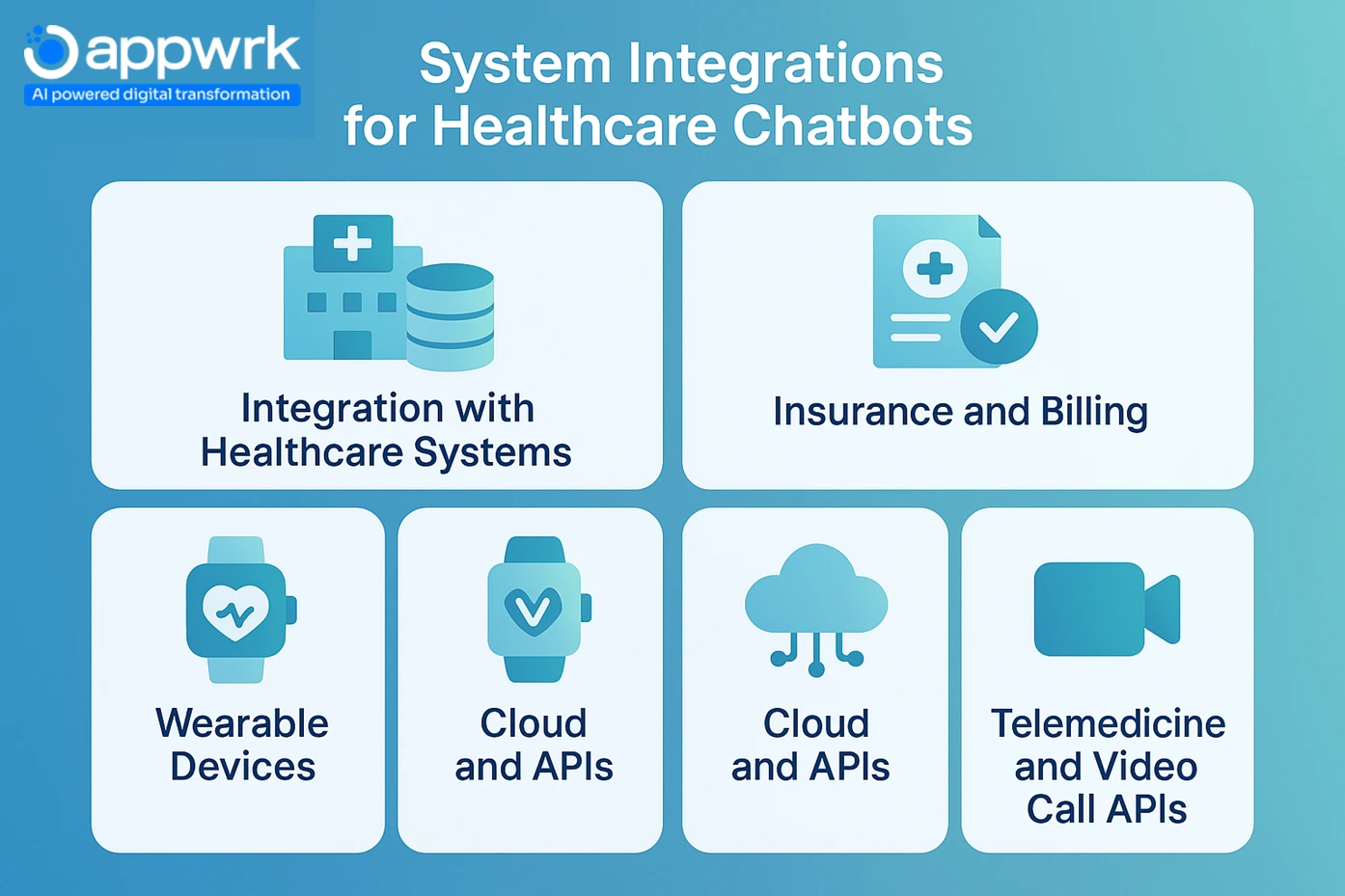
What Is the Cost of Integrating Healthcare Chatbots with Systems?
System integrations are often one of the most underestimated cost drivers in a chatbot project. Without integration, even advanced AI chatbots risk becoming isolated FAQ tools instead of true digital assistants. Connecting them with EHR systems (like Epic, Cerner, or Meditech), billing software, or wearable device integration ensures the chatbot can support real-time clinical intelligence and deliver a consistent user experience across touchpoints.
These integrations not only enhance customer service chatbots but also align with strict regulatory compliance requirements, ensuring secure data exchange and robust security across hospitals and healthcare platforms.
Integration with Healthcare Systems
Most Medical Chatbots require access to EHR systemsfor real-time data flow. Secure API Accessensures safe data sharing while compliance checks validate that privacy rules (HIPAA, GDPR, EU AI Act) are met.
Cost: $5,000–$12,000, depending on complexity and the level of customization required.
Value: Enables clinical decisions backed by advanced AI models and integration with diagnostic tools.
Insurance and Billing
Integration with insurance and billing systems allows chatbots to automate policy checks, claims processing, and fraud detection.
Cost: $4,000–$10,000.
Why It Matters: Provides customer support for billing queries and ensures secure payment processing. Some advanced builds also include payment gateway integration across web, mobile apps, and social media platforms.
Wearable Devices
Wearable device integration connects IoT sensors and medical imaging tools with chatbots for data-driven care. Hospitals can use this to monitor vitals remotely and trigger emergency alerts.
Cost: $6,000–$15,000.
Why It Matters: Enhances preventive care, enabling clinical trials to track long-term patient data and feed insights into predictive algorithms.
Cloud and APIs
Cloud-based deployment allows AI-powered customer support with scalable infrastructure. Popular cloud platforms like AWS, Azure, and GCP ensure HIPAA-compliant hosting, encryption, and real-time sync.
Cost: $2,000–$6,000.
Value: Expands functionality with chat-based interfaces, telemedicine, and video call APIs, and integrations with third-party API integration services.
Payment Gateway Integration
A growing number of providers use chatbots for subscription models or usage-based pricing in telehealth. Integrating secure payment processing enables co-pays, appointment fees, and subscription handling.
Cost: $3,000–$7,000.
Key Benefit: Simplifies customer experience, reduces operational load, and ensures compliance-ready chatbot costs remain under control.
Telemedicine and Video Call APIs
Linking healthcare assistants to telemedicine and video call APIs transforms them into full-service clinical tools. Platforms like Zoom Healthcare or Doxy.me make this possible.
Cost: $5,000–$12,000.
Impact: Creates real-time escalation from chat to AI-powered live chat or doctor consults, backed by advanced NLP engines.
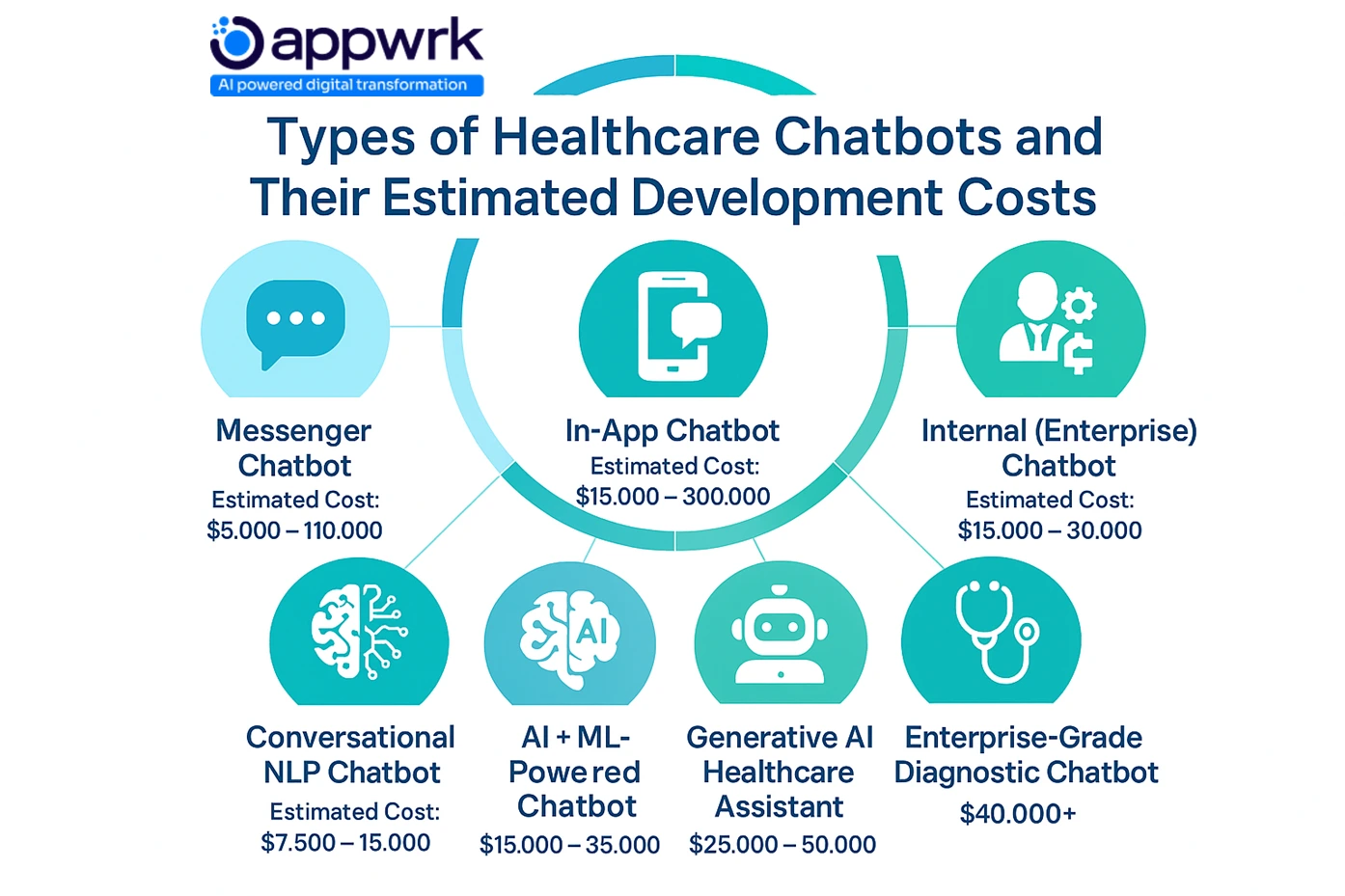
Types of Healthcare Chatbots and Their Estimated Development Costs
Not every Medical Chatbot serves the same purpose. Some are designed for customer service, others focus on clinical support, while advanced ones act as enterprise AI assistants. The type of chatbot you choose will directly impact the pricing models, complexity of the chatbot, and overall ROI of the chatbot project.
Below are the most common categories, their chatbot design costs, and where they fit into modern healthcare.
Messenger Chatbot
Messenger bots work across web, mobile apps, and social media platforms like WhatsApp, Facebook Messenger, or Telegram. They’re widely used for reminders, FAQs, and appointment scheduling.
Use Case: A clinic automates WhatsApp reminders to reduce no-shows.
Cost: $6,000–$10,000.
Why It Works: Offers basic chat-based interfaces and improves the customer experience with real-time notifications.
In-App Chatbot
Embedded into apps, these bots deliver seamless interaction for users without switching platforms.
Use Case: A hospital app with symptom triage and speech recognition support for accessibility.
Cost: $12,000–$20,000.
Strength: Strong UI/UX design for a consistent user experience, plus better integration with EHR access.
Internal (Enterprise) Chatbot
Designed for insurers or hospitals to improve back-office efficiency.
Use Case: Automating HR queries, claims, or medical coding tasks.
Cost: $15,000–$30,000.
Note: Often part of enterprise AI solutions, offering integrations with third-party API integration for claims and billing.
Conversational NLP Chatbot
These bots rely on natural language processing (NLP) for advanced query handling.
Use Case: A multilingual assistant trained with healthcare datasets for symptom triage.
Cost: $7,500–$15,000.
Why It’s Valuable: Uses sentiment analysis and data analysis to personalize responses.
AI + ML-Powered Chatbot
Goes beyond rule-based bots by adding machine learning (ML) capabilities and predictive algorithms.
Use Case: An AI chatbot in a hospital predicts follow-ups using deep learning and neural networks.
Cost: $15,000–$35,000.
Impact: Backed by advanced NLP engines, they transform raw patient interactions into actionable insights for healthcare professionals.
Generative AI Healthcare Assistant
These assistants rely on LLM-powered chatbot models such as GPT-4 technology or Google’s AMIE.
Use Case: A ChatGPT-style chatbot delivers real-time clinical intelligence and assists in clinical decision-making.
The most advanced category, often deployed in large hospitals or insurer systems.
Use Case: An enterprise AI chatbot integrated with wearable device integration and medical imaging tools to support diagnostic tools and sepsis detection.
Cost: $40,000+.
Why It Matters: Offers enterprise-level healthcare chatbot development that includes compliance checks, secure data exchange, and role-based access controls for scalability.
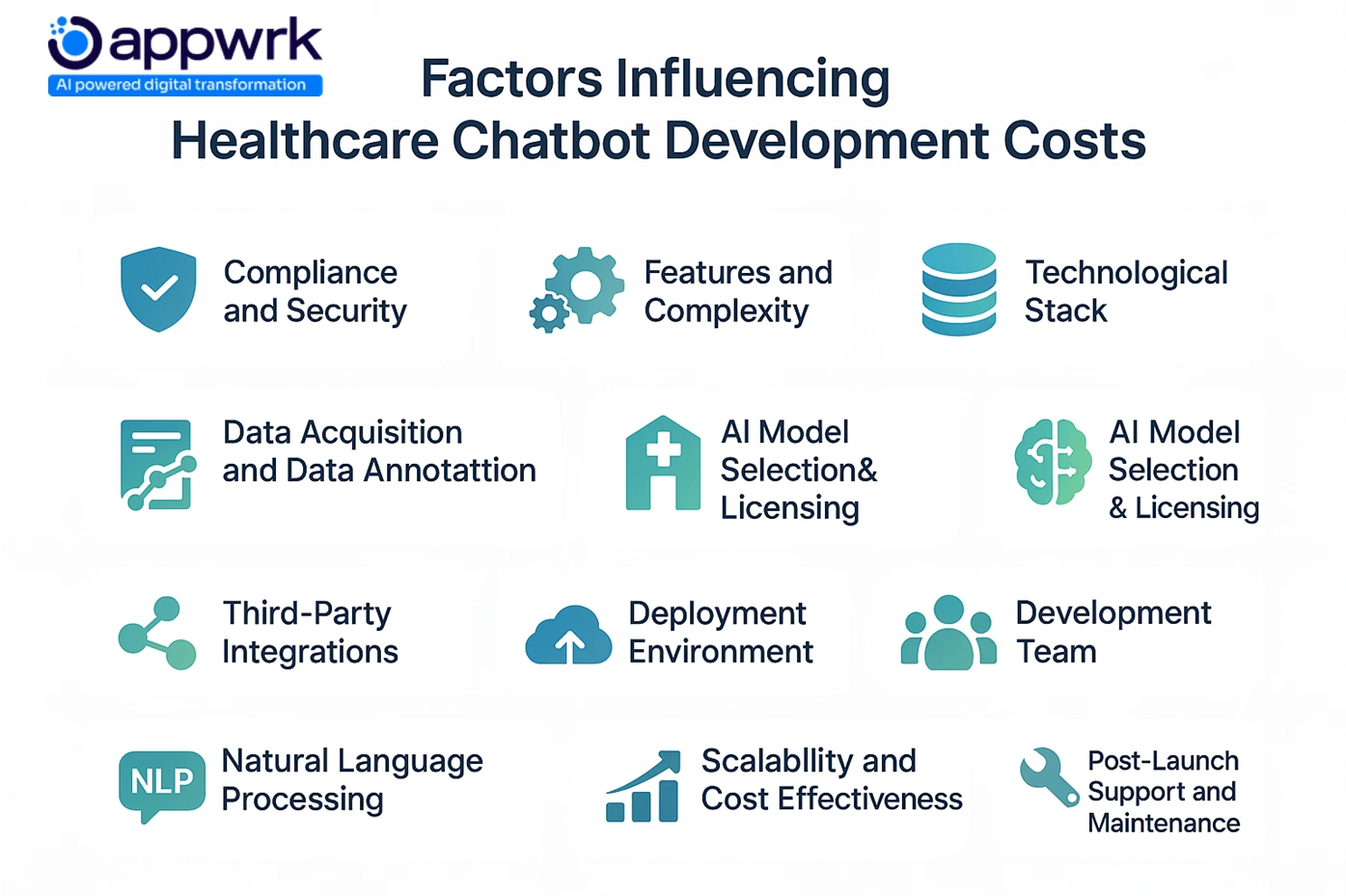
What Factors Influence Healthcare Chatbot Development Costs?
The cost of developing a chatbot is never a fixed number; it depends on the complexity of the chatbot, compliance needs, and the scope of the chatbot project. For healthcare, where accuracy and regulatory compliance are critical, costs often scale higher than in other industries. Below are the most important factors that influence pricing.
Compliance and Security
Healthcare is highly regulated, and compliance can add a big layer of cost. HIPAA-compliant chatbots, GDPR, and even the emerging EU AI Act set strict standards for handling sensitive data.
Why does it add cost?
Data encryption protocols and secure data exchange mechanisms.
Role-based access controls and multi-factor authentication.
Regular Security Audits, compliance checks, and vulnerability testing.
Ongoing certifications like ISO 27001.
On average, compliance-related features can add $5,000–$12,000 to overall chatbot build costs.
Features and Complexity
The number and sophistication of features are one of the clearest drivers of cost.
Choosing open-source frameworks keeps chatbot pricing models predictable, while proprietary platforms can increase licensing costs.
Data Acquisition and Annotation
AI-powered chatbot development relies on clean datasets. Costs rise with annotation needs.
Clinical conversations tagged for natural language processing (NLP) capabilities.
Medical images and medical coding annotations for accuracy.
Ongoing knowledge base updates and dataset expansion for reliability.
If ignored early, retraining later raises costs and impacts consistent user experience.
Integration with Healthcare Systems
Healthcare bots rarely operate in isolation. They need integration with EHR systems like Epic or Cerner, payment gateway integration, and integration with other systems or databases.
EHR access ensures data-driven care.
Telemedicine and video call APIs support virtual visits.
Third-party API integration for billing, insurance, and scheduling.
Integration typically costs $5,000–$15,000, depending on complexity.
AI Model Selection & Licensing
Advanced AI models such as GPT-4 or Google’s AMIE improve accuracy but add costs.
Choosing the right AI model impacts both accuracy and cost. Licensing large language models like GPT, Dialogflow, or IBM Watson often comes with monthly fees, and healthcare-specific NLP training adds to expenses. These costs can add $2,000–$8,000 annually, depending on usage volume.
AI Model Licenses → recurring fees.
Need for NLP retraining and AI Data Scientist input.
Backed by advanced NLP engines and convolutional neural networks or even generative adversarial networks for high precision.
Deployment Environment
Deployment choices, cloud, hybrid, or on-premises, affect infrastructure and compliance costs. While cloud hosting offers scalability at a lower upfront price, on-premises deployments demand higher investment for security and servers, sometimes adding 20–30% more to total costs.
Third Party Integrations
Where your chatbot lives impacts cost; many healthcare chatbots require integration with third-party tools such as CRMs, messaging APIs, or telehealth platforms. Each integration adds complexity and compliance testing, with costs typically ranging from $3,000–$7,000 per integration.
Cloud → Cost-effective, scalable.
On-premises → Secure, but 20–30% higher due to infrastructure.
High-level → LLM-powered chatbot with advanced strategies like predictive algorithms and sentiment analysis.
Costs range $5,000–$20,000, depending on sophistication.
Scalability and Cost Effectiveness
A healthcare chatbot must handle more users and queries over time.
Cloud scaling + load balancing.
Real-time clinical intelligence for live triage.
Cost optimization strategies ensure ROI even at high adoption.
Post-Launch Support and Maintenance
A bot’s lifecycle doesn’t end at deployment. Maintenance and Support are critical.
Continuous updates, Support Ticket Labeling, bug fixes.
Feature enhancements (e.g., Mental Health AI Chatbot modules).
Monitoring with ongoing technical support.
Typically adds 15–20% of build costs annually.
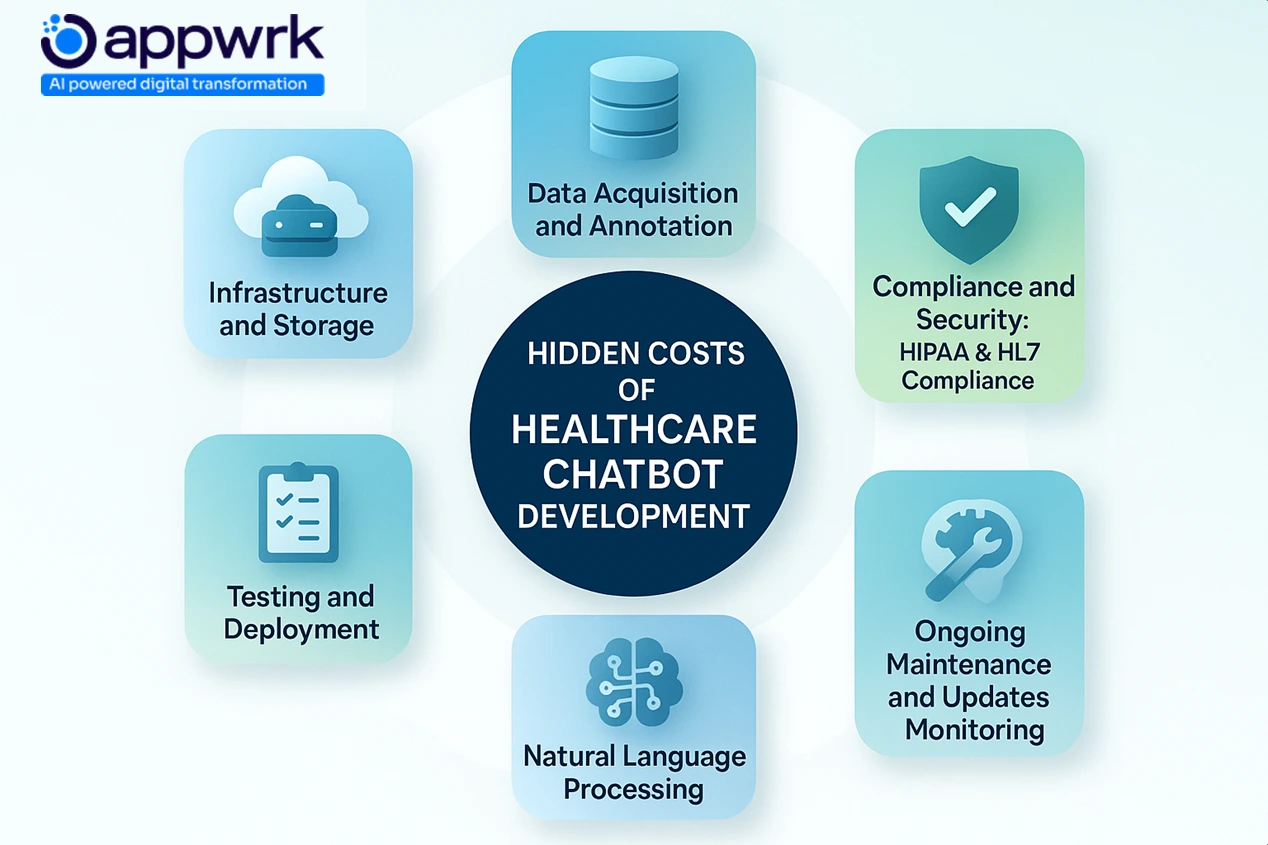
What Are the Hidden Costs of Healthcare Chatbot Development?
When planning a chatbot project, most organizations focus on upfront build costs like design, features, and integrations. What often gets overlooked are the hidden expenses that show up after launch, costs tied to compliance, scalability, and long-term reliability. Ignoring these can inflate the total cost of ownership (TCO) and reduce ROI.
Data Acquisition and Annotation
For AI chatbots in healthcare, high-quality datasets are non-negotiable. They fuel everything from Sentiment Analysis to clinical decision-making. While some open datasets are available, most Medical Chatbot projects require custom, domain-specific data to achieve accuracy.
Where costs add up:
Clinical dialogues must be annotated for intent and context.
Complex medical terminology requires expert input for reliable data analysis.
Larger datasets improve model accuracy but increase annotation time and cost.
Underestimating this stage often leads to weak performance, frequent NLP retraining, and higher Support Costs later.
Activity
Cost Range of Developing the Healthcare Chatbot
Small dataset annotation (basic use cases)
$1,500 – $3,000
Medium dataset annotation (specialized terms)
$3,000 – $6,000
Large dataset acquisition + annotation
$6,000 – $12,000
Infrastructure and Storage
Any Medical Chatbot that processes sensitive patient data needs more than just cloud space; it requires a secure, HIPAA-ready infrastructure. Costs rise as adoption scales, with every new batch of users adding to storage and hosting expenses.
Where the budget grows:
HIPAA-compliant hosting tiers on AWS, Azure, or GCP
Scalable storage for patient interaction records and data analysis
Ongoing server expenses as chat volume increases
Infrastructure Type
Monthly Cost Range
Basic cloud hosting
$200 – $500
HIPAA-compliant hosting
$500 – $1,200
Enterprise-grade scaling (multi-region)
$1,500 – $3,500
Compliance and Security: HIPAA & HL7 Compliance
Compliance is not a one-time checkbox. To meet regulatory compliance like HIPAA, HL7, and GDPR, healthcare bots need recurring audits, certifications, and Security Audits.
Hidden costs come from:
Annual penetration and vulnerability testing
Encryption upgrades and certificate renewals
Ongoing Support Costs for compliance reporting
These activities typically cost between $3,000 and $7,000 annually, depending on scope.
Ongoing Maintenance and Updates, Monitoring
Once launched, the work isn’t over. Continuous Maintenance and Support keep your system reliable and aligned with clinical needs. This includes bug fixes, new integrations, and UI refinements.
UI/UX Design improvements based on patient feedback
Adding modules such as mental health or chronic care
Expect annual maintenance to add 15–20% of the original build cost. For a $30,000 chatbot project, this equals $4,500–$6,000 per year.
Natural Language Processing
For AI chatbots to feel natural and accurate, AI models behind them need constant retraining. Medical language evolves, new use cases emerge, and models must adapt.
Where costs creep in:
Retraining NLP with anonymized medical images, conversations, and clinical notes
Updating terminology to improve clinical decisions
Better context handling with Sentiment Analysis
These updates usually cost $2,000–$8,000 annually.
Testing and Deployment
Healthcare bots can’t afford errors. Each system update requires functional, regression, and load testing to ensure accuracy and compliance in real-world use.
Unseen costs here include:
Regression testing after every feature release
Stress testing for peak traffic in hospitals
Ongoing QA for new AI-powered chatbot development features
Testing and deployment cycles can add $1,500–$4,500 annually, depending on system complexity.
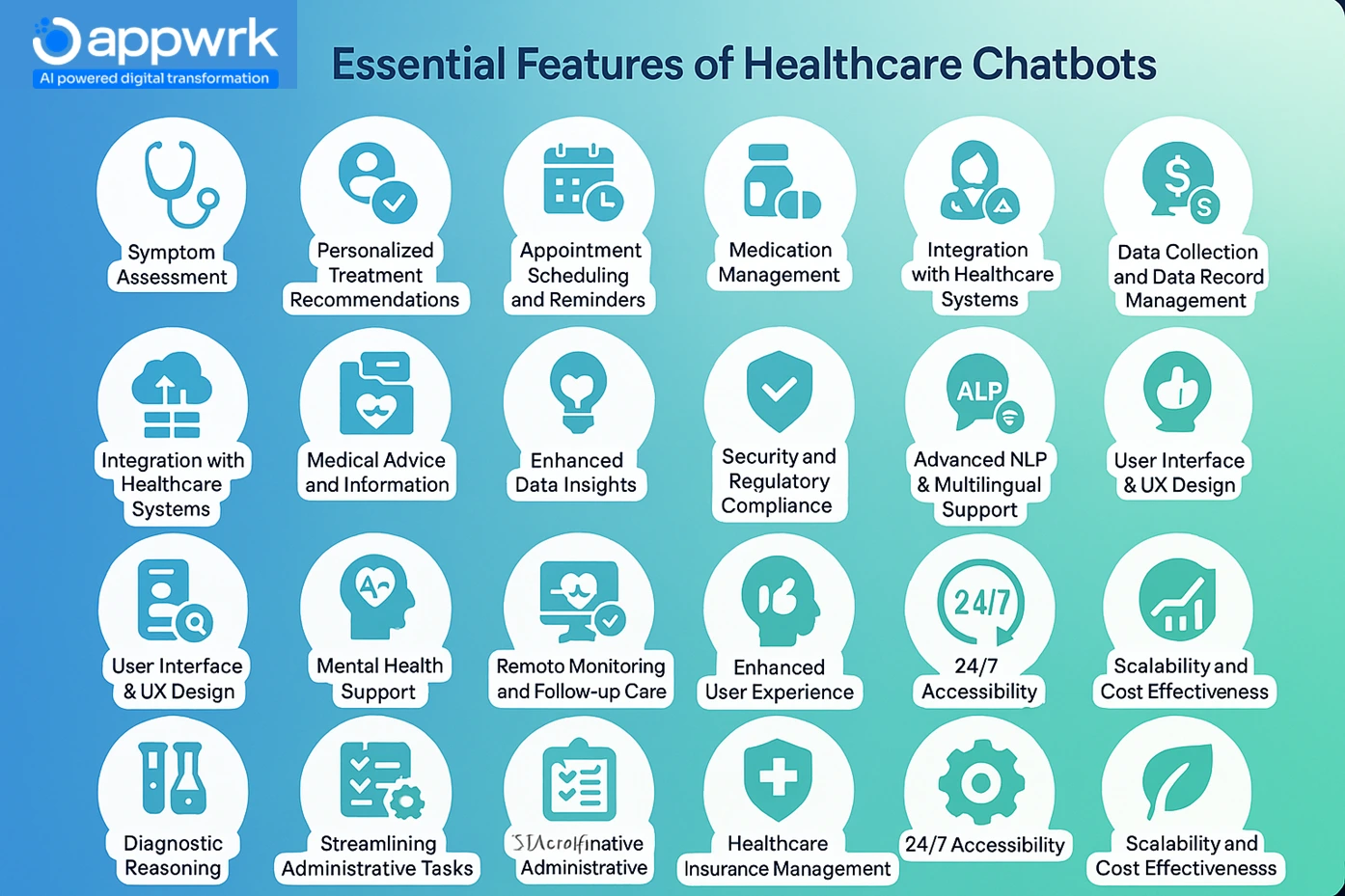
What Are the Essential Features of Healthcare Chatbots?
The success of a healthcare chatbot project comes down to its features. Some are essential for Customer Support and patient convenience, while others leverage artificial intelligence and advanced AI models to deliver predictive care and higher ROI. Below are the must-have and advanced capabilities that modern AI chatbots include.
Symptom Assessment
Guides patients through early symptom triage, reducing unnecessary hospital visits.
Supports clinical decisions by flagging urgent conditions.
Often backed by advanced artificial intelligence (AI) and natural language processing models trained on clinical data.
Integrates with wearables for wearable device integration.
Uses voice assistants or voice recognition for hands-free reminders.
Integration with Healthcare Systems
Connects with EHR access, CRM, billing, and insurance workflows.
Uses secure payment processing and third-party API integration for seamless operations.
Ensures compliance with healthcare regulations like HIPAA and regulatory compliance standards.
Data Collection and Record Management
Captures structured patient data for data analysis.
Uses secure data exchange with role-based permissions (role-based access controls).
Ensures interoperability through standards like FHIR and SaMD.
Medical Advice and Information
Provides evidence-based answers using knowledge base updates.
Redirects patients to trusted sources and professional solutions.
Improves Customer Experience by reducing repetitive calls to staff.
Cost Savings and ROI
Cuts call center and customer service expenses.
Automation through rule-based chatbots and LLM-powered chatbots saves thousands in admin work.
Payback is often achieved within the first year.
Enhanced Data Insights
AI-powered chatbot development allows providers to turn conversations into insights.
Uses Sentiment Analysis and data analysis for predictive care.
Helps AI Data Scientists refine deep learning and neural networks for future improvements.
Continuous Learning and Improvement
Powered by advanced strategies like federated learning and digital twin simulations.
Expands vocabulary and adapts using generative adversarial networks.
Creates a smarter enterprise AI chatbot over time.
Security and Regulatory Compliance
Includes HIPAA and GDPR safeguards.
Uses multi-factor authentication, encryption, and robust security.
Regular Security Audits and compliance checks keep it audit-ready.
Advanced NLP & Multilingual Support
Features language processing abilities for global patients.
Backed by advanced NLP engines like Google Dialogflow CX and Google’s AMIE.
Enables accessibility through speech recognition and automatic speech recognition.
User Interface & UX Design
Strong UX/UI design drives adoption.
Offers chat-based interfaces across web, mobile apps, and social media platforms.
Ensures a consistent user experience for patients and staff.
Mental Health Support
Builds Mental Health AI Chatbot modules for stress and anxiety.
Expands with clinical trials data and med-paLM integration.
Uses ChatGPT-style chatbot approaches for natural conversations.
Remote Monitoring and Follow-Up Care
Uses IoT sensors for vitals like glucose and heart rate.
Supports Sepsis and chronic care alerts.
Enables data-driven care through AI-powered live chat support.
Diagnostic Reasoning
Acts as an advanced Medical Chatbot for clinicians.
Assists with medical imaging, clinical decision-making, and diagnostic tools.
Backed by convolutional neural networks for accuracy in medical images recognition.
Streamlining Administrative Tasks
Automates claims, billing, and intake forms with order tracking.
Reduces staff burden by integrating with proprietary platforms or open-source frameworks.
Supports ongoing technical support with Support Ticket Labeling.
Healthcare Insurance Management
Simplifies insurance claims with pre-built services and pre-made chatbot solutions.
Reduces paperwork with integration with other systems or databases.
Helps providers avoid fraud through real-time clinical intelligence.
24/7 Accessibility for Improving Patient Care
Ensures 24/7 patient care with enterprise-level healthcare chatbot development.
Runs seamlessly on cloud platforms for uptime.
Appeals to users who expect instant responses anytime.
Scalability and Cost Effectiveness
Built for growth with AI-powered customer support features.
Can handle 20,000+Enterprise-Level or 45,000+Application-Based Chatbots chatbots depending on demand.
Uses modular pricing models, usage-based pricing, and chatbot pricing model structures to align with budget needs.
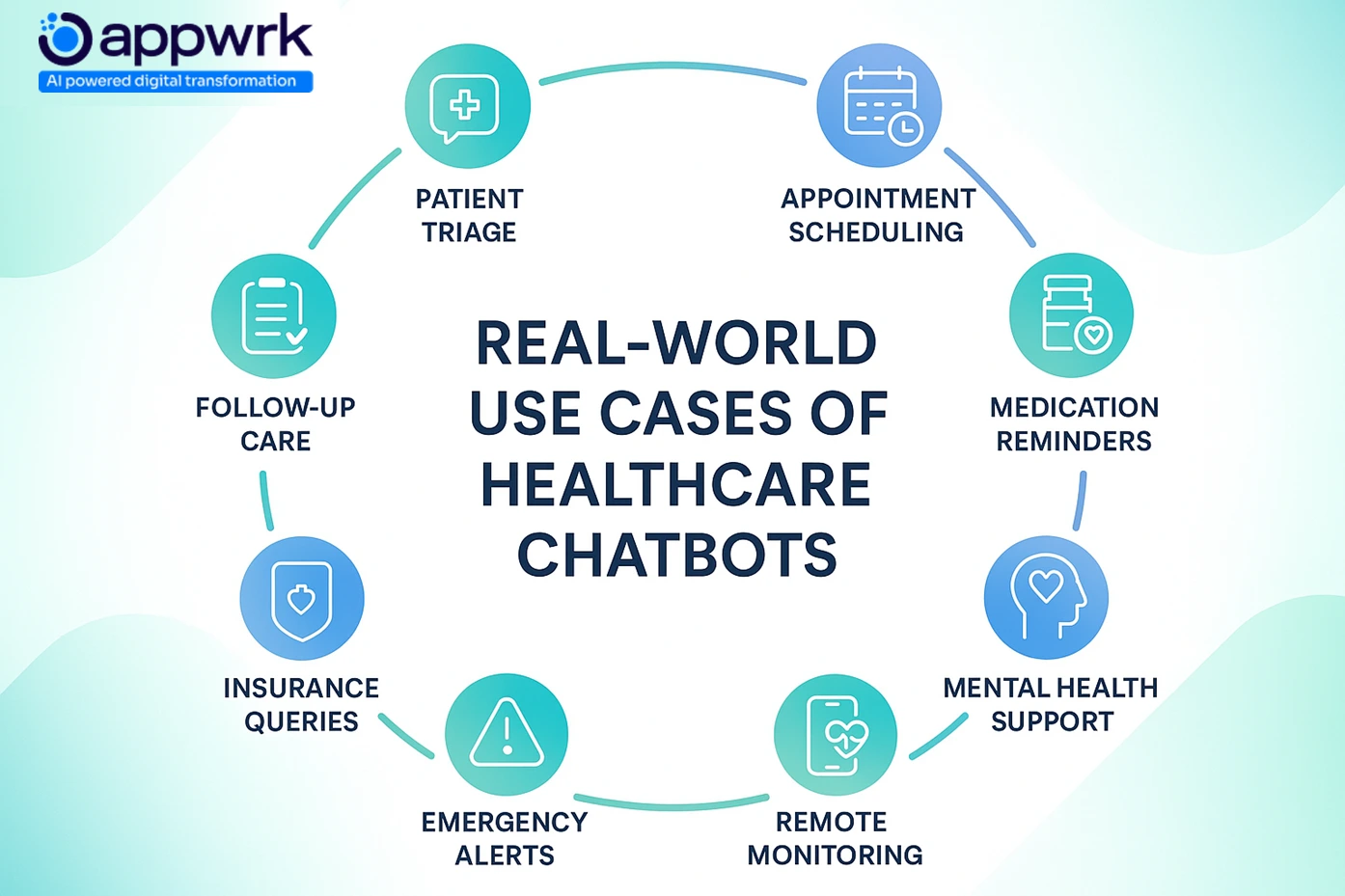
What Are the Real-World Use Cases of Healthcare Chatbots?
In real-world healthcare, AI chatbots are not just digital helpers; they’re reshaping how hospitals, clinics, and insurers deliver Customer Support and patient engagement. With advanced artificial intelligence (AI), LLM-powered chatbots, and strong integration with EHR systems, these solutions are proving their ROI across multiple scenarios.
Patient Triage and Symptom Checking
Helps users with initial symptom triage and directs them to the right care option.
Reduces hospital congestion and unnecessary ER visits.
Improves clinical decision-making by using AI models backed by data analysis.
Some deployments even use Google’s AMIE or Med-PaLM to enhance diagnostic reasoning.
Appointment Booking and Scheduling
Automates appointment scheduling across web, mobile apps, and social media platforms.
Syncs with EHR systems (like Epic, Cerner, or Meditech).
Offers rule-based chatbots for basic booking, or AI chatbots with voice recognition and speech recognition for advanced handling.
Medication Management and Reminders
Provides reminders and refills while ensuring a consistent user experience across channels.
Integrates with wearable device integration to track adherence.
Uses chat-based interfaces to deliver patient-friendly alerts.
Mental Health Support
Increasingly, providers are investing in Mental Health AI Chatbots.
They deliver therapy-like conversations using ChatGPT-style chatbot flows.
Built on deep learning and convolutional neural networks for emotional tone detection via Sentiment Analysis.
Shares knowledge base updates and post-discharge guidance.
Supports clinical trials with patient follow-up surveys.
Demonstrates the value of ongoing technical support and Maintenance and support investments.
Appwrk Mini-Case – AI-Interviewer for Healthcare Staffing: In another engagement, Appwrk developed an AI Interviewer bot that can accelerate healthcare staffing by evaluating candidates’ competencies via structured calls, cutting hiring time by 50% while maintaining compliance and neutrality.
Operational Efficiency Gains
Frees staff from repetitive administrative work like claim queries.
Proves ROI through cost optimization strategies and automation of Support Ticket Labeling.
Often developed using pre-built services or open-source frameworks for faster adoption.
Better Resource Allocation for Boosting Healthcare Efficiency
Uses advanced strategies like federated learning to optimize predictive scheduling.
Delivers measurable outcomes such as reduced staffing costs at a hospital level.
ROI of Healthcare Chatbots
Healthcare organizations see ROI not only in reduced staffing costs but also in efficiency and patient retention.
Telehealth Startup Case Study
A mid-sized telehealth provider facing seasonal spikes turned to a triage assistant.
Investment: ~$150,000 build, ~$30,000 annual Maintenance and Support.
Outcome: Hotline volume reduced by 30%, response times cut from 15 minutes to 3.
ROI: $2M in annual savings, driven by retention and faster triage.
Enterprise Insurer Example
An insurance company automated claims and fraud detection with an enterprise AI chatbot.
Cost: ~$90,000 for development.
Savings: $500,000 annually in admin tasks.
Fraud prevention: 12% reduction in false claims.
ROI: Payback in under six months.
Key ROI Drivers
Cost Savings and ROI Healthcare providers see real ROI by automating patient interactions and routine tasks. Reducing call center costs, cutting down no-show rates, and streamlining symptom triage often deliver payback within the first year of deployment.
Faster triage shortens wait times and improves patient satisfaction.
Stronger engagement keeps patients actively connected to providers.
Scalability ensures thousands of queries can be managed without expanding staff.
Enhanced Data Insights Modern AI chatbots don’t just respond—they capture detailed patient interaction data. This fuels data analysis to understand behaviors, predict care needs, and optimize clinical workflows for better outcomes.
Continuous Learning and Improvement With machine learning (ML) capabilities, these virtual assistants grow smarter over time. They expand vocabulary, improve accuracy, and adapt to new medical protocols, ensuring every interaction feels more relevant and supports long-term patient trust.
How to Build a Healthcare Chatbot Step by Step
Developing a healthcare AI chatbot isn’t just a technical exercise. It’s a structured journey that blends technology, regulatory compliance, and a seamless Customer Experience. Each stage makes sure the solution is scalable, secure, and capable of delivering measurable value for both providers and users.
Define Goals and Scope
The first step is defining what the chatbot project should accomplish. This involves identifying target users, mapping use cases like symptom triage, Triage & Scheduling, or medication reminders, and tying them to outcomes such as reducing Customer Support load or improving engagement.
A Medical Chatbot inside a hospital may aim to cut wait times by 25%.
A Mental Health AI Chatbot could focus on improving therapy adherence rates.
This stage sets the foundation for aligning costs with real-world value.
Choose the Technology Stack
Your choice of tech stack determines scalability, security, and Support Costs.
Backend languages like Python, Node.js, and Java, combined with AI models such as GPT-4 technology or Google’s AMIE, give the system reasoning power backed by advanced NLP engines.
Chatbot platforms like Google Dialogflow CX simplify integrations.
Choosing frameworks built on artificial intelligence, deep learning, and neural networks prevents costly rework later.
Design UI/UX
An intuitive UI/UX Designis what makes a Medical Chatbot feel natural. A well-designed conversational flow builds trust and delivers a Consistent user experience.
Add multilingual options for diverse users.
Incorporate Voice Recognition and speech recognition for accessibility.
Optimize across web, mobile apps, and social media platforms for a frictionless journey.
Develop Backend and Frontend
This is where AI-powered chatbot development comes alive.
The backend powers AI chatbots, LLM-powered chatbot logic, and integrates with diagnostic tools, medical imaging, medical coding, and scheduling systems.
The frontend manages real-time patient interactions with intuitive chat-based interfaces.
Together, they ensure reliability, security, and quick support for clinical decisions.
Integrate with Healthcare Systems
Integration turns a simple bot into a robust assistant.
Connect to EHR systems(like Epic, Cerner, Meditech) for personalized care.
Sync with CRMs and billing for secure payment processing and claims support.
This step ensures compliance with FHIR standards, accurate clinical decision-making, and full compliance with healthcare regulations.
Train and Test the Chatbot
Training involves curated datasets: clinical trials, medical images, and patient conversations. Testing validates accuracy, compliance, and reliability.
Retrain AI models with NLP Retraining as new terminology emerges.
Use data analysis and Sentiment Analysis to refine patient interactions.
Carry out Security Audits and vulnerability checks to align with ISO 27001.
Deploy and Monitor
Deployment makes the bot operational, and monitoring keeps it relevant.
Scale via cloud platforms to handle query spikes.
Use analysis dashboards to measure adoption and ROI.
Apply chatbot pricing models like usage-based pricing for SaaS deployments.
Post-Launch Support and Maintenance
No chatbot project is ever “done.” Continuous Maintenance and Support ensures security, compliance, and growth.
Regular patching, bug fixes, and data-driven care updates.
Retraining AI chatbots using fresh patient data for improved intelligence.
Add-ons like Rule-Based Chatbots for FAQs or AI-powered customer support for billing and customer service chatbots.
Planned post-launch updates reduce Support Costs and keep ROI sustainable.
How Can You Reduce the Cost of Healthcare Chatbot Development Without Compromising Quality?
For most healthcare providers, the biggest hesitation around adopting AI chatbots is cost. But here’s the truth: with the right approach, organizations can reduce development expenses by 30–40% while still maintaining compliance, security, and a high-quality Customer Experience for patients.
Identifying Minimum Viable Product Features for Cost-Efficiency
You don’t need to launch with a full-scale enterprise AI chatbot on day one. Instead, start with an MVP (Minimum Viable Product) that focuses on essential modules.
Begin with basics like appointment booking, FAQs, and reminders.
Add advanced features such as Triage & Scheduling, symptom analysis, or billing automation later.
Early MVPs can go live for as little as $3,000–$8,000, while proving ROI before scaling.
This phased model not only reduces upfront chatbot design costs but also ensures a more Consistent user experience as the system evolves.
Leverage Pre-Trained AI Models
Developing NLP or natural language processing models from scratch is resource-heavy. Using pre-trained AI models like Google’s AMIE, GPT-4, or Med-PaLM cuts costs while maintaining accuracy.
Lowers dataset annotation costs.
Accelerates deployment time.
Keeps space for medical customization later.
This can shave $5,000–$15,000 off initial development while still enabling advanced reasoning through deep learning and predictive algorithms.
Outsource to Reduce Costs
Full in-house teams are costly in markets like the US or EU. Outsourcing to healthcare-specialized vendors helps lower build costs significantly.
Offshore developers bring down spend by up to 40%.
Hybrid models (offshore development + onshore compliance consulting) balance quality and regulatory compliance.
Access to skilled AI-powered chatbot development without permanent salaries.
The right outsourcing partner ensures HIPAA-compliant infrastructure and ongoing Maintenance and Support.
Adopt Modular Development
Why pay for everything up front? Modular builds let you add components over time.
Start with FAQs and appointment scheduling.
Add modules like Mental Health AI Chatbot or insurance management later.
Keeps the chatbot project flexible while distributing Support Costs.
This plug-and-play approach is especially useful for providers rolling out across multiple hospitals or clinics.
Open-Source Platforms and Tools
Using open frameworks reduces dependency on proprietary licenses.
Saves big on recurring software fees.
Allows flexibility to connect with chatbot platforms and cloud platforms.
Strong communities provide updates, bug fixes, and even free Security Audits.
This is one of the most effective cost optimization strategies for scaling providers.
Plan for Iterative Development
Don’t think of chatbot builds as one-and-done. Treat them like a journey.
Deploy in phases. Gather feedback from users.
Use data analysis and Sentiment Analysis to improve performance.
Spread investment across milestones while ensuring continuous ROI.
By taking an iterative approach, providers reduce upfront risk while building a smarter, custom AI-powered chatbot over time.
Cost reduction doesn’t mean cutting corners; it means prioritizing what matters most, whether that’s modular builds, leveraging pre-trained AI chatbots, or working with partners who understand compliance and clinical workflows.
How Appwrk Can Help in Healthcare Chatbot Development
Appwrk combines deep healthcare expertise, artificial intelligence know-how, and compliance-first delivery to help providers build smarter, scalable, and cost-efficient digital assistants.
Why providers choose Appwrk:
Healthcare expertise: Proven delivery for hospitals, insurers, and digital health startups, including complex integrations with EHR systems and wearable device integration.
Compliance-first builds: Aligned with HIPAA-compliant architectures, GDPR, the EU AI Act, and SOC-2 standards for safe patient data handling.
Cost-effective MVPs: Solutions starting at $3,000 with flexible pricing models, including usage-based pricing and tailored chatbot pricing model structures.
Agile delivery: Modular builds, pre-built services, and open-source frameworks that accelerate timelines and reduce total spend.
Post-deployment value: Continuous AI Model Licenses, retraining through NLP Retraining, knowledge base updates, and ongoing Maintenance and Support keep solutions compliant and future-ready.
Impact metrics:
90% retention rate across healthcare clients.
Average savings of 30–40% vs in-house builds.
MVPs delivered in just 8–12 weeks.
For organizations aiming to scale patient engagement, reduce Support Costs, and future-proof healthcare operations, Appwrk is a strategic partner for enterprise-level healthcare chatbot development and beyond.
Ready to build a healthcare chatbot that helps scale your healthcare services with higher client retention? Let’s talk about your project today.
FAQs
How much does it cost to build a healthcare chatbot? The cost to build a healthcare AI chatbot for healthcare starts at $3,000 for basic healthcare chatbot development and goes up to $90,000 for advanced healthcare chatbot development with compliance, integrations, and AI. Mid-tier builds usually range from $12,000–$45,000. Appwrk helps innovators launch basic medical chatbot MVPs at startup-friendly costs.
Contact us to know the real costs to build your healthcare chatbot right away.
What is the cost to build a healthcare chatbot per month? Using SaaS subscription pricing models, costs range from $200 to $1,000 per month. Custom builds require higher upfront spend but lower ongoing Support Costs compared to subscription-based services.
How does a chatbot cost calculator estimate pricing for healthcare bots? A chatbot cost calculator evaluates features, integrations, and compliance:
$3K–$8K for basic chatbots.
$12K–$45K for AI Healthcare Chatbot Development with NLP and integrations.
$50K–$90K for enterprise AI chatbot builds with advanced artificial intelligence (AI).
What is included in a chatbot price list for healthcare solutions? Healthcare chatbot pricing models typically include:
SaaS bots: $200–$1,000/month.
Custom development: $20K–$90K one-time.
Hybrid model: $10K–$50K depending on the level of customization.
How much does it cost to build a healthcare AI chatbot? An AI-driven solution with NLP (Natural Language Processing) capabilities, Voice Recognition, and EHR access usually costs $12,000–$50,000. Adding multi-factor authentication, robust security, and secure data exchange pushes it higher.
What is the ChatGPT development cost for building a ChatGPT-style chatbot or LLM-powered chatbot? Building a ChatGPT-style chatbot or LLM-powered chatbot on GPT-4 technology can cost $15,000–$60,000. Additional API Access and usage fees ($500–$2,000/month) depend on users and volume.
How much does it cost to develop a chatbot across industries? The cost of developing a chatbot across industries is usually $5,000–$40,000. Healthcare is higher because of regulatory compliance, compliance checks, and integrations with clinical decision-making systems.
What is the cost to build a healthcare chatbot in India? Development in India lowers costs by ~40%.
$3,000–$6,000 for basic chatbots.
$8,000–$25,000 for AI chatbots with machine learning (ML) capabilities.
$30,000–$50,000 for enterprise-level healthcare chatbot development. With hourly developer rates of $25–$50, India is ideal for cost-efficient builds backed by ongoing technical support.
How much does it cost to build a healthcare app? Healthcare apps cost $40,000–$250,000, depending on features, the platform it will be deployed on, and compliance. By contrast, chatbots are a more affordable entry point for 24/7 patient care.
How to build a healthcare chatbot? Key steps in a chatbot project:
Design strong UX/UI design and conversation flows.
Train AI models with healthcare datasets.
Enable third-party API integration with EHR systems and IoT.
Add role-based access controls and data encryption protocols for compliance.
Test for HIPAA-compliant data security, SOC-2, and Security Audits.
Deploy and run continuous Maintenance and Support.
How much does it cost to own a chatbot long-term? Ownership includes retraining via NLP Retraining, knowledge base updates, and hosting. Expect 15–20% of the original chatbot build costs annually.
Are healthcare chatbots HIPAA compliant? Yes, if designed with safeguards. HIPAA-compliant chatbots use encryption, secure payment processing, audit logs, and regular Security Audits. Compliance typically adds $3,000–$12,000.
How long does it take to build a healthcare chatbot?
MVP: 8–12 weeks.
Enterprise AI Solutions: 4–6 months, depending on complexity and integrations.
What is the ROI of healthcare chatbots? ROI comes from:
Reduced customer service and call center costs.
Faster triage with real-time clinical intelligence.
Automated insurance processes with Legal Consultations built in.
Stronger fraud prevention with predictive algorithms and generative adversarial networks.
Many providers achieve ROI in 6–12 months, especially when Biz4Group or Appwrk supports scaling through advanced strategies, data analysis, and digital twin simulations.
Gourav Khanna is the Co-founder and CEO of APPWRK, leading the company’s vision to deliver AI-first, scalable digital solutions for enterprises and high-growth startups. With over 16 years of leadership in technology, he is known for driving digital transformation strategies that connect business ambition with outcome-focused execution across healthcare, retail, logistics, and enterprise operations.
Recognized as a strategic industry voice, Gourav brings deep expertise in product strategy, AI adoption, and platform engineering. Through his insights, he helps decision-makers prioritize market traction, operational efficiency, and long-term ROI while building resilient, user-centric digital systems.
Subscribe to APPWRK Blogs, We'll Do the Rest!
Get Blogs on UI/UX, Mobile Apps, Online Marketing, and Web development technology.
Unlock worthy and priceless suggestions from the masters of mobile and web app development