150+ minds across 4 countries. Join a culture of innovation, ownership & growth.
Rewire for AI
From machine learning to deep learning, from classification tools to overall process automation – our AI engineers will help you retool your existing system or enhance your company results.
Ship faster, scale smarter, built for product companies and SaaS teams
Our Latest Work
We strive hard to deliver result-driven digital solutions across the globe. Check out our case studies to get a glimpse of how we ideate, innovate, and create unconventional digital solutions according to the requirements of our clients.
Discover diverse and passionate insights from our tech enthusiasts. We collaborate across various sectors to streamline operations and drive innovation. Explore our rapidly growing collection of articles to see why we’re at the forefront of IT solutions.
The decision to move from Magento to Shopify is one of the most significant replatforming choices an ecommerce business can make. Magento is powerful, but its power comes with...
Accuracy gap is real: Traditional CPG forecasting carries a 25-40% MAPE error rate. AI-powered models bring that down to 8-15%, according to McKinsey research....
Real stories from global leaders who trusted us with their ideas.
Partnering with APPWRK helped us build a compliant and scalable healthcare platform, accelerating our time-to-market by 35%. Their team consistently delivered outstanding work.
Beesers
Digital Healthcare Client
Collaborating with APPWRK, Sportskeeda modernized its platform into a real-time sports engagement ecosystem, enabling seamless content delivery, scalable fan interactions, and high-velocity performance.
Sportskeeda
Sports & Entertainment Partner
Working with APPWRK was effortless. They captured our vision, maintained full compliance, and delivered a digital experience that built trust and elevated how customers interact with our fintech brand.
PayPenny
Fintech Partner
Working with APPWRK gave us confidence in adopting AI responsibly. Their team built a safe, intelligent bot that transformed how we engage with leads and helped us achieve measurable revenue growth.
IFB
AI Transformation Partner
Leveraging APPWRK’s digital expertise, Nemesis launched a scalable, compliant, and safe super app that connects content delivery, real-time communication, and logistics management within a single platform.
The price to develop a meal planner app such as HelloFresh begins at $35K for an MVP and goes up to $250K+ for a feature-rich product with AI, subscription management, and integration with logistics.
How to build it: Start by understanding user needs, how to choose a scalable tech stack (e.g., Cloud-native architecture for diet-based subscription meal delivery services + mobile-first) then validate with a lean MVP. In later phases, add AI features and logistics integrations.
What features to include: Data-driven personalization in meal kits, recipe browsing, subscription billing, real-time delivery tracking, smart reminders, admin analytics, and user feedback.
Which tech stack to use: Use React Native or Flutter for cross-platform apps, Stripe for payments, Firebase or AWS for a modular backend for meal planning, and integrate with APIs.
Challenges to plan for: Manage dietary personalization, recipe licensing, delivery coordination, and launch a GDPR and PCI-DSS compliant meal planning app for global markets.
How to monetize: Beyond subscriptions, add upsells like premium meal packs, referral bonuses, branded grocery tie-ins, and digital recipe sales.
This blog is tailored for business owners and CXOs who want to build a scalable, AI-powered meal planner app for healthy eating and weekly meal prep. It offers a strategic walkthrough of cost structures, development stages, technology considerations, and cost optimization tactics. It provides a clear blueprint for building a successful product in the evolving tech landscape.
Introduction
With convenience being the customer’s fundamental need in today’s globalized world, demand for meal kits and meal planner solutions has increased dramatically. The total addressable global meal-kit delivery market was USD 20.5 billion in 2022 and is expected to grow to USD 26.3 billion in 2023 at a Compound Annual Growth Rate (CAGR) of 15.3% from 2023 to 2030.
HelloFresh, a meal subscription delivery app, is at the forefront of this demand. Their approach to combining weekly menus, diet preferences, and logistics has not just scaled operationally but redefined modern eating. According to Tobias Hartmann, CEO of HelloFresh, “Scaling a recipe subscription is about delivering trust weekly: consistency, quality, and convenience.” That philosophy now powers over 8 million active subscribers globally, making HelloFresh the gold standard in meal planning and home cooking delivery.
It is essential to understand HelloFresh’s model prior to its replication. The recipe planning app is a guided weekly meal planning platform where users can subscribe to a desirable plan according to dietary needs and household size. Every week, they have pre-measured ingredients and simple recipes delivered to their doorstep.
What propels its retention is simplicity combined with personalization. Along with that, this personalized meal kit delivery app for families and health-conscious users also gives its customers the flexibility to change their weekly plan by skipping orders or suspending the plan. For developers, this implies constructing a solid backend supporting content management, logistics synchronization, subscription levels, and customized frontends.
Must-Have Features in a Meal Planner App
A custom meal planning app like HelloFresh’s core functionality needs three foundational pillars:
User Panel
This is what customers interact with daily. It enables users to:
Onboarding flow: Helps with inputting user preferences like the number of meals or household size.
Weekly planner: Visual display of upcoming meals, meal prep calendar integration, and recipe selections.
Order history and ratings: Users can track past orders and give feedback.
Admin Panel
This backend interface allows your team to:
Inventory and recipe sync: Ensures ingredients match weekly menus.
Subscription analytics: View active users, cancellations, and growth trends.
Delivery monitoring: Coordinate with logistics partners and view order statuses.
Advanced Functionality
AI meal planning: An AI-powered recipe planner for healthy eating and nutrition tracking.
Referral engine: Users get rewards for inviting friends, growing organic reach.
Smart notifications: Meal reminders, new dish alerts, cart abandonment nudges.
Detailed Feature Architecture of a Meal Planner App
The following outlines the comprehensive feature requirements for a robust meal planner application.
User Registration & Profile Management
The meal planning app for families includes secure sign-up flows with multi-factor authentication, OAuth integrations (e.g., Google, Apple), and user preference data capture, such as dietary restrictions and household size, serving as the personalization engine foundation.
Personalized Meal Plans and Filters
Leverages user data and AI algorithms to auto-generate personalized weekly menus based on past behavior, allergies, and nutritional goals. Through tagging systems and meal metadata, users can use filters like vegetarian or gluten-free.
Recipe Browsing & Cooking Instructions
Includes a multimedia-rich interface displaying step-by-step guides, cooking timers, and nutritional facts. Recipes are stored in a structured CMS with smart search and indexing for seamless discoverability.
In-App Purchases & Subscription Management
Integrated with Stripe or similar payment gateways, this feature supports flexible billing cycles, one-click upgrades, pausing, and cancellation, all while adhering to PCI-DSS compliance standards.
Real-Time Order Tracking
Uses APIs from third-party logistics providers to offer live shipment status, ETAs, and last-mile delivery alerts. Often integrated with GPS and warehouse management systems (WMS) for complete visibility.
Push Notifications and Reminders
Drives user engagement through Firebase Cloud Messaging or OneSignal, sending context-aware alerts like meal reminders, new recipe drops, and delivery updates, customized by behavior triggers.
Rating & Reviews
Allows users to rate meals, leave feedback, and suggest improvements. Data is funneled into analytics dashboards, enabling iterative improvements in meal design and recommendation models.
Cost Drivers for a Meal Planner App Like HelloFresh
How Much Does It Cost to Build a Meal Planner App Like HelloFresh?
The cost to build a recipe planning app like HelloFresh depends on what phase you’re in:
$35K to $100K (MVP): Just core features.
$120K to $200K (v1 build): More personalization, analytics.
$150K to $300K+ (enterprise): AI, logistics, and multi-region scalability.
It takes more than just subscriptions to build a sustainable meal planner business. (You can explore the cost structures further in App Development Cost: A Detailed Guide.
Cost Breakdown by Development Module
Let’s understand where the budget goes and why.
Module
MVP Cost
Scale Cost
Notes
User Signup and Authentication
$10K
$15K
Login, password reset, 2FA
Recipe Catalog and Search
$15K
$30K
Recipe browsing, filters, search intent
Subscription Flow and Billing
$20K
$40K
Stripe integration, plan upgrades
User Panel Features
$10K
$25K
Dashboard, preferences, customization
Admin Panel Features
$15K
$35K
Inventory, order control, user data
Advanced Functionalities (AI, etc.)
—
$50K+
Personalized meal planning, smart tags
Integrations and Logistics
$10K
$50K
API for shipment tracking, route logic
UX/UI and Platform Support
$20K
$40K
iOS/Android design, responsive frontends
Maintenance and Updates (annual)
$20K/year
$40K/year
Bug fixes, platform updates
Timeline and Team Composition
This section outlines how long each phase takes and who you need:
MVP (4 to 6 months): 1 UI/UX designer, 2 developers, 1 backend engineer, and 1 QA tester.
v1 growth (6 to 9 months): Add PM, data engineer, and integration support.
Full scale (12+ months): Add DevOps, marketing automation, and regional teams.
Hidden Costs and Miscellaneous Expenses
These costs creep up fast:
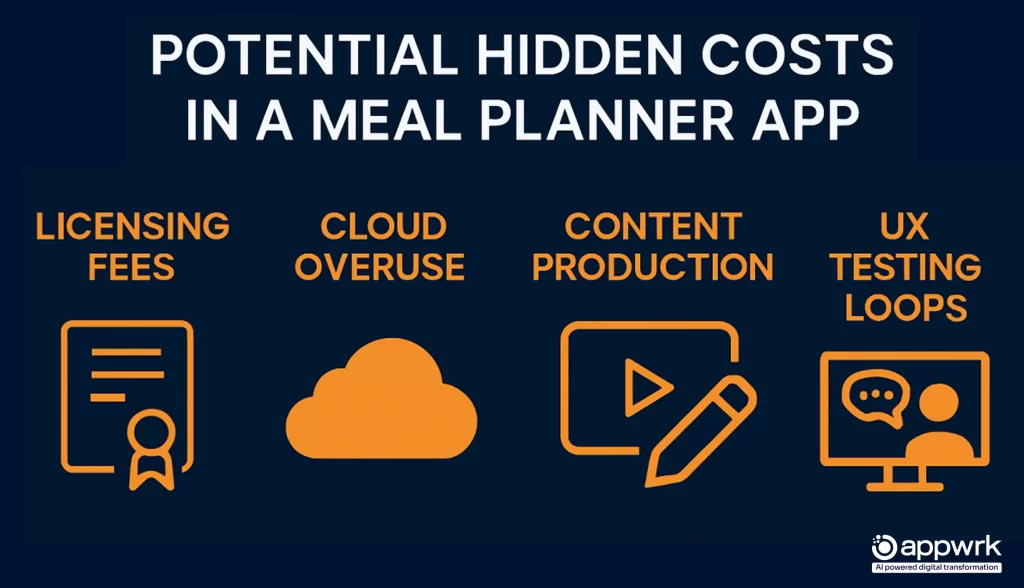
Licensing fees: Often, third-party tools, databases (like food nutrition APIs), or integrations require monthly or per-usage fees. Without tracking these, you can burn through your budget quickly.
Cloud overuse: Developers may provision more servers, storage, or bandwidth than needed. If these resources aren’t scaled down during low usage, you’re paying for idle capacity.
Content production: Every recipe needs photography, step-by-step guides, and SEO-rich descriptions. Many founders underestimate the time and cost of creating or localizing content.
UX testing loops: Repeated usability tests are vital for mobile-first UX for nutrition tracking and family meal scheduling. If not budgeted correctly, design overhauls and A/B testing campaigns can double your UX costs by the second or third iteration.
Together, these hidden costs can add up to 20 – 30% more than your initial estimates, especially in the scale-up phase where fast iteration meets real-world complexity.
App Store and Compliance Costs
As you prepare to launch your custom meal planning app, whether it is a cross-platform mobile app development or a native app development, be aware of post-development costs tied to platforms and regulations. These can add up quickly and must be baked into your go-to-market planning:
Apple App Store Developer Fee: $99/year
Google Play Developer Fee: $25 one-time
GDPR/CCPA Compliance: Setting up data governance and consent frameworks can cost $5K – $15K
PCI-DSS: If handling direct payments, you’ll need security compliance like encryption, secure checkout, etc.
These expenses often go unnoticed early on, yet they are mandatory for commercial launches, especially subscription models operating across regions.
UI/UX Design & Iteration Cost Table
Creating an intuitive and engaging user interface involves more than just aesthetics. It requires following mobile UI/UX best practices for food apps and striking a balance between usability, behavioral science, and continuous feedback loops. Here’s what a design lifecycle can look like:
Stage
Time Estimate
Cost Range
Notes
Wireframes & Prototyping
2–3 weeks
$5K–$10K
Visual planning, layout sketching
Design Sprints
3–4 weeks
$10K–$20K
Collaborative cycles to refine UX
Usability Testing & Revisions
Ongoing
$5K+
A/B testing, accessibility updates
Tools like Figma, Firebase, and Stripe play key roles at different stages, design, backend infrastructure, and secure payment, respectively, ensuring your design system is cohesive and technically sound.
Strategies to Optimize the Cost of Your Meal Planner App
This section explores practical ways to control development costs while building a scalable, cloud-native food delivery solution.
Lean Validation Before Full Development
Instead of immediately investing in full-stack development, many successful startups begin with a low-code MVP for a nutrition-focused mobile meal planner app. For example, using Figma for UI prototyping or Airtable as a makeshift backend can reduce initial spend while still delivering a user-ready experience. These tools allow early iterations to be tested with real users, uncovering usability flaws and gathering insights before a single line of production code is written.
Modular Development and Feature Prioritization
Start with essential modules like meal selection, user onboarding, and basic subscription flows. When building a health-focused recipe planner app with calorie tracking and smart meal reminders, it is essential to prioritize must-haves to ensure the budget is focused on where it counts.
Use of Open-Source Frameworks and APIs
Opting for established, open-source frameworks like React Native or Flutter for cross-platform deployment can lower costs and speed up development. Integration with nutrition APIs also reduces the time and cost of building from scratch.
Leverage Cloud Tools and Serverless Architecture
Serverless platforms like AWS Lambda or Google Cloud Functions enable apps to scale without maintaining costly backend infrastructure. With meal planner apps, serverless meal planning app architecture can also help in cutting down costs. These pay-as-you-go models allow for precise budgeting during user growth phases.
Challenges in Developing a Meal Planner App Like HelloFresh
Developing a complex mobile app for meal planning like HelloFresh doesn’t come without its hurdles. From managing live inventory to recipe copyright, here are the most pressing challenges:
Recipe licensing: Recipes are intellectual property. Using aggregated content without permission can lead to legal complications. Startups need either licensing agreements or a custom CMS for owned content.
Inventory and logistics coordination: Real-time syncing of ingredient stock, delivery scheduling, and perishable inventory control requires robust backend architecture and third-party integrations for building a cross-platform food delivery app with personalized recipes and real-time logistics tracking.
User personalization: Custom meal recommendations based on dietary goals need a solid machine learning foundation trained on behavioral and nutritional datasets.
One underrated but critical piece of this puzzle is logistics orchestration. Perishable inventory management, coordinating deliveries, grocery and ingredient automation, and fleet operations optimization can overwhelm startups without a dedicated system. Yard Management Systems (YMS) can help meal-kit businesses streamline these operations by providing real-time insights into dock scheduling, inbound truck flow, and outbound shipment tracking. For a deeper look, refer to What is a Yard Management System?
You need more than subscription fees to survive. Building a sustainable and diversified revenue stream is crucial for long-term growth in the meal planner app business.
Value-added content monetization
This model involves selling complementary digital products such as downloadable recipe PDFs, customized meal plans, or niche-specific content (e.g., keto, vegan). These assets provide one-time or upsell opportunities, especially useful for users not yet ready to commit to a full subscription. It’s a low-cost way to monetize casual users and drive additional revenue without major development overhead.
Subscription dynamics
This refers to how users interact with and pay for app features over time. Dynamic subscription models allow flexibility, such as pausing, customizing plans, or trial periods. It helps reduce churn and increase LTV (lifetime value). In the health and fitness space, in-app purchases now represent 45% of overall revenue, showing the power of well-structured subscriptions in driving growth.
Building vs Buying: What Should You Do?
Should a company build from scratch or license a ready-made solution?
Simple Breakdown
For companies facing tight deadlines, choosing a white-label SaaS platform is often a smart and efficient solution. These solutions come bundled with essential modules, meal planning templates, subscription workflows, and analytics dashboards—perfect for launching a pilot or MVP without the heavy lift. However, when the business idea demands something beyond the standard, like AI-powered meal recommendations or region-specific logistics, building a custom platform offers unmatched flexibility, future-proofing, and brand differentiation.
Case Study: Blue Apron (2016)
In 2016, Blue Apron stood at the forefront of the U.S. meal-kit movement. Their strategy? Focus on operational excellence. With centralized logistics and fixed weekly menus, they scaled fast, shipping over a million meals each month and generating $795 million in annual revenue. This approach allowed them to keep delivery quality high and costs predictable. It’s a reminder of how mastering core logistics can turn a meal-kit concept into a nationally recognized brand.
Why It’s Relevant
Blue Apron’s rise illustrates the power of building proprietary systems when operations are a competitive advantage. For businesses entering the meal planning space, this reinforces the importance of evaluating what really drives differentiation. If it’s logistics, personalization, or scalability, then investing in custom infrastructure isn’t just smart, it’s strategic.
How APPWRK Can Help in Meal Planner App Development?
APPWRK is your strategic partner in bringing an enterprise-ready meal planning platform with multi-region logistics and DevOps support, that is built to scale and engineered for retention. We offer:
Agile full-stack teams that work across time zones to maintain momentum without compromise.
Secure integrations and DevOps support to streamline logistics, payments, and compliance workflows.
Human-centered UX design crafted specifically for food commerce, ensuring seamless onboarding, retention, and upsell paths.
Whether you’re validating an MVP or scaling to multi-region operations, APPWRK provides the architecture and execution expertise to help you thrive.
Ready to build your HelloFresh-style app?Contact us today to get a tailored product roadmap and cost estimate.
Frequently Asked Questions
How much does it cost to build a meal planner app?
The cost to build a meal planner app like HelloFresh typically starts at $35,000 for an MVP (Minimum Viable Product) with core features and can exceed $250,000 for a full-scale version that includes AI-based recommendations, advanced subscription logic, and real-time logistics integration. The total budget depends on factors like platform support (iOS/Android), feature complexity, third-party API integrations, design quality, and the geographical scope of operations.
What features should a HelloFresh-like app include?
A HelloFresh-style meal planner app should include user-friendly onboarding, a personalized meal planner, flexible subscription management, recipe browsing with multimedia guides, in-app payments, real-time order tracking, and AI-driven meal recommendations. It should also provide admin tools for inventory, logistics coordination, customer analytics, and smart notifications to support user engagement and operational efficiency.
How long does meal-kit app development take?
Meal-kit app development typically takes 4 to 6 months for an MVP, 6 to 9 months for a growth-stage version, and up to 12+ months for a full enterprise-scale launch. Timelines vary based on feature complexity, design iterations, team size, and whether the app is built from scratch or uses modular, reusable components and open-source frameworks to accelerate delivery.
Can AI meal planning reduce costs?
Yes, AI meal planning can reduce long-term costs by automating personalized recommendations, minimizing food waste through better inventory prediction, and improving customer retention with hyper-relevant meal suggestions. While AI integration may add upfront development costs, it pays off through improved operational efficiency, reduced churn, and higher average order values over time.
Should I buy white-label or build from scratch?
Choosing between white-label and custom development depends on your goals and timeline. White-label solutions are ideal for rapid MVPs and lower budgets, offering prebuilt templates and faster time-to-market. However, if your vision includes advanced AI, custom logistics workflows, or a highly differentiated brand experience, building from scratch offers greater scalability, control, and long-term flexibility.
What is HelloFresh’s subscription business model?
HelloFresh operates on a flexible subscription model where users select weekly meal plans based on preferences and household size, with options to pause, modify, or skip deliveries. The model is built around recurring revenue, but it also emphasizes personalization, convenience, and customer retention through meal variety, consistent quality, and seamless delivery experiences.
How do you integrate delivery and logistics APIs?
Integrating delivery and logistics APIs involves connecting your backend with third-party services (like ShipEngine, FedEx, or custom fleet solutions) to enable real-time order tracking, ETAs, route optimization, and delivery status updates. This typically requires secure API keys, webhooks for status changes, and syncing with inventory and order management systems to ensure seamless coordination between your app, warehouse, and logistics providers.
Gourav Khanna is the Co-founder and CEO of APPWRK, leading the company’s vision to deliver AI-first, scalable digital solutions for enterprises and high-growth startups. With over 16 years of leadership in technology, he is known for driving digital transformation strategies that connect business ambition with outcome-focused execution across healthcare, retail, logistics, and enterprise operations.
Recognized as a strategic industry voice, Gourav brings deep expertise in product strategy, AI adoption, and platform engineering. Through his insights, he helps decision-makers prioritize market traction, operational efficiency, and long-term ROI while building resilient, user-centric digital systems.
Subscribe to APPWRK Blogs, We'll Do the Rest!
Get Blogs on UI/UX, Mobile Apps, Online Marketing, and Web development technology.
Unlock worthy and priceless suggestions from the masters of mobile and web app development