150+ minds across 4 countries. Join a culture of innovation, ownership & growth.
Rewire for AI
From machine learning to deep learning, from classification tools to overall process automation – our AI engineers will help you retool your existing system or enhance your company results.
Ship faster, scale smarter, built for product companies and SaaS teams
Our Latest Work
We strive hard to deliver result-driven digital solutions across the globe. Check out our case studies to get a glimpse of how we ideate, innovate, and create unconventional digital solutions according to the requirements of our clients.
Discover diverse and passionate insights from our tech enthusiasts. We collaborate across various sectors to streamline operations and drive innovation. Explore our rapidly growing collection of articles to see why we’re at the forefront of IT solutions.
The decision to move from Magento to Shopify is one of the most significant replatforming choices an ecommerce business can make. Magento is powerful, but its power comes with...
Accuracy gap is real: Traditional CPG forecasting carries a 25-40% MAPE error rate. AI-powered models bring that down to 8-15%, according to McKinsey research....
Real stories from global leaders who trusted us with their ideas.
Partnering with APPWRK helped us build a compliant and scalable healthcare platform, accelerating our time-to-market by 35%. Their team consistently delivered outstanding work.
Beesers
Digital Healthcare Client
Collaborating with APPWRK, Sportskeeda modernized its platform into a real-time sports engagement ecosystem, enabling seamless content delivery, scalable fan interactions, and high-velocity performance.
Sportskeeda
Sports & Entertainment Partner
Working with APPWRK was effortless. They captured our vision, maintained full compliance, and delivered a digital experience that built trust and elevated how customers interact with our fintech brand.
PayPenny
Fintech Partner
Working with APPWRK gave us confidence in adopting AI responsibly. Their team built a safe, intelligent bot that transformed how we engage with leads and helped us achieve measurable revenue growth.
IFB
AI Transformation Partner
Leveraging APPWRK’s digital expertise, Nemesis launched a scalable, compliant, and safe super app that connects content delivery, real-time communication, and logistics management within a single platform.
Nemesis
Super App Partner
Your eCommerce AI Advantage
Find the best AI shopping assistants for eCommerce success.
The best AI shopping assistants for eCommerce now act as digital concierges guiding product discovery and purchase journeys.
Nearly half of product discovery is now powered by AI agents, driving hyper-personalization and loyalty across retail websites and AI platforms as per Mckinsey reports.
Modern assistants span the full journey from conversational chat and visual search tools to voice input and predictive personalization via AI-powered recommendation engines.
In this blog, we explore the best AI shopping assistants for eCommerce, explain how each AI shopping assistant in eCommerce transforms the buyer journey, and compare tools revolutionizing online retail.
Today, the best AI shopping assistants for eCommerce combine personalization, automation, and predictive recommendations to redefine the way customers shop online.
Let’s look at the best AI shopping assistants in eCommerce across conversational, visual, voice, and predictive categories.
Tool Highlights by Category
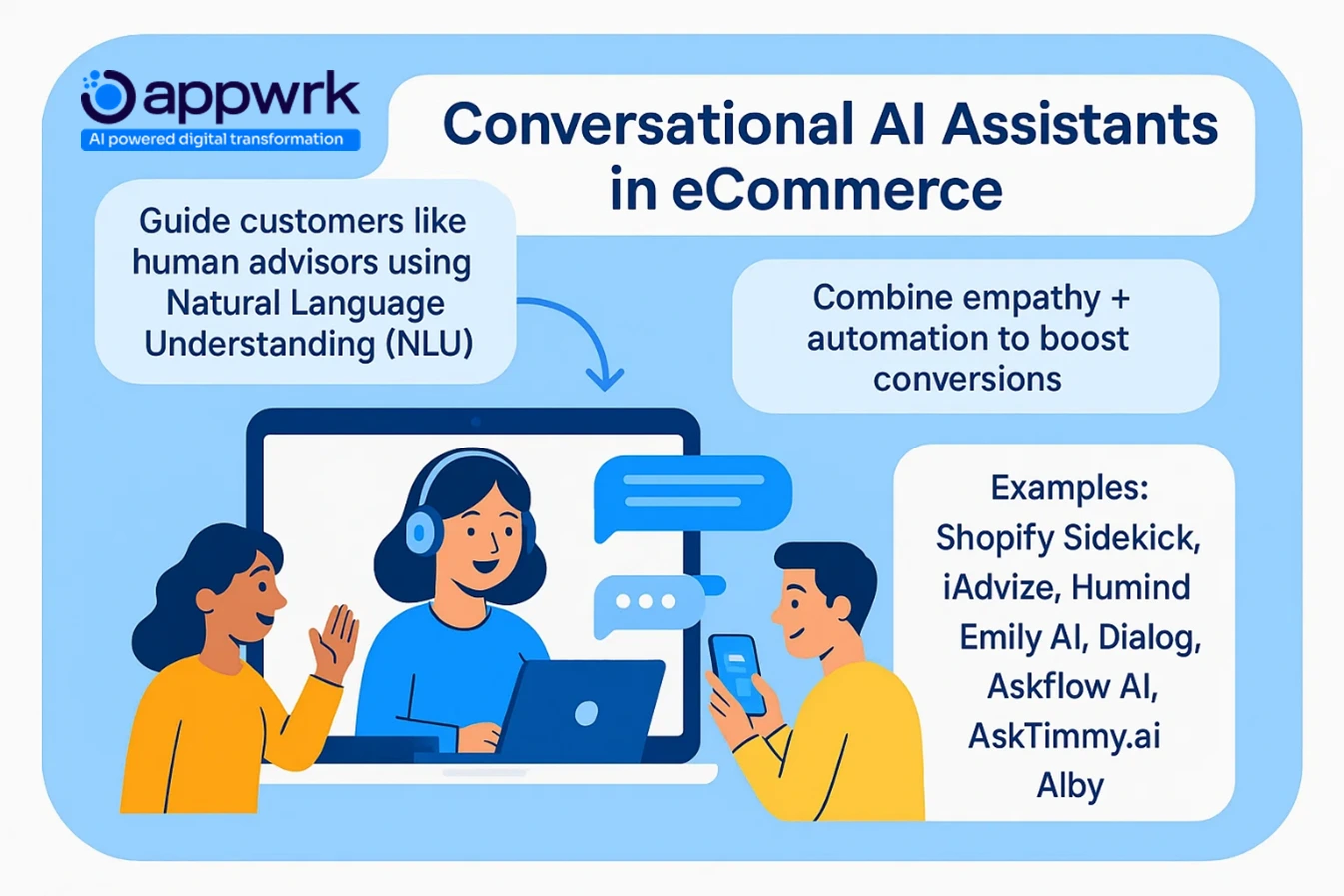
Conversational AI Assistants:Shopify Sidekickdelivers contextual, emotionally intelligent AI assistants that guide users in real time.
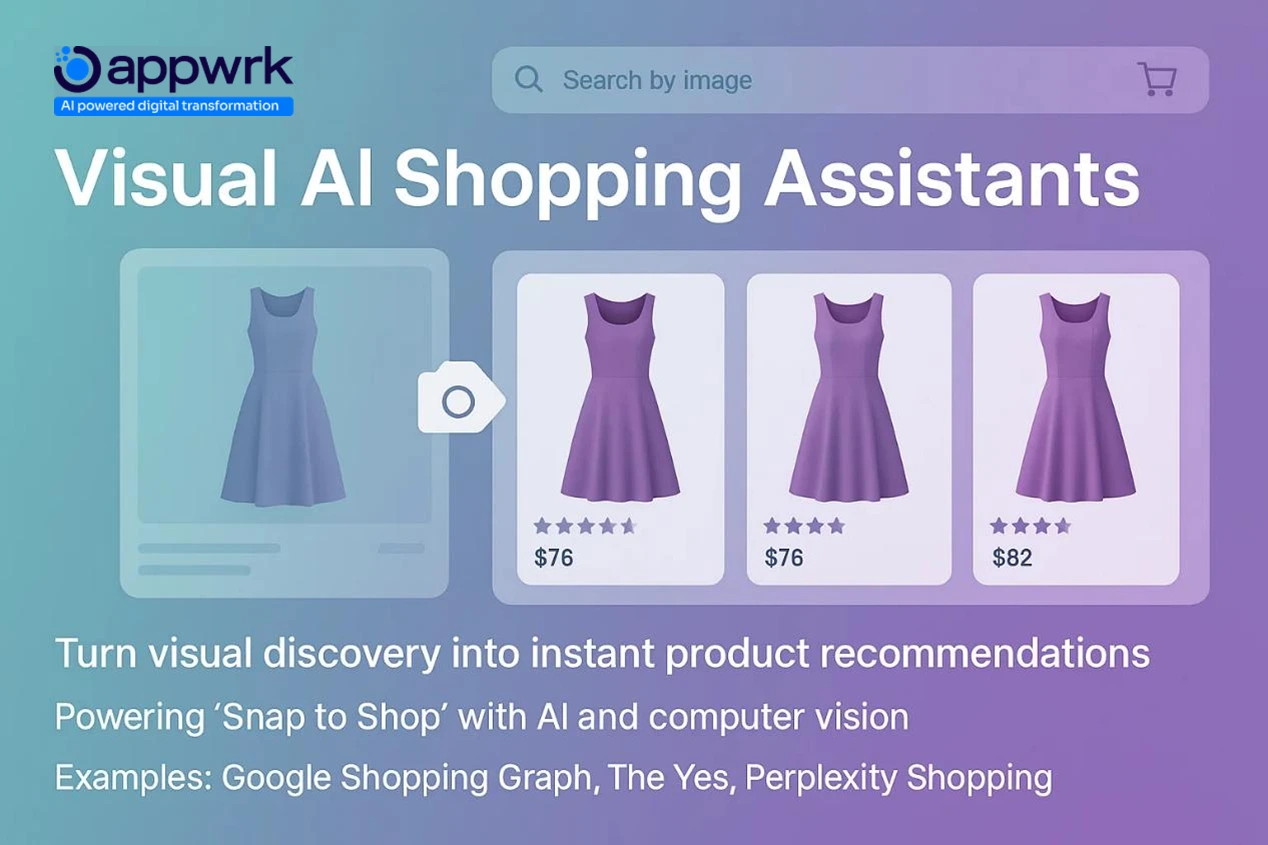
Visual AI Shopping Assistants:Google Shopping Graph and The Yes redefine “Snap to Shop” with dynamic, image-based product discovery.
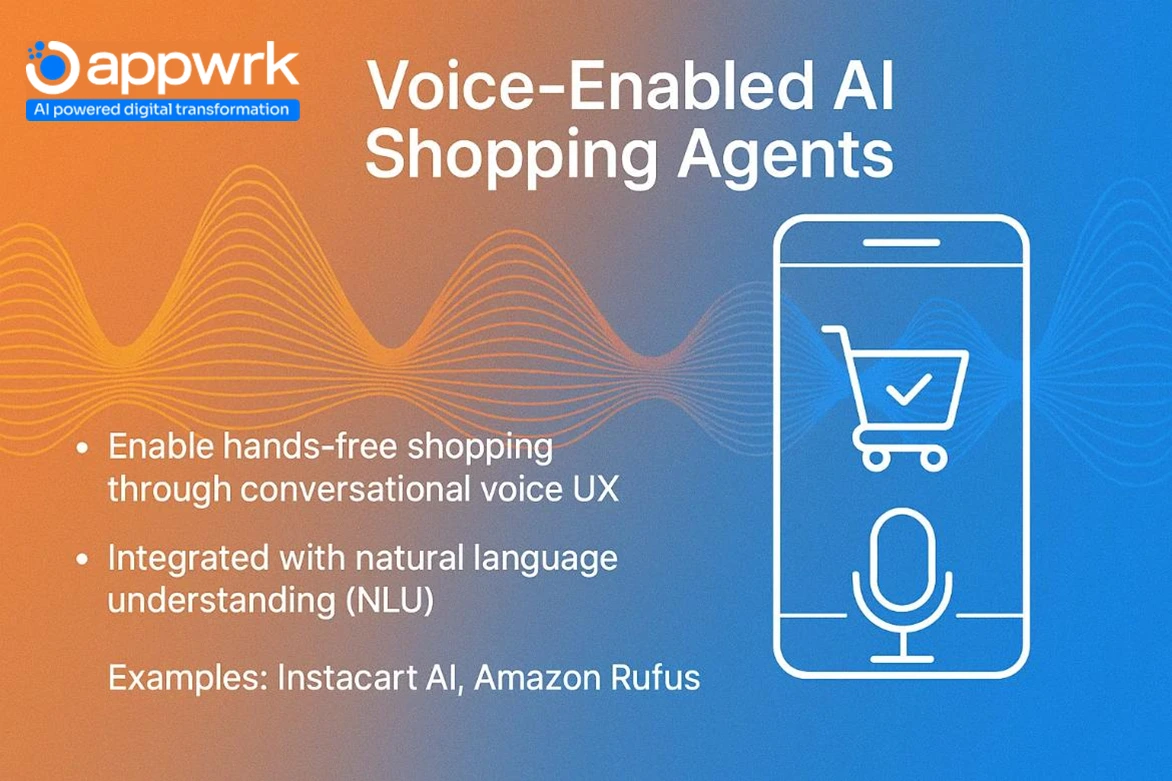
Voice-Enabled AI Agents:Instacart AIand Amazon Rufusenable seamless, hands-free shopping through natural language understanding (NLU).
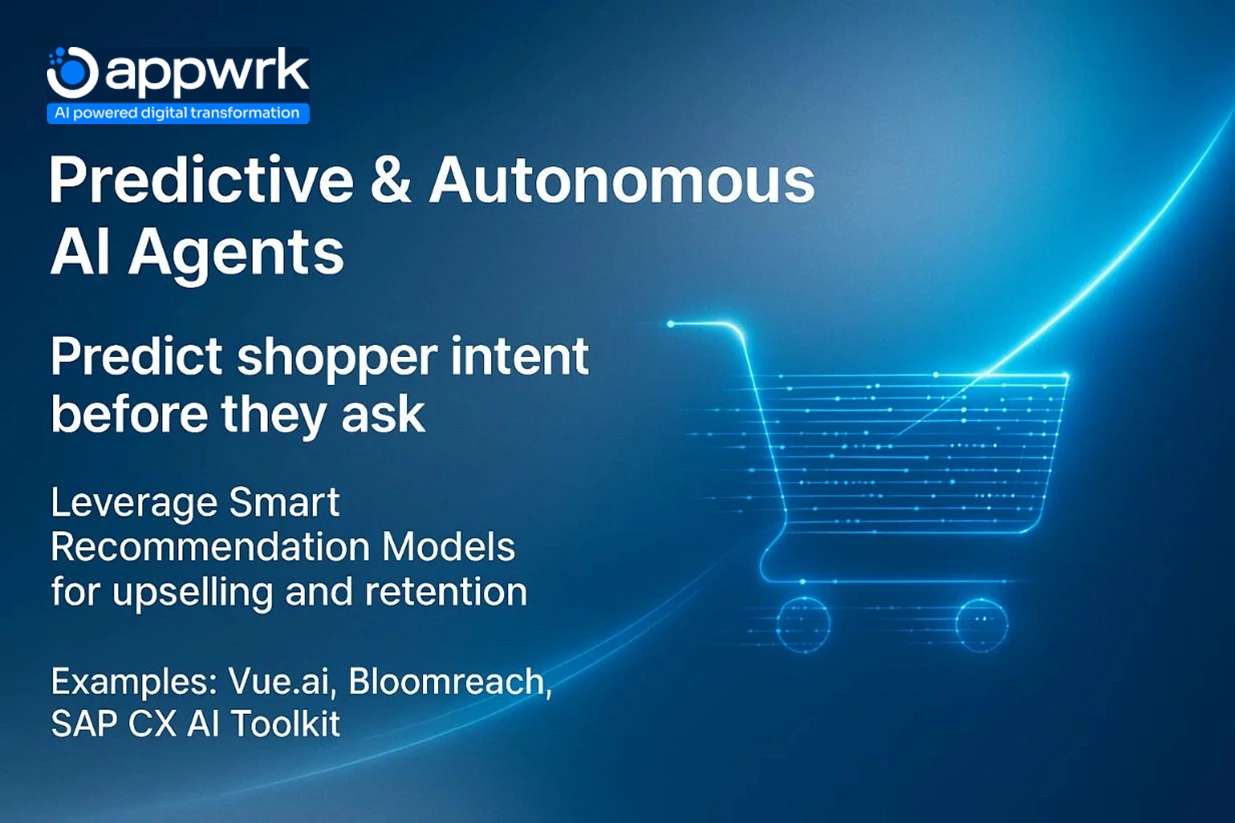
Predictive & Autonomous Agents:Vue.aiand Bloomreachuse Smart Recommendation models to anticipate buyer intent and automate upselling.
Strategic Advantages for Founders & Companies
Adopting AI-driven eCommerce solutions empowers stores to scale personalized engagement across chat, visual, and predictive channels.
AI shopping assistants cut decision fatigue and boost conversions with guided, conversational commerce.
Integrating OpenAI or ChatGPT-based APIs enables personalization and support automation in days, not months.
These AI-native omnichannel experiences connect chat, email, and checkout, creating frictionless journeys that scale.
What You’ll Learn
How AI shopping assistants differ from chatbots in engagement and conversion.
Categorized insights on AI shopping agents by platform and intelligence type.
Integration steps: build vs buy, using Shopify AI tools for conversion, and Magento or SAP CX AI Toolkit connections.
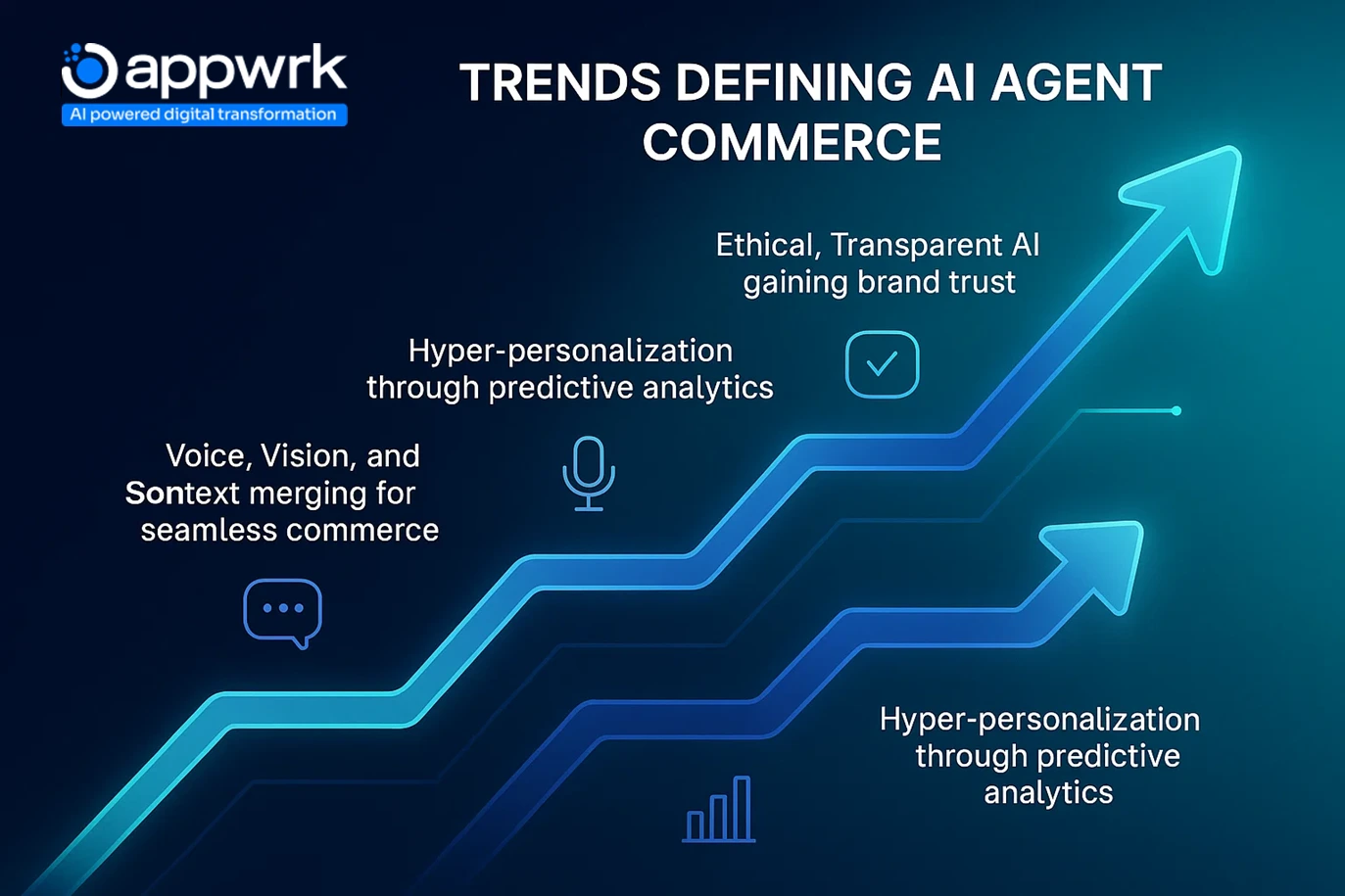
The trends shaping AI Agent Commerce from Agentic AI to adaptive, AI-driven ecosystems in retail.
AI shopping assistants are now the backbone of modern AI-driven eCommerce solutions, powering personalisation, product discovery, and conversion. They help users discover, compare, and purchase products in real time, while enabling brands to create seamless shopping journeys.
Based on competitor analysis and leading industry implementations, AI-powered shopping assistants can be grouped into four main categories: Conversational, Visual, Voice-Enabled, and Predictive AI Assistants.
Each category below highlights the top tools, their specific use cases, and the AI capabilities that drive them. These AI-powered shopping assistants and AI-powered recommendation engines form the backbone of modern personalized commerce.
1. Conversational AI Assistants
Conversational AI assistants act like real human advisors, guiding customers with product questions, comparisons, and purchases using natural language understanding and contextual intelligence. Among all types, the best AI shopping assistants for eCommerce often start as conversational agents that guide purchases in real time. The best AI shopping assistants for eCommerce leverage conversational AI to improve purchase decisions and increase retention. These assistants dominate eCommerce adoption because of their flexibility, integration readiness, and measurable ROI.
Shopify Sidekick
Shopify’s built-in AI shopping assistant for merchants.
Automates store management and delivers personalised product suggestions.
Learns from sales patterns and customer queries for context-aware responses.
Combines AI-driven responses with live human escalation.
Handles multilingual queries for global commerce experiences.
Improves customer satisfaction and support efficiency.
Agentforce (Salesforce)
Enterprise-grade AI shopping agent built on Salesforce’s generative AI ecosystem.
Delivers autonomous product recommendations integrated with CRM data.
Best suited for large-scale retailers seeking autonomous agents for customer engagement.
2. Visual AI Shopping Assistants
Visual AI assistants use computer vision, ML tagging, and context-aware recommendations to redefine product discovery. The best AI shopping assistants in eCommerce increasingly rely on visual data to make online discovery intuitive and personalized. They are highly effective in fashion, lifestyle, and home décor, where visual appeal drives customer decisions. While conversational bots lead engagement, the best AI shopping assistants in eCommerce now include visual and predictive capabilities for omnichannel experiences.
Google Shopping Graph
Maps billions of product images with live retailer data.
Links images to product cards for personalised search.
Boosts visibility across Google Shopping and organic search results.
The Yes
AI-powered fashion shopping platform with individualised “style graphs.”
Learns from browsing patterns, likes, and dislikes.
Generates curated outfit recommendations in real time.
Perplexity Shopping
Hybrid shopping assistant blending conversational AI with visual intelligence.
Allows users to ask contextual product questions and receive visual matches.
Ideal for information-heavy, research-driven buying journeys.
3. Voice-Enabled AI Assistants
Voice commerce remains a smaller adoption area but plays a critical role in mobile-first shopping and multitasking environments. According to PYMNTS, 86% of shoppers avoid in-store voice assistants, showing that the real value of voice-enabled AI assistants lies in context-aware, personalised guidance. Still, the best AI shopping assistants for eCommerce integrate voice to enable hands-free, multilingual shopping experiences. However, the best AI shopping assistants for eCommerce now integrate voice tech for hands-free, multilingual shopping.
Let’s users add items, discover recipes, and build carts through voice.
Predicts next purchases by learning from frequent orders.
Amazon Rufus
Amazon’s generative AI shopping assistant within its app.
Handles layered, complex product queries such as “best laptops under $800.”
Blends text and voice to enhance decision-making confidence.
As smart speakers and mobile voice tech adoption continue to rise, voice AI shopping assistants will play a critical role in omnichannel retail strategies, connecting voice, visual, and predictive AI into a seamless, personalized buying journey.
4. Predictive Recommendation Bots
Predictive recommendation bots drive predictive personalisation by analysing browsing behaviour, purchase history, and customer intent signals. They help retailers anticipate needs, recommend relevant products, and boost upselling opportunities across AI-native omnichannel experiences. For modern brands, the best AI shopping assistants for eCommerce rely on these predictive models to anticipate customer intent. The best AI shopping assistants for eCommerce use these predictive models to anticipate buyer intent and automate offers.
Each assistant relies on an intelligent product recommendation engine that learns from behavioural data, adjusts offers dynamically, and curates the most relevant products in real time, similar to how Amazon’s or Netflix’s algorithms refine user preferences continuously.
Vue.ai
AI suite for fashion and lifestyle retail.
Automates product tagging, styling, and smart recommendations.
Powers personalised discovery, upselling, and cross-selling.
Bloomreach
Enterprise personalisation and search optimisation platform.
Uses behavioural analytics to deliver AI-driven product grids and content.
Works across websites, mobile apps, and in-store systems.
SAP CX AI Toolkit
Enterprise-grade AI solution for omnichannel personalisation.
Analyses customer behaviour across all touchpoints.
Best for enterprise retailers seeking AI-driven eCommerce solutions with deep SAP integration.
To help you choose the best AI shopping assistant for eCommerce, here’s how each category aligns with your business model and audience.
Choosing the Right Category of AI Shopping Assistant
Whether you’re comparing tools or planning custom builds, knowing which are the best AI shopping assistants for eCommerce helps you prioritize based on conversion goals.
For most eCommerce founders, success lies in layering these categories, starting with Conversational AI, then integrating Visual and Predictive layers to create a truly adaptive, data-led shopping experience.
Benefits of AI Shopping Assistants in Online Retail
The best AI shopping assistants in eCommerce are no longer experimental—they’re measurable growth levers for modern retail. The best AI shopping assistants in eCommerce are now measurable growth levers, improving discovery and conversions. When deployed correctly, an AI-powered shopping assistant improves discovery, reduces friction, and increases lifetime value by making every customer interaction more relevant and timelier.
Why retailers invest in AI shopping assistants
Boosts conversion and average order value (AOV). AI-powered product recommendations and contextual upsells lift conversion rates by delivering the right product at the right moment.
Speeds product discovery. Visual and conversational AI reduce search friction and accelerate decision-making, turning browsing into buying.
Improves support efficiency and reduces costs. Conversational assistants and AI-powered FAQ automation deflect routine inquiries, lowering support tickets and cost-per-contact.
Increases retention through personalization. Hyper-personalization engines create returning-customer experiences that encourage repeat purchases and loyalty.
Enables 24/7 guided commerce. Virtual shopping assistants keep stores open all hours with consistent, brand-accurate guidance across channels.
Quick stat
AI shopping assistants are projected to influence nearly half of product discovery by 2026, making AI a primary driver of online purchase intent.
Top ROI levers
Personalized recommendations – increased AOV via cross-sell and upsell.
Conversational conversion – guided flows that remove choice paralysis.
Support automation – fewer live-agent handoffs, faster resolution times.
Visual search & AR – higher findability for visual-first categories (fashion, home).
Predictive re-engagement – data-driven prompts that revive abandoned carts and recover revenue.
How to measure success
Conversion rate lift (before vs after assistant launch)
Average order value (AOV) uplift from recommendation modules
Support deflection rate (% of queries handled by AI)
Repeat purchase rate / Customer retention lift
Time-to-first-recommendation and engagement rate of assistant interactions
What is an AI Shopping Assistant and How Does It Work in eCommerce?
The best AI shopping assistants for eCommerce act as digital equivalents of skilled in-store associates, personalizing every interaction at scale. These AI-powered shopping assistants don’t just answer questions; they interpret intent, learn from customer behaviour, and guide buyers toward decisions that feel personal and relevant.
Imagine walking into a store where every recommendation, comparison, and offer is crafted for you. That’s the online experience an AI shopping agent delivers.
Technically, an AI shopping assistant connects three critical systems:
Large Language Models (LLMs): Interpret customer intent, handle contextual conversations, and generate human-like responses.
Product Databases and Catalogue APIs: Connect live inventory, product metadata, and availability to ensure accurate recommendations.
Real-Time Interaction Layer: Tracks shopper behaviour, cart updates, and feedback loops to refine recommendations dynamically.
Together, these create a self-learning ecosystem that gets smarter with every interaction, making online shopping more conversational, personalised, and profitable.
Modern virtual shopping assistant software replicates the experience of an in-store associate by combining conversational intelligence with visual and behavioural data. It interprets queries, recommends products, and guides customers across multiple channels, turning every click into a personalized shopping journey.
AI Shopping Assistants vs Chatbots: What’s the Actual Difference for eCommerce?
While both chatbots and AI shopping assistants converse with customers, their intelligence differs dramatically. Chatbots follow scripts, but AI-powered shopping assistants understand context, intent, and emotion. A chatbot answers what, while an assistant understands why a customer is asking and what they’ll likely do next, making the best AI shopping assistants for eCommerce critical for higher conversions and customer satisfaction.
Traditional chatbots rely on keywords or preset flows, answering simple questions like “Where’s my order?” or “Do you have this in size M?” but failing with layered or emotional queries. In contrast, AI shopping assistants use LLMs, behavioural data, and predictive personalisation to guide customers much like a skilled salesperson who anticipates intent before the question is fully asked.
Build vs Buy AI Shopping Assistant: What’s Right for Your eCommerce Business?
Every eCommerce founder faces the decision of choosing or developing the best AI shopping assistant for eCommerce, balancing speed, control, and cost. This choice impacts speed, scalability, and long-term ROI.
Building In-House: Gives full control over tone, personalisation depth, and data privacy. It’s best for enterprises with AI and data science teams that can train models on proprietary datasets.
Buying or Subscribing: Platforms like Shopify Sidekick, and Dialogue AI offer proven frameworks, APIs, and Shopify AI tools for conversion, reducing deployment. This makes it ideal for startups or brands prioritising speed to market.
Buy: Less scope for customisation, lower risk, continuous support, and updates.
Salesforce Commerce Cloud data shows plug-and-play AI shopping agents deliver measurable improvements within 60 days, while custom builds outperform only when a business has advanced data maturity.
The right approach depends on your growth stage. Startups often benefit by buying, while enterprise retailers gain more from building, owning, and deploying autonomous agents for customer engagement.
How to Add an AI Shopping Assistant to Shopify or Magento Without Heavy Dev Work
Integrating the best AI shopping assistant for eCommerce platforms like Shopify or Magento ensures smarter conversational interactions.
Adding an AI shopping assistant no longer requires deep coding or long integration cycles. Platforms like Shopify and Magento now support plug-and-play AI extensions that connect seamlessly with product catalogues, chat interfaces, and CRM systems.
On Shopify, AI assistants can connect through Shopify AI tools or plug-ins such as Sidekick and Tidio. These allow for quick implementation of conversational or predictive AI without complex coding.
For Magento, AI integration can be achieved through APIs and extensions that enable advanced customization, such as AI-powered product recommendations, customer intent analysis, and personalized shopping journeys.
To implement an AI shopping assistant integration with Shopify, brands should:
Choose the right AI platform based on their product categories and customer volume. Tools such as Alby, Chatzap, and Askflow AI integrate easily through APIs or low-code widgets.
Connect via secure APIs or embedded plug-ins.
Train the assistant on catalog data and historical customer queries.
Test and monitor interactions using analytics dashboards for accuracy and conversion performance.
Appwrk supports both no-code and custom AI integrations, helping businesses create Shopify AI assistants and Magento AI shopping assistants that align with brand voice, improve engagement, and deliver measurable ROI.
According to Shopify’s 2025 Commerce Insights, merchants deploying Shopify AI tools for conversion have seen a 15% boost in conversion rates. The process is straightforward: choose your assistant, install, connect your product data, and configure it to reflect your brand tone and buying logic.
The outcome is a smarter, self-learning shopping experience built on automation rather than heavy development.
Integrate ChatGPT in eCommerce Apps: Smart Ways to Add Contextual Shopping Guidance.
Integrating ChatGPTinto your eCommerce app transforms simple product search into conversational commerce. By using the OpenAI API, ChatGPT can understand shopper intent, recommend products, and handle natural follow-ups just like a trained sales advisor.
Developers can embed ChatGPT with lightweight APIs or no-code connectors to manage FAQs, size recommendations, or personalised bundles. Many retailers already use it to generate dynamic responses powered by live inventory and product metadata.
According to OpenAI research, stores using ChatGPT-driven shopping assistants have reduced support requests by up to 40% while improving response accuracy and customer satisfaction. This makes ChatGPT an accessible path to conversational commerce without building complex systems from scratch.
Use OpenAI API for Personalised Shopping Experience
The OpenAI API allows eCommerce brands to deliver personalisation at scale without heavy infrastructure. Connecting LLMs with product data enables human-like recommendations, upsell prompts, and guided discovery.
When combined with customer profiles and browsing behaviour, this API powers predictive personalisation in real time. It helps small teams achieve personalisation once reserved for enterprise retailers.
OpenAI’s developer insights show that brands integrating the API for product recommendations and chat flows achieve double-digit growth in average order value and significantly higher engagement rates. This makes it a direct, scalable path to AI-driven eCommerce solutions.
Data Privacy and Ethical AI in Shopping Assistants
Modern AI shopping assistants rely on vast amounts of customer data, making privacy and ethics central to their adoption. Successful retailers design their AI-powered shopping assistants with privacy-by-design principles, ensuring transparency in how data is processed, stored, and used.
Forward-thinking businesses also align with GDPR and CCPA compliance while adopting consent-based personalisation. This approach transforms privacy into a competitive advantage, reinforcing brand trust and credibility. Ethical and transparent AI isn’t just regulation-friendly; it is a brand differentiator.
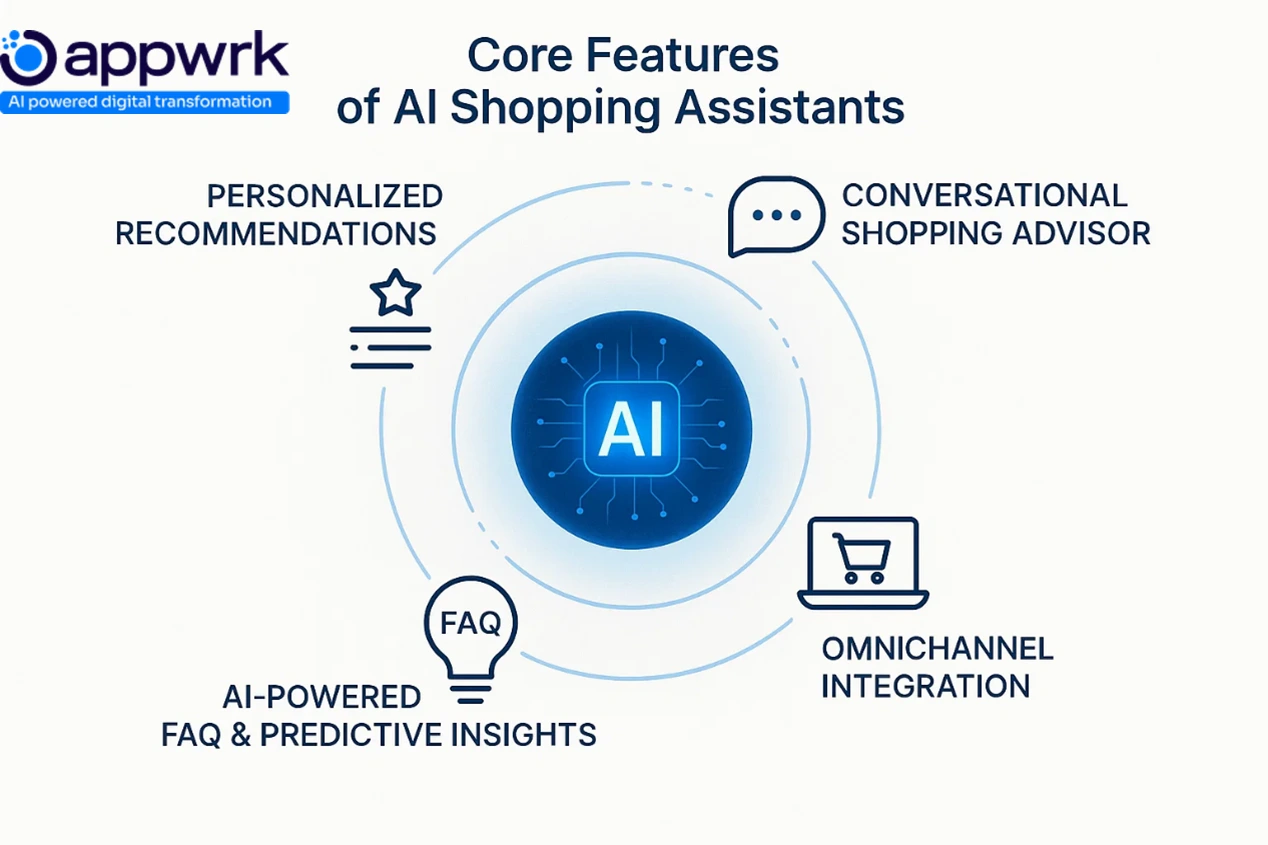
Key Features of AI Shopping Assistants
AI shopping assistants combine intelligence, personalisation, and automation to turn static stores into guided journeys. They predict intent, analyse behaviour, and provide real-time engagement that feels natural.
Whether built in-house or sourced from an eCommerce automation platform, AI shopping assistants simplify repetitive workflows and allow brands to focus on high-value interactions rather than manual merchandising tasks.
Today’s AI-powered retail personalization tools enable eCommerce businesses to move beyond static product suggestions. By analyzing browsing behavior and intent in real time, these systems create adaptive experiences that align with shopper goals and brand voice simultaneously.
Core Features include Personalised Product Recommendations: Tailored suggestions based on browsing and purchase history, boosting engagement and AOV.
Continuous Optimisation: Machine learning feedback loops that refine performance over time.
Implementing AI voice and chat agents into contact centers can cut your cost per call by nearly 50%. A McKinsey study found generative AI assistants helped agents resolve 14% more tickets per hour and reduced handling time by 9%.
Challenges and Limitations of Current AI Shopping Assistants
Many AI shopping agents still struggle with real-time context, biased data, and limited machine learning for online retail capacities. Despite rapid adoption, today’s AI shopping agents still face limitations in contextual reasoning, bias control, and reliance on structured data. Many lack advanced machine learning capabilities for online retail, which limits their ability to deeply personalise or predict intent across every channel.
Integrating Agentic AI frameworks and natural language understanding for Shopify is helping bridge these gaps. However, human oversight remains critical to ensure accuracy, empathy, and brand consistency. Overcoming these challenges will define the next phase of the AI commerce revolution, making personalisation more resilient and scalable.
What Trends Are Shaping the Next Generation of AI Shopping Assistants?
The rise of Agentic AI and AI Agent Commerce is accelerating the shift towards autonomous assistants in retail automation. AI shopping assistants are evolving from simple chat interfaces to intelligent autonomous agents for customer engagement that learn, predict, and personalise at scale. The next generation of AI-driven eCommerce solutions will be shaped by:
From Static Widgets to Learning Agents: Assistants that adapt with every interaction, refining discovery in real time.
Hyper-Personalisation and Predictive Analytics: Data-driven models predicting shopper intent and delivering proactive suggestions.
AI as Analyst: Shopping agents that not only recommend products but also suggest optimisation strategies for merchants.
Human + AI Hybrid Retail: AI takes over repetitive tasks, while humans manage nuanced conversations.
Ethical, Transparent AI: Consent-based personalisation becomes a long-term trust builder.
Integration with Smart Devices: Voice and contextual AI extending into connected homes.
Sustainable Shopping Guidance: AI factoring eco-friendly and ethical choices into recommendations.
Personalised Commerce at Scale: Cloud-based AI making 1:1 personalisation achievable even for mid-sized retailers.
According to Accenture and Digital Commerce 360, AI-powered shopping assistants are projected to influence nearly half of all product discovery by 2026, marking a decisive shift from static commerce to AI-native omnichannel experiences.
As AI shopping assistants continue to evolve, businesses that integrate conversational, predictive, and visual AI tools early will define the future of eCommerce personalization. From open-source tools to custom-built systems, the best AI shopping assistants for eCommerce now represent the new competitive advantage in online retail.
eCommerce AI Implementation Roadmap
Implementing an AI shopping assistant in your eCommerce ecosystem requires more than just technology, it needs a structured roadmap that balances customer experience, data readiness, and measurable ROI.
Below is a simple six-step roadmap to guide founders and eCommerce teams through the process:
Step 1: Audit Your eCommerce Ecosystem
Start by assessing your existing data infrastructure, product catalog, CRM, OMS, and customer journey analytics. Identify where AI can deliver the highest impact: product discovery, personalization, or customer support.
Step 2: Define Business Goals & Use Cases
Outline specific outcomes such as improving conversions, reducing bounce rate, or enhancing cross-selling. Prioritize one use case at a time for easier ROI measurement and tracking.
Step 3: Select the Right AI Shopping Assistant Model
Choose between conversational, visual, voice-enabled, or predictive assistants depending on your audience and industry. Evaluate off-the-shelf tools or opt for a custom AI shopping assistant for deeper personalization and control over your data.
Step 4: Integrate Seamlessly with Your Platform
Integrate your assistant into your Shopify, Magento, or WooCommerce store using APIs or AI plug-ins. Sync CRM data and train the model using historical behavior patterns to maintain contextual accuracy.
Step 5: Train and Test the AI Model
Feed the assistant with product data, FAQs, and real user queries. Conduct A/B tests on conversation flows and monitor response accuracy, engagement rate, and conversion improvements.
Step 6: Monitor, Optimize, and Scale
Use analytics dashboards to track performance, conversion rate lift, cart abandonment recovery, and support deflection. Refine responses and add new features such as voice, AR, or predictive elements as your system matures. This iterative approach ensures your AI shopping assistant evolves with your customers’ expectations and market trends.
AI Shopping Assistant Cost, Pricing, and ROI
Once your eCommerce AI roadmap is clear, the next step is understanding the cost, pricing models, and ROI of implementing an AI shopping assistant. While pricing varies based on complexity, the right investment can deliver significant long-term gains in personalization, automation, and conversions.
Cost Factors
Type of Assistant: Conversational, visual, voice-enabled, or predictive, each requires different data models and development efforts.
Integration Depth: Advanced integrations with Shopify, Magento, CRMs, or analytics systems increase both capability and ROI.
Training & Optimization: Larger product datasets and continuous AI model refinement drive accuracy and performance.
Scalability & Maintenance: Ongoing model training, analytics, and upgrades ensure consistent ROI growth over time.
Pricing Overview
Basic AI Chatbot Integration: Ideal for startups, includes rule-based automation and NLP training.
Advanced AI Shopping Assistant: Adds predictive personalization and omnichannel integration.
Enterprise AI Implementation: Full data ecosystem integration with AI analytics dashboards and multilingual support.
ROI Impact Brands adopting AI shopping assistants typically achieve:
15–25% increase in conversion rates
10–20% reduction in cart abandonment
20–30% improvement in retention
30–40% lower customer support costs
The ROI of AI shopping assistants lies not just in automation, but in creating continuous, personalized experiences that convert.
How Appwrk Can Help in AI Shopping Assistant Development
Appwrk has delivered 40+ AI-driven eCommerce projects, helping global brands boost conversions through custom AI shopping assistants that align with product catalogues, buyer behaviour, and brand tone.
Speed, Quality & Integration
We design and deploy AI-powered shopping assistants in 6–10 weeks. Our solutions benchmark against Shopify Sidekick and Salesforce Agentforce, offering scalable conversational intelligence through Shopify AI tools and Magento-ready integrations.
Security & Performance
Every build follows enterprise-grade security and privacy-by-design standards, ensuring full GDPR/CCPA compliance and reliable performance at scale.
Partner with Appwrk
Collaborate with our AI commerce development experts to:
Integrate assistants using OpenAI APIs, ChatGPT, or custom LLM pipelines.
Explore personalized AI frameworks for Shopify or Magento.
Transform static stores into intelligent, conversation-led commerce.
Appwrk combines deep AI engineering with personalization expertise, helping businesses accelerate growth through smarter, data-driven online experiences.
A Founder’s Guide to AI Shopping Assistants
For eCommerce founders, AI shopping assistants are no longer experimental add-ons. They are fast becoming the baseline of competitive retail. The right approach starts with clarity on data, audience, and the level of automation your brand needs.
Identify where customers drop off, whether during discovery, product comparison, or checkout, and deploy AI where it has the highest impact. Conversational commerce tools like Dialogue AI and Askflow handle engagement, while predictive personalisation platforms such as Vue.ai and Bloomreach drive retention and repeat purchases.
Adoption works best in phases:
Phase 1: Integrate conversational or recommendation assistants to validate ROI.
Phase 2: Expand with predictive analytics and AI-native omnichannel experiences.
Phase 3: Move toward agentic AI that automates end-to-end shopping journeys.
According to BCG’s AI Playbook, 84% of failed AI projects fail due to unclear ownership or lack of optimization. Founders who treat AI shopping agents as strategic growth engines, not just customer support add-ons, achieve faster scaling and stronger long-term data advantages.
The real impact of AI in commerce lies in crafting a personalized virtual shopping journey, where every customer interaction feels curated, responsive, and emotionally intelligent, transforming browsing into buying with precision and empathy.
By adopting the best AI shopping assistants for eCommerce, brands can future-proof their digital strategy and deliver 1:1 personalization at scale. In short: start small, measure impact, and let AI evolve with your customers.
FAQs
1. What are the best AI shopping assistants for eCommerce? Some of the best AI shopping assistants for eCommerce include Chatzap, Askflow AI, and iAdvize.They are ideal for validation before scaling. Appwrk helps eCommerce brands create custom AI assistants that boost conversions and personalize every customer interaction.
2. Are there AI shopping assistants available for free? Yes. Most leading platforms offer free or freemium plans that cover chat, product search, and basic recommendation features. Paid tiers unlock analytics, predictive personalisation, and API-level integration.
3. Which AI shopping assistants work best for clothing and fashion eCommerce? Fashion brands rely on The Yes, Vue.ai, and Humind for AI-powered outfit recommendations, styling advice, and visual product discovery.
4. Where can I find AI shopping assistant projects on GitHub? GitHub hosts open-source frameworks built with OpenAI API, LangChain, and Rasa, making it easier for teams to customise and deploy assistants on proprietary data.
5. How does Google’s AI shopping assistant work? Google Shopping Graph maps user queries to millions of live products across Search, YouTube, and partner sites, generating context-aware recommendations in real time.
6. What is Perplexity AI’s shopping assistant used for? Perplexity Shopping merges conversational AI with product comparison, helping users make faster decisions through contextual summaries.
7. What do Reddit users recommend as the best AI shopping assistants? Reddit communities often highlight Alby, Shopify Sidekick, and Salesforce Agentforce for their accuracy, easy integration, and strong personalisation.
8. How does Klarna’s AI shopping assistant improve customer experience? Klarna’s assistant, powered by OpenAI, automates two-thirds of customer interactions globally, managing post-purchase support, returns, and real-time product recommendations.
9. What is the best AI chatbot for eCommerce stores?
The best AI chatbots for eCommerce stores include Shopify Sidekick, iAdvize, and Humind for automating sales and customer engagement.
10. What are some examples of eCommerce chatbots?
Popular eCommerce chatbot examples are Alby, Chatzap AI, and Salesforce Agentforce, all designed to enhance conversions through conversational AI.
11. What are the best free Shopify AI shopping assistant alternatives?
Free Shopify AI shopping assistant alternatives include Chatzap AI, Askflow AI, and iAdvize for affordable conversational commerce.
12. What is an AI-based shopping assistant?
An AI-based shopping assistant is a digital agent that personalizes product discovery, comparisons, and recommendations using AI and data analytics.
13. What is a shopping assistant AI agent?
A shopping assistant AI agent helps users find, compare, and buy products faster through natural language and predictive recommendations.
14. What is the Salesforce AI shopping assistant?
Salesforce’s Agentforce is an AI shopping assistant that uses generative AI to deliver real-time product suggestions and customer support automation.
15. What is the Google AI shopping assistant?
The Google Shopping Assistant uses AI and its Shopping Graph to match user queries with live products, reviews, and prices across the web.
16. What is the best AI search engine for shopping?
Perplexity and Google’s AI Shopping Graph are among the best AI search engines for shopping, enabling smart, conversational product discovery.
17. What is a conversational AI for eCommerce?
Conversational AI for eCommerce enables real-time, human-like product guidance through natural language chatbots and shopping assistants.
18. What is an eCommerce chatbot project on GitHub?
Open-source eCommerce chatbot projects on GitHub often use OpenAI API, Rasa, or LangChain to build customizable AI shopping assistants.
19. What is the Salesforce AI shopping assistant? Salesforce’s Agentforce is a Salesforce AI shopping assistant that leverages generative AI and CRM data to deliver autonomous, real-time product suggestions.
Gourav Khanna is the Co-founder and CEO of APPWRK, leading the company’s vision to deliver AI-first, scalable digital solutions for enterprises and high-growth startups. With over 16 years of leadership in technology, he is known for driving digital transformation strategies that connect business ambition with outcome-focused execution across healthcare, retail, logistics, and enterprise operations.
Recognized as a strategic industry voice, Gourav brings deep expertise in product strategy, AI adoption, and platform engineering. Through his insights, he helps decision-makers prioritize market traction, operational efficiency, and long-term ROI while building resilient, user-centric digital systems.
Subscribe to APPWRK Blogs, We'll Do the Rest!
Get Blogs on UI/UX, Mobile Apps, Online Marketing, and Web development technology.
Unlock worthy and priceless suggestions from the masters of mobile and web app development