150+ minds across 4 countries. Join a culture of innovation, ownership & growth.
Rewire for AI
From machine learning to deep learning, from classification tools to overall process automation – our AI engineers will help you retool your existing system or enhance your company results.
Ship faster, scale smarter, built for product companies and SaaS teams
Our Latest Work
We strive hard to deliver result-driven digital solutions across the globe. Check out our case studies to get a glimpse of how we ideate, innovate, and create unconventional digital solutions according to the requirements of our clients.
Discover diverse and passionate insights from our tech enthusiasts. We collaborate across various sectors to streamline operations and drive innovation. Explore our rapidly growing collection of articles to see why we’re at the forefront of IT solutions.
The decision to move from Magento to Shopify is one of the most significant replatforming choices an ecommerce business can make. Magento is powerful, but its power comes with...
Accuracy gap is real: Traditional CPG forecasting carries a 25-40% MAPE error rate. AI-powered models bring that down to 8-15%, according to McKinsey research....
Real stories from global leaders who trusted us with their ideas.
Partnering with APPWRK helped us build a compliant and scalable healthcare platform, accelerating our time-to-market by 35%. Their team consistently delivered outstanding work.
Beesers
Digital Healthcare Client
Collaborating with APPWRK, Sportskeeda modernized its platform into a real-time sports engagement ecosystem, enabling seamless content delivery, scalable fan interactions, and high-velocity performance.
Sportskeeda
Sports & Entertainment Partner
Working with APPWRK was effortless. They captured our vision, maintained full compliance, and delivered a digital experience that built trust and elevated how customers interact with our fintech brand.
PayPenny
Fintech Partner
Working with APPWRK gave us confidence in adopting AI responsibly. Their team built a safe, intelligent bot that transformed how we engage with leads and helped us achieve measurable revenue growth.
IFB
AI Transformation Partner
Leveraging APPWRK’s digital expertise, Nemesis launched a scalable, compliant, and safe super app that connects content delivery, real-time communication, and logistics management within a single platform.
Nemesis
Super App Partner
Powering Partnerships, Transforming Supply Chains
Unlock collaborative tools that drive digital supply chain transformation.
This guide outlines the leading supply chain management platforms shaping global operations in today’s era. It compares legacy systems, such as SAP SCM, Oracle, Manhattan Active, and Blue Yonder Supply Chain Planning, with newer, AI-first solutions, including o9 Digital Brain Platform, Coupa Supply Chain Design & Planning, and RELEX Platform.
These SCM platforms now go beyond basic logistics and warehouse control; they support multi-tier visibility, demand planning, procurement automation, supplier collaboration, and risk-resilient, reliable, and sustainable operations across the extended supply chain.
Modern deployment trends include cloud-based, software-as-a-service (SaaS) models, IoT asset tracking, and advanced analytics, which help organisations improve forecast accuracy, reduce wastage costs, avoid overstocking or stockouts, and elevate customer satisfaction even during business uncertainty and market disruptions.
The tools highlighted here provide a structured framework for leaders evaluating investments in SCM solutions based on scalability, operational flexibility, deployment speed, global compliance, and alignment with future supply chain objectives.
Modern supply chains are facing unprecedented stress from geopolitical shifts, demand volatility, and regulatory pressure. To survive these disruptions, enterprises are moving toward digital supply chain management platforms that improve visibility, resilience, and operational flexibility.
The global SCM software market will reach $30.91 billion by 2026, growing at a 10.4% CAGR.
SCM platforms have evolved from transactional tools into intelligent, interconnected ecosystems that support demand planning, logistics execution, fulfilment, orchestration, and control tower oversight. This curated list prioritises tools based on AI maturity, integration depth, deployment speed, and enterprise readiness.
1. Appwrk Intelligent SCM Platform
For real-time orchestration across complex, distributed supply networks
What it does best Appwrk unifies AI-driven forecasting, anomaly detection, and live dashboards across suppliers, logistics networks, and inventory flows. It integrates seamlessly with SAP, Oracle, Blue Yonder, and major WMS/TMS systems, enabling multi-tier visibility, ESG tracking, and automated planning.
Why is it different Built for rapid deployment, Appwrk’s Intelligent SCM Platform creates connected, intelligent ecosystems without ripping out existing ERPs, ideal for organisations modernising legacy operations.
Case in Spotlight, Global FMCG Leader (500+ Warehouses) Challenge: Manual trailer tracking, slow check-ins, and zero yard visibility Solution:Appwrk-built Yard Management System (YMS) with multilingual support, role-based interfaces, and sub-second sync Outcome:
Best For Companies need logistics precision and fulfillment velocity.
5. Infor SCM
Industry-specific SCM with modular cloud suites
Core Focus Supplier collaboration, production planning, and inventory visibility.
Strengths
Embedded analytics
Manufacturing and distribution focus
Native Infor ERP integration
Best For Enterprises requiring sector-specific SCM workflows.
6. E2open
Network-centric platform for multi-enterprise collaboration
Core Focus Partner orchestration and real-time visibility across OEM and logistics networks.
Strengths
Predictive network analytics
Strong in automotive and high-tech ecosystems
Unified planning and execution layer
Best For Organisations with complex supplier ecosystems.
7. Coupa Supply Chain Design & Planning
For companies optimising cost-to-serve and global footprints
Core Focus Scenario planning, network modelling, and logistics design.
Strengths
Simulation-based decisioning
Integrated with Coupa sourcing
Continuous cost efficiency tools
Best For Firms re-architecting supply chain networks.
8. Körber Supply Chain
Warehouse-centric suite fit for automation-led scale
Core Focus WMS, robotics integration, and order orchestration.
Strengths
Strong in retail and logistics
Modular deployments
Robotics-ready execution layer
Best For Companies are scaling fulfilment accuracy and speed.
9. Epicor SCM
Practical SCM for mid-market manufacturers
Core Focus Production planning, procurement, and plant-level inventory control.
Strengths
Seamless Epicor ERP ties
Cost-efficient setup
Multi-site ready
Best For Growing manufacturers need control without complexity.
Emerging SCM Platforms to Watch
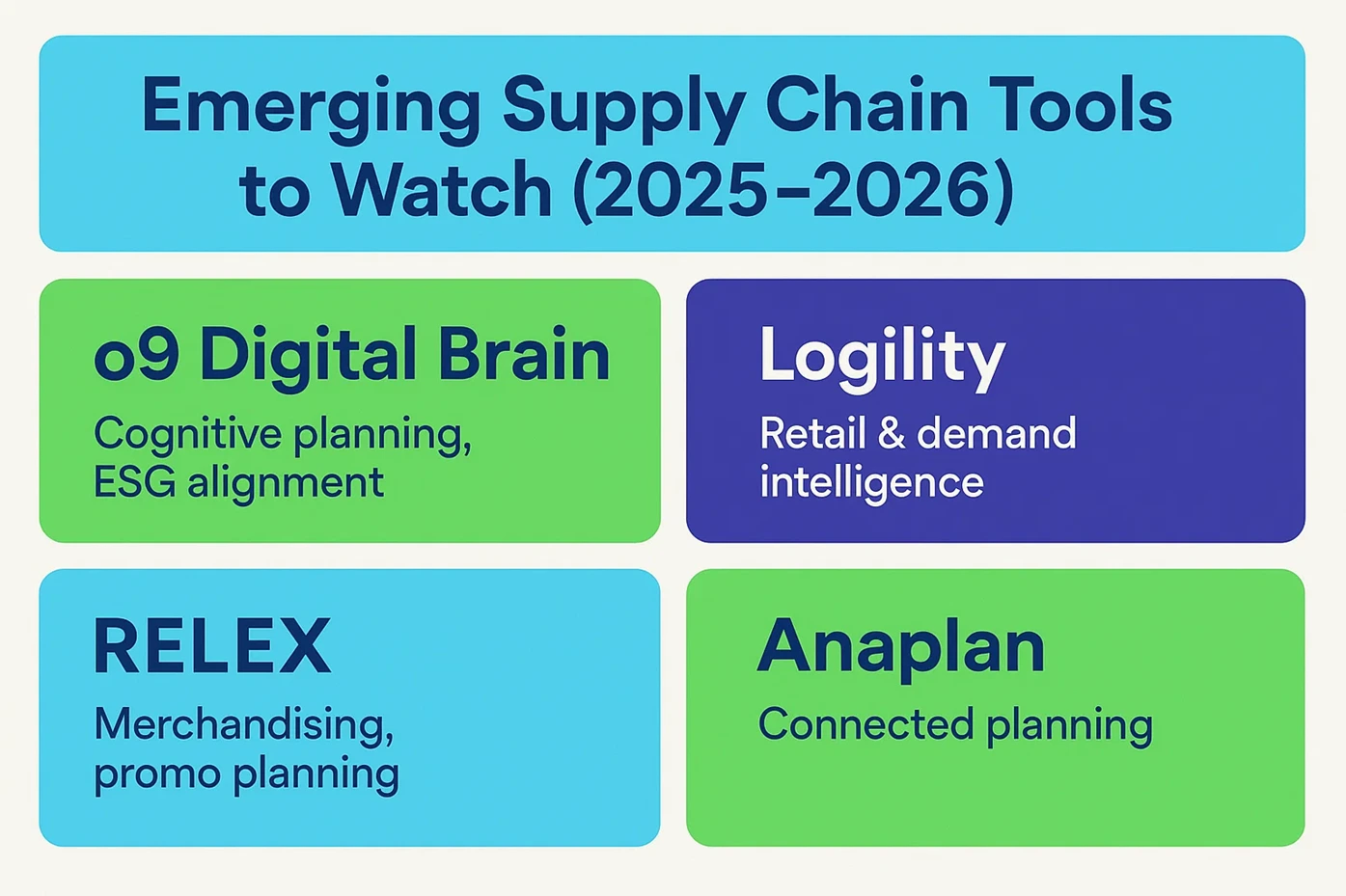
A new wave of supply chain management platforms is reshaping digital supply chain transformation throughAI-driven forecasting, advanced analytics, and always-on algorithms that enhance multi-tier visibility, decision speed, and resilience. These tools appeal to enterprises seeking operational flexibility, optimisation of end-to-end supply chains, and rapid deployment without heavy technical overhead.
Logility Decision Intelligence Platform
AI-powered decision automation for consensus demand planning, replenishment, and inventory control. Strong fit for consumer goods and apparel brands managing volatile demand.
o9 Digital Brain
A Cognitive Network Graph–based engine for predictive insights, ESG mapping, and real-time scenario modelling. Excels in integrated business planning and network design for global supply chains.
Anaplan Platform
A cloud-based, software-as-a-service (SaaS) planning ecosystem linking supply chain, finance, and sales. Known for alignment of planning decisions and cross-functional modelling.
RELEX Solutions
Retail-native platform specialising in forecast accuracy, replenishment planning, and overstock or stockout prevention. Ideal for companies facing seasonal disruptions and high SKU volumes.
GAINS
Focused on MEIO and detailed supply-side response planning to improve customer satisfaction and service levels while reducing wastage costs.
Unison Planning
Unified planning suite offering end-to-end planning and fulfilment visibility with long-range, simulation-ready workflows.
Arkieva Enterprise
Flexible digital model of supply chains for mid-to-large manufacturers. Strong in vendor requirements and S&OP alignment.
Slim4 (Slimstock)
Inventory-led planning tool designed to prevent stock obsolescence and ensure optimised service levels for regional and multi-site operators.
QAD Digital Supply Chain Planning
Part of QAD Adaptive Applications, supporting international shipments, agile manufacturing, and supplier collaboration with embedded advanced analytics.
Modern supply chain management platforms are no longer monolithic. They are segmented by functional priorities, deployment maturity, and the level of end-to-end supply chain optimisation they support:
Supply Chain Planning (SCP)
Platforms designed for forecast accuracy, demand sensing, production planning, and scenario modelling. These tools improve the alignment of planning decisions and help enterprises adapt to volatile business conditions and consumer expectations.
Logistics, TMS, WMS & Fulfilment Tools
Solutions for transportation management, warehouse operations, and last-mile orchestration. They optimise the flow of goods, data, and finances while reducing supply chain costs, transportation cost savings, and execution delays.
Inventory & Order Management Tools
Used to control stock across channels, enable replenishment planning, and prevent overstock or stockouts through multi-tier visibility and automated order orchestration.
Procurement & Supplier Collaboration
Focused on sourcing, contracting, approvals, and procurement of raw materials. These tools strengthen supplier relationships and reduce risk through ESG scoring, contract governance, and shared digital supply chain transformation workflows.
Risk, Cyber & ESG Monitoring Platforms
Platforms that monitor supply chain disruption, compliance, and cyber posture across the extended supply chain. Ideal for enterprises balancing regulatory demand, carbon footprints, and geopolitically driven uncertainties.
Integrated End-to-End SCM Suites
Unified control-tower environments that merge planning, execution, logistics, and analytics into a cloud-native global platform. They provide a true end-to-end view of operations and support risk-resilient, reliable, and sustainable operations.
Mandatory Features of Modern SCM Tools
Below is a concise feature set that every enterprise-grade SCM platform must support. These align with the user expectations around intelligence, automation, resilience, and interoperability.
Features of Modern SCM Tools
Why It Matters / What It Enables
Control-tower visibility
A real-time, unified operating picture for planning, logistics, procurement, and warehousing, ensuring all stakeholders act on the same live data, reducing delays and silos.
Multi-echelon inventory optimisation (MEIO)
Balances supply and demand across locations, improves working capital, and lowers wastage by reducing overstock or stockouts.
Predictive & prescriptive analytics
Uses data models and what-if scenarios to anticipate disruptions and recommend the best decisions, replacing reactive planning with proactive insights.
Automated workflows & exception management
Eliminates repetitive tasks, accelerates decision-making, and ensures rapid response during anomalies, vital for operational continuity.
ERP / WMS / TMS integration depth
Ensures a seamless planning, control, execution and monitoring framework across enterprise systems, enabling unified actions and avoiding fragmented operations.
IoT data ingestion & real-time monitoring
Connects logistics networks via GPS, RFID, and sensor data for international shipments, asset tracking, and environment monitoring, ensuring traceability and response accuracy.
Risk & supplier intelligence
Provides early warnings around supplier performance, compliance deviations, and geopolitical risks, helping firms maintain stability and avoid cascading failures.
Security, compliance & data governance
Protects sensitive operations and ensures regulatory readiness for multi-region deployments, critical in an era of cyberspace threats and increasing ESG audits.
Why These Features Are Essential
Modern supply chains operate across volatile markets, global logistics networks, and multi-tier partner ecosystems. These features are not optional add-ons; they are foundational for optimisation of end-to-end supply chains and enterprise-grade performance:
Real-time visibility and deep integration transform supply chains from fragmented functions into a unified end-to-end view, improving execution, responsiveness, and customer satisfaction.
Predictive and prescriptive analytics shift operations from reactive firefighting to proactive planning. Organisations gain forecast accuracy, scenario evaluation, and predictive insights that support strategic decision-making.
IoT-enabled automation enhances tracking, lowers manual workload, and scales operations across regions, peak seasons, and international shipments, reducing wastage costs and bottlenecks.
Risk intelligence and governance protect against supply chain disruption, regulatory pressures, and ESG expectations, ensuring risk-resilient, reliable and sustainable operations.
These capabilities define the difference between legacy tools and next-generation supply chain management platforms built for uncertainty, complexity, and global growth.
SCM Feature Coverage Table
This matrix maps leading SCM platformsagainst the eight mandatory enterprise capabilities discussed above. It provides enterprise teams with a fast, decision-ready benchmark for platform evaluation.
Modern supply chain management platforms follow flexible pricing models designed to match business maturity, deployment scale, and integration complexity:
1. Subscription-Based Licensing
A predictable monthly or annual fee for a cloud-based, software-as-a-service (SaaS) supply chain suite. This includes:
Best for enterprises seeking low upfront investment and faster adoption without infrastructure ownership.
2. Modular Pricing
Enterprises pay only for the SCM modules they use, such as procurement, warehouse execution, transportation orchestration, or supply chain visibility. Ideal for organisations scaling gradually from inventory management to end-to-end supply chain orchestration without committing to a full suite on day one.
3. Usage- or Consumption-Based Pricing
Costs scale based on:
API calls, shipment volumes, EDI transactions
Data ingestion from IoT sensors (RFID, GPS, cold-chain monitors)
Number of sites, warehouses, or logistics nodes
Perfect for seasonal operations or firms experimenting with automation, risk management, or demand-driven fulfilment.
4. Vendor License Packages + Renewals
Core licenses provide baseline capabilities (integration with ERP/WMS/TMS, planning, analytics), while advanced modules, like predictive models, ESG reporting, compliance layers are optional add-ons. This approach supports continuous adoption without heavy capital spend.
Net Advantage: These pricing models enable companies to scale features, control TCO, and adopt AI-first supply chain management software at their own pace.
5. Vendor responsiveness varies widely
Service levels during deployment and after go-live differ across providers. Firms should evaluate support quality, not just product features.
6. Governance is ongoing, not one-time
Post-deployment, strong governance frameworks are needed for workflow ownership, data quality reviews, and issue resolution processes.
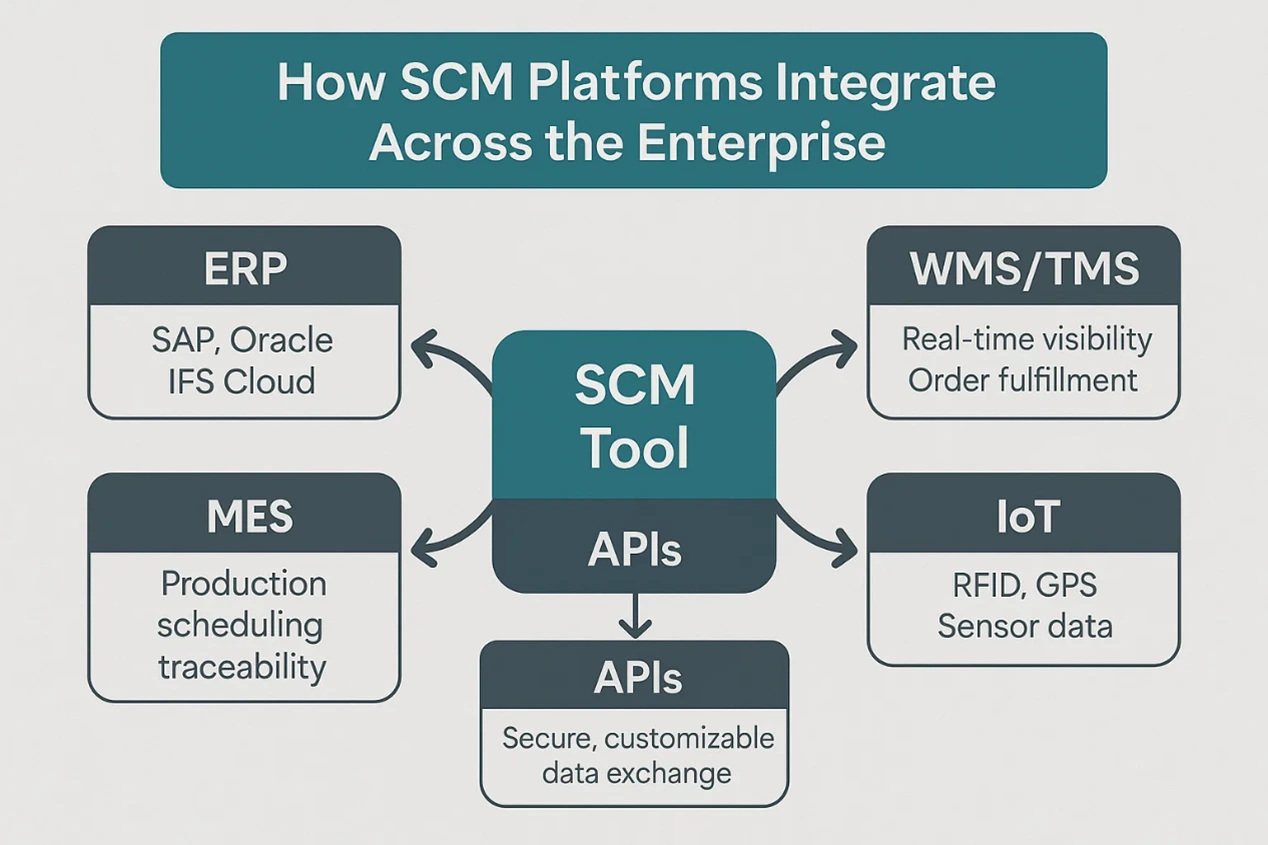
SCM Integration Strategy (ERP, TMS, WMS, IoT)
A modern SCM platform becomes the control tower for global operations only when integrations are done right:
ERP & SCM Integration
Platforms such as SAP IBP, Oracle SCM Cloud, and Microsoft Dynamics sync supply, finance, procurement, and manufacturing data. Outcome: alignment of planning decisions, streamlined financials, and real-time orchestration from suppliers to customers.
This ensures an end-to-end view of the flow of goods, data and finances.
IoT & Sensor Data
Ingestion from RFID, GPS, environmental nodes, and smart containers fuels:
Predictive maintenance
Continuous shipment traceability
Automated alerts for overstock or stockouts
Risk & Exception Workflows
Integrated networks help mitigate supply chain disruption, enable compliance, and support risk-resilient, sustainable operations.
The Result: A scalable, cloud-native global platform capable of digitalising end-to-end supply chain processes with minimal friction.
Peer Lessons Learned from SCM Implementations
Across deployments, leaders repeatedly encounter the same friction points:
Data readiness is underestimated –
Forecasting models collapse without cleansed supplier and SKU data.
Integrations slow time-to-value –
Even API-rich systems require structured mapping.
Global scaling adds hidden complexity –
Timezone logic, localisation, and multilingual UI are non-negotiable.
Change management ≠ training –
Workflows must reinforce usage incentives.
Vendor responsiveness varies –
Support quality is more decisive than feature lists.
Governance never stops –
Ownership roles and data quality reviews must continue post-launch.
USA vs Global SCM Technology Landscape
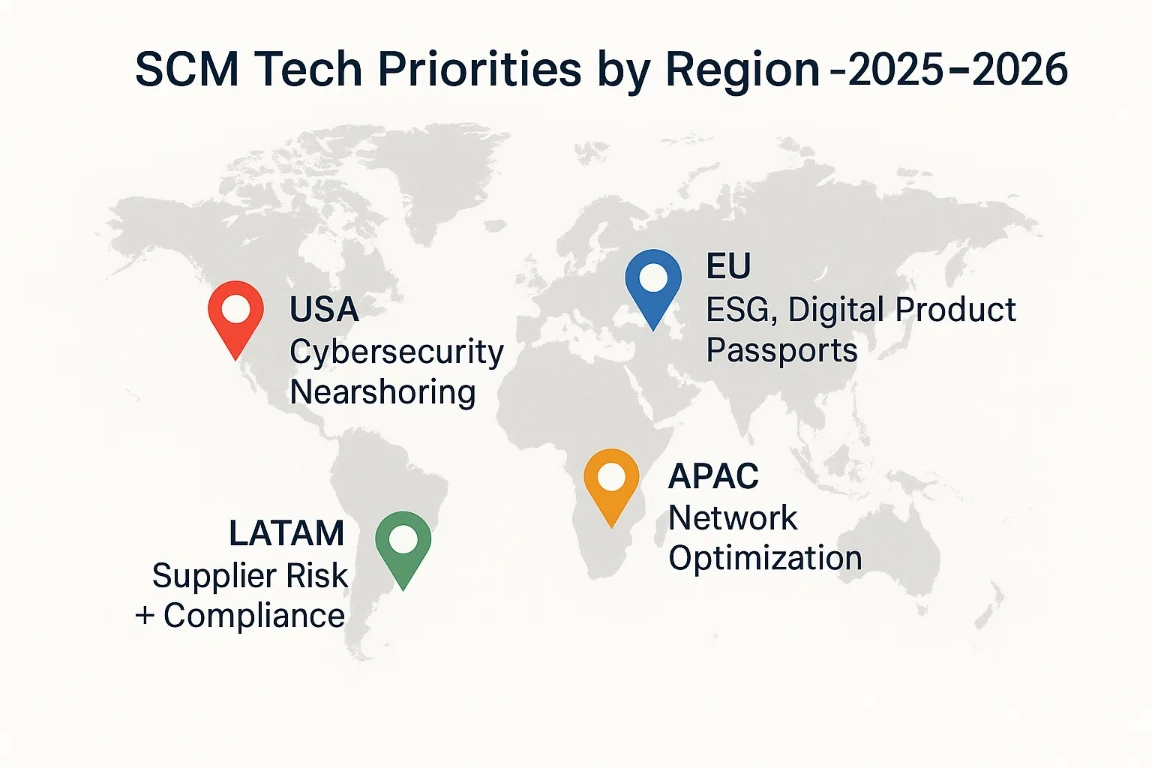
Supply chain strategies vary by region, shaped by local regulations, labor constraints, ESG mandates, and cost pressures. Here’s how technology priorities shift:
USA – Cybersecurity, Compliance & Nearshoring
Focus on secure platforms with NIST and SOC 2 compliance
Nearshoring drives demand for agile, North America-centric planning tools
Emphasis on AI-led inventory optimization and fulfillment
Latin America – Compliance, Cost Control & Supplier Risk
Inflationary pressure makes cost visibility key
High demand for supplier risk scoring and workflow automation
Compliance tools for import/export and cross-border visibility
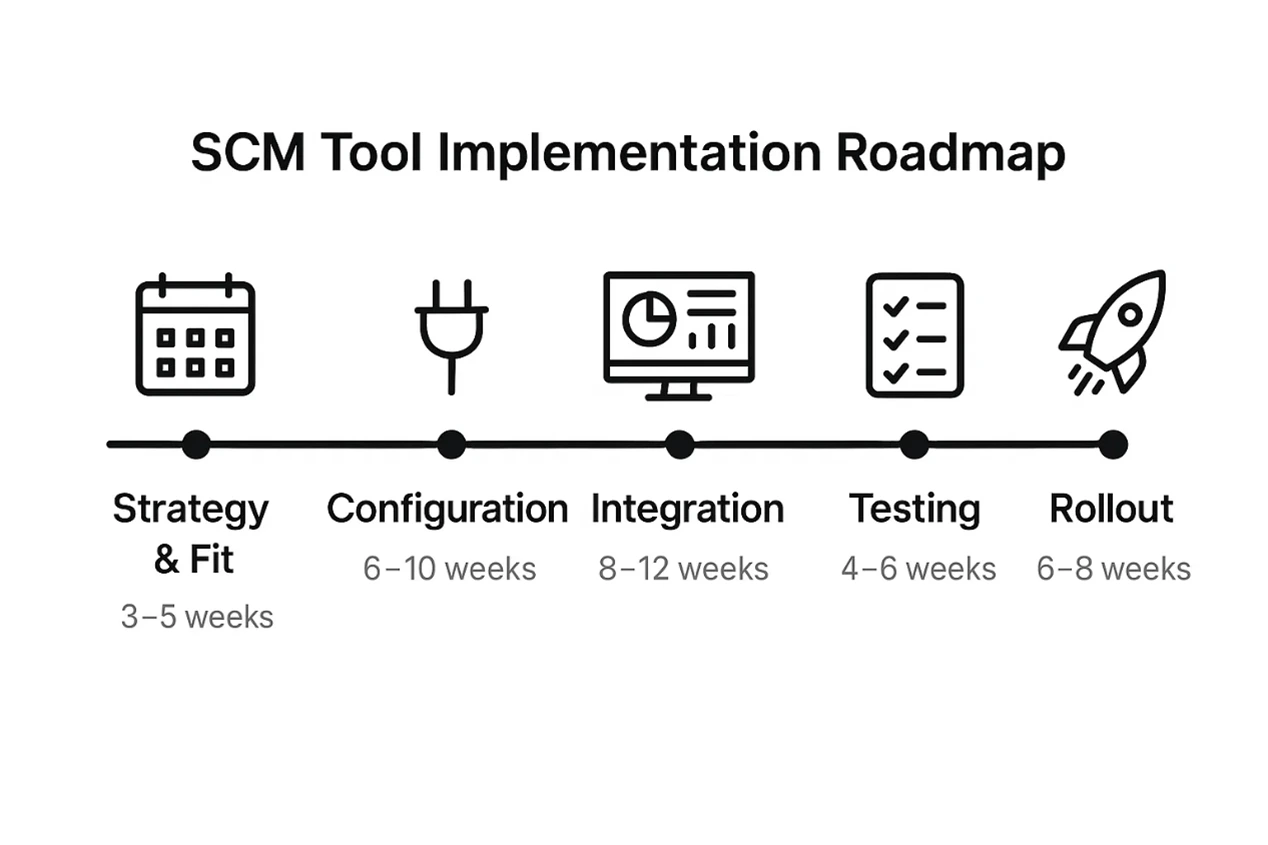
Implementation Timeline for SCM Tools
A typical supply chain management platform rollout spans 6–9 months, influenced by integration depth, data readiness, and global deployment complexity.
Phases of SCM Tool Development
Duration
Key Activities
Strategy & Fit Assessment
3–5 weeks
Current-state mapping, gap assessment, vendor shortlist, alignment with business conditions
Configuration
6–10 weeks
Workflow setup, data models, security profiles, planning rules
Integration
8–12 weeks
Connectivity across ERP / WMS / TMS / APIs, IoT and logistics networks
Q. How do I choose one? Match needs with integration depth (ERP/WMS/TMS), analytics maturity, and scalability.
Q. Do SCM platforms support AI and real-time data? Yes, modern suites offer predictive and prescriptive analytics, IoT ingestion, and exception workflows.
Q. Can these tools handle global operations? Yes, top platforms support multi-tier visibility, multilingual rollouts, and compliance layers.
Q. Are ESG requirements supported? Leading tools provide ESG scoring, emissions tracking, and circular-economy modules.
Q. Implementation timeline? 6–9 months for enterprise environments.
Q. Typical pitfalls? Poor data quality, integration complexity, limited governance, and weak change management.
Q. Suitable for mid-sized firms? Yes, modular models and cloud-native deployment remove heavy upfront investment.
Gourav Khanna is the Co-founder and CEO of APPWRK, leading the company’s vision to deliver AI-first, scalable digital solutions for enterprises and high-growth startups. With over 16 years of leadership in technology, he is known for driving digital transformation strategies that connect business ambition with outcome-focused execution across healthcare, retail, logistics, and enterprise operations.
Recognized as a strategic industry voice, Gourav brings deep expertise in product strategy, AI adoption, and platform engineering. Through his insights, he helps decision-makers prioritize market traction, operational efficiency, and long-term ROI while building resilient, user-centric digital systems.
Subscribe to APPWRK Blogs, We'll Do the Rest!
Get Blogs on UI/UX, Mobile Apps, Online Marketing, and Web development technology.
Unlock worthy and priceless suggestions from the masters of mobile and web app development