150+ minds across 4 countries. Join a culture of innovation, ownership & growth.
Rewire for AI
From machine learning to deep learning, from classification tools to overall process automation – our AI engineers will help you retool your existing system or enhance your company results.
Ship faster, scale smarter, built for product companies and SaaS teams
Our Latest Work
We strive hard to deliver result-driven digital solutions across the globe. Check out our case studies to get a glimpse of how we ideate, innovate, and create unconventional digital solutions according to the requirements of our clients.
Discover diverse and passionate insights from our tech enthusiasts. We collaborate across various sectors to streamline operations and drive innovation. Explore our rapidly growing collection of articles to see why we’re at the forefront of IT solutions.
The decision to move from Magento to Shopify is one of the most significant replatforming choices an ecommerce business can make. Magento is powerful, but its power comes with...
Accuracy gap is real: Traditional CPG forecasting carries a 25-40% MAPE error rate. AI-powered models bring that down to 8-15%, according to McKinsey research....
Real stories from global leaders who trusted us with their ideas.
Partnering with APPWRK helped us build a compliant and scalable healthcare platform, accelerating our time-to-market by 35%. Their team consistently delivered outstanding work.
Beesers
Digital Healthcare Client
Collaborating with APPWRK, Sportskeeda modernized its platform into a real-time sports engagement ecosystem, enabling seamless content delivery, scalable fan interactions, and high-velocity performance.
Sportskeeda
Sports & Entertainment Partner
Working with APPWRK was effortless. They captured our vision, maintained full compliance, and delivered a digital experience that built trust and elevated how customers interact with our fintech brand.
PayPenny
Fintech Partner
Working with APPWRK gave us confidence in adopting AI responsibly. Their team built a safe, intelligent bot that transformed how we engage with leads and helped us achieve measurable revenue growth.
IFB
AI Transformation Partner
Leveraging APPWRK’s digital expertise, Nemesis launched a scalable, compliant, and safe super app that connects content delivery, real-time communication, and logistics management within a single platform.
Nemesis
Super App Partner
Building Intelligent Workplaces, Together
Partner with Appwrk to transform workplace operations through a scalable, enterprise-grade IWMS built for long-term growth and measurable ROI.
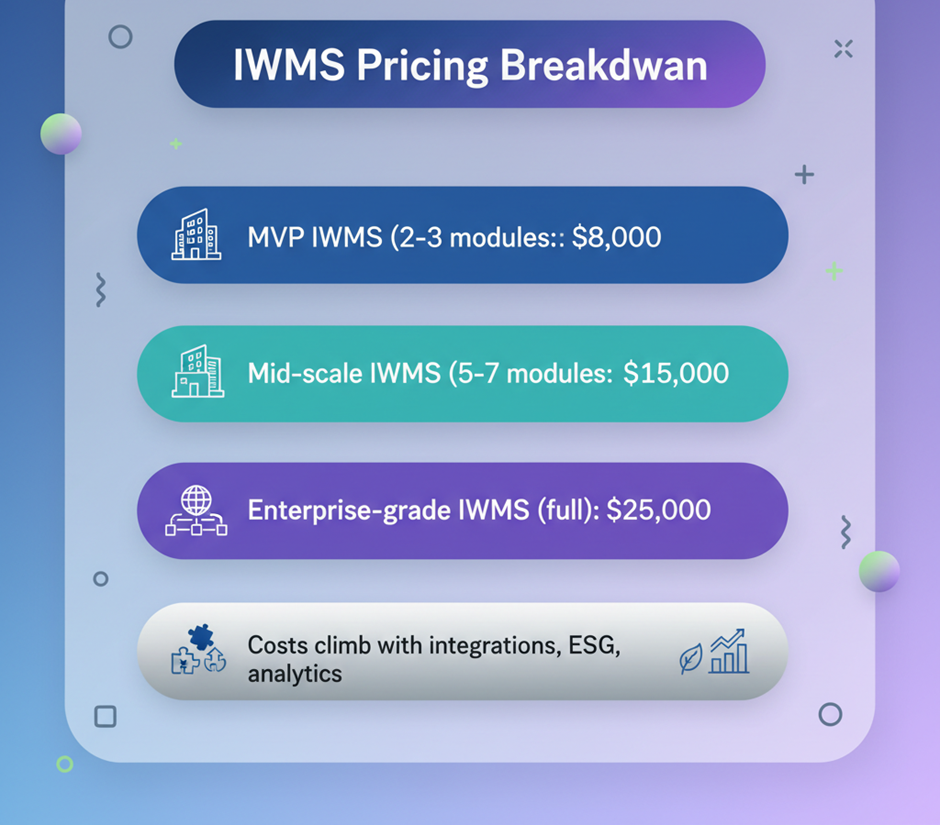
Building an Integrated Workplace Management System (IWMS) can start as low as $8,000, depending on module depth, integrations, deployment model, and long-term cost of ownership for IWMS.
A modern Integrated Workplace Management System (IWMS software) goes far beyond facilities tools; it unifies real estate management, space management, asset management, maintenance management, lease management, capital project management, vendor management, and sustainability tracking into one centralised database and single source of truth.
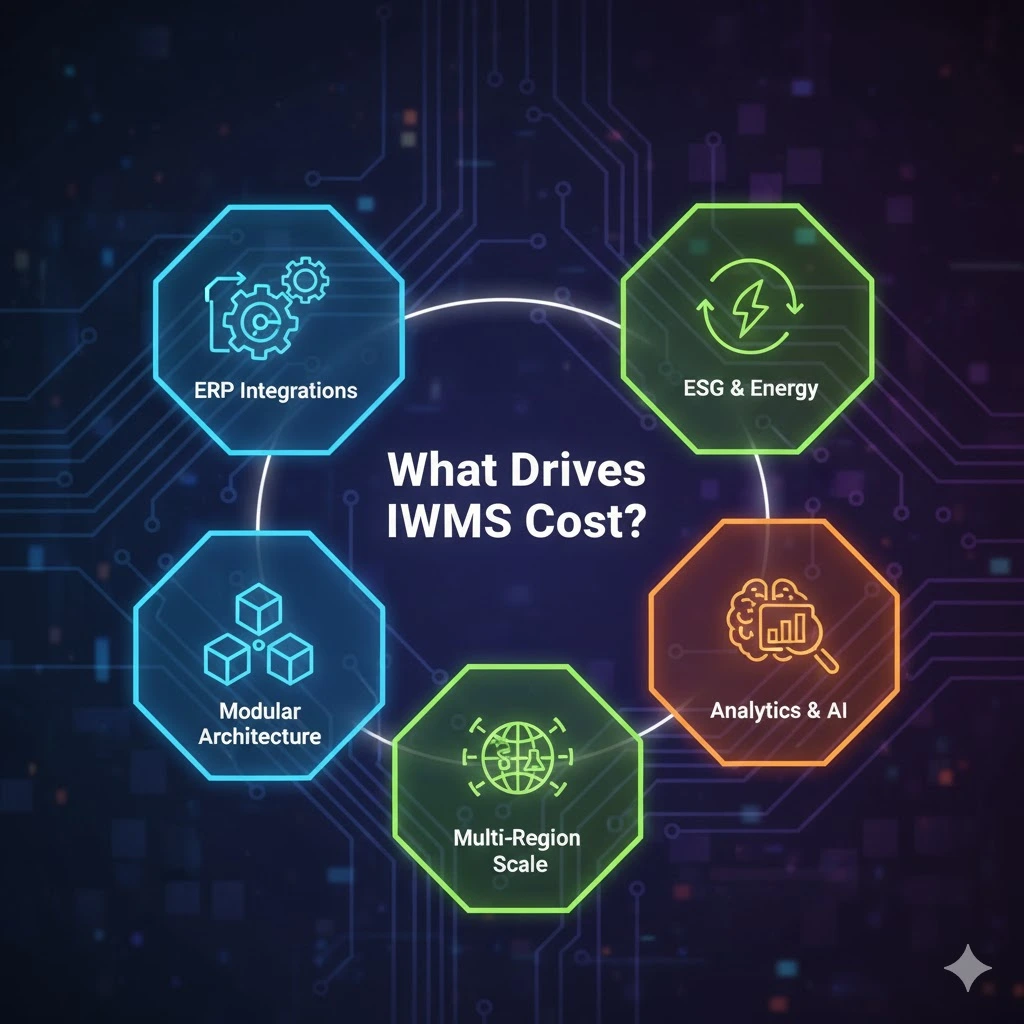
The largest cost drivers include ERP integration, cloud-based or on-premise deployment, modular architecture, energy & ESG compliance, space utilisation analytics, IoT-enabled maintenance, and enterprise-grade automation required for scalable workplace operations.
Organisations reduce implementation costs through SaaS or modular IWMS solutions, enabling phased adoption of core modules such as facilities management, move management, and space and resource utilisation instead of building the full platform upfront.
What Is an Integrated Workplace Management System (IWMS)?
An Integrated Workplace Management System (IWMS solution) is an enterprise-grade platform that unifies real estate, facilities management, space utilisation, maintenance management, asset management, and capital project management into a single source of truth (centralised database).
Unlike siloed tools, an IWMS provides real-time insights, reduces operational costs, automates compliance tracking, and strengthens governance across workplace operations.
At scale, IWMS software enables:
Portfolio-wide cost optimisation
Space and resource utilisation intelligence
Predictive maintenance and asset lifecycle planning
ESG compliance and sustainability goal tracking
Executive dashboards for workplace strategy and decision-making
It becomes the core unified platform connecting corporate real estate, facilities service teams, operations, finance, and sustainability leadership.
Core Objectives of an IWMS
The purpose of an IWMS is not limited to workflows; it enables enterprise decision intelligence.
Key IWMS objectives include:
Centralised workplace intelligence across facilities, assets, and the real estate portfolio
Portfolio-level cost optimisation with unified financial and operational visibility
Stronger regulatory compliance and ESG readiness
Data-driven decisions on space utilisation, energy management, and asset performance
A unified system that supports long-term workplace strategy and digital transformation
Organizations that treat IWMS as an enterprise intelligence platform, not merely a facilities system, achieve higher ROI, better governance, and scalable operational performance.
How Much Does It Cost to Build an IWMS?
Here is a simplified and competitive pricing structure aligned with your request for lower cost positioning while remaining realistic for global delivery:
Costs climb once you introduce portfolio-level real estate management, enterprise integrations, sustainability/ESG modules, and automated analytics. These modules generate the strongest long-term ROI, but require structured sequencing and governance.
IWMS Development Cost Overview: Understanding the True Cost of Building an IWMS
An Integrated Workplace Management System (IWMS) has evolved into a core enterprise platform rather than a facilities add-on. It centralises real estate, space, assets, maintenance, and sustainability data into a single system of record, enabling stronger decision-making, operational visibility, and cost optimisation across the organisation.
IWMS development costs vary based on functional scope, ERP integrations, cloud architecture, data quality, and the ability to scale across regions. Because the platform supports workplace operations, ESG compliance, and portfolio management, even early architectural decisions have a significant impact on long-term ROI.
Compared to standalone tools such as CAFM or CMMS, IWMS carries a broader cost profile due to its coverage of multiple domains, including real estate, facilities, space, maintenance, assets, vendors, and capital projects.
Three core dimensions determine IWMS development cost:
1. Functional breadth: How many modules do you include (e.g., lease management, move management, energy management, vendor management, sustainability tracking)?
2. Enterprise complexity: Depth of Enterprise Resource Planning (ERP) integration, number of regions, data volume, and compliance requirements.
3. Technology maturity: Use of cloud-based deployment, artificial intelligence (AI), automation, analytics, and modular architecture.
Enterprises manage cost most effectively when they adopt a modular rollout, launching high-impact IWMS modules first and expanding based on measurable ROI.
Common Workplace Challenges Without an IWMS
Enterprises operating without an Integrated Workplace Management System (IWMS) rely on disconnected tools like Computer-Aided Facility Management (CAFM), Computerised Maintenance Management Systems (CMMS), spreadsheets, and manual workflows. These fragmented systems create data silos, slow decision-making, and increase the overall cost of ownership across workplace operations.
Without a unified platform or centralised database, leadership lacks visibility into real estate management, asset health, space utilisation, maintenance performance, and compliance exposure, leading to higher operational costs and inefficiency.
Typical challenges include:
Disconnected CAFM, CMMS, and lease systems Data remains scattered across enterprise applications, preventing coordinated planning.
Manual tracking of leases, assets, and compliance Increases the risk of missed renewals, failed audits, and operational bottlenecks.
Underutilised workplace and portfolio space Poor occupancy insights lead to paying for space the business doesn’t need.
Limited ESG and sustainability tracking Energy benchmarking, carbon reporting, and sustainability goals become difficult to measure.
Rising maintenance and operational costs Reactive maintenance and poor asset lifecycle visibility inflate long-term OpEx and CapEx.
Cost implication: Individually manageable issues compound into higher operational costs that are often greater than the investment required for a unified IWMS solution.
Key IWMS Modules and Their Cost Impact
Not every IWMS module contributes equally to development cost. Modules involving large data sets, financial accuracy, or compliance logic require more engineering effort. Cost impact is determined by data complexity, integration depth, and audit requirements, not just feature counts.
IWMS Module
What It Covers
Cost Impact
Real estate & lease management
Portfolio, leases, and financial terms
High
Space & workplace management
Space utilisation, moves, layouts
Medium
Asset & maintenance management
Preventive, reactive, and asset lifecycle
High
Capital project management
CapEx planning, project execution
Medium
Sustainability & energy management
ESG compliance, energy data
High
Service request management
Tickets, workflows, SLAs
Low–Medium
Where Costs Escalate the Most
High-cost modules typically involve:
Complex or historic data ingestion
Tight integration with ERP systems and lease accounting
Phase 3: Advanced capabilities: AI automation, forecasting, digital twins
This approach reduces rework and accelerates time-to-value.
IWMS vs CAFM vs CMMS: Cost and Scope Comparison
Organisations often begin with CAFM or CMMS tools but eventually outgrow them as portfolio management, sustainability tracking, and enterprise compliance requirements expand. While these platforms overlap, they differ significantly in scope, architecture, and total cost of ownership.
IWMS, CAFM & CMMS: Cost and Capability Comparison
IWMS costs more than CAFM or CMMS because it includes:
Unified platform connecting real estate, facilities, assets, finance, and sustainability
Portfolio-level analytics, not siloed reports
Financial logic for leases, assets, energy, and CapEx
Integration with ERP, HRMS, IoT systems, and energy platforms
Multi-region configuration and compliance tracking
CAFM and CMMS solve operational tasks. IWMS enables strategic decision-making across the enterprise.
Decision Guidance
Choose CMMS → when maintenance efficiency is the main priority
Choose CAFM → for space management and facilities operations.
Choose IWMS → for enterprise-wide visibility, ESG compliance, cost optimisation, and real estate strategy.
Platform
Primary Scope
Typical Cost (Build / Deploy)
Best Fit
CMMS
Maintenance management, work orders
$5,000–$20,000
Asset-heavy ops, plants, basic maintenance teams
CAFM
Facilities ops, space & moves
$10,000–$40,000
Corporate offices, facility & admin teams
IWMS
End-to-end workplace, real estate, ESG
$25,000–$120,000
Mid–large enterprises, portfolio-led orgs
Most enterprises accumulate multiple CAFM and CMMS tools over the years. Their combined licensing costs, integrations, and operational overhead often exceed the cost of building a unified IWMS.
Factors That Influence IWMS Development Cost
The cost to build an Integrated Workplace Management System (IWMS) depends on scope, integrations, compliance needs, and long-term scalability. Even small changes in these areas can shift the total cost of ownership.
Key cost drivers include:
Functional scope & customisation More modules (e.g., lease management, move management, energy management) and deeper workflow customisation increase engineering effort.
Deployment model Cloud-based deployment is the most cost-efficient. Hybrid or on-premise solutions require additional infrastructure and increase cost.
Enterprise integrations Integrations with Enterprise Resource Planning (ERP) systems, Human Resource Management Systems (HRMS), Internet of Things (IoT) devices, Building Management Systems (BMS), and ESG tools add API and testing overhead.
Security & compliance Meeting SOC 2, ISO 27001, General Data Protection Regulation (GDPR), and audit-trail requirements typically adds 10–20% to total build cost.
AI & analytics Predictive maintenance, space forecasting, and energy benchmarking require data pipelines and machine learning, increasing upfront cost but improving long-term ROI.
Global scale Multi-region, multi-language, and multi-currency support adds configuration and QA complexity.
Ongoing ownership cost Maintenance, DevOps, and support generally require 15–25% of the initial build cost annually.
IWMS cost is driven more by enterprise complexity, data volume, and scalability expectations than by UI or feature count.
Global Regional Cost Analysis for IWMS
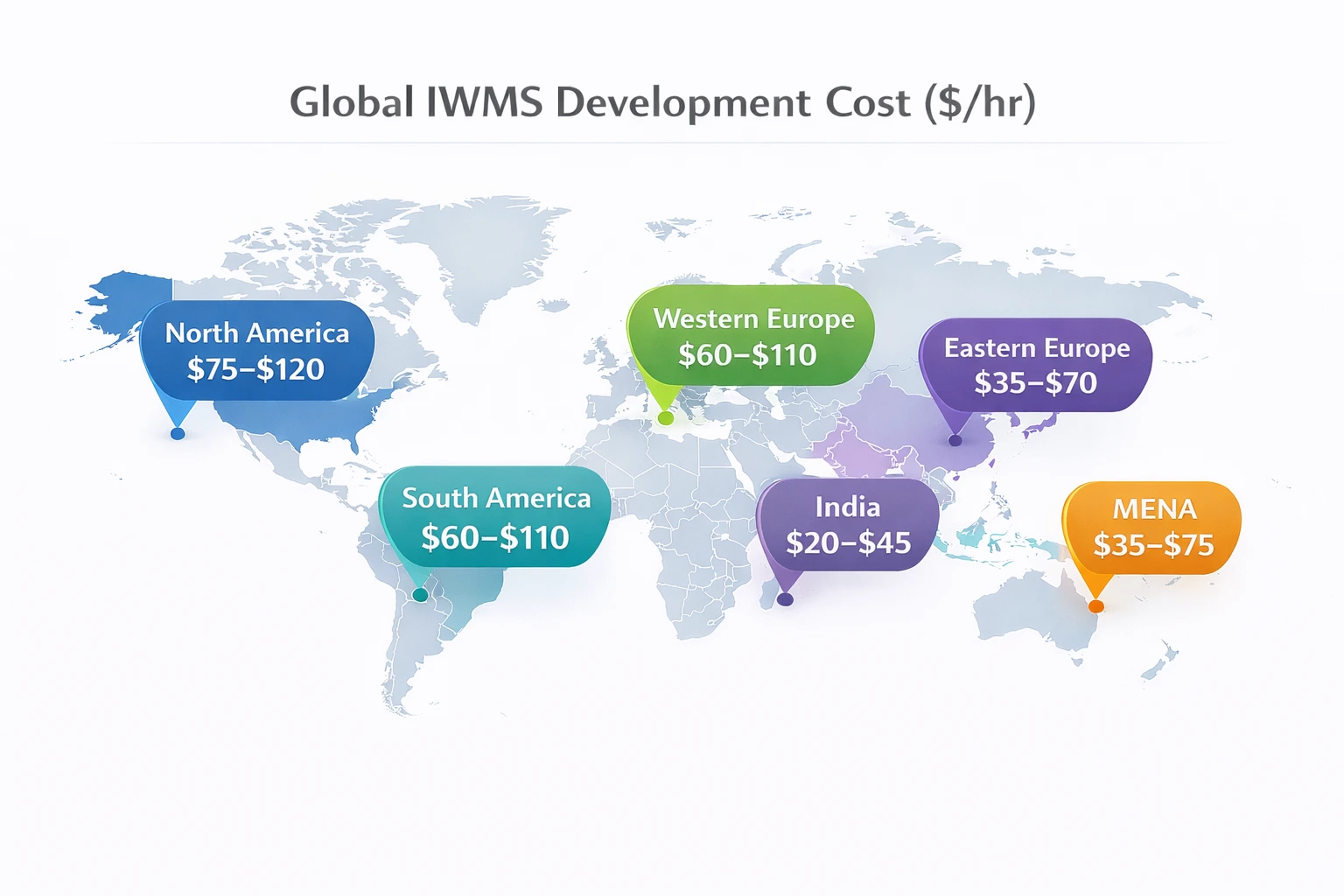
IWMS development cost differs across regions due to engineering rates, compliance maturity, and availability of enterprise system talent. Most large organisations use a hybrid delivery model to optimise cost and expertise.
North America: Low cost efficiency ($75–$120/hr) Deep IWMS domain expertise with strong SOC 2, ISO, and ESG compliance maturity, but higher delivery and scaling costs.
Western Europe: Medium–Low efficiency ($60–$110/hr) Regulation-heavy markets with strong security, sustainability, and data governance capabilities.
Eastern Europe: Medium efficiency ($35–$70/hr) Solid backend engineering, system integration skills, and cost-effective delivery for enterprise platforms.
India: High efficiency ($20–$45/hr) Best cost-to-scale ratio globally, with strong capabilities in cloud-native architecture, IoT, analytics, and enterprise-grade IWMS builds.
MENA: Medium efficiency ($35–$75/hr) Strength in localisation, government-led projects, and regulatory customisation, with moderate delivery costs.
Choosing the right IWMS strategy directly impacts cost, flexibility, and scalability. Many enterprises underestimate how quickly SaaS licensing fees and customisation costs accumulate.
Custom-Built IWMS (Recommended for Long-Term Scale)
A custom-built IWMS is designed as a core enterprise platform, not a rented tool.
Purpose-built around your real estate, facilities, and ESG workflows
Full ownership of data, security architecture, and system IP
Easier alignment with ERP, HRMS, BMS, IoT, and ESG reporting frameworks
Predictable long-term cost with no per-user or per-module licensing creep
Best suited for: Enterprises with complex portfolios, multi-region operations, regulatory exposure, and long-term digital workplace strategies.
A build-led hybrid approach combines custom IWMS architecture with selective third-party components where it makes sense.
Custom-built core platform with modular expansion
Faster deployment than full-suite builds while retaining control
Lower 5–7 year total cost of ownership compared to SaaS
Strong governance, compliance readiness, and scalability
For enterprises operating across regions, a build-led or fully custom IWMS consistently delivers the highest ROI over 5–7 years, balancing flexibility, security, and cost control.
Hidden Costs in IWMS: Total Cost of Ownership
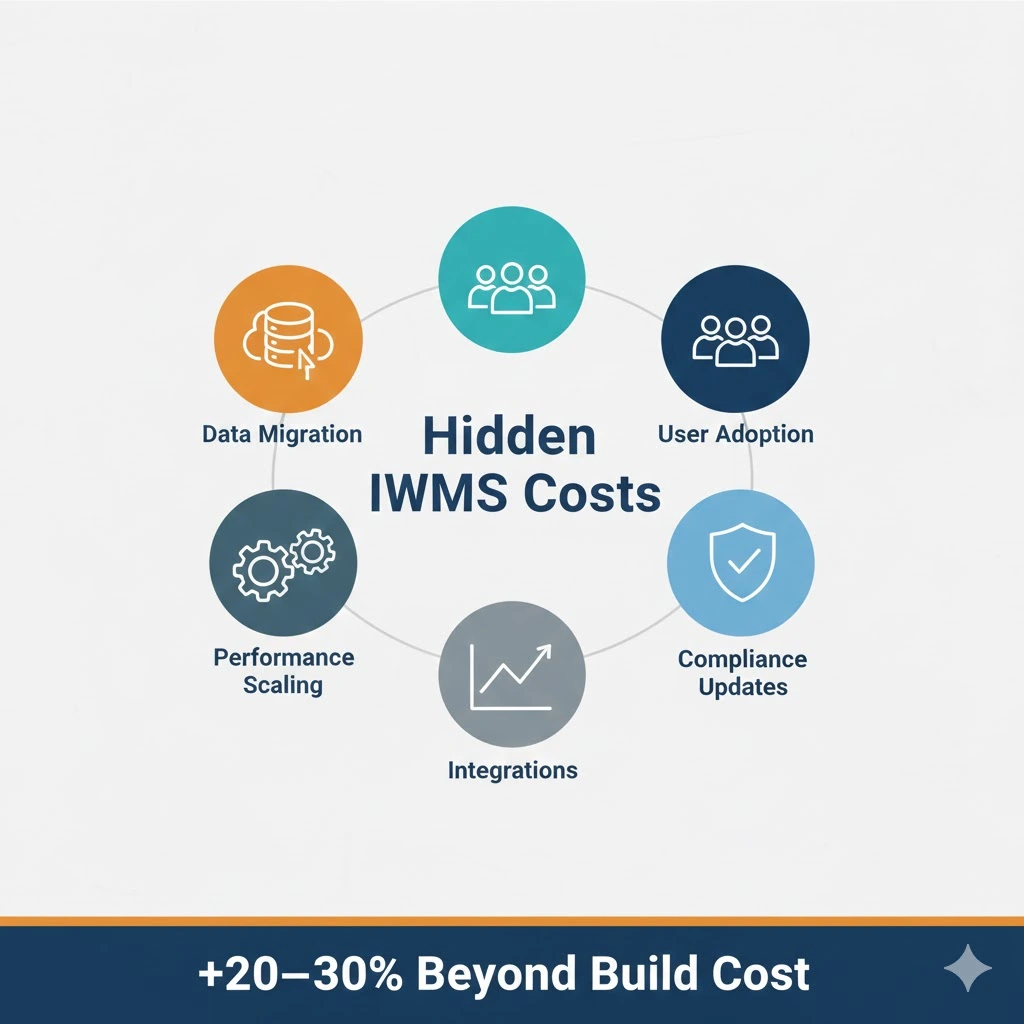
The visible build cost is only part of the actual investment. Many expenses surface during rollout or scale-up.
Common hidden cost areas:
Data cleansing & migration Legacy real estate, asset, and facilities data often needs heavy normalisation.
User training & adoption Adoption gaps slow ROI and increase support costs across global teams.
Third-party integrations ERP, HRMS, BMS, and ESG systems may add recurring licensing or usage fees.
Performance tuning As data and users grow, infrastructure must be optimised.
Executive takeaway: Enterprises should budget 20–30% beyond initial build cost to cover adoption, scaling, and long-term platform health.
AI-First IWMS: Cost vs Competitive Advantage
AI-enabled Integrated Workplace Management System (IWMS) platforms cost more to build initially, but they deliver far stronger long-term ROI by shifting workplace operations from reactive management to predictive optimisation.
Where AI increases IWMS development cost:
Building data pipelines, cleansing, and normalisation
Machine learning (ML) model training and refinement
How Appwrk Helps Build Scalable, Cost-Efficient IWMS Platforms
Appwrk builds Integrated Workplace Management System (IWMS) platforms that balance cost, scalability, and long-term ROI through modular architecture and efficient delivery models.
How Appwrk adds value:
Enterprise-grade architecture: Cloud-native IWMS with SOC 2 / ISO-ready security, centralised databases, and scalable modules.
Cost-efficient global delivery: Hybrid onshore–offshore teams reduce IWMS development cost while maintaining quality and compliance.
Modular rollout: Start with high-impact modules (space, maintenance, real estate management) and scale into ESG, AI, and analytics as needed.
Strong integration capabilities: Expertise in ERP integration (SAP, Oracle, Dynamics), HRMS, BMS, IoT, and sustainability tools.
AI-ready foundation: Systems designed for predictive maintenance, space forecasting, energy optimisation, and real-time insights.
Founder’s Guide to IWMS Investment Decisions
IWMS (Integrated Workplace Management System) investment is a strategic enterprise decision, influencing real estate cost, sustainability reporting, compliance, and workplace operations. Founders and CXOs should evaluate IWMS as a long-term business platform, not a facilities tool.
Key decisions leaders must get right:
Start with a modular MVP, not a full-suite rollout Begin with high-impact modules like space management, service requests, and asset management before scaling into lease management, ESG compliance, analytics, or AI capabilities.
Avoid over-customisation in Phase 1 Standardize where possible; only customise workflows that directly impact differentiation, adoption, or portfolio performance.
Define success metrics upfront Anchor your IWMS to measurable KPIs such as space utilisation, cost optimisation, OpEx reduction, compliance performance, and sustainability tracking.
Align the IWMS with ESG reporting needs Ensure the data model supports energy benchmarking, carbon reporting, audit trails, and executive dashboards from the start.
Budget beyond Year 1 Plan for future enhancements, new integrations (ERP integration, HRMS, IoT, BMS), AI modules, and user adoption initiatives.
Founder takeaway: The strongest IWMS outcomes come from treating the platform as a multi-year product roadmap, not a one-off IT deployment.
How much does it cost to build a custom IWMS globally?
Custom IWMS development typically starts as low as $8,000 for an MVP and scales based on module depth, integrations, AI features, and portfolio size.
Is IWMS pricing user-based or module-based?
Custom IWMS software follows a module-based cost model, while SaaS IWMS tools use user-based or site-based licensing.
Can IWMS integrate with SAP, IBM Maximo, or Workday?
Yes. Enterprise IWMS platforms commonly support ERP integration, EAM, HRMS, and BMS systems. Integration depth directly affects development cost.
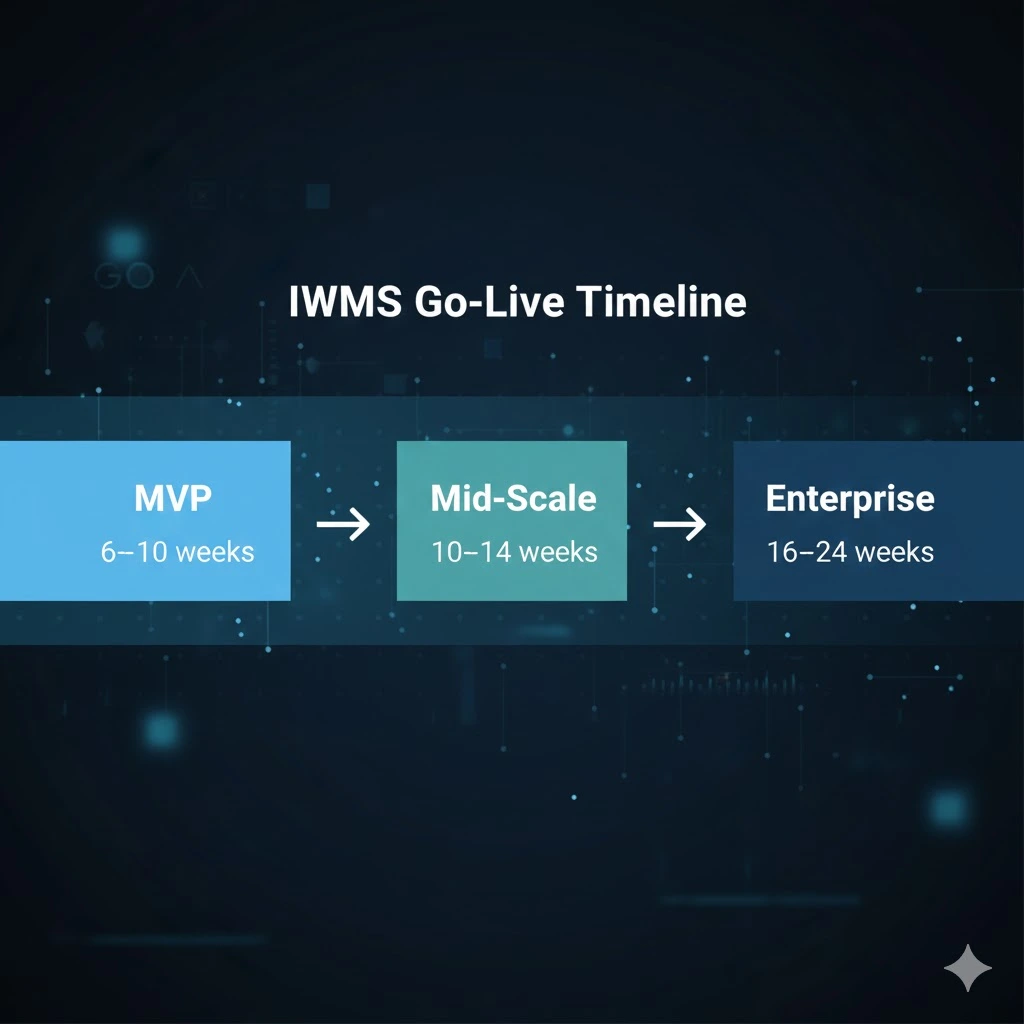
How long does IWMS implementation take?
MVP IWMS: 4–6 months
Mid-scale IWMS: 6–8 months
Enterprise IWMS: 9–12+ months
Is IWMS scalable across regions?
Yes. Modern solutions support multi-language, multi-region, and multi-currency workplace operations.
What security standards should an IWMS meet?
Core requirements include SOC 2, ISO 27001, GDPR, role-based access control (RBAC), and secure audit logs.
Planning to build a secure, enterprise-ready IWMS? Partner with Appwrk to engineer a compliance-first platform that meets global security standards and scales with your organisation.
Does IWMS support ESG and sustainability initiatives?
Yes. IWMS systems enable energy tracking, sustainability goals, carbon reporting, and ESG compliance across the real estate portfolio.
Can AI reduce ongoing IWMS operational costs?
Yes. AI enables predictive maintenance, space forecasting, energy optimisation, and anomaly detection, reducing long-term OpEx.
Which industries gain the most ROI from IWMS?
Enterprises with large real estate portfolios, corporate offices, healthcare, education, manufacturing, retail, and government, see the highest ROI.
What is the typical payback period for IWMS investments?
Most organisations see ROI within 18–36 months, driven by space optimisation, better asset management, and reduced operational cost.
Gourav Khanna is the Co-founder and CEO of APPWRK, leading the company’s vision to deliver AI-first, scalable digital solutions for enterprises and high-growth startups. With over 16 years of leadership in technology, he is known for driving digital transformation strategies that connect business ambition with outcome-focused execution across healthcare, retail, logistics, and enterprise operations.
Recognized as a strategic industry voice, Gourav brings deep expertise in product strategy, AI adoption, and platform engineering. Through his insights, he helps decision-makers prioritize market traction, operational efficiency, and long-term ROI while building resilient, user-centric digital systems.
Subscribe to APPWRK Blogs, We'll Do the Rest!
Get Blogs on UI/UX, Mobile Apps, Online Marketing, and Web development technology.
Unlock worthy and priceless suggestions from the masters of mobile and web app development