150+ minds across 4 countries. Join a culture of innovation, ownership & growth.
Rewire for AI
From machine learning to deep learning, from classification tools to overall process automation – our AI engineers will help you retool your existing system or enhance your company results.
Ship faster, scale smarter, built for product companies and SaaS teams
Our Latest Work
We strive hard to deliver result-driven digital solutions across the globe. Check out our case studies to get a glimpse of how we ideate, innovate, and create unconventional digital solutions according to the requirements of our clients.
Discover diverse and passionate insights from our tech enthusiasts. We collaborate across various sectors to streamline operations and drive innovation. Explore our rapidly growing collection of articles to see why we’re at the forefront of IT solutions.
The decision to move from Magento to Shopify is one of the most significant replatforming choices an ecommerce business can make. Magento is powerful, but its power comes with...
Accuracy gap is real: Traditional CPG forecasting carries a 25-40% MAPE error rate. AI-powered models bring that down to 8-15%, according to McKinsey research....
Real stories from global leaders who trusted us with their ideas.
Partnering with APPWRK helped us build a compliant and scalable healthcare platform, accelerating our time-to-market by 35%. Their team consistently delivered outstanding work.
Beesers
Digital Healthcare Client
Collaborating with APPWRK, Sportskeeda modernized its platform into a real-time sports engagement ecosystem, enabling seamless content delivery, scalable fan interactions, and high-velocity performance.
Sportskeeda
Sports & Entertainment Partner
Working with APPWRK was effortless. They captured our vision, maintained full compliance, and delivered a digital experience that built trust and elevated how customers interact with our fintech brand.
PayPenny
Fintech Partner
Working with APPWRK gave us confidence in adopting AI responsibly. Their team built a safe, intelligent bot that transformed how we engage with leads and helped us achieve measurable revenue growth.
IFB
AI Transformation Partner
Leveraging APPWRK’s digital expertise, Nemesis launched a scalable, compliant, and safe super app that connects content delivery, real-time communication, and logistics management within a single platform.
Nemesis
Super App Partner
Where Auction Innovation Meets Enterprise Scale
Partner with us to drive smarter, faster, and more transparent auction experiences.
Online auction platforms operate as high-trust, high-liquidity digital auction marketplaces across consumer goods, luxury items, real estate, vehicles, and government auctions.
The best auction apps and websites win on bidder trust, secure payments, compliance, and transparent bidding, not just brand recognition.
Mobile-first auction apps, real-time bidding, instant alerts, and live auctions are now baseline features across top online auction apps.
Rising adoption in government auctions and enterprise auctions is increasing demand for KYC, AML, auditability, and escrow-based settlement.
Selecting the right auction app or website depends on asset class, transaction value, regulatory exposure, and buyer–seller trust requirements.
This guide helps buyers, founders, and enterprises quickly identify the best online auction apps and websites, understand market direction, and choose platforms based on asset type, transaction value, and regulatory exposure.
Introduction: Online Auctions Are Now Global Digital Marketplaces
Online auctions in 2025 are mainstream digital marketplaces, not niche bidding sites. They power transactions across consumer goods, luxury items, real estate, vehicles, industrial assets, and government auctions on a global scale.
An auction is a demand-driven selling model where buyers compete through bids, and the market determines the final price. In digital-first auctions, listings, real-time bidding, closing rules, identity verification, and payments are fully automated through auction software, enabling borderless, mobile-first participation.
What’s changed is not just access, but trust and scale. Modern auction platforms are built around secure payments, KYC/AML compliance, audit trails, and high liquidity, making them viable for both everyday buyers and high-value enterprise or government transactions.
List of the Top 10 Best Online Auction Apps and Websites
These platforms dominate global auctions in 2025 across consumer goods, luxury assets, real estate, government inventories, and collectables. Each serves a distinct bidder type and auction model.
1. eBay: Global Consumer Auction Leader
The most liquid online auction marketplace worldwide, blending auctions with fixed-price listings. Best for: everyday buyers, resellers, SMBs Strengths: massive bidder base, global reach, strong buyer protection
A premium auction platform for high-value assets backed by centuries of institutional trust. Best for: art collectors, HNWIs Strengths: provenance, luxury assets, hybrid live + online auctions
3. LiveAuctioneers: Live & Timed Auctions
Connects bidders to thousands of auction houses via live-streamed and timed events. Best for: antiques and collectables Strengths:real-time bidding, strong auction-house network
4. Auction.com: Real Estate Auctions
A specialist real estate auction platform focused on foreclosure and distressed properties. Best for: property investors Strengths: structured due diligence, investor-grade listings
5. Catawiki: Curated Collectables Auctions
A quality-controlled auction marketplace where experts approve listings before launch. Best for: collectors Strengths: curated inventory, strong European presence
6. DealDash: Penny Auction Platform
A gamified bidding platform where users pay per bid to win discounted items. Best for: bargain hunters Strengths: low headline prices, high engagement (with risk)
7. PropertyRoom Government & Police Auctions
Specialises in seized, forfeited, and surplus assets from law enforcement agencies. Best for: public-sector buyers Strengths: transparency, regulated asset disposal
8. IRS Treasury Auctions: Official Government Auctions
The US government’s platform for selling tax-seized assets under strict compliance rules. Best for:regulated asset buyers Strengths: auditability, high-value properties
9. Invaluable Fine Art & Antiques Marketplace
Aggregates global auction house listings for professional collectors and institutions. Best for: art and antiques professionals Strengths: global access, live + timed auctions
10. ShopGoodwill: Charity Auction Platform
The nonprofit auction arm of Goodwill sells donated goods to fund social programs. Best for: value-focused buyers Strengths: charity-driven auctions, broad inventory
Core Features to Look for in a Modern Auction Platform
Modern auction platforms must deliver speed, trust, and scale. The essentials are clear and non-negotiable.
Bidding & Payments
Real-time bidding with auto-extend
Reserve prices and timed auctions
Secure payments with escrow or holds
Security & Trust
KYC and identity verification
Role-based access control
Fraud detection and dispute handling
Analytics & Integrations
Bid and pricing analytics
Seller and asset reports
Integrations with payments, ERP, and CRM
Scalability & Governance
High-concurrency performance
Private and invite-only auctions
Audit-ready transaction logs
Why Do Businesses Use Auction Software?
Modern auction software is a pricing and liquidation engine, not just a bidding interface. It helps businesses, governments, and institutions sell assets transparently while maintaining audit-ready records.
Price discovery: Competitive bidding reveals true market value, reduces underpricing, and improves realisation, especially for volatile or hard-to-price assets.
Asset liquidation: Auction platforms accelerate the sale of surplus inventory, repossessed assets, and government-seized goods by expanding buyer reach and shortening liquidation cycles.
Compliance and auditability: Digital auction systems automatically capture bid histories, identity logs, and payment trails, critical for regulated and public-sector auctions.
Why Are Online Auction Applications Gaining Global Adoption?
Online auction apps are scaling globally because they solve reach, trust, and efficiency at once.
Key drivers:
Mobile-first bidding: discover, bid, and pay entirely on mobile
Online auction platforms succeed because they combine convenience, transparency, and scale, making them viable for both everyday buyers and high-value enterprise transactions.
Global Online Auction Market Snapshot
The auction industry has shifted toward regulated, high-liquidity digital ecosystems.
Growth drivers
Mobile-first consumer bidding
Faster enterprise and government asset liquidation
Strong demand in real estate, vehicles, and surplus assets
Platform requirements
Mandatory KYC and AML
Secure payments and escrow settlement
Cross-border compliance and auditability
Platforms that combine liquidity, compliance, and mobile access now dominate high-value auction activity.
Region
Adoption
Key Categories
Regulatory Complexity
North America
High
Consumer goods, real estate, vehicles
Medium–High
Europe
High
Art, collectibles, government assets
High
Asia-Pacific
Medium–High
Electronics, B2B auctions
Medium
Middle East
Medium
Real estate, government auctions
Medium
Latin America
Medium
Consumer goods, vehicles
Low-Medium
Different Types of Auction Platforms and Bidding Models
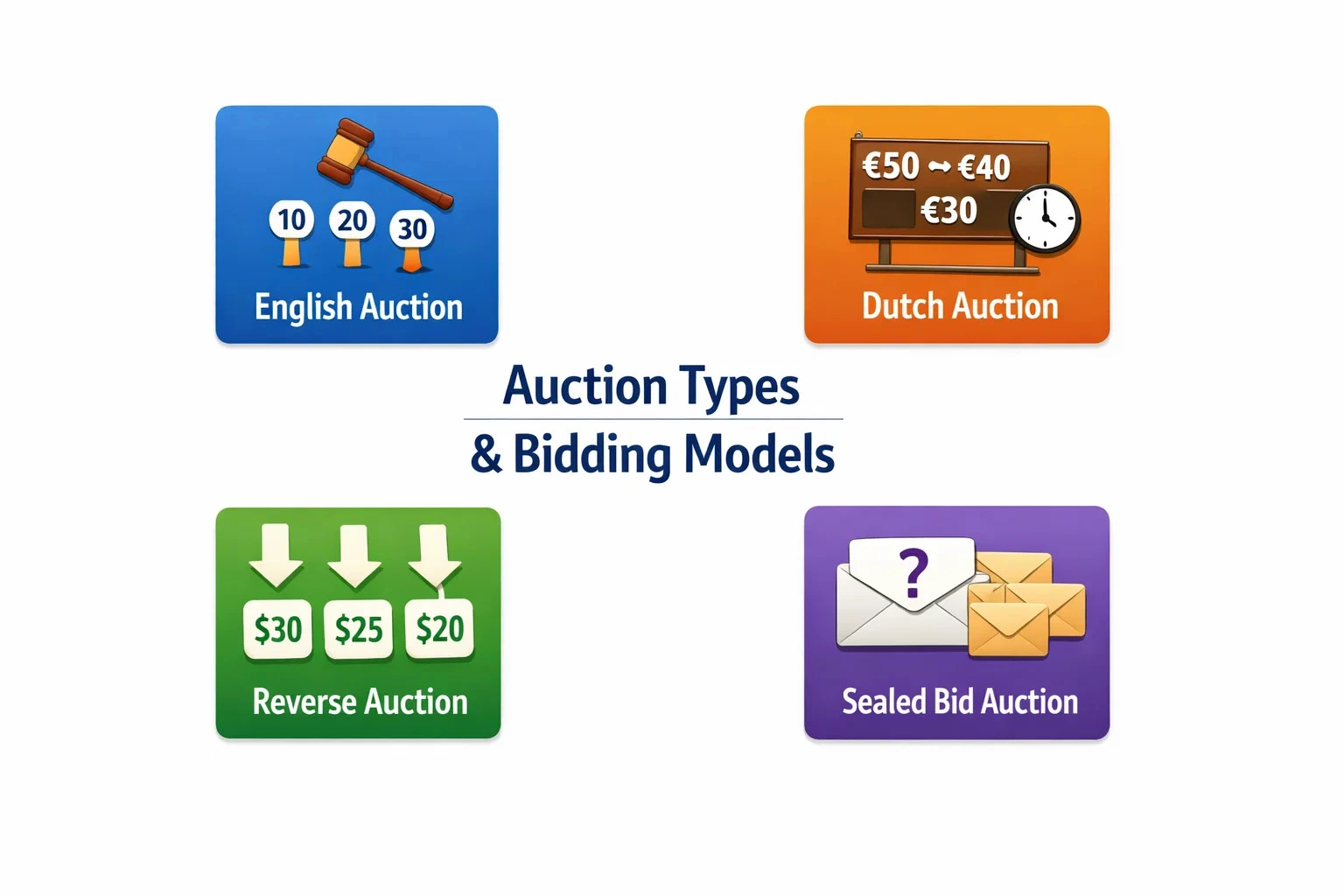
Modern auction platforms use different bidding models based on asset type, urgency, and buyer behaviour.
English auctions Open ascending bids; the highest bidder wins. Common for consumer goods, collectables, and art.
Dutch auctions Price drops until a buyer accepts. Used for fast liquidation and time-sensitive inventory.
Reverse auctions Sellers compete on price. Common in procurement, enterprise sourcing, and government tenders.
Penny auctions Users pay per bid; price rises incrementally. High engagement, but controversial.
First-price sealed-bid auctions Confidential bids; the highest bid wins. Used in real estate and private sales.
Vickrey (second-price) auctions The highest bidder wins but pays the second-highest bid. Encourages honest bidding.
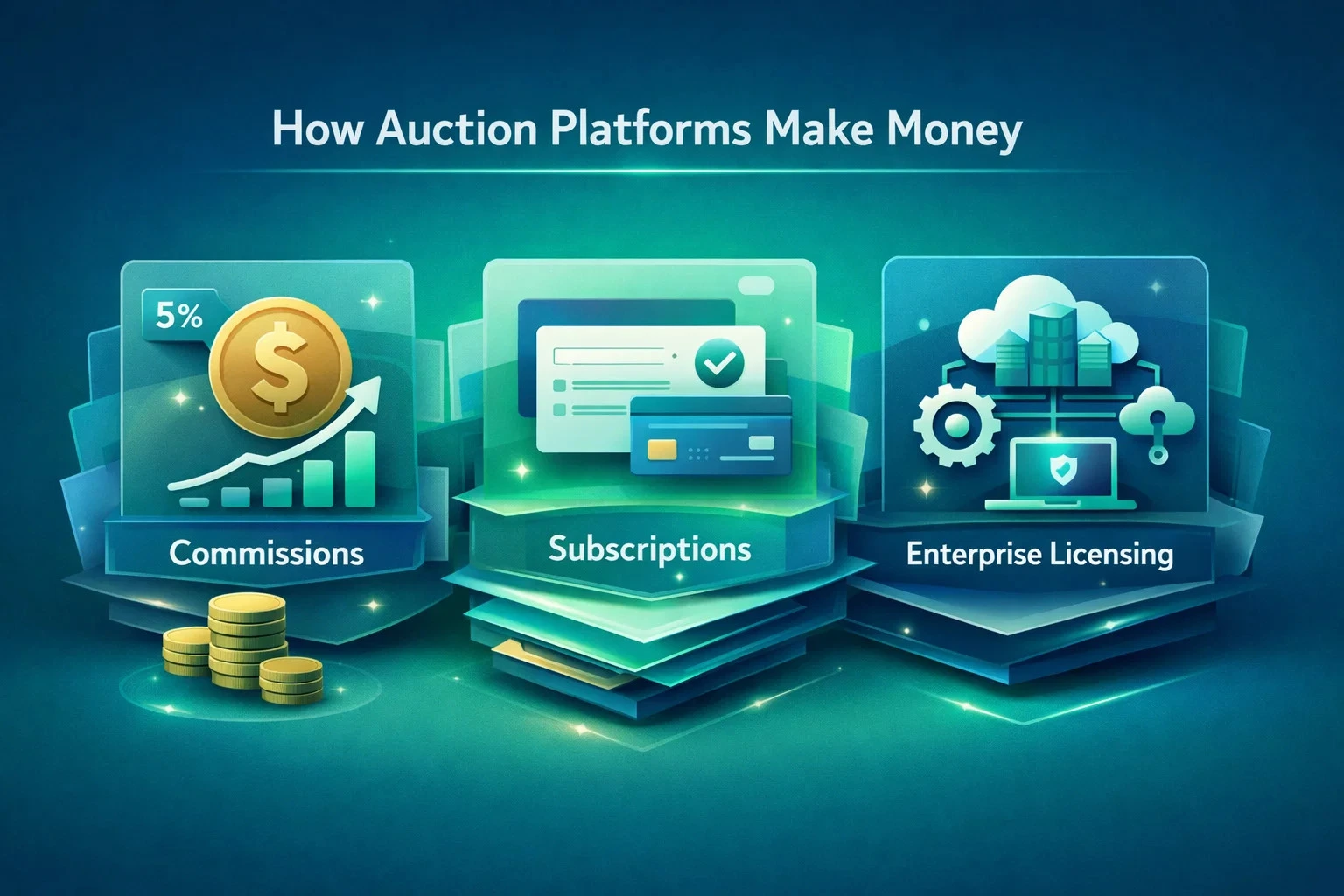
Monetisation Models Used by Auction Apps and Websites
Auction apps monetise differently based on transaction value, trust requirements, and user frequency.
Choosing the Right Auction App: Consumer vs Enterprise
The right auction platform depends on asset value, trust requirements, and regulatory exposure.
Consumer platforms
Focus on liquidity and speed
Assets: consumer goods, collectables
Basic KYC and payments
Revenue via commissions
Limited customization
Enterprise/government platforms
Focus on transparency and control.
Assets: real estate, seized, and surplus assets
Strong KYC, AML, and audit trails
Revenue via licensing or managed services
High customisation and reporting depth
Decision signal: If compliance, auditability, and governance matter more than bidder volume, enterprise-grade auction platforms deliver higher long-term value.
How to Conduct an Online Auction (Simple Flow)
Running a successful auction requires structure, not guesswork.
Choose the right platform Match the auction platform to your asset type, bidder profile, and compliance needs.
Built-in KYC, role-based access, and secure payments
AI-driven fraud detection and pricing intelligence
Seamless integration with ERP, inventory, and analytics systems
Positioning takeaway: Appwrk builds auction platforms that prioritise trust, scalability, and long-term extensibility, so clients can launch and grow auction businesses with confidence.
Founder’s Guide: Launching or Scaling an Auction Platform
Successful auction platforms are built around trust, liquidity, and control, not just listings. They operate as regulated transaction systems, not simple marketplaces.
What Matters Early
Fast, low-latency real-time bidding
Trust layers: KYC, escrow, dispute handling
Monetisation that doesn’t reduce bidder participation
The right choice depends on asset value, compliance exposure, and growth goals.
Frequently Asked Questions (FAQs)
Are online auction apps safe to use? Yes. Trusted platforms use KYC, secure payments, escrow, and audit logs. Safety depends on platform maturity and compliance standards.
Which auction app has the most bidders? eBay leads globally by volume. Sotheby’s, LiveAuctioneers, and Invaluable dominate high-value and niche auctions.
Best platforms for real estate auctions? Auction.com and IRS Treasury Auctions are widely used for property and seized-asset auctions.
How do auction apps prevent fraud? Through identity checks, bid monitoring, AI-based fraud detection, and transaction audit trails.
Can enterprises run private auctions? Yes. Enterprise platforms support private auctions with restricted access and full auditability.
Gourav Khanna is the Co-founder and CEO of APPWRK, leading the company’s vision to deliver AI-first, scalable digital solutions for enterprises and high-growth startups. With over 16 years of leadership in technology, he is known for driving digital transformation strategies that connect business ambition with outcome-focused execution across healthcare, retail, logistics, and enterprise operations.
Recognized as a strategic industry voice, Gourav brings deep expertise in product strategy, AI adoption, and platform engineering. Through his insights, he helps decision-makers prioritize market traction, operational efficiency, and long-term ROI while building resilient, user-centric digital systems.
Subscribe to APPWRK Blogs, We'll Do the Rest!
Get Blogs on UI/UX, Mobile Apps, Online Marketing, and Web development technology.
Unlock worthy and priceless suggestions from the masters of mobile and web app development