150+ minds across 4 countries. Join a culture of innovation, ownership & growth.
Rewire for AI
From machine learning to deep learning, from classification tools to overall process automation – our AI engineers will help you retool your existing system or enhance your company results.
Ship faster, scale smarter, built for product companies and SaaS teams
Our Latest Work
We strive hard to deliver result-driven digital solutions across the globe. Check out our case studies to get a glimpse of how we ideate, innovate, and create unconventional digital solutions according to the requirements of our clients.
Discover diverse and passionate insights from our tech enthusiasts. We collaborate across various sectors to streamline operations and drive innovation. Explore our rapidly growing collection of articles to see why we’re at the forefront of IT solutions.
The decision to move from Magento to Shopify is one of the most significant replatforming choices an ecommerce business can make. Magento is powerful, but its power comes with...
Accuracy gap is real: Traditional CPG forecasting carries a 25-40% MAPE error rate. AI-powered models bring that down to 8-15%, according to McKinsey research....
Real stories from global leaders who trusted us with their ideas.
Partnering with APPWRK helped us build a compliant and scalable healthcare platform, accelerating our time-to-market by 35%. Their team consistently delivered outstanding work.
Beesers
Digital Healthcare Client
Collaborating with APPWRK, Sportskeeda modernized its platform into a real-time sports engagement ecosystem, enabling seamless content delivery, scalable fan interactions, and high-velocity performance.
Sportskeeda
Sports & Entertainment Partner
Working with APPWRK was effortless. They captured our vision, maintained full compliance, and delivered a digital experience that built trust and elevated how customers interact with our fintech brand.
PayPenny
Fintech Partner
Working with APPWRK gave us confidence in adopting AI responsibly. Their team built a safe, intelligent bot that transformed how we engage with leads and helped us achieve measurable revenue growth.
IFB
AI Transformation Partner
Leveraging APPWRK’s digital expertise, Nemesis launched a scalable, compliant, and safe super app that connects content delivery, real-time communication, and logistics management within a single platform.
Nemesis
Super App Partner
Let’s partner to drive digital transformation in asset management
Unlock operational efficiency with custom-built platforms designed for innovation, compliance, and cross-team visibility.
If you’re wondering how much it costs to build asset management software, this guide breaks down the full development cost, from basic to advanced features.
The cost to build an asset management software starts at around $3,000 for a basic MVP and scales up based on complexity, integrations, and deployment model. Development rates typically range from $20 to $40 per hour, depending on geography, team expertise, and the chosen technology stack.
A starter asset management software with basic tracking, cataloguing, and centralised dashboards usually costs $3,000 to $8,000, built with modular architecture and cloud-based solutions.
A mid-scale asset management software featuring advanced analytics, multi-user authentication, and automated alerts typically ranges from $10,000 to $20,000, depending on workflow customisation and security measures.
A full-scale enterprise asset management software with IoT integration, predictive maintenance, and auditing and compliance workflows generally costs $25,000 to $50,000, influenced by ERP and CRM integration and scalability goals.
Annual maintenance, cloud hosting, and post-launch optimisation for digital asset management software or fixed asset management software usually add 10 to 15% of the build cost.
Development costs differ by region:
South Asia: $20 to $25/hour
Eastern Europe: $25 to $35/hour
US/UK: $35 to $40/hour
Hybrid development models often deliver the best cost-to-capability ratio.
This guide is designed for startup founders, CTOs, IT directors, and enterprise decision-makers evaluating the smartest way to build or scale asset management applications without overspending.
Building an efficient, scalable asset management software isn’t just about minimising cost; it’s about aligning customisation, workflow automation, and ROI with your long-term operational goals.
Why Is Everyone Building Asset Management Software in 2025? [Market Size + Opportunity]
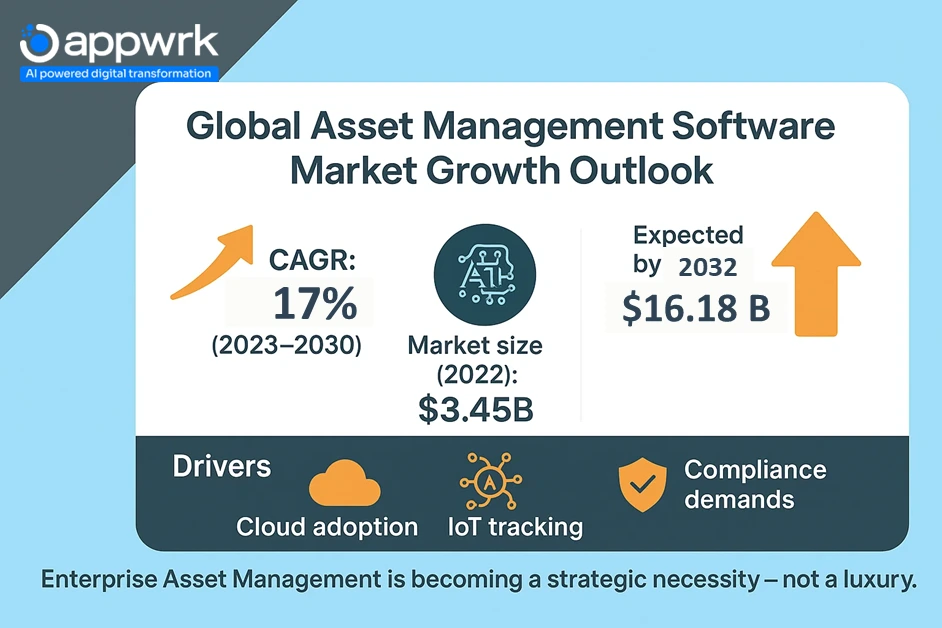
For modern enterprises managing both physical and digital assets, asset management software has evolved from a support tool into a strategic necessity. As industries accelerate their digital transformation, the demand for centralised, intelligent, and secure asset management solutions is growing at a record pace.
In 2023, the global Digital Asset Management (DAM) market was valued at $3.96 billion and is projected to reach $16.18 billion by 2032, growing at a CAGR of 17%. This surge reflects how companies are rethinking how they organise and store digital assets, track performance, and maintain compliance, all within unified, cloud-based asset management systems.
North America accounted for more than 39% of the total market share in 2023, driven by enterprise adoption across media, healthcare, manufacturing, and government. AI integration, once a differentiator, is now a standard expectation. Features such as automatic tagging, contextual search, predictive maintenance, and real-time analytics are redefining what qualifies as a modern asset management application.
As asset volumes rise and compliance pressures tighten, businesses are shifting from off-the-shelf asset management tools to custom-built applications that better fit their workflows. This trend is especially strong in sectors demanding traceability, access control, and advanced analytics, including facility asset management, IT asset management, oil and gas, and fleet operations, where performance, security, and auditing cannot be compromised.
In short, 2025 marks a turning point. Building a custom asset management app is no longer about convenience; it’s about control, efficiency, and competitive advantage in a data-driven economy.
Asset Management Software Development Cost Breakdown
The cost to build an asset management software in 2025 starts around $3,000 for a basic MVP and can go up to $50,000 or more for full-scale enterprise systems. The total budget depends on features, integrations, data architecture, and compliance needs.
Type
Cost to Build an Asset Management Software
Typical Use Case of the Asset Management Software
Basic MVP
$3,000 to $8,000
Asset cataloguing, barcode or QR code scanning, and mobile UI for basic tracking
Mid-Scale Platform
$10,000 to $20,000
Multi-user roles, analytics and reporting, automated alerts, and workflow management
Enterprise Asset Management Software
$25,000 to $50,000+
IoT integration, AI-driven insights, predictive maintenance, and ERP or CRM APIs
Development rates vary by region:
India / South Asia: $20 to $25 per hour
Eastern Europe: $25 to $35 per hour
US / UK: $35 to $40 per hour
These hourly rates typically include design, backend development, QA testing, and cloud-based implementation using scalable frameworks like Laravel, React, or Node.js.
What Factors Influence the Cost to Build an Asset Management Software?
The final cost isn’t only about development time; it’s shaped by how complex your asset management application becomes as it scales.
Factors Influencing the Cost to Build an Asset Management Software
Cost Impact of Building an Asset Management Software
Storage & Infrastructure
Cloud hosting and storage for digital assets can add $10 to $50/month. Larger setups with media or audit logs need higher capacity.
Asset Types & Metadata
Supporting diverse asset categories and adding metadata tagging or version control increases build cost by $20 to $100/month.
User Roles & Permissions
Role-based access, authentication, and onboarding for multi-user teams add $5 to $25 per user/month.
Advanced Features
Real-time tracking, predictive maintenance, or analytics dashboards can raise monthly costs by $15 to $40.
API Integrations
Linking with ERP, CRM, or content systems (like Salesforce or SAP) may cost $10 to $30/month, depending on complexity.
Compliance & Security
Implementing auditing and compliance, data encryption, and access logs adds to the cost but ensures reliability.
Support & Maintenance
Post-launch maintenance, version updates, and vendor-led training typically add 10 to 15% annually.
Hidden costs like cloud data storage, licensing, and custom onboarding also influence your total cost of ownership. If your business requires IoT integration, RFID tracking, or geolocation tools, those modules will raise costs but deliver long-term operational visibility and ROI.
Whether you’re building IT asset management software, facility management tools, or media asset tracking platforms, every additional module shifts the pricing curve, but also deepens the system’s value and resilience.
How Does the Cost of Asset Management Software Vary Regionally?
The cost to build an asset management software varies widely by geography, driven by hourly rates, experience, and infrastructure. Choosing the right region to develop your platform can dramatically affect total ownership cost and delivery timelines.
Building Asset Management Software in India Starts from $3,000
India offers one of the lowest entry points, with experienced developers delivering complete asset tracking systems, analytics, and integrations for $20 to $25/hour. Ideal for startups and mid-sized firms prioritising cost efficiency without sacrificing scalability.
Developing Asset Management Software in the USA Starts Near $8,000
U.S.-based teams typically charge $35 to $40/hour, offering strong compliance support, faster time zones, and deeper integration with enterprise asset management systems. Suitable for regulated industries and large enterprises.
The Cost of Asset Management System Development in the UK Typically Starts at $10,000
UK development teams operate in the $30 to $40/hour range, striking a balance between cost and high-quality delivery. They’re well-suited for custom asset lifecycle management, onboarding workflows, and user access controls for enterprise clients.
Asset Management Software Pricing in Europe starts from $7,000 to $9,000
Eastern Europe offers highly skilled engineers with cloud-based development expertise and strong predictive maintenance capabilities at $25 to $35/hour. This region remains a top choice for businesses seeking quality, innovation, and value.
What Features Should Be Included in a Scalable Asset Management Software?
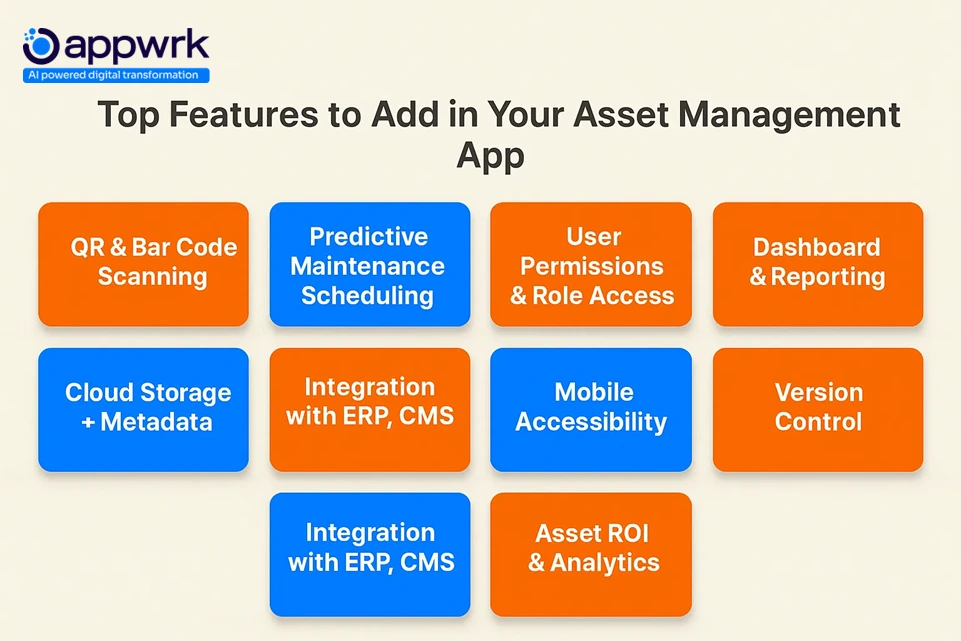
Scalable asset management software should manage thousands of assets, users, and workflows without friction. The features below define high-performance, future-ready platforms.
Real-Time Asset Tracking with Location Insights
Tracks assets continuously via RFID, barcode, or GPS for complete visibility across operations. Dev Cost: $1,500 to $3,000 Use Case:Fleet management, warehouse logistics, powered asset monitoring
Supports barcode and QR code scanning for fast, accurate identification. Dev Cost: $800 to $1,200 Use Case: Equipment checkout, inventory tracking, field operations
Predictive Maintenance and Scheduling Automation
Forecasts failures, automates maintenance schedules, and reduces downtime with AI and analytics tools. Dev Cost: $2,500 to $4,000 Use Case: Heavy machinery, utilities, infrastructure assets
Role-Based Access Control and User Permissions
Defines user authentication tiers for asset visibility and actions. Dev Cost: $1,000 to $2,000 Use Case: Finance, government, and compliance-driven sectors
Advanced Metadata Tagging and Search
Enables advanced search, version control, and metadata tagging for large digital libraries. Dev Cost: $1,200 to $2,500 Use Case: Media archives, digital asset management software, document repositories.
Dashboard, Reporting, and Audit Trails
Offers customizable dashboards, real-time analytics, and compliance audit logs. Dev Cost: $1,500 to $3,000 Use Case: Executive reporting, KPI monitoring, governance tracking
Integration with Cloud Platforms and API Tools
Ensures seamless integrations with ERPs, CRMs, and ticketing systems through APIs. Dev Cost: $2,000 to $4,500 Use Case: Automated workflows, connected data ecosystems
Mobile Accessibility and Remote Asset Control
Provides full access from mobile devices for remote tracking and updates. Dev Cost: $1,000 to $2,200 Use Case: Facility inspections, on-site asset audits
Scalable Cloud Storage and Secure Infrastructure
Supports large data volumes with encrypted, cloud-based storage and backups. Dev Cost: $1,500 to $3,500 Use Case: Enterprises managing extensive digital content or distributed teams.
AI-Powered Asset Optimisation and Insights
Uses machine learning to analyse performance, optimise costs, and predict ROI. Dev Cost: $3,000 to $6,000 Use Case: IT asset management, AI-driven predictive tools
What Type of Asset Management Software Is Best for Your Business?
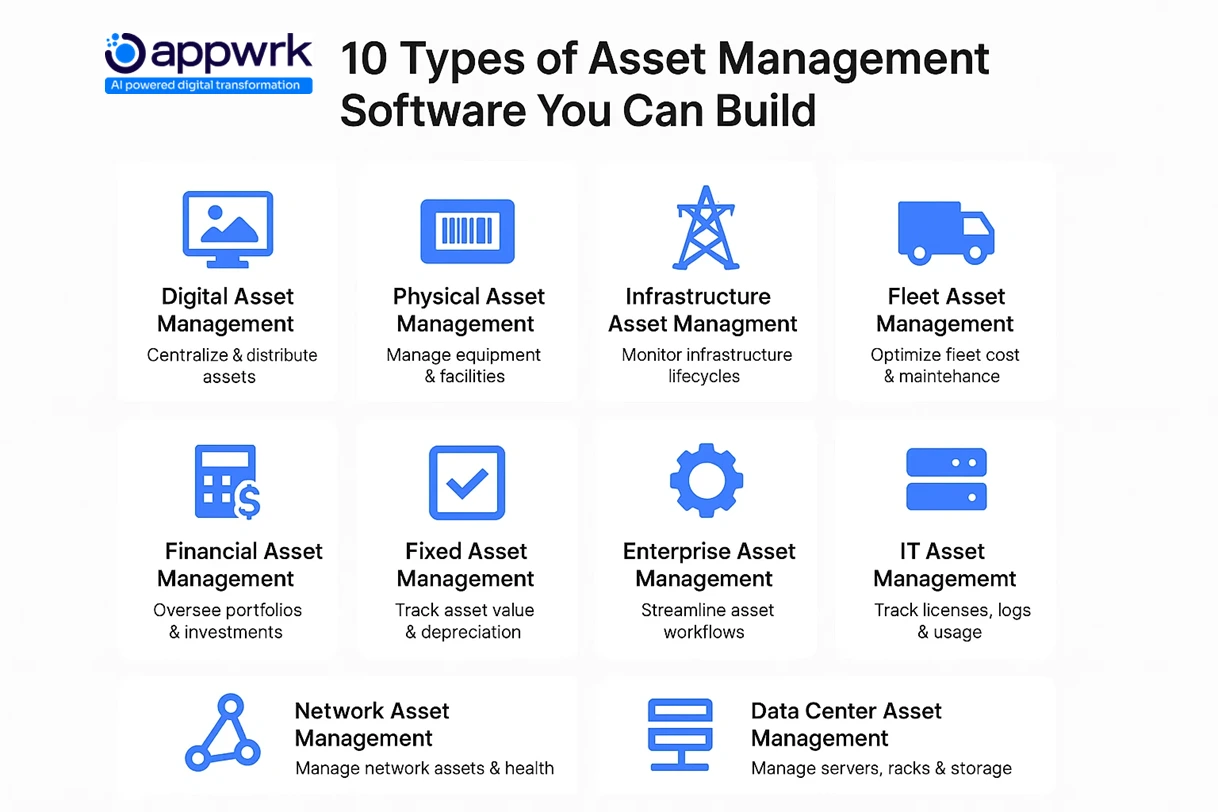
The ideal asset management application depends on your industry, asset type, and operational goals. Here’s how each category aligns with specific needs:
Digital Asset Management Software
Organises digital files with metadata tagging, version control, and secure sharing. Use Case: Media agencies, publishers, marketing teams. Cost Range: $5,000 to $15,000
Physical Asset Management Software
Tracks tangible assets using barcodes, QR codes, and RFID for better utilisation. Use Case: Manufacturing, logistics, public utilities. Cost Range: $4,000 to $10,000
Infrastructure Asset Management Software
Manages infrastructure assets like roads, networks, or pipelines through real-time data. Use Case: Smart cities, telecom, construction. Cost Range: $10,000 to $25,000
Vehicle Fleet Asset Management Software
Uses IoT and GPS for location tracking, diagnostics, and driver insights. Use Case:Logistics, transport, and delivery operations. Cost Range: $6,000 to $15,000
Manages portfolios, depreciation, and reporting with auditing and compliance features. Use Case: Banks, fintechs, investment firms. Cost Range: $8,000 to $20,000
Fixed Asset Management Software
Tracks depreciation, maintenance, and lifecycle of physical assets. Use Case:Warehouses, enterprises, and educational institutions. Cost Range: $4,000 to $12,000
Enterprise Asset Management Software
A full-scale platform with multi-department workflows and custom integrations. Use Case: Governments, manufacturers, Fortune 500 companies. Cost Range: $20,000 to $50,000+
IT Asset Management Software
Manages IT hardware, software licenses, and user provisioning with compliance tracking. Use Case:SaaS providers, IT teams, MSPs Cost Range: $6,000 to $18,000
Network Asset Management Software
Monitors network configurations, uptime, and risk across infrastructure. Use Case: Data centres, telecom, cloud platforms. Cost Range: $8,000 to $22,000
DataCentrer Asset Management Software
Optimises data centre assets, power, and cooling using real-time monitoring. Use Case: Hosting providers, hyperscale infrastructure teams. Cost Range: $12,000 to $30,000+
Which Use Cases Prove the Need for Custom Asset Management Software?
Off-the-shelf tools often fail when assets span multiple locations, teams, or lifecycles. In contrast, custom asset management software gives you full control, from tracking and compliance to integrations and scalability.
Here are the use cases where going custom delivers tangible business value.
Multi-Site Asset Tracking for Logistics and Warehousing
Track mobile and fixed assets across facilities in real time using barcodes, RFID, or GPS, and automate maintenance schedules. Value: Reduces loss, improves accuracy, and cuts downtime. Relevant For: Fleet management systems, warehouse asset tracking software
Role-Based Access and User Onboarding for Large Enterprises
Manage user authentication, permissions, and access levels tailored by department or region for better data control. Value: Strengthens security and ensures auditing and compliance. Relevant For: Enterprise asset management platforms, financial asset tracking
Lifecycle Management for High-Value Infrastructure Assets
Use predictive analytics and asset lifecycle data to monitor condition, forecast maintenance, and prevent unexpected failures. Value: Extends asset lifespan and avoids costly disruptions. Relevant For: Infrastructure, utilities, public sector projects
Digital Asset Control for Media-Rich Environments
Centralise digital content with metadata tagging, version control, and secure cloud access for easy search and reuse. Value: Saves hours in retrieval and maintains brand consistency. Relevant For: Media agencies, marketing teams, publishers
Custom Integrations with Ticketing and ERP Systems
Connect asset data with CRMs, ticketing tools, and ERP systems through APIs for workflow automation and faster service resolution. Value: Improves transparency and reduces manual tracking. Relevant For: IT asset management software, SaaS platforms, hybrid teams
How Appwrk Helped a Cloud Infrastructure Firm Track Digital Assets and ROI in Real Time
A global cloud infrastructure provider offering GPU-based IaaS needed to give its investors a transparent view of their digital asset performance, covering active, idle, and rented nodes with accurate revenue and utilization data. They partnered with Appwrk to build a custom asset management software that could monitor ROI in real time.
The Challenge
No unified dashboard for node utilization or revenue tracking
Limited visibility across idle, rented, and active assets
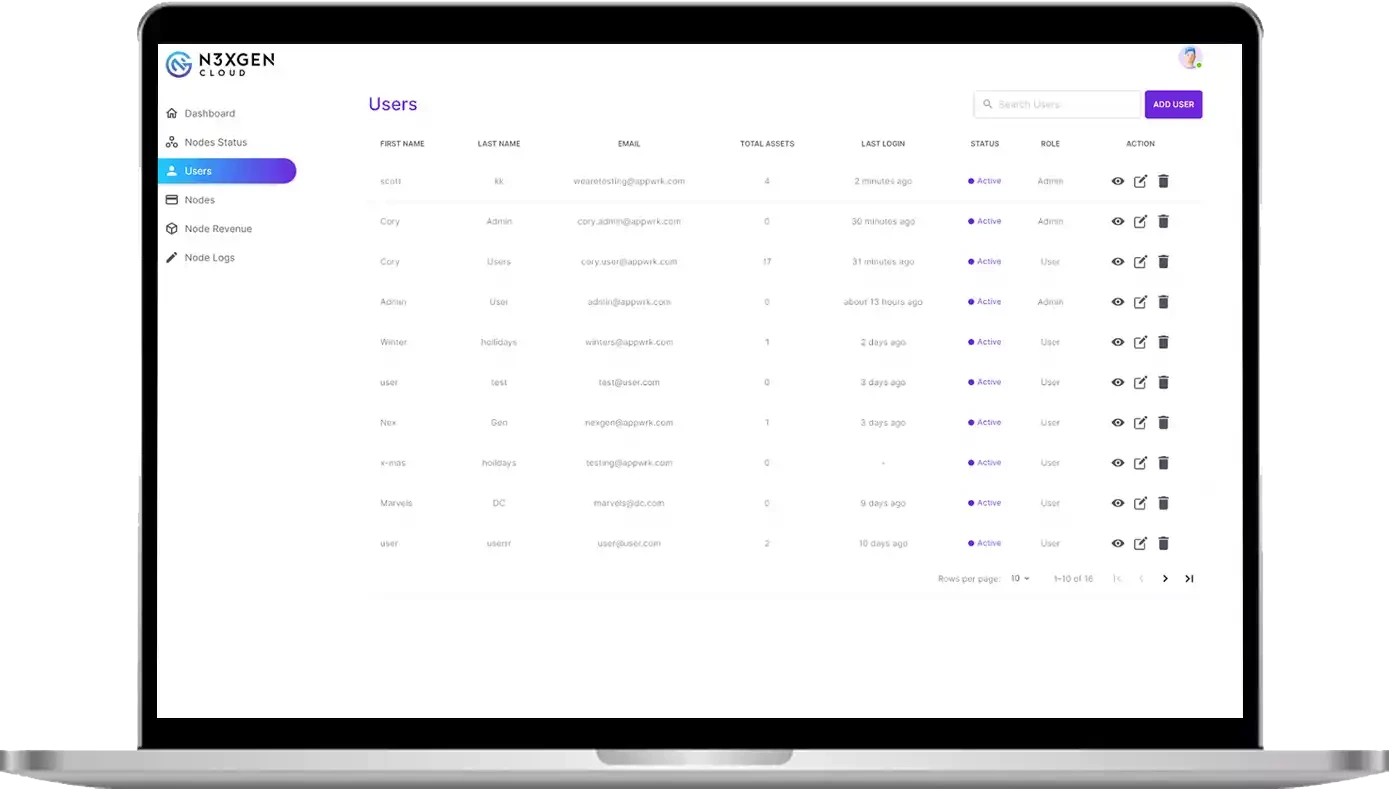
Designed a real-time dashboard to track node performance, activity logs, and financial metrics
Integrated automated data ingestion pipelines from multiple cloud log sources
Added ROI tracking modules for node-wise revenue, utilization, and depreciation
Built on a scalable tech stack: Python Flask, SQLAlchemy, Next.js, and Docker
Ensured compliance-ready architecture with full audit logging and lifecycle traceability
The Impact
Investors now monitor live node performance, utilization, and profits on demand
Enhanced transparency led to higher investor trust and stronger governance
Audit logs established end-to-end accountability across all assets
Strategic reinvestment decisions backed by real-time financial insights
The result was a complete shift from manual reporting to a data-driven, cloud-based asset management system that gave stakeholders full visibility into performance and ROI, built for scalability, transparency, and long-term growth.
Can You Build Asset Management Software Without Starting from Scratch?
Yes, you can. If you’re short on time or budget, you don’t have to build every feature from zero. Low-code platforms, open-source frameworks, and modular tracking systems can speed up delivery by 40 to 60%.
Common Alternatives:
Use modular platforms like AssetCloud Complete or AssetTiger, and expand through APIs.
Start with Snipe-IT (open-source) for basic IT asset management, then add automation or access control later.
License existing tools and build custom extensions for barcoding, onboarding, or reporting.
Best For: Startups, internal IT teams, or mid-sized companies are testing functionality before scaling into a full custom solution.
How Long Does It Take to Build Asset Management Software from Scratch?
The average build time ranges from 6 to 18 weeks, depending on complexity, integrations, and the number of modules involved.
Build Type
Timeline to Build Asset Management Software from Scratch
Delays usually happen when onboarding flows, data schemas, or compliance specs aren’t clearly defined, especially in regulated sectors like finance, healthcare, or government.
3 Common Mistakes to Avoid When Estimating Asset Software Development Cost
Even experienced teams miscalculate project budgets. Here’s what tends to go wrong, and how to avoid it.
Mistake 1: Underbudgeting Lifecycle Features
Teams often plan for tracking and dashboards but forget about maintenance scheduling, access control, or version history, which can increase costs by up to 30%. Tip: Break your cost estimate by modules, not by phases like “frontend” or “backend.”
Mistake 2: Choosing the Wrong Development Partner
A generalist tech agency might not understand regulatory, security, or workflow requirements for enterprise-grade asset tracking. Tip: Partner with teams experienced in Enterprise Asset Management (EAM) or IT Asset Discovery systems.
Mistake 3: Adding Features Mid-Sprint Without a Buffer
Midway additions, like QR scanning or complex permissions, stretch deadlines and inflate budgets. Tip: Keep a 15% contingency buffer and finalise specs after reviewing a working prototype.
What Are the Monetisation Models for Asset Management Platforms?
Monetising an asset management platform isn’t limited to flat licensing fees anymore. With SaaS models, data-driven insights, and white-label licensing, businesses can now turn their software into recurring, scalable revenue.
Subscription Model
The classic SaaS model charges monthly or annually based on user count, number of assets, or unlocked modules. Ideal For: Enterprise Asset Management, IT Asset Discovery, and B2B Digital Asset Platforms
Freemium Model + Feature Unlock
Offer a free starter version, with premium tools like predictive maintenance, AI analytics, or advanced metadata tagging available through paid upgrades. Best For: Startups and small teams testing ROI before full adoption
Pay-Per-Use Model or Per-Asset
Charge based on asset volume, storage consumption, or location updates. Common in fleet management and media asset systems, this model ties revenue directly to usage. Strength: Transparent pricing that grows with customer scale
Data & Analytics Resale
Monetise anonymised insights such as usage trends, performance benchmarks, or lifecycle analytics. As long as data governance and compliance (GDPR, SOC 2) are in place, this model offers strong recurring potential. Must-Have: Secure opt-ins and anonymised data pipelines
White-Label Solutions
License your asset management application to other vendors or vertical-specific resellers. Revenue Edge: Scalable enterprise adoption with minimal sales or marketing effort
What Makes AI a Game-Changer in Asset Management Software Today?
The leap from traditional to AI-powered asset management software is about more than automation; it’s about foresight. AI turns passive systems into self-learning ecosystems that analyse, predict, and optimise continuously.
AI Enhances Search and Metadata Tagging
AI-driven tagging automatically classifies digital content, from images to technical documents, for instant retrieval. Benefit: Cuts manual sorting by up to 80% and improves workflow efficiency
Predictive Maintenance Based on Usage Patterns
Machine learning tracks usage trends, detects anomalies, and flags maintenance needs before breakdowns occur. Use Case: Fleet systems, utilities, and infrastructure asset management
Image Recognition for Asset Scanning
AI enables barcode or visual scanning through any device camera, automatically identifying assets and updating their condition. Real-World Edge: Reduces field tracking errors by up to 70%
Intelligent Analytics and Optimisation
AI tracks asset usage, idle time, and cost triggers to generate ROI insights and performance dashboards. Bonus: Combine with advanced analytics tools to visualise operational KPIs
AI-powered platforms grow smarter with every interaction, learning from user activity, equipment performance, and location-based data to continuously improve asset efficiency and reporting accuracy.
Can You Integrate Asset Management Software with Your Existing Systems?
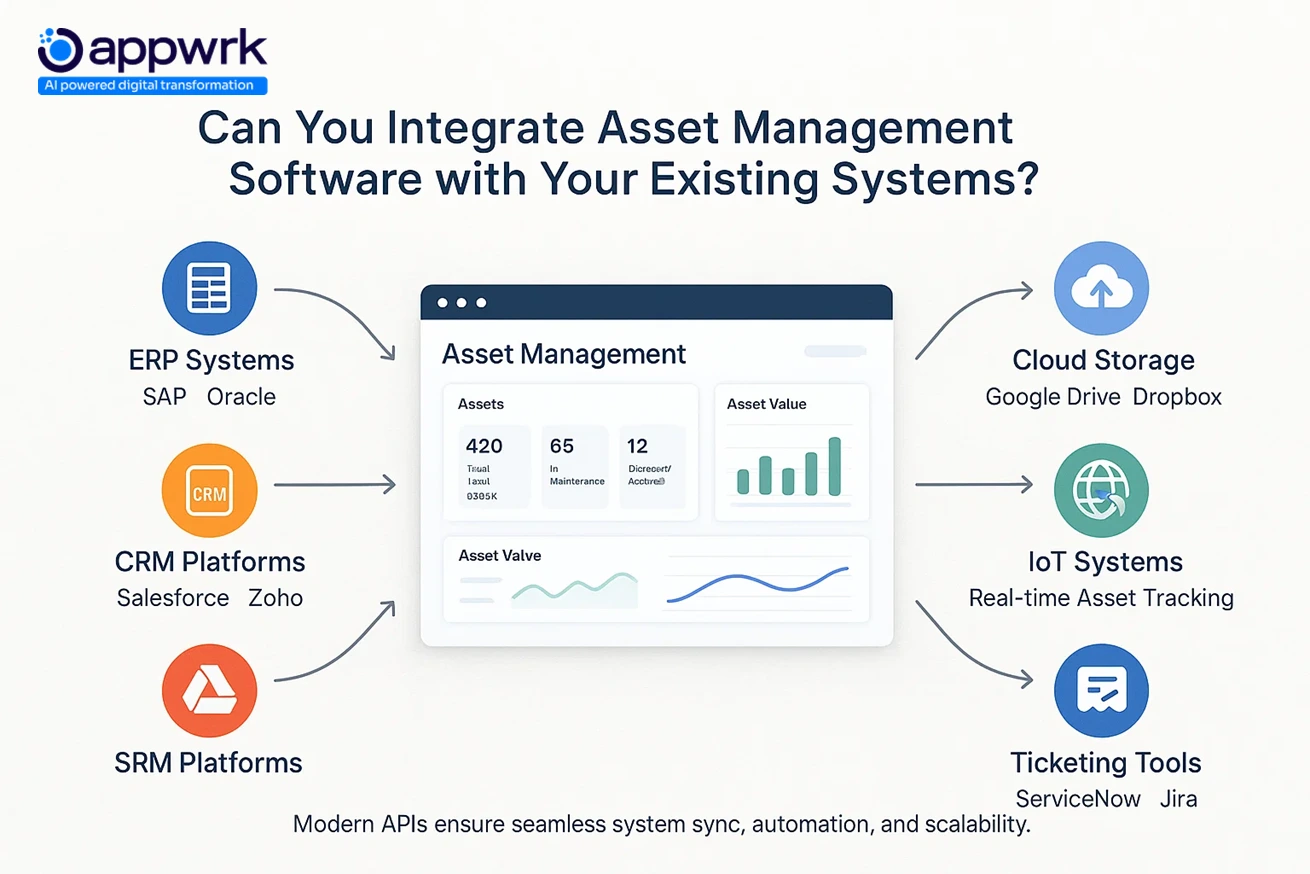
Yes, most asset management applications today are designed to integrate seamlessly with your existing tech stack. Whether you’re using ERP systemslike SAP, CRM platforms like Salesforce, or cloud drives like Google Workspace, modern APIs make it simple to connect and automate data flow.
CRM Platforms: To sync asset ownership, contracts, and client-side activity.
Cloud Storage & CMS Tools: Ideal for managing digital assets such as media files, product documentation, or compliance archives.
IoT Systems: To monitor physical assets, automate maintenance cycles, and trigger alerts based on live telemetry.
Ticketing Systems: To log issues, generate work orders, and assign maintenance tasks automatically.
Building integration-ready asset management software from day one minimizes manual entry, enhances compliance, and makes the system scalable across teams and departments.
How Does an Asset Management App Work?
An asset management app is not just a digital catalog; it’s a live command center for every stage of your asset lifecycle. Whether it’s IT equipment, vehicles, or digital content, the app centralizes tracking, maintenance, and ROI data under one dashboard.
1. Asset Registration
Every asset, physical or digital, is logged with key metadata such as model, ownership, warranty, and location. QR or barcode tagging makes onboarding fast and traceable.
2. Real-Time Tracking
Through GPS, RFID, or barcode scans, the app provides real-time visibility of assets across warehouses, job sites, or cloud environments.
3. Lifecycle Management
Tracks assets from acquisition to disposal, calculating depreciation, utilization, and lifecycle health. For digital assets, version control ensures full edit and access history.
4. Maintenance Scheduling
Automates preventive and predictive maintenance, notifying teams before failures occur. This reduces downtime and improves equipment reliability.
5. Auditing and Compliance
Maintains detailed logs of user activity, system updates, and lifecycle events to meet standards like SOX, HIPAA, or ISO 27001.
6. Reporting and Analytics
Interactive dashboards visualize KPIs such as asset ROI, utilization rates, and cost of ownership, empowering data-driven decisions.
7. User Access and Permissions
Implements role-based access control (RBAC) to ensure sensitive data stays protected while enabling smooth team collaboration.
Whether you’re building a full-scale enterprise asset management system or a lightweight mobile asset tracking app, the core principles remain the same: centralized control, automation, and scalability tailored to your industry.
Do You Really Need a Full Asset Management Software or Just an App?
Not every business needs a full-scale asset management software platform. In many cases, a lean, mobile-first asset tracking app can handle day-to-day operations effectively. Here’s how to decide which route makes sense for you:
Go for an app if your team is small, your assets are limited, and most usage happens on the move. Perfect for fleet operations, on-site inspections, or small warehouse environments.
Choose full software if you need lifecycle automation, compliance reporting, multi-location visibility, or ERP/CRM integrations. Ideal for large organizations managing diverse assets or operating across multiple facilities.
What About Cost?
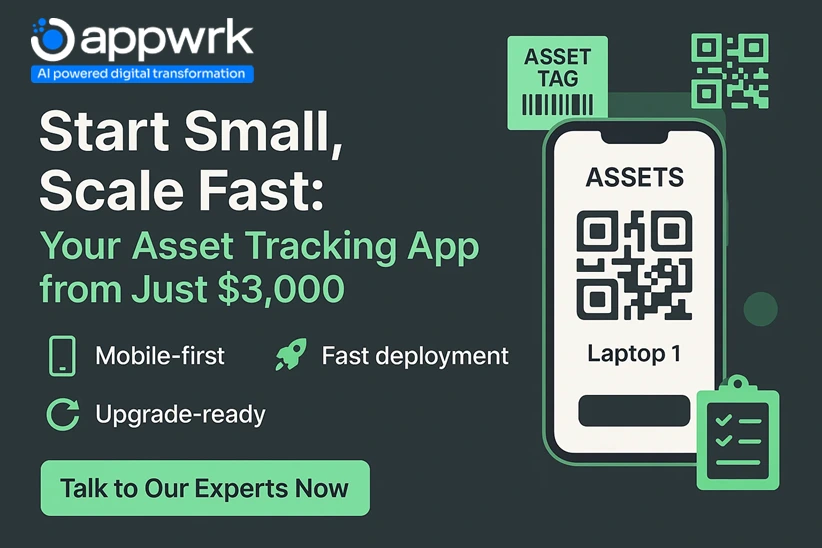
Asset Tracking App: Starting from $3,000–$6,500 for a basic iOS/Android version. Includes barcode scanning, GPS/geolocation, and basic analytics or reporting.
Full Asset Management Software: Typically ranges from $8,000–$35,000+, depending on modules such as maintenance scheduling, onboarding workflows, audit trails, version control, and metadata-driven analytics.
The right choice depends on your scale, compliance requirements, and how tightly you need your systems to integrate. Appwrk helps founders and CTOs build the right fit, not just the biggest build.
Asset Management Software Trends: What to Expect in the Next 12–18 Months
As digital asset management systems become central to operational efficiency, the next wave of innovation is already shaping how businesses track, analyze, and optimize their assets.
Here’s what’s on the horizon:
AI-Powered Asset Insights
AI will move from a “nice-to-have” to a core expectation, driving predictive maintenance, anomaly detection, and automated metadata tagging that reduce manual work and improve forecasting.
IoT Integration and Real-Time Tracking
Expect tighter connections between software and physical assets via IoT sensors, RFID, and GPS modules for real-time status updates across fleets, warehouses, and remote sites.
Blockchain for Asset Verification
Blockchain technology will begin enabling tamper-proof ownership logs and lifecycle validation, especially valuable in logistics, energy, and infrastructure management.
Enhanced Compliance Automation
More systems will auto-detect compliance gaps and generate reports aligned with ISO 27001, SOX, or GDPR requirements, minimizing human oversight.
Hyper-Personalized Dashboards
AI-generated KPI dashboards will adapt to user roles, offering customized reporting views and faster onboarding for teams handling complex asset ecosystems.
These shifts mark the evolution from static inventory tracking to intelligent asset ecosystems, platforms that learn, adapt, and deliver measurable ROI. If you’re planning to build or scale your asset management solution, aligning with these trends now ensures your system stays future-ready.
How Appwrk Can Help in Asset Management Software Development
Building scalable asset management software requires more than solid code; it demands strategy, domain experience, and execution discipline. That’s where Appwrk brings an edge.
30 to 40% lower build costs with component-based development
Up to 60% faster deployment through cloud-native architecture
90%+ client retention, driven by proactive support and predictable delivery
Secure, Scalable Architecture
Every build meets enterprise-level security and regulatory compliance standards, from GDPR and HIPAA to ISO frameworks, with encrypted metadata and scalable cloud-based asset management systems.
Founders’ Guide to Getting Asset Management Software Right
If you’re a founder or decision-maker planning to build asset management software, here’s a simple framework to stay on track from day one:
1. Start with Real Use Cases
Map out what your business actually needs to track, be it IT hardware, fleet vehicles, media files, or financial assets. Don’t overbuild for the sake of features.
2. Know What You’re Integrating With
List your existing tools (ERP, CRM, spreadsheets, ticketing, etc.). Strong API and integration tools are key to minimizing manual work.
3. Pick a Future-Proof Architecture
Choose cloud-first, modular platforms with metadata tagging, real-time tracking, and user permissions built in. Avoid bloated legacy systems.
4. Plan for ROI, Not Just Launch
Track everything from onboarding time, asset ROI, to maintenance schedules. Software is not a cost; it’s an asset optimizer if designed right.
Appwrk helps first-time tech founders align tech with ROI by translating real-world asset tracking into scalable, cost-efficient platforms.
People Also Ask
What is the cost of digital asset management software? A basic digital asset management system starts around $3,000 with onboarding and storage control. Enterprise solutions with AI analytics and predictive maintenance can reach $40,000+.
How does asset tracking software pricing vary? Pricing depends on users, assets, and feature depth, expect $10 to $25/user/month for SaaS tools or $5,000 to $30,000 for custom builds.
Is custom development better than SaaS tools? Custom builds are best for businesses needing deep integrations, access control, and compliance. SaaS fits short-term or single-department use cases.
How do I calculate ROI for enterprise asset software? Use: ROI = (Cost Savings to Software Cost) ÷ Software Cost Include reduced asset loss, optimised maintenance, and time savings in your analysis.
Which industries use Enterprise Asset Management software the most? Manufacturing, logistics, construction, public utilities, and IT, all driven by high-value physical assets and regulatory oversight.
What are the hidden costs in asset software development? Typical hidden costs include cloud data storage, post-launch support, training modules, and compliance integrations.
Should I choose cloud-based or on-premise asset software? Cloud-based systems are faster to deploy and scale easily. On-premise works better for offline environments or strict security mandates.
Can Appwrk build a fully custom asset tracking system? Yes, Appwrk specialises in developing AI-powered asset management solutions tailored to specific industries, asset types, and compliance frameworks. Contact Appwrk today to get your custom roadmap.
Gourav Khanna is the Co-founder and CEO of APPWRK, leading the company’s vision to deliver AI-first, scalable digital solutions for enterprises and high-growth startups. With over 16 years of leadership in technology, he is known for driving digital transformation strategies that connect business ambition with outcome-focused execution across healthcare, retail, logistics, and enterprise operations.
Recognized as a strategic industry voice, Gourav brings deep expertise in product strategy, AI adoption, and platform engineering. Through his insights, he helps decision-makers prioritize market traction, operational efficiency, and long-term ROI while building resilient, user-centric digital systems.
Subscribe to APPWRK Blogs, We'll Do the Rest!
Get Blogs on UI/UX, Mobile Apps, Online Marketing, and Web development technology.
Unlock worthy and priceless suggestions from the masters of mobile and web app development