150+ minds across 4 countries. Join a culture of innovation, ownership & growth.
Rewire for AI
From machine learning to deep learning, from classification tools to overall process automation – our AI engineers will help you retool your existing system or enhance your company results.
Ship faster, scale smarter, built for product companies and SaaS teams
Our Latest Work
We strive hard to deliver result-driven digital solutions across the globe. Check out our case studies to get a glimpse of how we ideate, innovate, and create unconventional digital solutions according to the requirements of our clients.
Discover diverse and passionate insights from our tech enthusiasts. We collaborate across various sectors to streamline operations and drive innovation. Explore our rapidly growing collection of articles to see why we’re at the forefront of IT solutions.
The decision to move from Magento to Shopify is one of the most significant replatforming choices an ecommerce business can make. Magento is powerful, but its power comes with...
Accuracy gap is real: Traditional CPG forecasting carries a 25-40% MAPE error rate. AI-powered models bring that down to 8-15%, according to McKinsey research....
Real stories from global leaders who trusted us with their ideas.
Partnering with APPWRK helped us build a compliant and scalable healthcare platform, accelerating our time-to-market by 35%. Their team consistently delivered outstanding work.
Beesers
Digital Healthcare Client
Collaborating with APPWRK, Sportskeeda modernized its platform into a real-time sports engagement ecosystem, enabling seamless content delivery, scalable fan interactions, and high-velocity performance.
Sportskeeda
Sports & Entertainment Partner
Working with APPWRK was effortless. They captured our vision, maintained full compliance, and delivered a digital experience that built trust and elevated how customers interact with our fintech brand.
PayPenny
Fintech Partner
Working with APPWRK gave us confidence in adopting AI responsibly. Their team built a safe, intelligent bot that transformed how we engage with leads and helped us achieve measurable revenue growth.
IFB
AI Transformation Partner
Leveraging APPWRK’s digital expertise, Nemesis launched a scalable, compliant, and safe super app that connects content delivery, real-time communication, and logistics management within a single platform.
A custom inventory software costs $15K, starting from as low as $18K for lean MVPs, and scaling up to $150K for enterprise-ready builds with AI, compliance, and multi-site integrations.
Warehouse automation, real-time inventory sync, and ERP integrations can increase your base cost by 1.5x-2x, making feature planning essential for ROI clarity from day one.
Integrating AI-driven demand forecasting and predictive restocking can increase development costs by approximately 20-25%. However, this investment significantly minimizes stockouts, overstocking, and fulfillment delays, delivering substantial annual savings, especially in high-volume inventory operations.
Sector-specific builds (e.g., for aviation, manufacturing, or real estate) demand deeper compliance, reporting precision, and asset tracking, often raising initial budgets by $30K-$100K.
Modular development approaches (ranging from $30K-$80K per phase) enable early MVP releases, adaptive scaling, and budget-controlled iteration without scope bloat.
Ongoing maintenance, infrastructure, and training costs often add 15-20% annually to the total cost of ownership, and yet are rarely accounted for during initial scoping.
This blog is crafted for founders, CIOs, supply chain heads, and digital product leaders aiming to build modern inventory software. From budgeting and feature scoping to sector-specific pricing logic and tech-stack tradeoffs, this guide delivers decision-grade insights for building a scalable, efficient, and future-ready inventory platform.
Why Are Businesses Prioritizing Inventory Platforms in 2025 and Beyond?
As global supply chains grow more complex and customer expectations climb, businesses are turning to advanced inventory platforms not just to manage stock, but to gain a competitive edge. The inventory management software market is expected to soar to USD 7.14 billion by 2033, with an 8.4% CAGR from 2025 onward, fueled by the rise of dropshipping, third-party logistics (3PL), and real-time fulfillment demands.
This shift signals a broader transformation: inventory systems are no longer just back-office tools; they’re becoming strategic assets powered by automation, predictive analytics, and live tracking capabilities.
Inventory Software Equals Working Capital Optimization
Inventory is often the largest component of working capital on a company’s balance sheet. However, outdated valuation methods, such as FIFO, LIFO, or weighted average, can distort cash flow planning when not supported by accurate, real-time data.
Modern inventory management software bridges this gap by enhancing stock accuracy and aligning valuation methods with dynamic market conditions. As a result, key financial indicators like Days Inventory Outstanding (DIO) are becoming boardroom metrics, not just accounting tools.
Driven by this shift, C-suite executives are prioritizing investments in inventory management platforms, not as IT infrastructure, but as strategic levers to unlock liquidity, reduce risk, and optimize working capital across the enterprise.
Demand Driven by Different Sectors
Different sectors are also accelerating the software demand through unique pressure points, and these have been discussed below:
Retail & E-commerce require omnichannel inventory sync, real-time stock, and automated reordering to meet consumer expectations. These platforms must unify inventory across web, mobile, store, and third-party channels to prevent overselling, avoid fulfillment errors, and maintain customer satisfaction.
Manufacturing & Automotive need precise materials requirement planning, compliance reporting, and just‑in‑time workflows. Inventory gaps here lead to stalled production, so the software must track every raw material’s usage, buffer level, and delivery status to maintain throughput efficiency.
Aviation & Real Estate focus on asset tracking with lifecycle logs and audit trails. Software must monitor high-value components or physical assets throughout their usage cycle, ensuring audit-readiness and reducing maintenance oversights.
Healthcare & F&B face strict traceability and FIFO compliance for regulatory needs. Inventory systems must maintain batch-level movement history, expiry alerts, and recall readiness, which is critical for FDA, USDA, and pharma-grade compliance.
This translates into sector‑wise pricing tiers, ranging from moderately priced retail systems to high-cost, compliance-heavy aviation and medical solutions.
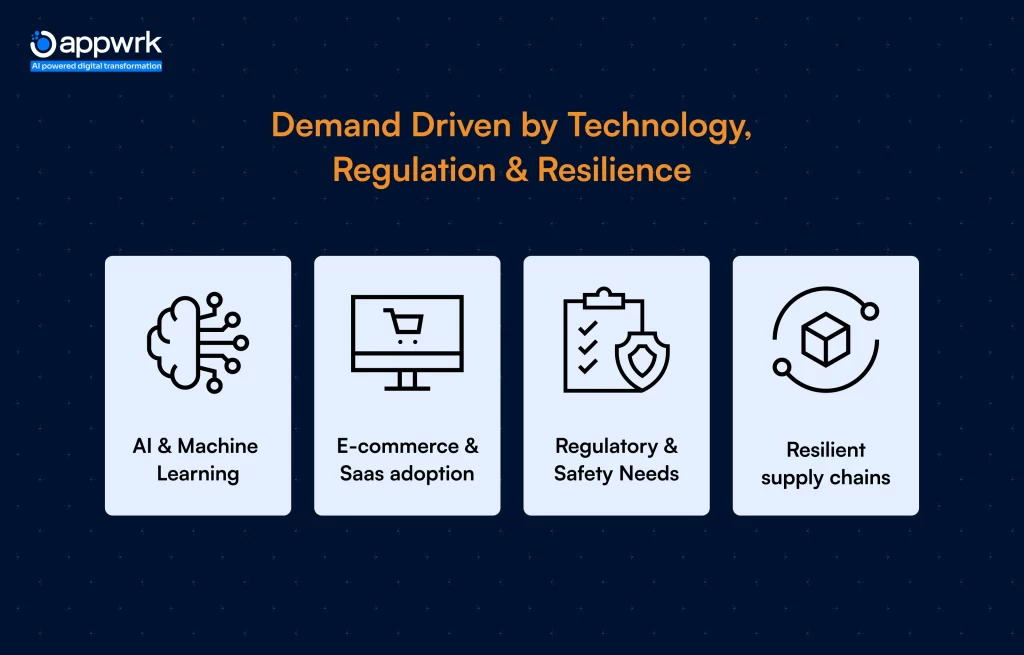
Demand Driven by Technology, Regulation & Resilience
The rapid adoption of inventory management systems isn’t just a passing trend; it’s being driven by powerful, long-term forces. Four key macro trends are reshaping both the need for advanced platforms and the cost of building them from the ground up.
E‑commerce & SaaS adoption: Retail and E-commerce businesses demand omnichannel inventory sync to manage stock across websites, physical stores, marketplaces like Amazon, and social selling channels. Without real-time data flow between these systems, businesses risk overselling, delayed fulfillment, or inaccurate product availability. This need for always-on visibility pushes demand for cloud-native, mobile-first platforms with API-driven architecture, adding upfront dev costs ($15K-$35K), but reducing friction and fulfillment errors at scale.
AI & Machine Learning: Features like predictive restocking, intelligent reorder point optimization, and anomaly detection rely on AI models trained on historical sales, seasonality, and demand triggers. While adding 20-25% to the initial build cost, these modules unlock downstream savings by slashing overstock, preventing out-of-stock events, and improving forecasting accuracy across dynamic SKUs.
Regulatory & Safety Needs: Industries such as pharmaceuticals, aviation, and food & beverage face stringent rules around product traceability, batch control, and compliance logs. This necessitates deeper architectural layers like audit trails, data versioning, and validation workflows, driving both development scope and testing time. Compliance modules alone can add $20K+ to regulated builds.
Resilient Supply Chains: Post-COVID volatility exposed the fragility of global inventory pipelines. Businesses are now investing in digital twins, scenario simulation tools, and resilience engines that dynamically adjust reorder points based on risk signals. These resilience modules elevate build cost by 10-20%, but help stabilize inventory health, avoid panic buying, and optimize buffer vs lean strategies across vendors, locations, and seasons.
Businesses in the USA, Europe, and India are leading the shift driven by E-commerce scale in the USA, regulatory tightening in Europe, and digital inventory modernization in India’s manufacturing and logistics corridors.
What Factors Should be Considered When Budgeting for Inventory Software Development?
Businesses often start with “How much will it cost?”. However, a more strategic question is:
“Which cost elements are league-changing, and how do they correlate with industry requirements, feature depth, and operational complexity?”
Hence, here’s a refined cost breakdown based on APPWRK’s build data across global clients, ensuring budget accuracy for varied project scopes.
To help businesses choose the right scope for their project, we’ve categorized inventory builds into three tiers: Lean MVP, Growth SaaS, and Enterprise Custom, each aligned with different operational needs and investment appetite.
Good (Lean MVP) Inventory Build
Ideal for startups and small warehouse operations, this build focuses on core essentials like inventory tracking and basic reporting, prioritizing speed and lean budgets. This build generally ranges between $18K to $50K.
Better (Growth SaaS) Inventory Build
Suited for scaling B2B platforms, this build adds integrations, barcode scanning, and mobility, helping streamline operations across growing locations. The cost of this build generally revolves around a range of $60K and $120K.
Best (Enterprise Custom) Inventory Build
Meant for regulated, multi-site businesses, this tier includes AI forecasting, compliance features, and multi-tenant cloud setup for long-term scalability. The budget range of this build lies around $140K and can rise up to $150K.
Build Category
Budget Range
Recommended For
Feature Depth of the Software
Good (Lean MVP)
$18K-$50K
Early-stage startups, single warehouse ops
Real-time inventory, basic reporting, and manual updates.
Better (Growth SaaS)
$60K-$120K
Scaling B2B platforms, 2–3 warehouses
POS integration, barcode, and mobile dashboards.
Best (Enterprise Custom)
$140K-$150K+
Regulated, multi-location businesses
AI forecasting, compliance, ERP sync, and multi-tenant cloud.
Note: Core development is just the base. Annual costs like maintenance, cloud infrastructure, and support typically add 15-25% to your total spend.
Factors Driving Inventory Software Build Cost
Let’s face it, the cost of building inventory management software goes far beyond code. It’s shaped by the unique operational demands of your industry, regulatory requirements, and future scalability goals. Many businesses underestimate the hidden challenges, like integration complexities and backend architecture, that can quietly inflate development budgets. In this section, we break down the key cost drivers you need to consider before planning your inventory software build.
Sector Complexity
The industry you operate in significantly influences build time, feature depth, and compliance requirements, making sector complexity a key cost driver.
Retail and E-commerce systems can launch within 4-6 months, as they involve standard workflows and lighter compliance needs.
Aviation, healthcare, or manufacturing solutions often take 12+ months due to deeper compliance, traceability, and regulatory audit requirements that raise architecture and QA overhead.
Feature Complexity
The number and sophistication of features directly impact coding hours, QA cycles, and system testing, affecting both time and cost.
Essentials like barcode tracking, asset tracking, and reorder automation are relatively quick to implement with off-the-shelf approaches.
Features such as AI-powered demand forecasting, ERP sync, and multi-site real-time visibility can raise costs by 20-30% due to the need for advanced logic, data modeling, and integration depth.
Legacy Integration Load
Legacy systems add hidden technical debt, making integration more expensive and time-consuming, especially in mid-to-large organizations.
Connecting with spreadsheets, ERP systems, or warehouse hardware introduces sync issues, API limitations, and schema mismatches that need middleware or data cleanup.
Legacy cleanups can significantly double your integration budget, particularly if there’s little documentation or inconsistent naming conventions.
Scalable Architecture
Future-proofing your software ensures it grows with your business, avoiding rebuild costs and system instability.
Basic MVPs without future-proofing may cost less upfront but often lead to rebuilds that can multiply the cost by 5-7 times later.
Layered tech stack design using serverless or microservices may increase cost slightly (by ~10–20%), but ensures long-term scalability, uptime, and modular upgrades.
Phased Development Approach for Software Cost Reduction and Quality Assurance
Smart businesses and product teams adopt phased development to avoid scope creep, manage inventory software build cost effectively, and deliver validated outcomes at each milestone. Here’s how a structured 4-phase rollout helps in aligning cost, feature depth, and go-to-market speed.
Core Inventory Management and Real-Time Reporting (MVP)
This phase sets the foundation. It includes essential modules for tracking stock inflow and outflow, with real-time dashboards, role-based access, and manual adjustments. Ideal for single-warehouse startups or lean operations launching fast.
Barcode Scanning, Asset Tracking, and UI/UX Enhancements
This phase expands operational efficiency through hardware integrations such as barcode and RFID, along with scanner-ready interfaces. It also enhances the front end for warehouse staff, improving adoption and reducing manual errors.
AI-Powered Forecasting and Automated Reordering
AI modules come into play here, delivering predictive analytics, demand planning, and threshold-triggered reordering. This reduces stockouts, optimizes carrying costs, and is highly valuable for mid-to-large retailers and distributors in the US and Europe.
ERP & CRM Integration with Multi-Site Inventory Synchronization
This enterprise-focused phase involves deep system integrations, including ERP (e.g., SAP, Oracle) and CRM (e.g., Salesforce, Zoho), as well as synchronizing inventory across multiple warehouses or geographic locations. Enables scalable architecture for global eCommerce, healthcare, or manufacturing.
Development Phase Breakdown Along with the Key Features and Cost Range
Development Phase
Key Features Included
Estimated Cost Range
Phase 1
Stock in/out, manual adjustments, basic dashboards, and user roles.
$18K-$35K
Phase 2
Barcode scanning, asset lifecycle logs, and scanner app UI.
$25K-$40K
Phase 3
AI forecasting, reorder automation, and stock trend analytics.
$30K-$50K
Phase 4
ERP/CRM integration, multi-site sync, and audit logs.
$40K-$60K
How Inventory Management Software Is Built: Full Development Lifecycle
Building inventory management software isn’t a one-size-fits-all process; it’s a strategic journey that unfolds across multiple stages, each with distinct deliverables, timelines, and cost implications. Whether you’re a CIO planning system architecture or a product team mapping ROI, this section walks you through the complete development lifecycle, offering a clear view into what gets built when, why it matters, and how it impacts your budget.
Requirements Gathering & Business Analysis
Purpose: Define user personas, workflow processes, data flows, and key integrations.
Cost: Typically, 5-7% of the total build cost, which is around $5K-$15K for full-scale inventory systems.
Impact: Ensures accurate tracking of feature costs (MVP vs enterprise models) and minimizes scope creep. Software lifecycle planning typically allocates 10% for planning, aligning with this phase.
Planning & UX/UI Design
Purpose: Create wireframes, prototypes, and visual designs tailored to multi-user environments (warehouse staff, managers, auditors).
Cost: Around 8–12% of budget (~$10K-$30K). This inclusively validates UI experiences for mobile scanning, dashboards, and enterprise use cases.
Why It Matters: Early UI validation reduces expensive reworks later by aligning user workflows with design. Design/planning stages parallel industry estimates of 5-10% of build cost.
Technical Architecture & Tech Stack Setup
Purpose: Define cloud/on-prem setup, tenancy, data pipelines, and security frameworks.
Cost: Approximately 10-15% of dev cost ($15K–$50K).
Rationale: A robust tech foundation determines scalability, data integrity, and ease of integrating modules like AI forecasting or ERP sync. Infrastructure phases align with engineering distributions at 5-10% architecture cost.
Cost: Cost typically accounts for 30-40% of the total project budget, making this the most resource-intensive phase, often ranging from $80K to $100K. Backend development alone contributes to around 40% of the total software cost.
Integration & Legacy System Sync
Purpose: Connect barcode/RFID readers, ERP/CRM platforms, WMS, and POS.
Cost: Typically, 15–20% of project budget (~$20K-$50K).
Value: Eliminates data silos, accelerates adoption, and prevents manual reconciliation workflows. Middleware/integration complexity drives significant budget increases.
Enterprise clients across North America and Europe often face heavier ERP/CRM legacy loads, while India-based SMEs increasingly opt for lightweight APIs or custom middleware to reduce vendor lock-ins.
Purpose: Execute manual and automated tests, and validate audit and regulatory modules.
Cost: Usually 10-15% of project value.
Importance: Ensures system resilience, traceability, and readiness for industry-specific compliance. QA is commonly 15-20% of dev cost.
Deployment, Go-Live & Launch Support
Purpose: Final rollout, initial performance tuning, user training, and issue mitigation.
Cost: About 5-7% of the total budget.
Why: A seamless deployment builds user trust and ensures business continuity from day one. While deployment typically accounts for just 1-2% of the total budget, it deserves full planning, including go-live readiness and initial support, to guarantee a smooth, disruption-free launch.
Purpose: Ongoing enhancements, bug fixes, cloud scaling, licensing, and support.
Cost: Annual recurring is 15-20% of the initial build cost.
Utility: Keeps systems secure, adaptable, and aligned with evolving business needs. Post-launch maintenance is estimated at 15-20% annually.
Impact of Industry-specific Needs on Inventory Management Software Design and Cost
No two industries manage inventory in the same way. Regulatory burdens in pharmaceuticals, SKU volume in retail, and batch traceability in food production each introduce distinct functional and architectural requirements. This section dives into how these sector-driven complexities shape both the design and the total cost of building robust, future-proof inventory management software.
Retail & eCommerce: Fast-Paced Builds with High ROI
Retail and eCommerce platforms require agile, omnichannel inventory solutions that drive tangible business outcomes:
These verticals mirror aviation in regulatory demands but with an added public safety focus:
Cost Range: $120 K–$150 K+
Feature Requirements:
FIFO, batch control, cold chain tracking — $40 K–$120 K.
Integrations with lab systems, ERP, and regulatory reporting add further cost.
Outcome: Supports recall readiness, prevents spoilage, and ensures compliance.
Consolidated Cost for Various Industry Types and Their Primary Cost Drivers
Industry Type
Estimated Cost for each Industry
Primary Cost Drivers
Retail & eCommerce
$50K-$100K
Barcode/POS sync, UX, and multi-site architecture.
Manufacturing & Automotive
$60K-$150K+
MRP/SCM modules, ERP integration, and compliance tracking.
Aviation & Aerospace
$100K-$150K+
RFID, serial logs, and regulatory audits
Real Estate / Facility Assets
$100K-$150K
Asset lifecycle tracking, and maintenance modules.
Healthcare / Pharma / F&B
$120K-$150K+
FIFO control, batch logging, and lab/ERP integrations.
High-Cost Inventory Management Features: Which Ones Deliver Real Value
When it comes to inventory management software build cost, not all features are equal in value. Some high-cost modules deliver disproportionately high ROI, while others may be overkill depending on your scale or industry.
Here are some features that founders and CIOs can evaluate to understand which features pay off the highest ROI:
Real-Time Inventory Tracking & Monitoring
This feature ensures live visibility into inventory movement, helping reduce stock discrepancies and enabling accurate, data-driven supply chain decisions.
Enables cloud-based, multi-location visibility via APIs, IoT sensors, and real-time dashboards.
Implementation ranges from $20K-$35K, with additional reporting and sync capabilities.
Benefits include 99% inventory accuracy and lower stockout/overstock rates, ultimately reducing carrying costs by ~25%.
Barcode & RFID Scanning Integration
Crucial for fast, error-free inventory logging, barcode and RFID tech enhance accuracy in high-volume environments and reduce manual reconciliation costs.
Barcode modules cost between $10K-$25K; RFID adds $30K+ for readers, middleware, and software.
Passive RFID tags are low-cost ($0.10-$0.20 each), but fixed readers are $2K–$8K, and handheld units $1K–$4.5K.
Barcode & RFID Scanning Integration is essential for sectors requiring bulk and non-visual scanning across locations.
Automated Reordering & Alerts
A proactive inventory safeguard, this feature eliminates guesswork by continuously monitoring stock levels and auto-triggering replenishment orders. It sharpens supply chain responsiveness while cutting down on costly stockouts and overordering.
Develops dynamic reorder point logic, threshold alerts, and purchase order automation.
Automated Reordering & Alerts likelycosts around $15K-$30K, reducing stockouts and improving inventory turnover.
Multi-Location & Cloud Architecture
Designed for growth-focused operations, this architecture unifies inventory oversight across multiple sites while leveraging the cloud for real-time visibility, seamless coordination, and uninterrupted performance at scale.
Synchronizes real-time data across distribution centers.
Cloud-native inventory architecture adds $15K-$35K, critical for scalability, multi-warehouse sync, and global uptime. It’s the default model for SaaS-based inventory tools aiming for zero-downtime sync and cross-platform operability.
AI-Driven Demand Forecasting
This feature enables accurate prediction of inventory needs by analyzing historical trends, seasonal shifts, and sales velocity, helping businesses reduce overstocking, prevent stockouts, and enhance fulfillment efficiency.
Implements machine learning for predictive restocking and trend analytics.
Modules add $25K–$50K, directly lowering inventory holding and improving fill rates.
Reporting & Analytics Dashboards
The reporting and analytics dashboards enable real-time monitoring of inventory performance, offering actionable insights through visual KPIs and trend analysis, allowing businesses to make faster, smarter operational decisions.
Custom BI platforms cost $10K–$20K, delivering KPI tracking and anomaly reporting across modules.
APPWRK builds inventory dashboards with DIO, stock turnover, and real-time alerts. We enable PowerBI and Mixpanel integrations for deeper insights, letting teams track demand shifts, reorder accuracy, and compliance gaps, all with drill-down capability.
ERP/CRM Integrations
The ERP/CRM integrations enable seamless connectivity between inventory systems and core business functions, automating procurement, finance, and customer operations to improve efficiency and maximize ROI.
Sync with existing systems to streamline operations.
Integration connectors can cost $20K-$50K depending on endpoints and complexity.
For enterprise builds, ERP middleware license costs ($5–$20/user/month) also contribute to recurring infrastructure budgets, especially when syncing with Oracle, SAP, or NetSuite.
Compliance & Audit Trail Modules
The compliance and audit trail modules enable organizations to meet regulatory standards by maintaining detailed, traceable logs and version histories—an essential feature for highly regulated industries like aviation, pharmaceuticals, and food.
Especially critical for aviation, pharma, and healthcare.
Includes detailed revision histories, activity logs, and built-in audit support, typically adding $20K or more to the development budget due to its complexity and compliance-critical role.
Mobile Interface & Scanner Apps
The mobile interface and scanner apps equip on-floor teams with real-time tools for inventory management, eliminating delays in data entry, reducing manual errors, and significantly enhancing operational agility and throughput.
Supports barcode scanning and warehouse operations via mobile UI.
Estimated cost: $15K-$30K, varies by functionality and offline support.
Security & Data Management
Security and data management features establish robust safeguards around sensitive inventory information, enforcing role-based access, encrypted backups, and disaster recovery protocols to ensure business continuity and regulatory compliance.
Adds role-based access, encryption, and backups.
Costs $10K-$25K, essential for enterprise-grade builds and compliance.
APPWRK also embeds data lineage tracking and compliance metadata tagging to ensure traceability across workflows. Features like role-based access, backups, and anomaly alerts are standard in regulated builds, especially for healthcare and aerospace sectors.
What Does Each Inventory Module Actually Cost to Build?
Feature Module of the Inventory Management Software
Build Cost Range
Real-Time Tracking
$12K-$25K
Barcode / RFID Scanning
$15K-$30K
Automated Reordering & Alerts
$15K-$30K
Multi-Location Architecture
$15K-$35K
AI Forecasting
$15K-$35K
Reporting & Analytics
$10K-$20K
ERP / CRM Integrations
$20K-$50K
Compliance / Audit Trail
$20K+
Mobile Interface Support
$15K-$30K
Security & Data Infrastructure
$10K-$25K
How Should Founders Prioritize Inventory Software Features for Better ROI?
Not every feature delivers equal value per dollar spent. Strategic prioritization ensures high-ROI modules go live early, maximizing impact while containing costs. Let’s have a look at some strategies that help businesses achieve a better ROI:
Cost-to-Benefit Paradigm Features like AI-powered forecasting and barcode scanning deliver measurable returns by boosting accuracy, reducing manual effort, and driving faster decisions, often paying for themselves many times over.
Modular, Phased Launch Strategy Begin with real-time tracking and reporting for ROI validation. Add advanced modules (AI, integration, compliance) in later phases to optimize cost and adoption.
Architectural Investment Saves Later A structured investment in security, backups, mobile support, and cloud infrastructure protects scalability and reduces future rebuilds by up to 5x.
Why Inventory Software Projects Go Over Budget and How to Prevent It
Even well-scoped inventory software projects can spiral beyond budget when key cost drivers are underestimated. At APPWRK, we’ve observed that hidden integration challenges, unclear requirements, and overlooked scalability needs often lead to 30–60% overruns.
This section highlights the common pitfalls and how forward-thinking teams avoid them with smarter planning and execution.
Overcustomization Early On
What Goes Wrong: Teams chase edge-case features before validating core workflows.
Cost Spiral: Adds 20-40% to UX and dev cycles, often scrapped in Phase 2.
CFO Fix: Lock MVP scope with no more than 3 “strategic” features. Appwrk’s B2B inventory client cut $35K from UI scope by prioritizing only stock accuracy and reorder flows in Phase 1.
Legacy System Surprises Mid-Build
What Goes Wrong: ERP, WMS, or CRM systems lack usable APIs or contain mismatched schemas.
Cost Spiral: Extends integration time by 3–6 weeks; adds $20K-$50K in middleware work.
CFO Fix: Demand a technical audit of existing systems before quoting. Appwrk flags system sync risk during discovery, saving a UAE-based client 12% on middleware budget.
Inadequate QA/Compliance Planning
What Goes Wrong: Sectors like pharma or aviation assume compliance can be “patched later”.
Allocate 10–12% for training, workshops, and post-launch support.
Optimizing Inventory Management Software Cost Through Smart Architecture Decisions
The architecture behind your inventory management software plays a far greater role than many businesses realize. It’s not just a technical foundation; it influences every aspect of your system’s performance, scalability, and total cost of ownership. Well-planned architectural decisions, such as modular codebases, cloud-native infrastructure, and scalable APIs, can significantly reduce both development costs and future maintenance burdens.
Businesses that prioritize smart architecture from the start often avoid expensive rebuilds and unlock faster innovation cycles as their operations grow.
Cloud vs On‑Premise: Which Architecture Fits Your Inventory Software?
Choosing between cloud-native and on-prem affects cost profile, maintenance, and control:
Cloud-Native (SaaS):
Enables flexible pay-as-you-go operational expenses, eliminating the need for upfront hardware investments.
Development cost includes setup of deployment pipelines, auto-scaling mechanisms, and container orchestration (~$15K–$35K).
Offers flexibility, global access, and reduced internal IT burden.
On‑Premise:
Requires initial CapEx: servers, storage, network, and IT staff setup.
Ongoing OpEx includes hardware maintenance and periodic upgrades.
Preferred in industries demanding sovereignty and deep customization.
Hybrid Architectures:
Combine cloud services with local data storage/control, offering a balanced cost and compliance model.
In the US and Europe, hybrid infrastructure supports compliance mandates and edge deployments. Meanwhile, India sees a rise in cloud-native builds due to rapid startup scale and SaaS-first ecosystems.
Single-Tenant vs Multi-Tenant Architecture
Choosing between single-tenant and multi-tenant architecture has a significant impact on overall costs, scalability, security, and how easily future upgrades can be deployed.
Multi-Tenant:
A single codebase and database are shared across multiple customers, allowing for economies of scale with reduced hosting, maintenance, and licensing costs per user.
Complexity arises in ensuring data isolation and tenant-level customization.
Single-Tenant / Private Cloud:
Dedicated infrastructure per client ensures enhanced security and performance, ideal for regulated sectors, but carries significantly higher cost.
Easier compliance and custom configurations with higher CapEx and maintenance.
Planning for growth means making conscious decisions early:
Cloud auto-scaling accommodates fluctuating warehouse loads with minimal cost.
On-site scaling demands reserved capacity, driving up hardware costs.
Architecture Tradeoff Analysis Method (ATAM) aids decision-makers in balancing performance, feature-rich vs infrastructure cost.
How Can APPWRK Help You Build Cost-Effective and Scalable Inventory Software?
Building smart isn’t just about saving money; it’s about investing right from day one. APPWRK brings sector-specific insights, phased delivery, and scalable architecture to maximize your ROI.
Domain Expertise Across High-Stakes Industries
APPWRK has successfully developed inventory management systems for sectors including retail, manufacturing, aviation, and E-commerce. With deep knowledge in areas such as warehouse management, asset tracking (RFID/barcode), and EDI integration, they ensure each build is tightly aligned with industry demands. This domain-specific experience prevents costly trial-and-error work, reducing initial build cost overruns.
With delivery capabilities across North America, Europe, and India, Appwrk ensures region-specific compliance, timezone-aligned support, and pricing strategies tailored to each market’s infrastructure expectations.
Proven Performance & Client Retention
With over 530 completed projects since 2012, APPWRK maintains high client satisfaction across verticals. Their structured delivery, which starts with lean MVP development and scales into enterprise-grade platforms, drives measurable impact:
Significant ROI gains, especially in inventory accuracy, by streamlining core processes before building advanced modules.
Architecture Alignment for Cost Control
At APPWRK, our architects align system design with your business growth trajectory, ensuring that every architectural decision supports scalability while keeping development and infrastructure costs under control. Here’s how we approach cost-efficient architecture planning:
Cloud-first builds use multi-tenant architecture, offering scalability and lowering per-user cost as your business expands
They match architecture (cloud vs on-premise) to your compliance and data requirements, either reducing infrastructure overhead or keeping it on-prem where needed
This strategic technical decision-making ensures your inventory software build cost aligns with long-term operational outcomes.
Security, Compliance & Support Built-In
APPWRK embeds enterprise-grade infrastructure in every build:
Implements encryption, audit trails, and regulatory logging to support sectors like aviation and healthcare
Partners with clients for robust post-launch support and cloud monitoring, helping maintain system health and compliance through evolving operational demands
Partnering with APPWRK means more than just a software vendor; you gain a strategic partner that aligns your technology build with budget clarity and sector-specific outcomes. Schedule a free strategic scoping call.
FAQs
1. What is the average cost to build a custom inventory management system?
A custom inventory platform typically starts around $15K, ranging from $18K to $150K+ for enterprise-grade, feature-complete solutions across sectors like manufacturing, aviation, or pharma. Cost hinges on modules, compliance needs, multi-location sync, and integrations, making clear scoping crucial.
2. How much does sector choice impact inventory software build cost?
Significantly. For example, retail/E-commerce builds cost $50K-$100K, whereas aviation or healthcare systems escalate to $100K-$150K due to deep traceability, audit trails, and regulatory compliance, often accounting for a 20-40% premium.
3. How can I minimize build cost for advanced features like AI forecasting?
Adopt a phased, modular approach. Begin with core tracking and analytics in Phase 1, then add AI-driven forecasting and ERP integration later. This spreads costs, validates ROI early, and allows flexibility if the business needs to shift mid-project. Contact us to build an Inventory Management Software that has advanced features but at a minimal cost for Higher scalability.
4. What are the hidden costs often missed in inventory software builds?
Budget can overshoot by 30-50% when hidden items are ignored:
Data migration complexity
Staff training and change management
Phantom inventory cleanup
Middleware licensing
Compliance module development Planning for these in the initial phases prevents budget overruns and delays.
5. Cloud vs on‑premise: Which architecture is cheaper for inventory systems?
Cloud-native builds typically add $15K-$35K upfront but eliminate hardware costs and simplify scaling. On-premises pushes capital expenses (servers, IT staff) and long-term maintenance. Hybrid solutions are ideal for balancing both models.
6. What integration costs should I expect for ERP and POS connectivity?
ERP, CRM, WMS, and POS integrations generally account for 15-20% of build cost, often $20K-$50K, depending on API complexity and connector stability. Well-defined mapping and phased builds can mitigate unexpected overhead.
7. What ongoing maintenance costs should be budgeted per year?
Expect 15-20% of the initial development cost annually for infrastructure, security updates, support, and hosting. Cloud environments may add usage-based charges; on-prem needs periodic hardware refresh and monitoring.
8. Why are multi-tenant and scalable architectures worth the extra build cost?
Multi-tenant design adds development complexity early (+15-25%) but drastically lowers per-user cost at scale, enabling premium business models like SaaS, subscription, or white-label solutions without major rework.
Gourav Khanna is the Co-founder and CEO of APPWRK, leading the company’s vision to deliver AI-first, scalable digital solutions for enterprises and high-growth startups. With over 16 years of leadership in technology, he is known for driving digital transformation strategies that connect business ambition with outcome-focused execution across healthcare, retail, logistics, and enterprise operations.
Recognized as a strategic industry voice, Gourav brings deep expertise in product strategy, AI adoption, and platform engineering. Through his insights, he helps decision-makers prioritize market traction, operational efficiency, and long-term ROI while building resilient, user-centric digital systems.
Subscribe to APPWRK Blogs, We'll Do the Rest!
Get Blogs on UI/UX, Mobile Apps, Online Marketing, and Web development technology.
Unlock worthy and priceless suggestions from the masters of mobile and web app development