150+ minds across 4 countries. Join a culture of innovation, ownership & growth.
Rewire for AI
From machine learning to deep learning, from classification tools to overall process automation – our AI engineers will help you retool your existing system or enhance your company results.
Ship faster, scale smarter, built for product companies and SaaS teams
Our Latest Work
We strive hard to deliver result-driven digital solutions across the globe. Check out our case studies to get a glimpse of how we ideate, innovate, and create unconventional digital solutions according to the requirements of our clients.
Discover diverse and passionate insights from our tech enthusiasts. We collaborate across various sectors to streamline operations and drive innovation. Explore our rapidly growing collection of articles to see why we’re at the forefront of IT solutions.
The decision to move from Magento to Shopify is one of the most significant replatforming choices an ecommerce business can make. Magento is powerful, but its power comes with...
Accuracy gap is real: Traditional CPG forecasting carries a 25-40% MAPE error rate. AI-powered models bring that down to 8-15%, according to McKinsey research....
Real stories from global leaders who trusted us with their ideas.
Partnering with APPWRK helped us build a compliant and scalable healthcare platform, accelerating our time-to-market by 35%. Their team consistently delivered outstanding work.
Beesers
Digital Healthcare Client
Collaborating with APPWRK, Sportskeeda modernized its platform into a real-time sports engagement ecosystem, enabling seamless content delivery, scalable fan interactions, and high-velocity performance.
Sportskeeda
Sports & Entertainment Partner
Working with APPWRK was effortless. They captured our vision, maintained full compliance, and delivered a digital experience that built trust and elevated how customers interact with our fintech brand.
PayPenny
Fintech Partner
Working with APPWRK gave us confidence in adopting AI responsibly. Their team built a safe, intelligent bot that transformed how we engage with leads and helped us achieve measurable revenue growth.
IFB
AI Transformation Partner
Leveraging APPWRK’s digital expertise, Nemesis launched a scalable, compliant, and safe super app that connects content delivery, real-time communication, and logistics management within a single platform.
Nemesis
Super App Partner
Partner with us to transform your logistics operations
Accelerate your growth with AI-powered logistics software, built for efficiency, visibility, and real-time control.
The cost to build logistics management software in 2025 starts around $5,000 for a basic Minimum Viable Product (MVP). Hourly rates range from $25/hour in India to $120/hour in the US, depending on region, stack, and project complexity.
Average timeline of Logistics Management Software: 6 to 24 weeks, depending on scope and integrations.
Pricing depends on software architecture, GPS tracking systems, AI automation in logistics, IoT integrations, and maintenance and support services post-launch.
Real-World Examples Projects range from a $22K 3PL logistics platform in India to a $120K SaaS logistics enterprise software build for global clients.
Build vs Buy
Buy off-the-shelf if you need a quick setup.
Build custom Logistics management software if you need deeper control and scalability.
Written for logistics startups, 3PL/4PL providers, CTOs, and supply chain leaders planning their logistics management software development budget or exploring custom logistics software for scalability.
Introduction: Understanding the Cost Landscape of Logistics Management Software
Building logistics management software has become a strategic necessity for global supply chains and mid-sized enterprises. In 2025, costs start from $5,000 for a basic MVP and can scale up to $150,000+ for enterprise-grade systems. Offshore teams typically charge $25 to $40/hour, offering the most cost-efficient development models.
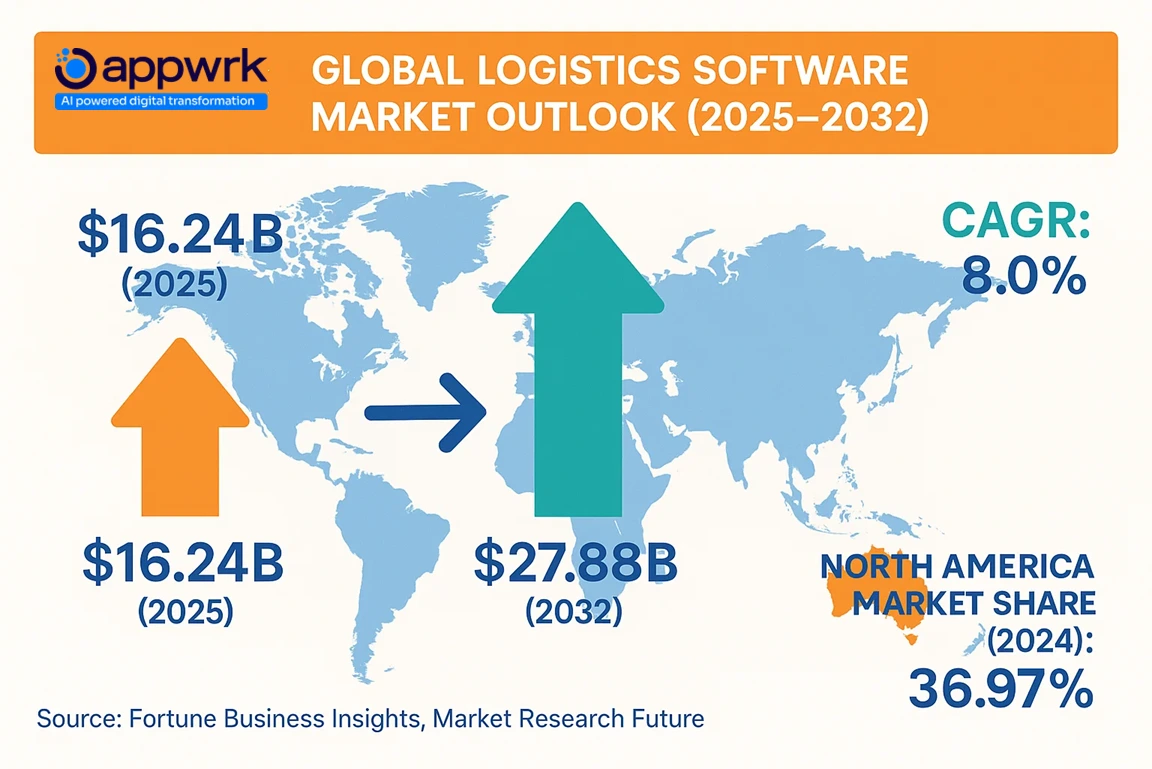
According to Fortune Business Insights, the global logistics software market is projected to grow from $16.24 billion in 2025 to $27.88 billion by 2032, at a CAGR of 8.0%, led by automation, AI, and real-time data visibility. North America holds the largest share at nearly 37%, while industries like e-commerce, oil & gas, and manufacturing are driving adoption.
This rapid growth has created a diverse cost landscape, where pricing depends on geography, integrations, and scalability demands, not just software complexity.
What Is Logistics Management Software?
Logistics Management Software (LMS) is a digital platform that streamlines the planning, execution, and monitoring of logistics and supply chain operations. Its core functions include order management, fleet routing, warehouse control, real-time tracking, and data analytics, all aimed at cutting operational delays and boosting visibility.
Modern LMS platforms use cloud-based architecture, predictive analytics, and AI automation to manage complex logistics networks across warehouses, fleets, and delivery channels.
How Much Does It Cost to Build Logistics Management Software in 2025?
The cost to build logistics management software starts at $5,000 for a simple tracking app and goes up to $150,000+ for fully custom, multi-module systems. Key benchmarks:
Logistics Management Software Type
Estimated Cost (USD) to Build Logistics Management Software in 2025
Logistics Management Software Build Time
Basic Tracking Software
$5,000 to $15,000
4 to 6 weeks
Mid-Level Logistics Management Software
$20,000 to $50,000
3 to 5 months
Enterprise Logistics Management Software
$60,000 to $150,000+
6 to 10 months
Basic Logistics Management Software: Order logging, fleet assignment, and basic tracking.
Startups often begin with 2 to 3 modules and expand as revenue or fleet size scales.
Comparative Cost Table: Logistics Management Software by Industry Use Case
Not all logistics software costs the same. Depending on the industry, from freight coordination to warehouse automation or retail logistics, the modules, integrations, and compliance needs vary, directly impacting total development cost.
Industry
Core Modules of the Logistics Management Software
Estimated Cost Range (USD)
eCommerce
Inventory management, order fulfilment, and delivery tracking
These figures help teams align budgets with real-world industry applications, whether developing a logistics tracking app or a cloud-based logistics management system.
Different Types of Logistics Management Software You Can Develop
Logistics management covers multiple verticals. Your software requirements depend on the type of assets, delivery model, and scale of operations.
Here are the most in-demand categories of logistics software to consider in 2025:
Transportation Management Systems (TMS)
Built for managing freight movements, carrier selection, route planning, fuel optimisation, and real-time shipment visibility. Integrates easily with ERP and warehouse systems.
Used for managing storage, picking and packing, inventory tracking, barcode scanning, and automated reordering, it is essential for warehouse-heavy operations.
Ideal for businesses with their own vehicles. Offers GPS tracking, vehicle diagnostics, fleet maintenance, and driver behaviour monitoring for compliance and efficiency.
Built for last-mile and on-demand delivery providers. Enables real-time tracking, push notifications, automated dispatch, and customer portals.
Freight Forwarding Platforms
Support intermodal operations, customs handling, and global freight movement. Often integrates with IoT sensors and digital twins in logistics for full lifecycle visibility.
Supply Chain Visibility Platforms
Provide end-to-end visibility across manufacturers, suppliers, and logistics providers. Help track inventory levels, avoid bottlenecks, and improve delivery efficiency.
Custom-built for decision-makers. Include AI-driven insights, cost forecasting, and performance benchmarking, often tied to BI or ERP tools.
Who Can Benefit from Custom Logistics Management Software?
Custom logistics management software offers flexibility, scalability, and control that off-the-shelf tools can’t. In 2025, it will be adopted by businesses that need real-time logistics data analytics, seamless API integrations, and advanced automation.
Rely on fleet management software, shipment tracking, and route optimisation to improve driver performance and reduce fuel costs.
eCommerce and Retail Enterprises
Handle dynamic inventory levels, multi-channel shipping, and customer satisfaction. Custom systems enable real-time warehouse management and barcode-based tracking.
Manufacturing and Supply Chain Networks
Require integration with ERP systems, RFID tagging, and predictive maintenance for logistics and production assets.
On-Demand and Last-Mile Delivery Platforms
Need cloud-based logistics tools and mobile apps for drivers, supporting GPS-based tracking, push notifications, and automated dispatching systems.
Why custom matters: Off-the-shelf systems often fail to match complex logistics workflows. Custom software aligns with existing IT infrastructure, ensuring scalability, security, and efficiency.
Regional Cost Analysis for Logistics Management Software Development in 2025
Development costs vary widely by geography, influenced by hourly rates, tech maturity, and logistics domain expertise. Choosing the right region can lower costs by up to 60% while maintaining high performance and compliance.
Region
Avg. Hourly Rate (USD)
Estimated Project Cost of the Logistics Management Software Development
Key Strengths of the Logistics Management Software
United States
$60 to $120/hr
$50,000 to $150,000+
Advanced TMS expertise, high compliance standards
Eastern Europe
$40 to $70/hr
$25,000 to $90,000
Balanced cost-quality mix, skilled in WMS and automation
Growing base for freight and shipping route software
Hybrid outsourcing, combining onshore management with offshore development, remains the most efficient model for custom logistics software development.
Beyond developer rates, cloud-native architecture, maintenance services, and compliance add to the overall cost. Teams skilled in supply chain management software and ERP integrations for logistics deliver faster builds and better ROI.
Timeline & Team Composition for Logistics Management Software Development
Developing custom logistics software, from delivery management tools to advanced warehouse management systems, typically takes 4 to 10 months, depending on project scope, integrations, and scalability goals. The right team structure ensures quality code, smooth execution, and post-launch stability.
Phase of Logistics Software Development
Duration
Key Roles Involved in the Logistics Software Development
Discovery & Planning
2 to 3 weeks
Business Analyst, Product Owner, Project Manager, IT Lead
UI/UX Design
2 to 4 weeks
UX Designer, UI Designer, focused on intuitive interfaces
Core Development
3 to 6 months
Frontend/Backend Developers, DevOps, and QA Engineers skilled in inventory and GPS tracking systems
QA & Testing
3 to 5 weeks
Manual and Automation Testers ensuring feature and performance quality
Deployment & Maintenance
Ongoing
DevOps, Support Engineers, Security Experts, Training Coordinators
Startups focused on Minimum Viable Product (MVP) builds often speed up timelines by using Flutter or React Native, and by reusing modules for shipment tracking, fleet management software, and order processing.
Enterprise-grade builds, on the other hand, usually include AI route optimisation, IoT-enabled logistics tracking, and custom Transportation Management Systems (TMS), requiring larger teams and deeper engineering expertise.
Modular Architecture and Ecosystem Integration in Logistics Software
Modern logistics platforms are shifting from monolithic builds to modular architectures that scale and adapt easily. Businesses now launch with core modules, like order management, warehouse control, and fleet tracking—and later add advanced layers such as freight management, analytics dashboards, or return logistics systems (RLS) as operations grow.
A modular setup only works when it integrates smoothly with the wider ecosystem. Seamless integration with ERP, TMS, and third-party carriers ensures real-time coordination without disrupting workflows. This is made possible through API-driven microservices architecture, enabling synchronized data across inventory, finance, and delivery systems.
Support for payment gateways (like Stripe or PayPal) and multi-client architecture centralizes control for vendors, warehouses, and carrier networks. Layered user roles and permissions give teams, from dispatchers to finance, secure, role-based access to the same platform.
By adopting a modular, API-first approach, enterprises gain flexibility, faster scaling, and independence from vendor lock-in, building logistics systems that are secure, interoperable, and built to evolve.
Emerging Technologies in Logistics Software Development (2025 & Beyond)
Modern logistics platforms are evolving into AI- and data-driven ecosystems, with a focus on automation, visibility, and predictive intelligence. These technologies don’t just add capabilities; they reshape development timelines and post-launch costs.
AI & Machine Learning
Used for route optimisation, demand forecasting, and driver behaviour analysis. Helps automate dispatching, predict fuel consumption, and enhance cost efficiency through AI automation in logistics.
IoT Devices & GPS Sensors
Crucial for real-time tracking, shipment condition monitoring, and predictive maintenance. Power cloud-based logistics software that links assets, vehicles, and inventory in one dashboard.
5G Networks & Cloud Infrastructure
Enable high-speed connectivity for mobile-first logistics apps, digital twins in logistics, and real-time data visibility. Reduce latency in warehouse automation and fleet tracking.
Blockchain & RFID
Blockchain ensures tamper-proof shipment records, while RFID tags and barcode scanning improve warehouse accuracy and speed during picking, packing, and inventory tracking.
Automates repetitive workflows, such as invoicing, order management, and customer communications, reducing operational load and long-term logistics software maintenance costs.
Together, these technologies enable scalable, future-ready logistics systems that reduce manual dependencies, enhance accuracy, and boost ROI.
Case Studies: Real-World Logistics Software Projects & Cost Outcomes
Understanding how logistics software performs post-deployment gives clarity on real ROI. Below are three verified examples across different regions and business scales.
Case Study 1: Freight Platform for a US Carrier Network
Scope: Real-time freight tracking, route automation, and carrier dispatch
Outcome: 40% faster warehouse operations and seamless scalability through cloud-native architecture
These results show that even mid-tier investments can yield measurable efficiency and cost savings when backed by clear planning and technical depth.
Build vs Buy: Which Is Better for Your Logistics Operations?
Choosing between building custom logistics software and buying an off-the-shelf solution depends on your operational complexity, integration needs, and long-term scalability.
tools with a custom Yard Management System (YMS). The system automated gate-in/out operations, improved real-time visibility of shipments, and reduced yard turnaround time by 35%. This tailored build-out performed off-the-shelf alternatives by integrating directly with the client’s ERP and fleet systems, proving that a custom approach drives measurable efficiency and long-term scalability.
Verdict: If you’re testing your model, SaaS logistics platforms can work short-term. But for growing 3PLs, freight firms, or multi-site logistics networks, custom logistics software provides a lasting edge, offering tighter integration, better ROI, and full ownership of your system.
Data Security, Compliance & Legal Standards in Logistics Platforms
As logistics software expands globally, handling financial and operational data demands strict security and compliance. Modern systems must protect every layer, from database to dashboard.
Key safeguards include end-to-end encryption, role-based access, and continuous monitoring to meet global standards like GDPR, ISO 27001, and PCI-DSS. These ensure all data, from shipments to payments, stays secure both in transit and at rest.
Compliance isn’t just technical; it’s geographical. Platforms must adapt to local tax laws, trade rules, currencies, and languages, while maintaining data residency and customs compliance for cross-border operations.
By adopting secure cloud infrastructure and automated audit logs, logistics firms can reduce legal risks, ensure transparency, and build stakeholder trust. A compliance-first approach turns logistics platforms into resilient, globally scalable systems, ready for real-world complexity.
Cost Optimisation Strategies for Logistics Software Development
Reducing the cost to build logistics management software isn’t just about hiring cheaper developers. Smart planning, modular design, and efficient architecture can cut costs while keeping scalability and performance intact.
Here are proven strategies used by logistics startups, freight operators, and 3PL companies:
1. Prioritise a Minimum Viable Product (MVP)
Start small. Focus on 2 to 3 essential modules, like inventory tracking, shipment tracking, or order processing, and scale once the product proves its core value. This lowers upfront investment and validates ROI early.
2. Outsource with a Hybrid Team Model
Combine a local Product Owner or Project Manager with offshore developers in regions like India or Eastern Europe, where skilled engineers cost $25 to $40/hour. This balance keeps quality high while optimising your overall logistics software development cost.
3. Reuse API-Driven Modules
Don’t reinvent the wheel. Integrate pre-built APIs for GPS tracking systems, push notifications, automated dispatching systems, and customer portals. Many SDKs and integrations already exist for logistics software tools.
4. Use Flutter or React Native
Cross-platform frameworks help launch both iOS and Android logistics apps from a single codebase, ideal for delivery management software and fleet tracking apps.
5. Adopt Cloud-Native Infrastructure
A cloud-based logistics software architecture reduces spending on servers, hosting, and IT infrastructure. It’s easier to maintain and scale compared to traditional on-premise logistics software.
6. Monitor Performance and Automate Maintenance
Use automated monitoring for fleet performance, order systems, and backups. Proactive diagnostics and maintenance, and support services keep long-term costs predictable and reduce downtime.
Together, these approaches ensure efficient spending while maintaining performance, compliance, and scalability for custom logistics software.
Sustainability in Logistics Software Development: Cost vs Impact
Sustainability now drives both business efficiency and brand reputation. Integrating green logistics features into your warehouse management software or transportation management system (TMS) can lower operating costs and help meet global ESG goals.
1. Green Tech Integration
AI route planning, IoT sensors, and automated reordering reduce fuel use, idle time, and wasted inventory. These features also enhance delivery precision and driver efficiency.
2. Cost Implications of Sustainable Features
Sustainability Element in the Logistics Management Software
Added Development Cost (Est.) for the Logistics Management Software
Integrating AI automation in logistics, RFID systems, and smart route planning pays off through cost savings, logistics data analytics, and better investor trust. ESG-aligned software improves efficiency, transparency, and long-term competitiveness.
Whether you’re developing delivery management software or a freight tracking platform, sustainability and cost optimisation now go hand-in-hand.
Key Business Benefits of Logistics Software Implementation
AI and GPS tracking systems improve last-mile efficiency and cut overall delivery costs.
Modern, cloud-native architecture not only ensures cost control but also makes logistics software future-ready, with scalability, visibility, and sustainability built in from day one.
How Appwrk Can Help in Logistics Management Software Development
At Appwrk, we build scalable, intelligent, and cost-efficient logistics management software solutions designed for modern supply chains, freight management, and warehouse automation. Our approach combines domain expertise with smart engineering to deliver measurable business value, not just software.
AI-First, Cloud-Native Architecture
Appwrk develops AI-powered, cloud-based logistics software with real-time shipment tracking, predictive fleet maintenance, and automated reordering. We use AI automation in logistics and IoT systems to improve asset visibility, fuel efficiency, and route optimisation.
Transparent, Cost-Efficient Development
Our hybrid engagement model blends local project oversight with offshore execution. By leveraging skilled developers in India and Eastern Europe, we cut logistics management software development costs by up to 50%, without compromising on quality or speed.
Rapid MVP Launches
We specialise in Minimum Viable Product (MVP) builds using React Native and Flutter, helping startups and enterprises validate their logistics workflows faster. From inventory management software to delivery management apps, we deploy within weeks, not months.
Beyond launch, we handle maintenance and support services, user training, performance optimisation, and upgrades. Our secure, cloud-native architecture ensures your logistics platform scales seamlessly with your business.
1. What is the average cost to develop a logistics Management Software in 2025? Development costs start at $5,000 for a basic logistics Management Software and can reach $150,000+ for enterprise-grade builds, depending on features, tech stack, and location of your development team. Contact Appwrk today to know the real cost estimate to develop a custom logistics management software.
2. Why is logistics Management Software development more affordable in India? India offers experienced engineers at $25 to $40/hour, especially skilled in inventory management software and ERP integrations for logistics, lowering both build and maintenance costs.
4. Which features impact logistics Management Software cost the most? AI route planning, real-time tracking, GPS integration, ERP connectivity, and scalability through cloud infrastructure typically add the most to development costs.
5. Should I build or buy logistics Management Software? SaaS tools are cheaper upfront, but custom logistics software offers better scalability, control, and integration, ideal for long-term growth.
6. How can I reduce logistics Management Software development cost? Focus on an MVP, use a hybrid team, reuse APIs, and build with cross-platform frameworks like Flutter or React Native.
7. What’s the best tech stack for delivery management software? Frontend: React / Flutter Backend: Node.js / Python Database: PostgreSQL / MongoDB Hosting: AWS or Google Cloud
8. How secure is the custom logistics Management Software? Appwrk uses data encryption, user authentication and roles, and compliance layers (ISO, GDPR) to ensure data integrity across logistics operations.
9. Who benefits from logistics Management Software development? Startups, freight companies, third-party logistics providers (3PL), and e-commerce platforms are handling complex order fulfilment and fleet management.
10. Can logistics Management Software help achieve sustainability goals? Yes, through AI route optimisation, IoT fleet sensors, and smart packaging analytics, logistics Management Software reduces emissions and long-term fuel costs.
11. How does Appwrk support clients’ post-launch? We offer ongoing support, maintenance contracts, and version upgrades to keep your system secure, compliant, and up to date.
12. What should founders track after launch? Monitor delivery accuracy, fleet utilisation, system uptime, cost per delivery, and customer satisfaction to measure ROI and optimise performance.
Gourav Khanna is the Co-founder and CEO of APPWRK, leading the company’s vision to deliver AI-first, scalable digital solutions for enterprises and high-growth startups. With over 16 years of leadership in technology, he is known for driving digital transformation strategies that connect business ambition with outcome-focused execution across healthcare, retail, logistics, and enterprise operations.
Recognized as a strategic industry voice, Gourav brings deep expertise in product strategy, AI adoption, and platform engineering. Through his insights, he helps decision-makers prioritize market traction, operational efficiency, and long-term ROI while building resilient, user-centric digital systems.
Subscribe to APPWRK Blogs, We'll Do the Rest!
Get Blogs on UI/UX, Mobile Apps, Online Marketing, and Web development technology.
Unlock worthy and priceless suggestions from the masters of mobile and web app development