150+ minds across 4 countries. Join a culture of innovation, ownership & growth.
Rewire for AI
From machine learning to deep learning, from classification tools to overall process automation – our AI engineers will help you retool your existing system or enhance your company results.
Ship faster, scale smarter, built for product companies and SaaS teams
Our Latest Work
We strive hard to deliver result-driven digital solutions across the globe. Check out our case studies to get a glimpse of how we ideate, innovate, and create unconventional digital solutions according to the requirements of our clients.
Discover diverse and passionate insights from our tech enthusiasts. We collaborate across various sectors to streamline operations and drive innovation. Explore our rapidly growing collection of articles to see why we’re at the forefront of IT solutions.
The decision to move from Magento to Shopify is one of the most significant replatforming choices an ecommerce business can make. Magento is powerful, but its power comes with...
Accuracy gap is real: Traditional CPG forecasting carries a 25-40% MAPE error rate. AI-powered models bring that down to 8-15%, according to McKinsey research....
Real stories from global leaders who trusted us with their ideas.
Partnering with APPWRK helped us build a compliant and scalable healthcare platform, accelerating our time-to-market by 35%. Their team consistently delivered outstanding work.
Beesers
Digital Healthcare Client
Collaborating with APPWRK, Sportskeeda modernized its platform into a real-time sports engagement ecosystem, enabling seamless content delivery, scalable fan interactions, and high-velocity performance.
Sportskeeda
Sports & Entertainment Partner
Working with APPWRK was effortless. They captured our vision, maintained full compliance, and delivered a digital experience that built trust and elevated how customers interact with our fintech brand.
PayPenny
Fintech Partner
Working with APPWRK gave us confidence in adopting AI responsibly. Their team built a safe, intelligent bot that transformed how we engage with leads and helped us achieve measurable revenue growth.
IFB
AI Transformation Partner
Leveraging APPWRK’s digital expertise, Nemesis launched a scalable, compliant, and safe super app that connects content delivery, real-time communication, and logistics management within a single platform.
If you’re considering building custom event management software, you can expect to start at around $8,000 for a basic MVP. However, most projects typically fall between $15,000 and $60,000, depending on how complex the features are, what integrations you need, and any compliance requirements. This investment is quite reasonable compared to many industry estimates.
The global market for event management software is booming, driven by the rise of hybrid events, virtual conferences, and an increasing demand for seamless attendee experiences. By investing in custom software now, businesses can set themselves up for long-term success.
To keep development costs in check, it’s smart to kick things off with a lean MVP, use a modular architecture, and consider hybrid or offshore development teams, all without compromising on functionality.
You can deliver essential features like registration, ticketing, attendee engagement, and analytics within a more budget-friendly range. On the other hand, premium features such as seating management, exhibitor portals, and advanced reporting will require a bigger budget.
It’s also important for companies to plan for ongoing costs after launch, including cloud hosting, compliance checks, customer support, and new feature rollouts to ensure everything runs smoothly and can scale as needed.
Creating custom event software gives you ownership, ensures brand consistency, and provides deeper insights into your data, all of which can lead to better ROI and improved client retention.
This blog is tailored for CTOs, startup founders, event agencies, and enterprise decision-makers who want to grasp the real costs, feature needs, monetization strategies, and ROI potential of developing custom event management software today.
How Much Does It Cost to Build Custom Event Management Software?
Well, let’s break it down! A lean MVP (Minimum Viable Product) kicks off at around $8,000, while a full-featured build usually falls between $20,000 and $45,000. If you’re looking for a scalable SaaS-style platform, expect to invest between $40,000 and $60,000. These prices are surprisingly lower than the industry averages and what many competitors offer. Now, let’s take a closer look at the costs
Cost by App Type (MVP, Full Suite, SaaS Model)
MVP (Minimum Viable Product): $8,000–$15,000
This option is perfect for startups, event planners, or agencies. It comes with the essential features you need, like registration, ticketing, an attendee list, confirmation emails, a basic admin panel, and entry-level reporting. It’s a smart way to test your ideas, make improvements, and get your project off the ground quickly.
Full-Feature Build: $20,000–$45,000
This version adds more advanced features, such as exhibitor portals, seating and floor plan management, multi-event dashboards, and integration tools. It ensures a rich experience for clients while still being budget-friendly.
SaaS-Style Scalable Platform: $40,000–$60,000
This option supports a multi-tenant architecture, API-based modules, subscription monetization, role-based access, and advanced analytics. It’s ideal for enterprise-level deployments or models that offer events as a service on a recurring basis.
Cost by Platform (Web, iOS, Android, Cross-platform)
Looking at costs by platform, if you’re going for a web-only solution, you’re looking at around $8,000. For native mobile apps, the price jumps to between $10,000 and $18,000, while hybrid or full-stack options can go as high as $50,000.
Web-Only Build: $8,000–$12,000
This is a budget-friendly choice for event management platforms that prioritize desktop dashboards, event content, and organizer workflows.
These apps provide a seamless user experience and top-notch performance, making them perfect for engaging attendees through push notifications and mobile check-ins.
With one codebase for both platforms, this option is efficient and savvy for those looking to maximize reach while keeping an eye on the budget.
Web + Mobile Suite: $25,000–$50,000
This package gives you a comprehensive solution, featuring organizer dashboards on the web alongside attendee apps, all while keeping costs manageable.
Cost by Development Model (In-house vs Outsourced vs Hybrid Teams)
Now, let’s talk about costs based on the development model, whether you go in-house, outsource, or use a hybrid team. Outsourced projects typically range from $12,000 to $40,000, while in-house teams can start at over $40,000 a year. Hybrid approaches usually fall between $20,000 and $50,000, which is often more economical than hiring full-time staff.
In-House Team
The total cost can easily exceed $40,000 annually when you factor in salaries, benefits, hiring time, and the ramp-up period.
Outsourced Partner
This option provides a streamlined, expert delivery for $12,000 to $40,000 per fully-featured project, making it a great choice for founders or agencies looking to get to market quickly.
Hybrid Model
This strategic mix of overseas developers and local project managers offers a balanced approach, typically costing between $20,000 and $50,000, ensuring you get the best of both worlds in terms of control and cost-efficiency.
Custom vs Template-Based Cost Difference
When it comes to the cost difference between custom and template-based solutions, templates usually start at around $8,000 to $12,000, while fully custom builds can range from $20,000 to $60,000. The custom option offers greater flexibility and branding precision without the added price tags that competitors might impose.
Template-Based Build
This option is quick and budget-friendly, making it perfect for projects with minimal branding needs, limited features, or tools meant for internal use.
Fully Custom Build
These builds are designed specifically for your workflows, featuring advanced integrations, personalized branding, and ongoing maintenance. While they do add value to your product over time, they can still fit well within your budget.
Feature-Led vs Backend-Led Budgeting
When it comes to budgeting, features can account for up to 50% of the total cost, while backend and infrastructure typically make up 30-40%. The choice between focusing on one or the other can significantly influence both your budget and the speed of development.
Feature-Led Costs
This approach prioritizes user interface and experience, attendee flows, scheduling tools, and interactions – essential elements when the user experience is what sets you apart.
Backend-Led Costs
Here, the focus is on scalability, data models, integrations, and hosting – vital for platforms that anticipate high traffic or complex workflows.
Balanced Approach
In the early stages, minimum viable products (MVPs) often lean towards feature-led development, but as platforms grow, shifting to a backend-led strategy can enhance performance and return on investment.
Integration Costs
Integrations generally range from $2,000 to $8,000, depending on the system and complexity involved, allowing for a streamlined yet scalable model for essential APIs.
CRM Systems (Salesforce, HubSpot, and Zoho)
Expect to spend between $2,000 and $4,000 each to efficiently connect attendee data and follow-up processes.
Marketing Automation (Mailchimp and Marketo)
These typically cost between $1,500 and $3,500, which is crucial for managing event campaigns and email workflows.
Payment Gateways & Accounting Tools
Budget around $2,000 to $5,000 for secure transactions and financial reconciliation.
How Can Custom Event Planning Software Solve Real Business Challenges? See How Appwrk Did It
Project Context: The Vision Behind Novela Wedding
Novela Wedding was conceptualized as a comprehensive wedding planning platform that brings all essential services under one digital roof. The objective was to create a fairy-tale planning experience for couples while offering vendors a streamlined way to manage and showcase their services.
Operating within the event management industry, Novela needed more than a basic website—it required a custom-built event management solution that supported vendor dashboards, couple dashboards, appointment booking, and end-to-end data management.
The Challenge
Before Appwrk’s intervention, Novela faced hurdles in building a seamless and scalable platform:
Vendor & Couple Experience Split → Needed different dashboards with unique permissions and workflows.
Data Storage Complexity → Efficient storage and retrieval of vendor and couple data was difficult with a traditional setup.
Integration Gaps → Uploading images to Google Cloud and syncing event booking data with Calendly posed technical challenges.
Appwrk’s Solution Approach
Appwrk designed and developed a custom wedding management website within a 6-month timeline, built to handle both vendors and couples in one platform.
Key Solutions Implemented:
Dual Dashboards: Separate interfaces for vendors (manage listings, pricing, availability) and couples (wedding details, budgets, appointments).
Appointment Booking System: Couples could seamlessly schedule meetings with vendors.
Smart Database Management: CRUD operations on Airtable ensured real-time updates and structured data access.
Zapier Integration: Solved challenges in Google Cloud image uploads and Calendly event data syncing.
Vendor Dashboard → Manage listings, pricing, and service updates.
Couple Dashboard → Track wedding details, manage budgets, and edit information before deadlines.
Appointment Scheduling → Direct vendor-couple booking system.
Budget Planning Tool → Couples could allocate and track expenses.
Service Aggregation → Centralized marketplace with all wedding services in one place.
Business Impact
The Novela Wedding platform transformed wedding planning into a centralized, data-driven, and personalized experience:
Couples gained control over their entire wedding journey, from budgeting to vendor selection.
Vendors could easily update pricing and availability, ensuring transparency and faster decision-making.
Improved user experience led to higher satisfaction and better service discovery.
The solution scaled Novela into a competitive digital-first wedding management platform.
Strategic Outcome
By creating a custom-built wedding planning ecosystem, Appwrk helped Novela capture a larger market share in the event management software industry. The platform not only streamlined operations but also set a new benchmark in personalized, digital-first event planning.
Regional Cost Breakdown for Event Management Software Development
Building event management software can set you back anywhere from $8,000 to $60,000, and this price range is influenced by several key factors, including the features you want, the complexity of the design, the integrations you need, the team you put together, and compliance requirements. Let’s take a closer look at the main elements that can impact your budget.
USA: $12,000 – $35,000
In a surprising turn of events, the USA has become a surprisingly affordable spot for custom software development. Thanks to efficient startup ecosystems, accessible cloud infrastructure, and a wealth of development tools, you can get MVP-level development rolling from just $12,000. Here, developer rates are more about productivity than just high costs.
Western Europe: $15,000 – $40,000
With its high design standards and thorough regulatory practices, Western Europe tends to have a steeper price tag. This reflects the need for strong GDPR compliance, a refined user experience, and typically higher developer rates.
Eastern Europe: $18,000 – $42,000
Eastern Europe is known for its tech-savvy workforce and growing demand, which keeps prices competitive but slightly higher due to the need for integration tasks and thorough QA cycles. It remains a solid option for larger projects that require careful architectural planning.
India & South Asia: $20,000 – $45,000
Often seen as a low-cost outsourcing destination, Indian developers typically charge between $15 and $40 per hour. However, hidden costs like reworks, compliance adjustments, and longer timelines can push final project costs into this range.
Latin America (LATAM): $18,000 – $38,000
LATAM is emerging as a great nearshore alternative to the US, benefiting from similar time zones and cultural compatibility. However, with rising demand – especially in countries like Brazil and Mexico, where hourly rates range from $30 to $50 – its overall costs remain moderately competitive.
Regional Development Cost Comparison
Region
Cost of Event Management Software Development
Key Cost Drivers
United States
$12,000 – $35,000
High startup density, efficient cloud infrastructure, streamlined compliance tools
Western Europe
$15,000 – $40,000
Strong UX/UX design process, GDPR compliance, and higher hourly rates
Low hourly rates, but longer timelines, high rework or compliance costs
Latin America (LATAM)
$18,000 – $38,000
Nearshore convenience, rising demand, and moderate hourly rates
Factors Influencing the Cost of Event Management Software Development
The total cost of developing event management software can vary quite a bit, ranging from $8,000 to $60,000. This difference in price is influenced by several factors, including the range of features, the complexity of the design, the integrations needed, the team structure, and any compliance requirements. Let’s dive into the main elements that can affect your budget.
Scope and Features
The wider the scope, the more you can expect to pay. A basic platform that includes registration, ticketing, and attendee lists might keep you under $15,000. However, if you’re looking for a more comprehensive system with features like multi-event dashboards, exhibitor management, and support for hybrid events, you could easily see costs soar above $40,000.
Feature Complexity of the Software
Every extra feature you add not only increases the development time but also requires specialized skills. For instance, incorporating interactive seat selection, gamification, or real-time event analytics demands advanced coding and thorough testing, which can drive the total cost up.
Customization Requirements
If you want custom branding, tailored workflows, or compliance modules specific to your industry, expect to add anywhere from $2,000 to $10,000 to your budget, depending on how in-depth those customizations are. While off-the-shelf templates can help keep costs down, they often sacrifice flexibility.
Design and User Experience (UX)
Putting money into a modern, user-friendly UX design can take up about 20–30% of your overall project cost. Features like multi-language support, accessibility compliance, and mobile-first design can significantly enhance attendee satisfaction, but they also require more design and testing time.
Development Approach
Agile and iterative builds tend to be more budget-friendly upfront because they focus on creating Minimum Viable Products (MVPs).
On the other hand, Waterfall builds come with a higher initial price tag since they commit to specific features and scope right from the beginning.
Opting for phased development can help reduce the upfront costs while allowing you to spread your budget over a longer period.
E-Commerce and Payment Integration
Integrating payment gateways like Stripe, PayPal, or Razorpay, along with accounting tools like QuickBooks or Xero, can add anywhere from $2,000 to $5,000. If you have advanced requirements, such as PCI-DSS compliance, expect additional expenses.
Mobile Responsiveness
In today’s world, providing a seamless experience across web, iOS, and Android devices is essential. Typically, optimizing responsive layouts will set you back about $3,000 to $7,000, depending on how many devices you want to cover.
Data Security and Privacy
Meeting compliance standards like GDPR, HIPAA, or CCPA can add between $2,000 and $6,000 for dedicated development and quality assurance. If you need enterprise-level encryption or multi-factor authentication, that could increase costs even more.
Content Management System (CMS)
Creating a CMS that allows organizers to manage events, content, and attendees requires additional backend work, which usually costs between $3,000 and $8,000, depending on the features you need.
Backend Development Costs
When it comes to backend complexity – think databases, APIs, and microservices – it typically makes up about 30–40% of your total expenses. A well-designed backend is crucial for ensuring that attendees can onboard smoothly, purchase tickets, and integrate without any hiccups.
Testing and Quality Assurance Costs
Testing is key to maintaining stability across different browsers, operating systems, and devices. You should budget around $2,000–$6,000 for quality assurance cycles, user acceptance testing, and fixing any bugs that pop up.
Ongoing Maintenance and Support
Annual maintenance usually runs about 15–20% of the total build cost. This covers hosting, bug fixes, security updates, and periodic upgrades to keep everything running smoothly.
In-house vs. Outsourced Development
Building an in-house team can be pricier, often exceeding $40,000 a year, but it gives you more control over the project. On the other hand, outsourcing can cost anywhere from $12,000 to $40,000, depending on where your partners are located. Hybrid teams offer a nice balance of cost and expertise, typically falling in the $20,000–$50,000 range.
Expertise of the Development Team
Senior developers, solution architects, and UX designers tend to command higher rates. However, partnering with a specialized agency can often be more budget-friendly than trying to put together a full in-house team.
Platform (iOS, Android, Cross-Platform)
If you’re developing separate apps for iOS and Android, be prepared for costs to double. But using cross-platform frameworks like Flutter or React Native can help you save around 30–40%.
Third-Party Integrations
Integrating with CRMs like Salesforce or HubSpot, marketing tools such as Mailchimp or Marketo, and event plugins usually adds an extra $2,000–$8,000 to your budget.
App Compatibility
Making sure your app works seamlessly across older browsers, devices, and new operating systems can really ramp up your testing hours.
Tech Stack
The tech stack you choose – whether it’s Node.js, Python, Java, React, or Flutter – will affect both developer availability and costs. Stacks that are mature and widely used tend to be more cost-effective than those that are niche.
Team Size and Location
Having a larger, distributed team can speed up delivery but will also increase costs. Smaller, focused teams using hybrid offshore models can deliver high-quality.
Build vs Buy: Should You Develop Custom Event Management Software or Use Off-the-Shelf Tools?
For organizations juggling multiple or complex events, investing in custom event management software starting at $8,000 can provide a much better long-term return on investment, scalability, and ownership compared to SaaS subscriptions that typically range from $500 to $2,000 a month but come with their own set of limitations. However, if you’re only planning a one-off or small-scale event, off-the-shelf tools might be the more budget-friendly choice.
Cost Comparison Between SaaS Subscriptions and Custom Build
Over a span of 2 to 3 years, these subscription fees can pile up to over $20,000 to $50,000, and you won’t get the full flexibility or ownership you might need. Plus, most SaaS platforms tack on transaction fees (around 2–3%) for ticketing, which can really add to your costs.
Custom Build: $8,000–$60,000 one-time
While a custom platform requires a bigger upfront investment, it cuts out those pesky recurring SaaS fees. For organizations that frequently host events or large-scale gatherings, a custom build often proves to be the more economical choice over 2 to 3 years.
Scalability and Ownership Advantages of Custom Builds
Scalability:Custom software evolves alongside your organization. Whether you need to add hybrid event support, exhibitor portals, or CRM integrations, you won’t be held back by the limitations of a SaaS vendor’s roadmap.
Ownership: You have full control over branding, attendee data, and monetization strategies – this is crucial for agencies and enterprises looking to maintain a competitive edge in the long run.
Integration Flexibility: SaaS tools might not accommodate advanced workflows like blockchain ticketing or AR/VR features; custom platforms open the door to endless innovation.
Long-Term ROI: While SaaS can get pricey as you scale, custom solutions often lead to significant cost savings after the second or third year of use.
When Buying Makes More Sense Than Building
Off-the-shelf tools can still be a smart choice in certain situations:
One-off or small events: If you’re only hosting 1 or 2 events a year, a SaaS subscription might be the more economical route.
Limited budgets: Organizations with budgets under $5,000 should consider starting with SaaS to test their needs before diving into custom builds
Urgency: SaaS can be deployed instantly, but custom builds usually need several weeks of development time.
Hidden and Ongoing Costs in Event Management Software Development
When businesses plan their budgets for custom event management software, they typically concentrate on the upfront development costs, which can vary from $8,000 to $60,000. However, it’s crucial to consider the total cost of ownership (TCO), which includes not just the initial investment but also ongoing and hidden costs that keep the platform operational over time. These expenses, like annual maintenance, hosting, compliance upgrades, and SLA-based support, can add an additional 15% to 25% each year on top of the initial build cost. Overlooking these costs can disrupt financial plans and pose risks to scalability and user satisfaction.
Annual Software Maintenance & Upgrades
Let’s face the fact that maintenance is essential. It’s what keeps your platform functional, secure, and user-friendly. Generally, you should plan for annual maintenance to take up about 15%–25% of the original build cost. So, if you invested $20,000 in your build, you might be looking at $3,000–$5,000 each year to keep it fresh and current.
Updates are crucial for ensuring compatibility with the iOS and Android versions.
They also help patch any vulnerabilities and maintain compliance with data security compliance.
And don’t forget about those minor feature upgrades that help meet the evolving expectations of your users.
As noted by Spaceo, software maintenance costs can make up to 25% of the annual budget for any digital platform.
Hosting, Cloud Infrastructure, and Performance Scaling
Cloud infrastructure can be a significant ongoing expense for businesses. Platforms such as AWS, Azure, and Google Cloud generally charge between $50 and $500 monthly, depending on your needs for bandwidth, storage, and event traffic. This translates to an annual cost ranging from $600 to $6,000.
For small-scale events with about 1,000 attendees, you might manage to keep expenses below $1,200 a year.
On the flip side, hybrid or global events that include streaming can push those annual cloud costs well over $5,000.
Additionally, many enterprises add load balancers, CDNs, and redundancy layers, which can further increase their infrastructure costs.
Customer Support, SLAs, and Technical Assistance
When it comes to supporting attendees and organizers, you might need a dedicated SLA-based support contract. The annual costs can fall anywhere between $1,500 and $5,000, depending on how fast you want issues resolved and the hours of coverage you require.
If you opt for 24/7 global support, expect to pay a lot more than for local working-hour SLAs.
For event agencies, having real-time support is essential, which typically leads to higher SLA fees.
Third-Party Licensing, Analytics, and Admin Tools
It’s important to note that advanced analytics, dashboards, and BI integrations can add extra licensing costs to your budget. For instance, CRMs like Salesforce or analytics suites like Mixpanel might run you between $1,000 and $4,000 a year. But what benefits do these tools bring?
Real-time event ROI tracking
Organizer-friendly dashboards with custom reporting
Better data ownership compared to SaaS vendor-limited analytics
Compliance, Privacy, and Security Maintenance
Data protection standards are constantly evolving each year. For software that deals with attendee data, keeping up with compliance requirements such as GDPR, HIPAA, or PCI-DSS can set you back anywhere from $2,000 to $6,000 annually. These costs are essential for:
Legal protection against fines and lawsuits
Continued attendee trust and brand reputation
Encryption, MFA, and regular penetration testing
Per Idealink, security and compliance upgrades are among the most commonly underestimated costs in software ownership.
Feature Enhancements & Version Upgrades
The world of event tech is evolving quickly. Adding exciting new features such as AR networking, AI matchmaking, or hybrid streaming can cost between $2,000 and $8,000 per release. Without these enhancements, your platform could easily be outpaced by competitors.
Frequency matters: Agencies releasing quarterly updates might find themselves spending upwards of $10,000 a year just to keep things fresh.
Phased upgrades can help manage costs, avoiding any sudden budget surprises.
Bug Fixes and Technical Debt
Unattended technical debt compounds like interest. Neglecting bug fixes and updates early often triples long-term repair costs. Studies confirm that 50%–80% of software lifecycle expenses occur after launch, with bug management playing a major role.
Total Ongoing Cost Outlook
On average, businesses should budget $3,000–$15,000 per year for hidden and ongoing costs. For enterprises scaling aggressively, this number can rise higher. Yet, these expenses are still lower than cumulative SaaS subscription fees, which often surpass $20,000–$50,000 over a few years.
Key Ongoing Cost Estimates by Category
Expense Category
Annual Cost
Why It Matters
Maintenance & upgrades
$3,000 – $15,000
Keeps the platform functional, secure, and updated
Hosting & infrastructure
$600 – $6,000
Supports traffic, performance, and uptime
SLA-based support
$1,500 – $5,000
Ensures attendee and organizer support
Analytics, CRM & licensing
$1,000 – $4,000
Enables insights, dashboards, and ROI tracking
Compliance & security
$2,000 – $6,000
Protects data and aligns with global regulations
Feature enhancements
$2,000 – $8,000+ per release
Prevents obsolescence and boosts competitiveness
Features of Event Management Software That Affect the Cost of Development
The total cost range of $8,000–$60,000 profoundly depends on the features you include in your event management software. While foundational tools like registration and ticketing form the baseline, adding engagement modules, exhibitor portals, or analytics can dramatically enhance both functionality and the final price. Below is a richly detailed breakdown of each key feature, optimized for clarity and search visibility.
Online Event Promotion and Marketing Tools
Cost range: $2,000–$5,000 These capabilities – like branded email campaigns, promo codes, social media sharing, and referral tracking – turn your software into a powerful marketing engine. This investment boosts event discoverability, ticket sales, and brand reach.
Event Registration and Ticketing Capabilities
Cost range: $3,000–$7,000 This core feature includes tiered ticket types, secure check-in, discount handling, and capacity management. When enhanced with QR codes, blockchain ticketing, or dynamic pricing, the cost reflects increased complexity and performance needs.
Attendee Management and Communication Functionalities
Cost range: $2,500–$6,000 Features such as attendee profiles, group segmentation, session access, and personalized communication (email, SMS) greatly improve engagement. Adding networking tools or AI-driven matchmaking elevates both functionality and development complexity.
Seating and Floor Plan Management
Cost range: $2,000–$5,000 This includes design tools for seating charts, layout builders, and real-time map interfaces. Advanced requirements like 3D modeling or real-time seat swapping may increase development time.
Sponsorship and Exhibitor Management
Cost range: $3,000–$6,500 Critical for monetization, this feature set includes exhibitor dashboards, lead capture forms, sponsor visibility options, and interactive booth management. Analytics-driven offerings enhance ROI visibility for sponsors, justifying higher investment.
Integration with Payment Gateways
Cost range: $2,000–$5,000 Incorporates gateways like Stripe, PayPal, or regional equivalents. Complexities such as multi-currency support, tax handling, and refunds or PCI‑DSS compliance can elevate costs.
Data Analytics and Reporting
Cost range: $2,500–$7,000 Includes dashboards, exportable reports, custom KPIs, and integration with BI tools (e.g., Mixpanel, Power BI). These systems power performance-tracking features that enrich data-driven decision-making – justifying the cost.
Agenda Scheduling, Alerts & Reminders
Cost range: $2,000–$4,500 Features such as session builders, automated push notifications, calendar exports, and speaker schedules help organizers keep events running smoothly and attendees well-informed.
In-app Messaging & Notifications
Cost range: $2,000–$5,000 Real-time messaging, group chats, and alert systems increase event engagement. This utility is vital for modern hybrid or digital experiences but demands scalable backend support.
CRM & Contact Management Features
Cost range: $2,500–$6,000 This allows seamless integration with CRMs like Salesforce, HubSpot, or Zoho, providing improved attendee tracking, lead management, and post-event outreach – a priority for agencies and revenue-driven enterprises.
Admin Controls and Security Layers
Cost range: $2,000–$5,000 Role-based access, encryption, audit logs, and admin dashboards are essential for secure and manageable software deployments. For compliance needs, multi-factor authentication and encryption specifications may raise the budget.
Integration with Calendar, Email, Maps & Social Media
Cost range: $1,500–$3,500 Low-overhead but high-value cross-platform features that enable users to sync with Google/Outlook calendars, share sessions on social media, and integrate mapping services – enhancing event convenience and discoverability.
Notable Industry Insight: A feature-rich build that includes registration, exhibitor management, live Q&A, analytics, event creation dashboard, and hybrid event support comfortably aligns with $25,000 – $60,000 cost brackets, similar to pricing tiers shared in studies like HashStudioz’s mid-level app range.
Quick Feature Cost Impact Guide
Feature
Cost Range
Primary Benefit
Ticketing & Registration
$3k – $7k
Essential entry, pricing tiers, check-in
Attendee Communications
$2.5k – $6k
Engagement, segmentation, follow-up flow
Exhibitor & Sponsor Management
$3k – $6.5k
Revenue generation and partnership control
Analytics & Reporting
$2.5k – $7k
ROI tracking, insights, performance dashboards
Payment & Security Integration
$2k – $5k
Safe transactions, user trust
Admin & UX Control Layers
$2k – $5k
User roles, data protection, brand presence
Compliance and Security Costs in Event Management Software Development
Compliance and security add an extra $2,000–$10,000 to event management software development, depending on regional laws, ticketing/payment compliance, and the level of encryption required. For enterprises handling sensitive data, these are non-negotiable investments that protect against fines, breaches, and brand damage.
GDPR, HIPAA, and Data Protection Standards
Cost impact: $2,000–$6,000 Compliance with GDPR (Europe), HIPAA (U.S. healthcare-related events), and other regional data protection laws requires additional development hours. Costs are linked to:
While startups may skip these for small-scale local events, enterprises must budget for compliance, as non-compliance fines can exceed $20M+ under GDPR.
PCI-DSS Compliance for Ticketing & Payments
Cost impact: $2,000–$5,000 Any event software handling ticket sales or transactions must comply with PCI-DSS (Payment Card Industry Data Security Standards). Implementation includes:
Compliance not only prevents breaches but also reassures attendees that transactions are secure – directly influencing ticket conversion rates.
Security Architecture and Encryption Costs
Cost impact: $3,000–$7,000 Robust security architecture ensures resilience against cyberattacks and data breaches. Features include:
End-to-end encryption for attendee communications
Multi-factor authentication (MFA) for admin and organizer dashboards
Role-based access control to prevent data misuse
Penetration testing and vulnerability scans
According to IBM’s Data Breach Report, the average cost of a data breach is $4.45M (2023) – making preventive investment in encryption and architecture significantly more cost-effective.
Competitors often gloss over compliance costs, but for corporates, universities, and healthcare-related events, these are non-negotiable. Investing upfront in compliance and encryption reduces legal exposure, builds attendee trust, and protects ROI.
Timeline for Building Custom Event Management Software
Building custom event management software typically takes 3 to 9 months, depending on complexity: MVPs are delivered in 10–14 weeks (~2.5 to 3.5 months), full-feature platforms take 4–6 months, and enterprise/SaaS-scale systems require 6–9 months (sometimes up to 12 months).
The timeline you should plan for depends on project scope, integrations, compliance requirements, and whether you’re targeting an MVP launch or a full enterprise-ready deployment. Below is a breakdown of the phases, cost drivers, and delivery expectations.
MVP Timeline: 10–14 Weeks (~2.5 to 3.5 Months)
2–4 Weeks: Discovery & Requirement Analysis for aligning business goals, workflows, and feature priorities.
2–3 Weeks: Wireframes & UX/UI Design for ensuring responsive layouts across web and mobile.
5–7 Weeks: Core Development to build ticketing, registration, attendee lists, and admin dashboard.
2–3 Weeks: Testing (QA + UAT) for debugging, regression testing, and cross-device compatibility.
1–2 Weeks: Deployment & Launch for cloud setup, monitoring, and onboarding.
Best suited for startups or small agencies validating demand.
Full-Feature Platform Timeline: 4 – 6 Months
Includes all MVP functions plus:
Sponsorship & exhibitor modules
Payment gateway integrations
Advanced analytics & reporting
Multi-platform optimization (iOS, Android, Web)
This timeline fits growing event agencies or enterprises managing multiple events per year.
How Can You Reduce the Cost Without Compromising Quality?
Investing in custom event management software can really pay off, often bringing in an impressive ROI of 25% to 60%. This return can come from various sources like cost savings, ticket sales, sponsorships, and even better attendee retention. But it’s not just about the money; ROI also reflects improvements in how attendees experience events, accessibility, and engagement in hybrid formats.
Custom platforms help organizations cut down on recurring SaaS fees, streamline data for smarter marketing choices, and create outstanding experiences that encourage attendees to return and build brand loyalty. Let’s dive into how this value accumulates over time.
Custom software stands out by delivering ROI (Return on Investment) through automation, data control, and monetization, unlike off-the-shelf options:
Cost savings: By automating essential tasks like registration, data entry, and reporting, organizations can slash staffing costs by 50% to 85%, depending on the size and complexity of the event.
No more SaaS subscription fees: While many SaaS event platforms can run between $20,000 and $50,000 a year, a custom solution, despite its higher initial cost, becomes more cost-effective after just a few years.
New revenue opportunities: Features for sponsorships, exhibitor modules, and tiered ticketing can significantly increase revenue.
Custom solutions help centralize event data, automate processes, and boost registration conversion rates, all of which have a powerful impact on ROI.
Features that enhance the attendee experience lead to stronger ROI by keeping audiences engaged, broadening reach, and making monetization easier. Here are the key areas where this impact is felt.
Personalization and Engagement Features
Customization options like personalized agendas, AI-driven matchmaking, and push notifications foster high levels of attendee satisfaction and encourage repeat participation.
Accessibility and Multi-Language Support
Catering to diverse user needs – through multilingual interfaces and accessibility options – expands your audience base, especially for international or inclusive events.
Hybrid and Virtual Event Experiences
Supporting both physical and virtual attendance scales audience reach. Many organizations find that hybrid models double potential attendance and sponsor interest.
The event industry ROI averages between 25% and 34%.
Measurement Models for Calculating Event ROI
Event ROI can be quantified using straightforward formulas:
Simple ROI = (Net Value ÷ Total Investment) × 100
Incremental Revenue ROI = [(Revenue Attributable to Event – Cost) ÷ Cost] × 100
Measuring both tangible (revenue, leads) and intangible (satisfaction, retention) outcomes ensures a rounded ROI perspective.
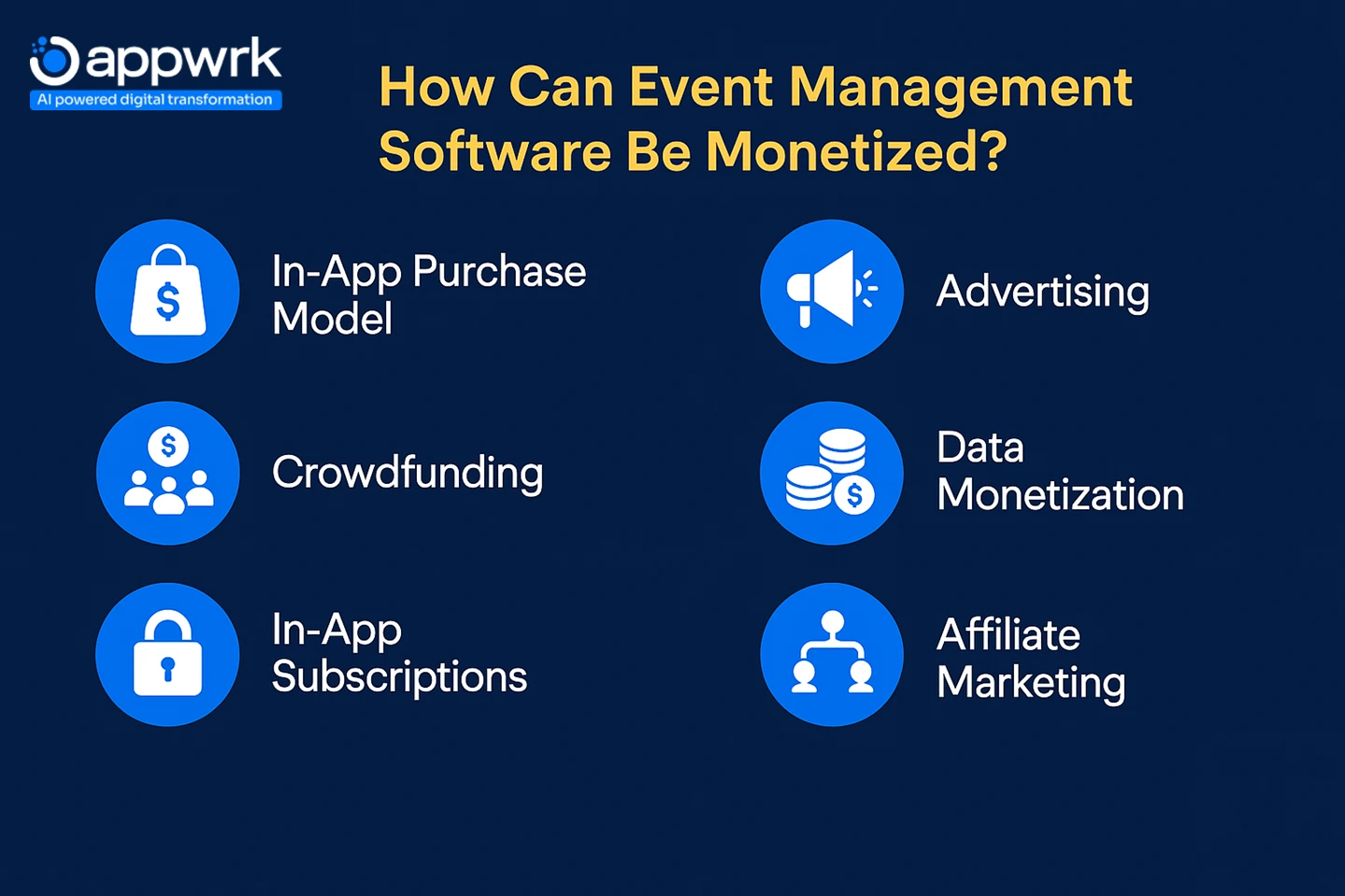
How Can Event Management Software Be Monetized?
Your custom event software can do so much more than just generate ticket sales. It can tap into various monetization strategies like in-app purchases, ad placements, crowdfunding, data-driven offerings, ongoing subscriptions, and affiliate partnerships. This means you can build a diverse and scalable revenue stream. With these models, you could see an increase of 20–50% in revenue for your digital, hybrid, and in-person events.
In-App Purchase Model
Let attendees enhance their experience right from the app, think VIP seating, downloadable session recordings, premium networking lounges, or exclusive merchandise. In-app purchases not only boost revenue but also enrich the attendee journey. Offering upgrades through limited-time deals or tiered packages can really ramp up engagement and increase average revenue per user. According to Meegle’s monetization guide, creating event ecosystems that incorporate these options can significantly improve monetization rates without sacrificing user experience. Meegle
Advertising
Expanded Insight: Sponsorship through native ads, video spots, branded pop-ups, or sponsored push notifications brings in sponsor income while keeping the content relevant. Including sponsor analytics in the backend (like view counts and interaction data) helps validate those premium sponsorship fees. EventsAir confirms that well-placed ads, when aligned with event content, deliver impressive ROI for sponsors. EventsAir
Crowdfunding
This approach is especially effective for thematic or passion-driven events, think community festivals, startup showcases, or educational expos. Crowdfunding allows attendees to support special features, gain early access, or earn community rewards, all directly through your app. The most engaged attendees often become funders when they feel a connection to the event’s mission. Deal Room’s monetization overview points out that this can be a sustainable revenue booster.
Data Monetization
With clear attendee consent, anonymized data like engagement trends, session popularity, or networking activity can be compiled into sponsor insights dashboards or aggregate market reports. This provides sponsors with deeper value beyond just visibility and helps create a data-driven sponsorship model. However, maintaining trust and compliance (like GDPR and CCPA) is crucial. Event planners need to implement transparent privacy settings to uphold attendee trust and legal integrity.
In-App Subscriptions
Tiered subscriptions (monthly or annual) unlock premium features like full access to event archives, exclusive networking sessions, or consultant matchmaking. This model transforms your app into a recurring revenue asset – not just an event one-off – aligning perfectly with SaaS-style planning businesses or educational event series. Swoogo notes that such recurring strategies ensure consistent cash flow and post-event engagement.
Affiliate Marketing
Tap into adjacent revenue by embedding affiliate links for hotel bookings, travel, dining, or event-related services. Every attendee purchase through your app brings a small commission – boosting monetization while delivering value. Dryfta lists affiliate marketing as a proven revenue extender for event platforms, especially in travel-heavy or conference use cases. dryfta.com
Future Trends in the Development of Event Management Software
The evolution of event management software is being powered by AI, blockchain verification, voice-activated tools, immersive AR/VR experiences, microservices modularity, and sustainability dashboards – all designed to enhance security, personalization, accessibility, and impact while scaling the event experience in innovative ways.
Blockchain for Ticket Verification
Blockchain enables immutable and transparent ticketing, effectively eliminating fraud and ticket resale issues. Platforms like Tixbase – used by EXIT Festival and regional ticketing companies – use blockchain-enabled systems for traceable, secure digital ticketing, providing enhanced fan trust and security.
Voice-Activated Scheduling & Event Commands
As voice interfaces remain ubiquitous, event apps are beginning to incorporate command-driven scheduling, session lookups, and reminders via Siri, Alexa, or Google Assistant. This hands‑free experience improves accessibility and engagement, particularly for live event logistics and on-the-go usage.
AR/VR and Immersive Hybrid Events
Augmented and virtual reality are redefining hybrid events. From virtual booths and 3D networking lounges to immersive venue navigation, AR/VR creates engaging experiences beyond physical limitations. In 2025, immersive reality and AI personalization became central in event tech solutions for deeply engaging attendee experiences.
Modular Microservices & Plug-and-Play Event Tools
Future-ready event software is shifting towards microservices architectures, allowing organizers to add only the tools they need – such as payments, analytics, or chat functionality – as separate plug-and-play modules. This modularity reduces development time, lowers cost of future upgrades, and enhances scalability.
Sustainability Dashboards and ESG Reporting
Event organizers face growing pressure to report environmental and social impact. AI-driven dashboards can measure metrics like carbon footprint, waste reduction, attendee travel emissions, and vendor compliance, giving organizers data-backed ESG transparency – a competitive advantage increasingly demanded by sponsors and partners.
Market Growth & Industry Catalysts
The adoption of AI, AR/VR, and blockchain technologies in event management is part of a wider growth trend. The global event management software market, driven in part by these technologies, is projected to grow from $15.5 billion in 2024 to $34.7 billion by 2029, at a CAGR of 17.4%. Meanwhile, the AI specifically for the event management sector is forecasted to expand from $1.8 billion in 2023 to $14.2 billion by 2033 – at a soaring CAGR of 22.9% – highlighting the scale of this technological shift.
Future Feature vs Benefit Table for Event Management Software
How Appwrk Can Help in Custom Event Management Software Development
Appwrk helps businesses design and build custom event management software solutions that balance cost efficiency, scalability, and feature innovation. With expertise in end-to-end development, integration, and post-launch support, Appwrk ensures your platform is not just functional but future-ready.
Proven Expertise in Event Technology Development
Appwrk specializes in building custom event management applications that cover the full lifecycle of event workflows – from online registration and ticketing to analytics dashboards and hybrid event integrations. By focusing on MVP-first delivery and modular upgrades, Appwrk ensures lower upfront costs while keeping scalability intact.
Scalable and Future-Ready Architectures
Whether you are targeting a lean MVP launch or building a SaaS-scale platform, Appwrk leverages modern frameworks (React, Flutter, Node.js, AWS) and microservices architectures to create event software that grows with your business. This ensures long-term ROI by avoiding costly rebuilds.
Global Delivery with Cost Advantage
With access to hybrid development teams across regions, Appwrk helps companies reduce development costs by up to 40% compared to local in-house hiring – without compromising on quality or compliance.
Focus on Security and Compliance
Every solution is built with enterprise-grade security standards, including GDPR, HIPAA, and PCI-DSS compliance, ensuring that your platform is trustworthy and regulatory-ready for global events.
Why Choose Appwrk for Custom Event Software?
120+ successful app deployments across industries
Cost-effective builds starting as low as $8,000
Faster time-to-market with Agile & DevOps practices
Retention-driven approach with ongoing support and optimization
Appwrk is the strategic technology partner for businesses that want to build secure, scalable, and cost-efficient custom event management platforms.
Get in touch with Appwrk today to discuss your custom event management software project and receive a tailored cost estimate.
FAQs
1. How much does it cost to build custom event management software?
The cost to build custom event management software starts from $8,000 for a basic MVP and can go beyond $40,000+ for a full-featured enterprise platform, depending on features, integrations, team location, and compliance requirements.
Want an exact figure for your project? Contact Appwrk and get a tailored cost estimate today.
2. Can I customize the event management software according to my specific needs?
Yes. Custom event management software allows you to build industry-specific features such as multi-tier sponsorship tools, exhibitor dashboards, virtual event integrations, and AI-powered attendee matchmaking. Unlike off-the-shelf SaaS solutions, custom development ensures branding flexibility, scalability, and long-term ROI.
3. How long does it usually take to develop event management software?
Development timelines vary:
MVP builds: 10–14 weeks (~2.5–3.5 months)
Full-feature platforms: 4–6 months
Enterprise/SaaS-scale systems: 6–9 months, sometimes up to 12 months
The timeline depends on scope, complexity, integrations, and compliance layers.
4. Can event management software be integrated with other systems?
Yes, modern event apps can integrate seamlessly with:
CRMs (Salesforce, HubSpot, Zoho)
Payment gateways (Stripe, PayPal, Razorpay)
Marketing automation tools (Mailchimp, Marketo)
ERP & Accounting systems for finance
This ensures a single source of truth across event operations.
5. What security measures are in place to protect sensitive attendee and event data?
Robust security features include:
End-to-end encryption for all sensitive data
Multi-factor authentication (MFA)
Role-based access control for admins
Compliance with GDPR, HIPAA, and PCI-DSS
These safeguard against fraud, data breaches, and unauthorized access.
6. What are the most important features in an event management app?
Core features include:
Ticketing and registration systems
Attendee management tools
Event promotion & marketing features
Real-time analytics dashboards
In-app chat, alerts & reminders
Integration with calendars, maps, and email
These features directly shape user adoption and attendee satisfaction.
7. Which platform should I choose for my event app?
iOS or Android apps for mobile-first audiences
Web apps for corporate or desktop-heavy users
Cross-platform (Flutter, React Native) for cost-effective reach across devices
Cross-platform frameworks are often the best choice for budget-conscious yet scalable builds.
8. What are the risks and challenges of building an event management app?
Operational risks: refunds, cancellations, and attendee management
External risks: sudden event postponements or venue disruptions
Mitigating these requires robust infrastructure, flexible workflows, and contingency planning.
9. How do hybrid and virtual events impact event software development?
Hybrid and virtual events require advanced live streaming, virtual booths, 3D navigation, and AR/VR integrations. These increase upfront development costs but expand audience reach globally and unlock new monetization channels.
10. Is it cheaper to buy off-the-shelf event management software or build custom?
Off-the-shelf SaaS platforms have lower upfront costs but recurring subscription fees. Custom builds provide data ownership, scalability, and brand alignment – which often makes them more cost-efficient long-term for companies running multiple or large-scale events.
11. Can event management software integrate with CRM and payment systems?
Yes. Most modern platforms come with ready-made APIs to integrate with CRMs like Salesforce or HubSpot and payment gateways like Stripe or PayPal. This reduces operational bottlenecks and centralizes attendee + revenue management.
12. What are the ongoing costs of running event management software?
Ongoing costs include:
Hosting & cloud infrastructure
Compliance updates (GDPR, PCI-DSS, HIPAA)
Feature upgrades & maintenance
Customer support tools
These typically account for 15–20% of annual development costs.
13. What technologies are shaping the future of event management platforms?
Future event apps will leverage:
Blockchain for secure ticketing
AI-powered personalization
Voice-activated scheduling
AR/VR immersive hybrid events
ESG dashboards for sustainability reporting
These innovations are forecasted to drive double-digit CAGR growth in the event tech sector.
Gourav Khanna is the Co-founder and CEO of APPWRK, leading the company’s vision to deliver AI-first, scalable digital solutions for enterprises and high-growth startups. With over 16 years of leadership in technology, he is known for driving digital transformation strategies that connect business ambition with outcome-focused execution across healthcare, retail, logistics, and enterprise operations.
Recognized as a strategic industry voice, Gourav brings deep expertise in product strategy, AI adoption, and platform engineering. Through his insights, he helps decision-makers prioritize market traction, operational efficiency, and long-term ROI while building resilient, user-centric digital systems.
Subscribe to APPWRK Blogs, We'll Do the Rest!
Get Blogs on UI/UX, Mobile Apps, Online Marketing, and Web development technology.
Unlock worthy and priceless suggestions from the masters of mobile and web app development