150+ minds across 4 countries. Join a culture of innovation, ownership & growth.
Rewire for AI
From machine learning to deep learning, from classification tools to overall process automation – our AI engineers will help you retool your existing system or enhance your company results.
Ship faster, scale smarter, built for product companies and SaaS teams
Our Latest Work
We strive hard to deliver result-driven digital solutions across the globe. Check out our case studies to get a glimpse of how we ideate, innovate, and create unconventional digital solutions according to the requirements of our clients.
Discover diverse and passionate insights from our tech enthusiasts. We collaborate across various sectors to streamline operations and drive innovation. Explore our rapidly growing collection of articles to see why we’re at the forefront of IT solutions.
The decision to move from Magento to Shopify is one of the most significant replatforming choices an ecommerce business can make. Magento is powerful, but its power comes with...
Accuracy gap is real: Traditional CPG forecasting carries a 25-40% MAPE error rate. AI-powered models bring that down to 8-15%, according to McKinsey research....
Real stories from global leaders who trusted us with their ideas.
Partnering with APPWRK helped us build a compliant and scalable healthcare platform, accelerating our time-to-market by 35%. Their team consistently delivered outstanding work.
Beesers
Digital Healthcare Client
Collaborating with APPWRK, Sportskeeda modernized its platform into a real-time sports engagement ecosystem, enabling seamless content delivery, scalable fan interactions, and high-velocity performance.
Sportskeeda
Sports & Entertainment Partner
Working with APPWRK was effortless. They captured our vision, maintained full compliance, and delivered a digital experience that built trust and elevated how customers interact with our fintech brand.
PayPenny
Fintech Partner
Working with APPWRK gave us confidence in adopting AI responsibly. Their team built a safe, intelligent bot that transformed how we engage with leads and helped us achieve measurable revenue growth.
IFB
AI Transformation Partner
Leveraging APPWRK’s digital expertise, Nemesis launched a scalable, compliant, and safe super app that connects content delivery, real-time communication, and logistics management within a single platform.
The cost to build a ride-hailing application like Bolt starts at $8,000 to $12,000 for a Minimum Viable Product (MVP) with essentials such as User Registration/Login, GPS navigation, and Map-based ride booking. On average, most startups spend $15,000 to $55,000 for mid-tier builds, while enterprise-level ride-hailing services rarely exceed $95,000 when developed with offshore teams, reusable APIs, and phased rollouts.
Using Readymade Software and prebuilt APIs helps launch faster, while Custom Development offers more control and scalability. Founders must balance both to manage cost and speed.
Core features of a car-hailing application include driver verification, driver management, secure payment processing, and In-app payments. Advanced add-ons such as AI-driven route planning, multi-stop rides, loyalty programs, and real-time notifications raise costs but deliver stronger ROI.
Hidden costs like regulatory approvals, app store compliance, security monitoring, and driver onboarding can add 10–20% but are manageable with early planning.
Partnering with experts like Appwrk helps reduce costs by 30 to 40% using agile workflows, offshore execution, and skilled UI/UX designers for polished apps.
The transportation services market is booming, with global leaders like Uber, Lyft, Careem, Grab, and Bolt driving growth. Rising demand for micro-mobility via the Bolt Scooter Platform, innovations in electric scooters, and even automated cars make now the perfect time to launch a ride-hailing app with essentials like an SOS feature, review system, and driver-rider communication.
What Is Bolt App, and Why Is It One of the Fastest-Growing Hailing Apps?
If you’ve ever searched for “what is the Bolt app”, you’ve probably seen it described as one of the fastest-growing mobility platforms in the world.
Founded in 2013 by Markus Villig in Estonia, Bolt (formerly known as Taxify) started as a simple taxi-booking app, but today it’s evolved into a multi-service super app that goes far beyond just rides. At its core, the Bolt taxi app connects riders with nearby drivers in seconds, offering affordable fares, transparent pricing, and shorter waiting times.
Micromobility services like e-scooters and e-bikes
Car rentals and corporate ride management solutions
For drivers, the Bolt driver app provides flexible earning opportunities with optimised route matching, fair commission rates, and real-time trip tracking. For riders, a simple Bolt app download on iOS or Android allows them to manage bookings, payments, and loyalty rewards in one place.
This diversified ecosystem is why so many startups now ask: How do I build a Bolt-like app? The demand for Bolt-style ride-hailing solutions is rising because the model is proven, multi-service, scalable, and designed for rapid adoption.
Bolt App Download
The Bolt app download is available on both the Google Play Store and the Apple App Store, with over 100M+ installs worldwide. For drivers, the Bolt driver app ensures seamless trip management and real-time payouts, making it one of the most trusted platforms in the ride-hailing industry.
Bolt App Review
With a 4.8-star rating from 8.7M+ reviews, the Bolt app consistently ranks among the best ride-hailing apps across regions like London, Singapore, Nigeria, and beyond. Users highlight its affordable fares, reliable drivers, and smooth user experience as key differentiators compared to Uber and other alternatives.
The real attraction for entrepreneurs lies in Bolt’s growth playbook: launch lean with a core ride-hailing app, then expand into adjacent services that multiply revenue streams.
How Much Does It Cost to Build a Ride-Hailing App Like Bolt?
The cost to build a ride-hailing app like Bolt starts at $8,000 for a basic MVP and typically ranges between $15,000 and $65,000 for mid-level builds. Even enterprise-grade ride-hailing apps with advanced features rarely exceed $90,000 when developed with offshore teams, modular components, and phased rollouts.
This makes it possible for startups to launch the cheapest ride-hailing app in London, Singapore, or emerging markets while keeping scalability in mind.
Development Stages and Their Costs in Ride Hailing App Development
Stage
What It Covers
Estimated Cost Range for Ride Hailing App Development
App store publishing, updates, and long-term monitoring
$1,000 to $5,000
This roadmap shows that even a full Bolt ride-hailing app can be launched in phases, starting lean, then scaling with advanced integrations.
Features and Their Cost Breakdown
Feature Set
Examples
Estimated Cost Range for Ride Hailing App Development
User App Features
Signup/login, ride booking, fare estimate, payment
$2,500 to $6,000
Driver App Features
Trip alerts, navigation, payouts
$2,000 to $5,000
Admin Dashboard
User management, analytics, support tools
$3,000 to $8,000
Advanced Features
Real-time tracking, AI route optimisation, loyalty apps
$5,000 to $12,000
With this modular approach, you can build the essentials first and add AI-powered or region-specific features later, reducing upfront investment.
Regional Cost of Building a Ride-Hailing App
When it comes to building a ride-hailing application like Bolt, development costs vary widely depending on geography, developer rates, and regulatory factors. Here’s a region-by-region breakdown:
United States & UK – $70,000 to $95,000
The US and UK remain the most expensive markets for ride-hailing app development, with hourly rates often between $80 and $150. Startups here frequently outsource to offshore teamsfor cost optimisation. Enterprise builds also include added expenses like security & compliance monitoring, which further raise budgets.
Eastern Europe – $35,000 to $65,000
Countries in this region combine strong technical expertise with moderate pricing ($40–$70 per hour). Many companies opt for a hybrid approach, with core development done locally, while some features like API integration and payment processing are supported by onshore teams.
Asia (India, Vietnam, Philippines) – $8,000 to $40,000
Asia is the most cost-effective hub for developing Minimum Viable Products (MVPs) and scalable ride-hailing services. Hourly rates hover around $20–$40. Developers in India and Vietnam excel at rapid builds using Readymade Software, React Native, Flutter, and databases like Firebase or PostgreSQL, making it a prime region for startups.
Singapore & London – $20,000 to $60,000
While both hubs are globally advanced in transportation services, strict local compliance requirements can increase costs. However, with modular builds, microservices architecture, and platform integration, startups can balance regulations with affordability.
Brazil & Nigeria – $15,000 to $45,000
Demand for ride-hailing services in Brazil (especially Rio de Janeiro) and fast-growing African markets like Nigeria is rising sharply. Development costs are competitive, and apps are often localised with features like driver verification, SOS feature, Real-Time GPS Tracking, and a review system to boost trust and adoption.
Choosing the right development region can swing your costs by over 50%. By combining offshore teams, Readymade Software, and phased rollouts, even enterprise-grade ride-hailing applications can be built within budget.
What Factors Affect the Cost of a Ride-Hailing App Like Bolt?
The cost of developing a ride-hailing app or a Bolt taxi app depends on multiple technical and business factors. Understanding these helps startups plan better and avoid overspending.
1. App Design and User Experience
A clean, intuitive design improves retention for both riders and drivers. High-fidelity designs and interactive elements add costs but boost engagement.
2. Feature Set and Complexity
A basic MVP covers sign-up, booking, and payments. Adding features like real-time tracking, AI-driven route optimisation, loyalty programs, or driver incentives will raise costs but also increase long-term ROI.
3. Technology Stack and Integrations
The chosen backend, APIs, and frameworks play a major role in determining costs. Using third-party APIs for payments, maps, and geolocation is cost-effective compared to building custom stacks.
4. Platform Choices
Building only for Android reduces costs significantly. A cross-platform launch for Android and iOS nearly doubles expenses but improves market coverage.
5. Security and Compliance
Hidden yet critical costs come from GDPR compliance, PCI-DSS payment security, and regulatory audits, especially if scaling in regions like Europe or Singapore.
6. Updates and Ongoing Maintenance
Every Bolt driver app or Bolt app download requires updates, bug fixes, and server monitoring. Long-term maintenance should be budgeted from the start.
In short, while an MVP of a ride-hailing app in London may cost as little as $8,000, scaling it into the best ride-hailing app in Singapore or London involves these layered cost factors.
7. Development Team’s Location
The location of your development team significantly affects the cost to build a Ride-hailing app like Bolt:
US/UK Developers – $80 to $150 per hour; higher reliability but costly.
Eastern Europe – $40 to $70 per hour; balance of cost and quality.
Asia (India, Philippines, Vietnam) – $20 to $40 per hour; lowest cost with skilled offshore teams.
Hiring offshore developers is one of the most effective ways to reduce the Ride-hailing app development cost without compromising quality.
In short, while an MVP of a ride-hailing app in London may cost as little as $8,000, scaling it into the best ride-hailing app in Singapore or London involves these layered cost factors.
The ride-hailing market is full of options, from Readymade Software to Custom Development solutions. Choosing the right one is crucial for controlling your ride-hailing app development cost and ensuring scalability. Here’s how to evaluate software options before making a decision:
Credibility
Always check the credibility of your shortlisted ride-hailing applications. Look for proven case studies, client testimonials, and compliance with industry standards. Trusted providers with a strong track record ensure smoother launches and fewer risks.
Pricing
Compare pricing beyond upfront costs. Factor in ongoing expenses like maintenance, upgrades, third-party API integration (e.g., Google Maps API, payment processing), and support. The cheapest ride-hailing app software isn’t always the most cost-effective long term.
Cost-Benefit Ratio
Evaluate whether the software’s features and scalability justify the price. Sometimes, slightly higher costs deliver stronger ROI through better driver management tools, SOS features, and Real-Time GPS Tracking.
Scalability
Choose a solution that grows with your business. Whether launching in London, Singapore, or Nigeria, your app should handle more drivers, passengers, and advanced modules like e-scooters or multi-stop rides without performance issues.
Customization
Your business needs may differ from Uber, Bolt, or Careem. Look for flexibility in customizing UX/UI components, branding, commission structures, and integrations to fit your niche market.
Free Demos and Trials
Take advantage of free demos or trial versions. This lets you test essential features like rider registration, route planning, and driver-rider communication before committing.
Customer Support
Reliable support is a must for scaling. Check response times, availability, and whether vendors offer technical guidance for issues like server scaling, app store compliance, or dispute resolution.
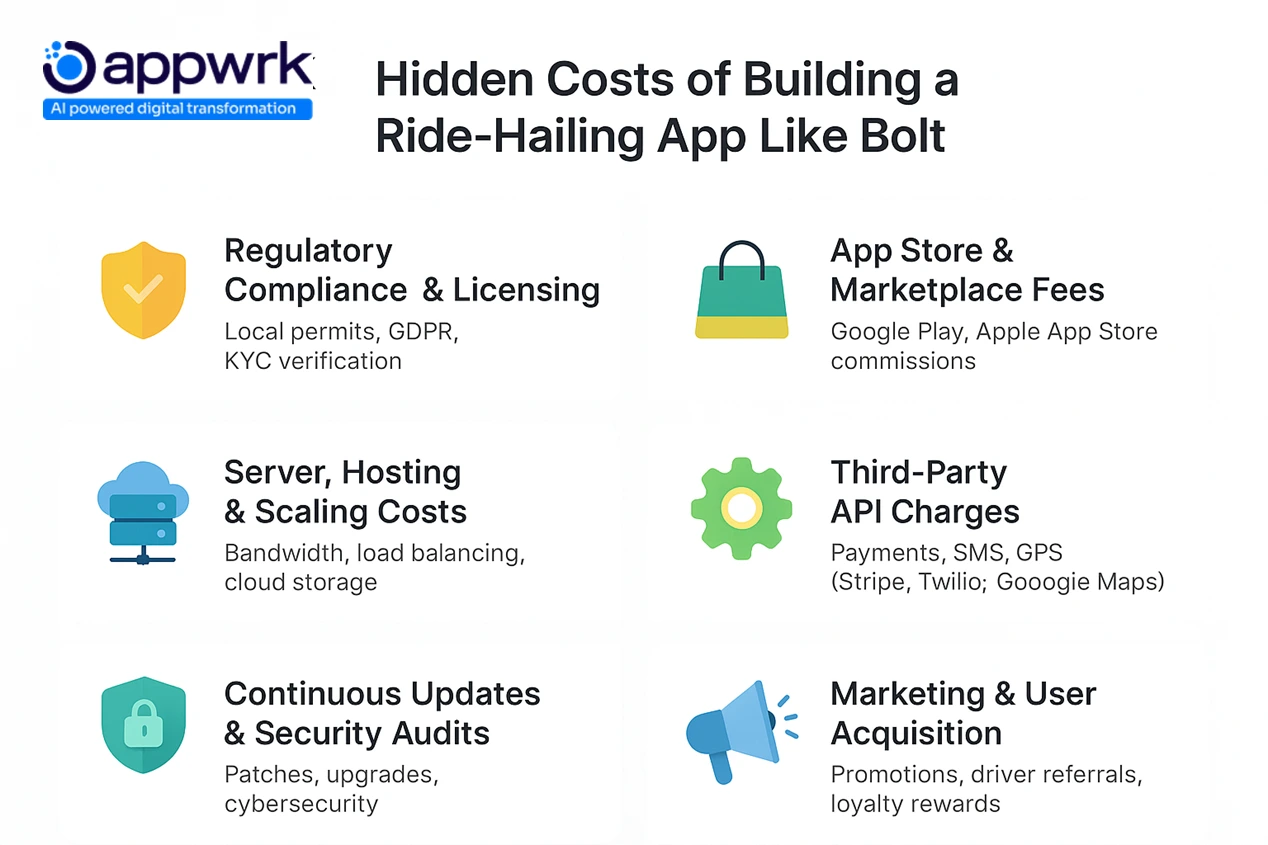
What Are the Hidden Costs of Building a Ride-Hailing App Like Bolt?
When planning the budget for a ride-hailing app, many founders only calculate development and design. In reality, several hidden costs can add 15–25% to the overall budget if not anticipated early.
1. Regulatory Compliance and Licensing
Launching a Bolt taxi app or any ride-hailing platform requires permits, local transport authority approvals, and data privacy compliance. For example, GDPR audits in Europe or KYC verification for driver onboarding add to long-term expenses.
2. App Store and Marketplace Fees
Every Bolt app download through Google Play or Apple App Store incurs submission, review, and commission fees. These small recurring charges add up quickly, especially at scale.
3. Server, Hosting, and Scaling Costs
While the MVP might run on a lean setup, scaling a Bolt ride-hailing app in high-demand cities like London or Singapore means higher server bandwidth, load balancing, and cloud storage, all of which increase costs over time.
4. Third-Party API Charges
Integrations for payments, SMS notifications, or GPS mapping aren’t one-time costs. APIs like Stripe, Twilio, or Google Maps work on a per-transaction model that can cut into margins if not accounted for.
5. Continuous Updates and Security Audits
Every ride-hailing app development project must budget for regular patches, feature upgrades, and cybersecurity audits. These ensure trust for both riders and drivers, but they also increase yearly operational costs.
6. Marketing and User Acquisition
Building the cheapest ride-hailing app in London or anywhere globally still requires a budget for rider promotions, driver referral bonuses, and loyalty rewards. Without this, even the best-built app struggles to gain traction.
Hidden costs are unavoidable, but by planning them upfront, founders can still keep the cost to build a ride-hailing app like Bolt under control and avoid last-minute budget shocks.
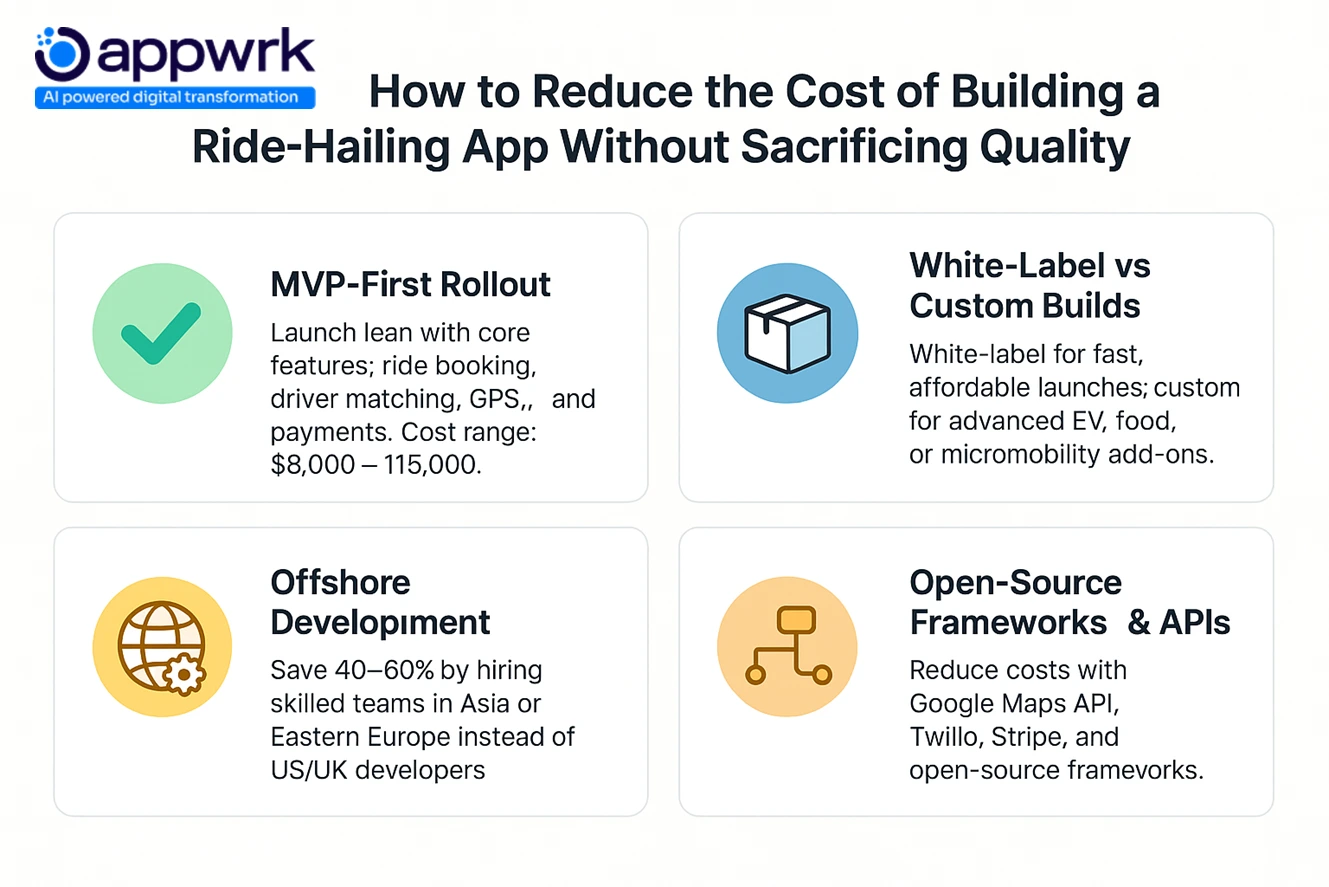
How to Reduce the Cost of Building a Ride-Hailing App Without Sacrificing Quality
Budget is always top of mind when planning a ride-hailing app development project. The good news is, you can still launch a Bolt-like app affordably with the right strategies.
1. Start With an MVP-First Rollout
Don’t build everything up front. Focus first on core features, booking, driver matching, payments, and GPS tracking. This keeps the cost to build a ride-hailing app in the $8,000–$15,000 range while letting you validate demand before scaling.
2. White-Label vs Custom Builds
A white-label solution comes pre-built with essentials like a Bolt driver app and can be customised to your brand, making it cheaper and faster than starting from scratch. If you need advanced features such as EV integrations or food delivery add-ons, a hybrid model works best.
3. Offshore Development for Lower Rates
Hiring developers in the US or Western Europe can double costs. Offshore ride-hailing app development teamsin Asia or Eastern Europe deliver the same quality at 40 to 60 per cent lower rates, especially if they have proven case studies.
4. Use Open-Source Frameworks and APIs
Don’t reinvent the wheel. Use APIs like Google Maps for navigation, Twilio for SMS, and Stripe for payment processing. Open-source tools reduce dev time, ensure reliability, and lower ongoing expenses.
With these methods, you can build a Bolt-style app that’s both affordable and reliable, staying competitive in markets where riders search daily for the cheapest ride-hailing app in London or the best ride-hailing app in Singapore.
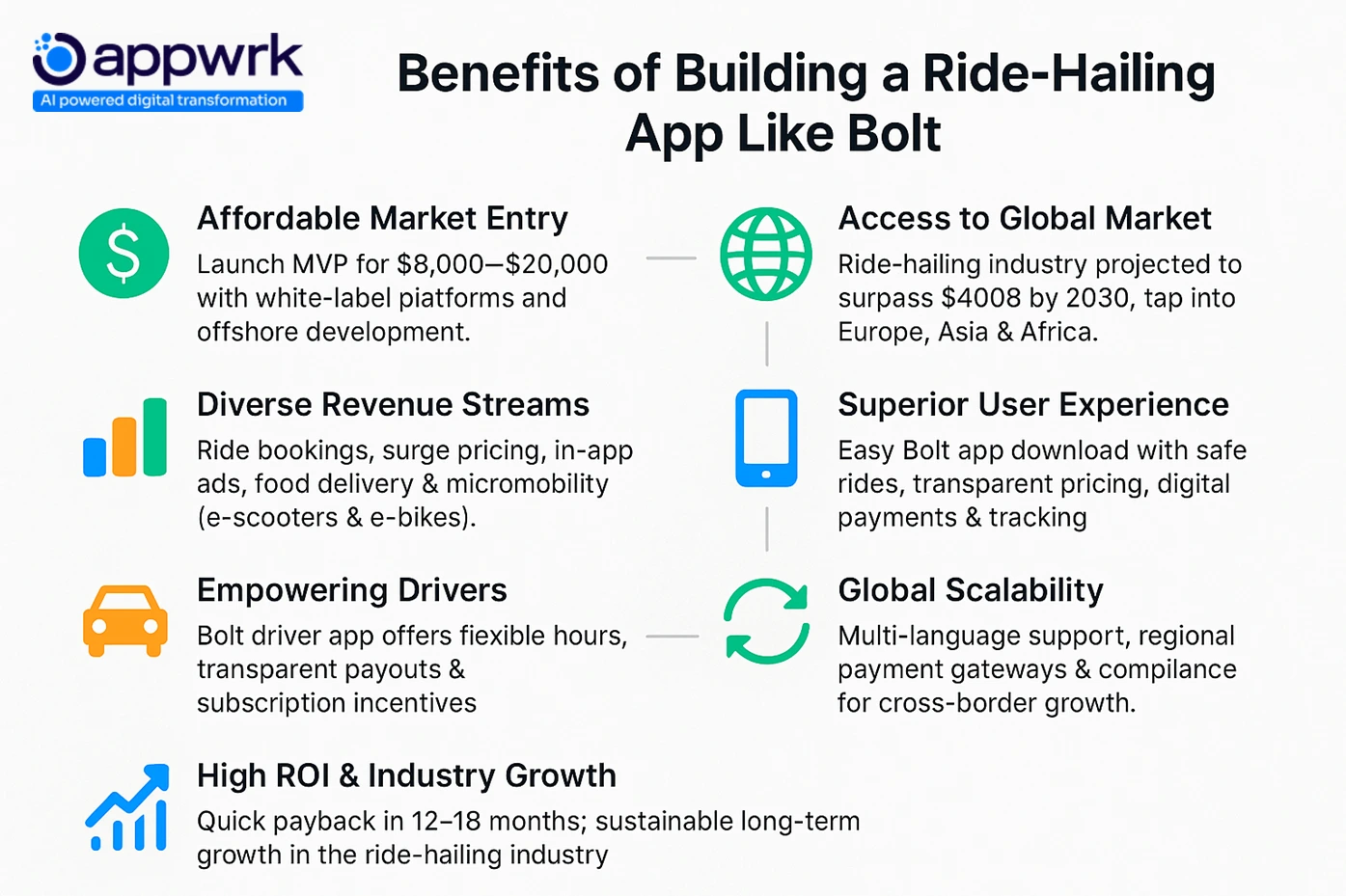
What Are the Benefits of Building a Ride-hailing App Like Bolt?
Building a Bolt ride-hailing app gives startups and enterprises more than just a taxi-booking platform; it opens doors to a multi-service mobility business with strong revenue potential.
1. Affordable Market Entry
Compared to traditional transport businesses, launching the cheapest ride-hailing app in London or Singapore requires far less capital. Starting lean with an $8,000 MVP means founders can test markets without heavy upfront risks.
2. Diverse Revenue Streams
The Bolt taxi app shows how ride bookings, subscriptions, surge pricing, and in-app ads can generate multiple income channels. Expanding into food delivery or micromobility multiplies revenue without rebuilding the core platform.
3. Better User Experience
Riders value convenience. With a simple Bolt app download, users get instant access to safe rides, cashless payments, and real-time tracking. This seamless UX builds loyalty faster than traditional taxi services.
4. Empowering Drivers
The Bolt driver app provides drivers with flexible earning opportunities, transparent payouts, and route optimisation. This strengthens driver retention, a critical factor in scaling any ride-hailing app development project.
5. Global Scalability
From the best ride-hailing app in Singapore to London’s competitive mobility market, the Bolt model proves it can scale across regions. Entrepreneurs replicating this can easily expand to new geographies with localised pricing and compliance.
6. High ROI and Long-Term Ride-hailing Industry Growth
Ride-hailing is one of the few industries where investment returns can be realised within the first 12–18 months. Building a Bolt ride-hailing app positions businesses for both quick payback and long-term sustainability.
According to projections, the revenue in this market is expected to reach US$179.70bn by the year 2025.
Furthermore, the annual growth rate (CAGR 2025-2030) of 5.06% is expected to result in a projected market volume of US$229.98bn by 2030 worldwide.
In short, the benefits of building an app like Bolt aren’t limited to cheaper rides; they extend to scalable revenue, loyal users, and global market expansion.
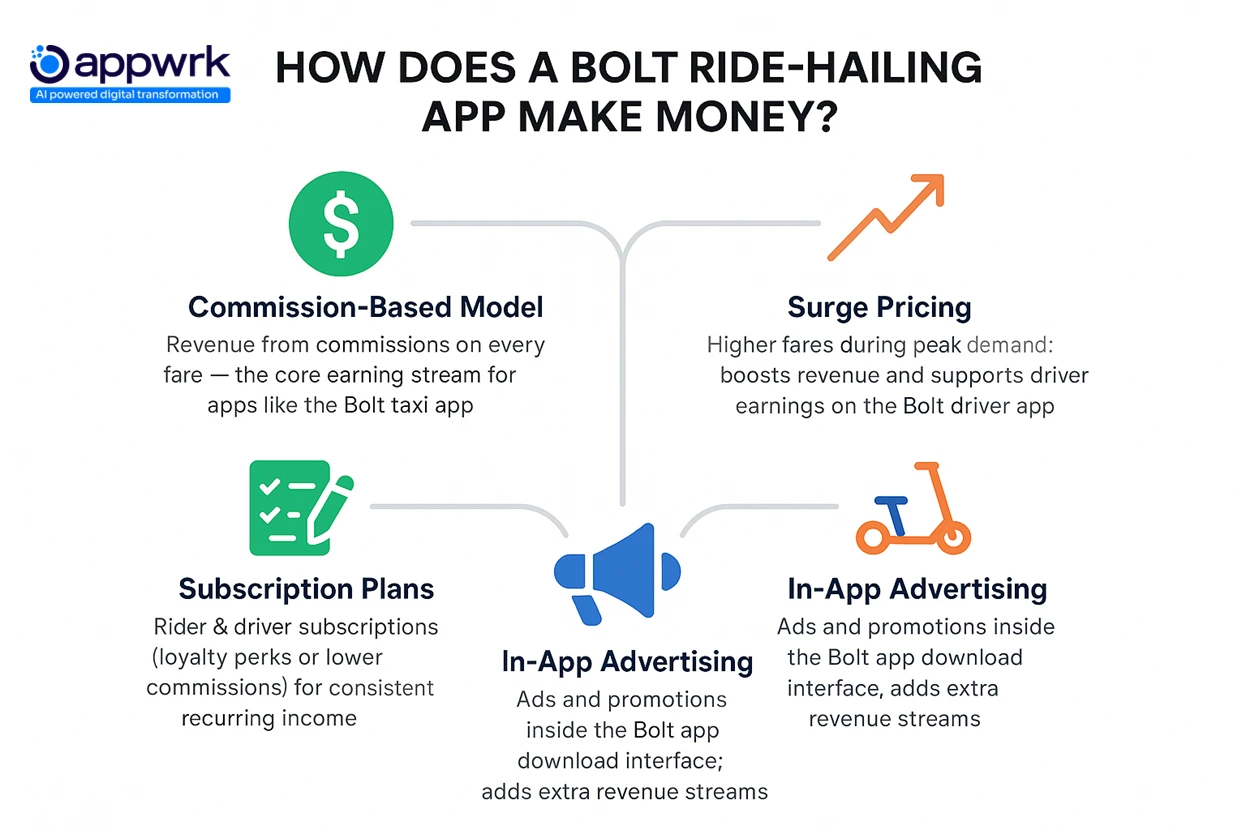
How Does a Bolt Ride-Hailing App Make Money?
A Bolt Taxi Business Model doesn’t just connect riders and drivers; it thrives on diverse monetisation strategies. By combining proven approaches with localised innovations, ride-hailing services can build sustainable, long-term revenue streams.
1. Commission-Based Model
Every ride generates revenue through a commission charged on the fare. This remains the backbone of apps like Bolt, Uber, and Lyft. With flexible Commissions Management, platforms can set different slabs by region, vehicle category, or driver tier.
2. Surge Pricing
Dynamic pricing during high-demand hours boosts margins and ensures ride availability. While passengers pay slightly more, drivers benefit directly, strengthening retention. Bolt and Careem are strong examples of balancing surge pricing with reliability.
3. Subscription Plans
Apps can introduce subscription models for both riders and drivers. Drivers may pay a flat fee to enjoy reduced commissions or priority rides, while frequent riders benefit from Subscription Services like loyalty discounts and bundled perks. Admins can streamline this using Subscription Order Management tools.
4. In-App Advertising and Partnerships
Platforms can monetise their Passenger App further with In-App Advertising and Partnerships. From local restaurants to global brands, partners can showcase offers, while riders receive contextual promotions, seasonal deals, or referral discounts.
5. Multi-Service Model
Modern ride-hailing applications expand beyond cars. Bolt, which began in Tallinn, now operates across micro-mobility (e-bikes, electric scooters), food delivery, courier services, and even car-sharing. This diversification multiplies revenue without building an entirely new ecosystem.
6. Ancillary Revenue Streams
Other monetisation opportunities include:
Cancellation/Wait Time Charges – ensuring riders respect driver time.
Loyalty Programs – offering rewards to boost retention.
Franchise Strategy – enabling local entrepreneurs or not-for-profits to run services in specific regions like Nigeria.
Advanced features like multi-stop rides and manual ride booking, which can be bundled as premium rider perks.
Core Features Needed in a Ride-Hailing App Like Bolt
When planning a ride-hailing application like Bolt, it’s essential to define the ride-hailing app features that create a smooth experience for riders, drivers, and admins. A strong foundation ensures faster adoption, higher retention, and long-term scalability across diverse transportation services.
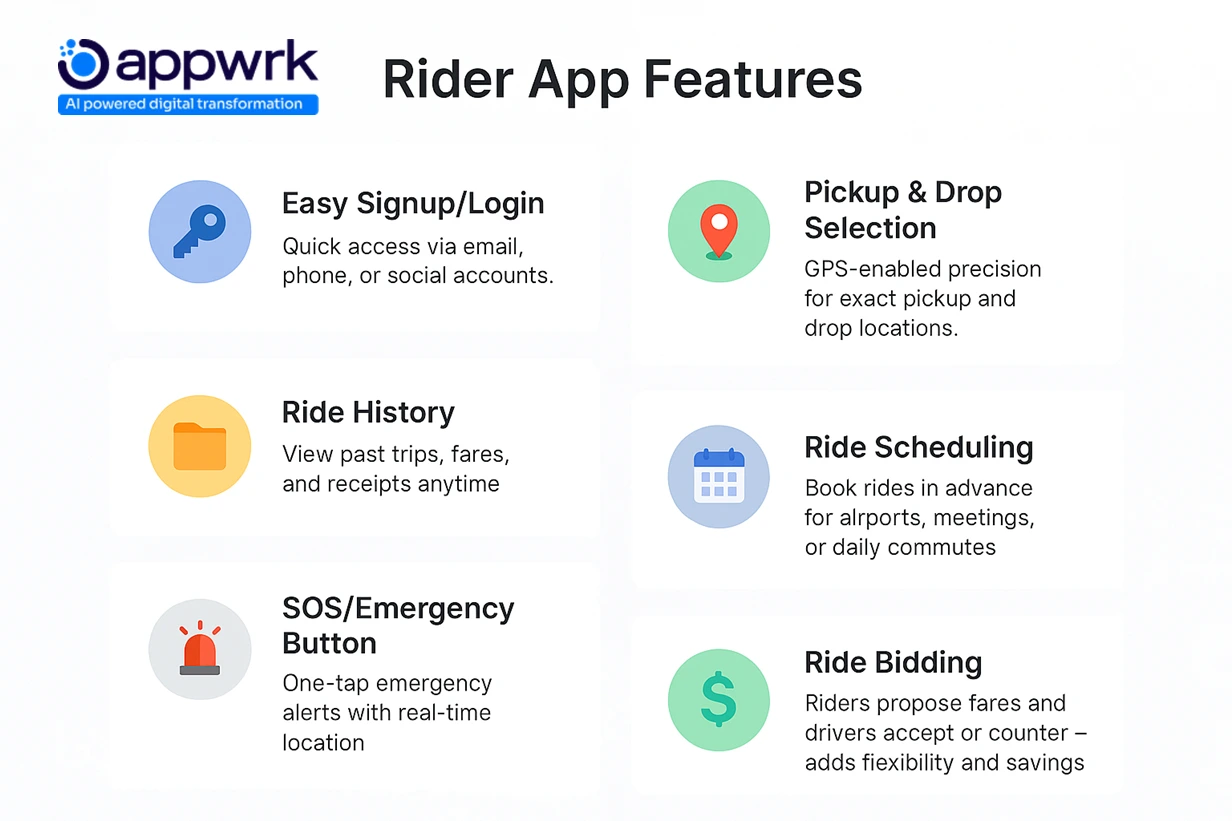
Rider App Features
The Passenger App is the face of your business. It must be intuitive, quick, and reliable, with features that enhance both safety and convenience:
Quick and Easy Login – via email, phone number, social accounts, or seamless User Registration/Login modules.
Pickup & Drop Selection – powered by Map-based ride booking with accurate GPS navigation and GPS technology for pinpoint accuracy.
Ride History & Receipts – allow users to track past trips, invoices, and payments for better transparency.
SOS Feature – ensures safety features with instant alerts to contacts, emergency services, or Government helplines.
Ride Scheduling & Ride Bidding – plan trips in advance or negotiate fares to make the app more budget-friendly.
Digital Wallet & In-App Payments – ensure flexible, secure payment processing with cards, UPI, or e-wallets.
Real-time Notifications – riders receive updates about driver arrival, trip status, and fare changes instantly.
Referral Program & Loyalty Rewards – attract new users with referral discounts and retain them through seasonal offers.
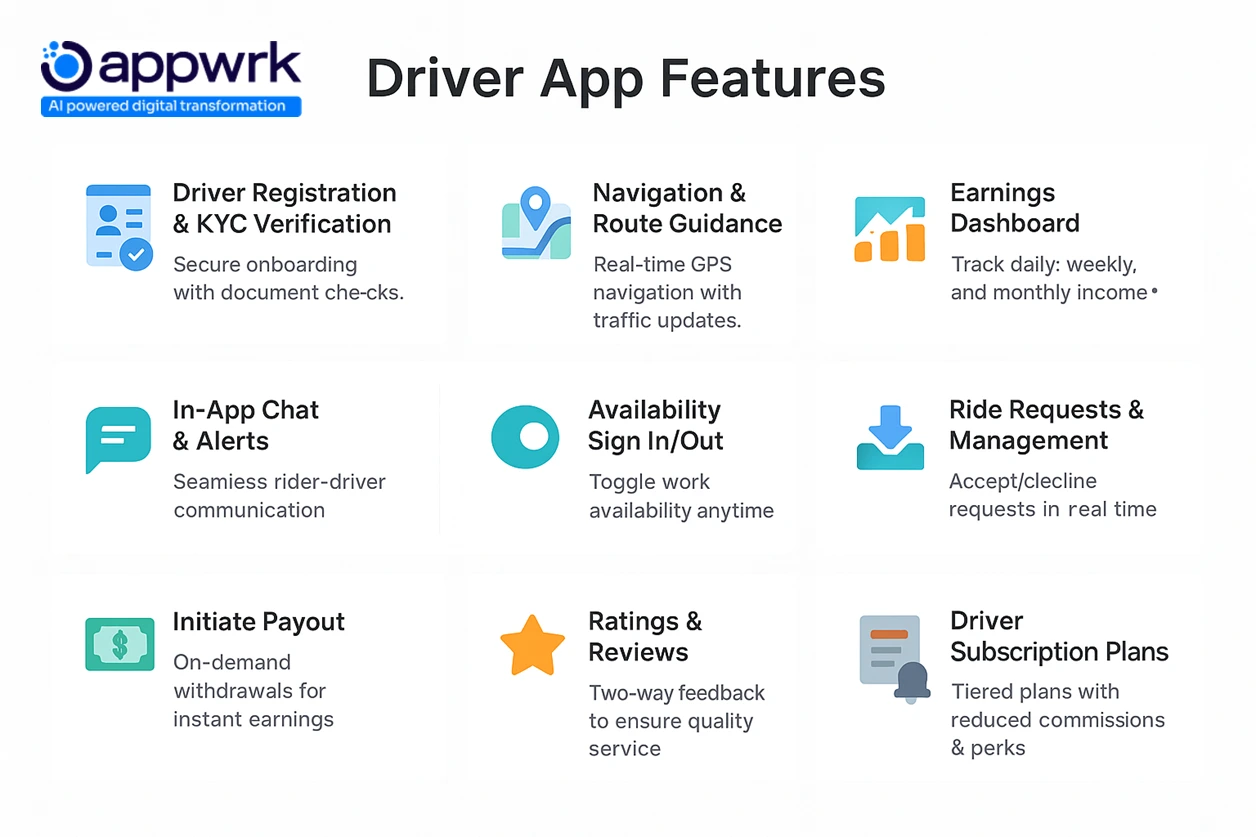
Driver App Features
The Bolt driver app needs tools that maximise efficiency, earnings, and accountability:
Driver Registration & Verification (KYC) – ensure only qualified and background-checked drivers are onboarded.
Navigation & Route Planning – integrated with Google Maps API, Mapbox, and Real-Time GPS Tracking for dynamic route planning and destination plotting.
Ride Requests & Management – drivers can view, accept, or reject requests, powered by WebSocket technology for real-time updates.
Availability Toggle (Sign In/Out) – drivers can mark themselves available when ready, ensuring work-life balance.
Driver Management Dashboard – drivers track earnings, Ratings & Reviews, and trip data for performance improvement.
Initiate Payout – drivers can withdraw funds instantly instead of waiting for weekly cycles.
Driver Support & Dispute Resolution – offer in-app support to handle issues with riders and reduce churn.
Subscription Plans – give drivers options to pay flat fees for reduced commissions, improving loyalty.
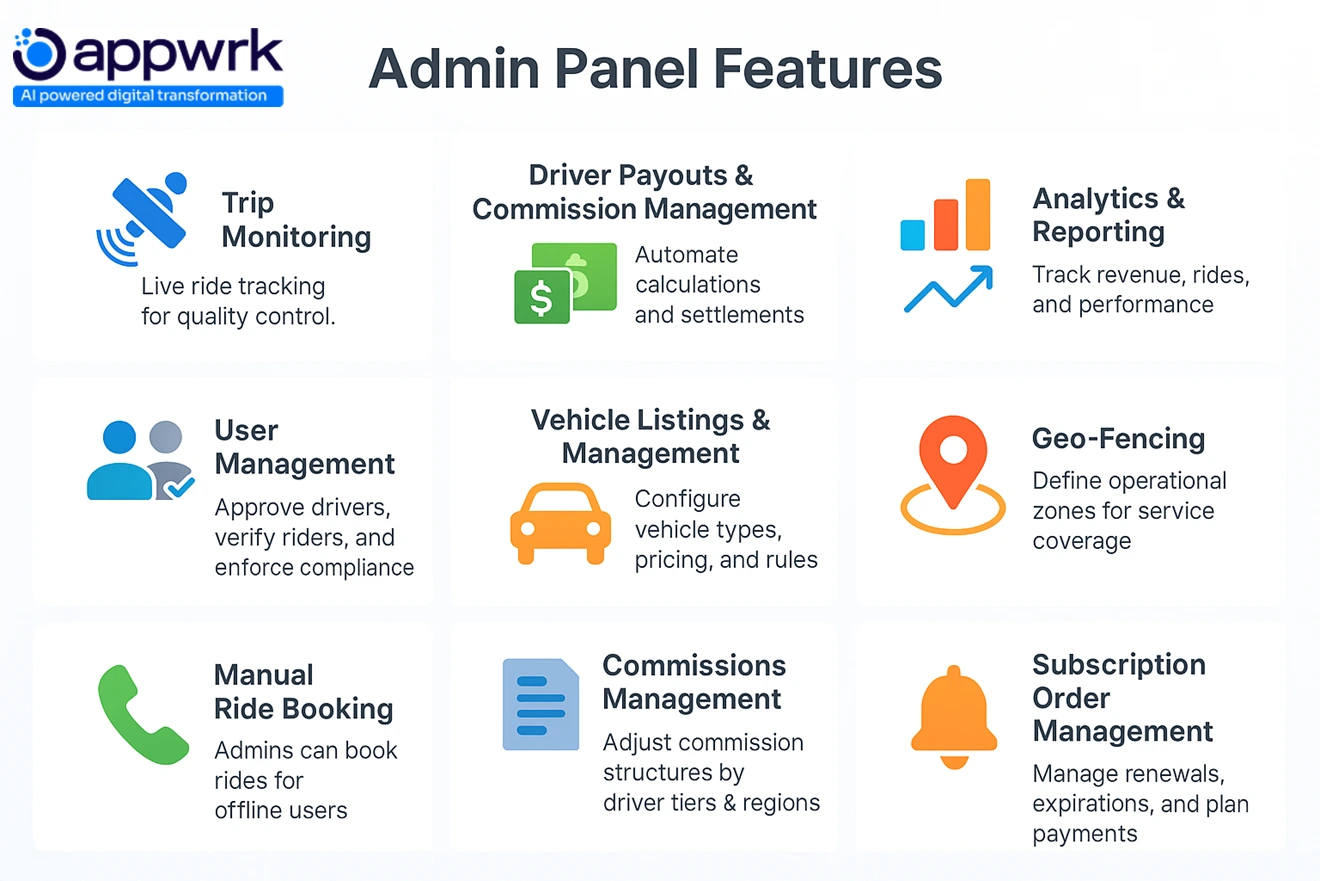
Admin Panel Features
The admin dashboard acts as the command centre, enabling business owners to monitor, optimise, and scale operations:
Trip Monitoring & Reports & Analytics – live ride tracking and insights into revenues, commissions, and service zones.
Driver & Rider Management – manage user profile setup, approvals, bans, and driver verification checks.
Vehicle Listings & Management – configure cars, EVs, or even electric scooters with tier-based pricing.
Geo-Fencing Technology – control where rides are allowed, improving density and efficiency.
Manual Ride Booking – book trips for users without smartphones, widening accessibility.
Commissions Management & Subscription Order Management – automate settlements, plan renewals, and push payment reminders.
Security & Compliance Monitoring – keep rides legal, safe, and in line with Government regulations.
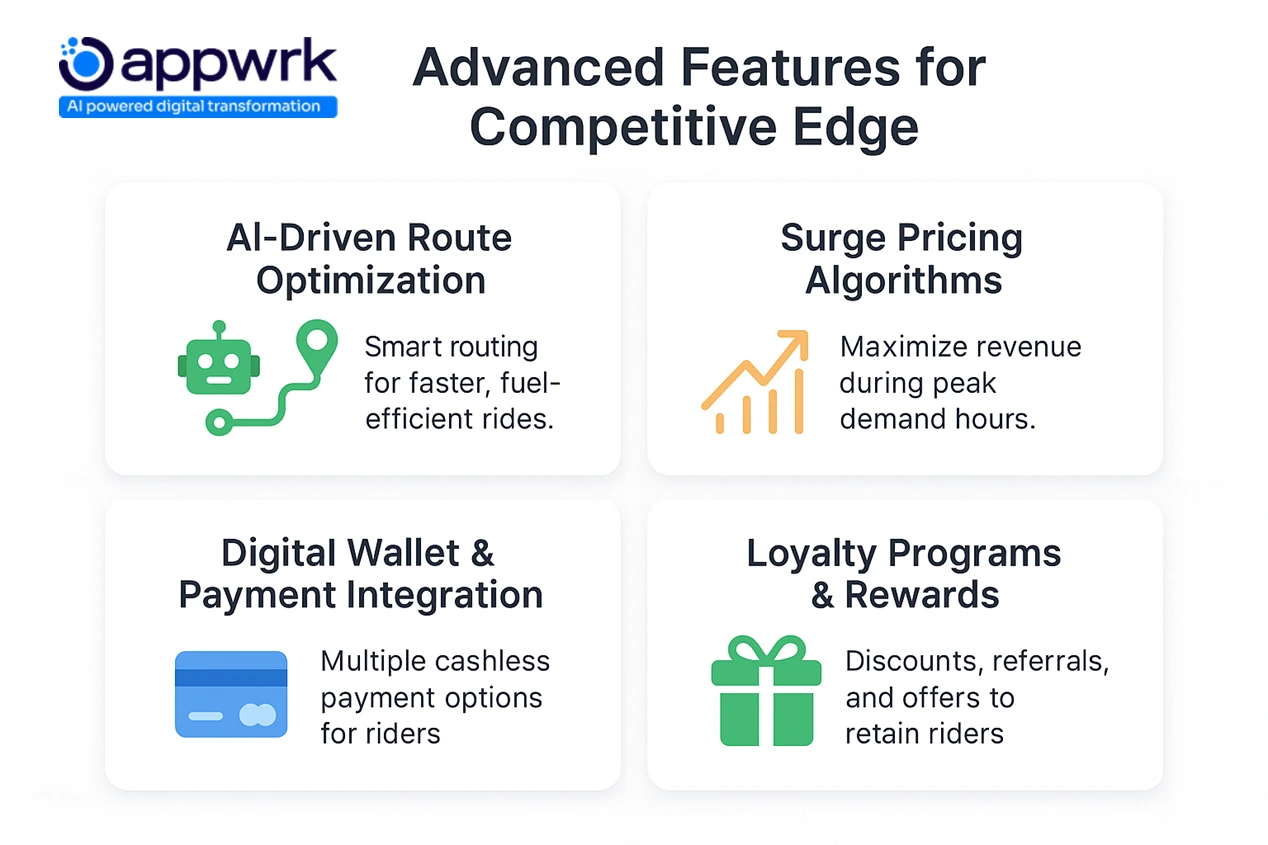
Advanced Features for Competitive Edge
To stand out against Uber, Bolt, Lyft, Careem, and other global leaders, adding innovation is crucial:
Surge Pricing Algorithms – adjust fares in real time during high demand.
Custom Development with Microservices Architecture – allows modular scaling, easier stress testing, and long-term flexibility.
Cross-Platform Development – leverage React Native or Flutter to support both iOS and Android efficiently.
Seamless Platform Integration – with API integration for maps, payments, and communication tools.
Advanced Navigation & Real-Time Analytics – offer multi-stop rides, driver-rider communication, and commute statuses with instant updates.
User-Centric Design – crafted by expert UI/UX designers who refine UX/UI components for maximum usability.
Not for Profits & Franchise Strategy – extend services to underserved communities or scale globally through partnerships.
By combining these features with Bolt-inspired simplicity and localised innovation, you create a car-hailing application that balances safety, usability, and profitability, while being future-ready for micro-mobility, automated cars, and beyond.
What Are the Top Use Cases of a Ride-Hailing App Like Bolt?
The success of the Bolt app goes far beyond taxis. Its strength lies in mobility innovation and the ability to expand into multiple verticals. For startups, a ride-hailing app development project doesn’t have to stop at point-to-point rides; it can branch into several profitable models.
1. Standard Ride Hailing (Bolt Taxi App Model)
The most common use case is the Bolt taxi app itself: on-demand rides, surge pricing, and quick payments. This remains the foundation for launching in urban transportation hubs like London, where passengers are actively searching for the cheapest ride-hailing app in London to save on daily commutes.
2. Corporate Mobility Solutions
Businesses need safe, trackable, and cost-efficient employee transport. A Bolt ride-hailing app clone can integrate features like expense management, invoicing, and fleet dashboards, making it appealing for global business hubs such as Singapore.
3. EV and Green Ride Hailing
Eco-conscious cities are shifting to electric-first fleets. Some of the best ride-hailing app Singapore examples now include EV car-sharing and carbon offset calculators. Startups can stand out by weaving sustainability into their ride-hailing app development roadmap.
4. Food and Parcel Delivery
A single Bolt app download can give users access not only to rides but also to food delivery, grocery orders, and courier services. This “multi-service” approach increases customer lifetime value by bundling mobility and delivery into one platform.
5. Micromobility and Last-Mile Rides
The Bolt driver app isn’t limited to cars. E-scooters and e-bikes are key in dense, high-traffic areas like Singapore, where last-mile connectivity is a daily demand.
6. Airport and Intercity Shuttle Services
Airport pickups, shuttle buses, and intercity trips are emerging use cases. Startups in newer markets can launch the cheapest ride-hailing app, London-style solutions tailored for longer journeys and airport runs.
These use cases show that building a ride-hailing app isn’t about cloning Uber or Bolt. It’s about creating localised, multi-service solutions that respond to specific rider needs and regional opportunities.
Popular Ride-Hailing Apps Around the Globe
Ride-Hailing Apps in London
In London, ride-hailing services have expanded far beyond just Uber. The Bolt taxi app, built on the foundations of Taxify, has quickly gained popularity thanks to its lower fares and eco-friendly options. Local startups are also experimenting with electric scooters and car-sharing features, supported by GPS technology and Google Maps API for better route planning and destination plotting.
Uber: known for its wide availability, premium choices, and robust driver management.
Bolt: favoured for its budget-friendly fares, sustainable fleets, and scalable Bolt Taxi Business Model.
Ola: perfect for those looking to save a bit on their commute, often offering seasonal offers and referral program discounts.
Free Now: a strong player with licensed black cabs and an integrated review system.
Cheapest Ride-Hailing App in London
When it comes to finding the most affordable car-hailing application in London, Bolt often takes the crown. Its Surge Pricing model is generally more reasonable than Uber’s, making it a go-to for students and those on a budget. In-app payments and seamless payment processing ensure convenience for riders.
The Bolt app is one of the most economical options available in London, offering Easy Payment and transparent fares.
Free Now occasionally provides discounts during off-peak times.
Ola is competitive, especially for students and group rides, with flexible ride types like budget, fancy, bike, or shared trips.
Best Ride-Hailing App in Singapore
For Singapore residents, the Grab ride-hailing application is the top choice. It seamlessly combines rides, food delivery, and digital payments into one platform with advanced platform integration. While Bolt is expanding in the region, Grab remains dominant, with Gojek and ComfortDelGro offering alternatives backed by strong customer service.
Grab: the all-in-one solution for rides, food, payments, and even not-for-profits and Government tie-ups.
ComfortDelGro: a trusted local taxi operator with robust driver verification and real-time ride requests and management.
Best Ride-Hailing App in London: Uber vs. Bolt
The ongoing debate about the best ride-hailing services in London often comes down to Uber versus Bolt. Uber’s admin panel and driver support tools give it global scalability, while Bolt appeals with lower fares and green initiatives, aligned with micro-mobility trends.
Uber: the largest fleet with real-time notifications, recognised for its availability and Ratings & Reviews system.
Bolt: known for affordable fares, multi-stop rides, and eco-friendly initiatives powered by its Bolt Scooter Platform.
Ola: a budget-friendly competitor, though it has a smaller fleet compared to Uber and Bolt, with limited driver-rider communication features.
Ride-Hailing Alternatives to Uber in Rio de Janeiro
In Rio de Janeiro, alternatives to Uber include Bolt and regional competitors. These platforms are adopting real-time GPS tracking, map-based ride booking, and driver registration and profile features.
InDriver – a unique model where passengers propose their fare.
What Are the Smart Steps to Build a Ride-hailing App Like Bolt (Without Overspending)?
When it comes to building a Ride-hailing app like Bolt, Founders often ask more than just what features to include. The real challenge lies in striking the right balance between quality, speed, and cost. Here’s a strategic approach to get you started when developing ride-hailing services or scaling into new markets like Nigeria or Tallinn.
1. Why is Market Research Essential Before Developing a Ride-hailing App?
Jumping into the development of ride-hailing applications without proper research is like navigating a maze blindfolded. Market research helps you understand what users actually value—whether it’s discovering which car-hailing application dominates in London or why Grab outpaces Careem in Singapore. Competitor studies (Uber, Bolt, Lyft) can reveal gaps in features like the SOS feature, customer service, or driver verification.
Cost Impact: Investing $1,000 to $2,000 upfront in research can save over $10,000 in Custom Development pivots later.
2. How Do You Establish a Unique Selling Proposition (USP) for Your Bolt Clone App?
Merely replicating Bolt isn’t enough. You must Define Your Unique Selling Proposition. For instance, you could focus on micro-mobility with electric scooters, or integrate on-demand taxi app bookings with food delivery like Grab. Another option could be tailoring a Passenger App specifically for corporate use cases with driver management dashboards.
Cost Impact: A strong USP avoids overspending on features that don’t resonate with your audience and ensures better alignment with your monetisation strategy.
3. Which Niche Should You Focus On First?
The global ride-hailing services market is diverse—ranging from multi-stop rides for corporates to micro-mobility options or regional niches like affordable airport transfers in Nigeria. Narrowing your focus lowers your Minimum Viable Product (MVP) costs. An MVP powered by React Native, Flutter, or Firebase could cost around $8,000, compared to a $20,000+ full build.
Cost Impact: Building a lean MVP lets you validate demand quickly and cut costs by half.
4. Why is a Monetisation Strategy Important From the Get-Go?
The Bolt Taxi Business Model is strong because it balances driver satisfaction (transparent payouts, Initiate Payout, Earnings Dashboard) with business needs (Commission-Based Model, Subscription Plans, In-App Advertising, and Partnerships). Uber and Lyft rely on flexible ride types like budget, fancy, or shared trips, while regional players like Careem monetise with Subscription Services.
Cost Impact: Choosing between ads, subscriptions, and surge pricing early saves $5,000 to $10,000 in future rework.
5. Should You Opt for a White-Label or Custom Development Approach?
Readymade Software (white-label) solutions are cheaper and faster, starting at $8,000, ideal for testing. They often include pre-built User Registration/Login, Map-based ride booking, GPS navigation, and In-app payments. However, Custom Development offers scalability, integrating advanced tech like Real-Time GPS Tracking, API integration with Mapbox or Google Maps API, fraud detection algorithms, and dispute resolution systems.
Appwrk’s POV:
At Appwrk, we recommend validating ideas with Readymade Software for speed, then moving to Custom Development with robust databases like PostgreSQL or MySQL, and leveraging microservices architecture, WebSocket technology, and stress testing for long-term scale.
Cost Impact: White-label gets you started quickly, but custom builds (ranging $30,000–$50,000+) give you freedom for UI UX designerinput, UX/UI components, and complex features like Geo-Fencing, driver-rider communication, or Bolt Dispatcher.
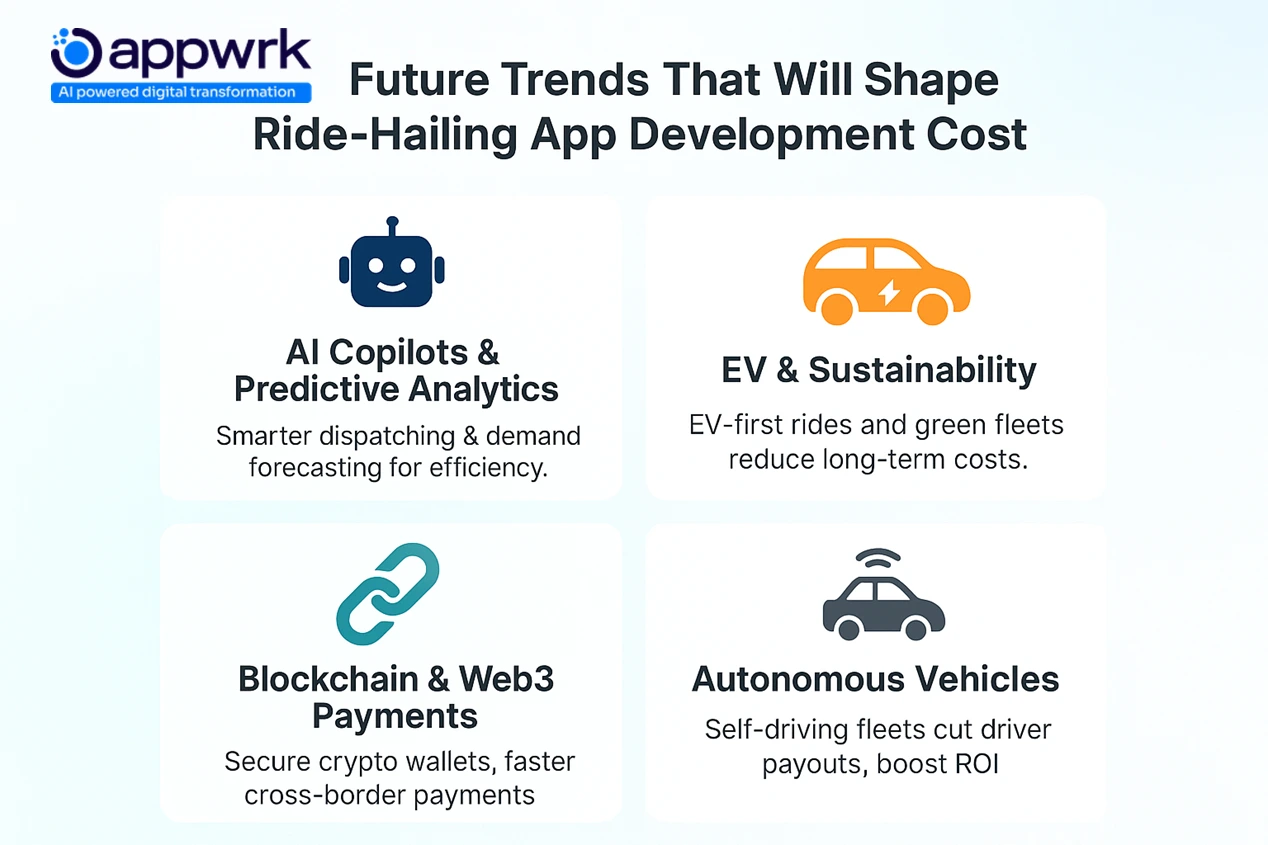
Future Trends That Will Shape Ride-Hailing App Development Costs
AI Copilots & Predictive Analytics
AI copilots are transforming how ride-hailing services operate. With predictive analytics, apps like Bolt, Uber, and Lyft can anticipate demand spikes, optimise route planning, and minimise idle time. These features require stronger driver management systems and real-time notifications to balance supply and demand. Adding layers such as the SOS feature, fraud detection algorithms, and review system integration enhances safety and customer service.
On the development side, building these AI features may increase early-stage costs, but they can reduce long-term operational expenses by streamlining driver verification, driver-rider communication, and support feature management.
EV & Sustainability
Electric vehicles are no longer optional—they’re integral to modern ride-hailing applications. Platforms like Bolt, Grab, and Careem now encourage EV-based rides to reduce emissions. In cities like Tallinn and Nigeria, EV adoption is being paired with micro-mobility solutions like electric scooters and shared bikes through the Bolt Scooter Platform.
From a tech perspective, Custom Development might be needed for EV routing, Geo-fencing technology, and multi-stop rides. This also calls for platform integration with charging networks and location services for mapping stations via Google Maps API or Mapbox. While upfront integration increases costs, lower ride expenses and higher retention balance the ROI.
Blockchain & Web3 Payments
Blockchain is introducing transparency and speed to payment processing in ride-hailing services. Apps are now experimenting with Web3 wallets and crypto for instant In-app payments and referral program rewards. For drivers, this means faster settlements and reduced gateway fees—critical for cross-border operators in Nigeria and beyond.
From a development standpoint, integrating crypto into a Passenger App requires API integration, security & compliance monitoring, and scalable databases like PostgreSQL, MySQL, or Firebase. While this adds complexity, blockchain-backed dispute resolution and Commission Management features can drastically reduce operational friction.
Autonomous Vehicles
The most disruptive future trend is autonomous or automated cars. Self-driving fleets are redefiningtransportation services, pushing beyond the traditional Bolt Taxi Business Model. For cities like London or Tallinn, this means restructuring apps to include AI-driven Advanced Navigation and Route Optimisation, Real-Time GPS Tracking, and GPS technology.
Building for autonomy is capital-intensive: developers must use microservices architecture, WebSocket technology, and conduct rigorous stress testingto handle live data from fleets. Features such as driver support and ride history will evolve into autonomous monitoring systems.
Long-term, however, autonomous fleets could cut down significantly on driver payouts, with platforms like Bolt, Uber, and Lyft benefiting from increased ROI and better alignment with not-for-profit and Government sustainability goals.
How Appwrk Can Help Build a ride-hailing App Like Bolt
At Appwrk, we create budget-friendly ride-hailing services that don’t just rival Bolt but set new benchmarks. From a lean Minimum Viable Product (MVP) starting at $8,000 to enterprise-ready builds with Admin Panel, Driver App Features, Real-Time GPS Tracking, In-app payments, and driver verification, we deliver scalable, secure, ROI-focused solutions.
Our team uses modern stacks like React Native, Flutter, Firebase, PostgreSQL, and MySQL, with seamless integrations such as Google Maps API, Mapbox, and GPS navigation for multi-stop rides and driver-rider communication. By combining Readymade Software for fast deployment with Custom Development for scalability, and leveraging offshore and onshore teams, we cut costs without compromising quality.
Beyond standard apps, Appwrk supports micro-mobility (electric scooters via the Bolt Scooter Platform), EV routing, car-sharing, and autonomous cars. Whether scaling in Tallinn, Nigeria, or new markets, we help clients handle security & compliance monitoring, dispute resolution, and franchise strategy.
Q1. How much does it cost to build a ride-hailing app? Building ride-hailing applications can start at around $8,000 for a Minimum Viable Product (MVP) and can climb to over $65,000 for enterprise versions. These advanced builds often include Real-Time GPS Tracking, In-app payments, driver verification, and AI-driven route planning with Google Maps APIor Mapbox. Costs also depend on whether you choose Custom Development or Readymade Software.
Q2. How much does it cost to build an app like Bolt? If you’re creating a Bolt Taxi Business Model clone, expect to spend between $8,000 and $55,000. The final cost varies based on User Registration/Login, design complexity, and integrations such as payment processing, API integration, and platform integration. Using frameworks likeReact Native, Flutter, and databases such as PostgreSQL, MySQL, or Firebase ensures scalability.
Q3. What is the Bolt app and how does it work? The Bolt app is a leading ride-hailing service originally launched as Taxify in Tallinn. Today, it offers on-demand taxi app services, food delivery, micro-mobility solutions like electric scooters, and even car-sharing through the Bolt Scooter Platform. Riders use the Passenger App for Map-based ride booking and destination plotting, while drivers leverage the Bolt Dispatcher for trip requests, earnings, and driver management.
Q4. Which is the best ride-hailing app in London? While Uber remains well-known, many riders prefer Bolt as their go-to due to affordability and eco-friendly fleets. Other alternatives like Ola, Free Now, and even Lyft offer options for different vehicle types, seasonal offers, and loyalty programs.
Q5. Is Bolt cheaper than Uber? Yes. In most cities, including London and Nigeria, Bolt’s Surge Pricing is lower than Uber’s. With features like Easy Payment and transparent fare estimation, Bolt often ranks as the most budget-friendly car-hailing application.
Q6. What are the hidden costs of ride-hailing app development? Hidden costs often include server scaling, third-party services (SMS, maps, GPS navigation), security & compliance monitoring, and testing and quality assurance. You should also account for referral program incentives, driver support, ongoing customer service, and maintenancecosts that can add 20–30% to your budget.
Q7. How to reduce ride-hailing app development cost? Start lean with a Minimum Viable Product (MVP), test features with Readymade Software, and scale later with Custom Development. Cost optimisation also comes from hiring offshore teams, using open-source frameworks, and embedding modular features like Quick and Easy Login, SOS feature, and Ratings & Reviews.
With Appwrk’s approach, development costs can be reduced by up to 40% without compromising on High-level security features or compliance.
Q8. What are the benefits of launching a Bolt ride-hailing app? A Bolt-style ride-hailing service offers global scalability, real-time notifications, multiple revenue streams (ads, subscriptions, Commission-Based Model), and enhanced user safety with dispute resolution and Geo-fencing technology. Companies like Bolt, Uber, Careem, and Lyft have proven that the model works across transportation services, making it attractive for both startups and enterprises.
Q9. What are the use cases of ride-hailing apps beyond taxi booking? Today’s ride-hailing applications cover much more than taxis. Popular extensions include:
Micromobility: bikes and electric scooters for last-mile rides.
Car-sharing and multi-stop rides for groups or not-for-profits.
Corporate mobility and Government partnerships for fleet operations.
Airport transfers in regions like Nigeria with real-time feedback, driver-rider communication, and review system integration.
Advanced innovations such as automated cars, EV routing, and franchise strategy expansion.
Gourav Khanna is the Co-founder and CEO of APPWRK, leading the company’s vision to deliver AI-first, scalable digital solutions for enterprises and high-growth startups. With over 16 years of leadership in technology, he is known for driving digital transformation strategies that connect business ambition with outcome-focused execution across healthcare, retail, logistics, and enterprise operations.
Recognized as a strategic industry voice, Gourav brings deep expertise in product strategy, AI adoption, and platform engineering. Through his insights, he helps decision-makers prioritize market traction, operational efficiency, and long-term ROI while building resilient, user-centric digital systems.
Subscribe to APPWRK Blogs, We'll Do the Rest!
Get Blogs on UI/UX, Mobile Apps, Online Marketing, and Web development technology.
Unlock worthy and priceless suggestions from the masters of mobile and web app development