150+ minds across 4 countries. Join a culture of innovation, ownership & growth.
Rewire for AI
From machine learning to deep learning, from classification tools to overall process automation – our AI engineers will help you retool your existing system or enhance your company results.
Ship faster, scale smarter, built for product companies and SaaS teams
Our Latest Work
We strive hard to deliver result-driven digital solutions across the globe. Check out our case studies to get a glimpse of how we ideate, innovate, and create unconventional digital solutions according to the requirements of our clients.
Discover diverse and passionate insights from our tech enthusiasts. We collaborate across various sectors to streamline operations and drive innovation. Explore our rapidly growing collection of articles to see why we’re at the forefront of IT solutions.
The decision to move from Magento to Shopify is one of the most significant replatforming choices an ecommerce business can make. Magento is powerful, but its power comes with...
Accuracy gap is real: Traditional CPG forecasting carries a 25-40% MAPE error rate. AI-powered models bring that down to 8-15%, according to McKinsey research....
Real stories from global leaders who trusted us with their ideas.
Partnering with APPWRK helped us build a compliant and scalable healthcare platform, accelerating our time-to-market by 35%. Their team consistently delivered outstanding work.
Beesers
Digital Healthcare Client
Collaborating with APPWRK, Sportskeeda modernized its platform into a real-time sports engagement ecosystem, enabling seamless content delivery, scalable fan interactions, and high-velocity performance.
Sportskeeda
Sports & Entertainment Partner
Working with APPWRK was effortless. They captured our vision, maintained full compliance, and delivered a digital experience that built trust and elevated how customers interact with our fintech brand.
PayPenny
Fintech Partner
Working with APPWRK gave us confidence in adopting AI responsibly. Their team built a safe, intelligent bot that transformed how we engage with leads and helped us achieve measurable revenue growth.
IFB
AI Transformation Partner
Leveraging APPWRK’s digital expertise, Nemesis launched a scalable, compliant, and safe super app that connects content delivery, real-time communication, and logistics management within a single platform.
Nemesis
Super App Partner
Partner to Build the Future of Grocery
We collaborate with founders to design, build, and scale high-performing grocery delivery ecosystems.
Grocery delivery app development cost starts at around $8,000 for a basic MVP and can reach $120,000+ for enterprise platforms. Developer rates typically range from $18-$40 per hour in regions like India and APAC, helping reduce overall budget without sacrificing quality.
A standard grocery delivery app includes product listings, cart and checkout, real-time delivery tracking, order management, payments, multi-store management, and delivery partner dashboards.
Custom grocery delivery apps offer better scalability, performance, and IP ownership compared to template or SaaS models that limit flexibility.
Key cost drivers include AI-based product recommendations, subscription modules, third-party integrations such as Google Maps or Stripe, and strong data security compliance.
Building an Instacart-like grocery app usually takes 4-10 months with a team covering product, UI/UX, mobile development, backend, QA, and cloud infrastructure.
This guide is built for founders, retailers, and entrepreneurs who want a clear, practical understanding of what it really costs to build a grocery delivery app in 2026.
A grocery delivery app allows users to browse products, place orders, and receive groceries at their doorstep through mobile apps or web applications. Core features typically include product listings, cart and checkout, secure payments, and real-time delivery tracking.
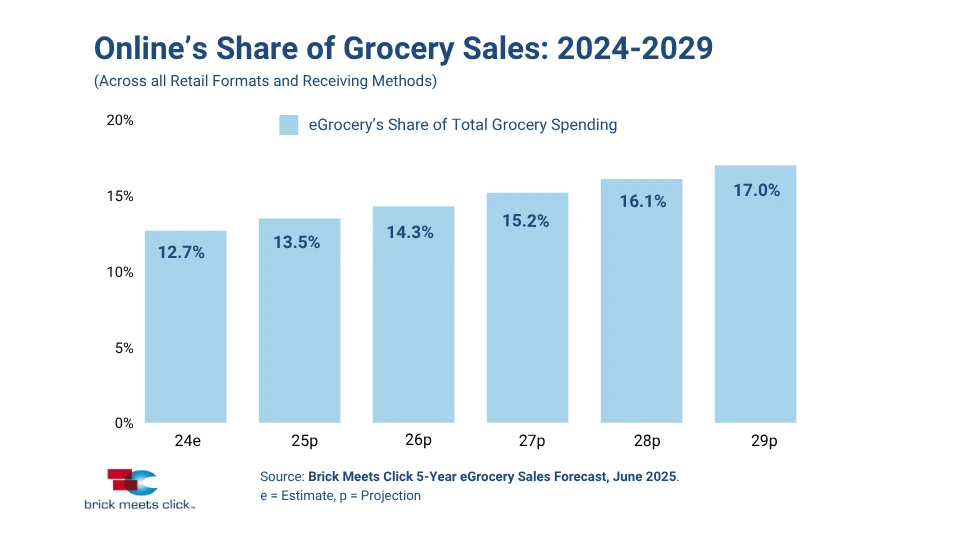
In 2024, the U.S. alone had 138.3 million online grocery shoppers, with monthly online grocery sales reaching $9.03 billion. Total spending is projected to hit $363.8 billion by 2026, with nearly 29.4% of groceries purchased online and steady annual growth of over 8% through 2030.
The grocery delivery app market overview shows sustained expansion driven by urbanization, mobile technology adoption, and demand for digital convenience. Global market statistics and growth projections indicate continued double-digit growth across North America, Europe, and APAC as consumers shift toward app-based grocery delivery services.
This transformation is being accelerated by consumer trends driving adoption, including faster delivery expectations, personalized grocery apps, and integrated delivery solutions connecting retailers, warehouses, and last-mile logistics networks.
Online grocery is no longer optional for retailers. It is a mandatory infrastructure.
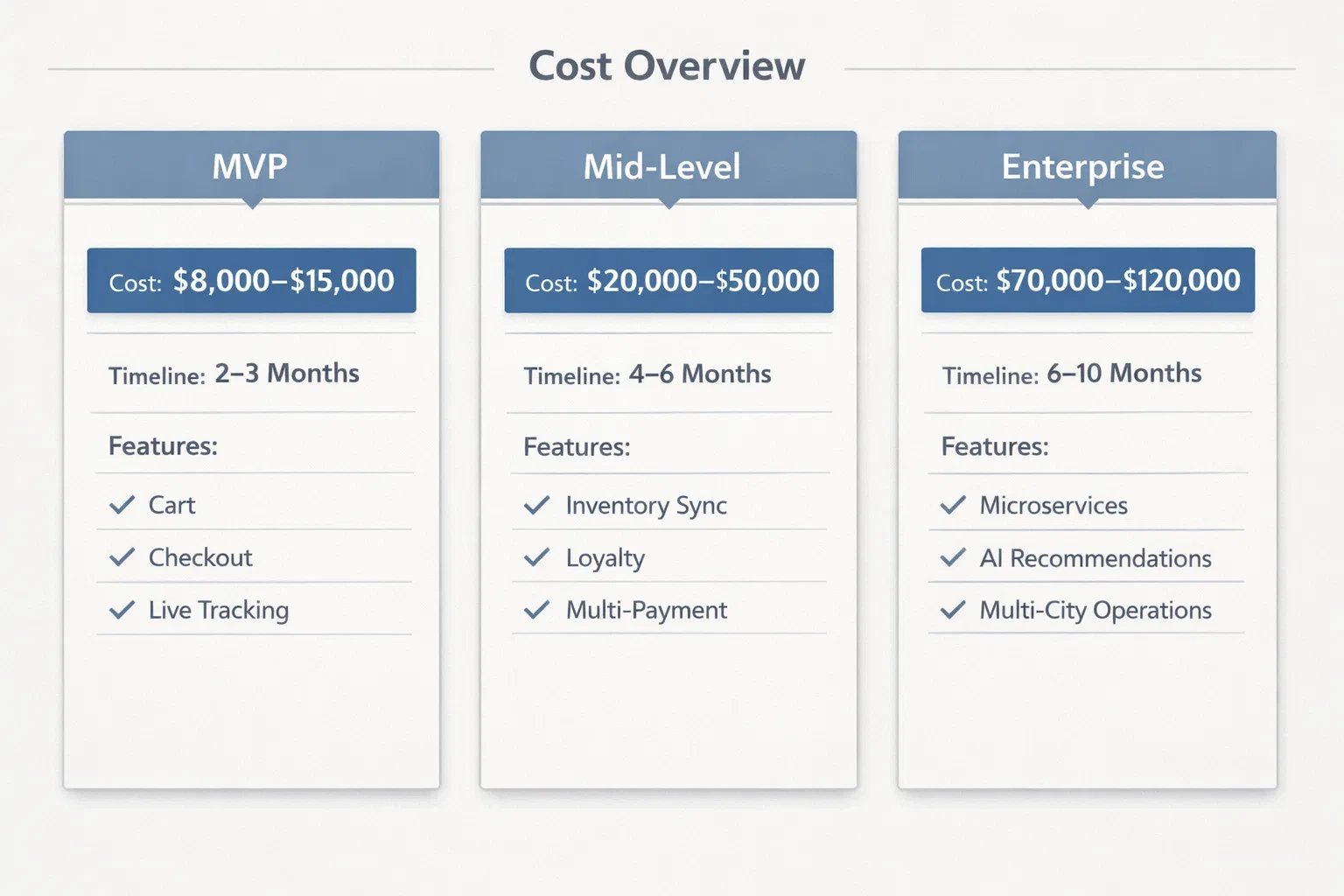
Cost to Build a Grocery Delivery App – MVP vs Mid-Level vs Enterprise
MVP Grocery App: $8,000 – $15,000
Basic ordering, cart, checkout, and live delivery tracking. Ideal for startups testing a local market.
Mid-Level Grocery App: $20,000 – $50,000
Adds real-time inventory sync, admin and vendor panels, loyalty programs, and multiple payment options.
Enterprise Grocery App: $70,000 – $120,000
Multi-city operations, micro-fulfillment, AI features, custom dashboards, scalable backend.
Advanced platforms now incorporate artificial intelligence through AI-powered capability layers such as AI chatbot development, generative AI development workflows, and AI-driven bots for personalization and automated customer service.
Development Timeline of the Grocery App by Complexity
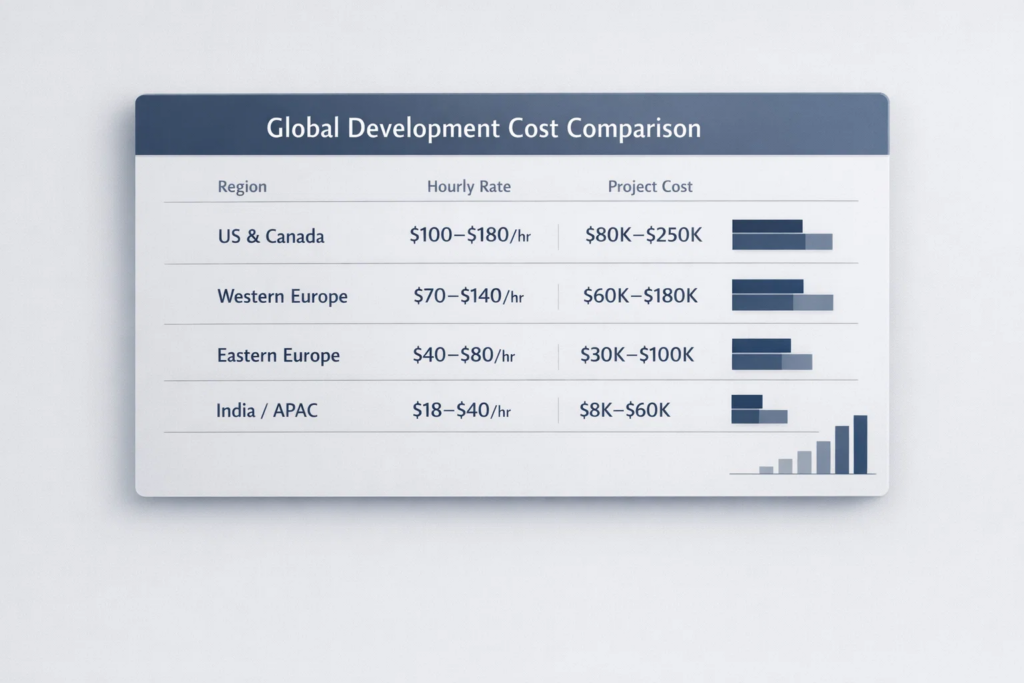
Region of Grocery Delivery App Development
Hourly Rate of Grocery Delivery App Development
Total Cost Range of Grocery Delivery App Development
US & Canada
$100-$180/hr
$80K-$250K
Western Europe
$70-$140/hr
$60K-$180K
Eastern Europe
$40-$80/hr
$30K-$100K
India / APAC
$18-$40/hr
$8K-$60K
India and APAC remain the most cost-efficient for full-cycle product development. Development costs are influenced not just by geography but also by required team composition, delivery model, and coordination across distributed engineering environments.
Grocery Delivery App Development Costs: How Much Does It Cost to Build from Scratch?
The final cost to build a Grocery Delivery App from scratch depends on feature depth, architecture, integrations, and team location.
Minimum viable app: Starts at $8,000
Scalable multi-store platform with AI and analytics: Up to $120,000
MVP Grocery Delivery App Cost Breakdown by Features
Feature Set of an MVP Grocery Delivery App
Estimated Cost
Purpose
Basic UI/UX Design
$1,000–$2,000
Simple, intuitive navigation
Order Placement + Cart + Checkout
$2,000–$4,000
Core functionality
Delivery Tracking (Live Map)
$1,000–$2,000
Route visibility for users
Admin Dashboard
$1,000–$2,000
Order management & inventory
Total
$8,000–$15,000
Best for startups testing an idea
Full-Scale Marketplace Grocery App Cost Breakdown
Feature Set of a Full-Scale Marketplace Grocery App
Estimated Cost
Advanced Search + Filters
$2,000–$3,000
User Profiles + Loyalty Program
$1,500–$3,000
Multi-Vendor Module + Commissions
$4,000–$6,000
Real-Time Inventory Sync
$3,000–$5,000
Payment Gateways (Stripe/Wallets)
$2,000–$4,000
Ratings, Reviews, Push Notifications
$1,500–$3,000
Admin Panel (Multi-role)
$3,000–$5,000
Total
$30,000–$60,000
Enterprise-Grade Grocery App Cost Structure
Total Estimated Cost: $70,000–$120,000
Includes: Microservices, Cloud-native DevOps, AI cart suggestions, predictive analytics, voice shopping, BI dashboards, role-based access control, multi-warehouse support, delivery optimization, and high-level security/compliance.
Cost to Build an Instacart-Like App
Estimated Cost: $80,000–$120,000
Timeframe: 6–9 months
Required Team: Solution Architect, Mobile Engineers, Backend Devs, UI/UX Designers, QA Team, DevOps, Data & AI Specialists
Notes: Add budget for product recommendation engines, inventory scaling, driver dispatch automation, and fallback logic for substitutions.
These tiers represent typical cost ranges by app complexity, where functionality, integrations, and scalability requirements directly influence development investment.
Regional Cost Analysis (US vs Global Development Hubs)
Where you hire your grocery app development team can make or break your budget. Rates vary widely across regions, and offshore teams offer significant savings without compromising quality if properly managed.
North America Development Cost
Rates: $100-$180/hr
Use Case: Complex enterprise apps, regulated industries
Total Cost Estimate: $80,000-$250,000
Western Europe Development Cost
Rates: $70-$140/hr
Use Case: Mid-to-large agencies, mature marketplaces
Total Cost Estimate: $60,000-$180,000
Eastern Europe Development Cost
Rates: $40-$80/hr
Use Case: Strong tech expertise at moderate cost
Total Cost Estimate: $30,000-$100,000
India Development Cost
Rates: $18-$40/hr
Use Case: Full-cycle product development at startup-friendly costs
Total Cost Estimate: $8,000-$60,000
Hybrid Global Delivery Model Strategy
Many companies adopt a hybrid model, with design/strategy based in the US/EU and development handled offshore in India or Eastern Europe.
This approach often saves 40-60% while maintaining control over project quality and timelines.
The feature set is one of the biggest cost drivers in grocery delivery app development. A lean MVP includes only essential shopping flows. A scalable platform adds multiple dashboards, automation logic, and real-time systems, increasing complexity, timeline, and overall investment.
Successful platforms organize Customer-Facing Features, Admin and Operations Features, and Delivery Partner Features to enhance customer experience and user experience. Features include Scheduled Delivery Slots, Same-Day Delivery, Next-Day Delivery, inventory management, dispatch management, and delivery automation to support online grocery shopping and scalable food and grocery delivery models.
Customer Side of the Grocery App (User App)
This is the shopper-facing interface used to browse, order, and track deliveries.
Key Features Include:
Sign In & Sign Up – Email, phone, social login, or biometrics
Profile Management – Saved addresses, preferences, and account details
Product Browsing & Listings – Categorized products with real-time updates
Search & Filters – Smart search, tags, and price filtering
Add to Cart & Checkout – Multi-item cart with secure payment flow
Discount Vouchers & Coupons – Promo codes and referral rewards
Delivery Tracking – Real-time GPS tracking and ETAs
Time Slot Selection – Scheduled delivery planning
Order History – Past orders and one-click reorder
Ratings & Reviews – Product and delivery feedback
Push Notifications – Order updates and promotional alerts
Help & Customer Support – Chat, call, or FAQ integration
Core features and functionalities typically include product catalog and search, user registration and authentication, secure order modes, and a seamless customer-facing portal designed for fast checkout experiences.
Development Cost for User App: $6,000-$30,000, depending on feature depth
Delivery Person Side of the Grocery App
Used by delivery agents to manage tasks and routes. This layer functions as a driver logistics application within the broader delivery management system, coordinating dispatch, routing, and fulfillment through an integrated delivery management module.
Key Features Include:
Delivery Requests – Accept or reject with timeout settings
Push Notifications – New orders and earnings alerts
Map Integration – Live route tracking using Geolocation APIs, GPS-based order tracking, and maps & GPS services such as the Google Maps API
Turn-by-Turn Navigation – Google Maps or Waze integration
Set Availability – On-duty / off-duty toggle
Delivery Time Slots – Slot-based scheduling
Order Weight View – Capacity visibility
Work History – Completed deliveries and logs
Earnings & Reports – Daily and weekly payout summaries
Ratings & Reviews – Customer-provided feedback
Customer Support – Escalation or contact button
Development Cost for Delivery App: $4,000-$15,000
Admin Panel Features of the Grocery Delivery App
Used by platform owners to control operations, vendors, and analytics.
Key Features Include:
User Management – Roles, permissions, access control
Product Management – Listings, categories, and inventory
Order Management – Live tracking and cancellations
Driver Management – Availability and performance tracking
Payment Management – Commissions, payouts, and fees
Campaign Management – SMS, email, and push automation
Promotion Control – Create and manage discount rules
Analytics Dashboard – Real-time business intelligence
App Content Management – Banners, FAQs, and policies
Administrators typically operate through a centralized admin dashboard and a store manager dashboard to oversee inventory, fulfillment, and analytics.
Admin Panel Cost Estimate: $6,000-$20,000
Vendor Panel Features of the Grocery Delivery App
Used by third-party sellers to manage store operations.
Key Features Include:
Item Management – Add, edit, or delete products
Coupon Code Management – Store-specific offers
Receive/Reject Orders – Manual or automated approval
Order Management – Delivery and customer tracking
Payment Tracking – Revenue and payout dashboard
Inventory Updates – Stock alerts and availability sync
Promotion Configuration – Discounts and store-level offers
What Factors Affect Grocery Delivery App Development Cost the Most?
Several key factors determine how much your grocery delivery app will cost to build from initial scope to post-launch scaling. Here’s what directly shapes your budget:
1. Design Complexity: Way Beyond Looking Pretty
Modern grocery apps require intuitive, conversion-optimized UI, not just basic visuals. Micro-interactions, dark modes, accessibility, and design systems add cost as they improve UX.
2. Backend Architecture: The Foundation That Determines Everything
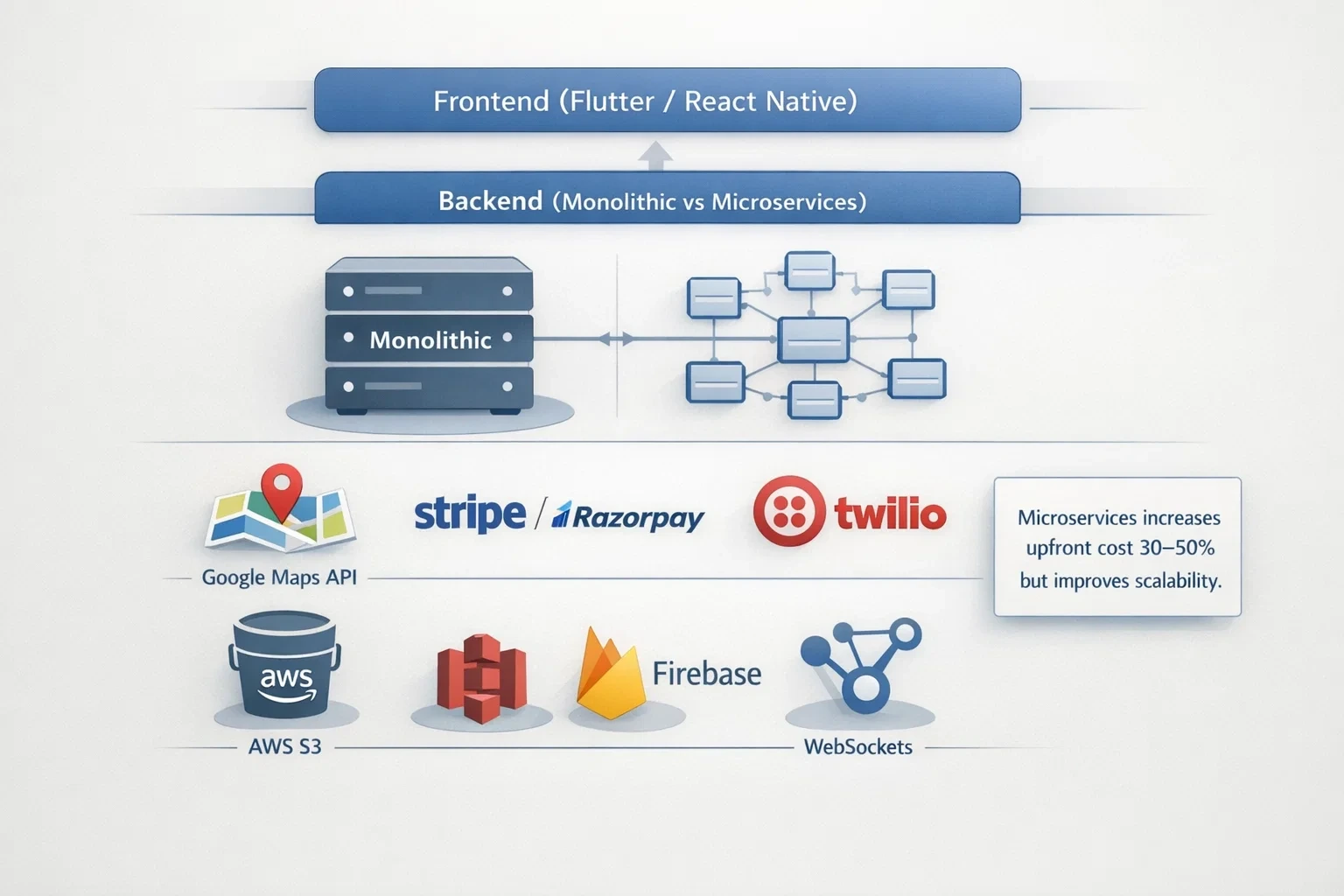
Monolithic setups are faster for MVPs, but microservices are essential for multi-vendor scalability. The more modular and distributed your backend, the more upfront planning and cost are involved.
3. Third-Party Integrations: The Sneaky Budget Destroyers
APIs like Google Maps, Stripe, Razorpay, Twilio, and Firebase power real-time capabilities but come with both integration and usage-based fees.
PCI-DSS for payments, GDPR for user data, and secure authentication (2FA, biometrics) are essential, especially if you’re scaling or operating in regulated markets.
5. Platform Selection: Native vs Cross-Platform Trade-offs
Building separate native apps for iOS and Android adds cost but delivers top-tier UX. Cross-platform tools (Flutter/React Native) reduce dev time by 30–40% using a single codebase.
6. Technology Integration Complexity
More features = more complexity. Features like AI-powered recommendations, smart filters, and wallet integrations increase architecture and QA effort.
7. Features and Functionalities
A simple cart and checkout flow costs less. Adding loyalty programs, real-time inventory sync, driver dashboards, and multi-store logic raises the bar and the budget.
Many founders budget for launch but overlook the long-term costs of maintaining and scaling a grocery delivery platform. These hidden expenses often surface post-launch and can significantly impact ROI if unaccounted for early on.
Third-Party API Usage Fees
APIs like Google Maps, Twilio, and payment gateways have usage-based pricing.
Monthly spend: $50-$500 depending on app traffic and transaction volume.
App Store & Platform Fees
Apple App Store and Google Play charge a 15-30% fee on in-app purchases or subscriptions.
Enterprise apps may also require developer account maintenance and renewal fees.
Security Audits & Compliance Renewals
Yearly GDPR/PCI-DSS compliance checks, penetration testing, and server security audits.
Budget at least $500-$2,000 annually for a secure and compliant platform.
Maintenance & Feature Enhancements
Regular bug fixes, feature updates, OS version compatibility, and performance improvements.
Monthly retainer with your dev agency or in-house team: $500-$2,000+
Marketing & Customer Acquisition Costs
Paid ads, influencer partnerships, SEO, and app store optimization (ASO).
Early-stage user acquisition can cost $1-$5 per install.
Development Process: From Market Research to Post-Launch Support
This structured grocery store app development process ensures scalability while aligning technical architecture with real-world grocery operations.
Market Research & Requirement Gathering to define logistics workflows and user expectations
UI/UX Design & Prototyping to map shopping journeys and conversion flows
Frontend & Backend Development across mobile applications, admin dashboards, and delivery systems
Testing & QA Cycles to validate performance, integrations, and real-time order tracking
Deployment & App Store Approvals to launch across Android and iOS ecosystems
Post-Launch Support & Updates to maintain performance, introduce new features, and scale infrastructure
Tech Stack & System Architecture in Grocery Delivery App Development
The tech stack behind your grocery delivery app affects performance, scalability, and long-term cost. Smart architecture decisions early on reduce rework, speed up development, and cut infrastructure expenses.
Modern grocery platforms rely on coordinated frontend & backend development built on mobile technology stacks such as Android Studio, cross-platform frameworks, and scalable cloud infrastructure.
These grocery delivery platforms use Microservices Architecture with Data Management and QA Testing to ensure Performance Optimization. They rely on Integrating Multiple APIs, including Payment APIs, Logistics APIs, Supplier APIs, and Customer Engagement APIs, to support online grocery shopping, inventory management, and delivery workers across grocery store operations.
Native vs Cross-Platform Development
Native (Kotlin/Swift): Best performance and UX, but higher cost due to separate codebases
Cross-Platform (Flutter/React Native): Faster builds with one codebase for iOS and Android
Cost Impact: Cross-platform saves 30–40% on dev time
Backend Architecture: Monolith or Microservices?
Monolith: Simpler, centralized – ideal for MVPs or small-market apps
Microservices: Scalable, modular – better for multi-vendor platforms
Cost Impact: Microservices cost 30–50% more initially, but scale better
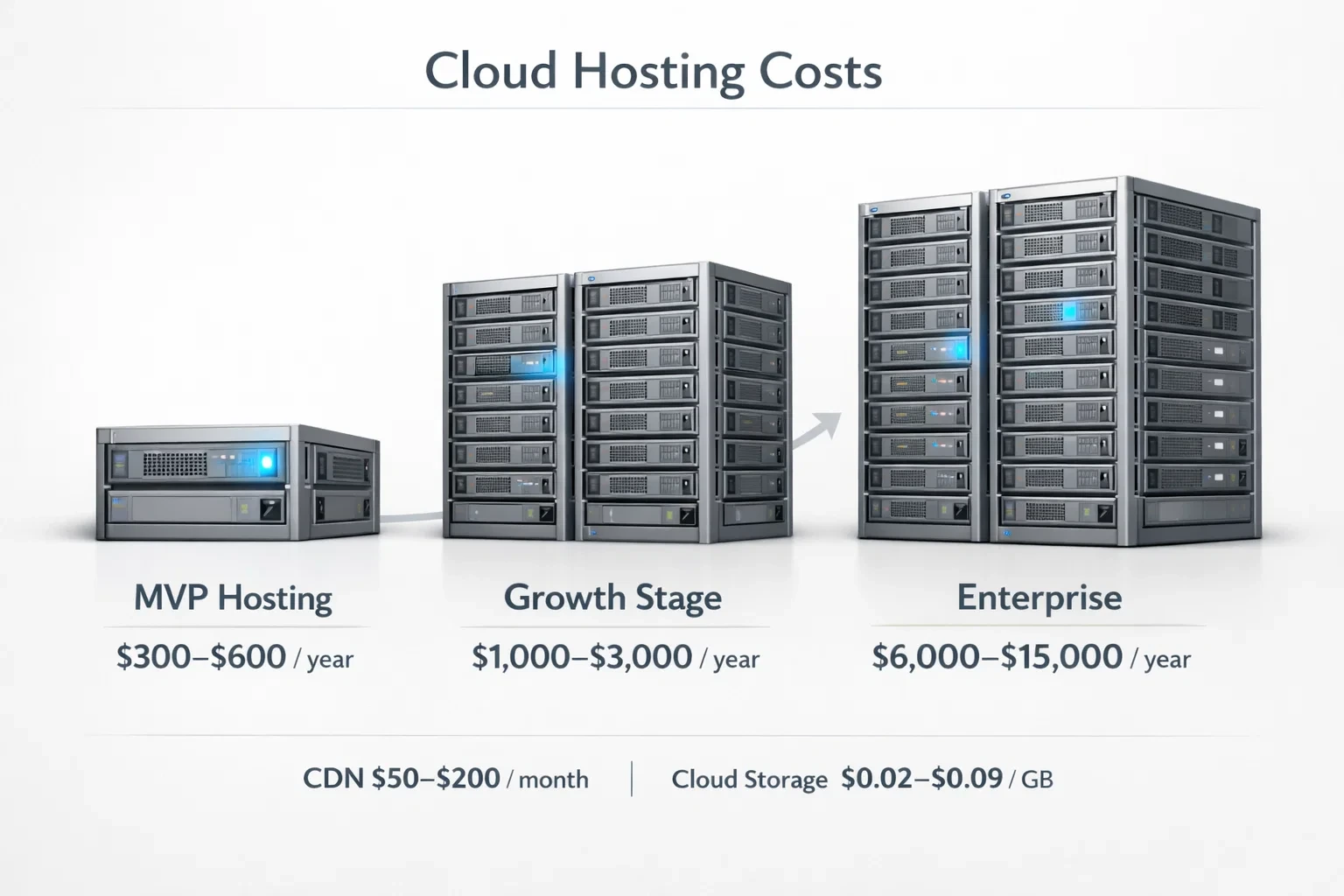
Includes – Basic database, storage, and limited traffic support
Growth-Stage Infrastructure Cost
Cloud Providers – AWS EC2 + RDS, Google Cloud, Azure
Typical Spend – $1,000-$3,000 per year
Includes – Auto-scaling servers, CDN, database backups
Enterprise Cloud Scaling Cost
User Volume – 50,000+ monthly active users
Typical Spend – $6,000-$15,000 per year
Includes – CI/CD pipelines, load balancers, failover systems, and advanced monitoring
CDN, Storage & Backup Cost Factors
CDN Services – $50-$200 per month, depending on traffic
Cloud Storage (S3) – $0.02-$0.09 per GB
Backups & Snapshots – $100-$300 per year
Annual Infrastructure Cost Projection
App Stage
Hosting Cost (Yearly)
MVP
$300-$600
Mid-Scale
$1,000-$3,000
Enterprise
$6,000-$15,000
Business Model in Grocery Delivery Apps
The cost of building a grocery delivery app in 2026 depends largely on the business model. Each model affects backend complexity, integrations, and long-term scalability. Grocery platforms are typically designed as a single-store model for independent retailers, an aggregator model connecting multiple grocery chains, or a full marketplace app enabling multi-vendor commerce.
Grocery platforms typically operate under structured Revenue Models such as the Inventory Model vs Aggregator Model, Subscription-Based Model, and Per-Order Revenue strategies.
These structures reflect broader Effective Business Models used by Internet-based businesses and delivery app corporations to balance Monetization Strategies, standard delivery costs, market penetration, Regulatory Compliance, and long-term sustainability in the evolving delivery sector.
Inventory-Based Model
The company owns inventory, warehouses, and logistics, similar to Walmart Grocery.
Cost Impact: Requires real-time inventory sync, warehouse management tools, and stock control systems. Development Range: $30,000 – $80,000+
Marketplace Model
The platform connects users with third-party grocery vendors, similar to Instacart.
A typical enterprise build requires a clearly defined team composition, including solution architects, mobile engineers, backend developers, QA specialists, DevOps teams, and data engineers.
Cost Impact: Needs multi-vendor panels, onboarding systems, automated payouts, and commission tracking. Development Range: $50,000 – $120,000
Micro-Fulfillment / Hybrid Model
Combines central warehouses with local delivery hubs, similar to GoPuff.
Cost Impact: Requires geofencing, advanced routing, localized inventory sync, and fulfillment intelligence. Development Range: $70,000 – $120,000+
Subscription-Based Grocery Model
Users pay recurring fees for premium delivery, discounts, or exclusive access.
Your revenue model impacts app design, backend structure, and data tracking systems — all of which affect development complexity and cost. Here are the most successful monetization paths:
Commission-Based Model
Take a commission on every order placed through the platform (e.g., 10-25%).
Requires detailed order tracking, automated payouts, and fee calculators.
Delivery Fee Structure
Charge users a delivery fee per order based on distance, weight, or speed.
Can be dynamic with surge pricing or time-slot-based premiums.
Subscription & Membership Plans
Offer premium users features like free delivery, exclusive discounts, or early access to slots.
Implement recurring billing (Stripe, Razorpay) and churn tracking.
Sponsored Listings & Brand Partnerships
Grocery brands can pay for promoted product placements or homepage visibility.
Requires a content management system (CMS) and ad analytics module.
Surge Pricing Model
Increase delivery fees during high-demand hours or low delivery partner availability.
Similar to Uber’s dynamic pricing logic, this must be built into the backend order engine.
Before investing $8,000 to $120,000+ in grocery delivery app development, founders should model revenue, unit economics, and time-to-profit clearly.
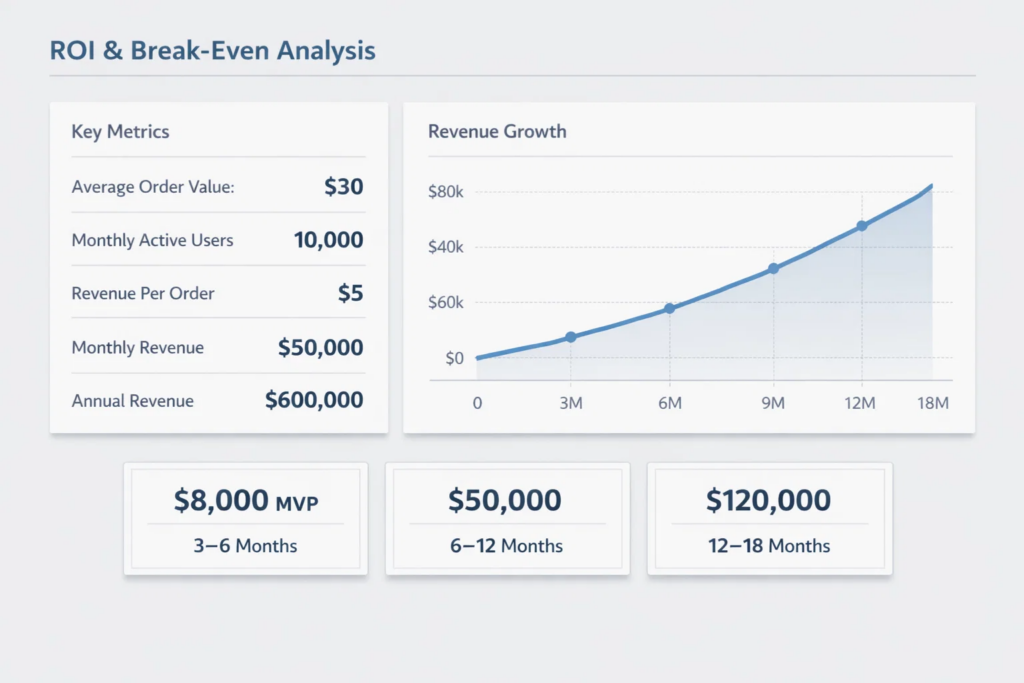
Revenue Projection Model
Average Order Value (AOV) – $30
Monthly Active Users (MAU) – 10,000
Commission + Delivery Fee Per Order – $5
Monthly Revenue – 10,000 × $5 = $50,000
Annual Revenue – $600,000
Apps generating $5,000-10,000 monthly orders can typically break even within 6-12 months if operating costs are controlled.
Unit Economics in Grocery Delivery
Cost Per Order (tech + delivery) – $2-$3
Gross Profit Per Order – $2-$3
Churn Rate – 15-20%
Marketing ROI – 3x-6x for optimized acquisition funnels
Positive unit economics at scale is what makes grocery platforms sustainable.
Break-Even Timeline Scenarios
Investment
Users Needed
Time to Break Even
$8,000 (MVP)
~3,000
3-6 months
$50,000
10,000-12,000
6-12 months
$120,000
20,000+
12-18 months
Cost-to-Scale Economics
Fixed build costs are one-time.
Incremental order cost remains low once infrastructure is in place.
Cloud-native systems scale predictably without large jumps in infrastructure expense.
Businesses that succeed apply clear lessons on cost, scaling, and sustainability, ensuring technology investments support long-term operational growth rather than short-term experimentation.
A detailed market analysis is essential to estimate demand, pricing strategies, and long-term profitability before development begins.
Buy vs Build Decision Framework
Choosing between white-label and custom development directly affects control, flexibility, and long-term cost structure.
White-Label Grocery App – Cost & Limitations
Cost – $4,000-$12,000 or subscription-based Time to Market – 2-3 weeks
Cost – $20,000-$120,000 Time to Market – 2-6 months
Pros
Full feature control
Brand differentiation
Optimized performance
Long-term scalability
Cons
Higher upfront investment
Longer development cycle
Total Cost of Ownership Comparison
Category
White-Label
Custom Build
Initial Cost
$4K-$12K
$20K-$120K
Monthly Fees
$100-$1,000
None (self-hosted)
Customization
Limited
Fully flexible
IP Ownership
No
Yes
Scalability
Moderate
High
Vendor Lock-In Risk
White-label platforms often bundle hosting, upgrades, and licensing.
Custom platforms provide full control over infrastructure, data, and roadmap.
Executive Decision Matrix
You Should Buy If
You are validating an idea quickly
Your budget is under $10,000
You need a fast prototype
You Should Build If
You want long-term differentiation
You are targeting aggressive growth
You need enterprise-grade performance
Case Study: Blue Apron (2016)
In 2016, Blue Apron stood at the forefront of the U.S. meal-kit movement. Their strategy? Focus on operational excellence. With centralized logistics and fixed weekly menus, they scaled fast, shipping over a million meals each month and generating $795 million in annual revenue. This approach allowed them to keep delivery quality high and costs predictable. It’s a reminder of how mastering core logistics can turn a meal-kit concept into a nationally recognized brand.
APPWRK Case Insight: Scaling Grocery Delivery Operations
Drawing from our global FMCG logistics case study, we helped a Fortune-ranked company streamline last-mile operations, reducing delivery turnaround times by 32% and missed dispatches by 47%. Our approach to logistics app development focuses on modular dispatch systems, mobile-first user experience, and secure compliance architecture.
For more case studies, please visit our portfolio.
Consumer Trends Shaping Grocery Delivery Apps in 2026
Evolving consumer expectations are pushing grocery apps to become smarter, faster, and more personalized. These trends directly influence development cost. These shifts reflect broader consumer trends driving the adoption of digital grocery delivery services worldwide.
AI-Powered Personalization & Predictive Carts
Apps now recommend products based on buying patterns, time of day, and location.
Requires custom algorithms, data pipelines, and machine learning integration.
Voice & Chat-Based Grocery Ordering
Users increasingly order through voice assistants and in-app chat.
Requires NLP integrations and voice APIs such as Google Assistant or Dialogflow.
Sustainable & Carbon-Aware Delivery Options
Customers prefer eco-friendly delivery slots and carbon-conscious options.
Requires routing optimization and carbon-tracking API integration.
Same-Day & Quick Commerce Expectations
Users expect 10 to 60-minute delivery windows.
Requires advanced geolocation, fulfillment logic, and hub-based inventory sync.
Subscription & Loyalty-Driven Retention
Apps implement cashback, referrals, and reward engines to reduce churn.
Adds backend complexity for rewards tracking and customer behavior analytics.
Choosing the right development partner requires clear evaluation criteria covering technical expertise, scalability planning, and experience in building delivery management systems.
Organizations should run a structured due diligence process to assess architecture decisions, integration capabilities, and long-term support models. Strong contract negotiation best practices help prevent scope creep, hidden infrastructure costs, and vendor lock-in.
Understanding development team structure options, offshore, hybrid, or in-house, ensures cost efficiency while maintaining delivery control.
How APPWRK Builds Scalable Grocery Delivery Platforms
APPWRK builds grocery delivery platforms designed to scale seamlessly from MVP launches to full-fledged multi-vendor enterprise ecosystems. Our approach starts with an MVP-first delivery model, helping founders launch lean, validate demand, and expand strategically based on real user data. We implement cloud-native architecture to ensure performance, uptime, and predictable hosting costs as traffic grows.
Our AI-ready systems allow you to introduce recommendation engines, analytics, and automation when the business justifies it, without rebuilding the core platform. Security-first infrastructure ensures secure payments, data protection, and compliance-ready backend systems from day one. Through a hybrid delivery model that combines US-led strategy with India-based engineering, we help reduce overall development costs by 40-50% while maintaining quality and scalability.
Founder’s Guide: Strategic Planning for Grocery Delivery Platforms
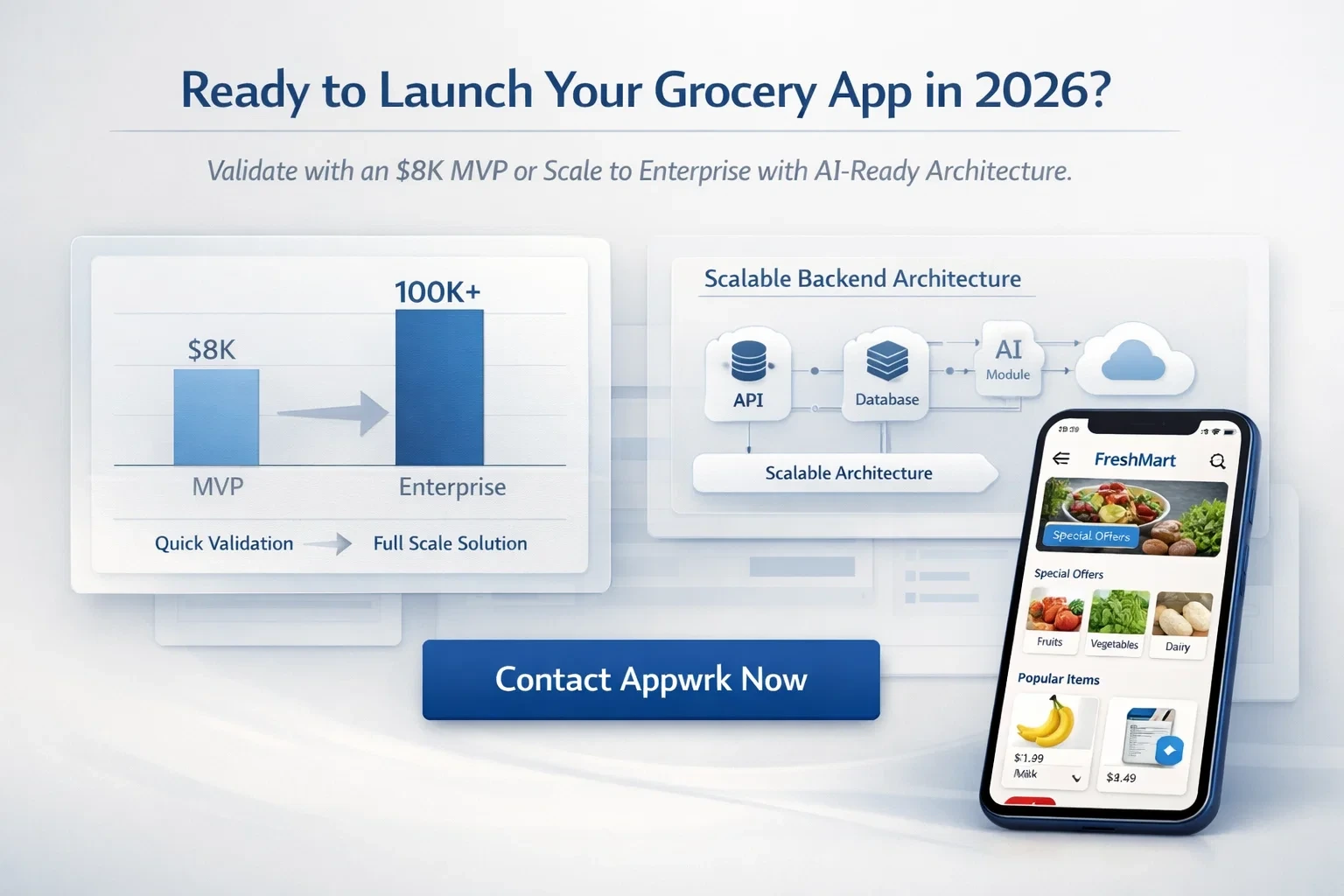
If you’re planning to launch a grocery delivery app in 2026, start lean. A focused MVP in the $8,000-$12,000 range is enough to validate demand, test unit economics, and understand customer behavior. Once traction is proven, move toward scalable architecture, stronger backend systems, and deeper third-party integrations.
When budgeting, think beyond development. Hosting, compliance, marketing, app maintenance, and API usage can materially affect profitability. Track metrics such as order volume, churn rate, customer lifetime value, and cost per acquisition to guide post-launch decisions.
If your goal is long-term differentiation or raising capital, avoid rigid template-based platforms. Built with ownership, scalable infrastructure, and a roadmap that supports expansion into multi-vendor or multi-city operations.
Frequently Asked Questions
How much does it cost to build a grocery delivery app in 2026? An MVP typically starts at $8,000-$15,000. A scalable marketplace or enterprise-grade grocery delivery platform can range from $50,000 to $120,000, depending on features and integrations.
How long does grocery app development take? Most MVP apps take 2-3 months. Mid-level platforms require 4-6 months, while enterprise builds may take 6-10 months.
What increases grocery delivery app development cost the most? AI-based recommendations, multi-vendor management, real-time inventory sync, microservices architecture, and compliance requirements are major cost drivers.
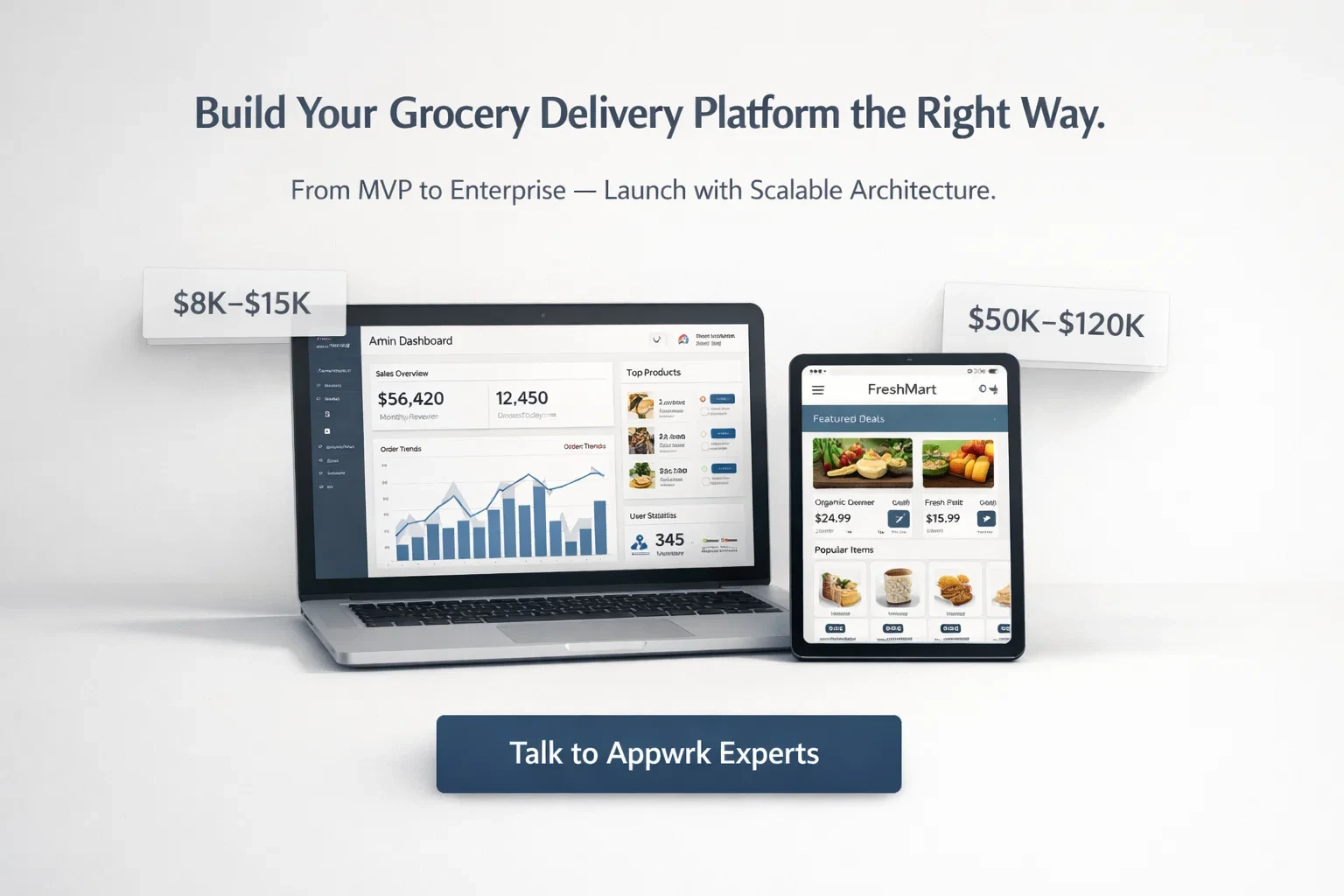
If you’re evaluating which of these features are truly necessary for your growth stage, APPWRK can help you prioritize high-impact capabilities, design a scalable architecture, and control development costs from day one. Talk to our team to define the right roadmap before overinvesting in complexity.
Is it better to build a custom or use a white-label grocery app? White-label solutions are faster and cheaper upfront, but limit scalability and ownership. Custom development offers long-term flexibility and stronger ROI.
How much does it cost to maintain a grocery delivery app? Ongoing maintenance typically ranges from $500-$2,000 per month, depending on updates, server load, and support requirements.
What is the break-even timeline for a grocery delivery app? With strong unit economics and 5,000-10,000 monthly orders, many platforms break even within 6-12 months.
Can I scale from MVP to enterprise without rebuilding? Yes, if the app is built with a cloud-native, modular architecture from the start, expansion can happen without major structural rework.
What technologies power a modern grocery delivery application? A modern grocery delivery application uses mobile applications, cloud infrastructure, real-time tracking systems, payment gateways, and AI-powered analytics to manage orders, logistics, and customer engagement.
How Much Does On-Demand Grocery App Development Cost? On-demand grocery delivery platforms typically cost between $20,000 and $80,000, depending on dispatch automation, delivery management modules, and real-time inventory synchronization required for rapid fulfillment.
How do you integrate delivery and logistics APIs?
Integrating delivery and logistics APIs involves connecting your backend with third-party services (like ShipEngine, FedEx, or custom fleet solutions) to enable real-time order tracking, ETAs, route optimization, and delivery status updates. This typically requires secure API keys, webhooks for status changes, and syncing with inventory and order management systems to ensure seamless coordination between your app, warehouse, and logistics providers.
Gourav Khanna is the Co-founder and CEO of APPWRK, leading the company’s vision to deliver AI-first, scalable digital solutions for enterprises and high-growth startups. With over 16 years of leadership in technology, he is known for driving digital transformation strategies that connect business ambition with outcome-focused execution across healthcare, retail, logistics, and enterprise operations.
Recognized as a strategic industry voice, Gourav brings deep expertise in product strategy, AI adoption, and platform engineering. Through his insights, he helps decision-makers prioritize market traction, operational efficiency, and long-term ROI while building resilient, user-centric digital systems.
Subscribe to APPWRK Blogs, We'll Do the Rest!
Get Blogs on UI/UX, Mobile Apps, Online Marketing, and Web development technology.
Unlock worthy and priceless suggestions from the masters of mobile and web app development