150+ minds across 4 countries. Join a culture of innovation, ownership & growth.
Rewire for AI
From machine learning to deep learning, from classification tools to overall process automation – our AI engineers will help you retool your existing system or enhance your company results.
Ship faster, scale smarter, built for product companies and SaaS teams
Our Latest Work
We strive hard to deliver result-driven digital solutions across the globe. Check out our case studies to get a glimpse of how we ideate, innovate, and create unconventional digital solutions according to the requirements of our clients.
Discover diverse and passionate insights from our tech enthusiasts. We collaborate across various sectors to streamline operations and drive innovation. Explore our rapidly growing collection of articles to see why we’re at the forefront of IT solutions.
The decision to move from Magento to Shopify is one of the most significant replatforming choices an ecommerce business can make. Magento is powerful, but its power comes with...
Accuracy gap is real: Traditional CPG forecasting carries a 25-40% MAPE error rate. AI-powered models bring that down to 8-15%, according to McKinsey research....
Real stories from global leaders who trusted us with their ideas.
Partnering with APPWRK helped us build a compliant and scalable healthcare platform, accelerating our time-to-market by 35%. Their team consistently delivered outstanding work.
Beesers
Digital Healthcare Client
Collaborating with APPWRK, Sportskeeda modernized its platform into a real-time sports engagement ecosystem, enabling seamless content delivery, scalable fan interactions, and high-velocity performance.
Sportskeeda
Sports & Entertainment Partner
Working with APPWRK was effortless. They captured our vision, maintained full compliance, and delivered a digital experience that built trust and elevated how customers interact with our fintech brand.
PayPenny
Fintech Partner
Working with APPWRK gave us confidence in adopting AI responsibly. Their team built a safe, intelligent bot that transformed how we engage with leads and helped us achieve measurable revenue growth.
IFB
AI Transformation Partner
Leveraging APPWRK’s digital expertise, Nemesis launched a scalable, compliant, and safe super app that connects content delivery, real-time communication, and logistics management within a single platform.
The cost to build a hotel booking application in 2025 starts at around $8,000 for a basic MVP and can scale between $15,000 and $50,000 for mid-tier builds. Enterprise-grade hotel booking software with advanced integrations rarely crosses $90,000 when developed with a smart, scalable development approach.
Costs can be optimized by outsourcing parts of the build, using modular architecture, and rolling out features in phases. This approach makes hotel booking mobile app development accessible not just to large hotel chains but also to startups, travel agencies, and vacation rental providers.
Core features like search filters, property listings, booking forms, secure payment integration (Stripe, PayPal, or third-party services), and user reviews can fit into a lean budget. On the other hand, advanced layers, such as AI-based recommendations, loyalty programs, forecasting tools, and real-time inventory management, raise the price but also boost long-term ROI.
Businesses should plan for hidden costs too: compliance audits, QA testing, backend development, user onboarding, and post-launch marketing. With proper planning, these can be minimized.
By working with a partner like Appwrk, companies can cut their total cost of ownership by 30–40% through reusable frameworks, agile delivery models, and global development resources. Investing in a booking app today means stronger brand control, fewer OTA commissions, and more direct bookings.
This blog is designed for CTOs, founders, and product managers who want a clear view of hotel app development costs, timelines, hidden expenses, and proven cost-saving tactics.
The hotel industry is rapidly digitalizing, with global hotel booking revenues expected to reach 2.1 trillion by 2032. More than 70% of guests now prefer mobile applications or online hotel booking applications over traditional websites or OTA apps. This shift proves that mobile-first travel booking platforms are no longer optional; they’re essential for capturing modern travelers.
The eTravel industry is growing at a CAGR of 7-10% over the next five years. Whether you manage boutique hotels, large chains, or vacation rentals, investing in your own hotel reservation app or travel app means owning the customer relationship instead of depending solely on third-party OTAs.
Shifting Traveler Behavior and Digital-First Booking
Today’s travelers expect real-time updates, flexible payment methods, and instant communication when booking. A hotel booking mobile app allows you to offer personalization, location-based services using tools like Google Maps, and push notifications for targeted promotions. Unlike a static website, a dedicated app improves user experience and keeps your brand front and center.
Why Timing Is Crucial for Hotel Brands
Acting now gives you the edge:
Capture digital-first travelers early and strengthen loyalty with personalized travel experiences.
Avoid rising mobile app development costs as global demand pushes developer rates higher.
Differentiate your brand: while competitors still rely on OTA apps, your custom hotel booking software builds direct trust with customers.
Start lean with an MVP (~$8,000) and scale features later using an MVP Strategy that ensures ROI before heavy investment.
What Types of Hotel Booking Apps Can You Build and Who Are They For?
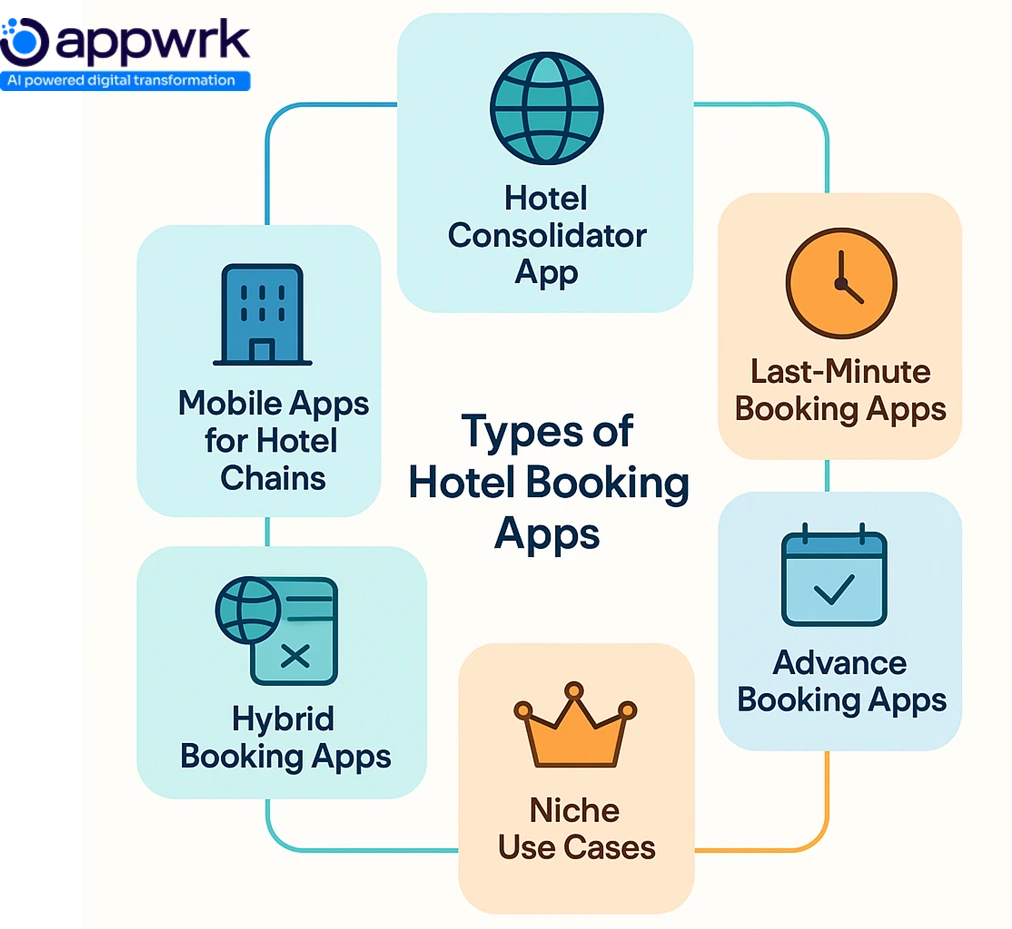
When it comes to hotel booking app development, there isn’t a one-size-fits-all formula. The right hotel booking application depends on your target audience, property type, and long-term growth strategy. Below are the main categories that dominate the travel app development market, along with their use cases and business advantages.
Hotel Consolidator App
A hotel reservation app that aggregates listings from multiple hotels and showcases them on one platform, similar to OTA apps. It’s a great choice for startups that want to act as aggregators.
Target users: Travelers comparing multiple properties at once.
Business benefit: Commission-driven revenue models on every confirmed booking.
Development note: Requires Booking Engine APIs and strong backend development to sync real-time inventory from different hotels.
Mobile Apps for Hotel Chains
These are branded hotel mobile apps designed for direct guest bookings, cutting out OTA dependency. Perfect for large chains that want full control over their hotel booking software.
Target users: Frequent travelers loyal to a chain.
Business benefit: Reduced OTA commissions, increased repeat bookings, stronger loyalty.
Development note: Integration with hotel CRM, loyalty points, and user accounts is critical.
Apps for Last-Minute Hotel Booking
These apps thrive on urgency, offering real-time availability and discounts for unsold rooms. A strong booking module ensures smooth last-minute transactions.
Target users: Business travelers, spontaneous tourists, budget seekers.
Business benefit: Monetizes unused rooms with dynamic pricing.
Development note: Needs push notifications, flexible payment integration, and real-time updates.
Apps for Hotel Booking in Advance
Built for planners, these apps allow users to book months ahead, offering assurance and better deals.
Target users: Families, long-haul travelers, international tourists.
Business benefit: Predictable revenue and a solid booking calendar pipeline.
Development note: Needs calendar sync, flexible cancellation policies, and forecasting tools.
Hybrid Hotel Booking App
A hybrid hotel application development approach combines both last-minute and advance booking in a single hotel booking mobile app development product.
Target users: Both planners and spontaneous travelers.
Business benefit: Higher occupancy rates year-round.
Development note: Requires advanced server-side infrastructure to handle dynamic pricing and long-term reservations simultaneously.
Additional Use Cases: Startups, B2B Travel Agencies, Luxury Resorts
Startups: MVP-driven Travel Mobile Applications built with an MVP Strategy. Lean builds test the market fast, cutting costs before scaling.
B2B Travel Agencies: Enterprise-grade travel booking tools for corporate bulk bookings with dashboards and Reservation Management.
Luxury Resorts: Premium hotel booking applications focused on experiences, personalization, AI-based recommendations, and loyalty perks.
Comparison Table: Types of Hotel Booking Apps
App Type
Target Users
Business Benefits
Cost Range (Approx.)
Hotel Consolidator App
Price-sensitive travelers
Commission on bookings
$15,000 – $35,000
Mobile Apps for Hotel Chains
Loyal repeat guests
Direct bookings, loyalty retention
$20,000 – $45,000
Last-Minute Booking App
Business & spontaneous travelers
Monetize unsold rooms
$12,000 – $30,000
Advance Booking App
Families, long-term planners
Predictable revenue, secure occupancy
$15,000 – $40,000
Hybrid App
Broad audience
Occupancy optimization, wider reach
$25,000 – $55,000
Specialized Apps (Startups, B2B, Luxury)
Niche groups
Tailored experiences
$10,000 – $50,000+
How Much Will a Hotel Booking App Cost by Features and Complexity?
Every hotelier or startup founder asks: “What is the real cost to build a hotel booking app?” The truth is, hotel booking application development costs depend on features, complexity, backend development, and long-term maintenance. While competitor estimates often stretch from $20,000 to $150,000, the good news is you can launch a functional hotel reservation app or online hotel booking application with an MVP Strategy starting at just $8,000, then scale gradually with a Scalable Development Approach.
Cost of a Basic Hotel Booking App (MVP)
Features: Registration, search and filters, property listings with hotel ratings, booking form, payment methods (like Stripe), reviews, push notifications.
Best For: Boutique hotels, vacation rentals, or startups testing a new business model.
Timeline: 8–10 weeks.
Estimated Cost: $8,000 – $15,000.
This stage prioritizes usability, quick response, and a user-friendly interface while keeping costs low.
Cost of a Mid-Tier Hotel Booking App
Features: All MVP features plus AI-based recommendations, loyalty programs, booking management, cancellations and refunds, multi-language support, and booking calendar.
Best For: Regional platforms and growing hotel chains looking to own their booking engines.
Timeline: 12–16 weeks.
Estimated Cost: $15,000 – $35,000.
Mid-tier builds strike a balance between advanced functionality and scalability while ensuring smooth navigation and a strong user experience.
Cost of an Enterprise-Grade App
Features: Advanced modules like AR/VR property tours, AI-driven pricing, blockchain payments, third-party services like taxi or flight booking apps integration, and real-time inventory.
Best For: Global hotel groups, B2B travel providers, and agencies in the eTravel industry.
Timeline: 20–28 weeks.
Estimated Cost: $35,000 – $90,000.
Enterprise apps are robust hotel booking software solutions that rely on strong server-side infrastructure, external databases like PostgreSQL, and advanced analytics with tools such as Google Analytics and Google Maps.
Custom Development vs. Pre-Built Solutions
Pre-Built Solutions ($5,000 – $12,000):
Fast to launch using responsive app builders like Adalo or Xano.
Limited customization and reliance on third-party services.
Ongoing licensing costs add up.
Custom Development ($8,000 – $90,000):
Tailored features that align with your branding and user-centric design.
Scalable and secure, ideal for long-term growth.
Higher upfront cost but stronger ROI in the long run.
Ongoing costs typically average 15–20% of the original development per year:
Bug fixes, OS upgrades, and backend stability: $1,500 – $5,000.
New features or booking calendar upgrades: $3,000 – $10,000.
Marketing, ASO, and Publish support for Apple App Store and Google Play Store: $2,000 – $6,000.
Security compliance and data audits: $2,000 – $5,000.
Regular updates ensure smooth performance, strong communication, and compliance across platforms.
DIY Builders vs. Professional Development
DIY Tools ($3,000 – $5,000):
Affordable and fast, but limited in scalability and Reservation Management.
Often lack advanced booking software integrations and proper testing via Testflight.
Professional Builds ($8,000 – $90,000):
Scalable, secure, and future-ready with robust booking engines, real-time updates, and seamless payment integration.
Ensures alignment with the hotel industry standards and provides support for growth.
For hotels aiming at long-term ROI, outsourcing to professionals with expertise in hotel booking mobile app development and travel app development always pays off.
Hotel Booking App Cost Breakdown by Complexity
App Type
Features Included
Estimated Cost (USD)
Timeline
Basic MVP
Core features: booking, search, payments, reviews
$8,000 – $15,000
8–10 weeks
Mid-Tier
Adds AI personalization, loyalty, chatbots, and multi-language
$15,000 – $35,000
12–16 weeks
Enterprise
All features + AI pricing, AR/VR, blockchain, integrations
$35,000 – $90,000
20–28 weeks
Pre-Built
Limited, templated features
$5,000 – $12,000
4–6 weeks
Maintenance
Annual bug fixes, updates, marketing, and compliance
15–20% of the build cost
Ongoing
Feature-Wise Cost Breakdown for Hotel Booking Apps
How Much Does a Hotel Booking App Cost in Different Regions?
Another factor that can influence hotel booking app development cost is where your development team is located. Hourly rates and total costs vary across regions.
North America (US & Canada)
Hourly rate: $100 – $180/hour
Best for: large enterprises prioritizing local teams and timezone alignment.
Western Europe
Hourly rate: $80 – $150/hour
Best for: mid-sized businesses seeking a balance of cost and quality.
Best for: cost-conscious startups and global firms seeking maximum value.
Appwrk’s offshore delivery model gives you the benefit of global expertise at 30–40% lower cost, while maintaining enterprise-grade quality.
Which Factors Have the Biggest Impact on Hotel Booking App Costs?
When you ask, “How much does it cost to develop a hotel booking application?” there isn’t a single number that fits all. The final cost depends not just on features but on deeper factors like platform choice, backend development, third-party services, and compliance requirements. From building a basic MVP hotel reservation app to scaling into a fully-featured online hotel booking application, each decision shapes both budget and timelines.
Let’s break down the major cost drivers in hotel mobile app development and hotel booking software design.
Platform Choice (iOS, Android, Cross-Platform)
Your first decision in hotel application development is whether to build for iOS, Android, or both.
iOS vs. Android Development
iOS Apps: Faster to develop because of Apple’s standardized ecosystem, but testing and Apple App Store approval can extend timelines.
Android Apps: Require more QA due to varied devices, screens, and OS versions. This can add 15–20% more testing costs.
For premium travelers in North America, iOS-first development makes sense. For wider adoption in Asia, Africa, and emerging markets, Android is often the priority.
Cross-Platform Development
Frameworks like Flutter and React Native let you create one codebase for both iOS and Android.
Saves 25–30% in development costs.
Reduces time-to-market.
Perfect for MVP Strategy builds of hotel booking mobile apps with limited budgets.
Many startups launch their first hotel booking software this way, then expand to native apps later as part of a Scalable Development Approach.
App Design Complexity and Branding
Design in hotel booking mobile app development isn’t just cosmetic. A smooth navigation flow, location-based services, and user-centric design directly improve conversions and repeat bookings.
Minimal/Template-Based Design
Uses pre-built UI kits, responsive app builders like Adalo, and basic layouts.
Affordable ($2,000–$4,000).
Best for MVP hotel booking applications or single-property hotels testing demand.
Custom Branded Design
Involves advanced prototyping, custom flows, animations, and branding alignment.
Typically costs 30–40% more than templates.
Boosts user experience, builds brand trust, and works well for premium hotels.
Luxury properties should always invest in custom hotel mobile apps to match high-end customer expectations.
Backend Architecture and Database Size
The backend is the Booking Engine that powers your app. It handles bookings, user accounts, real-time inventory, payment integration, and communication with external databases.
Basic Backend for MVPs
Manages bookings, the booking form, and the payment module setup.
Estimated cost: $3,000–$8,000.
Great for a quick market research test or pilot project.
Advanced Backend for Scalability
Adds features like Reservation Management, loyalty programs, collections, and forecasting tools.
Requires cloud hosting via AWS, Azure, or GCP and server-side infrastructure.
Estimated cost: $10,000–$25,000+.
The more complex the booking software and database requirements (e.g., PostgreSQL integration or real-time updates), the higher the total cost.
Third-Party Integrations and APIs
To build a competitive hotel booking application, you’ll likely need third-party services.
Essential Integrations
Payment methods like Stripe, PayPal, and Razorpay.
Google Maps for property listings and location-based services.
SMS/email APIs for booking confirmation and customer response.
Live chat or communication modules.
Advanced Integrations
OTA apps like Booking.com or Expedia for consolidator platforms.
Analytics tools such as Google Analytics or Mixpanel for performance tracking.
Each API integration in hotel booking mobile app development can add $1,000–$8,000, depending on depth and customization.
Security Concerns: Protecting Data and Compliance
A hotel reservation app processes sensitive customer data like payments, IDs, and travel insurance details, making compliance unavoidable.
Core Security Needs
PCI DSS compliance for payment integration.
GDPR compliance for European travelers.
SSL encryption to protect user sessions.
Advanced Security Features
Biometric logins on smartphones.
Two-Factor Authentication.
Blockchain-based payments for advanced booking management.
Neglecting compliance in hotel booking application development not only risks fines but also damages brand credibility in the hotel industry.
Development Team Structure
The team you assemble for hotel app development has a direct impact on both budget and delivery speed.
Core Team Roles
Project Manager: Aligns business goals with hotel booking application development.
UI/UX Designer: Builds intuitive navigation and user-centric design for smooth travel booking.
Frontend Developer: Designs app screens and ensures the user interface feels seamless on smartphones.
Backend Developer: Manages booking engines, databases like PostgreSQL, and server-side infrastructure.
QA Engineer: Tests across multiple devices and platforms to ensure bug-free releases.
A lean team can reduce costs, but timelines stretch. A full-stack hotel booking mobile app development team speeds up delivery, though it requires a higher upfront investment.
Many hotels and travel providers reduce expenses by outsourcing to offshore hotel application development teams while keeping communication and project management local. This hybrid approach ensures both cost savings and a strong user experience.
Monetization Strategy Considerations
The revenue model you select for your hotel booking software influences backend development and overall complexity.
Ideal for B2B travel booking platforms and travel mobile applications.
Ads & Sponsored Listings
Require dashboards for advertisers.
Increase revenue streams but add layers of backend management.
Building monetization directly into your hotel reservation app raises initial development costs but accelerates ROI with diversified revenue models.
Scalability and Future Growth
A Scalable Development Approach is essential for hotel booking mobile app development, especially when targeting global travelers or handling thousands of booking confirmations daily.
Key scalability features include:
Load balancing to manage peak traffic.
Multi-currency and multi-language support for global users.
A microservices architecture that allows independent scaling of booking modules.
Without scalability, even a well-built online hotel booking application could crash during high-demand travel seasons.
Ongoing Maintenance and Support
No hotel booking application is “done” after launch. Ongoing updates ensure your hotel reservation app remains competitive and secure. Expect annual costs to equal 15–20% of your original budget.
Typical Maintenance Costs
Bug fixes, OS updates, and iterative development: $1,500–$5,000/year.
New feature rollouts like AI-based recommendations or booking calendar improvements: $3,000–$10,000/year.
Marketing, App Store Optimization (ASO), and publishing updates for Apple App Store and Google Play Store: $2,000–$6,000/year.
Security compliance audits and data protection upgrades: $2,000–$5,000/year.
By planning hotel booking app maintenance costs upfront, you avoid financial shocks later and ensure a consistent, user-friendly interface for travelers.
What Are the Hidden Costs of Hotel Booking App Development?
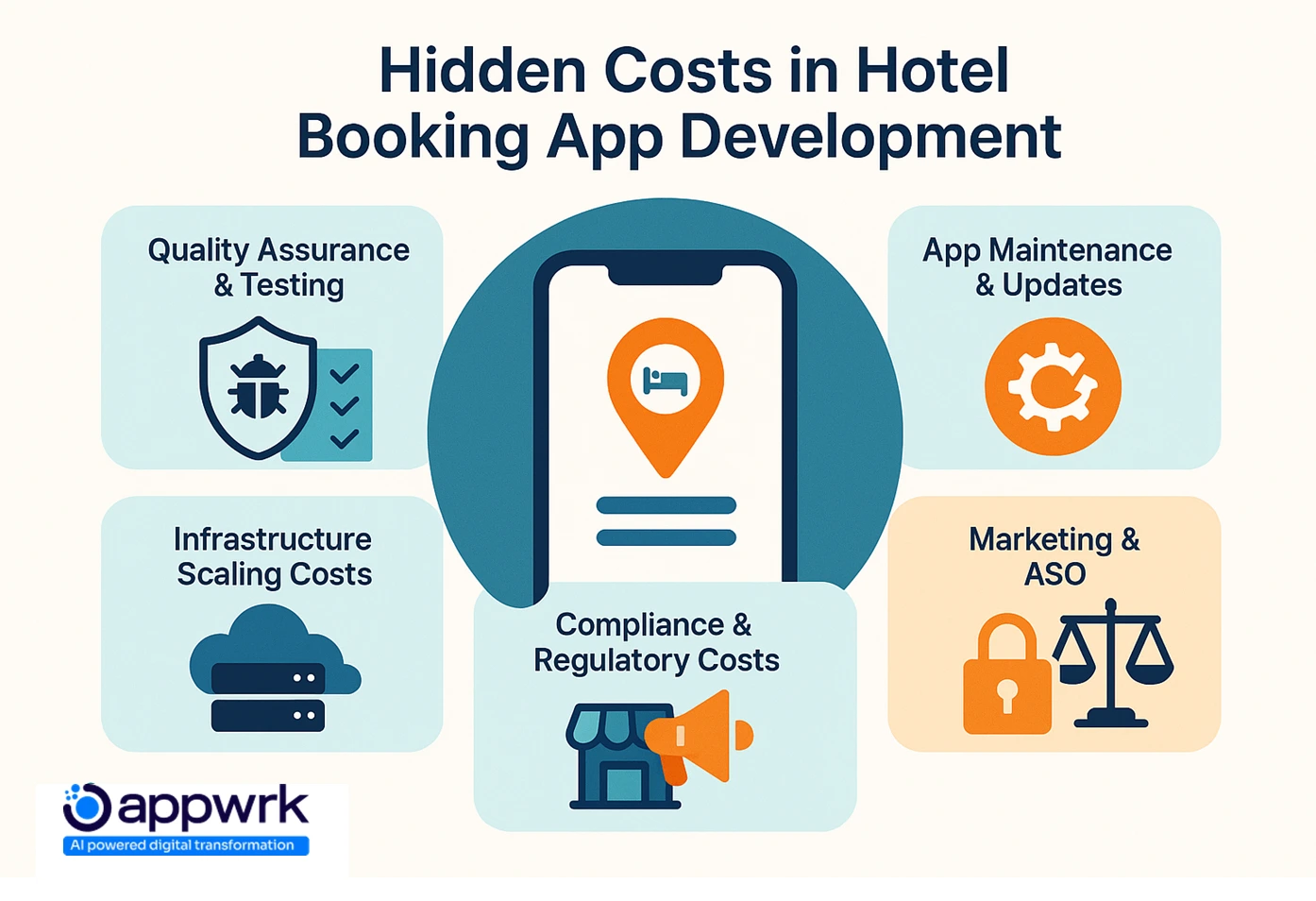
When budgeting for a hotel booking application, most businesses focus only on the upfront build. What often gets missed are the hidden costs that appear during development and after launch. These can add 15–30% to your total spend if not planned in advance. Below are the most common hidden costs you should factor into your hotel application development strategy.
Quality Assurance and Testing
One of the most underestimated drivers of cost in hotel booking mobile app development is quality assurance (QA). QA makes sure your app is secure, bug-free, and performs well under real travel booking conditions. Without it, your online hotel booking application risks errors like failed payments, booking mismatches, or crashes, all of which hurt credibility.
Performance testing (handling high booking volumes during peak travel seasons).
Security testing (compliance with PCI DSS, GDPR, and local data laws).
Usability testing (navigation, user experience, and design clarity).
On average, QA accounts for 15–20% of the total cost of hotel booking software. While it adds upfront expense, it prevents expensive rework post-launch.
App Maintenance and Updates
A hotel reservation app is never truly “done.” Maintenance ensures your app keeps up with new iOS/Android updates, smartphones, and user expectations.
Ongoing updates include:
Bug fixes and backend development improvements.
Adding new modules like loyalty programs, booking calendar upgrades, or AI-based recommendations.
Ensuring compatibility with third-party services like Stripe or Google Maps.
Adding advanced features can cost $3,000–$10,000 each. As a rule of thumb, plan for 15–20% of the original development cost annually. Apps that skip maintenance quickly become outdated and lose bookings.
Marketing and App Store Optimization (ASO)
Building your hotel booking mobile app is only half the challenge. Getting users to find it is the other. App Store Optimization (ASO) ensures your app ranks high on the Google Play Store and Apple App Store for search terms like “hotel booking app” or “hotel reservation app.”
ASO involves:
Keyword-rich app descriptions.
High-quality screenshots and video previews.
Positive customer reviews.
Regular updates to match market scenario changes.
ASO setup costs $1,500–$3,500, with ongoing optimization extra. Marketing campaigns such as Google Ads, social media, or influencer partnerships may cost $2,000–$10,000 per campaign. Skipping this stage means your app risks invisibility, no matter how polished it is.
Infrastructure Scaling Costs
As your travel app gains users, your infrastructure bills grow too. Hosting on AWS, Azure, or Google Cloud starts at $100–$300 per month. Once your app supports property listings for vacation rentals, multi-property booking management, or global audiences, costs may rise to $500–$2,000 per month.
Additional scaling requirements include:
Load balancing for traffic spikes.
Caching systems and CDNs for faster response times.
Database scaling (PostgreSQL, external databases) to handle real-time inventory.
Initial scaling setups may require a one-time investment of $2,000–$6,000. If overlooked, these can become surprise expenses once the app gains traction.
Compliance and Regulatory Costs
Compliance is a critical but often forgotten hidden cost in hotel application development. Since hotel booking software processes payments and personal guest data, compliance is mandatory.
Typical compliance costs:
PCI DSS certification for secure transactions ($1,500–$4,000).
GDPR audits if you target European travelers ($2,000–$5,000 annually).
Local laws for taxes, Travel Insurance, and digitalization standards.
Failing compliance can lead to fines, legal issues, or damage to your brand. Building compliance into your hotel booking mobile app development plan protects long-term ROI.
What Features Make or Break a Hotel Booking App?
The features you include in your hotel booking application will determine whether it succeeds in today’s competitive travel market. They impact user adoption, development cost, and long-term ROI. Below, we’ll cover the must-have features, advanced features, and future-ready innovations that set a strong hotel reservation app apart from an average one.
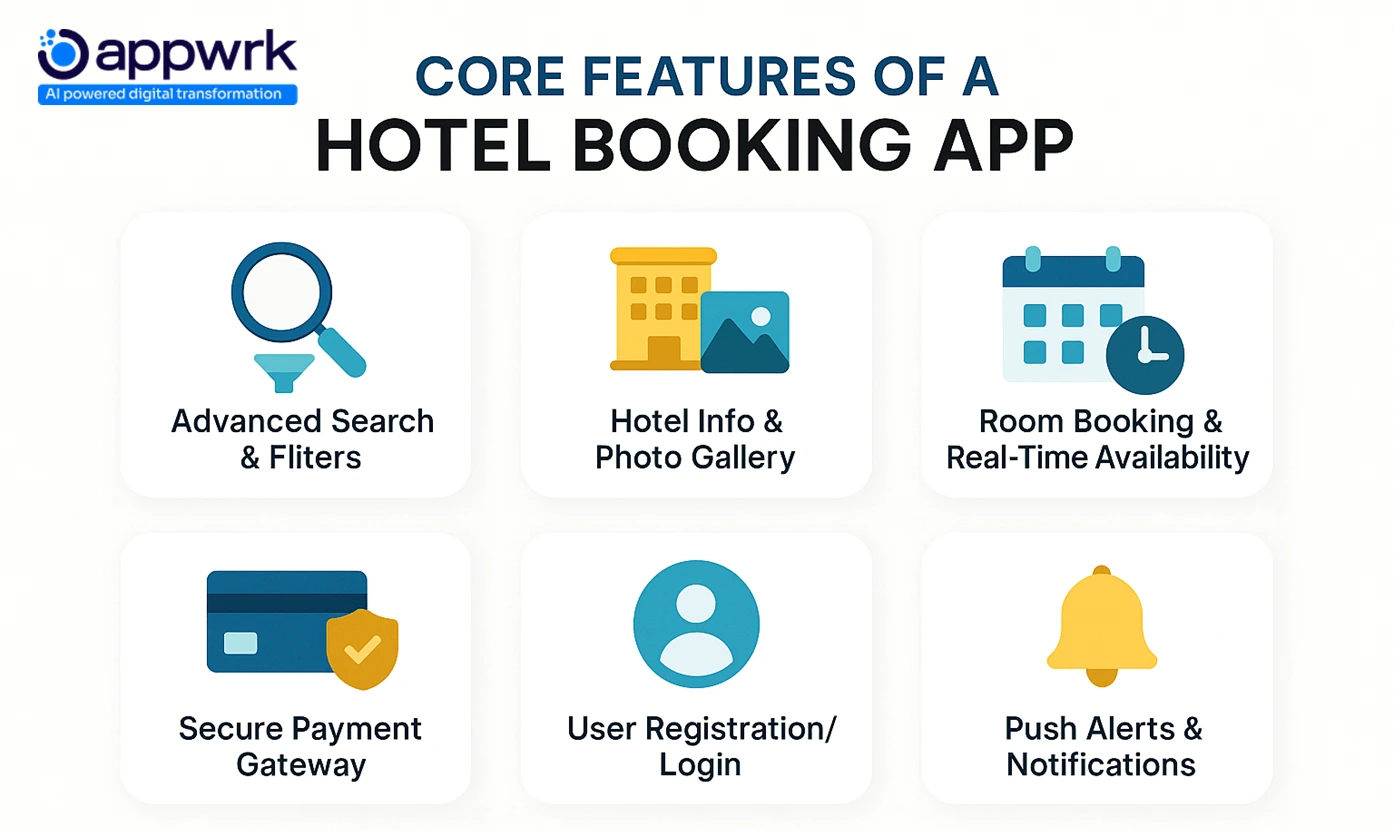
Core Features Every Hotel Booking App Must Include
Without these essentials, an online hotel booking application risks frustrating users and losing trust. These are the baseline features travelers expect from modern hotel booking software.
Advanced Search and Filter Options
A hotel booking mobile app is only as good as its search. Filters should allow guests to sort by price, hotel ratings, amenities, and location near landmarks.
Keeps the navigation simple and the booking journey intuitive.
Builds trust by showing only relevant results.
Prevents drop-offs caused by too many irrelevant property listings.
Hotel Information and Photo Gallery
Transparency is critical in the travel app industry. Detailed property listings with photos, amenities, and maps help users make confident decisions.
Increases credibility through visuals.
Reduces cancellations by aligning expectations with reality.
Encourages direct bookings by showcasing hotels in detail.
Room Booking and Real-Time Availability
Integration with booking engines and PMS ensures your app only shows what’s actually available.
Eliminates double-booking risks.
Improves customer reviews by meeting expectations.
Opens up selling opportunities for add-ons like meals or spa packages.
Secure Payment Gateway
Guests expect seamless, secure payment methods. Your app should integrate multiple options like Stripe, PayPal, cards, and wallets.
Strengthens trust in transactions.
Supports multi-currency payments for international travelers.
Enhances user experience with stored payment preferences.
User Registration and Login
Profiles enable personalization and loyalty-building.
Quick onboarding via email, mobile application, or social accounts.
Saves past bookings, payment details, and preferences.
Provides data for backend development and optimization.
Reviews and Ratings
No traveler books without reading user reviews first.
Adds credibility through peer validation.
Helps hotels improve services.
Increases engagement inside the travel booking app.
Push Alerts and Notifications
A simple but effective engagement tool.
Keeps your hotel booking app top of mind with reminders.
Drives last-minute bookings.
Enhances communication between the brand and traveler.
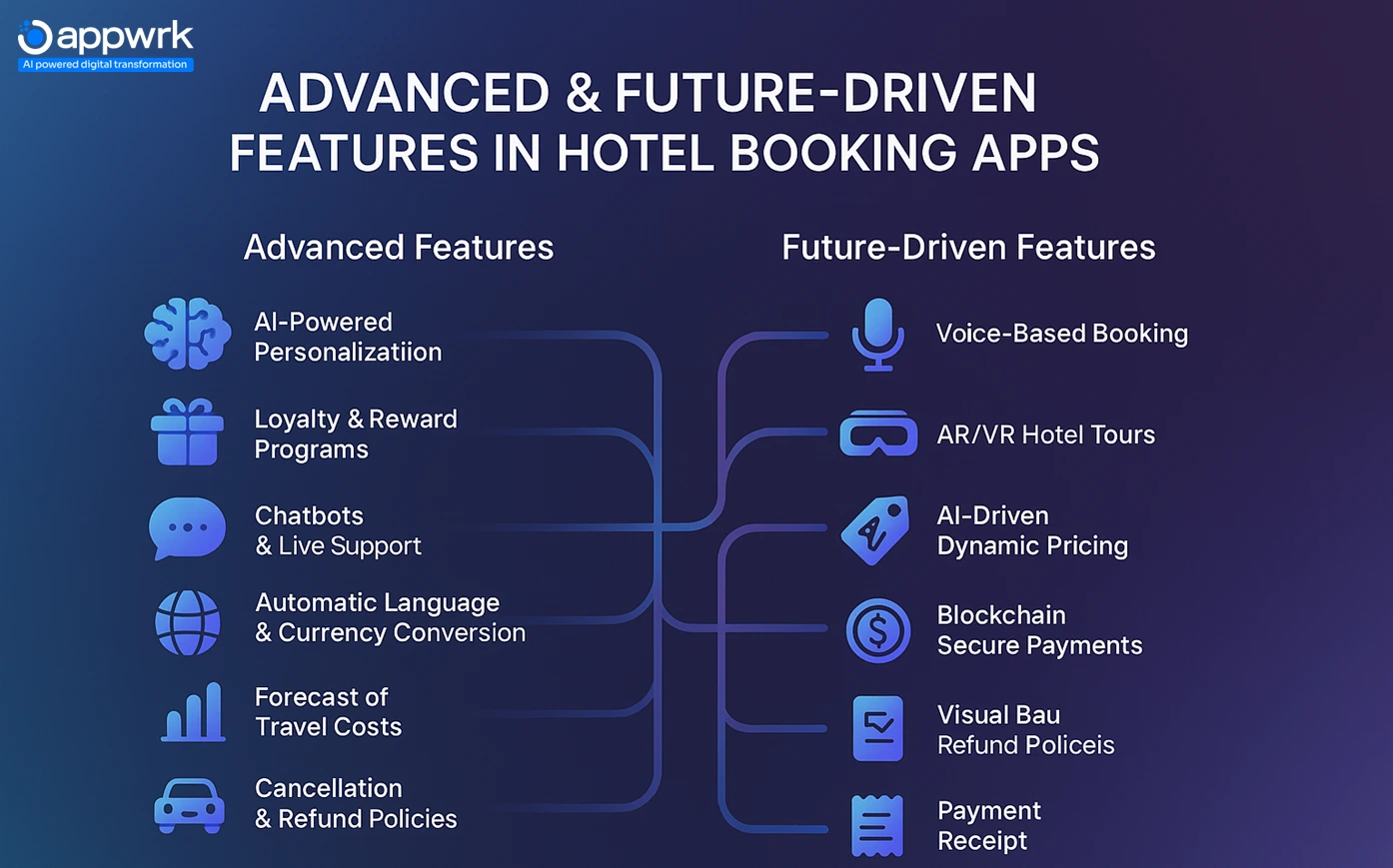
Advanced Features That Drive Higher Engagement
Once the basics are in place, advanced features make your hotel booking mobile app more competitive and profitable.
AI-Powered Personalization
AI-based recommendations analyze browsing and booking history to suggest tailored stays.
Improves conversions.
Increases satisfaction with personalized travel experiences.
Differentiates your app in the eTravel industry.
Loyalty and Reward Programs
A loyalty program integrated into your hotel CRM builds retention.
Encourages repeat travel booking.
Boosts premium upsells.
Strengthens long-term brand loyalty.
Smart Customer Support
Instead of overusing chatbots, combine automated responses with live support.
Provides 24/7 assistance.
Cuts down response delays.
Builds customer confidence in your booking management system.
Transform your app into a complete travel companion.
Adds convenience.
Improves app stickiness.
Opens new revenue models.
Digital Payment Receipt
Every booking should include an auto-generated receipt.
Confirms successful transactions.
Helps track expenses for business trips.
Boosts trust with documented payments.
Future-Driven Features That Differentiate Your App
Hotel application development is evolving fast, and forward-thinking businesses are already adopting next-gen features.
Voice-Based Booking
Integration with smart devices and smartphones allows hands-free booking through Alexa or Siri.
AR/VR Tours
Virtual tours of rooms, restaurants, or vacation rentals improve property listings and drive higher bookings.
AI-Driven Dynamic Pricing
Adjusts rates automatically based on demand, season, and real-time inventory.
Blockchain-Powered Payments
Adds transparency, reduces fraud, and secures high-value transactions.
What Is the Step-by-Step Process to Develop a Hotel Booking App?
The hotel booking application development process isn’t just about coding; it’s about creating a platform that meets business goals, delivers a smooth user experience, and matches industry standards. Here’s a clear, step-by-step breakdown.
Gathering Project Details
Everything starts with understanding your business needs. Project managers and analysts define the app’s purpose, core features, and target audience. This stage often includes competitor and market research, scope definition, and early cost estimates. It ensures your hotel booking software has a clear direction before development begins.
User Experience: UI/UX Design
Design is where ideas take shape. Wireframes and prototypes are built to map the booking journey, from the search screen to the booking form and confirmation page. Visual identity, branding, and navigation elements are also finalized. A well-thought-out design makes your hotel reservation app intuitive, user-friendly, and conversion-focused.
Development Process
The real build begins here.
Frontend development covers what users see: screens, navigation, and communication flows.
Backend development powers booking engines, databases (such as PostgreSQL), and integration with external services.
APIs are integrated for payment methods (Stripe, PayPal), maps (Google Maps, location-based services), and third-party services like CRM or customer support.
This stage is the backbone of any hotel booking mobile app development project.
Quality Assurance (QA)
Before going live, your app undergoes rigorous testing. QA teams check functional flows (search, booking, payment), performance under heavy traffic, and compliance with PCI DSS and GDPR. Testing ensures the online hotel booking application runs without errors and provides a smooth user experience. QA can take up 15–20% of total development costs but saves far more by preventing post-launch issues.
Product Release
Once the app passes QA, it’s prepared for release on the Apple App Store and Google Play Store. This stage includes App Store Optimization (ASO), compliance checks, and often a soft launch to gather real user feedback before a full-scale rollout. A successful launch is where the hotel application development process meets the market.
App Support and Updates
Post-launch is where long-term success is built. Regular maintenance keeps the app secure, while feature rollouts (like loyalty programs or AI-based recommendations) ensure it remains competitive. Businesses should budget 15–20% of the initial development cost annually for updates, bug fixes, and new features. Without consistent investment, even the best hotel mobile apps can quickly become outdated.
What Proven Strategies Can Reduce the Cost of Hotel Booking App Development?
Building a hotel booking application can get expensive, but the right planning choices help you keep costs under control without sacrificing performance. Here are proven ways hotels, startups, and travel providers can optimize their budget and still deliver a high-quality product.
MVP Strategy
Launching with a Minimum Viable Product (MVP) is one of the smartest ways to save money. An MVP hotel booking app focuses only on the essentials: search, hotel listings, booking form, and payment integration. This allows you to validate your idea, test user response, and identify what features really matter. Later, advanced modules like loyalty programs, AI-based recommendations, or property collections can be added once there’s real demand.
Choose Cross-Platform Development
With hotel mobile app development, you don’t always need separate apps for iOS and Android. Frameworks like Flutter and React Native let you build a single codebase that runs on both platforms. This reduces development time by 25–30%, lowers QA effort across screens, and ensures a consistent user experience on smartphones. Cross-platform hotel booking software is especially useful for startups and boutique hotels working with lean budgets.
Outsourcing and Offshore Teams
Outsourcing is a proven way to reduce hotel application development costs. Offshore teams, particularly in Asia-Pacific, deliver skilled hotel booking app developers at significantly lower hourly rates compared to the US or Western Europe. This approach can cut costs by up to 40% while still ensuring quality, especially if combined with strong project management and clear communication frameworks. For many hotels and travel booking platforms, offshore outsourcing provides the right balance of affordability and expertise.
Leverage Pre-Built APIs and Modules
Instead of reinventing the wheel, you can integrate ready-made third-party services. Payment modules like Stripe, navigation via Google Maps, or analytics through Google Analytics are all reliable, secure, and cost-effective. Using pre-tested modules saves thousands in backend development and shortens the QA cycle. For example, embedding a proven booking engine or database integration (like PostgreSQL) helps speed up launch without compromising on stability.
Scalable Development Approach
Cost isn’t just about launch, it’s about future-proofing. Adopting an Agile and scalable development model ensures you build in phases, which keeps budgets predictable and avoids unnecessary features. A scalable backend architecture allows your hotel reservation app to grow with real-time inventory, booking management, and revenue models without needing expensive rebuilds later. This approach is especially valuable for hotel booking mobile app development targeting long-term growth in the eTravel industry.
What Proven Strategies Can Reduce the Cost of Hotel Booking App Development?
Building a hotel booking application can get expensive, but the right planning choices help you keep costs under control without sacrificing performance. Here are proven ways hotels, startups, and travel providers can optimize their budget and still deliver a high-quality product.
MVP Strategy
Launching with a Minimum Viable Product (MVP) is one of the smartest ways to save money. An MVP hotel booking app focuses only on the essentials: search, hotel listings, booking form, and payment integration. This allows you to validate your idea, test user response, and identify what features really matter. Later, advanced modules like loyalty programs, AI-based recommendations, or property collections can be added once there’s real demand.
Choose Cross-Platform Development
With hotel mobile app development, you don’t always need separate apps for iOS and Android. Frameworks like Flutter and React Native let you build a single codebase that runs on both platforms. This reduces development time by 25–30%, lowers QA effort across screens, and ensures a consistent user experience on smartphones. Cross-platform hotel booking software is especially useful for startups and boutique hotels working with lean budgets.
Outsourcing and Offshore Teams
Outsourcing is a proven way to reduce hotel application development costs. Offshore teams, particularly in Asia-Pacific, deliver skilled hotel booking app developers at significantly lower hourly rates compared to the US or Western Europe. This approach can cut costs by up to 40% while still ensuring quality, especially if combined with strong project management and clear communication frameworks. For many hotels and travel booking platforms, offshore outsourcing provides the right balance of affordability and expertise.
Leverage Pre-Built APIs and Modules
Instead of reinventing the wheel, you can integrate ready-made third-party services. Payment modules like Stripe, navigation via Google Maps, or analytics through Google Analytics are all reliable, secure, and cost-effective. Using pre-tested modules saves thousands in backend development and shortens the QA cycle. For example, embedding a proven booking engine or database integration (like PostgreSQL) helps speed up launch without compromising on stability.
Scalable Development Approach
Cost isn’t just about launch, it’s about future-proofing. Adopting an Agile and scalable development model ensures you build in phases, which keeps budgets predictable and avoids unnecessary features. A scalable backend architecture allows your hotel reservation app to grow with real-time inventory, booking management, and revenue models without needing expensive rebuilds later. This approach is especially valuable for hotel booking mobile app development targeting long-term growth in the eTravel industry.
What Monetization Models Can Maximize the Profitability of Hotel Booking Apps?
A hotel booking application is not just a digital convenience for travelers; it’s a business engine. Picking the right monetization model ensures that your investment in hotel app development turns into sustainable revenue. Below are the most effective strategies used in the travel app ecosystem.
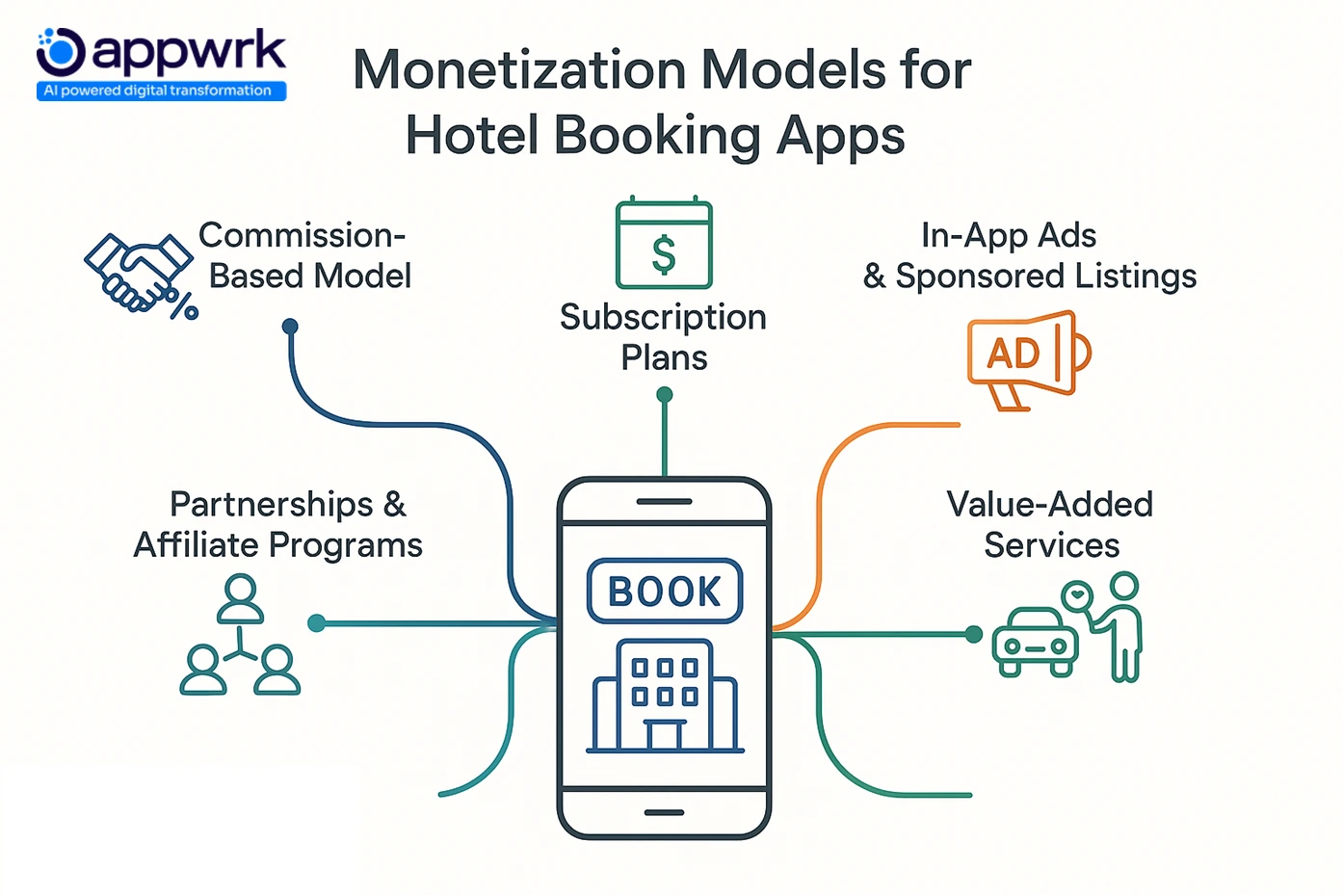
Commission-Based Model
The most widely used monetization strategy is commission-based revenue. The app earns a percentage from every confirmed booking. This works best for hotel consolidator platforms and OTA-style online hotel booking applications, where hotels get visibility without upfront costs and the app owner benefits from a steady, scalable income stream.
Subscription Plans for Hotels and Users
Some hotel booking software adopts a subscription-driven model. Hotels pay a recurring fee to be listed and highlighted, while travelers can subscribe for premium perks such as early access to discounts, waived service fees, or exclusive deals. This creates predictable cash flow and is ideal for apps that aim to retain loyal repeat users.
In-App Ads and Sponsored Listings
Once a hotel reservation app builds a large audience, in-app advertising and sponsored placements can become strong revenue streams. Hotels pay to rank higher in search results, and third-party services like travel insurance or guided tours can also be promoted. The challenge is ensuring ads don’t interfere with the booking flow or harm the user experience.
Partnerships and Affiliate Programs
By partnering with airlines, car rental companies, or even vacation rentals, apps can generate affiliate income. Each referral or cross-sell adds to profitability while enhancing the traveler’s journey by offering complete travel booking packages. This model diversifies revenue and reduces dependency on one stream.
Value-Added Services (Car Rentals, Guided Tours)
Expanding beyond hotel stays, many hotel mobile apps increase engagement by offering add-ons like airport transfers, restaurant reservations, or guided tours. These services turn a simple booking engine into a full travel companion. Value-added offerings not only bring in extra revenue but also improve retention by delivering richer travel experiences.
How Do You Connect Development Costs to Real Business ROI?
When budgeting for hotel booking mobile app development, the real question isn’t just “how much will it cost?” but “what business returns can I expect?” ROI comes from increased direct bookings, reduced OTA dependency, stronger loyalty, and operational savings. Here’s how ROI links directly to your development spend.
ROI Benchmarks from Small to Enterprise Apps
Basic MVP apps (~$8,000): ROI mainly comes from reducing OTA reliance and saving on commissions.
Mid-tier apps ($15,000–$35,000): ROI comes from repeat bookings, loyalty modules, and stronger traveler engagement.
Enterprise-level apps ($35,000–$90,000): ROI scales through international reach, multi-property management, and multiple revenue models.
Hotel application development with built-in loyalty rewards, push notifications, and AI-based recommendations leads to higher retention. Repeat customers spend more and book more often, which increases customer lifetime value (CLV). ROI is measured through repeat booking percentages, app usage frequency, and total revenue per traveler.
Long-Term Cost Savings from Automation
ROI isn’t only about revenue growth; it’s also about efficiency. A well-structured backend reduces repetitive tasks for hotel staff by automating booking management, cancellations, and real-time inventory updates. These savings compound over time, lowering staffing costs and ensuring operations run smoothly across screens, devices, and properties.
How Are Businesses Using Hotel Booking Apps Successfully?
The applications of a hotel booking application go well beyond basic reservations. From independent properties to B2B travel agencies, businesses are finding innovative ways to use apps for boosting revenue, loyalty, and operational efficiency. Below are real-world use cases that showcase how different business models benefit from hotel app development.
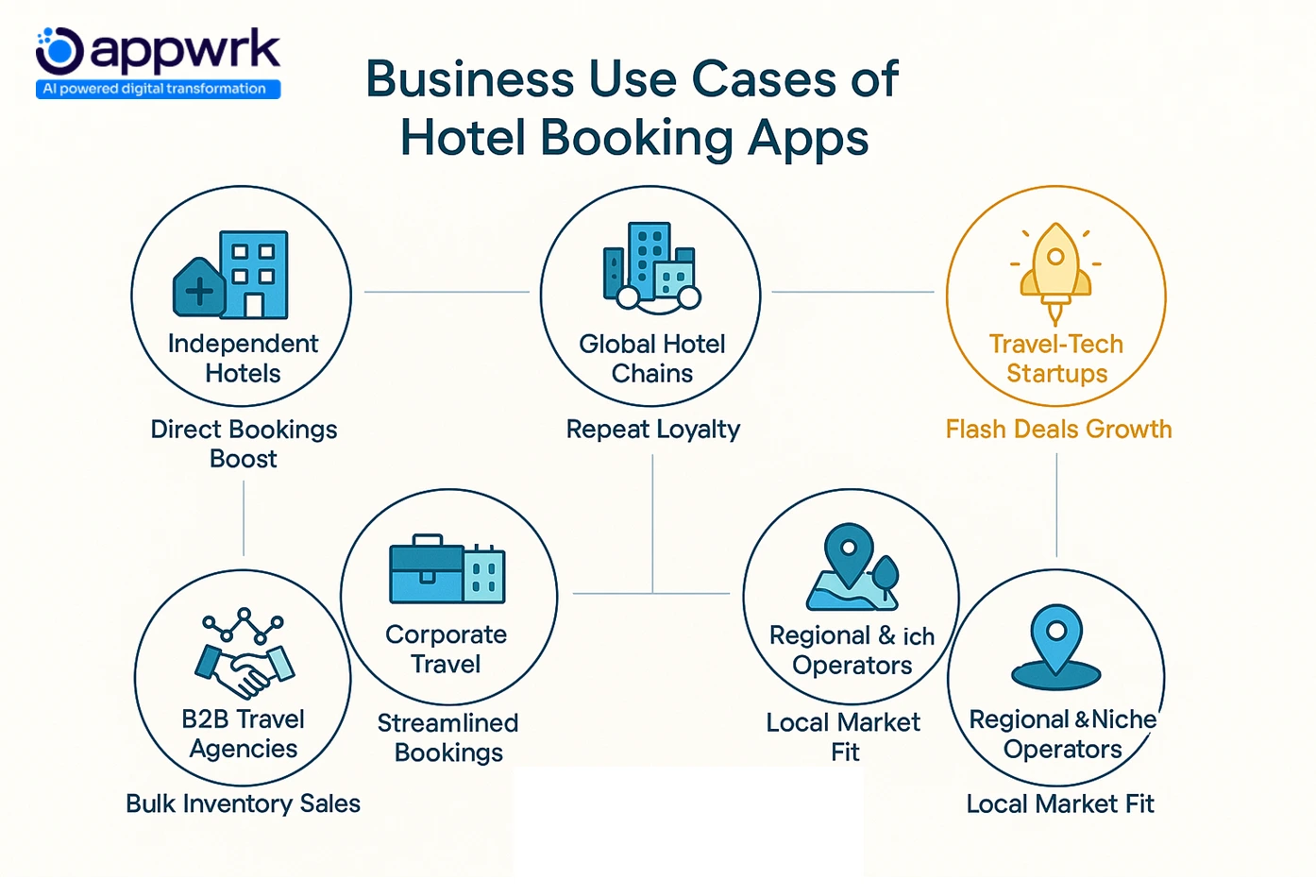
Use Case for Independent Hotels
Independent hotels often struggle against global chains and OTAs. A hotel reservation app gives them a direct booking channel to attract guests, showcase seasonal offers, and build loyalty programs without paying heavy OTA commissions.
Mini Case Study: A boutique property worked with Appwrk to launch a direct booking app featuring referral rewards and loyalty discounts. Within six months, they saw a 28% increase in direct bookings.
Use Case for Global Hotel Chains
For larger chains, hotel booking software allows all properties to be managed within one ecosystem. Features like unified loyalty programs, upselling across locations, and corporate booking support drive both revenue and convenience.
Mini Case Study: Appwrk delivered a multi-property hotel booking mobile app development solution for a regional chain. With AI-based recommendations and tiered rewards, repeat stays rose by 35%.
Use Case for Startups in the Travel-Tech Sector
Travel-tech startups are reimagining how people book stays. From last-minute deals to curated experiences, these online hotel booking applications create new monetization models using commissions, ads, and partnerships.
Mini Case Study: A European startup launched a last-minute travel app with flash-sale notifications. Within three months, the platform had 15,000 users and became popular among business travelers.
Use Case for Corporate Travel Management
B2B-focused hotel booking applications help corporations streamline travel. Centralized dashboards, automated expense tracking, and approval workflows save time and reduce errors.
Mini Case Study: A consulting firm’s custom hotel application developmentproject with Appwrk cut booking errors by 40% and simplified reimbursement with built-in expense tracking.
Use Case for Luxury Resorts
Luxury resorts use hotel mobile apps to offer premium digital experiences like virtual tours and concierge services. Features such as AR/VR previews and AI-powered personalization meet high guest expectations.
Mini Case Study: A Caribbean resort developed a high-end booking app with immersive VR room tours and custom upgrade suggestions. Premium suite bookings rose by 25%.
Use Case for B2B Travel Agencies
Travel agencies managing bulk or corporate bookings benefit from hotel booking applications with reservation management, custom dashboards, and negotiated rate modules.
Mini Case Study: A B2B agency in Asia worked with Appwrk to build a corporate-friendly app that included expense reporting and faster booking cycles, improving efficiency by 20%.
Use Case for Regional and Niche Travel Operators
Smaller travel operators focusing on eco-tourism, backpacker stays, or adventure travel use booking apps to reach niche audiences. These often leverage location-based services, curated itineraries, and flexible booking modules.
Mini Case Study: An eco-tourism operator built a mobile-first app with Appwrk, showcasing eco-lodges and offbeat homestays. They achieved a 30% boost in bookings from younger travelers seeking authentic travel experiences.
Case Study: What Can We Learn From a Successful Hotel Booking App Development Journey?
Case studies are the best way to see how careful planning and the right technology deliver results. Here’s a look at how Appwrk adapted its AI receptionist deployment into a model that could just as easily guide hotel app development for a modern booking experience.
Client Background and Challenges
The client ran a high-volume reception desk handling bookings, calls, and guest inquiries around the clock. The main pain points were staff shortages, inconsistent service quality, and rising operational costs. These challenges mirror what hotels face when relying only on front-desk staff without a dedicated hotel booking application.
Appwrk’s Solution Approach
Appwrk introduced an AI-driven reception and booking assistant that managed calls, scheduled appointments, and engaged with guests in real time. For hotels, this translates into a hotel booking mobile app development approach where reservations, room availability checks, and guest communications are automated and available 24/7.
Features Implemented
Voice-based booking and inquiry handling
Always-on support with human escalation when needed
Multi-language assistance for diverse guest groups
Real-time integration with scheduling and property systems
Each of these features can be mapped to a hotel reservation app or hotel booking software, enabling hotels to offer frictionless reservations, multilingual guest support, and instant confirmations.
Development Timeline & Budget Range
Timeline: 12 weeks from kickoff to deployment
Budget Range: $60,000–$80,000, covering AI modules, system integrations, and staff onboarding
This is in line with enterprise-level hotel application development, where investment goes toward scalable infrastructure and premium features that enhance both guest experience and operational efficiency.
Outcome and Measurable Results
The AI solution resolved 90% of inquiries without human intervention, reduced staffing costs, and boosted booking efficiency. Guests especially valued the voice-enabled assistant that worked outside standard hours, a critical advantage for hotels serving global travelers across different time zones.
Why This Case Matters for Hotel Booking Apps
Even though the project wasn’t a hotel-specific app, it highlights the potential of hotel booking applications built with automation, AI, and real-time systems. Hotels that adopt similar solutions can expect:
Higher direct bookings with 24/7 availability
Lower reliance on staff for routine queries
Better guest trust through consistent, multilingual support
This case proves how a strategic, scalable build in hotel mobile app development can deliver measurable ROI, combining customer satisfaction with long-term cost savings.
What Emerging Trends Will Shape the Future of Hotel Booking Apps?
The future of hotel app development is being shaped by AI, immersive tech, and mobile-first booking experiences. Whether you’re an independent property, a hotel chain, or a travel-tech startup, adapting to these innovations is critical to stay competitive. Here are the trends transforming the next generation of hotel booking applications.
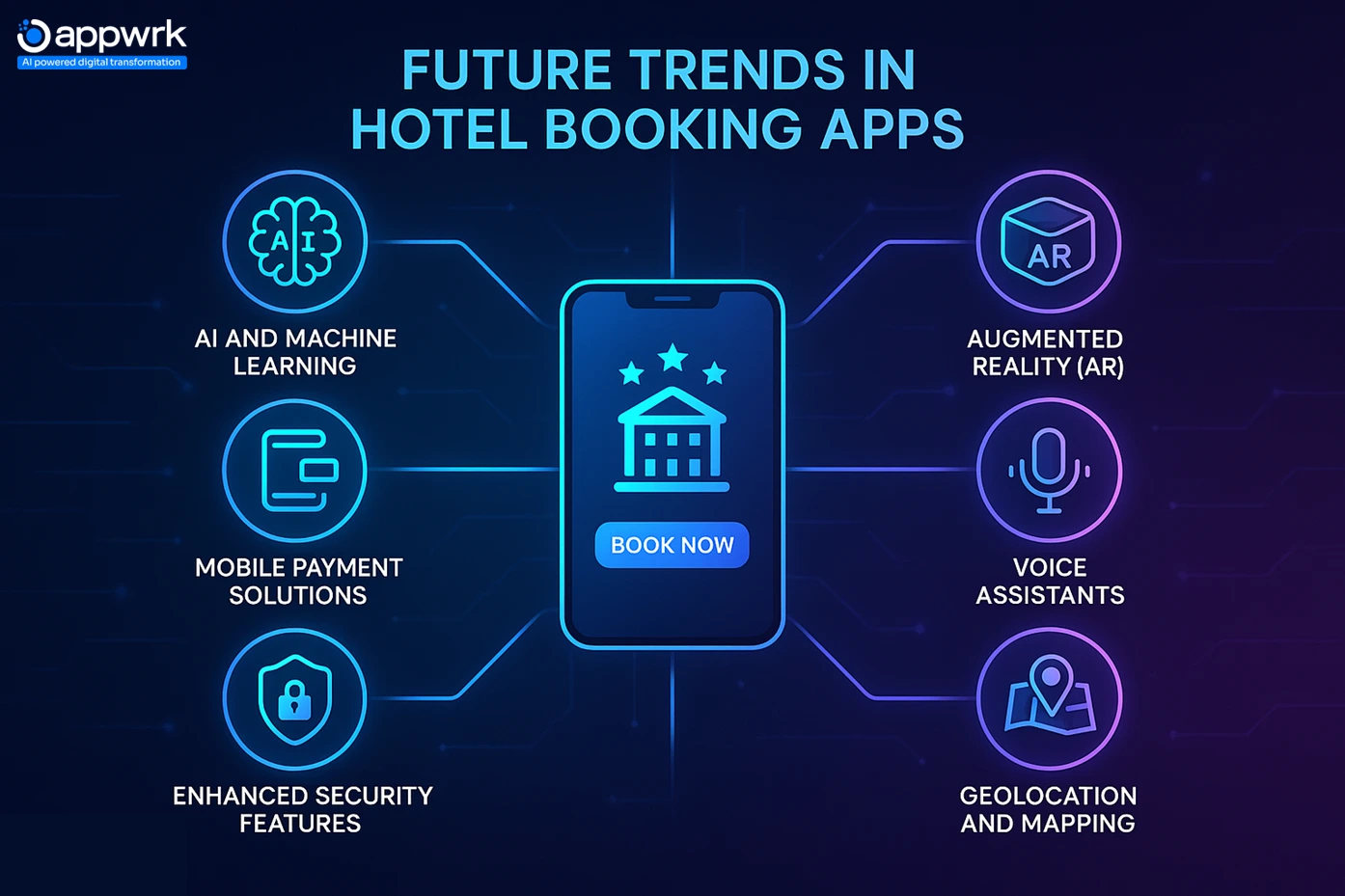
AI and Machine Learning
Artificial Intelligence is making hotel booking applications smarter than ever. By analyzing booking history, search patterns, and user preferences, AI can deliver personalized recommendations, AI-based recommendations for deals, and even predict demand with dynamic pricing. Machine learning also improves fraud detection and helps hotels reduce errors in booking management. For a hotel reservation app, this translates into higher profitability and better guest satisfaction.
Augmented Reality (AR)
AR is changing how guests evaluate properties before booking. With AR-enabled previews, travelers can explore rooms, lobbies, and amenities directly inside an online hotel booking application. This level of transparency reduces cancellations and builds trust. Resorts and luxury properties are already using AR walkthroughs to showcase value beyond photos on a website or OTA app.
Voice Assistants
Voice-enabled reservations are becoming a natural extension of hotel booking software. Guests increasingly expect to use assistants like Alexa or Siri to say, “Book me a room for tonight,” and receive instant results. Adding voice booking to a hotel booking mobile app development project enhances accessibility and speeds up the reservation process, particularly for busy or last-minute travelers.
Mobile Payment Solutions
Today’s travelers want frictionless payment experiences. Modern hotel booking apps now integrate Apple Pay, Google Pay, UPI, Stripe, and other gateways to support multiple payment methods and currencies. This not only caters to global travelers but also ensures secure, real-time transactions. For hotels, this simplifies booking software flows and boosts conversions by reducing checkout friction.
Enhanced Security Features
Security is non-negotiable in hotel application development. Future-ready apps are adopting biometric logins, two-factor authentication, and advanced encryption to protect user accounts, financial data, and compliance requirements such as PCI DSS and GDPR. These upgrades help build trust with travelers who rely on travel booking apps for sensitive transactions.
Geolocation and Mapping
Geolocation is no longer just about showing where a property is. Advanced hotel booking mobile app development integrates Google Maps and location-based services to recommend nearby stays, restaurants, or attractions. This enhances the user experience, making apps more like travel assistants than simple booking tools. For last-minute or on-the-go travelers using smartphones, this feature is becoming indispensable.
How Can Appwrk Help You Build a Future-Ready Hotel Booking App?
Choosing the right development partner is just as crucial as deciding on features, budget, or platforms. Appwrk combines technical depth, domain expertise, and a proven delivery model to make hotel app development efficient, cost-effective, and scalable. Here’s why businesses trust us for their hotel booking application projects.
Appwrk’s expertise and proven track record
Appwrk has built scalable booking and scheduling solutions across industries, with a strong focus on hotel booking app development. Our team has worked on everything from lightweight MVPs for startups testing an idea to enterprise-grade hotel booking software for global chains. Each project comes with measurable ROI, real-world case studies, and consistently high client satisfaction scores. Whether it’s a hotel reservation app for independent properties or a feature-rich online hotel booking application for chains, our expertise ensures performance and reliability.
We understand that every hotel or travel business has unique needs. That’s why Appwrk offers flexible engagement models, such as dedicated developer teams, time-and-material contracts, and fixed-cost delivery. These models give you the freedom to choose what works best for your timelines and budget while ensuring your hotel application development stays efficient and high-quality.
Retention metrics and success rate
High client retention and consistent delivery success define our track record. Unlike vendors who only ship code, Appwrk focuses on building hotel mobile apps that grow with your business. Our solutions are designed to evolve with changing traveler behaviors, ensuring your app doesn’t just launch but thrives. By blending strong UX, optimized Booking Engine integration, and scalability, we make sure your investment in hotel booking mobile app development delivers long-term ROI.
FAQs
How much does it cost to develop a booking app?
The cost of developing a hotel booking application starts at around $8,000 for a basic MVP with essential features such as search, booking, and payments. For mid-tier apps that include loyalty programs or AI personalization, costs typically range between $15,000 and $35,000. Enterprise-grade platforms with multi-property support, APIs, and advanced hotel booking software integrations can exceed $80,000.
If you’re exploring the most cost-efficient way to build an online hotel booking application, Appwrk’s consultants can provide tailored estimates and strategies based on your goals.
How much does a hotel app cost?
On average, a hotel reservation app costs between $8,000 and $35,000, depending on design, complexity, and development approach. Factors like custom UI/UX, backend scalability, and cross-platform hotel mobile app development directly affect the total budget.
How much does app development cost?
App development costs vary widely based on type and scale. Simple mobile applications can start around $8,000–$12,000, while feature-rich apps like hotel booking mobile app development projects range from $20,000 to $50,000. Enterprise solutions often exceed $80,000 when advanced features and integrations are required.
How much does a hotel reservation system cost?
A hotel booking system integrated into an app typically costs between $10,000 and $40,000. This includes modules for booking calendars, dynamic pricing, loyalty features, and third-party services like PMS or channel managers.
How long does it take to develop a hotel booking app?
Timelines depend on scope:
MVP builds: 10–12 weeks
Mid-tier apps: 16–20 weeks
Enterprise-grade platforms: 6 months or more
Well-structured hotel application development ensures faster delivery while maintaining scalability.
What is the average cost of building a hotel booking app?
The average cost to build a hotel booking application ranges from $15,000–$35,000. This estimate usually includes design, backend development, API integrations, QA, and publishing to the Google Play Store and Apple App Store.
Which features impact hotel booking app development cost the most?
These features increase complexity but also drive ROI and adoption.
Can I start with an MVP version?
Yes. Many businesses use an MVP Strategy to launch a lean version of their hotel booking mobile app development project for $8,000–$12,000. This allows market validation before scaling with a Scalable Development Approach.
How do you monetize hotel booking apps?
Monetization models include:
Commission-based bookings
Subscriptions for hotels or premium users
In-app ads and sponsored placements
Affiliate partnerships with airlines or tours
Add-ons like rentals and experiences
Each hotel booking app development model can be tailored to maximize revenue.
What is the difference between basic, mid, and enterprise apps?
Basic Apps (MVP): Core booking and payments ($8,000–$12,000)
Mid-Tier Apps: Loyalty, AI personalization, analytics ($15,000–$35,000)
Enterprise Apps: Multi-property, global scalability, AR/VR ($50,000–$90,000+)
Which region offers the most cost-efficient hotel booking app development?
The Asia-Pacific region is the most cost-efficient for hotel booking app development, with skilled developers charging $25–$50/hour. In contrast, North America and Western Europe average $100–$180/hour. Many businesses combine offshore developers with local project management to balance quality and cost.
Gourav Khanna is the Co-founder and CEO of APPWRK, leading the company’s vision to deliver AI-first, scalable digital solutions for enterprises and high-growth startups. With over 16 years of leadership in technology, he is known for driving digital transformation strategies that connect business ambition with outcome-focused execution across healthcare, retail, logistics, and enterprise operations.
Recognized as a strategic industry voice, Gourav brings deep expertise in product strategy, AI adoption, and platform engineering. Through his insights, he helps decision-makers prioritize market traction, operational efficiency, and long-term ROI while building resilient, user-centric digital systems.
Subscribe to APPWRK Blogs, We'll Do the Rest!
Get Blogs on UI/UX, Mobile Apps, Online Marketing, and Web development technology.
Unlock worthy and priceless suggestions from the masters of mobile and web app development