150+ minds across 4 countries. Join a culture of innovation, ownership & growth.
Rewire for AI
From machine learning to deep learning, from classification tools to overall process automation – our AI engineers will help you retool your existing system or enhance your company results.
Ship faster, scale smarter, built for product companies and SaaS teams
Our Latest Work
We strive hard to deliver result-driven digital solutions across the globe. Check out our case studies to get a glimpse of how we ideate, innovate, and create unconventional digital solutions according to the requirements of our clients.
Discover diverse and passionate insights from our tech enthusiasts. We collaborate across various sectors to streamline operations and drive innovation. Explore our rapidly growing collection of articles to see why we’re at the forefront of IT solutions.
The decision to move from Magento to Shopify is one of the most significant replatforming choices an ecommerce business can make. Magento is powerful, but its power comes with...
Accuracy gap is real: Traditional CPG forecasting carries a 25-40% MAPE error rate. AI-powered models bring that down to 8-15%, according to McKinsey research....
Real stories from global leaders who trusted us with their ideas.
Partnering with APPWRK helped us build a compliant and scalable healthcare platform, accelerating our time-to-market by 35%. Their team consistently delivered outstanding work.
Beesers
Digital Healthcare Client
Collaborating with APPWRK, Sportskeeda modernized its platform into a real-time sports engagement ecosystem, enabling seamless content delivery, scalable fan interactions, and high-velocity performance.
Sportskeeda
Sports & Entertainment Partner
Working with APPWRK was effortless. They captured our vision, maintained full compliance, and delivered a digital experience that built trust and elevated how customers interact with our fintech brand.
PayPenny
Fintech Partner
Working with APPWRK gave us confidence in adopting AI responsibly. Their team built a safe, intelligent bot that transformed how we engage with leads and helped us achieve measurable revenue growth.
IFB
AI Transformation Partner
Leveraging APPWRK’s digital expertise, Nemesis launched a scalable, compliant, and safe super app that connects content delivery, real-time communication, and logistics management within a single platform.
The cost to develop hotel management software starts as low as $5,000 for a basic MVP (Minimum Viable Product). Most mid-scale builds range between $8,000 and $35,000, while even enterprise-level solutions can often be delivered under $70,000 with the right architecture and rollout strategy.
Development expenses can be managed effectively by choosing the right pricing approach, whether per room per month pricing, a pay-per-room model, or subscription-based pricing through SaaS platforms. Many hotels now prefer flexible tiered pricing models instead of paying large upfront licensing fees, since licensing vs subscription structures have very different cost implications.
Budget PMS (Property Management solutions) makes it possible for independent hotels, bed and breakfast operators, and vacation rentals to access automation affordably. On the other end, premium PMS platforms and fully cloud-native systems are becoming the go-to choice for boutique chains and global franchises that need multi-location support, centralized management, and seamless distribution channel connectivity.
Core modules such as reservations, front desk operations, billing, CRM, and analytics dashboards can be developed on a lean budget. However, advanced capabilities like GDS integration, mobile app access, or AI-powered guest journey mapping add both cost and measurable ROI.
Hidden costs are often overlooked, such as implementation costs, setup fees, compliance audits, staff training, and long-term maintenance. Factoring in these ensures hotels can plan better for their total economic impact and calculate a realistic payback period using an ROI calculator.
By working with an experienced partner like Appwrk, hotel businesses can reduce development and maintenance costs by 30 to 40% through workflow optimization, reusable components, and proven DevOps practices aligned with hospitality industry standards.
The hotel technology space is evolving quickly. The right investment today supports faster operations, better guest experiences, RevPAR optimization, and scalable growth, keeping properties competitive in the broader wave of hospitality technology trends and digital transformation.
Market Size and Growth Potential for Hotel Management Software
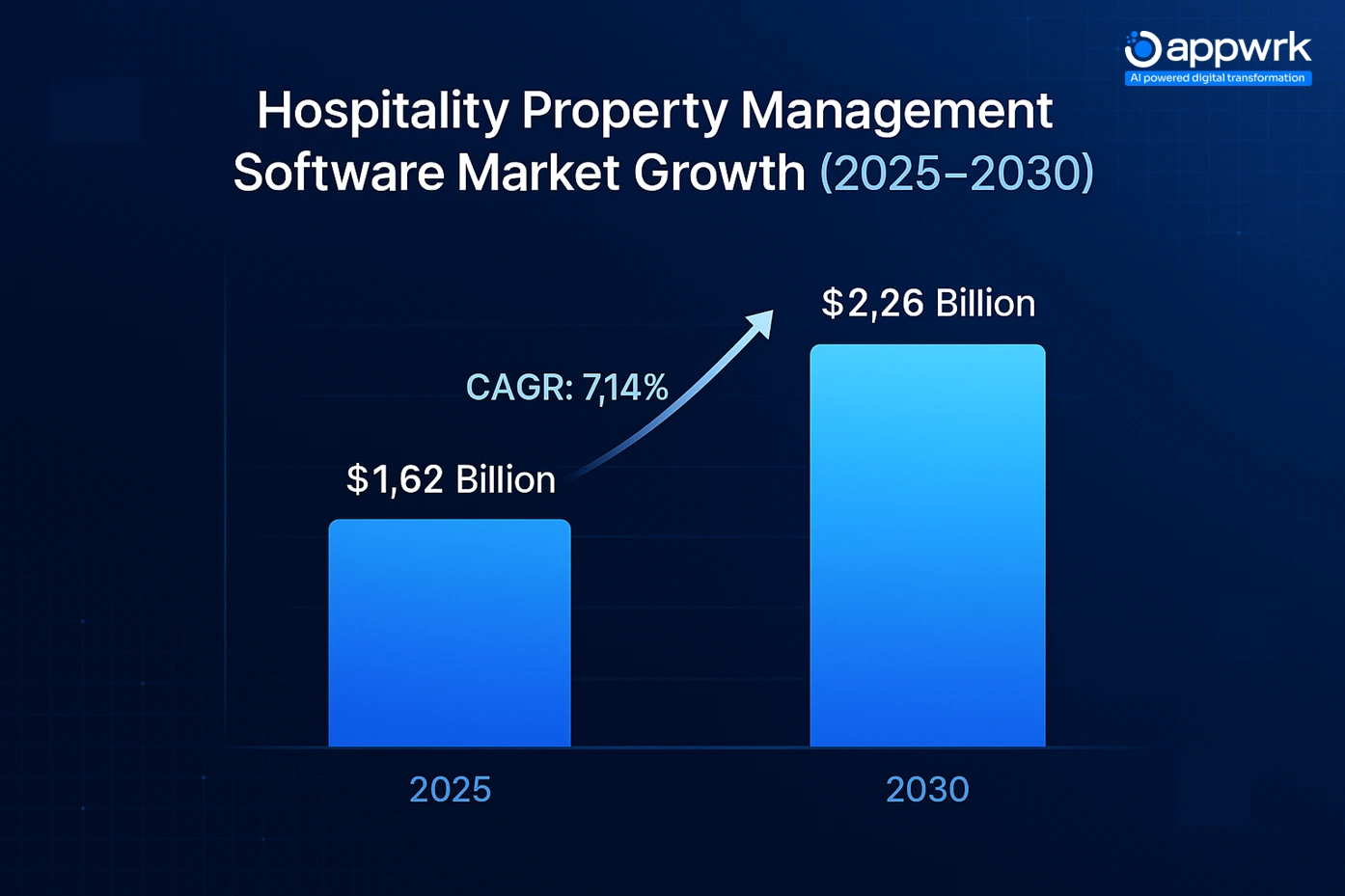
The Hospitality Property Management Software Market is witnessing rapid global adoption as hotels move toward digital-first operations. The market size is estimated at USD 1.62 billion in 2025, and is expected to reach USD 2.26 billion by 2030, at a CAGR of 7.14% during the forecast period (2025-2030).
Why This Growth Matters for Hotels And Hoteliers
Guests now expect seamless, self-service experiences: 71% of hotel guests are more likely to choose properties offering self-service technologies such as contactless check-in and digital room keys. This shift reflects how convenience and control have become baseline expectations, not premium perks. For operators, meeting this demand means implementing intuitive, reliable systems that guests adopt easily and repeatedly.
Digital efficiency translates to measurable ROI:82% of hospitality companies report improved operational efficiency through digital transformation. Streamlined workflows, reduced manual tasks, and faster service turnaround directly impact profitability. However, these gains only materialize when staff are fully enabled to use the tools, highlighting the need for structured adoption strategies.
Personalization drives loyalty and revenue: 70% of hotel brands leverage data analytics to personalize guest experiences, while 70% of guests say personalization significantly influences their loyalty. Whether through tailored offers, room preferences, or service recommendations, personalization builds emotional connections that encourage repeat bookings and increase upsell opportunities. Achieving this at scale depends on consistent, organization-wide adoption of CRM, analytics, and a personalization platform.
Scalability, remote access, reduced IT overhead, and real-time data analytics are primary adoption drivers.
AI and Automation Efficiency
AI-powered hotel tools are reported to achieve 20–30% cost savings by automating tasks like staff scheduling, dynamic pricing, energy management, predictive maintenance, and guest communication.
Centralized PMS solutions allow multi-property hotel chains to control rates, inventory, bookings, and staff across all locations in real time, supporting brand standards and streamlining reporting.
Benefits include: single logins for staff, standardized guest experiences, bulk procurement, group analytics, and quicker decision-making.
Risks of Delaying Digital Change
Failure to meet evolving guest expectations results in poor satisfaction scores and a tarnished reputation.
Lack of automation and real-time analytics leaves hotels exposed to higher labor costs and lost market share.
Inability to attract and retain skilled staff, as younger employees expect modern technology in their workplace.
Hotels with legacy, non-integrated systems are increasingly seen as outdated, while those embracing digital transformation achieve better loyalty, efficiency, and profitability.
What Is the Real Cost of Building Hotel Management Software in 2025?
If you’re asking “how much does hotel management software development cost in 2025?” The answer depends on functionality, rollout strategy, and platform choice.
Today, most custom hotel systems fall within a $5,000 to $70,000 range, depending on modules, user roles, and whether you build cloud-native systemsor rely on on-premise systems. The scope can vary from a single independent hotel to a franchise management setup with property portfolio management and multi-location support.
Unlike legacy providers that still rely on rigid on-premise systems, modern hotel platforms are modular, interoperable, and often delivered through subscription-based pricing models. This makes them easier to adopt for extended stay hotels, vacation rentals, and even boutique properties with tighter budgets.
Using agile development and scrum methodology, hotels can now launch an MVP in phases, significantly reducing upfront costs and improving scalability. This phased development approach also minimizes risk by allowing beta testing, user acceptance testing, and even performance testing before scaling into full enterprise-level solutions.
According to a hospitality pricing study by Grand View Research, adoption of cloud-native systems and guest engagement platforms is rising rapidly. Hotels are investing more in contactless technology, contactless payments, and mobile app integration to streamline the guest lifecycle from pre-arrival to post-stay follow-up, a factor that directly influences total project cost.
Typical Cost Tiers Based on Scope and Complexity
Build Type
Includes
Estimated Development Cost
MVP / Pilot App
Booking, Room Inventory, Guest Portal
$5,000 – $8,000
Mid-Sized Build
Admin Panel, Billing, Housekeeping, POS
$10,000 – $25,000
Feature-Rich App
PMS, CRM, Channel Manager, Reports
$30,000 – $45,000
Enterprise Suite
Multi-property, AI, Mobile, OTA Sync
$50,000 – $70,000
This approach ensures budget clarity without compromising on feature depth. Many hotel operators now deploy systems in phases to spread cost, reduce risk, and gain quicker ROI.
What Does It Cost to Build a Mobile App or Cloud-Based Hotel Management System?
The cost of building a mobile hotel management app usually ranges between $3,500 and $12,000, influenced by factors such as:
If your model includes contactless technology like mobile check-in/out, loyalty management systems, or in-room service requests through a smart room technology setup, expect additional setup fees and performance testingrequirements that slightly increase cost.
Similarly, building cloud-native systems adds around $2,000 to $5,000 compared to a basic PMS because of:
Multi-location support with centralized dashboards
Real-time booking channel and OTA distribution channel availability APIs
System monitoring, uptime scaling, and stronger security measures
While this adds to upfront cost, cloud-native systems are more cost-efficient long term, reducing overhead compared to on-premise systems that often require higher implementation costs and complex system configuration.
How Much Does It Cost to Maintain and Update Hotel Management Software?
Ongoing maintenance is one of the most overlooked expenses in hospitality software planning. On average, maintenance costs range from 10 to 18% of the original build annually. This usually includes:
Bug fixes, patch updates, and system monitoring
New feature releases based on expansion or franchise management needs
Regulatory updates to ensure alignment with GDPR, PCI-DSS, and key hospitality compliance standards
Technical support, uptime monitoring, and disaster recovery
For example, a mid-size system built for $15,000 will require about $1,500 to $2,500 annually in maintenance, depending on vendor agreements and whether you choose subscription-based pricing or a per-room per-month pricing model.
Pro tip: Choose modular, interoperable architectures so new features, like GDS connectivity, voice technology, or AR/VR technology, can be plugged in without re-architecting the base PMS. This approach not only lowers maintenance costs but also supports continuous alignment with hospitality technology trends and long-term RevPAR optimization.
What Is the Cost Breakdown of Custom Hotel Software by Development Stage?
Every dollar you spend should map to a critical delivery milestone. Here’s how custom hotel software costs are generally allocated:
How Much Do Hotel Management Software Features and Modules Influence Total Cost?
When it comes to budgeting hotel management software development, nothing shifts the cost faster than the number and complexity of modules you include. A basic check-in dashboard and room calendar cost far less than integrating multi-property CRM, AI analytics, mobile POS, or revenue tracking.
Each module adds logic layers, UI workflows, and backend processing, which directly affect development hours, cloud hosting, QA cycles, and post-launch maintenance.
Below is a practical cost map that compares different feature sets across use cases and investment levels.
Feature-Wise Cost Estimation Table
Feature / Module
Description
Cost Range
Reservations Management
Calendar view, guest booking, availability sync
$700 to $1,200
Guest Check-in/Check-out
Manual & digital workflows, ID capture, room status
Complexity of workflows: A mobile-friendly POS with tipping logic costs more than a simple billing form.
The number of user roles supported in a module affects cost: Admin-only dashboards are simpler and cheaper than systems with multi-role access.
Data sync requirements: Real-time OTA sync is more expensive than static CSV uploads.
Third-party integrations: Platforms such as Stripe, Twilio, or Google Maps often involve licensing fees or API usage limits
Pro Tip: Prioritize Based on ROI
Not every module needs to be built in phase one. High-value core modules like reservation, POS, and CRMdeliver the most impact early. Features like AI automation, mobile app, or multi-property admin can be added later through planned releases, reducing upfront capital burn.
This modular rollout approach is what helps Appwrk clients get to market 30–40% faster while still keeping the platform extensible.
Key Factors Influencing the Cost of Hotel Management Software Development
No two hotels share the same operational DNA, so the cost to develop hotel management software varies widely. Whether you’re an independent hotel, a bed and breakfast, or managing vacation rentals and extended stay hotels, pricing depends on the features you prioritize, the deployment model, and the long-term scaling strategy. Below are the most critical cost drivers.
Modules Included
The number of modules determines both implementation costs and development time.
Type of Hotel Management Software (Cloud, Web, App)
Architecture has a direct impact on cost and scalability.
Web-based: Lower infra costs, often used in budget PMS solutions
Mobile-first: UI/UX testing adds 20% cost but improves guest engagement
Cloud-native systems: $2,000 – $5,000 extra for infra, but cheaper long-term
On-premise systems: Higher setup fees, suited for chains with strict compliance
Feature Complexity
Logic-heavy modules like RevPAR optimization, yield management, and predictive AI engines cost more than simple reporting. Adding GDS integration, distribution channels, or loyalty workflows increases the effort.
Cost Impact: +25–60% of development hours
Custom Design and UI Requirements
Branded dashboards, guest journey mapping, or personalized marketing add cost through design sprints and usability testing. If you’re aiming for hospitality industry standards, polished UI/UX is worth the investment.
Cost Impact: +$1,500 to $6,000
Development Team Model and Location
In-house (US/EU): $100–$150/hr
Offshore (Asia/Eastern Europe): $25–$50/hr
Hybrid: Balance of quality and affordability
Cost Optimization Tip: Choose teams with hospitality technology trends expertise who understand workflow optimization and hospitality metrics.
Third-Party API Integrations
Every connection to OTAs, payment systems, or POS adds custom coding.
For the hospitality sector, seamless GDS connectivity and diverse booking channels are essential.
Cost Impact: +$800 to $3,500 per integration
Compliance and Security Standards
Guest privacy and financial compliance are non-negotiable. Expect added spend for:
Data migration and system configuration with GDPR/PCI-DSS
Contactless payments and interoperability with secure system monitoring
Disaster recovery and business continuity plans
Cost Impact: +$2,000 to $5,000
Software Platform (Cross-platform, Web, Native)
Building for multiple platform options (iOS, Android, web) expands your QA scope. Native builds deliver better performance, while Flutter development or React Native cuts costs through shared code.
Cost Impact: +$3,000 to $7,000 for multi-platform support
Tech Stack Selection
Choosing the right backend and database directly impacts scaling.
Preferred stacks: MERN, MEAN, serverless
Databases like PostgreSQL ensure smooth system agnosticism
Testing makes or breaks guest experience. Advanced QA often includes:
User acceptance testing (UAT)
A/B testing for interface experiments
Stability checks through performance testing, stress testing, and beta testing.
Cost Impact: +10–20% of total budget
Ongoing Maintenance Scope
Post-launch support can add 15–25% annually. This covers:
Bug fixes and system monitoring
New features introduced in response to market analysis and competitive insights.
Security updates and hospitality benchmarks
SLA-driven uptime guarantees
Sample Cost: $800 – $2,000/month
Pricing Models That Influence Cost
Modern hotel software vendors adopt flexible pricing. You’ll see models such as:
Per room per month pricing for small hotels
Pay-per-room model for scalable deployments
Tiered pricing model for franchise management and centralized management
SaaS pricing or subscription-based pricing, which are now more common than licensing vs subscription one-time fees
Here, a built-in ROI calculator helps hotels measure payback period and total economic impact before committing to a vendor.
Hidden Costs of Hotel Management Software Development That Businesses Overlook
When hotels budget for software, most focus only on implementation costs and initial deployment. But the total economic impact is shaped by hidden costs that quietly accumulate over time. If not planned for, these can increase the total cost of ownership (TCO) by 20–30% each year. Here’s a closer look at the most common overlooked costs and why they matter.
Licensing and Annual Update Charges
A large number of hotel systems depend on third-party APIs, cloud platforms, or analytics services that operate on subscription-based pricing or per-room, per-month models. As your property grows, so do these recurring costs.
Expanded Features:
OTA connectivity licenses (Expedia, Booking.com, Airbnb)
Payment gateway subscriptions
Analytics and reporting add-ons
Cloud hosting licenses
Why It Drives Cost: Vendors often charge on a pay-per-room model or tiered pricing model, making scaling more expensive. Choosing the right structure, SaaS pricing or licensing vs subscription, directly influences predictability.
Estimated Range: $500 – $3,000 annually
User Training and Onboarding
Even budget PMS (Property Management solutions) require staff onboarding. Skipping training leads to under-utilization, inefficiency, and higher support tickets.
Expanded Features:
Staff training sessions and role-based manuals
Interactive demo environments
Ongoing training for multi-location support rollouts
Why It Drives Cost: Hotels with independent hotels, extended stay hotels, or vacation rentals often underestimate training needs across varied staff sizes.
Estimated Range: $800 – $2,000 per property
Compliance and Patch Updates
Compliance is non-negotiable for enterprise-level solutions. Laws such as GDPR, PCI-DSS, and local hospitality regulations require frequent updates.
Expanded Features:
Data encryption upgrades and privacy protection tools
Local tax compliance logic
Ongoing patching for vulnerabilities
Why It Drives Cost: Staying aligned with hospitality industry standards avoids fines and reputational damage. Compliance should always be built into your system configuration roadmap.
Estimated Range: $1,500 – $4,000 annually
Seasonal Scaling and Infrastructure Costs
Hotels experience seasonal peaks where cloud-native systems and on-premise systems behave differently. Cloud often scales dynamically, while on-prem setups need upfront infra investments.
Expanded Features:
Cloud auto-scaling and uptime monitoring
Load testing before high occupancy
Traffic balancing across booking channels
Why It Drives Cost: Scaling costs rise with demand. Strong performance testing and disaster recovery planning avoid downtime during peak seasons.
Estimated Range: +15–25% of hosting costs in peak
SLA-Driven Support and Maintenance
Basic support may not cut it. Hotels often need business continuity guarantees, like uptime SLAs, 24/7 support, and hotfixes.
Expanded Features:
Continuous system monitoring
Guaranteed response times
Emergency bug patches
Why It Drives Cost: Premium SLA packages reduce operational risks but increase annual spend. Choosing vendors who align SLAs with your KPI tracking metrics is key.
Estimated Range: $1,000 – $3,000 annually
Third-Party Software License Costs
Beyond PMS, hotels integrate CRMs, loyalty engines, or guest engagement tools. These add both flexibility and hidden recurring costs.
Expanded Features:
CRM systems like Salesforce or Zoho
Loyalty management systems and reward programs
Guest messaging via chatbots
BI dashboards for hospitality metrics
Why It Drives Cost: These tools enhance guest feedback systems, review management, and post-stay follow-up, but license fees add up quickly.
Estimated Range: $500 – $2,500 annually
The Real Impact of Hidden Costs
Hidden costs don’t just affect budgets; they impact ROI, payback period, and scalability. A system with poor planning can drain funds through unplanned third-party dependencies or compliance gaps, limiting innovation.
Best Practice: Use an ROI calculator during planning to evaluate both upfront spend and long-term costs. Incorporating workflow optimization, task automation, and hospitality technology trends like contactless technology, IoT integration, and sustainability features reduces long-term risks.
Reference: Allied Market Research shows hotels with long-term digital strategies save up to 35% in hidden costs compared to reactive adopters.
What Hotel Management Software Features Drive the Most Cost?
Every feature in a hotel management system adds a cost layer depending on its scope, integration depth, and performance requirements. For hoteliers, understanding these modules upfront avoids hidden implementation costs and helps calculate the payback period with tools like an ROI calculator. Below is a breakdown of cost-driving modules and why they matter.
This is the heartbeat of any hotel system. A robust reservation engine ensures smooth bookings across booking channels, OTAs, and direct sites while preventing overbookings.
Expanded Features:
Real-time room inventory Management tracking with occupancy optimization
Dynamic pricing tied to yield management strategies
Room hold/cancellation workflows
Multi-property and franchise management support
Why It Drives Cost: Requires strong backend logic, API development, and GDS integration to sync multiple distribution channels seamlessly.
Contactless experiences are now standard, supported by contactless technology and smart room technology.
Expanded Features:
Pre-arrival communication and online check-in
Mobile keys and voice technology access
Guest ID scanning
Checkout synced with billing
Why It Drives Cost: Security compliance, multi-device compatibility, and system configuration for cloud-native systems or on-premise systems require careful engineering.
Estimated Cost: $900 to $1,800
Front Desk: Billing & Invoicing
Billing modules must handle global guests and diverse payment needs.
Expanded Features:
Automated invoices with multi-currency support
Split billing for rooms vs add-on services
Local tax compliance
Refunds and commission on bookings
Why It Drives Cost: Complex billing rules, licensing vs subscription contracts, and audit compliance drive development hours.
Why It Drives Cost: Complex vendor interoperability and data encryption requirements.
Estimated Cost: $1,000 to $2,500
Inventory & Room Management
Tracks availability, upgrades, and repair workflows.
Expanded Features:
Room upgrade engines
Block/maintenance status tracking
Custom room editor
Why It Drives Cost: Needs robust databases and system monitoring for accurate visibility.
Estimated Cost: $900 to $2,000
Loyalty Programs & Guest Profiles
Turn one-time visitors into repeat guests.
Expanded Features:
Tiered loyalty schemes
Birthday/anniversary offers
Guest feedback systems
Why It Drives Cost: Integrates with guest journey mapping, CRMs, and booking engines for upselling automation.
Estimated Cost: $1,200 to $2,400
Payment Gateway Integration
Secure global payments are essential.
Expanded Features:
Multi-gateway support
PCI DSS compliance
Fraud detection
Why It Drives Cost: Requires security measures, cloud storage, and compliance audits.
Estimated Cost: $1,000 to $2,000
Reporting & Analytics Tools
Dashboards for owners and managers.
Expanded Features:
Occupancy and KPI tracking
Staff productivity dashboards
Revenue and competitive analysis
Why It Drives Cost: Advanced market analysis and BI tools demand more DevOps practices and QA.
Estimated Cost: $1,200 to $2,800
Third-Party Integrations
Connects with CRMs, accounting tools, and PMS add-ons.
Expanded Features:
Zapier/Make integrations
System configuration and data migration
Sync logging and retries
Why It Drives Cost: Every tool has unique APIs. Requires custom coding, beta testing, and user acceptance testing.
Estimated Cost: $2,000 to $4,500+
Real-time Availability Tracking
Prevents overbookings and supports extended stay hotels and vacation rentals.
Expanded Features:
Smart alerts and occupancy dashboards
Buffer logic for room holds
Why It Drives Cost: Maintains real-time inventory with OTA syncs, requiring uptime monitoring.
Estimated Cost: $1,000 to $2,200
Staff Management Elements
Optimizes labor allocation.
Expanded Features:
Role-based permissions
Staff scheduling and attendance
Task allocation boards
Why It Drives Cost: Multiple roles, compliance needs, and business continuity planning.
Estimated Cost: $900 to $1,800
Reservation Operations
Handles bulk, VIP, or corporate reservations.
Expanded Features:
Linked reservations
Group booking workflows
Deposit and refund policies
Why It Drives Cost: Supports independent hotels as well as chains. Requires advanced automation logic.
Estimated Cost: $1,200 to $2,500
Analysis & Monitoring Features
Critical for reliability.
Expanded Features:
Error tracing and system monitoring
Stress testing and alerts
Why It Drives Cost: Requires scrum methodology, A/B testing, and disaster recovery plans.
Estimated Cost: $1,000 to $2,300
Interactions with Customers
Covers surveys, chats, and post-stay follow-up workflows.
Expanded Features:
Live chat with guest engagement platforms
Review management and reputation tracking
Automated personalized marketing campaigns
Why It Drives Cost: Requires cross-platform scalability and compliance with hospitality industry standards.
Estimated Cost: $1,500 to $3,200
Essential Features in Hotel Management Software
While advanced modules like CRM, POS, and AI analytics drive innovation, hotel operators also prioritize everyday features that directly improve operations and guest experience. From a user’s perspective, here are the essential user features of hotel management software that cannot be overlooked:
Reservation Booking
A reservation booking engine simplifies direct bookings through websites, apps, and OTAs. Hoteliers gain full visibility of occupancy and avoid double bookings.
User Value: With automated reservation booking, I no longer worry about overbookings or missed opportunities. Every room status updates instantly across all channels.
Feedback and Reviews
Integrated feedback collection allows hotels to gather guest ratings, post-stay surveys, and real-time service feedback. This drives reputation management and service improvement.
User Value: Guest feedback is captured directly in the system, helping me monitor satisfaction levels and respond before negative reviews impact our ratings.
Account Management
Hotels need robust account management to handle staff permissions, vendor accounts, and guest profiles. Centralized account handling improves security and efficiency.
User Value: I can assign roles to staff, manage guest accounts, and track loyalty programs all in one dashboard, no manual updates required.
Check-In/Check-Out
Digital check-in and check-out streamline the guest journey with mobile apps, kiosks, or web portals. Features include keyless entry, identity capture, and billing sync.
User Value: My front desk workload has dropped significantly since guests can check in via mobile and settle bills instantly at checkout.
Concierge Services
A digital concierge feature enables guests to request transport, make dining reservations, or book spa services directly through the hotel’s app or portal.
User Value: Guests love the ability to book extra services on demand — and I can upsell packages without extra staff effort.
Room Service and Amenities
Guests can order room service, request housekeeping, or book amenities like gym slots and spa sessions through the platform. Orders integrate directly with billing.
User Value: Room service requests now come directly into our system, eliminating manual calls and ensuring staff respond faster.
Notifications and Alerts
Automated notifications keep both staff and guests updated. Guests get reminders for bookings, check-outs, and offers, while staff receive alerts for housekeeping, maintenance, or VIP arrivals.
User Value: Notifications help me stay ahead, as my staff gets real-time alerts for urgent tasks, and guests never miss important updates.
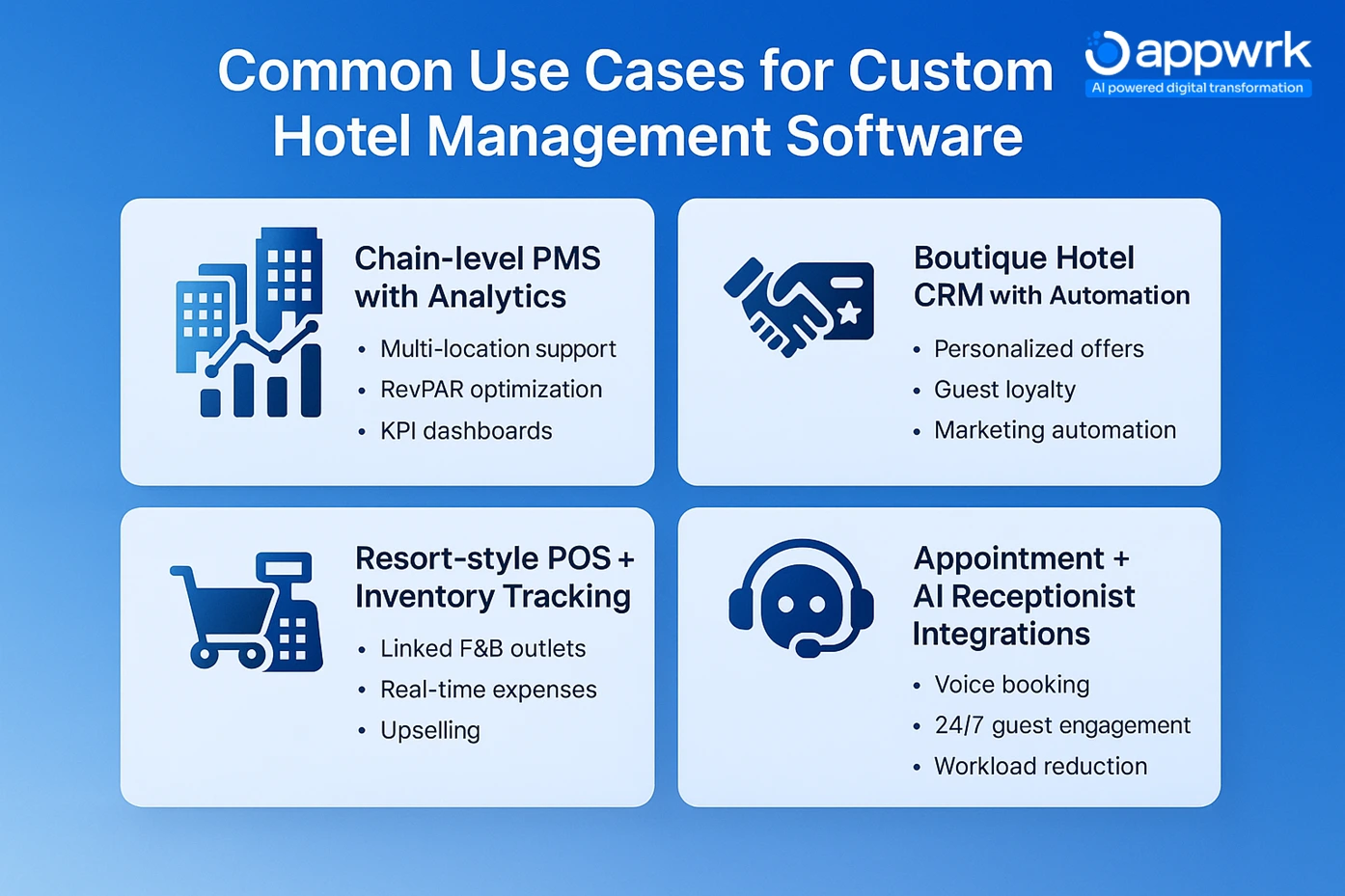
What Are the Common Use Cases for Custom Hotel Management Software?
Custom hotel management software isn’t just about replacing manual processes; it’s about tailoring solutions to different business models and guest journeys. Below are some of the most common use cases where custom builds deliver measurable results while keeping long-term scalability in mind.
Chain-level PMS with Analytics
Large hotel groups and franchises needenterprise-level solutions that consolidate operations across multiple properties. A chain-level PMS connects reservation systems, front desk operations, and loyalty programs with multi-location support and centralized management dashboards.
Impact: By integrating RevPAR optimization, occupancy optimization, and KPI dashboards, chains gain visibility into their entire property portfolio management. Unified data improves yield management while reducing silos across departments. This is where cloud-native systems offer an advantage over on-premise systems, scaling analytics without heavy infra.
Pricing Models: Larger chains often adopt per room per month pricing or a tiered pricing model, aligning costs with room inventory and usage.
Boutique Hotel CRM with Automation
For independent hotels and bed and breakfast properties, guest loyalty and personalization are the differentiators. A lightweight CRM tailored for budget PMS solutions automates pre-arrival communication, targeted personalized marketing, and post-stay follow-up.
Impact: This allows boutique properties to upsell travel packages, offer reward programs, and build stronger engagement with fewer staff. Unlike premium PMS platforms, smaller operators may prefer subscription-based pricing or pay-per-room models to reduce implementation costs and avoid heavy setup fees.
Resort-style POS + Inventory Tracking
Resorts and extended-stay properties often manage multiple outlets, restaurants, spas, shops, and activities. Here, system agnosticism and interoperability matter, since the POS needs to link with F&B systems, guest folios, and booking channels.
Impact: Integrated POS with inventory management prevents leakage, syncs expenses in real time, and enables contactless payments at scale. Resorts benefit from total economic impact gains by reducing reconciliation errors and increasing upsell opportunities across distribution.
Appointment + AI Receptionist Integrations
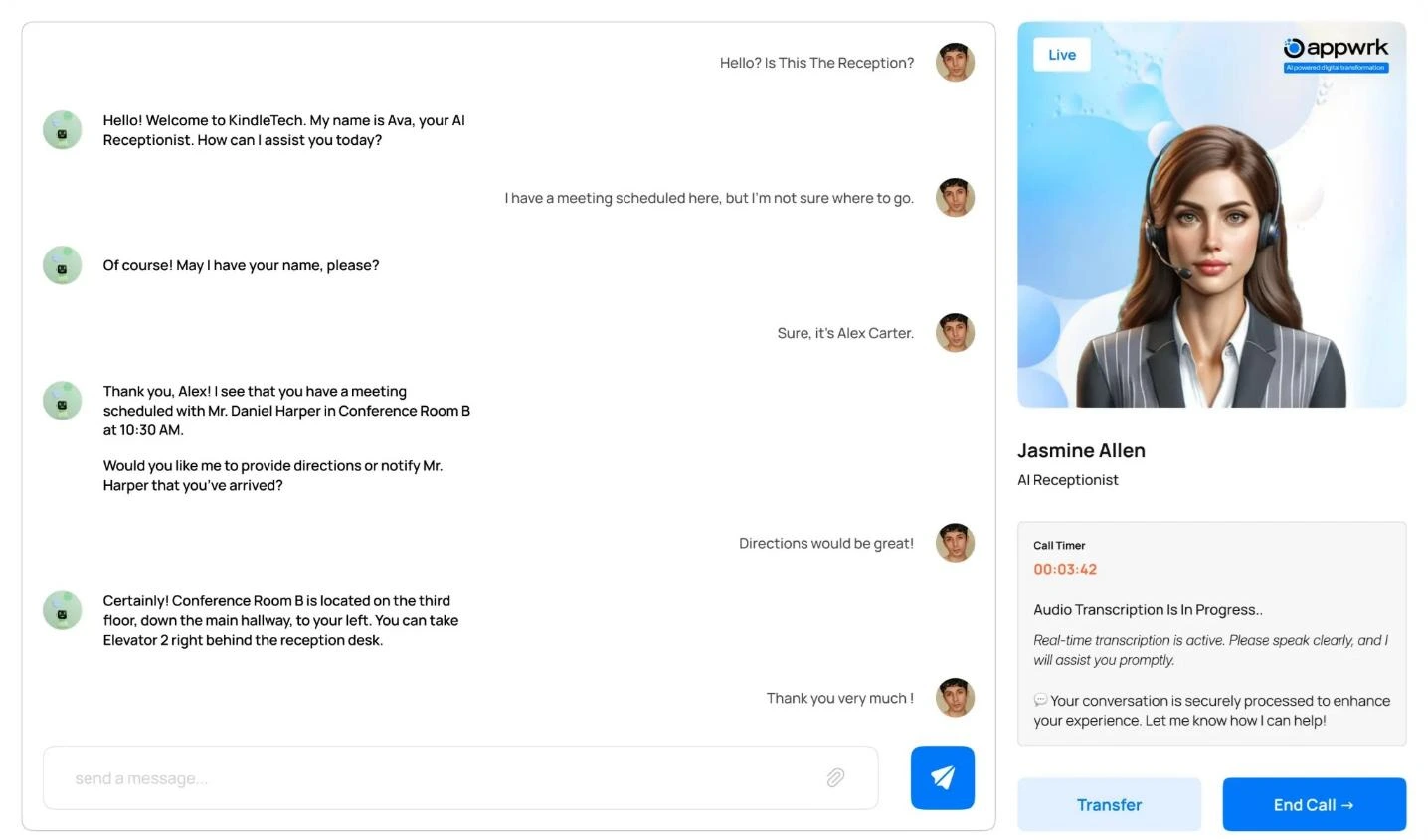
Front desk teams in mid-sized hotels often struggle with appointment scheduling and guest calls. An AI-powered receptionist acts as a guest engagement platform, handling bookings via voice technology, confirming availability through real-time data, and integrating with PMS calendars.
Impact: Guests benefit from faster, 24/7 responses, while hotels cut reception workload by up to 40%. AI integrations can also work with GDS connectivity, ensuring guest requests align with distribution channels.
AI Receptionist for Hospitality: Appwrk Client Case Study
The Challenge A hospitality group managing multiple boutique hotels faced bottlenecks at reception. Manual scheduling, calls, and guest inquiries caused long wait times, errors, and dissatisfaction. The lack of automation limited scalability across properties.
AI Receptionist Transformation Appwrk developed a custom AI receptionist integrated with the PMS and Google Calendar API. Using NLP, Twilio voice automation, and custom API development, the solution synced bookings, provided real-time inventory updates, and routed calls.
Strategic Relevance This implementation demonstrates how digital transformation in hospitality, through AI and automation, directly improves hospitality metrics like guest satisfaction and operational cost savings. When paired with an ROI calculator, hoteliers can clearly track the payback period of such innovations.
What Is the ROI from Investing in Hotel Management Software?
When evaluating hotel management software development cost, it’s not just about the upfront spend; it’s about the total economic impact the system creates. ROI comes from reduced labor costs, optimized revenue, and stronger guest experiences. Here’s how the returns stack up.
CapEx vs OpEx
Legacy on-premise systems often meant heavy CapEx with large licensing fees and local infrastructure. Today, modern cloud-native systems follow SaaS pricing with subscription-based pricing, turning spend into predictable OpEx.
ROI Insight: By avoiding big setup fees and moving toward per-room per-month pricing or a pay-per-room model, hotels improve cost flexibility and achieve a shorter payback period.
Labor Cost Reduction
By automating staff scheduling, housekeeping coordination, billing, and reporting, hotels reduce manual workloads. AI kiosks, contactless technology, and digital task boards streamline operations.
ROI Insight: Hotels typically record a 20–30% reduction in staffing costs, freeing up budgets for guest-facing services.
Upsell and Cross-Sell Improvements
Custom CRMs and loyalty management systems enable upsell offers like room upgrades, late check-outs, or spa packages. Combined with personalized marketing and upselling automation, these campaigns create new revenue streams.
ROI Insight: Hotels see a 10–20% uplift in guest spend. Using an ROI calculator highlights exactly how upsell engines contribute to the bottom line.
Better Inventory and Rate Management
With booking channels, distribution channels, and OTA connectivity, hotels manage availability in real time. Advanced systems integrate GDS connectivity for global reach and use yield management tools to optimize rates.
ROI Insight: These strategies improve occupancy optimization by 5–15% annually, ensuring revenue protection in both peak and low-demand seasons.
ROI Matrix: Cost vs Benefits
Investment Area
Typical Cost Range
Direct ROI
Long-Term ROI Impact
Automation & Labor Savings
$3,000 – $10,000
20–30% reduction in routine staffing costs
Consistent cost savings across operations
CRM & Guest Analytics
$2,000 – $6,000
10–20% uplift in guest spend
Improved loyalty and repeat bookings
Channel Management & Rate Control
$1,800 – $4,000
5–15% increase in occupancy
More stable year-round revenue
AI & Predictive Analytics
$2,500 – $7,000
Faster, data-driven decision-making
Competitive advantage in pricing & marketing
Mobile & Self-Service Tools
$3,000 – $6,000
Reduced wait times, higher guest satisfaction
Stronger brand value & reviews
What Revenue Optimization Strategies Can Hotels Use with Management Software?
Modern PMS platforms are no longer just operational; they act as full-fledged guest engagement platforms, driving top-line growth. By combining automation, AI, and advanced reporting, hotels can maximize RevPAR optimization while reducing commission on bookings paid to OTAs.
Dynamic Pricing with Real-Time Analytics
Dynamic pricing uses real-time data, competitor rates, and seasonal demand to adjust room pricing.
Benefit: Improves RevPAR by 10–20% and aligns with industry hospitality metrics. Example: A hotel can raise rates during festivals while using discounts to sustain occupancy in the off-season.
Upsell and Cross-Sell Automation
Automated upsell flows introduce offers during booking, check-in, or via mobile apps.
Benefit: Adds 15–25% more guest revenue while personalizing the guest journey mapping. Example: A standard booking can be nudged toward premium suites with smart reward programs.
Channel Mix Optimization
Over-reliance on OTAs leads to high commission on bookings. A channel manager integrated with PMS helps balance OTA exposure, direct bookings, and B2B channels.
Benefit: Cuts OTA costs by 8–15% while increasing long-term profitability. Example: Resorts offering direct website discounts see higher ROI than OTA-heavy properties.
Predictive Demand Forecasting
AI engines forecast demand using hospitality technology trends, events, and competitor analysis.
Benefit: Avoids under- or over-staffing by 20–30% and aligns resources through shift management. Example: Forecasting tools prepare hotels for event-driven spikes while trimming costs during slow periods.
Loyalty-Driven Revenue Growth
By combining customer lifecycle management with review management and guest feedback systems, hotels build repeatable revenue loops.
Benefit: Repeat bookings rise 15–20%, lowering acquisition costs and boosting long-term business continuity.
Revenue Leak Prevention through Reporting
Advanced dashboards and KPI tracking highlight inefficiencies like missed invoices or discounts.
Benefit: Prevents 3–5% revenue loss annually and strengthens compliance with hospitality industry standards.
Cross-Property Revenue Optimization
For franchise management and hotel chains, a centralized management PMS ensures portfolio-level insights.
Benefit: Enables property portfolio management with promotions spread across locations, boosting chain-wide revenue.
What Pricing Models Are Available for Hotel Management Software? (SaaS vs Perpetual License vs Hybrid)
When calculating hotel management software development cost, one of the most important choices is the pricing model. Whether you go with SaaS pricing (subscription-based), a perpetual license, or a hybrid approach, each model carries unique implementation costs, scalability benefits, and ROI implications. Choosing poorly can lock a hotel into high expenses or limit growth flexibility.
SaaS (Software-as-a-Service) Model for Hotel Management Software
SaaS pricing is a subscription-based pricing model where hotels pay monthly or annual fees to usecloud-native systemshosted by vendors. This is the most widely adopted model, especially for budget PMS solutions and mid-sized properties.
Advantages:
Low upfront setup fees compared to legacy builds.
Automatic updates, compliance, and security patches.
Scales easily for multi-location support and seasonal demand changes.
Reduced IT overhead with no on-premise systems required.
Disadvantages:
Ongoing per-room per-month pricing or a pay-per-room model can add up over time.
Dependence on vendor uptime and internet reliability.
Best Fit: Independent hotels, B&Bs, and vacation rentals that prioritize affordability, quick setup, and transparent costs
Estimated Cost Range: $20–$50 per room/month, depending on modules.
A Statista report shows SaaS adoption in hospitality has grown by 60% in five years due to its lower total economic impact compared to traditional systems.
Perpetual License Model for Hotel Management Software
The perpetual license model involves a one-time purchase, giving hotels ownership of the system. These builds are typically on-premise systems, with recurring costs for maintenance and updates.
Advantages:
Full ownership and direct control over data and system configuration.
No recurring subscription bills beyond maintenance.
Easier to build premium PMS platforms with custom features.
Disadvantages:
High upfront CapEx, not ideal for independent hotels or small chains.
Upgrades and compliance updates require additional spend.
Dedicated IT teams are needed for system monitoring, disaster recovery, and uptime monitoring.
Best Fit:Enterprise-level solutions in large hotel groups with property portfolio management strategies and in-house IT support. Estimated Cost Range: $50,000–$200,000 upfront + 15–25% annually for maintenance.
Hybrid Pricing Model for Hotel PMS (Blending SaaS and Licensing)
Hybrid models combine the best of licensing vs subscription. Hotels pay a smaller license fee upfront, while also subscribing to cloud hosting, updates, and support.
Advantages:
Combines tiered pricing model flexibility with partial ownership.
Predictable OpEx with some long-term control.
Easier migration from older on-premise systems to modern cloud-native systems.
Disadvantages:
Complex cost structure (license + subscription).
Slightly higher cost than pure SaaS for smaller hotels.
Best Fit:Franchise management groups and extended stay hotels looking for flexibility without sacrificing scalability. Estimated Cost Range: $20,000–$70,000 upfront + $500–$2,000/month subscription.
Final Takeaway: Choosing the Right Model
SaaS pricing → Ideal for scalable growth, faster implementation, and predictable expenses.
Hybrid → A middle ground for chains needing flexibility across distribution channels and booking channels.
By aligning pricing models with property size, IT capabilities, and growth goals, hotels can optimize ROI, shorten the payback period, and calculate benefits with an ROI calculator. This approach ensures better hospitality metrics like RevPAR optimization, occupancy optimization, and overall yield management.
Hotel Management Software Development Process
The development of hotel management software is not just about coding; it’s a structured journey that ensures scalability, usability, and long-term reliability. Each stage directly impacts implementation costs, timelines, and ROI.
Requirement Analysis
This stage starts with stakeholder discussions, mapping the guest journey, and identifying operational pain points like staff scheduling, POS integrations, and compliance. Objective: Align business needs with technical feasibility to avoid costly scope creep and unexpected setup fees.
System Design
Here, detailed system configuration, wireframes, and user flows are prepared. Scalability and system agnosticism are often planned at this stage to ensure interoperability with booking channels and distribution channels. Objective: Build an intuitive design that fits both staff workflows and guest-facing modules.
Development
This is where coding, API development, and database logic are implemented. Modules such as reservations, billing, channel management, and loyalty workflows are built. For hotels adopting SaaS pricing models, cloud-native systems are prioritized, while some enterprises may still prefer on-premise systems for control. Objective: Convert business requirements into functional, testable software.
Quality Assurance
Testing ensures performance, security, and compliance. Beyond regression and functional checks, QA covers performance testing, stress testing, user acceptance testing, and even A/B testing for new features. Objective: Guarantee that the system runs reliably across mobile, web, and multi-property environments.
Deployment
At this point, the solution is rolled out, involving hosting setup, third-party connectivity, and integration with OTAs via GDS integration and GDS connectivity. Cloud-first deployments usually reduce implementation costs, while on-premise systems demand higher infrastructure setup. Objective: Deliver a production-ready platform that supports multi-location support and smooth OTA sync.
Training
Staff training covers workflow optimization, shift operations, and role-based modules. Hotels that invest in personalized marketing, upsell automation, and guest engagement platforms often conduct extended training cycles. Objective: Enable employees to use features effectively, maximizing ROI and improving adoption speed.
Maintenance & Updates
After launch, software requires ongoing system monitoring, bug fixes, uptime monitoring, and security patches. For chains, centralized management makes property portfolio management easier. Agile approaches with Scrum methodology and DevOps practices are often used for continuous releases. Objective: Keep the system compliant with hospitality industry standards while ensuring business continuity and adaptability.
What Are the Future Trends Impacting Hotel Software Costs and Features?
The hotel technology landscape is rapidly evolving. These hospitality technology trends not only add new guest experiences but also redefine cost structures.
Generative AI for Guest Interactions
AI chatbots,voice technology, and concierge bots streamline pre-arrival communication and post-stay follow-up, reducing front desk loads. Cost Impact: Increases upfront AI/API costs but lowers labor-related implementation costs long term.
Blockchain for ID & Payments
Blockchain integration ensures secure ID checks, loyalty point tracking, and transparent contactless payments. Cost Impact: Higher setup fees and compliance costs, but reduced fraud risk and improved trust.
Hyper-Personalized Guest Journeys
Customer lifecycle management tools powered by AI anticipate guest needs, enhancing personalized marketing and loyalty campaigns. Cost Impact: More investment in data analytics, but stronger repeat bookings and ROI calculator results.
Centralized Cloud PMS for Multi-Property Groups
Hotels are shifting from fragmented tools to cloud-native systems that unify multi-location support. This also helps with yield management, RevPAR optimization, and occupancy optimization across properties. Cost Impact: High initial data migration costs, but reduced IT overhead with lower long-term total economic impact.
IoT-Enabled Smart Rooms
IoT integration and smart room technology enable keyless entry, automated climate control, and in-room service apps. Cost Impact: Adds hardware and system interoperability costs but increases guest satisfaction and enterprise-level solutions’ competitiveness.
AR/VR for Virtual Tours and Training
AR/VR technology is now used for immersive property tours and staff training, reducing physical demo and training expenses. Cost Impact: Higher upfront build but long-term ROI via improved marketing and operational efficiency.
Sustainability-Focused Software Features
Sustainability features like energy dashboards and waste management modules are gaining traction due to compliance and eco-conscious travelers. Cost Impact: Minor upfront add-ons but critical for aligning with hospitality industry benchmarks and competitive analysis trends.
What Are the Key Risks and Challenges That Impact Hotel Management Software Development?
Building custom hotel management software delivers immense value, but the journey is rarely straightforward. Projects often run into challenges with scope, compliance, integrations, and adoption. Identifying these risks early helps hoteliers manage implementation costs, avoid delays, and strengthen ROI.
Mid-scope Changes
Scope creep is a classic budget killer. Hotels may start with core modules but later add loyalty programs, mobile apps, or AI analytics. These require new system configuration, re-coding, and additional performance testing. Impact: Adds 15–25% to development costs and delays delivery timelines. Example: Adding multi-location support or property portfolio management midway doubles database complexity and testing cycles.
Data Privacy Delays
Hotels handle sensitive guest data, IDs, payments, and booking histories, which require strict compliance with GDPR, PCI-DSS, and local hospitality industry standards. Compliance checks, data migration, and penetration testing often slow down projects. Impact: Non-compliance risks fines of up to 4% of revenue and reputational damage.
App Store Rejections
For guest-facing apps, Apple and Google rejections are common. Failures in user acceptance testing, privacy handling, or contactless technology can delay approvals. Impact: Each rejection adds 2–4 weeks of redesign, debugging, and resubmission.
Vendor Lock-in Risk
Hotels relying on proprietary PMS or OTA vendors risk long-term contracts and a lack of system agnosticism. This raises TCO and restricts interoperability. Impact: Contracts may inflate total economic impact by 30–40% compared to flexible, API development-driven systems.
Guest-Facing UX Failure
Poorly designed interfaces lead to abandoned apps, failed guest engagement platforms, and bad review management. Impact: Hotels risk losing 10–15% of digital bookings if UX falls below modern hospitality technology trends.
Integration Complexity
PMS, POS, CRMs, OTAs, and GDS integration requires seamless synchronization. Without proper system monitoring and uptime monitoring, mismatches in booking channels and distribution channels increase staff workload. Impact: Failed integrations cause duplicate bookings, errors, and operational inefficiencies.
Scalability Issues
As hotels grow, from independent hotels to chains with franchise management, the PMS must scale. Without a scalable architecture, peak seasons lead to downtime and missed revenue. Impact: Missed opportunities for RevPAR optimization, yield management, and occupancy optimization.
Security Risks
Hotels are prime targets for cyberattacks. Without robust data encryption, disaster recovery, and business continuity plans, breaches can cost millions. Impact: Damages brand trust and leads to financial/legal liabilities.
Mobile Accessibility Gaps
Guests demand mobile-first experiences: contactless payments, voice technology, and smart room technology. Skipping these alienates younger, tech-driven travelers. Impact: Missed opportunities for upselling and cross-selling via mobile workflows.
Real-Time Data Analysis
Hotels run on real-time data. Without live dashboards, managers can’t adjust pricing, track KPI, or optimize resources. Impact: Lost opportunities for upselling automation, dynamic rate changes, and quick decision-making.
Regulatory Compliance
Beyond GDPR/PCI-DSS, compliance with regional tax, hospitality metrics, and hotel industry benchmarks is mandatory. Delays here ripple into launch dates. Impact: Risk of fines, revoked licenses, and reputational damage.
Final Takeaway: Mitigating Risks Proactively
Most risks come from scope creep, compliance gaps, poor integrations, or a lack of adoption. Proactive planning, modular builds, agile development, and scrum methodology reduce these risks by up to 40%. Using a trusted partner who balances SaaS pricing and on-premise systems, provides clear ROI calculator frameworks, and supports subscription-based pricing ensures a lower payback period and better long-term total economic impact.
How Appwrk Can Help in Hotel Management Software Development
Choosing the right development partner can be the difference between a smooth, scalable hotel management solution and a costly, inefficient system. Appwrk combines technical expertise with hospitality domain knowledge to help hoteliers minimize implementation costs, shorten the payback period, and achieve measurable ROI.
Multi-domain Experience
Appwrk has delivered solutions across independent hotels, boutique chains, resorts, and enterprise-level groups. Whether building budget PMS solutions or premium PMS platforms, our team designs systems aligned with unique workflows, from reservation engines and GDS integration to property portfolio management. Benefit: Faster setup, reduced training time, and workflows that reflect real-world hotel operations.
Support Across Web, Mobile, and Cloud
Whether you need a guest-facing mobile app, a web-based PMS dashboard, or a cloud-native system for multi-location support, Appwrk ensures full interoperability across devices and platforms. For enterprises requiring greater control, we also deliver on-premise systems with hybrid options. Benefit: A unified staff and guest experience with real-time sync, data migration, and seamless scalability.
Low-bug, SLA-governed Support
Appwrk follows agile development, scrum methodology, and DevOps practices, reinforced with user acceptance testing, beta testing, and performance testing. Combined with SLA-driven support, this ensures uptime reliability, predictable maintenance, and faster updates. Benefit: Peace of mind with lower downtime, structured system monitoring, and measurable service quality.
Cross-border Development Execution
By combining offshore engineering with onshore management, Appwrk offers subscription-based pricing and per-room per-month pricing flexibility. Hotels can adopt a pay-per-room model or a tiered pricing model while keeping setup fees transparent and predictable. Benefit: Significant reduction in TCO with cost efficiency, while maintaining compliance and quality.
Ready to Build Your Hotel Management Software?
Appwrk’s track record in hotel software development ensures you get a solution that’s secure, scalable, and designed for measurable ROI. Whether you’re aiming for RevPAR optimization, yield management, or automation of guest journey mapping, we cover the entire cycle, from planning to deployment and post-launch support.
Contact Appwrk today for a tailored cost estimate and see how our ROI calculator can forecast the total economic impact for your property.
FAQs
How much does hotel management software development cost on average? The cost to develop hotel management software typically starts at $5,000 for a basic MVP. Advanced enterprise-level solutions for franchise management or centralized management can reach $40,000–$60,000, though outsourcing and modular rollout can optimize spend.
Contact us to know the real costs to build your hotel management software.
Which modules are must-haves in a hotel management system? Core modules include reservations, check-in/out, billing, housekeeping, POS, and channel management. Advanced features like CRM, loyalty management systems, mobile accessibility, and AI-driven analytics strengthen customer lifecycle management and occupancy optimization.
What are the typical maintenance costs post-launch? Ongoing maintenance averages 15–25% of the initial build annually, covering bug fixes, compliance patches, upgrades, and system configuration.
Can I reduce PMS costs with open-source? Yes, but even open-source budget PMS solutions require customization, security hardening, and workflow optimization. Overlooking these can create hidden costs.
What tech stack works best? Popular choices include MERN, MEAN, and cloud-native systems like Firebase. Hotels with legacy infra may prefer hybrid or on-premise systems for better control.
How do I reduce costs without sacrificing performance? Adopt modular builds, A/B testing, and phased rollouts. Start lean, then add features like contactless payments, smart room technology, or blockchain integration for future scalability.
How can software improve revenue management? By combining real-time data, dynamic pricing, and predictive analytics, hotels can improve KPI tracking, reduce reliance on OTAs (and commission on bookings), and maximize RevPAR optimization.
How secure is hotel data? Security relies on compliance with GDPR, PCI-DSS, and hospitality industry standards. Appwrk includes data encryption, fraud monitoring, and regular audits to safeguard guest trust.
How does software enhance guest experience? Features like pre-arrival communication, upselling automation, personalized marketing, and 24/7 AI concierge tools drive guest satisfaction, loyalty, and repeat bookings.
Gourav Khanna is the Co-founder and CEO of APPWRK, leading the company’s vision to deliver AI-first, scalable digital solutions for enterprises and high-growth startups. With over 16 years of leadership in technology, he is known for driving digital transformation strategies that connect business ambition with outcome-focused execution across healthcare, retail, logistics, and enterprise operations.
Recognized as a strategic industry voice, Gourav brings deep expertise in product strategy, AI adoption, and platform engineering. Through his insights, he helps decision-makers prioritize market traction, operational efficiency, and long-term ROI while building resilient, user-centric digital systems.
Subscribe to APPWRK Blogs, We'll Do the Rest!
Get Blogs on UI/UX, Mobile Apps, Online Marketing, and Web development technology.
Unlock worthy and priceless suggestions from the masters of mobile and web app development