150+ minds across 4 countries. Join a culture of innovation, ownership & growth.
Rewire for AI
From machine learning to deep learning, from classification tools to overall process automation – our AI engineers will help you retool your existing system or enhance your company results.
Ship faster, scale smarter, built for product companies and SaaS teams
Our Latest Work
We strive hard to deliver result-driven digital solutions across the globe. Check out our case studies to get a glimpse of how we ideate, innovate, and create unconventional digital solutions according to the requirements of our clients.
Discover diverse and passionate insights from our tech enthusiasts. We collaborate across various sectors to streamline operations and drive innovation. Explore our rapidly growing collection of articles to see why we’re at the forefront of IT solutions.
The decision to move from Magento to Shopify is one of the most significant replatforming choices an ecommerce business can make. Magento is powerful, but its power comes with...
Accuracy gap is real: Traditional CPG forecasting carries a 25-40% MAPE error rate. AI-powered models bring that down to 8-15%, according to McKinsey research....
Real stories from global leaders who trusted us with their ideas.
Partnering with APPWRK helped us build a compliant and scalable healthcare platform, accelerating our time-to-market by 35%. Their team consistently delivered outstanding work.
Beesers
Digital Healthcare Client
Collaborating with APPWRK, Sportskeeda modernized its platform into a real-time sports engagement ecosystem, enabling seamless content delivery, scalable fan interactions, and high-velocity performance.
Sportskeeda
Sports & Entertainment Partner
Working with APPWRK was effortless. They captured our vision, maintained full compliance, and delivered a digital experience that built trust and elevated how customers interact with our fintech brand.
PayPenny
Fintech Partner
Working with APPWRK gave us confidence in adopting AI responsibly. Their team built a safe, intelligent bot that transformed how we engage with leads and helped us achieve measurable revenue growth.
IFB
AI Transformation Partner
Leveraging APPWRK’s digital expertise, Nemesis launched a scalable, compliant, and safe super app that connects content delivery, real-time communication, and logistics management within a single platform.
Cost Range: The Cost to build a Medical Scheduling Software starts at $10,000 for an MVP and can go up to $90,000 for a full enterprise-grade healthcare appointment scheduling app.
How Costs Stay Low: Offshore teams, cross-platform app development, modular architecture, and automated workflows can cut doctor appointment app development costs by 30 to 40% while meeting HIPAA, GDPR, and FHIR compliance.
Compliance & Security as Non-Negotiables Meeting HIPAA, GDPR, and FHIR compliance is essential. Investment in security audits, patient data security, and compliance certifications ensures trust and legal protection.
ROI Beyond Development Well-designed scheduling systems improve patient experience, reduce no-shows, optimise resource scheduling, and boost practice revenue, making cost a long-term investment.
Who It’s For This breakdown is for Clinic founders, CTOs, healthcare founders, product managers, and medical practices exploring custom medical scheduling software development with full cost clarity, compliance, and ROI-driven strategies.
The Covid-19 pandemic accelerated adoption, pushing clinics, hospitals, and wellness sector providers to embrace cloud-based medical appointment scheduling software as the new norm.
For Patients: Real-time availability, appointment reminders, access to Patient History and Records, online health payments via payment gateways, and telemedicine services.
For Doctors: Calendar syncing, predictive scheduling, reduced no-show prediction/reduction, and smarter workload/resource allocation.
For Admins: Staff scheduling, workforce management, queue management system, compliance audits & certifications, data preparation & cleaning, Legacy System Data Migration, and change management.
Hidden Costs & Pricing Models
Hidden costs often add 20 to 30% on top of the base build and may include:
Vendor subscriptions
Licensing fees and compliance audits
Data preparation & cleaning
Handling API Deprecation issues
Pricing models you should consider:
Subscription model – predictable recurring revenue
Freemium with paid add-ons – wider adoption, upsell potential
Pay-per-use model – best for smaller clinics with fluctuating volumes
Enterprise licensing model – ideal for large-scale medical practices
Also, keep in mind: cloud hosting and cloudbooking services often come with recurring infrastructure fees.
How Much Does It Cost to Build Medical Scheduling Software from Scratch?
Building medical scheduling software can start as low as $10,000 for a basic MVP and usually ranges between $20,000 and $55,000 for mid-tier solutions. Even advanced medical office scheduling software with AI, telemedicine, and EHR integration rarely exceeds $90,000 when built with the right development approach.
The doctor appointment app development cost for a basic MVP starts at $10,000 and scales with added features like telehealth consultations and predictive scheduling.
Here’s a cost snapshot:
Medical Scheduling Software Type
Cost Range of Medical Scheduling Software Development
How Much Does It Cost to Develop Medical Scheduling Software with Core Features at Each Stage?
The cost of medical scheduling software development depends heavily on each stage of the build. A lean MVP can start at $10,000, with staged investments helping to spread the budget efficiently.
Deployment & Launch Cost of Medical Office Scheduling Software
$2,000 to $6,000
Cloud setup, app store publishing, staff onboarding
Maintenance & Updates Cost for Medical Staff Scheduling Software
$3,000 to $10,000 annually
Regular updates, bug fixes, server hosting, compliance upgrades
Stage-wise allocation ensures medical appointment scheduling software stays affordable while leaving room for scalability and advanced features in later phases.
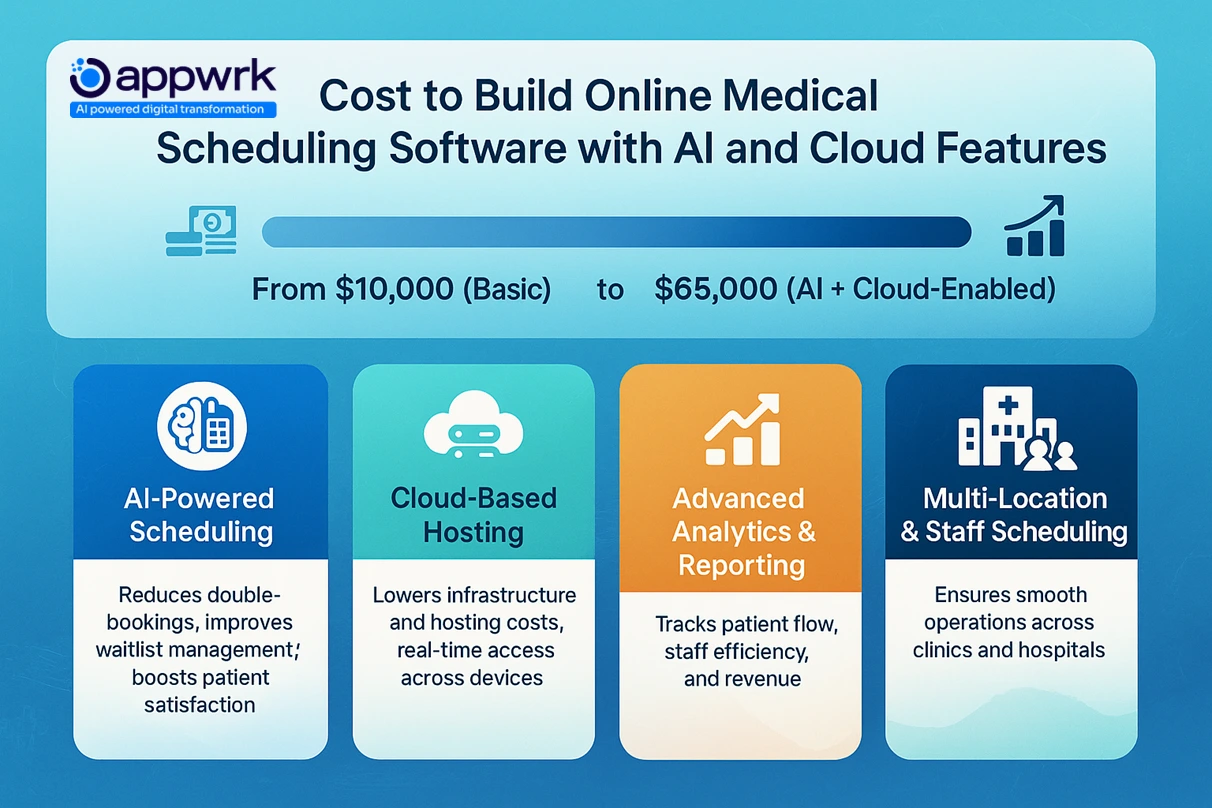
How Much Does It Cost to Build Online Medical Scheduling Software with AI and Cloud Features?
Adding AI and cloud-based architecture takes online medical scheduling software beyond basic booking tools. While a standard build may start from $10,000, AI-enabled solutions with predictive and automated features range from $25,000 to $65,000, depending on scope.
Online Medical Scheduling Software Type
Cost Range
Differentiating Features
Value for Healthcare Providers
Standard Online Medical Scheduling Software
$10,000 to $20,000
Appointment scheduling, automated reminders, patient profiles, and online payment integration
Streamlined booking and reduced no-shows
AI-Powered Medical Appointment Scheduling Software
AI-powered schedulingreduces double-bookings, improves waitlist management, and boosts patient satisfaction.
Cloud-based hosting lowers infrastructure and hosting costs while offering real-time access across devices.
Advanced analytics and reporting help clinics measure patient flow, staff efficiency, and revenue.
Multi-location and staff scheduling ensure smooth operations across clinics and hospitals.
Secure patient messaging and telemedicine integration make care delivery more convenient and compliant.
By combining medical appointment scheduling software, medical office scheduling software, and medical staff scheduling software on the cloud, providers gain a future-ready solution with lower total cost of ownership.
How Much Do Regional Costs Impact Medical Scheduling Software Development?
The cost of building medical scheduling software varies significantly by region. Development teams in North America charge premium rates, while outsourcing to India keeps the budget at its lowest. Choosing the right region can save up to 60% of the total medical appointment scheduling software development cost.
Region
Hourly Rate Range
Estimated Cost to Build Medical Scheduling Software
Key Insights
USA (Medical Scheduling Software Development Cost in USA)
$80 to $120/hr
$70,000 to $90,000
Premium quality, compliance-ready, but most expensive
Western Europe (Medical Appointment Scheduling Software Cost in Europe)
$60 to $100/hr
$50,000 to $75,000
Strong healthcare expertise, but costs closer to US levels
Eastern Europe (Medical Office Scheduling Software Development in Eastern Europe)
$35 to $60/hr
$30,000 to $50,000
Balanced costs with reliable technical talent
India (Medical Scheduling Software Development Cost in India)
$20 to $35/hr
$10,000 to $25,000
Lowest cost for MVPs and scaling, strong in cross-platform builds
Southeast Asia (Medical Staff Scheduling Software Outsourcing Cost)
$25 to $40/hr
$15,000 to $30,000
Affordable alternative to India with growing expertise
USA and Western Europe → high cost but compliance-heavy projects.
India and Southeast Asia → cost-effective without compromising quality, ideal for MVPs and startups.
Eastern Europe → mid-tier costs, strong technical reliability.
For clinics and healthcare providers, outsourcing to India offers the best chance to build affordable medical office scheduling software while keeping features like AI-powered scheduling, online payments, and telemedicine integration intact.
What Are the Core Features Required in Medical Scheduling Software?
The doctor appointment app development cost varies based on the features you include. Each capability adds measurable value for patients, staff, and doctors—while also shaping the overall pricing of your scheduling system. Below is a breakdown of the must-have features, their benefits, and cost ranges.
Mid-Tier Build: $25,000 to $55,000 (telehealth, billing, analytics).
Enterprise Full-Featured: $60,000 to $90,000 (AI, workforce management, EHR/HL7v2, compliance with FHIR, cloud hosting, data preparation & cleaning, legacy system data migration).
The health tech market is growing fast, with leading vendors like HotDoc, Phreesia, DiabeticU, Soniphi, and Health-e-people already setting benchmarks. Whether you’re building a simple appointment booking app or an enterprise-grade cloud-based medical appointment scheduling software, understanding feature costs, compliance, and hidden costs (licensing model, subscription vs freemium vs pay-per-use model, vendor fees) ensures a smarter investment.
Choosing the right vendor with healthcare domain expertise, cross-platform building, and cloud booking support is key to balancing cost, scalability, and compliance certifications.
Which Factors Influence the Cost of Medical Scheduling Software Development?
The overall medical scheduling software development cost depends on factors like design complexity, backend requirements, third-party integrations, compliance, and scalability planning. Each of these directly affects pricing, timelines, and ROI for clinics, hospitals, and healthcare providers.
Design Complexity: Simple vs Advanced Interfaces
The design complexity of your scheduling system is one of the biggest budget drivers.
Simple UI: Covers essentials such as patient self-scheduling, appointment reminders, and appointment slots, more budget-friendly.
Advanced UI: Involves custom branding, dashboards, and enhanced user experience for medical practices, often adding thousands to your investment.
Backend Development Cost: The Engine Behind Everything
Backend development usually makes up 30 to 40% of the total cost.
Lightweight backends: Best for smaller practices, managing only appointment booking apps and patient information.
Complex builds: Include EHR/EMR connectivity, workforce management, analytics, and secure handling of sensitive data.
Third-Party Integrations Cost: Adding More Capabilities
Integrations expand functionality but also raise costs. Examples:
Enterprise-grade custom medical scheduling software development with AI medical scheduling platform features, compliance certifications, and cloud-based services can cost between $70,000 and $90,000, but delivers long-term efficiency and ROI.
What Are the Hidden Costs of Developing Medical Scheduling Software?
When building a medical appointment scheduling app, clinics often face hidden costs that can increase the overall doctor appointment app development cost by 20 to 30%. These extra expenses are crucial to plan for, as they ensure smooth operations, compliance, and long-term success.
Software Maintenance and Regular Updates
Expect to spend 15 to 25% of the initial build cost annually.
Covers bug fixes, UI/UX improvements, compliance upgrades, and automated testing.
Critical for medical office scheduling software to stay in line with HIPAA, GDPR, and FHIR compliance.
Infrastructure and Hosting Costs
Cloud hosting, database servers, and cloudbooking services can cost $500 to $2,000/month, depending on traffic.
Additional costs include API usage fees and Legacy System Data Migration when shifting from older setups.
Marketing and Promotion
Competing with leaders like HotDoc, Phreesia, and Doctolib requires visibility.
SEO, app store optimisation, and digital ads can cost $1,000 to $5,000/month.
Compliance certifications, GDPR audits, and third-party vendor licensing can cost $2,000 to $10,000.
Especially relevant for cross-border healthcare systems and providers in the wellness sector.
How Can You Reduce the Cost of Building Medical Scheduling Software Without Compromising Quality?
Developing a healthcare appointment scheduling app doesn’t have to be prohibitively expensive. A structured approach helps maintain quality, compliance, and scalability while keeping costs under control.
Start with an MVP vs a Full-Featured Build
Launch lean with scheduling, reminders, and patient profiles for ~$10,000 to $18,000.
Scale later with AI-driven automation, predictive scheduling, analytics, and compliance features.
Focus on Core Features First
Prioritise essentials like real-time availability, telehealth integration, and payment gateways.
Delay advanced features such as SOAP notes, predictive analytics, and provider dashboards.
How Can You Make Your Medical Scheduling Software Stand Out in a Competitive Market?
Dozens of Healthcare appointment scheduling applications exist, but only a few capture lasting market share. To make your product stand out, focus on differentiators that directly impact customer trust, patient experience improvement, and provider adoption.
Rock-Solid Security & Compliance
Embed HIPAA, GDPR, and compliance with FHIR standards. Use encryption, secure patient messaging, and compliance audits & certifications. Clinics, hospitals, and medical practices prioritise security as much as features.
Outstanding UI/UX Design
Offer customizable booking forms, patient-friendly flows, and real-time availability. The better the user experience, the higher the adoption by both patients and staff.
Built to Scale with Growing Practices
Ensure your medical clinic scheduling software can scale with multi-location and workforce management. Scalable systems support resource allocation as patient volumes grow.
Seamless EMR/EHR Integration
Direct practice management software integration (HL7v2, EMR/EHR) saves hours in admin work. Unified Patient History and Records builds continuity of care and helps with revenue cycle management.
Cross-Platform Compatibility
Support cross-platform accessibility via mobile, desktop, and tablets. Use cross-platform app development frameworks like Flutter or React Native for consistent performance across devices.
Differentiation is not about feature overload. It’s about offering AI-driven automation, predictive scheduling, and an AI medical scheduling platform tool like no-show prediction while ensuring compliance and scalability.
How Do Revenue Streams Impact the ROI of Medical Scheduling Software?
Turning the doctor appointment app development cost into ROI depends on choosing the right monetisation strategy.
Subscription-Based Model
Clinics pay a fixed monthly fee for your online medical scheduling software. This model ensures predictable recurring revenue and makes budgeting easier for clinics.
Pay-Per-Use Model
Small practices pay only when bookings occur. This model fits clinics with fluctuating patient flow, lowering upfront investment while tying revenue to actual use.
Freemium with Paid Add-Ons
The appointment booking app is free at the entry level, but advanced features like AI scheduling, analytics dashboards, or telehealth are paid. This widens adoption and enables upselling.
Enterprise Licensing
Large hospitals purchase a licensing model/enterprise licensing contract for lifetime or long-term use. While costlier upfront, it provides substantial cash flow and retention.
Integration and API Fees
Vendors like labs, pharmacies, or insurance firms connect to your software via APIs. They pay integration fees, creating new revenue streams while boosting ecosystem value.
Top Medical Scheduling Software in the Market Today
Before investing in custom medical scheduling software development, it’s important to see what current leaders offer:
Tebra
Strong medical office scheduling software features.
Includes billing, appointment reminders, and reporting.
Best for small-to-mid medical practices seeking all-in-one tools.
Vagaro
Functions as a cloud-based medical appointment scheduling software across the healthcare and wellness sector.
Great for practices offering both healthcare and spa/wellness services.
Mend
Focused on online health and telemedicine.
Includes video visits, digital intake forms, and patient engagement tools.
Ideal for clinics moving into virtual-first care after the Covid-19 pandemic.
Noterro
Lightweight medical staff scheduling software with charting, SOAP notes, invoicing, and scheduling.
Suitable for chiropractors, physiotherapists, and smaller practices.
Pabau
Enterprise-grade medical clinic scheduling software with CRM integration, provider dashboard, and performance analytics.
Supports multi-location practices with advanced compliance tools.
Competitors like HotDoc, Phreesia, DiabeticU, Soniphi, and Health-e-people highlight how App Complexity, hidden costs (like API Deprecation or Legacy System Data Migration), and strong healthcare domain expertise play a role in long-term success.
What Are the Pros and Cons of Custom Medical Scheduling Systems vs Ready-Made Solutions?
When deciding between custom medical scheduling software development and ready-made tools, the trade-offs go beyond cost. Both options have strengths depending on your practice needs, growth goals, and budget.
Custom Medical Scheduling Software Development
Building a custom scheduling system means starting from scratch. Development costs begin around $10,000 for a basic MVP and rise with App Complexity and integrations.
Pros:
Full control over features, design, and compliance.
Tailored workflows, from AI-driven automation to telemedicine integration, patient portal/self-service portal, and insurance verification.
Easier to integrate with existing practice management software, revenue cycle management, and provider dashboard tools.
Cons:
Higher upfront investment.
Longer timelines (3 to 9 months).
Requires careful planning, data preparation & cleaning, and sometimes Legacy System Data Migration.
Best for: Clinics and hospitals needing scalability, GDPR / FHIR compliance, and advanced features like predictive scheduling, no-show prediction, and multi-location workforce management.
Ready-Made Scheduling Software
Solutions like HotDoc, Phreesia, Tebra, Vagaro, Mend, Noterro, and Pabau provide instant access for a monthly subscription. Pricing starts as low as $50/month, making them attractive to small medical practices.
Pros:
Fast deployment with minimal setup.
Affordable entry-level pricing.
Ideal for clinics just moving from manual to online booking system tools.
Cons:
Limited customisation and control.
Features may not scale as the customer base grows.
Potential hidden costs like licensing fees, vendor subscriptions, and API Deprecation.
Best for: Small practices testing online medical scheduling software costs before committing to custom builds. Many clinics start with ready-made tools and transition to custom medical scheduling systems as patient volumes and compliance demands grow.
How Long Does It Take to Develop Medical Scheduling Software?
The development timeline depends on scope, app complexity, integrations, and team structure. Here’s a breakdown:
Basic MVP Medical Scheduling Software
Timeline: 2 to 3 months
Features: Appointment scheduling, appointment reminders, patient profiles, and simple patient information storage.
Best for clinics exploring MVP vs full-featured rollout before investing further.
Mid-Tier Medical Appointment Scheduling Software
Timeline: 4 to 6 months
Features: Adds telemedicine integration, digital intake forms, payment gateways, reporting, and a queue management system.
Suitable for clinics scaling during the Health Tech Market boom Covid-19 pandemic.
Enterprise-Level Medical Office Scheduling Software
Timeline: 6 to 9+ months
Features: AI-powered scheduling, AI medical scheduling platform, predictive scheduling, multi-location and multi-language support, EHR/HL7v2 integration, compliance audits & certifications, cloud hosting / cloudbooking, and CRM integration.
Key Insight: Timelines are shorter with cross-platform app development frameworks like Flutter or React Native, which cut delivery time by 30 to 40% while ensuring cross-platform accessibility.
What Future Trends Will Shape the Cost and Development of Medical Scheduling Software?
The future of medical scheduling systems is being shaped by technology, regulations, and rising patient expectations. Clinics’ building today should prepare for tomorrow’s demands.
AI-Powered Predictive Scheduling
Next-gen AI medical scheduling platforms will use predictive scheduling to anticipate cancellations, optimise resource scheduling, and suggest the best appointment times. This reduces no-show prediction/reduction while improving provider utilisation.
Voice-Enabled Appointment Booking
Integration with Alexa, Siri, and Google Assistant will make online booking systems more accessible, allowing patients to schedule hands-free. This enhances patient experience improvement and inclusivity.
IoT and Wearable Integration
Enterprise-level medical office scheduling software will sync with wearables to adjust schedules dynamically. For example, abnormal readings from a smartwatch could prioritise a patient in the system, merging patient information with care delivery.
Advanced Telemedicine Features
As online health grows post-COVID-19 pandemic, expect deeper telemedicine integration with video visits, digital intake forms, and e-prescriptions tied directly into payment gatewaysand billing.
Shift Toward Value-Based Care
Hospitals will evolve from basic scheduling systems into platforms that align with value-based care models. Medical staff scheduling software will track both appointments and outcomes, ensuring better ROI for providers and patients alike.
Real-World Insights: Lessons from Case Studies in Medical Scheduling Software Development
Looking at real-world Research and experiences shows where costs rise — and how clinics can avoid pitfalls.
Case Insight 1: Small Clinic Launching an MVP
Scope: Scheduling, appointment reminders, and patient profiles.
Cost: Under $15,000.
Timeline: 10 weeks.
Lesson: Focus on core MVP features to control doctor appointment app development cost and launch quickly.
Case Insight 2: Scaling to Multi-Location Hospitals
Scope: Multi-location medical clinic scheduling software, insurance verification, and online payments.
Cost: Around $40,000.
Impact: Patient wait times reduced by 30%.
Lesson: Scalability requires higher upfront investment, but ROI grows with efficiency.
Case Insight 3: Enterprise Build with AI Integration
Scope: AI scheduling, staff allocation, and compliance with FHIR/HL7v2.
Cost: $75,000+.
Impact: No-show reduction by 40%, improved staff utilisation.
Lesson: Advanced features increase upfront cost but cut long-term operational overhead.
How Appwrk Can Help in Medical Scheduling Software Development
Building medical scheduling software requires more than coding. It demands compliance, scalability, and clear cost planning. This is where Appwrkstands out.
Proven Track Record
From MVPs to enterprise builds with AI, Appwrk has delivered across healthcare clients worldwide, including wellness sector integrations and Healthcare appointment scheduling applications.
Focus on Compliance and Security
Our builds ensure HIPAA, GDPR, and compliance audits & certifications readiness. Patient information security and audit trails are built into every solution.
Scalable and Cost-Efficient Approach
We design with modular architecture, cross-platform building, and cloud hosting/cloudbooking. Whether your practice needs a lean MVP at $10,000 or a full-featured enterprise system under $90,000, we ensure every dollar delivers ROI.
Retention Value
Post-launch, we provide change management, maintenance, and optimisation. This reduces long-term costs while keeping your system compliant with evolving standards, avoiding risks like API Deprecation and supporting Legacy System Data Migration.
If you’re a clinic founder, CTO, or healthcare leader evaluating custom medical scheduling software development, our team can help you define scope, reduce online medical scheduling software cost, and scale effectively.
Contact us to build a scheduling system that delivers today and adapts for tomorrow.
FAQs
What is medical scheduling software? Medical scheduling software is a scheduling system that helps clinics, hospitals, and medical practices manage patient appointments, staff schedules, and resources. Typical features include appointment booking apps, automated workflows with appointment reminders, patient portals/self-service portals, telemedicine integration, and secure patient information handling.
What is the best scheduling software for healthcare? Top Healthcare appointment scheduling applications include HotDoc, Phreesia, Tebra, Vagaro, Mend, Noterro, and Pabau. These platforms offer features such as a provider directory (with search & filters), patient engagement tools, and multi-language support. However, clinics that require tailored workflows, compliance audits & certifications, or deep practice management software integration often choose custom medical scheduling software development.
How much does software development cost per hour? Hourly development costs vary by geography and vendor:
USA/Europe: $80 to $150/hour.
India/Southeast Asia: $25 to $50/hour
Choosing the right vendor location can reduce doctor appointment app development cost by up to 60% without compromising healthcare domain expertise or security.
How much does scheduling software cost?
Ready-made solutions: $50 to $500/month, depending on pricing tiers and features.
Custom builds: Start at $10,000 for MVP vs full-featured systems and can reach $90,000+ for enterprise-grade builds with AI-driven automation, predictive scheduling, and compliance with FHIR/GDPR.
How long does it take to build medical scheduling software? Timelines depend on App Complexity and scope:
Basic MVP: 2 to 3 months with scheduling, reminders, and patient profiles.
Mid-Tier: 4 to 6 months with online payments, insurance verification, digital intake forms, and reporting.
Enterprise-Level: 6 to 9+ months with AI medical scheduling platform capabilities, predictive scheduling, no-show prediction/reduction, EHR/HL7v2 integration, and cross-platform building with automated testing.
Which features are must-haves in medical scheduling software? Must-have features for patient experience improvement and operational efficiency include:
Appointment scheduling with real-time availability.
Customizable booking forms and patient portal/self-service portal.
Workforce management, queue management system, and provider dashboard for larger hospitals.
Advanced builds may also include performance analytics, CRM integration, and resource allocation tools.
Who can build medical scheduling software for my clinic? Experienced vendors like Appwrk specialise in custom medical scheduling software development. With expertise in cloud-based medical appointment scheduling software, compliance with HIPAA/GDPR/FHIR, cloud hosting/cloudbooking, and Legacy System Data Migration, they ensure your investment stays optimised. Whether you need a lean MVP or an enterprise-grade system, Appwrk delivers scalable, secure solutions with long-term ROI.
Gourav Khanna is the Co-founder and CEO of APPWRK, leading the company’s vision to deliver AI-first, scalable digital solutions for enterprises and high-growth startups. With over 16 years of leadership in technology, he is known for driving digital transformation strategies that connect business ambition with outcome-focused execution across healthcare, retail, logistics, and enterprise operations.
Recognized as a strategic industry voice, Gourav brings deep expertise in product strategy, AI adoption, and platform engineering. Through his insights, he helps decision-makers prioritize market traction, operational efficiency, and long-term ROI while building resilient, user-centric digital systems.
Subscribe to APPWRK Blogs, We'll Do the Rest!
Get Blogs on UI/UX, Mobile Apps, Online Marketing, and Web development technology.
Unlock worthy and priceless suggestions from the masters of mobile and web app development