150+ minds across 4 countries. Join a culture of innovation, ownership & growth.
Rewire for AI
From machine learning to deep learning, from classification tools to overall process automation – our AI engineers will help you retool your existing system or enhance your company results.
Ship faster, scale smarter, built for product companies and SaaS teams
Our Latest Work
We strive hard to deliver result-driven digital solutions across the globe. Check out our case studies to get a glimpse of how we ideate, innovate, and create unconventional digital solutions according to the requirements of our clients.
Discover diverse and passionate insights from our tech enthusiasts. We collaborate across various sectors to streamline operations and drive innovation. Explore our rapidly growing collection of articles to see why we’re at the forefront of IT solutions.
The decision to move from Magento to Shopify is one of the most significant replatforming choices an ecommerce business can make. Magento is powerful, but its power comes with...
Accuracy gap is real: Traditional CPG forecasting carries a 25-40% MAPE error rate. AI-powered models bring that down to 8-15%, according to McKinsey research....
Real stories from global leaders who trusted us with their ideas.
Partnering with APPWRK helped us build a compliant and scalable healthcare platform, accelerating our time-to-market by 35%. Their team consistently delivered outstanding work.
Beesers
Digital Healthcare Client
Collaborating with APPWRK, Sportskeeda modernized its platform into a real-time sports engagement ecosystem, enabling seamless content delivery, scalable fan interactions, and high-velocity performance.
Sportskeeda
Sports & Entertainment Partner
Working with APPWRK was effortless. They captured our vision, maintained full compliance, and delivered a digital experience that built trust and elevated how customers interact with our fintech brand.
PayPenny
Fintech Partner
Working with APPWRK gave us confidence in adopting AI responsibly. Their team built a safe, intelligent bot that transformed how we engage with leads and helped us achieve measurable revenue growth.
IFB
AI Transformation Partner
Leveraging APPWRK’s digital expertise, Nemesis launched a scalable, compliant, and safe super app that connects content delivery, real-time communication, and logistics management within a single platform.
The cost of travel app development in 2025 can start as low as $5,000 for a simple MVP travel app and typically ranges between $12,000 and $40,000, depending on features, design complexity, and platform choices.
This blog is written for startup founders, small travel agencies, digital product managers, students, and side-hustle entrepreneurs who are actively exploring how much it costs to build a travel app and what drives those budgets.
Here’s what you’ll learn:
A clear breakdown of why a basic MVP can be launched at $5,000, and how scaling into advanced travel booking app development with maps, payments, and integrations raises the budget into the $12K–$40K range.
Practical insights into which features are essential for a fast launch and which can be deferred, such as flight booking app development, hotel booking app development, or AI-powered personalization.
A realistic comparison of development models, in-house, outsourced, or hybrid, and how they influence cost, delivery speed, and ROI.
A detailed look at hidden costs in travel app development, including compliance, third-party APIs, cloud hosting (AWS, GCP, Azure), and long-term customer support.
Proven cost-saving strategies like agile development methodologies, phased development approaches, and using cross-platform frameworks even small businesses to launch efficiently without overextending resources.
This guide walks you through travel app pricing ranges, regional variations, essential features, monetization strategies, and optimization practices, giving you a practical roadmap to budget smartly and build with confidence.
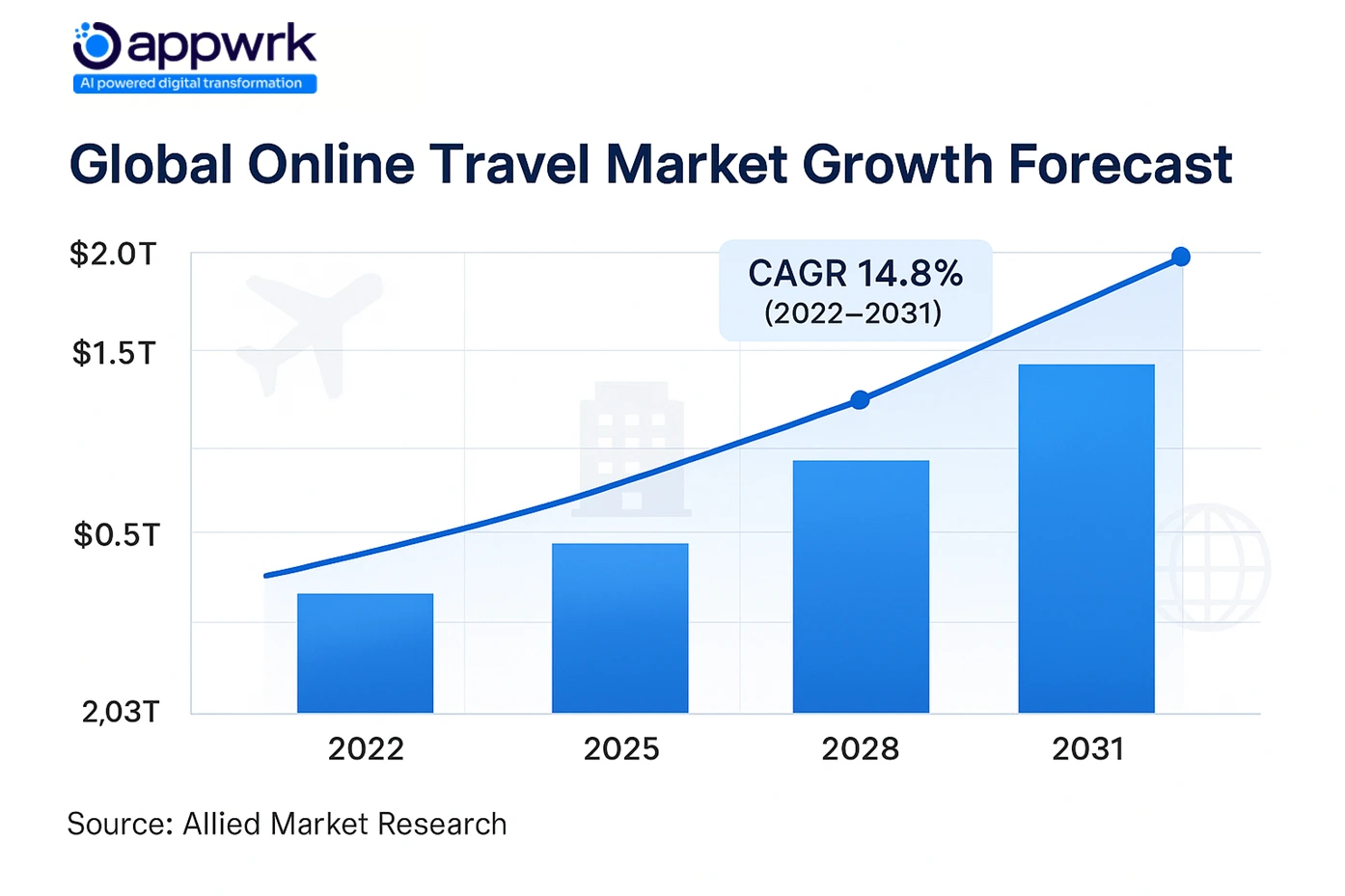
With global tourism and travel rebounding post-pandemic, the demand for digital-first solutions has surged. The travel app market remains one of the fastest-growing categories in mobile app development, fueled by rising smartphone adoption, personalization, and the shift toward mobile-first bookings. According to Allied Market Research, theglobal online travel marketis expected to hit $1.8 trillion by 2031, growing at a CAGR of 14.8% from 2022 [Allied Market Research].
Travel App Industry Growth Rate and CAGR
Travel and tourism contributed nearly 7.6% to global GDP in 2023, and smartphones now account for the majority of mobile bookings. From booking travel reservations to discovering unique travel experiences, users expect seamless flows across mobile app development ecosystems. Giants like Google Trips, Airbnb, and Expedia dominate, but niche-focused apps for vacation rentals or travel packages tied to curated property listings are seeing rapid adoption.
Market Share of Top Travel Platforms
Big players like Booking.com, Airbnb, and Expedia dominate the mainstream segment, generating billions in annual bookings. However, their focus is broad. Niche segments remain underserved, creating opportunities for startups to win market share through customizable event pages, real-time updates, and AI and machine learning features that improve personalization.
Untapped Niches in Travel Apps
Eco-Travel Apps → Growing demand for sustainable travel is driving carbon offset features, eco-certified properties, and green itinerary options. These apps benefit from feedback surveys and post-event analysis that demonstrate environmental impact.
Group Travel Apps → Shared bookings, expense splitting, and synced itineraries are underdeveloped, despite demand from families, students, and group tour organizers.
Solo Travel Apps → Safety-first navigation, community features like real-time chat and networking opportunities, and curated itineraries align with the solo travel boom.
Luxury Travel Apps → High-net-worth travelers demand concierge-level service, exclusive offers, and loyalty perks. Here, features like multi-currency payment, advanced booking, and premium subscription plans can generate strong margins.
The travel app development market is far from saturated. Mainstream apps dominate general bookings, but niche-focused platforms, eco, group, solo, or luxury, offer profitable entry points for startups and SMEs. With the right monetization model and scalability planning, entering in 2025 is both viable and rewarding.
Travel App Development Cost Breakdown
The cost of travel app development typically ranges between $5,000 $40,000, influenced by the app type, supported platforms, development model, and whether you opt for a custom build or a template-based approach. Unlike many competitors who recommend starting budgets of $25,000 or higher, a lean MVP travel app can be launched at a fraction of that cost with the right planning.
Travel App Development Cost by App Type (MVP, Full Suite, SaaS Model)
MVP Travel App: $5,000 to $12,000
A lightweight version designed with essential booking flows, search functionality, and itinerary management. This type of travel booking app is ideal for startups or entrepreneurs testing new concepts and validating demand before scaling further.
Full Suite Travel App: $15,000 to $30,000
A more complete build including flight booking, hotel reservations, secure payment gateways, push notifications, maps integration, and multi-currency payment support. This setup is best for growing agencies or travel businesses looking to enter the market with competitive features and a polished mobile travel app.
Travel SaaS Platform: $25,000 to $40,000
A scalable platform designed for multiple agencies or large-scale users. These builds often include admin dashboards, subscription plans, and advanced integrations. Perfect for companies pursuing a SaaS model in travel technology, offering long-term recurring revenue opportunities.
App Type
Feature Scope
Estimated Cost
MVP Travel App
Booking, search, itinerary basics
$5,000 to $12,000
Full Suite Travel App
Bookings, payments, maps, notifications
$15,000 to $30,000
SaaS Travel Platform
Multi-tenant dashboards, analytics, subscriptions
$25,000 to $40,000
Travel App Development Cost by Platform (Web, iOS, Android, Cross-platform)
The platform you choose directly shapes your travel app development cost. A web-first build is often the most affordable starting point, while building for both iOS and Android or opting for cross-platform frameworks like Flutter or React Native influences budget, scalability, and maintenance.
Web or Single Platform App: $5,000 to $10,000
Ideal for startups testing market fit, this option focuses on travel websites or a single mobile travel app. While affordable, it limits audience reach compared to dual or cross-platform development.
Dual Platform App: $12,000 to $20,000
Building separately for both iOS and Android doubles the effort but ensures a smooth native experience. These mobile apps excel for travel businesses prioritizing rich engagement features like push notifications, real-time updates, and event app-style check-ins for bookings.
Cross-Platform App: $10,000 to $18,000
With frameworks like Flutter or React Native, you use one codebase to deliver apps on multiple platforms. This approach is cost-effective, accelerates development, and simplifies updates, making it the most popular choice for mobile event apps and modern travel startups alike.
Web + Mobile Suite: $20,000 to $40,000
For established agencies, building a complete ecosystem with a travel website for organizers and mobile travel apps for users delivers maximum impact. This setup offers end-to-end coverage, from browsing and booking to reminders and in-app engagement.
Travel App Development Cost by Development Model (In-house vs Outsourced vs Hybrid Teams)
How you structure your development team plays a huge role in cost-efficiency and delivery speed.
In-House Team: $30,000+
Gives full control but comes with high overhead due to salaries, benefits, and infrastructure. In-house teams also require strong project management and ongoing maintenance budgets.
Outsourced Development: $6,000 to $18,000
A popular option for startups and small agencies. Offshore teams in regions like India or Eastern Europe deliver affordable builds without compromising on quality. Outsourced setups often include support and service contracts or a dedicated support team for post-launch assistance.
Hybrid Teams: $12,000 to $25,000
Balances local oversight with outsourced cost savings. Often involves a local product manager coordinating with offshore developers, ensuring better alignment on timelines and features while staying within budget.
Custom vs Template-Based Cost Difference in the Development of a Travel App
Template-Based Apps: $5,000 to $8,000
Good for fast launches, but lacks flexibility and long-term scalability. Best for travel startups seeking early traction without complex workflows.
Custom Travel Apps: $12,000 to $40,000
Designed around unique workflows and long-term ROI. Offers advanced features like multi-currency payment, online payment gateways, and custom booking engines. Better suited for agencies or SaaS startups that need scalability and differentiation.
Feature-led Budgeting Strategy vs Backend-Led Budgeting Strategy
Budgeting depends on whether you focus more on feature sets or backend infrastructure.
Feature-Led Costs
Prioritize user-facing capabilities such as loyalty rewards, AI-based travel suggestions, itinerary builders, or push notifications.
Backend-Led Costs
Backend architecture, cloud hosting (AWS, GCP, Azure), and integration with legacy systems like airline APIs or hotel CRMs often account for up to 40% of overall development. Features like real-time updates and performance-heavy integrations can drive this cost higher.
Why a Travel Mobile App Outperforms a Travel Mobile Website in Conversions, Speed & User Experience
Travel Activities for Travel App / Websites
Mobile App Users
Mobile Website Users
Searching for a flight
78% of users search via apps
55% search via mobile web
Booking a flight
62% bookings via apps
51% via mobile web
Searching for accommodation
71%
51%
Booking accommodation
70%
51%
Searching for discounts/offers
62%
50%
Checking into a flight
66%
58%
Generating a boarding pass
68%
58%
Buying add-ons (Wi-Fi, baggage, upgrades)
62%
54%
Looking for car rentals
44%
56%
Making last-minute bookings
61%
50%
Searching for things to do in destination
53%
46%
Booking destination activities
58%
48%
User Experience (Product Views)
4.2× more views per session
Lower engagement
Offline Functionality
Offline maps, itineraries, booking confirmations available
No offline support
Performance (Speed)
Load 3× faster than web
Slower, image-heavy pages cause drop-offs
Engagement (Push Notifications)
+40% engagement
Not supported
Significant Conversion Gains with Travel Apps
Travel app conversion rates can be up to 220% higher than mobile websites, within equivalent booking funnels, in-app rates can reach as high as 20% vs just 6% on the mobile web.
With mobile travel traffic rising steadily, 70.5% of global online travel traffic came from mobile devices in 2024, mobile apps capture substantially more engagement by meeting users where they are.
Access to native mobile features, such as GPS-based localization for personalized travel suggestions, biometric login, seamless payments, and push notifications, elevates the user journey beyond what mobile websites can offer.
Real-time updates and dynamic journey cues (e.g. gate changes, boarding passes) reduce friction and increase booking completion.
Offline Accessibility: An Indispensable Travel App Capability
Travel apps supportoffline access to itineraries, maps, booking confirmations, and essential travel documents, meeting traveler expectations in low-connectivity or international settings.
In contrast, mobile websites lack the ability to cache complex, data-heavy travel content for offline scenarios, often leaving users stranded without critical trip info.
Push Notifications Drive Engagement and Immediate Actions
Push notifications provide ~40% higher user engagement across travel apps by delivering timely alerts, such as flight delays, last-minute deals, reservation reminders, directly to users’ home screens. Mobile web cannot replicate that level of immediacy or persistence.
Combined with fast response rates, they significantly reduce booking abandonment and boost upsell opportunities.
Performance and Speed: Key to Travel App ROI
Apps load 3× faster than mobile websites, critical in travel where users often make time-sensitive booking decisions.
Native screens handle image-heavy content, hotel galleries, interactive maps, destination media, more efficiently than mobile browsers, which can lag or throttle under load.
Why this matters for founders: Launching a robust travel mobile app, even at the higher end of your projected development cost range (e.g., $12K–$40K), can yield exponentially better engagement, conversion rates, retention, and operational efficiency than relying solely on a mobile-optimized website.
How Can You Launch a Travel App Under $10K? Learn From Appwrk’s Proven Case Study
Even under tight constraints, you can launch a scalable MVP that feels branded and user-ready. Here’s how Appwrk delivered a travel app on a $10,000 budget.
1. Context and Challenge: Launching Under Budget with Essential Features
A travel startup approached Appwrk with less than $10,000 to create a mobile travel app that supported itinerary planning, offline navigation, and reminders. They had no in-house team and needed a fast way to validate their idea.
The team focused on features that mattered most to early users:
A user-friendly itinerary builder to plan multi-leg trips.
Offline map access for areas with poor connectivity.
Push notifications for reminders and trip changes.
A modular backend prepared for future booking APIs, and online payment gateways.
3. Travel-Specific Solutions Implemented
Itinerary Builder – Easy planning and tracking of trips.
Offline Maps with Navigation – Reliability when traveling without internet.
Trip Alerts and Reminders – Keeps travelers informed in real time.
Modular Backend Setup – Built for scalability, allowing future upgrades like loyalty programs or post-event analysis for group trips.
4. Results: Functional App Delivered Within Budget
Delivered in just 8 weeks, under $10,000.
Achieved a 60% onboarding completion rate in the first week.
Positioned to evolve into a full-fledged platform with bookings, live streaming for travel events, or AI-powered recommendations without a full rebuild.
5. Strategic Relevance for You
This case shows how even on a limited budget, Appwrk’s phased development approach and modular design deliver scalable, future-ready travel software. Starting lean doesn’t mean sacrificing quality; you can begin with the essentials and expand intelligently as your demand grows.
Regional Cost Breakdown for Travel App Development
The cost to build a travel app depends heavily on where your development team is based. The same MVP that costs $7,000 in Asia could run four times higher in North America. For founders, understanding these regional differences is key to smarter budgeting, better resource allocation, and choosing the right pricing models.
Travel App Development Cost in North America
In the USA and Canada, development typically ranges from $15,000 to $25,000. With hourly rates of $60 to $100, this region is the most expensive for mobile app development and travel websites. While in-house development provides local expertise and tighter control, many startups turn to offshore or hybrid models to keep their MVPs under budget.
Travel App Development Cost in Europe
Western Europe (UK, Germany, France) averages $18,000 to $28,000, with hourly rates from $50 to $90. Eastern Europe, especially Ukraine and Poland, offers strong technical talent at lower rates of $30 to $50 per hour. This brings MVP costs down to $10,000 to $18,000, making the region attractive for multi-platform support and more complex builds.
Travel App Development Cost in Asia
Asia remains the most affordable region for outsourcing.. In India, Vietnam, and the Philippines, an MVP can be launched for as little as $5,000. More advanced mobile travel apps with itinerary planning, maps, and online payment gateways typically cost $8,000 to $15,000. With hourly rates of $20 to $40, Asia is the go-to choice for founders building their first version or experimenting with phased development approaches.
Travel App Development Cost in MENA
In the Middle East and North Africa (UAE, Saudi Arabia, Egypt), costs range between $10,000 and $20,000. Hourly rates of $35 to $60 make this region more expensive than Asia, but its advantage lies in closer time zones, cultural proximity, and easier vendor collaboration for businesses in the Middle East.
Cost Comparison: USA vs India vs Ukraine vs UAE
USA: $15,000 to $25,000: highest labor costs, best suited for enterprises needing local expertise.
India: $5,000 to $15,000: most cost-efficient, ideal for MVPs and small startups.
Ukraine: $10,000 to $18,000: reliable for complex builds with advanced features and capabilities at mid-tier costs.
UAE: $10,000 to $20,000: balanced pricing, strategic regional proximity.
Pricing Models for Travel App Development
When planning your travel app development cost, it is not only about the geography but also the contract model you choose.
Fixed Price: $5,000 to $20,000 Best for MVPs with a clearly defined scope. Works well when timelines and deliverables are predictable, and budget tracking is a priority.
Hourly: $20 to $100 per hour Flexible but variable, depending on app complexity, scope changes, and task management. Ideal for projects where collaboration tools and agile methods are central.
Dedicated Teams: $2,500 to $6,000 per month per developer Designed for long-term projects, scalability, and continuous delivery. Dedicated models are popular for agencies looking to grow their apps into SaaS platforms with ongoing support and performance monitoring.
Travel App Development Cost by Region
Region
Average Cost Range
Hourly Rate Range
Best Fit
North America
$15,000 to $25,000
$60 – $100/hr
Enterprises & funded startups needing local teams
Western Europe
$18,000 to $28,000
$50 – $90/hr
Established companies seeking proximity
Eastern Europe
$10,000 to $18,000
$30 – $50/hr
Startups seeking quality + affordability
Asia (India, etc.)
$5,000 to $15,000
$20 – $40/hr
Budget-friendly MVPs, rapid prototyping
MENA (UAE, etc.)
$10,000 to $20,000
$35 – $60/hr
Regional builds, cultural alignment
What Exactly Influences Travel App Development Cost the Most?
The cost to develop a travel app isn’t set by a single factor. It’s shaped by design decisions, backend architecture, team setup, and long-term business goals. A simple MVP can start at $5,000, while apps with AI and machine learning features, advanced booking flows, and multi-currency payment gateways may cost $30,000 to $40,000. Here are the factors that most directly influence your budget.
App Complexity
A lightweight itinerary planner can be built for $5,000 to $8,000, while a full travel booking app with live flight data, maps, reviews, real-time updates, and secure payments may exceed $20,000. Complexity also comes from how features interact, for example, connecting booking engines with real-time seat availability and automated task management.
Hired Development Team
Your travel app development cost is tied to who builds it. Freelancers may deliver a prototype under $6,000, but long-term scalability often requires an agency or dedicated support team. Agencies typically push costs closer to $18,000 while balancing accountability with expertise. Hybrid teams offer middle-ground value by combining local project managers with offshore developers.
Features and Functionalities
Every feature adds to the cost. Basics like hotel booking, GPS navigation, and reminders keep budgets lean, while custom attendee forms (for travel preferences), loyalty rewards, and live streaming of travel events increase complexity. Third-party API integrations, such as Amadeus or Skyscanner, carry licensing fees and development hours. For example, Expedia reports a 35% increase in booking completions by using AI-driven personalized recommendations, proving how advanced features can directly impact ROI.
Platform Choice (Native vs Cross-Platform)
Native Apps (iOS and Android): Best performance, but separate builds may cost $15,000 to $25,000.
Cross-Platform Apps: Frameworks like Flutter or React Native reduce duplication, bringing costs to $8,000 to $18,000 with full multi-platform support.
UX/UI Design
Design isn’t just aesthetics; it’s a cost driver. A clean, functional UI may cost $2,000 to $5,000, while fully branded, animated interfaces with branding elements can add $7,000 to $10,000. In travel apps, intuitive navigation is crucial; confusing booking flows lead to drop-offs.
Backend Infrastructure
The backend powers everything: user accounts, bookings, payments, notifications, and data analytics. Modern travel apps often rely on robust databases like PostgreSQL, supported by secure server-side infrastructure and cloud storage. A lightweight setup may cost $3,000–$6,000, but scalable architectures with data encryption, automated performance testing, and compliance-driven security measures can push costs into the $12,000–$15,000 range while ensuring reliability during peak traffic.
Location of the Agency
Development costs swing widely by geography. US or Western Europe can cross $20,000+, while teams in India, Vietnam, or Ukraine can deliver an MVP between $5,000 and $12,000 with a strong quality-to-cost balance.
Backend Architecture Choice
Monolithic builds: $5,000 to $8,000 upfront, but harder to scale.
Microservices: $12,000 to $18,000 initially, but scalable for booking engines, payments, or future AI upgrades.
Technology Incorporation
Adding advanced tech like AI-powered trip suggestions, AR navigation, or blockchain ticketing adds $5,000 to $10,000. While not essential for MVPs, these features differentiate your app in a competitive market. For instance, Hopper’s AI‑based dynamic pricing helps increase airline and hotel operator revenue by at least 10%, showing how AI-powered pricing infrastructure can pay for itself.
Travel Booking App Design and Development
Building booking engines with live hotel and flight data is one of the costliest elements. APIs like Booking.com or Skyscanner bring fees plus development effort, typically adding $8,000 to $15,000.
Backend Development
Beyond infrastructure, backend tasks include integration with legacy systems, load balancing, and database orchestration. Optimized systems lower long-term maintenance costs, a factor often overlooked during initial budgeting.
Development Team
A dedicated support and service model can cost $2,500 to $6,000 per developer per month. This suits businesses planning continuous updates, post-event analysis (e.g., seasonal travel data), and ongoing scaling.
Premium and Basic Features
Basic builds: Booking flows, maps, reminders → $5,000 to $12,000.
Premium builds: Loyalty points, AI recommendations, dynamic pricing → up to $25,000+. Balancing business objectives with features is key to avoiding overspending.
Maintenance and Support
Ongoing costs average 15 to 20% of the initial build cost. For a $10,000 MVP, budget $1,500 to $2,000 annually for server hosting, bug fixes, security patches, and security audits. This also covers regular user acceptance testing to maintain quality.
Buyer Takeaway
The cost of travel app development is never fixed; it depends on how you prioritize features, infrastructure, and delivery models. With a smart phased development approach and careful cost allocation, you can launch an MVP for $5,000 and scale strategically into a robust, competitive platform.
Hidden and Ongoing Costs of Travel App Development
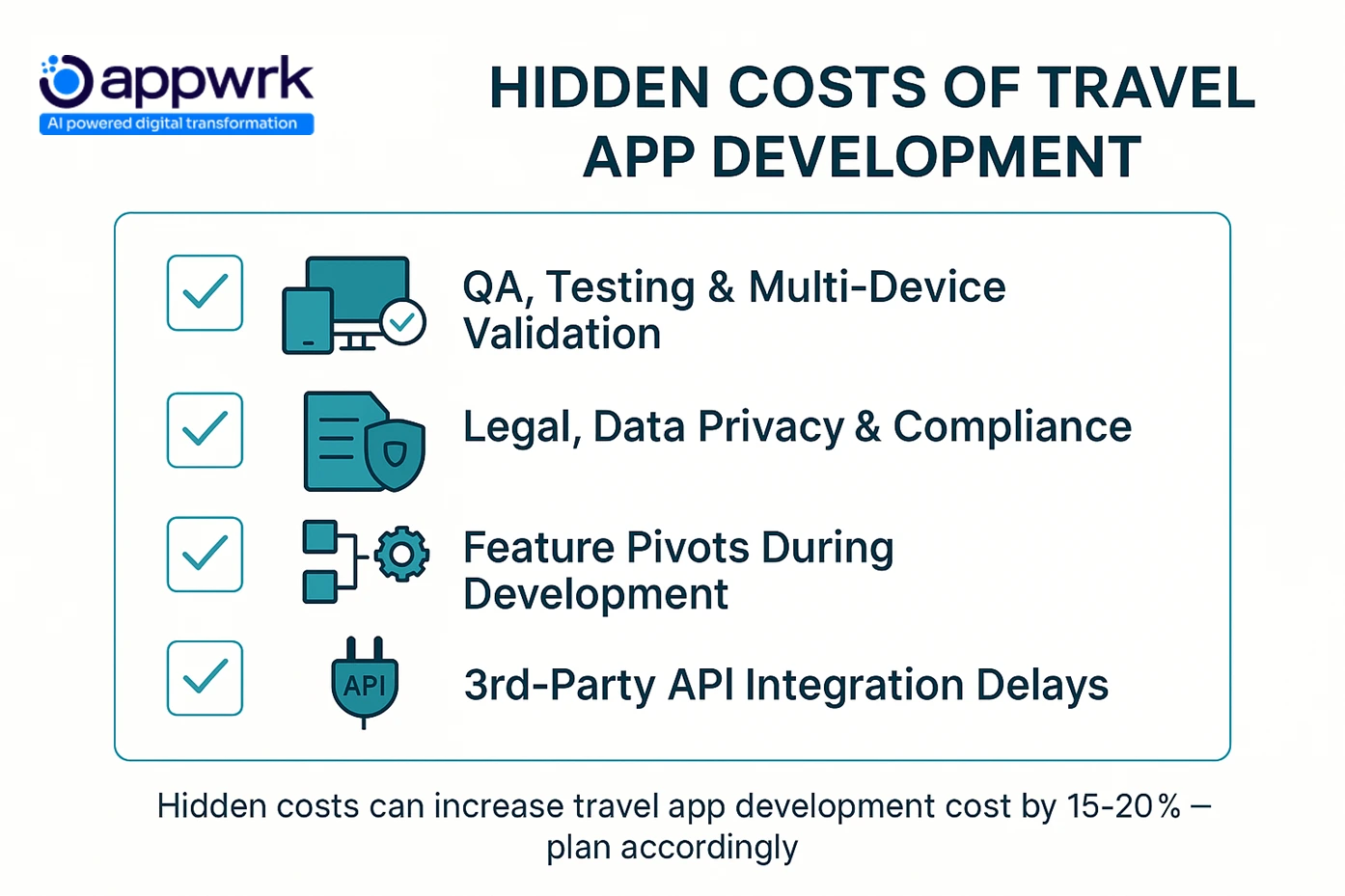
When budgeting for a travel app, most founders only think about upfront development. But the real travel app development cost extends well beyond coding. Hidden pre-launch tasks and recurring post-launch commitments can add 20 to 30% to your budget every year. Overlooking them risks cost overruns, delays, and poor performance down the line.
QA (Quality Assurance), Testing Cycles, and Multi-Device Validation
A travel app must work flawlessly across devices, platforms, and network conditions. Quality assurance ensures smooth booking flows, secure payments, and real-time updates for users. Testing alone can add 15 to 20% of the original build cost. For example, a $10,000 MVP might require another $1,500 to $2,000 just for validation, bug fixes, and user acceptance testing.
Legal, Data Privacy, and Certification Costs
Travel apps handle sensitive data, from payment details to IDs. Compliance with GDPR, PCI DSS, and CCPA is essential. Certification audits and legal reviews may add $1,000 to $5,000, but they are non-negotiable for app store approvals, security audits, and user trust.
Feature Pivots During Development
Market realities change fast. Founders often add loyalty programs, AI and machine learning features, or expanded booking flows mid-development. These pivots increase costs by 10 to 30%. Allocating budget flexibility up front ensures feedback doesn’t derail timelines.
Communication and Sync Delays with Third-Party APIs
Flights, hotels, maps, and payments, most travel apps rely on external APIs. Hidden costs often show up in the form of licensing fees, sync delays, or downtime. Setting aside $1,000 to $3,000 prevents disruptions when integration with legacy systems needs extra development.
Post-launch Support and Maintenance
The work doesn’t end at launch. Expect annual maintenance to cost 15 to 20% of the original build. For a $10,000 MVP, that’s another $1,500 to $2,000 per year for bug fixes, server monitoring, and feature upgrades. Most agencies provide support and service contracts to keep apps healthy.
Running a travel app requires ongoing infrastructure:
Cloud hosting (AWS, GCP, Azure): $300 to $1,500 per month
Analytics (Firebase, Mixpanel): $100 to $500 per month
Support systems: $200 to $500 per month
Together, these can add $500 to $2,000 monthly to your expenses.
Update Cycles and Store Compliance
Apple and Google roll out constant OS updates. Staying compliant may cost $500 to $1,500 annually for code adjustments, security patches, and resubmissions. Without this, apps risk rejection or poor ratings.
Marketing Automation and Retention Tools
Building downloads is one thing; retaining users is another. Tools for push notifications, email, and CRM integration cost $200 to $500 monthly. But they improve retention, enable feedback surveys, and increase lifetime value by powering personalized engagement.
Travel app budgets must account for more than development. QA, compliance, APIs, cloud deployment, and retention tools are essential investments. Planning for them upfront avoids surprise bills and ensures the app stays secure, scalable, and profitable.
The General Data Protection Regulation governs how personal, financial, and location data is collected, processed, and stored. Travel apps targeting European markets must implement transparent privacy policies, data portability, and the “right to be forgotten”. Non-compliance can trigger penalties of up to €20 million or 4% of global revenue, making GDPR adherence a critical cost consideration in travel app development.
PCI-DSS Certification (Payments):
Handling bookings, ticket reservations, and in-app payments means strict adherence to Payment Card Industry Data Security Standard (PCI-DSS). Certification requires tokenization, strong encryption, and multi-layer authentication to secure credit/debit card transactions. Failure to comply can lead to loss of merchant privileges and legal liabilities.
Data Encryption & Secure APIs:
Travel apps exchange sensitive information, like user IDs, booking history, and payment details, with third-party APIs (Skyscanner, Amadeus, Google Maps). End-to-end encryption (AES-256) and secure API gateways with SSL/TLS are essential for preventing data breaches and API misuse.
User Consent & Privacy Controls:
Users must have explicit opt-in choices for data collection, cookies, and marketing preferences. This not only complies with GDPR but also builds long-term trust and transparency, improving conversion rates and app adoption.
Fraud Prevention & Monitoring:
AI/ML-driven fraud detection helps prevent payment fraud, account takeovers, and fake bookings. Automated monitoring systems identify unusual login patterns and stop threats before they impact users.
Multi-Factor Authentication (MFA):
A mandatory layer for secure identity verification, MFA ensures only verified users and agents access sensitive systems. Features like OTP, biometrics, or app-based authenticators significantly reduce unauthorized access risks.
Cloud Security & Storage Compliance:
Hosting on GDPR-compliant cloud providers (AWS, Azure, GCP) ensures secure storage with role-based access control (RBAC), intrusion detection, and regular penetration testing. Cloud security reduces risks of unauthorized data exposure while improving scalability.
Ongoing Compliance Updates:
Security and compliance aren’t one-time tasks. Frequent vulnerability scans, penetration tests, and compliance audits ensure that apps stay aligned with evolving data protection laws like CCPA, GDPR updates, and PCI revisions. Regular updates also safeguard user trust, app store approval, and long-term market scalability.
What Are the Must-Have Features for a Scalable Travel App?
The features you include directly impact cost, adoption, and ROI. For travel apps, scalability depends on both customer-facing and admin-side features. Here’s a breakdown of must-have features, with cost ranges and why they matter.
Customer Panel Travel App Features
Easy Onboarding with User Profiles
Cost range: $1,000 to $2,500 Quick onboarding via email, phone, or social logins reduces drop-offs. Profiles store preferences, booking history, and saved payments. Costs increase if you add biometric logins, AI personalization, or multi-platform support.
Browsing and Booking Hotels, Flights, or Activities
Cost range: $2,000 to $5,000 Browsing and Booking Hotels, Flights, or Activities – $2,000–$5,000. The backbone of any travel app. Users expect smooth browsing, filtering, and instant booking. Integrations with APIs like Amadeus, the Skyscanner API, or Google Maps for mapping services increase costs but deliver real-time data on availability, pricing, and routes. Some platforms also include real-time inventory for hotels, ticket booking apps for flights, or even bundled travel insurance apps for added peace of mind.
Personalized Trip Itineraries
Cost range: $1,500 to $3,000 Day-by-day itinerary planning with calendar generation and offline access. Advanced builds use AI to auto-suggest activities or optimize schedules. Integration with Google Calendar adds convenience for travelers.
Multi-language and Multi-currency Support
Cost range: $1,500 to $3,500 Essential for global adoption. Apps that support multiple languages and currencies increase reach while adding compliance for regional taxes. Including multi-currency payment options ensures smooth checkouts for international users.
Real-time Booking Confirmations and Receipts
Cost range: $1,000 to $2,500 Instant confirmations build trust. Receipts integrated with online payment gateways and loyalty tools streamline customer journeys. Enhanced builds can connect with feedback surveys for better post-trip insights.
Admin Panel Travel App Features
User and Agent Management
Cost range: $1,500 to $3,500 Admins need centralized control over users, property agents, and activity logs. Scalable systems with role-based access, on-site management features, and task allocation increase cost but are essential for compliance and large-scale travel platforms.
Advanced Analytics and Reporting Dashboards
Cost range: $2,000 to $5,000 Provide real-time insights into bookings, revenue, and user activity. When combined with predictive analytics, post-event analysis, and feedback surveys, costs increase, but strategic value skyrockets.
Advertisement and Promotional Management
Cost range: $1,000 to $2,500 Admins can create targeted ads, banners, and offers to boost engagement. Adding A/B testing or interactive social media posts pushes the budget higher but enhances discoverability.
Payment Gateway and Refund Control
Cost range: $2,000 to $4,000 Handles transactions, refunds, and chargebacks securely. Supporting multi-currency payment options, fraud detection, and complaints and refunds workflows increases costs but strengthens financial trust.
Fraud Monitoring and Compliance Settings
Cost range: $1,500 to $3,000 Prevents fraud with monitoring systems while ensuring compliance with GDPR, PCI-DSS, and local financial laws. Adding security audits and performance monitoring raises complexity but protects brand reputation.
Property Agents Panel Features
Property and Package Management Dashboards
Cost range: $2,000 to $4,000 Property owners and agents need intuitive dashboards to manage listings, availability, and pricing. Advanced dashboards with bulk upload, analytics, and mobile-first management add to the cost but significantly improve vendor management and operational efficiency.
Dynamic Pricing and Availability Updates
Cost range: $1,500 to $3,500 Agents can adjust prices in real time based on demand, season, or occupancy. Integrating with external property management systems (PMS) or legacy systems increases costs but ensures competitiveness in crowded markets.
Reservation and Booking Management
Cost range: $1,500 to $3,000 Allows agents to confirm, cancel, or modify reservations directly. When linked with CRM tools or task management systems, costs increase, but customer satisfaction improves dramatically through better coordination.
Commission Tracking and Payment Settlements
Cost range: $1,000 to $2,500 Automates financial workflows by calculating commissions and payouts. Advanced settlement systems with audit trails and budget tracking capabilities build trust between agents and platforms.
Customer Communication Tools (Messaging/Chatting)
Cost range: $1,500 to $3,000 Includes in-app messaging, inquiry handling, and chat support for direct interaction. Adding chatbots, real-time chat, or multilingual support raises costs but reduces operational load while boosting collaboration tools between users and agents.
Delivers a high-quality catalog with photos, amenities, pricing tiers, filters, and real-time availability for hotels, vacation rentals, and bundled travel packages to drive faster booking decisions.
Essential User Experience Features
Manage Bookings with Real-Time Updates
Cost range: $1,500 to $3,000 Users can edit, cancel, or view bookings with instant sync. Linking with event scheduling tools or multi-platform support ensures reliability across devices.
Detailed Analytical Reports for Users
Cost range: $1,000 to $2,000 Provides insights into travel spend, booking behavior, and past trips. Enhanced versions add budget tracking, post-event analysis, and AI-powered recommendations for personalization.
Advanced Search Filters
Cost range: $1,500 to $3,000 Filters by budget, ratings, amenities, or location enhance usability. Costs rise when powered by AI and machine learning features that personalize discovery.
Easy Reservations in a Few Clicks
Cost range: $1,000 to $2,500 Frictionless checkouts improve conversions. Adding one-tap payments, autofill, and custom attendee forms raises development effort but makes booking effortless.
Push Notifications for Timely Updates
Cost range: $1,000 to $2,500 Keeps users informed about deals, trip changes, or cancellations. Advanced tools allow segmentation, dealing with event cancellation notifications, and live polling/Q&A sessions for engagement.
Multiple In-app Payment Methods
Cost range: $2,000 to $4,000 Supports cards, wallets, and local payments. Adding integration with online payment gateways, crypto support, or subscription plans pushes costs higher but widens adoption.
Ratings and Reviews for Credibility
Cost range: $1,000 to $2,500 Let users share feedback, strengthening credibility. Verified reviews and AI moderation tools raise costs but ensure authenticity.
Top Features for Your Travel App
User Accounts and Profiles
Cost range: $1,000 to $2,000 Builds loyalty and personalization. Accounts can sync with Google Calendar or event scheduling software for smarter travel planning.
Search and Discovery Tools
Cost range: $1,500 to $3,000 Drives engagement by helping travelers explore destinations, venues, and venue information with interactive maps.
Booking and Reservations
Cost range: $2,000 to $5,000 A non-negotiable feature for revenue. Enhanced builds include RSVP, customizable event pages, ticketing system integrations, and speaker management for conferences or tours.
Location-Based Services
Cost range: $1,500 to $3,000 Provides nearby suggestions and contextual offers. Linking with venue space management and networking opportunities increases engagement.
Maps and Navigation with Offline Support
Cost range: $2,000 to $4,000 Ensures smooth navigation even without internet, a must for global travelers. AI-powered maps can provide real-time updates on local transport or weather.
Reviews and Ratings
Cost range: $1,000 to $2,500 Boosts purchase confidence. Integration with feedback surveys and collaboration tools increases strategic value.
Offline Functionality
Cost range: $2,000 to $4,000 Supports offline itineraries, maps, and saved bookings. Adds resilience in low-connectivity areas.
Photos and Media Galleries
Cost range: $1,500 to $3,000 Showcasing visuals improves conversion. AI-powered galleries personalize content for different user groups.
Notifications and Alerts
Cost range: $1,000 to $2,500 Keeps users engaged through updates, offers, and reminders. Best when tied to task management and loyalty programs.
Filters and Sorting Options
Cost range: $1,500 to $3,000 Refines search results for faster decision-making. Adding AI-powered matchmaking with personalization increases adoption.
AI-powered Visual Experiences
Cost range: $3,000 to $6,000 Transforms UX with personalized recommendations and immersive visual journeys. Luxury Escapes’ AI chatbot delivered 3× higher conversion and $300K in revenue within 90 days, showcasing how AI-enhanced user interaction drives ROI.
Social Media Integration
Cost range: $1,000 to $2,500 Encourages sharing and simplifies logins. When paired with interactive social media posts, costs rise but visibility multiplies.
Building a travel app with only basic features costs $5,000 to $12,000. Adding property dashboards, advanced admin controls, AI personalization, and multi-currency payments pushes budgets into the $25,000 to $40,000 range. Founders should prioritize features aligned with their business goals, begin lean, and scale strategically.
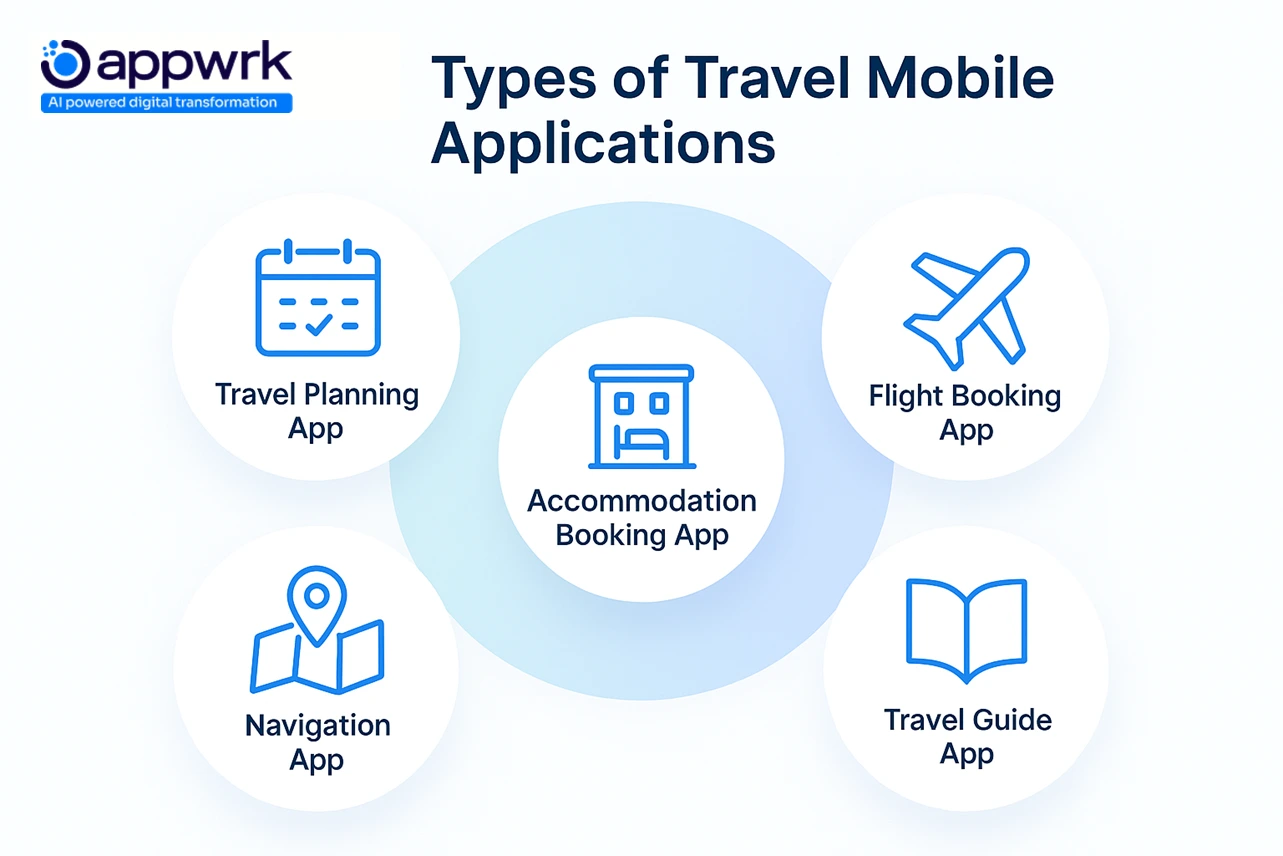
What Are the Different Types of Travel Mobile Applications?
Not every travel app serves the same purpose. The travel app development cost depends heavily on the type of app you want to build, since each comes with its own features, integrations, and scalability requirements. Below are the most common types, with their cost ranges and value insights.
Travel Planning App
Cost range: $5,000 to $12,000 These apps help users organize trips by suggesting destinations, building itineraries, and syncing bookings. Costs rise with features like AI-powered matchmaking, offline itinerary access, or integration with Google Calendar for agenda and scheduling.
Flight Booking App
Cost range: $7,000 to $18,000 Enables users to search, compare, and book flights in real time. APIs such as Amadeus or Skyscanner raise costs but ensure real-time updates and accurate seat availability. Extra features like fare alerts, event app check-in–style seat reservations, loyalty rewards, or multi-currency payment gateways push budgets higher.
Accommodation Booking App
Cost range: $6,000 to $15,000 Let travelers browse hotels, homestays, or rentals using filters like reviews, price, or amenities. Budgets increase when integrating property dashboards, vendor management systems, or dynamic pricing models. Adding badge printing for on-site management or customizable event pages with venue information further scales the cost.
Navigation App
Cost range: $8,000 to $20,000 Built for real-time navigation, route planning, and interactive maps with offline functionality. Costs increase when adding AR-based directions, live polling of routes, or AI and machine learning features for smarter trip suggestions.
Travel Guide App
Cost range: $5,000 to $14,000 Acts as a digital travel companion with interactive social media posts, venue space management, and curated networking opportunities. Advanced builds may include offline guides, AI personalization, and post-event analysis via feedback surveys.
The type of app you choose drives cost. A simple travel planning or guide app may cost $5,000 to $12,000, while feature-heavy navigation or flight booking apps can exceed $20,000. The best choice depends on your audience, your event lifecycle–style workflows, and your long-term scaling strategy.
How Long Does It Take to Build a Travel App?
Timelines vary based on scope, complexity, and the development model (in-house, outsourced, or hybrid) you choose. A lean MVP may take weeks, while an enterprise-grade platform could stretch close to a year. According to GoodFirms, most mobile apps take 3 to 9 months to build, with integrations and features being the biggest time drivers.
Time Estimates by Complexity Level
Basic MVP Travel App (profiles, booking, confirmations): 8 to 12 weeks. Best for startups validating demand quickly with limited budgets.
Mid-Level Travel App (payments, reviews, notifications, session scheduling): 16 to 24 weeks. Ideal for businesses scaling their reach with more features.
Enterprise-Grade Travel Platform (AI recommendations, global booking engines, multi-panel dashboards, and advanced analytics): 6 to 12 months. Needed for enterprises or training conference organizers, event planners, or large agencies requiring compliance and scalability.
Average Development Duration for Travel Apps
Most mid-level apps fall into the 3 to 6 months range. Timelines stretch closer to 9 months when integrating global flight APIs, PMS systems for property management, or complex event scheduling tools with collaboration features and real-time chat.
Cross-Platform vs Native Builds: cross-platform frameworks like Flutter reduce development time by up to 30% compared to separate iOS/Android builds.
Advanced Features: offline maps, blockchain-secured payments, or AI and machine learning features for predictive itineraries can extend development by 6 to 10 weeks.
Team Structure & Location: outsourced or hybrid models lower cost but require extra weeks for communication, task allocation, project management, and phased development approach alignment.
The time it takes to build a travel app depends on balancing scope with resources. By starting with a lean MVP and adopting an agile development methodology, you can get to market faster while leaving room for modular upgrades like add-on products & services, RSVP-style booking confirmations, or open source frameworks/libraries for scalability.
AI, advanced dashboards, offline features, global APIs
6–12 months
How Do Travel Apps Make Money: Monetization Explained
The timeline for travel app development can be as short as 2 to 3 months for an MVP, but may extend close to a year for enterprise-grade platforms. Factoring in complexity, integrations, and cross-platform development upfront helps founders align build timelines with budgets and business goals without running into costly delays.
But here’s the catch: the travel app development cost is only half the story. A well-defined monetization strategy is just as critical. With the global online travel market projected to hit $1.8 trillion by 2031, choosing the right revenue model will determine whether your app scales profitably.
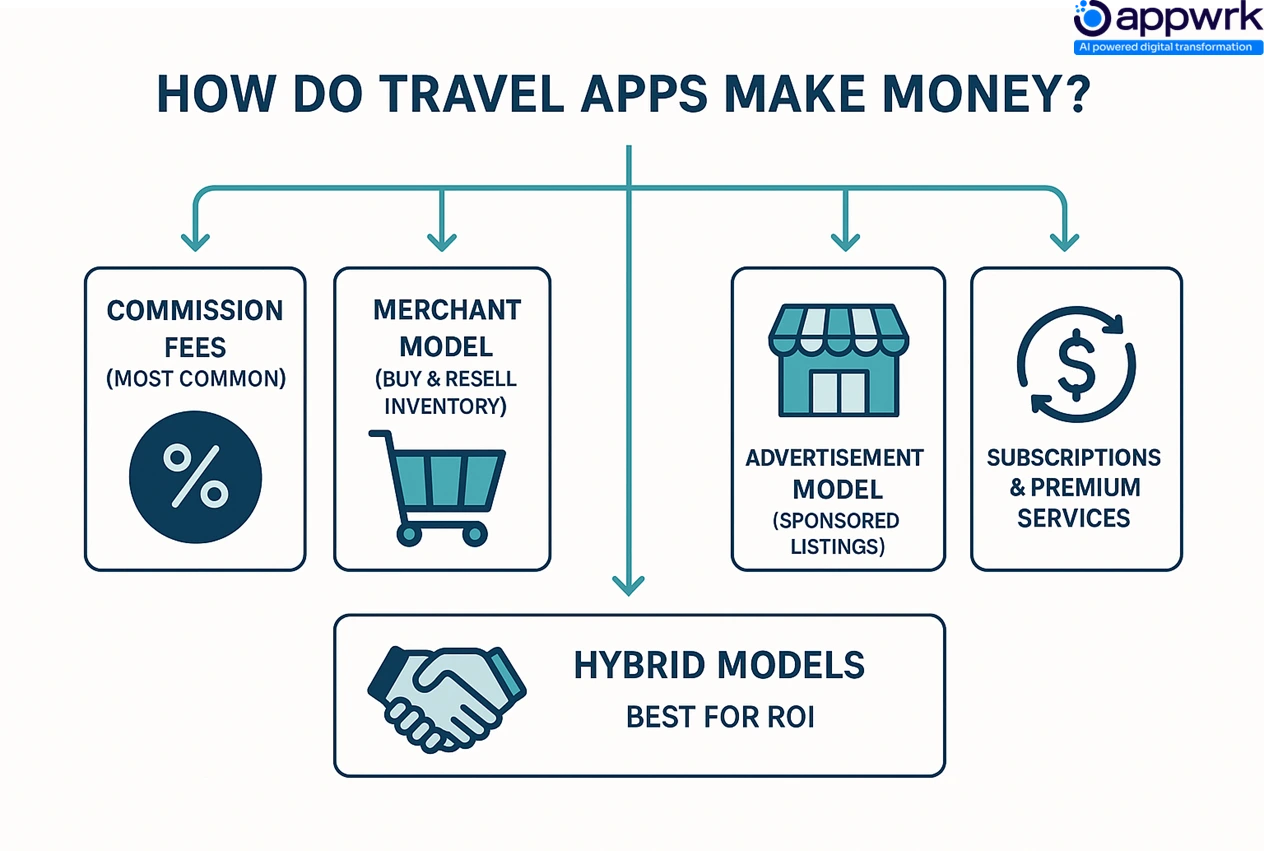
Merchant Model
In this strategy, the app purchases hotel rooms, flight tickets, or travel services in bulk at discounted rates and resells them at a markup. While development costs rise due to inventory dashboards, vendor management workflows, and dynamic pricing models, this approach allows higher margins and predictable revenue. The downside is that it requires significant upfront investment in supplier partnerships and budget tracking systems.
Commission Fees
One of the most common pricing models. The app earns a commission for every booking processed by airlines, hotels, or tour operators. Since there’s no inventory to manage, the main costs involve API integrations, online payment gateways, multi-currency payment support, and secure refund handling. This keeps development costs lower compared to the merchant model, making it a strong fit for startups.
Advertisement Model
For apps with high user traffic, targeted advertising is a proven revenue stream. Sponsored listings, banners, and featured placements bring recurring income. Development costs here include ad management modules, analytics dashboards, and AI personalization engines that ensure relevant placements. When paired with feedback surveys and real-time updates, ads can monetize free apps while boosting ROI.
Best Monetization Models for Long-Term ROI
Hybrid models often perform best. For example, you can combine commission fees with premium ad placements or subscription plans for frequent travelers. Larger SaaS-style travel platforms also layer in add-on products & services such as white-labeled booking engines, post-event analysis dashboards, or advanced collaboration tools for agencies. These recurring strategies ensure long-term ROI and scalability.
What’s the Ideal Strategy for Niche vs Mainstream Travel Apps?
Niche Travel Apps (eco-travel, luxury tours, solo-travel): Subscription models and curated partnerships work better here, as users are willing to pay for personalization and premium services.
Mainstream Travel Apps (general flight and hotel bundles): Commission and ad-driven pricing models scale efficiently, especially as RSVP-style bookings, customizable event pages, and venue information features draw mass-market traffic.
The cost to build a travel app is only one side of the equation. Picking the right monetization model ensures sustainable ROI. For startups, commission-based and ad-driven approaches are quickest to launch. For enterprises, merchant and subscription-based models deliver higher margins and longer-term competitive advantage.
Should You Outsource or Build In-House for Travel App Development?
Another decision that directly shapes travel app development costis whether to outsource, hire freelancers, or build an in-house team. Each has implications for cost, scalability, and innovation.
According to Deloitte’s Global Outsourcing Survey, 70 percent of businesses outsource primarily to reduce costs while gaining access to specialized talent and faster delivery timelines.
Outsourcing Development: Best for startups and SMEs with limited budgets. Offshore teams in Asia or Eastern Europe can deliver high-quality builds at a fraction of US/Western Europe costs, often with support and service contracts included.
In-House Teams: More expensive (upward of $30,000 annually per developer) but offer maximum control, compliance oversight, and alignment with long-term innovation goals. Often chosen by enterprises needing tighter project management and security audits.
Hybrid Teams: A mix of local product managers and offshore developers. Balances control with cost efficiency, using agile development methodologies and phased development approaches.
For travel startups, outsourcing is usually the most cost-effective strategy to launch fast. Enterprises, however, may justify the higher costs of in-house teams for compliance-heavy builds, multi-panel systems, and AI-driven personalization at scale.
Freelancers vs Agencies vs In-House Teams: Cost and Value Comparison
Team Type
Average Cost Range
Strengths
Challenges
Freelancers
$5,000 to $12,000
Extremely affordable, flexible, and ideal for MVP development. Good for testing ideas quickly with minimal investment.
Limited scalability, inconsistent quality, risk of delays due to lack of accountability, and often need multiple freelancers for design, backend, and QA.
Agencies
$8,000 to $25,000
Provide full-stack expertise, dedicated project management, and scalable teams. Agencies bring experience from building multiple travel apps and ensure delivery within deadlines.
Higher upfront cost compared to freelancers, dependency on vendor alignment, and potential communication gaps across time zones.
In-House Teams
$30,000+ annually (per developer)
Offers complete control over development, security, and alignment with business vision. Best for enterprises with long-term plans and ongoing updates.
Very expensive due to salaries, benefits, and infrastructure. Slower to assemble and scale compared to outsourcing, often unsuitable for early-stage startups.
Travel App Development Modes by Business Size
Startups
For startups, freelancers, or outsourced agencies are usually the best fit. With budgets starting at $5,000, they can quickly launch an MVP to test product–market fit. Freelancers may work for smaller prototypes, but agencies often provide more reliability for investor-backed launches by offering project management, QA testing, and post-launch support and service.
SMEs (Small and Medium Enterprises)
SMEs benefit the most from outsourcing to a specialized travel app development agency. With budgets ranging between $8,000 $25,000, SMEs can access design, development, and quality assurance under one roof. Agencies also bring multi-platform support, vendor coordination, and task allocation capabilities, making it easier to scale travel apps in competitive markets.
Enterprises
Enterprises with larger budgets and stricter compliance needs often rely on in-house teams. While costs per developer may exceed $30,000 annually, in-house builds offer stronger security audits, tighter data control, and ownership of the full event lifecycle. Increasingly, enterprises are also embracing hybrid models, combining in-house leads with outsourced developers to balance cost with delivery speed.
Strategic Considerations to Consider for Travel App Development Beyond Cost
Time-to-Market
Outsourced agencies often cut delivery timelines by 20 to 30% compared to in-house teams because they already have agile development methodologies, sprint planning, and domain expertise in building travel apps.
Access to Technology and Talent
Agencies provide broad expertise across open source frameworks/libraries, cloud deployment (AWS/Azure), and AI and machine learning features like personalization engines. Freelancers may lack this range, while in-house teams require months of recruitment.
Scalability and Flexibility
Outsourcing allows you to scale teams up or down based on project phases. In-house teams, on the other hand, require fixed salaries and overhead regardless of workload, limiting flexibility.
Risk and Accountability
Agencies sign contracts with deliverables, service-level agreements, and accountability measures. Freelancers carry a higher risk of leaving projects midway. In-house teams reduce dependency risks but come at a significantly higher financial burden.
Outsourcing remains the fastest and most affordable way for startups and SMEs to launch. Enterprises may justify in-house costs for long-term compliance, branding elements, and scalability planning, but hybrid approaches are increasingly becoming the best-fit option.
How Can You Save Money Without Compromising Quality?
The challenge for most founders isn’t just knowing the Event Management App Development Cost (or travel app cost in this case), it’s figuring out how to save money while still building a scalable, user-friendly platform. Here are proven cost-saving strategies.
Prioritize Essential Features
Instead of starting with everything, focus only on must-have MVP features like bookings, payments, and push notifications. This keeps your initial travel app build closer to $5,000 to $8,000. Add premium features like loyalty programs, live streaming content, or customizable event pages later once demand is validated.
Outsource Development
Outsourcing to specialized agencies can reduce development costs by up to 40 percent compared to in-house teams. Agencies typically provide support team resources, real-time updates, and collaboration tools baked into their workflows, reducing overhead.
Use Pre-Built Solutions
By leveraging online payment gateways, registration forms, event listing features, or integration with legacy systems, you avoid rebuilding common modules from scratch. Hybrid builds using pre-built solutions can stay in the $8,000 to $12,000 range while still offering strong functionality.
Adopt Agile Methodology
Breaking the project into sprints ensures you only pay for what’s validated. Phased development approaches minimize wasted effort, reduce technical debt, and accelerate ROI by launching faster.
Minimize Design Complexity
A clean, functional design costs $2,000 to $4,000, compared to $7,000 or more for heavy custom animations. For travel apps, simple and intuitive flows often outperform expensive visual gimmicks.
The Future of Travel App Development: Emerging Tech That Shapes Costs
According to Statista, global spending on digital transformation technologies is set to surpass $3 trillion by 2026, and travel apps will be part of this shift.
AI-Powered Personalization
Adding AI and machine learning features for personalized recommendations can increase development costs by $3,000 to $8,000. However, it also boosts booking conversions, retention, and overall ROI.
Voice Interfaces and Conversational UI
Voice-enabled search and Q&A sessions through conversational UI are becoming standard. Implementing them may cost $2,500 to $6,000, but they enhance accessibility and align with the growing use of voice assistants.
Blockchain for Secure Transactions
Blockchain ensures transparency in ticket disputes, complaints, and refunds, and payment terms. While adding it may cost $4,000 to $10,000, it builds user trust and reduces fraud risks.
Serverless Infrastructure and Cost-Saving Ops
Migrating to serverless cloud deployment (AWS/Azure) can cost an additional $2,000 to $5,000 upfront, but lowers long-term hosting and performance monitoring expenses by 30 to 40%.
Leveraging AI to Solve Real-World Challenges in the Travel Industry
Artificial Intelligence has evolved into a critical growth driver in travel app development, enabling real-time responsiveness, personalized user experiences, and operational automation at scale. Below are the most impactful ways AI is being applied in travel, across dynamic pricing, customer support, personalization, automation, and predictive analytics.
1. AI-Driven Dynamic Pricing & Revenue Management
Hopper, a pioneer in travel app dynamic pricing, uses machine learning to analyze hundreds of variables, enabling predictive pricing that boosts airline and hotel revenue, studies show AI-based pricing models can drive 10–22% revenue gains in dynamic environments.
Modern travel apps use real-time demand signals, competitor pricing data, and seasonality trends to optimize prices instantly, this personalized pricing strategy not only maximizes margins but also improves perceived value for users.
Cutting-edge systems adopt a microservices architecture, ensuring scalability and reducing latency during peak loads, one implementation showed 17% faster pricing responses and a 30% drop in resource usage, with a 15% increase in user satisfaction.
2. AI-Powered Customer Service: Virtual Assistants at Scale
Booking.com’s AI booking assistant now resolves up to 50% of inquiries within 5 minutes, demonstrating how AI can handle high-volume service while keeping users satisfied.
AI chatbots provide multi-language support, contextual query resolution, and 24/7 availability, significantly lowering support costs and freeing agents to manage complex customer issues.
Appwrk Case Study: Our AI chatbot solution for a global client delivered natural, human-like conversations that improved customer engagement by 45% while reducing support workload. The bot handled FAQs, booking queries, and follow-ups, freeing human agents for complex issues. See full case study.
3. Personalized Recommendations That Convert
Travel platforms increasingly embed AI to craft personalized itinerary suggestions, recommending hotels, flights, or travel packages based on prior behavior and preferences.
This personalization has been shown to drive a 35%+ uplift in booking completions, as users are more engaged when presented with relevant, tailored options. While specific examples like Expedia are anecdotal, the underlying AI benefit is well-documented in major industry applications.
4. Operational Efficiency Through Intelligent Automation
Luxury travel brands that deploy AI-driven booking chatbots have achieved up to 3× higher conversion rates and added substantial revenue, one implementation generated $300K in 90 days.
Airlines are also integrating AI tools for real-time baggage tracking and itinerary updates, improving both operational reliability and passenger experience.
Short-term forecasting powered by AI models helps travel apps manage seasonal booking surges and optimize inventory effectively, reducing overbooking and maximizing occupancy.
Platforms like Airbnb leverage behavioral analytics and sentiment data to detect fraud and mitigate risk before it impacts users, driving higher trust and long-term engagement.
Why This Matters for Travel App Builders: Incorporating AI is no longer optional, it’s central to smarter, revenue-driven, scalable app development. Whether targeting airlines, hotel booking apps, or multi-service travel platforms, AI empowers better user retention, monetization strategies, and competitive differentiation.
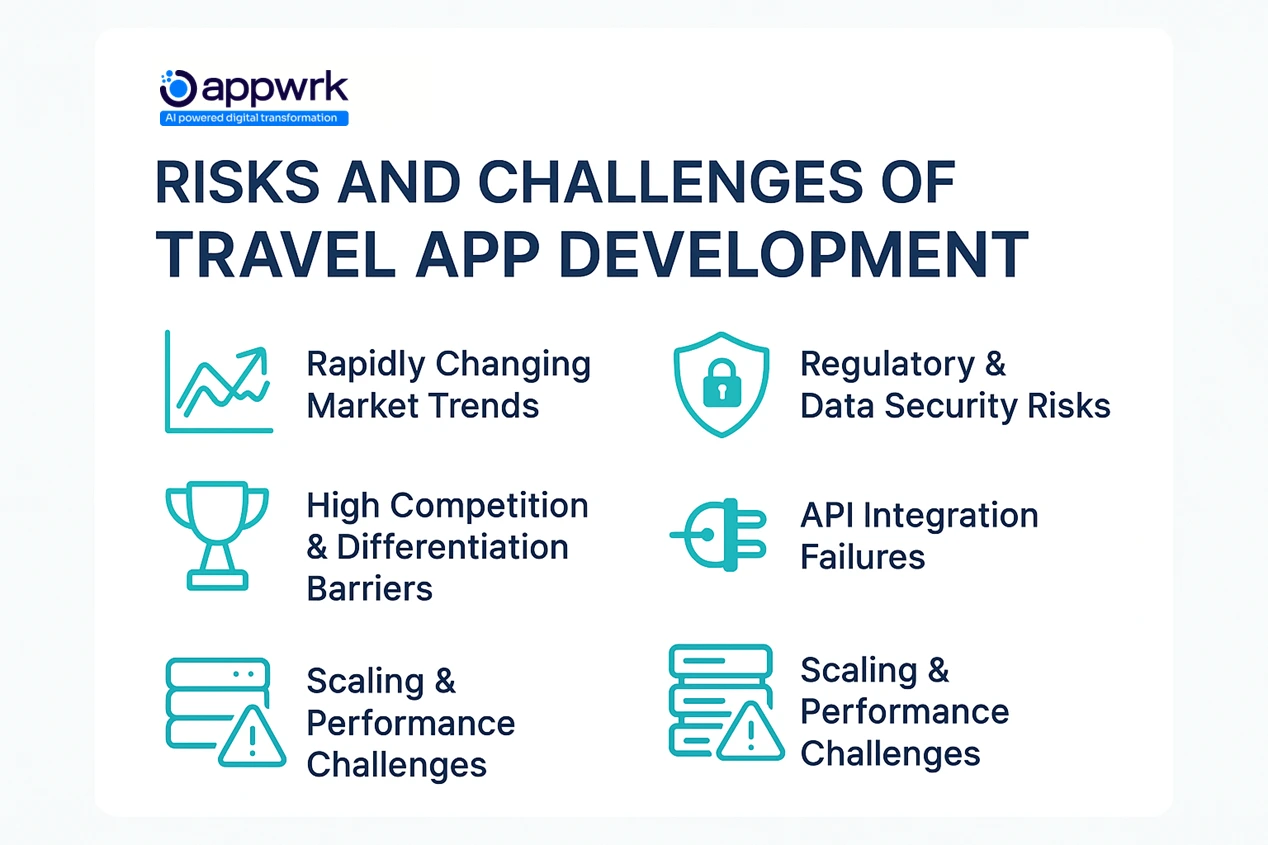
Risks and Challenges of Building a Travel App
While founders often focus on Event Management App Development Cost or travel app development cost upfront, long-term success depends on addressing risks that influence scalability, compliance, and user trust.
Rapidly Changing Market and User Preferences
User behavior in travel shifts quickly. Apps must adapt to personalization trends, seasonal surges, and changing expectations with real-time updates and agile development methodologies.
Regulatory Compliance and Data Security Risks
Travel apps collect sensitive data, from payments to IDs. Strict compliance with GDPR, PCI DSS, and CCPA is essential. Features like security service layers, security audits, encryption, and role-based access add cost but protect against fines and breaches.
High Competition and Differentiation Barriers
Global giants like Airbnb and Booking.com dominate, which means new apps must differentiate with branding elements, AI-powered matchmaking, and collaboration tools that elevate user experience.
Integration Failures with Third-Party APIs
APIs for hotels, flights, and payments are vital, but sync delays or outages can damage the booking flow. Accounting for user acceptance testing, performance monitoring, and integration with legacy systems helps mitigate these risks.
Scaling and Performance Challenges at Peak Demand
Seasonal spikes can overwhelm poorly designed systems. Withoutcloud deployment (AWS/Azure), task management, and phased development approaches, apps risk downtime and lost revenue.
Addressing these risks during early development ensures smoother scaling, stronger compliance, and higher user retention. A thoughtful balance of cost control, post-event analysis, and support and service planning will separate sustainable apps from short-lived launches.
How Appwrk Can Help in Travel App Development
Choosing the right partner is just as important as budgeting for the travel app development cost. At Appwrk, we build scalable, feature-rich travel applications that combine performance with affordability.
Full-stack build expertise → From lean MVPs to enterprise-grade platforms, our team covers everything: UI/UX design, backend infrastructure, mobile apps, API integrations, and cloud deployment (AWS/Azure).
Retention strategies → Push notifications, AI-powered personalization, multi-currency payment support, and loyalty program integrations designed to maximize attendee engagement and long-term ROI.
Quality-to-cost balance → With proven delivery frameworks and agile development methodologies, Appwrk helps startups launch apps starting from $5,000, while still delivering enterprise-level security and scalability planning.
Dedicated project management → Transparent milestones, agile sprints, and ongoing communication led by experienced PMs ensure smooth delivery and lower risks around delays or overspending.
Proven results → Trusted by startups, SMEs, and agencies for delivering mobile and web solutions that balance cost-efficiency, speed, and future-readiness.
Tapping Untapped Niches → Whether it’s eco-travel, group travel, solo experiences, or luxury apps, Appwrk helps businesses build differentiated solutions tailored to these emerging segments, unlocking new revenue streams and competitive advantage.
Ready to launch your travel app?Book a discovery call with Appwrk and explore tailored, cost-effective strategies built around your business goals.
FAQs
1. How long does it take to build a travel application? A basic MVP travel app can take 8–12 weeks, while mid-level apps with booking and payments need 16–24 weeks. Enterprise platforms with AI, offline maps, real-time updates, and global booking APIs may take 6–12 months, depending on scope.
Contact us to know the real costs to build your travel app.
2. How much does it cost to develop a travel app? The cost starts as low as $5,000 for a simple MVP and typically ranges between $12,000 and $40,000. The final number depends on complexity, supported platforms (iOS, Android, cross-platform), and integrations like payments or loyalty systems.
3. What are the key cost components in travel app development? UI/UX design, backend infrastructure, API integrations, online payment gateways, data compliance, and ongoing support. Each of these directly affects budget and scalability.
4. How do travel apps make money? Most apps rely on commission fees, but hybrid monetization works best: merchant models, ads, subscription plans, and premium feature upsells. The right mix depends on the audience and business goals.
5. Is outsourcing cost-effective for travel apps? Yes. Outsourcing often reduces costs by 30–40% compared to in-house teams. Agencies bring project management, collaboration tools, and post-event analysis expertise that accelerate timelines and reduce rework.
6. What post-launch costs should I plan for? Expect annual costs for hosting, compliance updates, security audits, analytics tools, and support systems. On average, post-launch expenses equal 15–20% of the initial build.
7. What features are essential in a successful travel booking app? Core features: quick onboarding, booking flows, secure multi-currency payment, push notifications, and reviews. Advanced add-ons like AI and machine learning features, offline maps, or real-time chat increase engagement but add to the budget.
8. How can startups reduce travel app development costs without losing quality? By prioritizing essential features, outsourcing, using open source frameworks/libraries, adopting Agile, and minimizing design complexity. This approach often reduces upfront spend by 20–30%.
9. Which is better: native or cross-platform development for travel apps? Cross-platform (Flutter, React Native) saves 25–30% of development time and cost, making it ideal for startups. Native is better for enterprises needing deeper customization or platform-specific user acceptance testing.
10. What security and compliance factors should be considered in travel app development? Compliance with GDPR, PCI-DSS, and CCPA is crucial. Apps should include encryption, fraud detection, task allocation for admin roles, and performance monitoring to keep data safe.
11. How often should a travel app be updated after launch? Every 4–6 weeks. Updates cover bug fixes, feedback surveys, security patches, and new features. Frequent updates improve support and service quality while boosting retention.
12. What technologies are best for building scalable travel apps? Cross-platform frameworks (Flutter, React Native), cloud deployment (AWS/Azure), AI/ML engines for personalization, and serverless architectures for cost efficiency. These tools make apps more reliable, secure, and scalable.
Gourav Khanna is the Co-founder and CEO of APPWRK, leading the company’s vision to deliver AI-first, scalable digital solutions for enterprises and high-growth startups. With over 16 years of leadership in technology, he is known for driving digital transformation strategies that connect business ambition with outcome-focused execution across healthcare, retail, logistics, and enterprise operations.
Recognized as a strategic industry voice, Gourav brings deep expertise in product strategy, AI adoption, and platform engineering. Through his insights, he helps decision-makers prioritize market traction, operational efficiency, and long-term ROI while building resilient, user-centric digital systems.
Subscribe to APPWRK Blogs, We'll Do the Rest!
Get Blogs on UI/UX, Mobile Apps, Online Marketing, and Web development technology.
Unlock worthy and priceless suggestions from the masters of mobile and web app development