150+ minds across 4 countries. Join a culture of innovation, ownership & growth.
Rewire for AI
From machine learning to deep learning, from classification tools to overall process automation – our AI engineers will help you retool your existing system or enhance your company results.
Ship faster, scale smarter, built for product companies and SaaS teams
Our Latest Work
We strive hard to deliver result-driven digital solutions across the globe. Check out our case studies to get a glimpse of how we ideate, innovate, and create unconventional digital solutions according to the requirements of our clients.
Discover diverse and passionate insights from our tech enthusiasts. We collaborate across various sectors to streamline operations and drive innovation. Explore our rapidly growing collection of articles to see why we’re at the forefront of IT solutions.
The decision to move from Magento to Shopify is one of the most significant replatforming choices an ecommerce business can make. Magento is powerful, but its power comes with...
Accuracy gap is real: Traditional CPG forecasting carries a 25-40% MAPE error rate. AI-powered models bring that down to 8-15%, according to McKinsey research....
Real stories from global leaders who trusted us with their ideas.
Partnering with APPWRK helped us build a compliant and scalable healthcare platform, accelerating our time-to-market by 35%. Their team consistently delivered outstanding work.
Beesers
Digital Healthcare Client
Collaborating with APPWRK, Sportskeeda modernized its platform into a real-time sports engagement ecosystem, enabling seamless content delivery, scalable fan interactions, and high-velocity performance.
Sportskeeda
Sports & Entertainment Partner
Working with APPWRK was effortless. They captured our vision, maintained full compliance, and delivered a digital experience that built trust and elevated how customers interact with our fintech brand.
PayPenny
Fintech Partner
Working with APPWRK gave us confidence in adopting AI responsibly. Their team built a safe, intelligent bot that transformed how we engage with leads and helped us achieve measurable revenue growth.
IFB
AI Transformation Partner
Leveraging APPWRK’s digital expertise, Nemesis launched a scalable, compliant, and safe super app that connects content delivery, real-time communication, and logistics management within a single platform.
The cost to build a mobile banking app like Chime starts from just $12,000 for a basic MVP and typically ranges between $20,000 and $70,000 for most scalable fintech builds. Even feature-rich neobank apps with advanced tech stacks rarely need to exceed $1,00,000, if built with a modular, phase-wise approach.
Essential features like seamless account creation, P2P payments, smart financial feeds, and debit card management can all be achieved within a lean budget. Add-ons like bill pay, ATM locating, and real-time alerts increase cost slightly, while premium functions (e.g., high-level security features, external account aggregation) scale the build.
Hidden costs like compliance, third-party integrations, security features, and ongoing maintenance often surprise founders. But with upfront planning and prebuilt core banking platforms, these can be reduced by up to 40%.
The banking industry is undergoing a shift where financial institution leaders are prioritising digital banking transformation strategies to reduce dependency on the conventional bank model.
The global neobanking market is exploding, and entering it with a cost-effective app like Chime ensures lower upfront investment, faster MVP validation, and long-term ROI.
This guide is written for CTOs, startup founders, fintech product heads, and digital banking decision-makers who want a clear, cost-optimized, and scalable roadmap for developing a mobile banking app like Chime, covering exact cost breakdowns, feature priorities, hidden expenses, and monetization strategies.
Mobile Banking Market Trends 2025: Why Apps Like Chime Are Growing Rapidly
Mobile banking app development cost is proving to be a smart investment. 57% of millennials and 64% of Gen Z now bank with nontraditional institutions (PwC). The global neobanking market is set to hit $2.05 trillion by 2030 (Grand View Research). Chime alone serves 22.3 million users, offering fee-free services, early deposits, and automation tools.
What’s driving growth?
Market Surge & Fintech Trends: Neobank usage up 40% YoY; mobile money transactions to reach $2 trillion by 2027 (Juniper Research).
Consumer Expectations: Seamless account creation, virtual debit cards, real-time alerts, and smart financial feeds are now standard in banking mobile apps.
Lower Barriers & Technology: Fintech APIs, KYC, cloud hosting, and third-party payment processors make the banking app development process faster and cheaper.
Chime’s business model with fee-free ATMs, interchange fees, and premium features drives fintech ROI. In the U.S., 70% of millennials and 50% of Gen Z use the Chime mobile app or similar banking mobile apps for money management. The mobile banking market in North America was $1.3B in 2023 and is rising.
Chime App Download
The Chime app download is free on iOS and Android, with1Cr+ downloads, a 4.1-star rating, and 8.79 lakh reviews. Rated 3+, it’s one of the most trusted mobile banking applications in the U.S. Users can open accounts in minutes, access fee-free ATMs, get early deposits, and enjoy real-time transaction alerts. For desktop, Chime login online without the app is also available.
How Much Does It Cost to Develop a Mobile Banking App?
Estimated total project cost: $12,000 (MVP) to $120,000+ (enterprise-grade Chime alternative).
Here’s a sharp, cost‑driven breakdown so you know what you’re really getting into when you start planning to build an app like Chime.
Development Complexity & Cost Tiers
App Type
Key Features included in the mobile banking app, like Chime
These are rough ranges. Actual cost depends on feature complexity, development team rates, compliance requirements, and backend/infrastructure choices.
Development Stages and Cost Breakdown
To build a mobile banking app like Chime, the banking app development process follows clear stages. Below is the step-by-step flow with cost ranges:
Planning & Research (5–10%) – [$600 – $6,000] Competitor analysis, compliance mapping, and early decisions on core banking platforms. This stage often involves an experienced banking app developer or consultant to validate the approach before coding starts.
Design & User Experience Design (10–20%) – [$1,200 – $12,000] Includes custom wireframes, onboarding flows, and responsive screens. A strong UX team ensures a user-friendly and aesthetically pleasing interface that drives adoption.
Backend & Infrastructure (25–35%) – [$3,000 – $42,000] Hosting setup, database design, payment processors, and integration with third-party APIs. High-grade encryption and high-level security features are added here to comply with regulations and secure data.
Frontend & Feature Development (20–30%) – [$2,400 – $36,000] Core mobile bank services like P2P transfers, smart feeds, ATM locators, and debit card tools. Teams may choose native or cross-platform development depending on budget and speed needs.
App Testing, QA & Compliance (10–15%) – [$1,200 – $18,000] Covers security features, multi-device testing, audits (KYC, AML, PCI DSS), and legal validations. This stage helps avoid the outs of banking like fraud exposure and weak compliance.
Launch & Post-Launch Support (5–10%) – [$600 – $12,000] Bug fixes, feedback loops, performance monitoring, and AppCare Maintenance. Iterative updates keep the app competitive long-term.
Pricing by Functionality in Mobile Banking App Development
The cost depends on which features are prioritised. Here’s the functionality-wise breakdown:
Basic Functionality (MVP)
Account creation/login
Balance view & transaction records
Peer-to-Peer payments
Notifications & real-time alerts Estimated Cost: $12,000 – $25,000 Enough to launch quickly with smooth onboarding and seamless money transfers.
Advanced Functionalities
Bill pay and automated payments
ATM locating & mobile check deposit
Debit card management (freeze/unfreeze, limits)
Contactless payments & instant transfers
Enhanced UI/UX principles with cross-platform framework options Estimated Cost: $25,000 – $60,000 Creates a scalable fintech app with stronger customer engagement and retention.
Services for Functionalities & Third-Party Integrations
External account aggregation
AI-powered budgeting and financial tracking
Voice-enabled digital banking
Payment gateway integration and APIs, and specialised technologies
Regular audits with Security Protocols Estimated Cost: $60,000 – $120,000+ Ideal for founders wanting advanced compliance, reporting, and premium features that maximise revenue streams.
Approximate Hourly Rate to develop a Chime-like App
Implication for Cost
Asia / South Asia
$20‑$40 / hour
Lowest rates; good for MVPs or parts of the project, but needs strong quality control & project management.
Eastern Europe
$40‑$60 / hour
Balance of cost & quality; higher reliability in infrastructure and often better compliance experience.
Western Europe / UK
$70‑$100 / hour
For high‑quality, secure, design‑focused builds, pushes cost toward upper tiers.
USA / Canada / Australia
$90‑$120+ / hour
Premium; best when you need top expertise or must satisfy strict legal / security requirements.
These are averages; specific teams or agencies may charge more depending on experience or specialisation in fintech/banking app development.
What Are the Key Factors Affecting the Cost to Develop an App Like Chime?
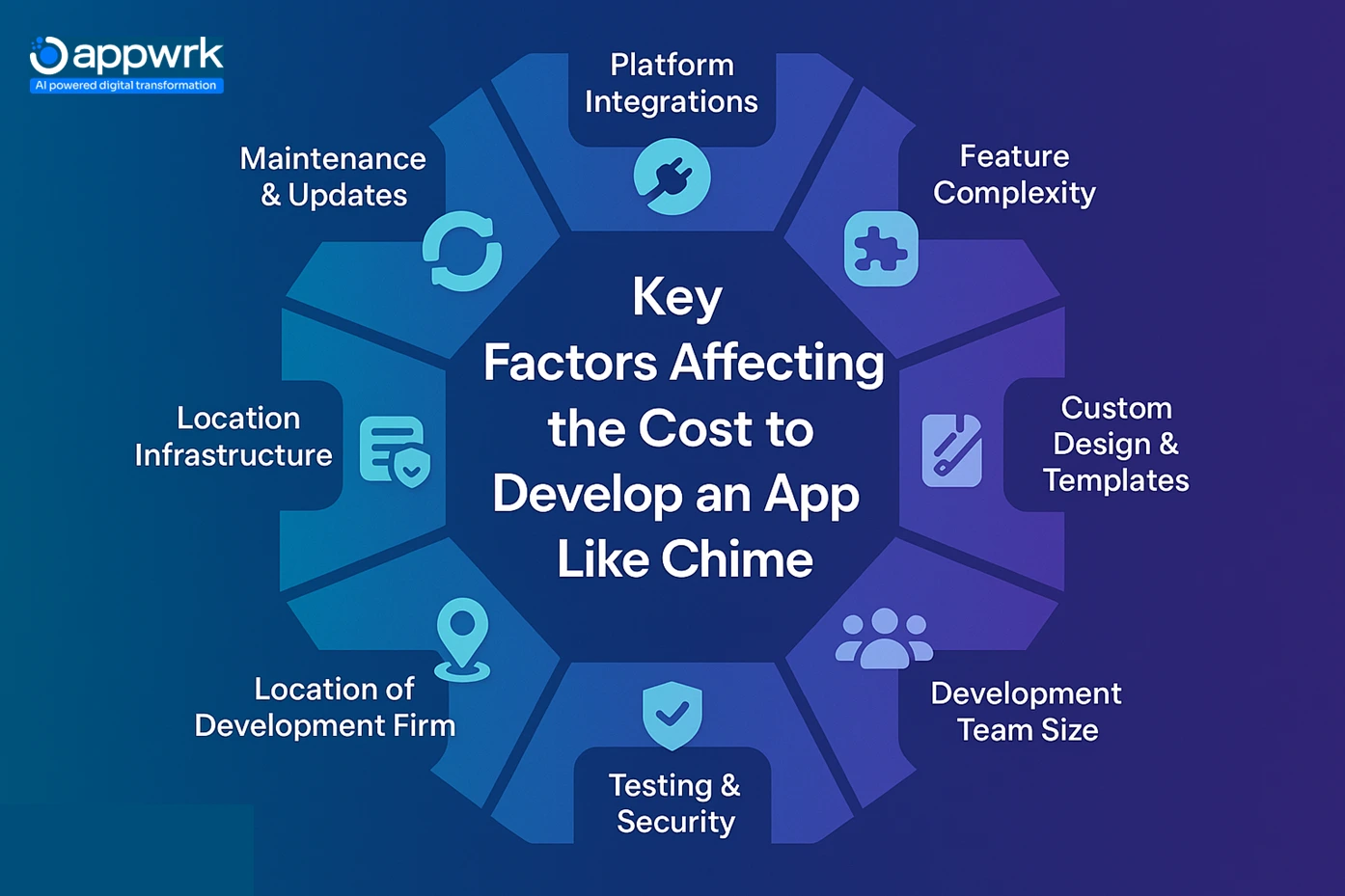
The cost of building a Chime-like app isn’t just about coding. It’s the entire banking app development process, shaped by features, design choices, team expertise, and long-term scalability. Below are the biggest cost drivers.
Number of Platform Integrations & Platform Selection
Every integration adds hours and licensing fees. From KYC/AML checks to payment processors like Stripe and Plaid, these third-party tools simplify compliance but still need secure wiring into your app.
Complexity of Features
The more advanced your app, the higher the bill. Core features like P2P payments or balance views are affordable, but layering on smart feeds, card controls, or advanced analytics requires expert bankingapp developers and more dev cycles. This is where specialised technologies, such as biometric login or AI budgeting tools, also add cost.
Custom Designs and Templates
Using prebuilt UI kits can save thousands. But if you want branded experiences with animations, micro-interactions, and dashboards like Chime’s, your UX team will need more time. The payoff: a user-friendly and aesthetically pleasing interface that drives adoption.
Wireframe
Wireframing is where ideas become visual. Low-fidelity drafts are quick and cheap. High-fidelity wireframes, complete with logic and flows, may raise design costs by 10–15%, but prevent expensive rework later.
Development Team Size
A lean crew of devs and designers lowers hourly burn but slows delivery. Larger squads, with experienced banking app developers, testers, and PMs, cost more upfront but shorten timelines.
Testing Requirements
Fintech isn’t forgiving. Apps must pass through rigorous security testing, regression checks, and compliance validation. Adding high-level security features is non-negotiable, as they directly protect users and build long-term trust.
Location of the App Development Firm
Offshore dev shops (India, Eastern Europe) can charge $20–$50/hr, while US and EU firms command $75–$150/hr. For highly regulated apps, choosing a trusted banking app development company locally may be worth the premium.
Hosting Infrastructure
Reliable infra is critical. Building on AWS, Azure, or GCP ensures your app scales to thousands of daily transactions. Backend engineers handle core banking platforms, software components, and APIs, ensuring smooth performance across millions of mobile devices.
Maintenance and Updates
Post-launch upkeep isn’t optional. Expect 15–25% of the build cost annually for bug fixes, AppCare Maintenance, and compliance-driven upgrades. Apps offering mobile bank services need constant patching to stay competitive.
Best Mobile Banking Apps and Their Development Costs
Studying the leading banking mobile apps gives us a clear view of how scope, compliance, and technology choices drive development costs. Below are some of the most popular U.S. apps, along with their estimated budgets, to give context for anyone considering a Chime-like build.
Chase Bank Mobile App
The Chase bank mobile app supports account management, bill pay, card rewards, credit monitoring, and fraud protection. With its mobile check deposit and robust integrations, it stands out among U.S. banking leaders. Estimated Development Cost: $200,000 – $400,000
Citizens Bank Mobile App
The Citizens Bank mobile app focuses on everyday banking tasks, offering account transfers, bill payments, and balance management. It is designed for a seamless banking experience with reliable security. Estimated Development Cost: $100,000 – $200,000
Key Bank Mobile App
The Key Bank mobile app offers basic mobile bank services like account monitoring, bill pay, and fund transfers. It provides a reliable mobile-first design while keeping costs moderate. Estimated Development Cost: $90,000 – $180,000
Regions Bank Mobile App
The Regions Bank mobile app is gaining traction for its combination of simple UI and secure money transfers. It also offers budgeting tools and ATM locators for user convenience. Estimated Development Cost: $100,000 – $190,000
Allied Bank Mobile App
The Allied Bank mobile app delivers essential banking services like payments, transfers, and account tracking. Known for reliability, it suits users looking for secure banking options at scale. Estimated Development Cost: $80,000 – $160,000
Venmo
Venmo is a social-driven P2P platform with debit cards, direct deposits, and merchant payments. Its interactive financial feed keeps users engaged, making it one of the top U.S. banking mobile apps. Estimated Development Cost: $80,000 – $150,000
Zelle
Zelle integrates with multiple banks, enabling instant peer-to-peer transfers, secure authentication, and external account linking. Its adoption highlights the role of banks’ mobile appsin everyday transactions. Estimated Development Cost: $120,000 – $250,000
Cash App
The Cash App goes beyond P2P transfers by offering Bitcoin trading, stock investments, debit card controls, and direct deposits. Its advanced functionalities reflect strong demand for financial fitness tools. Estimated Development Cost: $150,000 – $300,000
Chime App
The Chime app is built on transparency with fee-free ATMs, early payday, debit card management, and smart financial feeds. It has become a benchmark for neobanks thanks to its no-hidden-fee model. Estimated Development Cost: $80,000 – $120,000
Mint
Mint specializes in budgeting tools, expense categorization, bill reminders, and credit score monitoring. Its clean User Experience Design makes it a leader in personal finance management. Estimated Development Cost: $70,000 – $140,000
Bank of America Mobile Banking App
The Bank of America mobile banking app covers account management, custom alerts, mobile deposits, and investment services. It requires strong compliance work from experienced banking app developers. Estimated Development Cost: $180,000 – $350,000
Wells Fargo Mobile Banking App
The Wells Fargo mobile banking app integrates Zelle, card services, biometric logins, and fraud alerts. Its customizable dashboard delivers a seamless and user-friendly banking experience. Estimated Development Cost: $160,000 – $300,000
Citibank Mobile App
The Citibank mobile app combines international payment support, fund transfers, and card management with robust security features. It remains one of the best mobile banking app options for global users. Estimated Development Cost: $150,000 – $280,000
HSBC Mobile Banking App
The HSBC mobile banking app supports global accounts, cross-border transfers, and enhanced security features. It reflects how international banks’ mobile apps are adapting to the digital banking ecosystem. Estimated Development Cost: $200,000 – $350,000.
What Are the Hidden and Ongoing Costs After the App Is Launched?
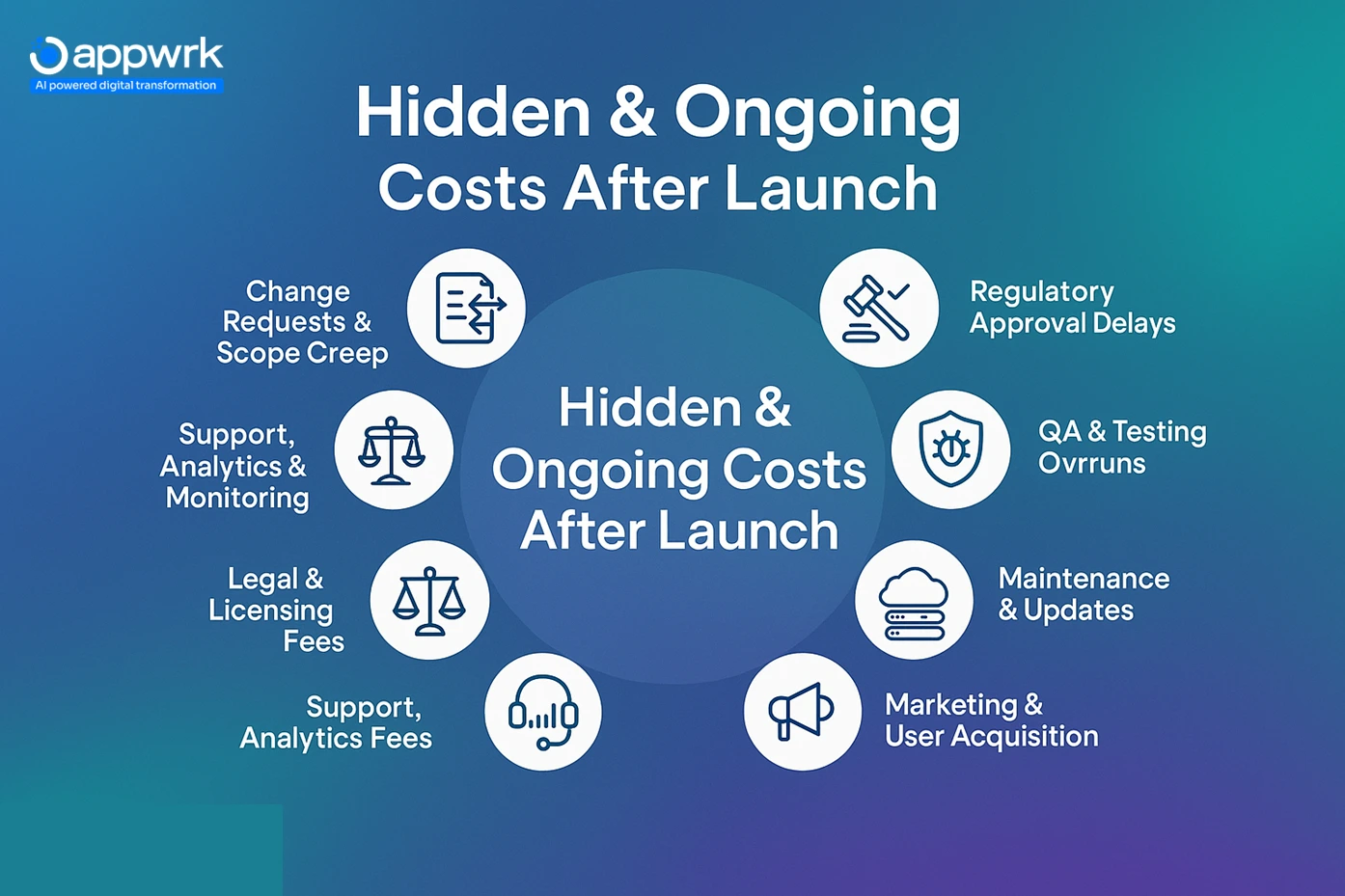
Many founders underestimate what happens after launch. Below are the “silent costs” you should budget for:
Change Requests and Scope Creep
Every last-minute feature request means more hours, more refactoring, and sometimes changes across the frontend, backend, and APIs. If not managed carefully, costs can balloon by 10–30%.
Integration with Existing Systems
Connecting your app to legacy banking tech or internal CRMs can create friction. Even “plug-and-play” APIs require adaptation, testing, and often hardened security protocols.
For apps offering lending features, compatibility with best cash advance apps that work with Chime requires additional API integration, compliance validation, and testing, which can increase ongoing costs.
Regulatory Approval Delays
Licenses for KYC, AML, PCI, or GDPR compliance aren’t guaranteed to come quickly. Delays lead to higher legal and consulting fees while your app sits idle.
Technology Licensing & Recurring Subscriptions
Fraud detection SDKs, manual banking operations replacements, notification tools, and hosting all come with monthly bills. These “invisible” expenses can stack up to thousands annually.
Testing & QA Overruns
With each new OS update or user surge, new bugs pop up. Ongoing QA, retesting, and patches are critical to maintaining transparency and user trust.
App Maintenance and Updates (Including Compliance Changes)
Expect to pay annually for bug fixes, OS compatibility updates, new features, and compliance-driven updates. Experienced banking app developers usually recommend 15–25% of the initial build as a safe maintenance budget.
Hosting Infrastructure & Scaling Costs
Growth = higher infra bills. A backend setup that works for 1,000 users may buckle at 100,000. Scaling servers, monitoring uptime, and adding backups all add incremental cost.
App Marketing, Customer Acquisition & Retention
It’s not just about building the app. You’ll need Cost-Effective Marketing with precise marketing strategies to attract and retain users. Think ASO, referral programs, business reports on campaign ROI, and retention incentives.
Legal & Licensing Fees Over Time
Audits, data protection laws, and renewal of compliance certificates like PCI-DSS or GDPR drive recurring legal fees.
User Support, Analytics & Monitoring
Support desks, analytics dashboards, crash monitoring, and feedback loops all cost money. But done right, they improve customer engagement, reduce churn, and strengthen long-term relationships.
Best Cash Advance Apps That Work With the Chime App
Chime users often connect with cash advance apps that work with Chime to cover urgent expenses before payday. These apps advance funds that are later repaid automatically, making them popular for short-term flexibility. Users often search for the best cash advance apps that work with Chime to get instant transfers, lower fees, and reliable access to cash.
Examples include:
Dave – Offers up to $500 in cash advances with no mandatory fees.
Earnin – Provides early wage access with real-time tracking.
Brigit – Allows up to $250 with smart budgeting tools included.
Loan Apps That Work With the Chime App
Many loan apps that work with Chime allow users to borrow money with flexible repayment schedules directly linked to their Chime accounts. This integration helps avoid traditional bank hurdles while ensuring quick cash flow for emergencies or planned expenses.
Examples include:
Avant – Personal loans with flexible repayment options.
OppLoans – Short-term loans designed for quick approvals.
MoneyLion – Combines credit builder loans with mobile banking features.
Payday Advance Apps That Work With the Chime App
With payday advance apps that work with Chime, users can access a portion of their paycheck before the official payday. These apps are especially popular among gig workers and employees who need flexibility in managing recurring expenses.
Examples include:
Albert – Offers instant cash advances up to $250 with budgeting tools.
DailyPay – Lets employees access earned wages before payday.
FlexWage – Provides payroll advances with direct deposit support.
Payday Apps That Work With the Chime App
Payday apps that work with Chime provide seamless direct deposit advances, often with no overdraft fees. They integrate directly with Chime accounts, giving users instant access to their earned wages without waiting for bank processing delays.
Examples include:
Klover – Free payday advance app supported by ad-based revenue.
Even – Allows early access to earned wages with financial planning tools.
Branch – Provides both payday advances and fee-free checking accounts.
Which Features Should You Prioritise to Build a Chime-Like App?
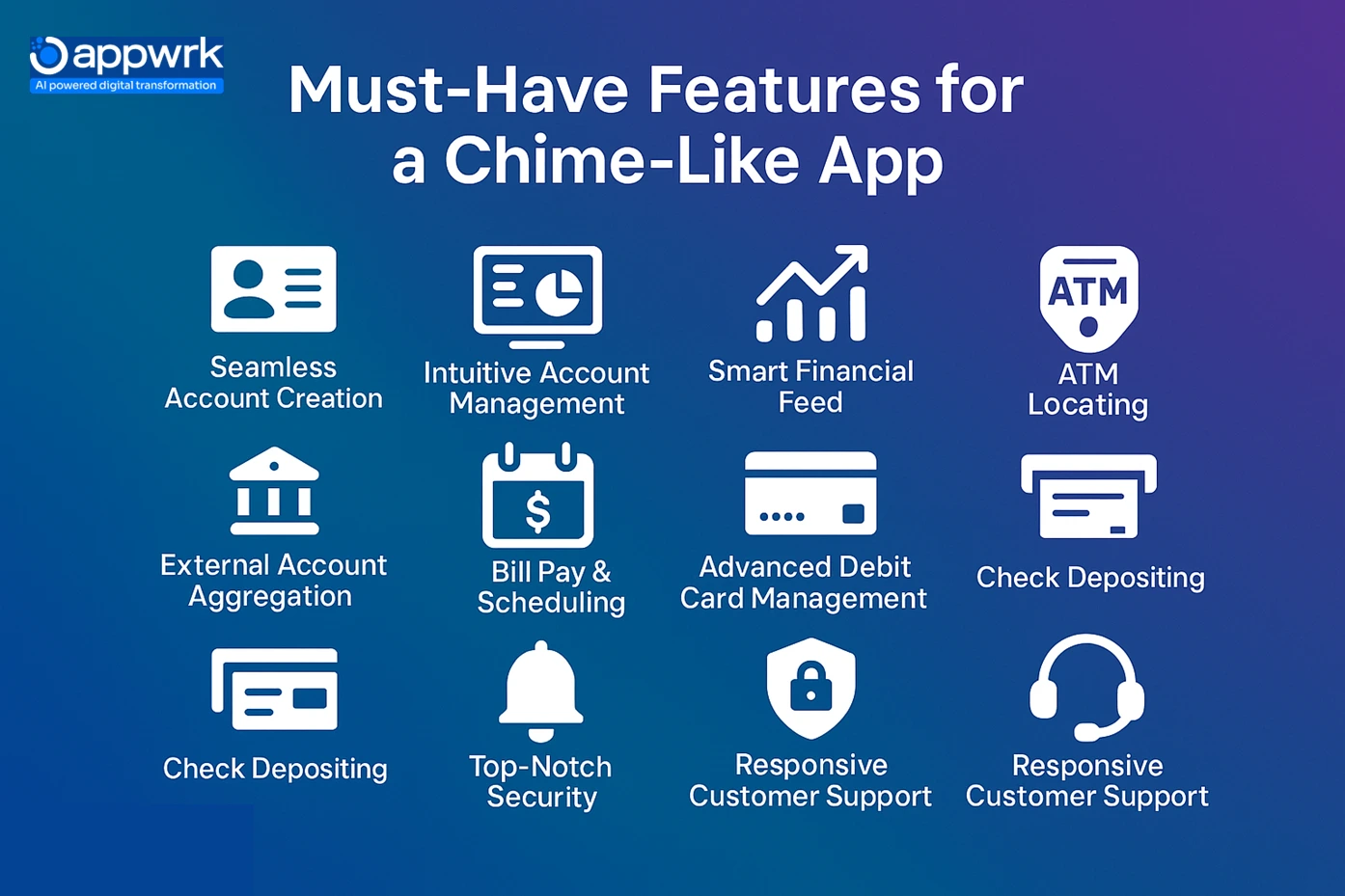
To truly compete with apps like Chime, your mobile banking app needs to strike a balance between core banking platforms, sleek design, and reliable security features. The goal is to deliver a product that feels intuitive, trustworthy, and scalable, without overcomplicating the banking app development process. Below are the must-have features every founder should prioritise.
Seamless Account Creation
Onboarding should be instant. With real-time KYC, document uploads, and identity checks, users can open accounts in minutes. This replaces manual banking operations with digital-first flows, cutting costs while meeting compliance needs.
Easy Access Through Chime App Login and Chime Login Online Without App
Users can access their accounts via the Chime app login or even use the Chime login online without the app for browser-based banking. This flexibility ensures accessibility across devices and builds trust with users.
AI-Powered Onboarding for Security and Speed
AI-powered onboarding automates KYC, risk checks, and compliance while issuing instant virtual debit cards for secure, quick account activation.
Intuitive Account Management
A clean, user-friendly, and aesthetically pleasing interface allows users to view balances, manage profiles, and track transaction history effortlessly. Done right, this enhances User Experience Design and strengthens long-term trust in your product.
Intuitive Dashboard for Complete Control
A customizable dashboard with charts, graphs, and widgets gives users a clear overview of balances, transactions, and financial trends at a glance.
Smart Financial Feed
Give users more than numbers. Auto-categorised transactions, insights, and savings nudges create a financial hub that feels intelligent. A well-coordinated UX team can build dashboards that not only present data but also encourage smarter money habits.
AI-Powered Insights for Informed Decisions
AI-powered analytics deliver personalized insights, predictive alerts, and financial tips to help users improve budgeting and saving habits.
P2P Payment Network
Instant seamless money transfers are non-negotiable. Competing with Venmo or Cash App requires frictionless P2P payments tied to phone numbers or emails. For stability, your backend should be built on scalable APIs and tested by experienced banking app developers.
External Account Aggregation
Connecting outside bank accounts in one dashboard elevates your app into a true financial hub. This requires expert banking app developers who can securely integrate APIs, reducing the outs of banking limitations users often face in fragmented ecosystems.
Bill Pay & Scheduling
From utilities to credit cards, bill payments with reminders ensure users never miss due dates. This boosts customer engagement while creating stickiness in your app’s business model.
Advanced Debit Card Management
Freezing/unfreezing cards, setting spending limits, or PIN changes empower users. These mobile bank services not only give peace of mind but also reinforce your app’s high-level security features.
Contactless Payments & Virtual Cards
Enable contactless NFC payments and issue single-use virtual cards for extra privacy, ensuring secure and seamless transactions anywhere.
ATM Locating
Leveraging geolocation helps users find nearby fee-free ATMs quickly. It’s a simple feature, but one that builds everyday utility and loyalty.
Check Depositing
Replacing manual banking operations like branch visits with mobile check scanning makes your app indispensable. This is where specialised technologies like OCR (optical character recognition) come into play.
Notifications & Alerts
Push or SMS alerts about deposits, fraud attempts, or spending thresholds are essential. These alerts, paired with fraud-detection APIs and security protocols, build transparency and trust with users.
Top-Notch Security
Your app must come equipped with biometric login, multi-factor authentication, and data encryption. With experienced banking app developers guiding the build, you’ll ensure compliance and safe handling of sensitive financial data.
Expanded Security Features
Robust security measures like activity logs, account recovery, encryption tools, and regular security audits safeguard sensitive banking data.
Responsive Customer Support
24/7 support through chatbots or human agents keeps users confident in your platform. With tools like business reports and analytics dashboards, support can also double as a feedback loop to improve product performance.
Self-Service Customer Support Options
Offer AI chatbots, searchable knowledge bases, and FAQs to empower users with self-service tools alongside live support options.
Why Prioritise These First?
Not every feature needs to be built on day one. The smarter approach is to work with experienced banking app developers to launch with 5–6 core modules, such as account creation, P2P transfers, debit card management, and fraud protection, then scale over time. Using a cross-platform framework for native or cross-platform development ensures your app runs on both iOS and Android without doubling the cost.
When combined with precise marketing strategies and Cost-Effective Marketing, these features don’t just meet user expectations; they fuel growth, retention, and revenue.
Connect external accounts via APIs (Plaid, Yodlee)
Bill Pay & Scheduling
$1,500 – $3,500
Utility payments, reminders, auto-pay
Advanced Debit Card Management
$2,000 – $4,000
Freeze/unfreeze, limits, PIN reset
ATM Locating
$800 – $1,500
Geolocation, nearby ATM database
Check Depositing
$1,500 – $3,000
Mobile check scan, OCR, deposit validation
Notifications & Alerts
$1,000 – $2,500
Push/SMS/email alerts for transactions
Top-Notch Security
$3,000 – $6,000
Biometrics, MFA, encryption, fraud detection
Responsive Customer Support
$1,000 – $2,000
Chatbot/live chat integration
These costs are approximate and vary depending on app complexity, team location, and tech stack. For an MVP, you can prioritise Seamless Account Creation + Account Management + P2P Payments + Security (~$12K–$20K) and add advanced features in later phases.
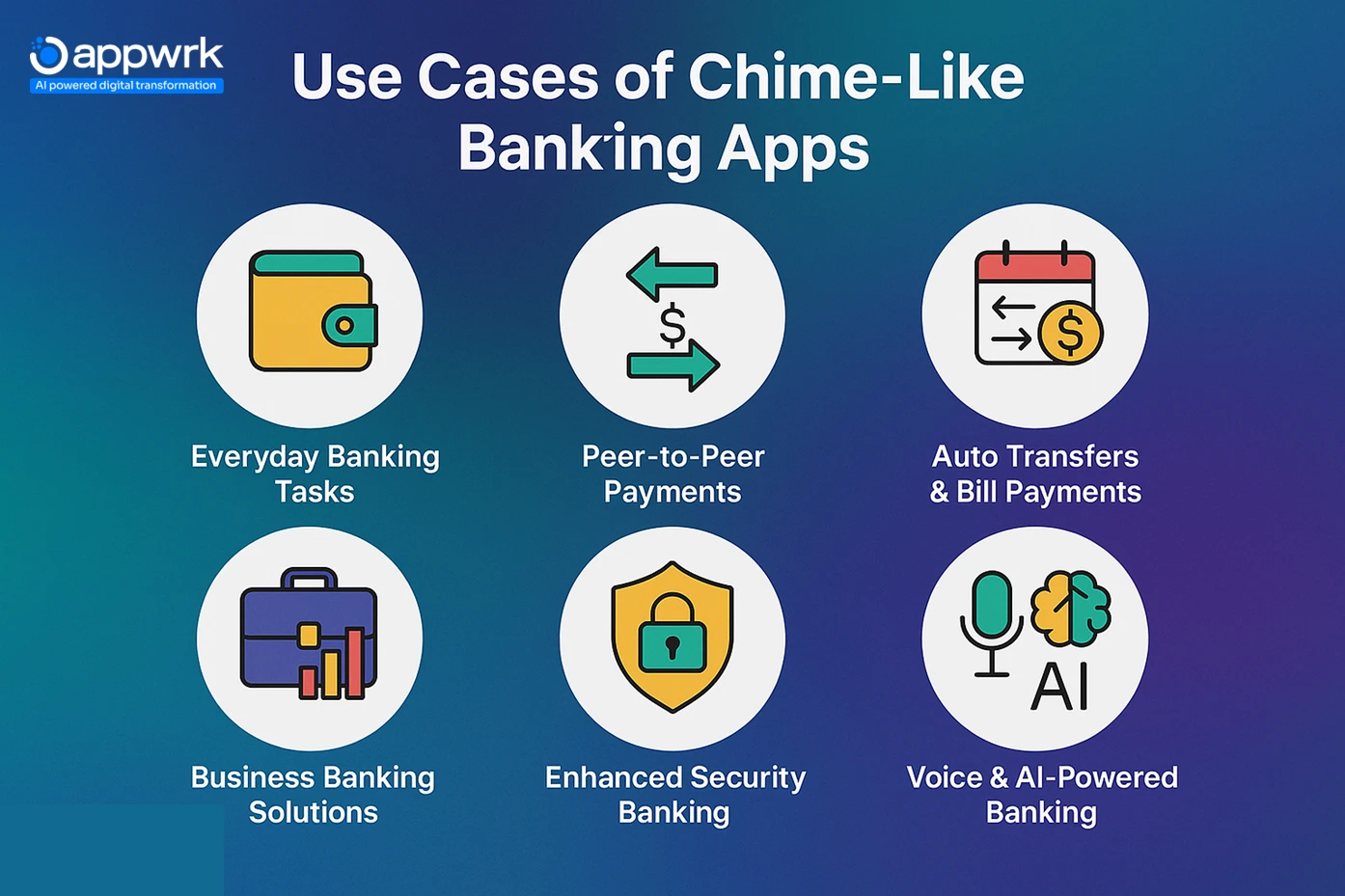
Use Cases of Chime-Like Mobile Banking Apps
Mobile banking apps are more than just digital wallets; they replicate and often improve the outs of banking by making financial services fast, intuitive, and secure. Below are the most common use cases for apps designed like Chime, all of which directly influence the banking app development process and the cost of delivery.
Everyday Banking Tasks
Users can open savings accounts, track transaction records, and manage money with ease, without the need for manual banking operations or branch visits. For many, these apps replace traditional touchpoints by offering mobile bank services available on any mobile device.
Apps from traditional players like the PNC Bank Mobile App and TD Bank Mobile App also emphasize everyday banking tasks such as savings accounts, transaction records, and quick transactions.
Users increasingly rely on payday advance apps that work with Chime or payday apps that work with Chime to manage everyday expenses and cover short-term financial gaps, making seamless integration critical for retention.
Peer-to-Peer Payments
Instant, fee-free P2P transfers with seamless money transfers and real-time transaction alerts are core features. This is where payment processors and core banking platforms come into play, ensuring transfers remain smooth and secure.
Automatic Money Transfers and Bill Payments
Apps integrate AI-driven budgeting and automation to cover bills, subscriptions, or recurring transfers. Backed by specialised technologies and APIs, these reduce missed payments while improving financial planning.
Business Banking Solutions
For businesses, digital banking apps unlock value through business reports, payroll APIs, invoicing, and integration with ERPs/CRMs. Experienced banking app developers often design these flows to fit into existing enterprise systems.
Enhanced Security Banking
A strong differentiator is high-level security features: biometric login, MFA, encryption, and fraud detection. Done right, these security features not only protect accounts but also increase trust and user retention.
Digital Banking Ecosystem
By reducing outs of banking, mobile-first platforms help financial institutions cut overhead, replace legacy stacks, and deliver scalable mobile bank services. This is especially relevant for startups looking to compete with traditional banks.
Voice-Enabled and AI Banking
AI and voice assistants personalise the banking journey. Features like financial fitness tools, voice commands, and predictive analytics improve customer engagement and stickiness.
Case Study: How Appwrk Built a Finance Management App Like Mesha
At Appwrk, we developed Mesha, a finance management app that helps users track investments, manage multiple accounts, and analyze spending with AI-powered analytics. The app offered a seamless and user-friendly banking experience with secure banking options, automatic saving tools, and robust security measures, proving our expertise in delivering digital banking solutions that balance functionality and cost efficiency.
Monetisation Strategies for Chime-Like Mobile Banking Apps
Building the app is only half the journey. The true value lies in its business model, which generates revenue while keeping costs under control. Below are common monetisation approaches used by Chime-like apps.
Interchange Fees
Every card swipe earns revenue through payment processors and card networks. Setting this up requires backend integration with issuing banks. Estimated build cost: $2,000 – $4,000.
Out-of-Network ATM Fees
Charging small fees for non-partner ATM withdrawals is a simple but steady income. Implementing ATM fee modules typically costs $1,000 – $2,500.
Partnership Revenues
Embedding payroll, lending, or insurance partnerships creates additional streams of revenue. For example, API integrations for invoicing or salary crediting may cost $3,000 – $5,000 but unlock recurring business relationship opportunities.
Optional Premium Services
Premium add-ons such as credit score checks, advanced budgeting tools, and fraud protection boost LTV. While development costs $2,500 – $6,000, the payoff comes through retention and upselling. This is where expert banking app developers ensure stability and compliance.
Monetization Strategies for a Chime-Like Mobile Banking App
Many neobanks also integrate with cash advance apps that work with Chime and loan apps that work with Chime, enabling users to access short-term credit or emergency funds directly from the app. This integration not only improves customer experience but also opens new revenue streams for app owners.
Cost vs Revenue Impact Table
Monetization Method
Dev Cost of an app like Chime (Approx.)
Revenue Potential
Interchange Fees
$2,000 – $4,000
High (recurring per card transaction)
Out-of-Network ATM Fees
$1,000 – $2,500
Moderate (fee-based, per use)
Partnership Revenues
$3,000 – $5,000
High (recurring partner payouts)
Optional Premium Services
$2,500 – $6,000
Very High (subscription or one-time fee)
With less than $10,000 investment in monetisation features, you can build a profitable revenue engine inside your mobile banking app like Chime.
How Long Does It Take to Build a Chime-Like Mobile Banking App?
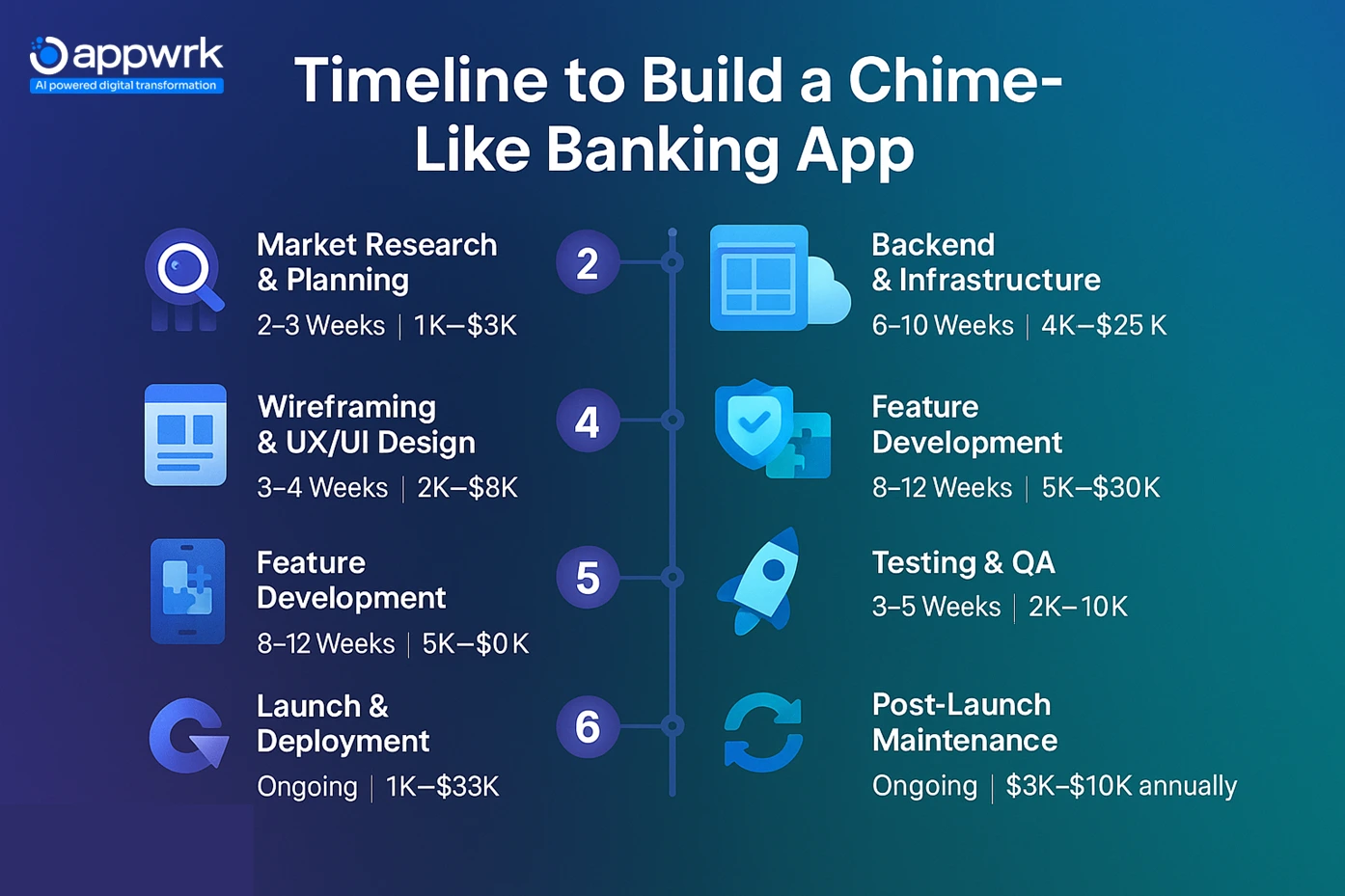
Building a mobile banking app like Chime isn’t just about coding features; it’s a structured banking app development process. The timeline depends on features, integrations, and team size. On average, you’re looking at 4 to 9 months, with costs starting at $12,000 for a lean MVP and climbing to $120,000+ for a fully featured neobank app. Working with experienced banking app developers ensures efficiency and avoids costly delays.
This stage defines the foundation. Teams carry out competitor studies, map compliance requirements, and align the business model with your audience. Done right, it reduces the outs of banking risks and prevents costly pivots later.
Wireframes and prototypes shape the user journey. A dedicated UX team focuses on User Experience Design to create flows that feel intuitive. Adding a user-friendly and aesthetically pleasing interface not only lifts engagement but also strengthens retention.
Here, the heavy lifting begins. Developers set up secure hosting, integrate APIs for payment processors, and establish core banking platforms. This stage also brings in High-level security features like encryption, biometric access, and fraud detection, essential for compliance.
Step 4 – Feature Development (8–12 Weeks | $5,000–$30,000)
This is where the app starts to look like Chime. Expert banking app developers build account management, P2P transfers, debit card management, and financial feeds. Features such as seamless money transfers and bill pay are powered by specialised technologies and may involve a cross-platform framework for scalability. Teams decide between native or cross-platform development depending on budget and timelines.
Testing is non-negotiable. Banking apps must pass security features checks, compliance audits (KYC/AML/PCI DSS), and device compatibility. QA also validates performance across iOS, Android, and hybrid builds. Strong QA saves future costs and builds trust among users.
Deployment involves app store submissions, setting up cloud servers, and performance monitoring. Here, experienced banking app developers ensure no detail slips, from distribution certificates to app store compliance.
After launch, ongoing support matters just as much. Updates include bug fixes, OS compatibility, AppCare Maintenance, and user-driven enhancements. With Cost-Effective Marketing and precise marketing strategies, this phase extends reach, grows adoption, and maximizes ROI.
In short, you can launch a working MVP in under 4 months with ~$12,000–$20,000, while a fully loaded Chime-like app takes closer to 8–9 months and $80,000–$120,000.
Mobile Banking Trends and the Future of Fintech Apps
The mobile banking market is evolving faster than ever. With user expectations shifting and neobanks disrupting the industry, building apps that are secure, scalable, and engaging is now the baseline. To succeed, fintech companies need to align with key mobile banking trends and integrate features that ensure long-term growth.
Growing Digital Banking Users and Seamless Experiences
The number of online banking users worldwide has reached approximately 3.6 billion in 2025. For many, mobile bank services have replaced visits to physical branches. Customers want smooth onboarding, intuitive dashboards, and a user-friendly and aesthetically pleasing interface that makes money management effortless. This is where User Experience Design and skilled UX teams prove invaluable.
AI Integration / Automation Use Cases
AI is no longer optional. From chatbots handling customer queries to predictive alerts that flag unusual spending, AI-driven automation is reducing costs and enhancing satisfaction. These tools also give financial institutions detailed business reports that help refine strategy.
Cross-Platform Development for Scalable Banking Apps
Startups and banks are leaning toward cross-platform frameworks like Flutter and React Native to launch faster without blowing budgets. Choosing between native and cross-platform development depends on scope, but for many, a hybrid approach balances speed, security, and customer reach.
AI-Powered Budgeting Tools and Real-Time Analytics
Today’s fintech apps are more than transaction tools. They include AI-powered budgeting, personal finance management, and real-time analytics that improve decision-making. These innovations support seamless money transfers, help users stick to budgets, and keep them engaged longer.
Blockchain Adoption and Enhanced Security
Blockchain and biometrics are redefining trust in fintech. When combined with High-level security features such as multi-factor authentication, encryption, and fraud monitoring, they ensure compliance while protecting sensitive data. This adds credibility to your banking app development process.
Alternative Revenue Streams for Fintech Companies
Modern apps are built with monetisation baked in. Beyond fee-free banking, fintech companies generate recurring revenue through payment processors, premium services, and embedded financial tools. A well-designed business model can include interchange fees, partnerships, and even Cost-Effective Marketing tactics like referrals and precise marketing strategies to maximise ROI.
Building the Digital Banking Ecosystem of Tomorrow
The future lies in ecosystems, not just apps. Expect greater automation of manual banking operations, integrated chatbots, and streamlined account services. With core banking platforms and specialised technologies behind the scenes, tomorrow’s apps will enable smoother, faster, and more secure banking interactions.
Benefits of Building a Mobile Banking App Like Chime
Creating a Chime-like app isn’t just about saving on development costs; it’s about delivering long-term value for both users and businesses.
Benefits for Users
Lower Fees: Neobank apps slash transaction and service charges.
Banking on the Go: Access accounts anytime, anywhere.
Improved Security: Biometric logins, fraud detection, and encryption.
Faster Transactions: Real-time transfers with instant alerts.
All-in-One Dashboard: Account management, P2P transfers, bill pay, and budgeting together.
Users also benefit from automated bill pay, scheduled transfers, and secure mobile bank services that boost trust.
Benefits for Businesses
Cost Efficiency: Running digital beats running branches.
Competitive Edge: A modern, app-first strategy attracts digital natives.
Wider Reach: Engage underserved and mobile-first users.
Actionable Insights: Analytics and business reports improve decisions.
Revenue Streams: From partnerships, interchange fees, and premium features.
For institutions, apps reduce reliance on outsourced banking, cut operational costs, and create digital-first systems that are easier to scale. With the right expert banking app developers and experienced banking app developers, businesses can turn apps into growth engines that balance compliance, security, and customer experience.
How Appwrk Can Help in Chime-Like Mobile Banking App Development
APPWRK is your trusted partner in building secure, scalable mobile banking applications and digital banking platforms tailored for fintech companies and financial institutions. We offer:
Experienced banking app developers delivering reliable cross-platform development with seamless user experiences.
Secure integrations and API support for payment gateway integration, core banking platforms, and compliance workflows.
Human-centered UI/UX design for intuitive banking experiences, customer engagement, and retention.
Agile full-stack teams that streamline banking operations, reduce development expenses, and ensure robust security measures.
Ready to launch your Chime-like banking app? Let’s talk and map out the most cost-effective strategy.
FAQs
1. How much does it cost to develop a mobile banking app like Chime? Costs start at $12,000 for an MVP and can exceed $120,000 for a feature-rich app. With Appwrk’s approach, development costs can be reduced by up to 40% without compromising on High-level security features or compliance.
2. What factors affect the cost of developing a mobile banking app? Scope, feature complexity, integrations with payment processors, compliance requirements, and the size/location of the team are key factors.
3. How long does it take to build a mobile banking app? Typically 4–9 months. An MVP can launch in under 4 months, while a Chime-like app with advanced features takes longer.
4. What features should a mobile banking app include? Core features: account creation, debit card management, mobile bank services, notifications, and P2P transfers. Advanced add-ons: bill pay, ATM locating, AI-driven budgeting, and chatbot support.
5. How do apps like Chime make money? Through a diversified business model: interchange fees, out-of-network ATM fees, partnerships, and premium upgrades.
6. Is it better to build a cross-platform or native banking app? A cross-platform framework like Flutter saves time and cost, while native apps offer better performance. Many founders start cross-platform, then scale.
7. What security measures are required for banking apps? Biometric login, encryption, fraud detection, compliance (KYC/AML/PCI), and High-level security features are non-negotiables to maintain trust.
8. What are the ongoing costs after launching a banking app? AppCare Maintenance, compliance renewals, updates, server hosting, and customer support typically cost 15–25% of the initial build annually.
9. Which is the best company to develop a Chime-like app? While several firms claim expertise, Appwrk stands out with experienced banking app developers, proven compliance-first builds, and a client retention rate of 95%.
10. Which Are the Best Mobile Banking Apps in the U.S. and Worldwide?
Top U.S. options include the Chase Bank Mobile App, Wells Fargo Mobile Banking App, Citi Bank Mobile App, TD Bank Mobile App, PNC Bank Mobile App, Regions Bank Mobile App, and the Bank of America Mobile Banking App. Other trusted picks are the Huntington Bank Mobile App and First Financial Bank Mobile App.
Globally, leading choices are the HSBC Mobile Banking App, Lloyds Mobile Banking App, and Santander Mobile Banking App, all offering secure online transactions and seamless banking experiences.
11. Which Cash Advance or Payday Apps Work with Chime?
Several popular tools support Chime users, including cash advance apps that work with Chime, loan apps that work with Chime, and even payday advance apps that work with Chime. Many users also look for payday apps that work with Chime and the best cash advance apps that work with Chime to cover short-term expenses, manage money, and access funds instantly.
12. How Do I Download the Chime App and Use It With Other Services?
To get started, simply download the Chime app from the iOS or Google Play Store. Users can log in via the Chime app or even use the Chime login online without the app. Chime also integrates with popular services, allowing users to learn how to send money from Chime to Cash App or how to transfer money from Chime to Cash App securely.
Gourav Khanna is the Co-founder and CEO of APPWRK, leading the company’s vision to deliver AI-first, scalable digital solutions for enterprises and high-growth startups. With over 16 years of leadership in technology, he is known for driving digital transformation strategies that connect business ambition with outcome-focused execution across healthcare, retail, logistics, and enterprise operations.
Recognized as a strategic industry voice, Gourav brings deep expertise in product strategy, AI adoption, and platform engineering. Through his insights, he helps decision-makers prioritize market traction, operational efficiency, and long-term ROI while building resilient, user-centric digital systems.
Subscribe to APPWRK Blogs, We'll Do the Rest!
Get Blogs on UI/UX, Mobile Apps, Online Marketing, and Web development technology.
Unlock worthy and priceless suggestions from the masters of mobile and web app development