150+ minds across 4 countries. Join a culture of innovation, ownership & growth.
Rewire for AI
From machine learning to deep learning, from classification tools to overall process automation – our AI engineers will help you retool your existing system or enhance your company results.
Ship faster, scale smarter, built for product companies and SaaS teams
Our Latest Work
We strive hard to deliver result-driven digital solutions across the globe. Check out our case studies to get a glimpse of how we ideate, innovate, and create unconventional digital solutions according to the requirements of our clients.
Discover diverse and passionate insights from our tech enthusiasts. We collaborate across various sectors to streamline operations and drive innovation. Explore our rapidly growing collection of articles to see why we’re at the forefront of IT solutions.
The decision to move from Magento to Shopify is one of the most significant replatforming choices an ecommerce business can make. Magento is powerful, but its power comes with...
Accuracy gap is real: Traditional CPG forecasting carries a 25-40% MAPE error rate. AI-powered models bring that down to 8-15%, according to McKinsey research....
Real stories from global leaders who trusted us with their ideas.
Partnering with APPWRK helped us build a compliant and scalable healthcare platform, accelerating our time-to-market by 35%. Their team consistently delivered outstanding work.
Beesers
Digital Healthcare Client
Collaborating with APPWRK, Sportskeeda modernized its platform into a real-time sports engagement ecosystem, enabling seamless content delivery, scalable fan interactions, and high-velocity performance.
Sportskeeda
Sports & Entertainment Partner
Working with APPWRK was effortless. They captured our vision, maintained full compliance, and delivered a digital experience that built trust and elevated how customers interact with our fintech brand.
PayPenny
Fintech Partner
Working with APPWRK gave us confidence in adopting AI responsibly. Their team built a safe, intelligent bot that transformed how we engage with leads and helped us achieve measurable revenue growth.
IFB
AI Transformation Partner
Leveraging APPWRK’s digital expertise, Nemesis launched a scalable, compliant, and safe super app that connects content delivery, real-time communication, and logistics management within a single platform.
The cost to develop a stock trading app like Robinhood starts around $10,000 for a simple app (MVP) and usually ranges between $18,000–$75,000 for a moderately complex app with stronger trading features. Even a highly complex app with real-time integrations, advanced analytics, and multi-asset trading rarely crosses $95,000 if built with offshore teams, reusable APIs, and phased rollouts.
Founders can significantly reduce the stock trading app development cost by working with offshore mobile app development companies, adopting a Monolithic vs Microservice backend strategy depending on scale, and leveraging third-party APIs for payments and market data.
Must-have feature list for an MVP includes stock & asset search, watchlists, trading dashboards, order execution, basic payment gateways, and KYC compliance. Advanced features like fractional trading, custom alerts, options trading, and advanced charting tools can be layered in later stages.
Hidden costs such as security measures, regulatory compliance, ongoing mobile app testing, and security practices often push budgets higher than initial estimates, but these are critical for user trust and platform reliability.
By partnering with an experienced firm like Appwrk, businesses cut 30–40% from total ownership costs through agile planning, feature planning, and app architecture, reusable fintech modules, and specialized fintech app developers.
The bottom line? With smart planning, businesses can control how much Robinhood-like trading app development costs, while ensuring compliance, scalability, and user retention.
What’s Driving the Demand for Stock Trading Apps Like Robinhood?
The rise of digital natives, especially Gen Z and Millennials, has shifted investing from Wall Street terminals to mobile screens. Today’s users demand zero-commission stock trading apps, mobile-first design, and full transparency.
The Robinhood App set the standard with commission-free trading, fractional shares, and a clean, user-friendly interface that made investing accessible to millions.
Why Robinhood App Disrupted the Market
Key features that shaped modern stock trading apps:
Commission-free trading — Removed per-trade fees
Fractional shares — Made high-value stocks accessible
Minimal UI — Simplified user experience
Mobile-first design — Seamless app experience
Gamified interface — Increased engagement
Learning tools — Educated beginners
Market Size & Growth Trends
With22M+ users and10M+ app downloads, the Robinhood App leads the market, surpassing apps like Cash App, eToro, and Webull stock trading app. Competitors like Trading 212, Freetrade, and Trade Republic are rising among Gen-Z investors.
Studies from Broadridgeand theWorld Economic Forum confirm this shift: 30% of Gen Z start investing in their early 20s, relying on stock trading apps over traditional brokers.
Robinhood App Download
If you’re planning to develop something like Robinhood, know that Robinhood app download trends show over 10M+ downloads and 521K reviews, reflecting the huge demand for trading apps in today’s market.
Robinhood App Review
The Robinhood app has a solid 4.2-star rating. It pioneered the zero-commission stock trading app model, offering a simple and intuitive interface for users of all levels. Most reviews highlight the user-friendly experience, real-time data, and fractional shares, though some note limitations in advanced technical analysis tools.
How Much Does It Cost to Build a Trading App Like Robinhood?
The cost to develop a stock trading app like Robinhood starts around $10,000 for a simple app (MVP) and usually ranges between $18,000–$75,000 for a moderately complex app with stronger trading features. Even a highly complex app with real-time integrations, advanced analytics, and multi-asset trading rarely crosses $95,000 if built with offshore teams, reusable APIs, and phased rollouts.
Building a stock trading app like Robinhood doesn’t have to break the bank. Whether you’re launching an MVP, building out an advanced platform, or scaling to an enterprise-grade trading solution, your development budget can stay lean and predictable with the right approach.
Here’s a breakdown of estimated trading app development costs by app complexity:
Stock Trading App Type
Estimated Cost to Build a Trading App Like Robinhood
Time Frame to Build a Trading App Like Robinhood
Basic MVP App
$10,000 – $25,000
2 – 4 months
Advanced Feature-Rich App
$30,000 – $55,000
4 – 6 months
Enterprise-Grade App
$60,000 – $95,000
6 – 9+ months
These estimates reflect full-cycle stock trading app development, including UI/UX, backend, integrations, and QA.
Development Stages and Cost Breakdown
Each development stage in a trading app like Robinhood comes with its own cost component. Here’s a clear breakdown:
Development Stage
Estimated Cost (USD) to build an app like Robinhood
These are flexible ranges, costs scale depending on your app’s complexity, the volume of features, platform count (iOS, Android, Web), and real-time trading integration needs.
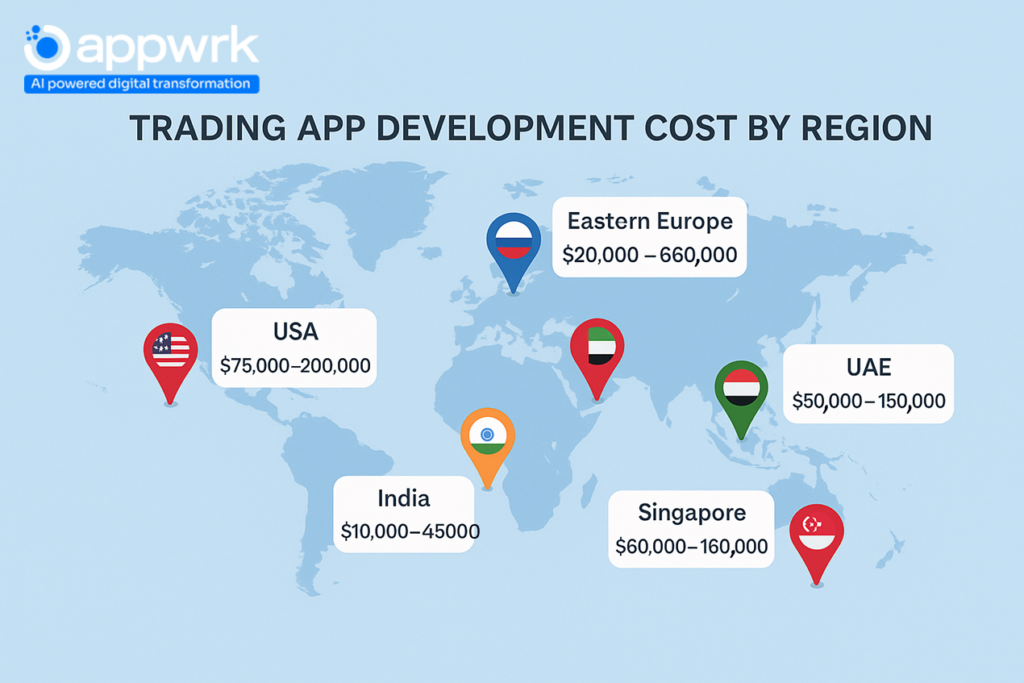
Regional Cost Comparison: What You’ll Spend Based on Where You Build an App Like Robinhood
Choosing the right development region significantly impacts your trading app cost.
Region
Hourly Rate to develop an App like Robinhood (Avg)
Cost Range for the development of an app like Robinhood (Full App)
Not all trading platforms are built the same. The stock trading app development cost depends heavily on the type of app you choose to create. Each comes with its own feature list, architecture demands, and compliance needs. Below is a breakdown of the most common categories, their examples, and estimated budgets.
Brokerage Apps
Traditional trading platforms that let users buy and sell equities, ETFs, and bonds. They require real-time stock market application APIs, compliance modules, and secure payment gateways for fund transfers. Examples: Fidelity, Webull, E*TRADE Estimated Cost: $25,000 – $70,000
Robo-Advisors
Automated investing platforms that use algorithms and sometimes automated trading logic to build portfolios based on user risk appetite. These apps also integrate investment portfolio management and AI-driven analytics. Examples: Wealthfront, iFlip Invest, Betterment Estimated Cost: $35,000 – $80,000
Social Trading Platforms
Designed for collaboration, these apps let users follow or copy the strategies of top investors. They often include chat features, custom alerts, and gamification for higher engagement. Examples: eToro, ZuluTrade, AvaTrade Estimated Cost: $30,000 – $75,000
Fractional Share Investing Apps
Make investing accessible by allowing fractional trading, so users can buy parts of high-value stocks. Requires precise execution logic and tight brokerage integrations. Examples: Robinhood, M1 Finance, Stash Estimated Cost: $25,000 – $65,000
Commission-Free Trading Apps
These apps eliminate fees, attracting younger investors and competing directly with the Robinhood App model of a zero-commission stock trading app. Needs extremely efficient payment processing and backend systems. Examples: Robinhood Estimated Cost: $30,000 – $70,000
Full-Service Brokerage Apps
These go beyond trading, offering retirement planning, tax tools, and business reports for users managing large investment portfolios. Typically aimed at long-term investors. Examples: Charles Schwab Estimated Cost: $50,000 – $90,000
Advanced Trading Platforms
Built for pros and high-frequency traders, these include algorithmic trading, advanced charting, and fast execution with Monolithic vs Microservice backend options. Examples: Ally Invest Estimated Cost: $60,000 – $95,000
Mobile-First Trading Apps
Optimized for mobile application users. They focus on gestures, one-click trading, and push notifications and alerts. Designed to match the demand for seamless mobile app experiences. Examples: IBKR Mobile Estimated Cost: $25,000 – $60,000
Cryptocurrency Trading Apps
Built for crypto assets, these require blockchain technology, wallets, and blockchain development expertise. Compliance with global crypto laws adds to the cost. Examples: Coinbase, Binance, Crypto.com Estimated Cost: $40,000 – $90,000
Many founders today combine features from multiple categories, for instance, commission-free + fractional shares + social trading. This hybrid model increases costs but helps capture a broader audience in the growing trading industry.
What Are the Key Factors That Affect the Cost of a Stock Trading App?
The cost to develop a trading app like Robinhood is influenced by dozens of moving parts. Here are the biggest cost-driving factors in trading app development you should know:
Feature List
More features = higher cost. A simple app with watchlists and stock search is affordable, but a moderately complex app with real-time feeds, order execution, and data protection jumps in cost. A highly complex app with algorithmic trading and deep analytics sits at the top.
UI/UX Design Complexity
Users expect sleek, intuitive, user-friendly, and aesthetically pleasing interfaces. Adding animations, transitions, and User Experience Design refinements from a skilled UX team can significantly raise costs, but also boost retention.
Coding & Architecture
Choosing between Monolithic vs Microservice backend architectures has long-term implications. Microservices cost more upfront but allow better scalability, reliability, and easier upgrades.
Testing
Mobile app testingand security testing are vital. Continuous QA ensures compliance with financial regulations, prevents fraud, and validates security practices like encryption, MFA, and fraud detection. This usually takes 10–20% of the total budget.
Security & Compliance
Strong security measures and security system design aren’t optional in a stock market app. Meeting FINRA, SEC, and GDPR standards, implementing KYC/AML, and passing audits increase upfront cost but build user trust.
A U.S. team of expert banking app developers or fintech app developers charges more, while offshore teams deliver the same build at a fraction of the cost. This decision alone can cut your budget by 30–40%.
Types of Stock Trading Projects You Can Build
Fintech founders have different goals, and the type of project dictates the stock trading app development cost. Here are some of the most common builds:
Automated Stock Trading Platform – Executes strategies in real time using pre-set rules. Often paired with algorithmic trading modules.
Wealth Management Platform – Offers robo-advisors and portfolio tracking, ideal for fractional trading investors.
OTC Securities Platform – Supports decentralized assets, often involving blockchain development or blockchain technology integrations.
Best App for Trading Stocks
The best app for trading stocks offers zero commissions, real-time updates, and an intuitive user interface.
Robinhood App
Perfect for beginners, Robinhood offers zero-commission trading with a sleek, mobile-first design.
Webull Stock Trading App
Built for technical traders, Webull provides advanced charting, indicators, and real-time market data.
Charles Schwab Stock Trading App
A robust platform for long-term investors, Schwab delivers research tools, full-service brokerage, and strong customer support.
These apps cater to both beginners and advanced traders with smart, feature-rich platforms.
Best Stock Trading App for Beginners
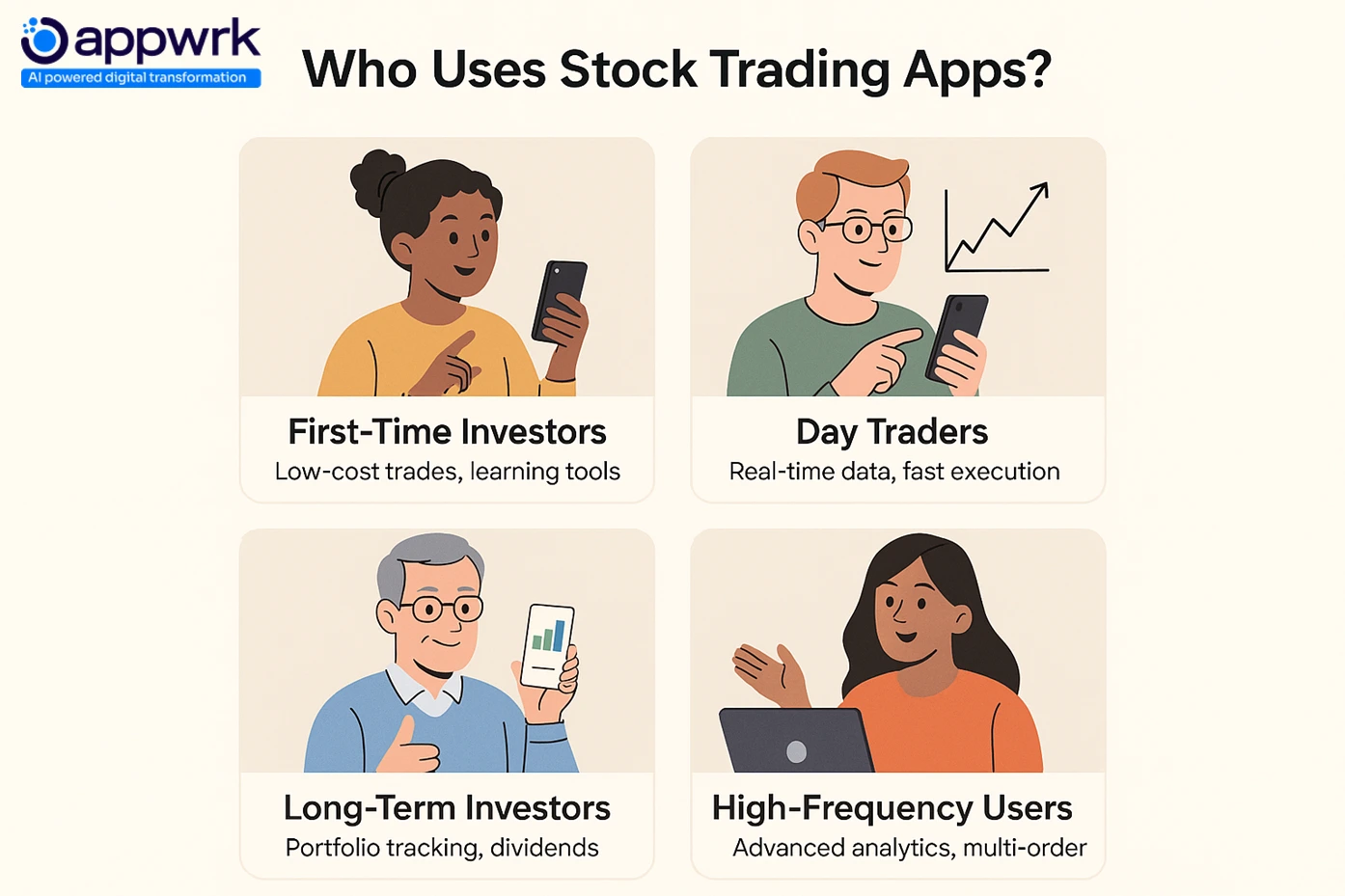
The best stock trading app for beginners must offer tutorials, low risk, and a simple UX. Examples include:
Robinhood App – Fractional shares and intuitive design
Acorns – Round-up investing makes it easy for new users
Stash – Educational resources for first-time investors
Features like learning tools and no account minimums make these ideal for beginners.
Best Stock Trading Apps UK
Investors in the UK often search for the best stock trading app UK that complies with local regulations and supports GBP. Popular choices:
Freetrade – UK-based with commission-free trading
Trading 212 – Offers stocks, ETFs, and CFDs
eToro – Regulated and supports fractional shares
Free Stock Trading Apps
A free stock trading app lets users invest without upfront fees. Here are a few top free options:
Robinhood App – Commission-free with no minimums
Public.com – Social investing, no trading fees
SoFi Invest – Offers stocks, ETFs, and crypto with zero fees
Free apps attract first-time investors who want to test the waters before committing to full-service brokers.
Zero Commission Stock Trading Apps
The zero commission stock trading app revolution was spearheaded by Robinhood, and many followed:
Robinhood App – The pioneer in commission-free trades
Webull stock trading app – Advanced charts, no fees
Moomoo – Offers commission-free trades with real-time data and AI tools
This pricing model has become a standard expectation rather than a luxury.
AI Stock Trading Apps
AI stock trading apps use machine learning, data analytics, and algorithmic strategies to automate investing, manage risk, and generate intelligent trade suggestions. These platforms are ideal for passive investors, quantitative traders, or users looking for smarter decision-making tools.
Trade Ideas
This high-performance AI app scans the market in real time, offering entry/exit signals based on predictive algorithms and back-tested strategies. Perfect for active traders and professionals.
Zignaly
Zignaly connects users to AI-powered bots that automate trading based on preset rules. It also allows copying trades from expert traders, making it great for beginners and hands-off investors.
Tikr Terminal
Tikr uses AI for deep fundamental analysis, helping long-term investors track companies, earnings, and financial metrics across global markets.
Regulatory compliance is a key decision factor here.
Free Penny Stock Trading Apps
For high-risk, high-reward traders, a free penny stock trading app is essential. Top choices:
TD Ameritrade – No-commission penny stocks
Robinhood App – Offers OTC stocks, limited penny support
Webull stock trading app – Good for speculative traders
Use these only if you’re experienced with volatile, low-cap stocks.
Top-Rated Stock Trading Apps
Top-rated stock trading apps are those with high reviews across app stores and analyst platforms. Examples:
Robinhood App – 4.2★ with over 10M+ downloads
Charles Schwab stock trading app – Trusted name, top performance
Webull stock trading app – For high-frequency traders
Online Stock Trading Apps
An online stock trading app offers accessibility and real-time execution from anywhere. Examples:
Robinhood App
eToro
Fidelity
Many also offer browser-based access synced with your mobile app.
Stock Trading Simulator Apps
Before trading real money, try a stock trading simulator app:
Investopedia Simulator – Widely used for paper trading
Trading Game – Gamified simulator for learning
WeBull stock trading app – Includes practice mode
Stock Trading App for Beginners
Another variation of beginner-focused search is stock trading apps for beginners:
Robinhood App
Stash
M1 Finance
What Are the Hidden and Ongoing Costs You Should Plan For?
Launching a trading app isn’t the finish line; it’s the start of ongoing investment. Many founders underestimate the hidden costs that surface once the app is live. These stock trading app development cost drivers range from compliance renewals to scaling cloud infrastructure. Planning ahead ensures sustainability.
Maintenance and Support Costs
Every mobile application requires updates. Security patches, OS upgrades, and bug fixes usually cost 15–20% of the initial budget annually. For a stock market app, this also includes stability checks to keep trading smooth during high-volume sessions.
Cost of Regular Feature Updates
Markets evolve, and so do user expectations. Adding advanced features like fractional trading, custom alerts, or AI-based recommendations means incremental development. Without updates, even a polished Robinhood App risks losing its edge.
Third-Party API Charges
Trading platforms run on data. APIs for the latest market data (IEX, Polygon), order execution (Alpaca), or KYC (Trulioo) charge usage-based fees. These costs grow with your user base and directly impact your feature count and complexity expenses.
Ongoing Compliance & Legal Expenses
Regulations like FINRA, GDPR, PCI DSS, and SEC oversight require constant attention. Each update involves audits, security practices reviews, and documentation. Skipping this exposes your trading industry business model to fines or worse.
Data Storage and Infrastructure Costs
User investment portfolios, historical charts, and live feeds demand scalable servers. Hosting on AWS, Azure, or GCP ensures reliability but scales with growth. Choosing between a Monolithic vs a Microservice backend impacts both cost and scalability.
Security Monitoring and Upgrades
Fintech is a high-risk target. You’ll need continuous security testing, fraud monitoring, and upgrades to your security system. Strong data protection and High-level security features aren’t one-time tasks; they’re ongoing safeguards.
Customer Support Setup
A trading app must provide timely support. Whether through AI bots or human agents, ongoing mobile app testing of support channels is critical for user engagement and retention.
User Training and Onboarding Resources
In-app tutorials, FAQs, and walkthroughs must be refreshed with each feature rollout. This improves adoption and helps reduce support costs, especially for users new to what a trading app like Robinhood is.
App Store Listing & Updates (iOS/Android)
Each submission involves assets, release notes, and compliance checks. Resubmissions after rejection also add cost. Continuous presence in app stores is essential for mobile app visibility.
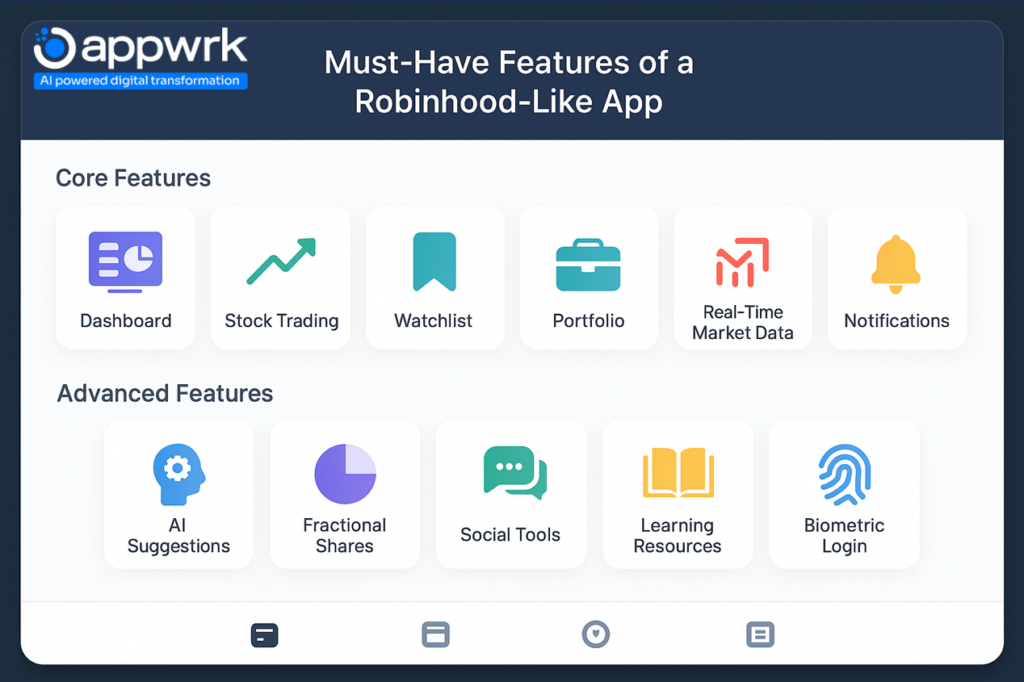
To thrive in the fintech space, your app needs more than a clean design. It must combine seamless functionality with security measures, scalable infrastructure, and strong regulatory compliance. Below are the must-have core features for a stock trading app like Robinhood.
Core Features of a Trading App Like Robinhood
Dashboard
The hub for users, showing balances, open positions, and recent trades. It’s the beating heart of every stock market application.
Robinhood Login and User Onboarding
An intuitive and secure login process is essential. The Robinhood App offers seamless onboarding with options like biometric login and KYC verification. To keep users engaged from day one, your app should mirror this process, combining simplicity with high security standards.
Portfolio Management
Tracks holdings, gains/losses, dividends, and generates business reports. This doubles as a light investment portfolio management tool.
Stock Trading Functionality
Supports buy/sell for equities, ETFs, and crypto with high-speed order execution. A smooth trading interface builds trust.
Real-Time Market Data
Provides the latest market data through integrations like IEX Cloud. Includes candlestick charts, trends, and advanced analytics and charting tools.
Watchlist
Let’s users monitor selected stocks or crypto. Combined with custom alerts, this boosts engagement.
Fund Transfer
Secure deposits and withdrawals via payment gateways like Stripe or PayPal. Reliable payment processing is critical to user trust.
Notification and Alerts
Push updates for trades, earnings, and news. Ensures users never miss opportunities in volatile markets.
User Registration and Secure Login
Simple sign-up with KYC compliance, MFA, and biometric login. Meets security & compliance standards while ensuring accessibility.
Can I Talk to People on the Robinhood App?
While the Robinhood App doesn’t have a built-in chatroom or social feed, other platforms like Public.com and eToro do offer community-driven features.
If you’re planning to build a social stock trading app, integrate features like:
In-app messaging
Group discussions
Copy trading
Community leaderboards
Advanced Features to Boost Engagement and Retention
Fractional Share Trading
Fractional trading lets users buy slices of high-value stocks instead of full shares. This feature is especially attractive to younger or budget-conscious investors who want exposure to premium assets without heavy upfront investment. It’s one of the key features that made Robinhood a market leader.
Commission-Free Trading
The zero commission stock trading app model, free trades on stocks, ETFs, options, and even crypto, is now the standard in the trading industry. Eliminating fees not only drives user adoption but also strengthens retention, which explains why Robinhood is so popular.
AI-Powered Insights and Stock Recommendations
Integrating machine learning for custom alerts, predictive insights, and portfolio suggestions gives users a smarter edge. These insights draw on real-time market trends and investment portfolios to enhance decision-making. Some platforms even experiment with algorithmic trading add-ons to appeal to advanced users.
Trading Education & Learning Resources
To engage beginners, apps should embed trading learning resources: glossaries, tutorials, and bite-sized explainer videos. This makes the mobile app accessible to first-time traders while adding value for seasoned investors.
Social and Community Features
Copy trading, community boards, and portfolio sharing turn a mobile application into more than just a trading tool; they create digital communities. By enabling users to observe and replicate trades, apps increase stickiness and boost user engagement.
Strong Security and Regulatory Compliance
A trading app cannot survive without robust security measures and strict regulatory compliance. This means data encryption, advanced security system protocols, and regular security testing. These security practices help build trust in a market where breaches can be catastrophic.
Predictive Analysis Tool
Using AI with the latest market data, predictive modules forecast stock performance and trends. For active traders, this tool bridges the gap between manual strategies and automated trading workflows.
Buy and Sell Crypto
Adding crypto trading for Bitcoin, Ethereum, or altcoins expands reach beyond equities. This requires compliance with crypto regulations, blockchain wallet integration, and efficient payment processing through secure payment gateways. Many fintech app developers now combine equity and crypto features to maximize adoption.
ETF Screener Tool
An ETF screener helps users filter options by risk, returns, or sector. For users managing investment portfolios, this doubles as a lightweight investment portfolio management tool that supports diversification.
What is Robinhood Gold?
Robinhood Gold is a paid membership with enhanced features, including margin lending, priority support, and premium research. This is one of the monetization models your app could adopt.
Is Robinhood FDIC insured?
Many users wonder if Robinhood is FDIC insured. While Robinhood offers SIPC protection for securities, FDIC insurance applies to cash sweep accounts under certain conditions.
Feature-Wise Cost Breakdown for a Stock Trading App Like Robinhood
Features of an app like Robinhood
Estimated Cost Range (USD)
User Registration & Secure Login
$500 – $1,500
KYC Verification & Biometric Login
$800 – $2,000
Real-Time Market Data Integration
$1,000 – $3,000
Stock Trading Functionality
$2,500 – $6,000
Order Types (Market, Limit, Stop Loss)
$1,000 – $2,500
Portfolio Management Dashboard
$1,500 – $4,000
Fund Transfer & Payment Gateway Setup
$1,000 – $2,000
Alerts & Notifications
$700 – $1,500
Fractional Share Trading Module
$1,500 – $3,500
Commission-Free Trading Setup
$1,000 – $2,500
AI-Based Insights & Stock Suggestions
$2,000 – $5,000
Trading Education & Learning Resources
$500 – $1,200
Social/Community Tools
$1,500 – $4,000
Security Layer & Compliance Setup
$2,000 – $4,500
These are modular estimates. You can prioritize features in phases to fit your startup budget.
How Do Stock Trading Apps Like Robinhood Work?
How to Get Started with Robinhood Download and Account Setup?
Getting started with the Robinhood download is as simple as visiting the App Store or Google Play. Once downloaded, users go through a smooth onboarding process involving email or phone registration, KYC compliance, and secure login via biometric authentication or MFA. The app is designed for minimal friction and maximum speed in account setup.
Account Setup & User Authentication
When a user downloads the Robinhood App or any other stock market app, the first step is onboarding. Registration usually happens via email or phone, followed by identity checks using KYC protocols. Multi-factor authentication and biometric logins (like Face ID or fingerprint scans) add extra security measures. This protects sensitive financial data and sets the tone for compliance-driven fintech apps.
Order Placement & Execution
Placing trades is the core of any stock market application. The app connects to exchange APIs (NYSE, NASDAQ) to process buy and sell orders, from market and limit orders to stop-loss execution. Behind the scenes, order flow is powered by fast APIs, payment processing engines, and reliable security practices to minimize latency while ensuring trust.
Real-Time Market Feed
Users expect accurate, latest market data in their dashboards. Apps like Robinhood integrate charts, watchlists, and financial news into one mobile app interface. This requires syncing with third-party feeds and conducting thorough mobile app testing to guarantee smooth updates across devices.
Transaction Management
Every trade, dividend, and fee is logged for investment portfolio management. Transaction histories allow users to review gains/losses, calculate taxes, and track cash flow. For long-term users managing complex investment portfolios, this feature is central to decision-making.
Search & Filter Tools
An essential feature in any mobile application, robust search functions let users filter stocks by sector, price, or popularity. For day traders, this means faster access to opportunities. For beginners, it makes the trading industry more approachable. Paired with custom alerts, it ensures users never miss opportunities.
How to buy stocks on Robinhood?
Core functions include straightforward buy/sell workflows: users expect simplicity when doing how to buy stocks on Robinhood or similar interfaces.
Is Robinhood Safe?
When launching a stock trading app like Robinhood, security is paramount. Robinhood is considered safe and legitimate due to its end-to-end encryption, multi-factor authentication, and compliance with FINRA and SEC regulations. Any stock market application aiming to replicate this success must prioritize data protection and follow the same compliance protocols.
How to Withdraw Money from Robinhood‑Type Apps?
Secure deposits and withdrawals are core features; users frequently search for how to withdraw money from Robinhood, so your app must ensure fast, reliable fund transfer mechanisms.
Can You Day Trade on Robinhood‑Style Apps?
Yes, day traders require fast trade execution, real‑time market data, and minimal delay; features like day trading on Robinhood are essential for active users.
How to Create an Investment App Like Robinhood?
Building an app isn’t just about clean code. It’s about aligning with user needs, compliance, and scalability. Here’s the development process step-by-step:
Market Analysis and Research
Study competitors (e.g., Robinhood Gold, Webull, M1 Finance) to see why Robinhood is so popular. Analyze gaps in UX, monetization, and user segments like Gen Z or crypto traders.
Formulate a Development Approach
Decide whether to start with an MVP (Minimum Viable Product) version with essential features, stock search, buy/sell functionality, KYC, or go for a full-scale launch. Delivery model choices (in-house vs. outsourced, agile vs. waterfall) also shape the timeline.
Create a Seamless UI/UX Design
Focus on UI/UX design complexity. A minimal, mobile-first dashboard improves retention. A strong UX team ensures a user-friendly and aesthetically pleasing interface.
Carry Out the Development Process
This includes frontend, backend, and third-party integrations (APIs, KYC modules, trade engines). Choosing Monolithic vs Microservice backend matters; monoliths are faster to launch, microservices scale better long-term. Partnering with trusted mobile app development companies ensures proper architecture.
Follow Stringent Testing Techniques
In fintech, testing is non-negotiable. Security testing, load checks, and mobile app testing validate data protection and reliability. It’s part of the cost, but without it, no launch is safe.
Deploy and Maintain the App
After app store deployment, set up CI/CD for smooth updates. Maintenance includes bug fixes, compliance renewals, and upgrades like blockchain development integrations.
How Robinhood Stock Features Attract Modern Investors?
The Robinhood stock feature allows users to search, track, and trade thousands of equities in real-time. From blue-chip stocks to volatile IPOs, users have access to comprehensive market data, performance graphs, and watchlist integration. Robinhood stock tools are designed to cater to both casual and professional traders with fast execution and clarity.
A well-designed stock tracking and trading module like the Robinhood stock system is critical to any competitive trading app.
Client Objective Build a cross-platform AI-powered trading solution with smart alerts, automation, and high-performance execution that could handle large investment portfolios while remaining cost-efficient.
Tech Stack React Native (mobile app), Node.js (backend), Python (AI layer), AWS (cloud), Plaid (finance integration), WebSockets (real-time), and blockchain development modules for secure ledger management.
Timeframe 6 months to launch MVP with 92% test coverage, advanced security practices, and real-time order execution.
Outcomes 80%+ user retention after 3 months Scaled to 100K+ users within the first year Downtime reduced to <1% during peak trading sessions
Even though most users love the Robinhood App for being a zero-commission stock trading app, the platform itself runs on a highly profitable business model. If you’re building a stock market application, monetization strategies matter as much as security measures and feature planning.
Advertising and Partner Promotions
Integrate personalized ads, from promoted stocks to fintech products, to generate recurring revenue streams.
Paid Membership
Offer advanced features such as market analytics, after-hours trading, or early IPO access under premium tiers like Robinhood Gold.
Transaction Fee
While commission-free trading dominates, apps may still charge for fractional trading in crypto swaps, international securities, or margin accounts.
Payment for Order Flow (PFOF)
A primary revenue model where brokerage firms are paid by payment processors and market makers for routing trades, a strategy Robinhood scaled early in the trading industry.
Margin Lending
Users borrow funds to trade on margin. This generates interest income and deepens engagement for both long-term and high-frequency investors.
Premium Subscriptions
Advanced tiers can include investment portfolio management, tax-optimized trading, and algorithmic trading tools, creating steady recurring revenue.
Interchange Fees from Debit Cards
Apps can integrate payment gateways and debit card services, earning interchange fees every time a transaction is made.
When combined, 2–3 revenue models (e.g., PFOF + premium memberships + ads) maximize profitability while still keeping your mobile application free to use.
What Is the Robinhood Gold Card and How Does It Work?
The Robinhood Gold card is part of Robinhood’s premium services, offering benefits such as higher instant deposit limits, professional research insights, and access to margin trading. It adds a layer of exclusivity and utility for serious investors. Monetizing your app through a Robinhood Gold-like model allows for recurring revenue and differentiation among power users.
If you’re including a paid membership feature, a Robinhood Gold card equivalent can be an excellent upsell strategy.
Does Robinhood Have Fees?
Although Robinhood is known for zero‑commission stock trading, it still has fees in certain cases. For example, margin interest, special order types, or after-hours. So, “Does Robinhood have fees?” is a question your cost and monetization section should address.
How Long Does It Take to Build a Stock Trading App Like Robinhood?
The timeline depends on the scope: whether you’re planning a simple app, a moderately complex app, or a highly complex app with automated trading features.
On average, the development process takes 8 to 28 weeks:
MVP (Minimum Viable Product) with stock search, KYC, and order execution → 8–12 weeks
Moderately complex app with alerts, social features, and analytics → 12–20 weeks
Highly complex app with blockchain technology, AI recommendations, and microservice backend → 20–28 weeks
Total Timeline: ~2 to 6.5 months Total Cost Range: $10,000 – $50,000 (MVP), up to $95,000 (Full-scale build)
The exact timeframe also depends on UI/UX design complexity, team size (in-house vs. offshore), and compliance requirements. Partnering with experienced mobile app development companies and fintech app developers helps reduce delays while ensuring enterprise-grade reliability.
Development Timeline & Cost Breakdown
Development Phase of Developing an app like Robinhood
Timeline to build an app like Robinhood
Cost Range (USD) to build an app like Robinhood
Discovery & Requirement Gathering
1–2 weeks
$500 – $1,000
UI/UX Design
2–3 weeks
$2,000 – $5,000
Frontend + Backend Development
5–10 weeks
$8,000 – $20,000
API Integrations & Payments
2–4 weeks
$2,000 – $5,000
Trade Execution Engine
3–5 weeks
$3,000 – $7,000
Security & Compliance Layer
2–3 weeks
$3,000 – $6,000
QA & Testing
2–3 weeks
$2,000 – $4,000
Deployment & Launch
1 week
$1,000 – $2,000
How to Reduce the Cost Without Compromising on Features or Security?
Cutting corners in stock trading app development can be risky, especially around compliance or security measures. But there are tried-and-tested ways to optimize costs while still ensuring a high-quality, scalable product.
MVP-First
Begin with a Minimum Viable Product (MVP). Focus only on the core features: login, KYC verification, portfolio tracking, and simple order execution. Launching fast with an MVP reduces your upfront stock trading app development cost and validates your idea before going big.
Open-Source Tools
Use open-source frameworks and charting libraries like TradingView, WebSockets, and analytics dashboards. They cut down dev hours and speed up delivery while maintaining strong security practices.
Prioritize Features
Not every feature is needed on day one. Start with essentials like fractional trading, secure logins, and real-time data feeds. Defer secondary features such as gamification or voice commands to later phases.
Nearshore/Offshore Development
Partner with experienced mobile app development companies in India or Eastern Europe. These fintech app developers can lower costs by up to 60% while maintaining quality. Reusable code modules and agile sprints further ensure predictability in budgets.
What’s the Best Way to Start: MVP vs Full Build?
Whether you’re a bootstrapped founder or a VC-backed startup, the smart play is to validate first with an MVP. This ensures you gather real user data before committing to a highly complex app build.
MVP Inclusions
For a fast launch, keep your MVP lean with only revenue-critical modules:
Login & KYC verification
Dashboard & watchlist
Real-time stock data feeds
Buy/sell button with simple order types
Estimated cost to develop a trading app like Robinhood (MVP): $10,000 – $25,000 | 2–3 months
Full Build Scope
Once your MVP gains traction, you can scale to include:
Estimated cost to develop a stock trading app (full build): $40,000 – $95,000+ | 4–6+ months
Investment Milestones & Validation
Each phase ties directly to funding stages:
MVP → Bootstrap or Pre-seed
Full App → Seed to Series A
Enterprise Expansion → Series B+
Investor-ready apps don’t just showcase downloads; they prove retention, security, and scalability.
What’s the Future of Stock Trading Apps?
AI & Machine Learning
AI and ML are reshaping the trading industry. Expect smarter analytics, automated recommendations, and algorithmic trading features to become standard in every stock market app.
Cryptocurrency & Web3 Integration
With blockchain technology maturing, more apps now allow trading of Bitcoin, Ethereum, and NFTs. Future-ready platforms will also explore blockchain development for secure transaction ledgers.
Global Market Expansion
Next-gen platforms are expanding globally with multi-currency and multi-region investment portfolios. Compliance with cross-border regulations will be critical for adoption.
Fractional & Micro-Investing
Apps offering fractional trading and micro-investments are driving adoption among Gen Z and millennials who want to invest with smaller budgets.
Social & Copy Trading
Social features, portfolio sharing, and copy trading will continue to grow. Expect mobile applications to double up as trading communities with built-in collaboration.
How Can Appwrk Help in Stock Trading App Development?
APPWRK is your strategic partner in building a Robinhood-like stock trading app that’s secure, scalable, and compliant from day one. From fractional trading to payment processing integrations, we bring fintech domain expertise and execution to every stage of development. Here’s what we offer:
Experienced fintech app developers who specialize in trading platforms, algorithmic engines, and investment management tools.
Modular, scalable architecture that grows with your app, from MVP to full-featured enterprise-grade builds.
Security-first development with KYC/AML, PCI DSS, GDPR, and FINRA-compliant workflows baked into the foundation.
Retention-driven UX with clean dashboards, custom alerts, and gamified trading experiences that engage first-time users and high-frequency traders alike.
Full-cycle product support, from discovery and prototyping to QA, deployment, and future-ready upgrades like blockchain integration and AI-powered trading insights.
Request afree estimate in 24 hoursand find out exactly how much Robinhood-like trading app development costs with our structured approach.
FAQs
How much does it cost to build a trading app like Robinhood? A basic MVP (with login, KYC, and trading features) costs between $10,000 and $25,000. A full-featured app with advanced analytics and feature list modules can range up to $95,000+.
What features are essential in a stock trading app? Core features include onboarding with KYC, real-time market data, buy/sell order execution, investment portfolio management, notifications, and seamless deposits/withdrawals via payment gateways.
How long does it take to develop a trading app? The timeline depends on complexity. An MVP can take 2–3 months, while a cost-to-develop trading app like Robinhood with advanced modules may take 6+ months. Contact us to know the real timeline to build your mobile application.
What’s the best way to start building a trading app? Begin with an MVP approach: focus on login, KYC, watchlist, and buy/sell functionality. Then, plan core features, build the MVP with essential features, test and launch the MVP to gather feedback, and finally add advanced features for a full-fledged app.
How do apps like Robinhood make money? Through Payment for Order Flow (PFOF), subscriptions like Robinhood Gold, interchange fees, custom alerts, advertising, and margin lending are offered.
Is Robinhood safe? Yes, the Robinhood App uses strict security system protocols, encryption, and regulatory compliance audits. Still, many ask “why is Robinhood so popular” or even “why is Robinhood so bad”; the answer lies in its dual position as both a disruptor and a business balancing compliance with monetization.
How many users does the Robinhood App currently have? Robinhood has over 22 million active users, making it a leader among modern stock trading apps.
What are some alternatives to the Robinhood App? Top alternatives include Cash App, eToro, Webull, Trading 212, Freetrade, and Trade Republic, all growing rapidly in global markets.
Why is the Robinhood App so popular among Gen Z investors? Robinhood’s mobile-first design, commission-free trades, and easy-to-use interface make it ideal for Gen Z users new to investing.
Gourav Khanna is the Co-founder and CEO of APPWRK, leading the company’s vision to deliver AI-first, scalable digital solutions for enterprises and high-growth startups. With over 16 years of leadership in technology, he is known for driving digital transformation strategies that connect business ambition with outcome-focused execution across healthcare, retail, logistics, and enterprise operations.
Recognized as a strategic industry voice, Gourav brings deep expertise in product strategy, AI adoption, and platform engineering. Through his insights, he helps decision-makers prioritize market traction, operational efficiency, and long-term ROI while building resilient, user-centric digital systems.
Subscribe to APPWRK Blogs, We'll Do the Rest!
Get Blogs on UI/UX, Mobile Apps, Online Marketing, and Web development technology.
Unlock worthy and priceless suggestions from the masters of mobile and web app development