












Introduction
App personalization has become a cornerstone of delivering standout user experiences in today’s competitive mobile market. It has gone from being just an added feature to a necessity for building meaningful connections with your audience. Personalization also transforms a generic app experience into one that feels tailored to each individual, creating a sense of relevance and value that keeps users coming back.
However, achieving this level of personalization requires more than just surface-level changes, it demands a deep understanding of user behaviors, preferences, and expectations. When done effectively, personalization not only enhances customer satisfaction but also drives higher engagement, increases retention rates, and builds long-term loyalty.
Let’s get into the nitty gritty of actionable strategies for app personalization and best practices to refine your approach.
Table of contents
- Introduction
- What is Mobile App Personalization?
- How does Personalization Enhance Mobile App Marketing?
- Types of Mobile App Personalization
- The Importance of Personalization in Mobile Apps
- Top 7 Ways to Personalize Your App
- 10 Mobile App Personalization Strategies to Improve Your Metrics
- 1. Leverage Cross-Channel Transactional and Behavioral Data
- 2. Increase In-App Purchases with Relevant Product Recommendations
- 3. Customize the Experience for iOS and Android
- 4. Collect Data Responsibly
- 5. Conduct Data-Driven Personalization
- 6. Choose the Optimal Timing and Messaging Frequency
- 7. Adaptive User Interfaces
- 8. In-App Rewards and Gamification
- 9. Integrate Privacy with Personalization
- 10. Contextual Help and Assistance
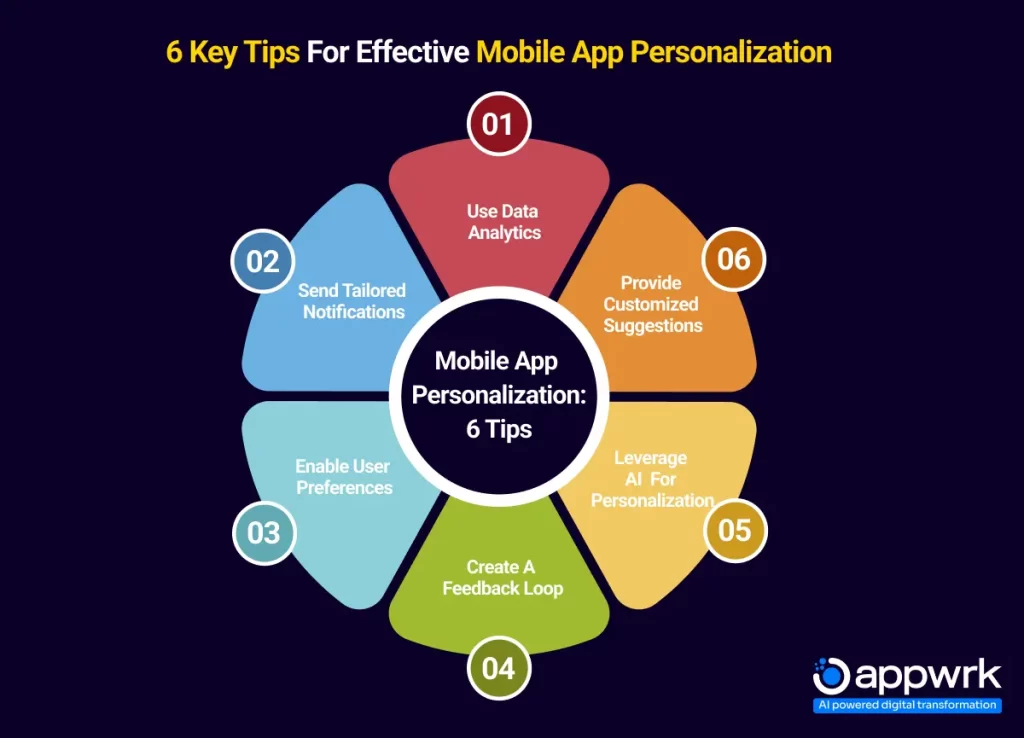
- 6 Key Tips for Effective Mobile App Personalization – Infographic
- Navigating the 6 Key Obstacles to Mobile App Personalization
- Conclusion
What is Mobile App Personalization?
Mobile app personalization is a term that refers to the process of customizing the content of an app along with its features and interactions so that it aligns with a user’s unique preferences, behaviors, and needs. App personalization can be done by leveraging user-specific data such as location, browsing history, purchase patterns, and user preferences.
The entire process of app personalization often revolves around using various tools like AI to provide user-specific recommendations, push notifications, and adaptive interfaces that are responsive to the behavior of each user. Personalization has many positive impacts, from allowing apps to become more intuitive and engaging to enhancing satisfaction and retention among users.
With customer satisfaction holding utmost importance in shaping the success of a business, more and more people are turning towards highly personalizing their apps. In fact, according to Forbes, 91% of consumers are more likely to engage with brands that provide a personalized experience.
As user expectations are evolving rapidly, businesses are also increasingly recognizing the need to adapt and meet these demands and are using a variety of approaches to app personalization. Let’s explore some of the most effective strategies and types of app personalization that are commonly being adopted to create tailored experiences for users.
App Personalization vs. App Customization and Segmentation
There are several ways to tailor user experiences and boost customer engagement through it. You can personalize your app to change dynamically according to each user or give your users the choice of how they want their experience to be personalized. While these seem to be quite the same, they are broadly different ideas and need a distinct approach. Let’s look into the different ways apps can be personalized and compare them with each other.
App Personalization vs. App Customization
Tailoring the app experience for an individual through different processes and modern technologies like AI, machine learning, and data analytics is app personalization, and it helps deliver highly relevant content, features, and recommendations. On the other hand, app customization puts the power in the user’s hands and allows them to manually adjust any specific features or settings within the app according to their preferences.
Some great examples of app customization include changing themes, organizing menus, or setting notification preferences within an application. While customization allows users to shape their own experience according to their personal taste, it is limited to the options provided by the app and, hence, is less dynamic than personalization.
App Personalization vs. Segmentation
The main goal of app segmentation is the same as personalization and is to improve user experiences, but it differs in its approach. With personalization operating at the individual level, segmentation focuses on categorizing all the users of the app into distinct groups based on shared characteristics, such as demographics, geographic location, or interests, and improving the experience based on this data. When compared to personalization, segmentation targets a broader group of audiences and personalized features for them instead of a single user.
For example, a fitness app might group users by their fitness goals, such as weight loss, muscle building, or endurance, and based on this information, it can offer tailored content to each segment.
How does Personalization Enhance Mobile App Marketing?
With businesses and app owners increasingly adopting app personalization while developing their applications, it has gone beyond the generic interactions and offers highly tailored experiences that resonate with individual users’ preferences and behaviors.
The process of app personalization has also changed over time and is now largely dependent on leveraging data and advanced technologies. Read on to learn more about how mobile app marketing personalization works in 2025.
1. Data Collection
The entire foundation of app personalization lies in data collection, as it serves as a base for customizing the content and features for the individual. Apps start with gathering user information through various channels, such as registration forms, user activity, browsing history, location tracking, and feedback. Through this highly confidential and quality data, businesses understand user preferences and personalize their app accordingly.
2. Customer Segmentation
Once the data is collected from users, it is used to group users into distinct segments based on their shared characteristics. These segments could be based on different factors such as demographics, purchase habits, app usage frequency, or user goals.
A good example can be an e-commerce app that segments its customers into groups based on their purchases, such as frequent buyers, first-time users, or those who abandon carts. By doing so, businesses can create content that is relevant to each group.
3. Targeting and Personalization
The final step to app personalization is leveraging the data collected and segmented to craft the best-customized experience for your users. This involves delivering custom content, push notifications, email campaigns, or in-app recommendations within the application.
By targeting users with highly personalized content that aligns with their interests, businesses can not only boost engagement and enhance customer satisfaction but also drive conversions.
Types of Mobile App Personalization
With advancements in technology, user behavior analysis, and data-driven insights, personalization has grown tremendously over the years. Initially, mobile apps only offered basic customization options, such as changing themes or setting preferences manually. Now, in recent times, hyper-personalization with various types has taken centre stage. Let’s look more deeply into these types and their explanation below:
1. Content Personalization
Customizing the content of an application to match the individual user’s preferences, interests, and behaviors is often referred to as content personalization. This type of app personalization can include tailored product recommendations, curated articles, or media based on certain factors such as past purchases, browsing history, and search queries.
2. UI Personalization
The visual UI layout and design of the app are extremely important to attract users and encourage them to use the app. With UI personalization, the app can suit the individual user’s preferences through options like dark mode, customized themes, adjustable font sizes, or reordering menus based on usage frequency.
3. Push Notification Personalization
Personalizing your app with push notifications involves sending timely and relevant notifications tailored to individual users based on their behaviors, preferences, or app interactions. For example, these notifications may be used to remind users about items left in their cart, exclusive offers, or updates about their favorite products, making way for more conversions.
Also Read: Why is it Important to Add Push Notification Features in Mobile Apps?
4. Location-Based Personalization
By using real-time geographic data, app personalization can be done to offer tailored content or services to users based on their current location. For instance, a food delivery app can personalize the results by showing nearby restaurant options. This type of personalization not only enhances the relevance of the app experience but also ensures that users receive information that is immediately useful.
5. Behavioral Personalization
With the data gathered from users’ interactions and behaviors within the app, their experience can be customized to create a dynamic user engagement that feels relevant. This behavioral personalization includes tracking their browsing habits, purchase patterns, or app usage frequency to offer recommendations or content that reflects their individual journey.
The Importance of Personalization in Mobile Apps
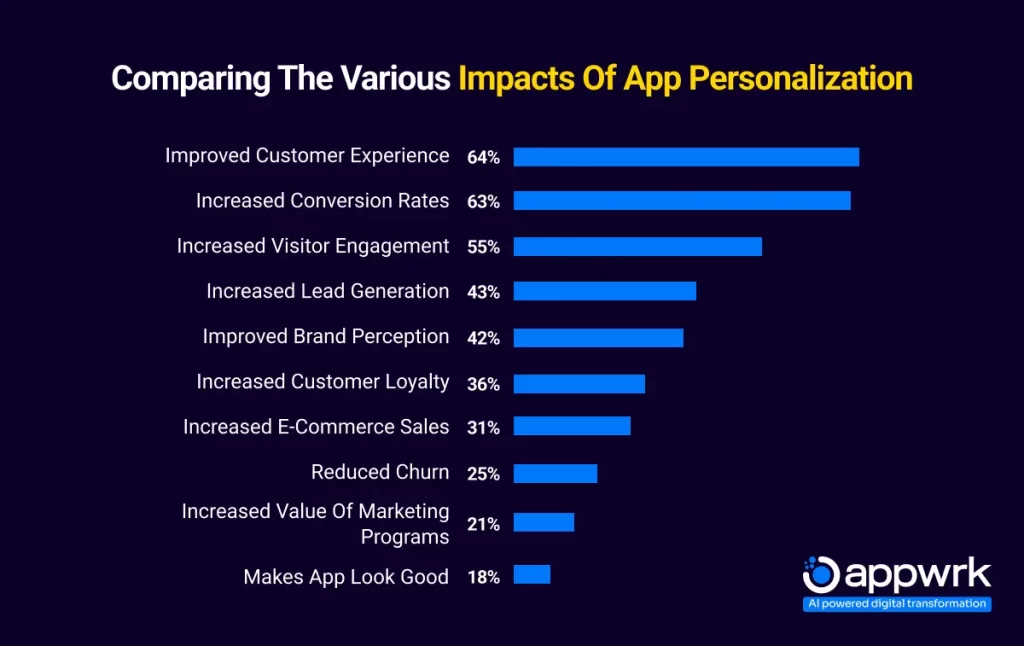
As the mobile app market continues to grow, users’ expectations are continuously evolving. They no longer just want functional apps and they demand an experience that feels intuitive, relevant, and personalized. Apart from satisfying the user, personalization also has a number of positive effects. Here is a graph that explains the various impacts of app personalization.