150+ minds across 4 countries. Join a culture of innovation, ownership & growth.
Rewire for AI
From machine learning to deep learning, from classification tools to overall process automation – our AI engineers will help you retool your existing system or enhance your company results.
Ship faster, scale smarter, built for product companies and SaaS teams
Our Latest Work
We strive hard to deliver result-driven digital solutions across the globe. Check out our case studies to get a glimpse of how we ideate, innovate, and create unconventional digital solutions according to the requirements of our clients.
Discover diverse and passionate insights from our tech enthusiasts. We collaborate across various sectors to streamline operations and drive innovation. Explore our rapidly growing collection of articles to see why we’re at the forefront of IT solutions.
The decision to move from Magento to Shopify is one of the most significant replatforming choices an ecommerce business can make. Magento is powerful, but its power comes with...
Accuracy gap is real: Traditional CPG forecasting carries a 25-40% MAPE error rate. AI-powered models bring that down to 8-15%, according to McKinsey research....
Real stories from global leaders who trusted us with their ideas.
Partnering with APPWRK helped us build a compliant and scalable healthcare platform, accelerating our time-to-market by 35%. Their team consistently delivered outstanding work.
Beesers
Digital Healthcare Client
Collaborating with APPWRK, Sportskeeda modernized its platform into a real-time sports engagement ecosystem, enabling seamless content delivery, scalable fan interactions, and high-velocity performance.
Sportskeeda
Sports & Entertainment Partner
Working with APPWRK was effortless. They captured our vision, maintained full compliance, and delivered a digital experience that built trust and elevated how customers interact with our fintech brand.
PayPenny
Fintech Partner
Working with APPWRK gave us confidence in adopting AI responsibly. Their team built a safe, intelligent bot that transformed how we engage with leads and helped us achieve measurable revenue growth.
IFB
AI Transformation Partner
Leveraging APPWRK’s digital expertise, Nemesis launched a scalable, compliant, and safe super app that connects content delivery, real-time communication, and logistics management within a single platform.
Nemesis
Super App Partner
Build Smarter Apps, Not Just Software
Partner with Appwrk to turn ideas into scalable, cost-efficient digital products.
The cost to develop an app ranges from $20,000 for a basic MVP to over $250,000 for complex, enterprise-grade solutions.
Most MVPs cost $20K - $50K, and adding real-time features or custom flows can double this amount.
Cross-platform development can reduce costs by up to 35% compared to native builds.
Backend infrastructure, security layers, and APIs are key cost escalators.
Location of the development team (US vs India vs East EU) impacts hourly rates by 3x- 5x.
Maintenance, hosting, and updates can add 15–20% of build cost annually.
This blog is meant for business leaders and CXOs looking to build an app. Tech-savvy or not, our blog has simply put across essential information like actual cost examples, major cost drivers, phases of development, technology selection, and optimization techniques, to make sense of the tech environment in today's world.
Why App Costing Matters More Than Ever
In today’s era, apps are a part of the DNA of modern business models. For companies, a well-designed app is no longer a nice-to-have but your customer-facing front, brand storytelling, and scalable business asset. Whether you need to address operational inefficiencies or build a disruptive new experience, an app is most likely the hub of your digital ambition.
As per Statista, the worldwide mobile application development market will surpass $600 billion in 2030 at a CAGR of 13.4%. This growth is driven by swift digital transformation, remote work culture, and more mobile-first services across industries from healthtech and edtech to retail and logistics.
“Every company is a software company.” – Satya Nadella, CEO, Microsoft
Understanding how much it costs to build an app, and where that money goes, isn’t just about budgeting. It’s about making smart, strategic decisions that balance short-term constraints with long-term growth.
Let’s start with a simple but important question that business owners often ask themselves: “How much does it cost to build an app?” According to Global App Testing’s 2024 data, over 6.3 billion people use smartphones globally, and 88% of mobile time is spent on apps, making mobile app investment essential for digital transformation and customer engagement.
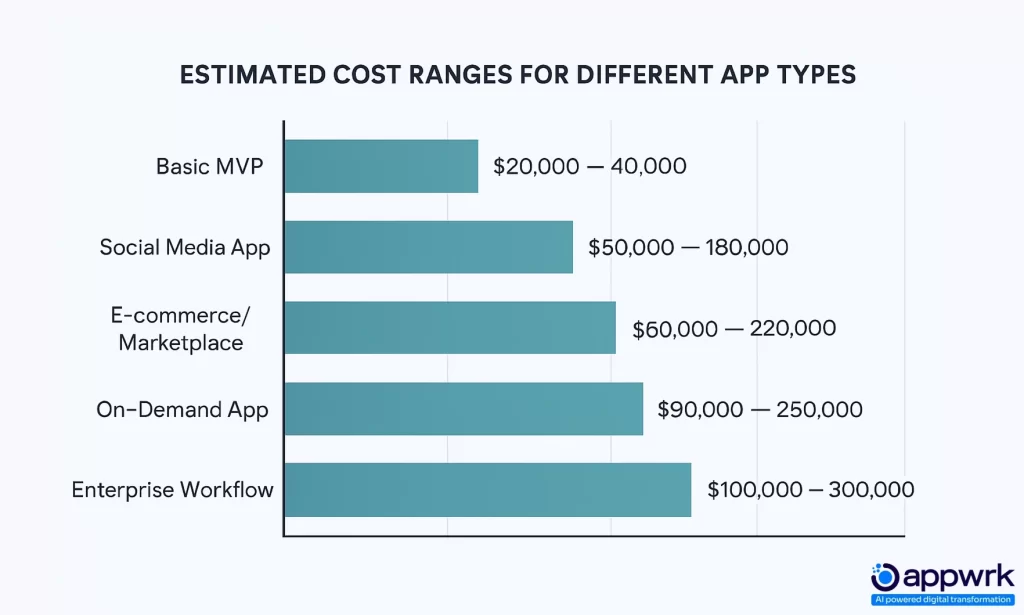
Before diving into individual pieces, it’s useful to consider an overall estimate across app types. These numbers serve as a baseline to set your expectations. But keep in mind that the ultimate number is highly dependent on your app’s complexity, design, tech stack, and your team’s geography.
Here’s a high-level Mobile app cost estimation snapshot of current market pricing:
App Type
Estimated Cost
Timeframe
Basic MVP
$20,000 – $40,000
2 – 3 months
Social Media App
$50,000 – $180,000
4 – 6 months
E-commerce/Marketplace
$60,000 – $220,000
5 – 8 months
On-Demand App
$90,000 – $250,000
6 – 9 months
Enterprise Workflow
$100,000 – $300,000
7 – 10 months
Now that we’ve set the baseline, let’s explore what these costs represent through real-world app examples.
Cost Breakdown of Popular Apps
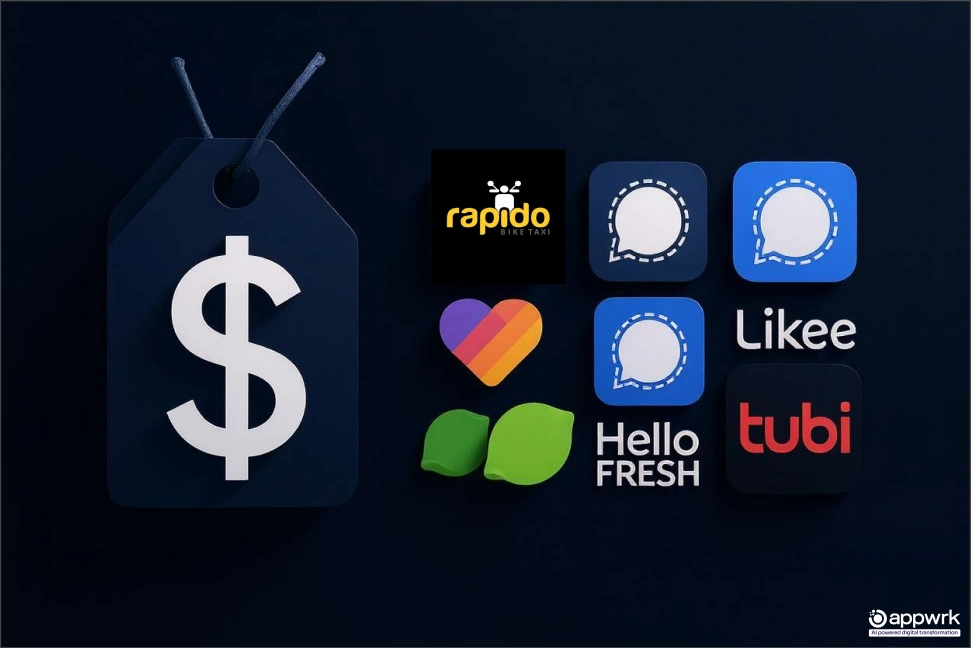
A great way to grasp enterprise app development pricing or SaaS app development cost is to examine familiar apps. These giants, used by millions of users, set benchmarks for budding businesses, not just in terms of functionality, but also for cost expectations.
While their development budgets range from $120,000 to as high as $450,000, depending on features and infrastructure, they serve as powerful reference points.
For business owners aiming to build a robust app, you should think of these apps not as unattainable models, but as blueprints from which you can scale down (or up) based on your target audience and feature list.
Rapido
Rapido isn’t just a bike taxi app. It integrates real-time GPS tracking, live fare calculation, driver analytics, and urban mobility optimization, all of which push the development cost to build an app like Rapido into the $200,000 to $280,000 range.
Signal
This privacy-first messaging app includes secure communication protocols, end-to-end encryption, disappearing messages, and real-time syncing across devices, typically bringing development costs between $150,000 and $210,000 to build an app like Signal.
Likee
A short video creation app, Likee, incorporates filters, background music libraries, user challenges, and a recommendation engine to personalize content feeds, usually costing between $200,000 and $320,000 to develop an app like Likee.
Tubi
Tubi offers a free video streaming service supported by ads. It includes smart categorization, adaptive streaming quality, user authentication, and content licensing support, which can drive development costs up to $300,000 – $450,000 for an app like Tubi.
HelloFresh
HelloFresh, a meal planning app for families, isn’t just a food delivery platform. This meal subscription delivery app includes subscription management, AI-powered recipe planner, dynamic recipe customization, delivery logistics, and backend inventory sync, resulting in development costs typically between $35,000 and $250,000 for a meal planner app like HelloFresh.
iOS, Android & UI/UX Design – Choosing the Right Mobile Approach
Being a leading service provider of mobile app development, we understand how different platforms shape your budget, timeline, and user reach. Before determining how much your app will cost, it’s equally important to decide where it will live and how it will look.
Before determining how much your app will cost, it’s equally important to decide where it will live and how it will look. The platform, iOS, Android, or both, impacts not just development time but long-term scalability. Here’s how each differs:
iOS App Development
For startups and enterprises aiming at Apple’s high-value user base, iOS app development typically costs between $60,000 and $120,000. Learn more on our iOS development service page. iOS apps are built specifically for Apple devices and offer highly consistent performance thanks to a limited range of supported hardware. Apple users are also known to spend more per app, which is a key reason why startups targeting a premium segment start with iOS first.
Android App Development
With a massive global reach, Android app projects generally fall in the $50,000 to $110,000 range. See how we build them on our Android app development page. Android dominates the global smartphone market share, especially in regions like Asia, Africa, and Eastern Europe. Android apps need to be compatible with thousands of devices, which adds testing and optimization layers, but offers massive reach.
Mobile App UI/UX Design
Designing for engagement and clarity usually costs between $15,000 and $40,000 if done as a standalone phase. Discover our UI/UX services. Whether the app is deployed to what platform, it’s a pretty design and intuitive design that keeps users returning.
A well-thought-out UI/UX guarantees intuitive navigation, responsive time, and good looks. Figma and Adobe XD are the tools usually employed to design prototypes that subsequently turn into production screens.
Legacy App Modernization
Updating older systems to current mobile platforms can run anywhere from $40,000 to $90,000, depending on the nature. Browse our legacy modernization offerings. At times, the way forward isn’t a new build but a makeover from top to bottom. Modernizing legacy mobile applications involves rewriting code in newer frameworks, updating design languages, and incorporating new APIs for speed, security, and cloud-readiness.
This section forms the basis for how your mobile vision translates into platform-specific development workflows. To know more, check out our full mobile app development services.
Top Factors Affecting App Development Cost
So, what exactly contributes to the numbers we just saw? It’s interesting to note that the largest cost driver according to the Clutch survey is not the features of the app but the infrastructure.
Let’s dig into the individual components that shape your app’s final price tag. These are the real drivers behind your budget, and where smart trade-offs can save you money.
Mobile App Complexity
Every app sits on a complexity spectrum.
Simple apps: In mind, think of calculators, note-taking apps, or to-do lists. They’re largely static, single-purpose apps with little backend logic.
Moderate complexity apps: Dashboards, chat functionality, moderate integrations, such as a doctor appointment reservation application.
Complex apps: Real-time logistics (such as Uber), e-commerce software, or fintech solutions fall under this category. These apps incorporate APIs, third-party SDKs, data protection, and so on.
Features & Functionalities
Here’s how typical features influence your cost to finalise your App development pricing guide. Some features are readily available through libraries, while others need custom builds.
Feature
Est. Cost Impact
Explanation
Login/Auth
$500 – $1,000
OAuth, 2FA, social logins
Payment Gateway
$2,500 – $5,000
Stripe, Razorpay, and PCI compliance
Chat & Messaging
$2,500 – $8,000
Real-time sync, push, privacy controls
Push Notifications
$500 – $1,000
Firebase, OneSignal integration
AR/VR Support
$20,000 – $40,000
Scene tracking, camera APIs, 3D rendering
Design, Animation & UX
Design is the quiet persuader. Proper UX minimizes drop-offs, while animation improves engagement. Figma and Adobe XD are some of the tools that take pivotal roles in prototyping and feedback loops.
Custom transitions, animations: $5K – $30K
High-fidelity prototyping: $10K+
Platforms
Choosing between native and cross-platform can change your cost structure dramatically.
Native: Separate iOS and Android codebases. More performance, better integration.
Cross-platform: Frameworks like Flutter or React Native cut dev time with reusable code. Ideal for MVPs or startups with cost sensitivity.
Cross-platform saves ~30% but may sacrifice UI precision
Backend & APIs
Your app’s backend is where the real logic happens: user management, transaction logs, push services, analytics, and more.
Backend with Node.js, Firebase, or Django can cost $10K–$60K
APIs include external services like Google Maps, payment processors
Third-Party Integrations
Time-saving, but each integration has its own pricing model and setup complexity.
Service
Providers
Est. Cost
Use Case
Payments
Stripe, Razorpay
$5K+
Online checkout, subscriptions
Messaging
Twilio, Agora
$3K+
SMS, in-app chat, VoIP
Analytics
Mixpanel, Firebase
$2K+
Event tracking, user funnels
Development Team Structure & Geography
Your team is your biggest asset or your biggest cost sink. Here’s a comparative view:
Role
Hourly Rate (India / US)
Role Insights
Developer
$30 – $60 / $120 – $200
Frontend/backend expertise
Designer
$25 – $50 / $100 – $180
UI/UX and brand fidelity
PM / QA
$20 – $40 / $80 – $150
Timelines, sprint delivery, bug catching
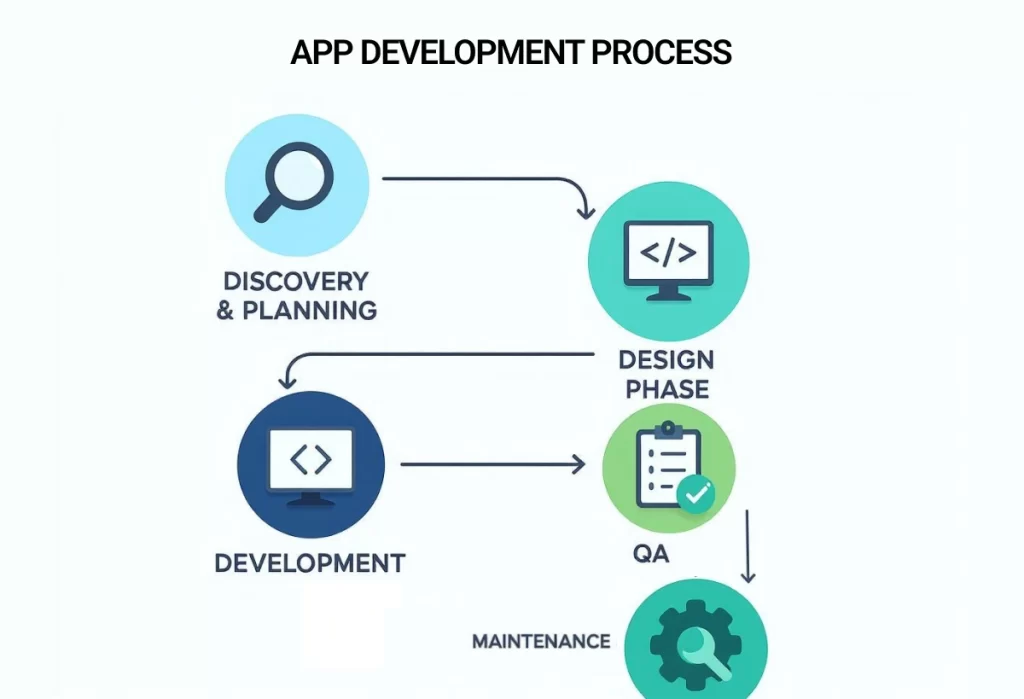
App Development Process: Guide
App development isn’t a single sprint; it’s a relay race across well-defined stages. A survey by Clutch displays the best practices to follow in the app development process.
All these steps impact not only the cost but also the quality and scalability of your product. Here’s how each phase unfolds:
Discovery & Planning
This is the blueprint phase. It sets the foundation for success.
Market research: Identifying target users, analyzing competitors, and assessing market gaps helps in shaping your app’s value proposition.
Requirement documentation: Every feature, user flow, and technical requirement is documented clearly to align expectations.
Wireframing: A skeletal layout of the app, built in tools like Figma or Balsamiq, helps visualize structure and functionality.
Tech stack and timeline planning: The right tools, languages, and frameworks are selected, and timelines are scoped realistically.
Design Phase
Design makes the difference between user retention and abandonment.
UX design: Defines the way a user experiences the app, trying to keep it simple and intuitive in terms of pathways.
UI design: Aesthetic and visual design, as well as colors, spacing, typography, and keeping it consistent with the brand.
Design systems: These shared UI components, designed in Figma or Sketch, stay consistent.
Validation: Click-through prototypes are tested by early users to identify usability problems before the development phase.
Development
The building process starts here, split between frontend and backend work.
Frontend: These are brought to life by frameworks such as Flutter, React Native, Swift, or Kotlin.
Backend: This manages the logic, user authentication, APIs, and database connections, using resources such as Firebase, Django, or Node.js.
CI/CD pipelines: Continuous integration makes it possible to have safe and automatic deployment of new versions of the code.
QA & Testing
No product is complete without strict verification.
Manual testing: Human testers check app performance in various scenarios.
Automated testing: Scripts test each line of code for bugs with unit and integration tests.
Regression testing: It confirms that new features do not break old ones, particularly crucial during scaling.
Launch & Store Submission
Submission requires technical and marketing readiness.
App store compliance: Apple and Google have detailed rules regarding data use, content, and design.
Assets and metadata: Descriptions, privacy policies, screenshots, and promo videos are submitted.
Automation tools: CI/CD helps publish new builds quickly while avoiding errors.
Maintenance & Optimization
Post-launch is about iteration.
Feature updates: Continuous monitoring and adding features based on user feedback keep the app relevant.
Version control: Git-based workflows manage bug fixes, improvements, and new releases.
Cost control: Server usage is monitored, and redundant services are trimmed to optimize spending.
Looking to build a custom mobile app? Connect with our expert team for premium support and high-quality development tailored to your business goals.
Cost by Platform, Type & Region
The platform(s) you choose and where your team is located can drastically impact your budget. Let’s explore both dimensions.
Platform Cost Comparison: Native vs hybrid app development
Native applications tend to provide superior performance, whereas cross-platform platforms assist you in progressing at a faster and more affordable pace. The compromises involve UI accuracy, code reuse, and time to develop.
Platform
Avg Cost Range
Notes
iOS Native
$40K – $100K
Polished UX, higher spend
Android Native
$40K – $90K
Complex testing matrix
Cross-platform
$20K – $80K
Cost-effective MVP strategy
Cost to Develop an App in the US & Canada
Be prepared to spend $100,000-$200,000+. High labor costs, high-end UI/UX design, and stringent regulatory adherence fuel these prices.
Cost to Develop an App in Eastern Europe
Pricing is $50,000 – $110,000. Eastern Europe provides good technical skills at affordable delivery, perfect for startups that require balance
Cost to Develop an App in India / SEA
Ranging between $30,000 – $80,000, this region provides top-tier coding and scalable MVPs. A smart choice for early-stage businesses with lean funding.
Cost to Develop an App in the UAE
App costs here start around $60,000 and can go beyond $150,000. Design-first thinking and compliance needs in finance, tourism, and public sectors add layers.
Cost to Develop an App in Australia
Expect $80,000 – $150,000. Australia combines local engineering talent with close timezone proximity to APAC tech hubs.
Cost to Develop an App in Singapore
Builds typically start at $90,000 due to regulatory standards and enterprise focus. Ideal for fintech, B2B, and regional HQ-driven apps.
Region
Avg Hourly Rate
US / Canada
$120 – $200/hr
Eastern Europe
$50 – $100/hr
India / SEA
$20 – $70/hr
UAE
$50 – $100/hr
Australia
$70 – $140/hr
Singapore
$80 – $150/hr
Cost Breakdown for BNPL, AI, and Super Apps
If you are planning to build a future-ready mobile application, understanding the development cost across fast-growing app categories is vital. Furthermore, BNPL, short for Buy Now, Pay Later, apps, AI-powered solutions, as well assuper apps are leading the market in innovation and user engagement. Here’s how much it typically costs to build each, whether you’re developing an MVP or scaling to a full-feature product.
Buy Now Pay Later (BNPL) App Development Cost
BNPL (Buy Now, Pay Later) apps like Klarna, Afterpay, and ZestMoney are reshaping the landscape of fintech app development and eCommerce. By giving users the flexibility to split payments into manageable, interest-free installments, these platforms have become a go-to choice for Gen Z and millennials. Whether you’re exploring the BNPL app cost for an MVP or planning a robust split payment app with advanced features, these solutions continue to lead innovation in consumer finance.
AI-driven apps are making a major impact across industries like healthtech, edtech, fintech, and productivity. From GPT-based chatbot solutions to computer vision-powered fitness platforms, these applications harness the power of artificial intelligence and machine learning to deliver highly personalized and predictive experiences. As demand continues to grow, understanding AI-based app pricing and staying informed about the typical AI app cost is key to planning your development roadmap effectively.
Top AI app use cases:
Pose detection and posture correction (health & fitness)
GPT-powered conversational chatbots
AI-based personal finance & forecasting tools
AI productivity assistants with calendar/email intelligence
Core features include:
Integration with OpenAI, TensorFlow, or Hugging Face
Real-time data streaming and API-based model serving
Background training engine for continuous improvement
Optional LLM fine-tuning for domain-specific accuracy
Estimated Development Costs:
MVP version: $30,000 – $70,000
Advanced AI app: $200,000 – $350,000
Timeline: 6 – 10 months
Super App Development Cost
Super apps, like Gojek, Tata Neu, and WeChat, bundle multiple services such as ride-hailing, payments, food delivery, shopping, and messaging into a single modular ecosystem. These require a microservices-based backend, multi-role user management, and strong scalability.
Admin/vendor dashboards for onboarding and management
Estimated Development Costs:
MVP (2–3 services): $15,000 – $150,000
Full-feature super app: $300,000 – $600,000+
Timeline: 8 – 14 months
App Type
MVP Cost (Avg)
Full App Cost
Timeline
BNPL App
$50K – $80K
$150K – $250K
5 – 9 months
AI-Based App
$30K – $70K
$200K – $350K
6 – 10 months
Super App
$15K – $150K
$300K – $600K+
8 – 14 months
Top Mobile App Monetization Models (With Use Cases)
Creating an app is the halfway mark. Getting it to generate revenue or fund your business model is what constitutes long-term success. Let’s dive into the major monetization tactics and when to apply them.
Freemium: Provide the essential experience at no charge while keeping premium features for pay. Ideal for apps with high user bases and sticky usage (e.g., Dropbox, Spotify).
Subscription: Consumers pay a monthly or yearly subscription fee to use content or features. Subscription models, driving such platforms as Netflix and Headspace, are the most rapidly increasing revenue source of the app economy, with worldwide subscription revenue at $140 billion in 2025, up by 45% from years past, according to Statista.
Ad-based: Make money from high traffic by ads, through Google AdMob or Facebook Audience Network. Most suitable for games or content apps with high daily active usage. Advertising accounted for almost $307 billion in app market revenues in 2023, constituting the biggest revenue-generating source for mobile apps, according to Statista.
In-app purchases (IAP): Offer digital products such as game coins, avatars, or eBooks. Most suitable for gaming, e-learning, and freemium models.
Licensing/SaaS: Sell your app to companies through licensing or white-labeling. Good for enterprise or B2B apps with separable features.
Model
Best For
Pros
Cons
Subscription
Fitness, Media, SaaS
Recurring revenue
Needs high retention
Ads
Games, Utility apps
Monetize free users
UX can suffer
In-App Purchases (IAP)
Gaming, eLearning
High revenue per user
Needs volume + strong features
Freemium
Productivity, Tools
Fast user adoption
Limited short-term ROI
Licensing
B2B SaaS apps
High upfront revenue
Longer sales cycle
Hidden Expense Traps
Budget overruns often don’t come from the core app features; they come from underestimated infrastructure and compliance needs. Here’s what typically catches founders off guard:
API Usage Fees: Many third-party services (like Google Maps, Twilio) charge per API call. At scale, these can exceed thousands of dollars per month.
Cloud Infrastructure: Hosting, bandwidth, and data storage (on AWS, Firebase, Azure) can escalate rapidly with app growth, especially if your architecture isn’t optimized.
App Store Costs: Apple charges $99/year, Google $25 one-time, and both take 15–30% of transaction revenue.
Security & Compliance: If you’re handling payments or sensitive data, you’ll need PCI, HIPAA, or GDPR compliance, which includes legal, encryption, and server auditing costs.
Testing Infrastructure: Device farms and automation suites (e.g., BrowserStack, Appium) can incur recurring fees.
To manage hidden costs:
Monitor API usage in real time
Use alerts for cloud billing spikes
Bundle services under a predictable pricing model where possible
How to Reduce App Development Costs
Smart planning is the fastest route to staying on budget. Here’s how high-growth teams reduce their app spend:
Validate Before You Build: Use low-code/no-code tools like Bubble, Glide, or Figma prototypes to test ideas before committing to code.
Prioritize a Lean MVP: Identify your core feature set using MoSCoW prioritization (Must-have, Should-have, Could-have, Won’t-have).
Cross-platform Development: React Native or Flutter can slash development time by reusing up to 80% of code.
Leverage Existing Services: Instead of building chat, auth, or payment from scratch, use Firebase Auth, Stripe, or Sendbird.
Outsource Smartly: Offshore your QA or backend, but keep project management and UX with senior leads to avoid miscommunication.
How APPWRK Can Help in App Development
At APPWRK, we don’t just build apps, we build digital foundations that fuel business growth. With a proven track record of delivering scalable, high-performance applications across industries, we bring:
15+ years of engineering excellence across 12 industries
Agile delivery model optimized for startups, SMBs, and enterprises
Certified professionals in React Native, Flutter, AWS, Firebase, and more
Retention-centric design frameworks that maximize ROI per screen
From MVP ideation to post-launch optimization, our strategists and developers collaborate closely with you. Whether it’s unlocking a lean MVP or scaling your enterprise SaaS platform, APPWRK is your growth partner.
📞 Contact us today to scope your project with precision and speed.
Frequently Asked Questions – FAQs
What does it cost to develop a mobile app?
$20,000 for a simple MVP to $250,000+ for sophisticated apps, depending on features, platform, and location.
What is the cost difference between native and cross-platform app development?
Cross-platform saves 30–35% in upfront cost but can trade off slightly on UI/UX accuracy to native apps.
What influences the overall app development price?
The main influencing factors are app complexity, platform (iOS/Android), number of features, location of the team, design requirements, and third-party integrations.
How long does it take to create an app?
The time is 3–12 months depending on the complexity. MVPs can be deployed in less than 4 months with quick iterations.
Is it less expensive to outsource app development?
Indeed, outsourcing to a place like India or Eastern Europe can save 40 – 60% of the cost without lowering quality if the vendor is seasoned.
What are the hidden costs in developing an app?
The typical hidden costs include API usage fees, cloud infrastructure expenses, submission fees to stores, and regulatory requirements such as GDPR.
How can I save on app development cost without sacrificing quality?
Use reusable parts, take cross-platform platforms, validate with prototypes as early as possible, and have must-have features only in Phase 1.
What is the optimal monetization strategy for a mobile app?
It depends on your audience. Subscription models provide steady income. Freemium is fine for engagement apps. Ads are for high-traffic consumer apps.
Do I require continuous maintenance after app release?
Yes. Periodic updates, server check, bug fixes, and feature enhancements are necessary to keep users engaged and the app safe.
How do I select the best app development partner?
Seek experienced partners with applicable domain expertise, open pricing, and readiness to assist after the launch.
Gourav Khanna is the Co-founder and CEO of APPWRK, leading the company’s vision to deliver AI-first, scalable digital solutions for enterprises and high-growth startups. With over 16 years of leadership in technology, he is known for driving digital transformation strategies that connect business ambition with outcome-focused execution across healthcare, retail, logistics, and enterprise operations.
Recognized as a strategic industry voice, Gourav brings deep expertise in product strategy, AI adoption, and platform engineering. Through his insights, he helps decision-makers prioritize market traction, operational efficiency, and long-term ROI while building resilient, user-centric digital systems.
Subscribe to APPWRK Blogs, We'll Do the Rest!
Get Blogs on UI/UX, Mobile Apps, Online Marketing, and Web development technology.
Unlock worthy and priceless suggestions from the masters of mobile and web app development