150+ minds across 4 countries. Join a culture of innovation, ownership & growth.
Rewire for AI
From machine learning to deep learning, from classification tools to overall process automation – our AI engineers will help you retool your existing system or enhance your company results.
Ship faster, scale smarter, built for product companies and SaaS teams
Our Latest Work
We strive hard to deliver result-driven digital solutions across the globe. Check out our case studies to get a glimpse of how we ideate, innovate, and create unconventional digital solutions according to the requirements of our clients.
Discover diverse and passionate insights from our tech enthusiasts. We collaborate across various sectors to streamline operations and drive innovation. Explore our rapidly growing collection of articles to see why we’re at the forefront of IT solutions.
The decision to move from Magento to Shopify is one of the most significant replatforming choices an ecommerce business can make. Magento is powerful, but its power comes with...
Accuracy gap is real: Traditional CPG forecasting carries a 25-40% MAPE error rate. AI-powered models bring that down to 8-15%, according to McKinsey research....
Real stories from global leaders who trusted us with their ideas.
Partnering with APPWRK helped us build a compliant and scalable healthcare platform, accelerating our time-to-market by 35%. Their team consistently delivered outstanding work.
Beesers
Digital Healthcare Client
Collaborating with APPWRK, Sportskeeda modernized its platform into a real-time sports engagement ecosystem, enabling seamless content delivery, scalable fan interactions, and high-velocity performance.
Sportskeeda
Sports & Entertainment Partner
Working with APPWRK was effortless. They captured our vision, maintained full compliance, and delivered a digital experience that built trust and elevated how customers interact with our fintech brand.
PayPenny
Fintech Partner
Working with APPWRK gave us confidence in adopting AI responsibly. Their team built a safe, intelligent bot that transformed how we engage with leads and helped us achieve measurable revenue growth.
IFB
AI Transformation Partner
Leveraging APPWRK’s digital expertise, Nemesis launched a scalable, compliant, and safe super app that connects content delivery, real-time communication, and logistics management within a single platform.
The benefits of AI in manufacturing are not theoretical anymore, but they’re powering real-time decisions, redefining product development, and enabling precision at scale. From predictive maintenance to generative design, Artificial intelligence is now a competitive necessity across the manufacturing value chain.
A leading auto parts supplier used predictive maintenance to cut unplanned downtime by 27%, improving throughput without adding new machinery, a direct outcome of intelligent asset monitoring.
AI-enabled design software reduced product iteration cycles by 45% at a European aerospace firm, accelerating time-to-market and lowering development costs.
Smart factories leveraging AI and collaborative robots (cobots) are achieving 20-30% efficiency gains by enhancing safety, improving flexibility, and enabling seamless human-machine collaboration on the production floor.
Supply chains powered by AI can react to real-time shifts in demand and logistics, like Rolls-Royce’s use of AI to manage complex global supply routes dynamically.
Quality control systems using AI-driven visual inspection have reduced defect rates by over 40% in electronics manufacturing, showcasing the tangible impact of precision automation.
This guide unpacks how AI transforms modern manufacturing, empowering CTOs, CFOs, founders, and investors to leverage intelligent systems for growth, efficiency, and strategic advantage.
AI in Manufacturing: Global Market Size, Trends, and Regional Growth
In today’s industrial world, AI is redefining the rules of manufacturing. No longer confined to labs or pilot programs, it now powers real-time decisions, streamlines operations, and enables factories to respond with speed and precision. As manufacturers embrace data-driven strategies, AI is becoming the engine behind global competitiveness and sustainable growth.
AI in Manufacturing: Market Size and Forecast
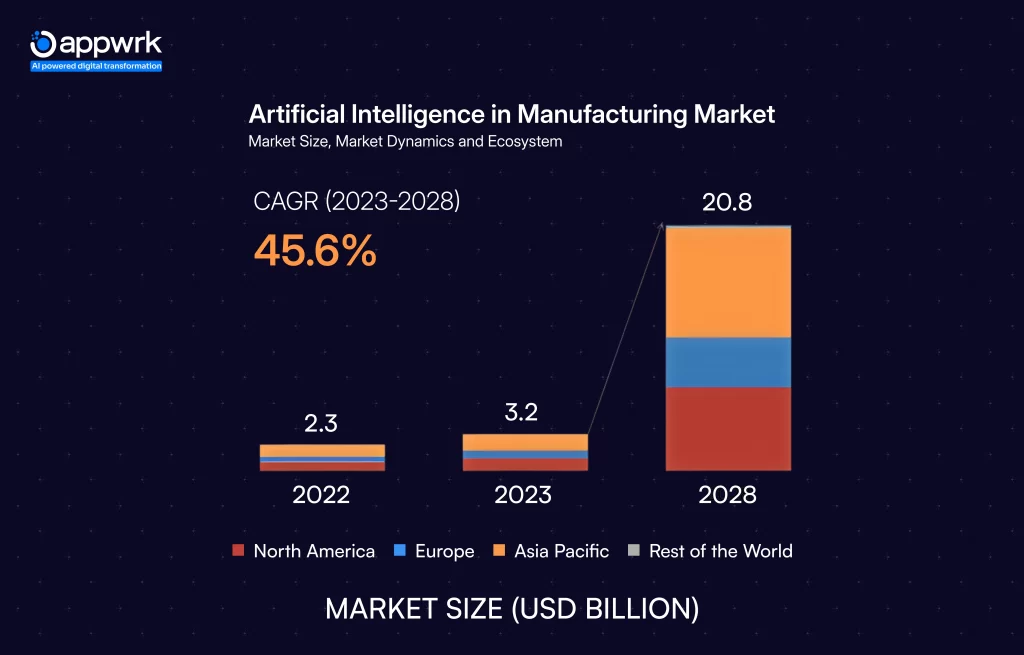
The AI in manufacturing market is projected to reach $20.8 billion by 2028, growing at a CAGR of 45.6%. North America leads adoption, but Asia-Pacific is witnessing the fastest growth due to smart factory initiatives in Japan, South Korea, and China.
This rapid growth is driven by advanced automation capabilities, the convergence of cloud and edge technologies, and mounting labor shortages, all fueling the need for intelligent, AI-led orchestration in manufacturing.
Sector-Wise ROI from AI in Manufacturing
AI investments are delivering solid returns. According to Capgemini, AI-led automation has improved operational efficiency by 29% and reduced costs by 15-20% across automotive, electronics, and industrial machinery sectors.
In FMCG and pharmaceuticals, AI applications in quality control and predictive supply chains show payback periods of less than 18 months, with scalability built in.
High-ROI zones:
Automotive: Predictive maintenance and autonomous assembly.
Artificial intelligence is not just enhancing isolated processes, but it’s restructuring entire operating models. From macroeconomic ripple effects to plant-level reconfigurations, AI’s impact is systemic and measurable.
AI’s Economic Impact on Global Manufacturing
AI is reshaping the foundation of global manufacturing by driving productivity, enhancing operational resilience, and transforming how value is created. As manufacturers scale AI across operations, they’re not only improving efficiency but also strengthening their ability to adapt to economic shifts and competitive pressures.
AI adoption is shifting supply chain models from cost-based to intelligence-led, affecting global trade patterns, labor markets, and capital allocation strategies.
Addressing the Manufacturing AI Talent Gap
The rise of AI in manufacturing is amplifying the demand for hybrid talent, engineers fluent in both operations and data. Yet, according to McKinsey, 42% of manufacturers cite skilled AI talent as a critical bottleneck.
Strategic upskilling programs and industry-academia partnerships are closing the gap. Some manufacturers are embedding data fluency training directly into plant workflows.
Digital Transformation and Smart Factories
Smart factories powered by edge AI, IoT, and real-time analytics are becoming the norm. These digitized plants offer real-time performance visibility, predictive diagnostics, and adaptive optimization.
According to IBM, manufacturers with mature smart factory frameworks report 30% faster time-to-market and 50% higher asset utilization.
Human-AI Synergy with Collaborative Robots
Collaborative robots (cobots) represent the frontier of human-AI synergy. Unlike traditional robotics, cobots are AI-enhanced systems designed to work safely alongside humans, amplifying dexterity, reducing fatigue, and accelerating task accuracy.
In high-mix, low-volume production settings, cobots supported by vision and NLP systems enable flexible retooling without retraining entire lines, which is a leap in manufacturing agility.
Top Benefits of AI in Manufacturing: Efficiency, Safety & Cost Gains
AI is transforming manufacturing by bringing intelligence to every stage of the process. It enables real-time decision making, enhances precision, improves workplace safety, and supports scalable customization, driving meaningful gains in performance, reliability, and cost efficiency. Listed below are some of the major benefits of AI in manufacturing.
Equipment Uptime Forecasting with AI: Reduce Downtime and Costs
AI in preventive maintenance uses real-time data to detect equipment issues early and avoid costly breakdowns. According to Deloitte, it can reduce maintenance costs by 25-30% and eliminate 70% of unplanned breakdowns.
AI models trained on sensor data continuously adapt, enabling proactive interventions that extend asset life and stabilize production uptime.
How Generative AI Optimizes Product Design
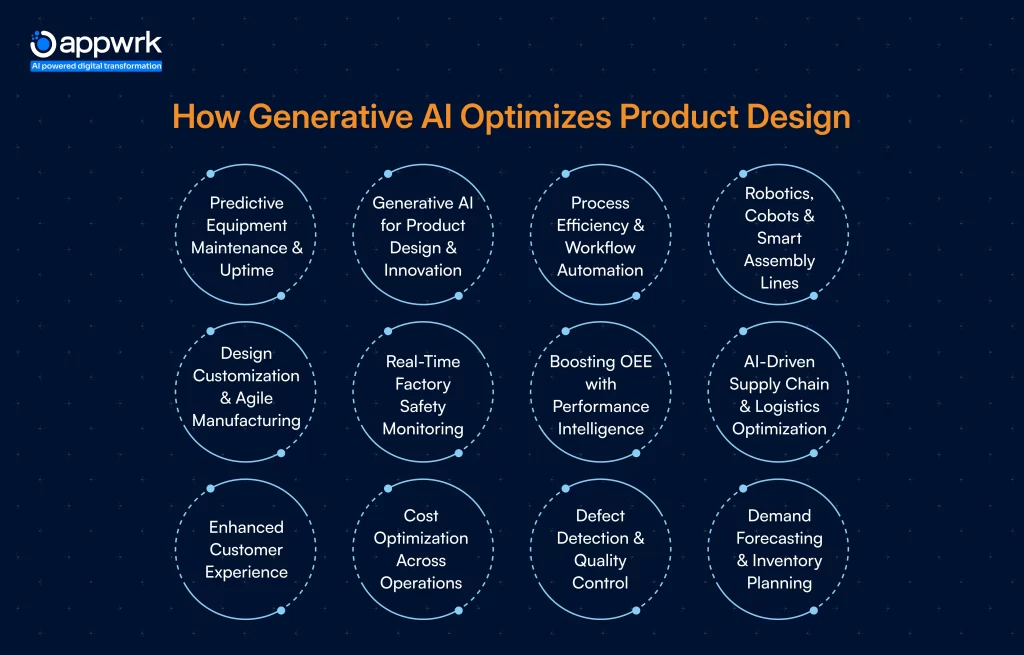
Generative AI tools allow engineers to explore thousands of design permutations in seconds. By factoring material constraints, performance goals, and cost tolerances, AI-driven design boosts innovation while slashing prototype cycles.
Example: Airbus used generative design to cut component weight by 45%, improving fuel efficiency and sustainability simultaneously.
Increased Efficiency
AI streamlines decision-making at every level, from real-time production adjustments to macro workflow optimization. McKinsey reports that AI-powered efficiency gains average 20–30%, especially in discrete manufacturing where variability is high.
This efficiency isn’t just speed, but it’s precision, throughput, and less scrap.
Robotics
AI-enabled robotics delivers higher precision, flexibility, and consistency across complex manufacturing tasks. They act as intelligent agents capable of adapting in real time, adjusting grip, movement, and pressure based on the environment to deliver higher precision, flexibility, and consistency across complex manufacturing processes.
In electronics and automotive plants, this precision reduces human error, accelerates repetitive tasks, and improves consistency in delicate processes.
Design Customization
AI enables mass customization by analyzing customer data and translating it into product variations, all without increasing production complexity.
For instance, Nike’s AI-driven customization line lets users tailor shoes at scale, with minimal impact on production time, powered by intelligent pattern recognition and demand clustering.
Cobots
AI-powered cobots are redefining how humans interact with machines on the factory floor. These systems adapt to operator behavior in real time, adjusting force, speed, and motion for both safety and precision.
In mixed-skill environments, cobots allow human operators to focus on cognitive tasks while machines handle repetitive physical work, improving both productivity and morale.
Real-Time Factory Safety with Smart Monitoring
AI enhances industrial safety by monitoring behavior, machine condition, and environmental parameters in real time. Computer vision systems detect PPE compliance and proximity violations, triggering preventive alerts.
According to IBM, AI-enabled safety systems reduce workplace incidents by up to 25% in high-risk zones like metal processing and automotive plants.
Optimizing Assembly Lines Through AI Automation
AI-driven assembly lines dynamically reallocate resources based on live input, detecting slowdowns, forecasting bottlenecks, and optimizing flow.
This allows leaner staffing, lower energy usage, and faster takt time. Bosch’s AI-enhanced lines achieved 18% cycle time reduction through predictive task sequencing.
Supply Chain Management
AI strengthens global manufacturing supply chains by adding real-time visibility, agility, and resilience. AI for inventory management anticipates disruptions, optimizes stock levels, and dynamically adjusts sourcing strategies to avoid overstock or stockouts.
Rolls-Royce uses AI to manage over 1,500 suppliers across continents, adjusting logistics paths dynamically to avoid cost and time overruns.
Boosting OEE with Real-Time Performance Data
AI enhances overall equipment effectiveness by optimizing performance across machines, people, and processes. Digital twins simulate real-world scenarios to improve efficiency, while machine learning detects early signs of underperformance, allowing proactive adjustments before issues impact operations.
Manufacturers deploying AI in operations report up to 35% higher OEE, per Gartner.
New Product Development
AI accelerates product development by automating early-stage R&D processes, simulating materials, predicting performance, and identifying risks.
Data-Driven Decision-Making with AI
Without a doubt, AI-based decision support systems help manufacturers make faster, evidence-driven decisions across operations. It enables manufacturers to make faster, evidence-based decisions, whether forecasting demand, optimizing supply routes, or selecting vendors, while reducing delays and improving responsiveness to changing market conditions.
Improving Quality
Machine vision in manufacturing, powered by AI, outperforms manual QC by detecting micro-defects with unmatched accuracy. They detect micro-defects invisible to the human eye and self-improve through feedback loops.
In semiconductor manufacturing, defect detection accuracy has reached over 98% using AI-based systems.
Accelerating Innovation with AI in R&D
By removing repetitive tasks and surfacing data-driven patterns, AI gives engineers and designers space to focus on breakthroughs.
AI doesn’t replace creativity, but it multiplies it. From generative design to agile prototyping, AI is now a co-pilot in industrial innovation labs.
Streamlined Paperwork
Robotic Process Automation (RPA) backed by AI simplifies administrative workloads like compliance logging, inventory reconciliation, and regulatory submissions.
This means fewer manual errors, faster audit readiness, and more operational bandwidth for high-value tasks.
Automation
AI enhances traditional automation by making it adaptive. Instead of fixed logic, AI systems respond to changing inputs like adjusting pace, load, or path without human interference.
Needless to say, AI in lean manufacturing enables intelligent automation that minimizes waste and supports continuous improvement.
Streamlining Logistics Planning with AI Intelligence
Logistics planning becomes faster and more precise with AI driving end-to-end visibility. It identifies bottlenecks, anticipates geopolitical and supply chain risks, and fine-tunes last-mile delivery, ensuring smoother, more resilient operations across regions.
Forecasting and Demand Planning
AI-driven demand forecasting models outperform traditional systems by integrating seasonality, promotions, and real-time signals.
This leads to smarter production schedules, fewer stockouts, and lower inventory costs, especially critical in volatile markets.
AI-Driven Defect Detection & Control
Advanced AI vision systems can now identify subtle variations in texture, contour, and temperature with real-time precision. These technologies support zero defect tolerance, making them essential in high-risk industries like aerospace and pharmaceuticals. Many leading manufacturers now rely on AI to optimize first pass yield and reduce rework.
Cost Savings
The financial benefit of AI is cumulative, such as fewer failures, lower labor costs, optimized processes. McKinsey reports AI can reduce total manufacturing costs by up to 20% in mature deployments.
Savings compound as AI matures from pilot to scaled implementation across facilities.
Product Development and Design
With the help of AI, manufacturers can accelerate the journey from concept to market. By simulating failure points, testing multiple design variants, and integrating real-time customer feedback, AI significantly shortens development cycles.
Both startups and established companies use AI to validate MVPs faster and refine products based on predictive insights.
Quality Inspection
Beyond vision systems, AI now fuses sensor, acoustic, and thermal data to create multi-dimensional inspection workflows.
This layered approach improves defect detection reliability and reduces dependence on manual touchpoints.
AI Optimizes Workflow
AI in process optimization uncovers inefficiencies in task flow, resource allocation, and workforce distribution to streamline operations. It autonomously suggests process improvements that reduce idle time, balance workloads, and prevent overproduction, driving smoother, more efficient operations across the factory floor.
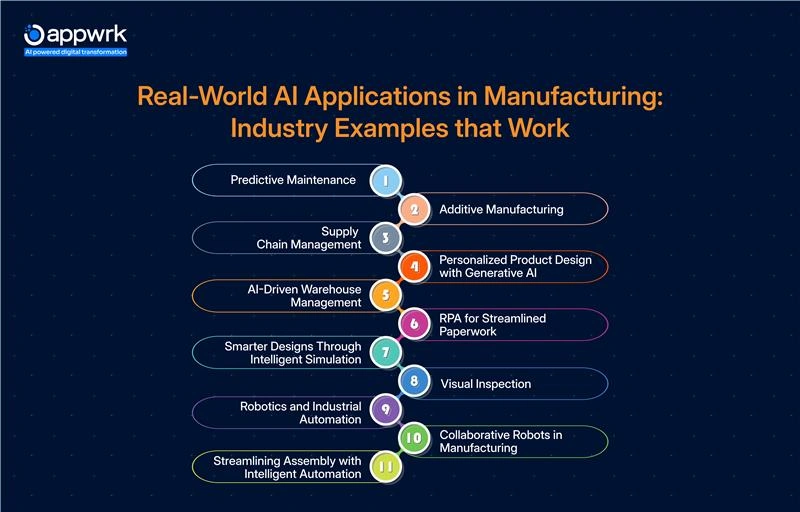
Real-World AI Applications in Manufacturing: Industry Examples that Work
AI in manufacturing moves beyond theory when applied on the floor. These real-world implementations reveal how global enterprises are leveraging AI to improve uptime, streamline operations, and gain a competitive edge.
Predictive Maintenance
With AI-powered predictive maintenance, manufacturers analyze vibration, thermal, and usage data to identify potential issues before they cause disruptions. By forecasting wear and tear patterns, they extend equipment lifespan, reduce unplanned downtime, and maintain steady production without costly interruptions.
GE uses AI to reduce downtime
GE deployed AI algorithms across turbine plants to monitor sensor anomalies. The result: a 29% reduction in unplanned downtime and $12 million in annual savings, according to GE’s internal operations data.
Their AI models also detect patterns invisible to manual checks, enabling timely part replacements before cascading failures occur.
Supply Chain Management
AI-driven supply chain systems enable manufacturers to respond instantly to demand shifts, weather delays, or supplier changes. This agility is crucial in today’s volatile global trade environment.
Rolls-Royce: Real-time logistics with AI
Rolls-Royce integrated AI into its global logistics system to track parts, routes, and suppliers across continents. AI detects potential delays in advance and auto-adjusts routes, reducing lead times by 18% and avoiding customs bottlenecks.
This has enabled real-time reallocation of shipping resources during geopolitical disruptions.
AI-Driven Warehouse Management
AI is transforming warehouse operations through dynamic slotting, demand-based inventory placement, and autonomous vehicle orchestration.
Companies like Ocado use AI to reduce human walking time by up to 40%, boosting pick accuracy and speed in high-volume fulfillment centers.
Smarter Designs Through Intelligent Simulation
AI tools simulate performance under multiple variables like stress, heat, and pressure long before prototyping. This enables faster iteration and failure-proof design optimization.
Siemens used AI to enhance turbine blade designs, achieving 5% higher thermal efficiency and reducing material waste.
Robotics and Industrial Automation
AI enables robots to operate beyond fixed routines, recognizing context, adjusting force, and avoiding collisions. In industrial environments, this means robots are safer, smarter, and faster.
Fanuc’s AI-integrated robotic arms reduced cycle time by 12% across automated welding and painting processes.
Streamlining Assembly with Intelligent Automation
Assembly lines are being reconfigured with AI that learns from performance data. Furthermore, AI in production scheduling dynamically adapts task order and resource allocation for optimal throughput.
Tesla’s production facilities rely on AI to maintain flow, achieving adaptive throughput without overstaffing.
Personalized Product Design with Generative AI
AI enables real-time personalization during production, whether it’s product features, aesthetics, or usage configuration.
Adidas used AI to enable made-to-order shoe designs that adapt to biomechanical inputs from users, reducing return rates and increasing satisfaction.
Additive Manufacturing
AI in 3D printing controls material deposition, thermal dynamics, and part consistency layer-by-layer.
General Motors applies AI-driven additive manufacturing for lightweighting car parts, achieving 30% weight reduction while preserving strength.
RPA for Streamlined Paperwork
AI-based RPA handles documentation-heavy tasks like order processing, compliance checks, and production reporting.
Schneider Electric implemented AI-RPA to reduce factory-level admin time by 25%, freeing up plant managers to focus on operations.
Visual Inspection
With AI-driven computer vision, manufacturers achieve a new level of precision in quality control. Furthermore, computer vision for defect detection enables manufacturers to spot micro-defects in real time with high precision.
Collaborative Robots in Manufacturing
Collaborative robots, or cobots, are redefining human-machine interaction on the factory floor. Powered by AI, they understand gestures, adapt to unstructured inputs, and learn from operators in real time, creating safer, more flexible, and more efficient production environments.
ABB reports that AI-enabled cobots reduce setup time by 60% compared to traditional robotic arms, making them ideal for batch manufacturing.
Enterprise Case Studies on AI Success in Manufacturing
With AI becoming central to modern manufacturing, leading enterprises are using it to drive sustainability, precision, and long-term growth. These case studies showcase real-world results, proving that AI is not just a tool but a transformative force reshaping operations at scale.
General Electric: Data for Sustainability
General Electric embedded AI across its industrial systems to analyze data from turbines, jet engines, and power grids, unlocking deeper insights into asset performance and energy use. By optimizing operations with AI driven models, GE improved energy output by 12 percent per unit of fuel and cut greenhouse gas emissions by 5 to 7 percent across test facilities.
These gains support the company’s broader commitment to achieving net zero emissions by 2035.
Toyota Collaborates with Invisible AI
Toyota partnered with Invisible AI to deploy computer vision across its North American manufacturing floors. The system monitors operator ergonomics, line flow, and task deviations without needing wearable sensors.
Early results: 15% reduction in repetitive strain injuries and a 10% uplift in line efficiency, thanks to real-time alerts and visual dashboards.
BMW Group: Quality Control Innovation
BMW implemented AI-based visual inspection for paint jobs and part alignment. The system, trained on millions of annotated images, identifies flaws faster than human QC.
Outcome: Defect rate fell by 32%, while inspection time per vehicle was reduced by 28%, boosting line throughput without sacrificing finish quality.
AI Adoption in Manufacturing: Regional Trends and Innovation Hubs
AI adoption in manufacturing is expanding globally, but regional patterns reveal unique maturity levels, policy support, and innovation hubs. This section maps where and how AI is scaling and where opportunity still lies.
AI Adoption in US Manufacturing: Leading Sectors and Hubs
The US leads AI integration in discrete manufacturing, with strong federal funding, academic R&D, and a surge of industrial AI startups.
According to McKinsey, 73% of US manufacturers are piloting or scaling AI, particularly in automotive, aerospace, and electronics.
Australia’s Emerging Smart Factory Ecosystem
Australia is fast-tracking industrial digitization through AI, especially in mining, food processing, and packaging. Government-backed initiatives like the AI Action Plan 2022 support tech adoption in mid-size plants.
Adoption is slower than in the US, but rising talent collaboration between universities and manufacturing SMEs is accelerating AI use cases.
Smart Manufacturing with AI in the UK
The UK focuses on smart factories and green AI, aligning manufacturing AI with net-zero goals. AI adoption is most visible in pharmaceuticals and aerospace.
Projects like Made Smarter UK are helping manufacturers integrate AI in quality control, predictive modeling, and agile production.
AI in Manufacturing Trends in Europe
Germany, France, and Italy lead the way in adopting AI across Europe’s industrial landscape. From automotive and heavy machinery to textiles, AI is being deployed to drive efficiency and innovation. The European Union’s strong regulatory framework also promotes responsible and ethical AI integration.
Regional Maturity Comparison: AI in Manufacturing
Region
Adoption Level
Focus Areas
Top Cities / Hubs
USA
Advanced
Robotics, Predictive Maintenance, Vision AI
Detroit, Austin, and Pittsburgh
Australia
Emerging
FoodTech, Mining AI, Packaging Automation
Sydney, and Melbourne
UK
Mid to Advanced
Pharma AI, Smart Factories, Green AI
London, and Manchester
Europe (DE/FR/IT)
Advanced + Regulated
Automotive AI, Heavy Industry, NLP
Munich, Paris, and Milan
India (Noida)
Service-led Scaling
Custom AI Services, IIoT, ERP integrations
Noida
UAE
State-backed Acceleration
Smart Factories, AI-Cloud Platforms
Dubai, and Abu Dhabi
The Technology Stack Powering Smart Manufacturing with AI
The backbone of AI in manufacturing lies in the convergence of multiple technologies, from vision systems to edge AI. Each layer adds a new dimension of intelligence, autonomy, and adaptability across production and operations.
Machine Learning
Machine learning is at the core of most industrial AI systems, identifying patterns from production data to make decisions, predict failures, or optimize resource use.
Whether it’s predicting motor failure or optimizing production schedules, ML models continuously learn from new inputs, making systems smarter over time.
Deep Learning
Deep learning enables complex, high-dimensional decision-making, especially in areas like image recognition and acoustic monitoring.
Manufacturers use deep learning to detect defects in PCB boards, assess weld quality, or identify friction noise in machinery. These applications go beyond rule-based systems, delivering precision from massive datasets.
Natural Language Processing (NLP)
NLP allows AI systems to understand and process human language, unlocking automation in documentation, instructions, and even maintenance logs.
Manufacturers are using NLP for voice-based control in smart factories and for parsing complex compliance documents faster and with fewer errors.
Computer Vision
Computer vision gives manufacturing systems the ability to see, interpret, and act in real time. It powers high-precision visual inspection, object tracking, safety monitoring, and augmented reality workflows on the factory floor.
As accuracy continues to improve, manufacturers are increasingly relying on vision systems for critical quality assurance tasks, boosting throughput while significantly reducing defects.
Digital Twins and Generative AI
AI and digital twins work together to simulate entire factory environments and recommend optimized workflows based on real-time data.
When combined with generative AI, they go beyond simulation: they recommend optimized workflows or machine calibrations based on real-time feedback.
Robotic Process Automation
RPA integrates AI into back-office and shopfloor admin, automating inventory updates, compliance checks, and even supplier communications.
In complex plants, RPA reduces repetitive administrative tasks by 30-40%, freeing teams for higher-value strategic functions.
Edge Computing and IoT Integration
Edge AI processes data directly on the shop floor, reducing latency and enabling real-time control even without cloud connectivity.
When combined with IoT sensors, edge AI powers autonomous decision loops: equipment adjusts itself based on real-time performance without human input.
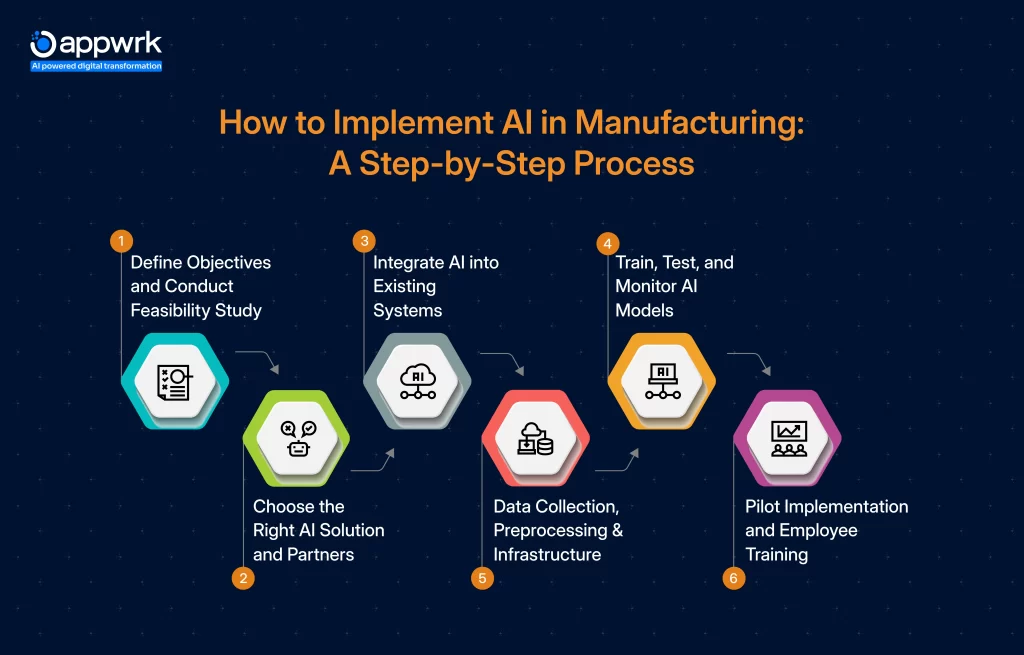
How to Implement AI in Manufacturing: A Step-by-Step Process
Successful AI adoption in manufacturing requires more than just the right technology; it demands a clear, structured approach. From defining objectives to integrating with legacy systems, the journey from pilot to full-scale deployment follows a strategic roadmap designed to maximize impact and ensure long-term success.
Define Objectives and Conduct Feasibility Study
Before implementing AI, manufacturers need to clearly define their goals, whether it’s reducing downtime, increasing yield, or cutting costs, and determine if AI is the right solution to achieve them. A thorough feasibility study assesses the quality of available data, the compatibility of existing systems, and the organization’s readiness for adoption.
Setting clear KPIs at this stage lays the groundwork for tracking ROI and guiding future decisions.
Choose the Right AI Solution and Partners
Not all AI solutions fit all factories. Custom AI, low-code platforms, and off-the-shelf models each suit different maturity levels.
The right partner brings domain expertise, not just tech, ensuring integrations work in real-world industrial constraints.
Integrate AI into Existing Systems
AI must interface with ERP, MES, SCADA, and machinery-level PLCs. Without seamless integration, insights remain siloed.
Manufacturers often use APIs or middleware layers to connect legacy systems with AI engines, enabling synchronized data flow.
Data Collection, Preprocessing, and Infrastructure
Raw data alone isn’t enough to power effective AI. It must be cleaned, organized, and standardized to ensure accuracy and reliability. Manufacturers also need a strong data infrastructure in place, including edge sensors, cloud gateways, secure storage, and real-time data pipelines.
High-performance AI begins with high-quality, well-prepared data.
Train, Test, and Monitor AI Models
Model accuracy depends on domain-aligned training data. After deployment, performance must be monitored continuously for drift, bias, or degradation.
MLOps tools automate retraining and version control, keeping production systems stable even as conditions evolve.
Pilot Implementation and Employee Training
Begin with a focused pilot, targeting a single machine, process, or KPI, to test AI performance in a controlled environment. Use results to refine the approach before scaling.
At the same time, equip floor teams and supervisors with hands-on training to build confidence, encourage collaboration, and ensure smooth integration of AI into daily operations.
Overcoming AI Implementation Challenges
While there’s no denying the fact that AI offers transformative potential in manufacturing, its implementation is not without hurdles. Legacy systems, talent gaps, resistance to change, and regulatory complexities can all slow progress. Overcoming these challenges requires a thoughtful, phased approach that balances innovation with practicality.
Integration with Legacy Systems
Legacy infrastructure often hinders real-time data flow and limits the effectiveness of AI implementations. Manufacturers can overcome this by using edge adapters, digital twins, or robotic process automation to bridge data and system gaps without requiring a complete hardware overhaul.
Lack of Skilled Workforce
A shortage of AI-ready talent can slow down adoption. Manufacturers should invest in upskilling existing operators and hiring hybrid engineers who understand both operations and AI. Collaborating with universities and AI service providers can also accelerate workforce readiness.
Change Management and Resistance
Resistance to AI adoption is common, especially when teams don’t fully understand its benefits. Regular demos, co-creation workshops, and transparent communication can help build trust and ease the transition.
High Initial Investment Costs
Upfront costs can seem high, but manufacturers can reduce risk by starting with small pilots. Demonstrating early ROI helps build a strong business case for broader deployment and long-term scaling.
Data Protection and Regulations
Compliance with data regulations like GDPR, HIPAA, and industry-specific standards is essential. Where sensitive data is involved, manufacturers can use privacy-preserving techniques such as federated learning to ensure security while still leveraging AI.
Generative AI in Manufacturing: Design, Simulation & Automation
Generative AI is rapidly expanding beyond content creation to transform how manufacturers design, prototype, and optimize their operations. It enables engineers to explore thousands of design possibilities, simulate real-world conditions, and adapt workflows in real time, unlocking new levels of automation, efficiency, and product customization.
Use Cases for Generative AI
AI for process standardization generates consistent production plans, ensuring compliance and reducing human variation. In manufacturing, this means generating thousands of viable designs, simulating material behavior, or even auto-writing machine-level instructions.
Use cases:
Generating lightweight structural components.
Designing heat-efficient enclosures for electronics.
Automating inspection model creation from CAD files.
Design, Development, and Customization
Design engineers now use generative AI to co-develop parts based on mechanical constraints, materials, and performance goals.
GM and Autodesk co-created a seat bracket using generative AI, resulting in a 40% lighter, 20% stronger part than the original. For custom products, AI can generate design variants in real time based on customer inputs.
Streamlined Operations and AI-Powered Automation
Generative AI doesn’t stop at design; rather, it writes code, configures machines, and adapts workflows autonomously.
In high-mix plants, it generates control logic for robotic arms based on sensor feedback. In documentation-heavy industries, it drafts SOPs or troubleshooting guides instantly based on live machine data.
Generative AI vs. Predictive AI in Manufacturing
Aspect
Predictive AI
Generative AI
Purpose
Anticipates future outcomes
Creates new options or designs
Use Case Example
Predict machine failure
Generate alternative machine configurations
Input Needed
Historical data
Goals, constraints, partial data
Common Applications
Forecasting, maintenance
CAD design, process modeling, digital twins
Output
Risk estimates, alerts
Blueprints, instructions, variations
While predictive AI optimizes what’s already defined, generative AI opens up new frontiers, rethinking how products and processes originate.
AI and the Future Workforce: Upskilling, Ethics & Operator Assistance
As AI becomes more embedded in manufacturing, its success depends on how well it complements and empowers the human workforce. Rather than replacing jobs, AI should enhance human capabilities, support safer environments, and enable continuous learning. A responsible, inclusive approach ensures that technological progress goes hand in hand with workforce trust, adaptability, and long-term growth.
Smart Assistants Enhancing Workforce Agility
AI-powered assistants and digital copilots guide operators through complex tasks, offer instant troubleshooting, and adapt instructions based on skill level.
In smart factories, wearable AI devices or voice-controlled dashboards enable floor staff to access real-time insights hands-free, boosting both accuracy and autonomy.
Addressing Workforce Skill Gaps
Skill gaps remain one of the biggest barriers to AI deployment. According to WEF, over 40% of manufacturing roles will require AI-related skills by 2027.
Leading manufacturers now invest in AI academies, micro-credentialing, and cross-functional training programs to upskill technicians and frontline workers, aligning workforce growth with AI adoption.
Ensuring Ethical and Responsible AI Use
Bias in AI models, opaque decision-making, and data misuse pose risks if left unchecked. Responsible AI governance includes audit trails, explainability tools, and clear accountability for automated actions.
Manufacturers must embed AI ethics into procurement, model training, and compliance processes, ensuring alignment with both regulations and workforce expectations.
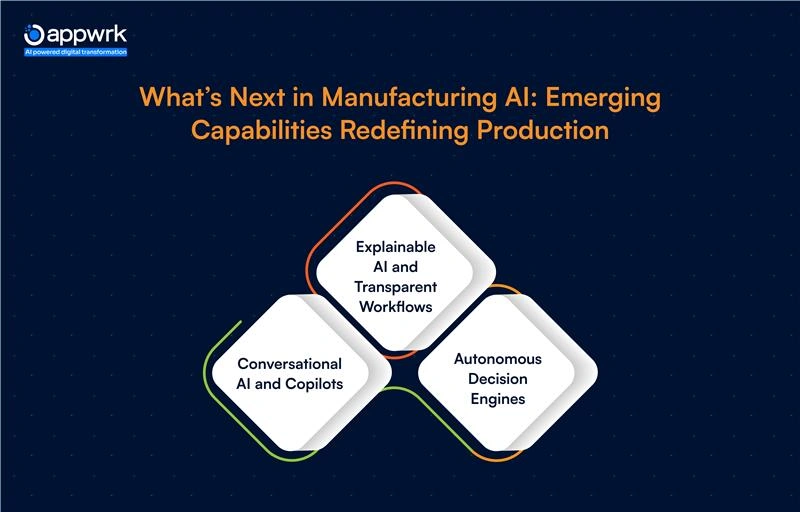
What’s Next in Manufacturing AI: Emerging Capabilities Redefining Production
Manufacturing AI is evolving fast, from reactive systems to autonomous, interpretable intelligence. These emerging capabilities unlock new potential for decision-making, human interaction, and transparency across operations.
Conversational AI and Copilots
Conversational AI allows operators, engineers, and managers to interact with systems via natural language, replacing command-line inputs with voice or chat interfaces.
Copilot systems suggest actions, summarize machine health, or auto-fill forms based on context. This reduces friction between human intent and system execution, particularly valuable in high-complexity operations.
These are AI models that make micro-decisions in real time, like routing products, allocating resources, or reconfiguring schedules based on live data.
Unlike predictive AI, autonomous engines don’t wait for human validation. They act within guardrails, optimizing KPIs like cycle time or energy use continuously.
Explainable AI and Transparent Workflows
As AI takes over more operational decisions, explainability becomes essential. Explainable AI (XAI) provides reasoning behind each action, helping teams trust, audit, and improve models.
In regulated industries like pharma or aerospace, XAI is a compliance necessity. Manufacturers are integrating dashboards that visualize AI logic in real time for quality and legal teams.
How AI Transforms ERP and SCM in Manufacturing
AI is reshaping enterprise resource planning and supply chain management by turning traditional systems into intelligent, real-time decision making engines. Instead of simply tracking data, modern ERP and SCM platforms now predict outcomes, optimize operations, and respond dynamically to changing conditions, driving greater agility, efficiency, and profitability across the manufacturing ecosystem.
Leveraging AI in Enterprise Resource Planning (ERP)
AI-powered production planning in ERP systems ensures optimized procurement schedules and balanced manufacturing loads.
For example, AI-enabled ERP platforms like SAP S/4HANA can auto-adjust procurement schedules based on raw material volatility or detect anomalies in cost structures across plants.
Smart Supply Chain Management with AI
In SCM, AI improves demand sensing, supplier performance tracking, and risk mitigation. Real-time insights help reroute shipments, pre-order high-risk parts, and flag vendor delays before they escalate.
Infosys reports that AI-driven SCM platforms reduce logistics disruptions by up to 35% and improve order fulfillment rates.
Real-Time Inventory Optimization
AI continuously balances inventory across multiple sites using inputs like customer orders, seasonality, supplier constraints, and production rates.
This dynamic model cuts holding costs, reduces stockouts, and frees up working capital, critical for just-in-time manufacturing.
Leveraging Edge AI for Faster, Smarter Manufacturing Decisions
As manufacturing becomes more data-driven and time-sensitive, real-time intelligence is no longer optional. Edge AI brings computing power directly to the shop floor, allowing machines to analyze data, make decisions, and take action instantly. By reducing reliance on the cloud, edge AI enhances speed, autonomy, and reliability, driving smarter operations where every millisecond matters.
AI at the Edge for Factory Floor Optimization
AI in shop floor automation uses edge computing to instantly analyze data and adjust machine behavior in real time.
In CNC machining or bottling lines, edge systems optimize temperature, torque, or speed in real time without waiting for cloud-side computation.
Reducing Latency in Automated Processes
In high-precision manufacturing, even slight delays can lead to errors or defects. Edge AI eliminates latency by allowing control systems to process data and respond within sub millisecond windows.
This level of speed is critical in applications like robotic welding, high-speed packaging, and semiconductor fabrication, where real-time adjustments are essential to maintaining quality and safety.
Enabling Autonomous Micro-Decisions at Scale
Edge AI empowers machines to make localized decisions, redirecting parts, skipping defective input, or rerouting materials dynamically.
At scale, thousands of these micro-decisions stack up to deliver significant gains in throughput, waste reduction, and energy efficiency.
How APPWRK Builds Intelligent AI Solutions for Manufacturers
APPWRK delivers tailored AI solutions for manufacturers, blending deep domain expertise with advanced technology to solve real-world challenges. From predictive systems to ERP integrations, Appwrk builds AI that performs at scale.
APPWRK’s Custom AI Development Services
APPWRK delivers tailored end-to-end AI solutions designed to match each manufacturer’s unique processes, scale, and existing systems.
From predictive models that minimize downtime to advanced vision systems for quality inspection, every solution is purpose-built to drive real, measurable improvements in performance and efficiency.
Integration with ERP, SCM, and IIoT
APPWRK enables the seamless integration of AI engines into core enterprise systems, including SAP, Oracle ERP, and custom MES platforms.
By bridging AI with IIoT and real-time data pipelines, APPWRK ensures synchronized decision-making across production, supply chain, and asset management.
15% drop in maintenance costs within six months of deployment.
These outcomes positioned the client for scalable efficiency gains across their entire production line.
Contact APPWRK to get AI integrated into your automotive company.
FAQs
Defining AI’s Role in Today’s Manufacturing Landscape
AI powers real-time decisions, predictive insights, and intelligent automation across design, production, and logistics. It’s no longer optional; it’s foundational for modern manufacturing competitiveness.
How can AI reduce manufacturing costs?
AI reduces costs by minimizing downtime, optimizing energy use, automating quality checks, and streamlining workflows. Predictive maintenance alone can cut operational costs by 20-30%, depending on implementation scale.
Top AI tools include Siemens MindSphere, IBM Maximo, Microsoft Azure AI, Autodesk Generative Design, and custom solutions built on TensorFlow, PyTorch, and MATLAB, depending on the use case and scale.
How quickly can businesses expect ROI from AI?
Pilot-level AI implementations show measurable ROI within 6-12 months, especially in predictive maintenance, visual inspection, and supply chain automation. Scaled rollouts typically see compounding returns in 18-24 months.
Is AI safe and scalable for small manufacturers?
Yes. With cloud-based AI, modular tools, and lower compute costs, even small and mid-sized manufacturers can deploy AI safely. Scalable entry points include RPA, AI-enabled ERP add-ons, and edge-based visual QC systems.
Gourav Khanna is the Co-founder and CEO of APPWRK, leading the company’s vision to deliver AI-first, scalable digital solutions for enterprises and high-growth startups. With over 16 years of leadership in technology, he is known for driving digital transformation strategies that connect business ambition with outcome-focused execution across healthcare, retail, logistics, and enterprise operations.
Recognized as a strategic industry voice, Gourav brings deep expertise in product strategy, AI adoption, and platform engineering. Through his insights, he helps decision-makers prioritize market traction, operational efficiency, and long-term ROI while building resilient, user-centric digital systems.
Subscribe to APPWRK Blogs, We'll Do the Rest!
Get Blogs on UI/UX, Mobile Apps, Online Marketing, and Web development technology.
Unlock worthy and priceless suggestions from the masters of mobile and web app development