150+ minds across 4 countries. Join a culture of innovation, ownership & growth.
Rewire for AI
From machine learning to deep learning, from classification tools to overall process automation – our AI engineers will help you retool your existing system or enhance your company results.
Ship faster, scale smarter, built for product companies and SaaS teams
Our Latest Work
We strive hard to deliver result-driven digital solutions across the globe. Check out our case studies to get a glimpse of how we ideate, innovate, and create unconventional digital solutions according to the requirements of our clients.
Discover diverse and passionate insights from our tech enthusiasts. We collaborate across various sectors to streamline operations and drive innovation. Explore our rapidly growing collection of articles to see why we’re at the forefront of IT solutions.
The decision to move from Magento to Shopify is one of the most significant replatforming choices an ecommerce business can make. Magento is powerful, but its power comes with...
Accuracy gap is real: Traditional CPG forecasting carries a 25-40% MAPE error rate. AI-powered models bring that down to 8-15%, according to McKinsey research....
Real stories from global leaders who trusted us with their ideas.
Partnering with APPWRK helped us build a compliant and scalable healthcare platform, accelerating our time-to-market by 35%. Their team consistently delivered outstanding work.
Beesers
Digital Healthcare Client
Collaborating with APPWRK, Sportskeeda modernized its platform into a real-time sports engagement ecosystem, enabling seamless content delivery, scalable fan interactions, and high-velocity performance.
Sportskeeda
Sports & Entertainment Partner
Working with APPWRK was effortless. They captured our vision, maintained full compliance, and delivered a digital experience that built trust and elevated how customers interact with our fintech brand.
PayPenny
Fintech Partner
Working with APPWRK gave us confidence in adopting AI responsibly. Their team built a safe, intelligent bot that transformed how we engage with leads and helped us achieve measurable revenue growth.
IFB
AI Transformation Partner
Leveraging APPWRK’s digital expertise, Nemesis launched a scalable, compliant, and safe super app that connects content delivery, real-time communication, and logistics management within a single platform.
Nemesis
Super App Partner
Transform Social Media with AI Partnership
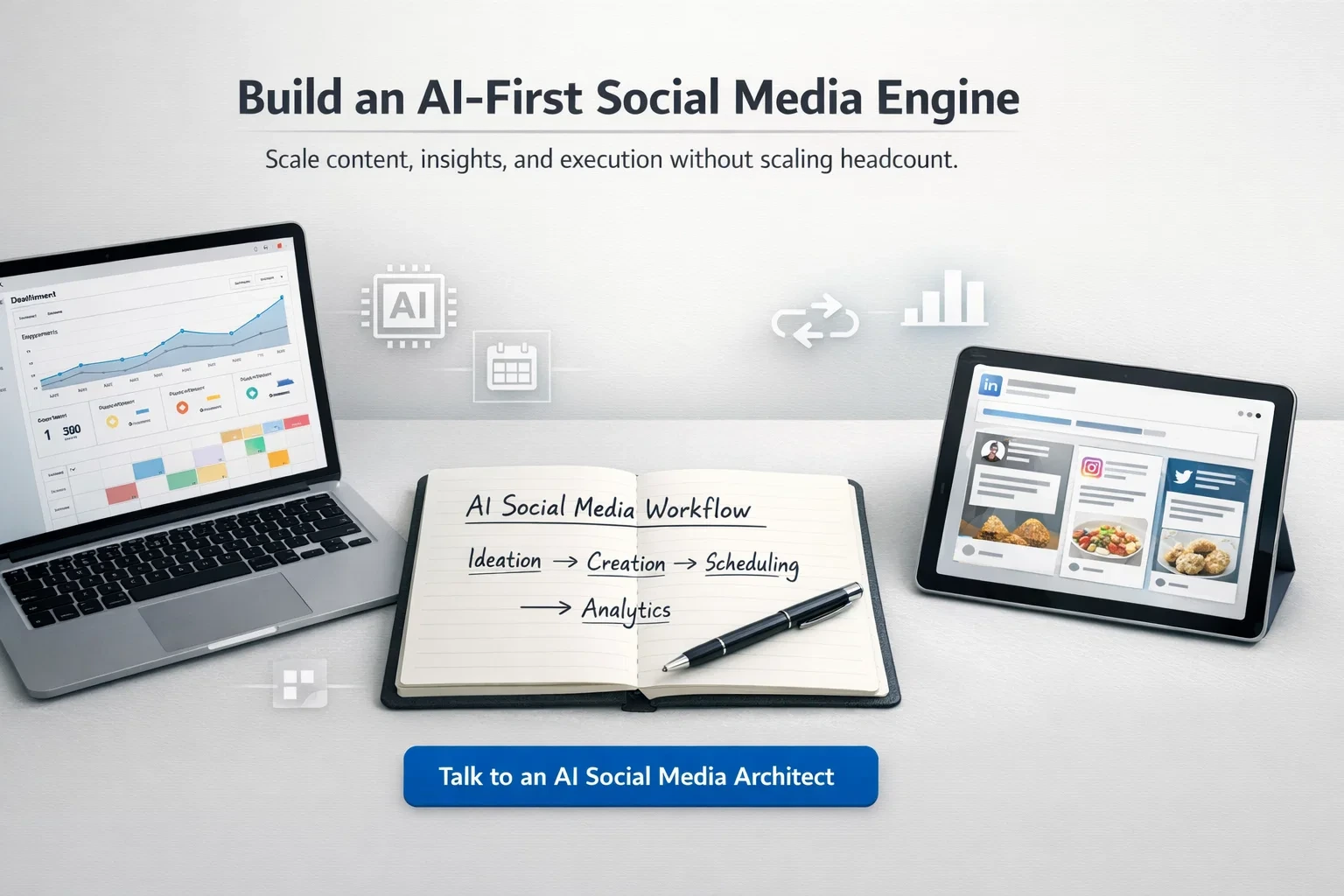
Partner with experts to operationalise AI-driven social media workflows that scale performance, insight, and impact, without increasing headcount.
AI for social media management refers to the use of intelligent systems that help teams plan, create, distribute, analyse, and optimise content across platforms, reducing manual effort while improving consistency, speed, and performance.
Modern social media teams are operating under increasing pressure: more channels to manage, shorter content cycles, higher expectations for personalisation, and fewer resources to execute at scale.
Manual, tool-by-tool social media management is no longer sustainable. As volume and complexity rise, AI has shifted from a productivity add-on to a core operational layer.
Founders, CMOs, and growth teams are adopting AI-driven social media tools to scale content output, extract performance insights, and lower cost per post without expanding headcount.
That said, AI is not a replacement for strategy. Brand context, editorial judgment, and governance still require human oversight to avoid generic content, brand risk, and algorithmic blind spots.
This guide breaks down where AI delivers measurable value in social media, where human decision-making remains essential, and how leading AI social media tools compare in real-world use, across cost, scale, and team impact.
Introduction: What Is AI for Social Media and Why Social Media Teams Are Turning to AI?
Social media teams are managing more platforms and faster timelines without proportional increases in resources, creating sustained operational pressure.
Key signals from the market:
In 2024, 60%+ of marketers, PR professionals, sales teams, and customer service leaders reported improved social media performance from labeling AI-generated content
As expectations for speed, consistency, and performance rise, manual workflows and disconnected tools no longer scale. AI in social media marketing has moved from experimentation to a core operational layer.
AI for social media management supports:
Content creation and scheduling
Analytics, social listening, and performance insights
Audience and customer engagement
Unlike traditional tools built on static rules, AI-powered systems learn from platform behavior and audience response, enabling dynamic content and timing optimization.
Why adoption is accelerating:
Growing investment in AI-driven social media and marketing technologies
Expansion across content creation, analytics, and campaign optimisation
Result: One strategist can manage end-to-end social media operations with significantly less manual effort and coordination.
What AI Can Fully Automate in Social Media Management
AI works best when it removes operational friction, not when it replaces creative or strategic judgment. Used correctly, it can fully own several high-volume, low-judgment layers of social media workflows.
Scheduling & Publishing
Automatically posts across platforms, adjusts time slots, and manages daily execution without manual input.
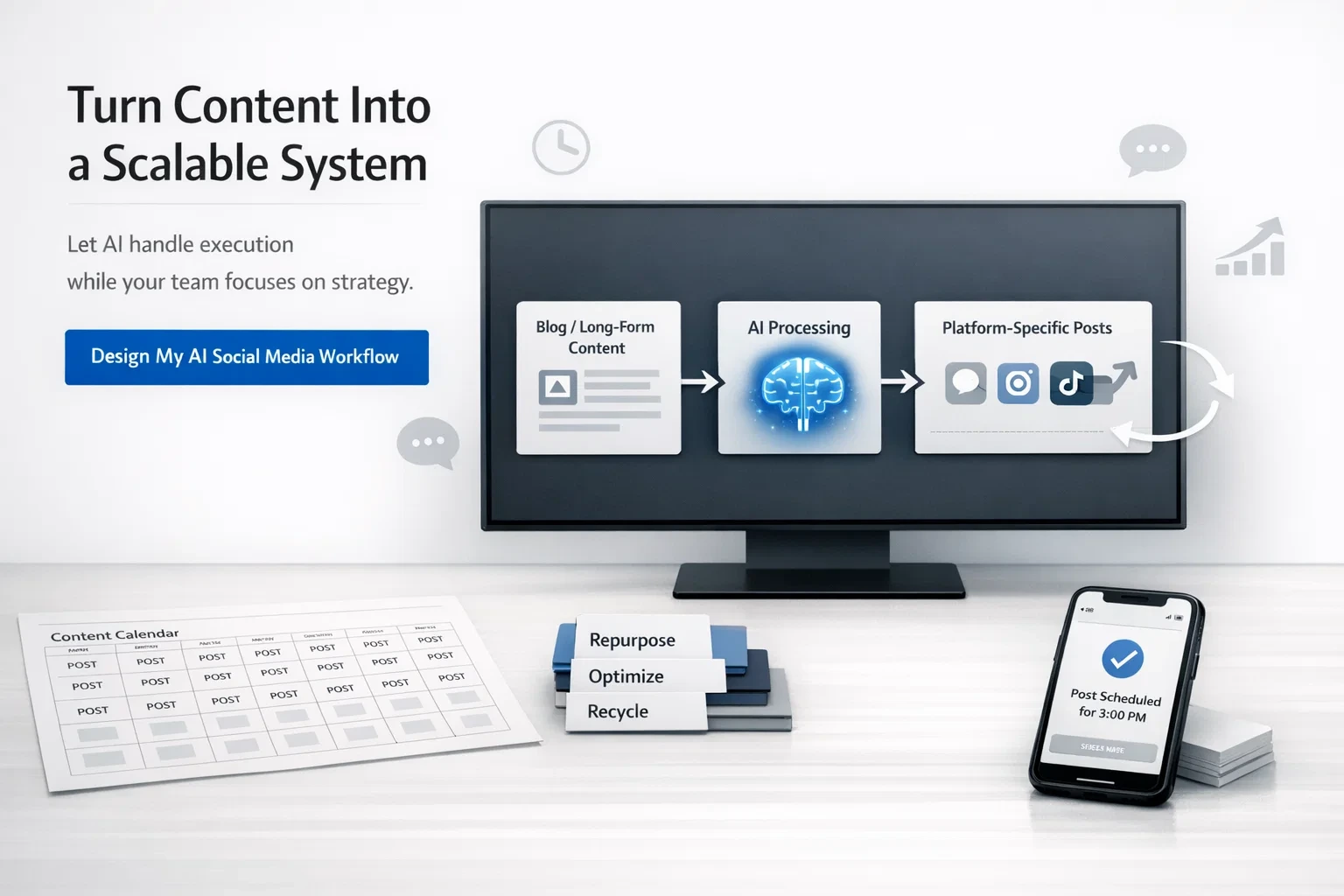
Identifies high-performing posts and repurposes them with new angles, updated CTAs, or channel-specific formatting.
These use cases are especially valuable for teams looking to scale output while controlling costs, and they form the operational backbone of most AI social media managementapps today.
AI Tools vs Traditional Social Media Management
The shift from manual workflows to AI-powered social media management represents a structural change in how teams operate.
Area
Traditional Approach
AI-Driven Approach
Content speed
Manual creation and approval cycles
Accelerated ideation and assisted publishing
Insights
Retrospective reporting
Predictive signals and real-time feedback
Cost per post
High due to people and tooling
Lower through reuse and automation
Scale
Limited by team capacity
One strategist manages multiple channels
Tone control
Inconsistent across contributors
Brand tone learned and applied consistently
Posting cadence
Irregular due to bandwidth
Maintained automatically
Data usage
After-the-fact metrics
Continuous learning loops
This is why AI-driven social media management is increasingly replacing traditional social media management software for high-volume teams.
AI for Social Media: Use Cases in the Real World
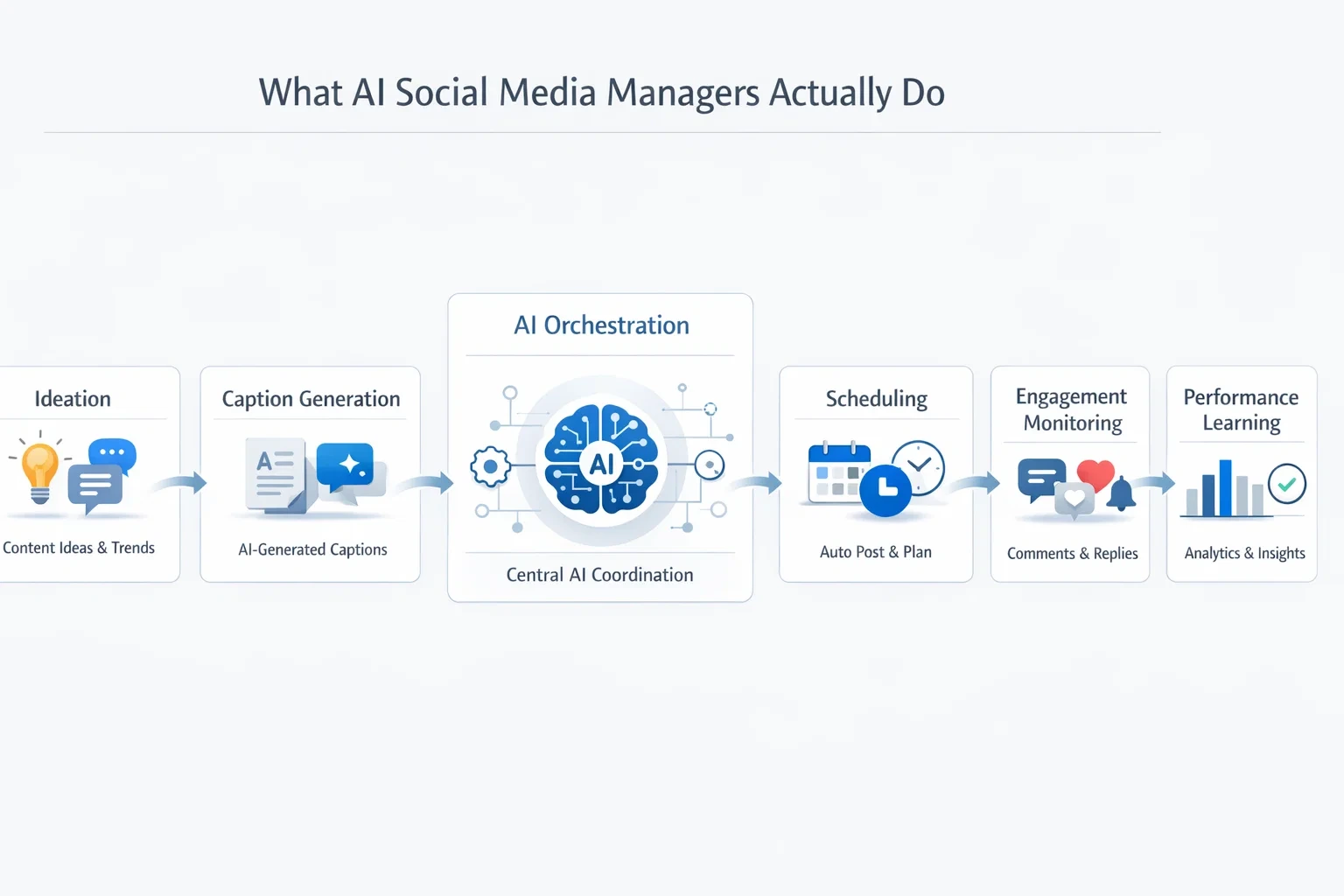
AI social media management delivers value when tools are mapped to operational jobs, not feature lists. In practice, AI functions as an execution layer across planning, creation, publishing, engagement, analysis, and scale. The framework below shows how AI social media management tools support real workflows, what AI handles at each stage, and the operational impact for modern teams.
Content Ideation, Planning, and Calendar Creation
Use case Transforming blogs, campaigns, and historical performance data into structured social media calendars.
What AI handles
Topic discovery using engagement signals and content recommendations
Identification of themes tied to marketing campaigns and market shifts
AI capabilities
Trend and keyword analysis
Blog-to-social content extraction
Campaign-aligned planning
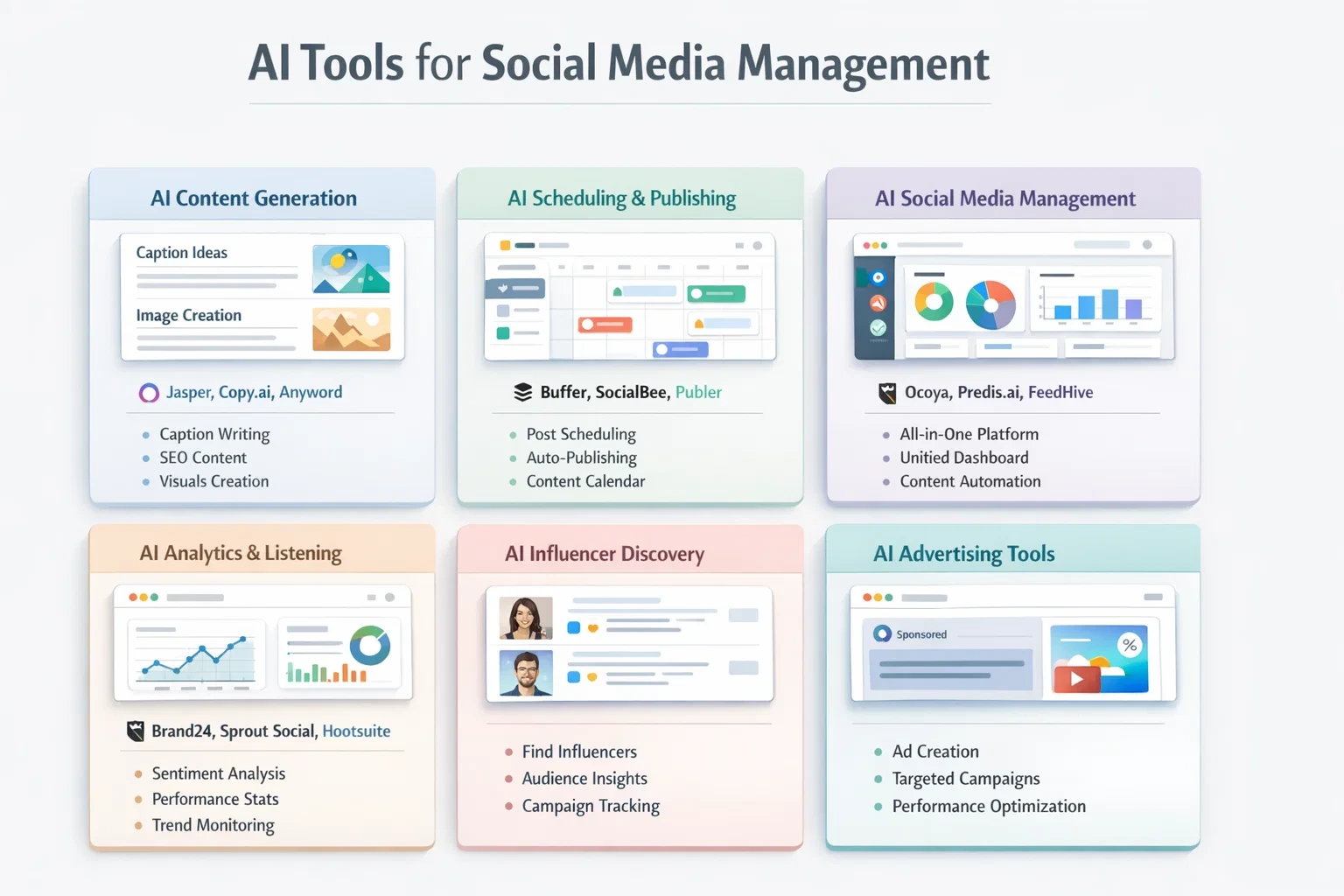
Tools that typically support this AI content generation tools, AI social media managers
Operational impact Planning cycles shrink from weeks to days, enabling consistent publishing without manual ideation bottlenecks.
Caption, Copy, and Platform-Specific Post Creation
Use case Generating captions, variations, and CTAs tailored to LinkedIn, Instagram, X, Facebook, Threads, and TikTok.
What AI handles
Caption writing for marketing content
Platform-specific tone adaptation
Call-to-action optimisation for audience engagement
Use case Turning engagement data into forward-looking insights rather than retrospective reports.
What AI handles
Performance analysis
Predictive engagement modelling
Identification of optimisation opportunities
AI capabilities
Pattern recognition across campaigns
Recommendation engines
Tools that typically support this AI analytics platforms, AI-enabled dashboards
Operational impact Teams adjust strategy proactively instead of reacting after performance declines.
Influencer Marketing and Paid Social (Advanced Applications)
Use case Scaling influencer discovery and paid social execution using data-driven evaluation.
What AI handles
Influencer discovery based on audience overlap and engagement quality
Creative testing and optimisation for ads
AI capabilities
Automated ad targeting
Performance optimisation across campaigns
Operational impact Reduces reliance on follower counts and improves alignment between creators, campaigns, and brand goals.
Free vs Paid AI Tools in Social Media Management
Free AI tools Useful for early-stage teams, experimentation, and individual creators.
Limitations
Generic outputs
Limited integrations
Weak governance and approvals
Paid AI social media management software Required for teams operating across multiple platforms, brands, or regulated environments where scalability, security, and workflow control matter.
Effective AI social media management is not about adopting more tools; it is about aligning AI capabilities to the right operational jobs. Teams that map AI to real workflows achieve faster execution, stronger consistency, and scalable performance without expanding headcount.
APPWRK Case Study: Operationalizing AI-First Social Media Workflows
Business context
Teams managing multiple social media platforms often struggle with fragmented logins, disconnected publishing tools, and manual scheduling. APPWRK addresses this by centralising authentication, platform connections, and content publishing into one workflow.
User Authentication and Access Management
The platform supports multiple authentication methods to reduce onboarding friction and improve adoption.
Capabilities
Standard user registration using email and password
Password recovery via secure email-based reset flow
Single Sign-On using Facebook and Twitter credentials
Outcome
Users can register, log in, or recover access without support dependency, improving time-to-first-use and reducing authentication-related drop-offs.
To see this approach in action, explore how APPWRK helped JJD Media, a content-driven social media agency, ease social media management operations through OnQue, an all-in-one platform built to support scalable, multi-channel execution.
Benefits of AI for Social Media Management
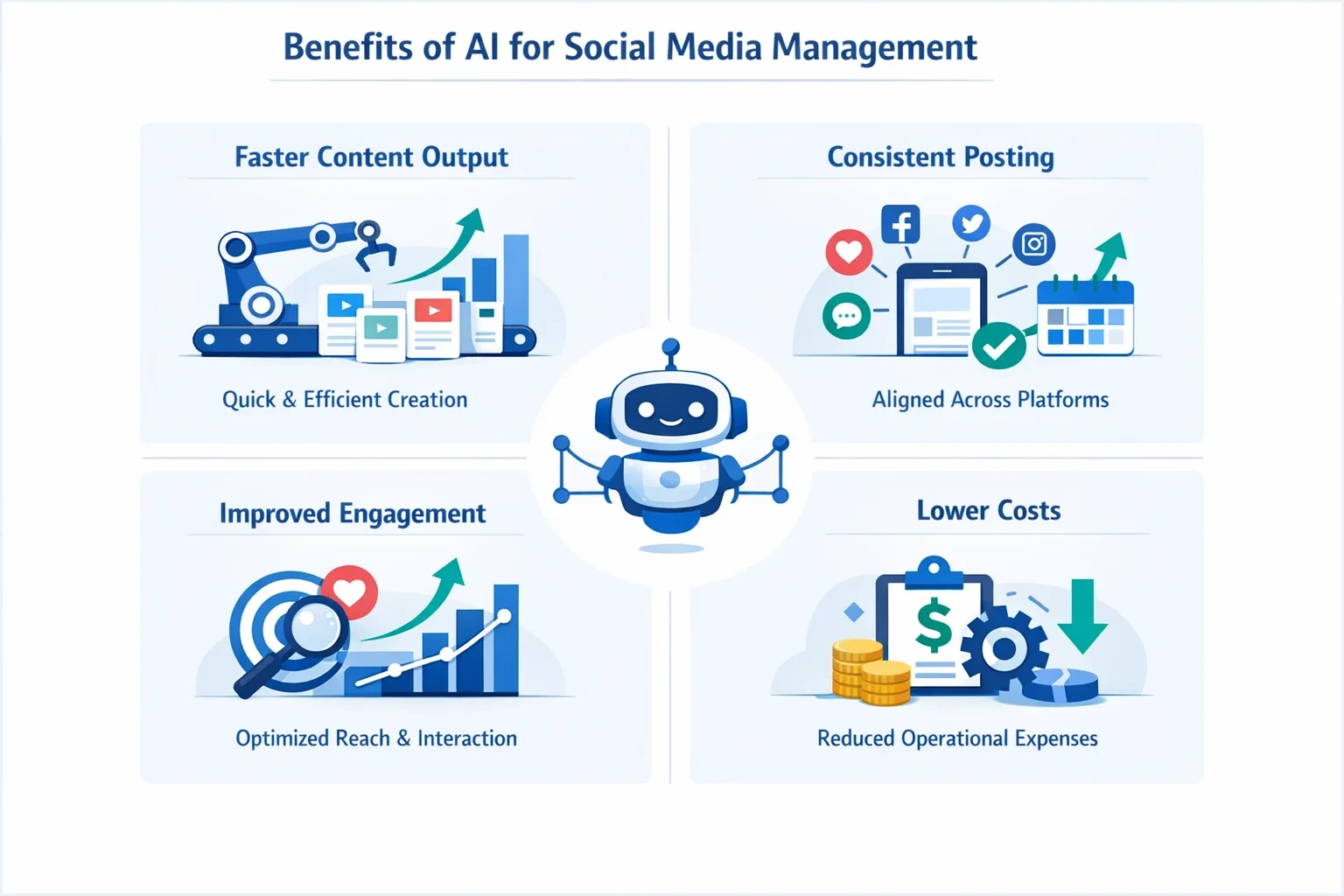
AI-first social strategies are being adopted for one simple reason. They allow teams to move faster and scale output without expanding headcount or burning out talent. AI for social media management does not just reduce effort. It creates a more resilient, predictable, and responsive content operation.
Faster Content Output Without Burnout
AI social media tools remove repetitive execution work such as ideation, caption drafting, formatting, and publishing.
Teams that once spent weeks preparing content calendars now generate and deploy content in days, without creative fatigue or operational overload.
Consistent Posting Across Channels
Maintaining platform-specific tone and cadence is one of the hardest parts of social media management at scale.
AI-driven social media management systems automatically adapt content for LinkedIn, Instagram, X, Threads, TikTok, and emerging platforms, ensuring consistent activity without manual duplication.
Improved Engagement Through Optimization
AI for social media management software continuously analyses engagement patterns and adjusts posting times, formats, and messaging accordingly.
This results in higher reach and engagement per post, without relying on trial-and-error scheduling or retrospective guesswork.
Lower Cost Per Post and Campaign
By consolidating writing, scheduling, and optimisation into a single workflow, AI significantly reduces cost per post.
For startups and growth-stage teams, this often replaces fragmented agency, freelance, and tooling expenses with one strategist supported by an AI stack.
Scalable Workflows for Lean and Enterprise Teams
AI social media management platforms scale with complexity, not headcount.
Whether supporting a small in-house team or a multi-brand content operation, AI enables structured workflows, approvals, and automation without adding operational friction.
Cost Implications of AI Adoption in Social Media Use Cases
AI adoption in social media does not simply add software costs. It reshapes business processes, reallocates jobs and tasks, and reduces cost pressure across customer-facing and marketing operations. The table below summarizes where AI reduces cost and creates business value across core social media workflows.
Social Media Domain
How AI Reduces Cost
Business Value Created
Content planning & ideation
Automates repetitive tasks and paper-based planning
Higher efficiency, faster business growth
Content creation & personalization
Generative AI reduces manual copy and image creation
How AI Reduces Content Planning and Ideation Costs
Social media planning traditionally consumes significant marketing time through meetings, paper-based workflows, and fragmented information.
AI applications powered by large language models and agentic AI automate topic discovery, demand analysis, and calendar creation using customer behavior data.
Cost impact
Fewer planning jobs are required per month
Reduced reliance on external sources and manual reports
Lower stress levels across marketing teams
Business value Improves organizational learning and supports consistent customer personalization at scale.
How Generative AI Lowers Content Creation and Personalization Costs
Creating platform-specific copy, images, and personalized messaging is one of the highest-cost areas in social media marketing. Generative AI systems reduce repetitive tasks by generating captions, product messaging, and human language variants aligned with consumer behavior.
Cost impact
Lower cost per post
Fewer freelance invoices and contract dependencies
Faster turnaround for sales and lead-focused campaigns
Business value Improves customer experiences, customer satisfaction, and customer engagement without sacrificing brand core values.
How AI Reduces Publishing, Scheduling, and Scaling Costs
Manual scheduling creates geographic self-bottlenecking and limits scalability across digital systems and eCommerce platforms. Agentic AI systems automate publishing, recycling, and ad targeting using real-time data analytics and streaming infrastructure.
Cost impact
Reduced execution overhead
Better utilization of existing content
Lower demand for manual coordination
Business value Supports business growth across markets while maintaining consistency at scale.
Check how APPWRK helped JJD Media, a content-driven social media agency, to ease social media management operations through an all-in-one social media management platform called OnQue.
How AI Cuts Monitoring and Analytics Costs
Traditional social media analytics rely on retrospective reports and manual number tracking. AI-powered Data and analytics systems identify anomalies, behavior shifts, and trends using autonomous market analysts and customer behavior data.
Cost impact
Fewer analyst hours spent on reports
Faster response to market demand and community signals
Business value Improves decision-making at every level of the business using business metrics instead of guesswork.
How AI Lowers Customer Engagement and Customer Service Costs
Business value Strengthens customer satisfaction and long-term loyalty.
How AI Reduces Optimization and Waste Costs
Without AI, teams rely on trial-and-error strategies that inflate costs. AI-driven recommendations continuously optimize campaigns using real-time data analytics and business metrics.
Cost impact
Less wasted marketing spend
Improved sales efficiency
Better profit margins
Business value Aligns AI solutions directly with measurable business value.
How AI Improves Security and Risk-Related Costs
AI-driven risk management identifies fraud detection signals, anomalies, and security gaps across digital systems. Modern implementations use encryption, access controls, and secure cloud document storage.
Cost impact
Fewer incidents and remediation expenses
Reduced compliance risk
Business value Protects customer information and business reputation.
What Changes Most: Cost Structure, Not Spend
AI transformation does not eliminate costs, but it shifts them from manual labor to scalable AI-powered workflows.
Less spending on repetitive tasks
More investment in data and infrastructure
Higher employee productivity and efficiency
This is why industry leaders treat AI adoption as a business transformation, not a tooling decision.
The real cost advantage of AI for social media comes from how it restructures work, not from software pricing. When implemented correctly, through AI pilots, AI Academy training, and aligned AI teams, AI delivers sustained business growth across marketing, customer engagement, and customer service.
How APPWRK Helps Teams Implement AI-First Social Media Operations
AI for social media management is an operating model decision, not just a tooling choice. Most teams struggle because they adopt AI tools without redesigning workflows, ownership, or governance.
APPWRK helps teams implement AI-driven social media management in a way that aligns with brand maturity, team structure, and compliance needs. AI is embedded directly into content planning, brand voice alignment, execution, approvals, and publishing, without adding unnecessary tool complexity.
Existing CMS, DAM, analytics, and reporting systems are integrated so teams can work end-to-end without manual handoffs. Performance is continuously monitored, prompts are refined, and workflows are updated to ensure AI systems remain effective as platforms and algorithms evolve.
Founder’s Guide to AI for Social Media Management
For founders and marketing leaders, the question is not whether to use AI, but when it makes sense and how far it should be applied.
AI-first social media operations work best for teams publishing across multiple platforms, operating lean, and relying on consistent content output for growth. They are especially effective when long-form content already exists and needs to be repurposed at scale.
AI should support, not lead, when brand voice is still evolving, content requires regulatory review, or reputation risk is involved. In these cases, AI improves execution efficiency, but strategic decisions must remain human-led.
Frequently Asked Questions
Can AI create a full social media content calendar from my website?
Yes. AI social media management tools can analyse blogs, landing pages, and internal content to generate structured 30-day calendars with platform-specific variations.
Can AI generate LinkedIn and Instagram posts from blogs?
Yes. With proper prompts and brand training, AI social media post generators can repurpose a single article into captions, carousels, or short-form posts tailored to each platform.
How do teams avoid generic AI-generated content?
By grounding AI systems in real brand inputs such as website copy, past posts, customer language, and clear tone rules. Human review and prompt refinement remain essential.
Which AI tools extract post ideas directly from URLs?
Platforms such as Predis.ai, FeedHive, and Simplified AI support URL-based content extraction. Jasper can achieve similar results through structured templates.
Can AI generate posts for multiple platforms from the same article?
Yes. Advanced AI social media management software supports platform-aware formatting, adjusting length, tone, and calls to action automatically. Want an AI platform that does this end-to-end? Contact APPWRK to build and operationalise AI-driven social media workflows tailored to your team.
How accurate is AI for social media analytics?
AI analytics are effective for trend detection, sentiment analysis, and timing insights. Strategic interpretation and campaign decisions should remain human-led.
Is AI-generated social media content original?
AI-generated content is original in structure and phrasing, based on prompts and training data. Most platforms include originality checks to support content authenticity and trust.
Gourav Khanna is the Co-founder and CEO of APPWRK, leading the company’s vision to deliver AI-first, scalable digital solutions for enterprises and high-growth startups. With over 16 years of leadership in technology, he is known for driving digital transformation strategies that connect business ambition with outcome-focused execution across healthcare, retail, logistics, and enterprise operations.
Recognized as a strategic industry voice, Gourav brings deep expertise in product strategy, AI adoption, and platform engineering. Through his insights, he helps decision-makers prioritize market traction, operational efficiency, and long-term ROI while building resilient, user-centric digital systems.
Subscribe to APPWRK Blogs, We'll Do the Rest!
Get Blogs on UI/UX, Mobile Apps, Online Marketing, and Web development technology.
Unlock worthy and priceless suggestions from the masters of mobile and web app development