150+ minds across 4 countries. Join a culture of innovation, ownership & growth.
Rewire for AI
From machine learning to deep learning, from classification tools to overall process automation – our AI engineers will help you retool your existing system or enhance your company results.
Ship faster, scale smarter, built for product companies and SaaS teams
Our Latest Work
We strive hard to deliver result-driven digital solutions across the globe. Check out our case studies to get a glimpse of how we ideate, innovate, and create unconventional digital solutions according to the requirements of our clients.
Discover diverse and passionate insights from our tech enthusiasts. We collaborate across various sectors to streamline operations and drive innovation. Explore our rapidly growing collection of articles to see why we’re at the forefront of IT solutions.
The decision to move from Magento to Shopify is one of the most significant replatforming choices an ecommerce business can make. Magento is powerful, but its power comes with...
Accuracy gap is real: Traditional CPG forecasting carries a 25-40% MAPE error rate. AI-powered models bring that down to 8-15%, according to McKinsey research....
Real stories from global leaders who trusted us with their ideas.
Partnering with APPWRK helped us build a compliant and scalable healthcare platform, accelerating our time-to-market by 35%. Their team consistently delivered outstanding work.
Beesers
Digital Healthcare Client
Collaborating with APPWRK, Sportskeeda modernized its platform into a real-time sports engagement ecosystem, enabling seamless content delivery, scalable fan interactions, and high-velocity performance.
Sportskeeda
Sports & Entertainment Partner
Working with APPWRK was effortless. They captured our vision, maintained full compliance, and delivered a digital experience that built trust and elevated how customers interact with our fintech brand.
PayPenny
Fintech Partner
Working with APPWRK gave us confidence in adopting AI responsibly. Their team built a safe, intelligent bot that transformed how we engage with leads and helped us achieve measurable revenue growth.
IFB
AI Transformation Partner
Leveraging APPWRK’s digital expertise, Nemesis launched a scalable, compliant, and safe super app that connects content delivery, real-time communication, and logistics management within a single platform.
Nemesis
Super App Partner
Partner for Smarter DAM Transformation
Collaborate with APPWRK to build scalable, future-ready digital asset management platforms that drive long-term business growth.
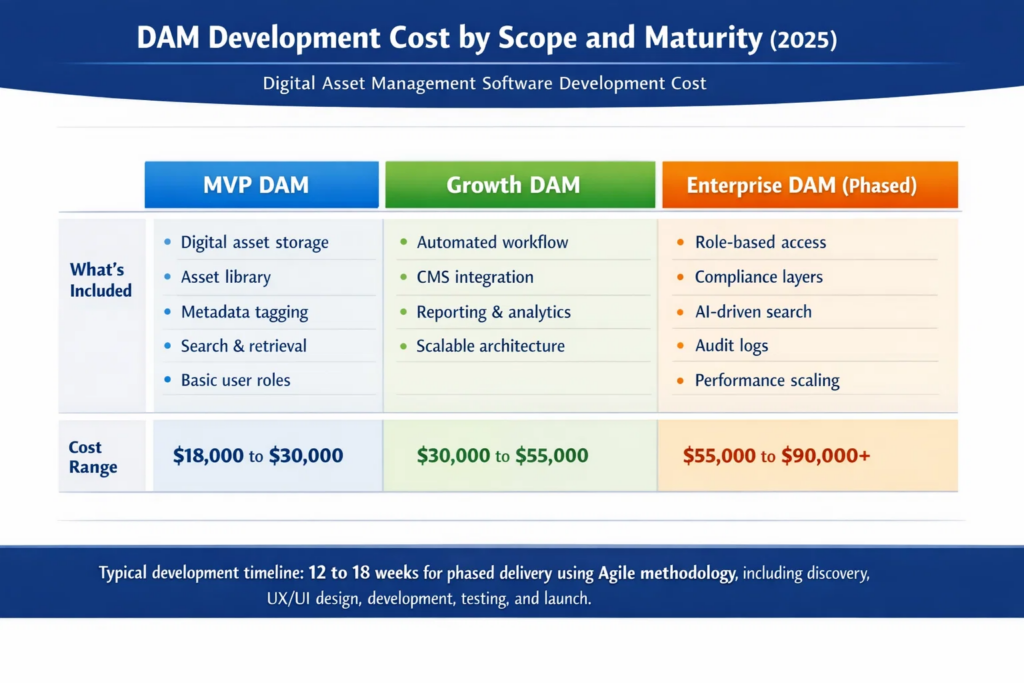
Digital asset management software development cost typically starts from $18,000 to $30,000 for an MVP DAM and can exceed $90,000+ for enterprise-grade DAM platforms, depending on feature depth, architecture complexity, integrations, AI capabilities, and compliance requirements.
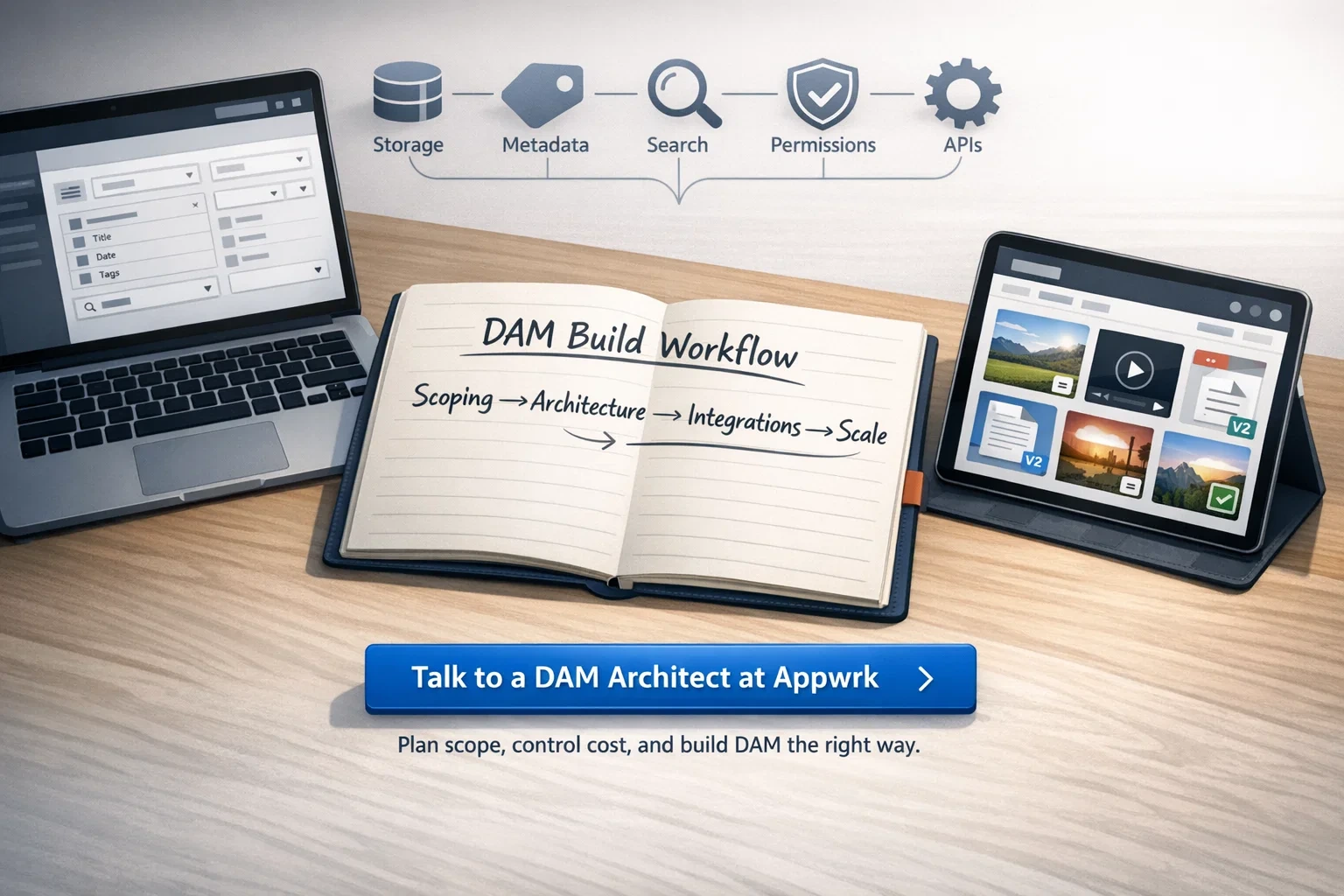
Modern digital asset management software functions as core infrastructure, centralising asset storage, metadata management, search and retrieval, version control, and user access control while integrating with CMS, CRM, PIM, and eCommerce systems.
Custom DAM development delivers stronger workflow alignment, long-term cost control, scalable architecture, compliance readiness, and full IP ownership compared to subscription-based SaaS DAM platforms.
Key factors influencing digital asset management software development cost include AI-driven search, automated workflow, enterprise security (SSO, MFA, audit trails), API-first architecture, cloud-based DAM infrastructure, omnichannel optimisation, and integration complexity.
Building an enterprise-ready digital asset management system typically requires 12–18 weeks for phased delivery, supported by a cross-functional team including Solution Architect, backend and frontend engineers, QA engineers, DevOps, UX/UI designers, and integration specialists.
Understanding digital asset management software development cost, implementation cost, and DAM pricing models is now critical for organisations planning scalable DAM investments. Refer to this comprehensive guide to understand these critical aspects of DAM software development.
Introduction: What It Really Costs to Build Digital Asset Management Software
In 2026, digital asset management software development has become a core infrastructure decision. Organisations are moving beyond SaaS tools and investing in custom digital asset management systems to support scale, compliance, and long-term content operations. Rising digital asset management costs in 2026 reflect increasing asset volumes and workflow complexity.
According to MarketsandMarkets, the global Digital Asset Management market is projected to grow from USD 5.3 billion in 2023 to USD 10.3 billion by 2029, driven by content expansion and enterprise adoption.
Modern digital asset management platforms extend beyond asset libraries. They enable asset tagging, metadata management, search and retrieval functions, version control, and user access control, while integrating with CMS, CRM, and eCommerce systems.
If you are evaluating how much a digital asset management system costs to build in 2026, the ranges below reflect realistic budgets based on scope, feature requirements, and delivery model.
DAM Scope
What’s Included
Cost Range
MVP DAM
Digital asset storage, asset library, metadata tagging, search and retrieval functions, basic user roles
$18,000 to $30,000
Growth DAM
Automated workflow, CMS integration, reporting and analytics, scalable architecture
Regional Cost Analysis for DAM Software Development
Development geography has a direct impact on digital asset management software development cost, but not necessarily on output quality. The difference lies in labour economics, delivery models, and operational overhead.
Region for DAM Software Development
Cost Impact
Notes
India / Southeast Asia
Lowest
Strong cost savings, mature offshore IT outsourcing, and high DAM delivery volume
Eastern Europe
Balanced
Higher cost than Asia, strong engineering depth, moderate timelines
US / Western Europe
Highest
Premium rates, higher implementation costs, and slower iteration cycles
For most organisations, offshore-hybrid delivery models provide the best balance between cost of DAM software, quality, and speed.
Many organisations confuse DAM implementation cost with digital asset management software development cost, but they represent different budget categories.
Development cost includes:
Architecture design
Core feature development
API integrations
Security engineering
Testing and deployment
DAM implementation cost includes:
Asset migration
Metadata restructuring
DAM deployment cost
Integration setup
User training and change management
Ongoing DAM maintenance cost
Ignoring implementation cost leads to inaccurate budgeting and an underestimated total cost of ownership (TCO).
For accurate planning, both development and implementation costs must be evaluated together.
Typical Development Timeline for Digital Asset Management Software
Most digital asset management software development projects take 12 to 18 weeks, covering discovery, UX/UI design, core development, testing, and deployment, when scoped as a phased build.
Phase of Digital Asset Management Software Development
Duration of Digital Asset Management Software Development
Discovery and scope
1–2 weeks
UX and architecture
2–3 weeks
Core development
8–12 weeks
QA and launch
2–3 weeks
Factors That Influence Digital Asset Management Software Development Cost
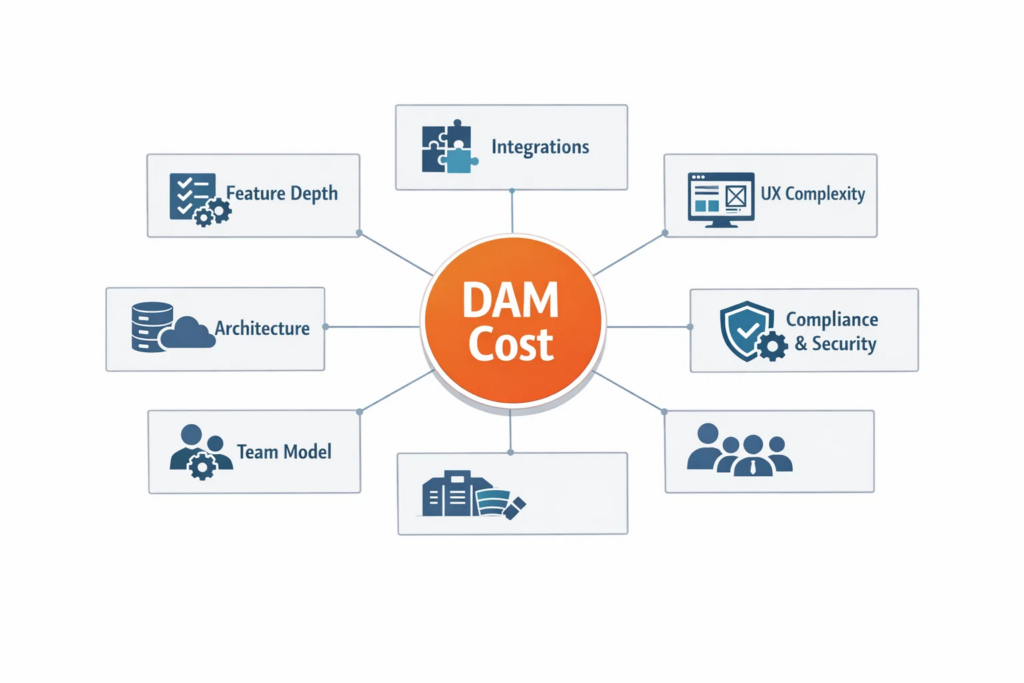
Digital asset management software development cost varies widely because DAM is not a single product category. The scope, architecture, feature depth, integrations, and delivery model directly shape the final cost estimate.
Below are the primary cost drivers that impact digital asset management pricing in 2026.
Platform Scope and DAM Maturity
The maturity level of your digital asset management system is the biggest pricing variable.
MVP DAM
Centralised asset library, basic metadata tagging, search and retrieval, limited user roles
Common for small business DAM or internal content repositories
Growth-stage DAM
Workflow automation, user access control, CMS integration, reporting, and analytics
Designed for scaling content operations and brand consistency
Enterprise DAM platform
Multi-brand architecture, digital rights management, compliance layers, and global delivery
Each integration adds API maintenance, data transfer fees, and long-term support and maintenance costs.
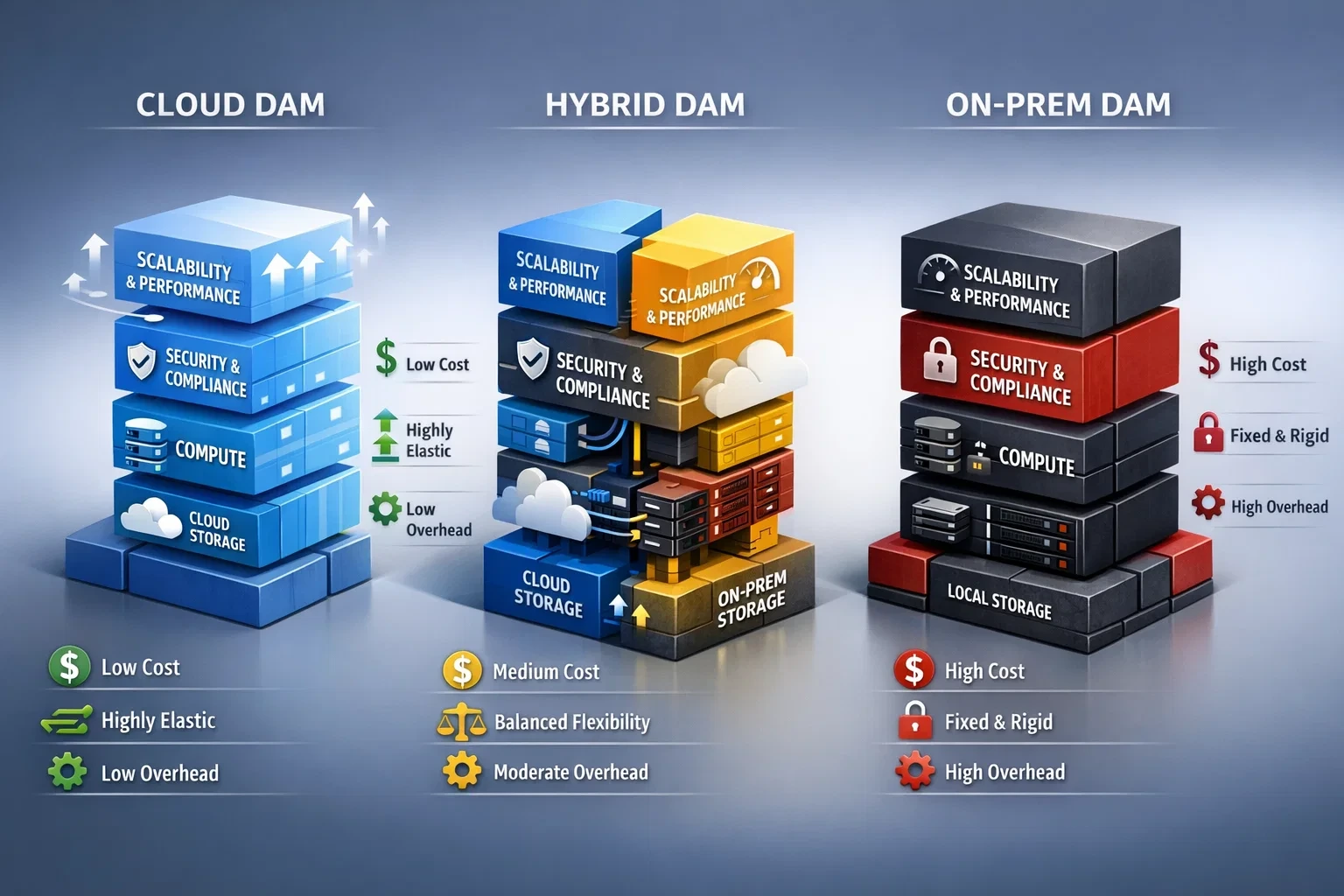
Technology Stack and Deployment Model
Architecture decisions directly affect digital asset management software development cost, scalability, and long-term digital asset management pricing.
Cloud-Based DAM
Lowest upfront costs
Fastest deployment
Scalable architecture
Predictable storage-based pricing
Best suited for organisations prioritising speed, flexibility, and cost control.
Architecture in Practice by APPWRK: Applying Cost-Control Principles in Enterprise Systems
Understanding cost drivers in digital asset management software development is one thing. Executing them correctly in complex enterprise environments is another. The same architectural discipline required to control digital asset management software development cost applies to any secure, scalable, data-intensive platform.
APPWRK’s Investor Portal Software demonstrates how modular architecture, phased development, and controlled feature expansion reduce long-term implementation cost while preserving scalability.
Although the platform is not a digital asset management system directly, it reflects the same principles required for enterprise DAM architecture, including governance, API-first integration, and cloud-native scalability.
Architectural Parallels Relevant to DAM Software Development
Role-based access control for secure data governance
Centralised dashboards with real-time data visibility
API-first integrations with backend systems
Cloud-native scalability for phased feature expansion
Modular feature layering to prevent overengineering
These architectural decisions mirror the cost-control strategies discussed earlier in this guide. By limiting early feature scope, prioritising scalable architecture, and avoiding premature complexity, enterprise systems remain extensible without inflating digital asset management pricing.
This approach reinforces a critical principle in DAM development: scalable architecture and disciplined feature sequencing are the strongest levers for controlling total cost of ownership (TCO).
DAM Pricing Comparison Table: How Much Do Popular DAMs Cost?
While many digital asset management platforms do not publicly disclose transparent pricing, industry research and customer feedback provide estimated ranges. The comparison below highlights pricing structure, enterprise pricing models, storage limits, and feature access across popular DAMs.
DAM Platform
Best For
Pricing Structure
Estimated Cost
Dash
Growing ecommerce brands
Tiered
Starts at $99 / £79 per month (all features, unlimited users)
Bynder
Enterprise businesses
Custom
Starts at $450 per month
Canto
Middle market companies
Custom
Starts at around $600 per month
Image Relay
Mid-sized businesses
Mixed
Starts at $300 per month
Brandfolder
Middle market to enterprise companies
Custom
Starts at $1,600 per month
Acquia DAM (previously Widen)
Enterprise content management
Custom
$29,000 per year
Air
Content operations
Tiered
$250 per month
DAM Pricing Models Explained
Understanding DAM pricing models helps organisations compare custom development with SaaS DAM platforms and evaluate long-term digital asset management pricing.
Common pricing models include:
Subscription-based pricing
Recurring monthly or annual payments are typical in SaaS DAM platforms.
User-based pricing
Costs increase based on the number of users and access tiers.
Storage-based pricing
Pricing scales with asset volume, file formats, and bandwidth usage.
Tiered pricing
Feature-based packaging where advanced capabilities increase cost.
Custom pricing
Enterprise DAM platforms often provide tailored pricing based on integrations, compliance, and workflow complexity.
Selecting the right pricing model directly impacts total cost of ownership, scalability, and long-term ROI.
Hidden Costs in DAM Projects and How to Avoid Them
Even a well-scoped digital asset management system build can exceed budget due to overlooked internal complexity. These hidden fees often surface after development has started.
Asset Migration and Cleanup
Legacy digital asset repositories often contain duplicates, unsupported file formats, and poor naming conventions. Migration becomes both a technical and content operations challenge.
Metadata Restructuring
Inconsistent metadata tagging frequently requires schema redesign and retroactive asset tagging, especially when integrating CMS integration or AI-driven search.
Performance Optimization
MVP DAM platforms are rarely stress-tested. Optimising search and retrieval functions, large file handling, or media pipeline performance post-launch can add 10 to 20 per cent to software development costs.
Change Management and Training Costs
User onboarding, adoption planning, and internal alignment often require more effort than expected, particularly in enterprise implementations.
Premature AI Investment
Generative AI features such as smart tagging, auto-cropping, or recommendations significantly increase upfront costs without early ROI.
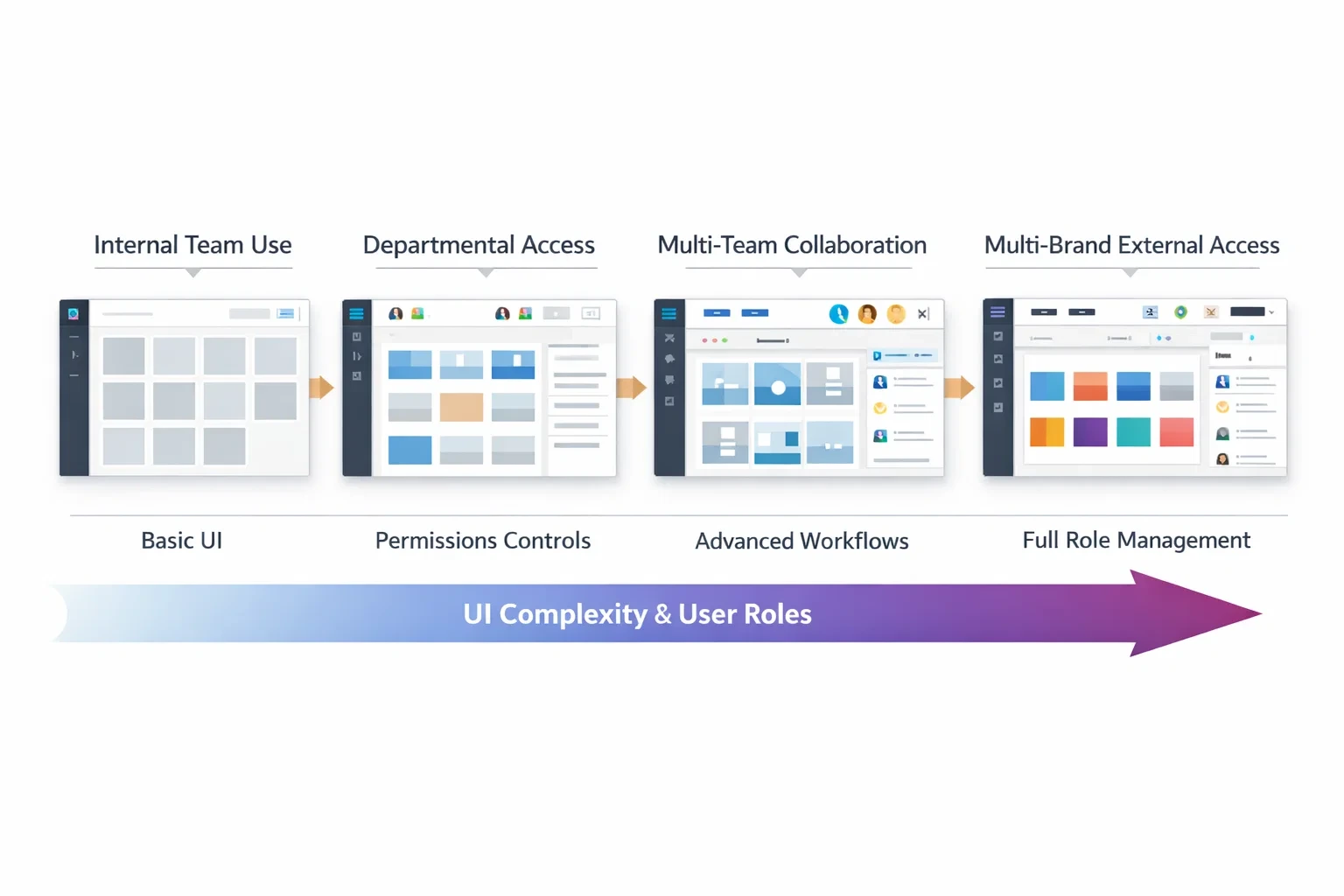
Over-Custom UX
Department-specific portals and heavy UX/UI design customisation add logic, testing, and long-term maintenance overhead.
Deep permission trees increase risk and development time. A phased role-based access model scales more reliably.
Core Features of Digital Asset Management Software
Feature selection directly impacts digital asset management software development cost, long-term scalability, and overall ROI. Not every feature should be implemented at once. The most cost-efficient DAM platforms sequence capabilities based on business maturity, asset volume, and governance complexity.
Feature Tier in the digital asset management software
Cost Impact on the development of digital asset management software
When to Add
Foundational Capabilities
Low to Moderate
Phase 1 – MVP DAM build
Workflow & Integration Capabilities
Moderate
After internal adoption stabilizes
Advanced AI & Enterprise Capabilities
High
After scale, asset volume, and governance complexity increase
Modern digital asset management software extends far beyond file storage. Below are the features that genuinely improve content operations, metadata management, automation, and enterprise scalability.
Centralised digital asset repository
Creates a single source of truth for managing digital assets across teams, improving governance, and reducing duplication.
Metadata management and asset tagging
Defines structured metadata schemas that enable scalable indexing, filtering, and asset retrieval.
Advanced search and filtering
Improves asset discovery using structured queries and metadata-driven retrieval logic.
Version control and audit trails
Prevents outdated content usage, tracks changes, and supports compliance monitoring.
Role-based access and user permissions
Controls asset visibility and governance without introducing excessive permission complexity.
Robust Security and Access Controls
Strengthens enterprise governance through layered authentication, policy enforcement, and structured access control models.
Support for Various File Formats and Media Types
Ensures compatibility across images, video asset management workflows, audio, documents, and rich media formats.
Seamless Integration with Other Business Tools
Enables CMS integration, creative tool integration, CRM sync, and enterprise system connectivity through API-first architecture.
Automated Workflow and Collaboration Tools
Streamlines asset review and approval workflows, reduces manual coordination, and improves content lifecycle visibility.
Customizable User Interfaces
Adapts dashboards and navigation to different departments while maintaining a consistent digital asset management architecture.
Scalable Cloud Storage Solutions
Supports storage-based pricing models and elastic compute provisioning for growing asset libraries.
Real-Time Analytics and Reporting
Provides usage tracking, performance monitoring, and operational insights to measure content effectiveness.
Content performance and usage insights
Tracks how digital content is shared, reused, or embedded across campaigns and regions.
Duplicate asset detection
Identifies redundant or near-identical assets during upload or indexing to reduce storage waste and compliance risk.
Auto-tagging with metadata enrichment
Automatically assigns tags using AI and intelligent indexing, improving search accuracy and reducing manual effort.
AI-powered tagging and AI-driven search
Enhances asset discovery using machine learning models and semantic indexing capabilities.
AI-Based Predictive Analytics
Uses asset usage patterns and behavioural data to improve content targeting and operational forecasting.
AI-Powered Asset Recommendations and Insights
Suggests relevant assets based on usage trends, improving campaign speed and creative efficiency.
Uses visual recognition to optimise assets for multiple channels, devices, and formats.
Speech-to-text for video and audio
Transcribes dialogue within digital media assets to support searchable metadata and accessibility.
Automatic image and media optimization
Compresses and reformats media for faster delivery without compromising quality.
Digital rights management
Protects licensed assets, enforces usage policies, and reduces legal exposure.
Multi-brand or multi-portal DAM
Supports distributed brand environments while maintaining centralised governance.
Omnichannel optimisation and video processing
Enables asset transformation across websites, advertising platforms, mobile construction management app environments, and global distribution networks.
Virtual and Augmented Reality Content Support
Manages immersive digital assets used in advanced marketing and product visualisation workflows.
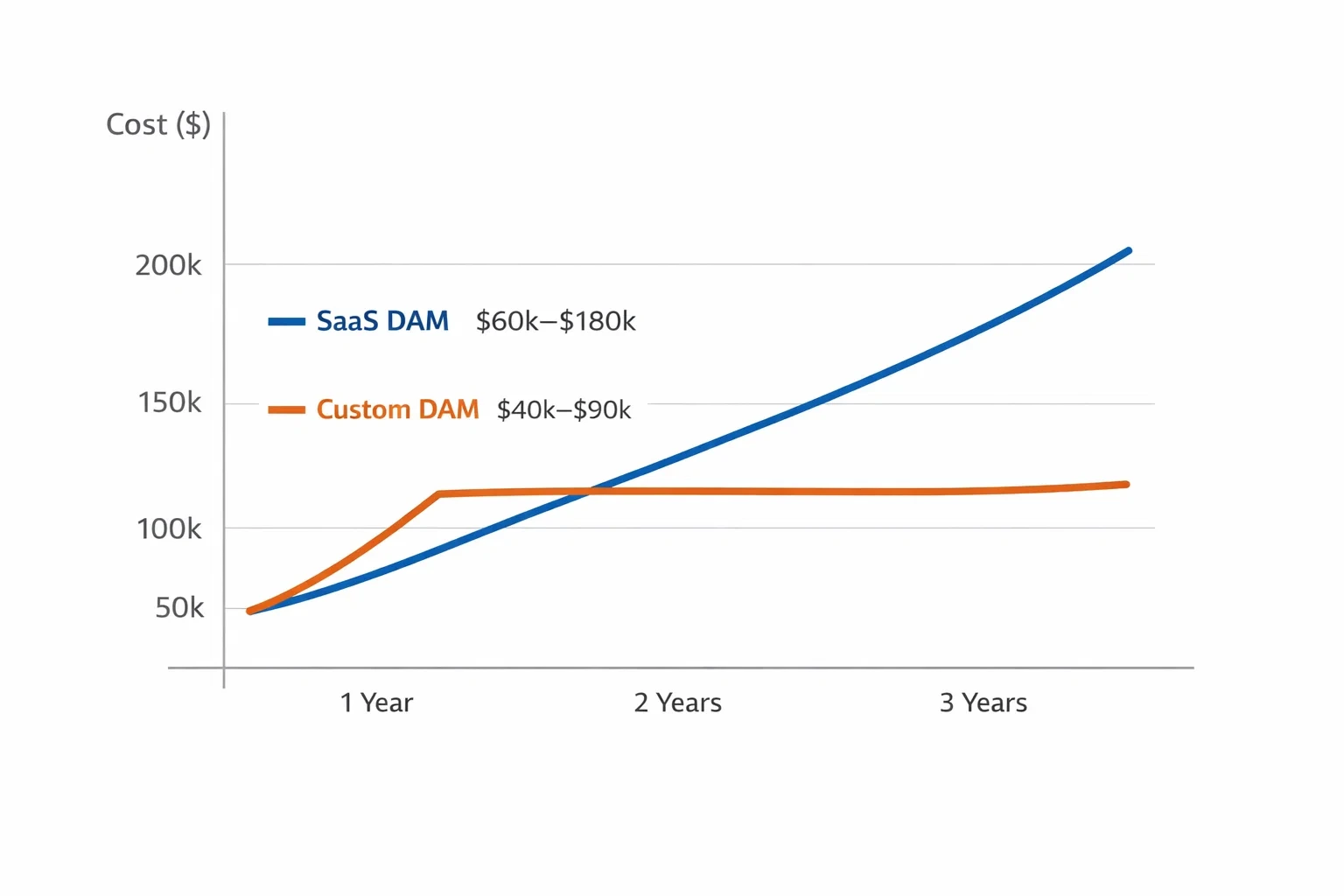
Custom DAM vs SaaS DAM: 3-Year Cost Comparison
Model of the DAM Software
3-Year Cost
SaaS DAM platforms
$60K–$180K
Custom DAM software
$40K–$90K
SaaS DAM pricing rises due to subscription costs, user-based pricing, storage-based pricing, and integration fees.
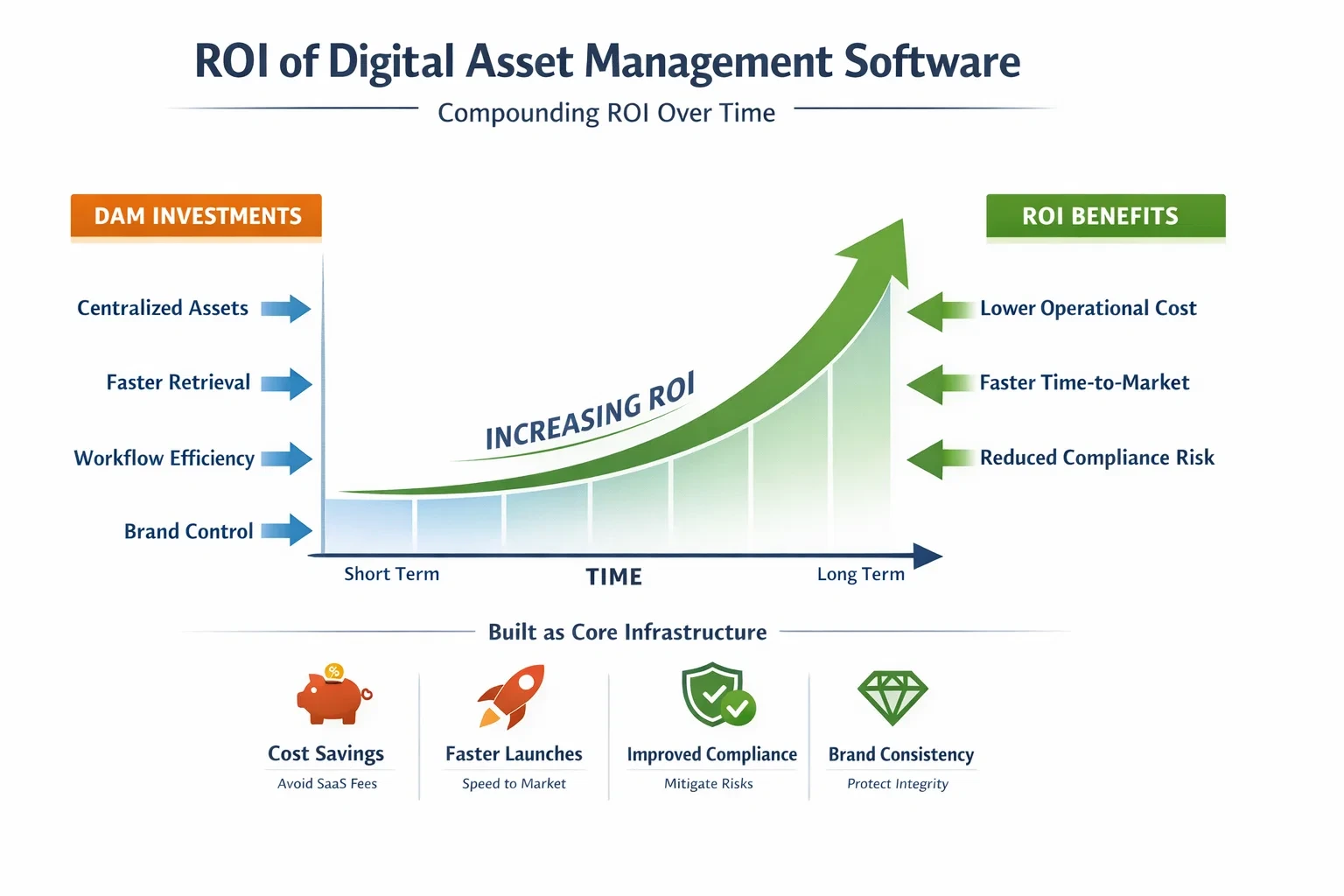
Faster time-to-market Centralised approvals and reusable assets accelerate launches.
Lower brand and compliance risk Reduced misuse of outdated or unapproved digital assets.
Cost savings vs SaaS DAM tools Custom DAM avoids rising subscription costs, user-based pricing, and storage-based pricing.
How APPWRK Builds Cost-Optimised DAM Platforms
APPWRK approaches DAM software development with an architecture-first discipline.
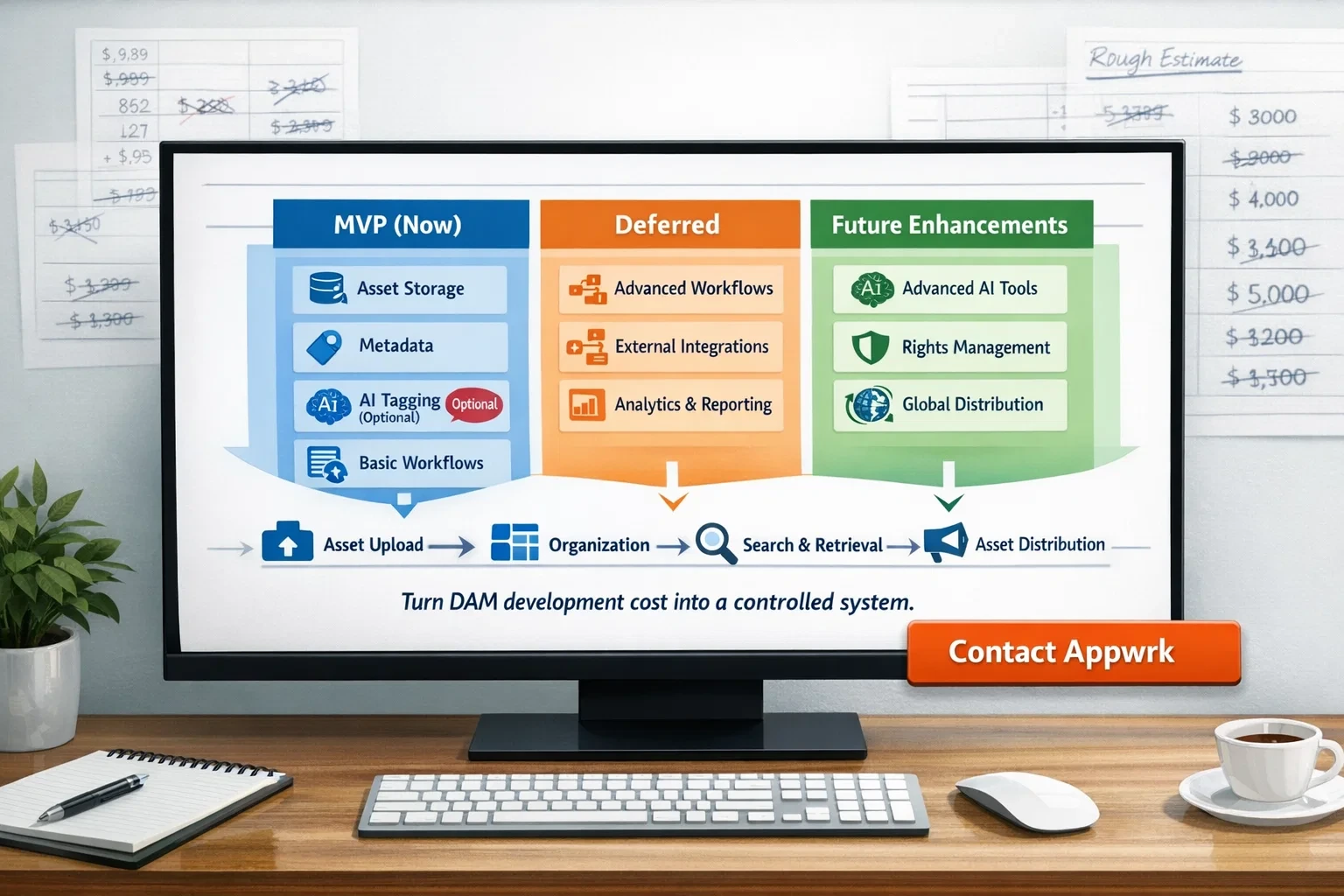
Phased delivery MVP-first builds focus on asset storage, metadata tagging, and search before advanced features.
AI-ready architecture Systems are designed for future AI-powered search and automated tagging without early cost bloat.
Avoiding overengineering Permissions, workflows, and automation scale only after real usage patterns emerge.
Future-proof system design Integration points, data flows, and governance are defined early to prevent rebuilds later.
Founders’ and CTO Guide to Controlling DAM Development Cost
Custom digital asset management software development is won or lost at the scoping stage. Early architectural decisions have a direct impact on long-term software development costs.
Key cost-control principles:
Limit Phase 1 scope MVP DAM builds should focus on digital asset storage, search, and metadata tagging only.
Keep permissions simple Start with role-based access instead of complex, multi-department hierarchies.
Delay advanced features AI-driven search, analytics, and automation should follow real adoption data.
Use cloud-native, API-first architecture. This reduces upfront cost and keeps integrations flexible.
Well-built DAM platforms are extensible systems, reviewed regularly to maintain cost-to-value balance.
FAQs
What is the minimum cost to build digital asset management software? An MVP DAM typically costs between $18,000 and $30,000, depending on scope and delivery model.
How long does DAM software development take? Most DAM systems are built in 12 to 18 weeks using a phased, modular approach.
Is AI mandatory in a digital asset management system? No. AI-powered tagging and search are optional and usually added later.
Can DAM software be built in phases? Yes. Phased development is the most cost-efficient and scalable model.
How much does DAM maintenance cost annually? Ongoing costs average 10 to 15 per cent of the initial development cost.
Is custom DAM cheaper than SaaS DAM long term? In many cases, yes. Custom DAM avoids rising subscription costs, user-based pricing, and storage-based pricing.
What features are essential in an MVP DAM? Asset library, metadata management, search and retrieval, version control, and user access control.If you’re planning to build a cost-efficient MVP DAM tailored to your business needs, APPWRK can help you define the right feature scope, architecture, and phased roadmap.
How much does DAM cost?
Digital asset management software development cost ranges from $18,000 to $30,000 for an MVP DAM and can exceed $90,000+ for enterprise-grade DAM platforms. SaaS DAM pricing varies based on pricing structure, storage limits, feature access, integrations, and enterprise pricing agreements.
What does enterprise pricing include in DAM platforms?
Enterprise pricing typically includes advanced feature access such as AI-powered tagging, role-based access control, digital rights management, API integrations, scalable cloud storage, and security configurations like SSO and MFA. Enterprise pricing is usually a custom pricing structure tailored to organisational scale and governance needs.
How does DAM development cost vary by region? Costs are lowest in India and Southeast Asia, moderate in Eastern Europe, and highest in North America and Western Europe.
What are common hidden costs in DAM projects? Asset migration, metadata cleanup, UX over-customisation, and premature AI adoption.
Can a low-cost DAM scale to enterprise needs? Yes, with cloud-based DAM architecture and API-first design.
How does AI impact DAM software development cost? AI increases development, infrastructure, and maintenance costs due to computing and integration needs.
When should AI-powered tagging be added? After assessing volume and diversity, justify automation.
Does generative AI increase operating costs? Yes. It raises compute usage, storage needs, and monitoring overhead.
Can DAM platforms integrate AI tools later? Yes. API-first DAM platforms support future AI integrations without rebuilds.
How do security and compliance affect cost? SSO, MFA, audit trails, and regulatory requirements add build and testing effort.
What is the total cost of ownership for DAM software? TCO includes development, infrastructure, maintenance, and phased feature expansion over time.
Gourav Khanna is the Co-founder and CEO of APPWRK, leading the company’s vision to deliver AI-first, scalable digital solutions for enterprises and high-growth startups. With over 16 years of leadership in technology, he is known for driving digital transformation strategies that connect business ambition with outcome-focused execution across healthcare, retail, logistics, and enterprise operations.
Recognized as a strategic industry voice, Gourav brings deep expertise in product strategy, AI adoption, and platform engineering. Through his insights, he helps decision-makers prioritize market traction, operational efficiency, and long-term ROI while building resilient, user-centric digital systems.
Subscribe to APPWRK Blogs, We'll Do the Rest!
Get Blogs on UI/UX, Mobile Apps, Online Marketing, and Web development technology.
Unlock worthy and priceless suggestions from the masters of mobile and web app development