150+ minds across 4 countries. Join a culture of innovation, ownership & growth.
Rewire for AI
From machine learning to deep learning, from classification tools to overall process automation – our AI engineers will help you retool your existing system or enhance your company results.
Ship faster, scale smarter, built for product companies and SaaS teams
Our Latest Work
We strive hard to deliver result-driven digital solutions across the globe. Check out our case studies to get a glimpse of how we ideate, innovate, and create unconventional digital solutions according to the requirements of our clients.
Discover diverse and passionate insights from our tech enthusiasts. We collaborate across various sectors to streamline operations and drive innovation. Explore our rapidly growing collection of articles to see why we’re at the forefront of IT solutions.
The decision to move from Magento to Shopify is one of the most significant replatforming choices an ecommerce business can make. Magento is powerful, but its power comes with...
Accuracy gap is real: Traditional CPG forecasting carries a 25-40% MAPE error rate. AI-powered models bring that down to 8-15%, according to McKinsey research....
Real stories from global leaders who trusted us with their ideas.
Partnering with APPWRK helped us build a compliant and scalable healthcare platform, accelerating our time-to-market by 35%. Their team consistently delivered outstanding work.
Beesers
Digital Healthcare Client
Collaborating with APPWRK, Sportskeeda modernized its platform into a real-time sports engagement ecosystem, enabling seamless content delivery, scalable fan interactions, and high-velocity performance.
Sportskeeda
Sports & Entertainment Partner
Working with APPWRK was effortless. They captured our vision, maintained full compliance, and delivered a digital experience that built trust and elevated how customers interact with our fintech brand.
PayPenny
Fintech Partner
Working with APPWRK gave us confidence in adopting AI responsibly. Their team built a safe, intelligent bot that transformed how we engage with leads and helped us achieve measurable revenue growth.
IFB
AI Transformation Partner
Leveraging APPWRK’s digital expertise, Nemesis launched a scalable, compliant, and safe super app that connects content delivery, real-time communication, and logistics management within a single platform.
Nemesis
Super App Partner
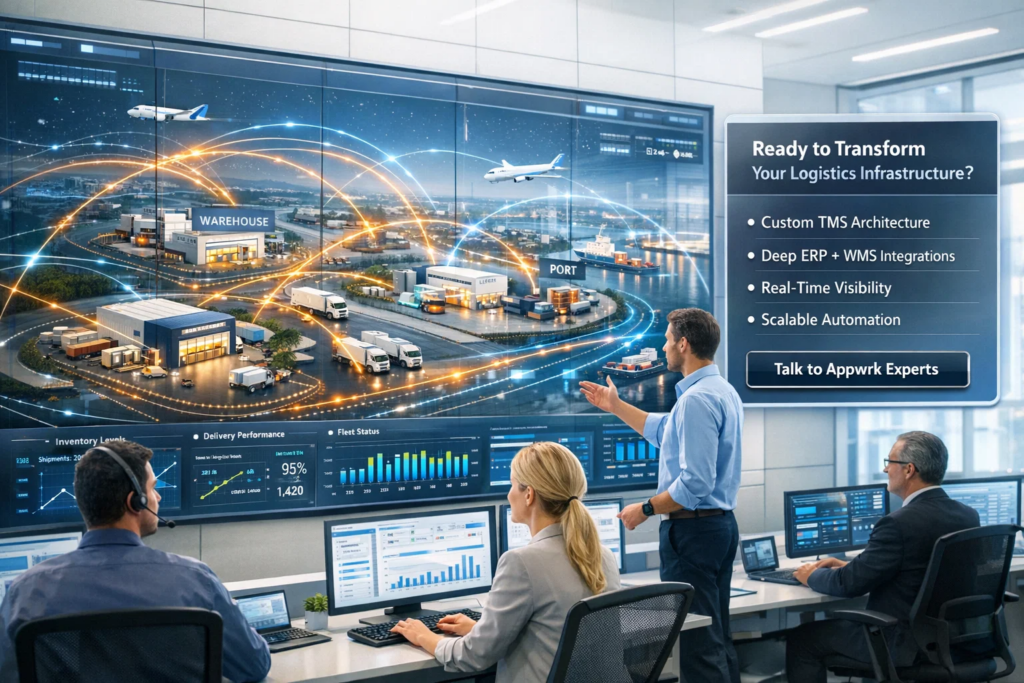
Scale Smarter with Strategic TMS Partnership
Work with a technology partner focused on transforming complex transportation networks into unified digital systems.
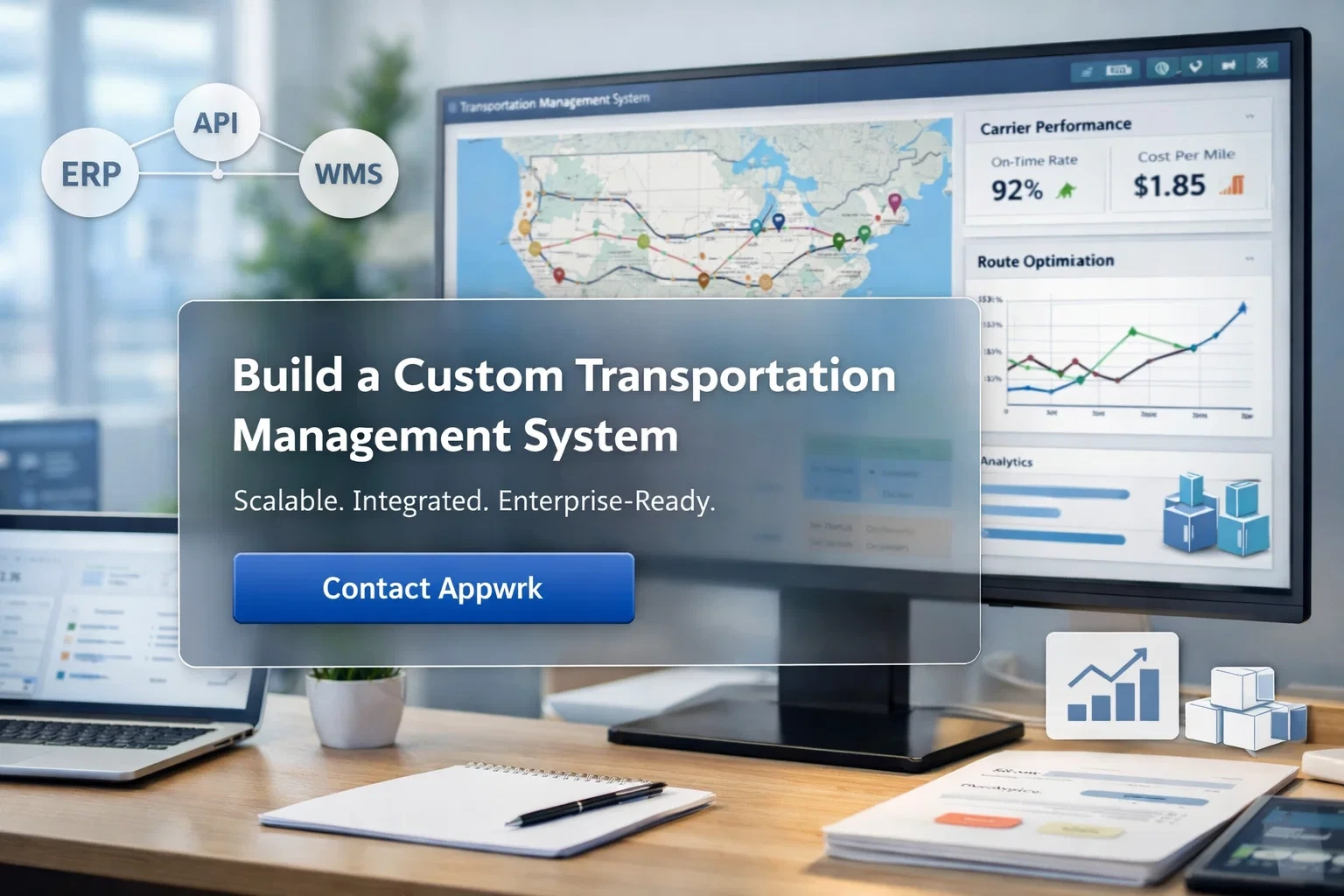
A Transportation Management System (TMS) is a centralized supply chain software solution that helps businesses plan, monitor, and execute the physical movement of goods across their supply chain network while controlling transportation spend.
Modern TMS software acts as a logistics platform that supports transportation planning, routing and optimisation, carrier selection, automated tendering, shipment tracking, freight auditing, freight billing and settlement, and analytics reporting through a real-time dashboard.
Leading transportation management systems integrate with ERP, Warehouse Management System (WMS), and other supply chain management (SCM) system tools using APIs, enabling automated workflows, data exchange, and operational accuracy.
Organizations using transportation management solutions report cost reduction, real-time visibility, enhanced forecasting, increased collaboration, and improved customer satisfaction across inbound and outbound movement.
Whether deployed as cloud-based TMS solutions or an on-premises solution, a transportation management system software platform helps companies scale logistics operations despite rising transaction volumes, global economic pressures, and supply chain disruptions.
From startups to enterprises, TMS solutions provide flexible adoption paths, making advanced transportation management software accessible without excessive upfront investment.
This guide explains how a transport management system works, its core features, benefits, integrations, and future trends, so supply chain leaders can choose the right transportation management solution confidently.
As part of a larger supply chain management (SCM) system, transportation management system software connects carriers, warehouses, wholesalers, and partners while handling multimodal and intermodal shipping, compliance, and trade documentation.
In short, a TMS turns manual logistics into structured, data-driven transportation operations.
Who Uses TMS Systems?
A transportation management system (TMS) is used by organizations that manage freight volume, carrier coordination, or delivery timelines across local, regional, or global supply chains.
Common users of transportation management software include:
Manufacturers managing inbound raw materials and outbound finished goods across suppliers and distributors
Distributors operating multi-location shipment networks within a supply chain network
Ecommerce companies requiring fast last-mile delivery and real-time shipment visibility
Retailers coordinating store replenishment, omnichannel fulfillment, and inventory movement
3PL and 4PL providers managing transportation operations for multiple clients
Freight brokers optimizing carrier selection, pricing, and load matching
Carriers and fleet operators improve route efficiency, utilization, and tracking
Any organization where transportation spend affects profitability, scalability, or customer satisfaction benefits from TMS solutions.
Why TMS Matters in Supply Chains
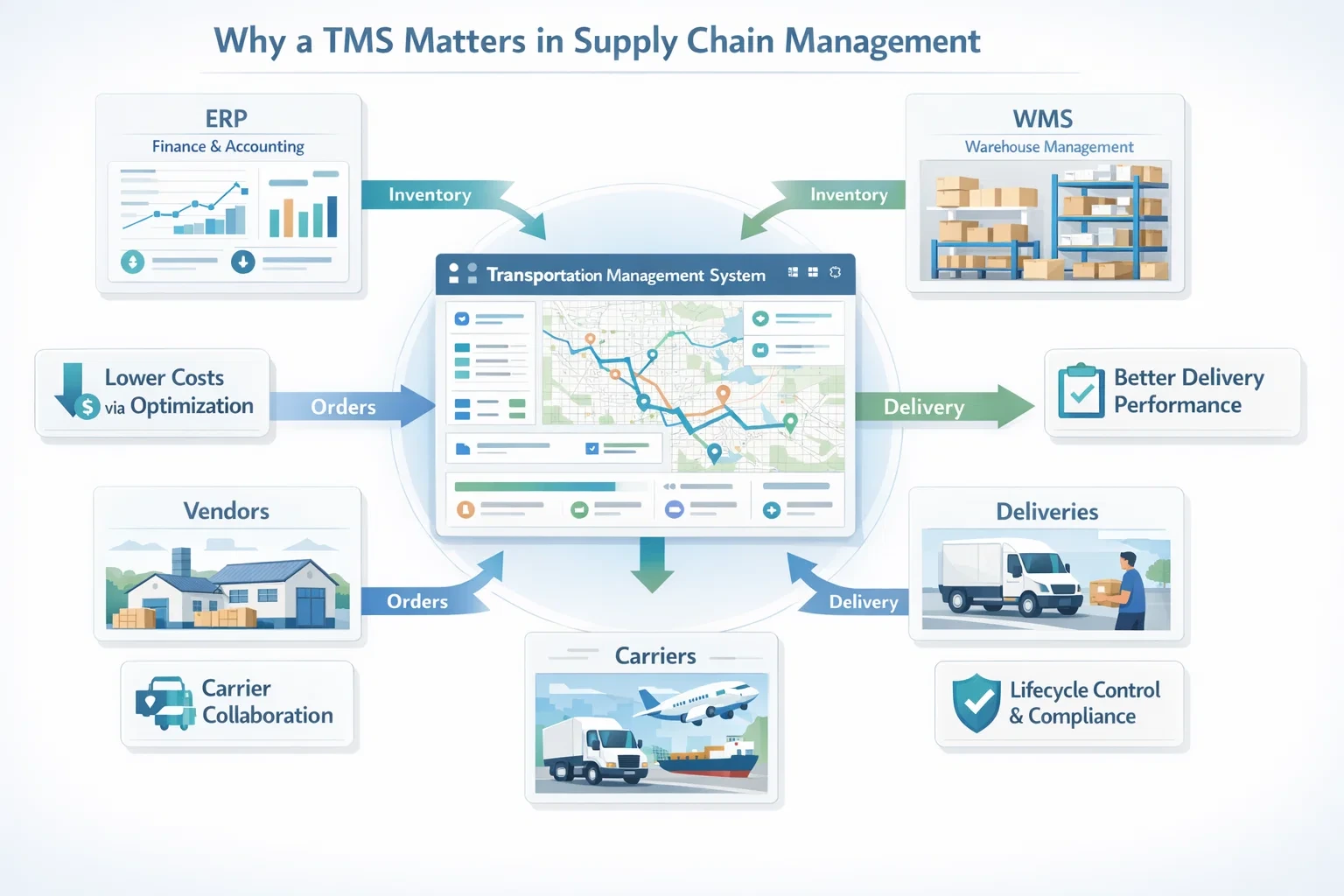
A transportation management system (TMS) connects inventory, orders, and delivery, while ERP manages finances, and WMS handles storage. As shipment volumes grow, TMS becomes mission-critical by:
Reducing costs by 15-20% through routing optimization and automation
Improving delivery performance and customer satisfaction via real-time visibility
Enhancing carrier/vendor collaboration and lifecycle control
Automating freight audit, billing, settlement, and disruption response
Modern TMS platforms provide strategic infrastructure for scalable, profitable supply chain operations.
The TMS selects carriers, consolidates shipments, performs load planning, and supports automated tendering and booking using APIs and integration with supply chain systems.
Execution
The transport management system generates trade documentation, dispatch instructions, and shipping schedules while coordinating multimodal or intermodal transportation.
Tracking and Visibility
A real-time dashboard provides shipment tracking, alerts, and status updates, improving visibility across the globally connected supply chain. This stage ensures real-time updates across the supply chain network so teams can respond instantly to disruptions.
Freight Billing and Settlement
The system performs freight auditing, validates invoices, and automates freight billing and settlement to improve financial accuracy.
Analytics and Optimization
Analytics reporting evaluates carrier performance, delivery accuracy, transaction volumes, and transportation costs to support data-driven decision making.
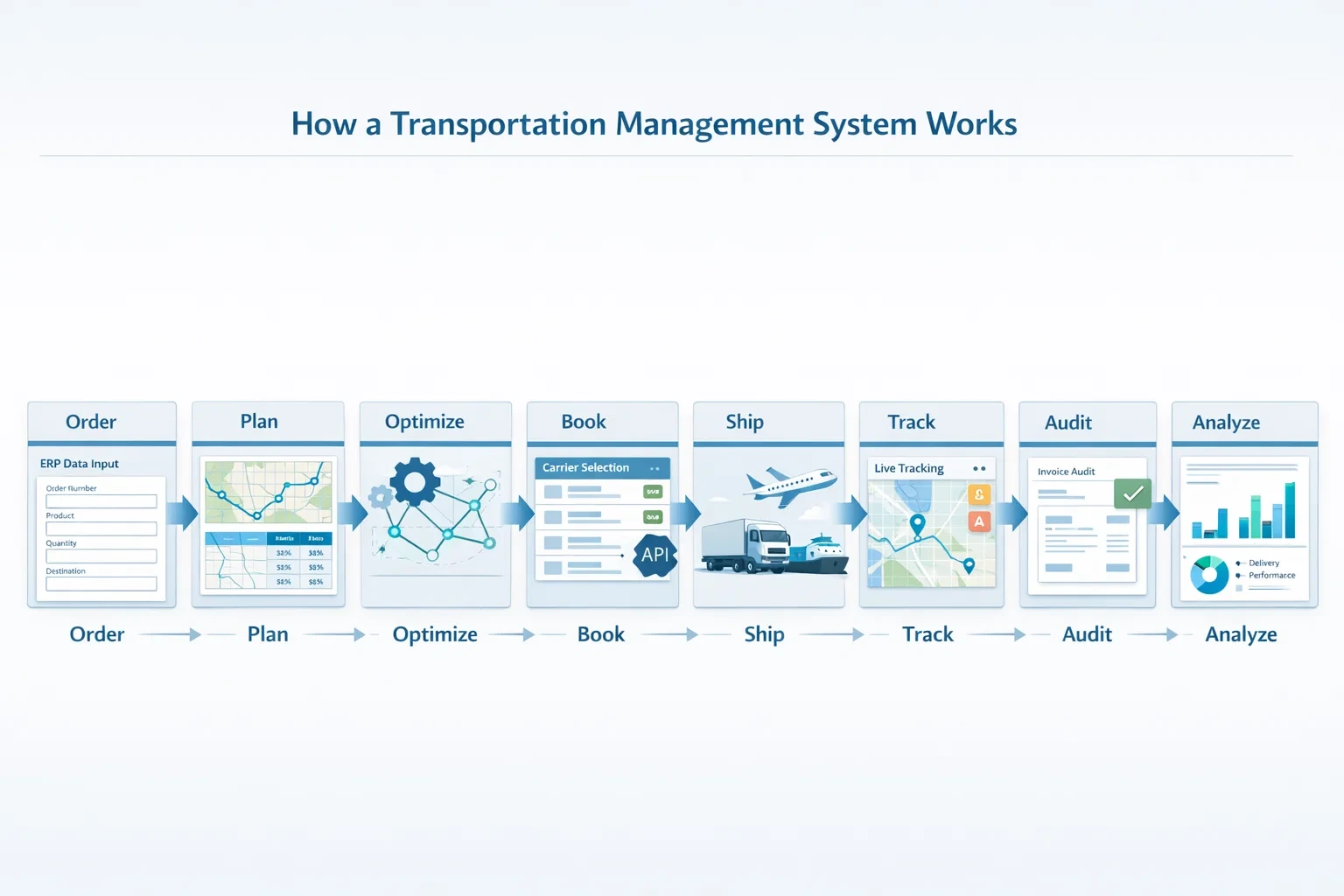
Simplified Workflow:
Order → Plan → Optimize → Book → Ship → Track → Audit → Analyze
A TMS system transforms manual freight coordination into automated workflows and structured logistics control.
What Are the Different Types of Transportation Management Systems?
Not all transportation management systems function the same. The right deployment model depends on scale, compliance needs, and system architecture.
Cloud-Based TMS Solutions
Hosted online and accessible through a logistics platform interface
Faster implementation and lower infrastructure cost
Strong APIs for integrations and automation
Ideal for companies prioritizing flexibility and increased collaboration
On-Premises Transportation Management Solutions
Installed inside the internal infrastructure
Higher control over customization, compliance, and data security
Requires more IT resources and maintenance
Often chosen for regulated industries or complex supply chain software environments
Supports better documentation, performance monitoring, and enhanced forecasting
Useful for enterprises managing inbound and outbound movement across regions
Industry-Specific TMS Platforms
Specialized transportation management system software exists for sectors such as:
Cold chain logistics
Air freight networks
Cross-dock operations
Global trade supply chains
These systems include features tailored for compliance, traceability, and performance optimization within the global economy.
Key Features of a Transportation Management System
The best transportation management systems combine execution control, visibility, financial management, and integration into one enterprise-ready supply chain management (SCM) system.
Route Planning and Optimization
Uses algorithms to minimize cost, reduce transit time, and optimize inbound and outbound movement.
Carrier Management and Rate Comparison
Tracks performance, compares pricing, and manages contracts for better cost control.
Load Planning and Execution
Supports consolidation, cross-dock operations, and optimized fleet vehicle utilization.
Real-Time Tracking and Visibility
Provides shipment monitoring, alerts, and delivery status updates across the supply chain network.
Freight Audit and Payment
Automates billing validation, settlement, and documentation accuracy.
Includes Procurement, Invoicing, mobility tools, digital chain of custody tracking, and integration with the global trade management (GTM) application for compliance and trade documentation. Cold chain management monitoring for temperature-sensitive shipments and regulated transport environments.
Reporting and Analytics
Offers enhanced forecasting, performance metrics, and operational insights for continuous optimization.
How Does a Transportation Management System Reduce Costs and Improve Efficiency?
Businesses adopt a transportation management system to reduce transportation spend, streamline workflows, and improve performance across the supply chain network. Modern TMS solutions function as a logistics platform that helps organizations plan, monitor, and execute the physical movement of goods efficiently.
Cost Reduction Through Routing and Optimisation
Advanced routing and optimisation algorithms minimize fuel usage, empty miles, and poor carrier selection. Load consolidation, automated tendering, and smarter planning reduce cost per shipment across inbound and outbound movement.
Operational Efficiency Through Automation
Transportation management software automates booking, documentation, carrier selection, and approvals. This eliminates manual tasks, improves data quality, and allows teams to manage higher transaction volumes without added workload.
Real-Time Visibility and Control
A real-time dashboard tracks shipment status, delays, and exceptions across multimodal and intermodal transportation. This visibility improves coordination across a globally connected supply chain and strengthens customer satisfaction.
Financial Accuracy and Freight Auditing
Automated freight auditing, plus freight billing and settlement ensure invoice accuracy, reduces disputes, and improves compliance with carrier contracts.
Scalability Across the Supply Chain Lifecycle
As shipment volumes grow, transportation management systems scale seamlessly. Reporting and analytics tools support enhanced forecasting, performance benchmarking, and continuous optimization.
In short, a transportation management solution acts as a centralized supply chain software solution that improves efficiency, reduces costs, and strengthens profitability.
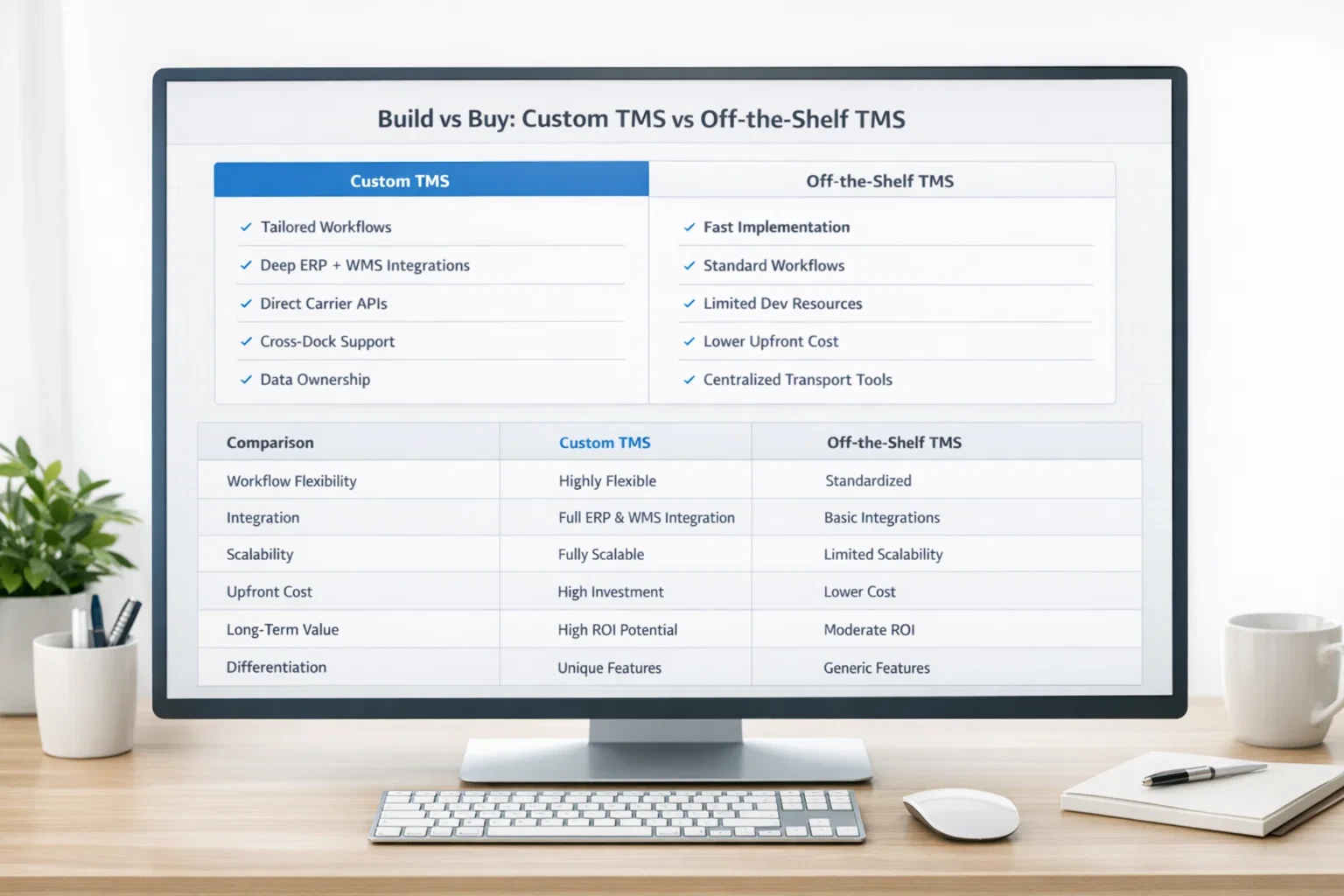
Build vs Buy: Should You Develop a Custom TMS or Purchase TMS Software?
Choosing between building or buying transportation management system software depends on complexity, integration needs, and long-term scalability goals.
When Building a Custom Transportation Management System Makes Sens
A custom transport management system works best when logistics are strategic.
It enables you to:
Design workflows tailored to your transportation operations
Enable deep integration with supply chain systems, ERP, and Warehouse management system (WMS)
Connect directly with carrier APIs and fleet vehicles
Support cross-dock operations and specialized logistics logic
Maintain ownership of data, architecture, and digital chain of custody
For companies managing complex supply chain software environments, custom platforms provide flexibility and a competitive advantage.
When Buying Off-the-Shelf TMS Software Works
Pre-built cloud-based TMS solutions or an on-premises solution are suitable when:
Faster implementation is required
Logistics processes are standardized
Internal development resources are limited
Lower upfront investment is preferred
These systems centralize all transportation-related processes quickly, though customization may be limited.
Custom vs Off-the-Shelf TMS: Quick Comparison
Criteria
Custom TMS
Off-the-Shelf TMS
Workflow Flexibility
Fully customizable
Limited
Integration
Deep APIs + SCM system control
Standard connectors
Scalability
Enterprise-grade
Vendor-dependent
Upfront Cost
Higher
Lower
Long-Term Value
Greater control
Subscription-based
Differentiation
High
Standard
Transportation Management System Use Cases Across Industries
A transportation management system functions as a logistics platform and supply chain software solution that helps organizations plan, monitor, and execute the physical movement of goods across a globally connected supply chain. These TMS solutions adapt to industry-specific logistics challenges while controlling transportation spend and improving visibility across the supply chain network.
Manufacturing: How Does TMS Help with Multi-Carrier Freight Scheduling and Freight Cost Analysis?
A transportation management system supports:
Multi-carrier scheduling and automated tendering
Routing and optimisation for inbound and outbound movement
Freight auditing, freight billing, and settlement
Cross-border trade documentation and digital chain of custody
Prevents production delays by synchronizing suppliers, wholesalers, and distribution.
Retail and Ecommerce: How Does TMS Improve Last-Mile Visibility for Urban Delivery?
Transportation management software enables:
Real-time dashboard visibility for last-mile delivery
Automated load planning during peak transaction volumes
Mobility tools for delivery teams using mobile devices
Improves customer experience, delivery speed, and profitability.
Automotive: How Does TMS Support Real-Time Tracking and Exception Alerts in Just-in-Time Supply Chains?
A transport management system provides:
Real-time tracking for just-in-time supply chains
Multimodal and intermodal shipment coordination
Carrier selection based on performance analytics reporting
Ensures production continuity and minimizes downtime risk.
Pharma and Cold Chain: How Does TMS Enable Cold Chain Compliance Monitoring?
Transportation management systems ensure:
Temperature monitoring and compliance tracking
Cross-border regulatory documentation
Secure monitoring of fleet vehicles transporting sensitive goods
Protects shipment integrity and regulatory compliance.
Transportation management systems ensure cold chain management compliance through temperature monitoring, alerts, and regulatory tracking.
3PL and Freight Brokerage: How Does TMS Optimize Automated Load Planning and Carrier Management?
TMS software enables:
Multi-client load consolidation
Carrier management and automated dispatch workflows
Shipment profitability analysis
For logistics providers, a transportation management system becomes a strategic supply chain management (SCM) system component rather than just an operational tool.
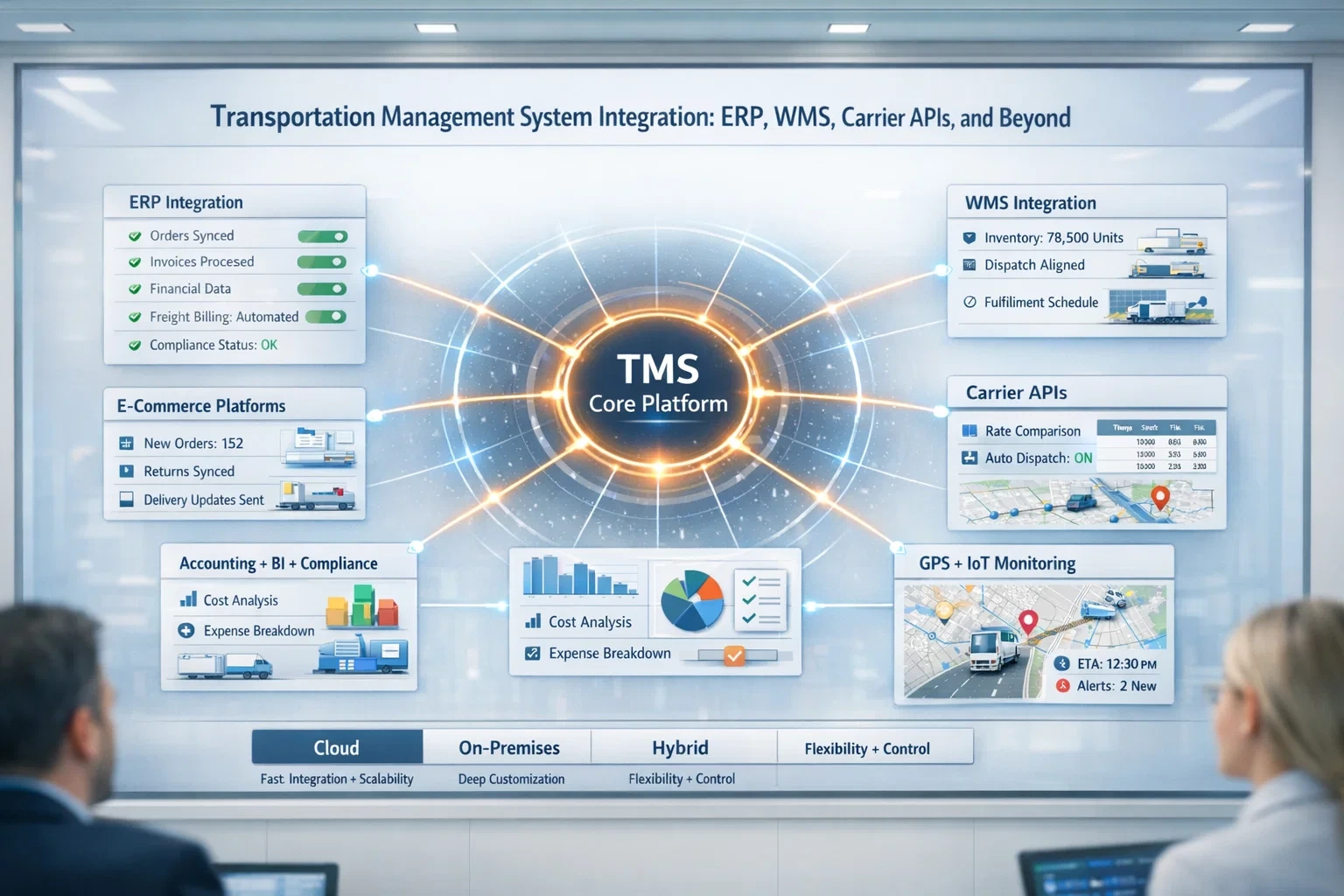
Transportation Management System Integrations: ERP, WMS, Carrier APIs, and Beyond
A transportation management system delivers maximum value when deeply integrated with supply chain software and enterprise systems.
ERP Integration for Order and Financial Synchronization
Integration with ERP platforms:
Syncs orders, invoices, and financial data
Supports automated freight billing and settlement
Improves compliance and reporting accuracy
This creates a unified supply chain management (SCM) system across logistics and finance.
WMS Integration for Inventory and Fulfillment Alignment
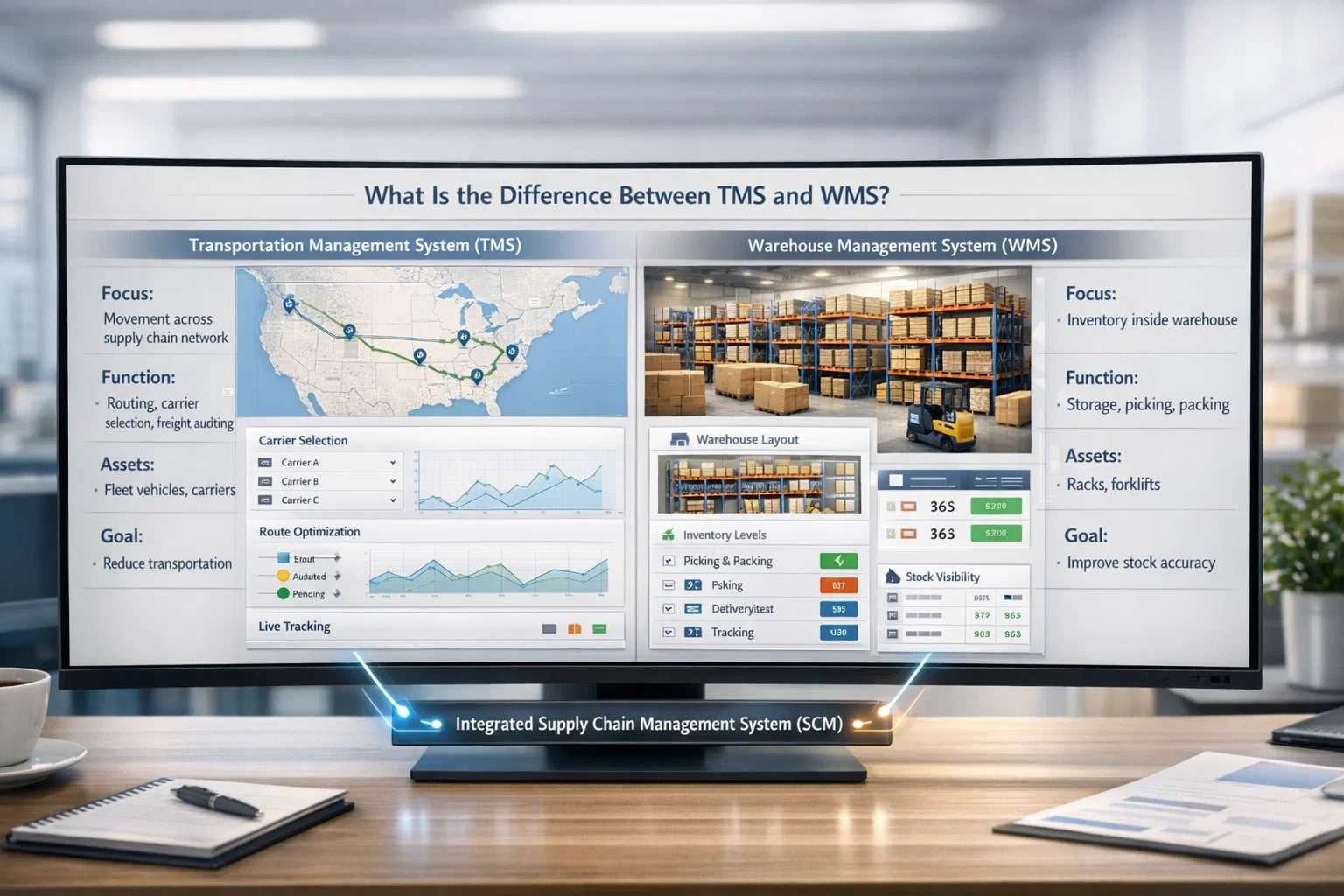
A Transportation Management System (TMS) and Warehouse management system (WMS) serve different roles inside a supply chain management (SCM) system, but both are essential components of a modern supply chain software solution.
A transportation management system is a logistics platform used to plan, monitor, and execute the physical movement of goods across transportation modes, including multimodal and intermodal shipping.
A WMS manages inventory, storage, picking, and cross-dock operations inside facilities.
Core Difference
Area
Transportation Management System
Warehouse Management System
Focus
Movement across the supply chain network
Inventory inside the warehouse
Function
Routing and optimisation, carrier selection, automated tendering, freight auditing
Storage, picking, packing
Visibility
Real-time dashboard across trade lanes
Internal stock visibility
Assets
Fleet vehicles, carriers
Racks, forklifts
Goal
Reduce transportation spend
Improve stock accuracy
TMS solutions optimize inbound and outbound movement between facilities, wholesalers, and customers.
WMS ensures products are correctly handled before shipping.
When integrated via APIs and integration with supply chain systems, both create a connected, globally connected supply chain with increased collaboration, better documentation, and enhanced forecasting.
Integration complexity with ERP, WMS, and GTM tools (Poor synchronization between systems can increase shipment delays and reduce supply chain responsiveness.)
A well-implemented transportation management system software improves:
Freight billing and settlement accuracy
Cost reduction and transportation visibility
Digital chain of custody tracking
Carrier performance measurement
Customer satisfaction
Industry analysts consistently identify TMS platforms as high-impact infrastructure within modern supply chain management.
A transportation management system is no longer optional software. It is a strategic control layer for managing freight, cost, compliance, and scalability across modern supply chains.
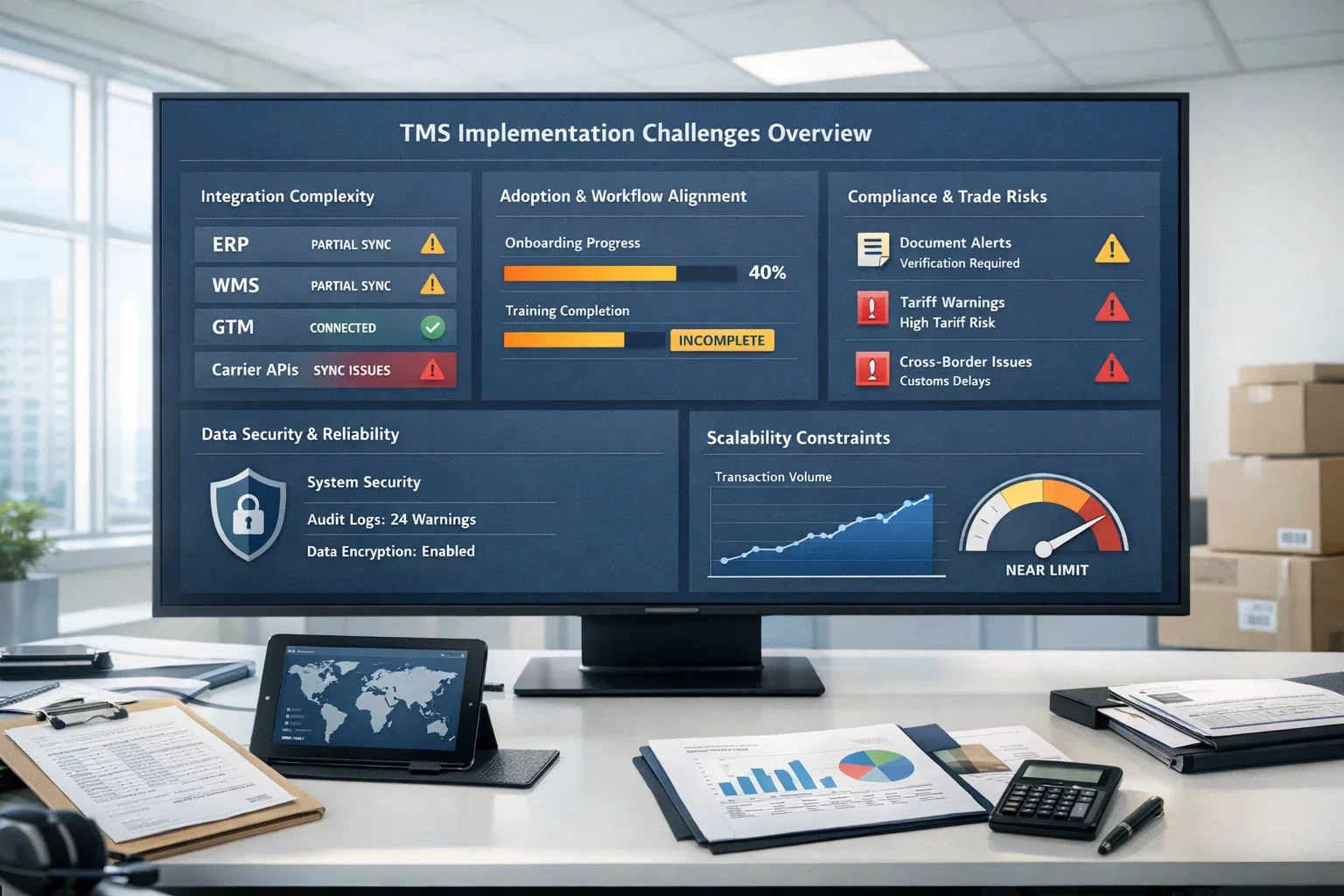
What Are the Limitations and Challenges of a Transportation Management System?
Even the most advanced transportation management system can present operational hurdles if not implemented strategically within a supply chain management (SCM) system or broader supply chain software solution.
Weak integration with supply chain systems may disrupt real-time dashboard visibility and data accuracy across the supply chain network.
Adoption, Training, and Workflow Alignment
New TMS solutions often require updated workflows, employee onboarding, and mobility enablement for distributed teams.
Poor user adoption reduces automation value and limits ROI from routing and optimisation capabilities.
Compliance and Global Trade Risks
Businesses operating across a globally connected supply chain must manage trade documentation, tariffs, and regulatory requirements.
Errors can disrupt multimodal or intermodal shipments and increase transportation spend.
Data Security and System Reliability Risks
Transportation management software handles sensitive shipment, carrier, and financial data.
Weak governance can affect the digital chain of custody integrity and compromise supply chain software reliability.
Scalability Constraints
Some platforms struggle to scale with rising transaction volumes, fleet vehicles, or wholesalers across global operations.
Limited customization may restrict analytics reporting or automated tendering features.
A transportation management system delivers measurable value, but success depends on integration design, training, and infrastructure readiness.
How Are AI, IoT, and Blockchain Transforming Transportation Management Systems?
Modern transportation management systems are evolving into intelligent layers within a broader supply chain software solution.
AI and Machine Learning
Improves routing and optimisation, automated tendering, carrier selection, and enhanced forecasting using transaction volumes and transportation spend analytics.
IoT and Real-Time Tracking
Enables real-time dashboard visibility across fleet vehicles, shipments, and multimodal or intermodal routes for better inbound and outbound movement monitoring.
Blockchains for Transparency and Traceability
Creates a secure digital chain of custody for trade documentation, strengthening trust across a globally connected supply chain network.
Automation and Digital Applications
Advanced TMS solutions use APIs, workflows, and analytics reporting to plan, monitor, and execute the physical movement of goods from one unified logistics platform.
These technologies transform transportation management software into predictive, automated engines inside a full supply chain management (SCM) system.
What Strategic Trends Will Shape Transportation Management Systems?
The future of transportation management systems will be driven less by individual technologies and more by strategic supply chain transformation.
Cloud-Native and SaaS Expansion
Cloud-based TMS solutions are replacing legacy on-premises solution deployments due to faster scalability, mobility support, and simpler integration with supply chain systems.
Demand for End-to-End Visibility
Organizations require unified monitoring across the supply chain network through real-time dashboards and centralized analytics.
Compliance, Sustainability, and Regulations
Trade rules, environmental mandates, and documentation standards are pushing platforms toward automation, accuracy, and better documentation governance.
Platform-Centric Decision Making
Vendors are now evaluated based on integration depth, scalability, and performance within the global economy rather than feature lists alone.
Market Consolidation and Analyst Influence
Industry research firms such as Gartner frequently evaluate TMS providers in their Magic Quadrant publications.
Top TMS Solutions in the Market
The transportation management system market includes enterprise-grade platforms and cloud-based transportation management software solutions used by global supply chains. Industry analysts such as Gartner evaluate many of these providers in their Magic Quadrant publications based on functionality, scalability, and execution capabilities.
Below are some of the leading TMS tools in the market today.
Oracle Transportation Management
Enterprise logistics platform supporting multimodal execution, freight auditing, billing, compliance, and global operations.
SAP Transportation Management
Deep ERP connectivity with routing, procurement, analytics reporting, and strong enterprise integration.
Manhattan Associates TMS
Built for high transaction volumes with strong visibility, execution control, and warehouse synchronization.
Blue Yonder TMS
AI-powered optimization platform designed for forecasting, collaboration, and data-driven transportation planning.
The right transportation management system is the one that aligns with integration needs, scalability goals, and operational complexity across your supply chain software ecosystem.
Many of these vendors are evaluated in industry analyst reports such as the Magic Quadrant, which assesses transportation management systems based on execution capability and completeness of vision.
How APPWRK Builds Custom Transportation Management Systems for Enterprise Logistics
For enterprises where logistics is mission-critical, standard TMS software often lacks the flexibility needed to plan, monitor, and execute the physical movement of goods across a globally connected supply chain. APPWRK delivers custom transportation management systems built as a scalable logistics platform and supply chain software solution tailored to complex enterprise operations.
Case Study: Kargo – Unified Multimodal Freight Operations
Client: Kargo, a global multimodal logistics provider serving 100+ enterprise brands across FMCG, electronics, wholesalers, and eCommerce.
As shipment transaction volumes grew, freight auditing, billing, and trade documentation were fragmented across tools, limiting visibility and increasing transportation spend.
APPWRK developed a cloud-based TMS solution acting as a centralized software platform within the larger supply chain management (SCM) system. It unified:
Multimodal and intermodal freight execution
Location-based carrier selection and automated tendering
Routing and optimisation engine
Real-time dashboard visibility
Cross-border compliance and digital chain of custody
Integrated freight billing and settlement workflows
This custom logistics platform connected shippers, carriers, vendors, distributors, and warehouse managers into a single supply chain network.
The Impact
30% faster delivery scheduling
40% faster fleet vehicles onboarding
600+ monthly bookings within one quarter
Stronger financial governance and increased collaboration
Improved analytics reporting and forecasting accuracy rate
Why Custom TMS Development Matters
A custom transportation management solution gives enterprises capabilities that packaged tools cannot match:
Architecture aligned to inbound and outbound movement demand
Deep integration across supply chain software environments
Support for cross-dock operations and global trade compliance
Control over APIs, workflows, and automation logic
Flexibility to scale with the global economy
For organizations operating complex transportation modes, custom TMS solutions transform fragmented logistics into an intelligent execution engine inside a full supply chain management (SCM) system.
FAQs
What is a transportation management system?
A transportation management system (TMS) is specialized supply chain software that centralizes planning, execution, optimization, tracking, and settlement of freight movements. It handles carrier selection, route optimization, freight auditing, and integrations with ERP/WMS for inbound/outbound logistics, reducing costs by 15-25%.
What is TMS in supply chain management?
TMS is the transportation-focused layer of SCM, managing physical goods movement while SCM oversees the full chain (sourcing to delivery). Unlike broader SCM, TMS specializes in routing, carriers, and real-time visibility.
What are the benefits of TMS systems?
Key benefits include cost savings (via optimization), real-time tracking, automated billing, better compliance, and scalability. Users report 20%+ efficiency gains amid rising volumes. Connect with APPWRK’s experts to design a scalable, integration-ready platform for your supply chain.
How does transportation management software work?
TMS ingests orders → optimizes routes/carriers → executes shipments → tracks via dashboard → audits/pays → analyzes performance. Workflow: Order → Plan → Ship → Track → Analyze.
TMS vs WMS: What’s the difference?
TMS manages external transport (routing, carriers); WMS handles internal warehouse ops (storage, picking). Integrate both for end-to-end visibility.
What are transportation management solutions for India?
In India (e.g., Maharashtra logistics hubs like Pimpri-Chinchwad), TMS solutions leverage AI for multimodal transport amid 11% market growth, supporting PM Gati Shakti infra.
How much does a TMS cost?
The cost to build a transportation management system (TMS) starts around $5,000 for a basic MVP and can cross $800,000 for full-scale enterprise builds. Pricing depends on feature depth, integration capabilities, regulatory compliance, and your development model, with hourly rates ranging from $18 to $70.
What are the 2026 TMS trends?
AI governance (EU AI Act enforcement Aug 2026), IoT for visibility, India-focused digital transformation.
What are the main functions of a transportation management system?
Core functions include route optimization, load planning, carrier management, shipment tracking, freight auditing, analytics reporting, and compliance monitoring.
Who uses transportation management systems?
Manufacturers, retailers, freight brokers, 3PL providers, distributors, and logistics operators rely on transportation management software to control costs and improve visibility.
Should a company build or buy a transportation management system?
Companies with standardized logistics may prefer off-the-shelf tools. Businesses managing complex transportation networks, trade compliance, or specialized operations benefit more from custom transportation management systems.
Gourav Khanna is the Co-founder and CEO of APPWRK, leading the company’s vision to deliver AI-first, scalable digital solutions for enterprises and high-growth startups. With over 16 years of leadership in technology, he is known for driving digital transformation strategies that connect business ambition with outcome-focused execution across healthcare, retail, logistics, and enterprise operations.
Recognized as a strategic industry voice, Gourav brings deep expertise in product strategy, AI adoption, and platform engineering. Through his insights, he helps decision-makers prioritize market traction, operational efficiency, and long-term ROI while building resilient, user-centric digital systems.
Subscribe to APPWRK Blogs, We'll Do the Rest!
Get Blogs on UI/UX, Mobile Apps, Online Marketing, and Web development technology.
Unlock worthy and priceless suggestions from the masters of mobile and web app development