150+ minds across 4 countries. Join a culture of innovation, ownership & growth.
Rewire for AI
From machine learning to deep learning, from classification tools to overall process automation – our AI engineers will help you retool your existing system or enhance your company results.
Ship faster, scale smarter, built for product companies and SaaS teams
Our Latest Work
We strive hard to deliver result-driven digital solutions across the globe. Check out our case studies to get a glimpse of how we ideate, innovate, and create unconventional digital solutions according to the requirements of our clients.
Discover diverse and passionate insights from our tech enthusiasts. We collaborate across various sectors to streamline operations and drive innovation. Explore our rapidly growing collection of articles to see why we’re at the forefront of IT solutions.
The decision to move from Magento to Shopify is one of the most significant replatforming choices an ecommerce business can make. Magento is powerful, but its power comes with...
Accuracy gap is real: Traditional CPG forecasting carries a 25-40% MAPE error rate. AI-powered models bring that down to 8-15%, according to McKinsey research....
The key success of an application is decided by selecting the right techstack. But, whether you are a startup or an established business, it is not easy to choose the technology that can skyrocket your project, as lots of great options are available in the market. We are easing down your work through this article by comparing the two powerful frameworks- “Ionic vs React Native” used for cross-platform app development. With the increase in the number of smartphone users (currently 6.378 billion) the demand for mobile app development is going high to meet the user requirements. Whenever mobile app development is considered, there are two types of apps in-demand: Android and iOS.
Don’t you think it will be good to write a single code that works for both platforms? It not only saves time and resources, but it is cost-effective too. This is what cross-platform frameworks do. React Native and Ionic are the two best cross-platform frameworks for mobile application development. Both these frameworks enable developers to build highly robust and performant mobile apps. You must be thinking now, which one to select for your next project? Don’t worry! Keep reading this article; we have covered the head to head Ionic vs React Native comparison, which will help you to decide the best framework for your next application development. If you are in a hurry, then go through the table below, which shows a quick comparison of these two frameworks.
Ionic vs React Native
If you want to learn from the basics, then let’s have a quick overview of both Ionic and React Native, before moving on to discuss their differences. If you directly want to jump to the comparison part, use the Table of Contents below as per your need. Stay Tuned!
*Remark-We will use two words- hybrid and native applications widely throughout this blog so let’s first clear them. Native Applications– Native applications are developed for specific platforms. For example, Android apps are native apps. Hybrid Applications- Those applications that are made for more than one platform are hybrid applications. The hybrid app can be partially web-based and partially on a particular platform.
Quick Overview of Ionic Mobile Application Development
Ionic is an open-source SDK for hybrid mobile app development . It consists of tools and services for developing hybrid mobile apps using web technologies such as CSS, HTML5, and SaaS. With these web technologies, apps can be built. These apps are then distributed through the native app store to ingress native functionality based on Apache Cordova plugins. Cordova is a tool for developing mobile apps using web technologies. Using this tool, you can write a single code for an app that can run on iOS and Android both. That’s why Ionic applications are time saving and cost-effective.
Quick Overview of React Native Mobile Application Development
React Native is an open-source JavaScript framework used for writing a mobile application for iOS and Android. It is based on React, which is Facebook’s JavaScript library for building user interfaces. The only difference is that React is used for web application development, whereas React Native is used for mobile application development It means using this framework, web developers can now write mobile applications that look and feel like native applications. One of the main benefits of using this framework is most of the code you write can be shared between platforms. Hence React Native makes it easier to develop applications for both Android and iOS altogether.
Competitive Rates and Free Estimates. Proven Results with Clients in Many Industries. Solutions Built to Last. Senior Developers. Accelerated Results. 24/7 Communication.
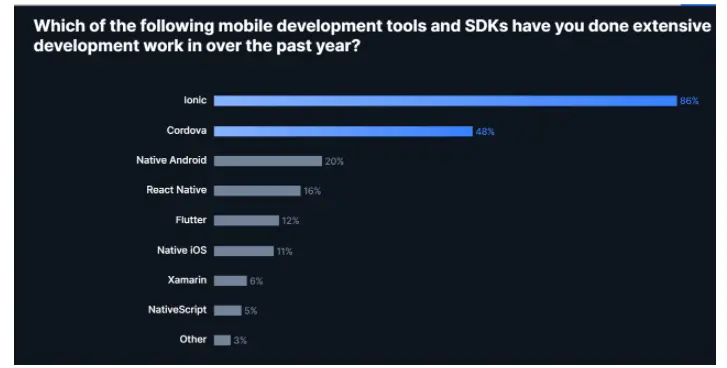
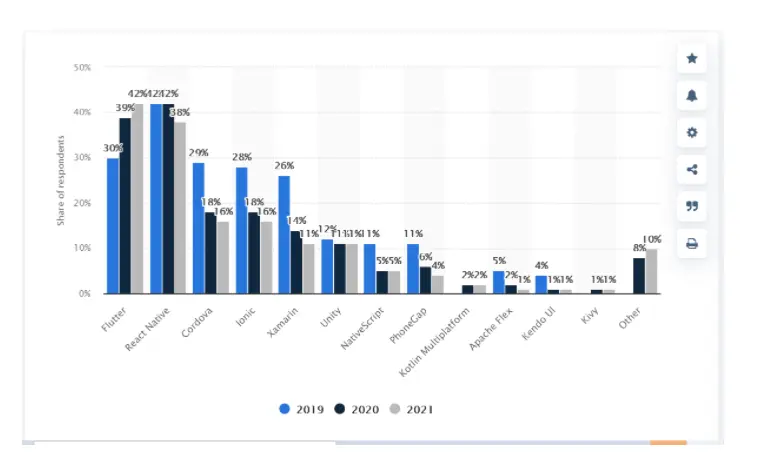
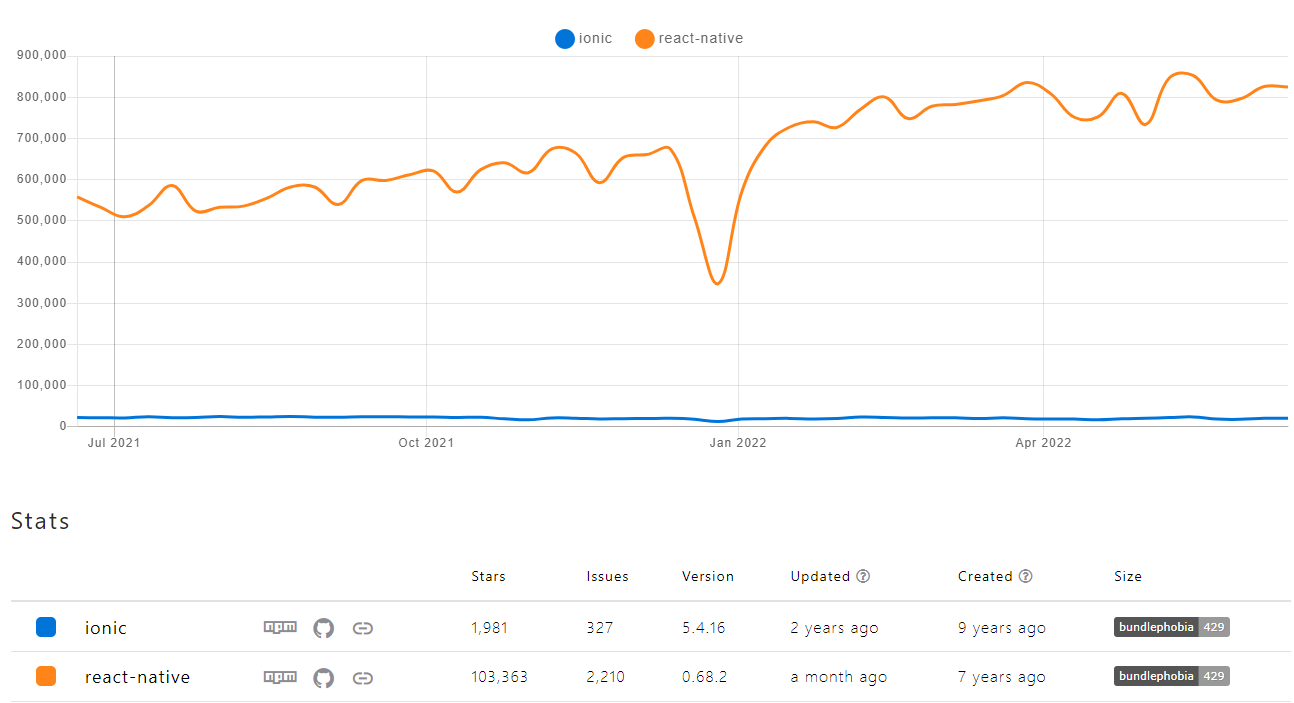
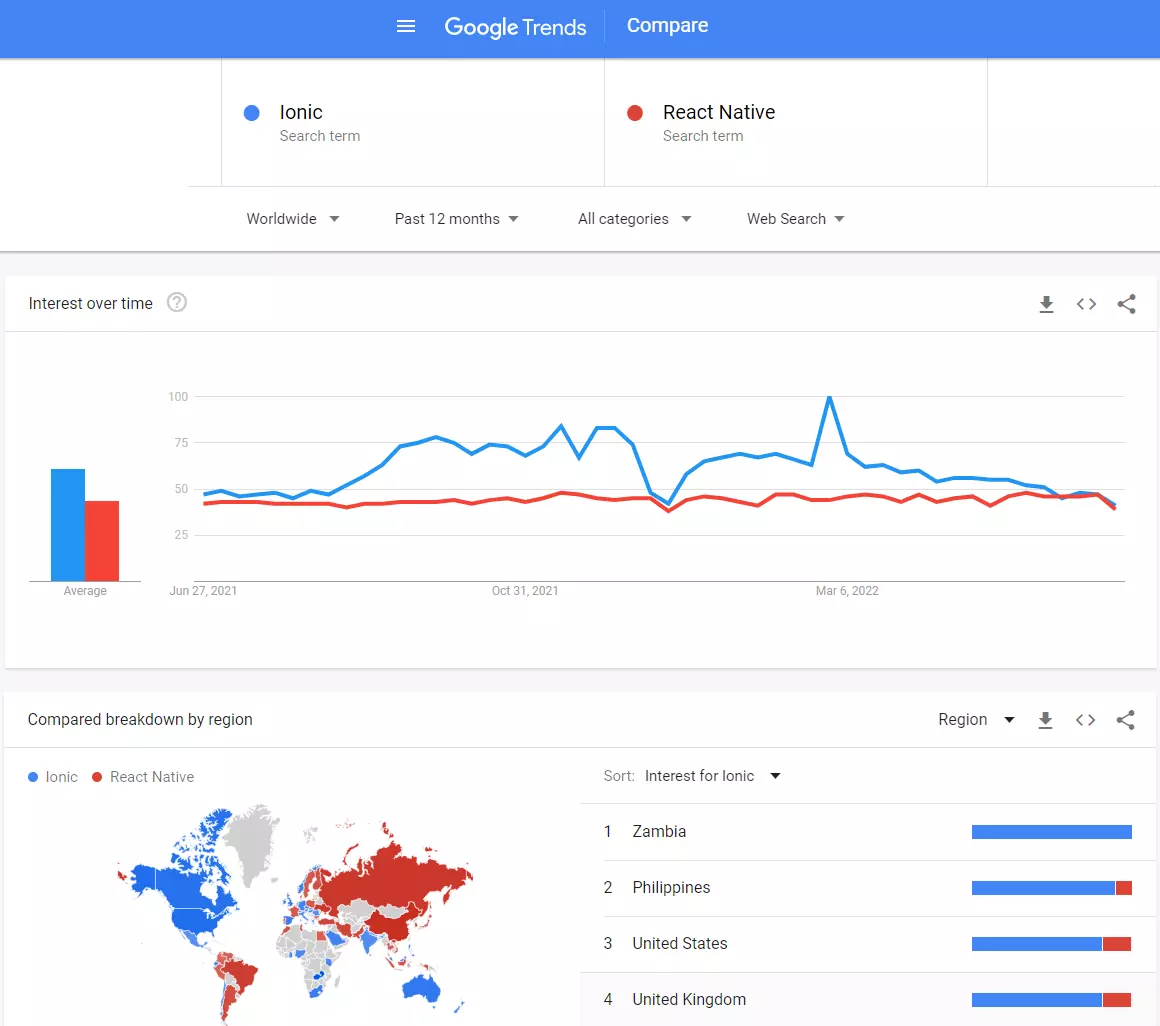
Most Likely you will want to know which framework is more popular between Ionic vs React Native, right? To get more insight into the popularity trends, look at the given below stats and facts.
(*colour intensity represents the percentage of searches)
Conclusion- It is clear from the above stats, that React Native is more popular than Ionic. The reason behind its popularity is its ability to create the look and feel of native apps using JavaScript and React. Ionic on the other hand is a hybrid so not able to create the look and feel of a native app.
2.Learning curve
However the core SDK of both frameworks comprise of JavaScript in common. But they are not similar. Let’s find out which one has an easy learning curve.
Ionic
Ionic tech-stack provides more flexibility. With Ionic, you basically build web apps that can become mobile apps. This hybrid approach is easier for developers to grasp in comparison to React Native’s native approach. Along with JavaScript, CSS, and HTML, in Ionic, you can use any framework of your choice like Angular, Vue, React, Knockout, etc. It means for a newbie it’s not difficult to learn Ionic as they can choose any framework with Ionic, in which they are experts. Hence its learning curve is quite less steep than Ionic.
React Native
If you have already worked with React or JavaScript then learning React Native is quite easy. The concept remains the same and you code in React. But the only difference is React uses web components like <p>,<div>. While React Native uses components that are wrappers around native iOS and Android components like <View>. If you are don’t know React then the learning curve is steep
Conclusion- Ionic is much easier and simple to learn.
3. Functionality
Ionic
Ionic is based on Cordova, which works on WebView Wrapper and Capacitor. It uses a WebView component or a Chrome window interface. The WebView component renders an HTML/ CSS user interface using a HTML layout engine (WebKit/ Blink). The capacitor interacts between the WebView framework and the Native platform. It uses a native JavaScript tunnel to do so. This approach enables the framework to enable the platform to gain access to Native APIs and application functionality. For example, a webcam is used by WebView.
React Native
In React Native applications are programmed in JavaScript. It is mainly based on a dynamic run time approach. With the help of a mobile JavaScript API, the JavaScript code is communicated with the platforms( Android iOS). Then the necessary data calls and functions to the native platform API are communicated. . Both APIs are linked via a bridge. This is why React Native mobile applications often function like they were developed natively.
Conclusion- Ionic is based on a run-time approach, while React Native-Based on WebView Wrapper. Both are highly functional.
4. Performance
The performance of an app is decided by various factors such as the efficiency of writing code in the particular framework. Let’s find out who (Ionic vs React Native) comes with better performance.
Ionic
It uses web technologies, like HTML, CSS, JavaScript, that help in creating high performing hybrid apps. But it requires third-party packages and plugins to give native look and feel to your application. The additional layer in Ionic, which involves Cordova plugins is the main reason for its slow performance. Because it is building a WebView and not a native app.
React Native
This framework uses native APIs and components. Hence the performance it provides is similar to the native applications. For complicated operations, React Native also enables developers to use native modules written in native languages to write code. In this way, it provides higher performance.
However React Native provides a truly native experience for your client, but it takes more development time as compared to Ionic. Because write-once-run-anywhere doesn’t work for React Native. Here you have to create a custom version of each screen for every platform.
Conclusion-Ionic provides the possibility for faster development time than React Native.
6. Encryption
Encryption is the process of scrambling plain text, like a text message or email into an unreadable format (cipher text) to protect the confidentiality of digital data. Now see out of these two frameworks which provide better security against applications.
Ionic
In Ionic while working with iOS developer’s ensures security with the help of secure storage Cordova plugin. While on Android the first condition for encryption is having a swipe or screen lock set on the device.
React Native
To achieve encryption developers can rely on various 3rd party libraries to store sensitive data locally. Some of them are:
Conclusion- Both React Native and Ionic provide better security, but if we are to compare then React Native provides slightly better securing possibilities.
7. Testing
Ionic
In Ionic the end-to-end testing set-up is just like Angular CLI. Hence it has the compatibility to use Protractor and Jasmine for unit testing and End-to-End testing. While Karma for component testing.
React Native
It uses some of the frameworks to do unit testing and automation testing. Those are:
Jasmine, Jest, ReactTestUtils for Unit Testing
Mocha for Integration Testing
iOS UI automation using EarlGrey
XC Test for test automating iOS mobile apps
Conclusion- Both Ionic and React Native are good in testing.
8. Debugging
Ionic
In Ionic debugging is simpler using tools such as Chrome dev tools at the developer’s disposal. But it is quite harder for the projects that use hardware features of ngCordova.
React Native
Here also code can be debugged by using Chrome developer tools. But if the native code is used in an app then debugging can be done using any editor like Visual Studio for Android and XCode for iOS.
Conclusion- Both React Native and Ionic can be debugged using Chrome developer tools.
9. Listview Scrolling
As discussed earlier Ionic applications render via a mobile wrapper(WebView), while React Native compiles natively( based on JavaScript). Hence the native rendering and performance of React Native are better than Ionic.
Conclusion- React Native has better listview scrolling due to high performance.
10. Third-party Libraries
Ionic
This framework comes with an extensive library. You can get any type of plugin from various libraries available in the marketplace, for example- Ionic plugins, Apache/Cordova/, etc. That’s why it is quite easier to build the personalized modules in Ionic.
React Native
However React Native also has an extensive set of libraries but it is difficult to integrate multiple third-party plugins
Conclusion– With Ionic building customized modules is easier as it is integrated easily with multiple 3rd party libraries.
11. Development cost
The cost is the biggest concern for both startups or established businesses before developing applications. However the cost of app development depends on various factors, but let’s see out of Ionic vs React Native who is the winner regarding development cost.
Ionic
However Ionic is a free, open-source cross-platform mobile app framework, but if you want professional-looking applications you need to go for the paid version. Ionic Pro can easily expedite the development process and allow developers to build an application in real-time.
React Native
React Native is also an open-source framework and provides developers with access to a wide range of libraries for free. Take the maximum benefits of this framework by hiring a professional React Native development company.
12. Maintainability
Ionic
Maintainability is better in Ionic as compared to React Native because you have to only maintain one single code (hybrid application). But the biggest challenge is the maintainability of continuous release cycles on Ionic and Cordova.
React Native
In React native maintainability is a big issue. Because any 3rd party that you might use anytime could become incompatible with your updated codebase.
Conclusion-Maintenance of libraries in both Ionic & React Native is quite inconvenient due to constant updates in these frameworks
13. User Interface
User interface is the very first factor on the basis of which user decides whether to go for this app or not. Move on to see the Ionic vs React Native user interface.
Ionic
However Ionic UI doesn’t utilize native elements at all, but to deliver a native-type app experience, it is totally dependent upon web technologies, like HTML and CSS, to deliver a native-type app experience. It also accesses Cordova to get the feel and look of native apps. Angular components that accompany the framework also provides a native look to Ionic applications
React Native
As React Native modules are connected with native UI controllers, hence it gives an amazing user experience that is very close to native apps.
Conclusion– React Native provides a better user interface as compared to Ionic.
14. Developers community
Ionic
Ionic has huge community support, as well as a great marketplace where you can find a lot of starters and templates to get an app like Uber. On GitHub, Ionic has about 46k stars with around 407 contributors to the framework.
React Native
React Native is the winner when it comes to market and community recognition. Its developer’s network is quickly growing due to its increasing demand. Hence it is easier to kick-start a project in React Native. The popularity of this framework further can be judged from the GitHub stats. It has 99k stars and 2257 contributors on GitHub.
Conclusion- React Native has a better developer community & support than Ionic.
15. Execution and reusability of code
Code reusability is the biggest concern when hiring a mobile app developer for a cross-platform application. Both Ionic and React Native follow different code execution strategies. Let’s find out what those are.
Ionic
Ionic works on “one code base, any platform”. Hence it provides the benefit of reusing the code base for various applications. Developers can build a highly interactive app in a quick time frame using the same code base.
React Native
React Native follows “learn once and write anywhere”. It means a single code base can be used to develop multiple apps for different platforms such as Android, iOS, and Windows. Because of this developers can create better apps in less time.
Conclusion-Both Ionic and React Native work well from the code reusability point of view.
Ionic Vs React Native: Pros & Cons
Ionic
Ionic Pros
Ionic is compatible with a number of prevailing frameworks such as React, Angular, and Vue.
It comes with good documentation. It is an organization that specializes in developing tools that assist businesses and engineers in building smartphone apps.
This framework is platform independent irrespective of the language used (HTML, CSS, Angular)
With the help of Ionic highly interactive and user-friendly mobile apps can be built.
The development cycle is shorter in Ionic, as you do not have to spend much time working with native languages or other platform-specific issues.
Ionic makes it easy to port the code into a Progressive Web App (PWA)
Ionic has maximum code reusability to develop apps for Android, iOS, and Windows platforms.
This framework is easy-to-learn, and a great number of developers are familiar with the technologies under the Ionic’s hood.
It is easy to learn as it is based on Angular and contains built-in components.
Ionic Cons
Ionic creates a WebView rather than a native app.
In Ionic you have to use Apache Cordova plugins to access device’s hardware functionality
These will be performance issues when there are too many call backs for the native code.
In Ionic the development of graphics transactions or advanced interactive is not secure.
Developers must have the knowledge of AngularJS.
React Native
React Native Pros
It has a huge community. Hence developers can easily resolve their issues.
It allows code reusability to create Android,iOS, Windows applications.
It makes the user feel like they are using a native app as it is transformed to native JavaScript and with the advantage that 60 frames per second are achieved.
The performance of applications created in React Native is excellent and much better than Ionic.
It provides rapid development with an efficient code structure.
It is a reliable and stable framework for large-scale projects
In React Native the code is independent of the platform and hence can be used on different operating systems.
React Native Cons
It creates placement issues by automatically transforming the graphical elements for each platform.
It does not support custom modules and requires native programming skills.
It is not appropriate if you choose to build an interface with a lot of transitions and graphics, for example simulation apps.
You have to follow the licensing rule as it is backed by Facebook.
Ionic vs React Native: What do APPWRK developers think?
Our developers have worked on both these frameworks and successfully delivered customized applications based on client requirements. Based on their over 10 years experience in developing web and mobile app solutions they concluded given below points about these two popular frameworks.
Ionic is best for
those who have no background in the native world.
developing mobile applications, accessing native features like GPS, maps, or audio
building applications across various platforms in less time.
startup and have ideas validated based on your priority.
So who is the winner of the Ionic vs React Native battle?We believe no one; as only the success of your project matters at the end. The success of an application depends on how far it is able to satisfy all your business needs. Hence depending on your business requirement choose the right framework. As we all know not all shoes fit everyone! Similarly, the requirement for techstack differs with the project. Carefully evaluate your project needs and select the one that goes best with your development. We hope this article will help you to make the right decision! If any doubts or confusion still persists in your mind, feel free to contact us. We are always here to help you!
Gourav Khanna is the Co-founder and CEO of APPWRK, leading the company’s vision to deliver AI-first, scalable digital solutions for enterprises and high-growth startups. With over 16 years of leadership in technology, he is known for driving digital transformation strategies that connect business ambition with outcome-focused execution across healthcare, retail, logistics, and enterprise operations.
Recognized as a strategic industry voice, Gourav brings deep expertise in product strategy, AI adoption, and platform engineering. Through his insights, he helps decision-makers prioritize market traction, operational efficiency, and long-term ROI while building resilient, user-centric digital systems.