150+ minds across 4 countries. Join a culture of innovation, ownership & growth.
Rewire for AI
From machine learning to deep learning, from classification tools to overall process automation – our AI engineers will help you retool your existing system or enhance your company results.
Ship faster, scale smarter, built for product companies and SaaS teams
Our Latest Work
We strive hard to deliver result-driven digital solutions across the globe. Check out our case studies to get a glimpse of how we ideate, innovate, and create unconventional digital solutions according to the requirements of our clients.
Discover diverse and passionate insights from our tech enthusiasts. We collaborate across various sectors to streamline operations and drive innovation. Explore our rapidly growing collection of articles to see why we’re at the forefront of IT solutions.
The decision to move from Magento to Shopify is one of the most significant replatforming choices an ecommerce business can make. Magento is powerful, but its power comes with...
Accuracy gap is real: Traditional CPG forecasting carries a 25-40% MAPE error rate. AI-powered models bring that down to 8-15%, according to McKinsey research....
Real stories from global leaders who trusted us with their ideas.
Partnering with APPWRK helped us build a compliant and scalable healthcare platform, accelerating our time-to-market by 35%. Their team consistently delivered outstanding work.
Beesers
Digital Healthcare Client
Collaborating with APPWRK, Sportskeeda modernized its platform into a real-time sports engagement ecosystem, enabling seamless content delivery, scalable fan interactions, and high-velocity performance.
Sportskeeda
Sports & Entertainment Partner
Working with APPWRK was effortless. They captured our vision, maintained full compliance, and delivered a digital experience that built trust and elevated how customers interact with our fintech brand.
PayPenny
Fintech Partner
Working with APPWRK gave us confidence in adopting AI responsibly. Their team built a safe, intelligent bot that transformed how we engage with leads and helped us achieve measurable revenue growth.
IFB
AI Transformation Partner
Leveraging APPWRK’s digital expertise, Nemesis launched a scalable, compliant, and safe super app that connects content delivery, real-time communication, and logistics management within a single platform.
The cost to build a laundry app usually starts at $5,000 for a basic MVP and can exceed $50,000 for a fully customized, AI-powered solution. The final price depends on feature complexity, tech stack, and the geographic location of your development team.
On-demand laundry apps are reshaping how urban consumers manage household chores, with rapid adoption driven by convenience, speed, and digital-first behavior.
Companies are leveraging modular development, prebuilt feature packs, and cloud-based infrastructure to accelerate time to market and streamline scalability.
Businesses are using data-driven insights, AI personalization, and loyalty automation to boost user retention and lifetime value in competitive metro markets.
From marketplace aggregation to franchise and hybrid models, laundry startups are choosing scalable structures that balance control, reach, and revenue diversity.
APPWRK’s clients report 45-60% faster time to market using prebuilt feature modules, all while customizing design and logic to fit local market needs.
This blog explores the real-world costs, feature decisions, market trends, and success models shaping laundry app development in 2025. It’s a must-read for founders, product leads, and CXOs focused on on-demand service innovation.
Global On-Demand Laundry App Market Trends and Expansion
The global on-demand laundry market is undergoing a major transformation, fueled by rapid urbanization, the rise of dual-income households, and a growing preference for app-driven convenience. Between 2025 and 2035, the industry is expected to double in size, signaling a pivotal decade for innovation and market expansion.
Why On-Demand Laundry Services Are Booming Globally
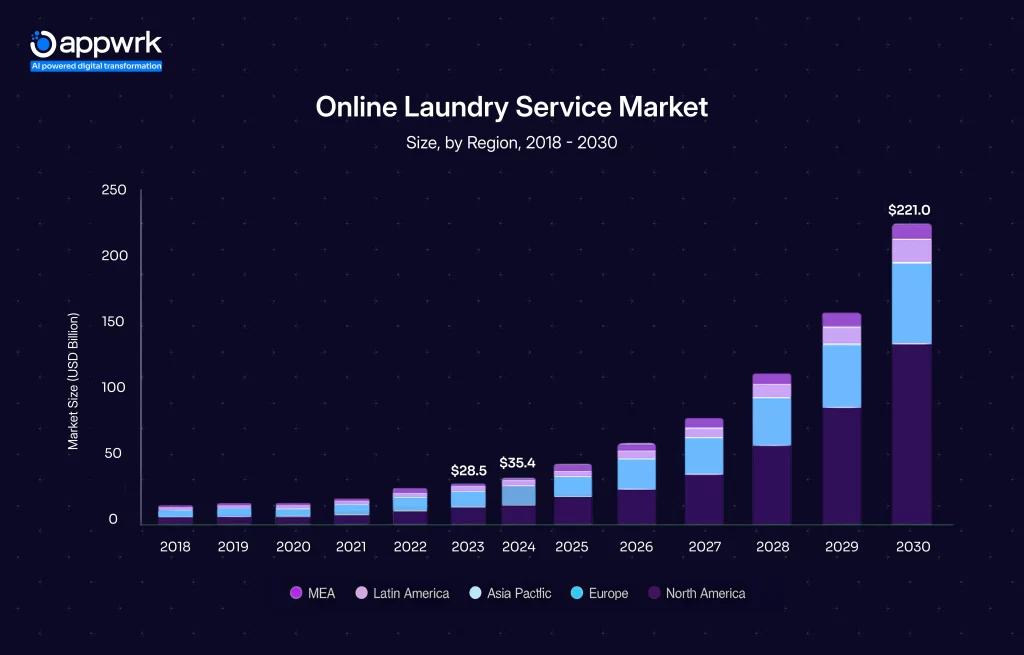
On-demand laundry apps have gained traction globally due to their hyper-convenience model, mirroring the rise of food delivery and ride-hailing. According to Grand View Research, the online global laundry service market is projected to reach USD 221 billion by 2030, growing at a CAGR of 35.7% from 2024 to 2030.
Startups in India, Southeast Asia, and the Middle East are replicating the Uber for laundry app model, offering flexible pricing, eco-friendly packaging, and doorstep pickup, unlocking new customer segments.
Shifting Consumer Preferences in Urban Areas
Shifting consumer behavior in urban areas is redefining the laundry service landscape. Today’s users prioritize speed, reliability, and flexible subscription models. According to Statista, 62% of millennials in metro regions use digital-first home services weekly, with laundry ranking among the top five since the post-COVID era.
The combination of widespread smartphone adoption, fast-paced lifestyles, and growing sustainability awareness is accelerating the move away from traditional laundromats toward app-based convenience.
2025-2035 Outlook: Laundry App Growth by Region and User Behavior
North America and Western Europe currently dominate revenue share, but APAC and MENA are witnessing the fastest growth. McKinsey notes that Tier-2 cities in India and Indonesia are fueling app-based laundry startups with localized logistics.
Regional trends in laundry tech reveal distinct patterns shaped by infrastructure, consumer expectations, and regulatory environments. From mature urban markets to emerging digital economies, adoption varies widely, influencing how apps are built, scaled, and monetized.
This section explores how localized dynamics will drive development priorities and innovation strategies in 2025 and beyond.
Why US Cities are Leading the Laundry App Adoption Curve
In the US, laundry apps such as Rinse, SudShare, and Hamperapp are rapidly scaling across urban hubs with dense populations of young professionals. IBISWorld reports that the US laundry services market reached $14.4 billion in 2024, with app-first platforms growing at an impressive 12.8% year over year, a clear indicator of shifting consumer preferences and digital adoption.
What’s driving demand? Seamless subscription models, 24-hour delivery promises, and integrated tipping. NYC, San Francisco, and Austin remain leading metros for app penetration.
European Laundry Apps: Sustainability, UX, and Growth Metrics
UK startups like Laundryheap and Oxwash are pushing sustainable laundry with carbon-neutral delivery fleets and biodegradable detergents. Europe’s regulations around emissions and E-commerce are influencing app feature sets, from digital receipts to GDPR-first login flows.
By 2026, Western Europe is expected to capture 21% of the global laundry app transaction volume, led by Gen Z usage in urban corridors like Berlin, Paris, and Manchester.
Laundry Apps in Australia: Growth, Costs, and Operational Challenges
Australia is seeing rising interest in niche laundry solutions, such as pet linen services, school uniform bundles, and eco-folding. However, high labor costs and fragmented suburbs slow scalability.
Sydney and Melbourne have shown promise, but apps must build route optimization, multi-drop support, and variable shift scheduling early on to remain viable.
What Features Do Laundry App Users Actually Use?
Modern laundry app users expect more than basic pickup and delivery tracking. They want seamless experiences, real-time updates, and personalized support. To stay competitive, platforms must deliver features that increase retention, reduce churn, and set the brand apart in a crowded market.
3 Must-Have Panels in a Laundry App: Roles, Functions & UX
A laundry app typically involves three operational layers:
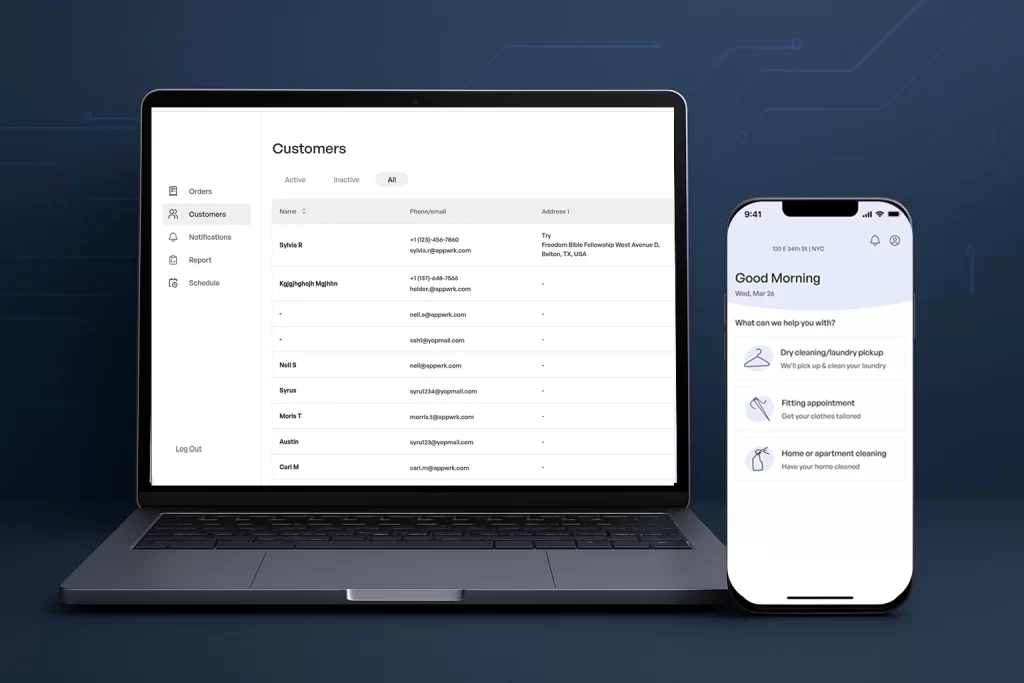
Customer Panel: Enables users to schedule orders, make secure payments, track real-time status, and access in-app support, delivering a seamless end-to-end experience.
Delivery Panel: This panel supports the key functions of pickup and delivery app development by providing drivers with tools like pickup and drop-off instructions, GPS tracking, shift scheduling, and earnings management to ensure smooth and reliable service.
Admin Panel: Acts as the control center for managing orders, dynamic pricing, staff performance, and analytics, with built-in POS integration for laundry business operations and multi-location oversight.
Apps like this rely heavily on a centralized admin console for dynamic pricing, route control, and real-time reporting.
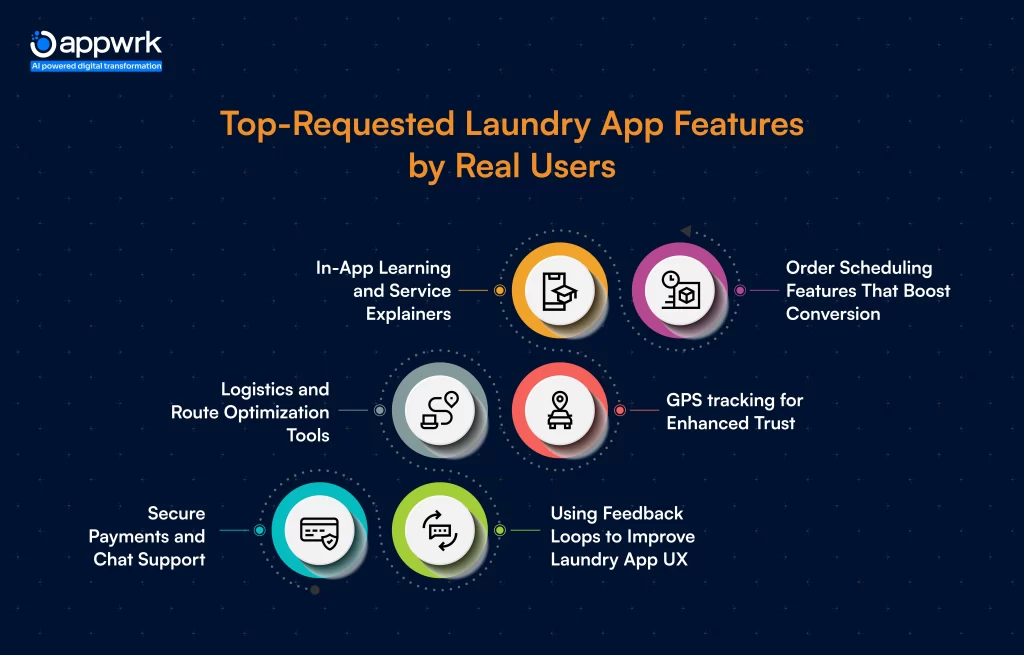
Today’s users expect laundry apps to be fast, intuitive, and reliable. The most successful platforms go beyond basic delivery tracking by offering smart scheduling, real-time updates, seamless payments, and responsive support. This section highlights the features most requested by real users that directly influence satisfaction, conversion, and long-term retention.
Order Scheduling Features That Boost Conversion
In laundry service booking app development, order flow clarity is essential. Users expect smart calendars, time-slot selection, and real-time status.
GPS Tracking for Enhanced Trust
A real-time laundry tracking system with an estimated delivery time is a baseline now. Push notifications, SMS fallback, and in-app banners boost engagement and reduce support tickets.
Using Feedback Loops to Improve Laundry App UX
Post-delivery rating flows, optional tip suggestions, and issue flagging (e.g., “Stain not removed”) help improve service and route learning algorithms.
Secure Payments and Chat Support
Payment gateway integration with Stripe, Razorpay, or Braintree must include one-click repeat payments, saved cards, and chat-based invoice access. WhatsApp or Zendesk chat support integration is increasingly expected.
Logistics and Route Optimization Tools
For driver apps: Features like route optimization for delivery apps, multi-drop routing, area clustering, and real-time updates based on traffic and volume increase fleet efficiency by 25-40%.
In-App Learning and Service Explainers
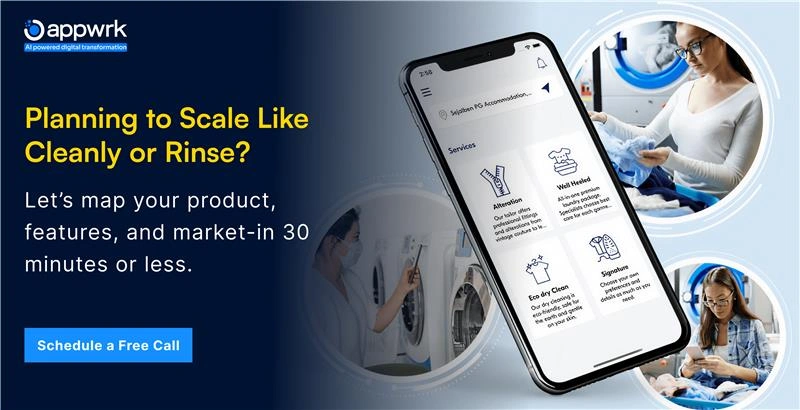
Users value clarity when choosing services. In-app guides and brief explanations of service types help reduce confusion, improve decision-making, and increase conversion, especially important in dry cleaning app development.
Laundry App Case Study: From MVP to 5-City Scale with APPWRK
When a UAE-based laundry marketplace startup approached APPWRK, the goal was clear: build a scalable, cost-efficient, multi-vendor platform that could expand rapidly across major cities like Dubai, Sharjah, and Abu Dhabi. APPWRK’s modular approach to laundry app development played a pivotal role in achieving this scale, without inflating the budget.
How APPWRK Helped a Marketplace-Model Client Scale to 5 Cities
Custom laundry app developers like APPWRK offer a mobile laundry software solution with modular pricing frameworks that reduce development hours and accelerate deployment. In the UAE project, APPWRK reused and adapted existing modules, including payment gateways, GPS-based pickup scheduling, vendor dashboards, and chatbot-powered support systems, tailoring each to the marketplace model.
By leveraging versioned feature packs customized for verticals like laundry, logistics, and delivery, the client avoided redundant code and cut development costs by 35%, without compromising on performance or personalization.
Custom Features That Drove Market Expansion
Beyond core modules, the client requested several impactful customizations:
Vendor Onboarding with SLA and Rating Logic – Enabled faster partner acquisition and improved service quality, leading to a 27% increase in customer satisfaction scores within the first quarter of deployment.
Real-Time Vendor Analytics and Payout Tracking – Streamlined operations and eliminated manual reconciliations, resulting in a 35% reduction in payout processing time and improved vendor retention.
Dynamic Pickup Assignment Based on GPS Clusters – Optimized logistics in high-density zones, reducing pickup delays by 41% and increasing average order fulfillment efficiency by 24%.
Local Tax Handling for Multi-Emirate Compliance – Simplified regulatory adherence across Dubai, Sharjah, and Abu Dhabi, helping avoid compliance penalties and reducing accounting overhead by 18%.
Route Batching Algorithms for Urban Density Optimization – Consolidated deliveries in clustered regions, lowering fuel costs and enabling a 22% improvement in operational margins per delivery cycle.
These features not only enriched the user experience but also directly contributed to operational scalability, helping the startup grow from a single metro to five cities within 6 months.Tech Stack Used: Flutter (Cross-Platform App), Node.js (Backend), Firebase (Push Notifications & Real-time DB), and MongoDB (Data Layer), with AWS hosting and integrated Stripe for payments.
Laundry App Development Costs: From MVP Launch to Enterprise-Grade Solutions
The cost to build a laundry app ranges from $5,000 to over $50,000, making it feasible to launch a low-cost laundry app MVP. This section breaks down real benchmarks, platform-level pricing, and hidden costs founders must plan for.
Laundry App Development Cost by Region (US, Asia, EU, MENA)
The regional cost to develop a laundry app can vary dramatically:
Region
MVP (2 Panels)
Mid-Tier (3 Panels)
Enterprise (AI + Multi-City)
USA
$5,000-$20,000
$20,000-$35,000
$35,000-$50,000+
Europe (UK, Germany, France)
$10,000-$25,000
$25,000-$40,000
$40,000-$50,000+
India & South Asia
$5,000-$15,000
$15,000-$30,000
$30,000-$45,000+
Middle East (UAE, KSA)
$5,000-$20,000
$20,000-$40,000
$40,000-$50,000+
Southeast Asia (Indonesia, Vietnam, Philippines)
$5,000-$12,000
$12,000-$25,000
$25,000-$45,000+
Eastern Europe (Poland, Ukraine, Romania)
$6,000-$18,000
$18,000-$30,000
$30,000-$50,000+
Apps targeting North American or EU markets should expect higher QA and compliance costs, especially with data encryption and GDPR mandates.
APPWRK’s Modular Cost Model for Laundry App Development
Custom laundry app developers like APPWRK offer a mobile laundry software solution with modular pricing frameworks that cut redundancy and speed up launch. By leveraging reusable components, like payment modules, route engines, and feedback systems, costs drop 30-40% for most clients.
Instead of rebuilding logic from scratch, APPWRK deploys versioned feature packs tailored by vertical (laundry, food delivery, logistics).
Top Cost Factors Behind Laundry App Development
Understanding the factors that influence laundry app pricing is essential for founders and CTOs. APPWRK’s modular cost model isolates major cost buckets and provides the flexibility needed for startups scaling in phases.
Custom UI Enhancements Can Increase Development Costs
Highly interactive user interfaces, such as dynamic state cards or animated progress flows, require more frontend development time. In the case of the UAE startup, the MVP phase utilized standard UI templates to reduce time-to-market, but later iterations integrated a UX-optimized interface to enhance retention and engagement across cities.
Cross-Platform Development Offers Higher Cost Efficiency for Most Use Cases
For budget-conscious startups, cross-platform frameworks like Flutter provide up to 35% in cost savings and accelerate time-to-market. However, performance-driven businesses or those planning multi-region expansion may still choose native iOS and Android stacks for smoother integration and performance optimization.
MVP Development Should Focus on Essential Features
A successful MVP should include only the most critical modules, such as pickup scheduling, order tracking, payment integration, and push notifications. More advanced features, like AI-powered route optimization or gamified loyalty systems, can be introduced in later phases, as demonstrated by APPWRK’s UAE client.
Development Region Plays a Significant Role in Cost and Speed
The choice of development region has a direct impact on hourly rates and delivery speed. For instance, hiring a US-based team may significantly increase development expenses. APPWRK mitigated this by implementing a hybrid delivery model, placing PMs in the UAE and developers in Noida, which helped reduce project costs by nearly 50% while ensuring delivery of a robust MVP in 90 days and a fully scaled solution in 210 days.
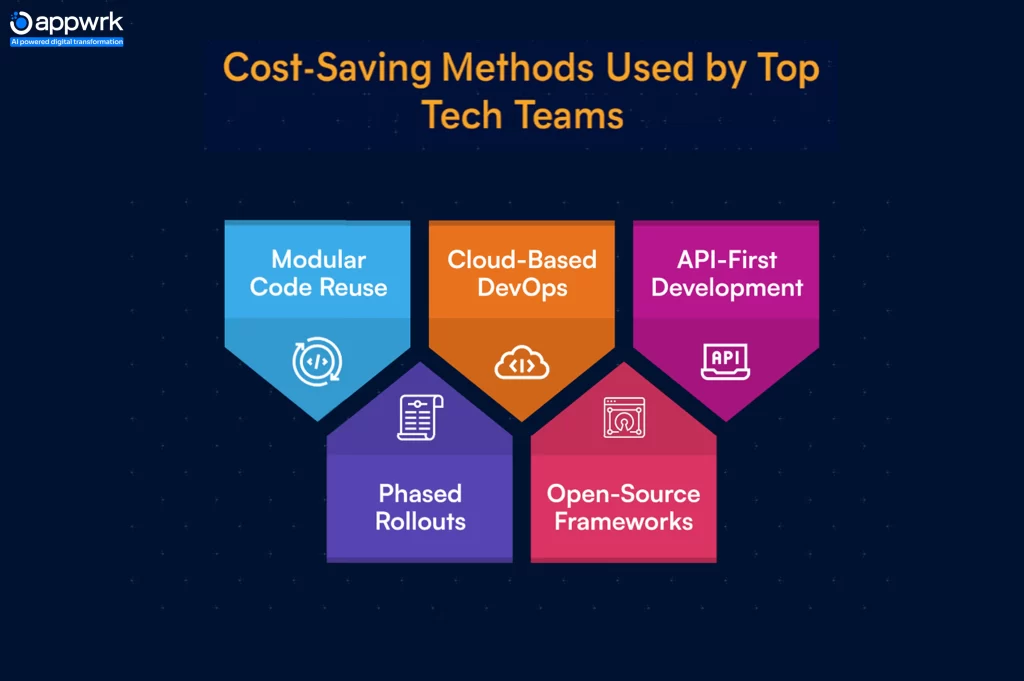
Cost-Saving Methods Used by Top Tech Teams
Modular Code Reuse: Cuts initial dev time by 30-40%.
Cloud-Based DevOps: AWS/GCP-native builds reduce infra costs.
API-First Development: Enables faster feature rollouts and easier third-party integrations without requiring major redesigns.
Open-Source Frameworks: Leverages libraries like Firebase, Mapbox, and RevenueCat.
Phased Rollouts: Launch an MVP in a single metro area and iterate quickly based on user traction and feedback.
Which Laundry App Business Models Make the Most Money?
The on-demand laundry space supports a range of viable business models. Choosing the right one impacts platform structure, pricing logic, and long-term scalability. This section explores models that are working across different geographies.
Uber-Model vs. Marketplace: Which Laundry App Model Wins?
Businesses often start with either the Uber-style managed model or the marketplace aggregator model.
Uber-style: The platform directly manages logistics and workforce operations, offering greater control over quality and service delivery. While overhead is higher, this model enables stronger brand consistency, as seen with apps like Cleanly and Rinse.
Aggregator: The app serves as a marketplace connecting users with independent laundromats, allowing for lower capital expenditure and faster scalability. This model, popularized by Washio’s early approach, is ideal for rapid market entry with minimal operational load.
Each approach affects backend logic, payment routing, and liability. Aggregators are faster to launch, but managed models offer more brand control.
How Subscriptions & Rewards Drive Laundry App Retention
In London, Laundryheap drives 40% of repeat revenue via tiered subscriptions. US-based Hampr grew 3X in retention after launching “Hampr Unlimited” at $39/month.
Loyalty is no longer punch-card logic; it’s automated points tracking, free add-ons, referral credits, and AI-led nudges that incentivize return orders.
Apps that introduce rewards and referrals by the third month tend to see 35-50% higher retention.
Franchise or Standalone: Which Scales Better for Laundry Startups?
Many app-based laundry startups are turning to franchise licensing to accelerate city-by-city expansion. A prime example is Tumbledry in India, which scaled to over 500 locations using tech-enabled franchise kits.
While standalone models offer complete operational control, franchise models can scale nearly twice as fast by leveraging shared branding, standardized SOPs, and app extensions, provided the platform supports multi-tenant management and robust revenue tracking.
Hybrid Laundry App Models for Scalable Multi-City Expansion
Hybrid models, which combine marketplace aggregation with internal logistics, are now popular in metro expansions. For instance, startups in the UAE offer managed pickup but outsource washing to certified local partners.
Such models require apps with:
Role-specific dashboards
Geo-fencing
Dynamic pricing based on region + service
It’s complex to build, but it supports faster growth with minimal infrastructure.
How Do Laundry Apps Make Money? Revenue Models Explained
Monetization isn’t just about per-order profits. High-performing laundry apps generate recurring revenue, upsell across categories, and diversify income streams using tech-driven logic. This section unpacks how money flows in leading platforms.
How Do Laundry Apps Make Money?
Most laundry apps monetize through a combination of:
Per-order fees: Core margin from service (usually 20–40% markup).
Surge pricing: Premium for urgent pickups or high-demand windows.
Partner commissions: In aggregator models, apps earn a cut (10–20%) from vendors per transaction.
Ad placement: Local laundries or eco-product brands buying exposure.
Real Examples from the Top 3 Laundry Platforms
Rinse (US): Primarily uses a managed service model. Monetization includes per-pound pricing, surge delivery fees, and “Rinse Repeat” subscriptions. According to Crunchbase, they surpassed $20M in annual revenue by 2024.
Laundryheap (UK): Mixes per-order pricing with monthly plans for frequent users. Also monetizes partner visibility within the app and offers eco-upgrades (e.g., detergent selection) at a premium.
Hampr (US): Hampr operates on a pure subscription model, offering a flat monthly fee for bag-based laundry pickups. Its growth was driven by targeting small towns underserved by larger competitors and eliminating the friction of per-order pricing.
Each app’s success correlates with platform versatility, enabling promo codes, flexible billing, and localized price logic.
Laundry App UX Best Practices That Drive Conversion
Design can make or break retention in laundry apps. A frictionless first experience, persona-based flows, and inclusive design choices directly impact repeat use. This section explores what top-performing apps are doing right in UX and UI.
How to Design Fast Signup & Scheduling in Laundry Apps
Users expect to get from signup to order placement in under 90 seconds. Best-in-class flows use:
Social logins or OTP-based access.
Pre-selected time slots based on ZIP code.
Quick address detection via GPS.
A well-designed mobile app for laundry service that reduces decision fatigue, through one-tap repeat orders or “usual slot” suggestions, can boost order completion rates by 28%.
Designing for Customers, Drivers, and Admins in a Single App
Laundry apps serve customers, drivers, admins, and vendors. Each panel needs its own UI logic:
Customers: Minimalist, visual flow (calendar, status card, payment CTA)
Admins: Control center (order funnel, route logs, performance stats)
Apps like Laundryheap use context-aware UI, showing only relevant options based on user role, saving dev time and improving app clarity.
Making the Laundry App Accessible, Multilingual & Inclusive
Apps entering multilingual markets must support:
RTL languages (Arabic, Hebrew)
Scalable fonts and dark mode
Region-specific iconography (e.g., rupee vs. dollar)
Accessibility is more than just meeting WCAG guidelines. Features like voice-read labels, adjustable contrast, and haptic feedback make the app easier to use for older adults and people with disabilities, a growing user base in service apps.
How to Launch a Mobile Laundry Business
Launching a mobile laundry business in 2025 is more capital-efficient than ever, but only with the right rollout plan. This section outlines lean startup principles, budget modeling, and how to forecast break-even with clarity.
Lean Startup Plan for Entrepreneurs
Businesses can now launch with just two core panels (Customer + Admin), targeting a single ZIP code or campus to validate demand. Using white-label laundry app solutions or modular codebases reduces time-to-market to under 90 days.
Success at this stage hinges on:
Hyper-local marketing
Manual ops support (before automation)
Feedback loops built into the app (reviews, support chat)
Once you validate order volume and retention, expand to full logistics and multi-city support.
Budgeting & Forecasting Tools
Cost Components Estimation
Breakdown of What It Costs to Build and Launch a Laundry App
Cost Element
Approximate Range
App Development
$5,000-$50,000
Hosting & Infrastructure
$1,200-$3,000/year
Initial Ops & Fleet Setup
$5,000-$10,000
Marketing & Launch Campaign
$3,000-$7,000
Contingency (10-15%)
Varies
Timeline to Break-Even
On average:
MVP laundry apps reach break-even in 10-14 months, depending on CAC and churn.
Apps with subscriptions and loyalty features onboarded in Phase 1 break even 3-5 months earlier.
Using forecasting tools like LivePlan, Brixx, or Appwrk’s in-house financial planner, founders can project break-even based on city, order frequency, and fleet size.
How to Choose the Right Laundry App Development Company
In today’s competitive on-demand economy, choosing the right laundry app development company is essential for launching fast, scaling confidently, and standing out in the market. A partner with deep domain knowledge, modular architecture, and a proven track record in laundry tech can accelerate your time to market and reduce long-term costs.
Checklist for Choosing a Laundry Tech Development Partner
Business owners should prioritize agencies that:
Specialize in on-demand or service logistics apps.
Offer modular builds with reusable features (e.g., route engines, chat, subscriptions).
Provide full-stack teams (PM, UI/UX, front-end, backend, QA, DevOps).
Demonstrate launch metrics (e.g., apps scaled to 3+ cities).
An ideal partner will have case studies, feature libraries, and launch timelines under 90 days for MVPs.
What to Ask Before Hiring a Laundry App Agency
Choosing the right development agency goes beyond looking at portfolios. The right questions can help you assess their real-world experience, technical flexibility, and long-term support capabilities. Before signing an NDA or committing to a contract, ask:
How many on-demand service apps have you launched in the past 12 months?
Do you build from scratch or use prebuilt components to save time and cost?
What is your SLA for post-launch support and maintenance?
Can your tech stack scale from MVP to multi-region deployment?
What analytics and retention tools do you integrate by default?
These questions help identify whether the partner is solution-ready or starting from zero. Teams like Appwrk offer transparent timelines, sandbox access, and cost breakdowns from day one.
How to Grow and Optimize Your Laundry App After Launch
In today’s fast-moving service economy, launching your app is only step one. Real growth comes from how well you listen, adapt, and scale. The top-performing laundry apps double down on post-launch optimization, using data to fine-tune features, feedback to improve UX, and infrastructure upgrades to handle increasing demand.
This section breaks down the proven strategies that turn early traction into long-term success.
Using Data to Retain and Retarget Laundry App Users
Smart apps don’t wait for churn. They use behavioral data (missed orders, delayed pickups, basket size drops) to trigger:
Personalized nudges (“Order before 8 PM and get 10% off”).
Win-back offers for dormant users.
Segment-based retargeting via email or in-app cards.
Tools like Firebase, Mixpanel, and MoEngage are often used in third-party API integration to enable analytics, messaging, and notifications. Apps that implement retargeting by Month 2 see 20-35% improvements in retention and LTV.
How to Build a Multi-Region Laundry App That Scales
When expanding across cities or countries, your stack must support:
Dynamic pricing rules (e.g., by ZIP or currency).
Geo-fencing logic (to show relevant vendors/delivery staff).
Multi-tenant admin dashboards (franchise vs owned ops).
Apps built with microservices on AWS/GCP scale faster than monoliths, supporting load balancing, real-time logs, and A/B testing environments by region.
Why APPWRK Is the Best Laundry App Development Partner
APPWRK has built, scaled, and optimized laundry apps across North America, the Middle East, and Europe. Our approach combines prebuilt architecture, vertical-specific logic, and flexible team pods to accelerate time to market and ROI.
How APPWRK Helps You Launch and Scale Laundry Apps Faster
We start with a 3-week Discovery Sprint to align features, user flows, and monetization goals. From there, we build in sprints using reusable logic (e.g., scheduling, route clustering, loyalty engines) tailored for laundry startups.
This method cuts development time by 40% and helps clients go live faster, without compromising scalability or design.
Security and compliance are not add-ons; they’re built into the foundation of the app from day one.
FAQs
How much does it cost to build a laundry app in 2025?
The cost to build a laundry app in 2025 typically ranges from $5,000 to $50,000, depending on platform type, feature set, and region. Modular builds and offshore teams can help lower total investment.
Which features are essential for a laundry delivery app?
At a minimum, your laundry delivery app should include order scheduling, real-time tracking, secure payments, chat support, an admin dashboard, and a delivery panel. These core features form the MVP, while advanced apps may add AI, loyalty programs, and route optimization.
How long does it take to develop a laundry app?
An MVP laundry app takes 8-12 weeks, while a mid-tier app with multiple panels can take 16-20 weeks. The cost to develop an Android/iOS laundry app varies based on whether you’re using cross-platform or native stacks, typically ranging from $20,000 to $50,000+.
Can I use an app to manage my laundry business?
Yes. With modern platforms offering admin dashboards, route tracking, and payment tools, managing your laundry business through an app is entirely feasible.
What business models are most profitable for laundry apps?
Subscription + managed service hybrids have the highest retention and margins. Aggregator models scale faster, but managed logistics offer better user experience and pricing control long term.
Can I build one app for customers, drivers, and admins?
Technically, yes, but it’s not ideal. Role-specific panels improve UX, security, and performance. We recommend modular multi-panel architecture with shared backend logic.
What makes APPWRK different from other app development agencies?
APPWRK offers vertical-specific feature packs, a proven launch process under 90 days, real-time analytics, and GDPR-compliant design, all backed by a team that has scaled laundry apps across five regions.
Gourav Khanna is the Co-founder and CEO of APPWRK, leading the company’s vision to deliver AI-first, scalable digital solutions for enterprises and high-growth startups. With over 16 years of leadership in technology, he is known for driving digital transformation strategies that connect business ambition with outcome-focused execution across healthcare, retail, logistics, and enterprise operations.
Recognized as a strategic industry voice, Gourav brings deep expertise in product strategy, AI adoption, and platform engineering. Through his insights, he helps decision-makers prioritize market traction, operational efficiency, and long-term ROI while building resilient, user-centric digital systems.
Subscribe to APPWRK Blogs, We'll Do the Rest!
Get Blogs on UI/UX, Mobile Apps, Online Marketing, and Web development technology.
Unlock worthy and priceless suggestions from the masters of mobile and web app development